







Abstract
This article explores my teaching experiences that informed my distinction between religious literacy and critical religious literacy, ultimately leading to the creation of the Challenge Islamophobia Project. I highlight the impacts of post-9/11 criminalization and dehumanization of Muslims, which have significantly shaped public perceptions of Islam and its followers. Central to the discussion are specific activities from the lesson plan titled “What is Islamophobia,” where students engage with various evidence, data, and artifacts to formulate their own definitions of Islamophobia. These lesson plans are tailored for secondary and college students, although adaptations for elementary education remain unaddressed at this time. Through this exploration, I aim to provide insights into fostering a deeper understanding of Islamophobia in educational settings.
From 2017 to 2019, I wrote a series of lesson plans called the Challenge Islamophobia Project at Teaching for Change, a Washington DC–based social justice education nonprofit that collaborates with the Zinn Education Project and Rethinking Schools. The shared mission of these three organizations is to promote social justice pedagogies that build critical literacy vocabularies and analytical skills to inspire active participation in the reduction and elimination of injustice and inequality. Informed by the work of Howard Zinn, Paulo Freire, bell hooks, Karl Marx, Michel Foucault, and others, the learning resources developed by these three organizations center people's history, or the perspectives of ordinary people, prioritizing a “bottom up” approach to understanding history, politics, and society. This approach illuminates power dynamics from diverse perspectives shaped by race, class, and gender. As noted on the Zinn Education Project (n.d.) website: A people's history flips the script. When we look at history from the standpoint of the workers and not just the owners, the soldiers and not just the generals, the invaded and not just the invaders, we can begin to see society more fully, more accurately. The more clearly we see the past, the more clearly we’ll see the present—and be equipped to improve it.
I was inspired to write the Challenge Islamophobia Project after teaching in an academic Abrahamic interfaith organization, where I taught about Islamic histories, rituals, and beliefs. I was motivated to teach these topics because I wanted to share my experiences as a Muslim and I wanted to challenge the discrimination I have faced for being Muslim, within the context of globalized Islamophobia. I, like many well-intentioned educators, believed that to challenge Islamophobia, we needed to increase literacy about religion. I taught from a place of great respect for and love of my religious traditions, supplemented by my academic study of Islamic history and the diverse cultural traditions spanning global Muslim communities over 1,500 years. However, after teaching about Islam for many years in diverse audiences, I became increasingly convinced I was doing more harm than good in my efforts to challenge Islamophobia. I came to understand that studying religious texts, beliefs, and rituals did not address the policies, biases, and discrimination facing Muslims and how those sociopolitical realities shaped public understandings of Muslims and Islam (Kysia, 2017).
Before writing the Challenge Islamophobia Project, there were no critical religious literacy teaching resources accessible to middle school, high school, and college students that differentiated the teaching of Islam versus Islamophobia (Kysia, 2017). In this context, my goal was to create teaching and learning activities to deconstruct the systematic knowledge and racialized frameworks about Muslims and Islam that have been constructed throughout the twentieth century to facilitate imperial domination of Muslim communities globally (Kumar, 2021; Said, 1997). I wanted to give non-Muslims the opportunity to interrogate their worldview of Muslims and Islam, shaped by sociopolitical forces about which they may not be fully aware.
In this article, I explain some of the teaching experiences that helped me differentiate religious literacy versus critical religious literacy, leading me to write the Challenge Islamophobia Project. I describe some of the experiences of criminalization and dehumanization of Muslims post-9/11 shaping public opinion about Muslims and Islam. I then describe a few activities from one of the lessons I wrote, called “What Is Islamophobia,” which gives students the opportunity to develop their own definition of Islamophobia after viewing evidence, data, and artifacts. These lesson plans were developed for secondary and college students. Unfortunately, I have not had the opportunity as of this writing to adapt any of these lessons for elementary school students and recognize the great need for the development of these additional resources.
Interfaith Insights and the 2016 Presidential Election
Teaching in an interfaith organization clarified my pedagogical suspicions and motivated me to create a curriculum that flipped the script on my previous teaching strategies. Interfaith conversations, in my experience, are rife with orientalizing and colonial assumptions about the perceived mysterious and medieval rituals and beliefs of Muslims, fetishizing obsessions about life behind the veil, and lots of strong opinions about the need for reforms both religious and cultural (Said, 1978). The coupling of Islam and terrorism was ubiquitous, and audience members regularly came prepared with their copies of the Quran filled with sticky tabs citing quotes where the Quran purportedly condones violence. And yet, collectively, these audiences, like Americans broadly, were unable to identify even one Muslim with whom they had ever had a close and mutually supportive relationship (Phillips, 2016). They did not know any Muslims, and yet they held very strong opinions about Islam and Muslims. When I asked them where they were getting the information about Muslims that shaped the questions they were asking me, they made vague pronouncements about the media, or worse, would claim common knowledge such as “Everyone knows Muslim women are oppressed.” All but the Muslim woman standing right in front of them, ironically. I tried shifting their perspective by teaching about Muslims within U.S. history and created a series of lessons about the first Muslims in the Americas, who were enslaved Black Muslims, but audiences expressed immediate frustration by the lack of content about “religion.”
After just a few weeks on the job, I appealed to the organization's Ivy League–trained administrators and scholars to revise the curriculum. I wanted to better humanize Muslims so we could show up as complex and dynamic people rather than being made to feel like we were foreign objects being analyzed by a set of criteria that bore little resemblance to my lived experience or that of my friends and family. I argued that we needed to contextualize the current social and political milieu so that non-Muslims could understand the implicit and explicit biases dominating our conversations. By increasing literacy about the racialization (Aziz, 2022), dehumanization (Resnick, 2017), and criminalization of Muslims (Beydoun, 2018; Shamas & Arastu, 2012), I argued, we could create a critical framework for non-Muslims to better understand the perspectives shaping their inquiry about Muslims. Teaching about religious rituals and beliefs felt voyeuristic and objectifying when trying to teach these topics divorced from contemporary political realities.
Sadly, I was labeled as a radical and relentlessly criticized for not focusing on “religion” and for making people feel uncomfortable with “tangential” conversations about racism and imperialism. Policing conversations along strict dogmatic silos is a by-product of the structure of academic discourse divorced from real-world application. It is also a consequence of the deep fear and hostility in this country about talking about histories of injustice and what we can do to transform those realities for increased freedom and liberation. I knew I needed to create critical teaching resources for myself and others to address these pedagogical shortcomings.
Along with my experience teaching in interfaith conversations, I was motivated to write the Challenge Islamophobia Project curriculum because of a steep increase in hate crimes against Muslims during Donald Trump's 2016 presidential campaign. Muslims were used as boogeymen throughout the campaign to represent one of several existential cultural and security threats. In the leadup to the 2016 presidential election, hate crimes against Muslims skyrocketed, even surpassing hate crime reports after the 9/11 terrorist attacks, when Muslims, Arabs, and others targeted as foreigners, like Sikhs, were routinely attacked and blamed for 9/11. Hate crimes against Muslims increased 67% from 2014 to 2015 and were also up a frightening 91% in the first half of 2017 compared to the first half of 2016, according to the FBI and the Council on American-Islamic Relations (Al Jazeera, 2017). Some of these thousands of reported crimes include the assault of a Muslim man in New York by an assailant shouting “ISIS”; the shooting of a teenager in Ohio by a man who called him a “terrorist” and a “Taliban bitch”; a man in Missouri threatening a Muslim family with a gun and yelling “You Muslim? All of you should die”; and the foiled plot of three right-wing militia members in Kansas to massacre Somali immigrants (Mathias, 2017).
Trump followed through on his promise to collectively punish an entire group of people based on a religious profile by instituting a Muslim ban on immigrants from seven Muslim-majority countries on January 27, 2017 (American Civil Liberties Union, n.d.). The ban survived multiple iterations and legal challenges, culminating in the Supreme Court of the United States upholding the bans, giving legal validity to this heinous form of exclusion until the next president, Joe Biden, came into office and immediately rescinded the bans.
I was shocked that so long after 9/11, the situation for Muslims in the United States seemed to be getting worse. I was particularly disheartened by a survey conducted by the Institute for Social Policy and Understanding (n.d.) that 42% of Muslims reported bullying of their school-aged children, and even more disturbingly, 25% of those cases involved a teacher. I wanted to write a series of lesson plans to teach teachers in professional development workshops, knowing we need to first educate educators before hoping to influence students.
Criminalization and Dehumanization of Muslims
Like all “isms,” “Islamophobia” is a term that is far too broad and theoretical to effectively communicate its meaning. Once I set the intention to write a curriculum about Islamophobia, the first order of business was to write a lesson that helped learners define the term. I was overwhelmed with the magnitude of the task. In addition to all my personal experiences with anti-Muslim bigotry and those of my friends and family, I studied Islamophobia academically, too. How could I distill decades of information into a coherent lesson plan? What kinds of acts of discrimination and bias are encompassed under this umbrella term “Islamophobia”?
The term “Islamophobia” was not used to describe anti-Muslim bigotry until the 2010s (Alsultany, 2022). Before that, we simply did not have good terminology to describe a host of overlapping forms of bigotry and discrimination facing Muslims and those perceived as Muslim, who could be ethnically Arab, South Asian, Black, African, African American, Southeast Asian, European, Latinx, or mixed race. Despite not having a comprehensive lexicon to describe and differentiate the multifaceted dimensions of anti-Muslim bias, we have plenty of documentation of it. For example, Jack Shaheen, a scholar of media images of Arabs and Muslims, analyzed over 1,000 films and found that throughout the twentieth century, Americans have been exposed to a steady diet of Hollywood caricatures about Muslims. According to his research, Muslims and Arabs in films are predominantly represented as savages, greedy Arab sheikhs, terrorists, uncivilized nomads, shallow oversexed belly dancers, and misogynistic men (Shaheen, 2015).
The U.S. government criminalized Muslims before 9/11, as in the FBI's decade-long surveillance and harassment of a mosque community outside of Chicago in the 1990s, chronicled in the documentary The Feeling of Being Watched (Boundaoui, 2018). Leading law enforcement agencies fueled a media firestorm of false accusations of Muslim and Arab perpetrators of the 1995 Oklahoma City bombing, when two white American anti-government extremist men blew up the Alfred P. Murrah Federal Building, killing 168 and injuring over 600 people (Council on American-Islamic Relations, 1995).
And yet, bias and discrimination against Muslims and those targeted as Muslim took on Orwellian proportions after September 11, 2001, when 19 Muslim men, at the direction of Osama bin Laden, leader of the al-Qaeda terrorist group, hijacked four commercial airplanes, two of which flew into the World Trade Center in New York City and a third into the Pentagon in Arlington, Virginia. The fourth plane crashed in rural Pennsylvania after a passenger revolt. The attacks killed over 2,900 people, making it the deadliest attack in U.S. history (National Commission on Terrorist Attacks Upon the United States, 2004).
As a form of collective punishment and retribution, Muslims became focal points of the national security apparatus in ways that completely transformed our relationship with the state. A still-evolving alphabet soup of legal measures and agencies conveniently obfuscates the erosion of civil liberties and human rights, using the Muslim menace as a primary excuse. Many of the ways Muslims have been criminalized were built upon discriminatory infrastructure used to criminalize Black, indigenous, Latinx, and immigrant communities (Aziz, 2022). In turn, these communities have been further harmed through the indiscriminate use of the government's surveillance and criminalization apparatus.
Mass surveillance became an immediate and ongoing threat to Muslims nationwide after 9/11 through a series of legal and illegal abuses of power that have far-reaching consequences for all Americans, particularly people of color and justice activists (Katzenstein, 2023). The passage of the Patriot Act in October 2001 and its host of warrantless spying provisions against citizens and noncitizens alike created paranoia in Muslim communities, with relentless accusations of terrorism based on secret evidence that the government deemed too sensitive to share with the accused, making it impossible for Muslims to defend themselves, coupled with the public court of opinion that assumed all Muslims were guilty of terroristic inclinations.
Over 100,000 Muslim and Arab male immigrants were racially profiled for over a decade through the National Security Entry-Exit Registration System (NSEERS), forcing them into humiliating public spectacles of registration and fingerprinting requirements that yielded a total of zero terrorist-related convictions (Rights Working Group, 2012). The program was dismantled in 2011 but left lasting distrust and resentment.
Muslim communities still experience widespread paranoia about informants and entrapment. Famously deployed by the FBI in their COINTELPRO program to target Black Power activists, the use of informants increased from 1,500 in 1975 to over 15,000 post-9/11 (Aaronson, 2011). The 2015 documentary (T)error chronicles the story of one informant, who was paid over $100,000 by the FBI to entrap Muslims in fabricated terror plots that could then be used for splashy media performances to convince Americans that the Muslim threat was a real and present danger (Cabral & Sutcliffe, 2016).
In 2014, President Obama further expanded the surveillance state with the Countering Violent Extremism program, which was repackaged in 2020 as the Targeted Violence and Terrorism Prevention program and repackaged again in 2021 as CP3—the Center for Prevention Programs and Partnerships. These programs included tens of millions of dollars in grant funding to purportedly deter U.S. residents from becoming terrorists, encouraging teachers, social workers, and community leaders to spy on their neighbors and report whatever they deemed to be “suspicious” behavior, using dangerously vague and debunked indicators like religiosity or interest in political activism. These programs have disproportionately targeted Muslim youth (Brennan Center for Justice, 2024). Not surprisingly, the Department of Homeland Security refuses to measure the efficacy of these programs, despite knowing that white supremacist violence is a far greater threat to Americans (Reynolds et al., 2023). In a 2022 report on domestic terrorism, the Department of Homeland Security stated: Since 2019, DHS and the Federal Bureau of Investigation (FBI) have repeatedly identified domestic terrorism, in particular white supremacist violence, as the most persistent and lethal terrorist threat to the homeland…. Despite this acknowledgement and multiple analyses, plans, and National Strategies across multiple Administrations, this investigation found that the federal government has continued to allocate resources disproportionately aligned to international terrorist threats over domestic terrorist threats. (Peters, 2022, p. 3)
While the U.S. government was committed to the dehumanization and criminalization of Muslims within the United States, the magnitude of harm done through the U.S.-led 20-plus year Global War on Terror cannot be underestimated. The wars cost over $8 trillion and counting, because these wars are ongoing as of the writing of this article (Crawford, 2021). Counterterrorism operations span over 70 countries, though it's hard to imagine that most Americans could name even five of them, because there is so little media reporting about these missions (Savell, 2021). The wars created over 38 million refugees and caused the direct death of at least a million people (Costs of War, 2023) and indirect death of upward of 4 million people (Savell, 2023). The U.S. government still maintains Guantanamo prison, committed to the torture and indefinite detention of Muslim men on land stolen from Cuba during the imperial 1898 Spanish-American War (Center for Victims of Torture, 2024). While September 11, 2001, was a terrible tragedy, the disproportionate use of force by the U.S. military turned it into a catastrophe for people all over the world, the majority of who are Muslim.
How could I create a lesson plan that introduces this trove of data to students so they can begin to understand the breadth and depth of interpersonal and structural manifestations of Islamophobia in order to construct their own definition of the term?
A Lesson Plan for Educators and Students
Most educators in the United States are not Muslim and do not have intimate relationships with Muslims. Islamophobia is not part of their daily experience or that of their close friends and relatives. And yet teachers are expected to get up in front of a room and be experts. I wondered how I could develop a lesson plan that takes the onus off the teacher within a very different classroom dynamic, where the teacher can learn alongside the students, leveling power between them and putting them in an evolving conversation that increases critical literacy for everyone in the room. I wanted the lesson to be interactive, giving students an opportunity to dig through lots of different kinds of sources, embracing inquiry and exploration without forcing anyone to come to any singular conclusion, but rather, putting teachers and students on a fact-finding mission to identify and piece together evidence to construct a definition in their own words. I wanted students to have an opportunity to process what they are learning by summarizing it verbally for others, effectively teaching one another.
I decided to create a lesson plan where students are given bite-sized quantities of information about Islamophobia and, after reviewing the source and discussing with peers, collectively construct a definition of Islamophobia, going back and forth between the evidence, data, and artifacts and the definition, resulting in a complex understanding of what could be included in a definition of Islamophobia.
I open the lesson by asking students to take out a piece of paper, pair up with a partner, and discuss for one minute: “What is Islamophobia? What does Islamophobia mean? Write down any words or phrases that come to mind. Do not use your phone or a computer to look up a definition.” I ask a few students to volunteer their answers and record it on a whiteboard or chart paper. Typical answers include being afraid of Muslims, stereotyping them, attacking them, making fun of them, calling them terrorists, or being “racist.” Most Americans are not systematically taught about racism, so while students are right to associate the word “racism” with Islamophobia, none can flesh out a coherent definition of what racism means in the context of Islamophobia, other than being biased or violent toward Muslims. Many students also struggle with the difference between the words “Muslim” and “Islam,” so it is helpful to ask students about the difference, helping them clarify the name of the community of people versus the name of a religion.
Throughout the lesson, we keep returning to the definition of Islamophobia to add more details every time we examine more evidence, data, and artifacts. This evolving definition gives students a useful visual for understanding that definitions of phenomena like Islamophobia are not simple sentences, but rather take a lot of research and analysis to build a multifaceted understanding of the many ways Islamophobia manifests in the world. Below, I offer a few examples of the activities we use in the lesson plan. The full lesson plan is free and downloadable at the Challenge Islamophobia Project website (https://www.challengeislamophobia.org/lessons/islamophobia).
Spoken Word Poem
I introduce an emotionally provocative poem about Islamophobia written by two Muslim youths, Sakila Islam and Hawa Rahman, presented at the 18th Annual Brave New Voices International Youth Poetry Slam Festival Finals in 2015 (Islam & Rahman, 2015). We first watch a video of their recitation, which is full of raw emotions, sarcasm, and anger. The video challenges stereotypes about Muslim women being mute and submissive, as we are confronted by two young women demanding the attention of the viewer as they defiantly hurl biting examples of their experiences as Muslims in the United States, deftly using uniquely American cultural references: Assalamualaikum warahmatullahi wabarakatuh May peace be upon you Who goes home and kisses your mother on her cheek and tucks your little sister into bed Who probably doesn’t know that the woman whose face you spray painted “go home” over is also a daughter, a sister, a human Who refuses to believe that even though she was born and raised in this country, her modesty and ideology make her foreign, alien, dangerous, a threat to freedom The very freedom you’re stripping her of May peace be upon you Who plays Call of Duty to practice being a soldier So the life of the enemy is laid upon the buttons of your controller Because you don’t wanna see what happens to little Mohammed once he grows older So you’re practicing for the day you can finally get some closure And just because some Muslims threatened you, you give us all the cold shoulder Knocking us all out like we’re the pins and you’re the bowler May peace be upon you Who takes your daughter's hand and crosses the street when you see a bearded man about to pass you A man who's just returned from the mosque, where he knelt to the ground and cried as he prayed for his father's health But in your eyes, he's probably a rapist, scum of the earth, evil to the point where just sharing the sidewalk with him will taint your child's milky white innocence May peace be upon you Who let that hijabi girl sit alone during lunchtime All she got was stares like she's a suspect of some crime She was innocent but they would always whine That the hijab on her head was an ISIS sign She was the butt of every joke, at the end of every punchline Yet you didn’t talk to her once, couldn’t save her, not one time May peace be upon you Who can spend hours on Tumblr ranting about how we shouldn’t be in this country but can’t take five minutes to see from our point of view Can’t even look up the difference between Arab and Muslim on Wikipedia You say you’re fighting terrorists from behind your computer screen but can’t see that you’re the one terrorizing me May peace be upon you Who stopped that innocent dad from seeing his child Because of his beard, his name, and his clothing style He can’t wear a khufi without you assuming that he's so vile He just hasn’t seen his own daughter for a long while When he tried to board an airplane, he was accused of being hostile Because of you who prejudge based on a profile You know when we were doing research for this poem, we Googled “why are Muslims so” and here are the top ten results: Why are Muslims so crazy those aladdins Why are Muslims so violent those ninjas Why are Muslims so angry those towelheads So stupid those sand monkeys So shallow those ragheads So strict those sand kissers So barbaric those bin Ladens So fanatic you ayrabs So intolerant you sand niggers So extreme terrorists Ughhhhhhhh, it's just so stupid, because listen Those words mean nothing to me because they don’t define me No graffiti artist is gonna tell me to go home No Call of Duty player is gonna threaten me No overprotective bigot of a mother is gonna ruin my day No ignorant bystander is gonna leave me feeling left out No Tumblr post is gonna scare me away No biased border patrol is gonna stop me from seeing my family Because today is one of the holiest days of the year and instead of spending time with my family, I’m up on stage, defending my family Because when society makes plans, they don’t think about us I wonder if an international youth poetry slam in the cultural mecca of the South would be held during Christmas? Easter? But it had to be on Eid. And because it's Eid We’re up here to say MAY PEACE BE UPON YOU, BNV WALAIKUM AS-SALAAM WA RAHMATULLAH EID MUBARAK, EVERYBODY.
I let students listen to the poem and watch the video without the distraction of pen and paper so they can emotionally connect with the content. After listening to the recitation, I ask a couple of volunteers to offer initial reactions. In one class, a student responded, “I never heard any of this before, but coming from a Latino family, I can relate to their feelings of not always being welcome and feeling scared for our safety because of the assumptions people make about us.” A Muslim student offered, “When you initially told us about this lesson, I said to myself, ‘I’ve never experienced Islamophobia.’ After hearing these poets, I wonder about some things that have happened to me and my family that I didn’t realize might be connected to us being Muslim.” Overall, students are struck by the raw emotions of the poets and their courage in talking back to these negative experiences. These first-person perspectives are hard to access when you do not have personal relationships with Muslims, let alone have time to reflect and dialogue with our reactions to the perspectives shared in the poem.
There are a lot of details to unpack in the poem, so after we watch a YouTube video of their recitation and debrief, I then give students the written copy of it. This helps slow down their processing of the content, giving them a chance to revisit the nuances of the poem. I ask students to identify a few lines that grab their attention or leave them feeling a strong emotion, instructing them to use the sidebar or back of the page to write some notes about why they chose the lines they chose. Students work in pairs and share a few examples, and I circulate around the room to answer questions. We debrief as a large group.
A Korean American student in one class noted the line “Who refuses to believe that even though she was born and raised in this country.” I asked why she highlighted that line and she said, “Because even though I was born in this country, people are always asking me what country I am from, and I can relate to how frustrating and alienating that is.” An African American student highlighted the line “Who takes your daughter's hand and crosses the street when you see a bearded man about to pass you” and said it reminded her of the complaints of the men in her family who have to deal with the same kind of suspicion when they are just trying to go about their daily life. These connections are powerful because they build compassion and help people from seemingly different backgrounds see connections they may not realize exist. During the debrief, I also highlight aspects of the poem that students may not fully understand. For example, students may need additional context for these lines: “When he tried to board an airplane, he was accused of being hostile, Because of you who prejudge based on a profile.” You can first ask other students to clarify what the author might mean, and if they cannot, you can tell them about the secret watchlist of names maintained by the FBI and shared with airlines to restrict the movement of anyone on the list, 98% of whom are Muslim. The FBI will not share the list, and there is no way to get off it once your name is placed on it. It is believed in Muslim communities that it is simply another tool in the U.S. government's arsenal to criminalize Muslims and collectively punish them for the crimes of individuals on 9/11 (Council on American-Islamic Relations, 2023).
We then return to the whiteboard or chart paper definition of Islamophobia. In the first iteration of collectively writing the definition, students typically offer vague terminology like being afraid of Muslims, stereotyping them, attacking them, making fun of them, calling them terrorists, or being racist. After the critical reading of the “Muslims are so…” poem, I ask: “What did you learn from the poets that we could add to our definition of Islamophobia? Use specific examples offered by the poets, examples they would argue are expressions of Islamophobia.” Now, students offer examples that include stereotypical representation in video games that encourage the killing of Muslims, organizing major secular conferences and events on Islamic holidays when that would never happen on Christian holidays, using particular slurs to define Muslims, airport surveillance targeting Muslims, targeted graffiti, second-class citizenship, actively marginalizing people based on religious attire, and online harassment.
This is the tempo of the lesson: Offer some evidence, data, or artifacts; interrogate the information; and then come back to the definition of Islamophobia to see how we can nuance it by adding specific examples rather than vague terminology.
Media Representations
The next activity is about media representations, offering students the opportunity to deconstruct a series of images and question them as constructed and intentional, rather than commonplace and meaningless. What can they tell us about the way Muslims are represented in the media? I ask students to work in pairs and give them a handout with four images, each with corresponding questions.
The first image is an advertisement for the TV show Homeland, depicting the lead actor, Claire Danes, looking at the camera, making direct eye contact with the viewer, wearing a tomato-red headscarf with a tuft of her shiny blond hair sticking out, surrounded by a crowd of black-clad burqa-wearing faceless figures. Students do not need to know anything about the show to complete this exercise, but those who have watched the show can add context to the image, explaining that it is a popular TV show about Americans fighting Islamic terrorism abroad, based on an Israeli show, Prisoners of War.
Whose face can we see in the photo? Whose faces can’t we see in the photo? If you were to name a country where this photo might have been taken, which country would you pick? Why did you pick that country? How would you racially and ethnically identify the person in the red scarf? What about the people wearing black? What does this image tell you about the gender of the person in the red scarf? What words would you use to describe this person? What does this image tell you about the gender of the people wearing black? What words would you use to describe them? What emotions are being communicated in the photo? What does the name of the show refer to? What does this image tell you about Muslims?
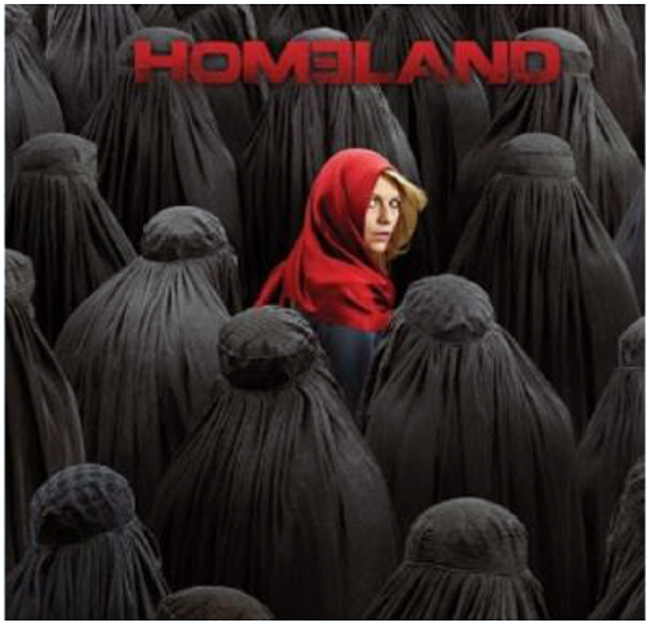
There are no right answers to these questions. My goal is to encourage students to begin a process of asking how Muslims are represented in the media, building their critical thinking and questioning skills beyond the classroom. In a recent teaching session, a student challenged this image and my inclusion of it in this activity by saying, “I watch this show and the lead character, Claire Danes, makes an effort to help Muslim women. I think it is a feminist show full of empowering images of women.” I want to trouble these images by inviting students to keep interrogating the multiple viewpoints therein. After telling her that I really appreciate her speaking up and offering her perspective, especially since she watched the show, I ask her permission to ask more questions about the power dynamics that I see in the image. What does it mean for a white American woman to help nonwhite women, particularly within the context of military occupation and counterterrorism operations? What does the dramatized show mean in the context of real-world warfare, where the U.S. military has conducted counterterrorism exercises in over 70 countries throughout the world during the Global War on Terror? What does helping Muslim women mean in the context of a 20-year war that has led to the killing of four million people globally, most of whom are Muslim? What is the sociopolitical and cultural context that makes a show like this popular in the first place?
The other images in the media literacy activity include two 2012 Newsweek cover photos, one of a young child holding an assault rifle, with the headline “Why They Hate Us,” and the other portraying a group of men screaming and looking angry, with the headline “Muslim Rage.” A third image is the cover of a 2008 New Yorker magazine, with caricatures of Barack and Michelle Obama, presumably at the White House, he dressed in a headscarf and ankle-length thobe, or traditional Arab or possibly South Asian shalwar kameez, and Michelle, her hair styled in a big afro, holding an assault rifle. There is a picture hanging over a fireplace mantle, possibly of Osama bin Laden, and an American flag burning in the fire. The fourth image is a 2010 Time magazine cover of a girl who looks like her nose was cut off, with the headline “What Happens if We Leave Afghanistan?” These are all periodicals sold in prominent public places, communicating their messages to the masses in places like shopping malls and supermarkets.
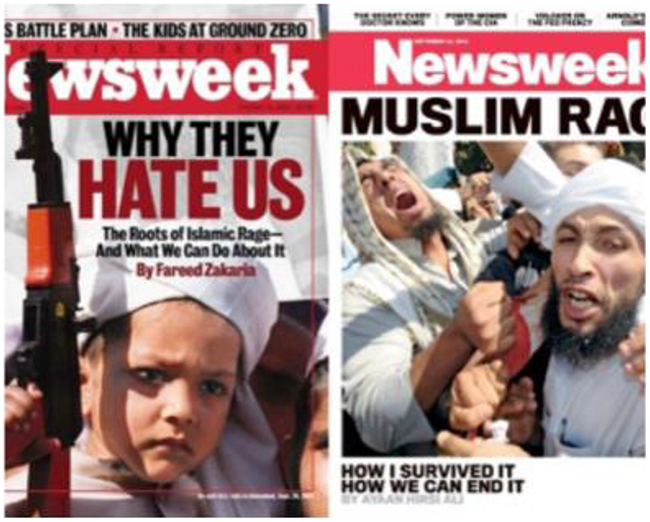
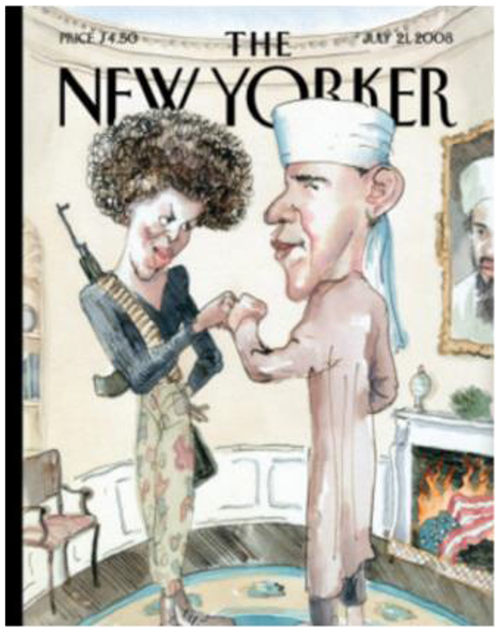
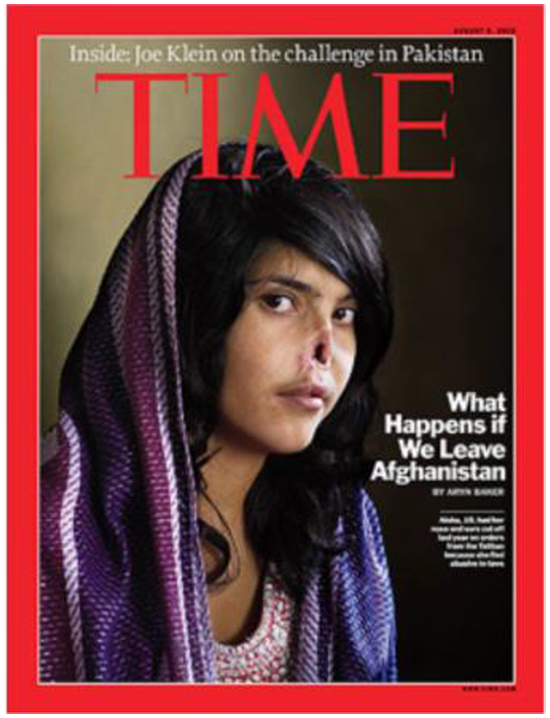
After students work in pairs to discuss the images and corresponding questions, I ask: “How are Muslims represented in the media examples we looked at today? Do you think these images affect the way people think about Muslims? Why do you think the people who chose to use these images made the choices they did? How do you think Muslims might react to these images?” After some discussion, we return to our written class definition of Islamophobia and I ask, “Now that we completed this exercise, is there anything you learned that could be added to our definition of Islamophobia? Try and use specific language beyond ‘negative media images.’” Students describe media images that can represent Muslims as violent, irrational, child abusers, women haters, or trying to take over the U.S. government.
Sharing More Examples of Islamophobia
The rest of the lesson plan continues like the activities described above, where students interrogate a variety of information and then come back to the definition of Islamophobia, adding specific examples to define the term. Below is a review of some of the additional sources I share in the lesson plan that offer clues about what can be included in a definition of Islamophobia.
Islamophobia can include anti-Mosque activity. The American Civil Liberties Union (2024) has a website of a clickable map of the United States, highlighting the reported anti-mosque activity in each state. What is even more impactful is clicking on the “Show Map Data” button directly under the map, which opens a list of anti-mosque incidents that would take hours to read. Some of the anti-mosque activities in the reports include theft, threatening emails and phone calls, anti-Muslim graffiti, city council efforts to ban mosque construction, conspiring to bomb mosques, trespassing, threats of violence, arson, assault, and murder. It is also important to remind students that these are only reported cases of anti-mosque activity, making it impossible to know the true extent of the problem. Gaps in reporting and fear of reporting are ongoing challenges for all communities trying to ascertain the extent of bigotry and discrimination.
Islamophobia can include hate crimes. Students use the Huffington Post's Anti-Muslims Acts in 2016 website to learn more about what kinds of crimes have occurred (Mattias & Abdelaziz, n.d.). I like that the examples are labeled with different categories like “bigotry,” “aggression,” “policy,” and “rhetoric,” giving students another set of terms to differentiate acts of discrimination.
Islamophobia can affect different Muslims differently; for example, Black Muslims may also face anti-Black racism inside and outside Muslim communities. Black Muslims are estimated to be approximately 20% of the total Muslim population in the United States (Pew Research Center, 2017). Black Muslims were, in fact, the first Muslims to arrive in America, through enslavement (CBS Sunday Morning, 2022). Islam in America is deeply influenced by Black Muslim history and culture (Associated Press, 2016), and yet many Black Muslims are marginalized and discriminated against in Muslim communities because of anti-Black racism (Scripps News, 2016). I want students to think about the diversity of Muslims because we are not all one people. Muslims, like all Americans, are not impervious to being bigots, either. When teaching about racism and discrimination, we never want to leave students with romanticized notions of “the other,” which is another form of dehumanization. Muslims are complex, and we want to amplify critical thinking skills that allow students to see that complexity.
Islamophobia can affect non-Muslims. A separate religious community entirely, Sikhs have experienced consistent violent hate crimes as retribution for 9/11 (Thompson, 2017). The first person murdered directly after 9/11 was Balbir Singh Sodhi, a gas station owner who was planting flowers when he was attacked in Mesa, Arizona, on September 15, 2001 (Sodhi & Sodhi, 2018). Learning about the experiences of Sikhs post-9/11 contextualizes Islamophobia within the larger umbrella of anti-immigrant hate and xenophobia.
Islamophobia can include state-sponsored secret surveillance. Students are introduced to the New York Police Department's Secret Muslim Surveillance program, giving insight into the way the government has targeted specific communities with collective punishment tactics that violate the civil rights of Muslim Americans and even violate U.S. law (Center for American Progress, 2015). For example, one of the tactics used by the New York Police Department was infiltrating Muslim kids’ soccer teams and encouraging them to spy on their parents and communities.
Islamophobia can include U.S.-sponsored targeted violence. In addition to the resources shared in the beginning of this article about the post-9/11 criminalization and dehumanization of Muslims, I share information about President Obama's commitment to the drone program by increasing drone warfare tenfold over his predecessor, George Bush (Hilal, 2022; Shah, 2017). Although Obama was celebrated for being the first Black president of the United States, many Muslims were deeply disappointed by his support for violence against Muslim communities globally. Lastly, there is an article provocatively titled “Why They Hate Us (II): How Many Muslims Has the U.S. Killed in the Past 30 Years?,” by author Stephen M. Walt (2009), a professor of international relations at Harvard University. The title of the article references one of President Bush's speeches after 9/11, when he asked inflammatory questions like, “Why do they hate us?,” reinforcing media coverage of September 11 as an ahistorical tragedy with no context or precedent (Bush, 2001). Bush answered this often-repeated question by stating that “they” hate “our” democracy and way of life, using dehumanizing terminology that creates manufactured boundaries between people. Americans collectively have no understanding of U.S. foreign policy in Muslim majority countries over the past 100 years, and Walt rightly asks probing questions about the indiscriminate and disproportionate use of violence by the U.S. military.
As students repeatedly come back to the definition of Islamophobia, they can see the details emerge from the information they have reviewed. Comparing the first definition to the final additions, I ask students, “If one of your friends asked you about this lesson and what you learned about Islamophobia, what would you say?” One student recently offered, “It would take some time to explain, because there are many different aspects to it, from war to hate crimes and negative media images. I cannot explain it in one or two sentences.” This is exactly the point of the lesson. I am not interested in students memorizing a definition they can regurgitate on a test. I want them to see images and remember details and perspectives that illuminate a multifaceted understanding of the ways Islamophobia shows up in the world, informed by multiple perspectives.
A Teaching Template for Any Controversial Topic
Since writing this lesson, I have taught it to hundreds of diverse learners. The examples in the lesson can be customized depending on the needs of the audience. For example, I have used the lesson to teach middle school and high school students, as well as adult educators, college students, activists, artists, philanthropists, and religious leaders. I tailor the lesson to different audiences by changing some of the examples in the activities to offer greater insight into how Islamophobia may show up in particular communities. The lesson is also a useful template to teach about any social justice topic, giving students the opportunity to investigate complex issues, like anti-Black racism, xenophobia, capitalism, the climate emergency, Indigenous rights movements, or any other topic where you want students to build critical literacy about a multifaceted social problem or issue.
You can access this lesson plan for free at https://www.challengeislamophobia.org/
Supplemental Material
sj-docx-1-jlr-10.1177_1086296X241300116 - Supplemental material for What Is Islamophobia? Teaching Strategies for Critical Literacy
Supplemental material, sj-docx-1-jlr-10.1177_1086296X241300116 for What Is Islamophobia? Teaching Strategies for Critical Literacy by Alison Kysia in Journal of Literacy Research
Supplemental Material
sj-docx-2-jlr-10.1177_1086296X241300116 - Supplemental material for What Is Islamophobia? Teaching Strategies for Critical Literacy
Supplemental material, sj-docx-2-jlr-10.1177_1086296X241300116 for What Is Islamophobia? Teaching Strategies for Critical Literacy by Alison Kysia in Journal of Literacy Research
Supplemental Material
sj-docx-3-jlr-10.1177_1086296X241300116 - Supplemental material for What Is Islamophobia? Teaching Strategies for Critical Literacy
Supplemental material, sj-docx-3-jlr-10.1177_1086296X241300116 for What Is Islamophobia? Teaching Strategies for Critical Literacy by Alison Kysia in Journal of Literacy Research
Supplemental Material
sj-docx-4-jlr-10.1177_1086296X241300116 - Supplemental material for What Is Islamophobia? Teaching Strategies for Critical Literacy
Supplemental material, sj-docx-4-jlr-10.1177_1086296X241300116 for What Is Islamophobia? Teaching Strategies for Critical Literacy by Alison Kysia in Journal of Literacy Research
Supplemental Material
sj-docx-5-jlr-10.1177_1086296X241300116 - Supplemental material for What Is Islamophobia? Teaching Strategies for Critical Literacy
Supplemental material, sj-docx-5-jlr-10.1177_1086296X241300116 for What Is Islamophobia? Teaching Strategies for Critical Literacy by Alison Kysia in Journal of Literacy Research
Footnotes
Author's Note
Alison Kysia is now the founder of 786Arts LLC, an arts-based organization that produces abstract Islamic sculpture and socially engaged projects about Muslims, Islam, and Islamophobia.
Declaration of Conflicting Interests
The author declared no potential conflicts of interest with respect to the research, authorship, and/or publication of this article.
Funding
The author received no financial support for the research, authorship, and/or publication of this article.

References
Supplementary Material
Please find the following supplemental material available below.
For Open Access articles published under a Creative Commons License, all supplemental material carries the same license as the article it is associated with.
For non-Open Access articles published, all supplemental material carries a non-exclusive license, and permission requests for re-use of supplemental material or any part of supplemental material shall be sent directly to the copyright owner as specified in the copyright notice associated with the article.
