







Abstract
Employing Asian critical theory as a theoretical lens and critical literacy as a pedagogical approach, the present study explores how Asian American counternarratives serve as vehicles for challenging dominant narratives and constructing an equitable classroom space for Korean American students who have been marginalized in their American schools. Using the literature that validates Asian Americans’ experiences and perspectives served as empowering transformative pedagogy to the traditional curriculum as they played vital roles in leveraging students’ cognizance about injustice issues and promoting educational equity in the classroom. The findings show that Asian American counternarratives helped Korean American students articulate their analytic perspectives through profound conversations in cultivating their critical consciousness, transforming their perspectives, and becoming active and cognizant citizens. The findings provide implications for educators that counternarratives not only dispel inaccurate stereotypes, biases, and prejudices by amplifying voices of underrepresented groups but also accomplish educational equity and social justice by enhancing transformations in education practices.
Keywords
Asian American students’ voices, experiences, and stories have been silenced and often disregarded in and out of school settings. Asian or Asian American children are not only underrepresented or described as perpetual foreigners in the United States but also usually portrayed as invisible characters in many children and young adult books (N. Rodríguez & Kim, 2018). It is, therefore, imperative for educators to provide curricula that can mirror, center, and highlight Asian American students’ life experiences and cultural values to amplify the voices of Asian Americans in their school curricula (Iwai, 2019; Lee, 2021a; Osorio, 2018). Engaging in mirror books that portray minoritized students’ cultural heritage and life experiences provides them with positive affirmation to build strong ethnic/cultural identities and enhance their positive self-concept (Lee, 2021b). Yet, the literature portraying Asians or Asian Americans has been seldom available and rarely used in the U.S. school curriculum (N. Rodríguez et al., 2023).
According to a Cooperative Children's Book Center report in 2023, the number of children's books depicting Asian children as protagonists (10%) lags behind the number of books with White protagonists (28%) and even those with animals or objects (i.e., nonhuman characters; 20%). Although the number of diverse books about Asians being published has steadily and gradually increased since 2016 (Cooperative Children's Book Center, 2023), the amount of literature about Asians is still insufficient compared to the Asian student enrollment in school settings. Due to the lack of multicultural Asian literature from classroom libraries, U.S.-born children of Asian immigrants continue to encounter a lack of exposure to accurate portrayals of Asian Americans’ life experiences and perspectives through literature (Lee, 2024b; N. Rodríguez & An, 2024). During a semester before the present study was conducted, Korean American students in my heritage language (HL) classroom shared that they learned about both accomplishments and challenges African Americans have made and faced in U.S. historical events in their American schools to honor Black History Month in February. The students additionally shared that they have read books featuring Hispanic protagonists and their immigration stories. The students reported that they gained knowledge about people and cultures from other racial minority groups, but Asian American history and notable figures or heroes have not been taught in their American schools, even during Asian Heritage Month.
Because Asian Americans are largely erased from the mainstream curriculum in the United States, one of my roles as a Korean HL classroom teacher and social justice scholar was helping students raise their Asian American voices to fight against racial inequality and advance social justice. Hence, I designed a curriculum by purposefully selecting literature that portrays Asian Americans as protagonists and guided students to analyze stories critically by identifying racial discrimination and racism against Asian American characters. Since counternarratives reject Eurocentric perspectives by challenging dominant narratives (Heidt et al., 2023; Liu & Ball, 2019), I believed that reading counternarratives written from Asian Americans’ perspectives and discussing prevailing sociopolitical, cultural, or racial issues in these stories would help Korean American students in my class develop their understanding of fairness, inclusion, equity, and justice.
The present study is designed to narrow the gap in the literature by demonstrating how counternarratives can achieve educational transformation, equity, and social justice using the lens of Asian critical (AsianCrit) theory when they are used in the classroom for Korean American students. This study incorporates Asian American counternarratives to bring into the lived experiences of Korean American students whose stories and voices are not often told and heard. The purpose of the study was to investigate how Asian American counternarratives serve as vehicles for challenging dominant narratives and constructing an equitable and unbiased learning space for Korean American students in an HL classroom. The following research question guided the study: In what ways do literature discussions based on Asian American counternarratives in a Korean HL classroom help fifth-grade Korean American students learn to disrupt hegemony, stereotypes, and racism?
Theoretical Framework
This study employed AsianCrit theory (Chang, 1993; Iftikar & Museus, 2018; Kim & Hsieh, 2021; Museus & Iftikar, 2013; Park & Liu, 2014), which is grounded in critical race theory (CRT; Crenshaw et al., 1995; Delgado, 2011; Solórzano & Yosso, 2002), as a theoretical lens and used critical literacy (Freire, 1978; Ladson-Billings, 2014) as a pedagogical approach. This section addresses essential tenets of AsianCrit and displays how scholars adopt its framework to challenge White privilege, dominant beliefs, and racism. Then it discusses key aspects of critical literacy by underlining the relationship between language and power in a text. The section then introduces the concept and role of counternarratives to illustrate how the present study incorporated Asian American counterstories as critical literacy practices to pursue the goals of AsianCrit.
AsianCrit From CRT
CRT recognizes that multiple forms of oppression (e.g., due to race, class, gender, sexual orientation, ethnicity, language, and immigration status) extensively exist in society (Crenshaw et al., 1995; Delgado, 2011). Since racism is pervasive in people's lives in a natural manner and is deeply rooted in history and permeates society, racialism is a permanent fixture in society (Museus & Iftikar, 2014). CRT scholars argue that a regime of White supremacy denotes a system of structural racism, which subordinates people of color. Proponents of CRT argue for drawing on the experiences, knowledge, and voices of people of color because the concept of race is a socially constructed phenomenon rather than a biological category or scientific fact (Delgado & Stefancic, 2013). Solórzano and Yosso (2002) pointed out that CRT helps us identify and criticize social oppression and racial subordination by analyzing experiential knowledge marginalized groups have gained. Since CRT is committed to social justice to eliminate racism and other forms of oppression in society, CRT scholars aim to challenge racial hegemony, phenotypical inequality, and color blindness.
Museus and Iftikar (2014) noted the limitations of CRT when studying Asian Americans’ experiences of racial oppression because CRT is disproportionately focused on Black populations. Museus and Iftikar proposed a critical race framework—Asian critical theory—that particularly ruminates on Asian Americans’ experiences in a racialized society. AsianCrit is grounded in CRT and offers a critical lens to explore racial prejudice, ethnic disparities, and structural racism experienced by Asian Americans that perpetuate systems of dominance and White supremacy (Iftikar & Museus, 2018; Museus & Iftikar, 2014). By echoing the original CRT tenets, AsianCrit comprises seven tenets—(a) Asianization; (b) transnational context; (c) (re)constructivist history; (d) strategic (anti)essentialism; (e) intersectionality; (f) story, theory, and praxis; and (g) commitment to social justice—and includes unique racial and historical features of Asian Americans that are fundamental in exploring Asian Americans’ stories and experiences (Museus & Iftikar, 2013).
Specifically, four tenets have been applied to this study. Asianization refers to the reality where racism and racial ideologies toward Asian Americans are pervasive in White society. According to Museus and Iftikar (2013), Asianization “(re)shape[s] laws and policies that affect Asian Americans and influence Asian American identities and experiences” (p. 23). Since White supremacy views all Asians as one group and does not distinguish but homogenizes their unique histories, experiences, and identities, strategic (anti)essentialism indicates why Asian Americans are regarded as a monolithic group (Iftikar & Museus, 2018). By disrupting the notion that Asian Americans are all the same, research grounded in this tenet strives to scrutinize diversity and heterogeneity in Asian Americans (Kim & Hsieh, 2021; Yoo et al., 2022). The story, theory, and praxis tenet highlights Asian Americans’ experiential knowledge and perspective by centering the voices and stories of Asian American communities (Museus & Iftikar, 2013). This tenet can challenge Euro-Western epistemological dominance as it offers an alternative epistemology that centers on Asian American people's experiences, practices, and values (Iftikar & Museus, 2018). Commitment to social justice not only challenges racism and imperialism but also prioritizes social changes to make equity and justice. AsianCrit is committed to ending all forms of oppression and exploitation and eradicating systems of dehumanization toward Asian Americans.
Critical Literacy
Educational researchers who have adopted the CRT framework considered critical literacy as a form of social protest and a political movement against systematic inequality and structural racism (Ladson-Billings, 2014). Freire (1978), whose work reflects critical literacy, claimed that reading the word critically and the world consciously can eradicate hierarchical forms of oppression and reinforce the transformation of the power dynamics. Similarly, Anderson and Irvine (1993) defined critical literacy as “the process of becoming conscious of one's experience as historically constructed within specific power relations” (p. 82). Advocates of critical literacy underscore the importance of taking an active stance toward language in the text to uncover the relationship between language and power since language is used to establish power dominance and maintain social hierarchies (Knoblauch & Brannon, 1993; Lewison et al., 2002). According to Hall (1980), readers can engage in three specific encodings of text to accept, negotiate, or reject the meanings presented in the text. That is, readers’ construction, deconstruction, or reconstruction of knowledge empowers them to critically identify the unequal status quo in social structures and prejudiced power relations that normalize and universalize whiteness (Freire & Macedo, 1987; Lankshear & McClaren, 1993; Morrell, 2004). Critical literacy works as a powerful tool in sustaining justice and resisting oppression by helping readers examine the complex relations of language and power within contemporary society.
The Concept and Role of Counternarratives
Counternarratives are stories that depict the lived experiences of racial, ethnic, or cultural groups who have been historically oppressed, excluded, and silenced in society (DeCuir & Dixson, 2004; Delgado & Stefancic, 2013; Solórzano & Yosso, 2002). Counternarratives unveil societal inequality and injustice as they construe stories from nondominant standpoints that are often suppressed or excluded in traditional curriculum materials (Cheruvu et al., 2015; Heidt et al., 2023; Miller et al., 2020; Milner & Howard, 2013). The Minnesota Humanities Center (2018) characterized counternarratives as “absent narratives” because the lived experiences of minority groups are often “left out, overwritten, [and] absented by a dominant story” (p. 1). Counternarratives lead readers to criticize unfair treatment or biased attitudes from the perspective of traditionally marginalized groups to build potential transformation (Solórzano & Yosso, 2002). Similarly, DeCuir and Dixson (2004) argued that counternarratives are “means of exposing and critiquing normalized dialogues that perpetuate racial stereotypes” (p. 27). When encountering counternarratives, readers can uncover and criticize injustice issues in a racialized society where the experiences of minority groups are eradicated and perpetuated. Opening spaces for engaged discussion after reading counternarratives can be a desirable idea to accomplish educational equity and justice.
Using Counternarratives as Examples of Critical Literacy to Pursue the Goals of AsianCrit
The goal of CRT is not just to inform people that racial/ethnic inequities exist in society but to educate people to achieve social equality and justice by changing the existing social order and transforming relationships of dominance and subordination (Delgado, 2011). Yet, earlier critical race theorists claimed that reflection itself cannot lead to transformation in learning; social action is strongly required for transformative social change (Ladson-Billings & Tate, 1995; Mezirow, 2000). According to Freire (1972), reflection without actions becomes mere “verbalism,” while action without critical reflection becomes “pure activism.” In this regard, Freire (1972) delineated the term praxis to indicate “reflection and action upon the world in order to transform” (p. 52). Since the praxis indicates taking actions based on critical reflections and contemplative insights, it generates transformation in education. Critical race theorists and critical literacy scholars accentuated the undividable relationship between reflection and social action to promote educational equity (Liu & Ball, 2019). Critical literacy scholars particularly supported using counternarratives in interrogating societal issues and challenging deficit perspectives toward socially marginalized groups to pursue equity and justice (DeCuir & Dixson, 2004; Delgado & Stefancic, 2013; Solórzano & Yosso, 2002).
Researchers have examined how counternarratives assisted students in criticizing majoritarian stories that immortalize racial biases and stereotypes (e.g., Cammarota, 2014; Cammarota & Romero, 2011; Ellison & Solomon, 2019; Godley & Loretto, 2013; Heidt et al., 2023) by understanding existing power structures and systems of oppression that played as the norms and neutral practices. Past studies discovered that engaging in counternarratives assisted marginalized students to identify whose voices were silenced or distorted using a critical stance and to confront biases, prejudices, and stereotypes in a racialized society. The use of counterstorytelling documents different forms of subordination and (hi)stories of oppressed people through voices from the margins and challenges dominant hegemony and persistence of racism (Delgado & Stefancic, 2013; Martinez, 2014, 2018).
It is, however, important to note that most research examining the role of using counternarratives has been conducted with African American (Caton, 2012; Ellison & Solomon, 2019; Flennaugh et al., 2017; Godley & Loretto, 2013; Motha & Vargese, 2018; L. Rodríguez & Greer, 2017; Shiller, 2018) or Latinx groups (Buchanan & Hilburn, 2016; Cammarota, 2014; Cammarota & Romero, 2011; Salinas et al., 2016). Little research has paid attention to Asian American ethnic groups. Furthermore, since a large amount of previous research on counternarratives dealt with adult participants (e.g., teachers, community members, or parents) and adolescent learners (e.g., high school and college students), we have little understanding of the ways in which elementary school-aged Asian American students respond to counternarratives to discover, analyze, or criticize injustice issues from traditional curricula materials. Past studies demonstrated that engaging with counternarratives produced an educational outcome by helping the readers challenge assumptions and biases that undergird dominant narratives and transform prevailing belief systems toward marginalized groups. Thus, I anticipated that including Asian American counternarratives in my curriculum would be a powerful praxis that achieves educational equity and brings a social justice outcome in pursuing the goals of AsianCrit in the classroom.
Methods
Research Context
This qualitative study took place in a Korean HL school in an urban Texas school district. The Asian American subgroup has been the fastest-growing population in the school district, but Korean–English bilingual education programs are not available for Korean students. Thus, community-based HL schools have been established in the local school districts, and they are operated by the Korean community and parents in the town to teach Korean children the language and culture of their heritage. The enrolled students at all elementary grade levels attended the school for three hours on weekends. Data collection for this article occurred during a spring semester in a fifth-grade class at the Korean HL school.
Participants
Students
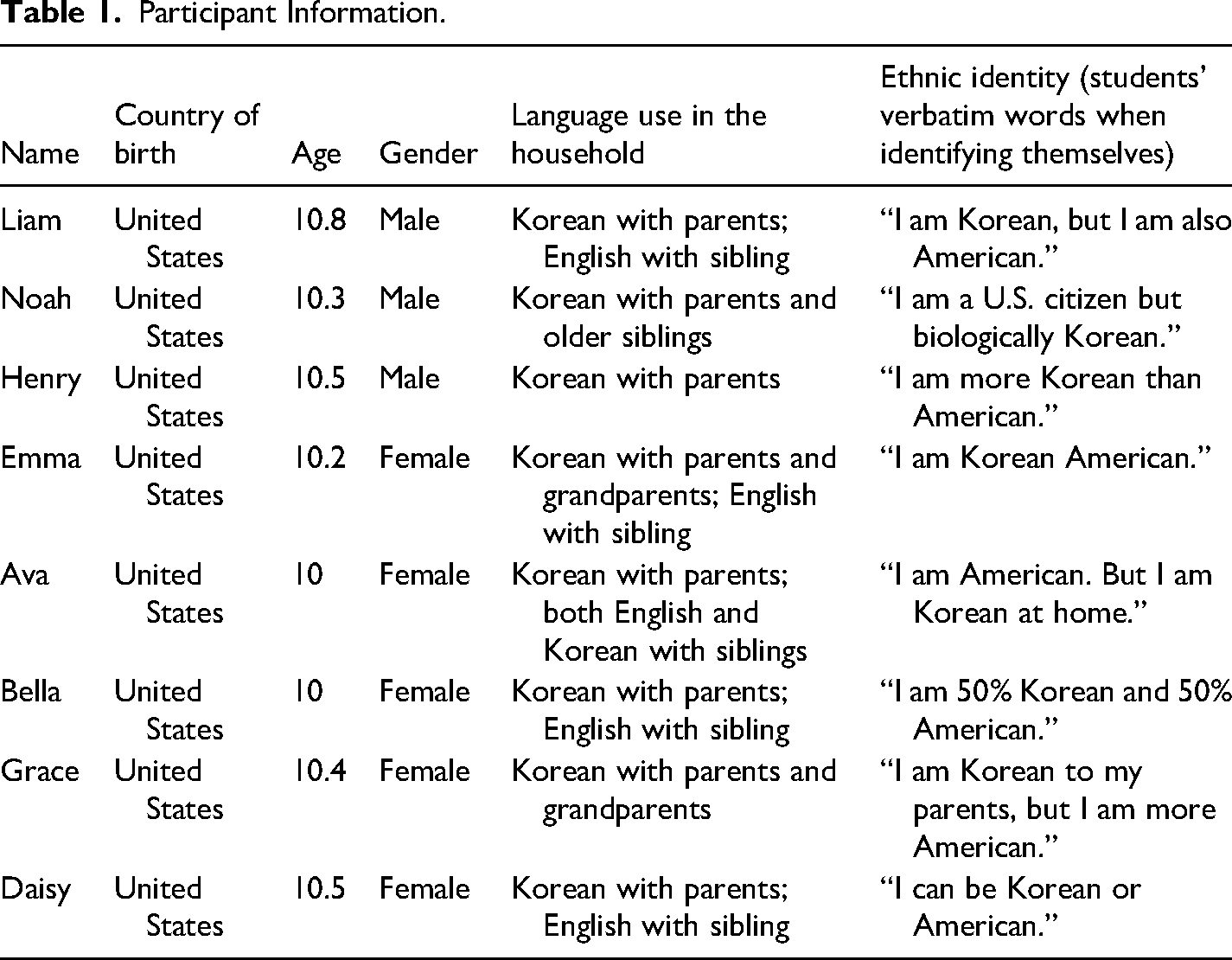
There were eight students (five female and three male) enrolled in the fifth-grade class, and all the students were invited to participate in the study. Parental permissions, which allowed me to include their children, were granted to all the students, and students’ assent forms to participate in this study were also obtained. All eight students were born in the United States and had received English-only instruction at their American schools during the weekdays. All students identified themselves as Korean Americans since their parents were first-generation immigrants from Korea. The students reported that although Korean was the main language spoken at home when interacting with parents, English became the dominant language in their daily lives. The students preferred speaking in English to Korean and rated their English proficiency higher than their Korean proficiency. Yet, thanks to their family engagement in culturally relevant practices at home and in the local community, the students were familiar with Korean culture and tradition. All students reported they were more competent in Korean culture than its language. Pseudonyms were used for all the participants (see Table 1).
Participant Information.
Teacher
I, as a race-critical researcher and teacher educator at a university who advocates multicultural education, was the fifth-grade classroom teacher at the Korean HL school. As a native Korean speaker, it was my ninth year of teaching in Korean HL school settings in the United States. I had previously worked as a Korean HL teacher with first graders for five years in a university town in the Midwest. After moving to the U.S. South, I taught second graders for a year and third graders for two years. As I advocate for bilingualism and biliteracy education, implementing and validating translanguaging have become my classroom norm for the past few years. Considering the concept of translanguaging, which refers to pedagogical practices that recognize and integrate bilingual and multilingual students’ full language and semiotic resources to support their active participation and meaning-making processes, I purposefully and strategically guided students to flexibly utilize their linguistic repertoires (García et al., 2017) and cultural knowledge from their funds of knowledge (Moll et al., 1992) when engaging in reading, writing, discussing, and thinking in the classroom (Lee, 2021c, 2023).
Researcher's Positionality
I used an emic—the insider's—perspective because I identified myself as a first-generation Korean immigrant and bilingual in Korean and English. The emic perspective strives to understand a specific culture from the perspective of cultural insiders because the researchers are members of the community or from the culture being studied (Malinowski, 1922; Morris et al., 1999). This emic approach provides insight into cultural nuances and navigates cultural norms. When conducting research, researchers who are cultural insiders can respond to sensitive issues in a more responsive and appropriate manner than outsider researchers because only a member of a cultural group can accurately apprehend the group's norms and values using unique insights and lived experiences (Banks, 1998). My position as a cultural/ethnic insider enhanced my understanding of the social values and cultural norms of the participants and their discursive practices and experiences.
For instance, I have recurrently encountered biases and stereotypes about Asian Americans and (in)directly experienced a rise in hate incidents and crimes against Asian Americans after the COVID-19 pandemic. Thus, the students’ testimonies helped me identify and understand how they have constantly grappled with racial or cultural biases and challenged existing disparities while living in the United States as Asian Americans. As the students and I shared the same ethnic and cultural identities, the sense of our shared identity, experiences, and knowledge helped us cultivate positive relationships and build trust, security, and reciprocity. Yet, Merriam et al. (2001) warned insider researchers that they can be “accused of being inherently biased and too close to the culture to be curious enough to raise provocative questions” (p. 411). To avoid and mitigate potential biases as an insider researcher, I foregrounded the richness and multiplicity of the students’ stories and testimonies (Martinez, 2014, 2018) rather than presuming Asian students as monoliths or assuming their experiences as generic commonalities. I tried to capture the heterogeneity of the students’ experiences by valuing various collections of Asian Americans’ voices, experiences, and stories.
The Selection of Asian American Counternarratives
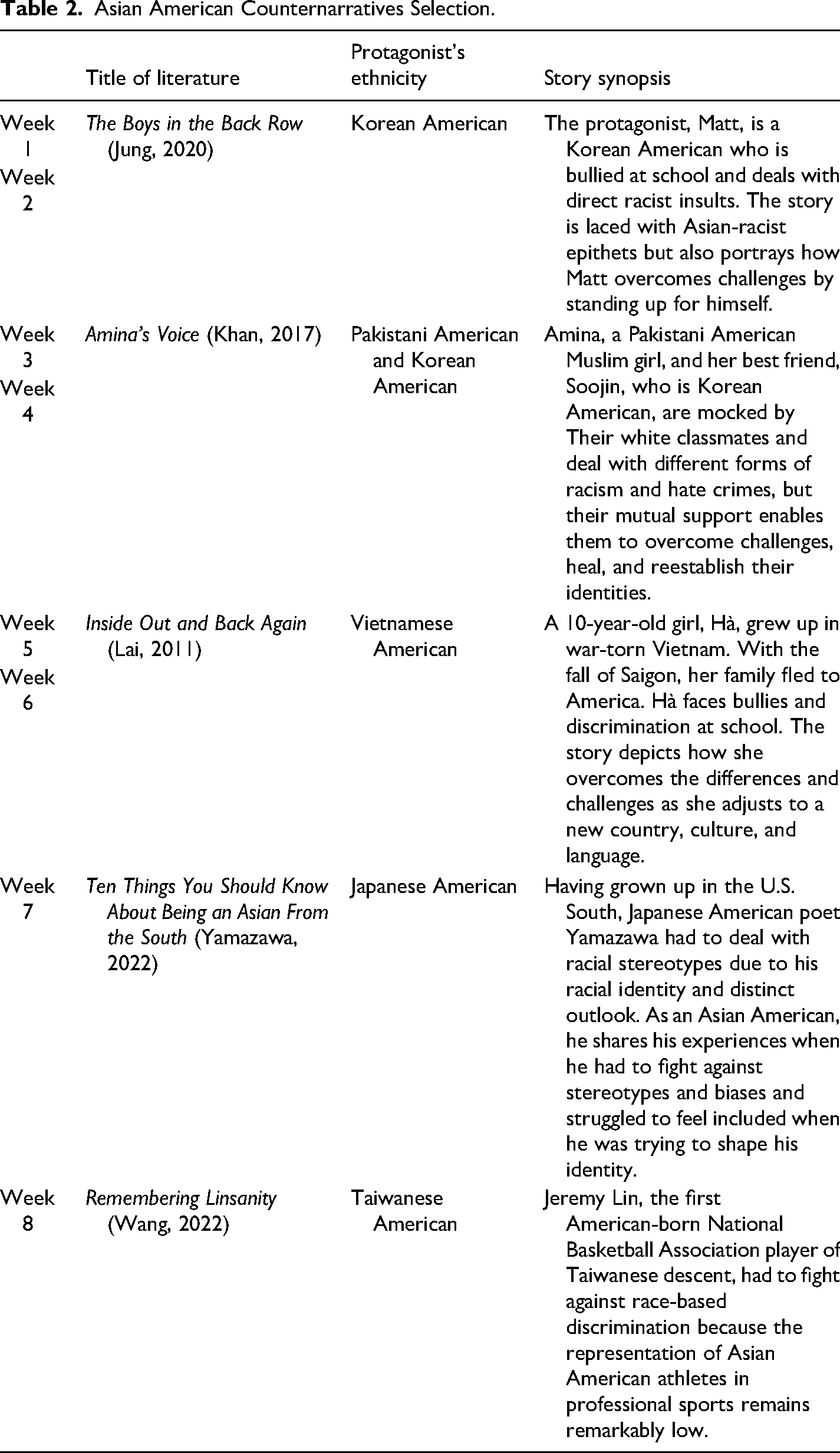
After recognizing the absence of Asian Americans from the curricula of the public school my students attended, I advocated for the use of counternarratives as a medium for promoting liberation and equality from a social justice/equity approach. As Martinez (2014) noted, counterstories portray marginalized groups by centering their experiences and embodied knowledge so that their voices, perspectives, and practices can be included and valued. I purposefully selected five literary works about Asian American individuals that depict their unique lived experiences and the challenges or obstacles they faced in certain events. Each piece of literature portrays different Asian ethnic groups with diverse genres (see Table 2). I used the chosen literature as my curricular counternarratives to question hegemonic discourse and deconstruct traditionally accepted narratives that had been prevalent in students’ mainstream school curricula. Unlike dominant narratives that perpetuate racial stereotypes, reading and analyzing counternarratives served as a vehicle for the students to identify issues of widespread structural racism against Asian American populations and communities by bringing and expressing their Asian American views and values.
Asian American Counternarratives Selection.
Data Collection Procedure
The primary data were the transcripts from the audio recordings of literature discussions the class participated in after reading books that depict Asian Americans’ different experiences living in the United States. For the first 50 minutes of the class period, the class closely read each story. The class read two literary works, Ten Things You Should Know About Being an Asian From the South (Yamazawa, 2022) and Remembering Linsanity (Wang, 2022), as a whole group during the class because they are succinct (a narrative poem and graphic memoir, respectively). Since the other three books—realistic fiction and a historical novel—are lengthy, with more than 200 pages, the class was asked to read them as homework at their own pace before they attended the class on Saturdays. The class spent two weeks reading each of the three books at home and discussed each story for two weeks in class (two class sessions).
After reading a literary work each week, the class engaged in literature discussion for the next 50 minutes by scrutinizing chapter(s) or pages from the literature that include incidents or issues Asian American protagonists confront in the United States due to their different racial, cultural, and linguistic identities. I elicited literature discussions by asking questions that helped the students engage critically with the texts to analyze power relations and issues of social inequality (e.g., “How would you react and respond if you were the protagonist who faces racist bullying in school?” and “What can be done to prevent this form of discrimination in our everyday lives?”). During their book discussions, the students used dialogue to share their understanding and interpretations of the stories by elevating their Asian American voices and viewpoints to fight against structural racism and social injustice against Asian Americans. The students’ oral discourses were audio-recorded for 50 minutes each week, resulting in about 400 minutes of audio recording over eight weeks.
Data Analysis
To seek the answer to the research question, I analyzed the students’ verbal discourses to the selected Asian American counternarratives. Since the chosen literature portrays issues of power asymmetries and structural inequities, classroom discourses during the literature discussion are critical in nature among the students. Thus, analyzing the students’ dialogic responses to the stories, characters, and issues from each piece of literature enabled me to identify their critical stances, voices, and perspectives toward the counternarratives and also allowed me to closely inspect how they addressed diverse cultural, sociopolitical, and racial issues raised in the literary work and the world around them. As the conceptual ideas—AsianCrit and critical literacy—accentuate the importance of disrupting dominant narratives using critical perspectives toward language uses, social problems, and injustice issues presented in texts, students were able to engage in critical conversations about Asian Americans’ lived experiences and discursive practices during their dialogic discussions by expressing their thoughts and viewpoints to foreground social justice and equity. I scrutinized the students’ genuine reactions and reflexive responses to societal power relations, hegemonic ideologies, and systematic racism that are exhibited both in the literature and in current society.
In an initial analysis of the data set, I used open coding (Saldaña, 2009) to search for emerging patterns to find themes by reading, rereading, and analyzing the transcripts of audio recordings that capture the students’ dialogic discourses from the literature discussions. During the process of the open coding, I collated all pieces of data and labeled each set of the students’ utterances with codes. In total, 15 different codes were discovered, such as “Criticizing English hegemony or linguicism,” “Embracing cultural diversity and acculturation,” and “Discussing how to solve problems to change school climate.” For instance, I coded “Criticizing English hegemony or linguicism” when the students stated that “people think that English is the most important language, but that's a selfish idea.” When the students argued, “We need to accept different languages as we have many people from different countries,” I coded their statements as “Valuing linguistic diversity.”
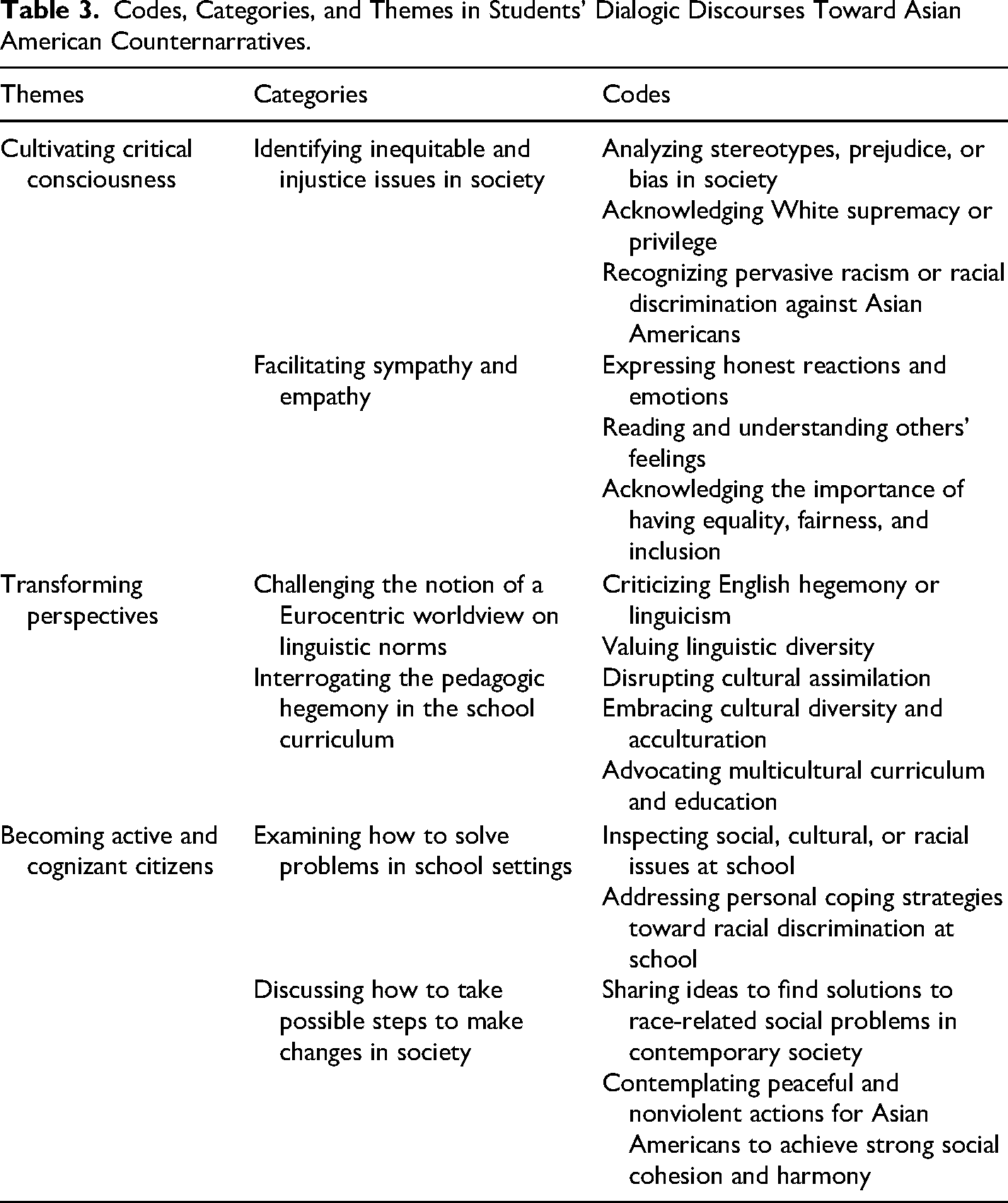
I then engaged in axial coding (Saldaña, 2009) using the lens of AsianCrit to identify categories among codes in the open coding phase. Using the data set labeled with particular codes, I searched for recurring patterns from conceptual categories to find themes. In the axial coding process, I drew connections between codes by comparing, contrasting, and identifying redundancies. All the existing codes from the students’ oral responses to the Asian American counternarratives were understood through the tenets of AsianCrit, and they were grouped into the six following categories: “Identifying inequitable and injustice issues in society,” “Facilitating sympathy and empathy,” “Challenging the notion of a Eurocentric worldview on linguistic norms,” “Interrogating the pedagogic hegemony in the school curriculum,” “Becoming active to solve problems in school settings,” and “Discussing how to take possible steps to make changes in society.” For example, the annotated codes “Criticizing English hegemony or linguicism” and “Valuing linguistic diversity” were included under the category of “Challenging the notion of a Eurocentric worldview on linguistic norms,” which is one of the categories under the three central themes: “Cultivating Critical Consciousness,” “Transforming Perspectives,” and “Becoming Active and Cognizant Citizens.” (See Table 3 for codes, categories, and themes in students’ dialogic discourses toward Asian American counternarratives).
Codes, Categories, and Themes in Students’ Dialogic Discourses Toward Asian American Counternarratives.
Findings
As a part of the instructional practices that mirrored critical literacy, the class participated in literature discussions after reading Asian American counternarratives by developing and asking critical questions, which required them to interpret, synthesize, evaluate, and respond to the word from the literature and then the world around them (Freire & Macedo, 1987). The following section displays how the counternarratives of Asian Americans helped the students articulate their analytic perspectives through profound conversations in cultivating their critical consciousness, transforming their perspectives, and becoming active and cognizant citizens.
Cultivating Critical Consciousness
When the class discovered social and racial injustice from the selected literature, they attempted to challenge the ideological hegemony, stereotypes, and racialism. Engaging in reading the counternarratives and discussing issues from the stories assisted the students in cultivating their critical consciousness by analyzing inequalities and injustice in society and expressing their sympathy and empathy with Asian American protagonists in the literature.
Identifying Inequitable and Injustice Issues in Society
All the selected literature includes racial/ethnic slurs to mock people of Asian descent as a part of their storylines. For instance, in the book The Boys in the Back Row (Jung, 2020), the Korean American male protagonist was labeled “the Chink” by his White classmate. The students were aware of racial biases and stereotypes toward Asians living in the United States. The class shared several stereotyped referents (e.g., banana and twinkie) and detrimental markers (e.g., “yellow monkeys” and “Ching Chang Chong”) they had heard in the media when describing Asian individuals. The students demonstrated their understanding of the widespread existence of racial injustice in current society by addressing discriminating behaviors and unjust treatment toward Asians. Noah stated, “These types of racism happen around us. This is not just a fiction from this fiction book. This is a reality.” Emma agreed with Noah and added, “Sometimes fiction is based on real-life events. That is what Asians are experiencing.” Noah's and Emma's responses indicate that they identified the existence of structural racism as they understood societies foster racial discrimination and reinforce discriminatory beliefs toward Asians. Since social inequity and racial injustice against Asians were depicted in the literature, close analyses of the issues in the storylines promoted the students’ critical consciousness about racism in society.
Expressing Sympathy and Empathy
The selected literature often enabled the students to develop their understanding and compassion, which ultimately facilitated their empathy with Asian American protagonists in the stories. When reading the free-verse historical fiction Inside Out and Back Again (Lai, 2011), which illustrates the story of disorienting immigrant experiences from a Vietnamese child refugee's perspective, I led the class to discuss the scene where the Vietnamese protagonist was called a “pancake” by a Caucasian boy due to the absence of her facial concavity and convexity. Excerpt 1 illustrates how the students expressed their sympathy and empathy toward the Vietnamese protagonist by sharing their genuine feelings and emotions.
Excerpt 1. Expressing honest reactions and emotions
Ms. Lee: On Halloween, when the children wore their costumes, one boy said to Hà [the Vietnamese protagonist] that “she has a pancake face.” Do you know why he said “pancake” to her? Henry: Yeah, because he thought that she had a very flat face as Asian. Hà knew why the boy called her a pancake because she said, “a pancake is very flat.” Bella: He is horrible and nasty. How could he say a pancake to a person? I can’t understand him. Liam: I am actually mad at him. Noah: I would be very upset and mad at him if I were her. Ava: Me, too. I think she should speak out and defend herself. But she couldn’t. Henry: That's why I felt so bad and sad. She just cried and couldn’t say anything to protect herself. Noah: I am sure that she must have felt so miserable and rejected. Bella: I know! I am sorry that she had to go through that bad moment just because she is Asian. Grace: I am sorry that it happened to her. As an Asian, I almost feel like the boy attacked me. Ava: If I were her, what he said to me would be bad trauma.
I initiated the discussion by pointing out the issue the Vietnamese protagonist faced in the story and asked the class to share their thoughts about using the detrimental remark “pancake” (line 1). The students not only judged the White boy's bigoted rhetoric by describing his behavior as “horrible” and “nasty” (line 3) but also provided their honest feelings using the adjectives “mad,” “upset,” “bad,” and “sad” (lines 4, 5, and 7). Henry predicted how the protagonist might have felt using the words “miserable” and “rejected” (line 8). Three other students (Bella, Grace, and Ava) also responded empathetically, affirming, “I am sorry that she had to go through that bad moment,” “I am sorry that it happened to her,” and “If I were her, what he said to me would be bad trauma” (lines 9–11). Specifically, Ava's response indicates that she understood the protagonist's experience by imagining herself in the protagonist's situation. Reading the story from the point of the Vietnamese protagonist's view supported the students’ awareness and understanding of others’ feelings and emotions, which positively facilitated their sympathy and affective empathy for other Asians’ experiences.
Transforming Perspectives
The students’ responses to the counternarratives demonstrate that they generated transformative perspectives as they questioned seeing the world from a Western-centered perspective and values only. Specifically, the class criticized the Eurocentric worldview on linguistic norms and interrogated the pedagogic hegemony in their American school curriculum.
Challenging the Notion of a Eurocentric Worldview on Linguistic Norms
The literature discussion led the students to disrupt Eurocentric epistemologies that are pervasive in the stories they encountered. For instance, the book Amina's Voice (Khan, 2017) illustrates a scene where two White American students condemned the Pakistan American and Korean American protagonists for the fact that they spoke languages other than English. Excerpt 2 displays the students’ responses after reading the scene, which reveals their criticism of the dominant Eurocentric worldview on language standards.
Excerpt 2. Criticizing English hegemony or linguicism
Ms. Lee: When Amina and Soojin were teaching each other's languages, Emily and Julie scoffed at them and said, “Speak English, you’re in America.” Why don’t we talk about the scene here? Henry: I think Emily and Julie are wrong. Since Amina speaks Urdu and Soojin speaks Korean, they can teach each other's languages. That's what I do with my friends. Emma: Maybe Emily and Julie are jealous of their language talents because they already speak two languages, and they are learning another one. Sometimes people are jealous of me because I speak two languages—Korean and English. But I have a right to use both. Noah: Hmmm… I don’t think they have to speak English only. They have the freedom to use whatever language they want to speak. Liam: Some of my classmates are from Mexico so they speak Spanish during recess. But I don’t mind because I often speak Korean with Korean people. Ava: Oh, last year we had a Korean kid from Korea. He couldn’t speak English, so I helped him [speak] English. We often spoke in Korean in the classroom. I was glad that I could help him, and he thanked me. So what Emily and Julie said to Amina and Soojin is rude and offensive. Bella: I know people sometimes think that English is the most important language or the only language people need to use because this is America. But that's a selfish idea. Henry: We should not tell people that they need to speak English only. Even though they live in America, they can freely use their languages. We need to accept different languages as we have many people from different countries.
I initiated the literature discussion by pointing out the scene where two White students (Emily and Julie) reprimanded their bilingual classmates (Amina and Soojin) when they taught each other their heritage languages (Urdu and Korean, respectively) in the classroom. Henry and Emma criticized the literary characters’ words by sharing their experiences as bilingual speakers. Henry understood that using two languages was a bilingual's normal practice when communicating with other bilingual speakers, and Emma identified that a bilingual individual has a right to use both their home and societal languages (lines 2 and 3). Noah rejected the linguistic hegemony of English; he believed that speakers have the freedom to use their heritage languages (line 4). Liam stated that he understood and accepted the use of Spanish by his classmates in the English classroom (line 5). Ava similarly shared when she assisted a recent immigrant classmate from Korea to learn English using Korean in her American school. By reflecting on the positive learning environment she had with her Korean-speaking peer, Ava criticized the literary characters’ attitudes toward Amina and Soojin (line 6). By pointing out that language practice has been framed predominantly by Eurocentric epistemologies, Bella understood the pervasive linguistic hegemony, which set standards that people must speak English only while living in the United States (line 7). Henry also acknowledged the danger of having Eurocentric ideological beliefs about language norms and further supported the notion of linguistic pluralism (line 8). This excerpt shows that the students challenged monolingualism and Eurocentrism by deconstructing Anglo-American assumptions but valued translanguaging practices to support multilingualism.
Interrogating the Pedagogic Hegemony in the School Curriculum
The literature discussion further focused on the importance of cultural diversity by criticizing the emphasis on mainstream culture in their American school curriculum. In Excerpt 3, I asked the class to closely examine the seventh stanza from the poem Ten Things You Should Know About Being an Asian From the South (Yamazawa, 2022), which portrays Americans’ lack of general knowledge about Asian countries and people. The classroom discourse in the following excerpt displays how the students expressed their voices and criticality by interrogating the hegemonic norm in their American school curriculum.
Excerpt 3. Advocating multicultural curriculum and education
Ms. Lee: Why don’t we think about the stanza here? (Reading aloud) “One day a classmate asked me what I was. When I told her I was Japanese, she said, Oh, I thought you was Asian.” Henry: That is so funny. I wonder if she really doesn’t know Japanese are Asian. Noah: She should read books and study something like geography. Ms. Lee: Well… What type of education does your school provide to learn about other countries such as their locations, cultures, and people? Henry: My school does not do a lot to learn about others’ cultures. We celebrated Black History Month and learned about a few Black heroes. But I think that was it. Liam: My school has many students from Mexico, so we once learned about Cinco de Mayo and read fiction where the main character was from Mexico, but not much about Asian culture. Ava: No Asian stuff in my school. Emma: Correct. I have never been taught Asian people, history, and culture. Ava: Our schools should teach Asian American history, people, and cultures so that Americans know and understand who Asians are, where we are coming from, why we are living here, and what we do and celebrate. Daisy: Right. Because we are different from Chinese, and Chinese people are different from Vietnamese. Vietnamese are different from Japanese. Not all Asians are not the same.
After rereading the stanza (see line 1), Henry and Noah condemned the ignorance of the American classmate, who did not know Japanese were Asians in the poem (lines 2 and 3). Responding to Noah's comment, I asked the class what they had learned about the cultural geography of other countries in their American schools (line 4). Although Henry and Liam stated that they learned about some aspects of African American and Hispanic cultures by celebrating Black History Month and Cinco de Mayo, respectively (lines 5 and 6), Liam added that his school did not teach about Asian histories and cultures. Both Ava and Emma reported that Asian histories and cultures were excluded from their mainstream curricula (lines 7 and 8). By acknowledging the absence of Asian American studies in her American school curriculum, Ava argued for the need for Asian American history and cultures in their U.S. school programs (line 9). Importantly, Daisy claimed the danger of classifying people of Asian descent under one single category because it ignores the differences and uniqueness among the Asian groups (line 10). Reading and analyzing this literary work allowed the students to critically interrogate the pedagogic hegemony in their mainstream curriculum by evaluating the lack of cultural diversity and inclusivity.
Becoming Active and Cognizant Citizens
It was formerly discussed that reading and responding to counternarratives led the students to discover racial disparities and identify social injustice issues in a dynamic society. Engaging in counternarratives further guided the students to consider how to solve problems in their school and discuss ideas for taking potential steps to make transformative changes in society.
Examining How to Solve Problems in School Settings
The literature discussion in Excerpt 4 was based on the book Boys in the Back Row (Jung, 2020), which captures when one of the students (Noah) took active action to resolve the issue he faced in his American school. The excerpt displays how Noah's testimony assisted the other students in coming up with possible plans or actions they would take to solve problems in their school settings.
Excerpt 4. Addressing personal coping strategies toward racial discrimination at school
Grace: Kenny [a white boy] kept calling Matt [the Korean American protagonist] Wang. Matt told Kenny that his last name was Park. But Kenny said, “You’re whatever I say you are, Wang.” Henry: Kenny is a racist. He said that “I am talking to the Chink.” That is a racial slur. I know people say Ching Chang Chong to Asians or to people they believe as Asians. T: What would you do if your classmate calls you “Chink,” as Kenny did, and does not respect where you are from or who you are? Noah: I had a similar experience. A few of my classmates called me Kim. But that's my last name. My first name [in Korean] is difficult. Kim is used as a first name for Americans. So I had to teach them my first name. T: That sounds great. I want to hear more. How did you teach them? Noah: I kindly taught them by telling them my full name and where I am from. I also taught them Kim is the most frequently used last name in Korea. I made sure that they said my name correctly. I asked them to practice until they said my name correctly. T: I love that. It is a great lesson that we all can learn from. Trying to call our friends’ names correctly is important because that's the way we value them. Noah: But that's not just about foreign names. To protect us from bullying, we also need to teach Korean culture to American kids. Bella: You are right. If I were Matt, I would introduce famous Korean artists like BTS. Since the boys are in a music band together [in the book], they may know and love BTS music and their songs. Emma: Korean food is popular nowadays, so I would bring Korean dishes to my school. They will probably change their mind and respect Korean people…?
In lines 1 and 2, Grace and Henry directly quoted what Kenny (a White male character) said to Matt (the Korean American protagonist) and criticized Kenny's use of pejorative words. While listening to their conversation, I asked the class to share what they would do if they heard derogatory expressions or offensive epithets from their classmates (line 3). Noah shared the issue he faced in his American school due to his foreign name and elaborated on how and why he was actively involved in solving the problem and finding solutions to the issue of assimilation in his name (lines 4 and 6). Noah's shared action—teaching his classmates his Korean name until they could correctly say it—led the other students to think about possible actions they could take to overcome racial or cultural discrimination. When Noah additionally underlined the significance of teaching Korean culture to his White classmates in protecting himself from race-based discrimination (line 8), Bella and Emma shared the ideas of introducing famous Korean artists (line 9) and Korean food items (line 10) as vehicles to shift their classmates’ existing beliefs, assumptions, or prejudices toward Koreans, which could eventually help them understand or respect Korean Americans residing in the United States. The class discussion in this excerpt displayed the students’ conscious awareness and strategies for solving problems in schools to create equitable and inclusive school environments.
Discussing How to Take Possible Steps to Make Changes in Society
The students’ responses to the literature extensively helped them contemplate ideas for taking possible actions to make transformative changes in society. Specifically, when synthesizing stories from the literary pieces, the students shared their ideas to solve societal problems and change current society. Since the Asian American characters in each story faced similar injustice issues and negative stereotypical assumptions, I asked the class what they would do if they were in the same situation. I then guided the students to think about ways to change people's views and perceptions of Asians and to prevent Asian hate incidents. For instance, Henry suggested organizing and participating in protests to fight against racism and racial injustice targeting Asians. The other students shared ideas to reduce prejudices and stereotypes toward Asians, such as creating “Stop Asian Hate” campaign signs, posting Asians’ experiences on public writing blogs, and using #StopAsianHate hashtags on social media. By engaging in conversation about how to take achievable steps to create transformative visions and strategies for societal change, the students planned to carry out collective actions against anti-Asian racism, which can change people's biases and widespread assumptions that undergird social dominance.
Discussion
Unlike traditional literature or majoritarian stories where Asian characters were often depicted as nameless, faceless, or voiceless foreign figures, Asian American characters in the selected counternarratives played a major role as protagonists in the storylines. Those Asian American protagonists, however, encounter multiple forms of oppression, which aligns with the tenet of Asianization in AsianCrit theory as it acknowledges the pervasive racism specific to Asian Americans (Iftikar & Museus, 2018). Thus, reading those counternarratives helped the students develop a critical eye to detect racial discrimination against Asian Americans and identify the (hi)stories and experiences of racially and socially marginalized Asian people and communities.
Drawing on the tenet of Story, Theory, and Praxis, the literature discussions using Asian American counternarratives helped the class cultivate their critical consciousness by scaffolding them to share their stories and experiences. Specifically, the students engaged in profound conversation while reading, analyzing, and discussing the counternarratives to challenge dominant hegemony, stereotypes, and racism. Past research has correspondingly demonstrated that counternarratives led members of marginalized groups to disrupt majoritarian narratives by critically reflecting on racial issues and centering their voices and experiences (e.g., Ellison & Solomon, 2019; Milner & Howard, 2013; Motha & Vargese, 2018). This study confirms and extends previous findings by showing that counternarratives facilitated readers’ understanding, compassion, and emotional intelligence. The Korean American students in this study expressed their sympathy and empathy toward the Asian American characters in the literature as they were able to be aware of other Asians’ emotional, affective, and cognitive states by positioning themselves in the same context or situation of the social environment (Lee, 2021a, 2021b).
As the Strategic (Anti)Essentialism tenet underscores, the class indicated the danger of grouping people of Asian descent under one racial category or treating all Asian Americans as a monolithic group without respecting the differences and uniqueness among the Asian groups (Iftikar & Museus, 2018). This finding corroborates what former researchers discovered in their studies. For instance, Buchanan and Hilburn (2016) and Glenn (2012) found that counternarratives helped preservice teachers reflect on and shift their biases about the cultures and life experiences of students of color. Kim and Hsieh (2021) also demonstrated how Asian American teachers in their study rejected essentialism and resisted broad classifications that accept Asian universality, commonalities, and homogeneity. The present study demonstrates that incorporating counternarratives into the curriculum played a similar role for elementary-aged students. Indeed, Lee's (2021b) earlier study showed that younger children (third-grade Korean American students) avoided essentializing toward a particular ethnic group after reading multicultural literature as they were able to identify individual distinctiveness and different experiences within the same ethnic group. Similarly, the fifth graders in the present study rejected the Eurocentric worldview on language norms and criticized the lack of diverse cultural curricula in their American schools by valuing linguistic and cultural pluralism when engaging in Asian American counternarratives.
Beyond developing critical consciousness and transforming perspectives, the counternarratives further led the students to contemplate achievable actions to change discriminating society. This finding aligns with the tenet of Commitment to Social Justice as the students showed their emerging but transformative activist stance to advocate for social and racial justice for Asian communities. Previous research demonstrated the vital role of counternarratives for marginalized youth in making changes (e.g., Cammarota & Romero, 2011; Shiller, 2018). For example, a Mexican high school student in Cammarota and Romero's (2011) study took action to make a new school policy by creating counternarrative poetry to persuade his school administrators to allow Latinx students to display their national flag at school as their cultural symbol. It is important to note that only one student (Noah) in this study took active action to resolve the issue. Hence, the findings suggest that engaging with counternarratives alone might not naturally generate transformations in students’ actions. Yet, the present study extends previous findings by demonstrating that educational equity and social justice can be attained through counternarratives in elementary school settings. In addition, the findings also suggest that one student's action can lead the other students to ponder achievable ideas for taking action to achieve social justice. Since taking actions for transformative social change should be based on critical reflections (Freire, 1972), the HL classroom provided a space for the students to develop critical insights and contemplative reflections for taking actions to dispel persistent stereotypes that paint Asian groups as perpetual foreigners. Using counternarratives in this HL classroom became a valuable classroom resource and a promising pedagogical tool to envision transformations and restorative justice. The findings indicate that counternarratives in this learning space can work as stepping stones to galvanize students’ dialogue and action for elementary-aged students.
Implications
The findings provide implications for educators of students from racially, culturally, or linguistically diverse backgrounds that incorporating counternarratives in their curricula can be powerful pedagogy. As this study showed, examining counternarratives as part of their literacy practices could provide ample opportunities for minority students to reflect on their lived experiences, which include struggles, challenges, and discrimination due to underlying injustice issues (e.g., structural racism) in society. Educators need to keep in mind that including dominant narratives solely in the classroom can perpetuate harmful stereotypes about minority groups, while counterstories can unveil the realities of subjugated or marginalized groups, which have often been silenced and distorted in majoritarian narratives (Godley & Loretto, 2013; Miller et al., 2020; Milner & Howard, 2013). Since counterstories can reveal biases of the dominant narrative and offer new ways of thinking by providing different standpoints, classroom teachers should acknowledge that counterstories can be used to eradicate inaccurate stereotypes, harmful prejudices, and contrived misconceptions.
Educators also should understand that counternarratives not only upend and disrupt dominant narratives in inequitable society but also accept and empower the perspectives of marginalized groups by giving them a voice to illustrate their dynamic life experiences. As shown in this study, the selected literature that portrays the stories of Asian Americans from Asian Americans’ viewpoints, rather than from the perspective of the dominant culture, allowed the Korean American students to gain a deeper understanding of experiences and struggles that other Asians have encountered and to contemplate practicable steps in making transformative changes in school settings and current society. Thus, educators need to understand that counterstories can raise students’ critical consciousness about social injustice as an initial step, but accomplishing educational equity and social justice by enhancing transformations in education practices should be the ultimate goal.
Future research can explore other Asian-origin groups’ construction of their own counterstories beyond analyzing their responses to the existing counterstories. Researchers can focus on the tenets of Story, Theory, and Praxis and Commitment to Social Justice and use these tenets to analyze Asian Americans’ reflective narratives and counterstories and examine issues that are presented in their counternarratives. This study suggests that teachers in diverse classrooms can encourage elementary-aged students to construct their counterstories after spending sufficient time to read and discuss counternarratives. Indeed, past studies where older students participated (e.g., Cammarota, 2014; Caton, 2012; Godley & Loretto, 2013; Shiller, 2018) demonstrated that guiding minority students to create their counternarratives became an authentic literacy activity. Investigating Asian American students’ self-created counternarratives will help us learn more about how their stories generate new ways to lead to educational transformation to pursue equity and justice (Freire, 1972). More work is needed to help students become activists by utilizing problem-posing pedagogy (Freire, 1972). Specifically, educational researchers can design lessons to connect students with various social movements for change and implement restorative practices to create inclusive, empathic, and egalitarian classroom environments. By doing so, further studies can echo the powerful role of counternarratives in honoring the (hi)stories, culture, and experiences of marginalized students in the most diverse classroom and society.
Supplemental Material
sj-docx-1-jlr-10.1177_1086296X251329507 - Supplemental material for Using Asian Americans’ Counternarratives for Social Justice and Equity
Supplemental material, sj-docx-1-jlr-10.1177_1086296X251329507 for Using Asian Americans’ Counternarratives for Social Justice and Equity by Chaehyun Lee in Journal of Literacy Research
Supplemental Material
sj-docx-2-jlr-10.1177_1086296X251329507 - Supplemental material for Using Asian Americans’ Counternarratives for Social Justice and Equity
Supplemental material, sj-docx-2-jlr-10.1177_1086296X251329507 for Using Asian Americans’ Counternarratives for Social Justice and Equity by Chaehyun Lee in Journal of Literacy Research
Supplemental Material
sj-docx-3-jlr-10.1177_1086296X251329507 - Supplemental material for Using Asian Americans’ Counternarratives for Social Justice and Equity
Supplemental material, sj-docx-3-jlr-10.1177_1086296X251329507 for Using Asian Americans’ Counternarratives for Social Justice and Equity by Chaehyun Lee in Journal of Literacy Research
Supplemental Material
sj-docx-4-jlr-10.1177_1086296X251329507 - Supplemental material for Using Asian Americans’ Counternarratives for Social Justice and Equity
Supplemental material, sj-docx-4-jlr-10.1177_1086296X251329507 for Using Asian Americans’ Counternarratives for Social Justice and Equity by Chaehyun Lee in Journal of Literacy Research
Supplemental Material
sj-docx-5-jlr-10.1177_1086296X251329507 - Supplemental material for Using Asian Americans’ Counternarratives for Social Justice and Equity
Supplemental material, sj-docx-5-jlr-10.1177_1086296X251329507 for Using Asian Americans’ Counternarratives for Social Justice and Equity by Chaehyun Lee in Journal of Literacy Research
Footnotes
Declaration of Conflicting Interests
The author declared no potential conflicts of interest with respect to the research, authorship, and/or publication of this article.
Funding
The author received no financial support for the research, authorship, and/or publication of this article.

References
Supplementary Material
Please find the following supplemental material available below.
For Open Access articles published under a Creative Commons License, all supplemental material carries the same license as the article it is associated with.
For non-Open Access articles published, all supplemental material carries a non-exclusive license, and permission requests for re-use of supplemental material or any part of supplemental material shall be sent directly to the copyright owner as specified in the copyright notice associated with the article.
