







Abstract
This paper focuses on a summer writing program we called GANAS with bi/multilingual youth, including English learners and one youth with a learning disability, that sought to facilitate sociocritical literacies (SL) based on youths’ lived experiences to imagine new social futures. Envisioned as a social design experiment, we used testimonio as a primary mediational tool to promote SL, with the goals of advancing: (1) an equity-driven learning ecology, (2) students’ sensemaking and critical thinking, and (3) social change. Using qualitative methods, we collected and analyzed multiple data sources, including youths’ testimonios. Our findings include an illustrative case of a Latino youth that illustrates how the testimonio process facilitated SL, and youths’ engagement in SL through their critical reflections on racism, colorism, linguicism, and their experiences as source for knowledge. We conclude with implications for literacy practitioners and researchers committed to transformative literacies for minoritized youth.
Bi/multilingual youths, including English learners (ELs), are marked by their social, cultural, linguistic, racial, ethnic, class, and religious differences—and nationalities, in the case of immigrants and refugees—in ways that affect their vulnerability in U.S. society. 1 While racist and anti-immigrant rhetoric and policies are a global issue, they are particularly acute in the United States. The rise of extreme anti-immigrant nationalism, both domestically and internationally, has created a hostile environment for racially, ethnically, and linguistically minoritized youths. Schools, unfortunately, are not immune to the effects of this political dehumanization.
For these youths, dehumanization in education manifests itself through racism and racialization, English-monolingual institutions, tracking into low-quality instruction, and the imposition of Eurocentric norms and expectations (Callahan, 2005; Gándara & Contreras, 2009; Gitlin et al., 2003, Vue, 2023). These policies and practices are often driven by deficit-based ideologies that conceive of linguistic and cultural differences as deficits in need of remediation (Valencia & Solórzano, 1997). In this regard, these youths’ intersectional identities and experiences mean that deficit-based ideologies affect their schooling and academic possibilities based on multiple social categories, particularly with regard to their status as immigrants and refugees or as the children of immigrants and refugees, and create contexts of violence and fear for these youths (Faltis & Valdés, 2010).
Dominant literacy approaches for bi/multilingual and EL youths reify deficit-based ideologies as they tend to focus on remediation aimed at “fixing” students’ perceived linguistic and cultural deficiencies and advance a “skills first” emphasis on discrete literacy skills exclusively in English (Gutiérrez et al., 2009; Pacheco, 2010). By focusing on remedial language and literacy instruction, educators disregard the strengths and assets available for youths’ learning and meaning-making. For example, bi/multilingual and EL students often receive low-quality literacy instruction because educators ignore their literacy abilities and skills in their home language(s) and instead overemphasize and overcompensate for their “limited” English (González & Artiles, 2015; Kwan, 2015; Spycher et al., 2020). To make matters worse, narrow conceptualizations of literacy have shaped an overemphasis on “standard” and “academic” forms, modes, and domains and hence further constrain opportunities for literacy educators to more fully build on diverse students’ histories, subjectivities, experiences, and cultural knowledge (Chiang et al., 2015; Molle et al., 2015).
The task for literacy educators is to both understand the dehumanizing contexts for bi/multilingual youths’ learning and development in and outside of school and, in response to these contexts, insist on transformative literacy approaches that prioritize their unique knowledge and experiences as learning and meaning-making resources (Bartolomé, 1994; Pacheco, 2009; Saavedra, 2011; Stewart & Babino, 2021). Transformative literacies must go beyond traditional, assimilationist school literacies, serving the long-term goals and needs of immigrant, refugee, and minoritized youths, families, and communities by providing literacy and critical thinking opportunities to reflect on their past and redesign and reimagine new social futures as they navigate dehumanization and marginalization in and outside of school (New London Group, 1996). As Patel (2018) maintained, literacy as sanctuary for immigrant and refugee youths instantiates linguistic sovereignty and creates affirming and self-determining spaces that elevate their full humanity. Given the need for transformative literacy approaches that center youths’ experiences and knowledge—through their cultural, linguistic, and other resources—more research is needed to examine their consequential affordances.
To address this need, this article focuses on a summer writing program that challenged remedial literacy approaches by centering the lived and material realities, histories, experiences, and knowledge of bi/multilingual youths who were current or former ELs and/or students with a learning disability (LD). Conceived as a social design experiment (SDE), the program sought to accomplish the following: (a) advance equity-driven learning ecologies, (b) promote students’ meaning-making and critical thinking, and (c) advance social change (Gutiérrez & Jurow, 2016). We called this program GANAS (Gira Académica para Nuestros Alumnos Sociocríticos; Academic Journey for Our Sociocritical Students) to invoke the common Spanish phrase “echándole ganas” that is about perseverance and self-determination; it reflected our view of youths as agentive and resilient given their contradictory lived realities. 2
Specifically, GANAS was driven by asset-based approaches promoting sociocritical literacies (SLs), or a “historicizing literacy that privileges and is contingent upon students’ sociohistorical lives, both proximally and distally” (Gutiérrez, 2008, p. 149). One fundamental mediational tool to promote SLs was the testimonio, a genre that provides opportunities to engage in collective critical reflection about oppression, marginalization, and resistance (Anzaldúa, 1987; Cruz, 2012; Delgado Bernal et al., 2012). Testimonio, as both a process and a product, involves bearing witness throughout the planning, writing, and revision process as well as when the text or story is shared publicly and collectively, in solidarity.
In the current study, we draw from multiple data sources from the GANAS program (Anderson-Levitt, 2006; Erickson, 1986) to examine how the process of testimoniando facilitated SL development and created opportunities for youths to draw on their lived realities, histories, cultural resources, and experiences. The present analysis was guided by the following questions:
Research Question 1 (RQ1): How do bi/multilingual youths enact SLs through the preparation of testimonios they created during a summer program? Research Question 2 (RQ2): What particular lived experiences, histories, knowledges, and cultural resources do they draw on to engage in critical social thought about bi/multilingual communities and their histories?
By analyzing youths’ testimonios, as process and products, we demonstrate their enactment of SLs and the ways they drew on their sociocultural resources to reflect critically on their lived realities as part of a broader sociohistorical trajectorie of their families and community, particularly around race/ethnicity, gender and sexual identity, language, culture, and LD. We first provide an illustrative case of how the testimonio process facilitated one youth's enactment of SLs and appropriation of the notion of bearing witness as he historized his lived experience. Next, we offer three generative themes to demonstrate how youths’ enactment of SLs allowed them to engage in sense-making about their experiences of being and becoming in Wisconsin and California. 3 We conclude with implications for literacy practitioners and researchers committed to transformative literacies that center youths’ learning, sense-making, experiences, and knowledge and invite them to reimagine and dream new collective social futures.
Literature Review: Sociocritical Literacy Development Through Social Design Experiments
SL development is distinguished by “its attention to contradictions in and between texts lived and studied, institutions (e.g., the classroom, the academy), and sociocultural practices, locally experienced and historically influenced” (Gutiérrez, 2008, p. 149). In contrast to traditional approaches to literacy learning, SLs shift the focus away from dominant “top-down” skills-driven literacies to a matrix of everyday and institutional languages, literacies, and cultural knowledge that bi/multilingual youths from immigrant and refugee backgrounds employ to learn (Moll, 1990; Orellana et al., 2003; Pacheco, 2009). This pedagogical approach, previously employed with migrant farmworker youths, emphasizes these youths’ sociohistorically situated experiences across transnational contexts and borders as well as the tensions and contradictions in and between everyday practices, experiences, and institutions (e.g., homes, classrooms). Gutiérrez et al. (2009) elaborated that a learning ecology designed around SLs can facilitate youths redefining their own identities, positionalities, and worlds, on their own terms, by taking up available texts and resources (e.g., narratives, memories) to engage in sense-making and developing new stances toward their families and communities. Thus, SLs create discursive spaces for youths to analyze their contradictory transnational, transcultural, transmodal lives and promote critical social thought by drawing on iterative and emergent sources of learning, knowledge, and understanding to reimagine and rewrite their social and educational worlds.
To foster SL development, SDEs have been leveraged as a distinct form of design-based research and design experiments (Brown, 1992; Collins, 1992; Gutiérrez et al., 2009). With regard to the inclusion of bi/multilingual and other minoritized youths, traditional design approaches tend to be ahistorical, apolitical, and acritical because they ignore documented social inequities that constrain opportunities for these youths to engage in meaningful and consequential learning. Gutiérrez and Jurow (2016) explained that in SDEs, social transformation is sought by creating a significant reorganization of systems of activity in which participants [are] becoming designers of their own futures … . The coordination of past, present, and future-oriented actions and identities sets the conditions for new forms of agency central to realizing possible futures. (pp. 566–567)
While SDEs align with principles of traditional design approaches, they explicitly center educational potential and possibility against a backdrop of social inequities as they utilize youths’ cultural and linguistic diversity as resources for teaching, learning, and curriculum to facilitate robust learning ecologies in their inception, organization, and implementation. Accordingly, SDEs are inspired by cultural-historical perspectives that view human learning and development as socioculturally mediated cognitive activity (Moll, 1990; Rogoff, 2003; Vygotsky, 1978). Inspired by these views, youths’ cultural and linguistic repertoires and histories of participation in cultural communities are leveraged as resources for critically interrogating the past, the future, and their present everyday lives.
Research has documented the transformative potential of SDEs. For example, Gutiérrez's (2008) Migrant Student Leadership Institute (MSLI) created spaces for migrant students to expand their repertoires of practice and reanalyze their lived experiences through testimonios and teatro (theater). Through the residential program on a university campus, youths engaged in complex reading and writing by using their linguistic and cultural repertoires to develop a critical autobiography that linked their lives as farmworkers and the children of farmworkers to broader sociological and structural realities in the areas of public policy, health, education, and the law. MSLI exemplified the transformative potential of hybrid language and literacy spaces that utilized testimonios “to locate and relocate [youths’] experiences in a personal, political, and cultural-historical context” (Gutiérrez, 2008, p. 150).
In the writing course that was part of the same MSLI program, Pacheco and Nao (2009) analyzed youths’ historicized writing. This approach offered migrant students opportunities to reassess their lives through a sociohistorical lens, thereby transforming their views of themselves, their families, and their communities, and to reimagine a more just world. It facilitated youths’ analysis and self-expression to rewrite their own and their families’ histories and mobilities and to develop new understandings of youths’ embodied identities as social-change agents.
Testimonio has created powerful opportunities for minoritized youths to renarrate and reimagine their past, present, and future. For example, research has documented that testimonio created opportunities for youths from mixed-status immigrant families to develop counter-stories and resist the essentialized, dominant tropes of immigrant groups and their experiences (Figueroa & Barrales, 2021). In urban classrooms, testimonio created a learning community of critical thinkers as the process provided opportunities for youths who were living through and witnessing civil unrest and violence across Los Angeles communities to enact faithful listening and witnessing as “the queer body became a mediating tool” (Cruz, 2012, p. 467). Designing a curriculum and social justice praxis through testimoniando invited youths to share their voices and stories to promote mutual learning and critical thinking about their intersectional oppression. Scholars have also employed testimonio to facilitate immigrant Salvadoran high school students’ narration of their migration experiences using interviews, artifacts, and focus group discussions (Olivares-Orellana, 2020). These texts positioned immigrant students as knowledge producers who offered critical yet missing insights about their educational trajectories and knowledge. Youths reflected critically on their subjectivities and transformed dominant discourses about them and their immigrant families through text.
Focusing on Hmong narratives, Vue (2023) drew on critical refugee studies and Hmong cosmology to analyze a rap song as a testimonio “that centers Hmong refugee epistemologies and reveals narratives not available in the official archives, but as a testimonio of U.S. injustice that requires radical listening” (p. 4). Her analysis of linguistic and narrative features and cultural references illustrates that by addressing Hmong people's embodied experiences about, for example, troubles with other racial/ethnic groups during their resettlement in the United States, the song revealed Hmong ways of knowing, being, and cosmology. Ngo (2017) focused on community-based theater programs that created opportunities for Hmong youths to create, produce, and perform plays that named their heritage and complex intersectional identities. These youths developed critical consciousness as they narrated their lived experiences and analyzed their struggles with processes of acculturation, cultural expectations from within and without, and racial marginalization and exclusion. Similar to the value of teatro in MSLI, community-based theater provided powerful opportunities to rescript and reenact their own subjectivities and resist social injustice.
This literature illustrates that immigrant and refugee youths, and children of immigrant and refugee families, continue to experience exclusion and oppression in schools and communities based on their intersectional differences. Yet, this literature also demonstrates that opportunities for bi/multilingual and other youths of color to build on their lived experiences and material realities in and outside of school, through SDEs and SL development, promotes robust learning and meaning-making, allowing them to reimagine and reenvision the social world.
Conceptual Framework and Design of the GANAS Program
Inspired by the success of these creative and innovative interventions designed to re-center everyday local literacies and collective ways of knowing, we leveraged testimonios in the current project as a conceptual and methodological tool to engage bi/multilingual students in historicizing, with the goal of facilitating SL development. We conceive of SLs as a cultural-historical approach to literacy learning that employs the ways of being and knowing among minoritized students and their communities, pushing back against dominant and traditional forms of literacy. According to Gutiérrez (2008), an SL approach “historicizes everyday and institutional literacy practices and texts and reframes them as powerful tools oriented toward critical social thought” (p. 148). In doing so, SLs aim to move beyond vertical forms of knowledge transfer that are ahistorical, toward expansive forms of learning through historicizing lived experiences and practices. By integrating both formal learning that occurs in schools and informal learning that occurs outside of schools, SLs allow for both continuity and transformation toward a renewed understanding of what it means to know from a critical lens.
To promote SLs, we re-mediated and reorganized (Cole & Griffin, 1983) a learning ecology for bi/multilingual youths by radically reimagining what it means to learn and know and building intentionally on their learning resources (Gutiérrez et al., 2009). In doing so, we developed a curriculum that allowed students to bridge “everyday” and “academic” literacies, inviting them to consider new possibilities for learning, knowing, and social change. To that end, we implemented testimonio as a fundamental tool to mediate youths’ collective engagement in critical reflections about oppression, marginalization, and resistance throughout the planning, writing, revision, and sharing process (Anzaldúa, 1987; Cruz, 2012; Delgado Bernal et al., 2012).
In designing GANAS, our curriculum and pedagogical choices were inspired by the work of Anzaldúa (1987, 2002) and hence guided by Anazaldúan concepts. Specifically, we focused on four concepts that laid the foundation for the curricular content across the four-week program: (a) multiplicity and heterogeneity; (b) knowing through mind, body, and spirit; (c) collectivism; and (d) social change.
In Week 1, we introduced the concepts of multiplicity and heterogeneity to emphasize an individual's multiple and intersectional identities along with several testimonios as model texts that resist dominant narratives and ways of knowing. We posed questions as heuristic tools for thinking about identity in relation to collective witnessing and storytelling (e.g., What social identities do you believe most shape your and your family's life experiences in the world?).
In Week 2, we explored Anzaldúa's (2002) idea of knowing through mind, body, and spirit as a challenge to the Western mind/body split that locates intelligence “in the head” and to incite the development of “subversive knowledges” (p. 542), or our interpretation of SL development. We posed reflection questions such as, How can we respond to our bodies as a form of knowing? If your hand could talk, what would it say?
In Week 3, we centered a relational multivoiced worldview that promotes intersubjectivity by placing an emphasis on collectivism. In doing so, we stressed the need to relate to others through stories to “forge new bonds across race, gender, and other lines, thus, creating a new tribalism” (Anzaldúa, 2002, p. 574). Reflection questions included, Is there ever an “I” without a “we”? Is “I” really ever just “I”?
Finally, in Week 4, we considered how the previous conceptualizations can facilitate transformation of the self and world as social change. We positioned testimonios as a “dialogical confrontation” (Beverley, 1993, p. 41) with the structures and discourses that often result in trauma, oppression, violence, and injustice, and utilized collective sharing to help youths develop SLs and justice-oriented action in solidarity with those who have been ignored in dominant narratives. Among other reflection questions, we asked, Where do we go from here?
Taken together, we employed these Anzaldúan concepts to re-mediate (Cole & Griffin, 1983) a learning ecology for bi/multilingual youths through testimonios with the goal of facilitating SL development. Unlike other design approaches, GANAS was an SDE guided by equity as a key design principle. We prioritized youths’ meaning-making and critical thinking and enhanced youths’ SLs by addressing sociohistorical contradictions and envisioning new opportunities through testimonio writing, which we discuss next.
Methods
To promote SL development, GANAS employed testimonio to provide youths with robust opportunities to analyze the central contradictions of their transnational, transcultural, and transmodal lives. Testimonio has been conceptualized as a “process (methodology), product (inclusive of text, video, performance, or audio), and a way of teaching and learning (pedagogy)” (Delgado Bernal et al., 2012, p. 364). It can serve as a methodological (Figueroa & Barrales, 2021) and pedagogical (Cruz, 2012; Delgado Bernal, 2002; Latina Feminist Group, 2001) tool to understand the world through the voices of those who are excluded, silenced, and displaced within dominant discourses and institutions. In particular, individual narratives reflect the collective experiences of minoritized communities who have been harmed by systemic injustices and call on audiences to engage in “radical listening,” witnessing, and action. Drawing on Lugones’ (2003) notion of “faithful witnessing” (p. 7), Cruz (2012) emphasizes that bearing witness demands love and travel: A witness to a social upheaval, violence, poverty, or impunity, requests a tremendous libidinal response, one of loving … . The openness required to listen with love necessitates that our bodies be present … wholly focused and vulnerable in a way that allows travel. (Cruz, 2012, p. 468)
Thus, testimoniando provides opportunities to experiment with first-person storytelling that reflects collective realities; sharing publicly invites coparticipants to bear witness fully and lovingly as storytellers voice new visions of the social world and requires “present” bodies who will faithfully listen and travel in and through others’ storied realities. These literacy practices can potentially redefine what it means to learn, know, and write. Accordingly, we sought to understand how bi/multilingual youths enacted SLs through testimonios they created and what particular lived experiences, histories, knowledges, and cultural resources they drew on to engage in critical social thought about bi/multilingual communities and their histories.
Program Setting
GANAS was designed for high school students who, at some point in their education, (a) were identified as ELs, (b) identified as bi/multilingual, and/or (c) had been identified as having a LD. The four-week summer program was originally designed to be in person, but it was redesigned as a virtual program due to COVID-19. Program participants met daily for three hours per weekday.
Youth Participants
We recruited youth participants who met our criteria through professional and personal networks, which resulted in eight youth participants between the ages of 14 and 18 (see Appendix A). For this study, we relied on self-reported questionnaire data rather than school records. Participants included six young women and two young men, seven of whom resided in Wisconsin and, due to the virtual format, one in California. The majority were the U.S.-born children of immigrants or refugees, but one was a recent arrival from El Salvador. They self-identified racially and ethnically as Latina (three), Hispanic (two), Mexican (one), Hispanic/Latino (one), and Hmong (one). They identified as speaking another language in addition to English, though only four recalled currently or previously receiving EL services in school. One youth was dual-identified as an EL and having a LD. We learned anecdotally that they came from working-class families and that most had never met, although a few attended the same high school and/or were close friends. While participation was voluntary, we offered stipends for participation in GANAS.
Data Collection and Sources
We used ethnographic methods, including audio and video recordings, document and artifact collection, and individual interviews, to document how the program facilitated SLs pedagogically and discursively as youths prepared testimonios that reflected their unique ways of being, living, and knowing (Anderson-Levitt, 2006; Erickson, 1986). Data sources from the larger qualitative study of the four-week program included the curriculum, icebreakers and trust-building games, presentations that structured the instructional day, and model texts. Video-recorded class meetings from all 19 program sessions, including private and public chat data (e.g., text, symbols, and emojis), resulted in 57 hours of recordings that were later transcribed. Student work included quick-writes, class notes (e.g., about intersectionality, racism), multimodal collages, and poems. The larger study also included 30- to 45-minute audio-recorded pre- and post-program semi-structured interviews via Zoom with youths and their parents.
Data Analysis
For the present analysis, we analyzed multiple sources of data, including interactions, conversations, and quick-writes with one Latino youth (Jorge) to illustrate testimonio as a process and focused on youths’ completed narratives to explore thematic findings related to testimonio as a product (i.e., final testimonios). With a gaze on testimonios as a product, we began with an inductive analysis of youths’ finalized narratives to determine how they enacted SLs and specifically, the lived experiences, histories, knowledges, and cultural resources they drew on to enact critical social thought (Miles et al., 2019; Saldaña, 2015).
Each coauthor undertook thematic analysis of individual youths’ texts and developed initial codes and definitions based on our initial readings (e.g., family, background, migrations). Due to our interest in analyzing the extent to which GANAS youths enacted SLs through their testimonios and the particular resources they employed, we undertook a second round of deductive coding to explore core categories related to how youths reflected critically on their experiences with (a) oppression, (b) marginalization, and/or (c) resistance, as informed by the literature. Based on these codes and categories, we developed thematic findings (see Appendixes B and C) and came to joint agreement about their definitions and key examples that best reflected them. This collaborative work happened in biweekly research team meetings. The team members engaged in collective discussion regarding ways to interpret data and revise codes, categories, and themes accordingly.
With a gaze on testimonio as a process, we used critical discourse analysis (Luke, 1995) to analyze one illustrative case of a youth named Jorge. This analysis sought to explore instances of contradictions and sense-making that unfolded in relation to our findings. We choose to highlight Jorge because his process of testimoniando reflects in-depth engagement with the three core categories of oppression, marginalization, and resistance and captures a range of codes (e.g., collectivism, futurity, growth, identity, mobility) that span across the aggregate of youths’ texts. Specifically, we examine instances of when and where engagement with these categories and codes emerged across other data sources, including video recordings of whole- and small-group discussions and related program artifacts (i.e., Zoom chat discussions, Google Slides, quick-writes) to triangulate the data.
To begin, we worked backward from Jorge's testimonio to instances of dialogue that signaled shifts in his thinking related to themes, codes, and categories (see Appendix B). Instances of dialogue pertaining to Jorge were selected from video-recorded sessions. All dialogue from video recordings was rewatched, and any instances that signaled shifts in societal understandings for the focal youths were flagged and transcribed for discourse analysis. Discourse analysis was applied by first reading data segments in their entirety and then analyzing dialogue in turn-taking segments. In our analysis, we looked for words and phrases in the video-recorded session data that signaled new or different understandings (e.g., “before,” “now”), that focused on issues of power (e.g., oppression, racism), or that evoked discourses that exist in society (e.g., meritocracy). Overall, the case of Jorge offers a continuous narrative into testimonio as process, accentuating the many shifts that he, like others, encountered in recognizing one's own or one's family's experiences with oppression, marginalization, and resistance. As a research team, we then discussed our interpretation of these discourse moments and how they connected to the shifts in understanding that were embedded in the process of testimoniando. By analyzing instances of contradictions and related sense-making, we illustrate how Jorge, like the other GANAS youths, reconciled them through testimoniando as a form of enacting SLs and, in turn, engaged in future dreaming and calling for social change.
Together, this joint analytic approach encompasses exploration of collective remembering by identifying shared narratives, experiences, histories, knowledges, and resources across youths, highlighting testimonios as a product and locating interconnected codes and categories in other data sources to add complexity to our emergent themes, illustrating testimonio as a process.
Researcher Positionality
We engaged with positionality as an iterative process wherein we reflected and addressed where our “locations lie in relationship to interlocking systems of oppression; fields of study; and, most importantly, research participants over time” (Boveda & Annamma, 2023, p. 307). Consequently, we explored power dynamics between each other and in relation to youth participants, including project and program design and implementation, through dialogue, readings, and praxis. For example, as an instructional team, we struggled with the virtual format during COVID-19. We routinely invited GANAS youths to turn on their cameras, but they mostly kept them off for the entire program, even during their presentations. We challenged ourselves to fully respect their decisions by refusing to exert any authority we might have had. This exercise of constantly negotiating power differences with GANAS youths reshaped the program in unanticipated ways. Ultimately, we recognized the importance of purposefully attending to these moments so as not to reproduce dominant educational practices.
Our team included Chicana, Hmong American, Korean American, and white scholars, all bi/multilingual. In addition to English, three spoke Spanish, one spoke Hmong and Spanish, and one spoke Korean. As an interdisciplinary team, we brought an extensive set of methodological and professional expertise, including bilingual education, special and inclusive education, educational leadership, youth programming, and research-practice partnerships between school districts and universities. Interdisciplinarity allowed us to advance a more transformative approach to accounting for the complexity of language, race, ethnicity, disability, and social contexts. Some of us were former public school educators, though we sought to disrupt dominant educational practices and learning approaches.
We were committed to ethical, mutually beneficial scholarship that disrupted extractivist practices that center researchers’ needs. To this end, we dedicated an entire academic year to designing GANAS as a reorganized space to center the lived experiences and material realities of bi/multilingual youths, meeting biweekly to engage in positionality work and to delve into decolonial (Anzaldúa, 1987; Latina Feminist Group, 2001) and cultural historical (Gutiérrez, 2008) scholarship. Further, during the program, the two instructors wrote alongside the youths, sharing their testimonios as artifacts of oppression, vulnerability, and love. This vulnerability was also evident when a principal investigator (PI) shared the news of her mother's passing with the GANAS group, a moment of shared grief. Beyond the program, our commitment continued through a collaboration with a small group of youths interested in coauthoring a web-based publication of their multimodal testimonios.
Additionally, we organized an in-person university tour and provided application resources for those aspiring to higher education. Most importantly, our commitment to mutually beneficial research required us to engage in faithful witnessing in solidarity with youth participants by honoring the narratives they shared, sharing of ourselves and our own narratives, providing guidance to strengthen the power of their narratives without falling into correction mode, and listening with “our mind, body, and spirit as well as our head, heart, and hands” (Delgado Bernal et al., 2012, p. 368). Each testimonio reflects a privilege we valued and embraced wholeheartedly as we bore witness fully and lovingly.
Findings
In response to RQ1, we begin first by showing how the process of enacting SLs through testimonios was realized across program activities and discussions. By analyzing the illustrative case of Jorge (Latino), we show how instructors employed artifacts, instructional strategies, and discourses to facilitate SLs over time. In this case, bearing witness became fundamental to enacting SLs that realized the power of listening with love and vulnerability, in solidarity, to dignify individual narratives of oppression that are sociohistorically constituted and collectively experienced (Cruz, 2012).
Secondly, in response to RQ2, our analysis demonstrated that testimonio topics were varied. They address topics such as marginalization and exclusion due to language, gender and sexual identity, race/ethnicity, and disability; resilience through immigration and sports; and the migrations and sacrifices of their parents and ancestors (see topics in Appendixes A and C). Guided by our research questions, we classified the diverse topics of youths’ testimonios into three themes we discuss below: critical reflections on racism and colorism, critical reflections on linguicism, and critical reflections on experience as knowledge. We demonstrate that youths enacted SLs as they reflected critically, took stances of resistance, and remained steadfastly resilient as they focused on the struggles they and their families lived and overcame, proximally and distally.
Enacting Sociocritical Literacies
To highlight how testimonio as a process and bearing witness through testimonio-sharing were pivotal to the enactment of SLs, we drew from multiple data sources (e.g., video-recorded whole- and small-group discussions, written work) to analyze an illustrative case. We aim to illustrate for literacy educators the how of testimonios, or how different aspects of the preparation process created opportunities for youths to reflect critically, locate themselves sociohistorically, develop new stances toward their families and communities, and engage in sense-making about their identities, histories, and experiences. Rather than a traditional guided writing activity, the process invited youths to tell their and others’ stories and, importantly, to bear witness and listen faithfully through loving mind, body, and spirit.
We focus on Jorge to showcase the tensions and contradictions that can arise in SL development, leading to expansive learning in a collective third space (Gutiérrez, 2008). This case highlights the “messiness” of the iterative testimonio process and the rich discursive practices that revealed Jorge's emergent views and perceptions and the pedagogical moves used to support his historicizing and sense-making.
Bearing Witness
Our aim for the GANAS program was to design a learning ecology that enabled youths to uncover how processes of oppression and marginalization transpire and unfold sociohistorically (are produced and reproduced). The use of multimodal artifacts (e.g., blogs, video clips, poetry) prompted youths to reflect on and share their lived experiences and contradictions through writing activities, small breakout groups, and whole-group lectures and debriefs. Further, bearing witness became a normative and consequential practice. For example, after short lectures on relevant topics, youths regularly shared their personal reflections and developing writing in small groups.
By the end of Week 1, in part due to shared reflecting, most youths had identified an impactful experience that they were going to narrate in their testimonios. For example, Marbella (Latina) chose to focus on her solo journey, at the age of 16, as part of a “migrant caravan” from El Salvador through Mexico, until she arrived in Wisconsin. Based on small-group discussions, engaging with multimodal texts, and brief writing tasks, it was clear that Marbella wanted to include memories of her grandparents and her life in El Salvador, and that by locating herself sociohistorically, she took a stance of resilience and a survivor relative to this distressing experience.
Unlike Marbella and other GANAS youths, Jorge initially struggled to identify with experiences of oppression and marginalization because he believed he and his family had, in his words, “never experienced it.” In a Week 1 quick-write exploring youths’ experiences with exclusion, Jorge stated, “I have only witnessed oppression on other people … . But I have personally never been in that sort of situation.” In other quick-writes, he stated, “I have always been aware of my race and ethnicity because … my family has never let anyone silence that,” but he said that he was only racialized as “the only Latino in [an honors] class.” Thus, the instructors posed the following dilemma to the group: “If you’ve never experienced it and nobody in your family has ever experienced it, is there racism?” Further, to help youths understand how multiplicity and heterogeneity affect experiences with racism, they also highlighted other youths’ quick-writes. For example, Jennifer (Latina) addressed her multiple intersectional experiences as “a young woman of color … an immigrant … native [Spanish] language speaker … bisexual … survivor [of sexual abuse] … homeless.” Her writing illustrated that multiplicity and intersectionality shape our realities, but that testimonios might explicitly highlight salient aspects of one's collective experiences and identities (e.g., woman, immigrant).
Based on his faithful witnessing and listening to his peers’ narratives—which we analyze in the next section—Jorge came to interpret the testimonio process as a narrative exclusively about hardships (e.g., immigrating alone, sexual abuse), rather than a narrative that reconciled the central contradictions in their sociohistorical lives. By the end of Week 2, Jorge shared these emergent understandings with a small group: “I don’t think I’ve had any hardships or oppression.” To help him shift from a “lack of hardships” narrative to one about blessings and sacrifices made collectively—proximally and distally (i.e., by family in the United States and Mexico)—another instructional strategy encouraged him and the other youths to move from an individual to a collective narrative. Integral to this process was the fostering of critical awareness and critical reflection of mutually constitutive individual and collective realities (e.g., by asking “is ‘I’ really ever just ‘I’?”).
Sense-Making and Reconciling Contradictions
In addition to bearing witness to his peers’ narratives, Jorge's enactment of SLs emerged over time as he undertook writing tasks and quick-writes, engaged in dialogues with peers and instructors, located himself sociohistorically, and participated in the complex testimonio process. Based on his transnational, transcultural, transmodal lived reality, Jorge engaged in sense-making as he sought to reconcile the contradictions he perceived. That is, he was a member of a minoritized group (i.e., “aware of my race and ethnicity”) but had never experienced racism directly, he had deep knowledge of the immigrant experience but was U.S.-born, and he felt secure (i.e., no “hardships or oppression”) but recognized his family's modest and vulnerable circumstances.
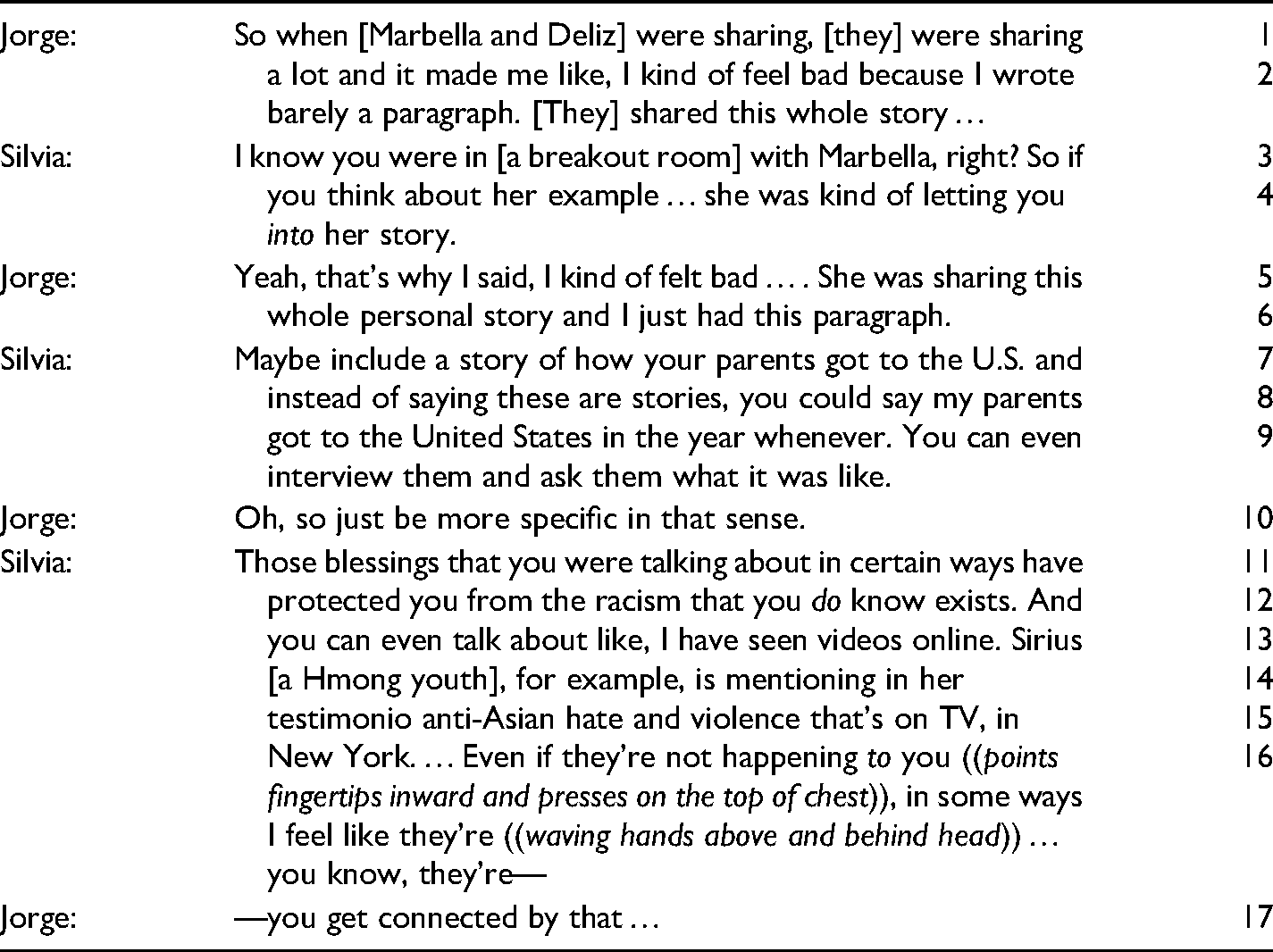
In lines 2 and 5, Jorge expressed feeling “bad”—an emotive and vulnerable response—because peers had shared a “whole personal story” whereas he only shared a paragraph. Further, Silvia noted that Marbella's text was effective in “letting you into her story” (line 4) to encourage Jorge to perhaps interview his parents to effectively provide more details, which he understood (line 10). Also, Silvia returned to the theme of “blessings” (line 11) Jorge had developed, and encouraged him to consider how others around him had protected him “from the racism that you do know exists” (line 12). To make her case, she encouraged him to address instances of racism he had encountered online or in the news, much like Sirius (Hmong youth) had shared that “anti-Asian hate and violence” (lines 13–15) had affected her community. Finally, Silvia was particularly instructive in stressing that racism and oppression might not be “happening to you” (lines 15–16), and Jorge was able to complete her sentence by adding, “you get connected by that” (line 17), which was a turning point.
Our analysis demonstrates that reconciling Jorge's lived contradictions as a racialized Latino from an immigrant family resulted, in part, from bearing witness to his peers’ stories as part of the testimonio process. That is, he came to recognize his own story as giving voice to his family's story. Thus, his engagement with the testimonio process would eventually lead to his emergent understandings of oppression and marginalization as a lived, embodied experience rather than direct and overt acts of hardship and violence. Ultimately, Jorge addressed the notion of bearing witness in his final testimonio, as illustrated here: One of the biggest questions that this program has asked is “What does it mean to witness?” It has taken me a while to understand and fully be able to answer the question, and the answer is: You don’t need to be physically in the moment, but just by simply listening to whoever tells the story.
Jorge's case allows us to show the negotiated quality of his sense-making and how, along with other multimodal tools and texts, it became consequential as he reconciled his lived contradictions in his final testimonio.
Historicizing
By engaging youths in faithful witnessing, which required traveling through their peers’ narratives, at the end of Week 3, when Jorge, Marbella, and Deliz (Latino/a youth) shared their near-final drafts, Jorge was compelled to more fully historicize his family's experiences with oppression and racism. Indeed, his final testimonio was about his parents’ migrations from Mexico to the United States and across several U.S. states: I’m going to tell how my parents made an effort to go to the United States, and how their life was like back then, and the huge journey they took, going from a small town to huge cities such as New York or [Melville, WI], and walking through the hot desert. And I wasn’t exactly there when it happened, but I still witnessed that moment by simply listening.
Through testimoniando, Jorge came to fully appreciate witnessing as empathy and solidarity-building because, as he concluded, “You don’t need to be physically in the moment.” By historicizing, Jorge's engagement with SLs illustrates how the process of reflection, critical discussion, and bearing witness to others’ experiences supported him in locating struggles of oppression and racism within the collective. Through this engagement in SLs within the collective, Jorge began to unravel how individual struggles are interwoven and result from systemic injustices at various levels. Jorge's case demonstrates how learning from and alongside others and bearing witness—that is, through faithful listening, love and travel—can create pivotal moments where youths enact SLs and historicize their individual, family, and community experiences to reimagine new educational possibilities.
In the following sections, we draw from youths’ final written testimonios to analyze how they consistently addressed key reflections, pivotal events, and formative experiences that generated struggle, marginalization, and exclusion for them and their parents, families, and communities—proximally and distally, living and deceased. We show how youths critically and agentively reflected on their lived contradictions, articulated their resilience and experiential sense-making, and engaged in testimoniando to foster collective memories and narratives.
Theme 1: Critical Reflections on Racism and Colorism
Across testimonios, youths critically reflected on their lived contradictions, as well as those of their immigrant and refugee parents, families, and communities in both their home countries and the United States. Youths understood that these contradictions were shaped by their linguistic, racialized, ethnic, cultural, socioeconomic, gender and sexual identities, and unique learning capacities. For example, Deliz (Latina) elaborated on how colorism shaped her childhood by highlighting the contradiction between being “darker” only relative to her mostly white peers. Yet, her testimonio also illustrated that she embodied a critical perspective about colorism and understood that she never should have felt that way, as shown here: I never liked when my friends in 1st grade would compare each other's skin colors and it was always me who was darker. I wasn’t so dark but I was darker than my classmates. It always made me feel like I needed to be lighter. My elementary school was … mostly white. The thoughts and feelings I had … were terrible. I thought that light skin was better and more attractive … . I remember … showering and I would try to scrub harder just to remove my color and be lighter. I was only 8 years old … . That should have never been a worry in my life as a Mexican little girl in elementary school.
Her text makes clear that her “terrible” thoughts and feelings about her darker skin were shaped by her white classmates who compared their skin color to determine who was “darker.” Moreover, the fact that Deliz attended a “mostly white” school seemed to exacerbate her thoughts and feelings since she developed a strong desire to have lighter skin and be “more attractive.” A painful reality was that as an eight-year-old, she routinely tried “to scrub harder” in the shower to lighten her dark skin in a desperate attempt to look and be “more attractive.”
Yet, Deliz also demonstrated a consciousness of her skin color. She recognized that colorism, hating her dark skin, and desperately wanting lighter skin “should have never been a worry in my life as a Mexican little girl.” Indeed, toward the end of her testimonio, she declared: “I now love my skin color … . [It] makes me feel even more Mexican … . I love it because it makes me feel powerful.” What she described as being “darker” was now intertwined with her Mexican identity and made her feel proud and empowered to call for an end to colorism because it “hurts anyone at any age.” This narrative demonstrated Deliz's critical reflections about her lived contradictions and resilience in coming to accept dark brown skin as a symbol of being Mexican, proud, beautiful, and powerful. Similarly, other youths discussed how racism played out in their lives. For Jennifer (Latina), this was an intersectional issue given that she connected the sexual abuse she had experienced to her race. Critical reflections on racism and colorism were reflected in codes addressing the youths’ self-descriptions and identities (i.e., race, sex, and gender), mental health, and negative experiences (see Appendix B).
Theme 2: Critical Reflections on Linguicism
Similar to Deliz, Bella (Latina) addressed how speaking Spanish as a home language in the United States created significant contradictions in her and her mother's lives, and her testimonio represented their collective experience. Bella's challenges around learning English were mitigated by the fact that her Spanish-speaking immigrant mother relied on Bella's English proficiency and bilingualism. She acknowledged that “Latinx people,” including her mother, migrated to the United States, which was “hard enough” but made worse because they cannot speak English. Yet, it was also framed by a recurrent theme that struggle does not impede pride in her language: she stated, “Where I come from … definitely made me strong.” In the following excerpt, she explained that being in a preschool bilingual classroom felt “easy” but that the transition to an English-only classroom provoked fear and insecurity: I had fear. I was a kid, so learning English wasn’t as hard for me, but it was definitely hard having everyone's eyes on you even if they were trying to help. You panic and think, “I’m not good enough. I’ll never understand this. I’ll never be able to speak properly.”
English-only classrooms generated fear and panic, and while the task of learning English was not “as hard,” the social context of “having everyone's eyes on you” was “definitely hard” for her, even if others were “trying to help.”
She also admitted that she did not feel “good enough” to comprehend and communicate in English, but elaborated the role that Spanish and her growing English proficiency ultimately played in her and her mother's life: I have been taught a lot in this world by her, not just Spanish, which is something I’m grateful for … [and] to repay a small part of that, I have always tried to teach her English along the way … . [As] a kid, I had to step in to translate English for her. It wasn’t easy, but I also know a lot of people have done this … . It's hard work but you also deal with it because you want to help and you understand that it's not easy to just understand English … . If I can help others, I will because it's cruel not understanding the language since for most of us, it isn’t our first.
This excerpt illustrates the lived contradictions around languages and related cultural practices, which were shaped by her relationship with her mother. She appreciated learning Spanish and other valuable knowledge from her mother, and wanted to “repay a small part” by trying to “teach [her mother] English along the way.” Lastly, the cultural practices around translation for her mother were “hard work,” and indeed, this complexity has been documented (Martínez et al., 2008; Orellana et al., 2003). Yet, Bella sympathized with her mother and was determined to help her and others like her.
Theme 3: Critical Reflections on Experience as Knowledge
Our data analyses showed that youths consistently articulated the valuable lessons they learned and knowledge they gained from a broad range of lived experiences proximally and distally, in the present and in the past. They learned about social relations, ways to overcome fears, legacy and reputation, and perseverance and resilience. This resilience demonstrated that youths were in the process of becoming conscious historical actors “locating themselves in a larger history, and developing a sense of their individual and collective agency and voice” and believing “they had an informed perspective to critique, challenge, and re-mediate society's dominant narratives and unjust practices” (Gutiérrez et al., 2019, p. 293). In their testimonios, youths consistently transformed their and their families’ often turbulent, vulnerable, and precarious experiences into opportunities for learning, sense-making, and dreaming. Some of them included sexual assault, migration to the United States, racism, colorism, linguicism, and marginalization in schools and society. While these experiences are often framed broadly as debilitating, and rightfully so, GANAS youths articulated the substantive life lessons and experiential sense-making that allowed them to persist, flourish, and dream out loud.
An illustrative testimonio that exemplified youths’ critical reflections on experience as a source of knowledge was written by Sirius and was titled “Meej mom” (“legacy and reputation”).
4
She began with her grandmother's pivotal death, which meant her uncle and aunt became the family's “grandparents” whose new role was to share important lessons with the “grandchildren” based on the trials of leaving Laos, their home country, and making a new life in the United States, as illustrated in this excerpt: After my grandma died when I was in second grade, yig laug Vam Xeeb [Uncle Vaseng] and phauj Thoj [Aunt Thao] became our grandparents, the people we would ask for advice, our wealth of knowledge, they were our living history.
5
Her narrative addressed her family's sociocultural practices that revered elders who were believed to possess valuable knowledge and insight. She explained that her yig laug and phauj were “our living history” and that these “grandparents” fostered intergenerational, transnational knowledge of their place in a broader sociohistorical trajectory as refugees.
Sirius then foregrounded her family's struggles, embodied learning, and knowledge. While she valued the lessons learned, she reflected more fully on capitalizing on opportunities for mobility but also feeling “conflicted” and “still questioning” her obligation to meej mom, her family's collective and enduring legacy and reputation. The following excerpt illustrates her learning and sense-making about meej mom: [Uncle] says we should uphold our grandfather's legacy and reputation. If we do not … we would corrupt it. However, by living up to this legacy and reputation, we need to be a good person and possibly be a person who does well in school … . As we uphold our grandfather's meej mom, we can also enhance it. Our grandfather's legacy and reputation will become our generation's legacy and reputation that we will transform.
She clearly understood the expectation for her to “uphold our grandfather's legacy and reputation” and the potential to “corrupt it.” She linked being “good” and doing “well in school” to legacy and reputation. Yet, she acknowledged that upholding meej mom was not static because younger generations “can also enhance it,” and indeed, it will “become our generation's legacy and reputation that we will transform.” She understood that her generation would leave a legacy and reputation for future generations to uphold, enhance, and transform. This view reflected her consciousness and future-dreaming about the sociohistorical trajectory of Hmong refugees who were resettled in Wisconsin and their U.S.-born children, and about her key role in conveying the meaning and value of meej mom for future generations.
Like Sirius, Diego (Latino) in his testimonio demonstrated a keen awareness of the school system, rather than his disability, being the primary source of his struggles. We drew heavily from the analytic code that demonstrated evidence of growth and/or critical consciousness (see Appendix B) to document the ways youths recognized their experiences as valuable sources of knowledge. Other GANAS youths understood themselves to be situated sociohistorically across places, regions, spaces, wars, and countries. Yet, they also demonstrated the learning, sense-making, and insights their contradictory lived experiences had imparted as well as their resilience and future-dreaming they articulated for themselves, for their parents, families, and ancestors, and for their communities.
Discussion
Our data analyses demonstrated first, through an illustrative case, that facilitating SLs through the process of constructing a testimonio was not a uniform and seamless process. While instructors provided model texts and opportunities for youths to begin to appropriate key constructs (e.g., multiplicity, collective narratives) as they reflected on their own lived experiences through brief writing tasks such as quick-writes, the case of Jorge shows that discussions and the notion of bearing witness were key. Bearing witness to his peers’ narratives, which were personal, holistic, and moving, he was ultimately compelled to narrate a fuller, more complex text. By instructors encouraging Jorge to move beyond reflecting individually about his “lack of hardships” and “blessings” and instead to reflect on how his parents and family collectively and deliberately protected him from racism and oppression, he was able to narrate his parents’ migrations and sacrifices as his own—even if he was not physically present.
Additionally, youths’ testimonios made visible their critical reflections about the central contradictions in their lives based on their unique backgrounds, histories, experiences, and sociocultural lives. Their critical thinking was demonstrated through their understanding of the extent to which their intersectional identities were shaped by broader sociopolitical, sociological, and structural dimensions. For example, they addressed linguicism, colorism/racism, and secret wars and how broader sociocultural and sociohistorical processes were consequential in their lives. Yet, youths also articulated how their individual and collective experiences were forms of knowledge and ways of knowing. They identified the new insights they have gained throughout their lives and enacted SLs by taking advantage of the opportunity to reimagine and reenvision future lives based on the resilience and self-determination they and their parents, families, and ancestors embodied. In this way, they engaged in testimoniando and echándole ganas. They voiced their stories, engaged in acts of resilience and self-determination, and dreamed out loud for themselves and others.
Moreover, youths’ testimonios were informed by the notion that as artifacts of collective remembering, they were also voiced by ancestors, parents, grandparents, and other significant people. These stories revealed youths’ perspectives and perceptions about their sociohistorically situated lives and how they saw themselves as part of a history and narrative of multigenerational struggle, self-determination, resilience, and reimagined futures, or a process of collective remembering that is nonetheless ultimately a contested historical narrative (Wertsch, 2009). Youths’ calls to action for social and societal change were imbued with the voices and consciousness of their parents, families, and communities near and far. The GANAS community contributed to this collective remembering through relationships and pedagogies that opened a space for youths to explore and redefine their sociohistorical lives.
Conclusion and Implications
Educators continue to underserve bi/multilingual and other minoritized youths by employing language and literacy approaches that overemphasize skills, texts, and practices and devalue these youths’ lived realities and full humanity. As an SDE, GANAS was equity-driven, promoted meaning-making and critical thinking, and advanced social change by facilitating testimonio as a process, product, and pedagogy (Delgado Bernal et al., 2012). It intentionally re-mediated and reorganized what counts as learning, writing, and knowledge by centering youths’ lived experiences and material realities in their creation of a testimonio, a genre that facilitated their enactment of SLs as they reflected critically on their past, present, and future. While these skills might be facilitated by other genres, skills, texts, and practices, developing testimonios and enacting SLs uniquely built on the lived experiences, histories, knowledges, and cultural resources of bi/multilingual youths from immigrant and refugee backgrounds.
Implementing an SL approach in classrooms may require educators to consider possible shifts in their Westernized thinking, exacerbated by the Western ideals that shape educational institutions, and shifts in their praxis around what it means to know, learn, and become from a critical lens. As our findings suggest, this can be achieved by promoting SLs and introducing pedagogical tools that promote (a) bearing witness, (b) sense-making and reconciling contradictions, and (c) historicizing. For literacy educators who seek to embody and enact SLs, we encourage the design of equity-driven learning ecologies that prioritize sense-making and critical thinking in service to social action (Gutiérrez & Jurow, 2016). As literacy educators encounter increasingly linguistically and culturally diverse classrooms, including immigrants and refugees and their children, we stress the importance of learning ecologies that deploy students’ everyday literacies and facilitate SLs and opportunities for faithful witnessing, with loving mind, body, and spirit, as they resurrect the silenced histories of marginalization and oppression. As we demonstrated, testimonios can facilitate the development of SLs and elevate the kinds of resources, learning, sense-making, and knowledge as youths prepare to further engage with a range of texts, genres, discourses, and modalities in their schooling.
By emphasizing bi/multilingual youths’ collective sense-making and remembering as they engaged in deep learning, dreaming, and becoming, they reimagined and rewrote their social futures by traversing historicity, temporality, and spatiality in their life histories and narratives. We recognize their dreaming of new social futures as a form of equitable social action and social change. As Gutiérrez (2008) has argued, innovative equity-driven programs for minoritized youths can create a “matrix of language and embodied practices [that] create a social situation of development that facilitates a collective social imagination … for participants who may share a social history as migrants but who have varied trajectories and challenges” (p. 154). Ultimately, the implication for literacy educators involves developing a penchant for engaging bi/multilingual youths in imaginative and collective future-dreaming as the radical roots of literacy activity and classrooms. Our hope is that literacy educators will challenge dominant discourses that tend to devalue the literate lives of these youths, their families, and their communities, and instead build on their dynamic ways of knowing, being, living, and thinking with the goal of promoting a collective social imagination and new social futures.
Supplemental Material
sj-docx-1-jlr-10.1177_1086296X251352622 - Supplemental material for Re-imagining Social Futures: Bi/Multilingual Youths’ Sociocritical Literacies
Supplemental material, sj-docx-1-jlr-10.1177_1086296X251352622 for Re-imagining Social Futures: Bi/Multilingual Youths’ Sociocritical Literacies by Mariana Pacheco, Taucia González, Na Lor, Joan J Hong and Kate Roberts in Journal of Literacy Research
Supplemental Material
sj-docx-2-jlr-10.1177_1086296X251352622 - Supplemental material for Re-imagining Social Futures: Bi/Multilingual Youths’ Sociocritical Literacies
Supplemental material, sj-docx-2-jlr-10.1177_1086296X251352622 for Re-imagining Social Futures: Bi/Multilingual Youths’ Sociocritical Literacies by Mariana Pacheco, Taucia González, Na Lor, Joan J Hong and Kate Roberts in Journal of Literacy Research
Supplemental Material
sj-docx-3-jlr-10.1177_1086296X251352622 - Supplemental material for Re-imagining Social Futures: Bi/Multilingual Youths’ Sociocritical Literacies
Supplemental material, sj-docx-3-jlr-10.1177_1086296X251352622 for Re-imagining Social Futures: Bi/Multilingual Youths’ Sociocritical Literacies by Mariana Pacheco, Taucia González, Na Lor, Joan J Hong and Kate Roberts in Journal of Literacy Research
Supplemental Material
sj-docx-4-jlr-10.1177_1086296X251352622 - Supplemental material for Re-imagining Social Futures: Bi/Multilingual Youths’ Sociocritical Literacies
Supplemental material, sj-docx-4-jlr-10.1177_1086296X251352622 for Re-imagining Social Futures: Bi/Multilingual Youths’ Sociocritical Literacies by Mariana Pacheco, Taucia González, Na Lor, Joan J Hong and Kate Roberts in Journal of Literacy Research
Supplemental Material
sj-docx-5-jlr-10.1177_1086296X251352622 - Supplemental material for Re-imagining Social Futures: Bi/Multilingual Youths’ Sociocritical Literacies
Supplemental material, sj-docx-5-jlr-10.1177_1086296X251352622 for Re-imagining Social Futures: Bi/Multilingual Youths’ Sociocritical Literacies by Mariana Pacheco, Taucia González, Na Lor, Joan J Hong and Kate Roberts in Journal of Literacy Research
Supplemental Material
sj-docx-6-jlr-10.1177_1086296X251352622 - Supplemental material for Re-imagining Social Futures: Bi/Multilingual Youths’ Sociocritical Literacies
Supplemental material, sj-docx-6-jlr-10.1177_1086296X251352622 for Re-imagining Social Futures: Bi/Multilingual Youths’ Sociocritical Literacies by Mariana Pacheco, Taucia González, Na Lor, Joan J Hong and Kate Roberts in Journal of Literacy Research
Supplemental Material
sj-docx-7-jlr-10.1177_1086296X251352622 - Supplemental material for Re-imagining Social Futures: Bi/Multilingual Youths’ Sociocritical Literacies
Supplemental material, sj-docx-7-jlr-10.1177_1086296X251352622 for Re-imagining Social Futures: Bi/Multilingual Youths’ Sociocritical Literacies by Mariana Pacheco, Taucia González, Na Lor, Joan J Hong and Kate Roberts in Journal of Literacy Research
Supplemental Material
sj-docx-8-jlr-10.1177_1086296X251352622 - Supplemental material for Re-imagining Social Futures: Bi/Multilingual Youths’ Sociocritical Literacies
Supplemental material, sj-docx-8-jlr-10.1177_1086296X251352622 for Re-imagining Social Futures: Bi/Multilingual Youths’ Sociocritical Literacies by Mariana Pacheco, Taucia González, Na Lor, Joan J Hong and Kate Roberts in Journal of Literacy Research
Footnotes
Acknowledgements
Dr. Yang Sao Xiong, Dr. Madeline Hafner, and Ana Mireya Diaz
Declaration of Conflicting Interests
The authors declared no potential conflicts of interest with respect to the research, authorship, and/or publication of this article.
Funding
The authors disclosed receipt of the following financial support for the research, authorship, and/or publication of this article: This work was supported by the Transform Grant - School of Education, UW - Madison, (grant number AAD-4265).

Notes
References
Supplementary Material
Please find the following supplemental material available below.
For Open Access articles published under a Creative Commons License, all supplemental material carries the same license as the article it is associated with.
For non-Open Access articles published, all supplemental material carries a non-exclusive license, and permission requests for re-use of supplemental material or any part of supplemental material shall be sent directly to the copyright owner as specified in the copyright notice associated with the article.
