






Abstract
The proliferation and importance of online communities have created an expansive research terrain for literacy research. Within a networked communication landscape located within and across platforms, designing studies of online communities presents methodological challenges, foremost of which is how to define and operationalize online communities. In this conceptual article, we explore interdisciplinary definitions of online communities and outline three constructs regarding literacy research about online communities: (1) spatiality: how online communities are constituted in virtual space, (2) reliability: how human subjects are composed online, and (3) temporality: how the passage of time blurs the boundaries between public and private data online. We discuss these constructs and the tensions they present for research about online communities in a postdigital era, explore implications for the study of literacy across various populations and global locations, and propose recommendations and questions for literacy researchers to consider in designing and conducting studies about online communities.
Keywords
The twenty-first century has witnessed the ubiquitous digital mediation of social life, politics, and meaning-making. The structures of social media allow for geographically disparate communities to assemble online and construct meaning together (Addeo et al., 2020). We have seen the impact of online communities on world events from the Arab Spring in the Middle East to the January 6, 2021, attack on the U.S. Capitol as people have organized and responded in real time through online platforms. At times, the activities of an online community can shift spheres of impact, as when Taylor Swift fans organized to show support for Palestine or Korean pop fans helped shut down a Trump rally (Coscarelli, 2020; Lee, 2024). Indeed, what happens in online communities does not stay in online communities. The meanings that online community members construct together have a reciprocally constitutive relationship with political and personal life outside of the internet.
Since Hine's (2000) argument for virtual ethnography, that online interactions are sites of socially meaningful learning and activity worthy of rich qualitative study, various fields have produced a diverse array of studies about online communities. For example, media scholars have highlighted the significance of online community formation for activist communication and solidarity (Arda & Akdemir, 2021). Online communities have also been critical for researchers tracing literacy practices that span off- and online settings (Lam & Wu, 2025). Literacy researchers have studied communities dedicated to fan fiction (Black, 2008), literature (Boffone & Jerasa, 2021), and transnational media (Kim, 2025). At the same time, the proliferation and significance of diverse forms and purposes of online communities have made the question of how to conceptualize them more elusive. These conceptual and methodological discussions have largely been located in media studies, with further clarification needed within literacy research.
The Need to Examine Online Communities in Literacy Research
Despite the growth of online communities and calls for more digitally oriented research (Baker, 2021), there remains ambiguity regarding what an “online community” is within literacy research, with studies defining and bounding communities in diverse ways (e.g., Black, 2008; Kist et al., 2014; McDaniel, 2025). Given the rise of platformization, the increasing organization of cultural, economic, and social activity around digital platforms (Robinson, 2025), public life is now inseparable from the digital as communities are formed, maintained, or managed online.
Literacy research's history of detailed excavations of socially situated communication provides a powerful theoretical lens for examining online communities. A slowly building tide of work over the last 20-plus years has shown the entanglement of digital and social literacy practices that have now become inseparable (Leander & McKim, 2003; McDaniel, 2025; Weich & Macgilchrist, 2023). Due to the increasing importance of online activities, literacy researchers at the start of the twenty-first century anticipated a destabilizing of key constructs in ethnographic research and the need for new frameworks and methodologies (Leander & McKim, 2003). The central role of digital platforms in mediating learning, socializing, and political engagement (Literat & Kligler-Vilenchik, 2021) has led some literacy researchers to argue for recentering the discipline around digital media ecology (Nichols & LeBlanc, 2021) as the guiding metaphor for understanding learning in digital spaces, which we discuss later in relation to studies of online communities.
There are now broad methodological guidelines for conducting internet research (franzke et al., 2020) that emphasize “asking and answering critical questions rather than taking a more deductive, rule-oriented approach” (p. 2) to research in virtual spaces. Aligned with this view, Howlett (2022) articulated how the COVID-19 pandemic forced a rethinking of research sites due to physical and social distancing, or what Haverinen (2015) had previously discussed as the “placeness of ethnography” (p. 82). Given their disciplinary location outside of literacy research, these guidelines understandably do not mention literacy or social practices, leaving a gap in discipline-specific discussions and guidance about online communities research.
In this conceptual article, we build upon recent guidelines for internet research and studies of online communities (e.g., franzke et al., 2020; Howlett, 2022) by placing this work in conversation with literacy scholarship that has framed place and identity as key constructs for studying online literacies as social practices (Leander & McKim, 2003). We focus on this central question: How are online communities defined? Drawing on literacy studies’ deep tradition of ethnographic research that contextualizes literacy in time, space, and individual/communal experience, we consider how “limits of the local” (Brandt & Clinton, 2002, p. 337) have been transformed by the digital, proffering three key constructs for studying online communities within literacy studies:
Spatiality: How does the dynamic geography of virtual space shift the constitution of communities online? Reliability: How do conceptions of participant identities and ethical issues surrounding privacy contribute to the ways researchers study online communities? Temporality: How do researchers define community membership and analyze data that accrue over time within online communities research?
By exploring these concepts in relation to fundamental questions about the nature of online communities, we seek both to contribute to nuanced discussions of online communities as field sites and to present literacy researchers with key theoretical and methodological challenges for conducting ethical research in and about online communities. We begin with a brief review of literacy research on online communities and an exploration of two relevant theoretical lenses: postdigital theory and platform studies. We then explore descriptions of online communities before introducing the three central concepts (spatiality, reliability, and temporality) in relation to methodological, theoretical, and practical questions for literacy research. We conclude with implications and recommendations specifically for literacy researchers.
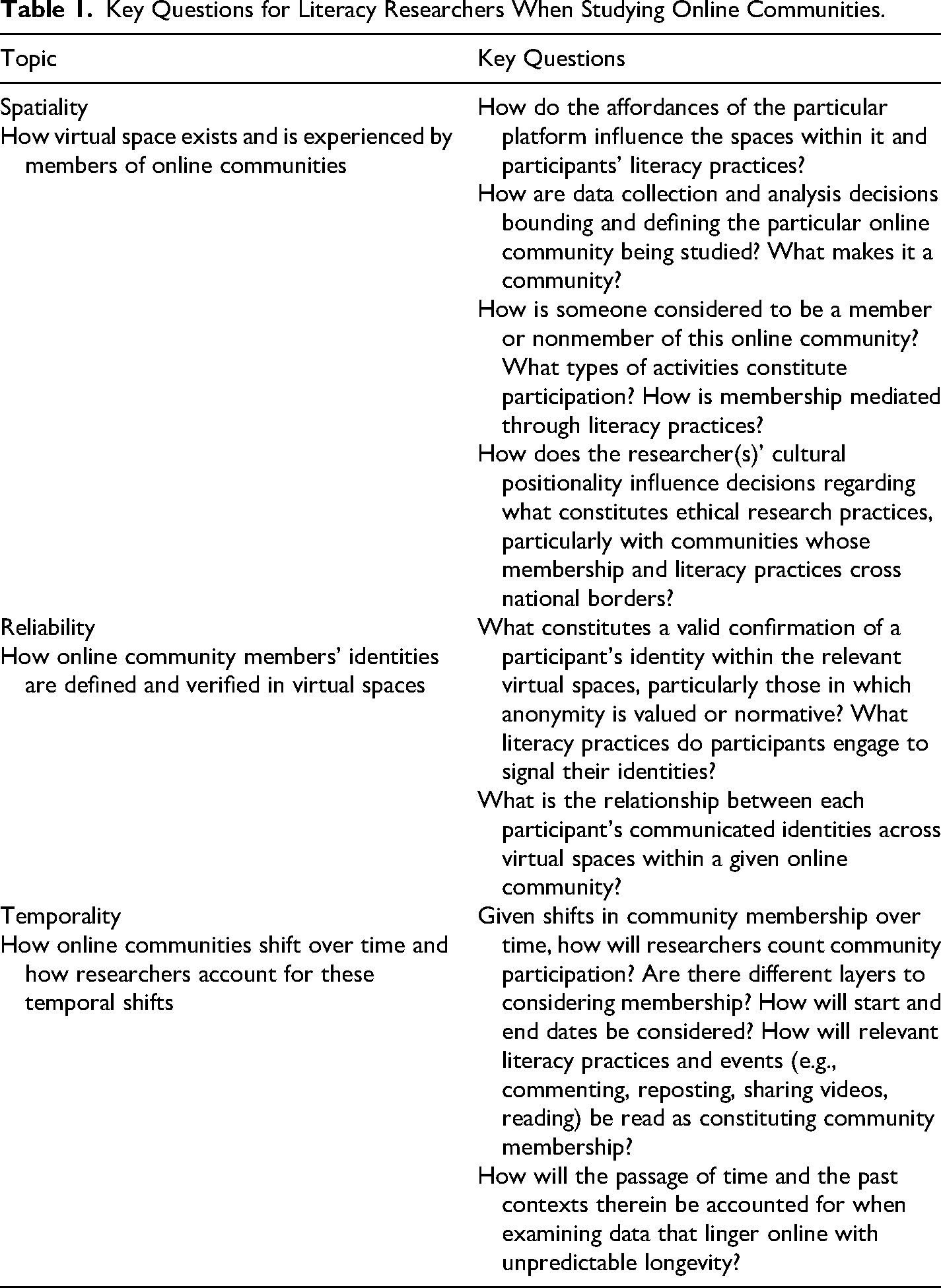
Key Questions for Literacy Researchers When Studying Online Communities.
Background and Perspectives
In this section, we draw upon literacy research, critical platform studies, and postdigital theory as relevant lenses for studying online communities.
The Evolution of Online Communities Research in Literacy Studies
Whether communities meet online or in person, their “ways with words” deeply inform how participants understand and act within the world (Heath, 1983). Literacy research about online communities has therefore been highly compatible with the concept of communities of practice (Lave & Wenger, 1991) by stressing learning as social participation. In an explication of practice as the cornerstone of community, Wenger (1998) argued that communities of practice are a special type of community: a unit composed of mutual engagement, a joint enterprise, and a shared repertoire. The concept of affinity spaces has also been taken up within literacy research, sometimes in tandem with communities of practice, to consider how learning and participation function in often networked spaces organized around shared interests and passions (Gee, 2003). In line with scholarship tracing shifts in authorship practices over the last 30 years (Knobel & Lankshear, 2014), affinity spaces tend to include more distributed power, looser participation structures, and a focus on studying identity within communities. In their study of professional development within a web seminar series, Albers et al. (2016) explained how just as there are varied definitions of communities of practice, the situated learning occurring within them might be understood using affinity spaces, which do not hold the same expectations of official membership and belonging of all members as the term “community” might contain: “Affinity spaces … are conceptualized around the key attributes of physical or virtual space and common interests …. That is, interest drives participation” (p. 228).
The evolution of social interactions within communities that meet primarily or entirely online led to a proliferation of interest-driven online communities research. New research emerged, including studying online communities as cultures in and of themselves. As virtual ethnography (Hine, 2000) became a more recognized method for examining shared practices within networked communities, studies of online communities documented the importance of students’ out-of-school literacy practices, such as Black's (2008) findings about young people's literacy practices within online fanfiction communities.
Adjacent to Hull and Shultz's (2002) seminal work highlighting out-of-school literacy practices, the spread of digital devices stimulated a surge of studies attending to students’ digital literacy practices in and out-of-school by following these practices across spaces (e.g., Lam, 2012, Leander & McKim, 2003), illustrating the need to move beyond place-based conceptions of ethnography for studying literacy practices in adolescents’ lives. Literacy researchers also began attending to the role of online communities within the everyday literacy learning of youth. Lammers et al. (2012) proposed affinity space ethnography as a way to study individuals’ digital literacy practices across multiple sites. Curwood (2013) focused on The Hunger Games fans by following their literate activities in a 2-year ethnography. Attention to out-of-school digital literacy practices led to studies that included data drawn from the texts of online communities and from outside of digital spaces. Kovalik and Curwood (2019) analyzed digital poetry created within an Instagram community using interviews and survey data. More recently, McDaniel (2025) analyzed one student's social media posts across four platforms and “off-social media artifacts” with interviews to understand critical cultural, racial, and discursive communities online. Literacy researchers have also considered networked individuals with shared identities and aims as virtual communities, such as vloggers within LGBTQ + video channels on YouTube (Shrodes, 2022). Similarly, examining the literacy practices of four Caribbean influencers, McLean (2024) studied online communities as the audience of the influencers across five social networks and platforms.
Digital Platforms and Postdigital Perspectives
Postdigital scholars have emphasized the ubiquity of the digital throughout contemporary life, arguing that recognition of culturally situated realities requires a movement beyond concern with digital literacies as novel or separate from nondigital life (Rowsell, 2025). Rather, the digital is “already deeply woven into everyday practices” (Weich & Macgilchrist, 2023, p. 20). The postdigital reframes literacy research's emphasis on situated contexts by bringing attention to the ubiquity and embeddedness of digital technologies, with greater focus on infrastructures, algorithms, data, and platform capitalism as central factors in human activity and learning (Bhatt, 2023). Building from this central presumption, studies of online communities will be critical for literacy research to address contemporary sociopolitical realities.
This theoretical shift has been accompanied by drastic changes in the functioning of the platforms upon which digital communities are housed. Critical platform studies trains its lens on the platforms that mediate and govern daily activity in and outside of schools (Garcia & Nichols, 2021). The “critical” in “critical platform studies” brings attention to the roles of power, politics, race, and history in the mediating functions of digital platforms (Noble, 2018; Tanksley, 2025). This perspective, applied to the study of online communities, focuses attention not only on social activity, but also on how digital platforms shape what literacy practices and learning are possible, encouraged, or discouraged within them (Robinson, 2022), with some researchers employing the term “platform practices” to emphasize the centrality of digital platforms (Duffy et al., 2019).
These lenses both extend and transform sociocultural theory's interrogations of the locally, culturally, and historically situated nature of online communication by considering the technological and material underpinnings of the digital spaces within which such communication occurs. We draw on these perspectives to examine key issues regarding literacy research conducted about, around, and in online communities, bringing particular attention to the ways that the logics, affordances, and constraints of online platforms shape and raise questions about studies of online communities, and how varied forms of power (on the part of researchers, participants, or other relevant stakeholders) are manifested in online communities research.
Situating Our Inquiry
Our work includes studies of different types of online communities, including a transnational forum in which members shared an affinity for Korean popular culture (Kim, 2016, 2019) and a community of teachers who gathered online to explore critical media literacy (Nash, 2024; Nash et al., 2023). Since collecting data for these studies, the growing importance of online communities and the rising prominence of digital platforms have further complicated our methodological questions about researching online communities. Designing studies of online communities today is an ever-evolving endeavor that presents many methodological questions. In the following section, we consider how scholars have framed online communities within this expansive research terrain.
Defining Online Communities
There is no single, agreed-upon definition of communities in online spaces, just as there is no singular definition of communities writ large. Defining online communities has always been elusive (Plant, 2004), due to issues such as whether an online community's interactions must occur exclusively virtually (e.g., Garcia et al., 2009; Kozinets, 2010) and how centralized the space in which a community's virtual activities must be online to be considered a community (Caliandro, 2018; DeCook, 2018). Researchers have documented social connections within online communities relying on local offline ties (e.g., Marsh, 2011) as well as relationships developed within exclusively online communities (e.g., Schaap & Aupers, 2017). In this section, we aim to unpack the use of the term—separating out myriad possible manifestations for its shape across dimensions, highlighting diverse possibilities for how online communities are constituted, articulating complexities in defining them, and offering key questions for studying them.
Varied Forms of Online Communities
Studies have detailed a range of online communities and illustrate diverse approaches to how a community can be bounded online for the purposes of a study. Researchers have, for example, examined the activity of gamers in three-dimensional virtual worlds (Schaap & Aupers, 2017), social media communities tied to particular universities (Bayne et al., 2019), and online gatherings of individuals tied through local bonds and relations (Nash, 2024). Kozinets (2010) termed this latter setup “communities online.” As researchers who examine online social formations use “community,” a term traditionally tied to geographic boundaries and the material world, theoretical and methodological questions emerge about how this term functions, or could function, in a networked world in which communities exist across geographic regions.
Given that “online community” is a term with variable definitions, identifying an online community for study requires first deliberating how the online social formation is a community (Caliandro, 2018). Some researchers have used the term “online community” when collecting data around a hashtag, identifying the accounts interacting around the hashtag as a community (DeCook, 2018). Others distinguish those formations under categories such as crowds or publics and emphasize how online environments challenge ethnographers to move away from focusing on field sites to mapping social formations that emerge around the “circulation of an empirical object within a given online environment or across different online environments” (Caliandro, 2018, p. 560).
To delineate an online community, Kozinets (2010) proposed a typology that includes four roles: devotee, insider, newbie, and mingler, which may, for example, not be present within an online forum and thereby preclude consideration of it as an online community. At the same time, online roles, practices, and criteria for membership are diverse and dynamic within forums and platforms (García-Rapp, 2019), such that the definition of an online community is diverse and dynamic as well.
Within literacy research, online communities have often been examined via case studies that define communities and field sites around particular websites. Examples of online communities that exist on particular websites include a fan fiction site (Black, 2008), a dog breed forum (Guzzetti & Foley, 2014), and a poetry-sharing site (Padgett & Curwood, 2016). Other literacy researchers have delineated online communities through social media threads (Kist et al., 2014) or school-connected sites as organizing principles for bounding communities. For example, Pytash et al. (2016) looked at activity in a massive online open course, Sherry (2017) looked at online discussion spaces as they were connected to students’ course assignments, and Albers et al. (2016) looked at an ongoing web seminar on literacy research for literacy teachers and teacher educators. Despite the now-established understanding of online activity as nearly always traversing sites and the diffuse, multimodal, multisited nature of literacy (Stornaiuolo et al., 2017), literacy research has largely defined online communities through participation in sites with recognizable boundaries, mirroring the field's extant theoretical and methodological grounding in local spaces. The postdigital's emphasis on the complex, messy, and entangled nature of digital activity can help to highlight the difficulties of bounding contemporary online communities. In this article, we build upon these theoretical assumptions that emphasize the complexity and fluidity of literacy across spaces to examine the nuances of how online communities are studied within ethnographic literacy research.
The Role of Platforms in Shaping Online Communities
Although platforms in themselves do not constitute communities, platforms can shape and construct online communities (McLean, 2024). There is not always a simple boundary for researchers to draw between a community member and a nonmember on sites like X or Instagram, in which communities are framed via threads, hashtags, or tagging mechanisms that allow users to enter or exit particular discourses or discourse communities. Online communities that are “closed,” such as private groups hosted on a social network site, provide a possible way of conceptualizing the boundary of an online community, as well as what literacy practices within it are sufficient to consider someone as a community member, such as reacting with “likes” and emoji (Collins et al., 2024). Researchers may still need ultimately to decide whether all participants in such an online group are community members and thereby qualify as potential research participants.
We began this section emphasizing the lack of a single definition of online communities, a fact that surfaces their diversity of forms (DeCook, 2018; García-Rapp, 2019; Kozinets, 2010). However, some shared boundaries and features exist. We thus broadly define online communities as social formations in and across digital spaces characterized by shared interests, practices, or purposes where members engage in sustained interactions, develop social connections, and contribute to each other's understanding of the world. These communities may exist exclusively online or blend virtual and physical interactions, with boundaries that are often fluid and defined by factors such as patterns of participation, shared discourse practices, and varying levels of member engagement rather than geographic proximity.
Exploring Central Concepts in Online Communities Research
Studies of online spaces require rethinking normative constructs of research (Markham & Gammelby, 2018). In this section, we draw from examples across fields, including literacy research, to highlight fundamental challenges in operationalizing online communities. We focus on three constructs: spatiality, reliability, and temporality. Within each section, we consider key theoretical, ethical, and methodological considerations for literacy researchers conducting research in online spaces.
Spatiality: Communities in Virtual Spaces and Places
Space takes on new meanings in virtual settings, as implied via the embedded metaphors in the word “website,” which indicates a site located within a larger connected web established via innumerable hyperlinks. Researchers have found that studies conducted partly or entirely online require new methods for defining the spaces in which they work, rather than applying methods used in offline settings to online research that deals in metaphorical and geographically undefinable spaces (Kaufmann & Tzanetakis, 2020). Although the “field” of “fieldwork” has always been an unstable category in academic research (Burrell, 2009), the widespread requirement for digital activity during the pandemic forced another rethinking of previously held notions of what constitutes a field site (Howlett, 2022).
Websites and Other Virtual Spaces
One way to begin thinking about the spatiality of online communities research is through studies of communities housed on singular websites. Researchers have, for example, examined a community board for those with an affinity for particular dog breeds (Guzzetti & Foley, 2014) and a discussion board for a challenging video game (von Gillern et al., 2024). Websites have been joined by smartphone applications, groups on social media sites, and private communities across platforms and devices, such as a Facebook group for teachers across the United States (Collins et al., 2024).
Moreover, online communities are not limited to singular platforms. Discord and Slack, for example, host numerous and myriad small online communities that can be accessed through multiple channels. Internet users may also engage in activity across platforms, presenting challenges for researchers interested in studying engagement within communities that span web spaces. For example, an online community devoted to photography in virtual worlds exists via a private Discord channel, on X, and on Instagram, in addition to various community members’ participation on individual sites or in smaller clusters elsewhere on the Web.
Some might consider social media platforms like Facebook or Twitter communities in themselves, and researchers have examined the participation of varied groups on these sites (e.g., Kist et al., 2014). The same could be said for massive, graphically rendered platforms like World of Warcraft, within which operate numerous explicit and de facto communities (Schaap & Aupers, 2017). Multiplayer online video games such as Fortnite or Destiny function as social networks of their own sort, within which communities form. Players within gaming communities often start through, or develop, shared in-game goals and work together to accomplish objectives within virtual worlds (Lakhmani et al., 2016). Communities always form within and in relation to sociomaterial environments, even online. A platform could therefore host countless communities, both those explicitly named and those formed within the platform through user-established connections and algorithmically formed networks across participants.
Transnationality and Transcultural Communication
Researchers have also documented the potential global expanse of online communities and the impact of these communities on their members’ literate identities and goals. Curran (2024) found that being part of a transnational fan community devoted to Korean media across multiple fan-related platforms led to Korean language learning practices and shaped the life trajectories of fans who are not Asian and did not live in Korea. This example illustrates how the bounding of communities across national contexts online requires researchers to operate from a position of inquiry in relation to multiple cultures and perspectives (Stornaiuolo et al., 2017). Relatedly, online transnational communities are not “borderless” as participants’ literacy practices create a sense of place, individually and collectively, within the community interactions, carving borders within transnational communities that reproduce inequalities. They have always been constrained in how participatory they are given their commercial and state mediation, yet tensions within online communities may offer insights about global civic dialogue and learning, such as in K-pop fans’ cross-racial dialogue and transnational literacy learning about anti-Blackness and Black allyship (Kim, 2025).
Some of these manifestations may come from researchers themselves as they engage in transnational and transcultural communication divorced from material cultural spaces. Howlett (2022) discussed the navigation of cultural difference in the newly virtual research conditions of the COVID-19 pandemic. The lack of a geographic presence in the country being studied, Ukraine, prompted researcher reflection on how cultural and spatial spheres of qualitative research inform one another during both in-person and virtual fieldwork. All research about online communities requires ethical pluralism and cross-cultural awareness (franzke et al., 2020), yet in the case of transnational studies, participants of online communities imagine physically distant places, peoples, and cultures. The import of online social imagination is also political; online spaces and activities have the potential, for example, to help community members develop more expansive conceptions of who and what exists or matters, or, alternately, to develop and spread hateful ideologies. Sociality, therefore, is always already political in online communities, even when organized around popular culture or fan activities. Literacy research about transnational online communities thus requires critical reflection about diverse cultural contexts, connections between social engagements and political implications, and researchers’ cultural positionalities.
The prominence of participants’ social imagination raises questions for researchers about how participants understand others in transnational online communities. Kim and Omerbašić (2017) found globally diverse youth engaged in digital literacy practices to cultivate and express their identities as participants of an imagined community (Anderson, 1991). Notably, some members of this online community indicated highly specific locations, such as “France, Near Marseille” and “Northern Wisconsin, USA” in their profiles; others indicated locations such as “Pure imagination” or simply “The Internet.” These examples highlight the issue of location verification and underscore the challenge of spatial demarcation when studying online communities. The examples also suggest how online communities research can disrupt traditional ethnographic methods and stimulate new ways of understanding, such as how “social and historical contexts are brought together to create a spatiotemporal frame of reference for our actions and relations with others” (Lam & Wu, 2025, p. 13) within transnational online communities. Individuals’ literacy practice in online communities can importantly unsettle singular place-based identities.
Localized Online Communities
Alternatively, online communities do not require a global expanse to exist. Other forms of online community exist in relation to local proximity. Nextdoor, for example, a social networking platform consisting of countless online communities, connects members based on local neighborhoods, even as interactions occur virtually. Local relationships may also develop within an online network that establish the online community. Stornaiuolo et al. (2013) studied a private platform created by researchers for use within an after-school course for students across five contiguous schools in California. The information youth posted to the network served as content to build common ground with peers they had not met in person. Two youth in this private network bridged distance between them by “adapting and shifting their rhetorical strategies across communal and private spaces” within the closed network to “overcome potential misunderstandings and communicative missteps by relying on texts and contexts they built together” (p. 86). In a separate study of an online community devoted to teachers’ professional learning, teachers with ties to the same city engaged in synchronous gatherings, utilizing the features of particular platforms to build and sustain community (Nash et al., 2023). As one example, participants used the chat feature built into Zoom to create alternate discursive spaces through which more humorous, informal comments could serve as adjuncts to the main audiovisual discourse. The findings suggest that communities, even ones with local ties, can be influenced and reshaped through the influence of platform features.
The flexibility of online communities to multiple formations spanning diverse locations presents researchers with ethical, methodological, and theoretical questions related to how “fields” or “sites” of online communities are defined. Researchers must consider the innumerable structures online communities can take. A potential “field site” that includes interactions among people located in multiple regions around the world across one or more websites is harder to immediately define as a community than, for example, an in-person sewing circle, school, or neighborhood. Online communities designed by literacy researchers may consist of localized online communities that have their own composing practices, as in the case of a community of Korean students in an after-school program who participated in a larger global online writing community for youth (Jung, 2024). Whether examining literacy practices within closed networks that have established and delimited the online community or mapping the social formation of an online community, the multiple mobilities and scales of literacy today point to the critical significance of online communities for literacy research.
Reliability: Human Subjects’ Identities in Online Research
Studying online communities raises an essential question regarding participants: How do we define and verify the identity of a human subject in virtual spaces? This term used by review boards already problematically connotes creatures being studied rather than foregrounding the cultural practices shaped within human interactions. Researchers sometimes draw on ethnographic methods because “ethnography within online spaces can look in close detail at how a distinctive culture may emerge in such a space, with its own sets of norms and values” (Hine, 2015, p. 34). Indeed, microcultures sometimes emerge within online communities that are valid in and of themselves as sources of identity and sociality (Mahiri & Kim, 2016). In this section, we examine questions related to validating and examining the identities of participants in qualitative studies of these online cultural spaces.
Identity Validation on the Internet
Online, researchers have the opportunity and challenge of considering how identity and representation take different shapes online compared to traditional, in-person studies (Kaufmann & Tzanetakis, 2020). People have the opportunity to represent themselves online in various forms—through pseudonyms, emoji, carefully worded print-based representations, photographs, uploaded drawings, or three-dimensional avatars. These diverse representational means are especially important given the central role of identity to literacy practices. Moreover, researchers have access to a wealth of information about participants via the internet. Such information may be posted by individuals themselves or by others, hosted within online communities that are the subjects of study, come from sources unrelated to the specific community, or even come from AI-generated text. The circulation of disinformation online makes the reliability of publicly available information even more tenuous. An expansion of access to information about participants in and outside of online communities raises questions about what data researchers should access and consider as valid in relation to their participants (Reich, 2015). Ethical commitments to mitigating potential risks and protecting the privacy of participants in an online community often include pseudonymizing names. Recent literacy research has also included additional measures in this regard, such as a study of secondary English teachers that pseudonymized both the names of participants and the online community name, deleted information within data examples that might lead to the identification of participants, and paraphrased the social media posts during the research dissemination stage (Collins et al., 2024).
Online Anonymity and Participant Identity
One central challenge for researchers of online communities is the multifaceted role of anonymity online. Anonymity has been cited as a central aspect of and motivation for online engagement. Individuals may seek online anonymity and participation in “hard to reach” online communities in which sensitive, personal, or taboo information is shared (Kaufmann & Tzanetakis, 2020). Discussions of anonymity have shifted in recent years as a datafied surveillance economy has drastically altered the ability to remain anonymous (Wang & Tucker, 2021), presenting unique challenges for researchers.
Extensive variability exists in the degree to which participants of private and publicly available online communities consider their participation public (Caliandro, 2018). Sardá et al. (2019), describing the “everyday” character of internet anonymity, explained, “Whenever users connect to the Internet, degrees of anonymity and non-anonymity are established that…shape their experience” (p. 562). This issue does not mean communities or community members that desire some veil between their in-person and online selves cannot be valid research participants. For example, Haimson et al. (2021) found that during gender transitions, online communities have functioned as emotionally supportive and informative spaces for trans individuals. Given that participants in online communities often share sensitive information, affective dimensions of participants’ personal experiences may be more comfortable to share and more noticeable to researchers when pseudonyms or online personas are considered legitimate forms of participant identity (Addeo et al., 2020).
In a study of women in Turkey developing solidarity and mobilizing online against an Islamic dress code, Arda and Akdemir (2021) found that collective identity may form through the practice of protecting anonymity. Researchers’ challenges in validating individual and group identities in “open” online spaces certainly raise potential limitations of findings, as suggested by Askanius (2019) in her research on networked neo-Nazism and other forms of organized racism. In a very different setting, Bayne et al. (2019) described the benefits that college students in local Yik Yak communities experienced through anonymous discussions related to health, gender, and student life, a finding that contrasts the common perception of anonymity as encouraging hate speech or cyberbullying.
In all of these cases, the deliberate ambiguity of participants’ identities was a critical component of their participation. Indeed, in the online social media community studied by Arda and Akdemir (2021), the possibilities for solidarity, safety, and self-reflection hinged on participants’ elusiveness. In these cases, questions of reliability are entwined with spatiality and become central to researchers’ studies and relationships to communities being studied.
Identity Across Varied Virtualities
Given community members’ and researchers’ diverse attitudes toward anonymity, a requirement to tether online identity to offline identity in research designs presents limitations. Rather than treating offline and online identities as separable or seeking to validate that a person is offline what they claim to be online, researchers now focus more on how the two intersect. For example, Nelson et al. (2020) argued for seeing young people's digital practices as a continuum between online and offline practices. Research participants may also present themselves differently across different social spaces online (Garcia et al., 2009); engage in different kinds of speech, writing, and action across different social media platforms (Literat & Kligler-Vilenchik, 2021); or take on different identities across offline and online spaces (Reich, 2015). The variability of identity across online spaces and online/offline contexts has implications for qualitative researchers analyzing data across sources and raises new questions about multimodal or multiplatform triangulation. Nash (2022) found that the ways in which participants used particular platform affordances of videoconferencing platforms, such as written language, emoji, and other within-video and within-chat semiotic symbols, within online communities influenced the development of teachers’ identities. This conjoined emphasis on literacy practices, identity, and platforms suggests new directions for fusing literacy research and platform studies (Robinson, 2025).
The contemporary disintegration of a previous online/offline binary echoes Hine's (2000) conceptualization of virtual ethnography that proposed interactions in electronic space as valid a priori, without comparisons to offline data: “It would be more fruitful to place authenticity in cyberspace as a topic at the heart of the analysis” (p. 49). Weighing which self-representations to create on social media platforms, especially with an awareness of the endurance of posted content (Brandtzaeg & Lüders, 2018), instantiates the affective significance of postdigital literacy (Rowsell, 2025). Given this critical interplay of exploration, emotion, and embodiment, we argue that an “unreliable” online identity expressed through a playful pseudonym, avatar, and other digital literacy practices may also be understood as an individual's gestures toward what they consider their authentic self.
Transnational Ethics and Positionality
Because issues of privacy, state regulations, and researcher positionality are defined differently in different regions, issues of inequitable power relationships must be negotiated in data collection, analysis, and dissemination of studies about global or transnational online communities. Online, access to information between nations, researchers, and participants with differential levels of power facilitate easier access to transnational data. Relatedly, a researcher's own relationship to an online community presents methodological challenges regarding participation within that community. Particular questions regarding anonymity arise when studying certain groups. While doing fieldwork in the online universe of a neo-Nazi organization, the Nordic Resistance Movement in Sweden, Askanius (2019) articulated challenges researching online organized racism, highlighting both the emotional toll and growing importance of researching online communities that pose threats to society. DeCook (2018) followed multiple hashtags and accounts to study the communications of the Proud Boys community and larger alt-right movement. In addition to making explicit the role of the researcher as outsider, such studies also suggest the purposefulness of methodological decisions that reify the online community as the unit of analysis. Efforts to delimit data collection and analysis to the online community may open important opportunities for close examination of how participation and power operate within that community's discursive practices. Such delimiting practices are not only related to particular places, but also shift across time, which can be especially salient for research about online communities given their indeterminate longevity.
Temporality: The Endurance and Mutability of Online Data
Lastly, defining an online community surfaces methodological challenges related to temporality. The seemingly contradictory ephemerality and permanence of online data, which can vanish in moments or stay posted in perpetuity, shifts the way researchers think about time in online spaces (Markham & Gammelby, 2018). There are unique difficulties in collecting data on potentially ephemeral communities. People have become more aware and conscious of a “time collapse” (Brandtzaeg & Lüders, 2018) between past and present narratives as content endures on the internet: A community's content may remain online, thereby giving its existence an indefinite importance through an archived trace. This flattening of time with online data can lead to ahistorical analyses of communities; a researcher may see the data as of a singular moment or period when the data actually accrued over time across eras with different social mores or personal circumstances.
The Endurance of Online Communication
The availability of accumulated historical digital data also presents opportunities. Researchers studying online communities have, through the digital footprint of communities’ activities, the opportunity to consider communities’ pasts and histories (Addeo et al., 2020), although this kind of analysis must occur with careful attention to timelines of content creation. The spatial differences in online research have implications for the way research plays out over time as well. While conducting fieldwork of a YouTube community, García-Rapp (2019) practiced ethnographic immersion in the community through analysis of community members’ already uploaded contents, creating a different approach to “being there,” as there was no “‘there’ after all” (p. 622).
Shifting Community Membership Over Time
Online communities are never static, with members joining, leaving, or becoming inactive. Caliandro (2018) described online interactions as existing across “fluid, ephemeral and dispersed social forms” (p. 557), reminding researchers to account for communities’ shifting and dispersed nature in data gathering and analysis. Online communities change, are reimagined and rebranded (Curwood et al., 2019), become inactive, or shut down (Kim, 2016). The potentially ever-expanding composition of online communities poses challenges as well. Consider, for example, Kovalik and Curwood's (2019) study of Instagram poets recruited from eight countries, McLean's (2024) study of Caribbean influencers, or McDaniel's (2025) study of youth activists. In studies like these that consider the audiences on social media platforms, does increasing readership potentially expand the bounds of the community and study participants? Does the expansive audience of some online communities mean widening the sampling to more platforms?
This instability reflects the fluid nature of web spaces and technologies. Platform modulation, or the process by which digital technologies constantly change by utilizing massive amounts of user data, requires continually reexamining how platforms mediate literacy (Literat & Kligler-Vilenchik, 2021; Robinson, 2022; Savat, 2013). These shifts present questions about the agency and control of participants in algorithmically mediated spaces, on which many online communities are hosted, as sites shift to anticipate the behavior of individuals and larger communities. By connecting internet users through targeted content, algorithmic modulation can play a role in constituting how those communities are shaped and defined over time (Etter & Albu, 2021).
Discussion
In this article, we explored the question of how online communities are defined through the research design challenges of spatiality, reliability, and temporality. We have drawn from cross-disciplinary theoretical and empirical work to bring these central concerns into dialogue with literacy research due to the increasingly consequential role of online communities in the study of socially situated meaning-making. Given the sociopolitical impacts of the meanings that people make while engaging socially on the internet, the stakes for literacy research and society at large could not be higher. It is within these spaces that young people not only communicate and socialize, but construct understandings and learn to act on a political and global level (Etter & Albu, 2021). This activity occurs within privately mediated digital platforms, which reproduce systems of oppression (Noble, 2018; Tanksley, 2025), thereby requiring literacy research to bridge critical platform learning (Means, 2018) with studies about literacy practices in online communities. Critical digital literacy research in today's platform culture must examine whether and how participants of an online community notice, analyze, and disrupt the imbrication of these systems. In the following section, we discuss implications for literacy researchers designing studies that involve online communities and offer key questions related to each concept.
Implications and Recommendations for Literacy Researchers
The Internet Research: Ethical Guidelines 3.0 (franzke et al., 2020) centered on research contexts and stages for making ethical decisions while conducting internet research. These guidelines’ emphases on ethical pluralism and cross-cultural awareness derive from the consideration of critical questions rather than a singular set of rules. Building on this central premise, we have outlined conceptual and methodological considerations specifically for literacy research about online communities. Echoing franzke et al.'s (2020) helpful caveat that “ethics is an ongoing process” (p. 2), we recognize that the questions we propose may have multiple answers, and the suggestions we offer may be employed in highly contextualized ways. Table 1 includes key topics and questions we have discussed, followed by recommendations we hope will be useful for literacy researchers.
Recommendations for Spatiality
At the outset of the design and proposal phases, literacy researchers first need to consider how they conceptualize online communities, and more specifically, how they operationalize the community of focus for the study's inquiry: carefully considering the spatial dimensions of their field sites, attending to how communities are constructed across and within digital platforms. Such work entails attention to how the community is constituted, ways that the relevant platforms exist (and connect to other platforms), and how the relevant community lives, reads, writes, and interacts in relation to this digital architecture and ecology.
Some communities are deeply tied to particular platforms, while others are spread more widely; others exist within multiple technomaterial spaces tied to geographic locales. Examination across different types of spaces includes both an ontological mapping of the community's boundaries and reflexive awareness of how researchers themselves delineate and navigate these fluid spaces. Attending to ethical pluralism in the study of transnational online communities, researchers might seek “informed consent” not only from individual participants of the community being studied, but also from its administrator and/or the collective consent of the delineated community. Researchers must also grapple with the way geography flows across online and offline spaces, particularly in relation to transnational and transcultural online communication (Kim, 2016, 2019), recognizing how digitally mediated interactions can expand and constrain participation and be shaped by differing social imaginaries (Stornaiuolo et al., 2017). Such work often surfaces the ways in which (in)equitable participation structures within communities are tied to platform logics or other aspects of spatial organization.
Recommendations for Identity and Reliability
Online identity markers require researchers to make careful, situated decisions about what norms of identity and representation are visible, trustworthy, or ethical. Researchers must attend to their positionality as participants within the community, especially as researchers sometimes deliberately take an etic position for various reasons, and their own or participants’ “lurking” can also present opportunities to examine literacy practices involved in readings of the online community's sociocultural context (Sipley, 2024). In communities where anonymity is crucial for safety or belonging, researchers will need to contend with how to ethically represent participants—sometimes choosing to alter or obscure profile images, pseudonyms, timestamps, and posted content to reduce traceability (e.g., Collins et al., 2024; Kaufmann & Tzanetakis, 2020). Yet, even the best practices only “de-identify” rather than fully anonymize participants (franzke et al., 2020), making transparency and care essential. Examining how one's own positionality shapes what gets viewed as credible identity markers and how to interpret digital traces is essential, particularly when working with transnational and transcultural flows of communication.
Literacy researchers, especially those invested in the interplay between identity and literacy practice, are uniquely positioned to investigate how platform affordances, algorithms, and emerging AI tools shape and even produce identities, and how human and nonhuman semiosis are intertwined with identity and platforms in emergent ways. Literacy researchers might examine how the platform's design intertwines identity construction and online community participation. As an example, creating a profile or character within an online game community is now a prosaic practice, yet the options for culturally diverse characters continue to be circumscribed by the platform. When researching an online community, what choices for gender, religious, and linguistic diversity are supported or omitted within its design? How and to what extent have participants of the online community disrupted those cultural constraints by inserting cultural symbols not allowed by the platform design, such as through uploading their own profile drawings that go beyond what was offered in the avatar or profile template? Consistent with a sociocultural view of communication, literacy researchers examining identity in these spaces must attend to the social situation of those literacy practices and also limitations of the platform's design.
Recommendations for Temporality
Online communities are often fluid and evolving, with shifting membership, changing platforms, and dynamic participation structures. Literacy researchers need to consider not only how to capture a community at a given moment, but also how to trace its development across time, including its potential “digital afterlife”—the lingering presence of posts, artifacts, and user data after a community has become inactive (Wertheim, 1999), each of which is constructed through digital literacy practices and lingers (or becomes changed and remixed) through later platform shifts or future literacy work. Elapsed time between analysis and data construction can be murkier online, where data accumulate and linger in ways that may appear flattened to researchers (and may also require being dislodged from their original context to be preserved). In such cases, researchers need to account for both context and time in the data analyses.
Community membership also changes over time; researchers conducting longitudinal studies of online communities may encounter continuous redefinitions of who counts as a participant and whether participation criteria change. For example, in online composing communities like fanfiction forums, readers who offer feedback may become integral contributors to the meaning-making process, although who counts as a participant is dependent upon the study aims and may shift over time. Moreover, digital tools and platforms evolve rapidly, sometimes reshaping community practices and norms midstudy. Researchers need to consider whether study designs are reliant upon external, perhaps privately controlled tools or platforms outside of their control, and whether and how to account for possible changes during the lifespan of the study. Attending to temporal dynamics is essential for literacy researchers who aim to represent online communities authentically, ethically, and in all their complexity.
Socially Just Directions for Literacy Research About Online Communities
Major changes to education and society being brought by big data and AI present new challenges for literacy research and education. The “participatory” possibilities of online communities and their opportunities for the practice of critical literacies are now limited by the evolution of algorithmic cultures that necessitate criticality in “working the algorithm” (Ehret, 2024) to subvert algorithmic guidance on what communities are culturally relevant or not to any individual. Building on Pangrazio et al.'s (2022) proposition of “possibilities for resisting, subverting, or intervening in modes of datafication that work against the promise of equitable public education” (p. 259), we argue that identifying and analyzing issues of social justice and oppression built into and perpetuated by platforms in how they guide the formation of online communities is a critical literacy practice in need of more studies. Online communities opened possibilities for new forms of civic imagination and engagement, for example, through the reading, analysis, and recontextualization of digital texts, yet it is the literacy practices of the online communities that sustain and reshape them.
As earlier conceptualizations and studies of participatory cultures highlighted their potential for promoting democratic principles through participatory politics, they have always included questions about ties to commerce (Jenkins et al., 2016). The commercialization of participatory cultures is apparent in current social media and society, and the current tide of AI is yet another example of how the evolution of platforms comes with commercial entanglements (Means, 2018). Because the data collected and used by companies within platforms along with their attendant commercial interests shape the online communities to which we are introduced and encouraged to participate, literacy research about online communities could offer insights about literacy learning related to urgent issues at the intersection of digital technologies and global capitalism. A potential future direction of critical literacy research about transnational online communities, for example, could include whether and how the online communities and researchers of them interrogate the conditions for generating and sustaining the platform, such as the labor conditions of those supporting data processing and its environmental impact.
Interest-driven online communities are now an established site of contestation about social change. For example, the ongoing importance of online communities is clear for minoritized youth, who have described social media communities as a vital context for their efforts to resist oppression and injustice (Wilf & Wray-Lake, 2024). Recently, Corbitt and Becker (2024) found that Brazilian immigrant children's literacy practices indexed their transnational identities and values to create spaces of belonging within a Roblox minigame community, despite the constraints of the playspace's mononational, capitalist cultural frame. More studies are needed that examine how children and youth within online communities challenge identities and ideologies perpetuated by platforms’ designs. Studies of how and among whom online communities form and, importantly, young people's creative literacy practices within platforms that read the systemic issues of oppression such as technoracism built into them and then repurpose the platform's available tools to engage in activism (e.g., Cortez et al., 2022) will be critical for the social futures being imagined and mediated in online communities today.
Engaging current conversations about platformization and artificial intelligence to consider the study of online communities, future literacy research could examine how online community formation is mediated by technomaterial realities that cross geographic and digital boundaries and how platform features shape the literacy practices within them, perhaps exploring whether and how nonhuman simulation of literacy counts as a literacy practice or contributor to community life. Researchers studying online communities may ask, for example, how AI-generated texts and nonhuman entities function as actors within the literacy events of online communities as well. Such work would extend a theoretical and methodological lineage of literacy research that brought material texts into the central action of literacy events (Heath, 1983; Lenters, 2014), and underscores how online communities research has the continual potential to offer new insights into how literacy events are being reassembled through ever-changing sociotechnical conditions.
Conclusion
The questions we present are not just relevant for understanding how people use literacy in online communities. Rather, the ways in which they use literacy have profound impacts on their own understandings and actions in the world. Learning, relationships, political activity, and nearly any human endeavor exist in relation to the social activity occurring within and across online platforms, which are both a part of and upstream from culture and literacy. Online communities and communication are thus now central, and becoming more so, across a range of literacy research. Researchers undertaking new studies must account for the ways that social spaces are organized online and how they will conceptualize, operationalize, and explore these in relation to space, identity, and time. While participants in online communities construct understandings within these spaces, literacy researchers construct knowledge through empirical studies of these communities. Our exploration of how to define and study online communities in literacy research is intended to contribute to the thoughtful and ethical design of studies exploring these spaces, which are now not only spaces for particular niche interests, but deeply embedded within flows of literacy practices that mediate how youth and adults alike understand reality and take action in the world.
Supplemental Material
sj-docx-1-jlr-10.1177_1086296X261461246 - Supplemental material for What is an Online Community? Conceptual and Methodological Considerations
Supplemental material, sj-docx-1-jlr-10.1177_1086296X261461246 for What is an Online Community? Conceptual and Methodological Considerations by Grace MyHyun Kim and Brady L. Nash in Journal of Literacy Research
Supplemental Material
sj-docx-2-jlr-10.1177_1086296X261461246 - Supplemental material for What is an Online Community? Conceptual and Methodological Considerations
Supplemental material, sj-docx-2-jlr-10.1177_1086296X261461246 for What is an Online Community? Conceptual and Methodological Considerations by Grace MyHyun Kim and Brady L. Nash in Journal of Literacy Research
Supplemental Material
sj-docx-3-jlr-10.1177_1086296X261461246 - Supplemental material for What is an Online Community? Conceptual and Methodological Considerations
Supplemental material, sj-docx-3-jlr-10.1177_1086296X261461246 for What is an Online Community? Conceptual and Methodological Considerations by Grace MyHyun Kim and Brady L. Nash in Journal of Literacy Research
Supplemental Material
sj-docx-4-jlr-10.1177_1086296X261461246 - Supplemental material for What is an Online Community? Conceptual and Methodological Considerations
Supplemental material, sj-docx-4-jlr-10.1177_1086296X261461246 for What is an Online Community? Conceptual and Methodological Considerations by Grace MyHyun Kim and Brady L. Nash in Journal of Literacy Research
Supplemental Material
sj-docx-5-jlr-10.1177_1086296X261461246 - Supplemental material for What is an Online Community? Conceptual and Methodological Considerations
Supplemental material, sj-docx-5-jlr-10.1177_1086296X261461246 for What is an Online Community? Conceptual and Methodological Considerations by Grace MyHyun Kim and Brady L. Nash in Journal of Literacy Research
Footnotes

Funding
The authors received no financial support for the research, authorship, and/or publication of this article.
Declaration of Conflicting Interests
The authors declared no potential conflicts of interest with respect to the research, authorship, and/or publication of this article.
Supplemental Material
Supplemental material for this article is available online.
References
Supplementary Material
Please find the following supplemental material available below.
For Open Access articles published under a Creative Commons License, all supplemental material carries the same license as the article it is associated with.
For non-Open Access articles published, all supplemental material carries a non-exclusive license, and permission requests for re-use of supplemental material or any part of supplemental material shall be sent directly to the copyright owner as specified in the copyright notice associated with the article.
