







Abstract
Situated within the current sociopolitical landscape of increasing book bans and educational censorship, this study explores how preservice teachers select and advocate for culturally diverse texts within a multicultural children's literature course in Texas. Drawing on Bakhtin's theory of dialogism, the authors analyzed 81 caregiver letters wherein PSTs selected a culturally diverse text for instruction and invited imagined family audiences to engage with the text. Findings revealed that preservice teachers participated in complex discourse moves to navigate dialogic tensions within their letters. In addition, an overall “flattening effect” was identified in what preservice teachers said and did not say about their diverse text choices, seen as broadly discussing topics of inclusion and omitting more specific terms about race and social injustice. The authors assert that authoritative pressures likely caused preservice teachers to self-censor their discussions on diversity and suggest recommendations for practice and research.
Keywords
In recent years, the U.S. children's and young adult literature landscape has become more inclusive, marked by the rise of emerging authors of color, the development of new imprints committed to publishing marginalized voices, and a growing availability of culturally diverse texts across grades and genres (Cooperative Children's Book Center, 2023; Sinykin & So, 2024). This shift allows educators to select instructional texts that are representative of their students’ identities, choices that can positively impact students’ reading motivation and academic success (Hiebert, 2017).
However, the potential benefits of incorporating culturally diverse texts into teaching and learning remain unrealized, hindered by several obstacles to implementation, including a recent rise in book banning across schools and libraries in the United States and resulting chilling effects on teaching topics of diversity and using diverse texts (Lammert & Godfrey, 2023; Rios et al., 2025; Sachdeva et al., 2023). Although teacher preparation programs frequently include training in evaluating and selecting high-quality, culturally diverse texts within children's literature courses (Graff et al., 2022), preservice teachers (PSTs)—still developing and conceptualizing their literacy practices as they enter the field—remain particularly vulnerable to these chilling effects and may engage in self-censorship in their talk about diverse texts (Beneke & Cheatham, 2020; Hartsfield & Kimmel, 2020).
Within the pandemic-era sociopolitical context of a large teacher preparation program in the state of Texas, we explore how PSTs navigate culturally diverse text selection and communicate their text choices with families. As part of a multicultural children's literature course, we designed a caregiver letter assignment in which fourth- through eighth-grade PSTs selected a diverse text for instruction and invited families to engage their children with the text. Drawing on Bakhtin's (1981) theory of dialogism, our analysis is framed by the ideological tensions between authoritative discourses about teaching diverse texts and PSTs’ internally persuasive discourses as they explain the merits of these texts to an imagined family audience. We asked the following questions:
How did PSTs navigate dialogic tensions within their letters? What discursive patterns are present across the sample of letters?
Literature Review
Teaching With Culturally Diverse Texts
The term “culturally diverse texts” refers to works depicting the experiences of underrepresented cultural groups (Liang et al., 2024). These include ethnic, racial, and linguistic groups who have been historically misrepresented or silenced, and those whose identities differ from mainstream culture based on gender, religion, sexual orientation, disability, or class (Temple et al., 2019). Ideally, such literature should be authored by individuals from within these groups (Banks & Banks, 2019). Research highlights the numerous benefits of including culturally diverse texts in the curriculum, including enhancing critical thinking, fostering empathy, raising awareness of sociopolitical issues, and broadening perspectives (e.g., Dignath et al., 2021; Wissman et al., 2017).
Despite the importance of diverse texts, teachers’ book-selection practices have seen little change (Rios, 2024; Watkins & Ostenson, 2015). Many titles that teachers select for instruction tend to be authored by white men from an Anglo-Saxon tradition—often the exact texts they read as students (Ervin, 2022). Scholars have identified obstacles to large-scale curricular change, including (a) regulated curriculum and high-stakes assessments (Smith & Banack, 2024); (b) limited familiarity and experience with diverse texts (Borsheim-Black, 2015); (c) lack of access, including resource and funding limitations (Liang et al., 2024); (d) sociopolitical pressures (Ervin, 2022); and (e) lack of instructional supports (Smith & Banack, 2024).
Encouragingly, research suggests that novice educators are interested in selecting culturally diverse texts, potentially influenced by the increasing presence of multicultural education and diverse literature coursework in teacher education programs (Ervin, 2022; Perry & Stallworth, 2013). Teacher preparation programs in most of the United States, including Texas, require PSTs to practice evaluating and selecting high-quality texts for instruction, most often within children's literature or teaching methods courses (Graff et al., 2022), which underscores how these courses could be influential in shifting PSTs’ perspectives on integrating culturally diverse texts for classroom instruction (Dignath et al., 2021; Flores et al., 2019; Liang et al., 2024).
Recent studies detail how structured experiences support PSTs to select and use diverse texts. For example, Paetsch et al. (2023) and Giunco et al. (2024) argued for place-based, structured, and reflective engagement with linguistic and cultural diversity, moving beyond surface-level or isolated exposure when making curricular choices. However, exposure to diverse literature alone is insufficient in changing PSTs’ willingness to select diverse texts, even when PSTs are trained using inclusive text selection frameworks (Hurley, 2024; Liang et al., 2024).
Various scholars have depicted how complex sociopolitical dynamics shape PST decision-making about diverse text selection. For example, Schieble (2012) observed that PSTs often anticipate parental disapproval when considering LGBTQ-themed texts, leading to preemptive censorship. Building on this work, Dávila (2015, 2022) identified self-censorship patterns among PSTs from white, middle-class backgrounds who were reluctant to include non-Christian religious and racially diverse narratives despite expressing support for multiculturalism. Mosley Wetzel et al.'s (2019) seminal study contextualized these findings in their comprehensive review of literacy-focused teacher education research, underlining a pervasive gap in PSTs’ cultivation of sociocultural knowledge and their assumptions about parental expectations and the risks of professional judgment. This body of literature underscores a recurring fracture in PST preparation: although PSTs and teacher preparation programs may ideologically endorse inclusive literacy practices, PSTs’ text selection and instructional decisions remain complicated and deeply shaped by broader sociopolitical narratives.
Sociopolitical Context Surrounding Diverse Text Inclusion
The charged U.S. sociopolitical climate has deeply impacted PK–12 education—nowhere more visibly than in literacy classrooms, which have become central targets of widespread book challenges and bans at the district, school, and library levels (Goncalves et al., 2024; Russell-Brown, 2024; Watson, 2023). These bans disproportionately target diverse texts which feature characters of color (44%), LGBTQ + characters (39%) and texts that discuss race, mental health, and death (American Library Association, 2026; Meehan et al., 2024).
In the years following our data collection, beginning in 2020, censorship debates have galvanized organized parent groups that challenge teachers’ professional authority over literacy curriculum (Juzwik et al., 2025). Though often presented as grassroots parental rights activism, book bans are largely supported by complex collaborations between local parent organizations and national political organizations (e.g., Patriot Mobile and Moms for Liberty; Goncalves et al., 2024), with 72% of censorship efforts connected to such alliances, compared to just 16% initiated by parents alone (American Library Association, 2025). Over 73% of these groups formed post-2020 in response to COVID restrictions and school mask mandates (Friedman, 2022).
Numerous scholars have warned how such divisive political rhetoric and restrictive legislation reproduces educational inequities by further marginalizing students from racially, ethnically, and culturally diverse backgrounds (Taylor & Marchand, 2025). This intimidation has produced a chilling effect on diverse text selection, causing censorship to be both overt and preemptive (Sachdeva et al., 2023). When overt, censorship manifests in formal book challenges and bans, often enacted by entities outside the school setting. When preemptive, censorship manifests as the deliberate, but quiet, limiting or removal of texts by internal entities (i.e., teachers and librarians) even when they are not officially banned, a practice described as “soft censorship” (Ginsberg & Chae, 2025).
The rise in book challenges and bans in classrooms and libraries has heightened tensions between educators and parents (Sachs & Young, 2023). Although parents are often presented as the drivers of book banning, McGehee and Chrastka (2025) found that parents generally oppose book bans and trust librarians, but they also believe parents should have the final say in what their children read and are assigned in school. They also found that parents held widely differing views about what to do regarding frequently challenged topics, underscoring divisions over what content belongs in schools. Collectively, these recent studies highlight the complex and often challenging context of parent and teacher authority surrounding which texts should be used in schools (Sachs & Young, 2023; Taylor & Marchand, 2025).
Theoretical Framework
The caregiver letter assignment designed for this study was discursively complex, requiring PSTs to address both a real audience (i.e., their course instructor) and an imagined one (i.e., the caregivers of their future students). This activity was also situated within a fraught sociopolitical context regarding diverse texts and teaching about diversity. To address this complexity, our research is grounded in two complementary perspectives: dialogism (Bakhtin, 1981) and flattening (Alexander & Rhodes, 2014).
At the heart of Bakhtin's (1981) theory of dialogism are heteroglossia and polyphony, terms that describe the coexistence of multiple voices, or “utterances” within a single text. Rather than living in isolation, each utterance carries with it its own history of communication, serving as a conduit for diverse and often conflicting ideologies. As a result, each utterance is a site of constant dialogic tension. One way Bakhtin envisioned this dialogic tension is through centripetal and centrifugal forces.
Centripetal forces aim for monologism, striving for a “unitary language” characterized by standardization and authoritative discourse (Bakhtin, 1981, p. 270). Authoritative discourse commands conformity and is institutionally sanctioned (Foucault, 1972), for example, by deriving power from laws and other forms of social power. In this study, authoritative discourse frames the teaching of diverse texts as “dangerous” and “forbidden.” This stance positions families as unwilling to permit such texts, which is reinforced by the recent U.S. legislation governing diverse texts as described in the literature review. In contrast, centrifugal forces push toward differentiation within language. Centrifugal forces are characterized by the presence of heteroglossia, stratification, and internally persuasive discourses. Unlike authoritative discourse, internally persuasive discourses remain open to negotiation and personal meaning-making, defining the polyphonic nature of language and thought.
The relationship between centripetal and centrifugal forces, however, is not a simple tug-of-war. Bakhtin (1981) posited that the unitary language sought by centripetal forces can never be realized because the more a centralized authority attempts to enforce a monologic, official discourse, the more it highlights the “contradiction-ridden, tension-filled unity” of the language it seeks to control (p. 272). Consequently, individuals do not simply submit to authoritative discourses; instead, they populate utterances with their own intentionality and interpretation, ensuring that language remains in a constant state of flux.
We connect this dialogic tension to the “flattening” effect described by Alexander and Rhodes (2014). Flattening refers to the simplification or reduction of discourse about diversity to make it palatable to a broad audience. Alexander and Rhodes (2014) argued that many multicultural curricula “efface radical alterities” by prioritizing narratives of inclusion which renders descriptions of difference “legible, identifiable, and thus acceptable to a normative readership” (p. 431). We conceptualize this flattening as a collapsing of multidimensional, tension-filled discourse about diversity into a two-dimensional “agreeable” sameness, where radical alterity is sacrificed for the sake of acceptability.
In Figure 1, we visualize this phenomenon as a flattened globe, the centripetal forces seeking to center the globe (i.e., the PST's letter) through monologism and authoritative discourse, and the centrifugal forces seeking to pull the globe outward toward heteroglossia and internally persuasive discourses. As a result, the dialogic tension between centripetal and centrifugal forces acting upon the globe causes a flattening effect. We reiterate that this dynamic is ever-changing—certain arrows may exert stronger push/pull factors than others at any given moment, depending on the individual's context and purpose for communication.
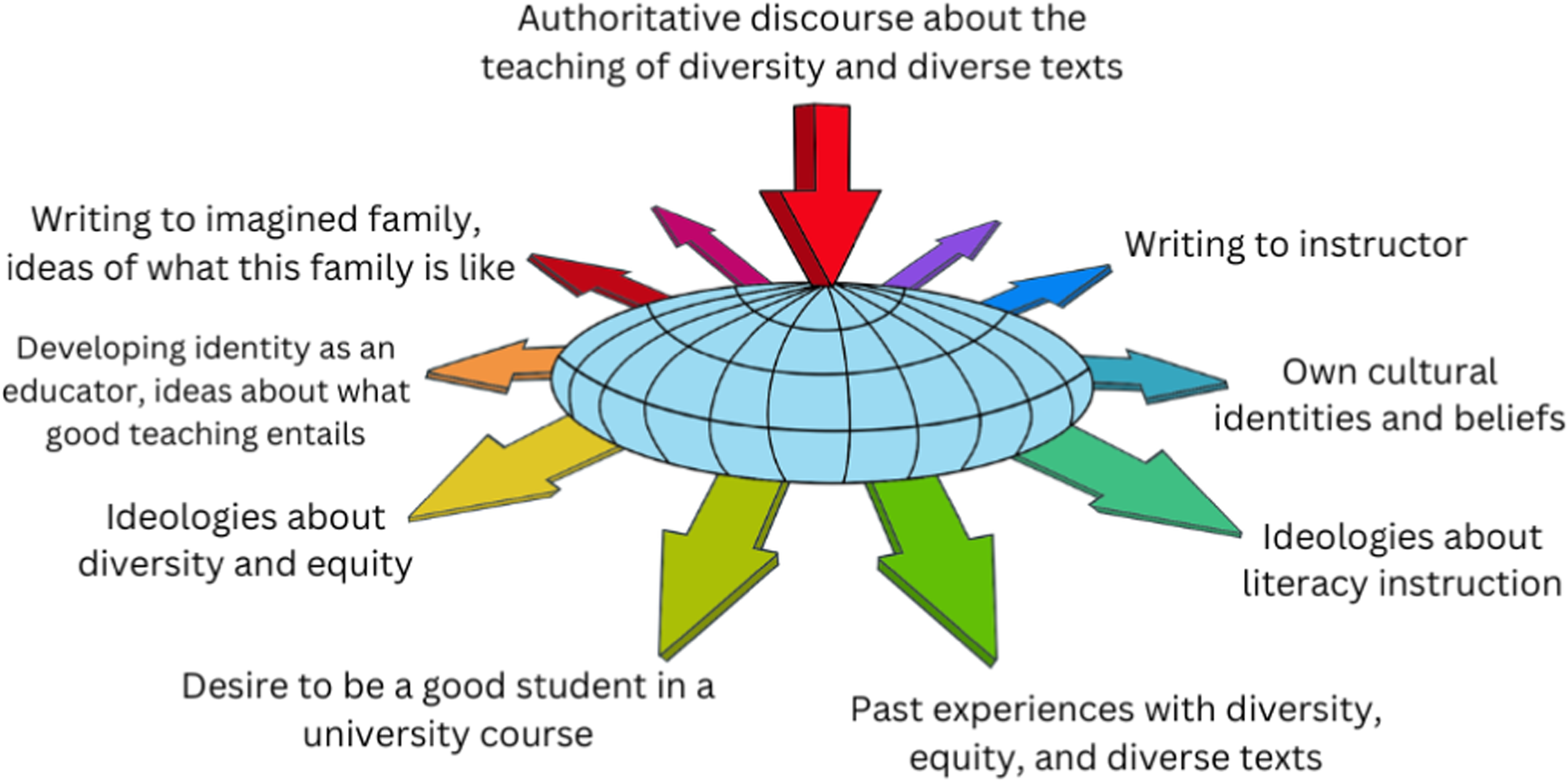
Flattening effect caused by dialogic tensions.
Through these lenses of dialogism and flattening, we sought to explore the tensions between what PSTs were expected to produce as a text for coursework, what they wrote to their imagined audience, and what they felt they could say given authoritative discourses around teaching with diverse texts. In other words, we sought to explain the patterns we identified in PSTs’ letters as a dialogic tension between centripetal and centrifugal forces (Bakhtin, 1981) contributing to an overall flattening effect (Alexander & Rhodes, 2014).
Methods and Data Selection
Data for this study came from a multicultural literature course within a large middle-grades university teacher certification program in Texas, which graduates approximately 400 PSTs per year. PSTs were enrolled in a middle-grade fourth- through eighth-grade teacher preparation program; 52% of them were in math and science and 48% were in English language arts and social studies. Though specific gender and race/ethnicity demographics were not collected, PST demographics within the course represented the larger program demographics, wherein 95% of the candidates were female and 76% were white. Designed for junior-level PSTs who were beginning their fieldwork, the multicultural literature course followed foundational studies in multicultural education, child and adolescent development, and early literacy. The course focused on strategies for evaluating and integrating diverse literature in instruction within interdisciplinary and diverse contexts, with explicit emphasis on adolescent literacy, text selection, authorship, and representation.
Ambyr served as an instructor of this course for four semesters, along with one other literacy education instructor. While the course was taught by two different instructors across sections and semesters, both shared a commitment to critical literacy dispositions and a social justice–oriented approach to education. Both sought to position the course as a safe and flexible space that supported PST discussions around diversity, current events, book banning, scripted curriculum, and anti-DEI legislation. Course readings, discussions, and assignments were intentionally designed to invite inquiry, tension, and negotiation, therefore creating an additional discursive space that interacted with but did not dictate PSTs’ internally persuasive discourses. Instruction emphasized multiple approaches to culturally diverse text selection, pathways for identifying high-quality diverse literature, and strategies for integrating such texts in pedagogically aligned and contextually relevant ways.
In the last quarter of the course, PSTs were asked to select a culturally diverse text and write a letter addressed to the imagined caregivers of their future middle-grade students. PSTs were encouraged to situate the letter within a classroom of their own imagination and to address families broadly, rather than a single, individualized caregiver. This challenged PSTs to view families through the same lens as the curriculum—as multifaceted and spanning a wide range of identities, experiences, and backgrounds. The assignment prompt asked PSTs to “compose a 300-word minimum persuasive letter to student caregivers sharing a children's book you have selected and invite caregivers to engage with the book in some way.” PSTs selected texts in the children's book section of the library, drafted letters during class time, received feedback, and submitted a polished final version. This multistage process allowed learners time and space to reconsider and revise their thoughts in writing. In total, 81 assignments across five course sections and four semesters were collected from 2020 to 2021. PST letters ranged from 320 to 500 words, with an average length of 375 words. Participants were recruited and their work anonymized by a researcher who was not the course instructor to minimize any perceived power differentials and ensure that participation was fully voluntary.
Methods of Analysis
We drew on the theoretical perspectives of dialogism and flattening to frame our qualitative analysis of PSTs’ discursive moves. The inherent complexity of dialogism, specifically the tension between authoritative and internally persuasive discourses, precluded a direct coding of these constructs. For instance, because authoritative discourse often manifests as subtle self-censorship, a preservice teacher is unlikely to explicitly state they are defying a “forbidden” mandate in their letter. Consequently, we adopted a nuanced analytical approach to identify evidence of potential self-censorship.
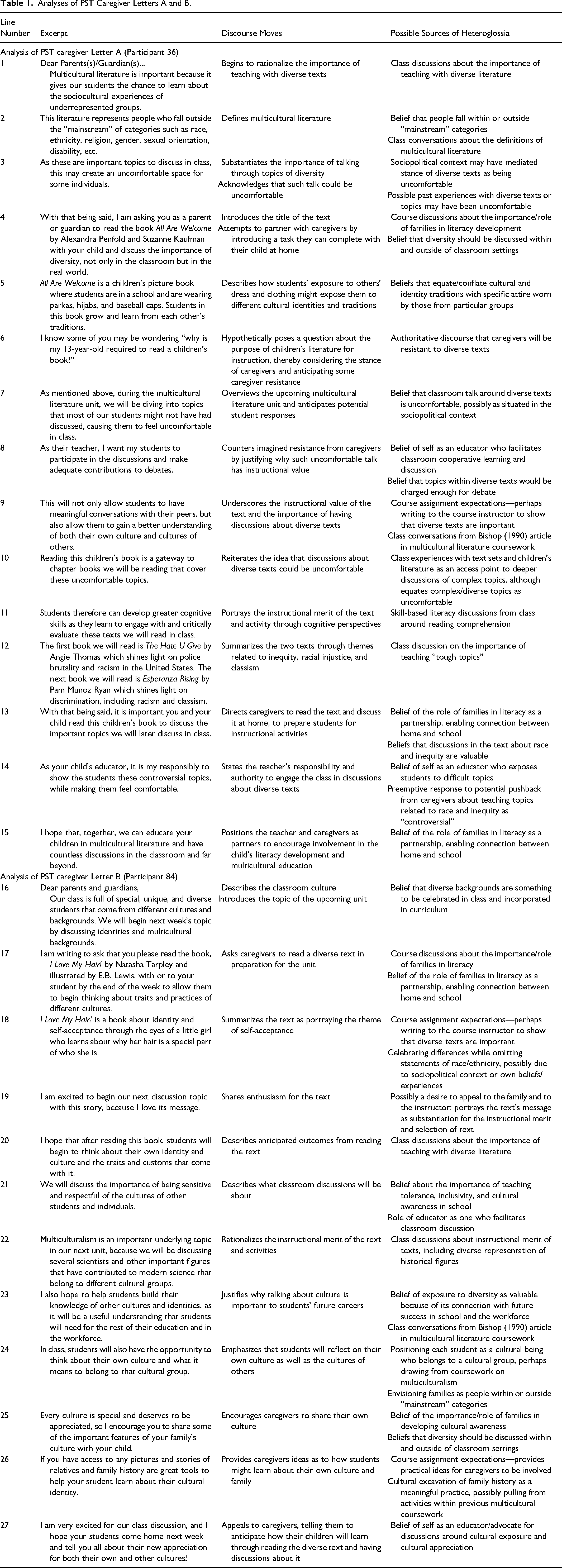
First, we read the entire collection of caregiver letters to familiarize ourselves with the overall scope of the data. Next, we engaged in process coding (Saldaña, 2021) of two sample letters. We purposefully chose one letter which was unique in that it was the only one which brought forward multiple specific terms about race, social justice, and power. The other letter was randomly chosen from the sample, which seemed representative of the data as a whole. Process coding involves identifying the actions (typically coded as verbs) of the participants in the data. For our study, we identified these processes as discourse moves (e.g., “defines multicultural literature” or “describes the text”) for each sentence of the letter. Second, we drew on our interactions with the PSTs leading up to this assignment (including course discussions, our knowledge of the teacher education curriculum, and previously submitted work for the course) to identify possible sources of heteroglossia (e.g., “course discussions about the role of families in literacy development”) that could have contributed to the dialogic tensions within these letters (see Table 1 for the resulting analysis).
Analyses of PST Caregiver Letters A and B.
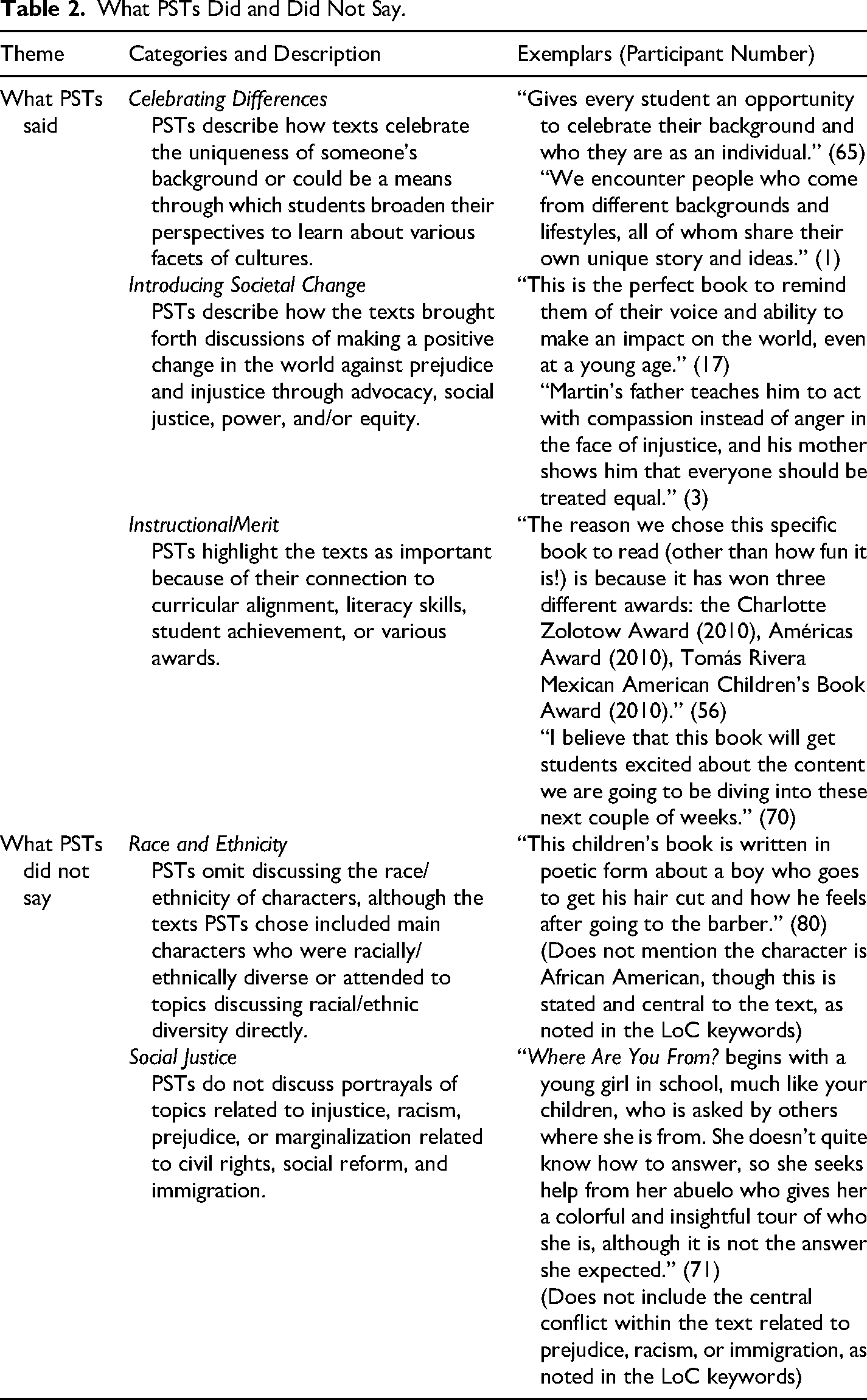
What PSTs Did and Did Not Say.
After reading the full data set and analyzing two letters in detail together, we noticed that both PSTs dealt with dialogism and included instances of flattening, patterns present in the entire data set. We observed that flattening, or the simplification of writing about diversity, was present not only in what PSTs articulated, but also in what they omitted. This realization prompted us to expand our analysis through the entire data sample to systematically examine patterns of “what was said” and “what was unsaid” as functions of the flattening effect.
To analyze “what was said,” we identified PSTs’ text descriptions and rationales as our primary units of analysis. We independently performed open coding (Strauss & Corbin, 1998) on the 81 letters, generating preliminary codes grounded in participants’ language. We subsequently met iteratively to compare codes, discuss discrepancies, and refine category definitions until we reached 100% agreement across categories. For example, initial open codes such as “uniqueness,” “celebrating one's background,” and “acceptance” were grouped into the category of “celebrating differences.” Throughout this process, we maintained analytic memos and a reflexive audit trail by reviewing course artifacts such as course syllabi, class assignments, course materials, the diverse texts that were chosen, course readings, and our own instructional histories with the course. Nothing was excluded from consideration; rather, these course materials and our experiences helped us situate the letters within their specific pedagogical context.
To analyze “what was unsaid,” we compared PSTs’ text descriptions and rationales to the Library of Congress (LoC) subject terms and summaries. We used the LoC as a standardized, publicly accessible reference point to anchor our comparative analysis, rather than relying solely on our own identifications of what was left unsaid in PSTs’ letters. We recognize that the LoC's purpose is archival and used for classification rather than to provide nuanced and critically informed diversity descriptions, and we acknowledge that the LoC is not a neutral or definitive authority on a text's meaning, nor is it an unbiased source of diversity-related themes. However, no other existing textual database possessed the same scope and functionality, particularly as a database inclusive of the diverse children's and young adult texts in our data set. As academics committed to adopting the asset-based perspectives of our aspiring educators, we leveraged this database in combination with our grounded coding process to enhance analytic credibility and ensure trustworthiness of the patterns we identified (Lincoln & Guba, 1985).
We searched each text in the LoC catalog, excluding four letters (5%) for which no entry existed for the book chosen by the PST. We demarcated the topics featured within both or only one of the two data sources (i.e., the PSTs’ letters and/or the LoC summaries). We then analyzed the resulting comparison data using open coding (Strauss & Corbin, 1998) to identify overarching patterns of what PSTs did not mention in their letters. Following the same dual-coder process used for the “what was said” data set, we independently coded across comparison units, identifying instances where LoC subject terms or summaries introduced themes or topics that were not taken up in PST letters. We subsequently met for multiple sessions to compare codes, examine discrepancies, and clarify categories until we reached 100% consensus across categories. For example, initial open codes of “immigration,” “segregation,” and “prejudice” became the broader category of “social justice.” This iterative approach ensured analytical consistency across both phases of coding.
Positionality Statement
As white and Vietnamese American teacher educators working within predominantly white teacher preparation programs in the South and Midwest, we acknowledge how our racialized, cultural, gendered, and professional identities shape how we experience sociopolitical pressures and perceive PST discourse about diverse texts. As teacher educators working in states where academic freedom is increasingly contested, we are not insulated from legislative restrictions shaping literacy education. We ourselves have experienced firsthand authoritarian pressures and mandates—from the removal of our course textbooks to the required omission of diversity-related topics from our instruction. We are unsettled by the pervasive sense of possible surveillance and constraint, a tension that we imagine PSTs may also feel when completing assignments such as the caregiver letters analyzed in this study. In this way, our engagement with this topic is not purely intellectual; it is shaped by the emotional weight and uncertainty of navigating these constraints alongside our PSTs.
At that same time, we acknowledge the asymmetrical power dynamics inherent in analyzing students’ work. We recognize that PSTs may have shaped their responses in ways they perceived to be aligned with our expectations and course norms. To mitigate this, we tried to frame the assignment as an open space for inquiry and emphasized that there was no singular “correct” way to write this letter. We also took care to analyze these letters not as singular reflections of belief, but rather as situated dialogic texts shaped by layered meanings and audiences, including us as instructors, the imagined caregivers, and the broader context in which we work. Even so, we recognize that our dual roles may have influenced both what PSTs chose to express and how we interpreted those expressions. As a result, we engaged in ongoing reflexive dialogue, examining how our commitments to diversity, experiences with censorship, and pedagogical aims shaped our perspectives. This allowed us to map how PSTs’ discourse was entangled in competing pressures.
Findings
In response to the first research question, “How did PSTs navigate dialogic tensions within their letters?,” we found that PSTs engaged in multiple discourse moves in their letters to navigate the tension between authoritative and internally persuasive discourses. In response to the second research question, “What discursive patterns are present across the sample of letters?,” we found that the flattening effect is a pattern in what PSTs say and do not say, particularly by broadly considering topics of diversity and inclusion and generally not discussing specific descriptions of race/ethnicity and social justice.
PSTs’ Navigation of Dialogism
We highlight two letters from Lila and Sienna (pseudonyms; see Table 1). In both letters, the PSTs grapple with authoritative discourses that diverse literature is dangerous, and that families will resist it, albeit in different ways. As mentioned in the Methods section, Lila's letter is unique in that it is the only one in the data sample that explicitly includes terms about race and injustice, whereas Sienna's letter is more representative of the data sample and illustrates the flattening effect by omitting specific terms about race or social justice while broadly celebrating diversity.
Lila: “Talking About Diverse Texts Is Uncomfortable”
Throughout her letter, Lila demonstrates a strong influence of authoritative discourse, expressing a belief that discussing diverse texts is uncomfortable and a likely source of caregiver resistance. She begins her letter with a definition of culturally diverse literature, which “represents people who fall outside the ‘mainstream’” (Line 2). She then states three times that discussions about diverse texts are “uncomfortable” (Lines 3, 7, and 10) and describes these texts using terms as such as “race, ethnicity, religion, gender, sexual orientation, disability” (Line 2) and “police brutality, discrimination, racism, and classism” (Line 12). With this belief that diverse texts are inherently uncomfortable, Lila expects some resistance from caregivers, expressed through phrases such as “With that being said” (Line 4) and a hypothetical question, “Why is my 13-year-old required to read a children's book?” (Line 6).
On the other hand, internally persuasive discourses also find their way into Lila's letter, as she asserts her role as the teacher in promoting the importance of diverse texts. She manages this tension between authoritative and internally persuasive discourses by rationalizing the importance of having uncomfortable discussions to learn about other cultures. In addition, she is persistent in partnering with the caregivers to read diverse texts, reflecting her belief about the importance of family engagement. One way Lila attempts to convince caregivers to engage in this “uncomfortable” activity is to highlight the instructional merit of the text, as it will “allow them to gain a better understanding of both their own culture and cultures of others” (Line 9) as well as “develop greater cognitive skills” (Line 10). Lila ends her letter with a plea to partner with families, saying, “Together, we can educate your children in multicultural literature” (Line 15).
Overall, Lila expresses a conflicted view of diverse texts, warning of their potential dangers even as she champions their inclusion in the curriculum. The dialogic nature of her letter is seen through Lila's explicit use of terms related to race and social injustice, her sense of teaching diverse texts as uncomfortable, and her advocacy for teaching diverse texts. Partly because the caregiver letter assignment was situated in a course in which she was learning about the importance of teaching culturally diverse texts, Lila may have been navigating the tension between authoritative and internally persuasive discourses, resulting in heteroglossia in her letter.
Sienna: “Celebrating Differences”
Like Lila, Sienna similarly navigates dialogism in her letter, albeit differently. Instead of conceding any sense of possible discomfort about reading diverse texts in her letter, as Lila did, Sienna highlights the notion of celebrating differences and does not mention any specific references to race or social justice. This omission of specific terms creates a flattening effect that was a common pattern in the data.
First, Sienna describes the classroom as “full of special, unique, and diverse students” (Line 16), and in the rest of her letter, she discusses the importance of examining one's cultural identity (Lines 18, 20, 24, 25, 26, and 27) to gain appreciation and respect for others (Lines 16, 17, 21, 22, and 27). Sienna also warrants celebrating differences as a means of preparing her students for future success, as “it will be a useful understanding that students will need for the rest of their education and in the workforce” (Line 23). Sienna seeks family engagement by inviting caregivers “to share some of the important features of your family's culture with your child” (Line 25), such as “pictures and stories of relatives and family history” (Line 26), encouraging families to explore their cultural heritage together.
In contrast to Lila's letter, Sienna's text obscures any reference to race specifically. In her description of I Love My Hair! (Tarpley, 2003), Sienna continues to espouse this message of appreciating one's own identity: “I Love My Hair! is a book about identity and self-acceptance through the eyes of a little girl who learns about why her hair is a special part of who she is” (Line 18). However, the character's African American heritage is not mentioned, which is central to this story. To illustrate this point, we juxtapose this letter with the LoC keywords “Hair, African Americans” and the LoC summary, “A young African American girl describes the different, wonderful ways she can wear her hair.”
In this example, Sienna does not concede in her letter to an authoritative discourse that diverse texts pose a threat or that families will resist them. Instead, she avoids the topic entirely, which appears to stifle any meaningful talk about diversity, resulting in a flattening effect that was representative of the overall data set. In the subsequent finding, we analyze the entire data sample to demonstrate similar patterns of this flattening effect.
Flattening as Revealed in What Was Said and Unsaid
For our second finding, we report patterns of flattening in what PSTs said and did not say, particularly by broadly discussing topics of diversity and inclusion and not including specific descriptions of race and social justice in their letters. Three patterns are reflected in how PSTs articulated choosing texts in the overall sample: celebrating differences, societal change, and instructional merit. In addition, through our comparison analysis using the subject key terms and summaries from the LoC, we identified two patterns of what was left unsaid by the PSTs: mentions of race/ethnicity and social justice descriptions (see Table 2).
What Was Said: Flattening Through Broad Descriptions of Inclusion
Celebrating Differences
We identified a category of celebrating differences, accounting for 70% of the codes, in which PSTs described how diverse texts honor the uniqueness of someone's background or could be a means through which students learn about various facets of culture. First, PSTs’ purported reasoning for text selection within this category was that students should learn to honor their identity. PSTs explained how diverse texts send messages that every student should celebrate their background (36%), including “who they are as an individual to discover self-love and acceptance” (26), 1 and accept that it “is okay to be a little different from someone else” (24).
Second, 34% of PST responses were coded as broadening perspectives, in which PSTs foregrounded how selected texts hold the potential to broaden students’ attitudes about multiculturalism and diversity. PSTs noted how a selected text can help students “gain cultural insight” (16) and be “sensitive and respectful of other cultures” (4). Other PSTs explained how cultural perspective-taking is made possible through texts that illuminate characters’ “unique identities through understanding their beautiful ancestral name” (56), “resilience after experiencing bullying and discrimination related to their religion and cultural clothing” (64), and “struggles of the parents immigrating to America and how that impacts their life” (35).
As PSTs wrote about the benefits of diverse texts for honoring differences in terms of one's self-identity and learning about differences in the cultures of others broadly, they also emphasized a focus on universality. PSTs purported views that we are “all the same and all equal” (7), even when sharing texts plainly discussing topics of discrimination, racism, and inequity (e.g., Harvesting Hope: The Story of Cesar Chavez [Krull, 2003], Let the Children March [Clark-Robinson, 2018]). The overwhelming message of this category is “We are different but all the same, and we should focus on our similarities more than our differences” (49).
Introducing Societal Change
Seventeen percent of PSTs articulated reasons for their text selection to introduce discussions of societal change. One PST explained how their selected text centered advocacy, which was “about the reliance and the fight for freedom and show[s] us that no matter our age, if we see something that we do not agree with, we are not too young to stand up, or sit, for change” (28). Another PST connected their text and social justice and power topics: “The author illustrates the courage, family, prejudice, and social power experienced throughout the story” (73). Last, a few PSTs discussed equity within their summaries, such as a PST who described how the text promoted “activism to make positive changes for a more equitable world” (43).
Instructional Merit
Twelve percent of PSTs highlighted the instructional or award-winning merits of the selected book. Most often within this category, and across 8% of the overall sample, PSTs rationalized their text selection primarily because it was honored with an award—for example, “I picked this book because it was honored in the Coretta Scott King Book Awards for its beautiful illustrations” (67)—but did not mention that this award is given annually to African American authors and illustrators who write books that reflect the African American experience. Less frequently, and across 4% of the sample, PSTs noted the text's ability to enhance students’ reading skills or incorporate facets of literacy development. Overall, the theme of “what was said” showcases the flattening effect through what PSTs articulated and rationalized in their letter. However, the flattening effect is twofold in that it was also present in what PSTs did not say in their letter, described next.
What Was Unsaid: Flattening Through Omission of Specific Terms
For the second theme of “what was unsaid,” we compare PSTs’ descriptions and rationales for their culturally diverse text choice to the LoC database of key terms and descriptions of each text. This second theme reflects the flattening effect by the noninclusion of specific terms within two encompassing categories indicated in 56% of the letters: race/ethnicity and social justice. The other 44% of responses include PST descriptions that do match the LoC database, meaning that nothing was identified as being substantively left “unsaid.”
Omission of Race and Ethnicity Topics
Most frequently, in 42% of total responses, PSTs omitted specifics related to race and ethnicity within their letters even though many of the texts that PSTs chose included main characters who were racially/ethnically diverse or attended to topics discussing racial/ethnic diversity directly. Within this pattern, PSTs specified the plot elements of the text and omitted the race/ethnicity of the featured characters, even if the character's race/ethnicity was central to the plot. In addition, as seen in Sienna's letter, PSTs framed discussions about race/ethnicity through an “inclusion” or “sameness” lens. As one example, for the selected text of I Am Perfectly Designed (Brown & Brown, 2019), the LoC includes the keywords “father and sons, African-Americans, self-confidence, and abilities.” In contrast, one PST described the same text as a “book about a dad and his son talking about why being yourself is perfect no matter what” (79). Within this response, the PST did not discuss that the characters are African American, although this is central to the text's message.
In other similar examples, four PSTs selected various texts that honor the accomplishments of pioneering female African American leaders in math: Hidden Figures: The True Story of Four Black Women and the Space Race (Shetterly, 2018), A Computer Called Katherine (Slade, 2019), and The Girl With a Mind for Math: The Story of Raye Montague (Mosca, 2020). In the LoC database, keywords for all three books include “African-American mathematicians/engineers.” However, three of the four PSTs who selected these texts omitted race altogether and instead featured the text's messages of “overcoming obstacles” (7) and “making great choices” (63), and even discussed “the history of segregation in our country…[and] capabilities of women in STEM” from a gendered, but not racial, perspective (70). The one PST that did mention the specific race of the characters in their summary, stating that “Hidden Figures is about four African-American women who are really good at math,” then flattened their description as to why the text was important, reasoning that the text “gives so much information about a little part of diversity in our world” (57). These examples represent many others which broadly discuss the importance of diversity but do not specify aspects of race/ethnicity central to the text's message, as denoted in the keywords of the LoC database.
Omission of Social Justice Topics
Less frequently, in 14% of total responses, PSTs glossed over text portrayals of topics related to civil rights, social reform, and immigration. As an example, when discussing Dreamers (Morales, 2018), a true story about Yuyi Morales's own immigration from Mexico to the United States with her young son, one PST summarized the book as a story that “follows a young mom and her baby son who are navigating the real struggles of finding comfort and identity in the United States” (48). Even though they hinted at the topic of “immigration”—included within the LoC text summary and keywords—this PST sidestepped specifically mentioning immigration and instead focused on how this text “reminds students they should be kind and respectful of all stories and cultures” (48). In another example, one PST portrayed Malala's Magic Pencil (Yousafzai, 2017) as a text that “discusses how Malala's life was in Pakistan. She wished that she had a magic pencil that would make magical things happen if you wrote with it” (78). In their description, the PST wrote that the text was about using your “voice and ability to make an impact” (78). Still, they did not depict the multiple textual layers, including the book's primary focus on social justice for women in Pakistan, as noted by the LoC keywords: “girls, education, Pakistan, women social reformers.”
In yet another example, one PST silenced the specifics of the school desegregation movement for Hispanic Americans in Separate Is Never Equal: Sylvia Mendez and Her Family's Fight for Desegregation (Tonatiuh, 2014). In this PST's description of the text, they stated: “She stands out in the school because she looks different from most other students. Her mother then tells her something very important that meant a lot for their family and other families in the state” (79). The PST attributed the problem in the story to Sylvia being bullied for looking different, after which her mother “tells her something very important.” The LoC summary, in contrast, underscores Sylvia's role in school desegregation efforts: “Sylvia Mendez, an eight-year-old girl of Mexican and Puerto Rican heritage, played an instrumental role in Mendez v. Westminster, the landmark desegregation case of 1946 in California.” Overall, flattening patterns can be seen in what PSTs said and did not say about culturally diverse texts in their letters.
Discussion
Since the conclusion of this study, restrictions around the teaching of diversity and diverse books have intensified. In the 2023–2024 school year alone, 10,046 book bans of 4,231 unique titles were recorded in 29 states and across 220 public school districts, increasing nearly 200% from the previous year (PEN America, n.d.). In Texas, legislative actions have accelerated book bans, as HB 900 (2023) enabled text removal without due process (Meehan et al., 2024), while SB 12 and SB 13 (2025) expanded parental control over curriculum and restricted DEI efforts related to race, gender, and sexual orientation.
However, Bakhtin (1981) reminds us that the more language and meaning is constrained through centripetal forces, the more it inevitably clashes with the complexities of heteroglossia. It is within this dialogic friction that we found some potential moments of agency within PSTs’ letters. First, PSTs navigated complex tensions across personal, curricular, and sociopolitical contexts (Lammert & Godfrey, 2023) as they were asked to balance their identities as students, future teachers, and society members while imagining a family audience, crafting a formal but welcoming communication, and enacting pedagogical content knowledge. As we deconstructed what we had once considered to be a straightforward task, we newly acknowledged and appreciated PSTs’ efforts to negotiate the layered complexity of the caregiver letter assignment, the sociopolitical moment, the geographic and institutional context, and their early career developmental stage (Kwok et al., in press).
Second, we were encouraged that 97% of texts selected by PSTs centered culturally diverse main characters and authors. This finding is significant given the established importance of culturally diverse texts and the role of teacher preparation coursework in addressing teachers’ limited exposure to such texts (Borsheim-Black, 2015; Wissman et al., 2017). PSTs’ selected texts reflected a broad range of culturally diverse characters and perspectives, representing diverse racial, ethnic, cultural, national, historical, linguistic, and religious backgrounds. However, none chose texts with LGBTQ themes—despite the inclusion of such texts in class materials—suggesting an act of preemptive censorship that aligns with Schieble's (2012) findings from over a decade ago. Therefore, despite moments where PSTs championed the text, it is clear that authoritative discourses also likely contributed to instances of self-censorship in their letters.
Authoritative Discourse and the Flattening Effect
As PSTs negotiated dialogic tensions in their letters (Bakhtin, 1981), their talk about diversity often lost nuance and specificity—a phenomenon known as the flattening effect (Alexander & Rhodes, 2014). Our findings contribute to and build on Alexander and Rhode's (2014) ideas by providing textual evidence of how PSTs engaged in the “subtle (and sometimes not-so-subtle) erasure of difference that occurs when narrating stories of the ‘other’” (p. 431). The flattening effect was manifested in both what PSTs said and did not say. Through a broad celebration of differences and inclusion, PSTs neutralized “radical alterities” to ensure their discourse remained acceptable to caregivers. Consequently, PSTs may have adopted self-protective practices, self-censoring curriculum and communication to mitigate anticipated parental disapproval (Beneke & Cheatham, 2020; Dávila, 2015, 2022).
More broadly, PSTs demonstrated a tendency toward soft censorship, which was defined by Ginsberg and Chae (2025) as the internal limiting or exclusion of texts by educators to ensure discourse remains within “safe” normative boundaries in the absence of official bans. For instance, only 17% of PSTs explicitly introduced concepts of social change within their letters, even though many of the texts they chose addressed issues and themes related to equity, racism, and social justice. Further, even when the texts featured non-Christian religions—for example, The Proudest Blue: A Story of Hijab and Family (Muhammad, 2019)—PSTs avoided specific references to cultural or religious practices despite these being central to the text's themes, reflecting other similar instances of self-censorship (Dávila, 2015; Hurley, 2024). Collectively, our findings reveal that most PSTs did not take up the discursive possibilities that foregrounded race, religion, and social justice as identified by the LoC keywords and summaries. This practice illustrates how authoritative discourse silences the centrifugal potential of teaching with diverse texts.
Research suggests that PSTs self-censor their talk about race and social justice due to a perceived lack of agency or ability to challenge systems of power (Diaz et al., 2021; Min et al., 2022). Given the rise in book banning in the United States, PSTs might envision inherent resistance from families, school administrators, or the community where they will work and self-censor as a means of self-preservation (Cook & Yielding, 2022; Hartsfield & Kimmel, 2020). However, as Foucault (1980) would argue, power relationships move in complex, unpredictable ways. The dialogic tensions that resulted in a flattening effect in PSTs’ letters show how the power dynamics flowing within this task were fluid and complex, rather than linear or hierarchical. In other words, PSTs may have flattened their discourse as a strategic “workaround” to navigate authoritative discourses, rather than as a direct consequence of this pressure.
Conceptually, the findings of this study raise questions about the possibility of PSTs’ agency through flattened discourse. For PSTs who are still developing their advocacy skills, flattening may have allowed them to manage sociopolitical pressures and the inherent politics of their curricular choices without completely retreating. We also assert that the flattening effect within PSTs’ letters may have been due to the complexity of the task and related power dynamics that mediated the task, not necessarily their own lack of engagement or knowledge. We cannot, however, be content with flattened discourse as the pedagogical status quo. We conclude this article by addressing the study's limitations and proposing ways to support PSTs to develop more direct strategies for resisting flattening in their advocacy for diverse texts.
Limitations
Our study intentionally employed a hypothetical assignment and imagined family audiences as an entry point into understanding how PSTs begin to articulate beliefs about literacy instruction, diversity, and family engagement (Gutiérrez et al., 2020). We acknowledge that we did not require PSTs to define the school or familial context when writing their letters, though we recognize that these aspects are important. In addition, while one could argue that the modality of the task (i.e., writing) may have contributed to PSTs’ flattened discourse by potentially inviting them to use more formalized language, we contend that this modality removed the pressure and immediacy of face-to-face dialogue, allowing PSTs greater time to reflect upon, draft, and craft their language.
Additionally, analyzing what was left unsaid in PSTs’ letters presents interpretive challenges; our goal was not to suggest these omissions should have been included, but rather to consider them as evidence of the repertoire of discourses that PSTs could be negotiating. Though we cannot ever fully capture what was not said by PSTs, there is a growing body of literature on teachers’ and teacher educators’ self-censorship in response to the current legislation, book banning, and the negative educational climate (Chang-Bacon, 2022; Cook & Yielding, 2022). Particularly because data collection coincided with the 2020 pandemic and the racial reckoning following George Floyd's murder, we cannot ignore the possibility of the sociopolitical context silencing their talk of race and social injustices. These limitations underscore the complexity of the moment and of studying PSTs’ evolving understandings of diversity and literacy instruction.
Implications
Pedagogical Implications
Prior research affirms the critical role of teacher educators in supporting PSTs’ engagement with issues related to diversity, equity, and social justice (Kwok et al., 2023, 2025; Haddix, 2017), yet it also highlights a tendency among teacher educators to self-censor discussions of race, equity, or topics perceived as controversial (Chang-Bacon, 2022). To counter this, critical literacy teacher educators should model the use of potentially “risky” texts in accessible and meaningful ways (Wessel-Powell & Bentley, 2022) and provide sustained, systemic opportunities for PSTs to engage with linguistic and cultural diversity (Giunco et al., 2024). In addition, teacher education programs must encourage PSTs to interrogate how discourses of inclusion and universality can function as flattening mechanisms (Kwok et al., 2021), which too often exert a centripetal pressure that results in the systemic erasure of racial and LGBTQ + identities (American Library Association, 2026; Meehan et al., 2024) in favor of a narrative that may be more approachable to a broader audience (Alexander & Rhodes, 2014). A recent resource that teacher educators might consider using is the National Council of Teachers of English (NCTE, n.d.-a) Book Rationale Database, which offers educator-developed tools to support selecting, teaching, and defending diverse texts in contentious contexts. Furthermore, teacher educators should find ways to humanize families and incorporate their perspectives to support PSTs to cultivate asset-based perspectives of families, communities, and their students (Howard et al., 2024). To reduce anticipated fears of censorship, teacher educators should draw on current resources that defend the right to read and prepare educators for book challenges (e.g., Bell et al., 2024; National Council of Teachers of English, n.d.-b). Finally, PSTs should be taught specifically to align culturally diverse texts within their curriculum and state standards by evaluating their contextual, cultural, and historical relevance (Rios et al., 2024).
Research Implications
Future research should center the voices of PSTs directly by employing interview and elicitation methods to unearth their reasoning, considerations, and questions in selecting and teaching culturally diverse texts. Especially amid growing parental group movements and anti-DEI legislation, these approaches can help portray how PSTs navigate dialogic tensions and decide what to omit or include when addressing “risky” topics. Future work should also closely examine teacher educators—their role in empowering PSTs to advocate for diverse texts and equity-oriented literacy practices, as well as how teacher educators themselves may be engaging in self-censorship or experiencing the chilling effects of their current time and place (Kwok et al., in press). Future research could also examine initial differences observed across certification content areas, which point to the need for deeper inquiry into how PSTs’ discussions of diversity may vary by certification level and disciplinary content. As parental rights movements and anti-DEI efforts gain momentum and legislative traction, these future studies become urgent. We worry that we are only beginning to bear witness to the profound and far-reaching chilling effects these sociopolitical times will have on literacy teaching and teacher education.
Supplemental Material
sj-docx-1-jlr-10.1177_1086296X261461689 - Supplemental material for Dialogism in Preservice Teachers’ Rationale of Diverse Texts
Supplemental material, sj-docx-1-jlr-10.1177_1086296X261461689 for Dialogism in Preservice Teachers’ Rationale of Diverse Texts by Ambyr Rios and Michelle Kwok in Journal of Literacy Research
Supplemental Material
sj-docx-2-jlr-10.1177_1086296X261461689 - Supplemental material for Dialogism in Preservice Teachers’ Rationale of Diverse Texts
Supplemental material, sj-docx-2-jlr-10.1177_1086296X261461689 for Dialogism in Preservice Teachers’ Rationale of Diverse Texts by Ambyr Rios and Michelle Kwok in Journal of Literacy Research
Supplemental Material
sj-docx-3-jlr-10.1177_1086296X261461689 - Supplemental material for Dialogism in Preservice Teachers’ Rationale of Diverse Texts
Supplemental material, sj-docx-3-jlr-10.1177_1086296X261461689 for Dialogism in Preservice Teachers’ Rationale of Diverse Texts by Ambyr Rios and Michelle Kwok in Journal of Literacy Research
Supplemental Material
sj-docx-4-jlr-10.1177_1086296X261461689 - Supplemental material for Dialogism in Preservice Teachers’ Rationale of Diverse Texts
Supplemental material, sj-docx-4-jlr-10.1177_1086296X261461689 for Dialogism in Preservice Teachers’ Rationale of Diverse Texts by Ambyr Rios and Michelle Kwok in Journal of Literacy Research
Supplemental Material
sj-docx-5-jlr-10.1177_1086296X261461689 - Supplemental material for Dialogism in Preservice Teachers’ Rationale of Diverse Texts
Supplemental material, sj-docx-5-jlr-10.1177_1086296X261461689 for Dialogism in Preservice Teachers’ Rationale of Diverse Texts by Ambyr Rios and Michelle Kwok in Journal of Literacy Research
Footnotes

Funding
The authors received no financial support for the research, authorship, and/or publication of this article.
Declaration of Conflicting Interests
The authors declared no potential conflicts of interest with respect to the research, authorship, and/or publication of this article.
Supplemental Material
Supplemental material for this article is available online.
Notes
References
Supplementary Material
Please find the following supplemental material available below.
For Open Access articles published under a Creative Commons License, all supplemental material carries the same license as the article it is associated with.
For non-Open Access articles published, all supplemental material carries a non-exclusive license, and permission requests for re-use of supplemental material or any part of supplemental material shall be sent directly to the copyright owner as specified in the copyright notice associated with the article.
