







Abstract

Black students are often viewed as being deficit in college readiness, financial stability, familial support, and self-esteem (Brooms, 2017; Harper, 2012; Strayhorn, 2008) which their retention and graduation rates (Ingram, 2013). The problem with this perspective is it is situated in deficit thinking and serves as psychological barriers for student expectations and success among advisors (Stephens, Hamedani, & Destin, 2014). Hence, advisors must begin to view students not by their lack but by their current cultural wealth. The purpose of this conceptual paper is to provide an overview of an alternative approach to advising Black students at Historically Black Colleges or Universities (HBCU). The appreciative advising approach assists advisors in not defining their students by their current and past situations. Rather, it embraces the unique individuality of each student and promotes a sense of authenticity, empowerment, and achievement. We position this paper by providing an overview of mentoring and advising at HBCUs, theoretical underpinnings of Appreciative Education, and providing an in-depth analysis into Appreciative Advising as a tool for empowering Black students at HBCUs. Hence, advisors must begin to view students not based on what they lack, yet by their current cultural wealth.
Rather, it embraces the unique individuality of each student and promotes a sense of authenticity, empowerment, and achievement.
Moving Beyond Advising
Mentoring is seen as a vital component to Black people in education (Strayhorn & Terrell, 2007). Furthermore, the role of mentoring can be seen within the K-12 sector to graduate education (Brooms & Davis, 2017; Fountaine, 2012). Watson and Dawson (2007) defined mentoring as “nurturing process in which a more skilled or experienced person, serving as a role model, teaches, sponsors, encourages, counsels and befriends a less skilled or less experienced person “(p. 4). Many scholars cite mentoring as a cornerstone of Black student achievement (Bertrand Jones & Osborne-Lampkin, 2013; Brooms & Davis, 2017; Fountaine, 2012; Strayhorn & Terrell, 2007). In addition, mentoring is often highlighted as being vital to the extracurricular experiences of Black students. Flowers, Scott, Riley, and Palmer (2015) found for Black men, faculty interaction must include mentoring as a form of meaningful experiences to develop students socially and academically. Specifically for Black men who attend HBCUs, mentoring aided in their support, motivation, and overall development. Those findings were consistent with Strayhorn and Terrell (2007) findings of Black students benefited from mentoring relationships. Both studies are critical to understanding the value of mentoring for Black students.
We believe appreciative advising moves the work of an advisor from being task-oriented to building interpersonal relationships.
Unlike a mentor, Watson and Dawson (2007) stated an advisor is a person who “helps the student select classes, informs the student about performance expectations, guides the student in research topics and suggests conferences for initial submissions. The advisor also gives the student honest feedback on performance so that the student can develop as a scholar (p. 6).” It is critical to note, advising and mentoring could be different as a mentor can serve as an advisor, but an advisor does not have to be a mentor. Advisors are needed for the day to day operations and navigation of the student process. While mentors and advisors are often used interchangeably, mentors often have more personable relationships with students than advisors. While both relationships are beneficial for Black students at HBCUs, we believe advisors who serve as mentors are best suited for Black students at HBCUs. Thus, we provide a snapshot of appreciative advising as a theoretical framework that situates the advisor within the context of the mentor for the student. We believe appreciative advising moves the work of an advisor from task oriented to building interpersonal relationships. In the following section, we provide background literature on appreciative advising and provide examples of how the framework could be employed HBCUs.
Appreciative Advising Framework
Appreciative Advising is broadly defined as the “intentional collaborative practice of asking positive-open ended questions that help students optimize their educational experiences and achieve their dreams, goals, and potentials.” (Bloom, Hutson, & He, n.d., para. 2). Built on the organizational development theory of Appreciative Inquiry (Cooperrider, 1990), Appreciative Advising developed by Bloom and Martin (2002). Hutson (2004, 2006) later coined the term Appreciative Advising, and, in 2006, an Appreciative Advising Interest Group was established within the National Academic Advising Association (NACADA) (Hutson & Bloom, 2007).
Advisors nurture students by becoming knowledgeable and appreciative of the ways their strengths, talents, and gifts led them to pursue a degree at an HBCU
Prior studies have confirmed Appreciative Advising as a powerful framework for advisors to utilize for the purpose of retaining and mentoring students (Bradfield & Knutson, 2015; Cooney, Pernick, Rice, & Monago, 2016; Isreal, 2013). Unfortunately, current scholarship on Appreciative Advising at HBCUs has been limited and not easily identified (Harris, 2018). Thus we aim to help identify practical ways in which advisors can expand their capacities beyond traditional approaches to assist their Black students at HBCUs (Orr, 2018; Reeder & Schmitt, 2013). By the utilization of the Appreciative Advising model, advisors can effectively build community with their students in hopes of increasing retention rates. With minor adaptations, the Appreciative Advising model is ideal to foster and enhance student retention for Black students as they begin and complete their academic journeys at HBCUs. The six phases of Appreciative Advising are: Disarm, Discover, Dream, Design, Deliver, and Don't Settle.
The Disarm phase is the first stage of Appreciative Advising that draws attention to the importance of first impressions. During this phase, advisors are responsible for creating a “safe, welcoming environment for students” (Bloom, Hutson, & He, 2008, p. 35). This phase can be implemented during orientation by advisors sharing their college experiences and their challenges as they once were in college. Next is the Discover phase. The significance of the Discover phase is to identify the strengths, skills, passions, and accomplishments of students through the use of positive, open-ended questions (Bloom et al., 2008). This phase allows the advisor to move beyond a deficit thinking approach and moves toward an empowering mindset. Advisors can ask intentional questions about students’ past experiences to understand more about their financial situations, course ability, and how students see themselves as a person.
Following the Discover phase is the Dream phase. This phase allows advisors to understand the visions of the students and to help them formulate their career and life goals (Bloom et al., 2008). Advisors nurture students by becoming knowledgeable and appreciative of the ways that their strengths, talents, and gifts led them to pursue a degree at an HBCU. After understanding the dreams and aspirations of students, advisors are ideally positioned to engage in the Design phase. During this phase, advisors assist students with co-creating concrete, incremental, and achievable goals (Bloom et al., 2008). Building on the Design phase, advisors and students move towards accountability with the Deliver phase by carrying out the plan in pursuit of accomplishing their dreams (Bloom et al., n.d.). The advisor's role for this particular phase is to explicitly reiterate their confidence in students’ abilities in being successful at an HBCU. By affirming the students and using statements such as, “I believe in you in being a successful student here”, makes them feel more confident in their academic capabilities. The final stage of Appreciative Advising is the Don’t Settle phase. This phase could be done in conjunction with the Deliver phase in which advisors follow up with students to provide additional support and challenge them to continually raise their internal bar of expectations despite challenges or roadblocks (Bloom et al., 2008). All in all, these phases of Appreciative Advising creates an opportunity for advisors to build authentic relationships with their students while still challenging and holding students to high expectations. The advisor's responsibility is to keep their student encouraged and reiterate their confidence in the students’ ability in being successful in college, in particular for students of color.
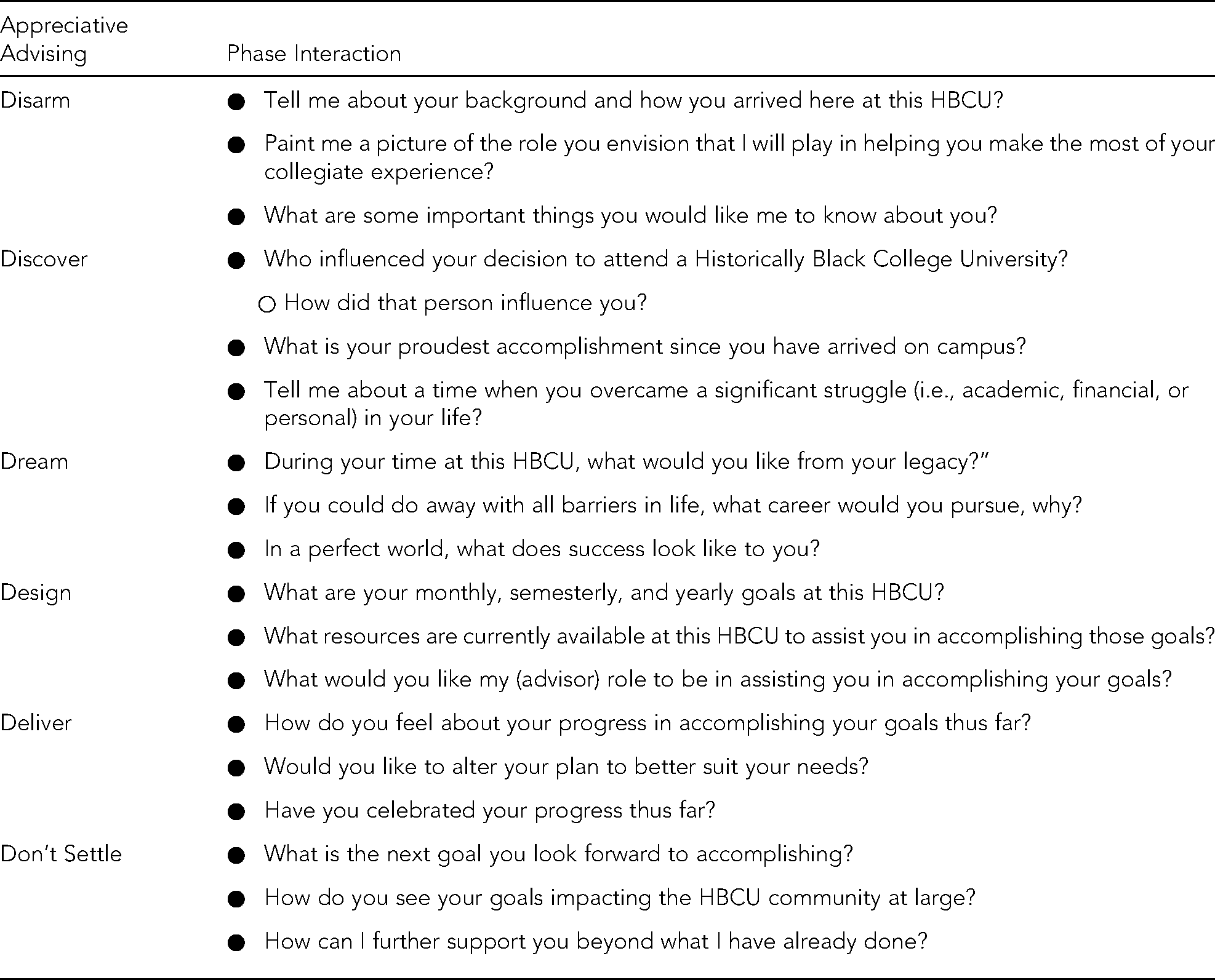
To move from mundane conversations, below you will find a table with example questions advisors may utilize while interacting with their HBCU students Table 1.
Example Questions per Appreciative Advising Stage for HBCU Students.
Conclusion
All in all, advisors must begin to employ intentional and practical approaches in order to combat challenges negatively affecting student retention, student morale, and self-confidence. We understand and acknowledge Appreciative Advising does not seek to dismantle systemic issues of oppression. Yet, it can be used as a tool to support Black students at HBCUs who are and have been marginalized by inequitable practices and policies. Moreover, this framework requires advisors to look beyond traditional approaches to advising and their biases while answering the pivotal question of “what do you see when you see me?”. If employed correctly, advisors can rethink their approaches to advising Black students at HBCUs.
In addition to employing the framework, we advocate for more research on Appreciative Advising with Black students at HBCUs. The current bulk of scholarship on Appreciative Advising takes place outside of the HBCU context, thus creating a gap in the literature.
Footnotes
Declaration of Conflicting Interests
The author(s) declared no potential conflicts of interest with respect to the research, authorship, and/or publication of this article.
Funding
The author(s) received no financial support for the research, authorship and/or publication of this article.
