







Abstract

Introduction
Peer mentoring programs have repeatedly shown that peer-to-peer support is a vital part of the transition process for new college students. Sometimes, what a student needs most in those imperative years is someone who can identify with them and provide the advice needed to get them to the finish line. In August 2019, the University of Nevada, Las Vegas (UNLV) College of Liberal Arts (COLA) launched a Peer Mentor Program Initiative to impact graduation rates, increase student retention and success, and advance learning experiences. We will discuss the two program models we developed throughout the 2019–20 academic year: (1) embedding the program into the curriculum and (2) an incentivized, opt-in model. We will also summarize both model's methods and results, discuss the program's successes and limitations, as well as future directions, and ease of replication at other institutions. Sometimes, what a student needs most in those imperative years is someone who can identify with them and provide the advice needed to get them to the finish line.
Program Inception and Purpose
The COLA Peer Mentoring Program was designed to help first-year students with their transition to UNLV. This program connects first-year students with an experienced upperclassman student peer mentor (PM) who can provide academic and social support and ongoing advice about how to succeed at UNLV. Significant research is available that suggests peer mentoring is an effective approach to advance student achievement, an important theme that could accelerate UNLV toward its mission of being recognized as a top-tier university. The Provost Office made the decision to pursue peer mentoring as a strategy for continuing to impact the university's goal for higher retention, progression, and completion in August 2019. The Director of Student and Community Engagement within COLA served as the supervisor of this program. By the end of September 2020, COLA had hired and trained PMs and had begun meeting with first-year students. Our student body and mentoring cohorts comprise 55 percent first-generation students, 40 percent Pell grant recipients, and 61 percent racial or ethnic minorities, presenting a diverse group from which we gained peer mentoring insights. Significant research is available that suggests peer mentoring is an effective approach to advance student achievement, an important theme that could accelerate UNLV towards its mission of being recognized as a top tier university.
Steve Crabtree of Gallup mentions in “Six College Experiences Linked to Student Confidence on Jobs,” that having supportive relationships with mentors boosts students’ assurance that they are gaining the skills and knowledge they will require in their working lives (2019). This indicates to us the benefit of mentoring relationships on a student's commitment to their journey, as well as the heightened responsibility levels of upperclassman PMs as they accelerate toward degree completion. Currently, our college has a mission to increase our graduation rates by 15 percent. The Peer Mentor Program Initiative is one way we are attempting to do this, by strengthening first-year mentees and upper-division PMs’ commitment to their goals. Since its launch in 2019, we have seen positive results and we are excited about the future outcomes of our retention rates for all students involved.
Program Design
Throughout the program's yearlong existence, we have experimented by implementing two program models. Although both models had differences in application, the overall objective remained consistent: recruiting junior and senior undergraduates to mentor first-year students in excelling toward their goals. Since first-year seminar courses are grouped by college major, pairing PMs with a cohort was straightforward. For instance, English major PMs were paired with an English first-year seminar course. In cases where a perfect major to major match was not achievable, we chose to pair that class of mentees with a mentor who at a minimum studied the seminar's focus subject, either as a minor or synonymous degree path. Assigning a PM to a first-year seminar bodes well because many first-year seminar students are still navigating common concerns about their major, degree planning, and post-college plans. After gathering end-of-semester feedback from participants, we learned that of the 541 students in the fall semester program, 151 students participated. In the spring semester program, of the 61 students, 58 were engaged. 89.66 percent of fall participants and 79.57 percent of spring participants surveyed having a positive experience with their mentor. Initially, our college was confident in the first approach, but with less engagement than expected, we pivoted to our second model which had exponentially higher participation rates.
Approach 1: Opt-in Model
Our pilot semester of the program used an opt-in model for first-year students, which we found to be challenging. Involvement in the program was optional for those enrolled in a first-year seminar. Over the course of the semester, all mentees would voluntarily engage in three 1:1 meetings with their assigned PM for a chance to be chosen as a scholarship recipient. The university holds a semesterly “Rebels Give” event, where local donors can contribute to high-impact causes, such as our program. Using a portion of these funds along with our provided budget, we incorporated an incentive of 10 $500 scholarships to be awarded to top participating mentees, selected by our 14 PMs and administrators. With the help of faculty, we emailed an advertisement of the opportunity to all COLA students to raise awareness. Given the structure of our first-year seminar courses for which we used as a basis of the program, each mentor mentored approximately 27 mentees. This ratio was initially perceived to be a constraint, as “most mentoring groups” typically contain about “15 mentees” according to Carvin (2011). Although this is best practice, our higher class totals in the fall along with budgetary restrictions led us to designate one PM per class. PMs were allocated an appropriate number of hours and pay to manage their cohort and were required to participate in team meetings with university faculty and university-wide training to ensure they stayed on track. Steve Crabtree of Gallup mentions in “Six College Experiences Linked to Student Confidence on Jobs,” that having supportive relationships with mentors boosts students' assurance that they are gaining the skills and knowledge they will require in their working lives (2019).
Approach 2: Curriculum-Embedded Model
During the spring semester, rather than make the program an option for COLA first-year seminar students, we built the program into the course curriculum and found that model to be much more successful. By reducing the previous semester to its challenges and successes and analyzing surveyed feedback, our team was able to collaborate and reposition the program before the following semester. Along with required assignments, PMs were this time integrated into the class and 1:1 meetings were graded by COLA instructors based on participation. Mentors were still paid, but there were no longer scholarship offerings for freshmen participants. Instructors had the option of making the program constitute 10 percent or 25 percent of their course grade. Freshmen still met with their assigned PM for three 1:1 s, in addition to a fourth in-person meeting that would take place at a campus event in an effort to connect students to resources, campus opportunities, and activities. Our college's online coordinator built discussion modules into our online course platform, Canvas, of which freshmen were required to respond to 10 posts. At the end of the semester, freshmen were also graded on their reflection paper addressing how they were impacted by the role of a PM in their first year. For instructors who chose the 25 percent worth curriculum, we added a creative reflection project, showcasing the questions they answered in their reflection paper. In the spring, we also added the new position of Lead Peer Mentor. This undergraduate and former PM managed the team meetings, facilitated faculty-to-mentor communication, and monitored mentor-to-mentee progress. Including this role added an extra level of organization, communication with our director, and allowed our PMs to gain mentoring as well.
Comparison of Both Approaches
Both approaches allowed for a bond between academic and student affairs for greater learning outcomes but they also bore many differences. In model two, required assignments motivated mentees to experience the benefit of having a PM, allowing them to self-reflect on their goals and learning. Because COLA offers more first-year seminar courses in the fall than in the spring, we began the program with 541 freshmen students enrolled in a class eligible for one of our 14 mentors hired, with an average of 27 students per class. In the curriculum-based spring model, our numbers decreased to 61 mentees total and 6 PMs, an average of 10 per mentor. We also found that including what Carvin calls an “appropriate-sized group” allows for variation in student perspectives as well as dispels any intimidation. Figure 1 demonstrates how many freshmen students engaged with their mentors, i.e., responding to emails or meeting for any number of 1:1 s. We had a higher response rate of 95 percent when the program was built into the curriculum with smaller class sizes rather than the optional incentive with larger class sizes, which had a 29 percent response rate. During the spring semester, rather than make the program an option for COLA first-year seminar students, we built the program into the course curriculum and found that model to be much more successful.
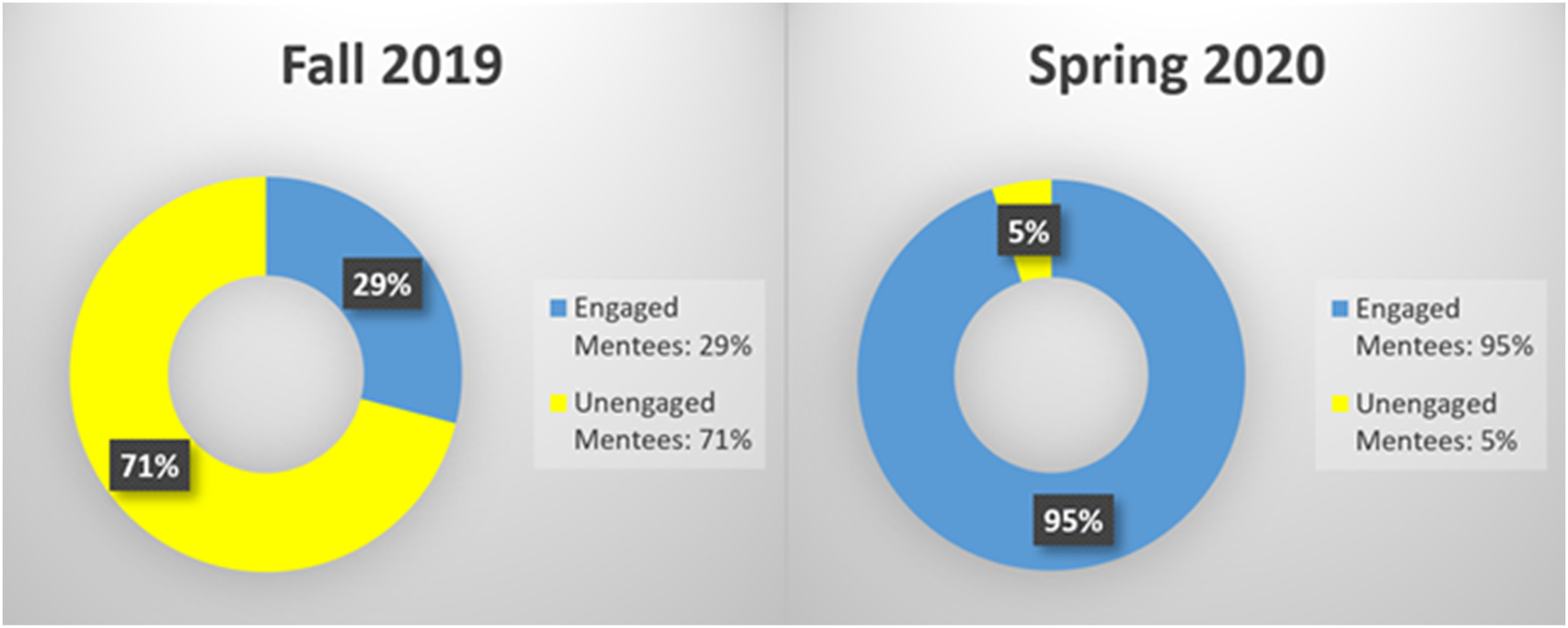
Fall 2019 and spring 2020 program engagement comparison.
Many mentees told us that they didn’t know how beneficial a PM was until they actually met with one and only a small number of those who engaged with their mentor in the spring failed to complete all of the requirements. This leads us to believe that more students may have engaged with the program in the previous model had they met with the PM at least once. When students engaged by choice, the completion rate was much lower, shown in Figure 2. Although only 29 percent of students engaged with the program, 27 percent met for at least one 1:1, indicating that only 2 percent of students who committed to engaging in the program failed to continue onto their second meeting. This tells us that once a student meets with a PM, they will likely discover the benefit and enjoy the experience, leading to a longer-lasting relationship and greater sense of commitment. These supportive relationships are precisely what we believe will catapult us closer to our goal of increased retention rates, as both mentees and mentors reported feeling heightened motivation to reach their goals when they were held accountable in social groups. We also found that including what Carvin calls an “appropriate-sized group” allows for variation in student perspectives as well as dispels any intimidation.
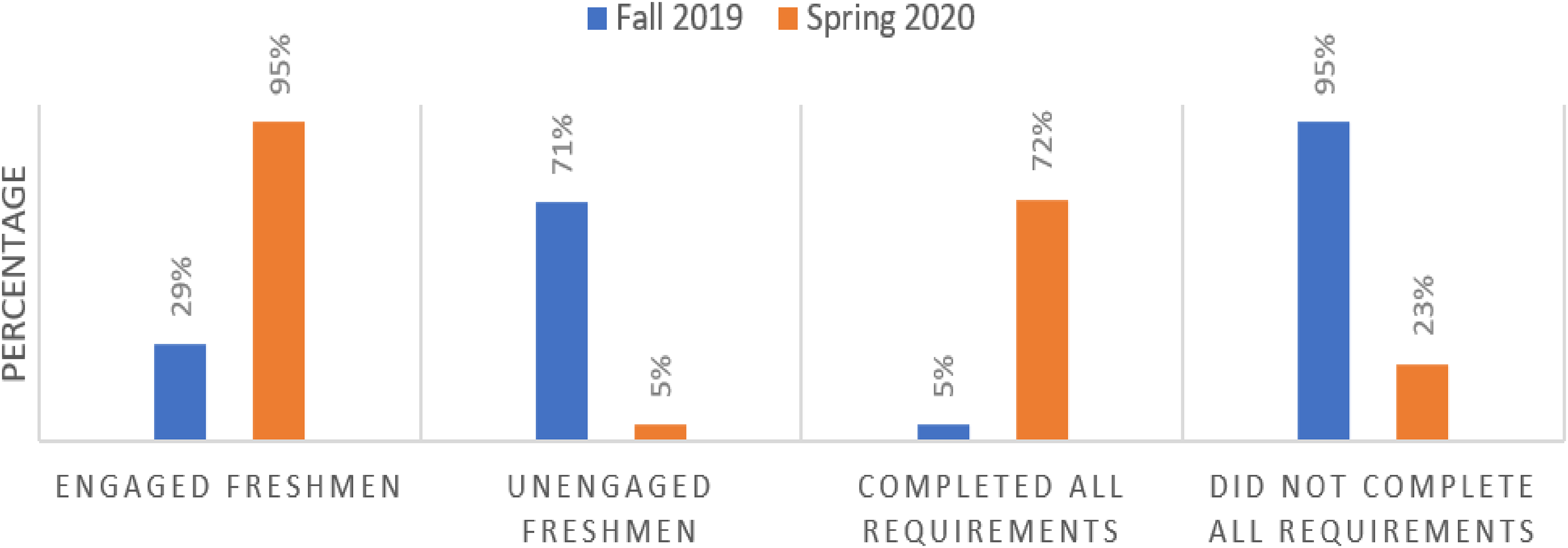
Fall 2019 and spring 2020 program completion comparison.
Reflection and Discoveries
Student feedback from this program helped us determine greatly what works and doesn’t in mentorship relationships. In the first model, our faculty introduced the program option to the students but was idle in the program for the remainder of the semester. In the spring, our curriculum-based program directly addressed this by getting professors of first-year seminar courses directly involved. A PM adds a different facet to a mentee's collegiate experience than a professor does because there are commonalities and they can be more candid with each other as peers. However, having a professor present shows mentees that the mentoring relationship is one to be taken seriously, which contributed to our increased completion rates in the second semester.
We learned that adding interactive, inclusive discussion posts built an alternative avenue for students to communicate outside of traditional contact, although 64.75 percent of mentees told us they preferred texting and email communication with their PMs over calls, apps, or video chats. Contrarily, other students expressed feeling more comfortable utilizing our online modules and safer expressing concerns than in text or email. Offering various options for students allowed us to identify key issues our students are facing and hear their voices, allowing us to better cater programming to them in the future. Many mentees told us that they didn't know how beneficial a PM was until they actually met with one and only a small number of those who engaged with their mentor in the spring failed to complete all of the requirements.
Limitations
Despite the numerous successes we have experienced, there were some limitations. Lack of engagement in the opt-in model was a primary drawback we endured, which ultimately initiated the replacement with the curriculum model. Not every student is intrigued by a scholarship, yet most participated when they were graded. In regards to our spring model's limitations, some mentors expressed that faculty changed aspects of the curriculum along the way to accommodate their unique teaching style and preferences, i.e., changing the number of required meetings, eliminating discussion posts, etc. Getting every administrator to follow consistent guidelines will be integral to the program's future and to the dissemination of information to our first-year students. Focusing only on first-year students has proven to be a limitation of ours, as shown in our mentees’ feedback. While placing PMs in first-year seminars have been conducive to our goals for the program and a majority of those students are underclassmen, first-year seminar courses are not restricted to first-year students by the university. One upperclassman first-year seminar student stated “I wish I had done this peer mentor program in the fall as an incoming freshman, as it defeats the purpose of doing it after you have already adjusted and been through the initial transition;” while a first-year student told us “it was nice to be taught by an upperclassman. I found it easier to talk to [my PM], and I genuinely felt more engaged.” Being able to make the program beneficial to all students regardless of class standing will be a focal point going forward. This tells us that once a student meets with a PM, they will likely discover the benefit and enjoy the experience, leading to a longer-lasting relationship and greater sense of commitment.
Another limitation was our required fourth 1:1 meeting to be taken place at a campus event or activity. Some participants said this presented difficulties for students who had limited availability and were not able to attend offered events on campus. In addition, due to COVID-19 many students were unable to complete the campus event or activity and going into the fall of 2020 we had to eliminate that facet entirely due to remote learning changes. Exceptions were made for webinars, which we plan to offer as a substitute for a 1:1 in future semesters. We’ve since determined that three 1:1 s is more realistic for first-year students and should be an adequate amount of visits to establish a mentoring relationship. Our aim for the future is to have consistency in the areas we weren’t able to achieve in the program's pilot year.
The limitations we experienced with the program have taught us a great deal about what should change for the 2020–21 academic year. With insights from PMs and our alumni board, we have decided to require PMs to meet with an assigned alumni board member mentor, so they too can be mentored. Such “supportive relationships and relevant engaging learning experiences” according to Steve Crabtree, will foster “long-term outcomes” in our PMs, including increased confidence and career skills, which will strengthen their abilities during their service as a PM (2019). Another planned change is to provide PMs with specific discussion content for mentees during their 1:1 s. In the previous two semesters, mentors would discuss anything the freshman wanted. We found that participants would be better guided if there were planned discussion points for instances when mentees aren’t asking questions. Similarly, we will be implementing a 1:1 schedule so students stay on track to completing their requirements. During our pilot year, some freshmen waited until later in the semester to request a 1:1 with their PM, causing the upperclassmen to feel overwhelmed with meetings in the final weeks of classes. To address this issue, we will be adding deadlines to all required assignments in the program for a higher level of accountability within the curriculum. One upperclassman first-year seminar student stated “I wish I had done this peer mentor program in the fall as an incoming freshman, as it defeats the purpose of doing it after you have already adjusted and been through the initial transition;” while a first-year student told us “it was nice to be taught by an upperclassman. I found it easier to talk to [my PM], and I genuinely felt more engaged.”
Implementation at Other Institutions
We believe the Peer Mentor Program would make a great addition to any college looking to improve student success and involvement. Key to implementation is attaining participation from full-time college staff to design PM training materials and program modules, enforce requirements, as well as track progress of the program and analyze the data for results. What is also unique about our program is that we were provided financial support from our administration. Having the option to offer wages to our PMs entices qualified and high-achieving students to apply for the role; however, all of our PMs divulged that they would have still participated in the program with or without compensation because of other, nonmonetary rewards. In the event that assistance is not available, implementation is still achievable by recruiting volunteer PMs. Similar to an internship, mentors can volunteer their time for the cause of the program in exchange for professional development from faculty or alumni board members, or involvement experience for their curriculum vitae.
Overall, this program has been a positive experience for our students, faculty, and staff. Our two models have taught us a great deal about what works in getting buy-in from faculty, developing our mentors, and investing in our student's success. Feedback has been positive and students are appearing to continue forward after their first-year seminar with increased confidence and excitement because of the work our mentors are doing. The latter model we used has shown to be effective according to our data, but we are continually refining and updating based on feedback from participants and budgetary changes. Because of its ease of modification, implementation is realistic for institutions of all types. We believe this program will continue to be a reliable asset to COLA as we excel toward our institution's goals of heightened retention and graduation rates.
Footnotes

We love feedback. Send letters to executive editor, and please copy him on notes to authors.