







Abstract
The coaching was really good for me because I think that I underestimated all the emotions that got in the way of my progression and my strategizing with my ADHD. I think that for me, personally, I pushed those aside a lot. It’s almost like I try to go one way and ignore the fact that there’s all these road blocks. I was like, “I’m just going to get to the other side of the road but I’m going to try to do [that] while all the cars are going by. I’m not going to wait to stop and clear the road first.” And that’s what I think coaching really helped me do—clear the road so I could get to the other side.
Barkley (1997) and others have identified impaired executive functioning as the underlying cause of ADHD symptoms. Executive functioning is a construct that includes self-regulatory mechanisms for organizing, directing, and managing other cognitive activities, emotional responses, and overt behaviors (Gioia, Isquith, & Guy, 2001). Brown (2005) described six specific types of executive functions, including activation of behavior, focus, sustained effort, management of emotions, memory, and goal-directed action. Services that help individuals with ADHD enhance their self-regulation have been recommended in recent literature (DuPaul, Weyandt, O’Dell, & Varejao, 2009; Silver, 2010). ADHD coaching has gained increasing interest as an intervention that may enhance individuals’ use of their executive functioning skills and, thus, improve their ability to control some ADHD symptoms (Parker & Boutelle, 2009; Quinn, Ratey, & Maitland, 2000; Swartz, Prevatt, & Proctor, 2005). This study investigated how ADHD coaching influenced undergraduate students’ use of their executive functioning skills to manage the academic and emotional performance challenges they encountered in a variety of postsecondary settings.
In a summary of current transition trends, Madaus and Shaw (2006) reported that more high school students with disabilities, including those with ADHD, are now entering college compared with 15 years ago. However, their preparation and graduation rates lag behind peers without disabilities. In 2008, nearly 11% of U.S. undergraduates reported one or more types of disability (National Center for Education Statistics, 2008). Until recently, national demographic profiles did not identify the number of students with ADHD because they are often counted under broader categories such as other health impaired, emotionally disturbed, or learning disabled (Wagner, Newman, Cameto, Garza, & Levine, 2005; Wolf, 2001). A national survey of Disability Services (DS) staff disaggregated these categories and reported that students with ADHD had emerged as the second largest subgroup of college students with disabilities, after individuals with learning disabilities (LDs; Harbour, 2004).
Students with ADHD frequently report a sharp rise in academic impairment and emotional distress as they begin college, compared with their high school years (Heiligenstein, Guenther, Levy, Savino, & Fulwiler, 1999). This transition phenomenon has been attributed to significantly increased demands on students’ self-regulation and a reduction in the organizing structures formerly provided by a high school curriculum and parental supervision (Katz, 1998; Parker & Boutelle, 2009). DS service providers help students achieve a level playing field by providing accommodations such as quiet test rooms and notetakers or services such as time management skills training (Quinn et al., 2000; Zwart & Kallemeyn, 2001). University mental health center professionals have responded to the increased number of students with ADHD by providing individual and group therapy services for students with this disorder and making psychiatrists available to prescribe and monitor their use of medications while on campus (Heiligenstein et al., 1999; Weyandt & DuPaul, 2006).
DS offices can only provide accommodations and services to students with ADHD who present adequate documentation and formally request this assistance each semester (Byron & Parker, 2002). There is evidence that there are more than 2 million college students with disabilities. However, it is likely that less than half of these students register for DS services in college. The National Longitudinal Transition Study–2 reported that only 40% of college students who received special education services in high school formally register with a DS office (Wagner et al., 2005). Consequently, the actual number of college students with ADHD is likely to be larger than current data reported by colleges suggest. Presumably, undergraduates who are not registered with a DS office use other campus services to address their academic, pharmacological, and mental health needs, even though the supports may be provided by individuals without an understanding of ADHD.
Postsecondary professionals have sought a better understanding of the types of interventions or supports that are most effective for the rapidly increasing numbers of students with ADHD (Byron & Parker, 2002; DuPaul et al., 2009). Faced with the need to develop or revise service delivery models in an era of diminishing budgets, campus administrators have debated whether ADHD is an academic problem, a mental health issue, a disorder primarily managed with medications, or even an overdiagnosed condition that resourceful students pursue to obtain benefits such as extra time on exams (Bryington Fisher & Watkins, 2008; Byron & Parker, 2002). Despite these debates, postsecondary professionals have clearly recognized how often students with ADHD struggle to meet institutional goals such as academic persistence and graduation (Wolf, 2001). For example, researchers have identified higher risk factors related to persistence and completion for students with ADHD in college (Loe & Feldman, 2007; Norwalk, Norvilitis, & MacLean, 2009). These findings are similar to what has been found for students with ADHD in secondary school settings. In a study of 29,662 high school students, 32.3% of the students with ADHD–combined type dropped out of high school compared with 15% of students with no psychiatric disorder (Breslau, Miller, Chung, & Schweitzer, 2011).
ADHD college coaching is a specialty area within the broader field of personal or life coaching. Coaching emerged from corporate mentoring models in which experienced employees guided newer employees with advice about how to achieve success in that workplace environment (Quinn et al., 2000). Bettinger and Baker (2011) found that coaching services for the general population of college students had a significant effect on persistence and retention. These authors noted a need to examine “the specific types of coaching services and the specific actions of coaches which are most effective in motivating students” (Bettinger & Baker, 2011, p. 20).
Hallowell and Ratey (1995) published the first description of ADHD coaching by referring to a coach as “an individual standing on the sidelines with a whistle around his or her neck barking out encouragement, directions and reminders to the player in the game” (p. 226). In contrast to psychotherapy, which is focused on healing damaged mental health conditions, coaching is a wellness model predicated on the belief that people who are coached are creative, resourceful, and whole (Hart, Blattner, & Leipsic, 2001; Jaksa & Ratey, 2006; Sleeper-Triplett, 2010). In contrast to didactic academic services such as tutoring or learning strategy instruction, coaching does not prescribe the same set of steps to all participants to follow (Allsopp, Minskoff, & Bolt, 2005; Byron & Parker, 2002). Rather than healing clients or prescribing a sequence of steps for improved learning, coaches instead ask questions to prompt reflection and planning. This process facilitates the client’s ability to clarify goals and create realistic plans for achieving them (Whitworth, Kimsey-House, Kimsey-House, & Sandahl, 2007).
ADHD coaching uses the same mind-set and techniques as life coaching. It also draws on current knowledge of ADHD to increase the structure of the coaching relationship that is codeveloped by each client and coach (Sleeper-Triplett, 2010). An example of this adaptation that can be particularly beneficial to clients with ADHD is the use of accountability techniques. Clients agree to be accountable to their coach by providing frequent updates about their goal-directed efforts in between actual sessions. These exchanges are believed to help clients maintain focus on their goals and motivation for working on them (Parker & Boutelle, 2009; Quinn et al., 2000).
Previous research on ADHD coaching in postsecondary settings has found that coaching has a positive impact on participants’ self-regulation through improved use of their executive functioning skills. For example, Zwart and Kallemeyn (2001) used a control group design to study peer coaching with 50 undergraduates with ADHD and/or LD at a small, private university in the upper Midwest. After one semester of coaching, the treatment group students had achieved significantly improved scores in time management, anxiety, motivation, and test preparation as measured by pre- and posttests of the Learning and Study Strategies Inventory (LASSI; Weinstein, Shulte, & Palmer, 1987), a standardized assessment of beliefs and skills related to academic success. Swartz et al. (2005) trained graduate students to provide 8 weeks of coaching services to university students with ADHD at a large public Southern university. Using a single case study approach, Swartz et al. described participant gains in studying, planning and prioritizing, time management, and other academic skills requiring effective self-regulation. They identified a reliance on self-report and the lack of follow-up (maintenance) data as limitations of the study. The researchers also noted that coaching complemented but did not replace existing campus services such as counseling or academic advising.
Similarly, Parker and Boutelle (2009) studied coaching with a group of 54 freshmen and sophomores with ADHD and/or LD attending a private college in the Northeast. They interviewed a purposive sample of 7 of these students once each semester during the same academic year. These students reported that coaching improved their capacity to achieve academic and life goals by helping them learn how to formulate more realistic plans and use other campus services more effectively as they became more organized. Students also reported an increased capacity to use “self-talk” to problem solve and minimize their levels of stress while working on their own. Depape (2006), Duncan and Cheyne (1999), and others have defined self-talk as the use of covert or overt language to organize one’s thinking while engaged in problem solving.
As a final example, in a pilot study of the present investigation, Parker, Field Hoffman, Sawilowsky, and Rolands (2011) studied seven undergraduates with ADHD and/or LD who attended a highly selective private university in the Midwest. After one semester of weekly, 30-min coaching sessions by phone, the majority of participants demonstrated improved grade point average (GPA) and made substantial gains in the self-regulation cluster of their LASSI (Weinstein & Palmer, 2002) pre- to posttest scores. Qualitatively, students reported that coaching helped them improve their goal-attainment skills and experience a greater sense of well-being.
These studies have all depicted coaching as a unique campus service that helped students become more self-regulated. However, the number of studies conducted on ADHD coaching to date has been small, and the majority of these studies have been based on relatively small sample sizes. Goldstein (2005) noted the need for rigorous research to empirically test the impact of coaching on a large group of postsecondary students across a substantial length of time.
To respond to this need, the authors conducted a mixed-methods (i.e., quantitative and qualitative), year-long study at 10 college campuses in geographically diverse locations across the United States to assess the impact of coaching services provided by a nonprofit coaching organization (Field, Parker, Sawilowsky, & Rolands, 2010). Undergraduates from 8 universities and 2 community colleges participated in the larger study. All participants were eligible for accommodations based on ADHD documentation on file with their DS office. A total of 127 participated in the study. Students were randomly assigned to either the treatment group (n = 88) or the comparison group (n = 39). Random assignment was made throughout the recruitment period during the fall semester and the coaching intervention lasted through the end of the following spring semester. Among the 88 students in the treatment (coaching) group, 49 were male and 39 were female. Of the 39 students in the comparison (no coaching) group, 23 were male and 16 were female. Students in the treatment group received an average of 16.45 weekly (30 min) coaching sessions by phone for an average of 527.44 min of coaching.
This article describes qualitative results from that research; quantitative findings are reported elsewhere (Field et al., 2010). Unlike special education, academic supports and accommodations are only provided to postsecondary students who voluntarily request such assistance. It is important, therefore, to develop a more complex understanding of how coaching is experienced by college students who choose to use this service. To do so, in-depth interviews with males and females with differing degrees of academic success who demonstrated impaired self-regulation were used to provide “enlightening” individual perspectives about ADHD college coaching, as described by Lincoln and Guba (1985, p. 102).
Method
Participants
To better understand students’ interactions with coaches and their perceptions about any outcomes that emerged from coaching sessions, the authors investigated two research questions.
Research Question 1: What is the effect of ADHD coaching on students’ perceptions of the process they used to achieve or maintain academic goals such as GPA?
Research Question 2: What benefits do students associate with coaching services?
Whenever possible, selections were based on gender, cumulative GPA, and the self-regulation cluster score from students’ pretest LASSI administration. In the words of O’Day and Killeen (2002), this approach to the creation of a purposive sample allowed the research team to stay
focused upon the reality of the disability experience and provide a powerful means both for understanding participants’ perceptions and for developing action strategies that will address the problems they face. It can also be a necessary preliminary step to larger-scale survey work that can confirm and quantify the exploratory findings uncovered through small-sample qualitative inquiry. (p. 12)
A purposive sample was created from the 88 students who had been randomly assigned to the study’s treatment group and, therefore, received weekly coaching services. Students were selected according to three criteria: gender, academic success as measured by cumulative GPA, and self-regulation skills. Although males often outnumber females in reported numbers of individuals with ADHD, Quinn and Nadeau (2002) suggested that a more equal gender ratio is accurate because males are more likely to be referred for diagnostic assessment. Consequently, one male and one female participant at each of the 10 research sites were identified when possible. It has been reported that academically successful undergraduates seek coaching services as often as those who may be experiencing difficulty (Parker & Boutelle, 2009; Parker et al., 2011). As a result, 1 student with a cumulative GPA at or above 3.0 and 1 student below this criterion were identified on each campus when possible to participate in interviews. Finally, students’ baseline scores on the self-regulation cluster of the LASSI (Weinstein & Palmer, 2002) were used as a measure of the executive functioning skills that are central to ADHD impairment (Brown, 2005; Weyandt & DuPaul, 2006). The LASSI is an “80-item assessment of students’ awareness about and use of learning and study strategies related to skill, will and self-regulation components of strategic learning” (http://www.hhpublishing.com/_assessments/LASSI/index.html). Results address 10 scale areas (skills such as time management and beliefs such as attitude) that are averaged into three cluster scores: skills, wills, and self-regulation. All scores are reported as percentiles. Subscale reliabilities are strong, ranging from .75 to .90. Two students who had self-regulation scores at or below the 50th percentile, which indicates risk of academic difficulty based on LASSI norms, were identified when possible. This approach resulted in a purposive sample of 20 students with a final N of 19 as 1 student in the sample was not available to be interviewed. See Table 1 for demographic information about the participants.
Demographic Data of Interviewed Students.
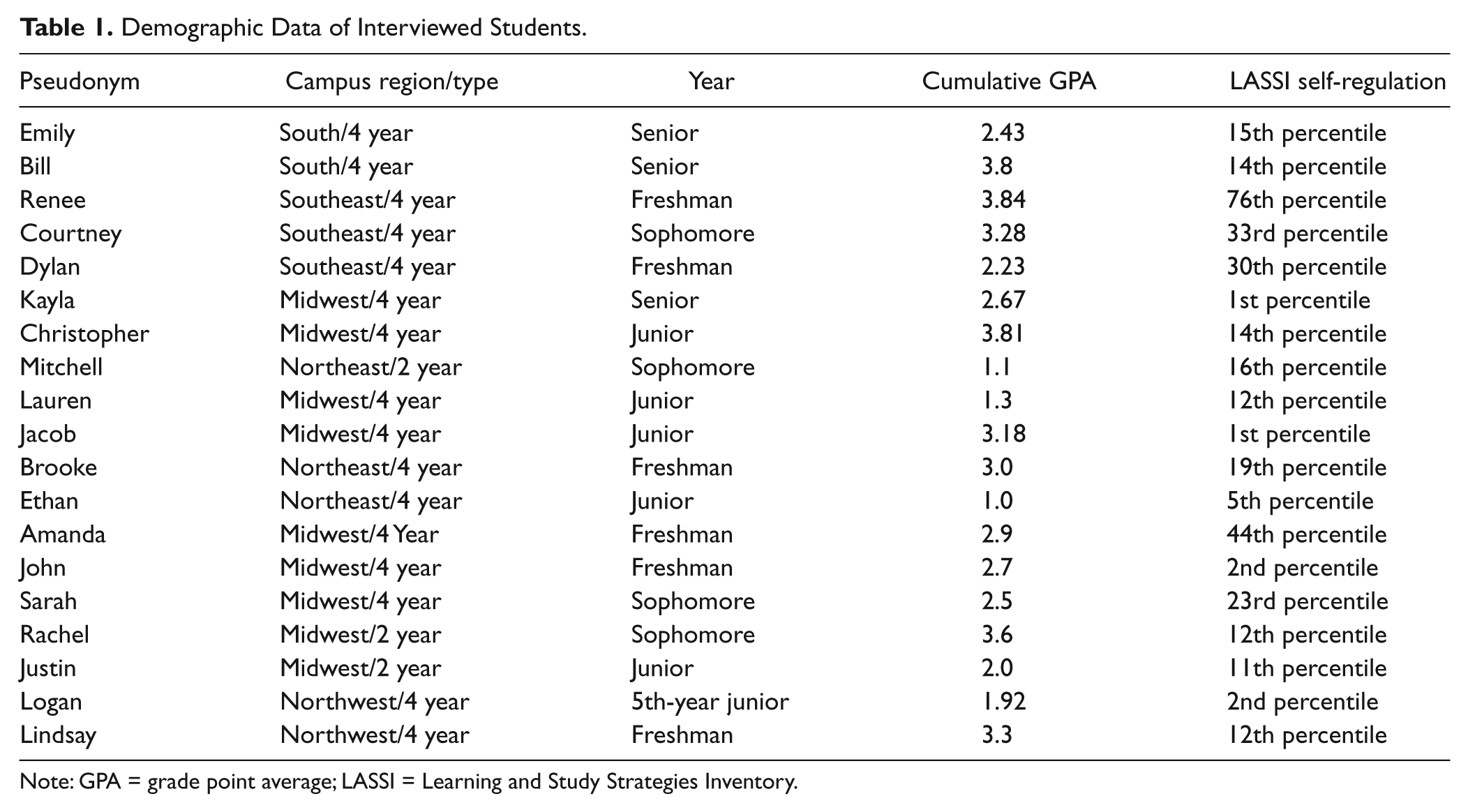
Note: GPA = grade point average; LASSI = Learning and Study Strategies Inventory.
Intervention
Sleeper-Triplett (2010) created the ADHD coaching model and trained and supervised all coaches who provided the intervention reported in this study. Using this model, coaches focused on seven major areas when working with students: scheduling, goal setting, confidence building, organizing, focusing, prioritizing, and persisting at tasks. These areas were selected to directly address the difficulties in executive functioning often experienced by individuals with ADHD (“How a Coach Helps,” n.d.). The coaches engaged in weekly, 30-min phone calls with students at a mutually agreed-on time. Coaches routinely asked students about their current academic goals and expressed interest in their physical and emotional well-being. As students identified or refined their plans, coaches helped them break larger goals into smaller tasks and create systems for remembering to act on those incremental steps. Many coaches helped students use more effective time management tools (such as reminder beeps on a cell phone) and create more balanced schedules that included physical exercise and routine sleep schedules. Coaches listened for and empathized with students who were stressed out or demoralized by events of that week, but they were trained to focus on helping students take action that could address the cause of those feelings. In addition, coaches and students often exchanged brief communications via texting, phone calls, or e-mails in between weekly sessions. This allowed students to be accountable for their progress—or lack thereof—on goal-directed behavior and gave coaches the opportunity to offer encouragement or relevant information.
Fidelity of treatment was assessed in several ways. First, a detailed protocol for the coaching model was developed. This guided the creation of biweekly written reports that all coaches submitted during the first month of the study and each month thereafter. The coach trainer/supervisor conducted regular conference calls with coaches during the study to reinforce adherence to the coaching protocol. In addition, fidelity of treatment was assessed through the qualitative interviews. Interviewees were asked (a) how frequently they spoke with their coaches and for what length of time, (b) the type of communication they used to communicate with their coaches (e.g., phone, e-mail, Skype), and (c) the estimated frequency and type of check-in (e.g., e-mail, texting, phone) between coaching sessions. Participants’ responses indicated a high level of consistency in these dimensions of the intervention, regardless of the coach involved.
Data Collection
The first two authors divided the 10 campuses and made site visits late in the spring semester to conduct one-on-one interviews. Each interview lasted approximately 1 hr, took place in the college or university DS office, and was audio recorded with the student’s permission. Students were invited to bring an artifact to their interview, which was described as “anything you find or make that symbolizes what coaching means to you.” Among the 19 students, 14 brought artifacts to the interview; 3 more students verbally described artifacts they might have used. All participants who brought artifacts allowed them to be photographed. Interviewers also took field notes while on each campus. Following the interviews, a professional transcription service was used to create verbatim transcripts. The authors had access to a broader data set for all 127 students in the study, including the 39 students in the control group. Data included students’ cumulative and semester GPA, pre- and postintervention scores on the LASSI, and a onetime score obtained near the end of the study on an instrument created for this study, the College Well-Being Survey.
The authors used the same interview protocol that had been developed for and successfully used in the pilot study (Parker et al., 2011). The interview questions prompted students to describe the logistics of their coaching services, the goals they addressed with coaches, how coaching seemed to affect their academic success, and how coaching compared with traditional support services such as counseling, academic advising, tutoring, strategy instruction, or meeting with professors during office hours. Students were also asked what they liked best about coaching and how the service could be improved.
Data Analysis
The authors created a codebook to record the process of developing, applying, and refining codes throughout the analytic stage of this study. The first two authors initially coded transcripts and recorded these early codes and descriptions of each prior to exchanging their versions of the codebook. This process resulted in the creation of 14 nodes (or categories) with a total of 92 associated search terms. As codes emerged, they were entered into NVivo Version 8 (QSR International, 2009). See Table 2 for additional information about codes and search terms Through the use of software commands, all transcripts were systematically analyzed by highlighting text that used the search term and generated coded data sets for further analysis. Directions were delineated to ensure that the coding process was carried out consistently. For example, the node of goal setting was used to capture quotes in which students described how they thought about, formulated, implemented, or self-monitored their progress on goals. Search terms that identified quotes that fit into this node included plan, realistic, specific, goals, smaller chunks, and system.
Sample of NVivo Nodes and Search Terms.
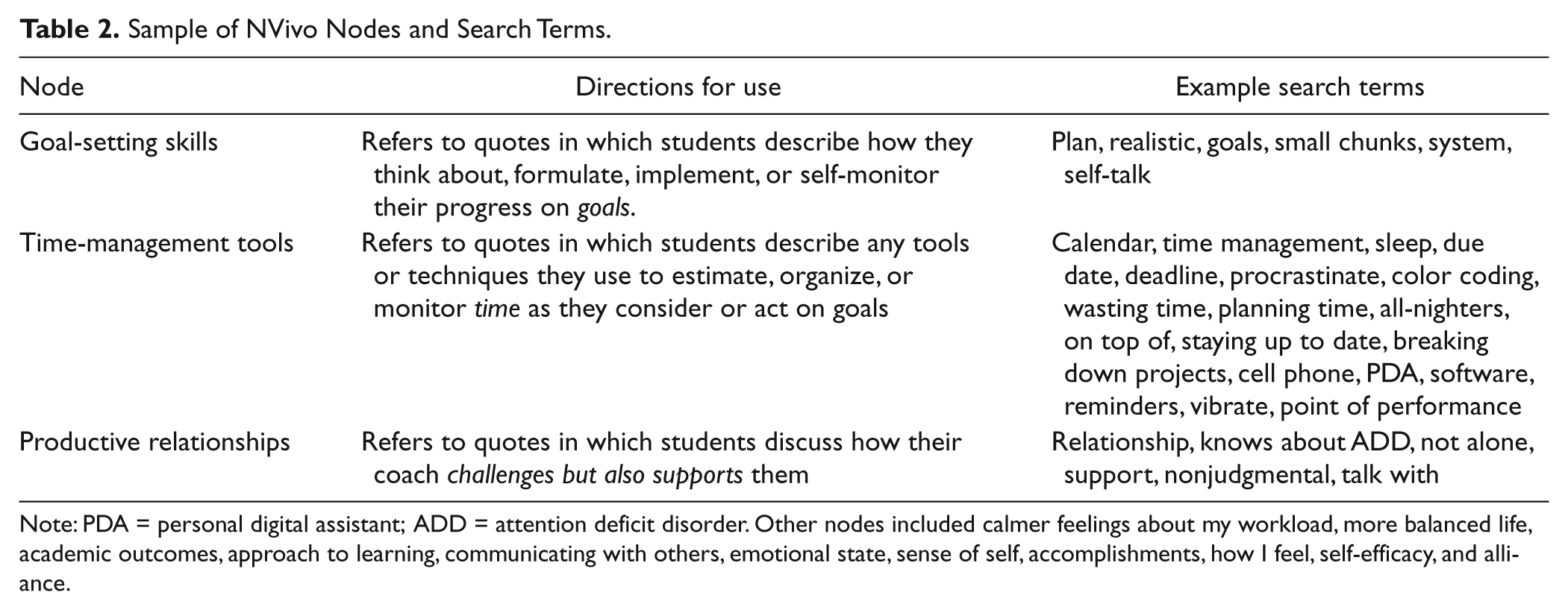
Note: PDA = personal digital assistant; ADD = attention deficit disorder. Other nodes included calmer feelings about my workload, more balanced life, academic outcomes, approach to learning, communicating with others, emotional state, sense of self, accomplishments, how I feel, self-efficacy, and alliance.
Qualitative analysis is an iterative process (Miles & Huberman, 1994). Periodic conversations allowed the researchers to revise the codebook by restricting certain search terms (e.g., “staying up late” became “up late”), adding new search terms (e.g., the terms cell phone and software were added to the time management node), refining directions for using some of the nodes (e.g., adding the phrase, “and applying skills learned in coaching to other parts of my life” to the more balanced life node), and creating a new node, coaching model, because many students volunteered comments about this model and their coach’s style or techniques. During the analytic process, the research team conducted two rounds of interrater reliability checks. At an early point in the process, one of the coders met with the fourth author, who had not engaged in the original coding work. After discussing the codebook in detail, they separately hand-coded Interview 1 before comparing results. Next, they informally compared results and clarified questions about applying the codes consistently. The researchers then separately hand-coded Interview 2 and achieved an 83% agreement rate after comparing results. Agreement rates at or above 80% are indicative of a strong level of clarity and consistency when conducting interrater reliability checks (Chi, 1997).
Given this foundation, the first and second authors continued coding the remaining interviews separately, using NVivo. They repeatedly exchanged observations about additional search terms and continued clarifying their understanding of how to apply codes consistently. A second interrater reliability check was conducted by comparing two more interviews that the first two members of the research team had coded separately. This time, the interrater agreement rate reached 85%.
Once all coding had been completed and applied to the 19 transcripts using NVivo software, one of the authors ran queries to address the two research questions. NVivo produces reports in response to such queries as “Display all comments in which students discussed grades.” The first author then sorted quotes in a given report into meaningful units. For example, in the query in which students discussed coaching’s impact on their goal attainment, four categories emerged from the highlighted quotes: more productive ways of thinking about goals, more effective approaches to working toward a goal, better coping strategies for persisting at goals, and positive outcomes.
As the researchers conducted this analysis, they engaged in a constant comparison across data sources to reflexively consider “groups, concepts, and observations . . . to develop an understanding that encompasses all instances of the process, or case, under investigation” (Denzin & Lincoln, 1994, p. 202). This involved comparing interpretations of students’ comments with their artifacts, GPA, LASSI scores, and College Well-Being Survey results. This triangulation process allowed the researchers to corroborate or revise their understanding of a student’s actual meaning (Miles & Huberman, 1994). In discussing these results, the research team was able to identify emergent themes from the interviews according to procedures defined by Lincoln and Guba (1985) that helped address both research questions.
Results
Effect of Coaching on Students’ Academic Goal Attainment
The first research question explored students’ perceptions of the impact of coaching on the processes they used to achieve or maintain academic goals such as GPA. Students’ comments were varied about whether coaching directly helped them achieve higher grades. These results parallel a similar finding in the pilot study (Parker et al., 2011). In most cases, students believed that coaching improved how they worked on academic goals, but expressed less certainty that it actually resulted in higher grades. Examples of students’ statements regarding this topic are provided below. Pseudonyms are used to protect participants’ confidentiality.
Brooke was a university freshman who earned a 3.0 cumulative GPA despite a LASSI self-regulation score at the 19th percentile. Her response was typical of many students’ insights into this question.
Has coaching helped you improve your grades at all?
Somewhat.
You’ve got a quizzical look on your face. Like, “I’m not so sure about that.”
I don’t have a lot of tests or quizzes or projects to manage my time to tell me how things are going. So, I think so. I think I’m doing a better job of managing things this semester than I was last semester. But to say the grades; I don’t know.
Participants noted that many factors could affect their grades and that they received infrequent feedback about their academic standing. Students felt strongly that coaching helped them enhance their capacity to formulate and work toward goals in more self-regulated ways. These enhancements led to more positive outcomes than participants had encountered prior to coaching, regardless of the student’s year in college. Although students did not explicitly link coaching to higher grades, they described four broad ways that coaching positively enhanced their academic experiences. Students reported that coaching helped them (a) work toward goals more productively, (b) persist at goals with better coping strategies, (c) think about goals more effectively, and (d) achieve more positive outcomes (see Figure 1 for a visual overview of the emergent themes for Research Question 1).
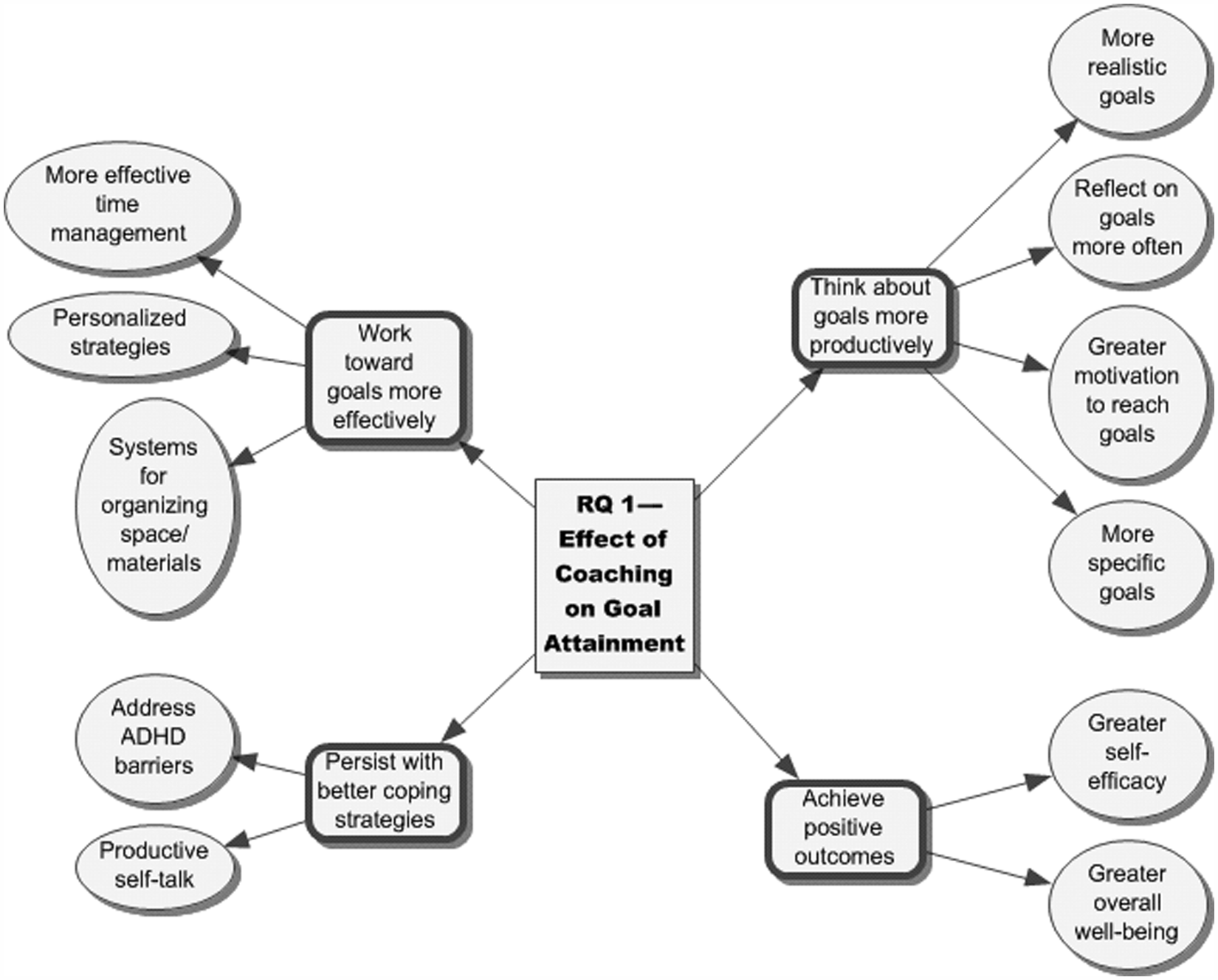
Mindmap of themes related to Research Question 1.
Work Toward Goals More Effectively
Students felt strongly that coaching helped them work toward their goals more productively. There were many examples of this outcome. Students reported that coaches helped them use better time management skills and personalized strategies for learning more effectively, and create better systems for organizing themselves or their environments.
More effective time management
Interview responses indicated that coaches helped students think about and use time more proficiently. While participants still reported being extremely busy and, at times, getting overwhelmed by their myriad responsibilities, they often attributed an improved capacity to manage multiple deadlines to the structures their coaches helped them create and follow. Brooke, for example, was embarrassed by a need to seek extensions on many course deadlines during her first semester. As her work with her coach unfolded, this happened less often. She added, “And I feel less guilty doing that because, last semester, I was doing that for everything. Just because I couldn’t handle everything all at once. And this semester I’m doing better about it.”
Several participants were clear that coaching’s impact on their time management skills influenced their academic success. Emily, the senior at a Southern university, stated emphatically that coaching helped her earn better grades in “all my classes but one. It’s made a significant difference with turning in completed work, turning work in on time.” Jacob was a junior at a highly competitive public university in the Midwest. He had earned a 3.18 GPA despite a LASSI self-regulation score at the 1st percentile. Jacob had struggled with his original program (engineering) before changing majors at the start of the study. In discussing grades, his comments mirrored those of Brooke and other participants.
Do you think coaching is helping you get better grades?
Yes, I would say so. I am hesitant to go off last semester, just because the academic courses I was in, I was a lot more able to do regardless of coaching compared to engineering beforehand. Which is the main reason I switched [majors]. Especially during finals, [coaching] definitely helps. I think I might not have done as well or had a harder time doing as well, getting everything done.
Personalized learning strategies
Jacob also discussed coaching’s impact on his study skills. Like other participants, coaching helped him pinpoint academic challenges and use newly individualized strategies. During a discussion of GPA, Jacob was asked if his coach had helped him earn grades in a more effective manner. He answered, “Yeah, I would definitely agree with that. Some of the study habits are just coming [together] . . . talking through better strategies for reading notes and that kind of thing.” Logan described himself as a “5th-year junior” who attended a highly competitive university in the Northwest. With a GPA of 1.92 and a self-regulation score at the 2nd percentile, he had encountered many academic struggles in college. Logan shared Jacob’s propensity for getting bored while reading. His coach helped him develop a highly personalized approach to learning from college textbooks.
In previous years when I was studying . . . my professor would always say, “You need to read this chapter, you need to read that chapter,” and I thought, “Okay, I need to read this chapter.” And it would take me forever to get through the chapter reading it linearly. And then what I found out was, “You know what?” And [my coach] helped me with this. “You know, I really don’t need to read this chapter, to be honest with you. I just need to understand the—she helped me think—‘What’s the goal of this class?’ It’s to understand these certain concepts. So, if you just want to go concept by concept and read what you need to read, not linearly but flip around, that might be a little bit more useful.”
Organizational techniques
Students’ responses to interview questions indicated that coaches helped them develop better organizational strategies. Dylan was a freshman at an urban university in the Southeast. Garrulous and personable, he had begun using a Palm™ device to better organize his week with the help of his coach. In addition to its calendar feature, this electronic tool allowed him to keep and update lists and access e-mails throughout the day. Dylan was pleased that this new approach to self-management minimized his procrastination. When asked what was most useful about coaching, he replied,
The organizational aspect, I would say; definitely the most helpful part of it. I’ve seen a marked improvement in my organization since I’ve started with [my coach] . . . With [my coach] I’ve been able to work on getting my weekly schedule out; getting the assignments that I have in advance done early so I can prepare for other things and organizing my entire weekly schedule. In high school, that would have been highly inconceivable for me to do that. That would have been a goal that I would have considered out of reach.
Sometimes, a coach helped students organize their physical environments or even the materials with which they studied. Rachel was a sophomore at a community college in the Midwest. With a 12th percentile self-regulation score and a 3.6 GPA, she worked very hard to organize her study activities to achieve impressive outcomes. Rachel discussed her need to pare down the copious lengths to which she tried to learn “everything.” Her coach helped Rachel prioritize and retain information more effectively. When asked about her artifact, Rachel reached into a stuffed backpack and pulled out a hammer and small screwdriver. She smiled broadly and said that, like coaching, these practical tools helped her reach goals one step at a time. This happened most recently as she tried to work on a research paper:
I talked to her and told [my coach] the parameters and what was going on with the assignment. And she just [started] giving me practical ideas, “Well, color code these or use note cards in this way and that’s going to help you structure what you’re doing. And organize all this information because, if you’ve got 15 or 20 sources, that’s a heck of a lot of information to put together in one paper.” I was just overwhelmed from that assignment. Just kind of stepping back and saying, “Here’s practically what I can do so that this information doesn’t get the best of me.”
Persist at Goals With Better Coping Strategies
Students reported that coaching helped them continue working toward their goals even when barriers impeded their efforts. Being accountable to their coaches meant that students had weekly, scheduled times to reflect on their efforts, identify successes, and develop new strategies for addressing challenges that thwarted their efforts to persist at their goals. Students reported that their conversations, emails, and text messages with coaches facilitated their problem solving and enhanced their motivation to pursue their goals. Many students also described their emerging use of positive self-talk while working on their own as another way that coaching facilitated their goal-directed efforts.
Overcome ADHD obstacles
Coaches helped participants develop strategies and structures that could be useful to college students with and without ADHD, such as improved time management and better study skills. In some cases, coaches also helped students overcome chronic difficulties with the distractibility, restlessness, or impulsivity that are symptomatic of executive functioning impairment. In this regard, coaches demonstrated a unique knowledge of ADHD and an ability to talk with students about ADHD symptoms that distinguished their efforts from the assistance commonly provided by college writing centers, study skills workshops, and other campus resources. For example, Sarah’s coach offered a suggestion for dealing with a chronic source of distraction:
Last semester, I brought my computer a lot to class and I would say, “Oh, I’m going to take notes on my computer.” But somehow the cursor would just creep over to the Internet Explorer. My coach said, one fun session we were talking about it and she just said, plain and simple, “Don’t bring it [the laptop].” And it was something so simple, but I just needed to be told that. Once I was told that, I said, “Okay.” That’s so easy to not bring the temptation with you. You’ll have to focus; you don’t have anything else to do. I would also keep my [phone] on vibrate when I would be in class and so, if I felt it, I’d say, “Oh, who’s texting me? Who’s emailing me?” Turn your phone on silent. It’s as easy as that and you won’t even think about it until the class is over.
Use of self-talk.
Prior research on ADHD coaching has reported enhanced self-talk as a positive outcome of this emerging intervention (Parker & Boutelle, 2009; Parker et al., 2011). Self-talk has been described as the use of covert or overt language to organize one’s thinking and to minimize subjective distress while engaged in problem solving (Depape, 2006; Duncan & Cheyne, 1999). During the interviews, students often reported hearing their coaches’ questions in their minds while working independently, asking themselves coaching questions to enhance their organization, or comforting themselves with positive encouragement and reminders to thwart growing anxiety about an approaching task or perceived outcome. Justin was in his 3rd year at a Midwestern community college. He reported his new habit of prompting himself with questions similar to his coach’s. When asked if he ever heard his coach’s voice in his head, Justin thought for a moment before replying, “It’s actually, no, I think it’s more my voice saying what she would.” Jacob, the junior at a Midwestern university, also discussed his use of self-talk, which had taken on a more positive tone while he was coached:
I don’t know if it’s an exact result of coaching. Definitely part of it is. The one thing that I’ve definitely noticed [about self-talk] that is improved over this year is doing homework and studying. It not as much as the berating myself to do it, it’s just I do it because I need to. Or it’s sometimes because I want to, once I get into [studying]. It used to be this real difficult thing; it’s like pushing myself to the doctor’s office or something that I really don’t want to. But it’s become easier to tell myself to just do it so I can do something else.
Courtney was a sophomore at a large, urban university in the Southeast. With a 3.2 GPA and a self-regulation score at the 33rd percentile, Courtney’s coach helped her organize and manage her schedule more effectively. As a result, she had more time for her social life and felt less “guilty” when socializing with friends or taking a nap. Courtney provided one of the most explicit descriptions of coaching’s impact on her emerging self-talk.
Has working with [your coach] done anything to your self-talk?
Yes, it has . . . Because I found that, the kind of questions that he asked me when I went about trying to solve the problem or get something done, they were pretty consistent, the types of questions. And so, when I’m on my own and trying to approach an assignment or trying to organize my schedule, I would organize it in the same way that he would have helped me to do, by asking me the questions that he asked me. So I would ask myself, “What’s most important? What do I need to accomplish right now? What’s stressing me out the most right now?”
Think About Goals More Effectively
Thematic analysis of transcripts, coupled with consideration of student artifacts, indicated that coaching helped students think about goals more productively. Although their goals were primarily academic in nature, coaches helped students address issues that could influence their academic success (e.g., scheduling more time at a gym to increase stamina or decrease stress). Students described four primary ways that coaching improved how they created or thought about goals. Analysis of the interviews indicated that coaches helped students (a) be more realistic when formulating goals, (b) create more specific goals, (c) think about their goals more often, and (d) maintain a desire to reach their goals.
More realistic goal setting
Coaches helped students pause and reflect on their habits, prior experiences, and challenges when developing goals. In the process, students reported creating goals they were more likely to accomplish. Lindsay, for example, was a freshman at a competitive university in the Northwest. She achieved a 3.3 GPA but also experienced the onset of an anxiety disorder during her first semester in college. She had been an honors student in high school but did not feel prepared for the rigors of her premed university curriculum. Lindsay’s coach helped her revisit her expectation that she could obtain a 4.0 GPA each semester:
I set a goal for a GPA but I think that’s before I started taking a lot of the chemistry and biology classes. I think it was a little bit too high of a goal or unrealistic. I guess I didn’t realize how difficult college was . . . So I think [my coach] has kind of helped me relax a little bit with that and try and set goals that are going to be more effective and realistic. Before [coaching], if I didn’t reach my goal, it just really brought me down.
Reflect on goals more often
Many students stated that they began using new time management systems while being coached. Some students, like Brooke, developed more effective ways to use a weekly planner. Brooke was a freshman at an urban university on the East Coast. Often overwhelmed by the daily demands of college life, Brooke routinely did her laundry after midnight and found herself falling asleep in class. Although a planner was not new to Brooke, her coach helped her review it during weekly calls and invited Brooke to text her during the week after checking off “to do” items she had accomplished. This new approach worked. As she observed, “I’ll remember I have an assignment but I can’t remember what the assignment is or for what class . . . So, if I have something that I associate with it, I’m more likely to remember it.”
In numerous cases, coaches helped students use calendar features on their cell phones they were aware of but had not used prior to the study. Cell phones allowed students to program real-time reminders in the form of text displays, vibrations, or audio alarms, creating what Barkley (1997) has referred to as point of performance prompts. For example, Mitchell was a sophomore at a community college in the Northeast. Prior to coaching, he frequently forgot about academic deadlines and personal responsibilities such as picking up friends at agreed-on times. He began e-mailing course information (such as test dates) to his coach, who in turn emailed study reminders to Mitchell. Over time, Mitchell’s coach taught him to begin programming his cell phone with his own deadlines and reminders, including the interview for this study. Mitchell confidently displayed his cell phone reminder system during this exchange:
Why is that strategy of setting your alarm to prompt you so helpful?
Because if I don’t, then I’ll completely forget.
Did you know that about yourself before coaching? Have you learned anymore about that during coaching?
I guess I knew it before but I didn’t really do anything about it.
Maintain motivation to reach goals
Regular contact with coaches helped students stay focused on their goals, remember why a given goal had motivated them, and talk through obstacles that temporarily impeded their efforts. These interactions seemed to buoy students’ motivation to persist and enhanced their self-confidence about achieving meaningful goals, even if the communication was extremely brief. Bill, for example, was a senior at a Southern university. Like other participants, he made it clear that his comfort and candor in following through with his coach stemmed from her ability to listen nonjudgmentally and encourage him to make progress without “nagging” him.
Sometimes, the way the person’s reminding them can sound like a put down. Did you ever experience that with your coach?
No, no. She’s not my mother. She made that clear at the beginning. I was the center of this coaching so, something I didn’t want to do or something I did want to do, that was up to me. If I didn’t do it, then—I don’t know if she would frame it that way, she didn’t say that it was your loss or something like that, of course she wouldn’t—but, she was just motivational because she reinforced my goals on a consistent basis. And we were able to talk about them and keep moving with it.
Accountability entailed providing coaches with honest feedback about goal-related activities and feelings. This often occurred through the use of brief texts or emails between the coach and student. Because coaches only focused on the student’s “agenda,” or the goals the student had created, their follow-up inquiries about success or lack of progress seemed less likely to trigger defensiveness or evasion in students. Students controlled the agenda. Brooke linked the experience of being in control to her enthusiasm for being coached.
You said, “I like [coaching] because I’m not being placed in a box.”
[Coaching] is very individualized and [my coach] is really forcing me to come up with it. “What will work for you? What will you do? Are you going to follow through?” And she’ll give me reminders but it’s not, she’s not here tapping on my shoulder following me around going, “You’re not doing what you’re supposed to.”
More specific plans
As coaches prompted students with questions and feedback, the participants reported many examples of engaging in more specific thinking about their plans. Whereas therapists are likely to probe how events make a person feel, coaches ask questions such as, “By when do you plan to do that?” The results indicated that prompts such as these helped students convert vague ambitions into specific steps they could work toward across time. Like Lindsay, Sarah aspired to obtain a perfect 4.0 GPA. Sarah was a sophomore at a large, public university in the Midwest. With a GPA of 2.5, Sarah’s coach helped her identify specific benchmarks she would need to meet to achieve that long-term goal:
Before coaching, it was really hard for me because I would set such high expectations for myself and I didn’t know that you need to take baby steps to get [there]. I know one was having a higher GPA and I just wanted the end result of a 4.0 GPA. When I would talk to my coach, yes, that was the goal I wanted to end at but it was, “Okay, maybe you want to set that 4.0 or close to it for your graduation GPA. Then let’s see. You need to get a 3.5 every semester.” So, she broke it down individually and that trickled down to what classes can you have As, what classes do you think you can bet on Bs in? . . . Versus, before, I just wanted the end-all goal and didn’t think about baby steps to get there.
Achieve More Positive Outcomes
Finally, as students improved their capacity to formulate and work toward goals, they attributed more positive outcomes in this area to their work with coaches. Transcript analysis identified four types of positive outcomes students associated with coaching: (a) better grades or better ways to achieve one’s grades, (b) more effective approaches to learning, (c) enhanced self-efficacy, and (d) a greater overall sense of well-being. Students’ insights about the impact of coaching on their academic outcomes and process have been presented. Additional responses that help to convey their perspectives about coaching’s influence on their self-efficacy and sense of well-being are provided below.
Greater self-efficacy
Bandura (1997) identified a relationship between positive beliefs about one’s potential and eventual success in accomplishing desired outcomes. Self-efficacious people, like those who are self-determined, successfully identify and act on personally meaningful goals (Field, Sarver, & Shaw, 2003). Analysis of the interviews indicated that many students described a growing self-efficacy related to academic or broader life endeavors as a result of participating in coaching. Their patterns of procrastination or worrying diminished during coaching, replaced by increased confidence that they could accomplish personal goals. Dylan, the freshman at an urban university in the Southeast, provided an example that unfolded while he was home on winter break.
During the time that you’ve been coached, would someone who knows you well have noticed any changes in you?
The person that would notice the most would probably be my mom. She said that I was more organized when I came home . . . So, I was pretty proud of that.
What did she notice that prompted that?
It wasn’t like the tendency [of], you’ll tell me something like, come down and do this and I’d say, “Yeah, sure,” and I’d never come down; I’d forget about it; and that wasn’t happening. I was able to keep up with all my different things that she wanted me; I wasn’t procrastinating; I want to do this. She was very happy for me to do that.
Student’s observations about their growing self-efficacy were consistently linked to specific examples. Like several other students, Jacob had developed a new time management system with his coach. During the interview, he described examples of how such a tool made his daily life more self-regulated and his accomplishments more consistently successful. While confidently describing his time management system, this junior at a Midwestern university said,
That’s the main thing that I like about it, because I can easily see stuff I have. All school stuff is just blue. And then appointments and things are red. The Air Force is purple. The best part that [my coach] said is, you can see very easily where your time is going. So if you have a lot of general time, then you can say, “I need to cut that down a little bit.” So pretty much, my week should be blue. It makes it a lot easier to see it.
Improved well-being
Students believed that working with coaches helped them improve their grades or their processes for achieving their GPA, how they learned, and their self-efficacy. Given these areas of growth, it is not surprising that students reported a fourth positive outcome of coaching: a greater sense of well-being. They stated that they were less stressed and more confident about their future success. Several students stated that they slept better or at least more routinely. Many said that they procrastinated less often and found that they were completing assignments on time or ahead of schedule. Christopher was a nontraditionally aged student attending a public, urban university in the Midwest. He was married and held two part-time jobs while attending college full-time. Intellectual and highly responsible, he stated high expectations for his own performance. Christopher’s coach helped him reframe his self-awareness. In the process, he stated that he felt calmer and more motivated to continue working hard:
Through [my coach] and through some other things that happened concurrently, I’ve managed to have a much better grip and much better mechanisms for dealing with some of those same situations . . . So, for example, she helped me understand more that I have made mistakes in this job. But frankly, the fact that I’ve made these mistakes and have not been terminated, means that some aspect of what I’m doing is at least at or above that level . . . Once I realized that, I was able to relax more in some ways and some of these problems went away.
Renee was a freshman at an urban university in the Southeast. Despite an extremely active social life, she maintained a 3.84 GPA. With a self-regulation score at the 76th percentile, Renee’s challenges were less about getting work done than limiting the number of commitments she took on. Her coach encouraged her to use a Life Wheel (Whitworth, Kimsey-House, Kimsey-House, & Sandahl, 2007) to reflect on her priorities and their impact on her well-being. A Life Wheel looks like a pie that has been divided into several pieces. Each slice stands for a different aspect of a person’s life. Coaches often ask clients or students to shade in each slice to represent how fulfilled they feel that part of their life. When all aspects are shaded in completely, a round or “balanced” wheel emerges. For her artifact, Renee discussed two Life Wheels she had created a month apart. The two wheels looked very different:
Look at just the orange part [of the first wheel]; it’s a really uneven wheel. And then, just a month later, it looks a little bit more like a wheel. They’re a little bit more filled out . . . I think time is the biggest trouble for me. I stress easily and stressing takes up time . . . It’s been really great. And I think this month, I saw a lot of positive outcomes.
Benefits of Coaching
The second research question explored any benefits that students associated with their use of coaching services. Based on thematic analysis of students’ transcripts, triangulation with their artifacts, and further consideration of quantitative data (e.g., GPA, LASSI scores, College Well-Being scores) about their college experiences, students identified four main benefits to coaching. Overall, students reported that coaching (a) promoted their self-regulated behaviors, (b) helped them develop productive beliefs, (c) was a unique and caring partnership, and (d) enhanced their positive feelings (see Figure 2 for a visual overview of the emergent themes for Research Question 2).
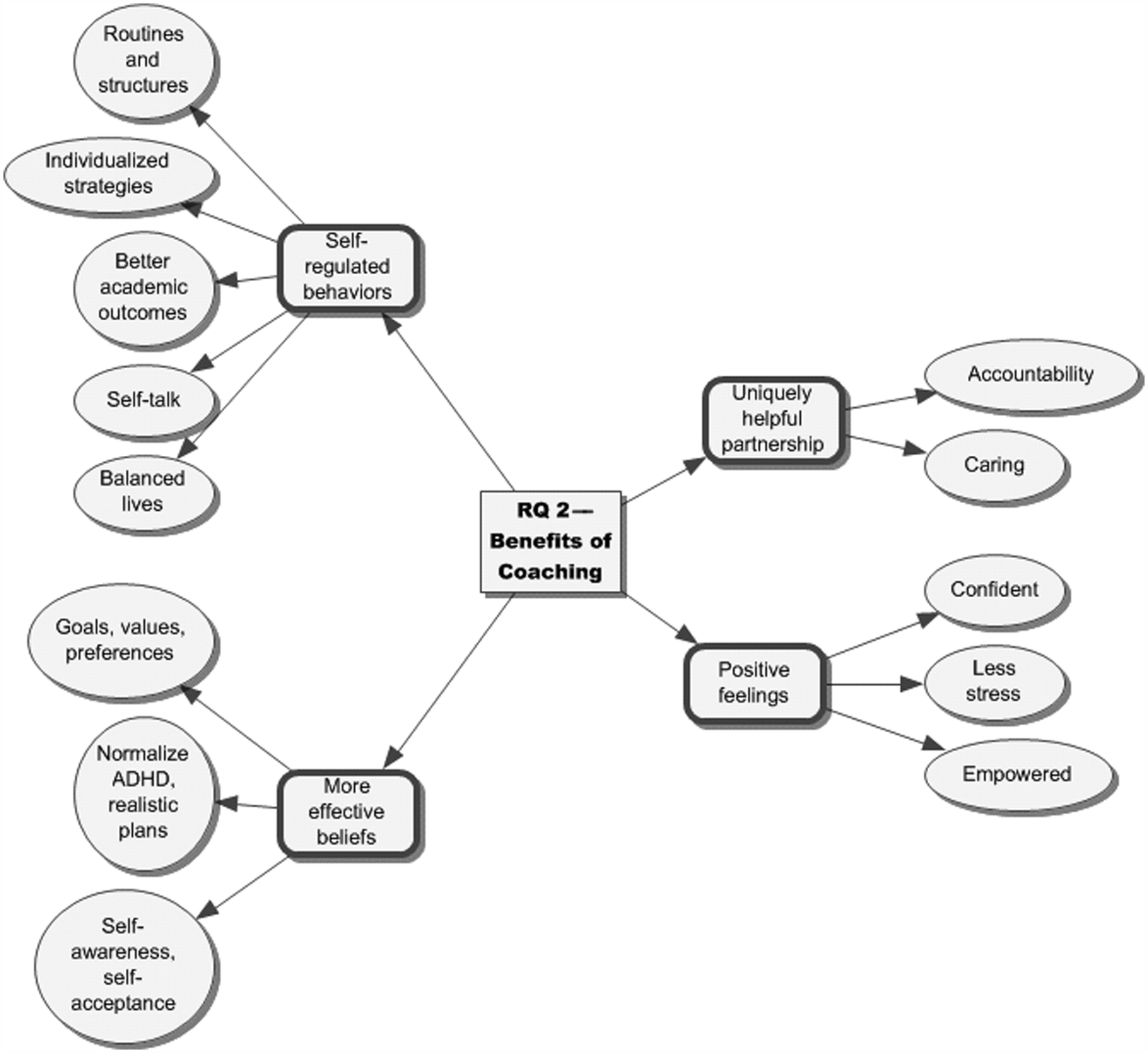
Mindmap of themes related to Research Question 2.
Self-Regulated Behaviors
In discussing the benefits of coaching, students described more self-regulated behaviors as a primary benefit. They recognized an increased likelihood that they would meet their goals, usually on schedule. Like several other participants, Dylan described his emerging capacity to do what he had planned. He noted, “As you’re seeing your improvement, you can see your success before you. And that’s definitely the most enjoyable part [of coaching].”
Students were able to manage their stress more effectively while using new organizational strategies or positive self-talk. Mitchell, the community college sophomore who learned how to program his cell phone with deadlines and reminders, was asked to describe the most useful outcome of coaching. Without hesitating, he said, “Getting papers in ahead of time or getting them done ahead of time, as opposed to finishing them the night before . . . Studying more for tests and stuff like that. Being more prepared.” Justin also observed himself becoming more self-regulated as he worked with his coach. Looking to the future, Justin offered this assessment of his emerging self-control.
Do you think the skills that you’re talking about are things you’ll continue to do once the study is over or once the coaching stops?
I think it will because . . . I don’t feel like [my coach] is pushing me anymore. I feel like I’m taking more initiative to do these things myself.
So you see a shift. You’re more . . .
I feel more in charge of it.
Emily’s artifact was an extremely personalized depiction of enhanced self-regulation. In discussing how her coach helped her manage her life activities more effectively, she held up a montage she had created with photographs of stacked rocks and the word “BALANCED” in the center. She described her artifact in this manner:
It came out when you were asking me to bring in an artifact . . . And I was thinking about it, and the words that came to mind were things like grounded and then balanced. And that one just fit, because it really is all about balancing between doing work and doing things that help me de-stress. Being realistic and balancing in between what I need to get done and what I’m actually capable of getting done.
More Effective Beliefs
Students also described positive beliefs that they developed from working with a coach. Amanda was a freshman at a regional public university in the Midwest. She had a GPA of 2.9 and a self-regulation LASSI cluster score at the 44th percentile. When asked how it felt to work with her coach, Amanda described a greater sense of self-efficacy. She said, “Working with a coach helps me feel confident and comfortable with my ADHD. And that’s important, because then I can take steps to deal with [challenges].” When Rachel was asked the same question, she reported a similar belief as she picked up her hammer artifact and said, “More confident. More structured. I feel better about myself overall because [my coach has] helped me achieve part of those goals I had set out.”
Uniquely Caring Partnership
When discussing the positive outcomes of coaching, students described the coaching relationship itself as a primary benefit. In comparison to friends, family members, and other professionals, participants commented that coaches had a unique ability to understand their needs in a nonjudgmental way and to motivate them to persist with new approaches to goal attainment. Consistent engagement with a caring and knowledgeable coach, in turn, led to positive benefits related to students’ thoughts, feelings, and self-regulated behaviors.
Participants described coaching as a supportive partnership that promoted their ability to understand and take care of themselves. Coaches’ beliefs and skills reflected a wellness model that views clients as resourceful people who should be coactive partners in the coaching relationship (Whitworth, Kimsey-House, Kimsey-House, & Sandahl, 2007). Several students, including Susan, described how much they enjoyed being able to set the coaching agenda. Susan elaborated on the coaching relationship by explaining that coaching was mostly about solving problems. When asked if her coach provided the answers, she replied, “No. Most of the time, she doesn’t. It’s more just kind of leading my thinking process towards the answer than just giving it to me.” In a manner similar to other participants, Courtney contrasted coaching with other professional services:
I was figuring it out on my own and [my coach] was doing it with me. He was learning about me as I was learning about myself. And we were both learning at the same time how I could make changes. And he did draw on insight a lot but it didn’t feel like a prescriptive pathway of trying to heal me as therapy might do. He’s taking something, not necessarily broken, but . . . therapy might take something that’s broken and fix it. Whereas, right from the start, he would say all the things that I’m doing well already and how he’s impressed that I’ve been able to do so much considering all the conditions. And just go from there and move forward.
Coaches worked in ways that students had not experienced with other professionals prior to the study. Participants stated that they enjoyed coaches’ willingness to text or e-mail them, review upcoming deadlines via shared online calendar sites, and, in some cases, Skype with them. They said that coaches focused on students’ goals or agenda rather than what they thought students should do and offered suggestions without trying to persuade students to agree with them. When students were accountable to their coaches by reporting a lack of progress on goals, coaches kept the focus on what students could learn from their experiences to be more successful in the future. Many students described how unique it was to describe a lack of progress and not feel as if they were being judged. Lindsay shared a perspective that echoed what several other students said:
If you didn’t reach a goal that you would set for yourself and you told [your coach] that, how would she respond? Did she get disappointed or angry?
No. She would ask me, “Okay. What got in your way of reaching that goal? Why do you think that you weren’t able to reach it?” So then I would have to answer these questions and so something that maybe got in my way, like homework or being lazy or watching TV or something. Something that got in my way last week or last month, I can look out for it next time.
Justin, the 3rd-year community college student in the Midwest, was pleasantly surprised by his coach’s sensitivity to his communication preferences:
Have you had any other working relationships where you felt like you could say, “This is how I want you to talk to me.”
No. I can’t really say that I have. There’ve been teachers that just talk to me however they wanted and I just kind of had to bite my tongue because I knew that I couldn’t say what I wanted to.
What was it about [your coach] that made you feel it was okay to do that?
The first couple of sessions, we just talked. I talked about myself and she kind of related to it, I guess. But it felt like a safe environment to be able to say what I wanted to say and I knew that she was going to say what she needed to say.
Participants also spoke enthusiastically about coaches’ knowledge of ADHD. This expertise contributed to students’ sense of relatedness with their coaches. Like several participants, Rachel compared her coach with other people who knew her well.
Do you feel more understood by [your coach]?
Yes. Light years.
Because of her expertise in ADD?
Yeah, and I think one of the things in life that is so important is to know you’re not alone. And if I would have been going over this past semester, part of last semester, talking to my boyfriend mostly about this, and him just like, “Oh, well . . . ” Because, in the beginning, he wasn’t even so sure that [ADD] was real . . . Whereas, with my coach, she has coached a large range of people from kids to adults and has worked with probably hundreds of people with this stuff, she knows that it’s legitimate. There’s no question of this. I’m not on my own with this. And that’s super helpful, too.
Positive Feelings
Coaches encouraged students to support their own emotional needs in a way that enhanced their productivity. Kayla was a single mother and full-time student at an urban public university in the Midwest. Often overwhelmed by responsibilities, she talked about needing to decide if she should buy her textbooks or the family’s groceries with the same paycheck. Her teenage children often demanded her time, yet her coach helped Kayla use pockets of “calm time” each week.
Has your coach helped you change anything about working on goals?
She definitely has. She’s kind of helped me to be a little more selfish where, before, I wouldn’t imagine taking that half an hour [to be coached] . . . So, she helped me to take that important time to schedule and have my calm time and pick out the things that I needed to work on for that week, whether it be bills or just goals that I had.
Logan’s coach encouraged his efforts to develop a more effective approach to reading his textbooks. Her approach triggered affective as well as academic benefits:
And so I said, “You know what? I really don’t want to read this. You think it would be okay if I just skipped around and read the most important parts?” And I didn’t want to do that because I always felt you have to read whatever the professor tells you to read. And she was like, “Oh, yeah. Go ahead.” She gave me the support I needed and so she gave me confidence.
Discussion
Summary of Findings
Research data strongly indicated that coaching helped students establish more effective goals and work toward those goals in more efficient, less stressful ways. According to participants, coaches helped them reflect on themselves and their goals more often, in more positive ways, and to regulate their behaviors and emotions such that they could persist with goal-directed activities in newly effective ways. Self-regulated behaviors included more consistent routines and structures and more effective self-talk. Students spoke in great detail about the proficiency coaches brought to their work. From students’ perspectives, coaches had a unique ability to help them establish more realistic goals, maintain motivation and effort, and develop new time management and organizational strategies that minimized the impact of their ADHD. Coaches were warm and caring but they consistently focused on helping students learn from frustrating and stressful life events. In doing so, students learned how to create more effective action plans for surmounting initial barriers to goal attainment.
In linking the nature of attentional impairments to neurochemically based difficulties with disinhibition, Barkley (1997) described ADHD as a deficit in self-control of one’s executive functioning. Like Barkley, Brown (2005) identified emotional self-regulation as a key executive function. In noting that weak executive function skills are associated with academic difficulties, Meltzer (2010) observed that
strategies that address executive function processes provide an entry point for improving academic performance. When students learn and apply these strategies effectively, they become more efficient and thus begin to succeed academically. Academic success in turn boosts self-confidence and academic self-concept, which results in more focused effort so that students’ hard work is targeted strategically toward specific goals. In this way, a cycle of success is promoted. (p. 9)
These theorists help explain why many students with ADHD need stronger executive functioning skills to self-regulate their cognitive, behavioral, and emotional experiences in college. Some institutions of higher education offer content tutoring or learning strategies instruction (Allsopp et al., 2005). Although these services can be particularly helpful for students with LDs and other skills deficits, they have not been designed to teach students how to be more self-regulated and, thus, address the performance-based needs of students with ADHD (Barkley, 1997; Quinn et al., 2000; Wolf, 2001). DS accommodations are often helpful to students with ADHD but large numbers of potentially eligible students do not request any assistance from DS offices (Wagner et al., 2005). Although a great deal is now known about the impact of ADHD on students in postsecondary settings, the extant literature has yet to identify empirically based services that help college students achieve greater self-regulation—or self-control. Given the rapid rise in the number of college students with executive functioning disorders, it is time for postsecondary settings to offer services designed to promote greater self-regulation. As Reid (http://www.unl.edu/csi/self.shtml, n/d) noted in his discussion of recommended practices for students in K-12 settings,
Self-regulation is desirable because of the effects that it has on educational and behavioral outcomes. The use of self-regulation techniques are a way to actively engage otherwise passive students in their academic instruction. Students need to view learning as an activity that they do for themselves in a proactive manner, rather than viewing learning as a covert event that happens to them as a result of instruction. Allowing students to take a more active role in their education puts students in the driver’s seat and in charge.
Based on this study’s findings, coaching services appear to provide a valuable support service for students with ADHD without duplicating existing campus supports such as tutoring, strategy instruction, and DS accommodations. Coaches use a unique skill set that helps students develop better approaches to noticing and managing the impact of their ADHD. Griffiths and Campbell (2009) described coaching as an intervention that helps clients (including students) learn how to be more proficient. As this learning occurs, it also appears to enhance students’ self-efficacy and motivation (Griffiths & Campbell, 2009; Parker & Boutelle, 2009). In a study of 208 undergraduates with and without LDs, researchers found a positive correlation between students’ increased self-efficacy and decreased procrastination (Klassen, Krawchuk, Lynch, & Rajani, 2008). The present study provides thick descriptions of how coaching helped postsecondary students with ADHD minimize procrastination, enhance their intrinsic motivation, develop more realistic goals, improve their ability to persist at goals, and create more effective time management skills while deepening their understanding of how they can be successful. This is important given the limited research to date on ADHD coaching and a pressing need to better understand the subjective, more complex narratives that underlie quantitative findings about coaching’s efficacy (Davidson, 2011).
These qualitative findings illuminate the dynamics that contributed to the significantly higher LASSI self-regulation scores and College Well-Being Survey achieved by students who were coached compared with control group participants in the larger field study (Field et al., 2010). Coaching helped students develop greater self-regulation, or self-control, in a manner that respected their autonomy and reduced their daily stress. This overall finding suggests that coaching appears to meet the conditions that encourage students with disabilities to self-advocate in college (Hartman-Hall & Haaga, 2002). As illustrated by Amanda’s comments provided at the beginning of this article, coaching helped students develop more effective navigational tools for traversing the cognitively, behaviorally, and emotionally busy roads they traveled while striving for academic success in college.
Limitations and Future Research
Longitudinal research is needed to further identify any statistical relationships between ADHD coaching, enhanced self-regulation, increased GPA, and graduation rates. Although students were mixed in their beliefs about coaching’s direct impact on their grades, overall findings indicate that coaching positively affected students’ self-regulation and their approach to the learning process. This study illuminates how coaching enhanced students’ efforts to achieve academic success. Therefore, further examination of the impact of coaching services over 2 or more academic years on grade attainment and graduation rates is warranted. Additional research with larger sample sizes could compare face-to-face coaching with the phone-based coaching model used in this study. Studies of this nature could identify helpful implications for college administrators. Campuses may not be able to train existing staff in coaching techniques but may find it more realistic to “outsource” coaching services to a phone-based coach or team of coaches at external locations. More research is needed to explore any differences in student satisfaction and outcomes between these two delivery systems for coaching services.
As with any qualitative study, the findings reported here are not designed to be generalized to other settings. Instead, students’ transcripts and the confirmatory data provided by their artifacts, GPA, LASSI scores, and College Well-Being Survey results provide evidence of how coaches created partnerships with students via weekly phone calls, emails, text messages, and Skype discussions. In turn, students worked with their coaches and on their own to enhance their goal-attainment skills and self-efficacy. In the process, students found that coaching helped them minimize cognitive and affective barriers to success that stemmed from their executive functioning difficulties.
Footnotes
Declaration of Conflicting Interests
The author(s) declared no potential conflicts of interest with respect to the research, authorship, and/or publication of this article.
Funding
The author(s) disclosed receipt of the following financial support for the research, authorship, and/or publication of this article: This research was supported in part by a grant from the Edge Foundation.