







Abstract
Introduction
Hyperactivity, impulsivity, and inattention are all major symptoms of the most common childhood mental disorder “ADHD” (Diagnostic and Statistical Manual of Mental Disorders, 4th ed., text rev. [DSM-IV-TR]; American Psychiatric Association, 2000).
Some authors (Swanson et al., 1998) argue that the three main symptoms of this disorder are due to a deficit in executive functions (EFs). Children with ADHD have difficulty in maintaining attention, in focusing their attention on a task, and, in particular, inhibiting visual and sound distractors. In addition to attentional difficulties, these children present impairments in working memory and EFs and, in particular, an inhibition deficit and planning difficulties. The inability to inhibit or defer an answer explains many of the behavioral symptoms (hyperactivity, impulsiveness, and intolerance with frustration) and cognitive symptoms (notably difficulty in resisting distractors; Barkley, 2003; Mayes & Calhoun, 2006; Shanahan et al., 2006).
The precise cause of attentional dysfunctions in ADHD remains unclear. From a neuropsychological perspective, ADHD is associated with deficits in well-defined cognitive domains, including sustained attention and executive functioning (Barkley, 1998; Pennington & Ozonoff, 1996). Some theorists focus on executive deficits (Shallice et al., 2001); children with ADHD show deficits in executive functions, including response inhibition, working memory, and conflict resolution (Bush et al., 1999; Casey et al., 1997; Doyle, 2006; Pliszka et al., 2006; Rubia, Smith, Brammer, Toone & Taylor, 2005; Vaidya et al., 2005); other theorists recognize a difficulty in ADHD in the automatic processing of basic skills (Ackerman, Anhalt, Holcomb, & Dykman, 1986; Fabio, 2001, 2009) or in the modality of stimulus presentation (Fabio & Antonietti, 2012). Moreover, Hazell et al. (1999) suggested that participants affected by ADHD show, along with a deficit in the central controlled processes, a deficit in the encoding and in the automaticity of processes. This distinction was acknowledged for the first time by Shiffrin and Schneider (1977). The two authors argue that the controlled processes have a limited capacity, require attention, and can be used flexibly in different circumstances, whereas automatic processes have a limited capacity, do not require attention, and are very difficult to change. Automatic processing is no longer required for attention, it is the result of prolonged practice, it is not conscious, and it is inevitable.
Both automatic and controlled information processing have been investigated in studies on the cognitive performance of children with ADHD, but results are inconsistent. Several authors have shown that children with ADHD do not perform as well as controls in situations demanding automatic and/or more controlled processing strategies (Ackerman et al., 1986; Borcherding et al., 1988; Hazell et al., 1999), whereas other authors have not (Van der Meere & Sergeant, 1988).
Hurks et al. (2004) examined the performance of ADHD children on semantic category fluency (SCF) versus initial letter fluency (ILF) tasks. For each participant, word production was recorded for each 15-s time slice on each task. The authors hypothesize that children with ADHD perform significantly worse on both types of information processing (automatic vs. controlled) than do healthy control participants. Results were taken to indicate that children with ADHD symptoms show a delay in the development of automating skills for processing abstract verbal information.
This last hypothesis, that hyperactive children fail to develop automatic processing, is less consolidated; recent research (Ackerman et al., 1986; Borcherding et al., 1988; Ott & Lyman, 1993) suggests that ADHD children have no deficit in innate automatic tasks but they could display difficulties in acquired automatic skills.
The purpose of this study is to test the hypothesis that deficits of EF are at least partly due to a deficit in automatic processing. The logic of our investigation is that if the basic processes are not well automatized, they will result in a high cognitive load and compete for limited resources used by EFs.
Automatic processes can be observed by examining differences in the automatization of basic skills in children with and without ADHD, because these processes can be accomplished simultaneously with other cognitive processes without interference (Fabio & Cossutta, 2001; Hasher & Zacks, 1979; Melnik & Das, 1992).
In this study we examined the hypothesis that task inefficiency in ADHD children can be caused by EF deficit, as well as by automatic learning dysfunctions.
Study 1: Visual Test
The specific aims of the first study are twofold. Firstly, as suggested by the Joston and Heinz (1978) and Hommel (1998) multimodal model, the type of task has relevance to the processes of automaticity. In fact, when selective attention is focused on the physical characteristics of the stimulus, participants use less cognitive resources, decrease the reply time, and increase precision in respect to selective attention when the recognition of stimulus is at semantic level. In this case, the correct passage from a perceptual task of identification to a semantic identification may indicate good automatization, whereas an inaccurate or slow passage could indicate difficulty in automating or in EFs. The second aim is to analyze Merril’s (1992) theory on automaticity. If normal participants and ADHD participants are able to perform the tasks of selection equally well, both in the absence and in the presence of memory load, the selection could be automatic; if there are errors in the memory interference, the selection is not automatic.
Method
Participants
For the initial phase of this study, a sample of 912 students aged between 8 and 10 years, attending Classes III and V of the elementary school, were selected.
It was possible to perform the procedure in all the public schools of Lombardia that had given their consent to participate in the survey.
The pretest phase involved the administration of two questionnaires, which were conducted by teachers to their students:
The Sindrome Deficit Attentivo e Iperattività (SDAI) scale (Marzocchi & Cornoldi, 2000), can be used to highlight the subtypes of ADHD. The SDAI scale consists of 18 items, which correspond to the symptoms described and listed in the DSM-IV-TR, containing two subscales of 9 items each: one related to inattention and the other hyperactivity-impulsivity. The teacher, for each item that will indicate the severity of behavioral disorders of children, gives a score ranging from 0 = absent behavior to 3 = very frequent behavior. The cutoff for each item is 1.5 points. It is, therefore, considered problematic behavior of a child if, in at least one subscale, an overall score equal to or greater than 14 is achieved.
The Scala Comportamenti Dirompenti (SCOD) scale or “scale for the assessment of disruptive behavior” (Marzocchi et al., 2001) is present in two versions: one for parents (Scala Comportamenti Dirompenti - Genitori; SCOD-G) and one for teachers (Scala Comportamenti Dirompenti - Insegnanti; SCOD-I).
The SCOD consists of 42 items and can be divided into four subscales, respectively: a rating scale of aggressive behavior; information about the socioeconomic family, a series of 5 items related to school learning problems, and general information aimed at discriminating against individuals with ADHD from other related diagnosis.
Both scales were administered by teachers to their students.
Based on data collected through two questionnaires, the final sample of the research selected consists of 30 participants divided into two groups:
Group 1 consists of 15 children aged between 8 and 10 years with ADHD.
Group 2 consists of 15 children aged between 8 and 10 years constituted the control group.
Due to lack of authorization from the parents of 3 children, the sample was then reduced to 27. Consequently, the sample used was as follows:
Group 1 consists of 13 ADHD children.
Group 2 consists of 14 normal developing children.
The administration of the visual test was made with the aid of a portable computer, using a program for Mac called “Super Card.” Participants were asked to sit in front of it.
The test took place in front of the PC screen in a quiet classroom in the school of origin for a maximum of about 40 min.
Prior to conducting the test, the load of individual memory was calculated, both for patients with ADHD and for normal participants, on the basis of the test of the digit span of the Wechsler scale.
Each participant was asked to repeat a series of numbers: first two numbers, then three, then four, until the participant made a mistake. If an error in repeating the numbers was made, another series of the same numbers was presented and if the participant mistook that series as well, the test was stopped. Specifically, the full memory load was the number of series in which the test was stopped, whereas the half memory load was the full memory load divided by two. Subsequently, they were asked to click a button on the computer when they saw physically identical pairs on the screen (first test: perceptual identity) and pairs of figures belonging to the same nominal category (second test: categorical identity).
Each test, both perceptual identity and categorical identity, was presented three times to each participant. During the test, each participant had to repeat at the same time, n − 1 digits (full load), (n − 1) / 2 digits (half load), and 0 digits (empty load).
As the automatic processes require minimal cognitive resources to be carried out, the purpose of this test is to note that the automaticity of the processes of encoding can be highlighted by the absence of penalty due to the memory load. Children with ADHD may not automate, however, the underlying processes and present the effects of penalty due to the memory load.
Procedure
Once parents were informed about the aims of the study and written consents were obtained, participants participated in a single testing session that was divided into two experiments: visual test and auditory test. The administration of visual test was made using a portable computer. A Mac program called “Super Card” was used. The participants were invited to sit down. The test took place on a computer in a quiet classroom of the school for approximately 40 min.
Before the test, individual memory load was calculated, both for ADHD participants and for normal participants, on the basis of digit span test of the Wechsler scale.
The participants were instructed to recognize, as quickly as possible, the two stimuli belonging to the same category. The methodology of memory load was integrated with the methodology of the function of codification. Participants had to repeat a list of numbers during the codification task. Memory load was manipulated by increasing or decreasing the memory set. The purpose was to measure the level of cognitive load that interferes with performance in ADHD and in normal groups. Automatic processes, in fact, can be accomplished simultaneously with other cognitive processes without interference. Thus, difference on interference of memory load could reflect a difference in automatic performance in participants with and without ADHD.
As automatic processes can be accomplished simultaneously with other cognitive processes without interference (Hasher & Zacks, 1979; Lavie, 1995; Posner & Snyder, 1975), any difference in interference of memory load could reflect a difference in automatic performance in participants with and without ADHD.
In the first task, participants were asked to circle, as quickly as possible, the pairs of identical pictures, whereas in the second task, participants were asked to circle, also as quickly as possible, the stimuli belonging to the same semantic category.
Each selective attention task was repeated three times for each participant. Participants were asked to listen and repeat a list of numbers read aloud by an experimenter.
Memory load was manipulated by increasing or decreasing the memory set (full load = span − 1 digit, half load = span − 0.5 digit, and no load = 0 digits).
During experimental blocks of trials, we measured response time and error rates. Our primary aim was to investigate how task difficulty interacted with distractor salience in the three participant groups. For this analysis, response times and error rates from the mixed display experiment were measured and submitted to analysis with repeated measures ANOVA, with participant group as a between-participant factor, and discrimination difficulty and distractor salience as within-participants factors (Friedman-Hill et al., 2010).
Data analyses
The data were analyzed using a 2 × 2 × 3 repeated measures ANCOVA, with one between-group factor (participants: normal vs. ADHD-combined [ADHD-C]) and two within-group factors: experimental condition (perceptive vs. categorical identification) and cognitive load (zero load vs. half load vs. full load).
Two measures of task performance were recorded:
the number of correct responses and
the number of errors (number of false alarms + number of mistakes).
Results
Data analysis of the procedure perceptive/category identification
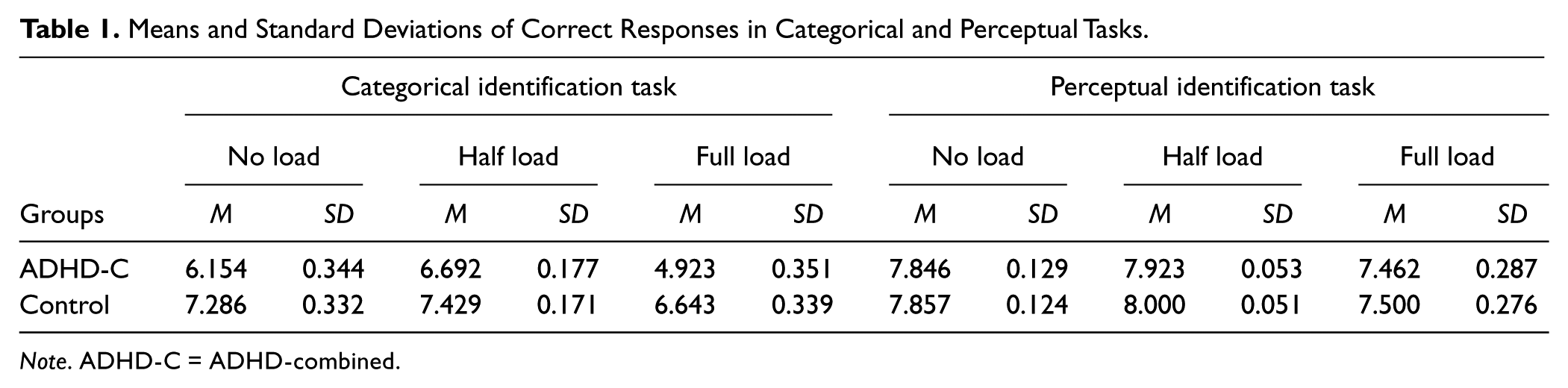
The main effects of group and task were significant, respectively, F(1, 25) = 11.34, p < .01 and F(1, 25) = 54.69, p < .001. ADHD children showed higher correct responses. With reference to the task in categorical identification, all the participants showed a lower number of correct responses than in the perceptual identification task (Figure 1). The task × group interaction was also significant, F(1, 25) = 11.46, p < .001: ADHD participants showed a lower number of correct responses in categorical identification tasks than control participants. Whereas in perceptual identification tasks, the performances of both groups were similar. There was also a significant effect of load condition, F(2, 50) = 23.39, p < .001.
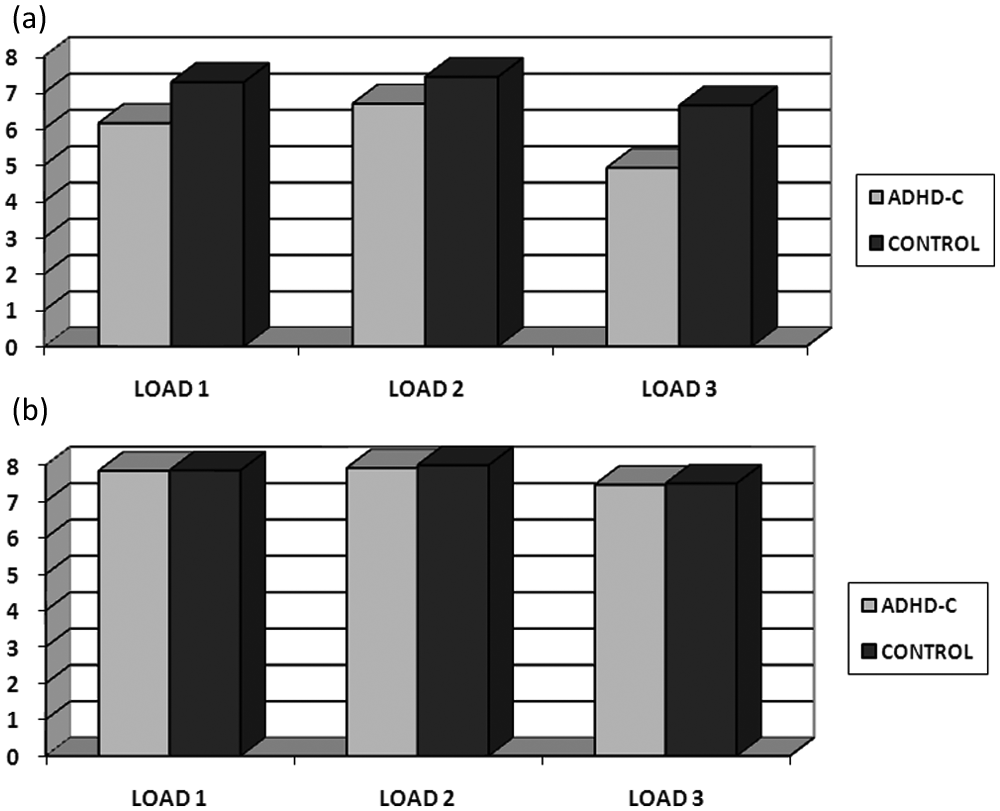
Mean of correct responses in the task of (a) category identity and (b) perceptive identity.
The results are summarized in Table 1 with reference to two parameters: number of correct responses and number of errors and omissions.
Means and Standard Deviations of Correct Responses in Categorical and Perceptual Tasks.
Note. ADHD-C = ADHD-combined.
Correct responses
The main effect of group was significant F(1, 25) = 11.34, p < .01; Experiment condition × group interaction was also significant, F(1, 25) = 13.46, p < .001. Also the type of task showed significant effect: F(1, 25) = 54.69, p < .001.
This shows that, with the task of categorical identification, the participants have a lower number of correct responses. Data show a significant interaction effect type of task × groups of participants. ADHD participants have a more considerable decrease in the number of correct responses when the type of task is of categorical identification with respect to when the type of task is of perceptive identification. When the type of task is of perceptive identification, the performances of normal participants are similar to ADHD participants, whereas when the type of task is of categorical identification, there are differences in the performances.
Data analysis also evidence a significant effect of load: F(2, 50) = 23.39, p < .001.
Errors
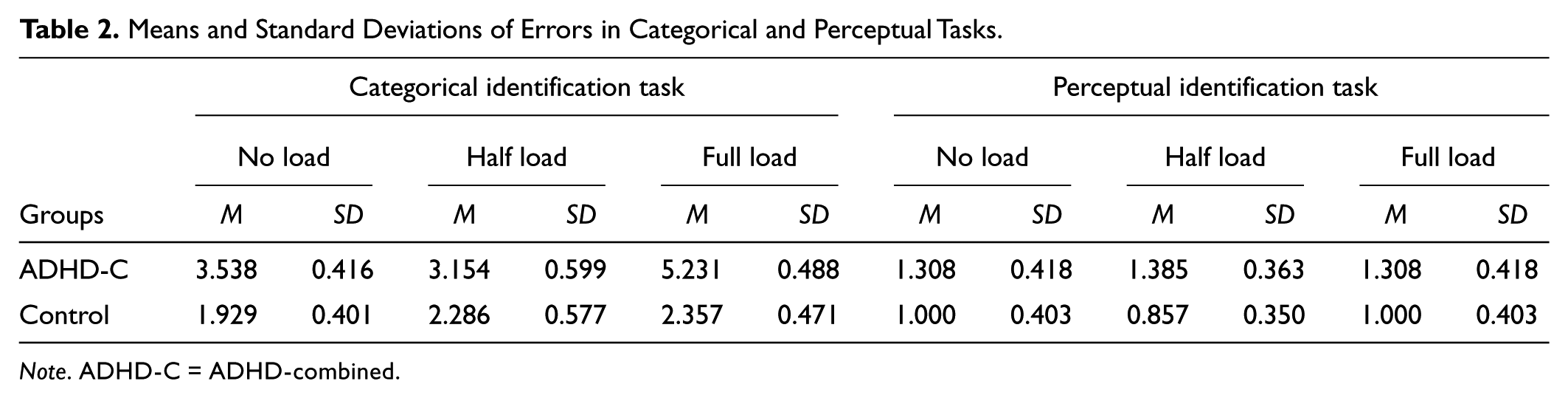
Figure 2 and Table 2 indicate media and standard deviation in all the considered conditions.
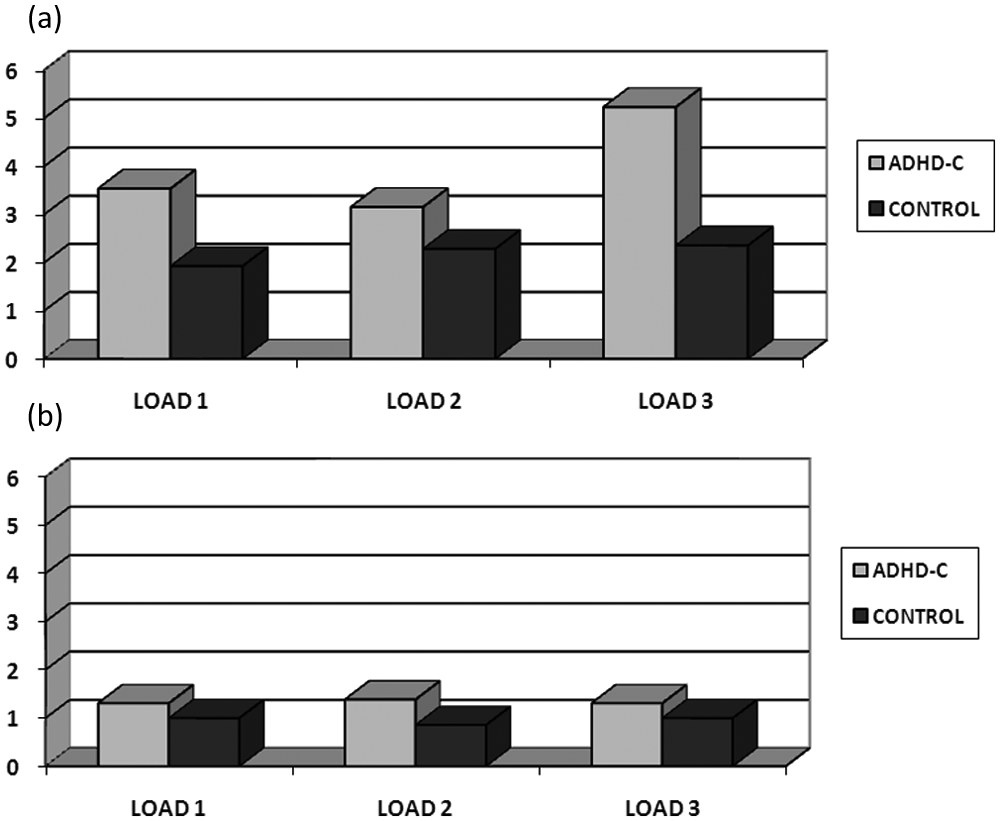
Mean of the errors in the task of (a) category identity and (b) perceptive identity.
Means and Standard Deviations of Errors in Categorical and Perceptual Tasks.
Note. ADHD-C = ADHD-combined.
The main effect of group was significant, F(1, 25) = 36.58, p < .001. ADHD participants made more errors than control participants; significant main effect of task was also found, F(1, 25) = 36.58, p < .001. A significant interaction task × group of participants was found, F(1, 25) = 4.78, p = .038.
ADHD participants showed higher number of errors in categorical identification task than control participants.
Last variable with significant effects is the level of full-load cognitive; the errors are increased to strengthen the load of memory.
Discussion
A three-way interaction, group × task × condition, was also significant, F(2, 51) = 5.98, p < .001. This means that in categorical task, ADHD-C participants showed higher levels of errors in full-load condition than control participants.
It has been suggested that ADHD children fail to acquire certain learning skills because they differ in encoding abilities. Group differences were obtained in the present study.
First, with respect to correct responses, all groups disclosed lower performance in categorical tasks compared with perceptual tasks, but the ADHD group showed a lower performance than the control group in categorical task. With reference to errors, ADHD participants presented higher error rates when both categorization task and full-load condition appeared.
The main finding of this study is that if intensive mental processes are requested, as in category task, requiring central information-processing level, ADHD participants increase error rates and decrease correct responses.
The main result of this study is that when forceful mental processes are requested, as in the categorical task, ADHD participants increase error rates and decrease correct responses. Worthily, this cost in performance appears higher in full-load condition. Inaccurate performance in full load condition may be interpreted as a partial deficit in automatic processing.
Study 2: Auditory Test
Method
In the second study, the aim is to verify if the participants with ADHD present fewer elements of automatization in respect to normal participants, or give correct number of replies and a higher number of errors in the fourth test in respect to the first.
Participants
Participants were the same as those reported in Experiment 1.
In this experiment, a program called “Super Card” was used. A list of items was made by letter and number (see, for example, D2 in Table 3). These files were recorded as vowel and they were inserted in the program computer. During the test, the participants were invited to sit down in front of the screen. They had to listen to the combination of letter-numbers by means of four computer phases (e.g., T5).
List of Files of the Auditory Test.
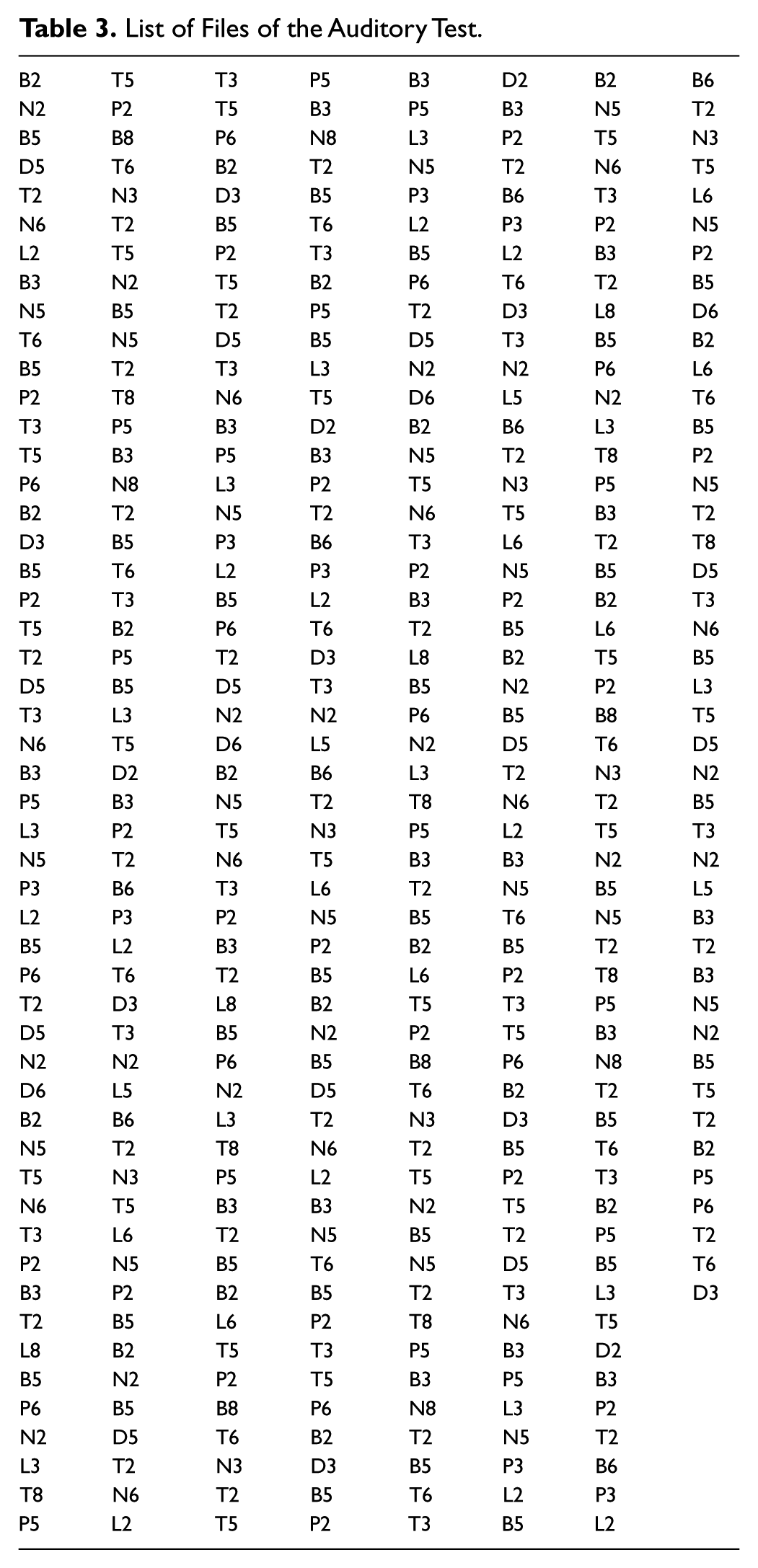
During the test, the participants had to press a key of the computer when they heard the precise target that was previously communicated by an experimenter (B5). The four phases were composed each of 100 letter-number files and in each there were 10 targets to pick out.
The aim of this test was to measure the automatic effects on performance and care. The automation of mechanisms of selection implies the increase of correct responses and the reduction of errors during the four phases.
The aim of this second study was to analyze if ADHD participants have a lower index of automation in respect to normal participants.
Data analyses
The design was a 2 (group: normal vs. ADHD) × 4 (phases: 1, 2, 3, and 4).
Two measures of task performance were recorded:
the number of correct responses and
the number of errors (false alarms + omission).
Results
The focus of the present study was to evaluate whether the ADHD participants had a lower index of selective automatization than the control group.
A 2 × 4 ANCOVA repeated measures design with two factors, 2 (group) × 4 (number of phases).
Correct responses
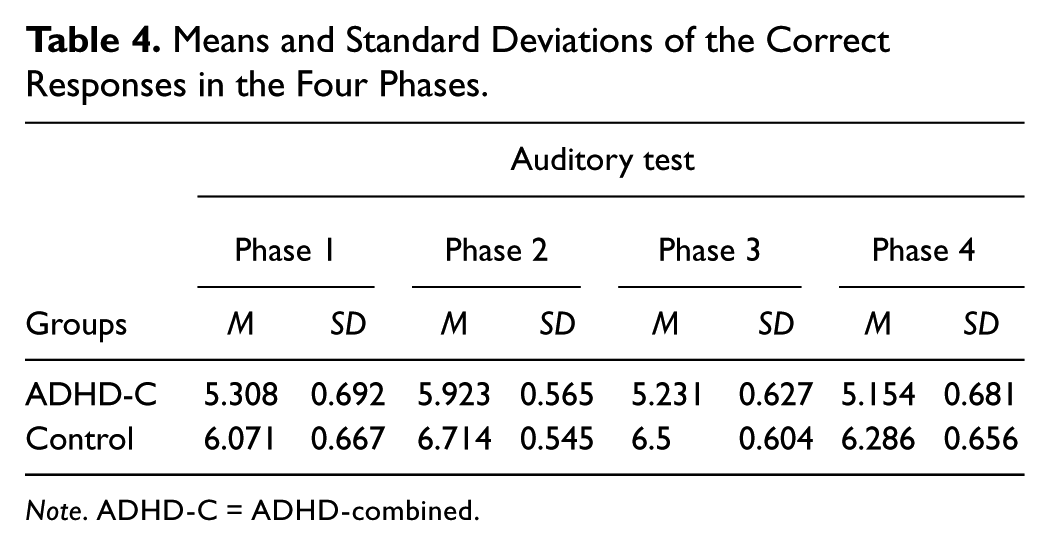
Table 4 shows the means and standard deviations.
Means and Standard Deviations of the Correct Responses in the Four Phases.
Note. ADHD-C = ADHD-combined.
With reference analyzing to the “number of correct responses,” there are no significant differences (Figure 3).
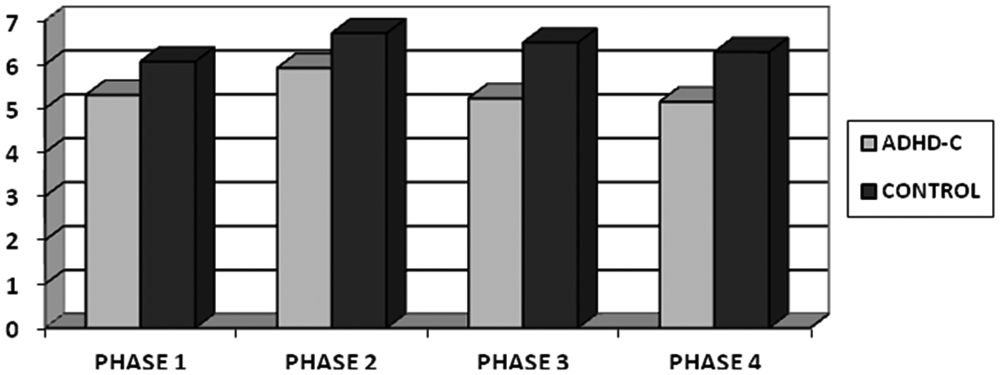
Mean of the correct responses in the auditory test.
Errors
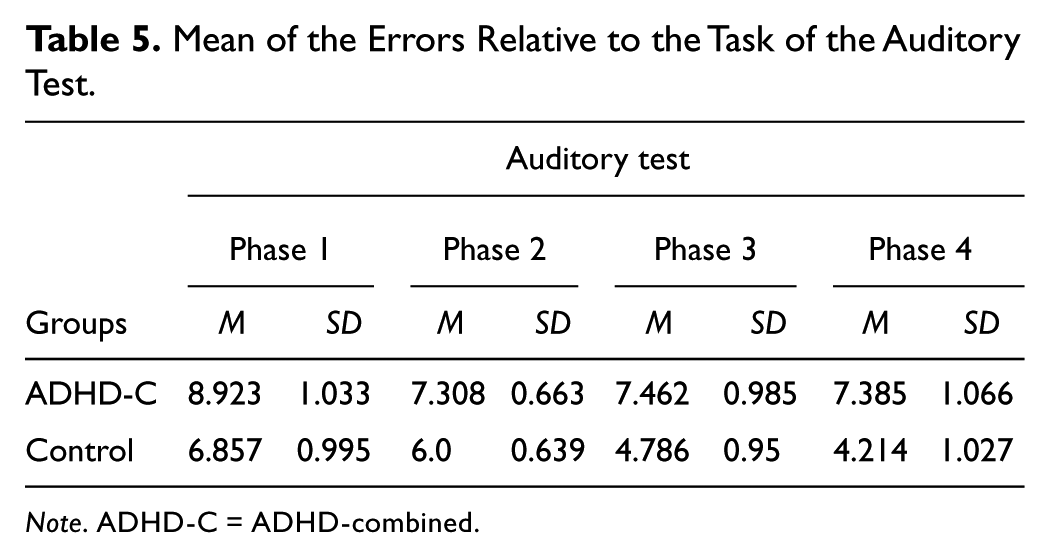
Table 5 shows the means and standard deviations for each group in the four phases. The main effect was significant: F(1, 25) = 6.309, p < .001.
Mean of the Errors Relative to the Task of the Auditory Test.
Note. ADHD-C = ADHD-combined.
The overall number of errors (false alarms + omissions) was calculated.
The control group shows a decrease of this parameter during the four phases, whereas the ADHD-C group keeps the number of errors high and constant.
The main effect of phases was also significant, F(3, 75) = 2.81, p < .045. Figure 4 shows that errors decrease in ADHD participants, whereas the errors are stable in ADHD group, F(3, 75) = 2.81, p = .045. This suggests that control participants did not have deficit in automatic components. In contrast, the ADHD-C group found more difficulty in acquisition of automatic processing.
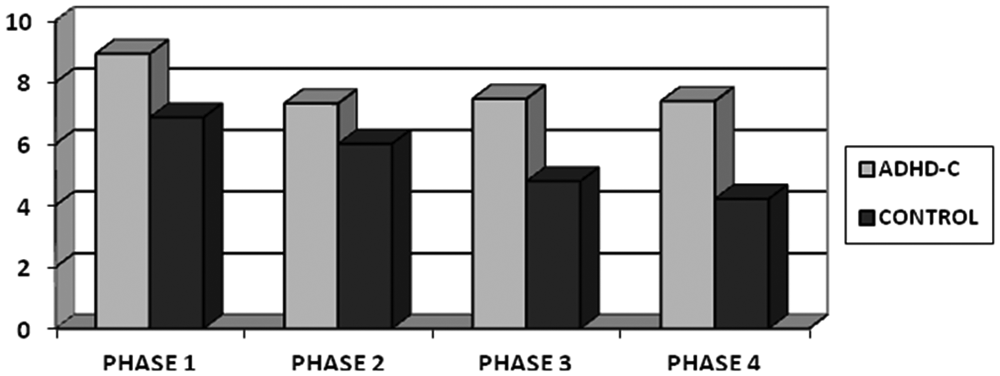
Mean of the errors in the auditory test.
Discussion
The data analysis suggests that there are differences between the groups. With reference to the parameter “correct responses,” there are no significant differences between ADHD participants and normal controls. The differences arise with reference to the parameter “errors.” The number of errors is higher in the ADHD-C participants. During the four phases, the errors of control participants decrease, whereas the errors of ADHD participants are stable from the second phase onward.
The differences may be due to the automatization. In the ADHD participants, the deficits of codification of the information seem to charge the sensorial auditory canal. The conclusion is that EF deficits may be at least partially due to a deficit in automatic processing. Moreover, it is possible that when the stimuli require a decoding to auditory level, the ADHD participants might involve higher cognitive effort.
The aim of this study is to demonstrate that even if partially deficits of EF are at least partly due to a deficit in automatic processing, in fact if the basic processes are not well automatized, they will result in a high cognitive load and compete for limited resources used by EFs. Automatic processes can be observed by examining differences in the automatization of basic skills in children with and without ADHD, because these processes can be accomplished simultaneously with other cognitive processes without interference.
As previously seen, in this study we examined the hypothesis that task inefficiency in ADHD children can be caused both by EF deficit and by dysfunctions in automatic learning.
In the first study, three-way interaction shows a deficit in the automatization tasks in ADHD participants, with higher levels of errors in full-load condition than control participants; in fact, ADHD participants fail to acquire certain learning skills because they differ in encoding abilities. The main result of this study is that when effortful mental processes are requested, as in the categorical task, ADHD participants increase error rates and decrease correct responses. This cast in performance appears higher in full-load condition. Inaccurate performance in full-load condition may be interpreted as a partial deficit other than in central process also in automatization process.
The second study suggests differences that arise to the parameter “errors,” because the number of errors is higher in the ADHD-C participants. These differences may be due to the automatization. In the ADHD participants, the deficits of codification of the information seem to charge the sensorial auditory canal. The conclusion is that EF deficits may be at least partially due to a deficit in automatic processing. Moreover, it is possible that when the stimuli require a decoding to auditory level, the ADHD participants might involve higher cognitive effort.
Conclusion
The data on this study will not allow us to come to any definitive conclusions about the automatic/controlled processes in ADHD children. The present work can be seen as a pilot study and as a first and provisional attempt to complete literature on cognitive processes in ADHD children. Future studies need to have relatively large sample sizes and to verify further the type of experimental paradigm used here.
Footnotes
Declaration of Conflicting Interests
The author(s) declared no potential conflicts of interest with respect to the research, authorship, and/or publication of this article.
Funding
The author(s) received no financial support for the research, authorship, and/or publication of this article.