







Abstract
The purpose of the present study was to investigate the quality of same-sex and other-sex friendships in dolescents with and without ADHD. Friendships are co-constructed relationships that are reciprocal, mutual, and with a sense of equality at their core (Bagwell & Schmidt, 2011). Friendships are normative, they serve as a backdrop for development, and they are considered to be paramount in contributing to the social, emotional, and cognitive functioning of children and adolescents (e.g., Bagwell & Schmidt, 2011; Goswami, 2012; Hartup, 1996; Kipp & Weiss, 2012; Morgan et al., 2011). Friendships provide children and adolescents with opportunities to resolve conflicts, practice cooperation, cultivate patience, develop perspective taking, and they serve as a rubric for future interpersonal relationships that span the life cycle (Bagwell, Newcomb, & Bukowski, 1998; Berndt & Murphy, 2002; Vitaro, Boivin, & Bukowski, 2009). At the most fundamental level, studying friendships is important because children and adolescents value them greatly.
Representing friendships as a unitary construct, however, is misleading (Hartup, 1995; Mikami, 2010). Friendships vary in their stability, quality, and the characteristics of the partners involved in the dyad. High-quality friendships comprise many positive features (e.g., intimacy, support, and validation) and few negative features (e.g., conflict, criticism, aggression), and they are positively associated with relationship stability and satisfaction (e.g., Bagwell & Schmidt, 2011; Branje, Frijns, Finkenauer, Engels, & Meeus, 2007). Although high-quality relationships with friends may safeguard adolescents from maladjustment (e.g., Berndt, 1999; Cotterell, 2007; Waldrip, Malcolm, & Jensen-Campbell, 2008), poor-quality friendships have been linked to negative outcomes in youth and often jeopardize their academic, behavioral, and socioemotional functioning (e.g., Allen, Porter, McFarland, McElhaney, & Marsh, 2007; La Greca & Harrison, 2005).
To date, we have begun to gain a better understanding of friendships from a normative perspective, but know significantly less about the effects that individual differences, such as ADHD, may have on these relationships. The majority of research investigating the social functioning of youth with ADHD has examined peer rejection and social skills deficits (Hoza, 2007; Sciberras, Ohan, & Anderson, 2012; Sibley, Evans, & Serpell, 2010), while generally overlooking their friendships. The few existing studies investigating the friendships of individuals with ADHD tend to focus on children and the mere presence/absence of friendships while paying virtually no heed to adolescent friendships or the quality of these relationships.
Friendships and ADHD
Although ADHD is conceptualized as a neurobiological disorder (Kieling, Goncalves, Tannock, & Castellanos, 2008), it is diagnosed on the basis of a persistent pattern of inattention and/or hyperactivity–impulsivity that causes significant impairment across settings (American Psychiatric Association [APA], 2013). Attentional difficulties may make individuals with ADHD appear socially withdrawn and disinterested, and may make it more challenging for them to be emotionally supportive and demonstrate a reciprocal understanding of their friends’ needs and feelings (Mikami, Huang-Pollock, Pfiffner, McBurnett, & Hangai, 2007; Normand et al., 2013). Symptoms of hyperactivity and impulsivity may result in difficulty modulating emotions, resolving conflicts equitably, and interacting in a sensitive manner. Thus, although social problems are not part of the diagnostic criteria of ADHD per se, it is not surprising that, oftentimes, the core symptom dimensions present in these individuals also interfere with the development of their social skills and social functioning (Mikami, 2010; Normand, Schneider, & Robaey, 2007).
Research suggests that the behavioral profile of children with ADHD in conjunction with their associated social skills deficits may account for the interpersonal difficulties they experience (e.g., Hoza, 2007; Marton, Wiener, Rogers, Moore, & Tannock, 2009). Indeed, children with ADHD have fewer friends than their typically developing (TD) peers (e.g., Bagwell, Molina, Pelham, & Hoza, 2001; Blachman & Hinshaw, 2002; Hoza et al., 2005; Marton, Wiener, Rogers, & Moore, 2015), and approximately half of children with ADHD have no reciprocal friend (Hoza et al., 2005). Those with friends tend to have relationships that are characterized as less intimate, supportive, cooperative, and satisfying, and more conflictual than their TD peers (e.g., Blachman & Hinshaw, 2002; McKee, 2014; Normand et al., 2011, 2013; but see Glass, Flory, & Hankin, 2012). Children with ADHD also tend to value certain characteristics in their friendships (e.g., fun, mutually entertaining) that may conflict with the characteristics valued by children without ADHD (e.g., emotional support, sense of security) (Gardner & Gerdes, 2015; Heiman, 2005). Thus, it is not surprising that children with ADHD also have fewer stable friendships than their nondisordered peers (Blachman & Hinshaw, 2002; Marton et al., 2015; Normand et al., 2013).
Developmental Factors
Friendships change as children age. They become more complex, more strongly embedded in a social context, more intimate, and more significant to one’s psychological adjustment (e.g., Buhrmester, 1996; Hartup, 1996; Rubin, Coplan, Chen, Buskirk, & Wojslawowicz, 2005; Selfhout, Branje, & Meeus, 2009). The need for companionship that was prominent in childhood is supplanted by a need for reciprocity, intimacy, self-disclosure, and emotional support in adolescence. Accordingly, as youth move across adolescence, their expectations of friendships increase, the number of conflicts decrease, and levels of empathy, intimacy, and attachment tend to remain stable or increase (McNelles & Connolly, 1999; Meter & Card, 2016; Neyer, Wrzus, Wagner, & Lang, 2011; Poulin & Chan, 2010).
The composition of adolescents’ social networks also changes and begins to include members of the other-sex and romantic partners. Nevertheless, the developmental significance of other-sex friendships remains largely ignored, despite that same- and other-sex friendships have important and unique implications for psychological adjustment (Bagwell & Schmidt, 2011). Interestingly, adolescents who are either popular with, or rejected by, same-sex peers are more likely to have close other-sex friendships than adolescents with average peer status among same-sex peers (Bukowski, Sippola, & Hoza, 1999). Moreover, for unpopular boys, having other-sex friendships predicts higher self-worth and mitigates some of the deleterious effects of peer rejection (Bukowski et al., 1999). Regardless of peer status, by late adolescence, other-sex friendships may eclipse same-sex friendships on relationship features of cohesion and closeness (Berndt, 1982; Guyer, Caouette, Lee, & Ruiz, 2014; Kuttler, La Greca, & Prinstein, 1999). Thus, other-sex friendships appear to offer a valued relationship with distinct rewards, including a compensation for a lack of close same-sex friends, a precursor to romantic relationships, and an additional context for self-exploration and identity development (Bagwell & Schmidt, 2011; Hand & Furman, 2009). Because youth with ADHD are more likely to be rejected by their same-sex peers (Bagwell et al., 2001; Hoza et al., 2005), other-sex peers may offer another avenue to form high-quality friendships.
The potential influence of age on the quality of friendships in adolescents with ADHD remains unclear. Over and above the developmental changes that occur in TD peers, research suggests that the manifestation of ADHD symptoms changes as individuals progress through adolescence (Biederman, Mick, & Faraone, 2000; Willcutt et al., 2012). Given the increased developmental significance of same- and other-sex friendships across time, examining the unexplored relationship between age, ADHD status, and friendship quality is important.
Gender
Research has firmly established that the interpersonal relationships of boys and girls are qualitatively different (Rose & Rudolph, 2006). Boys tend to engage in interactions that are activity-based and involve sports and games and require large groups, whereas girls are more relationship-oriented and tend to interact in small groups of friends (Claes, 2003; Rose, 2007). In general, research suggests that girls have higher quality relationships than boys, with girls placing a greater emphasis on intimacy, self-disclosure, emotional closeness, validation and enhancement of self-worth, conflict resolution, and helping behaviors (Bowker, 2004; Rose & Rudolph, 2006). Girls also tend to place more emphasis on their peers’ feedback, relative to boys (Guyer et al., 2014). By contrast, boys’ friendships tend to be characterized by a greater amount of competition and a dominance hierarchy (Rose & Rudolph, 2006) but also friendships of greater stability than the relationships of girls (Benenson & Christakos, 2003).
The limited research investigating gender differences in the peer relationships of youth with ADHD suggests that girls with ADHD have at least as many difficulties in their peer relationships, if not more, than their male counterparts (e.g., Blachman & Hinshaw, 2002; Ohan & Johnston, 2007; Zucchetti, Ortega, Scholte, & Rabaglietti, 2015). Although not empirically tested, Mikami (2010) suggested that the core symptoms and associated deficits (e.g., self-regulation, planning/organization, working memory) of ADHD may be more impairing to the friendships of girls, where features such as intimacy, conflict resolution, and emotional closeness are prioritized. In addition, because ADHD is less common in females, a girl with ADHD symptoms may be perceived as more deviant, and their actions as less tolerable, relative to boys with a similar presentation (Chang, 2004; Mikami, Lerner, & Lun, 2010). Including gender as a factor in the comparison of adolescent friendships, in addition to ADHD status and age, may help shed light on some of these assumptions.
Study Rationale and Objectives
Collectively, the available research on the friendships of individuals with ADHD reveals some troubling tendencies. In addition to the well-known domains of impairment associated with ADHD, children and adolescents with ADHD and peer problems have higher rates of criminality, conduct problems, depression, anxiety, substance abuse, eating disorders, and school dropout than youth with ADHD without peer relationship problems (Greene, Biederman, Faraone, Sienna, & Garcia-Jetton, 1997; Mikami & Hinshaw, 2006; Mikami, Lee, Hinshaw, & Mullin, 2008). Nevertheless, if youth with ADHD are able to establish high-quality friendships, this may serve to buffer them from future maladjustment, even if the child with ADHD remains unpopular in the overall larger peer group. Researchers have even hypothesized they may even benefit more from the buffering effect of these high-quality relationships than their nondisordered peers (Hoza, 2007; Mikami, 2010; Mrug, Hoza, & Gerdes, 2001; Normand et al., 2007).
Therefore, the overarching purpose of this study was to investigate the quality of friendships in adolescents with ADHD, across age and gender. Based on previous research examining the quality of friendships of children with ADHD (Blachman & Hinshaw, 2002; McKee, 2014; Normand et al., 2011, 2013), it was expected that adolescents with ADHD would have lower levels of friendship quality and that these difficulties would become more pronounced across development. It was also predicted that adolescents with ADHD would more frequently turn to other-sex friendships for support (Bukowski et al., 1999) and rate these friendships to be of relatively higher quality than those of their TD peers. Due to insufficient research examining gender differences in friendship quality in youth with ADHD, analyses of gender effects were exploratory.
Method
Participants
The original community sample comprised 123 adolescents. Six participants with an ADHD diagnosis were excluded from subsequent analyses either due to IQ scores below a standard score of 80 (n = 3), as assessed by the Wechsler Abbreviated Scale of Intelligence (WASI; Wechsler, 1999), or because they no longer exhibited clinical levels of ADHD symptoms (n = 3). Two comparison participants were excluded because of elevated levels of ADHD symptoms. Thus, the final sample consisted of 115 adolescents (65 boys, 50 girls) between the ages of 13 and 18 (13- to 15-year olds [n = 58], 16- to 18-year-olds [n = 57]). Of these adolescents, 61 participants had a diagnosis of ADHD (M age = 15.28, SD = 1.54) and 54 adolescents without a diagnosis of ADHD served as a comparison group (M age = 15.41, SD = 1.75).
For inclusion in the ADHD sample, participants were required to have an existing diagnosis of ADHD from a physician or mental health professional, based on Diagnostic and Statistical Manual of Mental Disorders (4th ed.; DSM-IV; APA, 1994) criteria. Participants and their parents and teachers were also asked to complete the Conners’ Rating Scales–Third Edition (Conners, 2008; Parent–Conners 3-P, Teacher–Conners 3-T, Self-report–Conners 3-SR) to confirm the presence of ongoing clinical levels of ADHD symptomatology. Based on the results of these measures, ADHD status was confirmed in one of two ways: (a) Participants were rated in the clinical range (T-score ≥ 70) by one of their parents on the DSM-IV-oriented ADHD subscales of the Conners’ Parent-Third Edition (Conners, 2008; n = 58) or (b) participants were rated in the borderline range (T-score = 65-69) by one of their parents and by a second informant (teacher or self-report; n = 3). For adolescents taking psychostimulant medication (n = 43), informants were asked to consider the participants’ behavior off medication. For inclusion in the comparison sample, participants were required to have no diagnosis of ADHD. Additional eligibility criteria for the comparison sample included (a) Conners 3-P ratings within the average range (T-score ≤ 60) on the DSM-IV-oriented ADHD subscales (n = 52) or (b) all three of the Conners 3-P, Conners 3-T, and Conners 3-SR ratings below the borderline range (T-score ≤ 64; n = 2).
More than two thirds (69%) of the ADHD sample (n = 42) had at least one comorbid diagnosis from a mental health professional (38 learning disabilities, two oppositional defiant disorder (ODD), one conduct disorder (CD), seven anxiety disorders, two mood disorders). Within the comparison group, 15% (n = 8) of participants had diagnoses of a learning or mental health problem (seven learning disabilities, one anxiety disorder, one ODD).
The t tests revealed no significant group differences on age or IQ (see Table 1). Chi-square tests revealed no significant group differences on level of parental education attainment, parental marital status, parental country of birth, or the language spoken at home (see Table 1). However, there was a significantly higher proportion of males in the ADHD group (n = 40; 66%), than in the comparison group (n = 25; 46%), χ2(1, N = 115) = 4.33, p = .04. As expected, participants with ADHD had significantly higher scores on variables measuring current manifestation of inattentive and hyperactive/impulsive symptoms (parent, teacher, self-report) and oppositional defiant behavior and conduct problems (parent, self-report). Teacher ratings, however, indicated no group differences in oppositional behavior and conduct problems (see Table 1).
Sample Characteristics and Demographics.
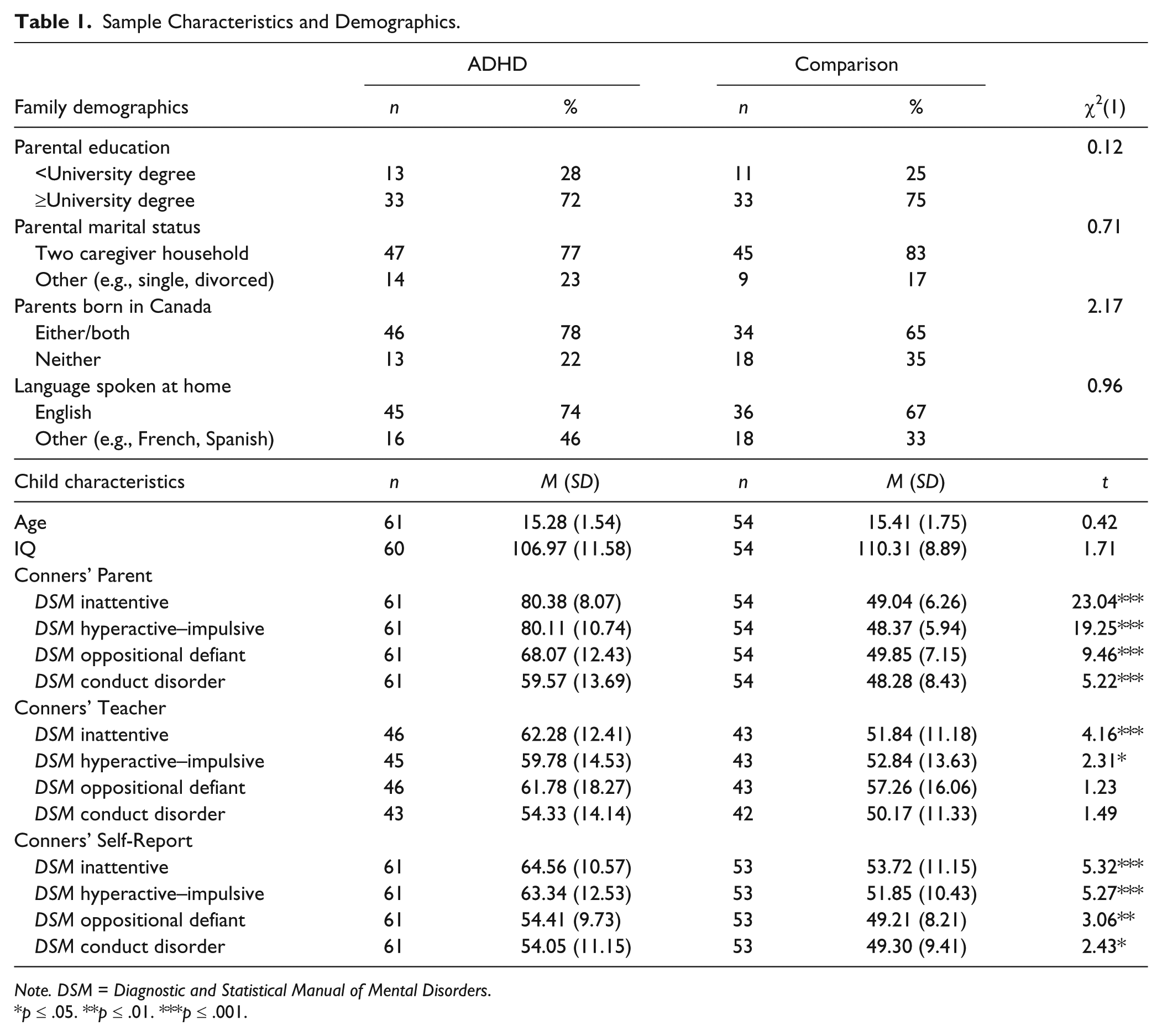
Note. DSM = Diagnostic and Statistical Manual of Mental Disorders.
p ≤ .05. **p ≤ .01. ***p ≤ .001.
Measures
The Networks of Relationships Inventory–Behavioral Systems Version (NRI-BSV; Furman & Buhrmester, 2009) assesses the frequency with which different relationships (e.g., mother, father, same- and other-sex friends, romantic partners) are used to satisfy the functions of three behavioral systems: attachment, caregiving, and affiliation (Furman & Buhrmester, 2009). The NRI-BSV is a 24-item survey, with three items per scale, rated on a 5-point scale from 1 (little or none) to 5 (the most). It assesses five support features (Seeks Secure Base, Seeks Safe Haven, Provides Secure Base, Provides Safe Haven, Companionship) and three negative interaction features (Conflict, Antagonism, Criticism). Two second-order factors (Social Support, Negative Interactions) are computed by averaging the five support and three negative interactions scales. For the purposes of this study, only responses pertaining to the participants’ same- and other-sex friends were explored. The second-order factors (i.e., social support, negative interactions) demonstrate strong internal consistency for same- and other-sex friends and romantic partners with alphas ranging from .89 to .92. Test–retest reliability for this measure is moderate, with stability of scores over 1 year ranging from .58 to .75, for same- and other-sex friends. Construct validity of the NRI-BSV has been established between coders’ ratings of observed interactions and adolescents’ ratings of their relationships with mothers and friends (Furman & Buhrmester, 2009). For the current study, internal consistency was also strong, with alphas ranging from .86 to .98. NRI-BSV Social Support scores were negatively correlated with the Conners 3-P and Conners 3-T peer relations scales (−.29 and −.35, respectively).
The Conners’ Rating Scales–Third Edition (Conners, 2008; Parent–Conners 3-P, Teacher–Conners 3-T, Self-report–Conners 3-SR) long forms were used to confirm ongoing manifestation of ADHD symptoms in the domains of inattention and hyperactivity/impulsivity, as well as to assess oppositionality and conduct problems. The Conners is a well-validated standardized measure consisting of 99 to 115 items on a 4-point Likert-type scale from 0 (not at all/seldom, never) to 3 (very much true/very often, very frequent). The DSM-IV subscales (DSM-IV Inattention, DSM-IV Hyperactive/Impulsive, DSM-IV ODD, DSM-IV Conduct Problems) demonstrate good internal consistency (Parent: .83-.93, Teacher: .70-.95, Self-report .81-.89) and good test–retest reliability (Parent: .84-.94, Teacher: .83-.87, Self-report .71-.81) (Conners, 2008). For the current sample, internal consistency for the two DSM-IV ADHD subscales and the ODD and CD subscales were high for all forms (parent, teacher, self-report; α > .80).
The WASI (Vocabulary and Matrix Reasoning subscales, Wechsler, 1999) is an abbreviated and standardized test of intelligence. It was used to determine eligibility for participation in the study and to estimate the participants’ cognitive functioning. The abbreviated IQ scale (based on two subtest scores) demonstrates good internal consistency (age ≤ 16 years: .93, age ≥ 17 years: .96) and test–retest reliability (age ≤ 16 years: .85, age ≥ 17 years: .88). The correlation with the full scale IQ on the Wechsler Intelligence Scale for Children - Fourth Edition (WISC-IV) is .82.
Procedures
The present study was conducted as part of a larger research study on the peer and family relationships of adolescents with ADHD. Adolescents were recruited through advertisements in community newspapers and websites, by distributing flyers to family doctors, psychologists’ offices, and children’s mental health centers, and by phoning research participants from previous studies who had agreed to be contacted for future research. Institutional ethic’s board approval was obtained from the University of Toronto (protocol reference #25468), and all participants and their parents provided informed written consent prior to the start of the study. During an initial phone screening, parents of participating adolescents were given detailed information about the study, and parents provided demographic information about their children and families and completed the Conners–Parent long form. Adolescent participants were given the choice of receiving Can$30 as compensation for their time (approximately 4 hr) and travel expenses incurred, or receiving a volunteer service certificate documenting time spent participating in the study. In addition, participants were provided with an educational report describing the adolescent’s cognitive, academic, and socioemotional functioning.
On the day of testing, researchers assisted participants in completing an individually administered battery of standardized tests and self-report measures (e.g., WASI, Conners 3-SR, NRI-BSV). Researchers were graduate students in school and clinical child psychology with extensive training in psychological testing. Caregivers completed a combination of paper-and-pencil and online questionnaires and provided consent for the Conners 3-T to be sent to one of the adolescents’ teachers.
Data Analyses
Statistical analyses were conducted using the SPSS Version 22 (IBM Corporation, Armonk, NY, USA) for Windows®/Apple MacIntosh®. The data were examined for outliers, and when detected, data points with SDs larger than 3 were adjusted using the winsorizing method (i.e., data points with extreme values were replaced with the next highest/lowest values within 3 SDs of the distribution). Descriptive statistics were calculated for the demographic characteristics (e.g., age, gender, IQ, parental education, parental marital status, parents’ country of birth, and language spoken at home) of the ADHD and comparison groups separately (see Table 1). Measures of IQ, parental education, parental marital status, parents’ country of birth, and language spoken at home were not significantly correlated with ratings of friendship quality (p > .430) and were not covaried in the analyses. A mixed ANOVA was performed on two indices of friendship quality: social support and negative interactions. The within-subjects factors were relationship (same-sex friend, other-sex friend) and scale (social support, negative interactions). The between-subjects factors were group (ADHD, comparison), age (13-15 years, 16-18 years), and gender (male, female). When appropriate, follow-up univariate ANOVAs were conducted to determine the locus of the statistically significant effects. Partial η2p values were computed to ascertain effect size and determine clinically meaningful differences.
Results
Quality of Same- and Other-Sex Friendships
The mixed ANOVA showed an interaction effect between scale (social support, negative interactions) and relationship (same-, other-sex friends), Wilks’s Λ = .883, F(1, 107) = 14.22, p < .001,
Social support
The Group × Age interaction effect was significant, F(1, 107) = 4.72, p = .032,
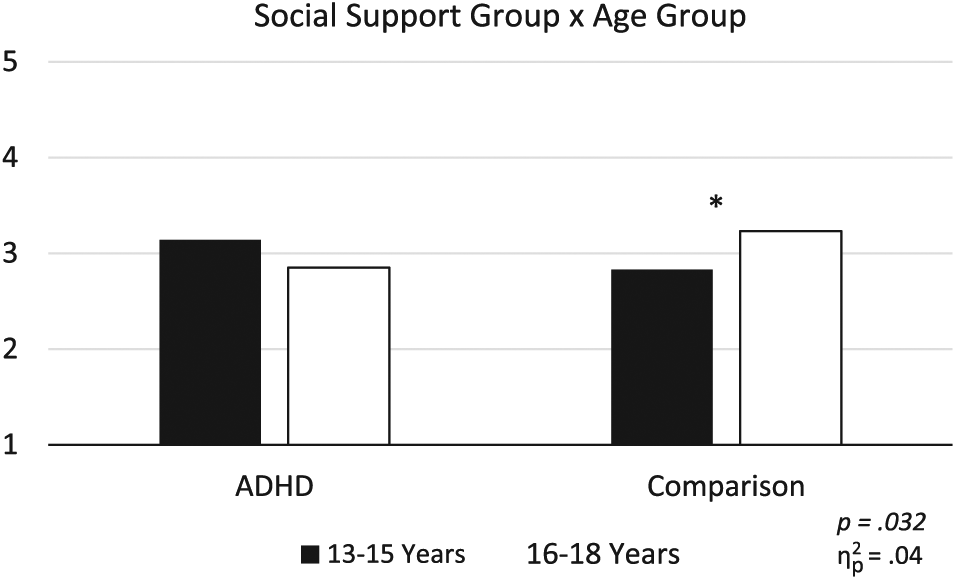
Social support as a function of ADHD status and age.
Friendships Quality of Adolescents by ADHD Status, Age, Gender, and Relationship.

Note. First number in each cell represents the mean and the number in parentheses is the standard deviation. NRI-BSV = Networks of Relationships Inventory–Behavioral Systems Version ; SF = same-sex friend; OF = other-sex friend.
Mixed ANOVA of Relationship Quality by ADHD Status, Age, Gender, and Relationship.
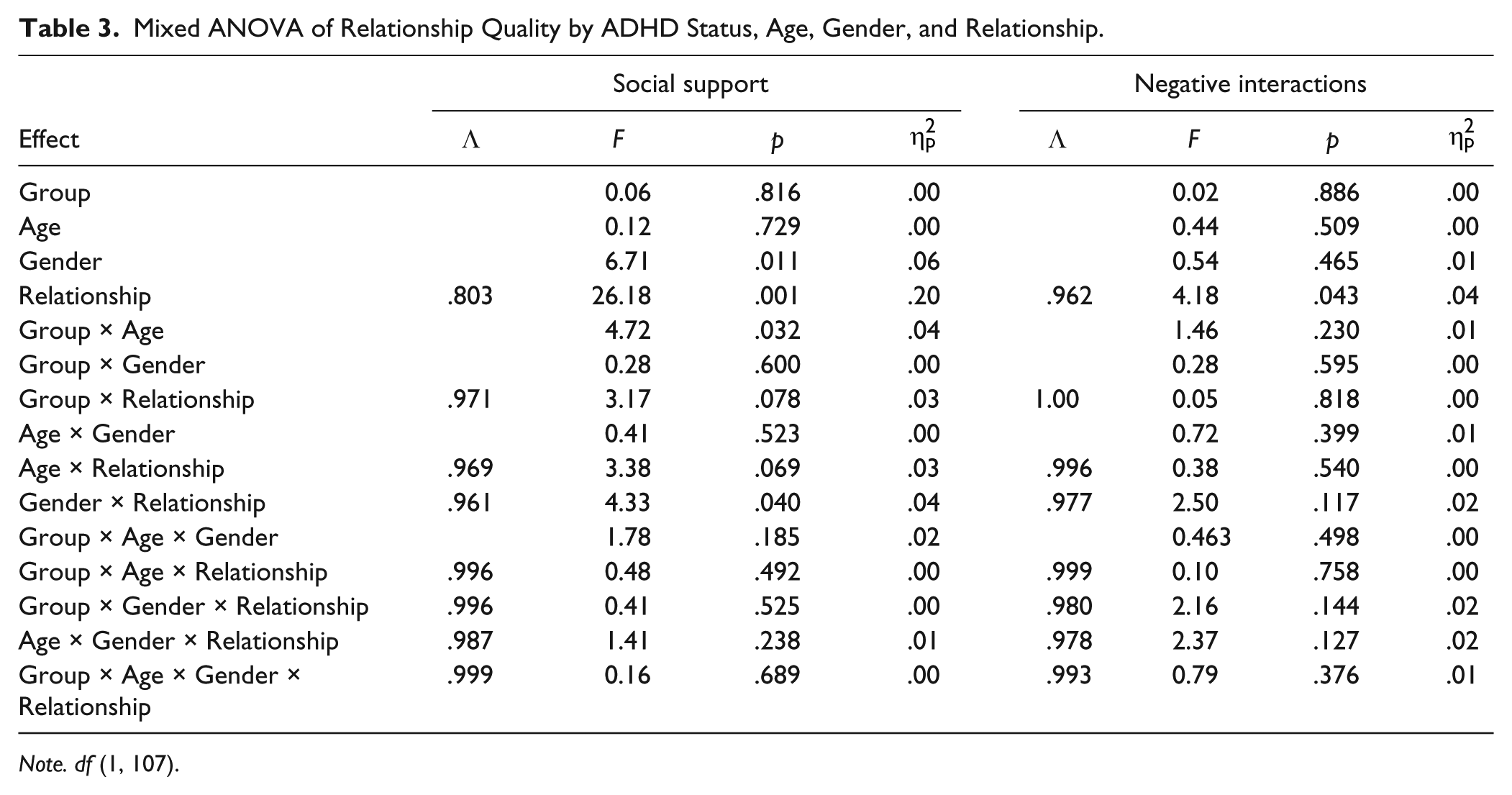
Note. df (1, 107).
Negative interactions
There was a significant main effect of relationship type, Wilks’s Λ = .96, F(1, 107) = 4.18, p = .043,
Discussion
The current study set out to compare the quality of friendships (same- and other-sex) in adolescents with and without ADHD using an empirically validated and reliable self-report questionnaire of relationship quality. Results provide partial support for the prediction that adolescents with ADHD have friendships of lower quality than their TD peers. More specifically, ADHD status was found to moderate the relationship between age and perceived social support in friendships, such that self-reported ratings of friendship social support diminished across age in youth with ADHD, but increased in TD youth. These findings were consistent across same-sex and other-sex friendships. However, when compared with their TD counterparts, adolescents with ADHD did not rate themselves as having more frequent negative interactions in their friendships. Compared with males, females with and without ADHD rated their same- and other-sex friendships to be more supportive. Finally, all adolescents, regardless of their ADHD status or age, rated their same-sex friendships to be simultaneously more supportive and more conflictual than their other-sex friendships.
Friendship Quality
The main objective of the present study was to investigate the quality of same- and other-sex friendships in adolescents with and without ADHD, across age and gender. The prediction that adolescents with ADHD would have lower levels of friendship quality was only partially supported. Younger adolescents with and without ADHD did not differ in their ratings of social support in their friendships. However, as predicted, levels of perceived social support diminished in the friendships of older adolescents with ADHD, but increased in the group of older adolescents without ADHD. The finding that ADHD moderates the relationship between age and social support in friendships is consistent with previous research. Blachman and Hinshaw (2002) and Normand et al. (2013) found no group differences in self-reported ratings of positive friendship features in a sample of children with and without ADHD, but McKee (2014) found that a sample of undergraduate students with ADHD had greater difficulty providing emotional support in their friendships than their non-ADHD counterparts.
As youth move across childhood and into adolescence, there is a shift in their interpersonal needs (Sullivan, 1953); companionship is no longer the preeminent feature of friendships. Instead, older adolescents describe loyalty, intimacy, empathic understanding, and emotional reciprocity as the core features of a high-quality friendship (Berndt, 1986; Meter & Card, 2016; Neyer et al., 2011; Poulin & Chan, 2010; Rubin et al., 2005; Selfhout et al., 2009). Findings from this study suggest that the core symptom dimensions of ADHD make it more difficult for teens with ADHD to shift their interaction patterns to adequately respond to these emerging friendship demands. Specifically, attentional problems may make it more difficult for teens with ADHD to develop social skills through observational learning (Hoza, 2007), to be attuned to the emotional needs of their friends (Mikami et al., 2007; Normand et al., 2013), and to process social cues to resolve conflicts in an equitable manner (Sibley et al., 2010). Hyperactive and impulsive behaviors may result in difficulty modulating emotions and an interactional style that is overbearing and undiplomatic (Hoza, 2007). In addition, children with ADHD tend to rely on their best friends for mutual entertainment, amusement, and having fun, whereas their TD peers favor caregiving and intimacy in their friendships (Heiman, 2005). Although these findings have yet to be replicated in older populations, findings from this study suggest that there may continue to be a mismatch between the salient features prioritized in the friendships of older adolescents with ADHD and their TD peers.
Consistent with previous research (e.g., Kuttler et al., 1999; Lempers & Clark-Lempers, 1993), results from this study indicate that, irrespective of ADHD status, gender, or age, adolescents find their same-sex friendships to be more supportive than their other-sex friendships. However, a trend-level (p = .078) group by relationship interaction effect suggests that the levels of perceived social support in same- and other-sex friendships may be more similar in adolescents with ADHD, than in adolescents without ADHD. These findings are in line with previous research which proposes that adolescents that are either high or low in popularity in same-sex peer relationships are more likely than other children to be engaged in close friendships with the other sex (Bukowski et al., 1999; Kovacs, Parker, & Hoffman, 1996). It is well documented that children and adolescents with ADHD experience low levels of peer acceptance and are frequently ostracized by their peers (Bagwell et al., 2001; Hoza, 2007; Sibley et al., 2010). These results are perhaps indicative that other-sex friendships may offer an alternative means of forging supportive relationships in youth with ADHD. Nevertheless, the absence of a significant interaction effect suggests that a larger sample size may have been required to achieve a significant effect, or may be required in the future to reach a firm conclusion. In any event, although there may be a link between high/low popularity and an orientation toward other-sex friendships, the mechanisms underlying this association remain unclear, and the present study did not investigate participants’ social status in their larger peer network.
Female adolescents rated their friendships (same- and other-sex) as involving higher levels of social support when compared with their male counterparts, irrespective of their ADHD status or age. By now, there is ample evidence that girls value friendships based on emotional closeness, intimacy, self-disclosure, enhancement of self-worth, and helping behaviors, whereas boys’ friendships emphasize agentic needs, individual status, competition, and a dominance hierarchy (e.g., Bowker, 2004; Rose & Rudolph, 2006). Thus, the finding that TD adolescent girls have friendships that they perceive to be more supportive is hardly surprising. However, research investigating gender differences in friendship quality among adolescents with ADHD is sparse. In the multimodal treatment of ADHD (MTA) study, boys and girls were equally impaired in terms of peer status and number of dyadic friendships, but friendship quality was not examined (Hoza et al., 2005). Blachman and Hinshaw (2002) found that girls with ADHD had higher levels of negative relationship features than did comparison girls, but levels of positive relationship features did not differ across subgroups. Furthermore, the study consisted of an exclusively female sample and lacked a group of boys with which to make gender comparisons. Zucchetti et al. (2015) found that hyperactivity symptoms were associated with best friend conflicts among boys, whereas symptoms of inattention contributed to conflicts among girls. However, in their study and Glass et al. (2012), no gender differences were found on positive friendships features, or the overall quality of boys’ and girls’ friendships. In her review article, Mikami (2010) hypothesized that symptoms of ADHD may be more impairing to the close friendships of girls relative to boys. Findings in this study, however, suggest that adolescent girls with ADHD, much like TD youth, have friendships that are more supportive than their male counterparts.
Adolescents with and without ADHD rated themselves as having comparable levels of negative interactions in their friendships, irrespective of age and gender. These findings are inconsistent with previous research indicating that children with ADHD report increased levels of conflict and relational aggression in their friendships (Blachman & Hinshaw, 2002; Zucchetti et al., 2015). These discrepant results may be potentially related to developmental changes in friendship selection. Adolescence represents a time of growing autonomy and participation in actively building one’s social universe (Bagwell & Schmidt, 2011). Parents have less input regarding the selection of their children’s friends and, consequently, adolescents may choose to become friends with peers with whom they share more attributes, aspirations, and achievement goals, resulting in less conflictual relationships than their younger counterparts (Claes, 2003). Future research is needed to replicate these findings.
Interestingly, adolescents with and without ADHD, irrespective of age and gender, rated their same-sex friendships to be simultaneously more supportive and more conflictual than their other-sex friendships. These findings suggest that an increase in negative friendship features may also reflect a greater openness and security within same-sex friendships, which in turn creates a context that allows friends to be more open about their potentially contrasting opinions, without the fear of reprisals (Banny, Heilbron, Ames, & Prinstein, 2011; Normand et al., 2013). Thus, conflict and, more importantly, conflict resolution within a reciprocal same-sex best friendship may function to strengthen the relationship by providing a safe environment to share sensitive and intimate thoughts and to develop social skills.
Limitations and Implications
The current findings should be considered in light of several important limitations. Friendship quality was assessed through self-report only, and not corroborated with the other member of the dyad, or through observations of naturalistic or contrived interactions among friends. A number of studies suggest that in ADHD dyads, partners often have conflicting views regarding their friendships (e.g., Normand et al., 2013). On one hand, findings in the present study, however modest, suggest that older teens with ADHD are sufficiently self-aware to identify that their friendships are less supportive than those of their TD peers. On the other hand, individuals with ADHD are notorious underreporters of problem areas in their lives, especially as it pertains to their social competence (see Owens, Goldfine, Evangelista, Hoza, & Kaiser, 2007, for a review). Therefore, the results may reflect an underrepresentation of their actual relationship impairment. Future studies should employ a multimethod, multi-informant assessment of friendship quality to provide more definitive conclusions.
Subsequent research should also collect information on the characteristics of the participants’ friends. Although high-quality friendships are generally associated with better psychosocial functioning, deviancy training and co-rumination also co-occur within the context of high-quality friendships (e.g., Dishion, Nelson, Winter, & Bullock, 2004; Oh et al., 2008; Rose, Carlson, & Waller, 2007). Because high-quality friendships, for better or for worse, are more influential than low-quality relationships (Berndt, 1999), and because youth with ADHD are more likely to befriend peers who exhibit behavioral and socioemotional difficulties (Hoza et al., 2005; Marton et al., 2015; Normand et al., 2011), it is especially important to consider the potential role that the characteristics of the friends have on adjustment, over and above friendship quality.
The present study provides some preliminary information about the quality of friendships in adolescents with and without ADHD, across age and gender. However, many relevant issues remain to be explored. The relatively small sample size prevented further exploration of additional factors potentially moderating or mediating the relationship between ADHD and friendship quality. Future studies, with larger samples, should examine the distal social context (e.g., culture, ethnicity, socioeconomic status), proximal environmental conditions (family structure, parental influences, peer groups), additional child characteristics (emotion regulation, aggression, social perspective taking, social skills), and their varying contributions to the quality of friendships. Investigating these associations over a longer period may also help to shed light on the potentially bidirectional relationship these correlates have with developmental outcomes such as self-worth, academic achievement, family and peer functioning, and externalizing and internalizing symptomatology.
Results from the present study indicate that older adolescents with ADHD, and males in general, perceive their friendships to be less supportive than the friendships of their respective counterparts. Empirical research indicates that it is the quality, rather than the quantity, of one’s relationships that is critical to psychosocial functioning (Berndt, 2002). Therefore, comprehensive assessments of adolescents with ADHD should include a careful examination of their social functioning with particular attention devoted to the quality of their interactions with friends. A greater understanding of how teens with ADHD perceive the positive and negative features of their friendships may help mental health practitioners devise specific strategies for intervention. Existing intervention programs (e.g., Frankel & Myatt, 2003; Hoza, Mrug, & Pelham, 2003; Keshavarzi et al., 2014; Mikami et al., 2013) are geared toward children with ADHD, and given the limited research on the friendships of adolescents with ADHD, it is premature to delineate more definitive implications.
These limitations notwithstanding, the present study contributes to the limited research base examining the friendships of individuals with ADHD in general and adolescents in particular. To our knowledge, this is the first study to simultaneously investigate the quality of same- and other-sex friendships from the perspective of teens with ADHD. The sample, which included male and female participants, is one of the few studies to examine gender-specific differentiations in friendship patterns while also exploring both positive and negative friendship features.
Footnotes
Declaration of Conflicting Interests
The author(s) declared no potential conflicts of interest with respect to the research, authorship, and/or publication of this article.
Funding
The author(s) disclosed receipt of the following financial support for the research, authorship, and/or publication of this article: This research was supported by the Social Sciences and Humanities Research Council (Grant/Award Number: 489309) to conduct research on the topic in general. Social Sciences and Humanities Research Council provided funding for this specific topic.