







Abstract
Objective:
Cognitive disengagement syndrome (CDS, previously referred to as “sluggish cognitive tempo”) is a set of symptoms defined by excessive mind-wandering, mental confusion, and slowed behaviors separable from ADHD inattention.
Method:
Of the studies examining CDS in relation to psychosocial outcomes, one of the most established correlates of CDS is social withdrawal. However, studies have yet to test mechanisms or moderators of the link between CDS and social withdrawal.
Results:
As a parallel body of literature exists in developmental psychopathology on predictors and outcomes of social withdrawal, this review merges these literatures to identify themes and advance a conceptual model on mechanisms (e.g., task-unrelated thought, poorer social skills, social anxiety) and moderators (e.g., behavioral inhibition, sex, parenting) of the CDS and social withdrawal link.
Conclusion:
This model provides researchers and clinicians with testable hypotheses to better understand the link between CDS and social withdrawal and to identify treatment targets to improve the social engagement of youth with CDS.
Keywords
Cognitive disengagement syndrome (CDS, previously referred to as “sluggish cognitive tempo”), marked by excessive mind-wandering, mental confusion and fogginess, slowed behavior, and drowsiness, is a unique set of symptoms distinct from ADHD-IN. Although CDS was initially viewed as a possible specifier of ADHD purely inattentive presentation, the empirical differentiation of CDS from ADHD-IN and associations with psychosocial outcomes have been replicated in numerous studies across young childhood, school-aged youth, and adolescence (for meta-analytic and CDS Work Group reviews, see Becker et al., 2016 and Becker, Willcutt et al., 2022, respectively). Although the best way to conceptualize CDS remains an area of ongoing discussion, CDS is a key construct for explaining symptom presentation, comorbidity, and impairments in youth with and without ADHD (Becker, Willcutt et al., 2022).
Among the strong associations CDS has with other psychopathologies and functional outcomes, one of the most established psychosocial correlates is social withdrawal. In fact, as studies characterized the peer impairments of youth with ADHD-IN as socially withdrawn and passive (Maedgen & Carlson, 2000; Mikami et al., 2007), researchers suggested that co-occurring symptoms of CDS may better account for the presence of social withdrawal (Solanto et al., 2009). Across community and ADHD-specific samples, consistent evidence characterizes the social profile of youth with CDS as socially withdrawn, isolated, and shy (Becker et al., 2019; Burns & Becker, 2021; Carlson & Mann, 2002; Marshall et al., 2014; Mikami et al., 2007; Rondon et al., 2020; Sáez, Servera, Becker, & Burns, 2019; Sáez, Servera, Burns, & Becker, 2019; Servera et al., 2018; Yung et al., 2021). For instance, studies in youth diagnosed with ADHD plus high CDS symptoms find significantly greater teacher- (Carlson & Mann, 2002) and parent-reported (Marshall et al., 2014; Rondon et al., 2020) social withdrawal compared to children with ADHD and low CDS symptoms. In a study of youth with and without ADHD, parent and teacher ratings of CDS, but not ADHD-IN symptoms, were uniquely related to greater parent-reported withdrawal and teacher-reported isolation (Willcutt et al., 2014). Further, in a sample of school-aged children being evaluated for possible ADHD, Becker et al. (2019) found, above and beyond ADHD and internalizing symptoms, parent ratings of CDS were uniquely associated with lower parent-reported social engagement, whereas teacher ratings of CDS were related to greater social withdrawal and peer ignoring. Conversely, ADHD-IN symptoms were unrelated to these peer domains. A recent study recruited children with and without clinically elevated teacher-reported CDS symptoms and found children with elevated CDS had significantly less engagement in the classroom compared to children without CDS (Cohen's d = 0.70; Becker, Epstein et al., 2022). Although limited compared to studies of school-aged youth, CDS symptoms are also associated with greater social withdrawal in adolescents (Jung et al., 2021; Willcutt et al., 2014). It is perhaps because of increased withdrawal and lower assertion that CDS is associated with lower teacher-reported leadership in children with ADHD (Marshall et al., 2014). Also, although these studies relied on rating scales, one study in youth with ADHD found parent ratings of CDS symptoms to be significantly associated with fewer responses made during a computerized chat room task (Mikami et al., 2007). More recently, a qualitative study of youth with ADHD and co-occurring CDS symptoms found over 25% of parents described CDS behaviors as negatively impacting their child's peer relationships. Germane to withdrawal specifically, the parent of one 16-year-old boy stated: "I mean, he’s just not inclined to really seek interactions with others, cause I think it’s difficult for him. To talk to others; to express himself. So, that may be why he doesn’t, you know” (Becker, Fredrick et al., 2022, p. 922).
Despite the consistent support for effects of CDS on social withdrawal, only one study, to our knowledge, has explored mechanisms or predictors of social withdrawal in individuals with CDS. In a community-based sample of school-aged children, task-based deficits in sustained attention were associated with greater parent-reported social withdrawal in children high in SCT (Yung et al., 2021).
Limitations of the Literature and Need for a Conceptual Model
Taken together, the literature to date points to a troubling social profile of youth with CDS, with and without ADHD, as not only cognitively disengaged but also “socially” disengaged. These findings are clearly important since social withdrawal has been linked to increased internalizing symptoms and loneliness (Rubin et al., 2009) and isolation from the peer group is considered one of the most robust predictors of suicidal behavior (Van Orden et al., 2010). Further, although social skills training for youth with ADHD has limited effects (Morris et al., 2021), preliminary evidence indicates that social skills training may be useful for youth with ADHD-IN specifically due to the presence of social withdrawal and social skill deficits (Antshel & Remer, 2003; De Boo & Prins, 2007). Importantly, why are youth with CDS socially disengaged? Although preliminary findings point to attention deficits as one potential mechanism (Yung et al., 2021), a large body of literature in developmental psychopathology on predictors, types, and outcomes of social withdrawal in youth has advanced separately from literature on CDS. Thus, to enhance our assessment and intervention of social withdrawal in youth with CDS, the following sections review and integrate findings on social withdrawal in order to advance a conceptual model of key mechanisms and moderators to further understand the CDS and social withdrawal link.
Social Withdrawal
In the developmental literature, social withdrawal is defined as the child “isolating himself/herself from the peer group. . . In this latter regard, social withdrawal is viewed as emanating from such internal factors as anxiety, negative self-esteem, and self-perceived difficulties in social skills and social relationships” (Rubin et al., 2009, p. 145). Thus, social withdrawal is conceptualized as a behavioral phenotype with many underlying causes. Further, the social withdrawal literature documents two subdomains of social withdrawal reflecting differences in social approach-avoidant motivational tendencies: shyness and social disinterest (Coplan et al., 2018). Specifically, youth may withdraw from the peer group due to elevated shyness (e.g., conflict between social interest and fear/anxiety responses) or social disinterest (e.g., non-fearful preference for being alone or engaged in solitary play; Rubin & Chronis-Tuscano, 2021; Rubin et al., 2009). In early childhood, social disinterest appears benign and unrelated to socioemotional outcomes (Coplan et al., 2018; Kopala-Sibley & Klein, 2017), whereas shyness is strongly linked to peer problems and internalizing symptoms (Coplan et al., 2018). However, both shyness and social disinterest are increasingly associated with internalizing problems during middle to later childhood, potentially due to increased expectations for assertiveness and social engagement (Kopala-Sibley & Klein, 2017).
When considering the literature on CDS in relation to subdomains of social withdrawal, a number of studies suggest that CDS may be more directly linked than ADHD-IN to shyness. In a large sample of school-aged youth, mother, father, and teacher ratings of CDS, but not ADHD-IN symptoms, were uniquely related to greater conflicted shyness (Sáez, Servera, Becker, & Burns, 2019; Sáez, Servera, Burns, & Becker, 2019). In two separate studies examining differences in peer impairments in youth with clinically elevated CDS and/or ADHD, greater shyness was found in the CDS-only and CDS plus ADHD groups compared to the ADHD-only group (Burns & Becker, 2021; Servera et al., 2018). Finally, a prospective longitudinal study documented stronger effects of CDS than ADHD-IN symptoms in childhood predicting shyness in adolescence (Becker et al., 2018).
Conversely, only one study has tested CDS symptoms in relation to social disinterest. In a large sample of school-aged youth, child self-report of CDS was moderately correlated with greater preference for solitude, though the magnitude of effect was small and lower in comparison to self-reported loneliness (Sáez, Servera, Burns, & Becker, 2019). Also, this study did not test unique effects of CDS on preference for solitude when accounting for overlapping psychopathology symptoms. Indirect evidence of a CDS and social disinterest link comes from a few studies showing CDS to be significantly elevated and uniquely associated with social functioning in youth with autism spectrum disorder (ASD; Duncan et al., 2019; McFayden et al., 2022).
Taken together, the research to date provides evidence for CDS being closely associated with social withdrawal and shyness specifically. In order to better understand the social motives of youth with CDS, future prospective studies are clearly needed to test whether CDS predicts certain types of social withdrawal profiles and trajectories. Next, as detailed in Figure 1, we highlight key mechanisms and moderators from the social withdrawal literature to guide future research and clinical intervention of CDS and social withdrawal.
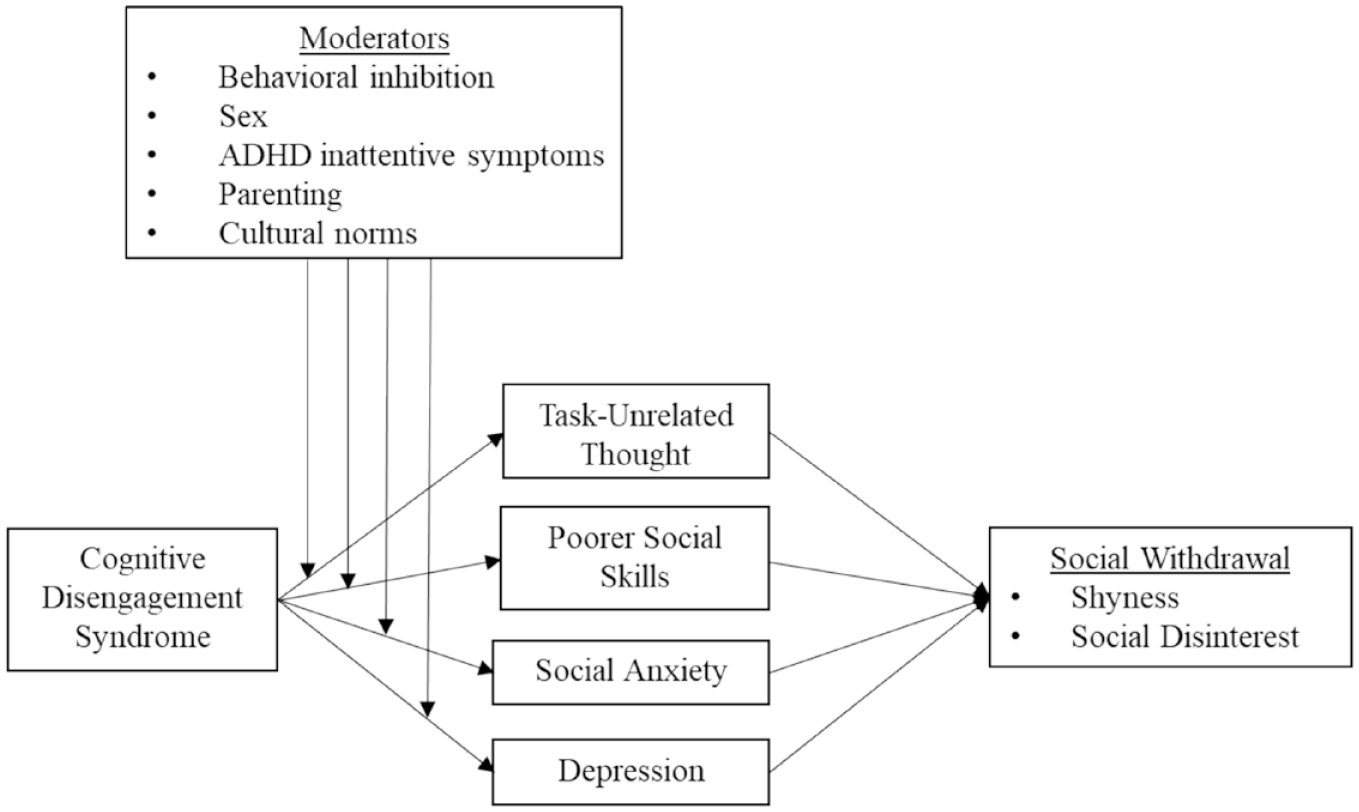
Conceptual model on cognitive disengagement syndrome and social withdrawal.
Mechanisms Linking CDS to Social Withdrawal
Task-Unrelated Thought
Task-unrelated thought is defined as the pattern and content of thought that is decoupled from the ongoing environment (Christoff et al., 2016). The different pattern and content of task-unrelated thought, such as attention-biases to threat, mind-wandering, and rumination, may be potential mechanisms of the CDS and social withdrawal link. Specifically, attentional biases to threat have been directly related to social withdrawal and found to moderate the prospective link between an early behaviorally inhibited (BI) temperament and later social withdrawal (Perez-Edgar et al., 2010). Further, excessive mind-wandering and rumination have been associated with increased negative affectivity and withdrawal behaviors (Becker & Barkley, 2021; Christoff et al., 2016).
Although CDS and ADHD-IN symptoms involve task-unrelated thoughts (e.g., inattention, distractibility), the nature of these difficulties appear to be distinct. In contrast to top-down executive control processes linked to ADHD-IN, greater task-unrelated thoughts have been proposed as an unique attentional feature of CDS (Barkley et al., 2022; Becker & Barkley, 2021). Specifically, CDS is more strongly associated than ADHD-IN symptoms with self-reported mind-wandering and rumination (Becker & Barkley, 2021; Becker et al., 2020; Fredrick & Becker, 2021; Fredrick, Kofler, et al., 2020). In school-aged children with high CDS, difficulties in sustained attention were significantly associated with parent ratings of social withdrawal, controlling for ADHD (Yung et al., 2021). Although no study has examined CDS in relation to objective markers of attentional biases to threat, there is evidence that CDS, but not ADHD-IN, strengthens the link between fears of social evaluation and social anxiety symptoms (Fredrick, Becker, et al., 2020). Potentially, due to excessive task-unrelated thoughts characteristic of CDS, youth with CDS may have difficulties successfully attending to key social cues and get “stuck” on socially anxious feelings and thoughts (Yung et al., 2021). In turn, youth may escape into internal thoughts and withdrawal from overwhelming social situations (Becker & Barkley, 2021; Willcutt et al., 2014).
Poorer Social Skills
When seeking to understand the experience of social withdrawal in youth, researchers have considered the role of social skills. Broadly, social skills refer to the verbal and non-verbal behaviors necessary for forming and maintaining social interactions (e.g., eye contact, rate/tone of speech, initiating conversations, engagement, and reciprocity; Spence, 2003). In a review on social skills in socially withdrawn youth, studies using teacher ratings, laboratory-based interaction tasks, and peer ratings found less assertiveness, active engagement, and fewer words/responses made during interactions (Kingery et al., 2010). Lower social skills are recognized as a key predictor and maintenance of social withdrawal, as these deficits interfere with social confidence and successful peer engagement (Rubin et al., 2009).
A few studies have explored social skills in youth with CDS, with inconsistent findings across informants. Specifically, CDS symptoms were uniquely associated with teacher, but not parent, ratings of social skills in two separate studies (Bauermeister et al., 2012; McBurnett et al., 2014). However, these studies created composite ratings and did not examine specific types of social skills. Conversely, Becker et al. (2019) found parent, but not teacher, ratings of CDS to be associated with less parent-reported engagement (e.g., starts conversations) controlling for ADHD, internalizing, and externalizing symptoms. This finding converges with one previous study showing CDS symptoms to be associated with fewer responses made during a computerized chat room task (Mikami et al., 2007). Finally, in a sample of adolescents with and without ADHD, lower social competence was prospecitvely associated with CDS across self- and paren-ratings above and beyond ADHD-IN symptoms (Fredrick et al., 2021). Taken together, youth with CDS may have difficulties with assertiveness and engagement in social interactions, potentially due to being lost in thought and easily zoned out which, in turn, result in withdrawal. Future research is encouraged to examine whether these processes differentially impact social withdrawal subdomains of shyness and social disinterest.
Social Anxiety and Depression
The literature on social withdrawal documents robust associations between internalizing symptoms of social anxiety and depression with social withdrawal (Cummings et al., 2014; Rubin et al., 2009). Social anxiety, characterized by persistent fears of social-evaluative situations, has been conceptualized as predictor, correlate, and outcome of social withdrawal (Rubin et al., 2009). The link between social anxiety and social withdrawal may be reciprocal, with avoidance and negative peer experiences functioning as maintenance factors (Kingery et al., 2010). Additionally, peer withdrawal is concurrently associated with greater depressive symptoms and clinical levels of depression in youth (Cummings et al., 2014). The hallmark features of depression, such as low mood and self-esteem, may contribute to active avoidance of the peer group due to feelings of incompetence.
Studies across school-aged and adolescent samples demonstrate that CDS symptoms are a strong correlate and predictor of depressive symptoms (Becker, Willcutt et al., 2022; Fredrick, Langberg et al., 2022). CDS symptoms may be associated with elevated depressive symptoms due to overlapping hypoactive behaviors (e.g., lethargy and daytime sleepiness) (Fredrick, Yeaman et al., 2022) or greater active peer rejection (Fredrick, Langberg et al., 2022), which, in turn, may result in withdrawing oneself from the peer group as a result of less motivation or self-regulatory deficits (Palmer et al., 2022). Due to overlapping temperamental and external correlates, such as BI, shyness, and internalizing symptoms, researchers have speculated that CDS may be uniquely and strongly linked to symptoms of social anxiety (Becker et al., 2019). However, to our knowledge, no study has explicitly tested CDS in relation to socially anxiety symptoms in youth samples, with one study in college students finding self-reported CDS to be correlated with greater fears of social evaluation and social anxiety symptoms (Fredrick, Becker, et al., 2020). Thus, future research is needed to better understand whether CDS is linked with social anxiety symptoms in youth samples.
Moderators of the Link Between CDS and Social Withdrawal
The final component of our conceptual model refers to key individual and contextual-level factors that might strengthen or mitigate the link between CDS and social withdrawal. Although not exhaustive, these moderator factors were previously identified in review articles on the developmental psychopathology of social withdrawal: behavioral inhibition, sex, parenting, peer relations, and cultural norms (Rubin & Chronis-Tuscano, 2021; Rubin et al., 2009). Further, albeit distinct, CDS and ADHD-IN symptoms remain strongly interrelated (Becker, Willcutt et al., 2022), and we acknowledge the role of ADHD-IN symptoms in our model.
Behavioral inhibition (BI), a temperamental style characterized by the biologically-based tendency to experience heightened emotional reactivity and avoidance to novel people, objects, or situations, is one of the most established precursors to social withdrawal (Fox et al., 2005). Research to date provides clear evidence that BI is a robust vulnerability factor for social withdrawal across development, likely a result of biological indices of physiological reactivity (for a review, see Rubin et al., 2009). Only one study has tested temperamental correlates of CDS in youth. In a community-based sample of school-aged youth ages 9 to 12, Becker et al. (2013) found parent ratings of the fear/shyness component of the behavioral inhibition system to be uniquely associated with greater CDS symptoms, whereas these behaviors were negatively related to ADHD-IN. Further, there is indirect evidence of the role of the BI system underlying the CDS phenotype, as CDS was associated with sympathetic nervous reactivity to a social stressor task (Becker & McQuade, 2020). However, both studies await replication, including in younger samples (e.g., infancy or toddlerhood) to test whether the link between CDS and social withdrawal is stronger for youth with BI.
Regarding sex differences, the socio-emotional consequences of social withdrawal appear to be most pronounced for boys given societal expectations for assertive behaviors (Rubin et al., 2009). Although sex differences in rates of CDS symptoms are not consistently found (Becker, Willcutt et al., 2022), future studies are encouraged to test whether CDS is more strongly linked to mechanisms of social withdrawal for boys compared to girls. Potentially, boys prone to mind-wandering and being lethargic may receive more negative responses, leading to fewer opportunities to build social competence. Further, as mentioned above, the presence of ADHD and CDS places youth at heightened risk for withdrawal and shyness (Burns & Becker, 2021; Marshall et al., 2014; Servera et al., 2018), underscoring the need to test the relation of CDS and social withdrawal in youth with and without ADHD-IN specifically.
Finally, parenting and cultural norms are critical factors to consider that may moderate the impact of CDS on social withdrawal. Protective parenting, characterized by autonomy-limiting and directive behaviors, is either directly related to social withdrawal or moderates the link between BI and withdrawal (Kiel & Buss, 2011; Rubin et al., 2009). Surprisingly, no studies have directly examined parenting behaviors and CDS in youth, though one study found that emotionally supportive behaviors in the school climiate mitigate the impact of poor social competency on CDS symptoms (Fredrick et al., 2021). Potentially, caregivers who limit opportunities to express one’s thoughts,gain social confidence, and feel supported, overly protective parenting may exacerbate the process in which CDS influences social withdrawal. Differences in cultural norms related to appropriate social behavior are likely a key contextual factor impacting the link between CDS and social withdrawal. Specifically, in families or cultures adopting interdependence expectations, socially withdrawn behaviors are viewed favorable as they maintain interpersonal harmony, which is in contrast to individualistic expectations for assertiveness and leadership (Rubin et al., 2009). Although the internal validity of CDS has been established beyond samples of youth in the United States (Becker, Willcutt et al., 2022), the social behaviors of youth with CDS may be less problematic in more interdependent cultural contexts (Jung et al., 2021).
Future Directions and Clinical Intervention of Social Withdrawal in Youth With CDS
In review of the two literatures on CDS and social withdrawal, findings for mechanisms and moderators are strikingly similar. Nevertheless, a number of key gaps in the literature remain and are necessary to address in order to advance our understanding of why youth with CDS are socially disengaged. First, nearly all studies reviewed on CDS and social withdrawal included samples of school-aged youth using parent or teacher ratings of CDS symptoms (for exceptions, see Jung et al., 2021; Willcutt et al., 2014). As BI is a robust precursor to social withdrawal across development, which may also serve as a vulnerability factor for CDS (Becker et al., 2013), additional studies in early childhood are critical to better understand the underlying temperamental correlates of CDS leading to withdrawal. Additionally, as adolescence represents a developmental transition marked by increased emphasis of peer acceptance, sensitivities to social-evaluation, and the emergence of internalizing psychopathology (Fredrick, Langberg et al., 2022; Morris et al., 2021), social withdrawal among adolescents with CDS may be particularly detrimental. Along these lines, as the CDS construct is at least in part an internal state (e.g., lost in thoughts, mental confusion, and sleepiness) that is strongly connected to internalizing domains (Becker, Willcutt et al., 2022), future research is encouraged to utilize a multi-informant design of CDS when testing social withdrawal. Regarding methodology, Mikami et al. (2007) was the only study to examine CDS and social functioning during peer interactions beyond rating scales using a computerized-based chat room task. The methdological limitations leads to several unanswered questions: What is the real-world behavior of youth with CDS during social interactions via laboratory-design and/or naturalistic observations? Are youth with CDS withdrawn from all peer interactions or mainly larger group-based activities? For instance, socially withdrawn youth are no less likely to have a best friend, albeit of lower quality (Kingery et al., 2010). Given preliminary evidence that youth with CDS, compared to ADHD, may have more impairments in sports-based activities than friendships (Barkley, 2013; Burns & Becker, 2021), further understanding the peer context of social withdrawal is an important next direction.
Finally, the conceptual model provides areas to target in treatment to improve the social engagement for youth with CDS. The inconsistent effects of social skills training (SST) to address peer impairments in youth with ADHD is well-documented (McQuade, 2020; Mikami et al., 2014), potentially due to performance-based deficits interfering with generalization of social skills (Morris et al., 2021). However, research suggests that SST may be more appropriate for youth with ADHD-IN as the peer impairments are characterized by more of a skill deficit (De Boo & Prins, 2007). In fact, one study of youth with ADHD-IN showed skills-based interventions (e.g., social skills and parent training) improved CDS symptoms and social functioning (Pfiffner et al., 2007). Also, indirect effect points to the effect of these trainings for youth with CDS, as social skills training has evidence for improving peer relations in youth with social anxiety and socially withdrawn behaviors (Kingery et al., 2010; Rubin et al., 2009). Thus, as recommended in prior reviews (Ferretti et al., 2019), studies are encouraged to examine CDS as a moderator of response to SST for youth with ADHD-IN, while assessing and targeting preference for solitude, shyness, attention, social skills, social anxiety, and depressive symptoms as possible mechanisms.
Footnotes
Declaration of Conflicting Interests
The author(s) declared no potential conflicts of interest with respect to the research, authorship, and/or publication of this article.
Funding
The author(s) received no financial support for the research, authorship, and/or publication of this article.
