







Abstract
There is a long history of ridership on urban rapid transit projects failing to meet predevelopment forecasts. This article examines the trade-offs for government associated with transferring the financial risk of ridership demand shortfalls to the private sector through public–private partnerships (PPPs). First, the article develops a theory of the way that PPPs are designed to clamp down on the causes of transit ridership shortfalls. Second, it outlines technical, planning, and financial trade-offs associated with transferring ridership demand risk to the private sector. Third, examples are presented to show how these trade-offs manifest in the most popular models of allocating ridership demand risk in PPPs. The article concludes that transit projects have particular characteristics that challenge the effective transferring of ridership demand risk to the private sector. Governments should instead focus on project procurement models that encourage risk sharing between the partners.
Introduction
Faced with a crisis of urban transportation, many cities are developing large public transit systems such as subways, light rail lines, and bus rapid transit systems as a way to reduce congestion, minimize pollution, improve social equity of mobility, and catalyze compact land development. Increasingly, there is interest in using public–private partnerships (PPPs) to design, build, finance, operate, and maintain new urban transit projects or refurbish and expand existing facilities. Between 1985 and 2010, PPPs have been used to deliver nearly 100 urban transit projects worldwide with a capital value of more than US$65 billion. Many more projects are in the planning and approval process (Public Works Financing, 2010).
The government motivations for delivering urban transit projects through public–private partnerships have varied by city and changed over time. One common early motivation was to raise private funds to pay for upfront capital costs so that politicians could deliver high quality infrastructure without taking on additional public debt (Flinders, 2005). This motivation has proved illusory, however, as transit PPPs typically require long-term operating subsidies from government that are increasingly being accounted for on public balance sheets (Hodge & Greve, 2010; Quiggin, 2004; Vining & Boardman, 2008).
More recently, achieving value for money has emerged as the primary motivation for delivering transit projects through PPPs (Morallos & Amekudzi, 2008). According to the U.K. Treasury (2006, p. 7), “Value for money is defined as the optimum combination of whole-of-life costs and quality (or fitness for purpose) of the good or service to meet the user’s requirement.” Importantly, value for money does not refer to the lowest cost project. Due to the higher cost of financing an asset with private capital and increased transaction costs, the base cost of PPP projects are typically higher than for a comparable public sector alternative (Shaoul, Stafford, & Stapleton, 2007; Siemiatycki, 2007).
Rather, value for money is seen to be achieved through a combination of lower total lifecycle costs as well as qualitative benefits such as enhanced building quality, innovative facility design, and rigorous contract management. At its core, the value for money of urban transit PPPs is driven by transferring project risks to the partner best able to manage them. Historically, urban transit projects have been plagued by major cost overruns and construction delays; and once operational, ridership demand has often failed to meet initial forecasts, leading to lower than expected revenues (Flyvbjerg, Bruzelius, & Rothengatter, 2003). Against this backdrop, value for money can be achieved if financial risks associated with large cost overruns and demand shortfalls are transferred from the public to the private sector partner. By putting private risk capital at stake through contractual arrangements in the PPP, the private sector partner faces the financial burden when poor project outcomes occur and conversely profiting when expectations are met or exceeded. They are therefore incentivized to identify and manage project risks (Grimsey & Lewis, 2004).
While recent evidence suggests that PPPs have been effective at transferring the risk of cost overruns and therefore delivering projects on time and on budget, transferring the risk of lower than expected ridership demand poses a unique set of challenges in the urban transit sector (Allen Consulting Group, 2007). Ridership on a single transit line is greatly affected by the integration of the facility into the wider transit network, scheduling, fare structures, and public policy shaping long-term land use development. Yet these issues are typically beyond the control of the private sector partner (Siemiatycki, 2010). As travel demand on transit PPPs has in some cases continued to be lower than expected, the contractual terms related to the transferring of ridership demand risk have become a serious source of conflict between government procurement agencies and their private sector concessionaires. In fact, in a number of cases these conflicts have precipitated collapses of the partnership (Menzies & Mandri-Perrott, 2010).
As such for planners of transit PPPs, there are often competing objectives. On one hand is the desire to transfer as many risks as possible to the private sector to ensure that the PPP model delivers value for money. On the other hand is the imperative of maintaining public control over key planning functions to maximize the public benefit of the transit system.
Within this context of competing objectives and conflict, how should planners of urban transit PPPs handle the vexing issue of ridership demand risk? This issue is important and timely as a large number of jurisdictions are exploring the prospect of delivering urban transit systems through PPPs, many for the first time, as well as the severe consequences that can arise when transferring travel demand risk is ill- conceived. The main purpose of this article is to identify the trade-offs and tensions associated with transferring demand risk on large urban transit projects. The first section of the article provides background on the transferring of demand risk and sets out a framework to understand the specific trade-offs that exist as demand risk is transferred on urban transit projects. This framework is informed by a review of the extensive global literature on PPPs as well as background interviews with key public and private sector stakeholders involved with delivering PPPs in Canada. Drawing on a series of examples, the second section identifies a number of models used internationally in transit PPPs to transfer ridership demand risk, some with better success than others. The article concludes by discussing and debating the trade-offs associated with transferring ridership demand risk on urban transit projects and identifies key questions for project planners to ask when assessing the alternatives.
Why Transfer Demand Risk?
It is little wonder that governments have sought to develop mechanisms to transfer the risk of demand shortfalls on urban transit projects to the private sector. Flyvberg (2007) reports that forecasted ridership levels are rarely met on large urban transit projects: 9 out of 10 projects worldwide fail to meet their expected ridership level, with three quarters of projects attracting at least 40% fewer passengers than forecasted. Indeed, urban transit projects stand out as having among the most inaccurate demand forecasts of any type of transportation asset, and the prevalence of underestimated ridership has been consistent for decades.
In traditional models of public sector procurement, urban transit facilities are designed, financed, and operated directly by the government agency, ministry, or commission responsible for public transit. These traditional procurement approaches typically follow the disaggregated design-bid-build model: the project is planned and designed by the commissioning agency, often in consultation with a team of contracted engineering advisors. Once the design is completed, a contractor is hired to build the facility as designed. The construction is paid for directly by the public sector agency, with money raised either through government debt or bonds. The facility is usually operated by government employees, or in some cases, asset operation and maintenance is subsequently outsourced to a private firm (Siemiatycki, 2006).
Under such arrangements, the commissioning agency bears the entire risk of lower than expected travel demand. When ridership levels do not meet their predevelopment forecasts, the missing revenues associated with fewer than expected paying customers, often totaling millions of dollars, is covered by the commissioning agency. This can place significant pressure on the agency’s finances, particularly if fare revenue is required to cover a project’s initial capital expenditure as well as ongoing operating costs.
Importantly, Flyvbjerg (2009) as well as Pickrell (1992), Wachs (1988), and Kain (1990) argue that persistent overestimation of traffic volume on urban transit projects is not merely the result of technical difficulties predicting ridership in an uncertain future. Rather, these authors contend that project planners and politicians have strong incentives to strategically misrepresent and inflate the expected ridership demand of a project in order to build public support, gain approval, and get the project started. This is especially the case when long-term accountability mechanisms are not in place to penalize individuals or firms if a project underperforms expectations later on.
To be certain, Flyvbjerg’s findings have been controversial and contested, both for the pattern of persistent ridership shortfalls he identifies and the explanations of strategic misrepresentation that he puts forward (Remington, 2002). Nevertheless, these findings provide a context for explaining the urgency with which mechanisms are being sought to improve accountability in the models of transit project delivery, one of which is to transfer the risk of ridership demand shortfalls to the private sector through PPPs.
The Theory Supporting Demand Risk Transfer
Public–private partnerships represent a fundamentally different approach to delivering large urban transit projects than traditional models of procurement. Garvin and Bosso (2008, p. 163) provide a useful definition of a PPP: A P3 (PPP) is a long-term contractual arrangement between the public and private sectors where mutual benefits are sought and where ultimately (a) the private sector provides management and operating services and/or (b) puts private finance at risk.
In PPPs, multiple aspects of project delivery are bundled into a single concession, with the private sector’s initial capital investment repaid over the course of a long-term operating period. In this way, governments are transformed from direct producers to purchasers and regulators of infrastructure services (Flinders, 2005). PPPs take on a variety of different forms depending on the range of project delivery services bundled into the concession. In Canada, partnerships that bundle design, construction, and project financing have been common, whereas public concerns about private ownership of key infrastructure assets and a lack of appetite among Canadian banks to assume demand risk have meant that fewer PPP concessions include operations and maintenance. In Europe, Australia, Asia, and much of the rest of the developing world, PPPs have bundled the widest range of services possible into the concession, including facility design, construction, financing, operations, and maintenance (Gil, 2011).
The United States, by comparison to other jurisdictions, has been slower to adopt the usage of PPPs in the transportation sector. PPPs are a state jurisdiction and more than 20 states do not have enabling legislation permitting project delivery through PPPs. Moreover, project planners have often found it less expensive to use tax-free government bonds to finance infrastructure rather than privately raised capital. To this end, while design-build contracts are commonly classified as PPPs in the United States and have been used to deliver transit projects, they are best thought of as contracting out since they do not include either private finance or operations (Garvin & Bosso, 2008). Notwithstanding the current limitations, there is a prevailing sentiment within the infrastructure industry that PPPs will become increasingly prominent in America (Brown, 2007; Garvin, 2010).
Importantly, as the bundle of responsibilities for project delivery taken on by the private sector partner increase, so too does the level of private control over the project, and the types of risk assumed by the concessionaire. In particular, the introduction of private sector risk capital that is recouped based on the success of the project, as well as performance-based financial incentives built into the contracts, are seen as providing a strong motivation to identify and manage project risks (Grimsey & Lewis, 2004). To this end, mechanisms to transfer demand risk are designed not only to encourage the best technical methods of forecasting but also to address the underlying social processes and incentive structures that have supported such a long history of ridership demand shortfalls on transit projects.
Three key accountability mechanisms for managing demand risk are encouraged when transit projects are delivered through PPPs. First, when the private sector partner is investing millions of dollars to be recouped based on the level of ridership demand on the system, a degree of analytical rigor will be introduced during the project planning process that may have been missing when investment decisions were made exclusively by government. In particular, private investors are expected to vet project demand forecasts more thoroughly and realistically to ensure viability and ultimately profitability, and care less about overly optimistic political considerations that may have motivated government-led projects (Flyvbjerg et al., 2003). Second, through the project design process, private sector bidders are expected to bring forward system alignments, design innovations, and service plans that will maximize ridership at the lowest cost. Third, once a transit system is operational, an incentivized private operator is expected to provide a high quality and efficient service on an ongoing basis since this supports higher ridership and thus greater returns (Daniels & Trebilcock, 1996). Moreover, the involvement of a private sector operator can also produce improved efficiency as a public sector regulator may exercise greater vigilance with a private operator than with a public operator.
The Challenges of Demand Risk Transfer
Given the persistent history of overestimating demand forecasts on large urban transit projects, it may be assumed that any approach to transfer the financial costs associated with traffic volume risk to the private sector would be welcome. Yet transit projects have particular characteristics that not only make demand risk transfer technically challenging but also call into question the wider public policy merits of such a strategy.
Technical concerns
At the core of any arrangement to transfer demand risk to the private sector is an accurate ex-ante forecast of the number of riders who will use the system. Yet accurately forecasting traffic volumes on a single transit line involves the modeling of multiple factors such as economic growth, future travel behavior, and long-term pricing, factors that can vary markedly over time (Garvin, 2010). As such inaccurate forecasts may persist, even when the forecast is developed using the best available techniques such as reference class forecasting (see Flyvbjerg, 2008, 2009) and conducted or closely vetted by private sector concessionaires that are financially incentivized to “get it right.”
Moreover, rapid transit projects (particularly in North America) rarely recover all of their operating costs through the fare box and thus require ongoing public subsidies. In addition, to promote mobility options among groups that may have few other travel choices, concessionary fares are often offered to youth and seniors. How these subsidies are accounted for and allocated to the private sector in a PPP arrangement where the private sector receives at least part of their compensation through fare box revenues can be technically complicated. Measuring gross ridership levels and the use of concessionary passes on a specific link in an integrated transit system is neither simple nor straightforward. In cases where considerable financial payments are at stake, the methodologies and practice of measuring transit system usage have been a source of conflict between the PPP partners (Siemiatycki, 2010).
Planning concerns
Wider issues about system planning, long-term flexibility, and control over key public policy levers have also challenged arrangements to transfer ridership demand risk to the private sector through PPPs. Urban transit systems operate within dense, complex transportation networks, with ridership on a single rapid transit line deeply affected by the way that the system is integrated into the wider network, fare rates, and coordination, and land use policy adjacent to the transit system (Menzies & Mandri-Perrott, 2010). Yet the extent to which a private sector operator of a single transit line can control any of these policy levers has been a flashpoint for conflict between the public and private sector partners.
First, system integration and competing transit services have posed a challenge to ridership on PPP transit projects. Buses operating on adjacent corridors may provide important localized transit services at varying price points but can also limit ridership on the rapid transit system. Such services may be completely beyond the control of the public sector commissioning agency in privatized transit markets. Moreover, cuts to feeder bus services can dramatically reduce ridership on a rapid transit system, though such decisions are typically outside of the control of the private sector PPP operator. To protect their returns, PPP concessions in the transportation sector involving demand risk transfer have often included strict clauses outlawing the provision of competing services by publicly operated transit agencies, leading to considerable community opposition if such services represent sound public policy (Bowman, 2002).
Second, authority over fare setting in PPPs can be a flashpoint for controversy, fraught with political risks. There is a strong social equity argument for keeping transit fares low, to encourage riders to switch from more polluting travel modes, or subsidizing youth and seniors to encourage access to mobility for those without other travel options. However, keeping fares low may not be the best profit maximization strategy for a private sector operator generating returns through the fare box. For private sector concessionaires, the benefits of maintaining authority over fare setting may be outweighed by the political risk of being viewed by the public as the responsible party when fares are raised (Koppenjan & Enserink, 2009). Third, long-term contracts with a private sector facility operator can limit a government’s flexibility to expand the system if it will affect ridership levels, or protect against service-level cuts by the private operator if it believes that ridership does not warrant such a high frequency of service (Ortiz & Buxbaum, 2008). Fourth, while private concessionaires may be counting on land use intensification adjacent to transit stations to catalyze long-term ridership growth and meet revenue projections, this is contingent on factors beyond the control of the concessionaire such as the strength of the local property market and supportive public policy. These factors are often difficult to predict. With respect to public policy in particular, expected rezoning approvals, density bonuses, or tax incentives to encourage transit-oriented development have sometimes been overturned in the face of community opposition to additional density.
These planning-related concerns can be addressed to varying degrees through the structure and terms of the PPP concession. Yet this adds considerable complexity to the contract and increases the cost of structuring, monitoring, and enforcing the deal. As Vining and Boardman (2008) argue, given the long-term nature of a PPP concesthese contracts are invariably incomplete. Conflicts can arise when the profit maximization goal of the private sector partners and the fiscal and political objecof the government partners lead to competing interests.
Financial concerns
Transferring demand risk to the private sector on a transit PPP can significantly impact on the financial cost of delivering the project and challenge the overall value for money of the PPP model. First, investors have increasingly come to see traffic demand risk on transit projects as particularly unpredictable and outside of the control of the private sector operator. As Bowman (2002) reports, projects that incorporate traffic volume risk and not just performance or availability risk are at the upper end of the risk spectrum for investors. Lenders have thus begun levying significant premiums on the cost of borrowing for projects involving the private assumption of ridership risk, which raises the overall cost of PPP project delivery. Second, there is evidence globally that fewer proponents may bid for bundled PPP concessions that require expertise in both facility design and construction as well as operations since relatively few firms have the capacity to take on these joint roles. This can limit competition and lead to higher bid prices and expected internal rates of return (Soliño & Vassallo, 2009).
Finally, transferring ridership risk from the public to the private sector may be more theoretical than real. Rapid transit lines move tens of thousands of people daily and are often the backbone of a region’s public transit system, supporting economic prosperity and urban livability. Transit systems are thus often deemed too important to fail. In cases where ridership does not meet expectations and puts the concessionaire under significant financial pressure, contracts are often renegotiated or the system nationalized at considerable cost to government. As such, it may be the case that even when demand risk is fully transferred to the private sector in a PPP arrangement, the private sector capitalizes on the upside benefit of incentives when success occurs, while passing the cost of downside risk back to the public sector in the case of project failures (Hodge, 2004; Quiggin, 2004).
Given the above discussion, while the theory of PPPs suggests that demand risks can be meaningfully transferred, in practice there are technical, planning, and financial challenges that may limit the effectiveness of transferring demand risk to the private sector through PPPs. In fact, these challenges call into question whether demand risk on transit projects should be transferred at all.
Demand Risk Transfer Models and Trade-Offs
Faced with the particularities of the urban transit sector, three different models have been applied globally to allocate demand risk between the public and private sector partners in urban transit PPPs. Each model finds a different balance between the benefits and costs of transferring demand risk in transit PPPs, underlining varying governance philosophies and market conditions.
Freestanding PPPs
The classic PPP model in the transport sector uses self-contained contracts in which facility design, construction, finance, operation, and maintenance are bundled into a single long-term concession, with private sector capital investment and operating costs recouped directly through user fees. These contracts are considered freestanding because they do not receive direct subsidies from the government. Rather a key attraction for government proponents is that the upfront capital cost of construction is covered by privately raised finances, limiting the need for public debt. Globally, hundreds of highway projects have been developed through freestanding PPPs. While traffic volume shortfalls have led to financial hardship and even bankruptcy of the concessionaire in some high profile projects (examples include the Cross City Tunnel in Sydney and the South Bay Expressway in San Diego), traffic volumes and toll revenues on highway projects have typically been sufficient to cover both capital and operating costs.
Early transit PPP projects sought to emulate this freestanding model, while taking into consideration the particularities of the urban transit sector. Specifically, since transit fare box revenues rarely cover both capital and operating costs, governments often provided capital grants to fund part of the upfront cost of facility construction. Similarly, to ensure that transit PPPs met public policy and social inclusion objectives, governments typically took a lead role in selecting the desired route for the fixed transit link, and operating subsidies were sometimes provided to cover concessionary fares for youth and seniors. High profile freestanding urban rapid transit PPPs include the Manchester Metro and Croydon Tramlink projects approved in Britain in the late 1980s and mid-1990s, respectively, the Orlyval rail shuttle to Orly Airport near Paris in the late 1980s, the Bangkok Skytrain and Kuala Lumpur rapid transit projects of the mid 1990s, and the Las Vegas Monorail approved in the early 2000s (Phang, 2007).
An important aspect of the freestanding PPP contract is the way that demand risk is transferred to the private sector. Since the private sector is directly remunerated through fare box revenues, the concessionaire bears the financial risk if ridership does not meet expectations. As highlighted above, PPP arrangements that transfer ridership risk to the private sector encompass important trade-offs. On one hand, freestanding PPPs provide strong financial incentives for the concessionaire to design, build, and operate the system in a way that maximizes ridership. On the other hand, there is a potential loss of government control and flexibility over service planning, coordination, and fares. In addition, lenders have demanded particularly high interest rates to participate in what are seen as high-risk projects that include demand risk (Gil, 2011; Iossa, Spagnolo, & Vellez, 2007).
Experience with early transit projects delivered through freestanding PPPs has been decidedly mixed. Freestanding PPPs have raised considerable private sector funds to pay for the capital costs of transit projects and also ensured that the concessionaire has significant risk capital at stake. The concessionaire of the Las Vegas Monorail raised more than US$500 million privately though tax exempt bonds to finance the capital costs of the system; £75 million or 38% of the project capital cost of the Croydon Tramlink were privately raised; and all of the 1.75 billion French Francs for the Orlyval airport rail link were privately financed (National Audit Office, 2004; United States Government Accountability Office, 2009). In addition, any construction cost escalations have typically been paid for by the concessionaire, effectively transferring a major financial risk to the private sector partner.
Nevertheless, a World Bank study on transit PPPs bluntly reports, “allocating all demand risk to private operators has a poor track record” (Menzies & Mandri-Perrott, 2010, 2). Ridership levels and revenues have often failed to meet ex-ante expectations, despite there being a strong financial incentive for the private sector partner to produce an accurate forecast. These ridership shortfalls have put immense financial pressure on the concessionaire. In Las Vegas and Bangkok, 3 years after opening, ridership was less than half the forecasted level. Significant ridership shortfalls were also observed on the Croydon Tramlink, Manchester Metrolink, Orlyval airport link, and Kuala Lumpur rapid transit system. Revenue shortfalls were compounded in Kuala Lumpur when the government exercised its right to offer discounted fares on the rapid transit system, a decision that became politically unfeasible to overturn (Menzies & Mandri-Perrott, 2010). In London, the mayor increased bus service levels on routes that directly competed with the Croydon Tramlink, further undermining system attractiveness and traffic volumes.
Despite the theory that transferring ridership risk provides private sector operators with a strong incentive to deliver high quality service, in practice freestanding PPPs have in some cases been characterized by poor service levels, cleanliness, and maintenance. In Las Vegas, a wheel fell off a train on the newly opened monorail, and in London the mayor criticized the operator of the Croydon Tramlink for poor maintenance and cutting service frequency to save money at a time when ridership was increasing (Livingstone, 2007). In addition, numerous freestanding transit PPPs have suffered from poor integration and coordination with the built environment and the wider transit network planned by the public authority, which limited traffic volumes. Indeed, it appears that once the transit route has been selected and the system has been built through a PPP, the private sector partner controls few of the key planning or policy levers that significantly impact on facility ridership, including fare setting, transit service coordination, and development permissions.
Finally, as financial losses due to lower than expected ridership mount on the concessionaire, the costs of failure are sometimes transferred back to the government partner. Subsidy contracts may be renegotiated to improve profitability as in the case of the Bangkok SkyTrain. The transit system may be nationalized at considerable cost to government as in the case of the Croydon Tramlink in London, the Orlyval airport rail link near Paris, and the Kuala Lumpur rapid transit PPP (Phang, 2007). Investors may argue that government should cover private losses as was unsuccessfully attempted in bankruptcy court in the case of the Las Vegas Monorail. And in Manchester, public outcry over a concessionaire-initiated fare increase contributed to the termination of the PPP contract.
The examples cited above by no means characterize the experience of all freestanding urban transit PPPs. Rather they highlight limitations associated with transferring traffic volume risk to the private sector on urban transit projects. Faced with the particular challenges identified, relatively few transit projects have been carried out using PPPs: fewer than 15% of all surface transportation PPPs developed worldwide have been urban transit projects (Public Works Financing, 2010). Recently, governments and private sector proponents have sought to expand the use of PPPs in the urban transit sector by developing new and innovative models to transfer demand risks.
Availability Payments
One approach to make the classic freestanding PPP model more applicable in the urban transit sector has been for the public sector to assume demand risk through the use of availability payments. With availability payments, the private sector concessionaire designs, builds, finances, operates, and maintains the transit facility in a bundled PPP concession. All revenues collected through the fare box are paid to the public sector partner. The concessionaire’s initial capital investment, operating costs, lifecycle costs, taxes, and a margin of profit are recouped entirely through preset government payments made at designated intervals over the life of the long-term operating contract. These payments are made based on the system being available and performing up to a predetermined set of standards, which emphasize issues such as vehicle headways, schedule punctuality, cleanliness, and safety. A schedule of deductions and penalties are established if the system does not meet specified key performance indicators at each payment milestone, incentivizing the concessionaire to meet their obligations. The amount of the availability payment does not vary based on actual traffic volumes; so the government partner assumes the risk of ridership revenues not meeting forecasted levels.
Recently, the applicability of PPPs with availability payments has gained intense interest from planners of urban transit projects. The two largest transit PPPs approved in North America in the past decade—the Can$2 billion Canada Line light rail project in Vancouver, which started operations in 2009, and the US$2.1 billion Denver Eagle light rail line approved in 2010 both included availability payments. Likewise in Europe, a light rail line in the Spanish municipality of Parla, which was approved in 2006, used an availability payment structure. Availability payments can be structured to partially share ridership volume risk. On the Canada Line for instance, 10% of the scheduled availability payment to the private concessionaire is based on ridership meeting forecasted levels. And on the Parla light rail PPP, the contract specifies availability payments for the first 5 years of operations, after which time the private concessionaire assumes all ridership risk (McGuirk, 2007).
The use of availability payments are designed to capitalize on the benefits of a bundled PPP contract, while minimizing the costs of private sector borrowing. Through the application of a bundled PPP, the private sector concessionaire has an incentive to produce an innovative facility design, build the project on time and on budget, and ensure quality construction and upkeep since their long-term revenues depend on the facility being available and performing up to expectations. The Canada Line construction was completed on budget and ahead of schedule and early ridership has exceeded forecasted levels; however, since most transit PPPs involving availability payments are still either under construction or in the initial years of operation, it is too early to determine their long-term impacts. At the same time, availability payments provide the private sector concessionaire with a stable and predictable revenue stream over the life of the project, which reduces the perceived traffic volume risk and therefore in most circumstances lowers the cost of private sector financing on a PPP project (KPMG, 2009; PricewaterhouseCoopers, 2009).
PPPs structured around availability payments also provide the government partner with considerable planning benefits, by maintaining the public sector’s primary role as a planner, fare setter, and coordinator of regional public transit. Because the private sector concessionaire is being compensated through regular government payments rather than through fare box revenues, this avoids the need for noncompetition clauses, fare escalation schedules, or complicated arrangements to allocate subsidies based on ridership. Moreover, as the public sector partner captures any additional revenues if ridership exceeds expectations, there is a strong incentive for government planners to encourage densification around station areas and transit service integration across the entire system, which benefits system users. In a context where PPPs impose contractual terms on both partners that can bind future decisions, availability payments provide the public sector partner with a greater level of flexibility to alter service levels over time than under freestanding PPPs (Siemiatycki, 2010).
Despite their growing popularity, critiques of availability payment contracts have emphasized the weakening of incentives to drive quality performance. First, when compensated through availability payments, private sector concessionaires do not have an incentive to closely scrutinize ex-ante ridership forecasts since they are not recouping their investment through the fare box. As such the political pressures that have contributed to highly overestimated demand forecasts for transit projects may be perpetuated. Second, penalties for poor performance have sometimes been set too low, and financial penalties for underperformance have not always been strictly applied. Third, from a planning perspective, availability payments do have an impact on government flexibility. With preset payments based on availability, it can be contractually difficult for governments to cut service levels if ridership is not meeting expectations, even if this would save money and permit funds to be reallocated to other more deserving projects.
Finally, critics have noted that even without the inclusion of demand risk, bundled PPP concessions have high private financing costs (Auditor General of Ontario, 2008). The Can$600 million in bank debt raised for the Canada Line in Vancouver was priced at between 105 and 125 basis points over the cost of borrowing available to government (McGuirk, 2007). For the Denver Eagle light rail project, US$400 million in privately issued bonds were priced at between 217 and 247 basis points above the average AAA municipal bond (Project Finance, 2011). To provide a reference in monetary terms, a spread of 100 bps on a loan of US$100 million to be paid back over 30 years increases the project costs by about US$20 million (Sanger & Crawley, 2009).
Unbundled PPPs
While the use of availability payments attempts to reprise the freestanding PPP model by retaining traffic volume risk with the public sector, an alternative PPP approach in the transit sector has been to unbundle key components of project delivery into separate concessions. In unbundled PPP models, the government procurement agency takes on the role of an integrating agent for the entire project. They tender separate concessions for the design and construction of the facility, and the facility operation and maintenance, or alternatively may maintain some responsibilities in-house. Unbundled PPP models have been prominently used to deliver the extension of Line 8 of the Madrid subway to a new airport terminal, which was approved in 2006, and the TransMilenio Bus Rapid Transit system in Bogota, which began operations in the early 2000s.
Unbundled PPP concessions can be structured in different ways to suit the local context and contractually share demand risk between the public and private sector partners. In Madrid, the public agency responsible for subway service planning and operations in the region designed the airport subway extension, ensuring that the facility was well integrated into the airport to enable easy passenger connections. The PPP concession included facility construction, financing of the capital costs of the 63 million euro project, and facility maintenance. Train operations on the subway extension remained in the hands of the public agency that provides service on the rest of the Madrid subway, making it possible to provide a seamlessly integrated transit service to the airport.
Although the concessionaire is not responsible for train operations, traffic volume risk is shared between the public and private sector partners. The private sector contractor is compensated through revenues collected from the fare box, but if ridership is below a prespecified level, the contract is rebalanced to compensate the concessionaire. Conversely, if ridership exceeds a prespecified level, the contract is rebalanced so that the public agency captures some of the additional revenues. Penalties worth up to 12% of the contract value can be levied against the contractor for poor maintenance, while the government train operator is required to provide minimum service levels. What was innovative about this contract is that rather than the lower and upper end demand thresholds being preset by the government in the tender, they were proposed by the bidders and served as a competitive element of their bid (Soliño & Vassallo, 2009).
In Bogota, the PPP to deliver the TransMilenio Bus Rapid Transit system was even more extensively unbundled than the Madrid Metro extension concession. Not only was facility construction and operations contracted separately by the responsible public agency, but various aspects of operations such as the running of the buses, the collection of the fares, and the distribution of fare revenues were contracted to different firms. This made it possible for each contract to be carried out by a firm with specialized expertise in their given area.
In Bogota the upfront capital cost of the bus rapid transit system, amounting to approximately US$785 million, was financed directly by the national and local governments. Of particular interest with respect to the allocation of demand risk, the public agency used competitive bidding to select four different bus companies to provide service on the system. These companies were required to privately finance the cost of purchasing new efficient buses as well as cover operating expenses. These costs were recouped entirely through fare revenues, which are divided between the companies based on the number of service kilometers provided rather than ridership volume (Cain, Darido, Baltes, Rodriguez, & Barrios, 2006). Financial penalties of up to 10% of an operator’s revenue could be levied by the public authority for poor service quality, maintenance, or safety. Responsibility for fare setting was maintained by the public authority, with provisions to compensate the private bus operators if the public agency decided to drop fares. Small private bus companies were permitted to continue providing service on parallel routes, but since there was no difference in the fare rate charged, these operators found it difficult to compete with the rapid bus system (Iossa et al., 2007).
Unbundling components of project delivery into individual concessions contradicts the conventional theory on PPPs, in which concession bundling provides incentives for the private sector to control construction, operation, and ridership risks. Rather, unbundled contracts for individual aspects of project delivery are expected to create a new set of incentives based on more vigorous competition, while minimizing project costs. In Madrid, the airport subway PPP concession that did not include facility operation attracted three times as many bidders as two bundled light rail PPPs involving facility operations that were being tendered in the city concurrently. Moreover the unbundled airport subway line PPP was transferring more demand risk to the private sector partner than on the bundled light rail PPPs, however, the cost of private sector borrowing through the unbundled contract was substantially lower (Soliño & Vassallo, 2009). Likewise in Bogota, tendering service operations to multiple firms compensated based on kilometers traveled rather than ridership levels cultivated a managed form of ongoing competitive tension between the operating firms (rather than on-street competition). Each firm is incentivized to provide a high quality service on an ongoing basis to ensure they would be competitive to provide additional service on future concessions.
Despite potential benefits, delivering transit projects through unbundled PPPs can pose particular challenges. First, without the benefits of contract bundling, the major financial risks associated with construction cost overruns may not be as effectively transferred to the private sector. In the case of the Madrid subway, design changes instigated by the public agency following the signing of the contract resulted in a 20% construction cost escalation, an incident which the bundled PPP concession seeks to minimize (Soliño & Vassallo, 2009). Second, the lines of accountability and responsibility for underperformance may be blurred when multiple firms are involved in planning and operating a transit system. While complex contracts can be written to mitigate against the spillover effects of a labor stoppage or poor performance by one firm in the network, such contracts are invariably incomplete and can lead to conflict between the partners. Finally, in the absence of operating firms having a significant long-term financial stake in the project, penalties built into the PPP concessions amounting to around 10% to 15% of the total contract may be insufficient to incentivize high quality performance.
Conclusions
Around the world, governments have demonstrated an increased interest in delivering urban rapid transit projects through PPPs. In addition to the lure of raising private finance to pay for the upfront capital costs of project construction, transferring traffic demand risk to the private sector partner has emerged as an important motivation for using PPPs. With private risk capital at stake at each stage of project delivery, the theory of PPPs suggests that value for money is achieved when the private sector concessionaire is incentivized to identify and manage project risks (Grimsey & Lewis, 2004; Morallos & Amekudzi, 2008).
In spite of the prevailing theory, the optimal allocation of ridership demand risk is among the most vexing issues facing government planners of transit PPPs. As the above examples highlight and we synthesize in Table 1, the trade-offs are stark between the alternatives. The manner in which ridership demand risk is transferred impacts on key issues that influence a project’s success. These issues include the cost of financing, which partner controls the setting of fares, the level of service and fare integration with the rest of the transport network, and flexibility to incorporate system extensions. Moreover, the allocation of ridership demand risk can impact on the nature of the relationship between partners, creating tensions and legal conflicts that can ultimately trigger the collapse of the partnership.
Trade-Offs of Transit PPP Demand Risk Transfer Models
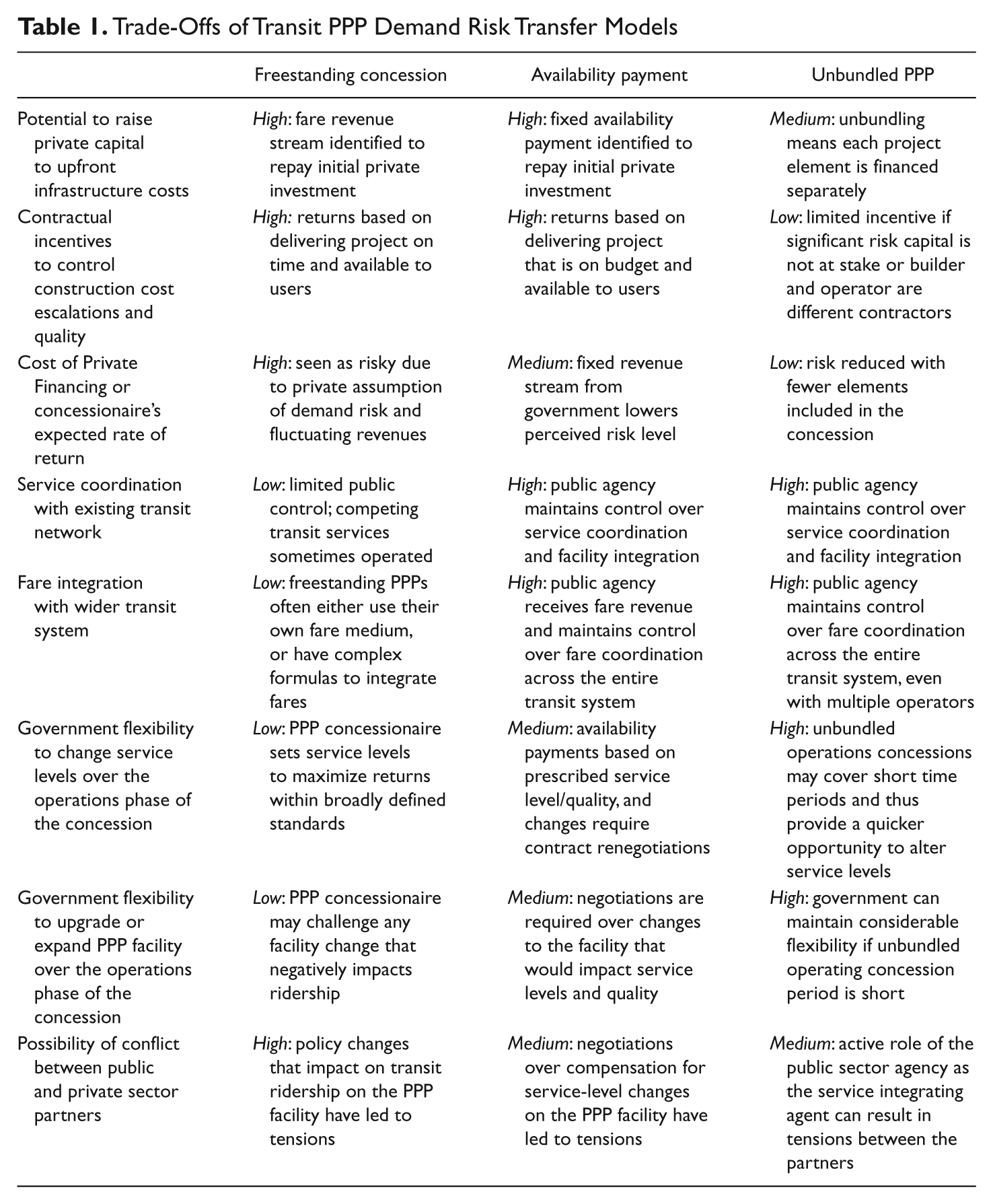
To date, the international experience shows that classic stand-alone PPPs that compensate the private sector entirely through the fare box have a poor record in the transit sector. Indeed, transit projects have particular characteristics that challenge the viability of transferring demand risk entirely to the private sector. Transit projects rarely recover all of their capital and operating costs through the fare box and thus typically require government subsidies; and the operator of a single rapid transit line is often ill-equipped to manage the full range of factors that affect system ridership, including service and fare coordination across the transit network and land use policy.
In response to the shortcomings of transferring traffic volume risk on transit projects, recent PPPs have used innovative models to share risk between the partners. At one end of the spectrum, PPPs with availability payments have sought to continue the use of bundled PPPs that involve significant initial private sector capital investment, while developing a mechanism for the government partner to assume most or all of the ridership demand risk. At the other end of the spectrum, contracts for facility operation can be tendered separately through unbundled concessions, where the operator has far less of an equity stake in the project, and traffic volume risk is shared through contract rebalancing around minimum and maximum ridership guarantees. The advent of these innovative project delivery models has been important in reinvigorating interest in using PPPs in the urban transit sector.
Other emerging PPP models to share demand risk that have been used predominantly for road projects may also have applicability to the transit sector. Of particular interest are duration-adjusted contracts where the length of the concession period varies until the concessionaire recoups a predetermined level of revenue. The concession term is lengthened when demand is lower than expected and shortened when demand is higher than expected, thereby providing a mechanism to share demand risk between the partners (Albalate & Bel, 2008; De Rus & Nombela, 2004; Engel, Fischer, & Galetovic, 2001; Geddes, 2010; NCHRP Synthesis, 2009). Despite innovations in the approaches to allocate demand risk, the unique context and circumstances surrounding each rapid transit project means that there is not a single optimal model of allocating traffic volume risk.
In determining the appropriate contract structure to share demand risk between the partners, transit project planners should focus on four key questions. First, how does the allocation of ridership demand risk within the PPP impact on the cost of borrowing capital for the project? Second, do the terms of the PPP contract limit the integration of the rapid transit project into the wider urban transit network and built form? Third, in what ways do the terms of the PPP structure impinge on the flexibility of governments to change fares, reorganize adjacent transit service, or expand the rapid transit network in the future? Fourth, are the incentives and penalties built into the PPP contract significant enough to encourage ongoing quality performance by the concessionaire, and how will these activities be monitored and enforced? Clearly, governments should favor PPP structures that promote low cost borrowing, service coordination, and flexibility, while ensuring strong incentives are in place to drive quality performance by the private sector concessionaire. In a context of incomplete contracts and competing interests among the partners, however, structuring a PPP deal to achieve these objectives is easier said than done.
Footnotes
Declaration of Conflicting Interests
The authors declared no potential conflicts of interest with respect to the research, authorship, and/or publication of this article.
Funding
The authors disclosed receipt of the following financial support for the research, authorship, and/or publication of this article: This research was supported by a grant that Matti Siemiatycki holds to study infrastructure public-private partnerships from the independent Social Sciences and Humanities Research Council of Canada (Grant No. 410-2010-0768).