






Abstract
Intelligent Transportation System (ITS) often includes technologically sophisticated devices, computer hardware and software, and communications infrastructure; for which traditional asset management tools are not always appropriate. In challenging economic times, it is essential that public agencies manage their ITS systemsmore efficiently, yet ITS asset management is new to many. There is a need to review different asset management systems for their ability to support the ITS needs of public transportation agencies. The primary contribution of this paperis establishing a method for making this comparison andidentifying measures of effectiveness to use for evaluating such systems. Thesemeasuresof effectiveness were identified through a nationwide survey of public transportation agencies and the method was demonstrated through a case study in South Carolina.
The performance of modern transportation systems are frequently enhanced by applying Intelligent Transportation System (ITS). These ITS tools help improve reliability in travel times, safety, and reduce environmental impacts (Chowdhury & Sadek, 2003). Because system upgrades and expansion is an inevitability of such systems, large regional ITS infrastructure requires the proper management and integration among the subsystems, to maintain cost-effective and efficient performance. Otherwise, the quality of the ITS system might be substantially degraded, raising operating costs and lowing public benefits. ITS asset management can help system managers and operations engineers at state departments of transportation (DOTs) and other transportation agencies to expand and rearrange their ITS system’s while maintaining performance at desired levels, all the while minimizing operational costs.
Although the expansion of ITS infrastructure has demonstrated the need to manage these assets, ITS asset management differs from traditional asset management applications in its features and characteristics, specifically with the inclusion of electronic devices and communication systems. Traditional transportation asset management includes assets such as highways, pavements, bridges, and so forth and these management systems are not capable of managing the diverse and technologically focused assets that support most ITS systems; therefore, there is a need for a customized asset management system that can serve ITS operations and maintenance and can be integrated with other asset management systems (Small & Swisher, 2000), particularly those currently used for road and bridge assets. Many transportation agencies have been proactive in identifying or adopting an effective asset management system that will accommodate existing infrastructure and manage their planned ITS infrastructure expansion.
The focus of this article is to present a method for transportation agencies to select an ITS asset management system. For transportation managers approaching ITS asset management for the first time, this article presents which criteria are important. Next, this article offers a relative ranking of the importance of these criteria from a survey of DOTs in the United States. The authors then illustrate the entire method with a case study for the South Carolina Department of Transportation. The findings presented in this article will be valuable to engineers and resource managers at transportation agencies that are considering better management of their ITS assets.
Related Work
Asset management for ITS is still a new concept in the transportation industry. Within a short time, ITS has played a significant role in the improvement of the overall performance of transportation operations with higher efficiency and safety. Due to the dynamic nature of ITS and the variety of system components, asset management for ITS is gaining importance and attention from public agencies. Despite this fact, few studies have been conducted addressing ITS asset management systems.
Most notably, the Florida Department of Transportation (FDOT), evaluated three ITS customized systems supporting asset management for ITS including OSPInSight (Advanced Fiber Optic Inc., 2009), FiberTrak (Precision Contracting Services Deploys Bentley’s Communications Projects, 2011) and Fiber management tool for ITS (FMT-ITS). Subsequently, FMT-ITS was renamed as NexusWorx (Byers Engineering Company, 2010). The study used an evaluation team from the local ITS Working Group to rate several commercial off-the-shelf asset management software based on (a) system architecture, (b) system administration, (c) remote access, (d) user requirements, and (e) reporting capabilities. The findings from this utility analysis indicated that although the three software programs were rated similarly, the first two categories (system architecture and administration) differentiated them the most significantly. Overall, this study determined that the NexusWorx fiber management tool for intelligent transportation systems (FMT-ITS) would best serve their need for managing the ITS features for FDOT. This software was found to have more capabilities than the other two applications to support ITS asset management (FDOT, 2006).
Although an ITS customized asset management system was most appropriate for FDOT, several other options exist for transportation agencies to manage their ITS assets. For example, enterprise-based GIS systems and general data management systems such as Microsoft Access are available and possible already used for managing other transportation assets. Enterprise-based GIS, with some plug-ins to support ITS asset management, could be a viable alternative to customized ITS asset management systems as many agencies already have deployed enterprise-based GIS tools for managing other infrastructure assets. Microsoft Access, or similar, could serve as a data management system when only data inventory is of sole interest. Although other research has compared types of asset management software (Halfawy, Newton, & Vanier, 2009), their emphasis was on municipal infrastructure and not specifically on either transportation or ITS.
Other work has focused on asset management of traffic operations systems such as traffic signals, finding “the importance of taking a broader view of asset management techniques to reflect electronic system components rather than physical infrastructure elements such as those constituting pavements and bridges (Markow, 2008).” This study concluded that agencies will need to combine their knowledge to identify best courses for managing such transportation assets. Although previous work has identified that traffic monitoring systems (Larson & Skrypczuk, 2004), 511 and other ITS tools (Cambridge Systematics, PB Consult, & Texas Transportation Institute, 2006; Federal Highway Administration [FHWA], 2010; Skolnik et al., 2009) are appropriate for asset management tools, no particular emphasis was placed on the uniqueness of managing these technological assets. Additionally, it is noteworthy that asset management focus is currently broadening to include some geotechnical transportation assets such as rockfall protection (Stanley, 2012).
The transportation system is complex and has various functional divisions to fulfill the need for travel. As the system continues to grow, the components became so numerous that an appropriate management system becomes essential. The system requires very different divisions between the various assets because they all need different approaches for management. Over time, asset management systems have been developed for each type of asset, including pavements, bridges, and roads. Because of the diversity of these transportation assets, some have investigated outsourcing the asset management to private companies (FHWA, 2009). Many methodologies have evolved for proper management of these various assets as well as the integration between management systems; however, ITS is unique due to its variety of components and the technology-focus, which makes asset management for ITS even more critical. Also, with a number of categories of ITS asset management systems available, it is difficult to select the right one and the decision making becomes even more challenging with requirements that are more qualitative than quantitative. Asset management is a clear requirement for expanding ITS systems. Selecting an appropriate asset management system that satisfies users’ requirements is challenging because it is unclear how transportation agencies value these different user requirements. Thus an evaluation of available ITS asset management systems that includes the values perceived by DOT transportation engineers would facilitate the adoption of appropriate tools by public agencies. Multicriteria decision analysis has the potential to identify more appropriate tools by providing the flexibility to consider quantifiable as well as nonquantifiable requirements.
Method of Evaluating ITS Asset Management Systems
The requirements for an ITS asset management system were identified from a thorough review of previous work including American Association of State Highway and Transportation Officials (AASHTO; 2001), Gao and Zhang (2008), FDOT (2006), Hall, Robinson, and Paulis (2005), Larson and Skrypczuk (2004), Small and Swisher (2000), and Gharaibeh, Darter, and Uzarski (1999). After the project team reviewed the available literature and developed the foundation of approaching ITS asset management requirements, officials from the South Carolina Department of Transportation (SCDOT) were interviewed including traffic operations engineers and management center operators. These engineers and operators also provided the research team with thorough review of the ITS assets that could be managed and what assets could include in the future. This information led the research team to select measures of effectiveness (MOEs) for evaluating ITS asset management systems and classify them into two groups. Figure 1 shows these groups and how each was broken down based on information from the literature and interviews.

Measures of effectiveness for ITS asset management.
Currently, three categories of asset management tools are available to agencies operating ITS systems. These include (a) ITS customized systems, (b) enterprise-based GIS systems, and (c) typical database management software. ITS customized systems are typically those systems that are specially designed to address ITS components whereas enterprise-based GIS systems are basic GIS systems with enterprise capability. GIS-based systems can be modified according to the need to address ITS components and integrate with other transportation assets such as pavements and bridge structures. Typical database systems such as Microsoft access, excel, and so forth, have been traditionally used to keep record of these assets. Furthermore, within each category, there are multiple software and service vendors that offer such products. To assist state DOTs and other transportation agencies with their selection of appropriate ITS asset management tools, the authors present a method for evaluating these three categories of tools to identify the most appropriate one for a particular transportation agency.
Important characteristics of ITS asset management systems include visualization capability, data management ability, user interface quality, remote access ability, enterprise capability, and training required. The following paragraphs will describe the importance of each of these characteristics.
The ability to display assets graphically, also known as visualization, is one of the most important factors for ITS asset management. It plays an important role in decision making through visual observation and interpretation of a scenario, particularly for those more familiar with asset management of more traditional and visible infrastructure. The visualization capability could include map viewing, visual representation of spatial queries, visualization of fiber optic cable locations and connectivity, customization for enhanced ITS visualization, and wireless network visualization.
Data management is also an important issue to ITS asset management, particularly the ability to allow a single administrator control. The capability of having a single administrator who validates all of the updates made by field personnel before they become final might also be important if there is a concern that database changes from field users or technicians might not be always correct. Therefore, an administrator can be responsible for validating the updates before they become permanent. Additionally, researchers evaluated the need of transportation agencies to recover and retrieve data to protect against system failures of the data storage components.
It is important for the user interface of an asset management system to be easy to use. This ease of software use, or user-friendliness, can be measured as how efficiently users could manage ITS assets assuming proficiency with the asset management tool. Because customization is also important to manage the diverse ITS systems deployed throughout the United States and the world, customization was also considered in user-friendliness. In particular, user friendliness is important when importing data files from other software in different formats such as shape files and/or as-built drawings from AutoCAD/Micro Station, without having to reformat the database. Each system should be judged based on their capability to import and support different types of files that are common to either transportation engineering or information technology.
The ability for remote or web-based access is critical due to the amount of field reporting that must be entered into any asset management system. A web-based asset management system will be most effective, as it will allow instantaneous access to the database. It will also allow immediate updates of the database and reduce the need for redundant paperwork. ITS facilities require an asset management system that will compile information regarding the entire network’s assets. This compiling will help in managing the assets, maintaining and operating the system, and will support decision making about expansion and rearrangement.
Another possible requirement for the asset management tool is its capability for deployment in the enterprise-wide environment. Enterprise capability allows the support of multiple users at the same time and allows simultaneous access to the database that is saved in a central location. Most agencies need this flexibility for their system as they often need concurrent access to the same database for planning and decision-making purposes. Lastly, because software training can be time-consuming and costly to agencies, the amount of training required is also a significant factor. Careful consideration should be given to how much training is required for database and field personnel, when selecting the appropriate ITS asset management tool for any agency.
Researchers created, conducted, and received survey responses from the Virginia, Tennessee, Minnesota, North Carolina, South Carolina, and Wisconsin DOTs. Several personnel from different sections of these DOTs have participated in the survey. These DOTs were chosen because they represent a range of ITS deployment levels, ranging from those that currently require asset management tools to those considering ITS asset management in the near future. The authors consider this sample representative of states that would find value in the findings of the study, as shown in Figures 2-4.

ITS asset management survey.

ITS asset management survey.

ITS asset management survey.
The surveys asked DOTs to rate the importance of MOEs on a scale from 1 to 10, where 10 was the most important. The survey had two sections, system capability and cost. The respondents were asked to rate the relative importance of these items to their agency, as they relate to asset management purposes. Although previous literature had identified all of the 15 capabilities as important, the survey sought to differentiate them further. The survey asked respondents to rank the importance of each of these 15 capabilities and also asked for relative importance between capabilities and cost.
Based on the survey responses, the researchers computed utilities for each MOE for two different scenarios. In one scenario, only system capabilities of the selected ITS asset management system were included, neglecting asset management system cost. The researchers also evaluated a second scenario where the cost of the license, operation and maintenance of selected ITS asset management systems was included. The utility related to these factors were also calibrated so they too, added to one. Note that these utilities can be used for multiple forms of optimization analyses and the values represent how important each characteristic was to survey respondents, where a higher value indicated more importance.
Although the utilities identified from the survey can be used to evaluate ITS asset management systems using different optimization methods, the researchers chose a multiattribute utility analysis for the case study. This method was ideal because it provided simple but valid comparison between the three systems where not all requirements could be easily quantified. To apply this method, the research team conducted an evaluation workshop with experts in and users of asset management systems, intelligent transportation systems, and geographical information systems. These experts were selected from South Carolina DOT and Clemson University and reviewed the capabilities of an example ITS customized system (NexusWorx), an enterprise-based GIS system, and a typical database management software. For each MOE, participants at the workshop were asked to rate each system either 0 (does not have the capability), 1 (has the capability but not very good), 2 (satisfactory), 3 (good), 4 (very good), or 5 (excellent capabilities).
Because the cost of the systems did not directly lend themselves for inclusion into a multiattribute utility analysis, the research team took a linear approach to assigning ranking numbers. Table 1 shows the annual costs of ITS asset management systems in 2009 US dollars, including licensing, fees, maintenance, and 20 users for 5 years. Although these rankings were specific to the case study conducted in South Carolina, similar ranges are likely appropriate for other states in the United States.
Cost and Relative Ratings.

After the data was collected from the evaluation team, utilities were calculated using Equation 1 (without considering costs) and Equation 2 (including costs), where performance rating is abbreviated PR.
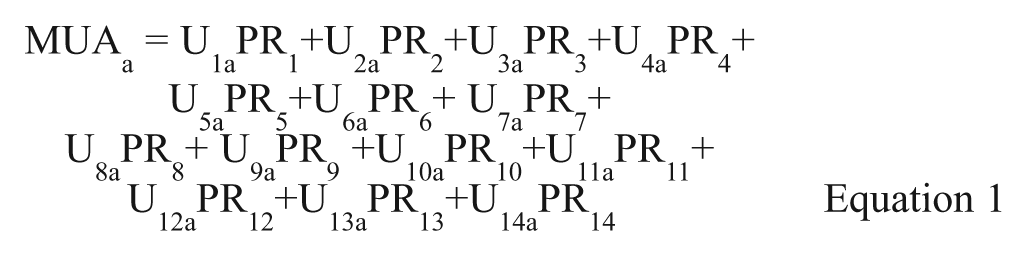
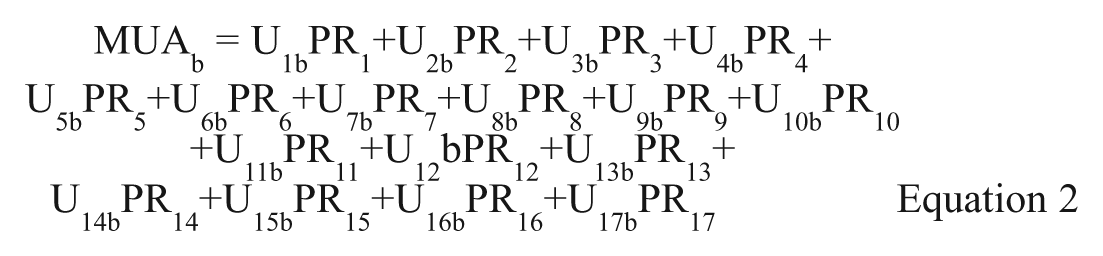
The following defines the performance rating variables in Equations 1 and 2.
PR1 = Visualization Quality of Map Viewing Capability;
PR2 = Visualization Quality of Spatial Query;
PR3 = Visualization Quality of fiber trace and connectivity of the fibers;
PR4 = Visualization Quality of Customized ITS Symbology Quality for Enhanced Visualization;
PR5 = Visualization Quality of Wireless Network Depiction;
PR6 = Quality of Data Recovery and Retrieval System;
PR7 = Quality of Single Administrator Control;
PR8 = Quality of Ease of Use of the Software;
PR9 = Quality of Customized Import Functionality (straight out of the box);
PR10 = Quality of Customized Import Functionality (supporting user specific customization);
PR11 = Capability to Support the Web-Based Application;
PR12 = Capability to Support Field Updates/Usage;
PR13 = Capability to Restrict Data Access;
PR14 = Capability to Support Enterprise Environment;
PR15 = Capability to Minimize the Cost of Personnel;
PR16= Capability to Minimize the Cost of Software;
PR17= Capability to Minimize the Cost of Operation and Maintenance;
MUA = Total Multiple Rating Utility of Alternative “A”;
Ui = Utility of the utility corresponding to the performance rating (see Table 2).
Utilities for the MOEs.

Straight out of the box. bSupporting user specific customization.
Based on the utilities generated, where a higher utility indicates a more-preferable alternative, information can be drawn to support decision makers in their selection to manage ITS assets within a state or agency.
Findings and Discussion
This section presents the findings from the survey of state DOTs, suggesting utilities that can be used when evaluating asset management systems for U.S. transportation agencies. Next, the authors detail the ratings of experts at the evaluation workshop and present the findings of the South Carolina case study.
Findings from the survey indicate that cost is a significant factor when considering the optimum tool for ITS asset management. The ability for users to customize such software tools and the ability to visualize wireless networks were rated the lowest value to transportation agencies. The utilities for the scenario where no cost was considered and the scenario including cost are presented in Table 2. The point to be noted here is that although all the MOEs are desired by particular agencies, some are more desirable than others, as depicted by the survey. The agencies considered the ability to customize software tools or having a wireless visualization capability is less important than compared to the ability to make the system web based, which was rated highest among all other MOEs. The ratings of the MOEs are relative to each other, the higher the rating the MOE is, the more desired an ITS asset management tool is among the agencies.
The authors applied Fisher’s Least Significant Difference procedure to identify if survey respondents perceived any MOEs significantly more important than the rest. The results did not show any significant difference between the utility ratings of the different MOEs, confirming that it is important to include all of these MOEs in any future analysis comparing ITS asset management tools. To validate these findings, the authors inspected the residuals of the data set, finding no significant systematic errors, as shown in Figure 5.

Residuals plot.
Data from the evaluation workshop provided strong evidence that standard database software does not have the capabilities required to manage the assets included in South Carolina ITS systems. The relative ratings suggested that ITS customized systems and enterprise-based GIS systems were similar in their performance, as shown in Table 3.
Relative Ratings for User Friendliness and ITS Suitability.

Straight out of the box. bSupporting user specific customization.
Due to the unique nature of the cost element, the ratings of these MOEs are shown separately. The primary difference was that ITS customized systems could be either hosted by the vendor or set up on a transportation agency’s computer servers. On the contrary, an enterprise-based GIS system would normally be installed on an agency’s computers/servers. Both alternatives could be installed new or added onto an existing enterprise-based asset management system. These findings are presented in Table 4.
Relative Rating for Costs of Alternative Software.

Combining the performance ratings and the utilities via Equations 1 and 2 provides information that can support the selection of a particular category (not brand) of asset management system. The utility ratings found are displayed in Figure 6, where a higher rating indicates a better choice. When neglecting cost, enterprise-based GIS was a better option; however, when considering cost, ITS customized system was slightly preferable.

Summary of multiattribute utility analysis findings.
When selecting an alternative between such similar choices, consideration of existing asset management tools and practices in the transportation agency is required. For example, does an agency already use enterprise-based GIS to manage pavements, bridges, or other assets? Although there is no significant cost saving toward adding onto an existing asset management system, employee training can be considerably reduced.
Conclusions and Recommendations
The researchers presented a method for transportation agencies to evaluate asset management systems for ITS assets. Results from a survey of state transportation agencies guided the researchers to develop utilities that represent the importance of primary measures of effectiveness for ITS asset management tools. These ratings can be used by any transportation agency with a variety of optimization methods for selecting appropriate ITS asset management tools for their specific agencies.
To demonstrate the use of these utilities and the method, the authors presented a case study evaluating three asset management platforms for the South Carolina Department of Transportation using a multiattribute utility analysis. The findings indicated that standard database software lack the capabilities to manage standard ITS assets. In addition, enterprise-based and ITS customized platforms were found to be similarly capable. The study results suggested that if an agency already operated enterprise-based GIS to manage other assets, the best option would be to extend its use for ITS applications rather than implementing new software; however, because this transition may take time, ITS customized platforms may be a feasible option if a transportation agency would like to implement a system in the short term. Future work might investigate the return on investment for employing ITS asset management systems and report best practices during the implementation of such tools.
Footnotes
Declaration of Conflicting Interests
The author(s) declared no potential conflicts of interest with respect to the research, authorship, and/or publication of this article.
Funding
The author(s) disclosed receipt of the following financial support for the research, authorship, and/or publication of this article: The authors would like to thank the South Carolina Department of Transportation for funding this study. Additional thanks is due to those individuals who participated in the expert panel evaluating the three software platforms.