







Abstract
Water services, that is, water supply and wastewater disposal, are traditionally the responsibility of local governments. Many municipalities have joined forces to meet the challenges of increasing water quality requirements, aging infrastructures, and decreasing fiscal resources. Regional cooperation is claimed to generate benefits in various ways, but there are challenges to this assumption. This article assesses the benefits and challenges of regional cooperation through the following categories: economies of scale, socioeconomic and spatial disparities, autonomy and legitimacy, by comparing Finnish experiences with previous research findings. Our assessment concludes that the benefits and challenges of regional cooperation are not straightforward, not only dependent on the local context but also on the level and tradition of cooperation, especially on the degree of organizational autonomy.
Introduction
Water can be seen as a natural element for enhancing regionalization processes as it crosses jurisdictional boundaries all over the world. Indeed, regional context plays a central role in the water governance of Western Europe (Fürst, 2007). Regional governance involves various characteristics including horizontal coordination of various actors; cooperation between governmental, municipal, and private organizations; as well as multi-level features, which means that in addition to organizational policies, local, regional, and national policies need to be considered (Benz, 2001). Furthermore, horizontal, network-based decision-making structures have replaced hierarchical and vertical model of government (Benz & Papadopoulos, 2006; Michels & Meijer, 2008).
A practical example of regional collaboration 1 is a joint organization established by two or more local authorities in geographic proximity to enhance a single local government function. Typically, horizontal character of regional collaboration leads to a high degree of organizational autonomy, which means that a joint organization is no longer embedded within the public administration (Lieberherr, 2016). However, regional cooperation is not limited to joint organizations, it can also be a joint effort undertaken by many independently owned public utilities (American Water Works Association [AWWA], 1981). Thus, it is notable that the organizational autonomy within regional collaboration varies: The lowest degree of autonomy occurs when public authorities offer services to each other through bilateral contracts (Kurki, 2010), whereas the highest degree of autonomy is gained through a joint organization operating under private law (Lieberherr, 2016). Our study analyzes inter-municipal water services as one manifestation of regionalization.
In the Western world, organizing water supply and wastewater disposal is traditionally a responsibility of local governments (Pietilä, 2006). However, during the last few decades, some municipalities have faced increasing challenges in fulfilling this duty. Major challenges are institutional fragmentation (OECD, 2011) and several changes in the operating environment of water services: augmented statutory requirements in drinking water quality as well as in the quality of wastewater discharged to water bodies, expectations of more profound risk management, and of more enhanced communications to consumers and decision makers. Furthermore, aging infrastructure increases economic pressures all over the world; old drinking water and wastewater networks in particular require renovation (Hukka & Katko, 2015). In addition, many experienced workers are about to be retired during the next few years, which raises the fear of losing tacit knowledge concerning water services. Consequently, these challenges and limited capacity at the local level to address them have furthered collaboration between single municipalities.
Inter-municipal cooperation in water services occurs in several European countries, as well as in the United States, Middle East, and North Africa. Yet, the subject has generated research only to a limited extent, drawing on case studies of inter-municipal collaboration in urban wastewater treatment (Hophmayer-Tokich & Kliot, 2008; Lieberherr, 2011, 2016) and water supply (Schmidt, 2014; Stenroos & Katko, 2011), as well as regionalization of community water systems in rural areas (Hansen, 2011). In addition, some nationwide analyses have been conducted on the regionalization of the water and wastewater sector (Frone, 2008; Grigg, 1996; Mullin, 2009; Okun, 1977; Raucher et al., 2006).
Previous research emphasizes the benefits gained from inter-municipal collaboration in addressing problems that extend beyond the municipal boundaries. For example, Schmidt (2014) argues that regional approaches should be systematically established and developed to enhance the sustainable development of urban water management. Furthermore, Grigg (1996) considers regional cooperation, with its several advantages, the most powerful tool that water managers can use. This is also recognized by the AWWA (2015), which highlights the benefits gained from regional cooperation: knowledge sharing, increasing efficiency, minimizing capital expenditure, and enhancing source protection. These benefits are commonly recognized; however, the researchers do acknowledge some disadvantages as well.
In assessing benefits and challenges of inter-municipal cooperation, this article compares Finnish experiences with previous research in water sector through an analytical framework, which includes three categories: economies of scale, socioeconomic and spatial disparities, and autonomy and legitimacy. However, most of the existing research concern the performance of regional cooperation based on single or multiple case studies without recognizing that collaboration actually occurs at various levels. The degree of organizational autonomy especially affects the performance of a particular cooperation model. Therefore, our nationwide analysis aims at contributing to the knowledge base for this particular subject by exploring the following research questions:
This study is organized as follows: The material and methods used in this study is described in the next section, and the analytical framework is introduced in section “Analytical Framework.” The section titled “Background of Inter-Municipal Water Services in Finland” introduces the background, and the section “Three Levels of Inter-Municipal Collaboration” discusses the levels of regional water services cooperation in Finland. Section “Analyzing Benefits and Challenges of Regional Collaboration” outlines the benefits and challenges of regional water cooperation in the Finnish context, and compares the findings with international experiences. This assessment indicates that neither benefits nor challenges invariably occur but are strongly dependent on the context as well as the level of cooperation. The section titled “Concluding Remarks” discusses the results and suggests that in the future, not only the contextual influence but also the various levels of cooperation within the nation in question should be recognized as an important part of the evaluation of inter-municipal cooperation in the water sector.
Research Design
The material for this article was obtained from research conducted during the years 2008 to 2015. Three separate studies were carried out, from which Study 1 had the major relevance to this article, whereas Studies 2 and 3 offered complementary material:
Study 1: Research on the inter-municipal collaboration in the Finnish water sector.
Study 2: Research on the bilateral collaboration in water services in Finland.
Study 3: Two case studies on contentious inter-municipal groundwater projects.
Details on the individual surveys are shown in Table 1.
Material Collected During the Three Studies.
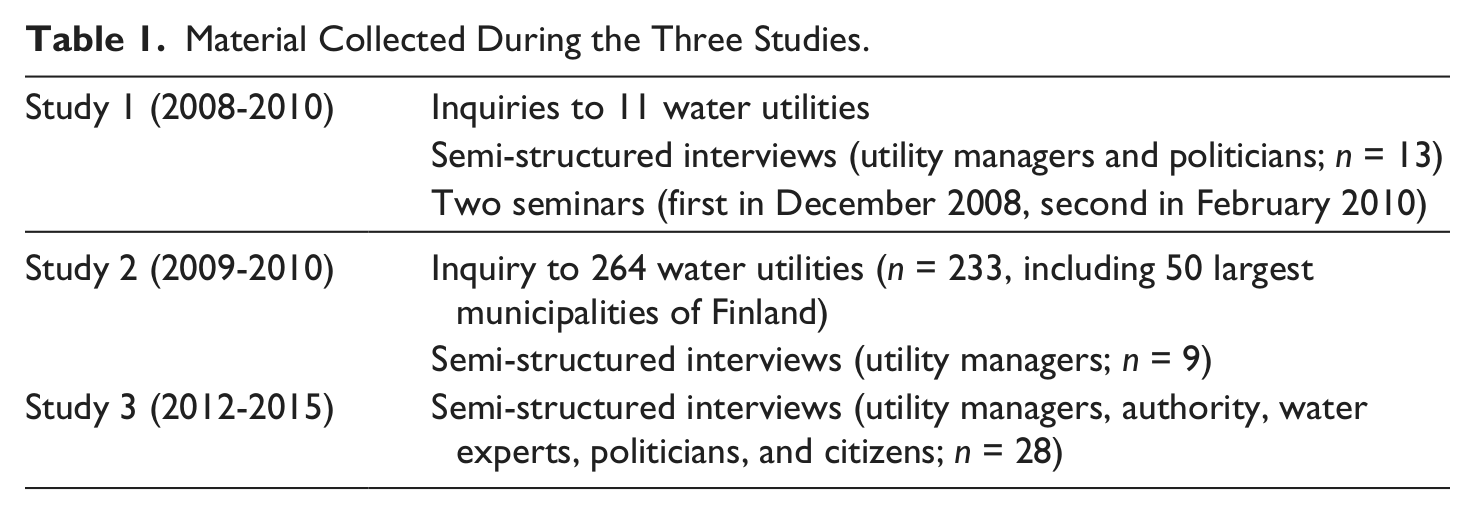
The first study explored the inter-municipal cooperation in the Finnish water sector; particularly, cases where two or more municipalities had established a joint organization, either a company or a federation of municipalities. Empirical data were gathered from water utilities by inquiries and interviews. Ten cases representing various kinds of cooperation between municipalities were chosen for closer examination. The focus was on their experiences with different cooperation models, including possible constraints and opportunities. The information collected was complemented by two seminars which convened water experts from various organizations including water utilities, regional water companies, the Environmental Center of Tampere Region, the Association of Finnish Local and Regional Authorities, and the Finnish Water Utilities Association. The purpose of the seminars was to gain a deeper understanding of the reasons why joint organizations were established, what is critical to a well-functioning organization, and what is needed for successful collaboration in the future. (See Pietilä, Katko, & Kurki, 2010 for more on the research approach and results).
The second study provided complementary insights for this article about bilateral collaboration in water sector. It collected quantitative data on the extent of bilateral, agreement-based collaboration. An inquiry was sent to 264 utilities of which 233 responded (88%). In addition, nine semi-structured interviews were conducted to gather qualitative data about operational experiences and future cooperative plans. The qualitative data were analyzed through a strength, weaknesses, opportunities, and threats (SWOT) analysis. (See Kurki, Katko, & Pietilä, 2010 for more on the research approach and results).
Whereas the first two studies were nationwide analyses, the ongoing 2 third study is a case study that analyzes two contentious inter-municipal groundwater projects with an emphasis on water conflicts. Accordingly, the actual focus of the study is not on the regional water cooperation as such; thus, it is used only as a complementary material for this article. However, the interviews revealed interesting aspects about the operation of wholesale companies, the most used organization model in regional water services in Finland. Altogether, the interviewees included utility managers, water experts, authorities, politicians, citizens, and representatives of an environmental non-governmental organization (NGO).
This study followed a dialogical process where material collection and theoretical observations overlap. Our analysis is based on the analytical framework, which enabled us to assess benefits and challenges of inter-municipal cooperation in water sector in Finland, as well as to compare our findings with the case studies from other countries. It is established on the basis of the academic literature of regional governance as well as case studies from the water sector in Finland and other countries such as the United States, Sweden, Israel, Germany, and Switzerland. First two case countries were observed through literature review as well as personal communications. In addition, material was collected during a professional visit in 2008 to the United States. Other cases were observed solely based on the literature.
Analytical Framework
To assess the regional cooperation in water services, we established an analytical framework for analyzing benefits and challenges of inter-municipal cooperation. It includes three categories: (a) economies of scale, (b) socioeconomic and spatial differences, and (c) autonomy and legitimacy.
Economies of scale refer to the idea that the production costs per unit are lower as the volume of production increases. In addition to product-specific approach, overall economies of scale are recognized in association with increases in all organization’s outputs (J. A. Clark, 1988), such as knowledge sharing, complementary resources and capabilities, and more effective governance (Dyer & Singh, 1998). Economies of scale are recognized in several fields, especially in industries, such as electricity (Christensen & Greene, 1976), machinery, and high-tech industries (Henderson, 2003), as well as in banking (Adams, Bauer, & Sickles, 2004) and education (Cohn, Rhine, & Santos, 1989).
In terms of regional cooperation, economies of scale occur when small public organizations are merged into larger, inter-municipal units. This may bring economies of scale in capital facilities and operational costs (Frone, 2008; Grigg, 1996), which usually means efficient use of limited financial resources when high-cost advanced systems can be constructed with a lower per capita cost (Hophmayer-Tokich & Kliot, 2008). However, the economies of scale do not increase endlessly while the size of organization grows. The optimal size of an organization is hard to determine, because specific circumstances vary with each case and have an influence on the relative efficiency (Frone, 2008).
Closely related to the economies of scale, regional collaboration may enhance uniform regional development even more in terms of balancing socioeconomic and spatial differences between municipalities. This refers, for example, to differences in the geographical situation, fiscal strength, and sufficiency of professional capacity for performing public services. In general, small municipalities benefit from the fiscal and human resources capacity of larger municipalities (e.g., Hophmayer-Tokich & Kliot, 2008); however, in terms of common pool resources, such as water, in many cases city centers benefit from the resources obtained from surrounding municipalities.
The third category analyzes the organizational autonomy and related legitimacy. Autonomization is related to the horizontalization of government where vertical government structures are gradually replaced by horizontal ones. In meso-level, this means that the government bodies are no longer central actors but rather partners with NGOs and private enterprises (Michels & Meijer, 2008). Thus, many public organizations are no longer embedded within administrative bodies, and they have a higher degree of organizational autonomy: Political decision making is separated from operational and management decisions (Lieberherr, 2016).
In this context, legitimacy can be defined as something that converts power into authority: Those who have the decision-making power are expected to follow the pre-established norms (Schmitter, 2001). However, problems of legitimacy occur when political sphere has no longer influence on the decision-making process (Benz, 2001). Strong autonomization generally weakens democratic structures: As the degree of autonomy increases, the transparency of decision making decreases, as the public sphere has less opportunity for control. Thus, the question of legitimacy is closely related to the organizational autonomy (Lieberherr, 2011, 2016).
Background of Inter-Municipal Water Services in Finland
According to Finnish legislation, municipalities are in charge of arranging water services, but they are free to decide how these services are actually provided (Katko & Hukka, 2015). Municipalities can provide the services as a section within technical services, as an independent water department, as a municipal water utility or company, or jointly with other municipalities in different organizational forms. In addition, water services can be provided by cooperatives owned by the water users.
Finland is a rather sparsely populated country with its five and a half million inhabitants occupying more than 300,000 km 2 . Furthermore, the country has abundant water resources with more than 180,000 lakes as well as groundwater, mainly in alluvial eskers. However, settlement is concentrated in the coastal areas of southern and western Finland where geological conditions contribute to water quantity and quality problems that are more serious than elsewhere in Finland. In these parts of the country, only a few large groundwater areas exist, and the surface water consists mainly of river water that is of low quality due to acid sulfate soils which (Figure 1), together with human activities such as agriculture and draining, impose high loads of acidity, metals, humus, and suspended matter (Edén, Weppling, & Jokela, 1999).
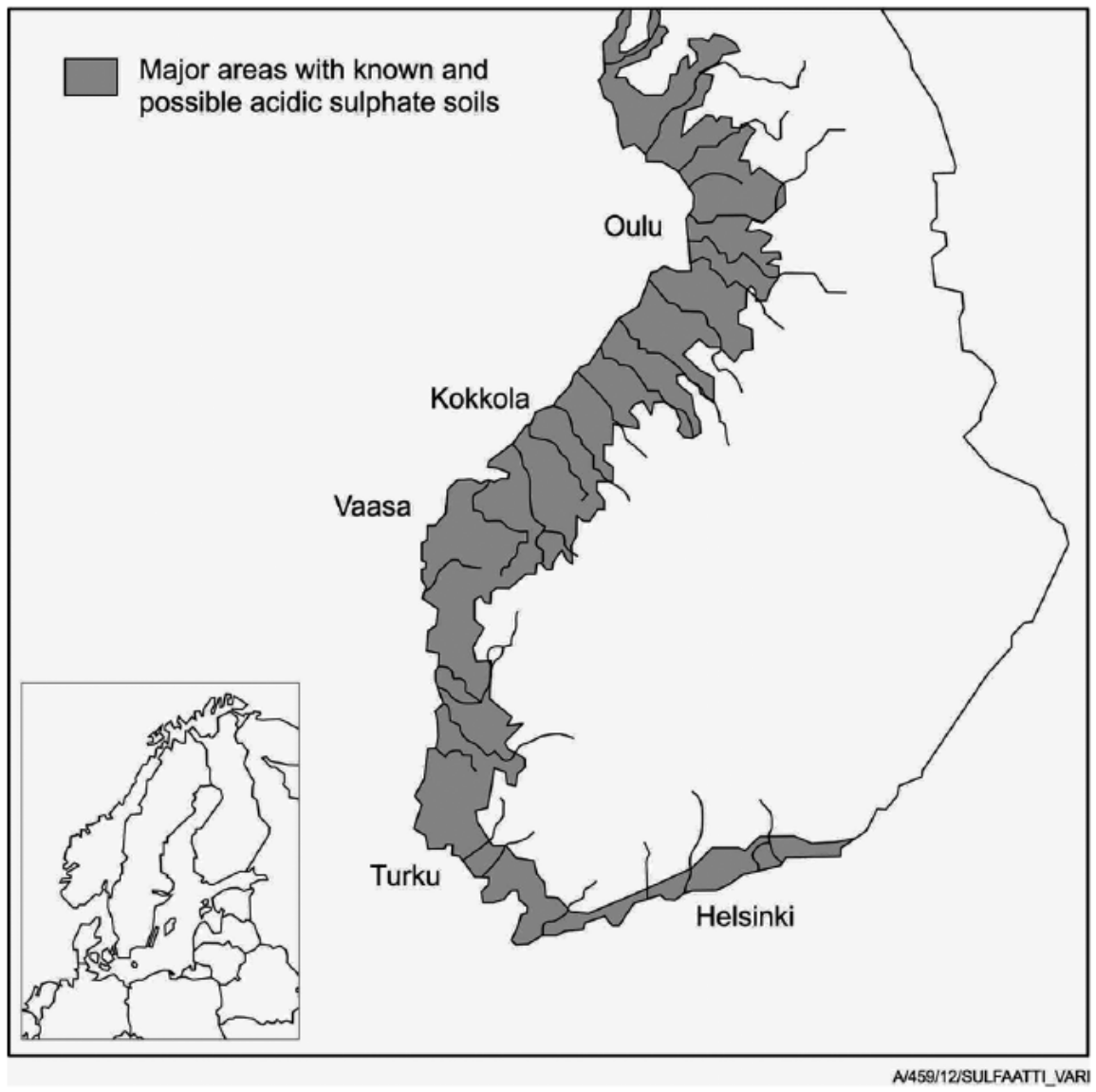
Deposits of acid sulfate soils in Finland, formed during the Litorina stage of the Baltic Sea about 7500-1500 BC.
Consequently, to gain adequate fresh water resources, inter-municipal cooperation concerning water supply started to develop in the coastal areas as early as in the 1950s. Currently, most of joint organizations are located in those areas (Figure 2). For example, the two largest coastal regions, 3 the Helsinki metropolitan area and the Turku Region, currently receive their drinking water from inland water sources through a 120-kilometer-long tunnel and a 70-kilometer-long water transfer pipeline, respectively.
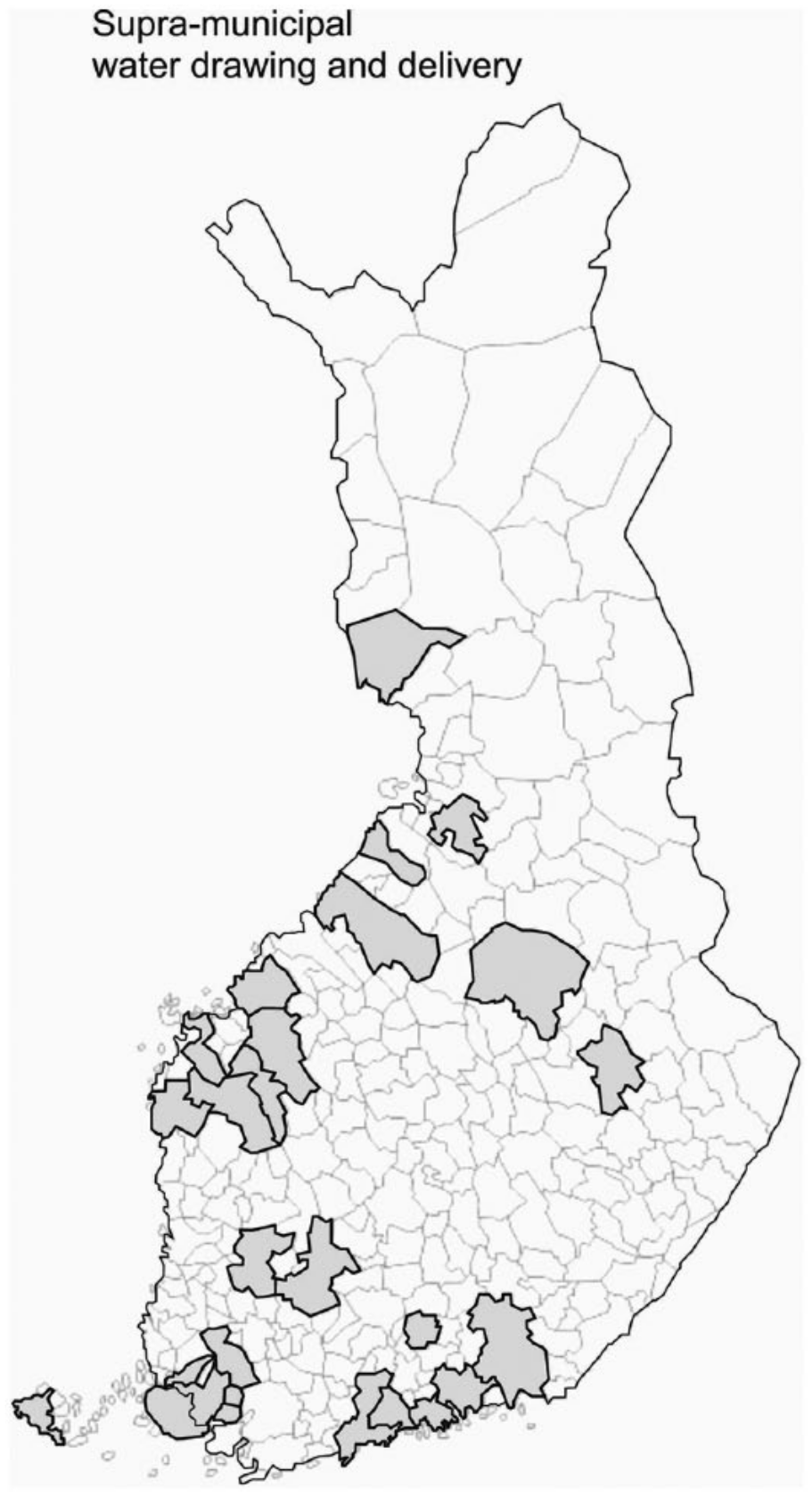
Locations of joint organizations for regional water drawing and delivery.
In terms of wastewater treatment, although the first regional wastewater company was established as early as in 1961, the process of centralization emerged much later. This can be observed from the number of urban wastewater treatment plants, which gradually increased up to the 1990s: Local needs were satisfied with local solutions. However, economics and stricter quality requirements for treated wastewater justified larger, more centralized systems, and the total number of wastewater treatment plants started to decrease. For example, the City of Helsinki, the capital of Finland, had 11 wastewater treatment plants at the beginning of the 1970s, but currently, there is only one, which receives wastewater from several neighboring municipalities as well (Kurki, 2010).
Regional cooperation in water services has been promoted strongly by government authorities as well. Official policy has provided financial incentives, for example, for construction of water transfer pipelines from one municipality to another. Figure 3 illustrates the role of various administrative bodies in water services in Finland. The Center for Economic Development, Transport, and the Environment (ELY Center) acts as environmental authority and is guided by three ministries. Regional ELY Centers coordinate regional development plans for water services which aim at developing inter-municipal collaboration.
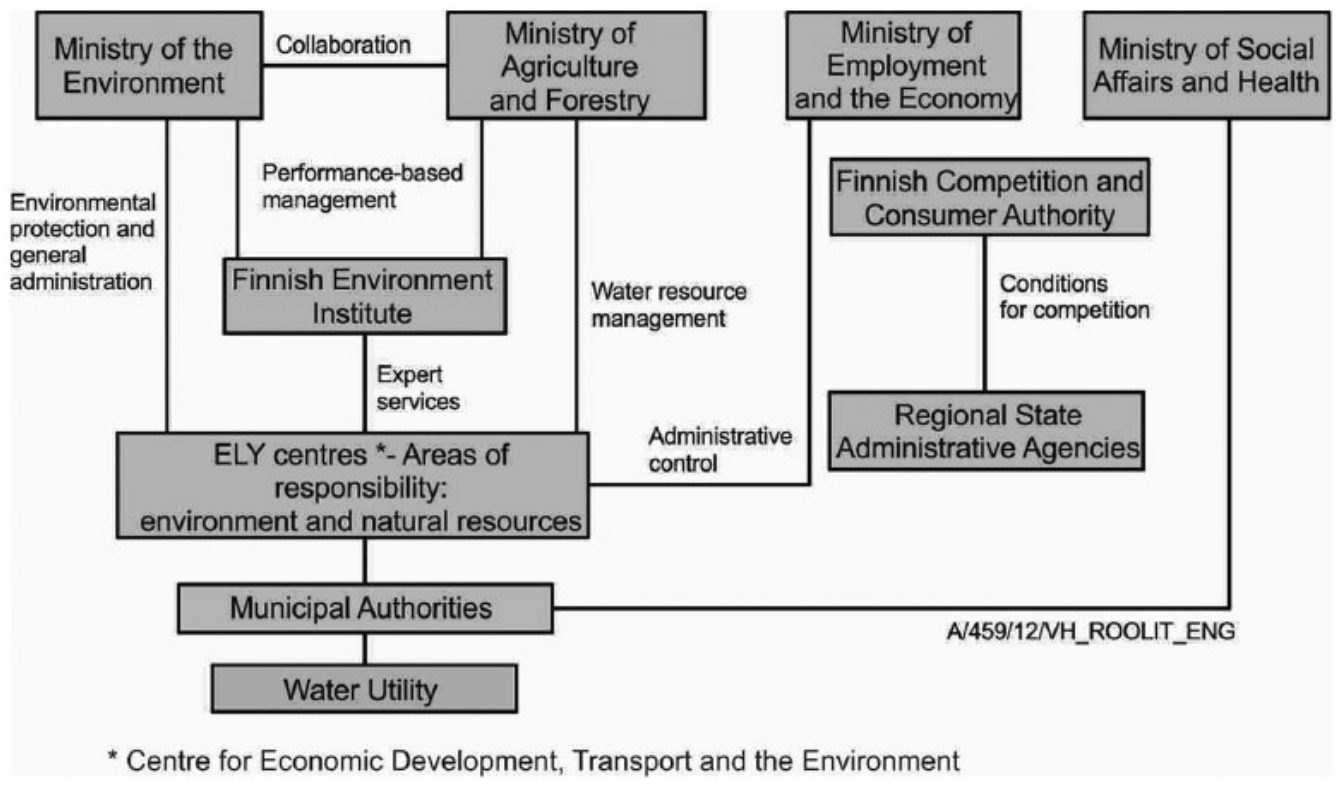
Institutional framework of Finnish water and sanitation services (Katko, 2016).
The first plans were established in the 1970s when water supply challenges started to emerge, especially on the coastal areas of southern and western Finland (KUVENE, 1975). Consequently, several regional water utilities were founded. Water supply was their main concern until the mid-1990s, when regional plans also started to consider regional sewerage systems. From the beginning of the 21st century, planning has addressed water supply and wastewater treatment comprehensively.
Three Levels of Inter-Municipal Collaboration
In this section, we will illustrate the specific design of regional cooperation in water services in Finland. However, it is important to note that regional cooperation can be performed through various arrangements depending on the nation’s history and related political and administrative traditions. For example, in the United States, the most commonly used arrangement is the so-called special district, which can be traced back to the 1880s. These are autonomous governmental bodies that can perform almost any local government functions but usually only one function per district: water, sewerages, irrigation, parks, transit, libraries, fire protection, health care, and so on. Furthermore, a special district reduces the financial risk of municipality, because unlike in Finland these districts have the ability to issue debt in the form of bonds which is underwritten by the taxing power of the special district not the municipality. As special districts perform a single function, they can customize the service area according to its needs instead of jurisdictions (Mullin, 2009). In addition, inter-municipal cooperation in the United States is performed through regional agreements and authorities. Here, we can find several similarities to Finnish systems.
In Finland (as well as in Sweden), we can distinguish three main levels of inter-municipal cooperation in water services:
Bilateral agreements
Wholesale water or wastewater company (or federation)
Regional water and wastewater company (or federation)
First level is rather light form of inter-municipal collaboration because no joint organization is established; municipal water utilities collaborate through bilateral agreements, which are rather easy to negotiate. A water utility can either sell or buy drinking water at an approved price, and the contract can be either continuous, as in cases of inadequate water resources, or provisional, to secure water supply at times of crises. In addition, there are an increasing number of contracts for transferring wastewaters to the treatment plant of a neighboring municipality. As the contracts are bilateral, water utilities commonly have several contracts with neighbor municipalities, for both supplying water and receiving wastewater. When the number of bilateral contracts increases, it causes additional challenges in managing the ensemble. In many cases, cooperation based on contracts has been the first step toward a joint inter-municipal organization (Kurki, Katko, & Pietilä, 2010).
In general, in the second level of cooperation, a wholesale company (or federation) typically concentrates on water supply and/or treatment only, while the municipalities are responsible for water distribution to the users or wastewater collection from the users. Consequently, the ownership of water distribution networks or sewers stays with the municipalities except for the trunk mains and sewers. However, in case of a regional water and wastewater company (third level), the organization is in charge of the whole chain of water services and owns the entire infrastructure it operates with. Thus, the third cooperation level integrates water supply and wastewater management sectors, which has also been a common practice in municipal-level organizations in Finland since the 1970s (Katko, Kurki, Juuti, Rajala, & Seppälä, 2010).
In terms of organizational autonomy, the first level of cooperation has the lowest degree of autonomy because it is operated through municipal utilities, which are embedded within administrative structures and political decision making (see Lieberherr, 2016). Concerning Levels 2 and 3, a new organizational entity is formed and the degree of autonomy increases. However, organizational structuring also has an influence on this. The legal form of a joint organization in the water sector in Finland is either a company owned by municipalities or a federation of municipalities. They both have legal personality, but a company has a higher degree of autonomy than a federation.
Wholesale companies and regional water and wastewater companies in Finland are regulated by the Limited Liability Companies Act (624/2006). They follow the principles of private sector, and their decision making is decoupled from municipal structures. However, municipalities are the shareholders, and they use the right of decision at the General Meeting, which is the supreme decision-making body. In addition, they choose the members to the Board of Directors, who are personally responsible for administration and operational management. Thus, the municipalities cannot direct their action but they can give instructions to supervise owner interests (Metsälä, 2001). Furthermore, the decision-making process of companies is not public: The Board of Directors can decide which information will be published and decisions can be enforced immediately. As for municipal federations, although they form a legal entity, they operate under the Local Government Act (365/1995) and are more connected to the municipal decision-making structures than companies. For example, the decisions are subordinates to appeals and demands for rectification.
Inter-municipal collaboration in water sector began in the 1950s, and it has increased and developed in its all forms. In comparison, in Sweden the current trend is also to increase inter-municipal collaboration in water sector (Thomasson, 2013). Currently in Finland, altogether 40 joint regional organizations (Levels 2 and 3) operate in the field of water services and serve close to 35% of the country’s population (Stenroos & Katko, 2011; percentage value updated by the authors). However, the most commonly used form is bilateral contracts (Level 1). The number of contracts has more than tripled since the 1970s, and it appears that the number will continue to increase in the future (Kurki et al., 2010). Table 2 summarizes the characteristics of each cooperation level.
Characteristics of the Three Cooperation Levels.
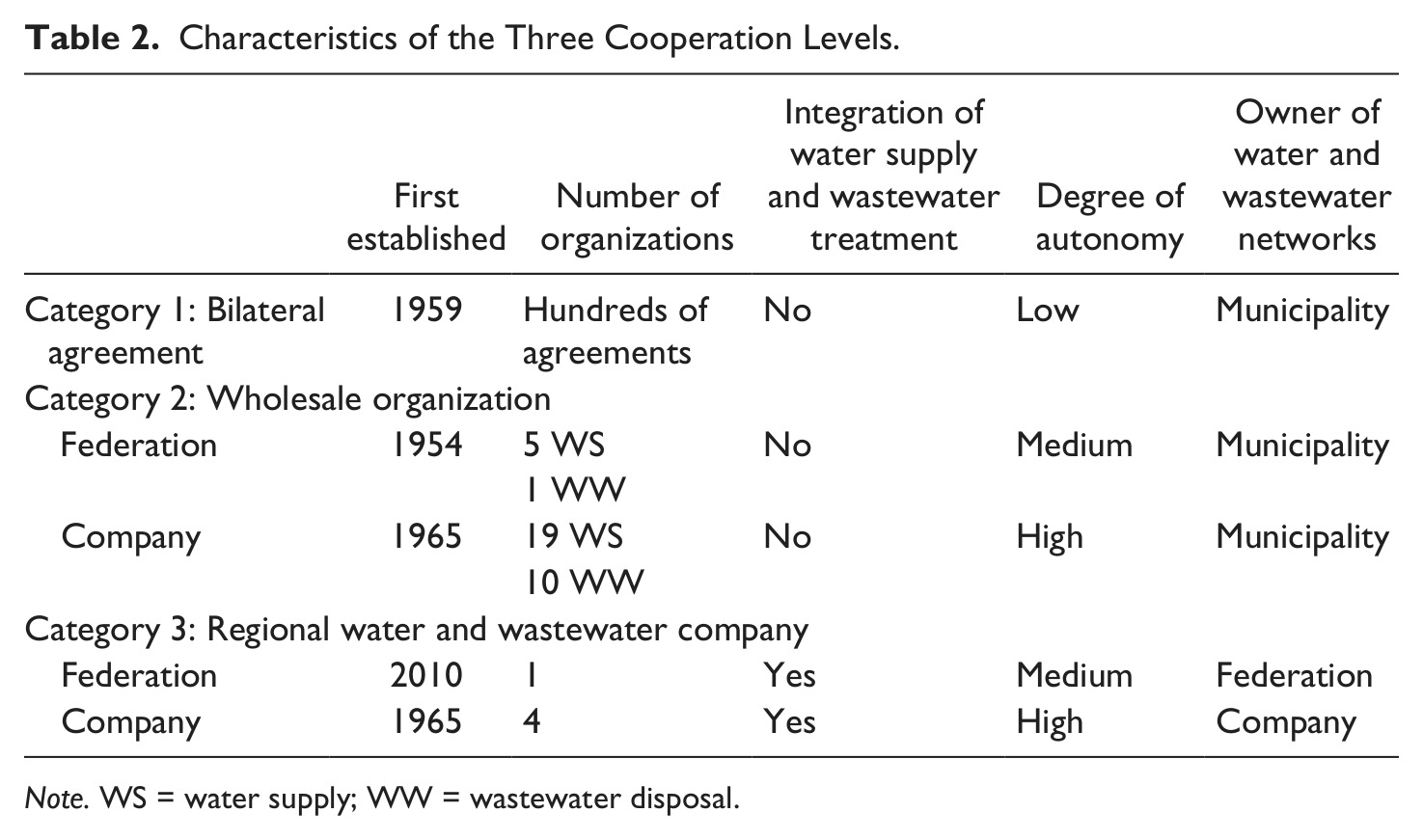
Note. WS = water supply; WW = wastewater disposal.
Initially, joint inter-municipal organizations were mainly municipal federations for wholesale water sales, whereas in the 1960s, water companies started to emerge. Currently, nearly half of the joint organizations are water wholesale companies. The emphasis on water supply can be explained by geography because most of the companies are established in the water-scarce coastal areas. However, the popularity of companies over federations is a more complicated phenomenon. Interviewees emphasized the bad reputation of federations in terms of organizational flexibility and decision making. However, good experiences of federations were reported as well. Accordingly, in most cases, planning of inter-municipal cooperation did not precede any profound analysis of different organization models, rather the decisions were made based on minnow and general trends.
Analyzing Benefits and Challenges of Regional Collaboration
In general, the reasons for inter-municipal cooperation are very clear: sufficiently good-quality raw water is not available in certain regions, or the capacity of old wastewater treatment plants has been exceeded, and neighbor municipalities decide to join forces and construct a larger, common one. Accordingly, collaboration between municipalities aims at bringing benefits for all parties. However, in practice, it may face several challenges as well. In this section, we analyze the benefits and challenges of inter-municipal collaboration by using an analytical framework, which includes the following categories: economies of scale, socioeconomic and spatial differences, autonomy and legitimacy. The Finnish experiences are compared with the research findings in other countries.
Economies of Scale
Economies of scale are generally referred to as indicators for benefits, which emerge from larger units followed by lower per capita costs. In terms of water services, this may entail a possibility to gain improved water quality; for example, through more advanced treatment processes, the ability to use better laboratories or resources for source protection programs (Grigg, 1996), as well as reduction of spillover effects in case of wastewater treatment (Hophmayer-Tokich & Kliot, 2008). As the regulatory challenges increase, concerning, for example, safe drinking water, small utilities may benefit from consolidations to reduce their regulatory burden (Shih, Harrington, Pizer, & Gillingham, 2006). In the case of Finland, these benefits were identified by the water experts and authorities as well. Furthermore, in case of wholesale companies and federations, the actors can concentrate on a specific operational area instead of managing the entire water sector. In addition, the interviewees emphasized better risk management as well as synergies in electricity, automatization and process management competence. Indeed, “economies of scale” have become a hegemonic discourse around the regionalization phenomenon in Finland—only few dare to question it. However, both large and small units most likely are needed, as F. E. Schumacher (1973/2010) notes in his book Small Is Beautiful,
For different purposes man needs many different structures, both small ones and large ones, some exclusive and some comprehensive. Yet people find it most difficult to keep two seemingly opposite necessities of truth in their minds at the same time. (p. 58)
The concept of economies of scale is critically reviewed in the literature; for example, R. M. Clark (1979) questioned it in connection with water supply and regionalization. According to Grigg (1996), larger units do not necessarily provide additional reliability for water services: For example, a large, single facility might have greater vulnerability in case of failure than several small units where the risk is far more diffuse (Lieberherr, 2011). In our study, a causality to a financial risk was introduced as well, as insurances do not cover all damages. Moreover, Bakir (2001) has studied sparsely populated small communities in the Middle East and North Africa, where centralized wastewater treatment may become economically infeasible due to the high cost of the wastewater transfer network. This is relevant also in Finland, which is a sparsely populated country. Accordingly, population density has an influence on the relative efficiency and the benefits obtained through large units. Furthermore, our interviewees argued that local knowledge can become invisible inside large joint organizations. Here, the concept of local knowledge not only refers to the knowledge that local residents have—for example, concerning the local aquatic environment or locations of old wells and pipelines—but also to the tacit knowledge that employees have inside their company.
In addition, Schmidt (2014) argues that regional collaboration may be inefficient when the economies of scale are hindered by spatial and institutional fragmentation. In a German case study, she presents the situation of inter-municipal collaboration in the region of Frankfurt and Rhine-Main: There are altogether 17 associations for water supply, as well as 85 providers and 19 associations responsible for wastewater disposal serving 2.2 million inhabitants in 75 municipalities. Conversely, a positive example can be found from the Ruhr urban region, where highly integrated regional governance processes recognized the intersection of spatial development and regional water management as well (Schmidt, 2014). Accordingly, as regionalization may involve complex double structures and fragmentation, an adequate institutional platform for a higher level coordination is needed (see also OECD, 2011).
In terms of three different cooperation levels in Finland, presented in the previous section, assessing the challenges and benefits under the category of economies of scale has only minor variation. The size of an organization grows from the first to third level of cooperation, but economies of scale are evident in all three levels. However, the size of an organization may affect its operational flexibility. The interviewees stated that wholesale companies are usually quite small organizations when compared with regional water and wastewater companies, and thus more flexible in their decision-making processes. Furthermore, a weakness of the third level of cooperation is that the regional monopoly becomes stronger than in the first and second levels of cooperation.
Socioeconomic and Spatial Differences
Regional collaboration may balance socioeconomic and spatial differences between municipalities. In terms of water supply, this means, for example, more equal access to water resources (Frone, 2008). As discussed earlier in this article, in Finland this was the main motivator for the establishment of regional wholesale water companies in the water-scarce coastal regions. In addition, collaboration may bring more expertise inside an organization and therefore enable better service to the customers.
Hophmayer-Tokich and Kliot (2008) present an example of regional wastewater treatment, and how cooperation can efficiently balance socioeconomic as well as spatial disparities between local authorities. In their case study from Israel, there were several small municipalities in the Karmiel region, which were not able to establish an advanced wastewater treatment plant by themselves. However, cooperation with a stronger local municipality enabled them to overcome the fiscal as well as political, organizational, and human-resources-related challenges, and establish a centralized wastewater treatment plant. Consequently, regional collaboration solved many sewage pollution problems in the drainage basin by enabling small towns to upgrade their wastewater to a higher standard, thus bringing environmental advantages to the whole area.
According to Hophmayer-Tokich and Kliot (2008), small municipalities may benefit from the capacities of stronger municipalities, as well as from the authority of a joint organization which has greater political strength to promote their interests. However, in the Finnish context, also contradictory observations were made. Commonly in joint organizations in Finland, smaller municipalities are afraid that they will not have enough power to drive their own interests because the central municipality will have the largest number of shares. Thus, they fear they would lose their autonomy if they collaborated with larger city (see also Lieberherr, 2011). For this reason, some small municipalities preferred agreement-based collaboration rather than participating in a large joint organization. However, various organizational examples from Finland show that there are several ways to balance power between shareholders. In some organizations, decisions require 80% endorsement or alternatively, the largest owner cannot have more than 50% of the seats on the Board of Directors. Another example suggests that each member municipality may have an equal number of members on the board, regardless of the size of the municipality. Nevertheless, concerning the distribution of dividends, the largest shareholders generally have more substantial shares of ownership.
Another problem, introduced by the interviewees, concerned already-existing old infrastructure. A regional water and wastewater company will possess and sustain the entirety of the water infrastructure. This may raise issues with value and share determination. Representation of each municipality on the board is determined according to the value of assigned infrastructure or to the volume of business. Agreement may be hard to reach because the capital value in proportion to the volume of business may vary between different municipalities: In a sparsely populated area, the length of network is often greater compared with densely populated municipalities where the capital value may be higher because of the volume of delivered water. In addition, the condition of infrastructure may vary greatly between municipalities; thus, the potential partner municipality may not want to inherit a poorly maintained infrastructure system (Schmidt, 2014). These issues may even prevent the establishment of a joint organization.
In terms of finance and large capital investments, accessing long-term finance is crucial in the water sector. Frone (2008) argues that regional cooperation is a suitable tool to address this, because large long-term loans to a single entity are considered to be more efficient than providing small loans to a large number of entities. Within a single structure, small units can guarantee each other in the event of default. In case of Finland, wholesale companies and municipal federations have the whole responsibility of finance, although municipalities may act as lenders or guarantee for the loans. In addition, they do not have to earn profit to the shareholding municipalities—any possible profit will be used to improve the service. Shareholders pay for the services according to the use; consequently, the operating and investment costs are covered with the payments. This allows long-term development of the operations, and the company can concentrate on its own activity.
Autonomy and Legitimacy
The degree of organizational autonomy varies within the three levels of inter-municipal collaboration as well as within organizational models. A general view among the interviewees of our study was that decision-making process is generally more efficient and less bureaucratic in more autonomous organizations (joint companies) than in those with lower degree of autonomy (municipal water utilities or federations; see also Lieberherr, 2011).
In the case of Finland, in joint companies, there is an embedded structural need for the members to pursue the company’s interests together (Stenroos & Katko, 2011). The organization is not embedded within municipal administration, and although the Board of Directors is typically a mixture of technical experts and politicians, the party politics stays away from the negotiation tables. The board can be seen as a team which shares common knowledge on possibilities, threats, and limiting factors concerning water works; leaving, however, the leading role in matters concerning technological solutions to the managing director. Stability and commitment of the board members are important to build a functioning management structure of the company. Furthermore, interviewees emphasized that in a joint company decisions can be made without publicity, and thus without political pressures.
Thus, the high degree of autonomization may increase organizational competencies by decoupling the decision-making process from the political system as it was also shown in a Swiss case study (Lieberherr, 2011). The decision making becomes more resilient and efficient, and instead of party politics, professionalism determines the strategic directions. However, this leads to the question of legitimacy (Lieberherr, 2011, 2016), which is highly relevant when dealing with something falling under the public good, such as water.
Lieberherr (2011) emphasizes the importance of acknowledging the tradeoffs between legitimacy, efficiency, and effectiveness: As the degree of autonomy increases, the transparency of decision making decreases. Sometimes this tradeoff is difficult to see or accept. Accordingly, one of our interviewees stated, “They [politicians] would like to have both; flexible decision making and the ability to control it through the political system, but it is impossible” (a representative of the Board of Directors of a wholesale company).
Among the interviewees, citizens especially recognized the problem of legitimacy. They were afraid that a municipal water company, regulated by the Limited Liability Companies Act, slides too far away from the democratic decision making. The most extreme scenarios predicted that this would eventually lead to privatization of water services. Nevertheless, water professionals, managers, and authorities were not as concerned with the consequences of autonomization. Conversely, they desired even more autonomy to avoid political debates inside a decision-making process.
However, prior to the establishment of an autonomous joint organization, a common political will needs to be developed within all stakeholder municipalities. According to Grigg (1996), divergent interests and tensions in policy arenas may hinder launching a collaboration project, and regionalization may be a hot topic at the local political level. As Schmidt (2014) argues, “[ . . . ] the logics of action driven by local egoisms work against regional activities” (p. 836). Nevertheless, several examples from Finland show that once political approval has been obtained, it is easier to negotiate the general terms of collaboration before establishing a joint organization. Subsequently, basic principles can be negotiated, such as value estimation of infrastructure and share distribution, and to gain final agreement about the form of collaboration.
However, in some cases, political will has collapsed after the establishment of a joint organization. The deteriorating influence of autonomization on democratic input may cause conflict between citizens and a water company. For example, there may be opposition against a large wastewater treatment plant in the host community, which falls into the “NIMBY” syndrome (Not In My Backyard; see Hophmayer-Tokich & Kliot, 2008). Furthermore, opposition may spread among the other stakeholder municipalities. In Finland, some contested inter-municipal groundwater projects have been delayed for several years, even decades, due to the collapse of a common political will after the local inhabitants intensively opposed the projects (Kurki & Katko, 2015; Kurki, Takala, & Vinnari, 2015). Indeed, Nolon, Ferguson, and Field (2013) argue that collaboration based only on political power cannot last because the power balance often changes with new elections.
Consequently, more profound engagement of each municipality is needed. During the interviews of our study, some representatives of wholesale companies proposed that this engagement should be done by more strict charters. However, this would not probably solve the issue of legitimacy. On the contrary, many authors suggest various collaborative methods to gain a higher level of commitment and legitimacy in the beginning of the project or even at the state of conflict (Innes & Booher, 1999; Islam & Susskind, 2013; Nolon et al., 2013). The basic idea is to find new and creative possibilities together with key stakeholders to create mutual gains and find solutions, which can be approved by each party.
Concluding Remarks
In the context of regionalization, our study utilizes water services as an example to illustrate the benefits and challenges of inter-municipal collaboration in the Finnish context, and it also compares these observations with international research. Various levels of cooperation are emphasized.
The normative guidance concerning regional water cooperation in Finland is restricted to the municipal responsibility: Municipalities are in charge of arranging water services that are actually provided by water utilities or cooperatives (Katko & Hukka, 2015). State authorities can provide financial incentives or set requirements but cannot control decisions of local governments. For example, since 2010 large cities have been required to have more than one raw water source available. Municipalities can decide how they arrange this; however, in many cases it can be seen as promotion for inter-municipal collaboration. The collaboration has evolved during the last six decades, and it now represents a significant aspect of water services. Nevertheless, the subject has not previously evoked any comprehensive research in Finland. Moreover, at global level, earlier studies have addressed inter-municipal collaboration in water sector mainly through case studies, without acknowledging various cooperation levels and the diversity of collaboration within single nation. Thus, the current study offers valuable insights for practitioners and authorities who are planning inter-municipal cooperation.
Regional collaboration in water sector began in the 1950s. Bilateral collaboration was first established in the Helsinki region and expanded from there to other regions. Frequently, bilateral collaboration has been the first step toward a joint organization. Especially in the 1970s and 1980s, wholesale water companies emerged in the Ostrobothnia region, in the western coast of Finland. Coastal areas especially have long experience with regional collaboration in water supply and demonstrate its importance because the lack of good fresh water resource is evident. Furthermore, regional authorities have strongly promoted inter-municipal cooperation in water sector through financial incentives and regional development plans. Currently, some 40 joint organizations operate in the field, and the number of bilateral contracts has more than tripled since the 1970s. However, regional cooperation may encounter several challenges. Therefore, successful implementation always requires thorough contextual consideration of multiple aspects, including analysis of technological capacity, the socioeconomic situation, as well as the political atmosphere.
Returning to our first research question, what are the benefits and challenges of inter-municipal water collaboration in the Finnish context, and how do these correlate with international experiences, we conducted our evaluation under three categories. First, economies of scale are widely acknowledged as a benefit of regional cooperation. The main argument is that financial, human, and technological resources are more efficiently used in larger and joint units. In Finland, the main argumentation to support inter-municipal cooperation in water services is based on economies of scale, and only few dare to question it. However, these benefits are strongly dependent on context and should not be taken as self-evident.
Second, regional collaboration is argued to balance socioeconomic and spatial differences between municipalities. The question is particularly relevant in the case of a large central city compared with smaller surrounding municipalities. This raised divergent remarks in two different contexts. In the case of Israel, small municipalities acknowledged fiscal, authoritative, and political benefits when they established a joint wastewater treatment organization with a stronger municipality (Hophmayer-Tokich & Kliot, 2008). However, in the case of Finland, although these benefits are also visible, inter-municipal collaboration raises the issue of unbalanced power between the central city and surrounding municipalities; for example, in the decision-making process inside a joint organization (see also Hytönen et al., 2016).
An intrinsic question related to inter-municipal cooperation, and our third category, is autonomy and legitimacy. Regional cooperation may increase the degree of autonomy in the water sector, which means that the decision-making process is more or less decoupled from municipal structures (Lieberherr, 2016). Autonomization brings benefits, especially in terms of effective decision making. However, the tradeoff between effectiveness and legitimacy needs to be recognized and addressed (Lieberherr, 2011). Accordingly, as the degree of autonomy increases, the legitimacy in terms of democratic decision making decreases. Our conclusion is that the problem of legitimacy in large regional projects may lead to opposition among citizens, which may lead to the collapse of common political will inside and between the municipalities. Therefore, the issue of legitimacy should be acknowledged among decision makers, authorities, as well as water managers in early stages of regional cooperation.
Our second research question, how do the different levels of collaboration affect the performance of regional cooperation, deepened our analysis in terms of diversity of regional collaboration. Excluding Lieberherr (2016), previous literature has not considered this question. In the Finnish case, we identified three levels of regional collaboration: bilateral agreements, a wholesale water or wastewater company (or federation), and a regional water and wastewater company (or federation). These levels and collaboration models vary especially in terms of organizational autonomy, which is closely related to the question of legitimacy. We found that regional collaboration cannot be viewed only through one kind of collaboration model. Instead, various forms of collaboration should be recognized and studied by the practitioners and planners considering collaboration with neighboring municipalities, as well as by scholars assessing the performance of inter-municipal collaboration.
The benefits and drawbacks of the three collaboration levels are strongly dependent on context. This study distinguishes, however, some general insights. Bilateral contracts are rather easy to negotiate, and the decision-making process stays inside the municipal organization as no joint organization is established. However, if the number of contracts increases, managing the ensemble may become challenging.
From joint organizations, a wholesale water company is the most used model of collaboration in Finland. It is usually quite small and flexible organization when compared with a regional water and wastewater company. However, the large operating area and concentration only on water supply or wastewater treatment enables persistent long-term planning inside the company. Rather, autonomous decision-making process outside the public sphere and policy-making guarantees flexible process but raises the issue of legitimacy. This may, for example, lead to the collapse of common political will inside and between municipalities.
The third level of collaboration—a regional water and wastewater company—is in charge of the whole chain of water services. Thus, the whole process is in the hands of one organization, and the economies of scale become more evident than in the first two levels of collaboration. However, a weakness of this model of collaboration is that the regional monopoly and the issue of legitimacy become stronger. Finally, we conclude that organization model does not explicitly determine the success of cooperation, but other features, such as leadership and political atmosphere as well as prevailing norms, are relevant as well.
The presented collaboration models and their performance can be considered in global context as an example of the diversity of organizing regional collaboration in water sector. Diversity in inter-municipal collaboration has proved valuable for water cooperation, at least in the Finnish context. Thus, in accordance with previous studies (Grigg, 1996; Hophmayer-Tokich & Kliot, 2008), the findings suggest that inter-municipal collaboration must be considered on a case-by-case basis, and suitable alternatives should be compared to find the most feasible solution. The danger of a single management structure is that collaboration is performed in different regions and the same pattern may not be suitable for all regional contexts. Thus, in each case, the most appropriate solution should be carefully considered, bearing in mind that cooperation between municipalities can also be achieved through varying levels of commitment and autonomy.
Footnotes
Acknowledgements
The authors wish to thank the Doctoral Program in the Built Environment (RYM-TO), Maa- ja vesitekniikan tuki ry, and Kaupallisten ja teknisten tieteiden säätiö (KAUTE) for financial support.
Declaration of Conflicting Interests
The author(s) declared no potential conflicts of interest with respect to the research, authorship, and/or publication of this article.
Funding
The author(s) received no financial support for the research, authorship, and/or publication of this article.