







Abstract
Although its investment needs lag the dominant transportation category, water infrastructure addresses human needs at a foundational level because it plays public health and economic roles. Much of it is old and not likely to be replaced soon, so federal policy must focus on intergovernmental leadership to sustain vital dams, urban water systems, and natural systems. Fixing the federal responsibility requires attention to intergovernmental relations and the conflicting goals of investment and regulation. Regulatory reform is ongoing, and normally not amenable to political initiatives. Federal water policies for both investment and regulatory controls seem to be on a flat trajectory, which is expected because they have evolved over decades. These can be summarized as: maintain federal dams and levees, invest in small grants and leveraging funds for state and local governments, address water justice issues, and operate essential programs like flood insurance. Public health and safety concerns will continue to dominate, more than in other infrastructure sectors. The future of water investments will be to hold the course with occasional shifts to respond to emergencies and new opportunities, such as greater private sector involvement.
Introduction
Leaky drinking water pipes, broken sewers, polluted streams, and risky dams are widespread in the United States, but they rate headlines only during crisis. This was apparent during the 2021 deep freeze in the South, when millions in Texas lost their drinking water (Oxner & Garnham, 2021) and residents of Jackson, Mississippi went without safe water for over a month (Haselhorst, 2021). Visitors to Fort Lauderdale, Florida enjoy the sparkling ocean water, but are unaware of the pollution risk posed by a failing sewer system. (Bryan, 2020). Where is the will to fix these problems and where will the money come from? President Biden’s infrastructure plan that was announced on March 31, 2021 offered limited funding, but the plan and its enormous price tag face an uncertain future.
While these Commentaries respond to a perspective by Netzer (1992), the situation addressed here for water is quite different. He wrote shortly after a massive subsidy for wastewater infrastructure under the Clean Water Act, and needs due to deteriorating water distribution systems had not been as apparent as they are now. Netzer argued that the only real need is to fund roads and highways better, and that could be accomplished without federal subsidies. He acknowledged federal interest in water, mainly through water pollution control, but did not relate it to infrastructure funding. His viewpoint article came on the heels of a review led by Munnell (1990) that largely put to rest the zeal of the 1980s about a new infrastructure “crisis.”
The question of funding water infrastructure has been asked many times, stemming back to the water policy studies of the 1950s and 1960s (Holmes, 1979), but it has not enjoyed the high profile of highway funding. The answers about water infrastructure are always muddled because it involves multiple types of systems and levels of responsibility. More worrisome is that it lacks the pizazz needed for political prioritization. That being the case, the paramount question is: what should the federal responsibility be? The answer is muddled again by intergovernmental relations and conflicting federal goals of investment and regulation.
On the investment side, if the Infrastructure Report Card of the American Society of Civil Engineers (ASCE, 2021) is a guide, little if any progress is apparent during the last two decades, despite efforts by many advocacy groups. On the regulatory side, failures such as the recent Flint, Michigan water fiasco (Campbell et al., 2016), and the close call in 2017 during a storm-induced threat to the massive Oroville Dam in California (Alvi, 2021) indicate the ongoing need to keep close watch.
Not the least of water concerns are water security and water justice. Water security involves flooding, drought, water safety, and the reliability of service. Water justice addresses human rights issues ranging from poor service to affordability and is a priority in the Biden infrastructure agenda.
These complexities and questions lead to constant calls for a comprehensive and integrated approach, such as the current focus on “One Water,” which seeks to manage water as a unified system (US Water Alliance, 2016). Neither the public nor politicians are very interested in such comprehensive approaches, however, and this leads to piecemeal approaches to investment, a result for water infrastructure that is similar to transportation policies for roads, bridges, transit, air, and rail. Discussion of needs is more coherent when a single system, such as drinking water, is involved but this creates a dilemma by leaving out some parts of water infrastructure.
This article addresses this dilemma by explaining the range of water infrastructure sectors and addressing policy needs of those where federal interest is greatest. The goal is to identify the principal areas where federal attention is most important and other important areas where responsibilities are important, but more diffused.
Water Infrastructure Sectors
The sectors of water infrastructure can be identified by their purposes and scales in their respective watersheds. At the large-scale, storage dams and reservoirs serve multiple purposes. For example, the Missouri River reservoir system of the U.S. Army Corps of Engineers (USACE, 2018) serves eight purposes, such as water supply and flood control. Stream networks and aquifers are natural infrastructure, which provides ecosystem services of provisioning and regulating (National Wildlife Federation, 2021). Most infrastructure is local and comprises water, wastewater, stormwater, and irrigation systems. These provide drinking water, pollution control, drainage, and water for food supply. Water supply also is critical for energy production and many other economic and social purposes.
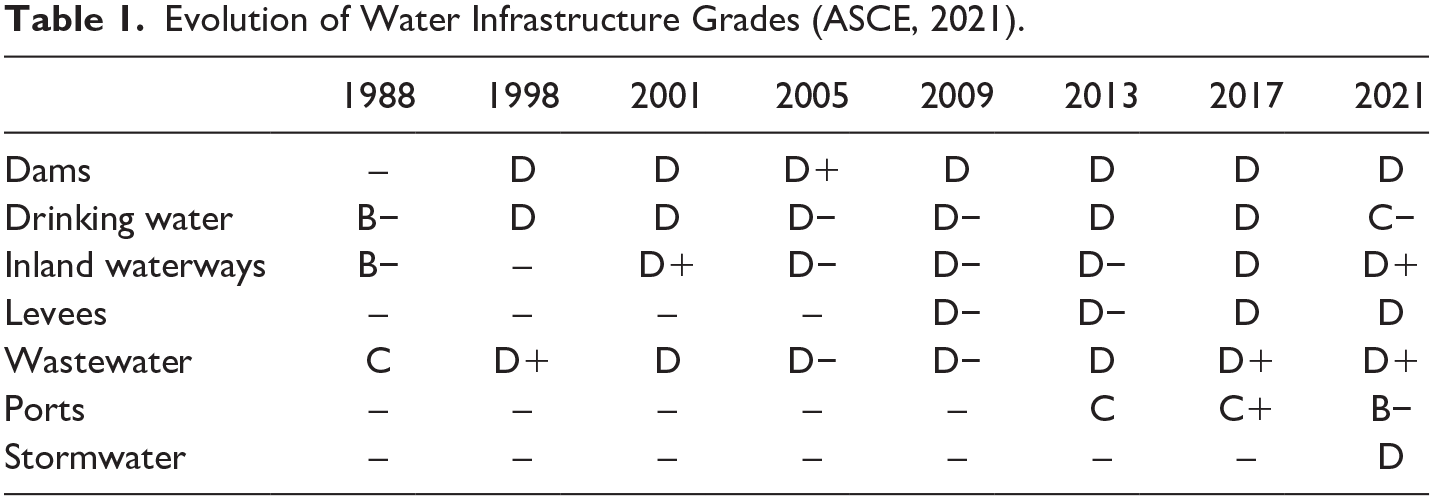
These water sectors can be grouped in different ways. For example, the water-related categories of the ASCE Report Card comprise 7 of its 18 grades and include dams, drinking water, wastewater, stormwater, levees, inland waterways, and ports. To illustrate their status, Table 1 shows evolution of the grades assigned. The 1988 report card was by the National Council for Public Works Improvement (Price, 1999), while the others are ASCE grades.
Evolution of Water Infrastructure Grades (ASCE, 2021).
By reviewing the ASCE Report Card, major issues and investment needs of these categories can be explored (Table 2), although in most cases, the extent of investment needs is unclear.
Issues and Investment Needs of Water Infrastructure Elements.
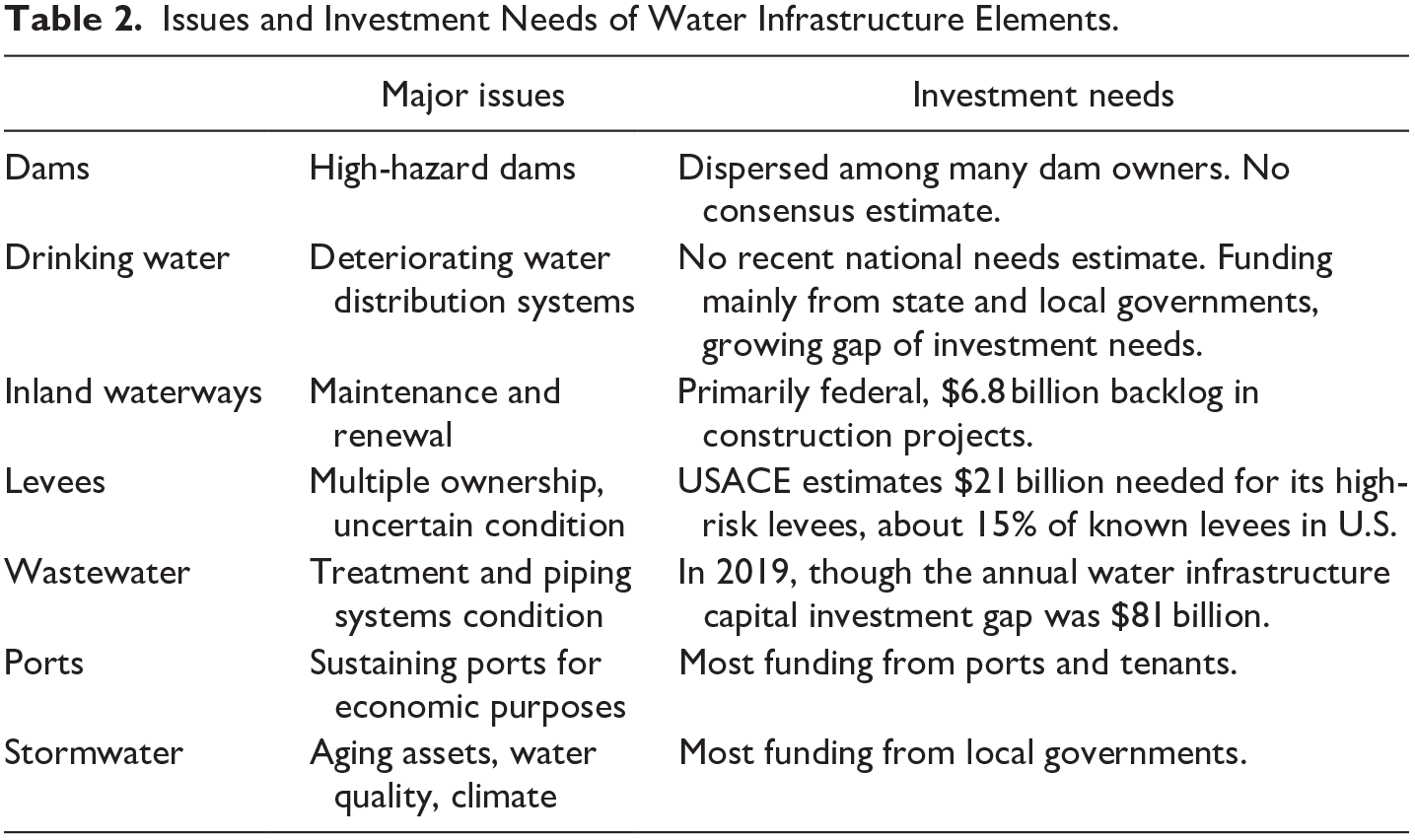
While the current Report Card does not offer comprehensive needs estimates, previous federal reports have indicated the scale of the major categories of water and wastewater needs. For water supply, the U.S. 2018 Environmental Protection Agency’s (USEPA, 2021a) Drinking Water Needs Survey showed $472.6 billion needed to maintain and improve drinking water infrastructure over 20 years. For wastewater, the comparable need for 20 years was $271 billion, according to the 2012 USEPA (2021b) survey.
The federal approach to funding water supply is through its loan program and periodic funding bills like the current stimulus. Under the 1996 amendments to the Safe Drinking Water Act, it established the State Drinking Water Revolving Fund which has been capitalized by annual appropriations and is expected to be supplemented by state governments (Tiemann, 2017). For wastewater, the 1972 Clean Water Act established a construction grants program that has been replaced by a Clean Water State Revolving Fund (Congressional Budget Office, 2002).
From these data, it is apparent that federal policy for water infrastructure has stabilized after a few major legislative actions such as the Clean Water Act and establishment of a national program for dam safety (Cornell Law School, 2021). The directions that are apparent from this stabilization of policy are:
Invest in leveraging funds such as the annual appropriations to the drinking water and wastewater revolving funds.
Invest discretely in programs as a policy response to public interest stemming from crises such as the 1969 Cuyahoga River fire (Boissoneault, 2019) and the Teton Dam failure (U.S. Bureau of Reclamation, 2021).
Develop and manage regulatory programs for issues of national concern such as public health, environment, and risk management.
These policy directions, along with their funding levels, might not satisfy advocates for a comprehensive and long-term federal response, but they are consistent with evolving federal-state relations and political realities, or realpolitik.
President Biden’s 2021 American Jobs Plan
President Biden’s Infrastructure Plan is a composite display of multiple areas of built-up needs assessments across sectors. It seemed to be deliberately modeled after the first 100 days of the New Deal. Most funding is aimed at transportation, and parts related to water infrastructure were replacement of lead service lines, upgrading of drinking water, wastewater, and stormwater systems, and investments in waterways and ports.
The proposed water investment was $111 billion focused on drinking water, wastewater, and stormwater systems, or about 5% of the overall price tag of about $2 trillion. The program would direct $45 billion for replacement of lead service lines to the drinking water revolving fund and to the Water Infrastructure Improvements for the Nation Act. Another $56 billion would be directed toward grants and low-cost flexible loans to states, Tribes, territories, and disadvantaged communities. Additionally, $10 billion was to be aimed at funding to address concerns about PFAS (per- and polyfluoroalkyl substances) in drinking water and small rural water systems (White House, 2021).
Taken over 8 years, the $56 billion toward support for state and local program averages $7 billion per year, which is a relatively small amount when compared to the $23.6 billion annual needs of water systems as estimated by the USEPA (2021a). The proposed program to replace lead service lines would be a one-time effort to address a legacy problem, which has important public health implications. However, the larger problem will not be solved by simply replacing the lines because sources of lead in drinking water are not restricted to that one source. Another complication is that responsibility for the lines is shared by utilities and homeowners.
The proposed $17 billion in funding for ports and waterways would be directed toward economic objectives related to movement of freight. How this would relate to the current federal policy of working with states and local governments and relying on user fees to fund water navigation is not specified in the President’s plan.
Other than the bold initiative to replace lead service lines, President Biden’s water initiatives are for modest increases in federal support, while the major burden for sustaining water systems will continue to fall on state and local governments.
How Adequate is the Current Policy Approach?
Given the stabilization of water policy, how adequate is it for today’s major water-related issues, such as: climate change, flooding, water shortages, pollution concerns, buried infrastructure, and water conflicts like interstate water transfers? These issues are interdependent and not amenable to general approaches. To illustrate, climate change affects both flooding and water shortages, and water shortages can exacerbate regional water conflicts. Climate-induced sea level rise threatens coastal areas, especially low-lying infrastructure. Despite the interdependence, discussion of policy needs is served by addressing the categories separately.
Flood damages have worsened in recent decades, and federal attempts to address the issues through flood insurance have been somewhat disappointing (Strother, 2018). Drought-induced water shortages and urban water supplies are a matter of local responsibility, as are actions to increase water safety. Emergencies such as in Flint, Michigan happen due to local action or inaction, and of the ±50,000 community water systems in the United States, many lack the capacity and funding to address Flint-like issues.
Perhaps best known among the regional water conflicts are concerns about the adequacy of Colorado River supplies, which are essential to some 30 million people and seven states (Zielinski, 2010). While federal control of the river has been dominant, some environmental interests have called for the removal of the Glen Canyon Dam, a critical storage facility which has been essential to manage the system according to the Law of the River (MacDonnell et al., 1995). No clear direction for federal investment policy is evident for these issues.
Analysis and Conclusions
With its infrastructure plan, the Biden Administration’s goals for water infrastructure are evident. For the dominant categories of urban water, wastewater, and stormwater, it plans modest increases in funding to leverage capital for state and local governments. It also offered a signature plan for one-time funding to replace lead service lines, but given the complexity of the issue, the solutions will require more than just these investments. Like many water infrastructure issues, even finding and assessing condition of system elements can be major difficulties.
Other than the lead service line initiative, federal policies for investment and regulatory controls in the water sector are on a flat trajectory. This is reasonable, given the timeline where the nation confronted policy issues of water pollution, drinking water safety, dam safety, and stormwater. For the most part, these were settled by the end of the 1970s, although statutory amendments and responses to disasters such as record flooding or the water supply failure in Flint, Michigan have rippled the water.
Federal interest depends on the balance of powers between federal and state governments, which evolves in response to political forces and changes. This interest has been expressed through major federal investment, such as the dams of the US Army Corps of Engineers and the Bureau of Reclamation, and through regulatory programs with limited financial support. Federal interest is also evident in addressing some large-scale problems, such as managing the giant Ogallala aquifer, but is normally expressed in low-cost approaches, such as data collection and research. If the Biden plan succeeds, the large-scale investment in replacement of lead service lines could be an exception. Large-scale issues of river basins often end up in the courts, rather than on the agendas of federal agencies. Perhaps the greatest future areas of federal concern will be water justice and environmental sustainability including climate change.
The federal interest in renewing dams and levees will be expressed in future appropriations and guidance to the USACE and Bureau of Reclamation. Emphasis will be on regulation of high-hazard dams, regardless of ownership, but investment in federal facilities seems certain to continue at a low level. The federal role in dams and levees owned by others will focus on data management to determine ownership and responsibilities. Regulation will be pushed down to state governments, as it is presently.
The federal role in empowering and assisting state and local water supply and wastewater agencies seems unlikely to change, with continued modest investments in the form of loans or small grants. No substantial federal investment in stormwater systems seems forthcoming, other than their inclusion in the Clean Water State Revolving Fund. The federal government will also sustain cooperative funding systems for the inland waterways and ports systems because of the economic and national security facets of these facilities.
On the regulatory side, existing programs will need continuing attention and reforms for each major regulatory category. Perhaps the most prominent examples are the Safe Drinking Act and the Clean Water Act. Development of new legislation and rules under existing regulations will continue, often with long timetables. Some policy issues, such as the recent “Waters of the United States” debate under the Clean Water Act, involve political issues that must be resolved to determine the regulatory strategy.
Because water systems are interconnected in multiple ways, federal policy will continue to emphasize intergovernmental and public-private approaches. On the intergovernmental side, the subsidiarity principle will endure, where responsibilities should be devolved to the lowest level of government that can handle them.
Public-private partnerships will remain in vogue but must be worked out on a case-by-case basis. The brief love affair with privatization that occurred during the Reagan Administration has long passed, but many opportunities exist for cooperative ventures such as contract operation and possibly ownership of key water infrastructure facilities. Where these can succeed, revenue streams must be adequate to sustain them, and in most cases, the arrangement could be either all government or a partnership. The federal government will continue to look for reforms such as spinning off management of the flood insurance program to private insurance companies, but such possibilities usually lose their luster once the realities like unknown risks and costs to property owners are finally understood.
Data collection and research do not seem exciting, as compared to major investments or controversial regulations, but the payoff from federal investments and participation in these activities seems attractive. Sometimes the concept of national commissions is dismissed as of little use, but these do not cost much and offer substantial opportunities to engage stakeholders in study of major issues. Among professionals, the water policy studies of the 1950s and 1960s provided substantial understanding of issues faced today. The 1980s National Council for Public Works Improvement created the first infrastructure report card, which set the stage for a great deal of public understanding at no apparent cost to the taxpayer.
The question of whether these policies are adequate can be divided into two parts to provide insight into the difference between sustaining old water infrastructure and responding to emerging sudden and creeping crises. Most water infrastructure is old, such as the approximately two million miles of buried water supply pipe that is nearing the end of its service life (American Water Works Association, 2001). Federal dams provide another example, as most were completed more than 50 years ago. Despite their age, these legacy water infrastructure systems can continue to serve if they are maintained well. Maintaining them is not a popular program, but it requires government to act despite its low profile.
The likelihood of sudden and creeping crises is unknown, although the specter of climate change continues to unfold with many ramifications for water infrastructure. As it will unfold over a long time, governments will naturally be cautious about investments. If a sudden disaster occurs, such as failure of a major dam or massive earthquake, it seems certain that governments will mount rapid responses, but these cannot be predicted.
The future for national policy in the water sector seems to be one of holding the course with occasional shifts to take advantage of changes in the wind. While the change from the Trump to Biden Administration has brought about dramatic changes in infrastructure policy, most of the major implications are in sectors other than water. Consequently, there seems little prospect that dramatic changes are in the cards.
Ultimately, the answer to the question whether we need a national infrastructure policy is “of course we do.” However, this broad notion seems about the same as saying we need a national defense policy or a national environmental policy. The discussion is more relevant at the level of individual infrastructure sectors, like transportation or water, but it only becomes specific for their subsectors with questions such as investment in federal dams or drinking water treatment systems. This multi-level definitional issue has roots in the “internal improvements” conflicts of the 19th Century and blossomed with the infrastructure “crisis” of the 1980s. Now that the Biden plan has added social programs to the mix, the picture is more muddled. We need a national infrastructure policy, but it must be comprehensive across sectors and regions, and reflect best practices in allocation of responsibilities to the three levels of government and to the public and private sectors.
Footnotes
Declaration of Conflicting Interests
The author declared no potential conflicts of interest with respect to the research, authorship, and/or publication of this article.
Funding
The author received no financial support for the research, authorship, and/or publication of this article.