







Abstract
Situated in a context of rapid technological innovation, coupled with federal and state efforts to foster sustainability, the continued growth of electric vehicle adoption presents new challenges concerning the capacity of existing transportation infrastructure. This study explores the diffusion, adoption, and prospects for adoption of a new technology: battery electric vehicles within local government fleets. Coupling archival data of municipal characteristics with an original survey of local government officials, this study examines which social, economic, and technological factors shape governmental pursuit of this technology within one culturally dynamic state. A supply-side, top-down framework for installing supportive infrastructure takes a central place in our consideration as the outcomes of that process have led to implementation of key charging stations with geographic significance. Results of our analysis reveal broad interest, though with expressed hesitance, in electrifying municipal vehicle fleets. While the policy diffusion literature places a premium on geographic proximity, municipalities reflecting the strongest prospects for fleet electrification are located within areas with greater public support, investment in capital infrastructure, and higher electric vehicle adoption rates.
Growing adoption of alternative fuel vehicles in the United States represents a crucial juncture in the transformation of existing national transportation infrastructure. Recent federal legislation promoting sustainable infrastructure policies such as the Inflation Reduction Act of 2022 (H.R.5376 - 117th Congress, 2022) and the Infrastructure Investment and Jobs Act of 2021 (H.R.3684 - 117th Congress, 2021) highlight the role which federal policy plays in modernizing transportation infrastructure. Enhancing the availability of federal resources to state and local governments represents a pivotal step toward sustainable infrastructure modernization necessary for adaptation to technological and environmental changes (Knopman et al., 2018), as evidenced by the increasing rate of electric vehicle (EV) ownership nationwide (International Energy Agency, 2023). Similarly, legislative and policy initiatives seeking to expand necessary supporting infrastructure, such as EV charging stations, underscores the latent value of alternative fuel vehicle adoption as a potential mechanism for economic development and a policy benchmark toward broader sustainability goals. Taken as a whole, infrastructure modernization initiatives prioritizing sustainability as a key pillar through the incorporation of environmental, economic, and equity factors are thus reflective of the core values of public administration and good governance (Cheng & Ali, 2023).
While the focus of such policies has predominantly centered on synergies between sustainability, infrastructure capacity, and EV adoption, another policy concern has remained unaddressed: Should governments lead by example through electrification of their own vehicle fleets? Despite greater access to federal resources aimed at facilitating sustainable infrastructure modernization, the lagged pace of municipal governments’ acquisition of EVs for municipal fleet use underscores the complexity of the broader policy issue. Factoring for multiple facets inherent within policy proliferation dynamics, municipal governments deciding whether to adopt new policies or programs simultaneously serve as both market-based consumers and public officials which must justify such policy intentions to constituents and community members.
At the local government level, the capacity for electrification of municipal vehicle fleets has thus far remained within the domain of larger municipalities, notably those afforded substantial resources and with a relatively greater risk margin. As such, the efforts of larger municipalities to electrify their existing vehicle fleets obscures the challenges faced by smaller municipalities seeking to replicate such policy initiatives. In contrast to their larger counterparts, small municipalities face considerable challenges when contemplating such policy initiatives, including fiscal constraints coupled with smaller revenue streams, greater risks associated with policy adoption and implementation, diminished stakeholder participation within state-level infrastructure planning, and inequities related to requisite information communication technology infrastructure. The confluence of issues facing smaller, often rural, municipalities in the context of policy adoption involving emergent technology warrants further exploration. This study seeks to better understand factors influencing local government adoption of electric vehicles through the lens of policy innovation, diffusion, and adoption. By identifying key factors considered by municipal government leaders concerning vehicle fleet electrification, this study seeks to provide insights into how local governments approach broader technology-focused transitional policy trends.
To analyze these influential factors, a single state approach was selected to ensure that policy influences on local governments were consistent. The state of Kentucky, centrally-located in the Ohio Valley region of the United States, reflects distinct economic and political characteristics imitating the complexity of policy innovation, diffusion, and adoption. Coal mining has long been a core sector of Kentucky’s economy, cementing a focus on traditional energy sources. Additionally, the state is home to multiple, large-scale automotive production and support facilities for three major automotive manufacturing companies and over 500 related automotive parts and supplier entities. Currently, just under 10% of Kentucky’s economic activity is directly connected to the automotive industry (Kentucky Cabinet for Economic Development, 2021). Kentucky’s centralized location and low energy rates have made it an ideal location for automotive manufacturing, as evidenced by recent investments in existing facilities to support hybrid and electric vehicle manufacturing. Moreover, the geographic dispersion of automotive manufacturing investment and activity spans the entirety of the state, from smaller municipalities such as Bowling Green to large-scale manufacturing facilities in the Louisville and Lexington metro areas, as well as numerous third-party automotive parts manufacturers throughout the state. This juxtaposition of values—an economy deeply connected to fossil-fuel production versus modernized manufacturing of products eschewing fossil-fuels—provides unique contrasts and the potential for variation across regions of the state which may influence policy choices by local government leaders.
This study compliments data from an original survey instrument with secondary data to identify primary factors that influence municipal government leaders’ predisposition toward fleet electrification and its requisite EV charging infrastructure. We first review legislative and policy initiatives promoting transportation infrastructure modernization and transition to alternative fuel vehicles. Following a concise review of the policy innovation and diffusion literature, we apply policy diffusion theory to the case of municipal fleet electrification. We look explicitly at social, economic, political, and technological data that may influence local and regional adoptions. Results of the analysis, along with a discussion of its implications for diffusion of electric vehicles in municipal fleets, are then presented. The study concludes by outlining existing limitations of the current study while indicating potential avenues for future research building on the resulting insights into the dynamics of local government planning, budgeting, and policy formation associated with emergent technologies, sustainability, and innovation.
Legislation as Policy Innovation, Diffusion, and Adoption Catalyst
Planning and development aimed at rapid consumer and corporate adoption of alternative fuel vehicles, specifically EVs and partial-hybrid electric vehicles (PHEVs), throughout the United States embodies the concept of cooperative federalism. Through mechanisms such as tax credits and incentives, both federal and state governments have taken active measures to promote mass consumer adoption of EVs and induce economic growth through investment in electric vehicle manufacturing. Two key pieces of recent federal legislation have served as catalysts for accelerating EV adoption the U.S.: the Inflation Reduction Act (H.R.5376 - 117th Congress, 2022) and the Infrastructure Investment and Jobs Act (H.R.3684 - 117th Congress, 2021). Whereas the Inflation Reduction Act (IRA) of 2022 sought to promote broader interest and investment into renewable energy products and systems, thereby providing an indirect influence on broader adoption of alternative fuel and battery-electric vehicles, the Infrastructure Investment and Jobs Act (IIJA) of 2021 had more direct implications for large-scale transformation of existing transportation infrastructure within the United States.
Signed into law into in November of 2021, the IIJA sought to leverage bi-partisan support for capital projects to modernize existing transportation infrastructure. Through restoration and modernization of existing infrastructure, the legislation aims to capitalize on the renewed capacity of major infrastructure systems to not only improve the safety and structural integrity of existing infrastructure but to accommodate evolving transportation needs. Highly visible infrastructure projects funded by the IIJA of 2021 provide a snapshot of tangible outcomes of the legislation’s goal of improving existing infrastructure across the nation. Viewing the IIJA more holistically, on the other hand, illustrates the law’s ambitions to fundamentally shift both infrastructure and passenger transportation. A core tenet of the IIJA of 2021 focuses on supporting domestic automotive manufacturing of alternative fuel vehicles and incentives for widespread consumer adoption of alternative fuel vehicles and battery-electric vehicles. Utilizing federal resources to encourage automakers to accelerate battery-electric vehicle development and create domestic supply chains for vehicle components, the IIJA provides a reciprocal platform for domestic automakers (including legacy automakers and start-ups) to increase the self-sufficiency of North American supply chains while incentivizing consumers to purchase domestically assembled and sourced battery-electric vehicles through applicable tax credits. As a result, the Internal Revenue Service developed eligibility criteria for consumer tax credits for the purchase of both new and used battery-electric vehicles meeting domestic manufacturing requirements, with tax credit incentives ranging from $4000 for qualifying used EVs to $7500 for qualifying new EVs (U.S. Internal Revenue Service, 2024).
While consumer incentives for purchasing alternative fuel vehicles through tax credit eligibility remains a lynchpin for the IIJA’s goal of transition toward environmentally sustainable transportation, it represents one component of a multi-faceted challenge: As consumer interest in, and adoption of, alternative fuel and battery-electric vehicles increases, so, too, does the need for sufficient infrastructure to support new vehicle fuel types. In contrast to traditional internal combustion engine vehicles, aided by the convenience of a vast array of proximate fueling stations nationwide, existing infrastructure supporting EVs and PHEVs has been primarily composed of proprietary charging networks developed by entrepreneurial entities either in conjunction with, or as a part of, the EV and PHEV automotive industry (such as Tesla’s Supercharger network or Electrify America, which has partnered with multiple automakers to facilitate public access to EV and PHEV charging infrastructure). To address this discrepancy, the IIJA established the National Electric Vehicle Infrastructure (NEVI) Formula Program through the U.S. Department of Transportation’s Federal Highway Administration (FHWA) to fund and support state transportation agencies tasked with developing comprehensive infrastructure modernization plans. Alongside the newly established Joint Office of Energy and Transportation (JOET), the NEVI program aims to accelerate EV and PHEV charging infrastructure expansion at the state level by subsidizing project costs and knowledge sharing support units such as the JOET Electric Vehicle Working Group.
NEVI program funding eligibility is contingent upon state transportation agency planning. Under the NEVI program, each state must submit a comprehensive strategic infrastructure modernization plan outlining how the state aims to develop and implement EV and PHEV charging stations along FHWA designated Alternative Fuel Corridors (AFCs). In order to receive NEVI program funding, strategic infrastructure modernization plans submitted to FHWA and JOET by each state must be reviewed and approved. An overview of approved and estimated funding per state between fiscal year 2022 and fiscal year 2026 is available on the U.S. Department of Transportation’s FHWA Bipartisan Infrastructure Law website 1 .
Kentucky’s Electric Vehicle Infrastructure Deployment Plan: Better Kentucky Plan
Developed by the Kentucky Transportation Cabinet (KYTC), in close coordination with the Kentucky Energy and Environment Cabinet (KEEC), the 2022 Electric Vehicle Infrastructure Deployment Plan of 2022 reflected a strategic approach to facilitate broader adoption of EVs in Kentucky by leveraging the modernization of existing roadway infrastructure (Kentucky Transportation Cabinet, 2024). Directed by a steering committee which included members of the Kentucky Public Service Commission (KPSC) and FHWA, formation of the Electric Vehicle Infrastructure Deployment Plan began in January of 2022, with three primary areas of focus: stakeholder engagement, technical assessment and analysis, and policy and plan development. A preliminary draft of the Electric Vehicle Infrastructure Deployment Plan was made public in July 2022, with a final version approved by JOET and FHWA in September 2022. Subsequent revisions were incorporated in July 2023, receiving approval from JOET and FHWA in September 2023.
The Kentucky Transportation Cabinet’s infrastructure plan focuses on developing electric vehicle charging stations along 17 alternative fuel corridors (AFC) throughout the state. Currently, the AFCs identified by KYTC include 11 federal interstates, six parkways, and multiple state highways, totaling 1469 miles of roadway across Kentucky. To facilitate greater accessibility to electric vehicle charging stations and to satisfy federal funding requirements under the IIJA, KYTC anticipates developing 37 direct current fast charging (DCFC) stations along the AFCs between 2023 and 2026 to achieve the goals set forth in the Electric Vehicle Infrastructure Deployment Plan. Prior to the development of the preliminary Kentucky Electric Vehicle Infrastructure Plan in 2022, seven NEVI-compliant DCFC electric vehicle charging stations were already operational in the state.
Electric vehicle charging station development throughout Kentucky is guided by a Kentucky Transportation Cabinet request for proposals (RFP) process accessible to potential developers. At each phase of the multi-year Kentucky Electric Vehicle Infrastructure Deployment Plan, the Transportation Cabinet releases an RFP notifying interested contractors of available funding for charging station development along designated AFC locations throughout the state. Proposals submitted are assessed by an Evaluation Committee which reviews, evaluates, verifies information submitted by prospective developers, and scores proposals to make contract award recommendations. The RFP guidelines involve three separate proposals: an Administrative Proposal, a Technical Proposal, and a Cost Proposal. Proposals require development within Designated Zones along AFCs, though contractors may submit proposals across multiple Designated Zones for each zone of proposed development.
In June 2023, KYTC issued a request for proposals to solicit bids for development, installation, operation, and maintenance of additional DCFC charging stations along the designated AFCs. Applicants selected for additional DCFC charging station development were announced in October 2023, with six contractors awarded subsidies to install electric vehicle charging stations at 15 designated AFC locations across Kentucky. Image 1 indicates the locations of the initial existing DCFC stations in Kentucky prior to approval of the 2022 Electric Vehicle Infrastructure Deployment Plan, while Image 2 illustrates both existing operational DCFC station locations and the locations of approved DCFC charging station construction and maintenance.
Kentucky’s Electric Vehicle Infrastructure Deployment Plan distributes access to EV and PHEV charging stations geographically along roadways incurring the most motorists with alternative fuel vehicles traveling interstate or intrastate. Despite the investment to improve accessibility to EV charging stations throughout the state, EV registrations per capita in Kentucky are among the lowest across all 50 states (Dept. of Energy Alternative Fuels Data Center, 2023). The incremental EV registration rate for Kentucky becomes more complex when considering the notable economic activity of the automotive industry within the state, which includes four major assembly operations from three automotive manufacturers, numerous automotive parts suppliers, and a multi-billion-dollar investment toward the construction of an electric vehicle battery plant. This juxtaposition of governmental investment in electric vehicle infrastructure and economic development against the leisurely pace of EV adoption throughout the state motivates our research questions: Does state-level policy influence policy initiatives at the local level? Additionally, what is the role of existing infrastructure and socio-economic conditions in policy adoption efforts, such as fleet vehicle electrification, amidst federal and state infrastructure investment policies?
Vehicle Electrification, Infrastructure Capacity, and the Spaces in Between
The movement toward broader adoption of alternative fuel vehicles such as EVs and PHEVs reflects a paradigmatic shift in consumer behavior and governmental policy. In addition to the considerable advancements in EV and PHEV technology, consumer awareness of the environmental benefits of alternative fuel vehicles has grown steadily alongside governmental policies and programs aimed at curbing macro-level challenges such as climate change (Degirmenci & Breitner, 2017). The ambitious goal of transitioning passenger and light-duty vehicles from internal combustion engines to sustainable alternative fuels reflects an agenda which impacts all stakeholders, including governments. Urban and suburban municipalities, those which frequently serve as catalysts for change through their resource advantages and more progressive policy stance, face challenges similar to those in rural and exurban areas, though at considerably different scales.
The latent disparities between metropolitan areas and their smaller, less populated, rural counterparts within a state highlight the differential challenges and risks faced by governments of varying scale and entrenched with different values. These dissimilarities call into question which factors contribute to, and detract from, municipal adoption of EVs. With top-down pressure to adopt evolving technologies, policy innovation and diffusion provides a mechanism for understanding these factors. Broadly conceptualized, policy diffusion concerns the policy choices of one government being influenced by the policy decisions of another government (Shipan & Volden, 2012, p. 788). Moreover, policy diffusion can be the result of pressures advocating for the adoption of policy innovations already present within other governmental entities (Shipan & Volden, 2008, p. 841). Interest in the distribution of policy and facilitating mechanisms has resulted in a wealth of literature exploring factors contributing to the formation, diffusion, and adoption of policy among governmental institutions. Walker’s (1969) work examining the diffusion of policy innovations at the state level is frequently credited as a catalyst for subsequent advancements in policy diffusion literature, notably as it relates to theoretical and methodological approaches (Berry & Baybeck, 2005; Berry & Berry, 1990).
Policy diffusion, adoption, and innovation all pertain to the introduction of a new policy or program to a particular jurisdiction. Indeed, previous literature has broadly examined the notion of “newness” of what is being adopted, regardless of its presence in other jurisdictions (Rogers, 2003; Walker, 1969). More recent studies, such as Berry and Berry (2018), however, distinguish policy adoption from policy diffusion by proposing a unified model of policy innovation in which policy adoption is a phenomenon contingent on various factors, including policy diffusion, managerial factors, and internal determinants. Similarly, Shipan and Volden (2008) clarify that policy diffusion is an impetus coming from outside the jurisdiction for policy adoption. Accordingly, studies of policy adoption have been centered around the mechanism of policy diffusion whereby one public official or jurisdictional government emulates another. Based on this rich literature (e.g., Berry & Baybeck, 2005; DiMaggio & Powell, 1983; Shipan & Volden, 2008; Simmons et al., 2006), Berry and Berry (2018) identify five streams of policy diffusion ultimately leading to policy adoption: learning, competition, imitation, normative pressure, and coercion.
By learning, policymakers adopt a policy that has been successful both politically and on policy grounds (Shipan & Volden, 2008). Jurisdictions learn from neighboring and nearby states with similar cultural, socioeconomic, and political characteristics when their adoption leads to performance dividends (Berry & Baybeck, 2005; Lundin et al., 2015; Volden, 2006). Competition occurs across borders of neighboring jurisdictions as the cases of lottery adoptions and welfare benefit levels corroborate (Berry & Baybeck, 2005; Berry & Berry, 1990). Imitation takes place when a desire to be seen as a leading jurisdiction with little consideration for the efficacy of the policy itself (e.g., effectiveness or political consequences), but the imitated governments’ success and performance stimulate policy diffusion (Shipan & Volden, 2008). Normative pressure also leads to policy diffusion, given the expectations about adopting a certain policy due to shared norms, such as political and economic liberalization (Simmons et al., 2006). Lastly, coercion takes place mostly due to asymmetric relationships between jurisdictional governments, and vertical coercion is more frequent in the American federal system (Welch & Thompson, 1980).
Even though policy diffusion may initiate or stimulate policy adoption, it does not guarantee successful policy adoption (Berry & Berry, 2018). Rather, a variety of factors contribute to a jurisdiction’s decision to adopt. It includes not only managerial attributes of adopters, such as the abundance of resources or leadership types (Moon, 2002; Moon & Norris, 2005; Teodoro, 2008; Wang & Feeney, 2016; Yi et al., 2018). But also, contextual factors, such as political, economic, and social characteristics of the jurisdiction, lead to policy adoption (Jun & Weare, 2011; Lee et al., 2011). That being said, a jurisdiction adopting a new policy—whether through one or multiple mechanisms of policy diffusion—needs to consider whether it possesses the managerial capacities and contextual conditions necessary for successful implementation. Capacity plays a central role in predicting performance (Hall 2008a, 2008b).
Building on this point, vehicle electrification is not merely an innovation to be diffused and adopted, but can also be conceptualized as a form of technology adoption. Adopting new technologies has been a focal point in such studies. Notably, the Technology Acceptance Model (TAM), proposed by Davis (1989), highlights perceived easiness and usefulness of the technology being adopted. Moreover, the model resonates with the mechanisms of policy diffusion given its values, such as efficiency, effectiveness, and transparency, as well as learning, imitation, normative pressure, and political circumstances led by federal governments or global endeavors (e.g., E-Government Development Index of United Nations) and of coercion (Ahn & Chen, 2022; Distor et al., 2021; Gilbert et al., 2004; Jun & Weare, 2011; Moon, 2002). Similar to Berry and Berry’s (2018) comprehensive perspective, technology adoption also is contingent on organizational characteristics and managerial conditions of adopters, such as organizational centralization and risk-averse organizational culture (Wang & Feeney, 2016). Taken together, electric vehicle adoption could be diffused through learning, competition, imitation, normative pressure, and coercion, but successful vehicle electrification cannot happen without considering the organizational and managerial conditions of adopters as well as contextual factors facing the target jurisdictions.
Parallels Between Policy Innovation, Diffusion, and Adoption and Institutional Change
Whereas policy innovation, adoption, and diffusion represent mechanisms for change, institutions such as municipal governments can be viewed as the agents of change. Confined by geographic and constituent boundaries, municipal governments are increasingly reliant on portable policies to adapt and modernize. While bureaucracies have become the predominant organizational and institutional form, structural and systemic change have been spurred less by the drive towards efficiency or competitiveness and more by homogenization through the structuring of organizational fields. Homogenization is best reflected through the concept of isomorphism, described by Hawley (1968) as a constraining process forcing one unit in a population to resemble other units facing similar environmental conditions. Hannan and Freeman (1977) expand this view, characterizing isomorphism as a byproduct of organizational decisionmakers discovering appropriate responses to behaviors and adapting accordingly. These adaptive actions provide the foundation for DiMaggio and Powell’s (1983) three primary external mechanisms catalyzing institutional isomorphic change pressures: coercive, mimetic, and normative.
The first change mechanism, coercive isomorphism, derives from formal and informal pressures exerted on organizations that are dependent upon other organizations establishing cultural and societal expectations (p. 150). Shared legal environments, such as systems of structured federalism, have the greatest potential for coercive isomorphic pressures to form. Ashworth et al. (2009) describe coercive forces as external pressures exerted by institutions carrying legal or constitutional authority seeking to facilitate adoption or compliance with favored structures or systems (p. 167). These environments and conditions place a premium on the capacity to legitimize coercive actions and diffuse policy agendas viewed as authoritative, even when the legitimacy of such actions stem from less powerful institutions (Scott, 1987, 1995). Such coercive pressures for institutional change may result in decisionmakers not experiencing the outcome of actions due to uniformity of their application (Pfeffer & Salancik, 1978). Mimetic isomorphism is the process by which institutions and organizations seek to alleviate external pressures by modeling or emulating policies, activities, and systems present in other organizations and institutions. The desire to identify and replicate institutional activities and policies viewed as beneficial are frequently rooted in within the aim of achieving or increasing institutional legitimacy. Organizations and institutions engaged in mimetic modeling of initiatives and policies often tailor their effects to those of peer organizations and institutions sharing similar structures, environments, and populations. Normative isomorphism pertains to professionalism’s role as a key contributor toward institutional change, often involving the establishment of accepted professional standards. Normative pressures manifest in the expectation that organizations will conform to developing standards which their professional peers accept as legitimate. Professional certification, training, and education are mechanisms by which norms are established and conveyed.
Regardless of external isomorphic pressures influencing decisions related to policy adoption, attaining legitimacy is paramount in driving public organizations’ policy implementation (Jensen, 2003). However, the propensity of municipal governments to harness policy adoption toward increasing organizational legitimacy does not rest solely with the substance of policy under consideration. Alongside external environments and existing organizational conditions, factors such as decisionmaker support, existing policy congruence with the policy climate, the degree to which a policy or program is necessary, and modeling processes based on comparable jurisdictions, may augment influence within the policy diffusion and adoption agenda (Bowman & Kearney, 1986; Cope & Davies, 1991; Feiock & West, 1993). In the arena of public sector innovation, diffusion, and adoption, policies related to technology are notably complex. Jun and Weare’s (2011) analysis of municipal government adoption of e-government tools underscores the inherent risks, including dedication of budgetary resources to technological uncertainties and the need for increasing both technical proficiency and organizational capacity. Furthermore, rapid technological evolution places considerable strain on public organizations in terms of modernization and asset acquisition (Exmeyer & Hall, 2022 Hall & Handley, 2011), creating scenarios in which public organizations dedicate considerable resources only for such technologies to quickly become obsolete.
This initial analysis focuses on a single state to minimize the effect of state-to-state variance in policy and context. Kentucky was selected as our focal state for several reasons. First, and primarily, the state lacked substantial EV charging infrastructure at the study’s genesis, but the state is currently experiencing pressure to backfill that deficiency as it builds an electric vehicle charging network utilizing federal grants. It is important to note that the pressure is external, rather than in response to internal stakeholder demand. Current EV registrations in the state are just over 4,000 in a state with 5 million residents; those are concentrated in the two most populous counties. So, Kentucky’s infrastructure will support motorists visiting or transiting the state from other locales more than state residents, at least until local demand increases. Still, with new development underway, local conditions will influence the geographic location of new charging infrastructure. The positive externality is that this capacity, once in place, will remove an important barrier to more widespread EV adoption.
Secondly, Kentucky offers complex variation along key contextual characteristics that makes it ideal for an analysis of local government preferences. The state is comprised of 120 counties, each with unique character, and hundreds of small to medium-sized municipalities; its governmental structure is highly fragmented. Economically, Kentucky is a traditional state, growing out of legacy industries such as timber, mining, and agriculture. With the fall of tobacco, and stringent environmental regulations, agriculture and coal mining have given way to alternative economic activities. Manufacturing and services have grown considerably in recent decades. Of important note, the automotive manufacturing sector plays a major role in Kentucky’s manufacturing economy. From the GM Corvette plant in Bowling Green, to Toyota in Georgetown, and Ford in Louisville, component manufacturing facilities are collocated to support just-in-time manufacturing processes. Recent announcements indicate that substantial development and retooling is underway that will maintain Kentucky’s automotive manufacturing economy through the transition to electric vehicles. These economic activities have geographic importance; Coal mining operations are heavily concentrated in eastern and far western Kentucky, while automotive manufacturing is concentrated in the central part of the state, between Interstates 65 and 75.
Lastly, Kentucky’s status as a rural state, with a few large cities and their surrounding suburban development, presents a prominent social dynamic. Income is varied, with McCreary County reporting the lowest per capita income in the United States, in contrast to more affluent urban and exurban areas such as Louisville or Prospect, Kentucky, both located in Jefferson County. Both technologically and politically, the state seems to be in transition; voter registration has traditionally favored Democrats, but Republican registrations are on the rise. Kentucky has a Democratic governor in his second term, but supermajorities of both the state House and Senate are Republican. A strong majority of Kentucky’s federal elected officials are Republicans.
We are interested in determining what impact these various factors have brought about for municipal governments’ fleet management decisions, by positioning vehicle electrification at the intersection of multiple scholarly discourse, drawing on the unified framework proposed by Berry and Berry (2018)—rather than their earlier diffusion model (1990)—we capture multifaceted nature of vehicle electrification as innovative policy, including not only the diffusion mechanisms but also managerial conditions and contextual settings. Additionally, vehicle electrification possesses a dual nature as both a consumer good and a technology, bringing broader discussions of market-based consumer behavior and with technology adoption models, such as Davis (1989)’s Technology Acceptance Model. In particular, we are interested to learn which diffusion mechanism has influenced municipal adoption, or municipal consideration of adopting EVs for official municipal use. First, a jurisdiction may adopt EVs to address the normative pressures to avoid being perceived as indifferent or idle in addressing environmental concerns. Second, jurisdictions may face coercive pressures when they need to expand their fleet but lack the necessary budget, making federal or state funding for electrification their only viable option. Third, some jurisdictions adopt EVs through mimetic mechanisms, observing neighboring jurisdictions that have already implemented electrification and perceiving it as a feasible and legitimate approach. Lastly, jurisdictions may adopt EVs through a learning mechanism as they see adjacent jurisdictions successfully benefiting from electrification—such as reducing costs or mitigating air pollution.
While various internal determinants and external pressures influence policy diffusion, contextual conditions such as geographic proximity to necessary infrastructure—or infrastructure availability—are especially likely to affect jurisdictions’ policy adoption (Fay & Polischuk, 2022). Considering that EVs cannot operate without necessary infrastructure (e.g., charging stations), we assume that geographic proximity to infrastructure can increase the likelihood of adoption by removing barriers and reducing the costs of the policy. That is to say, infrastructure may be necessary but not sufficient to influence policy adoption. The closer the necessary infrastructure, the more likely the local government would then be to adopt the policy. However, geographic proximity is also likely to strengthen the relationship. For example, while mimetic isomorphism pushes municipalities to adopt policies other municipalities adopt, feeling this pressure strongly and having nearby infrastructure likely increases the likelihood of adoption relative to feeling mimetic pressure without infrastructure.
We therefore test whether geographic proximity moderates the propensity to adopt, along with various factors discussed in Berry and Berry (2018)’s framework. To do so, we leverage original survey data collected from city mayors/managers to capture internal determinants (e.g., leadership), as well as secondary data describing contextual conditions in adopting jurisdictions (e.g., socioeconomic characteristics, infrastructure availability).
Data and Collection Procedures
Original Data - Survey Instrument
We collected data on the adoption of EVs in municipal fleets through an original survey of Kentucky mayors and city managers following IRB approval 2 . After piloting the survey with a small number of mayors and city managers not in the final sample, we collected emails from the Kentucky Department for Local Government (DLG) for all municipalities registered with DLG as of June 2023, supplemented with municipal databases to form a comprehensive distribution list of potential survey participants, resulting in 470 emails. We sent an invitation two weeks prior to distribution of the survey in fall 2023. A total of 435 surveys were distributed through Qualtrics after accounting for undeliverable emails. After 90 days, we received 57 completed surveys, a 15% response rate.
Survey respondents were asked to indicate the title of their position, the municipality which they are employed by, whether their municipality has a strategic plan in place and if it contains environmental sustainability goals. We next asked the number of municipal fleet vehicles in service, the financial method of fleet vehicle procurement, preferred EV or BHEV types, and whether EVs or PHEVs have been acquired as municipal fleet vehicles in the past two years. Survey items measuring the five streams of policy adoption were derived from Section 3 of the U.S. Department of Transportation’s Toolkit for Planning and Funding Rural Electric Mobility Infrastructure (2023) concerning the benefits and challenges of vehicle electrification. Policy adoption stream items were measured on a Likert-type 1 to 4 scale, from 1 representing No Influence to 4 indicating Very Influential. A Likert scale of 1 to 5 was used for separate survey items measuring municipal openness to adopting new technologies, familiarity with vehicle electrification efforts drawing on consumer behavioral studies (Degirmenci & Breitner, 2017; Song et al., 2022). Cronbach’s alpha values for policy adoption stream items ranged from 0.7436 to 0.9936. A list of survey items, including policy adoption stream survey items and their associated alpha values, are provided in Tables 1 through 3 (Tables 1–3).
Secondary Data
Secondary data from multiple sources was collected to document and understand access to relevant infrastructure and attitudes towards renewable energy and related policies. The Digital Divide Index provided by Purdue University’s Center for Regional Development details existing technology infrastructure at the county level and represents a composite score for both infrastructure/technology adoption and socioeconomic factors within a specified geographic location. The infrastructure score reflects five key variables: percentage of total population not using internet speeds of 100/20 (download/upload), percentage of homes without a computing device (e.g. laptops, desktops, smartphones, tablets et al.), percentage of homes without internet access via internet service provider (ISP) or mobile data provider, weighted by download speeds and upload speeds in Megabits per second (Mbps) 3 . The socioeconomic score includes: (1) percent population ages 65 and over; (2) percent population 25 and over with less than high school education; (3) individual poverty rate; (4) percent of noninstitutionalized civilian population with a disability: and (5) a brand-new digital inequality or internet income ratio measure. As both battery-electric and partial-hybrid electric vehicle charging systems require broadband internet connectivity, DDI data provides a suitable proxy for existing municipal broadband internet capabilities related to vehicle electrification initiatives.
Yale Climate Opinion data come from the Yale Program on Climate Change Communication and provide local estimates regarding public opinion about global warming and related policies. The local estimates come from a national survey of over 31,000 respondents and use multilevel regression (Howe et al., 2015). We focus on three items: 1. Estimated percentage who somewhat/strongly support providing tax rebates for people who purchase energy-efficient vehicles or solar panels; 2. Estimated percentage who somewhat/strongly support funding research into renewable energy sources; and 3. Estimated percentage who somewhat/strongly support setting strict limits on existing coal-fired power plants.
We chose these based on their close relationship to electric vehicles and renewable energy. While tax rebates directly relate to a policy that would support adoption, the latter two on renewable energy provide a sense of support for the broader infrastructure that would support shifting to renewable energy and non-fossil fuels.
Analysis
Using our combined primary and secondary data, a series of descriptive analyses were conducted. First, we estimate variation in the Digital Divide Index scores, support for the three policies from the Yale Climate Survey, and their correlations against whether the county has a level-3 charger, was announced to receive one, or has none. This analysis reveals clear gaps between support for renewable energy and available infrastructure. Related to our survey of Kentucky municipal leaders, we show average levels for each question as well as correlations between survey items to identify whether the policy innovation, diffusion, and adoption items correlated with each other or attitudes toward adoption.
Results
Digital Divide
Figure 1 shows the two components of the Digital Divide Index (DDI) for each county in Kentucky, along with a 45-degree line. If the county is above the line, additional investment should be made into digital infrastructure, such as broadband. If the county is below the line, investment should be in digital literacy and understanding technology’s benefits. Additionally, blue markers do not have a Level-3 charging station whereas orange ones do have a charger.
88% of counties have a higher socioeconomic divide score than infrastructure divide score. Whereas most infrastructure scores range between about 5 and 45 with an average of 28, socioeconomic scores have a full range and an average of 45. This suggests that, while Kentucky has sufficient existing infrastructure in many counties, there may be socioeconomic factors that could limit adoption and use.
Counties with chargers may have a lower digital divide; however, most had relatively low divide scores for both measures. Figure 2 compares the average scores between counties with no Level-3 chargers, those recently announced as receiving one in the near future, and those with a charger in operation. The markers show the average while the bars show the 95% confidence intervals. For each measure, counties with a charger had lower average divide scores compared to counties with no charger, ranging from 16 to 26 points lower, indicating higher socioeconomic status and more robust access to high-speed internet infrastructure. While not statistically different, they also had lower divide scores compared to counties with an announced charger, who likewise had lower scores compared to counties with no charger. Collectively, Level-3 chargers are located in areas with a lower digital divide. While some of the motivation may be due to infrastructure required, the divide seems to be primarily driven by socioeconomic divides, which suggests communities with less technological literacy or understanding will be left behind.
Support for Policies
We next explore attitudes toward common policies related to electric vehicles or fossil fuels. First, we look at the average support for common policies by county’s charger status: rebates for electric vehicles, funding research into renewable energy research, and placing strict limits on coal-fired power plants. Contrary to the results of the DDI analysis, there is little variation by a county’s charger status, shown in Figure 3. Rebates and funding renewable energy research have high levels of support, about 72% and 70%, respectively. However, as the national average for both in 2021 was 77%, this suggests Kentucky counties may be less open to these policies. In fact, Kentucky had the 5th lowest support for rebates and 4th lowest for funding research into renewable energies. Even fewer support strict limits on coal plants, averaging about 52% relative to the national average of 66%. In fact, Kentucky had one of the lowest rates of support, with only West Virginia (47%), Wyoming (48%), and North Dakota (48%) having less support.
A county’s digital divide may correspond to less support for these policies, again distancing them from emerging technologies, which Figures 4.1–4.3 support. Each figure shows a county’s support for the given policy against its DDI score. The dashed line shows the line of best fit along with the R2 which explains the variance in the policy support that can be explained by the DDI score.
For each policy, DDI is negatively associated with policy support; as the digital divide increases, support wanes. However, DDI varies in its explanatory power for the policies, having the most for rebates (Figure 4.1) and least for CO2 limits (Figure 4.3). Almost half of the variance in a county’s level of support for electric vehicle rebates can be explained by DDI. As DDI includes metrics on broadband, internet speeds, demographics, and poverty, these factors collectively can partially explain a community’s support for rebates. On the other hand, while DDI negatively relates with support for CO2 limits, other factors seem to play a greater role in explaining a community’s support, such as reliance on coal mining or production for the local economy. These findings suggest closing the DDI may be a potential avenue to stimulate local government adoption of EVs.
Survey Results: Policy Innovation, Diffusion, and Adoption
Armed with a basic understanding of the broad relationships between local context, level 3 charging infrastructure, DDI, and preferences obtained from the Yale climate population survey data, our analysis turns to the finite policy actions and perspectives of municipal governments themselves. Only three of 57 responding municipalities indicated having purchased or leased EVs for their fleets, suggesting EVs are still an emerging technology for municipal governments in Kentucky. Given the limited use, we focus on what they believe will lead to adoption: coercive pressures, normative pressures, learning, competitive pressures, or imitation, as suggested broadly by the policy innovation and diffusion literature.
We next consider PIDA scores based on our survey of Kentucky municipalities’ managers and mayors, shown in Figure 5. Markers show the average score from 1-4, with bars showing the 95% confidence intervals. Respondents indicated federal and state funding (coercive pressures) to be the most influential for adopting electric vehicles for their municipal fleet. Over 60% rated each as somewhat or very influential, indicating the ability to secure external funding may relate to future adoption of electric vehicles.
Public/employee support (normative pressures), knowledge/environmental impacts (learning), and economic development and gaining new residents (competitive pressures) were each seen as moderately influential. While each could relate with adoption, none were as strong as external funding. However, they do suggest potential avenues for adoption. Last, neighboring or similar municipalities adopting electric vehicles (imitation) was not seen as influential.
In considering what may lead to adoption of electric vehicles by municipal fleets, coercive pressures such as federal and state funding are likely to be the most influential. On the other hand, appealing to the fact that nearby municipalities adopted electric vehicles is unlikely to lead to change based on these attitudes. This was an unexpected finding, as mimetic pressures are seen as powerful drivers in the policy diffusion literature.
Turning to attitudes towards adopting electric vehicles, Figure 6 suggests that respondents believe that environmental issues are important to both the community and city council. However, they simultaneously believe the community and city to be neutral or somewhat negative towards EVs. Likewise, while they are familiar with drawbacks of EVs, they are less familiar with the benefits. Additionally, most municipalities view themselves as behind other municipalities in terms of EV adoption. Taken together, it may be that municipalities see the need for addressing environmental issues but focus on the drawbacks of EVs rather than the benefits or EVs as a solution to a larger policy problem. Attaching EV adoption to a specific, local, tangible, policy dilemma may offer an avenue to stimulate adoption. For example, the window of opportunity surrounding a budget crisis, or a significant increase in fuel prices, etc., may provide the context within which the policy alternative may reach agenda status.
We additionally estimated the relationship between whether there was an existing or planned charger in the county with respondent’s attitudes towards EV adoption policy, shown in Figures 7.1–7.3. For most measures, there is little variation by charger status, although average scores tended to be slightly lower for cities in a county with an existing charger. This suggests that respondents from cities with a charger nearby were not more likely to feel positive towards adoption or ahead of other municipalities, with a similar relationship for cities with a new charger announced nearby.
Last, we analyzed the correlation between PIDA and attitudes. Figure 8 shows the correlation between each original survey item. A red circle indicates a strong positive correlation, a diamond a moderate positive correlation, and a square a weak correlation. While some survey items are strongly related as expected, such as the PIDA pairs internally, little else strongly correlated. For instance, no PIDA items correlated with attitudes by more than 40%. The only pairs with a higher correlation within the attitudes were the questions asking about city council and community views, suggesting respondents believe there are similar views between communities and their elected representative councils, which is to be expected.
Our survey permitted open-ended responses to capture other barriers or opportunities that we may have overlooked during the survey design and pilot testing. In those comments, respondents mentioned issues such as lack of EV charge duration, difficulty in experimenting, lack of utility of EV vehicles for municipal purposes, initial costs of purchasing EVs or installing charging stations, and potential negative spillovers to other energy infrastructure. For instance, one respondent referred to many of these issues in explaining why they do not adopt EVs in their municipal fleets. Cost of replacing a charged battery and maintenance. Plus, number of charging stations available and the distance which can be traveled on a charged battery with no knowledge of where the next charger can be located. Plus, the concern for the ability of our electric grid to handle the addition of thousands of charging cars. Cost for providing electricity will cause an escalation of cost for providing electricity for heating and cooling homes.
It may be that EVs do not serve the specific needs of municipal fleet vehicles, the lack of infrastructure is seen to be a barrier, and most interestingly, policymakers are able to see beyond the short-term policy impacts to the broader implications of policy change through a range of possible externalities affecting the power grid and utility prices.
Uncertainty surrounding EVs’ long-term effectiveness may also limit willingness to adopt. One respondent wanted to “wait and see if new trends produce positive results before jumping in on unproven and untested things that have significant investments and questions.” Other respondents, even when recognizing benefits to EVs, noted political issues and resistance to feeling like they were being forced to adopt EVs. I expect that renewable energy vehicles are the wave of the future … It has turned into a conservative vs. liberal issue nationally. I think our federal government could do a much better job by educating and offering the pros/cons of sustainable energy rather than try and mandate it like its [sic] life and death.
This would suggest that municipal governments prefer to let the market sort out their adoption of electric vehicles. They seek out the best, most efficient vehicle to perform a needed task; when the market provides an EV that meets those criteria, they will likely consider it.
A minority of respondents saw no benefits and were strongly opposed to the idea of adoption. For example, one respondent commented: Not helpful to our country state cities or environment. Not realistic in thinking we can rid the use of fossil fuel unless we move to electric power being provided by atomic sources. Our political opportunists lie to us and promote only issues that assure their own financial benefits. As College graduates I hope you will look to a greater purpose then [sic] satisfying our National Elected Officials and their unrealistic and less than beneficial ideas for the people of the world.
Overall, opinions about EV adoption are varied, but even those most open to adopting EVs view barriers such as upfront costs and charging infrastructure to be barriers to adoption. As the comments above reveal, municipal government leaders are savvy, and are aware of the political lightening rod that is currently attached to this topic. They also seem to be very pragmatic in their approach—they stick with what works as long as it works better than the alternative. And they are aware of side effects and externalities, including demand for power, cost of providing power, and even disposal of lithium batteries as they reach the end of their useful life.
Discussion and Conclusion
Through analysis of original and secondary data, this study illustrates factors relating to how local government leaders approach potential municipal fleet vehicle electrification through the lens of policy innovation, diffusion, and adoption. As technology continues to serve as a vital service dimension of governance, understanding how local governments approach technology adoption initiatives while factoring for costs associated with emergent technologies, ensuring quality and equity of services, as well as citizen preferences becomes increasingly salient (Holmen & Ringholm, 2023; Zheng & Schacter, 2018).
Results of the analysis yield three areas of consideration related to how local governments, and local government leaders, approach policy innovation, diffusion, and adoption initiatives. First, as it relates to governance and technology, the factors contributing to local government leaders’ approach toward municipal fleet vehicle electrification are consistent with existing policy innovation, diffusion, and adoption literature (Berry & Berry, 2018; Moon & Norris, 2005; Yi et al., 2018). The analysis shows that policy adoption should be understood from a comprehensive perspective, considering external factors like policy innovation mechanisms and internal factors such as motivation, relevant policies, and the resources or obstacles of adopters. Considering that only three out of 57 municipalities indicated the purchase or lease of EVs, it is implied that municipal fleet electrification is gridlocked rather than progressing smoothly.
Factors facilitating municipal fleet electrification include external impetus that aligns with policy innovation mechanisms. Municipal managers and mayors cited coercive pressures (e.g., federal/state funding), normative pressures (e.g., public/employee support), learning (e.g., knowledge and environmental impacts), and competition (e.g., economic development and attracting new residents) as significant influences. However, internal factors also have a substantial impact. Indeed, municipal managers are aware of the drawbacks of municipal fleet vehicle electrification and are hesitant due to the initial costs of purchasing EVs or installing charging stations, potential negative spillovers to other energy infrastructure, and political issues. These perceived drawbacks and potential risks lead to a lack of motivation, hindering municipal managers and mayors from taking action. Moreover, the availability and condition of resources or the presence of obstacles, such as existing infrastructure and public support, is essential for facilitating policy adoption. For local executives, EV adoption seems to be a concocted problem not yet worthy of their attention.
Second, we find a negative relationship between the digital divide, presence of NEVI Level 3 charging stations, and support for environmental solutions. While counties had similar infrastructure divide scores, they varied greatly in terms of socioeconomic divide, implying variation in digital literacy and understanding technology’s benefits. Additionally, a county’s digital divide explained half of the variation in its support for rebates for EVs and a third of the variation for funding renewable energy. If hoping to increase electrification of fleets, closing the digital divide through improving digital literacy could be one strategy by emphasizing the benefits of technology. More generally, reluctance to adopt the emerging technology may not be from political will but from knowledge and familiarity with the benefits, consistent with our survey results.
The proliferation and expansion of broadband information technology underscores the value of information communication technologies, representing considerable community and economic development value (Wieman, 1998). Whether public organizations pursue early adoption of technology rests, in part, on assessed capacities relating to organizational capabilities and existing infrastructure. Results of the analysis reinforce the vital role of infrastructure as a contributing factor to technology adoption, illustrating the chasm between organizational capacity, infrastructure capacity, and the anticipated benefits of undertaking technology policy adoption initiatives. Crucially, the analysis highlights the gap between supporters and opponents of municipal fleet electrification in terms of perceived value of early technology adoption efforts. This dynamic becomes increasingly salient in terms of technology adoption when paralleled with existing studies illustrating how state and federal infrastructure investments in broadband networks may facilitate technology adoption through diffusion mechanisms (LaRose et al., 2011; Whitacre et al., 2014).
Additionally, technology infrastructure can create value in public organizations extending beyond ICTs and into other technology-related domains of governance, ranging from e-government services and transportation to economic development and social equity among community residents (Whitacre et al., 2015; Yang & Melitski, 2007). Factoring for ongoing efforts to expand broadband network access and multi-level infrastructure investment initiatives by state and federal governments, the confluence of increased infrastructure capacity combined with evolving transportation trends provides a unique opportunity for local government leaders to further explore avenues of value-creation through technology policy adoption. Whereas respondents from municipalities with lower infrastructure divide scores (e.g. areas with greater infrastructure capacities) reflected more positive or optimistic views of fleet vehicle electrification, the tepid responses from local leaders of municipalities with lower infrastructure capacities are indicative of the established association between broadband network infrastructure quality and propensity toward technology policy adoption.
Third, while not directly measured through original data collection, politicization of alternative fuel vehicle growth and adoption was reflected as an ancillary element of decision-making by local government. In light of the unparalleled application of federal and state resources, alongside efforts to expand stakeholder input, external isomorphic pressures fueled by partisan influences may unduly influence policy preferences of local government leaders in terms of municipal fleet electrification efforts. These conditions, when combined with the fluid nature of policy diffusion and adoption, present a tenuous environment wherein political policy platforms fuse with existing economic, social, and cultural factors to insulate potential policy adopters from external pressures. As a result, resistance to policy adoption within local governments which view such external pressures as primarily partisan in nature may be robust enough to repel latent socioeconomic or infrastructure advantages within such communities. Subsequent studies incorporating political conditions at the county or municipal level of government which may influence the propensity of local government leaders to pursue the adoption of emergent technologies would serve to further illustrate the outcomes of the current study.
Limitations and Future Research
Viewed broadly, this study provides a preliminary baseline for examining factors and conditions which shape municipal fleet electrification initiatives. That noted, the current study contains latent limitations which prohibit the outcomes of the analysis from being generalized. Due to the cross-sectional design of the study, respondent survey data and the progress of state-level infrastructure investment are reflective of both opinions and conditions at a fixed point in time, thus limiting the ability to thoroughly assess time-intensive activities over long periods of time. Similarly, the fluid dynamics of both the broader trends toward electric vehicle adoption and outcomes of governmentally driven efforts to modernize existing infrastructure provide less-than-ideal timeframes for optimal data collection and analysis. Future research initiatives leveraging longitudinal designs would complement the current study by facilitating economic and policy preference analysis of data captured across a wider range of points throughout infrastructure modernization and electric vehicle adoption efforts. Such future studies, potentially combined with qualitative approaches capturing detailed insights concerning sustainability policy preferences among local government leaders, would have the ability to reinforce existing literature underscoring the vital role of capacity toward governmental technology adoption (Melitski, 2003).
In addition to development of longitudinal studies examining municipal policy innovation, diffusion and adoption efforts, formation of multi-state comparative analysis can assist in accounting for variances in state-level infrastructure modernization plans and potentially introduce previously unknown factors and preferences among municipal leaders pursuing sustainability agendas in local government. Comparative analysis outcomes of state infrastructure modernization plans, alongside data collected from municipal leaders of states sampled, would serve as an ideal platform towards understanding regional trends and supporting broader generalization of policy innovation, diffusion, and adoption research at the municipal government level.
Footnotes
Acknowledgements
The authors would like to thank Dr. Matt Ruther, Director of the Kentucky State Data Center for his assistance with geographic mapping of existing charging stations and radial development, as well as Dr. Robert Gallardo, Director of the Purdue Center for Regional Development for providing a subset of DDI data related to the state of Kentucky. Additionally, the authors would like to thank Mr. Logan Foyle, Chief Information Officer for the Kentucky Department of Local Government for compiling contact information for municipal leaders throughout the state of Kentucky.

Funding
The authors did not receive funding or financial support toward the research, authorship, and/or subsequent publication of this article.
Declaration of Conflicting Interests
The authors declared no potential conflicts of interest related to the research, authorship, and/or subsequent publication of this article.
Notes
Author Biographies
Appendix
Municipal Technology and EV Familiarity Survey Items and Item Response Scales
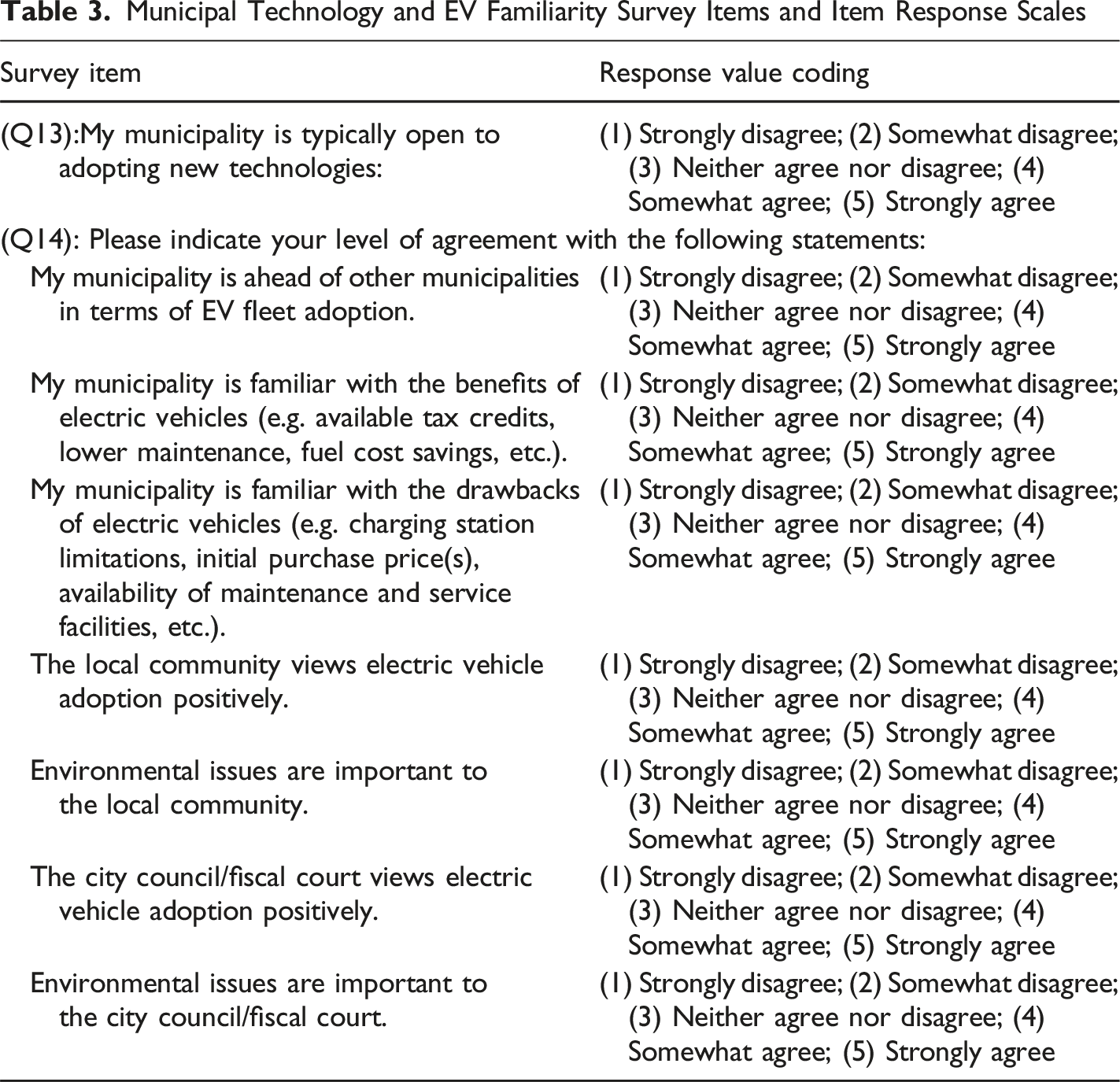
| Survey item | Response value coding |
|---|---|
| (Q13):My municipality is typically open to adopting new technologies: | (1) Strongly disagree; (2) Somewhat disagree; (3) Neither agree nor disagree; (4) Somewhat agree; (5) Strongly agree |
| (Q14): Please indicate your level of agreement with the following statements: | |
| My municipality is ahead of other municipalities in terms of EV fleet adoption. | (1) Strongly disagree; (2) Somewhat disagree; (3) Neither agree nor disagree; (4) Somewhat agree; (5) Strongly agree |
| My municipality is familiar with the benefits of electric vehicles (e.g. available tax credits, lower maintenance, fuel cost savings, etc.). | (1) Strongly disagree; (2) Somewhat disagree; (3) Neither agree nor disagree; (4) Somewhat agree; (5) Strongly agree |
| My municipality is familiar with the drawbacks of electric vehicles (e.g. charging station limitations, initial purchase price(s), availability of maintenance and service facilities, etc.). | (1) Strongly disagree; (2) Somewhat disagree; (3) Neither agree nor disagree; (4) Somewhat agree; (5) Strongly agree |
| The local community views electric vehicle adoption positively. | (1) Strongly disagree; (2) Somewhat disagree; (3) Neither agree nor disagree; (4) Somewhat agree; (5) Strongly agree |
| Environmental issues are important to the local community. | (1) Strongly disagree; (2) Somewhat disagree; (3) Neither agree nor disagree; (4) Somewhat agree; (5) Strongly agree |
| The city council/fiscal court views electric vehicle adoption positively. | (1) Strongly disagree; (2) Somewhat disagree; (3) Neither agree nor disagree; (4) Somewhat agree; (5) Strongly agree |
| Environmental issues are important to the city council/fiscal court. | (1) Strongly disagree; (2) Somewhat disagree; (3) Neither agree nor disagree; (4) Somewhat agree; (5) Strongly agree |