






Abstract
Urban governance relies on data for planning and delivering projects-but data systems are not considered fundamental infrastructure. This paper argues that understanding data as infrastructure is useful in understanding persistent integration challenges in Nigerian cities. Drawing upon comparative qualitative analysis of Lagos, Abuja, and Port Harcourt, analyses the influences of institutional arrangement and technical as well as civic practices on urban data systems. Findings reveal that fragmented platforms, poor data stewardship and limited community generated information limit the coordination and learning across all three cities in different ways. Lagos embodies digital ambition but poor interoperability, Abuja exhibits technical coherence but poor public engagement, Port Harcourt reflects extractive political economies and governance capacity deficits rooted in extractive political economies that produce critical informational blind spots. The paper concludes that treating data as shared civic infrastructure will accelerate adaptive urban governance with broader implications for rapidly urbanizing cities with similar institutional conditions.
Introduction
Urban governance increasingly relies on data to plan, coordinate urban planning projects as well as manage complex urban systems. As cities grow and governance challenges rise, data now influences how land is allocated, infrastructure is delivered, and services are monitored. While physical infrastructure has always played a central role in urban development, the systems that generate, structure and circulate data have become equally important. Kitchin (2014) characterize these systems as socio-technical infrastructure that supports the administrative routines and decision-making processes. When considered as infrastructure, data is not merely an output of the governance process, but a condition that facilitates coordination, learning, and adaptation.
In Nigeria, the role of data in urban governance is quite important. Rapid urbanization, fragmented institutional responsibilities and long-standing governance constraints place heavy demands on planning and project delivery systems (Kleer & Nawrot, 2017). Although there are increasing national and sub-national efforts to focus on digital transformation, urban data systems are often poorly integrated across agencies, have unevenly maintained data, or are too difficult to access (NITDA, 2023; World Bank, 2019). As a result, digital tools and platforms often arise from donor programme, vendor-led projects or short political cycles rather than through coherent data governance strategies (Dano et al., 2019). This creates poor interoperability and a lack of clear stewardship arrangements, hampering coordination between planning and project management, making implementation less transparent, and contributing to weaker implementation (Gujar, 2025; Oladeinde et al., 2023).
Conceptualizing data as infrastructure offers a helpful lens for understanding these challenges. Infrastructure theory emphasizes on infrastructures as relational systems embedded in institutional routines, professional practise and organizational cultures (Star & Ruhleder, 2010). From this perspective, data governance is not metastatic relying solely on technology but also depends on standards, protocols, skills, and mandates that link institutions over time. Fragmented or unstable data infrastructures make it hard to align planning objectives with project execution, limit institutional learning and obscure lived conditions of urban dwellers, especially in informal or under-served areas (Cinnamon, 2019; Edwards, 2013; Janssen & Kuk, 2016; Star & Ruhleder, 2010). Such socio-technical challenges are further compounded in Global South cities that are in the process of rapid urbanization, where digital transformation is challenged by issues of governance fragmentation, skill set deficiencies, and civic exclusion in data processes (Agboola et al., 2026; Agboola & Tunay, 2023).
Insights from the literature on adaptive governance highlight the relevance of well-functioning data infrastructures even further. Adaptive governance requires feedback, iterative learning, as well as integrating different forms of knowledge in the decision-making process (Chaffin et al., 2014; Folke et al., 2005). When data flows are siloed, incomplete or controlled by narrow institutional actors, governance becomes reactive and not adaptive. Poorly governed data systems have the potential to reinforce inequalities, restrict participation, and reproduce existing patterns of spatial exclusion (Cinnamon, 2019; Janssen & Kuk, 2016). In this sense, data infrastructure does not constitute a neutral technical resource but a key site where power, inclusion and coordination are negotiated.
Different configurations of these dynamics are evident in Nigeria’s major cities such as Lagos, Abuja and Port Harcourt. Lagos shows great digital ambition and experimentation yet institutional fragmentation remains. Abuja operates with technically coherent and centralized systems which limit public engagement and feedback. Port Harcourt reflects the impacts of extractive political economies, in which critical data related to the environment and space are often in the hands of private actors, leaving critical informational blind spots in informal settlements. Examining these cities in a comparative manner offers the possibility of identifying not only shared structural constraints but also context-specific changes in how data infrastructures inform planning and project management.
Despite an increasing number of publications and studies about smart cities, open data and digital transformation, there is a lack of empirical analysis of urban data systems, based on data from African cities, but in a way that considers their infrastructure perspective. Much of the available literature focuses on specific technologies, platforms or policy initiatives, and not on institutional conditions that sustain data systems over time. As a result, the interaction of institutional fragmentation, poor data stewardship and low civic inclusion that limits learning, coordination and adaptive governance is not sufficiently explored.
The challenges also need to be interpreted in the broader discussion of digital urban transformation and socio-technical change. Urban governance is not merely a technological change, but re-configuring institutional relations, professional practise and civic engagement patterns, which involves implementing data in various ways (Agboola & Tunay, 2023). Smart city resilience research in fast urbanizing Global South cities has shown that sustainable digital transformation demands adaptive service models that combine technological innovation with inclusive governance structures (Agboola et al., 2026). Specifically, in the Nigerian setting, issues of digital inclusion such as disparities in infrastructure access, skills dislocation, and civic engagement suggest that data systems can reinforce rather than diminish inequalities of the urban environment unless well regulated (Agboola & Nia, 2025). These observations contribute to the significance of seeing data governance not just as a technical or administrative issue but also as a socio-technical challenge of aligning institutions, communities, and technologies.
This study addresses this gap by exploring the implications of treating data as civic infrastructure for the integration of planning and project management in Nigerian cities. It is focused on the institutional arrangements, technical practise, and forms of civic engagement that characterize urban data systems in Lagos, Abuja, and Port Harcourt. This paper argues that persistent failures of coordination in urban governance are not necessarily technical but institutional, embedded in the manner of data infrastructures governance, sharing and maintenance.
The study is guided by four research questions: (1) How are data systems structured within planning and project management institutions in Lagos, Abuja, and Port Harcourt? (2) What institutional, technical, and civic factors facilitate or constrain the development of integrated urban data infrastructures? (3) How do these factors affect the capacity for adaptive, collaborative, and evidence-based governance? (4) What reforms are required to support more anticipatory and inclusive urban planning and project delivery?
By situating Nigerian cities within wider debates on data stewardship, infrastructure theory, and adaptive governance, this paper contributes to urban governance literature by showing how data infrastructures aids proper planning and effective project management integration in rapidly urbanizing cities. Specifically, the study contributes in three ways. In theory, it generalizes infrastructure theory to the context of urban data governance by showing how fragmentation, weak stewardship, and limited civic inclusion interplay in limiting adaptive capacity. Empirically, it presents systematic comparative evidence based on three Nigerian cities which are under-represented in literature on data-driven governance. Policy-wise, it portrays institutional changes needed to facilitate more inclusive and responsive urban planning and project delivery in fast urbanizing Global South cities.
Methods
Research Design
This study uses qualitative research design to examine the use and the organization of urban data systems in planning and project management institutions in Nigerian cities. A qualitative approach is suitable as data infrastructures are socio-technical systems and depend on institutional routines, governance arrangements and professional practices rather than solely technical components.
The study is guided by an interpretive orientation that treats planning institutions as producers and users of knowledge whose activity is created by context, power relations and administrative culture. This approach is widely used in the fields of urban governance and urban planning research, where meaning, interpretation and institutional behaviour cannot be reduced to measurable outputs (Flyvbjerg, 2012; Healey, 2020). It enables the systematic study of how one understands, manages and mobilizes data differently across different governance situations.
Case Study Strategy
A comparative case study approach was adopted with the focus on Lagos, Abuja and Port Harcourt. Case studies are appropriate for studying urban governance as they provide an opportunity to analyse institutional arrangements, decision-making and an interplay across different levels of authority (Yin, 2018). The comparative design allows identifying shared structural constraints and context-specific variations in data governance.
The three cities were chosen because they reflect contrasting arrangements of governance within a common national framework. Lagos is characterized by a high level of digital ambition and complex institutional landscape developed by partnerships of innovation. Abuja has a system of centralized and technocratic planning with relatively coherent internal data practise. Port Harcourt reflects a governance context shaped by extractive political economies, where key environmental and spatial data is often produced outside municipal institutions. Together, these cases offer a basis for analyzing the impact of various institutional settings on the development and use of urban data infrastructures (Obeng-Odoom, 2016).
The case selection was informed by a maximum variation logic of sampling (Yin, 2018), which was guided by three criteria: (i) governance configuration the three cities represent three different institutional arrangements (metropolitan, federal capital, and resource-economy) that enable comparison across different conditions of urbanization in rapidly urbanizing cities; (ii) documentary availability each of the three cities has an adequate amount of policy documents, urban plans, institutional reports, and Although analytical generalization on the basis of three cases is limited by its nature, the comparative design helps to formulate theoretical propositions that can be challenged and refined in subsequent studies (Yin, 2018). The paper recognizes that the results of Lagos, Abuja, and Port Harcourt might not be representative of the situation in secondary Nigerian cities or peri-urban regions and that additional comparative studies are required to confirm the generalizability of the results to other Global South settings.
Each city is considered as an embedded unit of analysis that is located within national regulatory frameworks, state-level responsibilities and sectoral mandates. This enables the study to understand the impact of national digital strategies and planning policies on data practices at a city level (NITDA, 2023).
Data Sources and Document Analysis
The study is based on document analysis as the main method of data collection. Document analysis is a standard qualitative method for analyzing institutional intentions, governance structures and formal rules which govern administrative action (Bowen, 2009). It is especially suited for analyzing data governance in which policies, plans and official reports specify responsibilities, standards and coordination mechanisms.
The documents reviewed include: (1) National, state, and local digital governance policies (2) Urban development plans and transformation frameworks (3) Project management guidelines and procedural documents (4) Institutional reports and official directives (5) Publicly available datasets and service portals (6) Academic and policy studies related to each city
These sources were chosen to reflect how data is formally situated within planning and project management systems, and how responsibilities for data production, sharing, and use are formulated across institutions.
The selection of documents was based on the criteria of direct relevance to the analytical topics of the study interoperability, data stewardship, transparency, and civic inclusion and the representation of various institutional levels (national, state, municipal) and functional areas (planning, project delivery, digital governance). Systematic searches of government portals, academic databases, and institutional repositories were used to identify documents. In cases of multiple sources within the same area of governance, the most recent and most institutionally authoritative sources were given priority. Admittedly, official documents can reflect aspirational, but not operational realities, and can be biased against informal practices, processes of contest, or the views of marginalized communities. To address this weakness, sources were triangulated among the various types of documents that include policy frameworks, project reports, evaluation studies, and independent academic analyses. Cases of inconsistencies between reported policies and recorded implementation results were also noted. The use of publicly available documents implies that internal administrative data and operational practices may not be properly represented; this is admitted in the Research Gaps section.
Analytical Framework and Coding
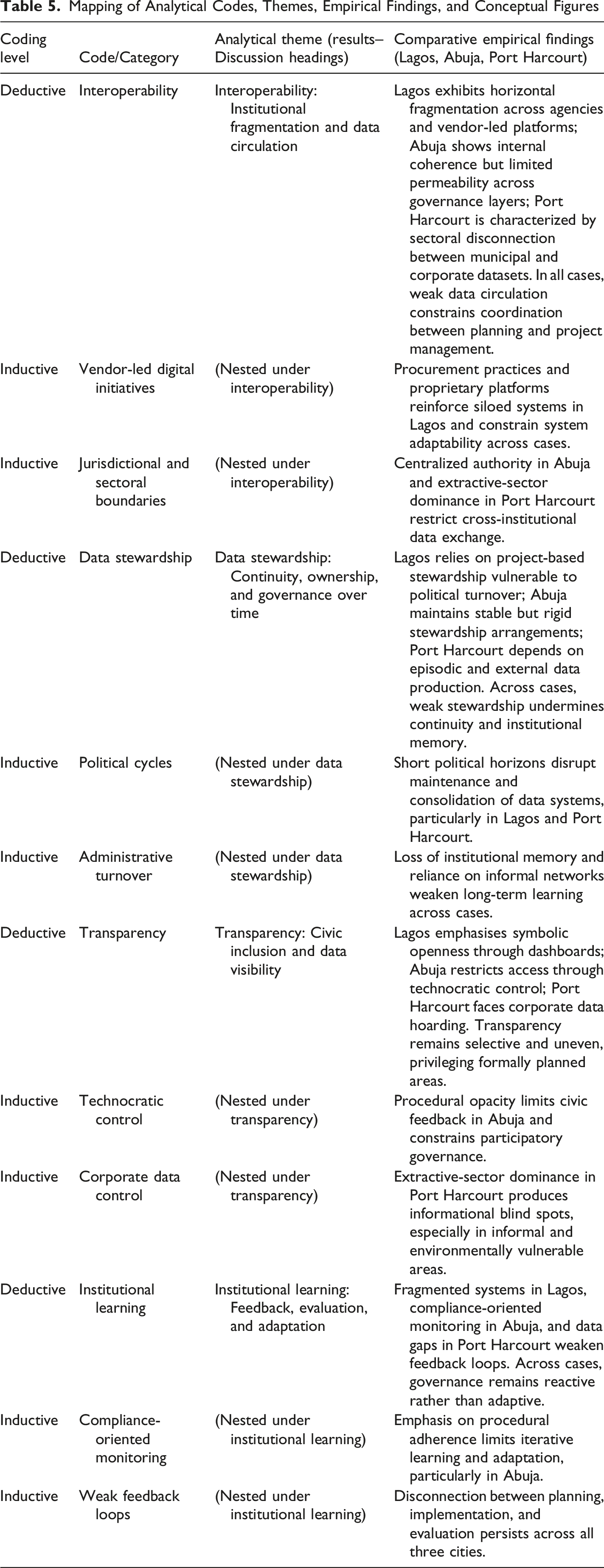
Data analysis was performed using a thematic approach that comprised deductive and inductive coding. Deductive codes were developed based on existing literature on data infrastructures, adaptive governance and digital governance, and around themes of interoperability, data stewardship, transparency and institutional learning (e.g., Chaffin et al., 2014; Folke et al., 2005; Purtova & van Maanen, 2024). These themes provided an analytical framework to offer an infrastructural evaluation of urban data systems.
Inductive coding was utilized to capture context specific dynamics that emerged from the documents such as influence of political cycles, administrative turnover, and vendor led digital initiatives. Coding was performed iteratively, and multiple readings were used to refine the categories and identify patterns across cases.
Through this process, three overall analytical categories were developed: institutional arrangements, technical practise and civic engagement with data. These categories organized the comparative process and contributed to the identification of cross-cutting constraints and opportunities affecting adaptive urban governance.
Relational and Institutional Analysis
Given that infrastructures are relational systems, the analysis focused on interactions between institutions, technologies, and decision-making processes. Particular attention was paid to. (1) Inter-agency coordination and communication pathways (2) Institutional cultures influencing data use (3) Dependence on proprietary vendor systems (4) Integration or exclusion of community-generated data (5) Alignment between planning processes and project delivery routines
This relational perspective reflects the understanding that data infrastructures are sustained through organizational routines, expectations and cooperative practise, rather than through technology alone (Edwards, 2013; Modgil et al., 2021).
The analysis also took into account wider political-economic factors impacting data visibility and control. In some cities, like Port Harcourt, there has been a history of extractive governance arrangements impacting access and ownership of data on the environment and spatial data which contributes to information gaps in informal and marginalized areas (Onyenechere et al., 2022). For instance, recognizing these influences was crucial to explain the continued fragmentation of certain data infrastructures or their exclusionary nature.
Ethical Considerations
The study is only based on publicly available documents and secondary sources and does not include human participants. Ethical considerations were therefore focused around responsible interpretation, transparency and sensitivity to institutional and political context. No individual officials or organizations were blamed. All sources were properly cited and careful attention was given when presenting the cases to show both constrains and capacities in Nigerian urban governance systems.
Results: Comparative Case Analysis
Lagos: Digital Ambition Under Fragmented Data Governance
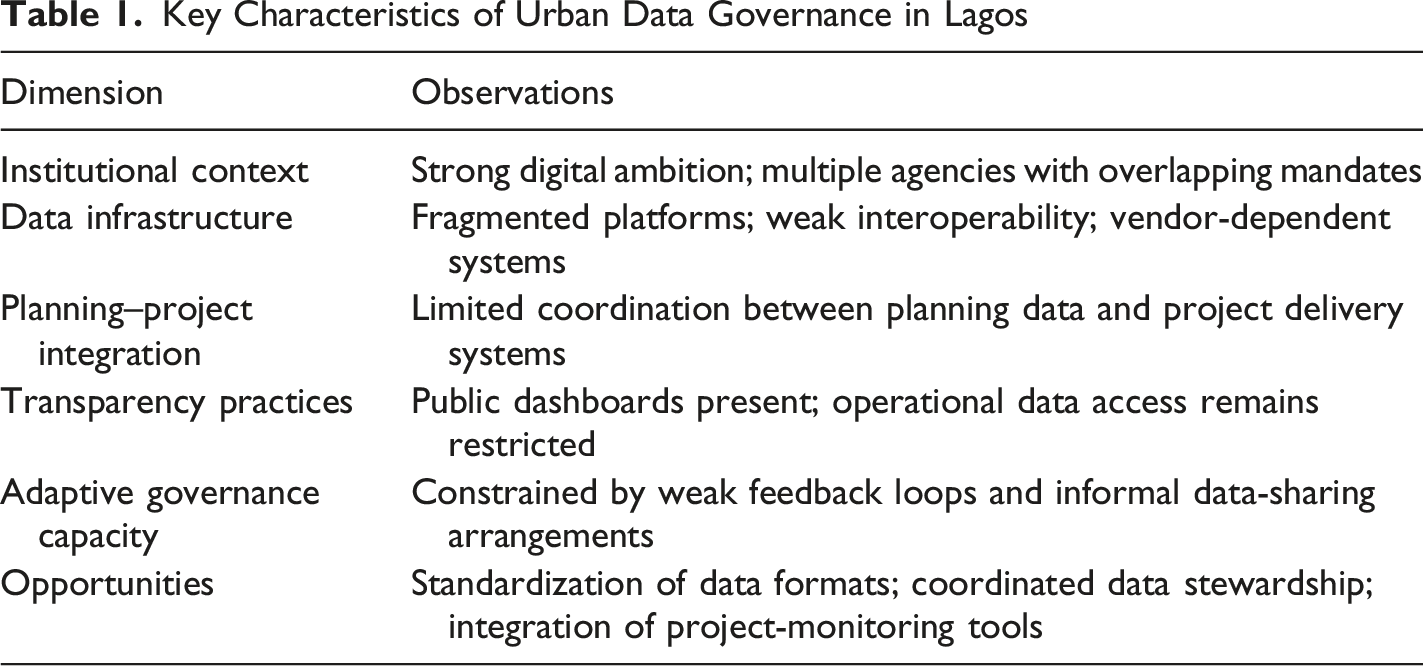
The case of Lagos shows how a lack of institutional coordination around powerful digital ambition can create fragmented data infrastructures, which limit the integration of planning with project management. Policy documents and strategic plans regularly highlight Lagos as a pacesetter in the area of digital innovation, with emphasis on smart city work, platform creation and collaboration with private organizations and universities (Anning-Dorson, 2025; Bello et al., 2024; Soyinka et al., 2016). These initiatives are indicative of the recognition of data as a strategic resource within urban governance.
However, closer examination of the sectoral plans and project documentation shows that most digital systems are constructed inside individual ministries and agencies with different procurement processes, technical vendors and data formats. Data systems for land administration, managing transport, monitoring environment and for social services are operating in large mutual exclusion with limited interoperability. Rather than forming part of a common urban data infrastructure, these systems represent agency specific priorities and short-term project objectives (Adama, 2017; Kitchin, 2014). As an example, the Lagos Metropolitan Area Transport Authority (LAGIS) land administration geographic information system and the Lagos Metropolitan Area Transport Authority (LAMATA) transport information platform is based on two different technical architectures meaning that a cross-sector spatial analysis cannot take place to aid multi-sector planning decisions.
This fragmentation has direct implications on planning and project management. First, the lack of shared standards and protocols limits the circulation of data across institutions, making it challenging to link planning objectives to project implementation. Second, the reliance on proprietary vendor platforms often binds agencies to closed systems, limiting the ability to both integrate data sets or adjust systems over time (Edwards, 2013). These conditions hinder institutional learning and undermine the continuity of the adaptive governance process (Chaffin et al., 2014; Dawes et al., 2016; Folke et al., 2005).
Transparency initiatives in Lagos are another example of such tensions. While there are several public dashboards and open data portals, the data that gets made available is often limited to high visibility indicators instead of operational datasets that were used to implement routine planning and monitoring of projects. This leads to a distinction between symbolic openness and functional openness. In reality, planners and project managers have limited access to integrated datasets to enable cross-sector analysis, performance tracking or iterative learning (Dawes et al., 2016; Folke et al., 2005).
Coordination challenges are being compounded by the metropolitan governance structure of Lagos. Planning responsibilities are spread between many levels of government and specialized agencies. Although the need for coordination is often acknowledged in policy documents, proposed solutions are often to build new platforms or task forces and not to consolidate existing systems. Data sharing hence depends much on informal networks and personal relations between officials, which hampers institutional memory and continuity at times of changing administrative leadership (Soyinka et al., 2016).
Key Characteristics of Urban Data Governance in Lagos
Abuja: Technocratic Coherence With Limited Permeability
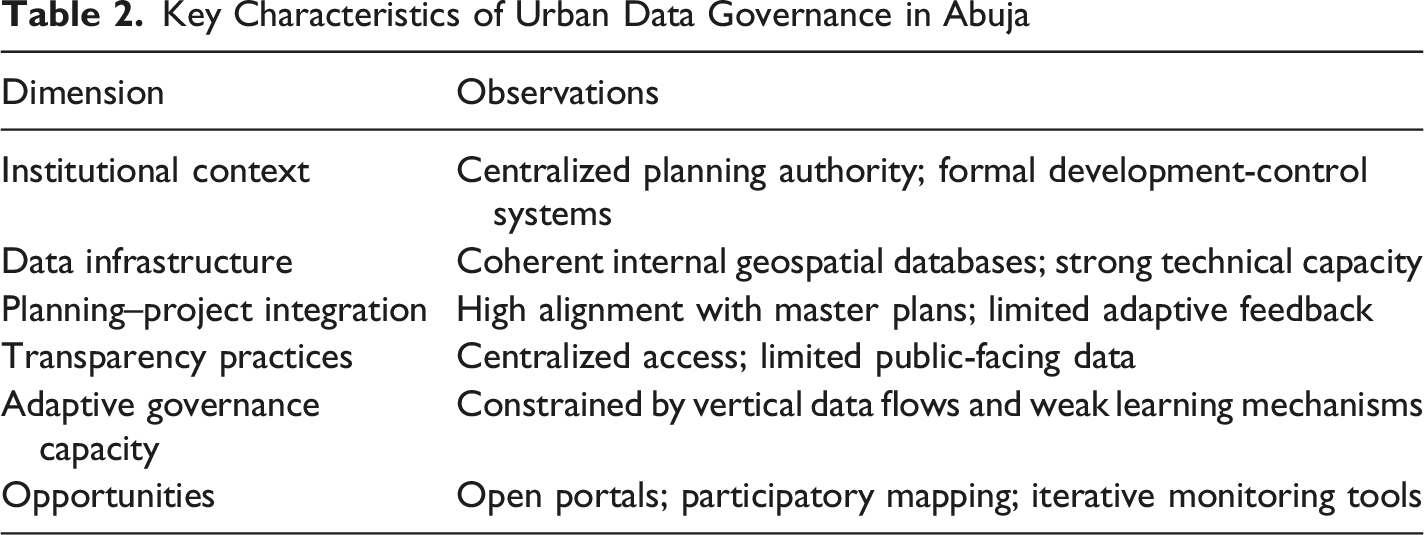
The case of Abuja shows how technically coherent data systems can co-exist with low levels of institutional openness, which limit adaptive governance, despite a strong internal capacity. Urban planning and infrastructure development of Abuja is structured on a centralized authority with formal geospatial databases and committed technical units for land administration and development control (Nor et al., 2020; World Bank, 2019). Policy and technical documents emphasize professional standards, spatial accuracy and procedural compliance and result in relatively consistent internal data practices.
In infrastructural sense, there is a high level of internal coherence in Abuja. Core datasets are kept in a single institutional context, and geospatial information is regularly utilized to determine land suitability, to enforce master plans and control project approvals. Compared to Lagos, this centralization reduces duplication and helps to increase the level of technical consistency. This coherence is however achieved at the expense of permeability.
The circulation of data in Abuja is mainly vertical. Information usually flows from consultants and technical staff to senior officials, with limited flow of information between different institutions horizontally or outward to citizens (Nor et al., 2020). Public-facing data portals and participatory interfaces remain limited in scope, and there is little evidence of the systematic integration of community-generated data or local knowledge into planning processes. As a result, feedback from implementation and lived experience is rarely reintroduced into decision-making structures in a structured manner, undermining institutional learning (Chaffin et al., 2014; Folke et al., 2005). The Abuja Metropolitan Master Plan update relied largely on technical surveys and consultants’ reports with only limited scope for participatory data gathering from the impacted communities showing how technocratic coherence can fall prey to procedural compliance over adaptive feedback (Abubakar, 2014; Olokesusi et al., 2019).
Project management procedures exemplify this trend even more. Formal guidelines specify sequential phases of initiation, design, procurement and supervision supported by space data to ensure that they align with statutory plans. Evaluation practices, however, are mostly compliance oriented. Monitoring involves focusing on the adherence of predefined plans and technical specifications rather than on adaptive performance indicators or iterative review (Cairney & Toomey, 2024; Flyvbjerg, 2012; Healey, 2020). This limits the ability for projects to respond to conditions, unforeseen impacts or emerging social needs (Flyvbjerg, 2012; Healey, 2020).
Transparency and public trust are among the other challenges. The importance of data protection, privacy, and information use by citizens are recognized in national policies (Chika & Tochukwu, 2020; NITDA, 2023) and yet access to urban data in Abuja is extremely centralized. Limited publication of project by level data, budgets or spatial indicators contributes to perceptions of opacity, even where formal rules are followed. This undermines incentives for citizen participation, and diminishes the possibility of collaborative data practices that foster adaptive governance (Olokesusi et al., 2018).
Key Characteristics of Urban Data Governance in Abuja
Port Harcourt: Extractive Governance and Informational Blind Spots
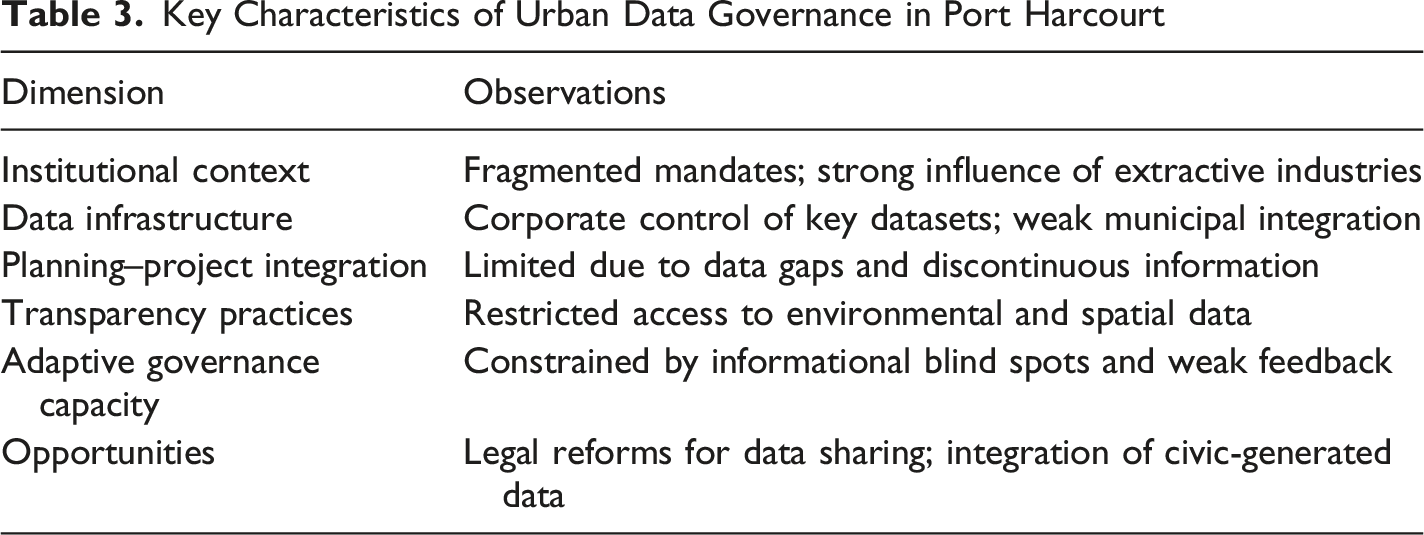
The Port Harcourt case points to the socio-political economic relationships of extractive domains and the consequent visibility, coordination and adaptive governance of urban data infrastructures. Planning authorities work within a context in which critical information on key environmental and spatial data, specifically related to land use, pollution and infrastructure, is often developed and owned by private actors in the oil and gas industry rather than by the municipal institutions (Echendu, 2021; World Bank, 2019). As a result, massive amounts of potentially relevant data are still outside of public planning systems.
Policy documents and project reports suggest that there are fragmented mandates and overlapping responsibilities between municipal, state, and federal institutions. Coordination issues, jurisdictional disputes, and resource constraints are reoccurring themes, indicating a lack of a stable institutional structure for data governance (Unegbu et al., 2024). Where planning authorities have no continuous access to environmental and social data, they rely on periodic studies or externally-funded surveys, which is challenging to update and rarely combined into ongoing data infrastructures; (Bernardo et al., 2024; Edwards, 2013). These conditions are indicative not just of technical inability but of more profound deficiencies of governance capacity due to decades of extractive political economy that has made institutional focus and resource allocation work towards hydrocarbon income instead of integrating municipal data systems.
Due to these institutional conditions, there are large information blind spots, especially in informal settlements and peri-urban areas. Secondary sources and planning documents reveal that many of the waterfronts and low-lying communities that are important to the social and economic life of the cities are not well represented in official maps and their datasets (Satterthwaite et al., 2020). An analysis of the development corridors of Greater Port Harcourt City revealed that about 40% of the built-up space in the waterfront neighbourhoods were not registered in municipal GIS databases (Onwuzuligbo et al., 2023), which is a representation of the level of informational exclusion caused by a breakdown in governance. Lack of systematic data on population density and housing conditions, and exposure to environmental risks, limits the ability of planners and project managers to prioritize interventions or assess the impact of projects. Consequently, infrastructure projects end up preferring formally recognized neighborhoods where data are more available and political risk lessened.
At the same time, civic and academic processes have arisen to address these gaps. Participatory mapping exercises conducted by civil society organizations and research institutions have produced rich spatial information on the location of informal settlements, local assets and environmental risks (Americo et al., 2024). These initiatives show the potential of community-generated data to improve the knowledge of cities and enable more inclusive planning. Institutional mechanisms for including such information in official planning and project management processes are, however, still weak. Community generated datasets tend to circulate outside the formal structures of decision-making and outside recognized status in municipal systems, which limits influencing decision making processes on project selection and design (Flyvbjerg, 2012; Healey, 2020).
Key Characteristics of Urban Data Governance in Port Harcourt
Cross-Cutting Patterns: Fragmentation, Stewardship, and Inclusion
Comparative analysis of Lagos, Abuja, and Port Harcourt reveals three interrelated patterns shown by how urban data as infrastructure for planning and project management can be described as fragmented institutional political control, weak data stewardship, and limited civic inclusion. Although these patterns are manifested in different ways in different cities, it has similar governance outcomes through constraints on coordination, learning, and adaptation. Collectively, they show that the major obstacles to adaptive urban governance are institutional rather than technical in nature.
Fragmentation as a Systemic Condition
Fragmentation is apparent in all three cases but it is of a different form. In Lagos, fragmentation is predominantly horizontal, reflecting the proliferation of agency-specific platforms with limited interoperability. In the case of Abuja, it is vertical fragmentation, aggregation of data within a central authority, and poor circulation between institutional and societal boundaries. In Port Harcourt the fragmentation is sectoral from separation of corporate-controlled environmental data from municipal systems engaged in planning.
Despite these differences, the effects are the same. Data still exists in the silos of institutions, as a result, such planning functions have not been integrated with project delivery routines. The lack of common standards, non-interoperable architectures and unenforceable coordination protocols restrict the reuse of data across policy domains. This finding aligns with insights from infrastructure scholarship, which argues that data coordination does not require a large amount of available data, but instead depends on the organizational arrangements that facilitate the circulation of data between different contexts (Edwards, 2013; Star & Ruhleder, 2010).
From the adaptive governance perspective, fragmentation undermines feedback loops. Planning data, implementation data and knowledge of the context are disconnected, so institutions are limited in the way they do revise their plans, adapt projects or deal with emerging risks. This is consistent with findings that have been established on the importance of adaptive governance processes requiring that information systems should be used to link planning, implementation and evaluation (Chaffin et al., 2014; Folke et al., 2005).
Weak Data Stewardship and Institutional Continuity
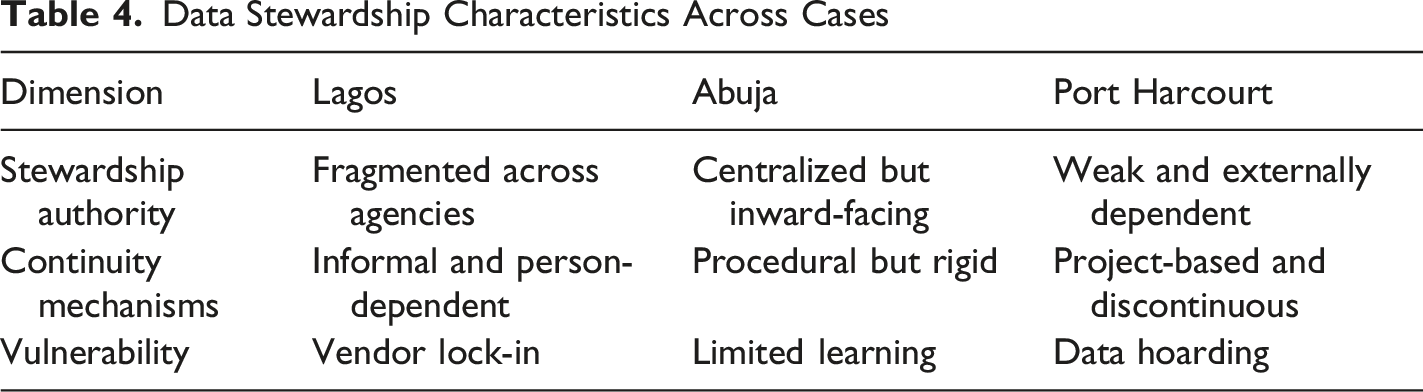
A second recurring theme is poor data stewardship. Across the three cities, responsibility for maintenance, upkeep, and governance of datasets tends to be ambiguous, inconsistently managed, and project-specific. Even where technical units exist, they often do not have the authority, stable funding or cross-sector mandate to enforce standards or guarantee continuity.
In cumulative effect is this weakness. Digital initiatives are frequently implemented as isolated projects without explicit integration into existing data constructions. Over time, this leads to the creation of parallel systems, redundant datasets, and tools which become obsolete when funding or political support runs out. Similar dynamics have been noted where digitalisation is progressing at a faster pace than institutional capacity (Chika & Tochukwu, 2020; World Bank, 2019).
Data Stewardship Characteristics Across Cases
Limited Civic Inclusion and Uneven Knowledge Production
Third pattern is related to limited civic inclusion in data governance. While all three cities show some type of data practise in how they incorporate public-facing data, none shows an advanced model of a co-produced data infrastructure. Lagos has emphasized visibility in the form of dashboards, Abuja focuses on technocratic control and Port Harcourt relies on civic mapping initiatives which remain on the margins in relation to formal planning systems.
Exclusion of community-generated data has serious implications on adaptive governance. Adaptive systems rely on various types of knowledge such as local knowledge and situated knowledge in order to identify emerging problems and update the interventions (Healey, 2020). Where data infrastructures do not represent informal settlement, environmental risks or lived conditions, planning and project management works to prioritize areas where they are already visible and formally documented. This reproduces spatial inequality and limits institutional responsiveness.
These findings align with studies on data inequality, which show that uneven data production and access can help to reinforce power asymmetries and marginalize certain populations from decision-making processes (Cinnamon, 2019; Janssen & Kuk, 2016).
Converging Implications for Adaptive Governance
Although Lagos, Abuja, and Port Harcourt differ in terms of political economy and institutional capacity, the convergence of fragmentation, weak stewardship and a lack of inclusion point to a similar governance challenge. Adaptive urban governance requires data infrastructures, which are integrated across institutions and sustained over time, and open to various forms of knowledge. Where these conditions are not met, governance systems are still reactive, compliance-oriented and woefully unable to manage rapid urban change.
Mapping of Analytical Codes, Themes, Empirical Findings, and Conceptual Figures
Discussion
The comparative exercise of Lagos, Abuja, and Port Harcourt provides results that go beyond the particular examples to provide structurally recurrent issues of the urban data governance. Although every city is a reflection of a unique set of institutional capacity, political economy, and civic activity, convergence on fragmentation, weak stewardship, and constrained points of inclusion is indicative of shared systemic conditions, likely applicable across a broader set of rapidly urbanizing cities.
Data Infrastructure as a Socio-Technical Governance Challenge
One of the key contributions of the present research is that breaches of city data governance are not technological, but rather soci-technological and institutional. As indicated in the three cases, the high technical aptitude as the Abuja present case of geospatial databases fails to produce adaptive governance results in instances where institutional structures of sharing data, receiving feedback, and civic inclusion are still underdeveloped. Instead, even the high degrees of civic experimentation such as in certain community mapping projects in Port Harcourt are not enough to increase the desired results of planning without any form of formal integration. This result confirms the socio-technical systems view, which reiterates that technology is effectively infrastructure only through facilitating institutional and social configurations (Agboola & Tunay, 2023; Edwards, 2013; Star & Ruhleder, 2010).
The implications of this view on the theorisation and pursuit of digital transformation of urban governance are significant. Agboola et al. (2026) show that the adaptive urban service structures in the rapidly urbanizing cities have to be sustainable by combining the smart technologies with the responsive institution structures. This applies to the Nigerian context where digitalization initiatives have been traditionally catalyzed by donor programme, vendor-priced acquisition, and sporadic political time-frames which implies that technical infrastructure investments are not enough. Systems of governance where stewardship functions, interoperability, and civil participation systems are clearly defined are also essential to attaining adaptive results (Agboola & Nia, 2025).
Towards Transferable Governance Mechanisms
Based on the cross-case analysis, three transferable governance mechanisms arise pertinent to the urbanization that is fast and cities in the Global South. First, instruments of shared data stewardship formalize agreements defining the roles in data maintenance, quality assurance, and sharing across agencies as a basis of infrastructure sustainability. The comparative evidence indicates that in absence of such arrangements, digital acts are still ad hoc and are prone to disruption by politics and government. Second, common data standards, open application programming interfaces, and shared technical architectures are needed, so that data flow across institutional borders is enabled without necessarily centralizing the whole system. Third, effective mechanisms of civic data integration formalize the processes by which community generated data, participatory mapping, and local knowledge become part of the planning process so that adaptive governance systems respond to various and rapidly evolving urban situations.
These forms of governance are not new to the literature but the kind of interdependence that they have with each other, as evidenced by the Nigerian cases, is novel. The lack of stewardship in interoperability results in the creation of institutionally ungovernable systems of technical compatibility. Civic inclusion creates coherent but closed data regimes when stewardship is practiced. And interoperability with civic inclusion provides abundant of individual data sets that cannot guide scaled planning. The combination of these three mechanisms to create effective adaptive governance is a lesson that has a wide applicability to similar contexts in urban governance.
Urban Data Governance as Part of Broader Socio-Technical Transitions
The results of this research can be profitably explained within the context of more general socio-technological changes in urban areas. The useful conceptual reference in this case refers to the calm mobility paradigm, which is created in the adoption of sustainable urban mobility transitions. Sustainable urban change is enabled by predictable, inclusive, and well-coordinated governance structures that minimize institutional volatility and allow long-term learning as theorized by recent work on urban mobility transitions to move beyond policy uncertainty and prominence towards the calm mobility paradigm (Süle et al., 2026; Turoń, 2025). When applied to the data governance situation, this framework implies that not only does the move towards adaptive urban governance need technical enhancements but that establishment of stable, trustful, and participatory data-oriented institutions is needed, which we could refer to as a calmer form of data governance orientation that prioritizes reliability, inclusiveness, and institutional learning, rather than turbulent cycles of politically-inspired digital projects.
This framing helps relate the results of the study to general discussion of institutional reliability and citizen trust in urban governance. According to Healey (2020) an absence of trust in administrative transparency and fairness prevents collaborative planning because citizens are not confident in the impartiality of administrative systems. The lack of transparency in data availability in all three cases in Nigeria, be it the symbolic dashboard systems in Lagos, the technocratic governance in Abuja, or the hoarding of corporate information in Port Harcourt, undermines the civic trust that adaptive governance relies on. The development of more open, accountable, and participative data infrastructures is thus not merely a technical or institutional challenge but a political one, which entails the selective redistribution of information power to citizens and communities.
Implications for the Global South
Though, the area of the study is Nigerian cities, the patterns found are generalized to urbanizing rapidly cities in sub-Saharan Africa and Global South in general. The numerous cities in this group experience similarities in governance fragmentation, digitization outpacing institutional capability, and civic marginalization in data practices (Chirisa et al., 2024; Obeng-Odoom, 2016). These findings indicate that generic smart city models, which are popularly formulated and suited to contexts with high institutional capacity and effective legal structures, need to be modified considerably to suit cities where informal governance, extractive political economies and poor interoperability are structural factors and not transitional issues.
To the urban planners and the project managers of the public-sector in such settings, the most important learning is that even governance of the data is a kind of governance infrastructure, which must be approached with as much mindful care and investment as tangible infrastructure. Pilot projects to prove the value of shared stewardship, civic data integration and open interoperability standards can be better access points to reform than any digital transformation programmes that are both faster than institutional capacity and civic trust (Peter, 2021).
Conclusion
The infrastructure approach to data is essential in improving the coordination in such cities as Lagos, Abuja, and Port Harcourt in Nigeria. Such challenges as lack of technical capacity and the necessity to work together in institutional frameworks are observed. The research provides urban planners with four priorities: the development of dedicated units of data stewardship, interoperability datasets based on open standards, formal mechanisms to incorporate community-generated data, and regulatory frameworks of data sharing of the private sectors. The changes are meant to change towards integrated data systems that facilitate adaptive urban governance. The lessons can be applied outside of Nigeria, as it can provide insights and help cities that are rapidly urbanizing in the sub-Saharan African region and Global South to enhance the data governance frameworks.
Research Gaps and Further Studies
The research is limited in its reliance on document-based analysis and these limits understanding of how urban data infrastructures are enacted in day-to-day planning and project management practices. Future studies could include interviews, observation or mixed methods which could explore how data is interpreted, negotiated and operationalized by practitioners outside formal policy frameworks.
Although fragmentation, weak data stewardship and limited civic inclusion are identified as some of the key constraints on adaptive governance, their implications are not empirically measured. Further studies could consider how changes in data integration and governance arrangements relate to the project delivery, institutional learning and service outcomes over time.
The focus on Lagos, Abuja, and Port Harcourt also limits the inferences. Comparative research, with either secondary cities or peri-urban areas or cities in different Sub-Saharan African contexts, would aid in determining whether these patterns are indicative of some broader structural conditions or context-specific dynamics.
Further research is required on the role of private vendors and actors in the extractive sector on urban data infrastructures, especially around data ownership, interoperability and accountability. Empirical examination of institutional experiments such as shared data stewardship frameworks or the formal integration of community-generated data would contribute towards a further understanding of how data infrastructures can help promote adaptive and inclusive urban governance.
Footnotes
ORCID iDs

Ethical Considerations
This study is only based on document analysis and does not involve human participants. Ethical considerations in relation to responsible interpretation and transparency were followed. There was no need for ethical approval.
Funding
The authors received no financial support for the research, authorship, and/or publication of this article.
Declaration of Conflicting Interests
The authors declared no potential conflicts of interest with respect to the research, authorship, and/or publication of this article.
Data Availability Statement
All data for this study was obtained from publicly available policy documents, urban plans, institutional reports and academic literature. No proprietary, confidential or personally identifiable data were used. Other references are available on request.