






Abstract
This study examined the effects of two social skills interventions, Sociodramatic Affective Relational Intervention (SDARI) and Skillstreaming, to compare their treatment mechanisms, social performance- and knowledge-training. A total of 13 youth with autism spectrum disorders were randomly assigned to 4 weeks of 1-day/week SDARI or Skillstreaming. Groups were matched on parent and child demographics, and intervention staff training. Participants were assessed on social behavior during treatment sessions, peer sociometrics, staff-reported social skills, and parent-reported social skill generalization. Results indicated that both groups increased in reciprocated friendship nominations and staff-reported social skills. Relative to Skillstreaming participants, SDARI participants liked and interacted more with each other after a single session. However, Skillstreaming participants increased in peer liking and interaction over the course of the intervention; SDARI participants decreased slightly. Parents reported no change in social functioning at home. Implications for research and practice are discussed.
Keywords
Among youth with autism spectrum disorders (ASD), difficulties in the social domain are considered a pathognomonic feature. This is particularly so for individuals who are considered to have high-functioning ASD (HFASD), for whom social difficulties are pervasive and related to emotional and behavioral problems, but not verbal ability (Carter et al., 2005). Crucially, these deficits are largely treatment refractory, and so efforts to design appropriate interventions to remediate them have proliferated.
Although social skills interventions (SSIs) for individuals with HFASD have existed for more than 20 years (e.g., Mesibov, 1984), a recent increase in interest has led to a surge in their evaluation (Matson, Matson, & Rivet, 2007; Rao, Beidel, & Murray, 2008; White, Keonig, & Scahill, 2007). Across these studies, effect sizes have varied widely in terms of target outcomes (i.e., social behavior during the treatment session vs. generalized prosocial behavior) and methodologies (i.e., cognitive-behavioral, role-play, modeling). Although SSIs for school-age children with ASD have been deemed evidence-based practice, particularly for the outcome of social behavior during the treatment session (Reichow & Volkmar, 2010), specific techniques, approaches, and theories that may be optimal remain unknown. This is especially true for individuals with HFASD.
Gresham (1997) provided a taxonomy of why some children fail to engage in appropriate reciprocal social behavior. He distinguished between social acquisition deficits (referred to here and elsewhere as social knowledge deficits), in which children lack knowledge of the social behaviors they should perform, and social performance deficits, in which children know the social behaviors they should perform, yet fail to do so. In terms of intervention, SSI strategies focus either on didactically presenting social knowledge that is presumed to be lacking or on evoking social behavior that may be known but not appropriately enacted (White et al., 2007). This distinction represents a difference in treatment mechanisms, the comparative effectiveness of which may best be assessed via the use of randomized-controlled trials (RCT), which are ideal for limiting influences of individual participant-related characteristics in this population and isolating specific treatment-related differences (Smith et al., 2007). Such investigations are a critical step in improving SSIs by identifying the most effective treatment strategies (Kazdin, 2007).
Social Knowledge Training
To date, despite a purported emphasis on social knowledge and performance (White et al., 2007), most SSIs for youth with HFASD have focused on social knowledge training via strategies such as social scripts, structured teaching, and reinforcement of specific desired behaviors (Goldstein & McGinnis, 1997; Laugeson, Frankel, Mogil, & Dillon, 2009; Matson et al., 2007), and are consonant with the social knowledge deficit model of social problems. Such interventions are widely used for individuals with HFASD.
A prominent knowledge-based SSI is Skillstreaming, which focuses on teaching correct behavioral steps to use in specific social situations (Goldstein & McGinnis, 1997). Skillstreaming focuses on didactically training the discrete steps of social interaction that youth with social problems may not know (Goldstein & McGinnis, 1997). Although there are some elements (e.g., role-play) that involve active practice of social engagement, they are focused on reinforcing the otherwise explicitly instructed social skills. The Skillstreaming manual contains 50 target skills such as “Understanding the Feelings of Others.” For this skill, didactic instruction focuses on attending to the other person and interpreting his or her body language. Each skill is presented in eight steps: (a) define the skill, (b) model the skill, (c) establish skill need, (d) to (f) engage in role-play, (g) provide feedback, and (h) assign skill homework.
This approach has been studied for a wide array of populations, focusing on a myriad of target skills, including assertiveness among youth with intellectual disability (Fleming, 1977), and social skills in withdrawn inpatients (Gutride, Goldstein, & Hunter, 1974). Controlled trials (Lopata et al., 2010) have found significant Skillstreaming effects for youth with HFASD on parent- and staff-reported social skills measures, as well as family-reported satisfaction, indicating that this is among the most research-supported knowledge-training SSIs.
Social Performance Training
Largely social performance-based approaches for promoting social skills also have been investigated (e.g., Gutstein, Burgess, & Montfort, 2007). Researchers have documented promising results for improving social cognition (Corbett et al., 2011), increasing self-initiated social contact and duration of social interaction (LeGoff, 2004) and social skills (Legoff & Sherman, 2006). There also has been evidence of skill generalization and maintenance, demonstrating changes in social functioning relative to matched clinical comparison groups that endured at several weeks post treatment (Lerner, Mikami, & Levine, 2011) and after multiple years of both groups receiving intervention (Legoff & Sherman, 2006).
A promising performance-based SSI is Sociodramatic Affective Relational Intervention (SDARI), which focuses on the use of specialized games to promote social motivation and creativity (Lerner et al., 2011; Lerner & Levine, 2007). SDARI is designed to provide participants the experience of successfully engaging in a target social skill, with minimal didactic instruction or instrumental reinforcement of that skill (Lerner & Levine, 2007). Rather, the goal of the intervention is to use activities that may be intrinsically reinforcing to motivate successful interactions. The SDARI manual contains more than 100 games targeting specific social goals (Lerner, Girard, Culp, Cruwys, & Levine, 2007), such as interpretation of body language and perspective taking. For instance, Lerner et al. (2011) described a game called “gibberish,” in which one participant speaks in nonsense sounds instead of words while “describing” how to perform a common task. Another participant must watch and translate the gibberish into words for the others. Participants are encouraged to shift the focus from rote practice (as in a role-play) to interpretation of the subtle nonverbal information being conveyed.
Although this intervention has been used in a community-based clinical context to address social problems for many populations (Lerner & Levine, 2007), the primary focus has been on youth with HFASD. For this population, researchers have found sustained treatment effects for emotion identification, social assertion, and reduced social problems (Lerner et al., 2011); autistic impairment in social settings (Lerner, Spies, Jordan, & Mikami, 2009); social anxiety (Lerner, Calhoun, & Mikami, 2009); and social comfort and client satisfaction (Lerner & Levine, 2007; Pierce, Malavich, & Grieves, 2010).
Because of their demonstrated promise for efficacy in clinical practice and emerging empirical support, Skill- streaming and SDARI represent prime candidates for examining the relative efficacy of performance- and knowledge-training SSIs. As they are not routinely combined, are amply distinct in the activities in which participants engage, and target analogous outcomes, they are ideal SSIs with which to compare their discrete treatment mechanisms.
We are aware of only one previous study that has attempted such a comparison. This study did so by examining a direct teaching (knowledge-training) group and an unstructured play (potentially performance-training) group (Kroeger, Schultz, & Newsom, 2007). The researchers found that both groups improved in terms of prosocial behavior, while the direct teaching group made relatively greater social skills gains. Although this study provides a useful foundation for future research, it has several key limitations. First, the control group received no instruction, rendering it unfit to be considered a bona fide performance-training group. Next, Kroeger, et al., (2007) were unable to accomplish true random assignment, limiting their ability to capitalize on methodological strengths of RCT (Smith et al., 2007). Finally, participants were 5 years old, much younger than the age for which SSIs for HFASD populations are evidence-based (Reichow & Volkmar, 2010).
The goal of the present study was to compare the effects of SDARI and Skillstreaming groups on youth with HFASD. Crucially, this does not represent a “race” study (Wampold et al., 1997, p. 203), in which one SSI is designed to best the other, but rather an initial attempt to disentangle the relative effectiveness of knowledge- and performance-based SSI techniques. As such, and because this study has no direct precedent, the specific aims were considered exploratory, and hypotheses were specified nondirectionally.
Our first aim was to compare effects of SDARI and Skillstreaming on social behavior during the treatment session. We sought to examine differences in change over time in observed social behavior, child-reported peer relations (sociometrics), and intervention staff-reported social skills. Our second aim was to compare effects of SDARI and Skillstreaming on generalized social behavior at home. We assessed change over time on two standardized parent-report instruments.
Method
Participants
A total of 13 boys with HFASD and their parents (see Table 1 for demographic information) were recruited to participate. They were contacted via community-based lists of families of children who had received a previous HFASD diagnosis. Of 21 parents who expressed interest, participants represent the families who met inclusion criteria (HFASD diagnosis), and who provided consent and child assent. All families produced documentation of a previous HFASD diagnosis from a licensed professional. To support the validity of the diagnosis, participants’ scores were compared with clinical cutoffs on the Social Communication Questionnaire (SCQ; Rutter, Bailey, & Lord, 2005) and Social Responsiveness Scale (SRS; Constantino & Gruber, 2005). We acknowledge that the Autism Diagnostic Interview–Revised (Lord, Rutter, & Le Couteur, 1994) and Autism Diagnostic Observation System (Lord, Rutter, DiLavore, & Risi, 1999) are considered “gold-standard” diagnostic tools for ASD populations in research. However, high correlations between the SRS, SCQ, and these instruments (e.g., Corsello et al., 2007) led us to conclude that an individual exceeding recommended cutoffs on both of these instruments met sufficient diagnostic criteria. All participants met SCQ cutoffs, but two participants failed to meet SRS cutoffs; analyses were rerun excluding these participants, obtaining similar results. Table 1 contains demographic variables for the participants.
Parent, Child, and Intervention Staff Demographic Variables by Condition
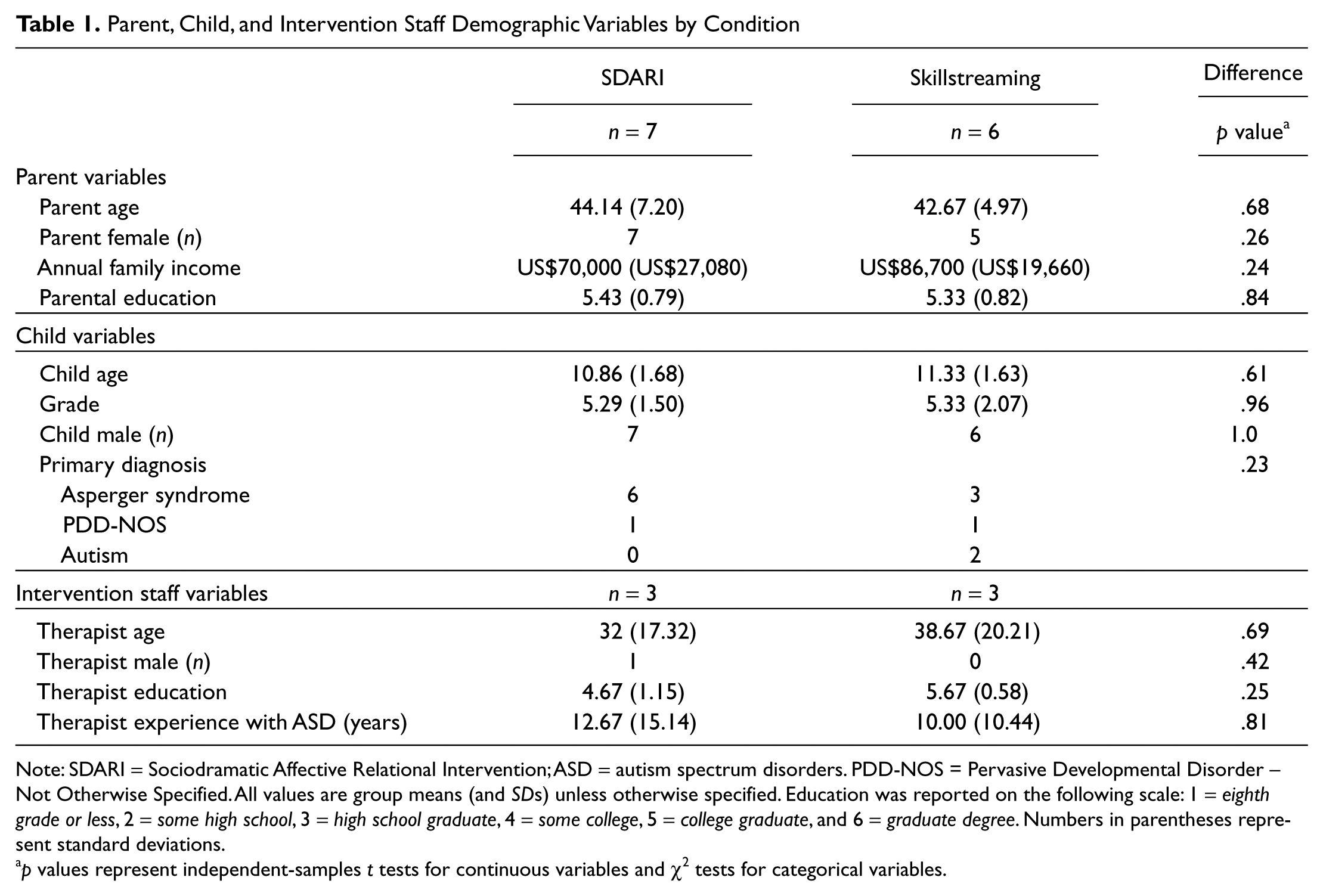
Note: SDARI = Sociodramatic Affective Relational Intervention; ASD = autism spectrum disorders. All values are group means (and SDs) unless otherwise specified. Education was reported on the following scale: 1 = eighth grade or less, 2 = some high school, 3 = high school graduate, 4 = some college, 5 = college graduate, and 6 = graduate degree. Numbers in parentheses represent standard deviations.
p values represent independent-samples t tests for continuous variables and χ2 tests for categorical variables.
Condition Assignment
As we aimed to assess the relative efficacy of two interventions designed to address the same outcomes, we sought to employ the study methodology best suited to these goals. Researchers have called for increased use of RCT in SSIs for youth with HFASD (Rao et al., 2008). RCT is an approach to group-based, between-subjects treatment design in which participants are randomly assigned to condition (to control for selection effects), with the randomization procedure aimed at producing equivalent groups along all baseline and demographic measure (to ensure that differences between conditions are attributable to differences in treatments and not sample characteristics; Smith et al., 2007). Ideally, studies employ a bona fide control (Wampold et al., 1997) thought to be at least as effective as what the participant might otherwise receive. Using a RCT in this way can help elucidate relationships between the differing theories associated with specific treatment conditions and the unique outcomes produced by each (Westen, Novotny, & Thompson-Brenner, 2004).
Procedures
Participants were randomly assigned to either SDARI or Skillstreaming SSI conditions. Parents were kept unaware of their child’s treatment assignment for the duration of the study, being told only that their child was being assigned to one of two conditions in a free-treatment study, with both conditions believed to improve social skills in different ways. SSIs took place in 90-min meetings, once per week after school for 4 weeks. Each meeting included two 40-min sessions, using abridged versions of the SDARI and Skillstreaming curricula, covering 8 goals (matched between groups; see Table 2). Although typical SDARI after-school sessions cover 10 goals over 10 weeks and Skillstreaming groups may last up to 1 year, neither manual specifically indicates that the typical treatment duration should be necessary to produce effects.
Session Topic and Content by Condition
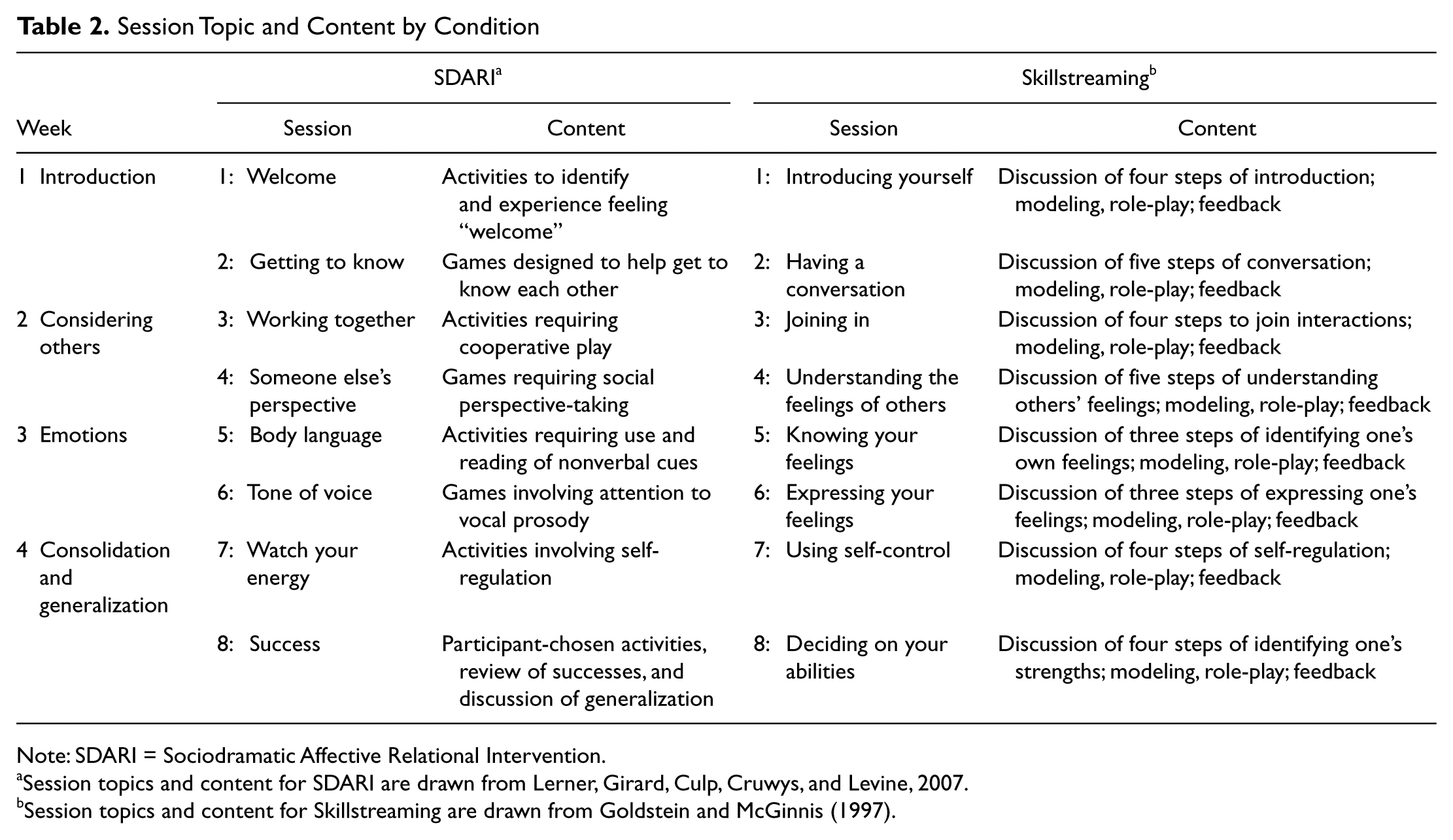
Note: SDARI = Sociodramatic Affective Relational Intervention.
Session topics and content for SDARI are drawn from Lerner, Girard, Culp, Cruwys, and Levine, 2007.
Session topics and content for Skillstreaming are drawn from Goldstein and McGinnis (1997).
There was a 10-min break in the middle of each session. During this videotaped break, interactive and solitary game materials (e.g., cards, balls, Legos®) were provided, and participants were permitted to play freely. Three intervention staff members were assigned to each group based on availability and with an attempt to balance level of previous training across conditions (see Table 1). All staff received the manual for their assigned intervention, 3 hr of training in intervention procedures, and weekly supervision in intervention administration and behavior management.
Multimethod outcome data collection was performed. First, parents completed standardized measures of their children’s social functioning before and after the SSI. Second, intervention staff completed a standardized measure of each child’s social functioning after the first and last sessions. Third, peer preferences and reliable observational coders were used to assess prosocial behavior within sessions. Finally, parents completed a posttreatment questionnaire to determine whether they remained unaware of their children’s condition assignment through the study.
Fidelity
All intervention staff members completed two 35-item self-report fidelity measures at the end of each meeting, one for each of the two sessions that took place each week. This measure included two sections, the first of which focused on manual fidelity (activities completed in the session were indicated in the treatment manual), capturing program adherence and exposure (Dane & Schneider, 1998), and required a binary response. The second section captured conceptual fidelity (how much intervention staff members adhered to knowledge- or performance-training principles), capturing program adherence and differentiation (Dane & Schneider, 1998). It was answered on a 1 (almost never) to 5 (almost always) scale, with higher values indicating more performance- and less knowledge-training (e.g., “we used activities that allow students to develop a collaborative, pretend world together”). An overall conceptual fidelity scale was calculated, with excellent internal consistency (α = .894).
Measures—Social Behavior During the Treatment Session
Social interaction observation system (SIOS)
The SIOS (Bauminger, 2002, 2007a, 2007b) is an observational measure designed to examine positive (e.g., “the child offers his or her objects to another child or shares an object with another child”), negative (e.g., “the child behaves in malicious intrusive ways toward peers”), and low-level (e.g., “the child looks at the other child’s face or body, or child’s action, without establishing eye contact”) social interactions of youth with HFASD. Raters observe social interactions for a series of fixed time segments and rate a maximum of three characteristic behaviors within a given segment. These behaviors may be distributed across the three social interaction scales or concentrated in only one or two; they also may be absent, giving a segment a rating of zero (no social interaction). For the current sample, raters observed tapes of the unstructured peer interaction during the midsession “break time.” They coded 8-min samples, with 60-s coding segments. These sample lengths were used to capture the core of the 10-min break times, while minimizing factors associated with transition into and out of these periods (e.g., setting and cleaning up a game) that may unduly affect the quality of observed peer interactions.
The coding team consisted of four undergraduate psychology students who were naive to treatment outcomes, group assignment, chronology of tapes, and study hypotheses. Over a 1-month period, the team was trained by reading the SIOS coding manual, attending meetings, reviewing session segments, and practicing coding. Intraclass correlations (ICCs) were calculated to assess reliability according to standards specified by Cicchetti (1994). Coders were “certified” for coding once their ratings achieved acceptable scale-level interrater reliability, ICC (2, 4) > .59, on 23 practice tapes of peer interactions of youth with developmental disorders. Once coding began, reliability assessments were performed and discussed weekly to minimize coder drift. All participants who attended SSI sessions were double coded, yielding 51 pairs of ratings (13 participants × 4 sessions − 1 child who missed a session). The SIOS has demonstrated treatment sensitivity to SSIs (Bauminger, 2002, 2007a, 2007b). Interrater reliability, ICC (1, 2), was excellent for positive (.90), negative (.75), and low-level (.81) interactions.
Sociometrics
Sociometric nominations, in which children indicate their liking/disliking and friendship patterns with their peers, are a widely used indicator of peer relations (Hoza et al., 2005) and are particularly important to use with populations of youth with HFASD due to their limited ability to reliably self-assess how they are perceived by peers (Bauminger et al., 2008). Little work has been conducted to examine sociometrics among those with HFASD (e.g., Rotheram-Fuller, Kasari, Chamberlain, & Locke, 2010), particularly within social skills groups, as the focus of most groups is to facilitate friendship-making outside the group (Rao et al., 2008). However, given the importance of having even one reciprocal friend (Bagwell, Newcomb, & Bukowski, 1998) and of modeling social success within groups (Barry et al., 2003), we considered it critical to determine whether participants liked and became friends with peers within their SSI group.
At the end of the first and last session, each child was privately administered a standard sociometric nomination procedure (Coie, Dodge, & Coppotelli, 1982) by a research assistant who was neither his or her intervention staff person nor a SIOS coder. For the sociometric procedure, the child nominated the peers in the playgroup he or she liked (positive nominations), did not like (negative nominations), and who he or she considered a friend (friendship nominations). Children were explicitly allowed to nominate none, some, or all peers in the group. To aid recall, the children were shown pictures of all group members. The total numbers of positive and negative nominations each child received from the other group members were divided by the number of children in the group, minus the child giving nominations, to derive proportion scores. To calculate social preference, a participant’s proportion of negative nominations received was subtracted from his or her proportion of positive nominations received. A participant’s proportion of reciprocated friendship nominations was calculated by considering the number of peers he or she nominated as a friend who also nominated him or her as a friend in return and then deriving a proportion score.
Social Skills Rating System–Teacher (SSRS-T)
Intervention staff members reported on participants’ overall social skills on the SSRS-T (Gresham & Elliot, 1990). The SSRS-T contains 51 to 57 items dependent on child-grade level (sample item: accepts peers’ ideas for group activities), rated from 0 (never) to 2 (very often). The SSRS-T yields standard scores, with higher scores corresponding to higher ratings of social skills. Although the SSRS-T has not been used extensively with populations of individuals with HFASD, its parent-report counterpart has been used (White et al., 2007). In this sample, average internal consistency was acceptable (α = .775).
Measures—Parent Report
SCQ
Parents reported on severity of ASD symptoms on the SCQ (Rutter et al., 2005). The SCQ is a 40-item measure of ASD symptoms (sample item: Has he or she ever had any interests that preoccupy him or her and might seem odd to other people?) used as a screening tool in research and clinical settings, answered on a binary yes/no scale. The SCQ scores range from 0 to 40, with higher scores corresponding to higher levels of ASD symptoms. In this sample, internal consistency was acceptable (α = .689).
SRS
Parents reported on social impairments using the SRS (Constantino & Gruber, 2005). The SRS contains 65 items (sample item: “takes things too literally and doesn’t get the real meaning of a conversation”), rated from 1 (not true) to 4 (very often true). Constantino and Gruber (2005) reported good internal consistency and validity for this measure. The SRS yields T-scores, with higher scores corresponding to social impairment. The SRS is considered sensitive to change in this population (White et al., 2007) and has demonstrated treatment sensitivity to the target SSIs (Lerner, Spies, et al., 2009; Lopata et al., 2010). In this sample, internal consistency was excellent (α = .918).
Social Skills Rating System–Parent (SSRS-P)
Parents reported on youths’ social skills on the SSRS-P (Gresham & Elliot, 1990). The SSRS-P contains 52 to 55 items, dependent on child-grade level (sample item: joins group activities without being told to), rated from 0 (never) to 2 (very often). The SSRS-P yields standard scores, with higher scores corresponding to higher ratings of social skills. SSRS-P is the most extensively used parent-report measure for assessing social skills in this population (White et al., 2007) and has demonstrated treatment sensitivity to performance- (Lerner et al., 2011) and knowledge-based (Laugeson et al., 2009) SSIs. In this sample, average internal consistency was acceptable (α = .617).
Posttreatment questionnaire
Parents completed a questionnaire at the end of the study on which they indicated their satisfaction with their children’s experiences in the group, ranging from 1 (not at all) to 5 (extremely). They also stated the group (SDARI or Skillstreaming) to which they believed their child had been assigned.
Data Analytic Plan
Using χ2 tests for categorical data and independent-samples t tests for continuous measures, we first compared the two groups in terms of descriptive family and staff factors, and baseline scores on all measures to ensure groups were matched and that parents were unaware of group assignment. We note that Time 1 differences in sociometrics or peer interaction may not be considered evidence of failed group matching, as these were administered after all or part of the first session; thus, they may be considered initial treatment outcomes. On the fidelity measure, we examined the proportion of no responses to determine whether groups differed in terms of manual fidelity. We used independent-samples t tests to compare the SDARI and Skillstreaming groups in terms of conceptual fidelity. To test Hypothesis 1, which examines differences in social behavior during the treatment session between SSI groups, we used repeated-measures ANOVA for sociometrics and SSRS-T. For SIOS scales, we used a standard hierarchical linear modeling–growth modeling analysis (HLM-GMA; Feingold, 2009; Lerner et al., 2011) model, examining change trajectories between SSI groups (β11; please contact the author for more information on models). To test Hypothesis 2, which examines differences in social behavior at home between SSI groups, we used repeated-measures ANOVA for parent-report measures. For all significant effects, a partial η2 effect size was calculated for repeated-measures ANOVA models and d GMA-RAW for HLM-GMA models (Feingold, 2009).
Results
Descriptive Statistics
Table 1 contains the results of the analysis to demonstrate that there were no differences between SSI groups in child, parent, or intervention staff demographic factors.
Table 3 demonstrates that there were no differences between groups on baseline scores on any measure of child functioning except social preference, for which SDARI participants indicated significantly greater peer liking after the first session. There was no significant relationship between child SSI assignment and parents’ belief about this assignment (χ 2 = .07, p = .797), indicating that they were successfully kept unaware of which SSI their child received.
Group Means on Primary Outcome Measures of Child Social Functioning
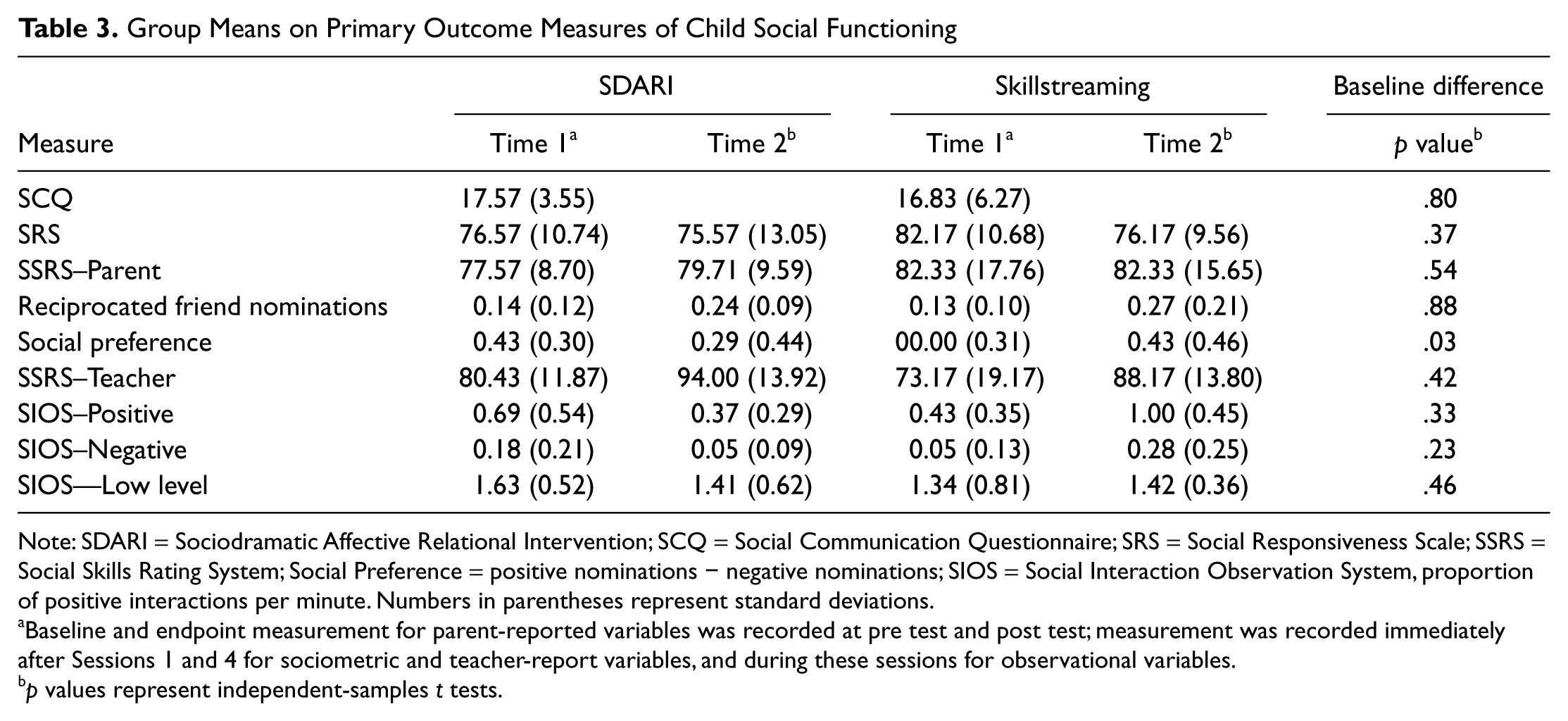
Note: SDARI = Sociodramatic Affective Relational Intervention; SCQ = Social Communication Questionnaire; SRS = Social Responsiveness Scale; SSRS = Social Skills Rating System; Social Preference = positive nominations − negative nominations; SIOS = Social Interaction Observation System, proportion of positive interactions per minute. Numbers in parentheses represent standard deviations.
Baseline and endpoint measurement for parent-reported variables was recorded at pre test and post test; measurement was recorded immediately after Sessions 1 and 4 for sociometric and teacher-report variables, and during these sessions for observational variables.
p values represent independent-samples t tests.
In terms of manual fidelity, intervention staff members reported 11 instances (3.2%) of engaging in activities not specified in the manual, 7 of which occurred in SDARI. SDARI (M = 3.39, SD = 0.26) intervention staff members indicated significantly higher performance-related conceptual fidelity (t = −2.71, p = .009) relative to Skillstreaming staff (M = 3.20, SD = 0.21). Although this difference was significant, examination of the mean differences (<1 SD) suggests that the interventions may have considerable conceptual overlap.
Social Behavior During the Treatment Session
Observed social behavior
The SDARI group decreased in positive (β11 = −0.29, p = .015) and negative (β11 = −0.12, p = .048), but not low-level, interactions over time relative to the Skillstreaming group. Effect sizes were large (d GMA-RAW = −1.17, −0.98, respectively).
Sociometrics
There was a significant effect of time for social preference, F(1, 11) = 6.47; p = .027, such that, on average, all children increased in social preference over time. There also was a Group × Time interaction for social preference, F(1, 11) = 25.44; p < .001, such that the Skillstreaming group increased sharply over time while there was a trend for the SDARI group to decrease (see Figure 1). Effect sizes were large (η2 = .37 and .70, respectively). Although there was no significant Group × Time interaction for reciprocated friendship nominations, there was a significant effect of time, F(1, 11) = 4.93, p = .048, such that participants in both groups increased over time on average (see Figure 2). Effect size was large (η2 = .31).

Change in the average number of social preference nominations between the first and last session, by intervention group.
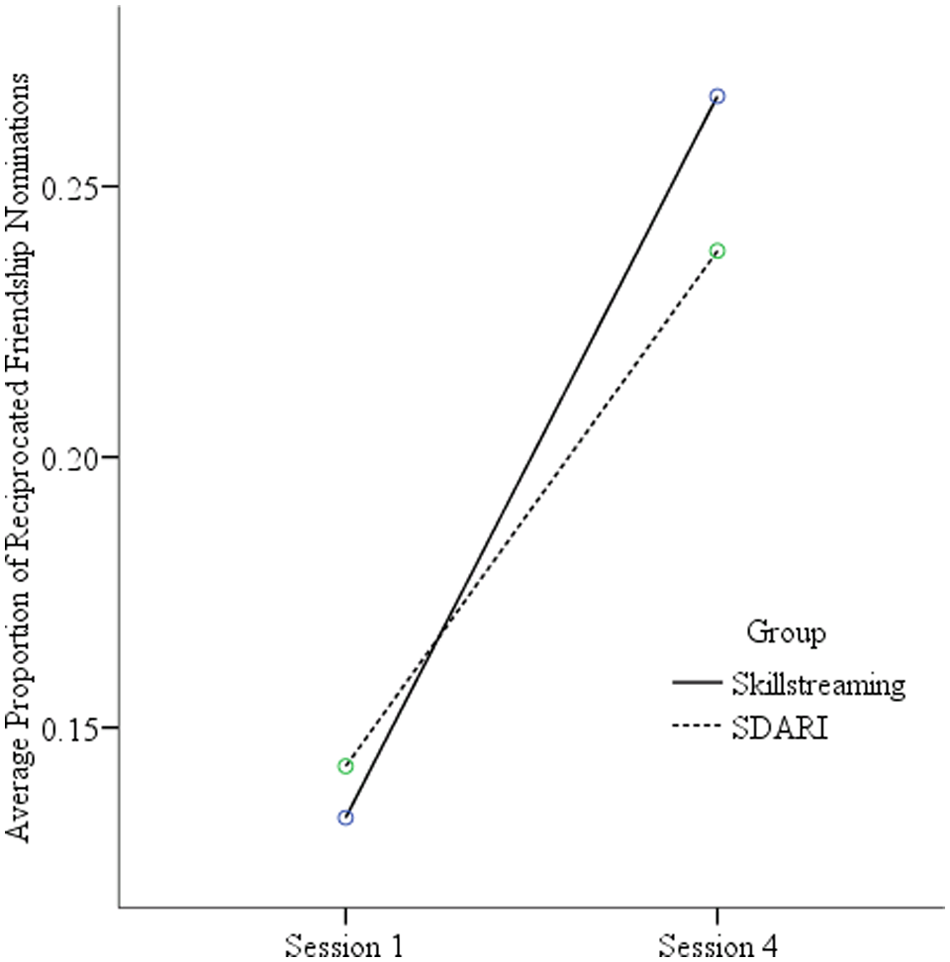
Change in the average proportion of reciprocated friendship nominations between the first and last session, by intervention group.
SSRS-T
Although there was no significant Group × Time interaction for intervention staff member–reported social skills, there was a significant effect of time, F(1, 11) = 15.71, p = .002, such that both groups increased over time on average. Effect size was large (η2 = .59).
Parent-Reported Social Behavior
No significant effects were found on the SRS (all p > .131) or SSRS-P (all p > .593).
Post Hoc Analyses
SDARI social preference
Using a paired-sample t test for SDARI participants only, the decrease in social preference was nonsignificant (p > .078), suggesting that the observed decrease was evident only when compared with the highly significant increase in Skillstreaming.
Unreciprocated friendship nominations
No significant effects were found for unreciprocated nominations given by the target participant (p > .235) or to the target participant (p > .320), suggesting that change in reciprocated friendship nominations was not a result of indiscriminate peer nominating.
General interaction
According to Bauminger (personal communication, May 5, 2010), one may calculate a SIOS general interaction score as the sum of positive, negative, and low-level interactions. This general interaction was calculated and analyzed to investigate the unexpected effect of relatively decreased positive and negative interaction in the SDARI group. In this model, the SDARI group evinced more general interaction at baseline (β01 = 1.14, p = .016), but a significant decrease over time (β11 = −0.53, p = .003) relative to the Skillstreaming group. The effect size for change over time was large (d GMA-RAW = −1.80). Change in general interaction was correlated with change in social preference (r = .53, one-tailed p = .030).
Discussion
Few researchers have attempted to directly compare two theoretically distinct evidence-based SSIs for youth with HFASD. In the present study, we sought to distinguish the effects of social knowledge- and social performance-training SSI components by randomly assigning participants to a brief knowledge-based (Skillstreaming) or performance-based (SDARI) intervention. Results indicated that both groups increased in reciprocated friendship nominations and staff member–reported social skills. Relative to Skillstreaming participants, SDARI participants liked and interacted more with each other after a single session. However, Skillstreaming participants increased in peer liking and interaction over the course of the SSI, whereas SDARI participants demonstrated a slight decreasing trend. Parents reported no change in social functioning at home.
In terms of social behavior during the treatment sessions and reciprocated friendships, it is notable that both SSIs evinced significant improvements. Although the social skills gains did not appear to generalize out of session, this may be a result of the unusually short duration of the intervention, as change in social behavior during the treatment session is often considered to be a precursor to more generalized change (Barry et al., 2003). The reciprocated friendship-making is particularly encouraging, as it is a typically treatment-resistant domain and is a widely used measure of friendship development in the peer-relations literature (Hoza et al., 2005). Although many SSIs focus on facilitating friendship-making outside the group, many individuals with HFASD have few or no reciprocated friends but report wanting them (Bauminger et al., 2008; Rotheram-Fuller et al., 2010). Given the importance of having even one friend (Bagwell et al., 1998) and of modeling successful interactions within groups (Barry et al., 2003), it is encouraging that these SSIs may be able to evoke friendship-making within group. In the future, researchers should examine whether longer durations may better facilitate social skills and friendship-making outside of group.
The social preference and interaction findings suggest that SDARI may be associated with very rapid peer liking and social interaction in unstructured time, but very slight decreases in these domains over time. In terms of the social performance-training mechanism, it may be that the activities used in SDARI allow participants with HFASD to immediately engage with their peers in a reinforcing way. Over time, it may be that SDARI activities become slightly socially tiring, compelling participants to use unstructured time as a “break” and engage in fewer free interactions connected to peer liking. Conversely, it may be that performance-training activities, which require unstructured interaction (Guli, Wilkinson, & Semrud-Clikeman, 2008), begin to constitute more substantive peer interaction, requiring less interaction during breaks. However, if this is the case, it raises the question of why participants do not develop peer liking during such performance-training activities. Future research should be conducted to examine this matter more closely.
Likewise, Skillstreaming may be associated with increases in social interaction in unstructured time and peer liking, but at a slower pace than is SDARI. In terms of the knowledge-training mechanism, it may be that participants increasingly practice didactically trained social interaction during unstructured time, providing them more opportunities to learn to like each other. Conversely, it may be that the knowledge-training activities, which require minimal spontaneous social creativity (Laugeson et al., 2009), do not fulfill participants’ increasing desire to socialize, so they begin to interact more during the break.
Crucially, these differences in interaction and liking took place in the presence of increased friendship-making. Speculatively, this suggests different mechanisms of learning in each SSI. It may be that those receiving performance training develop a more realistic perception of their peers such that they feel more capable of evaluating them negatively without affecting friendship-making. Meanwhile, those receiving knowledge training learn to like their peers via trained interaction. Thus, in SDARI, friendships develop naturalistically, facilitating realistic differentiation of friends (and confidence to make friends while reporting not liking others), whereas in Skillstreaming, friendships develop in a more rote, although no less effective, manner. Future research can be conducted to explore differences between SSIs pertaining to friendship-making.
We addressed nearly all quality indicators in clinical trials for ASD (Smith et al., 2007). First, participants were randomized to condition, with conditions equivalent on baseline measures, methodologically crucial features rarely found in SSIs for youth with ASD (Rao et al., 2008). Second, participants were assigned to bona fide intervention conditions (Wampold et al., 1997) that were matched on treatment duration and target goals (Baskin, Tierney, Minami, & Wampold, 2003), capitalizing on methodological advantages of experimental design and avoiding the “intent-to-fail” problem (Westen, Novotny, & Thompson-Brenner, 2005, p. 429). Third, intervention staff training was comparable across conditions, diminishing the possibility that staff competency affected results. Fourth, multi-informant assessment was used, including observers and parents unaware of treatment assignment and increasing validity of derived findings.
Interpretation of the results is affected by important limitations. First, we included a very small sample, limiting statistical power to detect effects (Smith et al., 2007). Future studies should use comparable RCT methods on larger samples of SSIs for youth with HFASD to assess validity of these findings. Second, there was no SSI-free control condition, such as an after-school group without a curriculum. As such, it is impossible to know whether observed effects are a discrete result of intervention or simply emerge from time in a group of youth with HFASD. Third, the intervention period was uncharacteristically brief relative to typical clinical use of the chosen SSIs (Lerner & Levine, 2007; Lopata et al., 2010). Therefore, the SSIs themselves may be unrepresentative, making the present investigation most similar to an analog study (Westen et al., 2005) instead of a comparison of true intervention conditions. Fourth, gold-standard methods were not used to confirm HFASD diagnoses (Smith et al., 2007). Fifth, fidelity was assessed via a novel, unstandardized self-report instrument, which suggested only a small significant difference between groups in terms of conceptual fidelity (program differentiation). In the future, researchers should use observational measures to corroborate report of fidelity. Finally, no follow-up assessment was used to assess posttreatment generalization of gains.
Even with these limitations in mind, a number of clinical implications can be derived from this study. First, results can be used to suggest that performance- and knowledge-based interventions (SDARI and Skillstreaming) may be useful for promoting reciprocated friendship-making and prosocial behavior during the treatment session among youth with HFASD. We also suggest that the type of intervention may work differently in terms of promoting observed social behavior and peer liking. Specifically, although SDARI may promote more immediate gains in participant interaction and social preference, Skillstreaming may result in eventual comparable interaction and social preference via a slower mechanism. As such, it may be the case that social knowledge and social performance training both work but at different rates. Finally, we interpret the data to conclude that the longer intervention durations typically used (Reichow & Volkmar, 2010) are necessary to produce generalized effects. In sum, it is important to disentangle the putative mechanisms of SSIs for youth with HFASD to help optimize service delivery and future research goals.
Footnotes
Acknowledgements
The authors would like to thank the participating families, whose valuable time and dedication made this study possible. They also like to thank the intervention staff, who dedicated a considerable amount of time and effort to the implementation of these interventions.
Authors’ Note
The sponsor of the study had no role in study design, data interpretation, or writing of the report.
Declaration of Conflicting Interests
The authors declared no potential conflicts of interest with respect to the research, authorship, and/or publication of this article.
Funding
The authors disclosed receipt of the following financial support for the research, authorship, and/or publication of this article: This study was partially supported by a Jefferson Scholars’ Foundation Graduate Fellowship to Matthew Lerner.