







Abstract
The current trend analysis was conducted to empirically document the characteristics of individuals with autism who participated in intervention research published between 1995 and 2009 in three journals (Journal of Applied Behavior Analysis, Journal of Autism and Developmental Disorders, and Focus on Autism and Other Developmental Disabilities). Information was collected on age of participants, cognitive and communicative functioning, setting, and ecological variables. Overall, the data are interpreted to document few changes over time; however, increasing trends were noted in the proportion of studies that included children below the age of 6 years and in the proportion of studies that included higher functioning participants. The data are discussed in relation to the status of intervention research and demographic changes pertaining to autism.
Prevalence rates of autism spectrum disorders (ASD) over the last 30 years have shown a dramatic increase in diagnoses and are second in frequency only to intellectual disability among the serious developmental disorders (Blaxill, 2004; Newschaffer et al., 2007). Rates in the United States increased from less than 3 per 10,000 children in the 1970s to between 34 and 93 children per 10,000 receiving ASD diagnoses in the 2000s (Manning et al., 2011; Ritvo, 1989; Rutter, 2005). A considerably higher figure has recently been reported in a study out of South Korea with estimates at about 1 in 38 children (approximately 260 out of 10,000) diagnosed with ASD (Kim et al., 2011). Although the underlying cause of this dramatic increase is uncertain, it is suspected that some of the rise in reported prevalence is related to the expansion of the boundaries set for behaviors consistent with an autism diagnosis (Newschaffer et al., 2007; Shattuck, 2006).
As many as 50% of all children diagnosed with autism are identified as higher functioning (Honda, Shimizu, Misumi, Niimi, & Ohashi, 1996; Kielinen, Linna, & Moilanen, 2000). The term high-functioning autism (HFA) has been used to describe children with autism who have intelligence quotients (IQs) at or above 70 (Koyama, Tachimori, Osada, Takeda, & Kurita, 2007). Fombonne (2005) reviewed 37 studies of autism for which 22 of the studies included 10,000 or more participants. Comparative data were used to suggest that the percentage of children classified with HFA changed from 24.6% prior to 1998 to 43.9% post 1998. This increase could suggest changes in diagnostic criteria, improvements in diagnosing children with autism who are higher functioning, and/or improvements in early intervention (Smith, 1999; Wing & Potter, 2002).
Researchers have documented substantial gains from intervention provided at early ages, leading to an increased emphasis on early intervention (Lovaas, 1987; McGee, Morrier, & Daly, 2000; Strain & Cordisco, 1994). There also has been an increased push for early screening and identification of autism in an attempt to provide services and interventions during early childhood (Dosreis, Weiner, Johnson, & Newschaffer, 2006). This has been difficult as few pediatricians routinely engage in autism screening and the demand for clinics conducting comprehensive evaluations for children suspected of having ASD far exceeds the supply (Newschaffer et al., 2007). Overall, there clearly is a shift toward early diagnosis and intervention of autism. It is not known whether similar trends are apparent in published studies.
Another clear shift in practice is seen in adjustments made to policies of educating children with autism (Kauffman & Hallahan, 1995; O’Neill, 1995; Sailor et al., 1989). The movement toward inclusion called for educating children with autism in more typical settings with nondisabled peers and has been supported by national policies including the 1997 amendments to the Individuals With Disabilities Education Act (IDEA). Given this movement, it is reasonable to expect that published intervention research might reflect similar trends with an increased proportion of studies being conducted in more typical social, activity, and physical contexts.
In this study, the authors sought to evaluate trends in autism intervention research by collecting information related to the characteristics of the children and settings reported in three behavioral journals over the last 15 years to determine (a) descriptive features of children with autism and settings reported in intervention research and (b) the possible appearance of trends in these features, with particular attention to whether similar trends as those reported in diagnostic increases, functioning level, early diagnosis, and inclusion are evident. A 15-year time frame (1995–2009) was selected for article review as this interval represented when criteria from the fourth edition of the Diagnostic and Statistical Manual of Mental Disorders (DSM-IV; American Psychiatric Association, 1994) were used for diagnosing autism. The DSM-IV contained important changes to the diagnostic criteria that had to be met to indicate a diagnosis of autism.
Method
Definition of Database
This study involved an analysis of intervention research articles conducted with children and youth with autism between 1995 and 2009. Examined for this analysis were three journals: Journal of Autism and Developmental Disorders (JADD), Journal of Applied Behavior Analysis (JABA), and Focus on Autism and Other Developmental Disabilities (FOCUS). These journals were selected because (a) they were identified as common outlets for intervention research with the target population, (b) their publication policies encouraged submission of studies with children and youth up to 21 years of age, (c) they included experimental research articles that met the inclusion criteria (described below), and (d) they were in continuous operation throughout the 15-year period under review.
The procedure for identifying intervention research articles was based on a manual examination of each issue of each journal. Articles were included in the overall database if they met the following criteria:
Participants included at least one child or adolescent (i.e., 21 years or younger) described as having a diagnosis of autism, autistic, autistic disorder, or ASD. Articles were excluded if participants did not have descriptive or diagnostic labels reflecting these categories of autism. Other terms currently used to describe participants on the spectrum (i.e., Asperger syndrome and pervasive developmental disorder) were not included as these terms were not prevalent in the earlier years;
The article must contain an original report of research, and the research design must have compared the effects of an independent (e.g., treatment) variable with a control or comparison condition. Brief reports were included if methods, results, and data displays were present. Abstracts, anecdotal case studies, and studies employing correlational designs were excluded;
The independent variable involved educational, behavioral, or psychological interventions; and
At least one dependent variable had to involve observations of a participant’s performance, inappropriate behavior, or social behavior.
Procedure
The initial phase of the study involved a hand search of the three journals according to the aforementioned selection criteria. Two coders independently reviewed the selected journals and identified articles that met the requirements for inclusion in the databases. The articles selected by the coders were matched to determine interobserver agreement. If a disagreement occurred, a third person independently reviewed the article in question and decided if the article met the criteria. Inclusion was dependent on consensus of third-person agreement with one of the two original coders. The number of articles reviewed for possible inclusion between the years of 1995 and 2009 was 2,685 (JABA: 1,000; FOCUS: 431; JADD: 1,254). A third-person review was required for 15 articles (JABA: 11; FOCUS: 3; JADD: 1).
Each article identified in this process was examined for bibliographic information and a number of dimensions that ranged from participant demographics to features of the intervention and measurement procedures. Operational definitions for each category and a standardized coding form were developed to record information extracted from the articles. The definitions and data-recording procedures are described in the following sections.
Participants
The number of participants with a description of autism was recorded for each article. Participant age was scored in the following ranges: 0 to 5 years, 6 to 11 years, 12 to 17 years, and 18 to 21 years. When participants were present in more than one category, the category with the greatest number of participants was counted. When participants were present in more than one category with no majority, the mean of ages was calculated and the category of the mean was scored. When only the mean or median age of participants was reported, the corresponding category was scored.
Overall level of cognitive and adaptive functioning was scored according to the level that matched the participants with autism in the study. This was intended to represent an overall composite of functioning level with consideration of all information provided about the participants. It was understood that many articles contain only limited information; however, recorders were encouraged to use all information available and it was expected that recorders would be obliged to use inference to complete an impression of the overall level of functioning. If there were multiple participants and they demonstrated different levels of functioning, an average score was provided. For example, if there were two participants and one would be scored a “1” and the other a “3,” the recorders would enter a level of “2.” If there were five participants, and three would be scored a “1,” one would be scored a “2,” and the remaining participant would be scored a “3,” the average would be “1.6.” The overall levels of functioning were defined as follows: (a) typical range: Test scores (e.g., IQ, achievement) and descriptions of any and all aspects of intellectual, academic, social, communicative, and independent functioning were within or above 2 SDs of normative levels; (b) mild to moderate disability: Test scores (e.g., IQ, achievement) and descriptions of any and all aspects of intellectual, academic, social, communicative, and independent functioning were between 2 and 4 SDs below normative levels; and (c) severe to profound disability: Test scores (e.g., IQ, achievement) and descriptions of any and all aspects of intellectual, academic, social, communicative, and independent functioning were below 4 SDs of normative levels.
The level of communicative functioning was scored according to the level that fit the participants with autism in the studies. This score was limited to information regarding the participant(s)’ communication and may have included test scores as well as narrative descriptions. Whereas the previous score on “overall level of functioning” might have incorporated information pertinent to communication, this score was for communication only. If there were multiple participants and they demonstrated different levels of functioning, an average score was given. The levels were defined as follows: (a) Communicative: Participant was able to communicate needs and desires with competence and was able to engage in at least some extended conversational interactions; (b) Rudimentary: Participant was able to communicate needs, and might use words and gestures, but did not possess skills needed to use sentences consistently, engage in extended communicative interactions, or engage in conversation; and (c) Nonverbal/Noncommunicative: Participant did not communicate regularly with conventional means (or with augmentative/assistive technologies). Communication might have occurred via problem behaviors, pulling, or occasionally pointing, but words or symbols were not used with any consistency.
Setting
For the purposes of this review, setting refers to the location in which measurement of the dependent variable(s) was conducted. If there was a primary setting in which the measures were obtained, that setting was recorded. Multiple categories were scored when dependent variables were monitored in more than one setting.
Settings were scored in six categories: (a) Community, defined as parks, stores, recreation facilities, restaurants, or other community setting; (b) General education, defined as regular or general education programs. This category also included integrated day care centers and preschools; (c) Special education, defined as special education classrooms/programs within community schools, or special education classrooms located at segregated schools for special populations; (d) Home, defined as the natural residence of the participant (could also include foster home); (e) Clinic, defined as outpatient facilities or environments that provided informational, emotional, social, or therapeutic services, such as university labs and pull-out analog sessions within those settings. This category also was scored when research took place within a clinical context or in a separate room in a school setting, such as a therapy room; and (f) Short-term residential, defined as public or privately run facilities (e.g., group homes, supportive living, institutions, hospitals).
Contexts
Context reflected where and how research occurred and was categorized as either “typical” or “analog.” Three dimensions of context—physical, activity, and social—were considered. Typical physical context was coded if the research was conducted in a typical setting that was not designated for a special population. Typical activity context was scored if the activities in which the independent variable was manipulated were part of the participants’ regular routine (i.e., the activity was not simulated or arranged specifically for the benefit of the research). Typical social context was coded if the participants interacted with peers or others during the research as they ordinarily would have during the course of the day. If multiple contexts were included in an article, the context for each of the three dimensions was scored as typical if at least 50% of the research occurred in typical situations.
Reliability
Four data collectors with a minimum of a master’s degree who were familiar with peer-reviewed journal articles were trained over 3 weeks to analyze and code all categories identified in the database. The training continued until each data collector independently arrived at a 100% reliability rating for all categories for 10 separate consecutive articles scored. The articles were matched to scored categories completed by the second author. Agreement was counted on each category when the coders entered identical information on the coding sheet. Interobserver agreement for coding articles included in the database was evaluated by two coders recording data independently on 68 (25%) articles that were randomly selected from the database.
Total agreement for all autism intervention articles reviewed was 99% (96–100) for all age categories, 74% (71–78) for level of cognitive functioning, 72% (67–74) for level of communicative functioning, 82% (75–91) for all setting categories combined, 87% (78–96) for physical context, 91% (83–95) for activity context, and 91% (83–96) for social context. The somewhat lower agreement for the levels of cognitive and communicate functioning appeared to result from indistinct descriptions in the text of some of the articles. In particular, articles reviewed and scored representing the earlier years of the database had fewer details regarding levels of cognitive and communicative functioning than more recently published articles.
Data Analysis
Each category coded was summarized by noting the total number of articles that reported the specific variables as well as the corresponding percentage represented by number of articles reporting a specific category divided by number of articles in the entire database. The percentages were initially arranged by year to examine potential trends for each journal. Subsequently, to further facilitate visual inferences or trends, data were combined by recording percentages in 5-year increments of the 15-year period (1995–2009).
Results
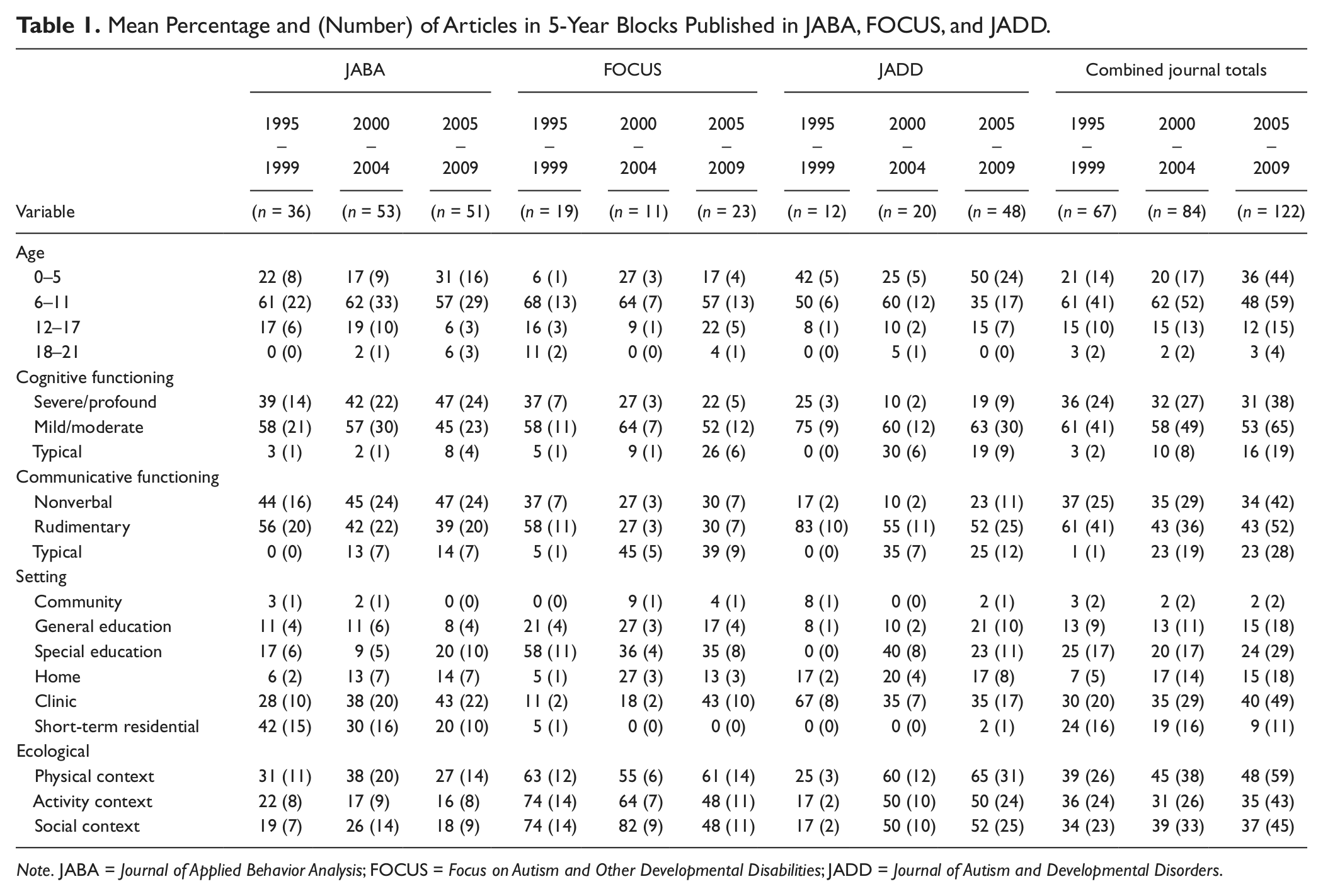
Table 1 displays the principal data derived from the analysis. The table shows the mean percentage and number of articles in 5-year blocks for key variables coded in the study published in JABA, FOCUS, and JADD. In addition, the final columns show data combined across the three journals. Data were interpreted to conclude that the majority of participants in research studies were in the 6- to 11-year age range and that the proportions were largely steady across the 15 years of the analysis. There was one deviation from the otherwise consistent pattern. The proportion of articles that included young children (ages 0–5) increased notably during the final 5-year block (2005–2009). This is evident in the final columns of Table 1, which show the combined figures, and it is depicted graphically in Figure 1. Corresponding to the increase in articles with young children was a decrease in the percentage of articles with participants in the 6 to 11 age range.
Mean Percentage and (Number) of Articles in 5-Year Blocks Published in JABA, FOCUS, and JADD.
Note. JABA = Journal of Applied Behavior Analysis; FOCUS = Focus on Autism and Other Developmental Disabilities; JADD = Journal of Autism and Developmental Disorders.
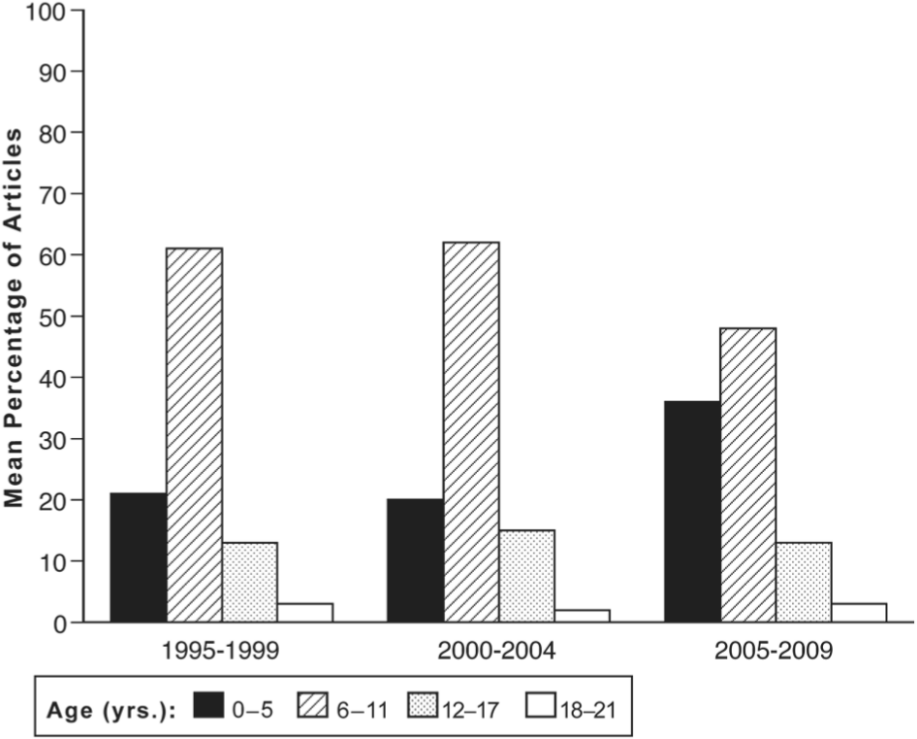
Mean percentage of combined journal articles with autism participants.
The second and third variables in Table 1 are cognitive and communicative functioning. These data showed few changes over the 15 years; however, the percentage of articles with participants who are described as having typical functioning levels increased over the later years of the analysis. The percentage of articles that included participants with typical functioning was very low in 1995 to 1999. In the area of cognition, typical functioning increased from 3% to 10% and 16% for the three journals combined. The associated figures for communicative functioning increased from 1% to 23% and 23%, respectively. These data are depicted in Figure 2.
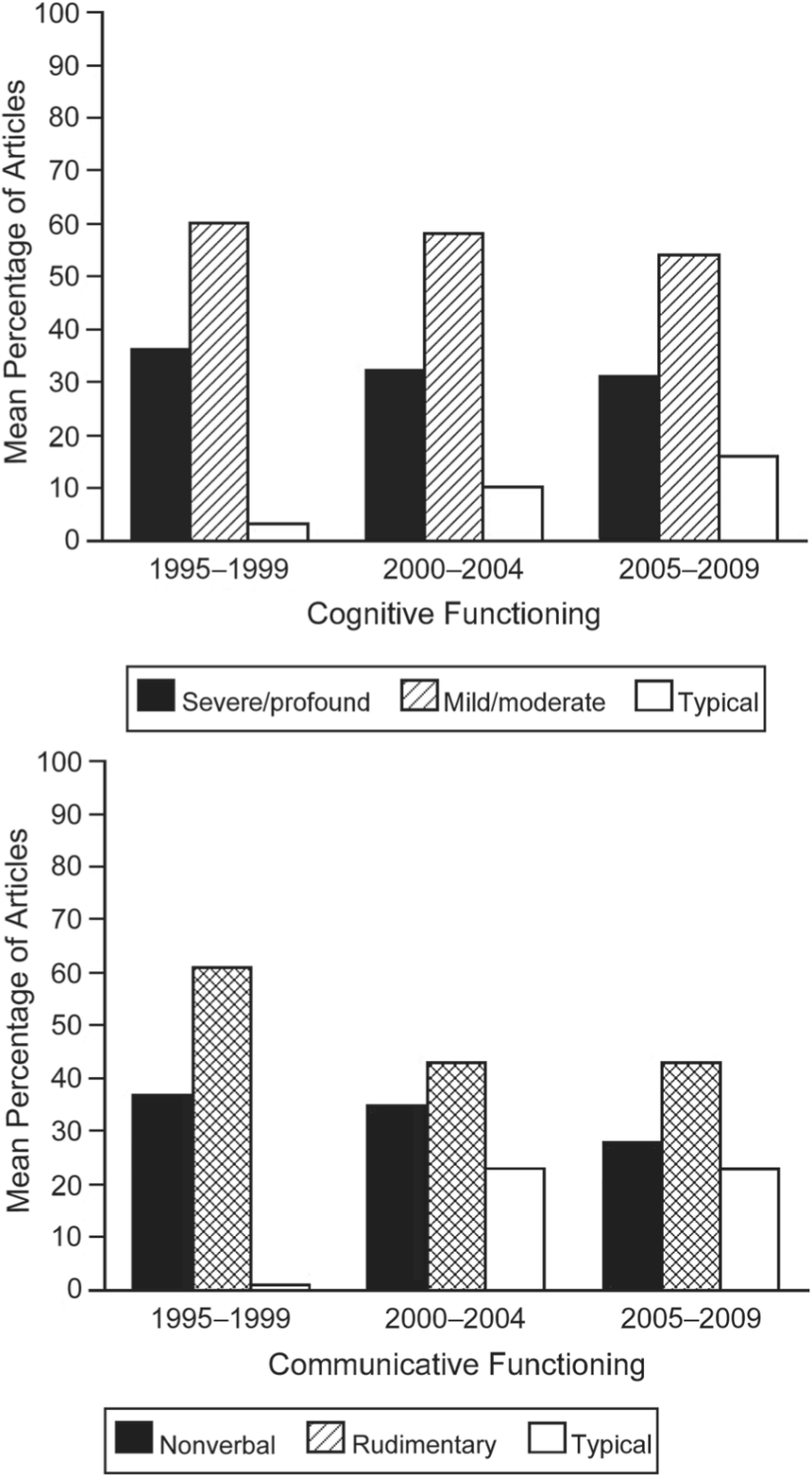
Mean percentage of all journal articles with autism participants representing different age ranges across 5-year blocks.
The final two variables of Table 1, along with the graphs in Figure 3, display the mean percentage of settings and ecological context categories for each of the 5-year blocks. On the top left graph of Figure 1, all articles that represent studies conducted in participants’ primary environments are displayed. Due to the amount of data involved, the only data presented in graphical form related to setting were primary environments, which included the categories of community, general education, special education, and home. The remaining three graphs for Figure 3 demonstrate a slight increase in typical physical and social context, although no change across the 5-year blocks was evident for activity context.
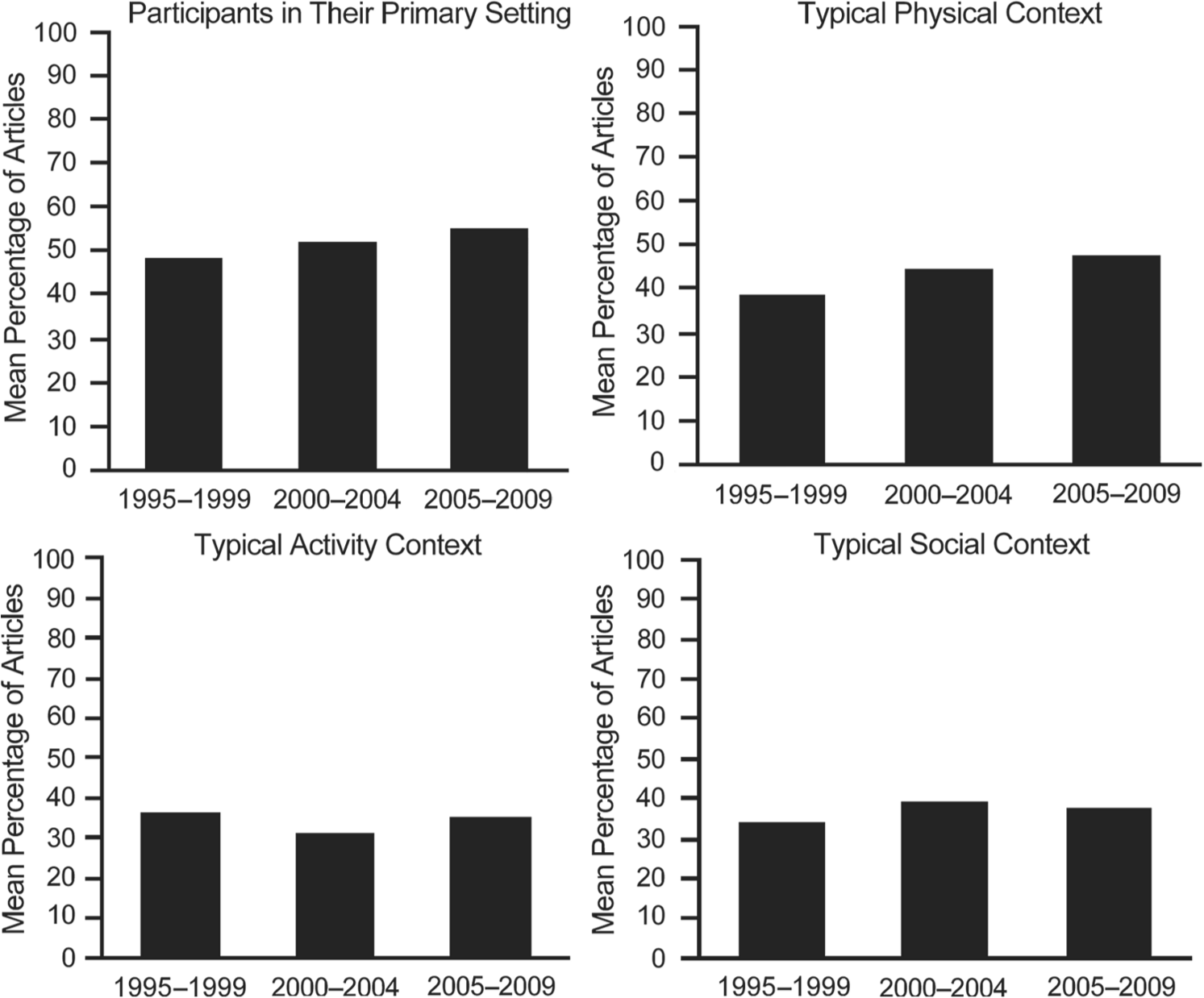
Mean percentage of articles with autism participants in primary settings, and typical physical, activity, and social contexts.
Discussion
This analysis was undertaken to investigate the descriptive properties of the intervention research over the last 15 years for individuals diagnosed with autism. A second purpose was to explore whether there was a relationship between the increasing number of individuals identified with autism and the number of intervention research studies published. Also of interest were additional variables related to demographic and functioning levels of research participants.
Data analysis reveals some overall trends that appear to be consistent with reported trends in early intervention and an increase in diagnoses of children with higher functioning autism. For example, the actual number of intervention articles published in the selected journals increased notably (see Table 1). During the first 5-year blocks of the study (1995–1999), the total number of intervention articles was 67, whereas the total for the last 5 years reviewed (2005–2009) was 122.
Analysis of data on the children who participated in intervention research shows some trends with regard to ages and functioning level. The percentage of studies with children from ages birth to 5 years increased from 21% to 36%, whereas a subsequent decrease from 61% to 48% occurred for children ages 6 to 11 years over the 15-year period. The journals selected were not specific to early childhood intervention; therefore, the increase may be associated with federal and state education policies that provided additional funding focused on early intervention. An increase in the percentage of articles that included children with typical cognitive functioning and typical communicative functioning increased over the 15 years; however, this increase was not comparable with the suggested number of children classified with higher functioning autism (i.e., 43.9%; Fombonne, 2005).
Trends were not evident with regard to the setting in which interventions were conducted. Less than 40% of the studies throughout the 15-year period reported conducting the intervention in the child’s primary environment (i.e., home, school, community), while a greater majority of interventions (>60%) were conducted in a clinic or inpatient setting. Perhaps procedural and methodological barriers continue to exist that impose difficulties regarding ability to conduct interventions in children’s primary environments. Clinic-based settings may provide a context in which internal validity can be assured, even though external and ecological validities may be limited. Therefore, the applicability of clinical demonstrations is a concern until relevant systematic replications can be conducted. A slight upward trend was noted in the percentage of intervention studies being conducted in the typical physical context, although it was still less than 50% of studies, whereas no trends were evident for the typical activity or social context.
Limitations
There are important limitations that must be considered when interpreting the findings of this study. It is particularly important to note that the list of journals chosen was not exhaustive because the selected journals were required to be in continuous operation between 1995 and 2009. The three journals were selected because they were common outlets for intervention research over the last 15 years regarding children diagnosed with autism. It is not known whether the addition of articles from other sources would alter the trends or percentages that emerged from this study. Finally, the data should be considered within the strictly descriptive parameters that composed the methodology. For each variable that was examined, many additional variables could have been included. For example, the types of interventions and the effectiveness of interventions were not noted in this initial review. It was necessary to restrict the scope of this investigation to a manageable level of inquiry. Future trend analyses might consider including these variables.
Conclusion
Data from this study provide a general overview of the descriptive features of intervention research conducted with children diagnosed with autism. Additional and ongoing analysis of intervention research trends for individuals with autism are warranted to determine whether the trends found in the current study are representative of a more comprehensive review and whether the research is following similar trends in diagnostic and policy changes.
Footnotes
Declaration of Conflicting Interests
The author(s) declared no potential conflicts of interest with respect to the research, authorship, and/or publication of this article.
Funding
The author(s) received no financial support for the research, authorship, and/or publication of this article.