






Abstract
People with autism spectrum disorder (ASD) may have difficulties with pragmatic behaviors in conversation such as staying on topic, taking the perspective of others, and repairing misunderstandings. Many social skill interventions teach conversation skills to assist the development of friendships and avoid social isolation, but few studies have examined whether conversation partners find the reported pragmatic behaviors problematic. We examined the effect of relationship type, regularity of contact, and age of the person with ASD on conversation partner perceptions. For problem scores, multiple regressions indicated an effect for relationship type such that friends tended to report lower problem scores than siblings/other relatives, parents, or life partners. Difficulties understanding humor was reported to be more problematic by friends, whereas for life partners it was the failure to keep conversations going and inappropriate terminations. Further research is needed to confirm and extend these results to better inform interventions into social communication.
Keywords
Individuals with autism spectrum disorder (ASD) are characterized by persistent difficulties in verbal and nonverbal social interactions and may exhibit difficulties in social contexts and in forming relationships with others (American Psychiatric Association, 2013). There is evidence that, although individuals with ASD may yearn for social interaction, they often lack the skills required to make the social connections needed to form and maintain friendships (Daniel & Billingsley, 2010; Orsmond et al., 2004). Individuals who experience difficulties with social communication may be at a disadvantage because casual conversations form a key part of social development, allowing individuals to discover their social position, share thoughts and experiences, and develop relationships with others (Eggins & Slade, 1997).
Researchers have suggested that individuals with ASD have difficulties with the pragmatic skills required in conversations, such as initiating conversations, turn-taking, staying on topic, shifting topics, producing coherent narratives, or repairing misunderstandings (Kissine, 2012; Sng et al., 2018; Volden, 2017). Nonverbal communication skills—such as lack of eye contact or inappropriate eye gaze—may make it difficult to establish a joint reference, which could result in problems with topic maintenance (Landa, 2000). Landa (2000) argued that people of typical intellectual capacity with ASD are associative, and this may result in abrupt topic shifts when something within a conversation reminds them of another topic. Abruptly changing a conversation partner’s topic and difficulties maintaining one’s own topic may negatively impact engagement in reciprocal conversations.
There is a body of literature on the pragmatic deficits associated with ASD (Landa, 2000; Philofsky et al., 2007; Volden, 2017) and the interventions designed to address these issues (Parsons et al., 2017; Williams White et al., 2007). Nevertheless, there is scant research on whether, these identified difficulties actually represent a barrier to social engagement from the point of view of the conversation partner or, what factors may affect these perceptions. More research into the issues that actually pose a problem for social interactions in natural contexts may help prioritize interventions.
Perceptions of social behavior can differ across individuals. For example, Knott et al. (2006) compared self-reported social competence of children and adolescents with ASD to the reports of parents, and they found that although individuals with ASD had some awareness of their social difficulties, parents tended to report much lower levels of social competence with peers. More specifically, for social behavior generally, the relationship of the observer to the person with ASD may influence perceptions and the degree of concern expressed. Myles et al. (2001) synthesized research on the intellectual, social, and emotional characteristics of young people with Asperger syndrome and found that parents reported greater concerns about social skills and behavior than teachers and that students self-reported concerns at an even lower level than both parents and teachers. Although parents and teachers agreed on overall social skills ratings, they differed on the rating of discrete skills (Murray et al., 2009). Thus, it is possible that the perception of conversational behaviors could be different depending on the regularity of contact or the nature of the relationship. For example, parents and siblings may perceive issues differently to other conversation partners, who may be in voluntary relationships (e.g., friends or life partners). Furthermore, regularity of contact could influence the issues that a communication partner perceives in conversation. Any difference in perception may have implications for the focus of intervention efforts.
As individuals mature and develop, their language and conversational behavior may change (Nippold, 2016), but social competence does not appear to improve in adolescence and adulthood in those with ASD (Gutstein & Whitney, 2002). In fact, the gap in communicative and social competence between individuals with ASD and their typically developing peers appears to widen in adolescence (Klin et al., 2007). In addition to facilitating interpersonal interactions, communication skills may become important as individuals enter the workplace. For example, a survey of online advertisements indicated that oral communication skills are considered among the most valuable by employers (Rios et al., 2020). Competent communication assists in promoting social engagement and professional success in the workplace (Chezan et al., 2020). The skills required to be a capable social communicator in adulthood may be different to those expected of adolescents or children; thus, the perceptions of conversation partners may also change depending on the age of the person with ASD.
The present report forms part of a larger survey study of perceptions of both verbal and nonverbal conversational behavior of people with ASD. General data on the features conversation partners found most problematic and differences between neurotypical (NT) conversational partners and those with ASD are reported elsewhere (Sng et al., 2020). Overall, conversation partners did not find the impairments in pragmatic skills widely reported in the literature as problematic during natural conversations with people with ASD. The behaviors that were reported to pose a problem were those related to the communication of emotions. Conversation partners who had an ASD diagnosis themselves reported behaviors to be less problematic than NT conversation partners, but the frequency rating of the behaviors was reported similarly by both groups. Furthermore, there was no strong relationship between frequency and problem ratings (i.e., behaviors that were reported to occur frequently were not always reported to be problematic). Given that social difficulties persist into adulthood and may become more evident when social interactions increase in complexity (Tantam, 2003), the present study was conducted to examine whether relationship, contact frequency, or age contributed to a conversation partner’s perception.
Thus, the research question was as follows:
Method
The research reported here was part of a larger study, and general data were reported in (Sng et al., 2020). The methodology is summarized below, and full details may be obtained from the first author.
Participation and Ethics Approval
Respondents 16 years of age and above who had regular conversations with an individual with ASD were invited to complete an anonymous online survey. When completing the survey, respondents were asked to have a specific person with ASD in mind who was 5 years or above in age and who could speak in sentences of four words or more. Participation was voluntary, and no incentives were provided. Ethics approval was provided by the University Human Research Ethics Committee (approval no: 5201700488).
Survey Development
The survey consisted of two sections. In the first, respondents provided general demographic information such as their age range (below 16 years, 16–20 years, 21–30 years, or above 30 years), regularity of contact (several times a day, once a day, 3–4 times a week, once a week, once a month, or less than once a month), relationship to the person with ASD (parent, life partner, friend, other relative, educator, sibling, other), and age range of the person with ASD (5–8 years, 9–12 years, 13–19 years, 19–24 years, and above 25 years).
In the second part of the survey, respondents used a 3-point scale to rate the frequency and severity of the problem in regard to statements related to conversation. To rate frequency of a behavior, respondents were asked whether each behavior occurred “Often,” “Sometimes,” or “Rarely or never.” For severity of the problem, response choices were “Major problem,” “Somewhat of a problem,” and “Not a problem.” The conversation behaviors included in the survey were drawn from the review conducted by Sng et al. (2018). The initial version of the survey was pilot tested by five special educators and a clinical psychologist. They provided feedback which resulted in minor clarifications to one statement and the addition of two items. The latter were 18: “Can’t explain emotions” and 29: “Asks questions when knows answer.” A summary of the 29 statements in the final survey and their corresponding short titles (see Tables 1 and 2) is available in Sng et al., 2020 or upon request. The short title will be used henceforth for conciseness.
Frequency and Problem Mean of Relationship Ranked by Mean From Highest (1) to Lowest (29).
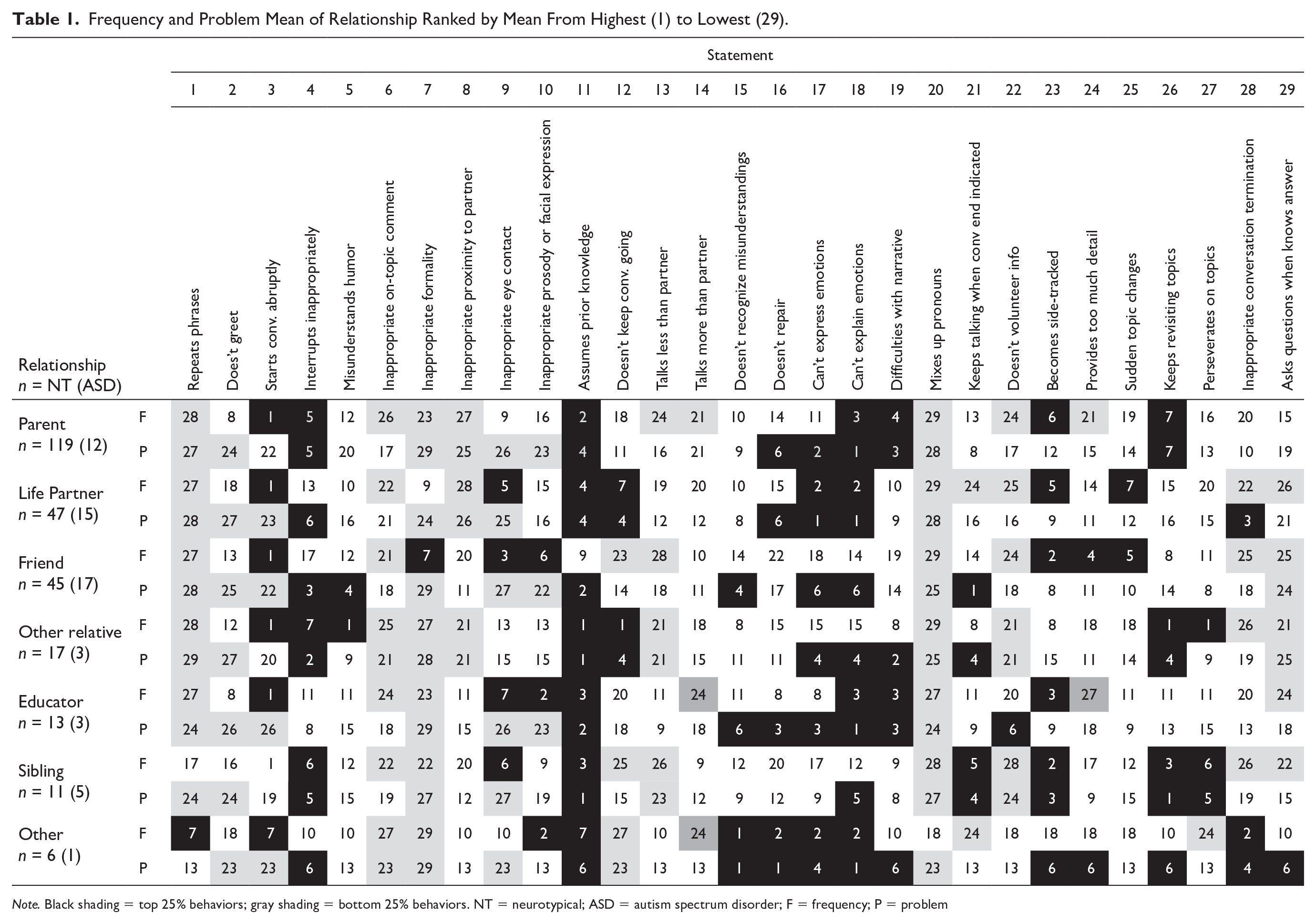
Note. Black shading = top 25% behaviors; gray shading = bottom 25% behaviors. NT = neurotypical; ASD = autism spectrum disorder; F = frequency; P = problem
Frequency and Problem Mean of Regularity of Contact Ranked by Mean From Highest (1) to Lowest (29).
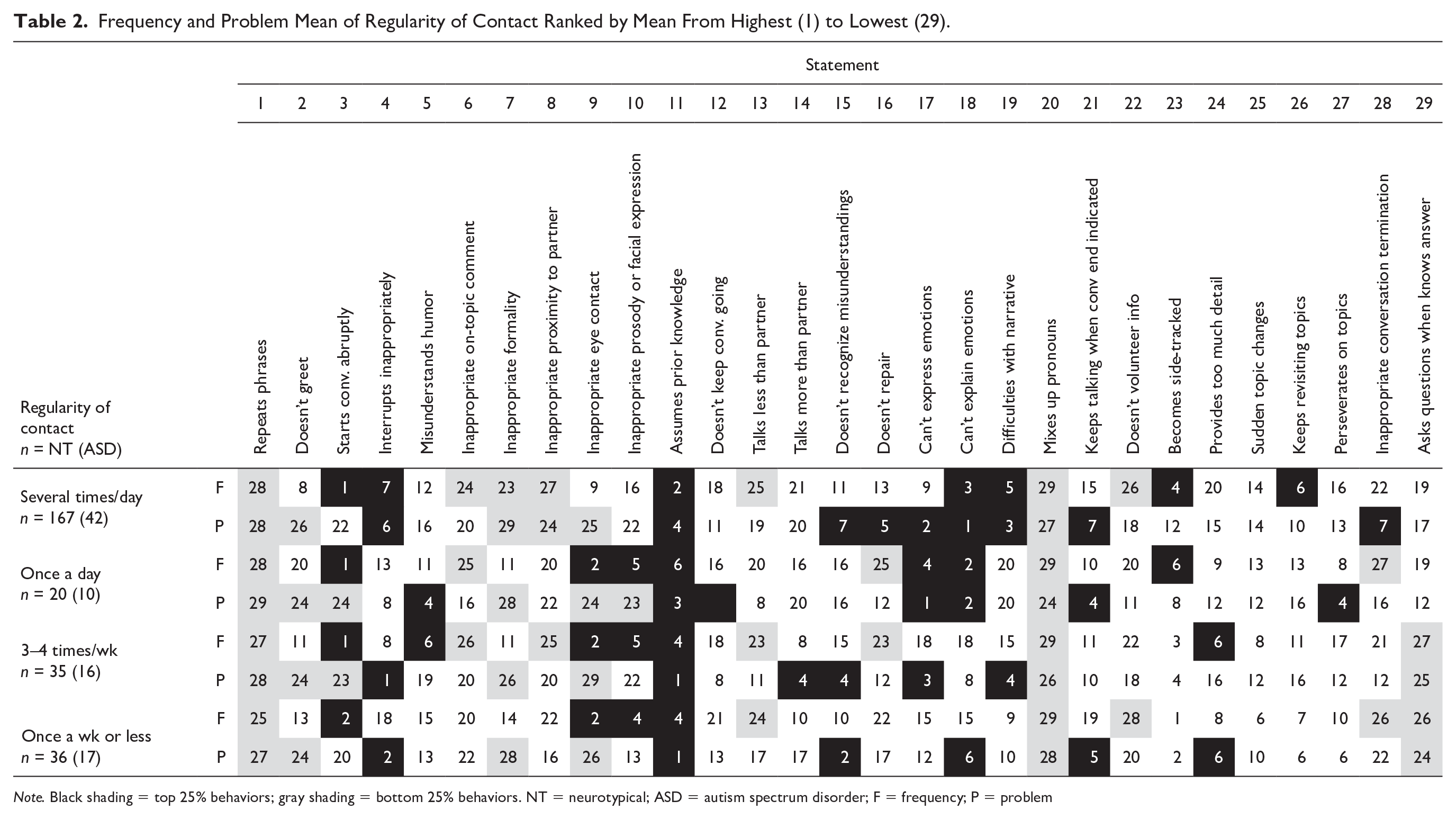
Note. Black shading = top 25% behaviors; gray shading = bottom 25% behaviors. NT = neurotypical; ASD = autism spectrum disorder; F = frequency; P = problem
Procedure
The first author contacted 33 ASD-specific organizations and community groups in English-speaking countries (e.g., Australia, New Zealand, Canada, the United States, and the United Kingdom) and requested they share the participant recruitment advertisement and a link to the survey on social media and their websites. Interested parties were also encouraged to share the link through other informal channels. The survey was hosted on the Qualtrics platform and was open for 9 months. A list of the organizations contacted is available upon request.
Data Analysis
Once the survey closed, data were downloaded and responses from respondents below the age of 16 years and responses that referred to individuals who were not reported to have a confirmed diagnosis of ASD were excluded from analysis. For analysis, the responses for frequency ratings were given a value of 1 (rarely or never), 2 (sometimes), or 3 (often). For problem data, values were 1 (not a problem), 2 (somewhat of a problem), or 3 (major problem). Using the numerical values assigned, the median, mode, and mean for each statement were calculated.
Initially an overall analysis of the data was completed using the mean scores for each respondent across all statements. Multiple regression was conducted with relationship status of the respondent, age of the person with ASD, regularity of contact between the respondent and the person with ASD as the independent variables. Whether the respondent themselves had a diagnosis of ASD was treated as a covariate for the purpose of analysis. Dependent variables were the mean score of responses on the frequency and problem ratings of each behavior for all 29 behaviors (Cronbach’s alpha for frequency of behavior mean score = .89; for problem of behavior mean score = .95). Residuals for the regression with the problem dependent variable were not normally distributed (with a significant Shapiro–Wilk test z = 3.88, p < .001). Analyses were therefore bootstrapped with 2,000 replications for this dependent variable. Residuals for the regression with the frequency dependent variable were normally distributed (Shapiro–Wilk z = 0.94, p = .17), and non-bootstrapped results are reported here. Results of pairwise comparisons are compared with a Bonferroni-adjusted alpha in all analyses. All other assumptions were met.
To determine whether there was a difference in how individual behaviors were reported, the means for both frequency and problem ratings of each behavior were ranked from 1 to 29 (highest to lowest). This provided a detailed analysis on the patterns of individual statements in the survey. This analysis focused on behaviors that were ranked in the top or bottom quartiles.
Results
For clarity, individuals who completed the survey will be referred to as “respondents,” and the individuals each respondent had in mind when completing the survey will be referred to as “the individual with ASD.” A total of 511 responses were received (316 complete and 195 incomplete). Out of these, 258 responses met the criteria for inclusion. Percentage of respondents in terms of country was as follows: Australia and New Zealand (39%), North America (35%), the United Kingdom and Ireland (19%), and Europe and South America (7%).
As there were too few respondents from some relationship groups for analysis in the regressions, relationship with the person with ASD was collapsed into Parents (n = 119), Life Partners (n = 47), Friends (n = 45), Siblings/Other Relatives (n = 22), and Educators/Other (n = 25). For individuals with ASD up to 24 years of age, parents were the main respondents, and for the 25 years and above age group, the respondents were usually friends or life partners. Sixty-seven respondents reported that they also had an ASD diagnosis. Respondents with ASD were predominantly peers (friends or life partners) of the individual with ASD; all except four were age 21 years or above.
For the purposes of the regression analysis, some categories were collapsed. A large proportion of respondents reported that they had conversations with the person with ASD several times a day (n = 167). The remaining categories had relatively few respondents and were collapsed into one category, once a day or less (n = 91). The responses received were mostly for individuals with ASD age 25 years and above (n = 94). Due to the relatively small number of respondents for the youngest age group of people with ASD, responses for 5- to 8-year-olds and 9- to 12-year-olds were pooled for subsequent analyses comparing mean ratings across age groups. As a result, 61 participants were in the youngest age group of 5- to 12-year-olds (elementary age children).
Overall Scores
Problem scores
The overall model was significant predicting problem scores, Wald χ2(9) = 64.12, p < .001, R2 = .16. There was a significant effect of relationship to conversation partner, χ2(4) = 23.07. Follow-up pairwise comparisons were compared with a Bonferroni-adjusted alpha of .005 (10 comparisons). Three comparisons were significant: Siblings/Other Relatives (z = 3.30, p = .001), Parents (z = 3.89, p < .001), and Life Partners (z = 3.69, p < .001), all of whom reported higher problem scores than Friends. No other comparisons were significant after Bonferroni adjustment.
There was a significant effect of ASD diagnosis of the respondent such that those with a diagnosis of ASD reported significantly lower problem ratings than those without a diagnosis of ASD (z = 3.10, p = .002). Although there was a significant overall effect of age, χ2(3) = 7.87, p = .049, no follow-up comparisons were significant compared with a Bonferroni-adjusted alpha of .008 (six comparisons). There was no significant effect of regularity of contact (z = 1.20, p = .230).
Frequency scores
The overall model was significant predicting frequency scores, F(9, 248) = 2.27, p = .019, R2 = .08. However, no individual predictors were significant: relationship to conversation partner, F(4, 248) = 0.89, p = .47; age, F(3, 248) = 2.17, p = .093; regularity of contact, F(1, 248) = 0.18
Specific Statements
Commonalities
Regardless of the relationship status, regularity of contact, or age of person with ASD, respondents to the survey reported that Statement 11 (“Assumes prior knowledge”) was high for both frequency and problem rating. Although Statements 3 (“Starts conversation abruptly”) and 9 (“Inappropriate eye contact”) were reported to occur frequently, these behaviors were not considered highly problematic. Behaviors that related to echolalia (Statement 1) and the reversal of pronouns (Statement 20) were low for both frequency and problem rating.
Relationship to conversation partner
The number of respondents was not equally distributed among relationship groups. Most were Parents, Life Partners, or Friends, with a smaller number of respondents in the remaining relationship groups. The results and subsequent analysis need to be interpreted with regard to this uneven distribution of respondents. A breakdown of the respondents in each category and information on the individual ranking of each behavior as reported by all seven relationship groups is presented in Table 1, along with information on behaviors that were ranked in the top and bottom quartile. The frequency and problem mean of each behavior are available upon request. Friends was the only group to rank Statement 5 (“Misunderstands humor”) highly for problem although it was not highly ranked for frequency. For Friends, none of the behaviors ranked highly for both frequency and problem. Other Relatives ranked Statement 5 (“Misunderstands humor”) as the most frequent, but it was not ranked among the most problematic for this relationship group. Although the problem rankings were low, Friends and Life Partners reported much higher frequency rankings for Statement 7 (“Inappropriate formality”). Educators were the only group to rank Statement 22 (“Doesn’t volunteer information”) highly for problem, whereas Life Partners ranked Statement 28 (“Inappropriate conversation termination”) highly for problem.
Regularity of contact
Table 2 shows the ranking of the frequency and problem mean from highest to lowest, with behaviors ranked in the top and bottom quartile indicated. Although Statement 23 (“Becomes side-tracked”) was highly ranked for frequency regardless of contact regularity, it was only problematic for respondents with less than daily contact with the person with ASD. Respondents who had contact once a week or less also ranked behaviors related to topic shift as more problematic than groups with more regular contact. On the other hand, behaviors related to emotions were ranked higher in frequency and problem by respondents who had daily contact with the person with ASD. Respondents who had conversations with the person with ASD Several times a day ranked difficulties repairing misunderstandings (Statement 16) and the tendency to terminate conversations inappropriately (Statement 28) high for problem, whereas respondents with irregular contact ranked the amount of information provided (Statement 24) more highly.
Age of person with ASD
The frequency and problem means, ranked from highest to lowest, are presented in Table 3. Behaviors in the top and bottom quartile are shaded. Statements 17 (“Can’t express emotions”) and 18 (“Can’t explain emotions”) had high problem ratings for all age groups. The problem rating for Statement 4 (“Interrupts inappropriately”) remained high through all the age groups, and the behavior increased in frequency ranking as the age of the person with ASD increased. Respondents also ranked the frequency rating of Statements 16 (“Doesn’t repair”) and 24 (“Provides too much detail”) more highly.
Frequency and Problem Mean of Individuals With ASD Across Age Group Ranked by Mean From Highest (1) to Lowest (29).
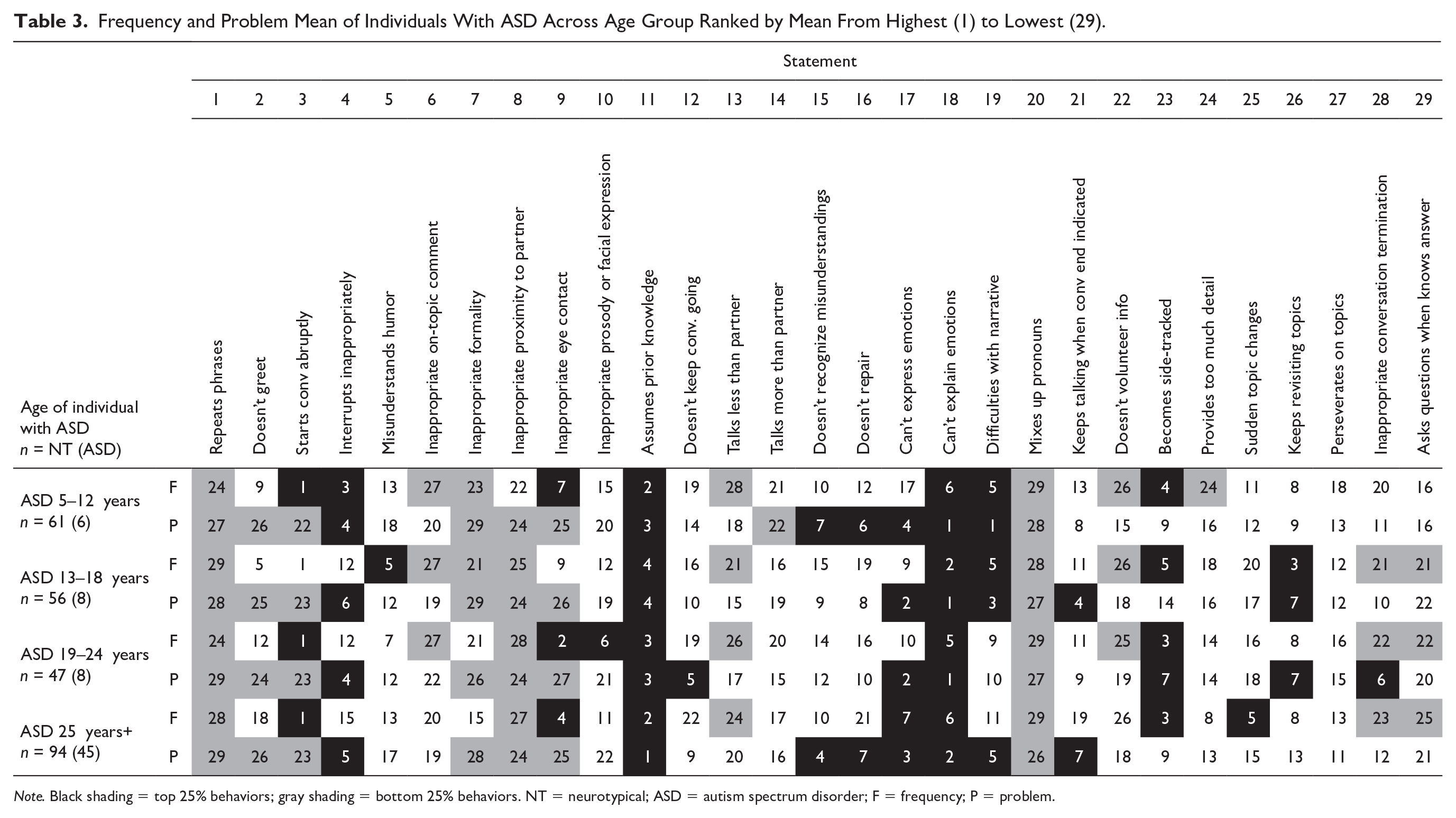
Note. Black shading = top 25% behaviors; gray shading = bottom 25% behaviors. NT = neurotypical; ASD = autism spectrum disorder; F = frequency; P = problem.
Discussion
The focus of this article is on whether relationship type, regularity of contact, and the age of the person with ASD impacts a conversation partner’s perception. General perceptions of frequency and problem were presented in an earlier paper (Sng et al., 2020). ASD diagnosis of respondent was significant in predicting frequency and problem ratings, and we considered this a covariate because ASD diagnosis affects perception (Sng et al., 2020). Although some behaviors transcended the categories of relationship, contact regularity, and age, others were distinctive.
Relationship to Person With ASD
Based on relationship status, the pairwise comparisons indicated that as a group, Friends reported that behaviors were less problematic overall than any of the other relationship groups. The voluntary nature of friendships may provide a possible explanation. Sedgewick, Crane, et al. (2019) posit that for individuals with ASD, friendships with one or two people may be sufficient to provide social fulfillment. Adults with ASD report being more comfortable when they find friends who accept their differences, eschewing the need to conform to social expectations (Sosnowy et al., 2019). Once a friendship is developed, conversation partners may be more accepting of idiosyncratic or atypical behavior. Typically developing friends of children with ASD often report satisfaction in their friendships (Calder et al., 2013; Petrina et al., 2017), but it should be noted that qualitative differences still exist (Petrina et al., 2020). Bauminger and Kasari (2000) outline companionship, intimacy, and affection as the main dimensions of friendship for typically developing children, but friendships involving children with ASD often place more emphasis on companionship (Petrina et al., 2020), and in adolescents, the provision of support and help is prioritized over intimacy (O’Hagan & Hebron, 2017).
Detailed analysis of individual statements showed other notable differences related to relationships. Compared with the other relationship groups, Life Partners and Friends reported high frequency for Statement 7 (“Inappropriate formality”), suggesting that individuals with ASD may fail to adjust the way they converse with different conversation partners. Friends were the only group to report Statement 5 (“Misunderstands humor”) in the highest quartile for problem rating. Laughing and humor is typically an important part of friendship for both NT adolescents and adolescents with ASD (Sedgewick, Hill, & Pellicano, 2019). Thus, social interactions where attempts at humor are misunderstood may affect friendships. Life Partners were the only group to report Statements 28 (“Inappropriate conversation termination”) and 12 (“Doesn’t keep conversation going”) in the highest quartile for problem rating. The nature of the relationship may be an explanation for why this behavior was particularly problematic for Life Partners. Wilson et al. (2017) conducted interviews with nine Asperger syndrome–NT couples and reported that NT partners found the lack of reciprocity and the unresponsiveness of partners with Asperger syndrome to be areas of difficulty. They described interactions where partners with Asperger syndrome walk away to avoid communication, which may be an example of an inappropriate termination of conversation. People in an intimate relationship may be more likely to discuss matters that require a decision or resolution. Given the tendency to avoid or terminate a communicative exchange, an unbalanced conversation or a conversation that is ended prematurely may be more problematic for Life Partners.
Regularity of Contact
Regression indicated that regularity of contact was not a significant predictor for overall frequency or problem rating, but there were some specific differences in how behaviors were reported by respondents with different levels of contact. Paradoxically, Statements 11 (“Assumes prior knowledge”) and 24 (“Provides too much detail”) were high in problem rating for the group with the most irregular contact. Individuals with ASD are reported to have weak central coherence (Barnes & Baron-Cohen, 2012; Happé et al., 2001) and may focus on specific details when telling narratives. The tendency to focus on details together with deficits in theory of mind (Baron-Cohen, 1988), in which people with ASD have difficulties inferring the thoughts of others, may be something that concerns conversation partners with less regular contact. As the number of interactions increase to Several times a day, the failure to repair and inappropriate terminations become more problematic.
Age of Person With ASD
The age of the individual with ASD was significant in predicting both overall problem and frequency scores, but pairwise comparisons did not indicate any significant difference between the groups. Nevertheless, there were some noticeable differences when individual statements were examined. The frequency rating for Statement 2 (“Doesn’t greet”) by the 13- to 18-year age group was ranked in the top quartile, and it was just outside of the top quartile for the 5- to 8-year group, perhaps indicating that progress is made in greeting prior to social exchanges. Another difference is the relatively high ranking of frequency for both Statements 24 (“Provides too much detail”) and 25 (“Sudden topic changes”) in the older age groups. This may be due to better language capacity leading to the provision of more details or a lack of improvement in social reciprocity in adulthood. Klin et al. (2007) measured the effect of age on social ability in people with ASD and found that social ability decreased with chronological age. They suggested that this may be a result of the intensity and types of intervention the younger cohort received. Furthermore, Taylor and Seltzer (2010) posited that social improvement declines after high school due to a lack of services and access to employment or stimulating activities. Our findings appear to corroborate their results in terms of frequency of behavior, but behaviors were not reported to be more problematic for conversation partners.
Limitations
This is a preliminary study into the conversation partner’s perspective and is a starting point for further research. The demographic information we requested did not include gender of the respondent or the person with ASD, how long the respondent had known the person with ASD, or severity of the symptoms of the person with ASD. In addition, given the nature of the anonymous online survey, it was not possible to confirm diagnoses. Nevertheless, there is evidence that reports of ASD diagnosis from some informants, specifically parents, are reliable (Daniels et al., 2012; Warnell et al., 2015).
The distribution of the survey through ASD-related groups may have led to an overrepresentation of certain relationship groups (i.e., Parents) and to the large proportion of the respondents in the Friend and Life Partner groups who indicated that they also had an ASD diagnosis. A broader sample of friends and life partners may yield different results. Surveys are based on self-report; this can be viewed as a limitation as the reports are subjective by nature, but there is merit in examining data of this nature as it provides a comparison for what is clinically observed to perceptions in a natural context.
Finally, the participation criteria for language were the same regardless of age, so the language profiles of the individuals with ASD will vary greatly. Conversation partner expectations during conversations with a 6-year-old are vastly different from conversations with a 26-year-old. As the age groups invariably refer to different individuals, the data must be cautiously interpreted.
Implications and Future Research
Although this research is exploratory, the results have identified some practical implications. The behaviors that are often addressed in interventions that teach conversation skills may not cover some of the behaviors that conversation partners find problematic during natural interactions. The provision of too much information was reported to be a problem for respondents with less regular contact. Providing too much information violates the maxim of quantity, one of the “rules” that underpin conversations (Grice, 1975); thus, the ability to ascertain whether a conversation partner possesses the requisite information to follow a conversation may be a focus for interventions in social communication. On the other hand, assuming a conversation partner has the requisite knowledge to follow a conversation was a behavior consistently reported to be high in problem ranking. Thus, researchers should consider whether a pivot toward the behaviors that conversation partners deem problematic is warranted.
To mitigate social isolation, attempts have been made to teach social skills, particularly to school-age children and younger, but there is a dearth of research for adolescents and adults (Reichow & Volkmar, 2010). The present results indicate that some problems identified in childhood persist into adulthood and may increase in frequency. Thus, research on continuing social skills programs into adulthood may be warranted given social interactions have an impact on the initial employability of an individual and also the ongoing ability to carry out duties as part of a team in the workplace (Baldwin et al., 2014; Cummings, 2017; Howlin & Moss, 2012).
Currently, the skills included in social skills programs are determined by adults, specifically clinicians and researchers, rather than by peers (Ellingsen et al., 2017). Consequently, these skills may not be ecologically valid, and this may have an impact on effectiveness (Ellingsen et al., 2017). Teaching skills that are accepted and valued by one’s cohort may promote acceptance and engagement by peers. The skills needed to maintain interpersonal connections change depending on age, and social skill programs usually take this into account. The target skills for young children may include sharing toys or asking for a turn during play; these skills may shift in early adolescence to learning how to take turns or stay on a topic during conversations (Laugeson & Ellingsen, 2014). The ability to take turns and share information helps establish common interests with peers which is crucial for establishing friendships (Laugeson & Frankel, 2010). Social skills programs should be age appropriate, with consideration given to cognitive and language function. Furthermore, the skills taught should be those deemed appropriate by the person’s peer group. The results of this study may inform the types of behaviors that could be addressed by practitioners. For example, the results indicate that individuals in the older age groups tended to provide too much information and make abrupt topic changes. Similarly, differences in perception exist depending on the relationship with the person with ASD. The results from this survey indicate that difficulties relating to the appropriate termination of conversations were more important for friends than many other relationship groups, so practitioners may consider whether differentiating the focus of interventions depending on age or relationship status is warranted.
As this is a preliminary study, further research is warranted to determine if the results can be replicated. Future surveys could be improved by collecting additional information on demographics, such as gender and on severity and confirmation of the diagnosis. Given that there are gender (Head et al., 2014; Raffaelli & Duckett, 1989) and cultural differences (Matson et al., 2011; Trembath et al., 2005) in the way communication is conveyed by people with ASD, information on gender, cultural background, IQ, and ASD severity (e.g., Social Responsiveness Scale measures) may be valuable. Importantly, data were collected solely from the point of view of the respondent in terms of perceived issues with the conversational communication of an individual with ASD. We acknowledge that communication issues may arise as a result of the conversation partner failing to make adaptations to their communicative style to adequately accommodate an individual with ASD. Examination of this issue was beyond the scope of the current research, but it represents a possible future direction. Finally, it would be appropriate to examine the extent to which conversation partners of individuals with ASD adjust their communication across a range of relationships and context. In addition, the effectiveness of such accommodations could be an important focus for research.
Conclusion
Clinical and descriptive studies highlight the social behaviors that set individuals with ASD apart from their NT peers. The results from this survey provide an insight into the behaviors that are perceived as problematic by conversation partners in natural settings. The perception of problem in some behaviors was unique to the nature of the relationship to the person with ASD. Life partners (or spouses/domestic partners) reported that inappropriate terminations and the need to carry the load of a conversation problematic, whereas for friends, it was the misunderstanding of humor and the failure to recognize the end of a conversation. Although not reported to be problematic during conversations, there was a tendency toward more frequent unannounced topic changes in the older age groups. Our results provide a snapshot of the discrete behaviors that pose a barrier to social conversation, but further research is recommended for a more complete view of the obstacles to social engagement.
Footnotes
Declaration of Conflicting Interests
The author(s) declared no potential conflicts of interest with respect to the research, authorship, and/or publication of this article.
Funding
This research was not supported by grants or any other sources of financial support.