






Abstract
From-Scratch Name Disambiguation (SND), a core Author Name Disambiguation (AND) task, aims to group papers with identical ambiguous names into clusters of distinct real-world authors. However, existing SND methods suffer from two critical limitations: first, the inherent long-tailed uneven distribution, where most papers belong to a few prolific authors, severely biases representation learning, causing low-discriminative embeddings and over-merging of tail authors; second, cluster number estimation methods are unreliable and poorly scalable for long sequences, restricting real-world deployment. To address these issues, we propose GRAND-HC, an end-to-end SND framework with three components. We first construct a heterogeneous paper graph based on co-author, co-organization and co-venue relations, and adopt a graph attention network as the backbone. Then, harmony contrastive learning (HCL) dynamically reweights loss to suppress overfitting to prolific authors, learning highly discriminative embeddings. On this basis, a graph-refined distance matrix (GRDM) leverages graph topology to optimize pairwise distances, preventing over-merging of tail authors. Meanwhile, a lightweight Paper Compression Module (PCM) achieves accurate cluster number estimation across varying scales, eliminating the long-sequence modeling defect. Finally, Hierarchical Agglomerative Clustering outputs the final clusters with the optimized distance matrix and estimated cluster number. Extensive experiments demonstrate that GRAND-HC outperforms state-of-the-art models on macro F1 score. Furthermore, GRAND-HC has been deployed in a billion-scale academic database.
Keywords
Introduction
The author name disambiguation (AND) problem i.e. authors sharing the same name, is a critical challenge in scientific literature database management and information retrieval such as AMiner 1 and DBLP. 2 This problem has long been commonly divided into three sub-tasks: 3 From-Scratch Name Disambiguation (SND), Real-time Name Disambiguation, and Incorrect Assignment Detection. In this paper, we focus on From-Scratch Name Disambiguation (SND) problem, which aims to group all papers by the same author for building a new academic system from the ground up.
Addressing the From-Scratch Name Disambiguation (SND) task requires effectively aggregating multi-source heterogeneous information from academic datasets to distinguish real authors with identical names, which is a fundamental component for academic knowledge graph construction, scholar evaluation, and academic search. As illustrated in Figure 1, existing mainstream SND frameworks follow a three-stage general paradigm for a given ambiguous name (e.g., ‘Tom’ with a pile of associated papers). First, they construct a heterogeneous paper graph, where nodes represent individual papers, and edges encode diverse relational clues including co-author, co-venue, and co-institution affiliations.4,5 Second, to learn discriminative paper embeddings, supervised methods construct a target paper relation matrix from labeled data to guide network training,6–8 while unsupervised counterparts leverage intrinsic paper correlations as pseudo supervision signals.9,10 Finally, based on the learned embeddings, they perform clustering with an estimated number of author clusters, and assign papers to distinct real authors (e.g., Tom
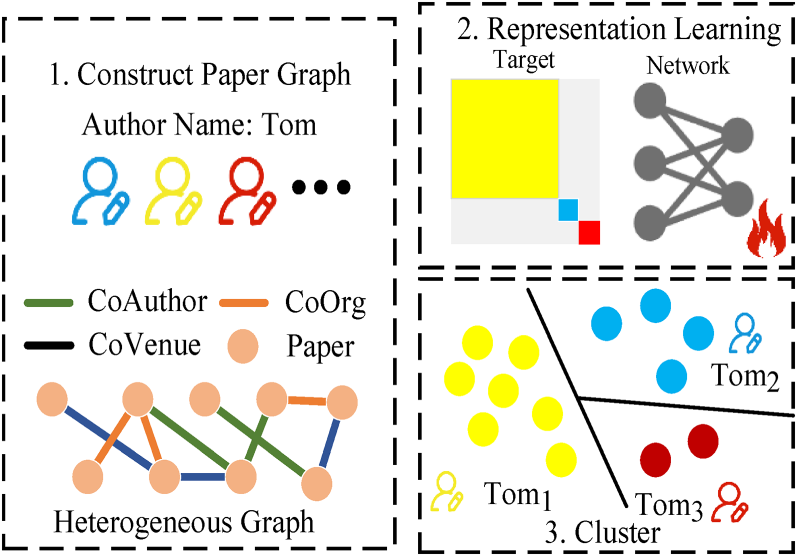
General flow of current SND frameworks.
Despite the promising performance of existing frameworks, they still face two critical limitations that severely hinder their performance and generalization in real-world scenarios.
Limitation 1 in the representation learning stage (Step 2 in Figure 1): most existing SND methods largely overlook the inherent long-tailed uneven distribution of papers across real authors, which severely undermines the core goal of this stage — learning highly discriminative paper embeddings, and remains a ubiquitous unaddressed challenge in real-world academic datasets.
For a given ambiguous name, a small number of prolific high-volume authors hold the majority of associated papers. To quantitatively validate the ubiquity of this phenomenon, we conduct a statistical analysis on two widely used large-scale SND benchmarks: WhoisWho-SND (https://github.com/THUDM/WhoIsWho) and AMiner-v2 (https://github.com/neozhangthe1/disambiguation), both constructed from real-world academic literature. As shown in Figure 2(a), nearly 40% of ambiguous names contain a dominant prolific author that accounts for more than 50% of the total papers under the name. Figure 2(b) further quantifies the dispersion of paper counts: for 29.1% of ambiguous names, the standard deviation of paper counts across different authors exceeds 50, reflecting an extremely uneven distribution with high volatility relative to the mean. These statistics confirm that the uneven paper distribution is an inherent and widespread characteristic of real-world SND tasks. This severe data imbalance brings fatal defects to existing frameworks. Conventional representation learning strategies are inherently biased towards dominant prolific authors during training, resulting in a low-discriminative embedding space where tail authors’ papers are heavily overlapped with no clear clustering boundaries, as visualized in Figure 2(c).
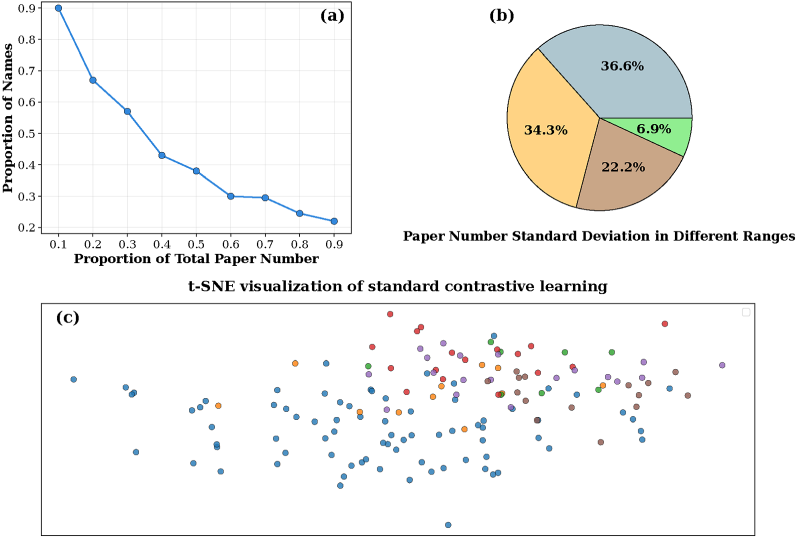
Statistical analysis of the long-tailed data distribution in SND tasks and its negative impact on representation learning. (a) Proportion of ambiguous names containing at least one prolific author whose papers account for x% of the total papers under the same name. (b) Distribution of the standard deviation of paper counts across distinct authors within the same ambiguous name. (c) t-SNE visualization of paper embeddings learned by standard contrastive learning.
Limitation 2 in the final clustering stage (Step 3 in Figure 1): existing methods suffer from unreliable cluster number estimation, which is an indispensable prerequisite for accurate end-to-end author clustering (the core task of this stage), and severely restricts the practical deployment of SND frameworks in large-scale real scenarios.
Mainstream cluster number estimation approaches for SND can be divided into two categories, both with inherent fatal flaws. For distance-based methods,9,11 they rely on hand-crafted distance thresholds to determine cluster numbers, which are extremely sensitive to data distribution shifts and embedding quality fluctuations, leading to severe systematic estimation bias.
For RNN-based methods widely adopted in prior SND works, 5 they fail to model overlong paper sequences effectively due to the inherent gradient vanishing problem of recurrent architectures, 12 thus cannot capture the global structural information of the heterogeneous paper graph when the number of papers grows large.
To quantitatively verify the ubiquity of these defects, we conduct comparative experiments on the widely used AMiner-v2 dataset, with results shown in Figure 3. As illustrated in Figure 3(a), mainstream methods suffer from severe underestimation of the real cluster number: the average predicted cluster number of distance-based methods is only 27, and that of RNN-based methods is 46, both far below the ground-truth average of 62. Figure 3(b) further demonstrates the poor scalability of existing methods: as the number of papers increases from 100 to 900, the Root Mean Log Squared Error (RMLSE) of distance-based methods surges from 0.96 to 3.72, while the estimation error of RNN-based methods rises sharply from 0.07 to 1.24. Without reliable and robust cluster number guidance, even high-quality paper embeddings cannot produce accurate end-to-end disambiguation results, which severely limits the deployment of existing SND frameworks in real-world large-scale academic scenarios.
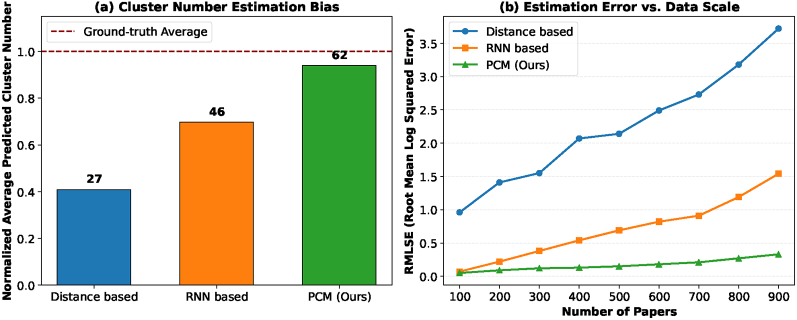
Quantitative evaluation of cluster number estimation performance on the AMiner-v2 dataset. (a) Normalized average predicted cluster number of different methods, where the red dashed line denotes the ground-truth average cluster number. (b) Estimation error (RMLSE) of different methods with the increasing number of papers.
To address the two aforementioned critical limitations in the standard three-stage SND pipeline (Figure 1), we propose GRAND-HC, a unified end-to-end from-scratch name disambiguation framework, where each component is explicitly designed to target one well-identified limitation.
To address
For
The main contributions of this paper are summarized as follows:
We identify and quantitatively verify two core, largely overlooked limitations in the standard SND pipeline: (1) the long-tailed uneven paper distribution skews representation learning and causes severe over-merging of tail authors; (2) existing cluster number estimation methods suffer from poor scalability and unreliable performance as the number of papers grows. To address the first limitation, we design two tightly coupled components: harmony contrastive learning (HCL) to alleviate model bias towards prolific authors and learn discriminative embeddings, and a graph-refined distance matrix (GRDM) to strengthen clustering boundaries and avoid over-merging of tail authors. To address the second limitation, we propose a novel Paper Compression Module (PCM) for accurate and robust cluster number estimation, which eliminates the long-sequence modeling defect of traditional methods and maintains stable performance across different data scales. Extensive experiments show that GRAND-HC achieves state-of-the-art (SOTA) performance on multiple classic SND benchmarks. Furthermore, the framework has been successfully deployed in a billion-scale academic database for real-world SND tasks, verifying its effectiveness and practicality.
The rest of the paper is organized as follows. In the related work section, we provide a literature review for SND. We formally formulate the SND problem in the problem formulation section. In the methodology section, we present the details of GRAND-HC. In the experiments section, we present our experimental results on several classic SND datasets and a comprehensive ablation study. Finally, we make conclusions in the conclusion section.
This section primarily delves into research concerning SND task, which is typically regarded as a clustering problem. The SND task involves two closely related components: paper representation learning and clustering. Current methods typically focus on learning paper representations to compute similarity, followed by clustering to assign papers to correct authors. Paper representation learning methods can be broadly categorized into feature-based and graph-based methods. In terms of clustering techniques, previous methods group data via distance matrix computed from paper embeddings, facing the challenge of unknown author cluster size.
Feature-based methods
There are some methods generate embeddings mainly based on paper information with less consideration about graph structure.10,13–18 Han et al. 19 proposes a semantic fingerprint-based approach for author name disambiguation in Chinese documents, integrating text fingerprints with co-author and institution features to address name ambiguities. Louppe et al. 20 presents a semi-supervised learning-based model, incorporating phonetic blocking strategies and ethnicity-sensitive features to build a linkage function, combined with hierarchical agglomerative clustering for efficient document grouping. Wang et al. 17 proposes a framework based on adversarial representation learning, integrating content and relational information through heterogeneous information networks, while employing a self-training strategy and a random walk-based generation algorithm to handle high-order connections. Santini et al. 10 proposes a multimodal knowledge graph embedding framework based on LiteralE, integrating literal features (e.g., titles, dates) into entities. Two variants are introduced: LAND-glin, employing linear projection of title embeddings, and LAND-ggru, which fuses textual and numeric literals via GRU. Recently, with the advancement of large language models, 18 fine-tunes several large language models to collaboratively address the IAD task. However, in the context of SND, due to the vast volume of literature, there appears to be limited progress so far in developing LLM-based approaches. In contrast, 15 trains the BERT model on academic text corpus in Open Academic Graph, including paper titles, abstracts and bodies and finetune it in SND tasks, which achieves outperformance over many baselines.
Graph-based methods
With the advancement of graph representation learning, Graph Neural Networks (GNNs) and their variants are increasingly used for extracting relational information from heterogeneous paper-author graphs.7,9,10,21–26 Chen et al. 27 proposes a Graph Convolutional Network (GCN) model that integrates attribute features and linkage information from various graphs, using hierarchical clustering for disambiguation. Ma et al. 28 combines a Variational Graph Auto-Encoder (GAE) with graph embedding to capture attribute and topological features, employing hierarchical agglomerative clustering for document partitioning. Pooja et al. 29 leverages a self-attention-based graph convolution network on multi-hop neighborhoods, incorporating neighborhood and relation-level attention to improve document embeddings and clustering accuracy. Xiong et al. 30 proposes a joint representation learning framework that simultaneously embeds semantic and relationship information into a low-dimensional space using a Variational AutoEncoder (VAE) and applies HAC for SND problem. Cheng et al. 9 proposes an end-to-end framework, BOND, which constructs multi-relational graphs, leverages Graph Attention Networks (GAT) for local metric learning, and utilizes DBSCAN clustering to jointly optimize local and global signals. Liu et al. 7 proposes a framework combining paper association graph refinement and contrastive learning, dynamically optimizing graph structures to reduce noise and uncertainties, while employing multi-level contrastive learning to enhance the discriminative power of semantic and structural representations. Gong et al. 31 integrates OAG-BERT, SimCSE, LightGBM, and iHGAT via supervised and unsupervised learning.
Clustering size estimation for SND task
In practical SND tasks, the true number of authors is often unknown, making the estimation of the number of clusters a crucial factor for the final disambiguation results. Although a segment of the methods focuses on directly inferring text-pair relationships, it lacks the ability to generate distinct paper clusters and suffers from notable inefficiency in computation.8,32,33 The main current algorithms for category number estimation fall into four categories: Bayesian-based estimation, 34 clustering algorithms using predefined thresholds, 9 graph-based clustering algorithms35–37 and neural network-based algorithms. 5 Pelleg 34 iteratively splitting the centroids and searching for an optimal K based on the quality of the proposes clustering. 9 Classless number clustering using DBSCAN clustering algorithm with predefined thresholds. Tang et al. 37 proposes a unified probabilistic framework, employing a dynamic method to estimate the number of clusters K. Han et al. 35 employs a K-way spectral clustering method for name disambiguation in author citations, predefining the number of clusters K as the labeled ground truth, focusing on partitioning citations into clusters that correspond to unique authors. Qiao et al. 36 utilizes an optimal modularity partitioning mechanism to determine the partition of publications, which iteratively calculates modularity after each cluster merging process until there is no edge among clusters, and choose the largest M as the final clustering result. Zhang et al. 5 proposes an RNN-based neural network model and construct a training set with strictly defined ranges for the total number of papers and the number of author categories to mitigate the limitations of RNNs in processing long sequences.
Problem formulation
In this section, we introduce the foundational concepts of author name disambiguation and formally define the SND problem.
Definition 3.1.
Definition 3.2.
Definition 3.3.
Problem

In this section, we provide a detailed explanation of GRAND-HC. We first describe our method for constructing heterogeneous graph. Then, we introduce paper embedding generation network, which is trained by harmony contrastive learning(HCL). Then, we calculate graph-refined distance matrix(GRDM) and estimate cluster size with paper compression module(PCM) for HAC clustering. Finally, the analysis of complexity and algorithm workflow is summarized. The overall framework is illustrated in Figure 4.
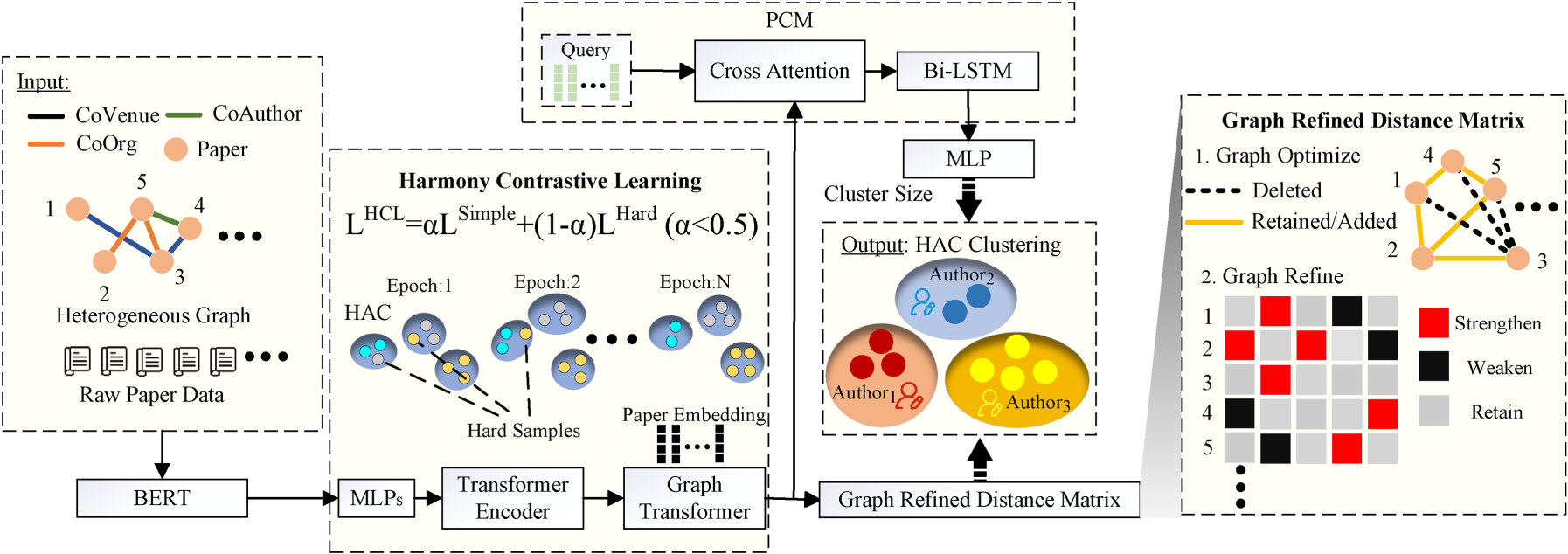
The overall framework of GRAND-HC. We first construct a heterogeneous graph based on paper relations and get the initial semantic embedding by BERT encoding. Then, representation network is trained by harmony contrastive learning and outputs paper embedding. With these paper embeddings, we train cluster size estimation network and calculate graph-refined distance matrix. Finally, HAC clusters papers into different authors with specified cluster size and distance matrix.
To better leverage the relationships between papers, we constructed a heterogeneous paper relationship network for candidate papers under each author name. Each connected component of the network represents a potential article set of a single author. In this network, nodes represent papers, whose attributes include features required for subsequent semantic information extraction (e.g., title, abstract, and keywords). Edges represent the similarity or relationships between papers and are the key to constructing the heterogeneous network.
Edge construction
The relational information of papers serves as a crucial feature for measuring similarity and is used to establish edges between papers. Traditional studies37,38 often rely on co-authorship and citation relationships to measure paper similarity. This study categorizes relationships into the following three types:
The detailed construction of these different types of edges will be elaborated in section experiments.
Text similarity measurement
To measure the similarity of different attributes between papers, we employed several text-matching methods:
Paper embedding generation
Firstly, BERT takes paper title, abstract, venue, authors, organizations and keywords and outputs 768 dimensions paper embedding. In addition, previous methods neglect certain SND-related graph information, such as the high likelihood that papers within the same connected component are authored by the same individual. As a result, we code every connected component and give each paper a subgraph label according to its location.
Suppose we have a paper relational heterogeneous Graph



Then, we utilize a variant of the Graph Attention Network (GAT)
39
proposed by Shi et al.
40
as a structure encoder to get final paper embedding

The core goal of the representation learning stage in SND is to learn a highly discriminative embedding space where papers from the same author are close while papers from different authors are far apart. However, as identified in Limitation 1, the inherent long-tailed uneven paper distribution severely undermines this goal.
Standard contrastive learning methods for SND9,33 fail to address this issue, as they minimize the standard binary cross-entropy (BCE) loss between the ground-truth paper relationship matrix


To address this problem and learn a balanced, high-discriminative embedding space (the core requirement for solving Limitation 1), we propose Harmony Contrastive Learning (HCL), which dynamically reweights the training loss to suppress the overfitting to prolific authors and force the model to focus on learning discriminative features for tail authors. The key insight is that paper pairs from prolific authors are usually ”simple samples” that are easy to cluster correctly, while pairs from tail authors are ”hard samples” that contain critical discriminative information but are masked by the dominant simple samples.
Specifically, during each training epoch, we first perform Hierarchical Agglomerative Clustering (HAC) on the current learned embeddings with the ground-truth cluster number

Based on this dynamic sample division, we reweight the BCE loss to reduce the influence of simple samples and amplify the influence of hard samples, forcing the model to learn more comprehensive and balanced discriminative features. The final harmony contrastive learning loss is formulated as:

In summary, HCL directly addresses the core defect of Limitation 1 from the representation learning perspective: it suppresses the model’s overfitting to prolific authors by dynamically reweighting the training loss, and learns a high-discriminative embedding space with clear boundaries between both prolific and tail authors. This high-quality embedding space provides a solid foundation for the subsequent GRDM module, which further eliminates the remaining prolific bias from the clustering perspective.
Although the proposed HCL module effectively alleviates the model’s bias towards prolific authors and learns a more discriminative embedding space, we empirically find that directly applying conventional distance-based clustering (e.g., vanilla HAC) on the learned embeddings still suffers from the over-merging of less-published tail authors into large prolific clusters. The root reason is two-fold: (1) The initial heterogeneous graph topology is inherently biased towards prolific authors, who have far more co-author, co-organization, and co-venue connections, thus dominating the graph structure and misleading the clustering process; (2) Graph Neural Networks (GNNs) inherently rely on message passing mechanisms to aggregate features from neighboring nodes, which tends to make embeddings of adjacent nodes more similar in the feature space, a phenomenon known as feature homogenization or over-smoothing. 41 In our heterogeneous paper graph, papers from prolific authors have much higher node degrees and more diverse neighbors, which further amplifies this homogenization effect: tail authors’ papers with few connections are easily ”assimilated” by the embeddings of adjacent prolific papers, even after HCL improves the overall discriminability, leading to over-merging in the final clustering stage.
To address the above issues and completely solve Limitation 1 from the clustering perspective (complementary to HCL which solves it from the representation learning perspective), we propose the Graph-Refined Distance Matrix (GRDM) module, which directly optimizes the clustering distance matrix based on the learned high-quality embeddings from HCL, without introducing additional training objectives or trade-offs. GRDM consists of two sequential steps: topology refinement and degree-aware similarity adjustment, both explicitly designed to prevent the over-merging of tail authors.
Topology refinement
We first correct the initial biased heterogeneous graph topology based on the learned paper embedding similarity matrix

On top of the refined topology, we further adjust the similarity matrix to explicitly leverage the node degree information, which is a strong indicator for distinguishing prolific authors and tail authors. Intuitively, a paper node with a higher degree (usually from a prolific author) has more credible co-author, co-organization, and co-venue connections, thus its embedding is more informative and stable. Conversely, a paper node with a lower degree (usually from a tail author) has fewer connections, and its embedding is more likely to be affected by noise. Conventional HAC only focuses on pairwise embedding similarity, which often leads to the over-merging of tail authors into prolific clusters due to accidental semantic similarity. To address this, we first convert the degree of each paper node into a confidence score of its embedding reliability:

Then, we use this confidence score to adaptively adjust the similarity matrix

Finally, we convert the adjusted similarity matrix

In summary, GRDM works in synergy with HCL to completely solve Limitation 1: HCL alleviates the prolific bias from the representation learning perspective by adaptively weighting the training loss, while GRDM eliminates the remaining bias from the clustering perspective by refining the topology and adjusting the distance matrix based on node degrees, ensuring that tail authors are not over-merged into prolific clusters.
As identified in Limitation 2, reliable cluster number (
Most previous SND works either require
To address the above issues and completely solve Limitation 2, we propose the Paper Compression Module (PCM), a lightweight yet effective neural network-based cluster number estimator that achieves accurate and robust
Specifically, given a set of paper embeddings

Next, the compressed fixed-length sequence

Since the number of author categories varies over a large range in real data, traditional methods5,36 often use Mean Squared Logarithmic Error (MSLE) as the loss function to ensure numerical stability. However, MSLE limits the model’s ability to learn with high precision, especially for small cluster sizes. In contrast, Huber Loss combines the advantages of MSE (Mean Squared Error) and MAE (Mean Absolute Error): when the absolute error between the predicted and true values is within a threshold

Finally, Hierarchical Agglomerative Clustering (HAC) with the average linkage criterion takes the predicted cluster size
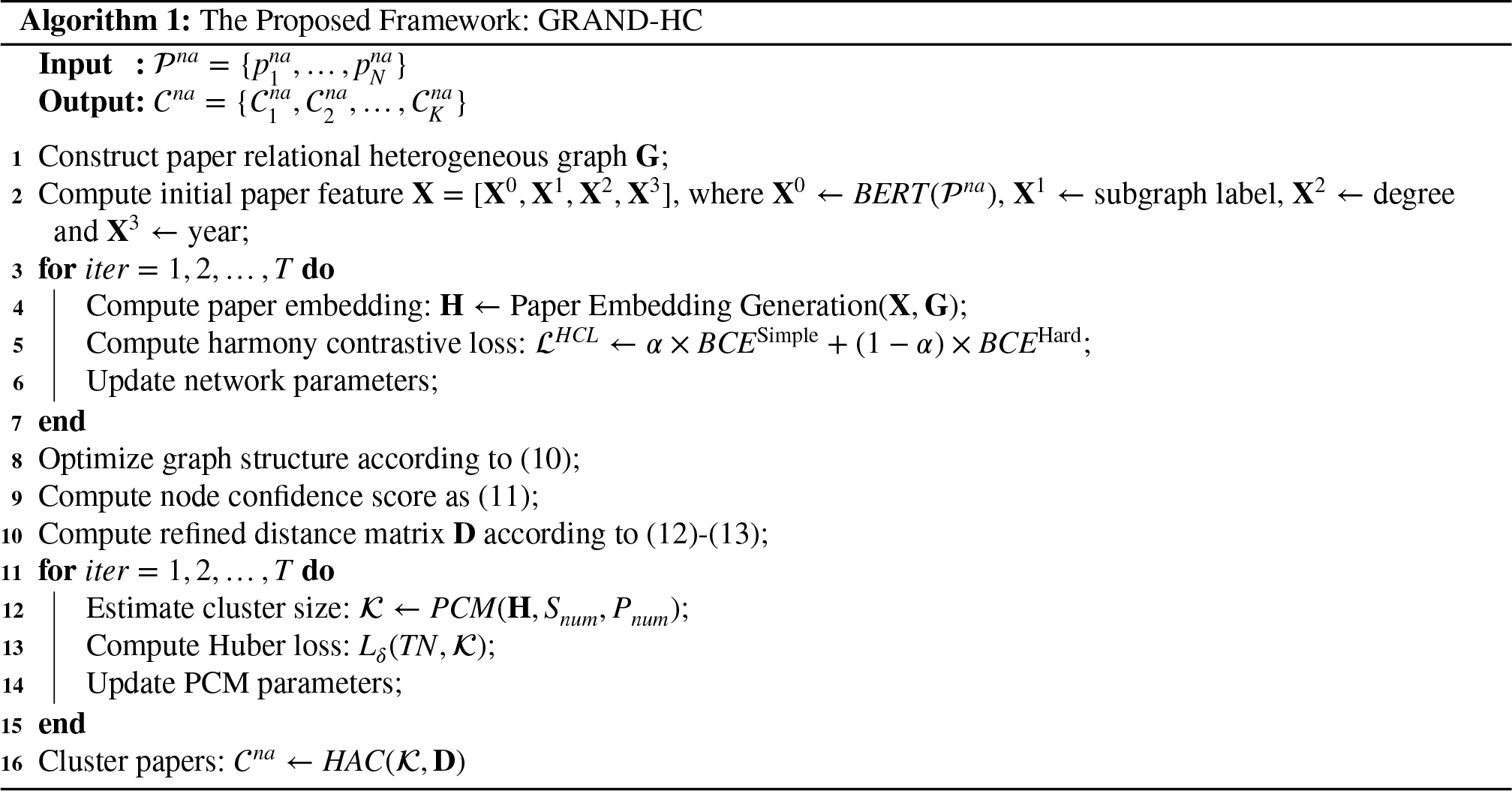
The whole process of GRAND-HC is summarized in Algorithm 1. The time complexity for the paper embedding generation network, which utilizes a transformer encoder and graph attention network, is given by
Experiments
Experiment setup
Datasets
We use two commonly used author name disambiguation datasets, AMiner-v2 and WhoisWho-v1. AMiner-v2 contains 400 training names,100 validating names, 100 testing names, while WhoisWho-v1 contains 221 training names, 50 validating names, 50 testing names. The details are shown in Table 1. It can be seen that the distribution of the number of authors per name and the number of papers per name is extremely uneven. For example, the maximum papers per name of WhoisWho-v1 dataset reaches 5682, far exceeding the average of 911.1.
The statistics of AMiner-v2 and whoisWho-v1 datasets.

The statistics of AMiner-v2 and whoisWho-v1 datasets.
To evaluate the model performance, we use pairwise precision, pairwise recall and pairwise F1-score as evaluation metrics for each name:




We use PyTorch to implement the scheme, the optimizer uses AdamW, 42 the learning rate is chosen from 0.01 to 0.00001, the number of training epoch is 200, the dropout ratio is 0.5. Besides, we utilize pre-trained OAG-BERT-V2 15 to get initial paper embeddings.
For model training, we use Optuna to obtain the best hyper parameters, which include the final paper embedding size from 64 to 128, the thresholds
Overall results
Since our architecture consists of paper embedding generation and cluster size estimation modules, we design
From the Tables 2 and 3, it can be seen that our model outperforms most of the current state-of-the-art methods in terms of macro F1 score. As shown in the results, MFAND’s use of text-pair relations as a training target causes its network to fail to capture global author feature information. The rest of the feature-based methods such as OAG-BERT-V2 and AMiner limit their performance since they do not consider the topology of the graph. As for graph-based methods, the recent GRAND neglects the uneven data distribution, resulting in less discriminative embeddings; ARCC relies on multiple rounds of topology modification, which risks introducing error edges and restricting performance. Meanwhile, BOND suffers from biased pseudo-label propagation based on DBSCAN clustering, while ITAND’s GVAE model lacks reliable training objectives for noisy datasets. For LLM-based approaches, GPT
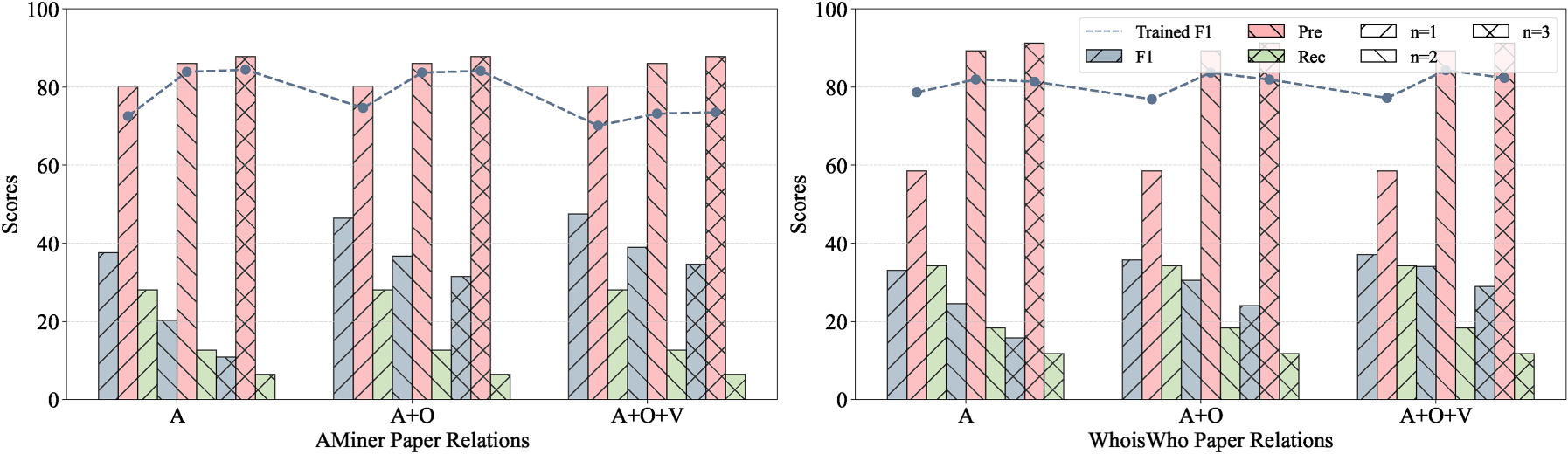
F1, precision and recall score of different paper relational graphs and their final trained F1. A: CoAuthor, O: CoOrg, V: CoVenue. For each paper relation, the co-authorship is analyzed under three scenarios: at least one, two, and three co-authors, as shown by n in the legend. Trained F1 represents the final training results using the corresponding construction principles.
The performance comparison of AMiner-v2.
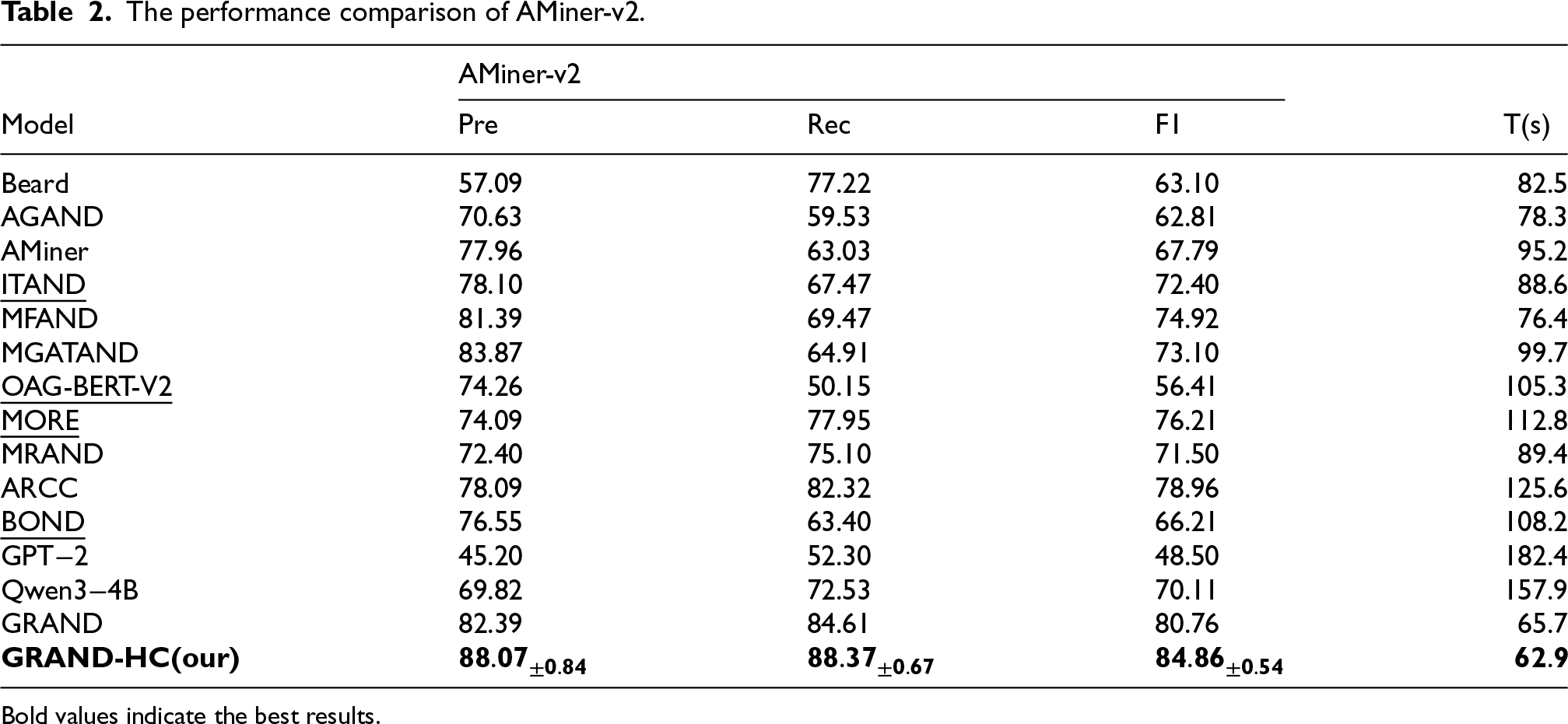
Bold values indicate the best results.
The performance comparison of whoisWho-v1.
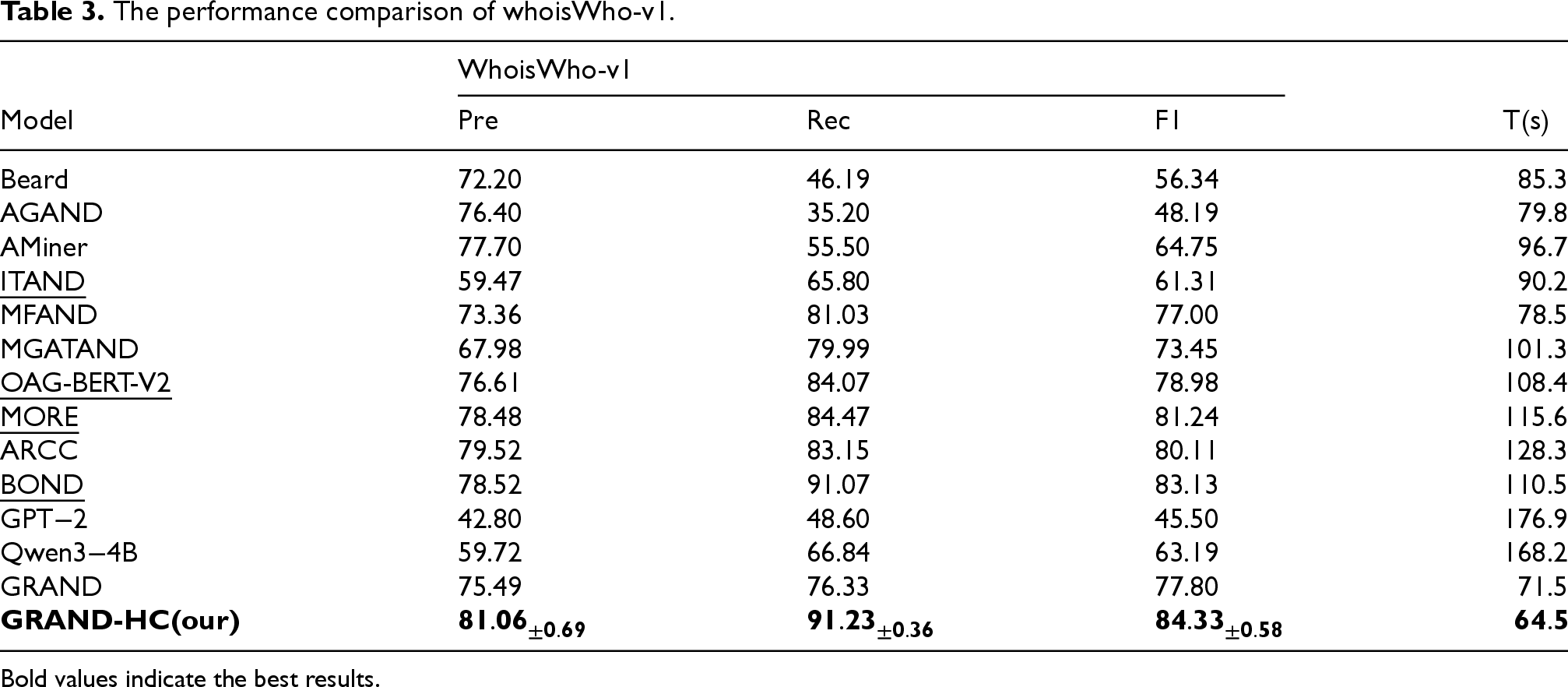
Bold values indicate the best results.
Under the unknown cluster number setting, most baselines fail to work, and only three valid methods are retained and shown in Table 4: RNN-based AMiner, threshold-dependent density clustering method BOND, and GRAND. For experimental consistency, the RNN module of AMiner and our PCM are trained on the same training set; BOND and GRAND adopt the default clustering thresholds in their official codes. GRAND-HC outperforms all baselines in three aspects. In performance, all baselines suffer significant degradation, while GRAND-HC achieves almost no drop on AMiner-v2 and negligible decline on WhoisWho-v1. In cluster number accuracy, GRAND-HC obtains the lowest RMLSE of 0.18. In time overhead, GRAND-HC brings the smallest extra delay and keeps the fastest inference speed. The results confirm that GRAND-HC maintains stable and superior performance in the realistic unknown cluster number scenario. We also conduct an ablation study to verify the contribution of each component (Figure 6). The baseline is our framework with standard contrastive learning and HAC clustering, achieving 56.41 F1-score. By replacing it with harmony contrastive learning (HCL), the performance jumps to 78.35 (+21.94), showing its effectiveness in learning discriminative embeddings. Adding graph-refined distance matrix (GRDM) further improves the result to 81.25 (+20.48), which validates the role of adaptive distance optimization. Combining HCL and GRDM yields 84.33 (+27.92), demonstrating their complementary strengths. Finally, the full model with cluster size estimation (PCM) reaches 84.23, realizing practical end-to-end disambiguation. These results confirm that each module delivers independent and stable gains, and the improvement comes from our core designs instead of heuristic combinations.
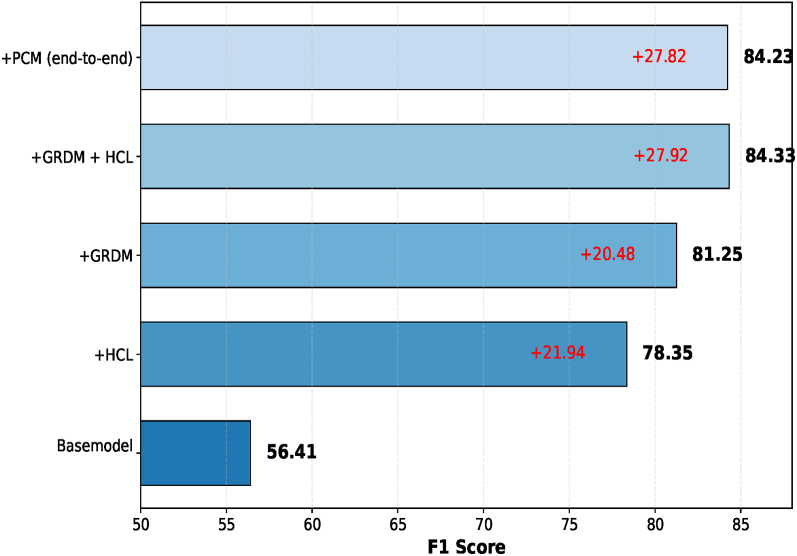
Ablation study of each key component in GRAND-HC. Baseline denotes our framework equipped with original contrastive learning and HAC clustering. HCL represents harmony contrastive learning. GRDM is the graph-refined distance matrix module. PCM denotes the cluster size estimation module.
Performance comparison under unspecified cluster size (vs. fixed cluster size setting).
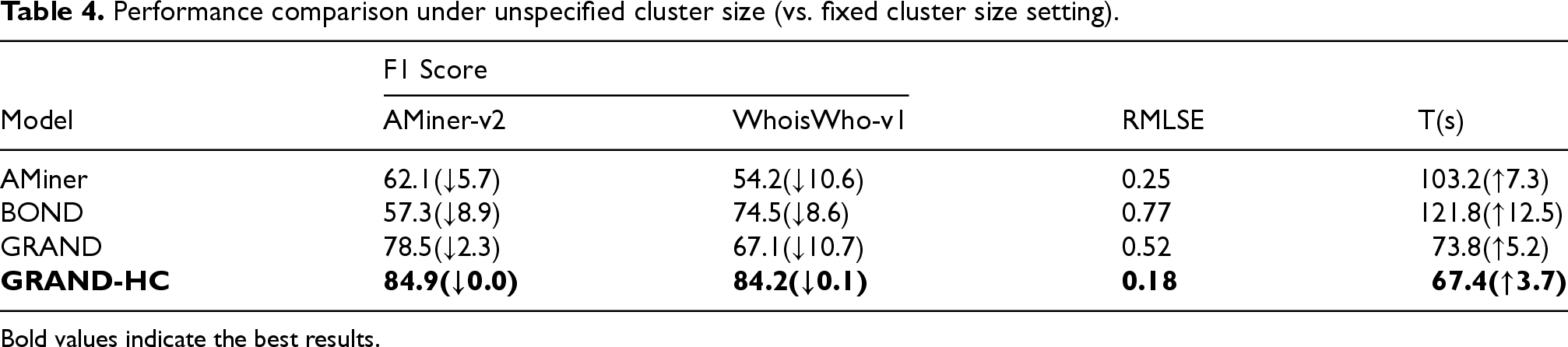
Bold values indicate the best results.
The results of 15 sampled names are displayed in the Tables 5 and 6. It can be seen that our model improves on almost all evaluation metrics. However, in the WhoisWho-v1 dataset, there are still some names performance worse than others. We further analyze the classification results for these names relying on the initial graph topology, with an average
The detailed results on AMiner.
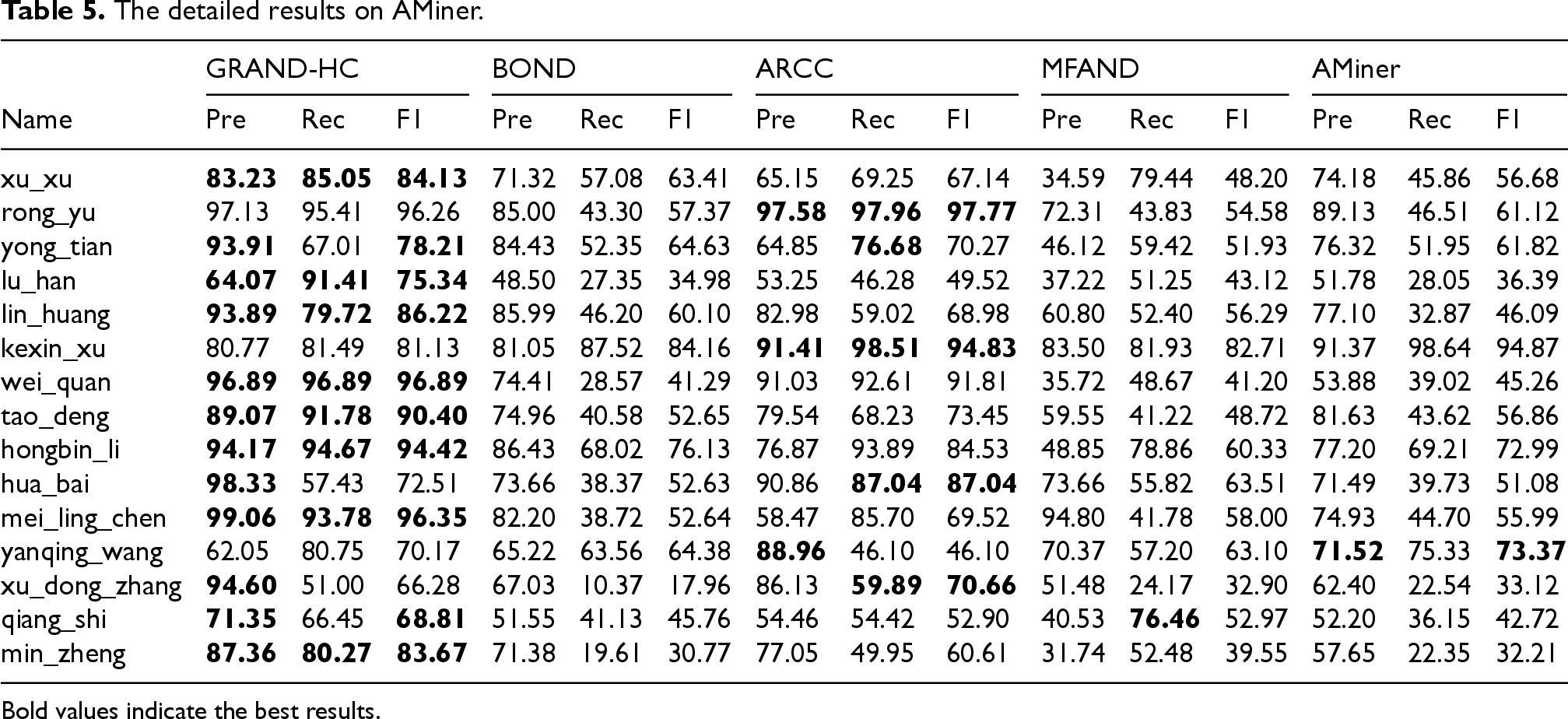
Bold values indicate the best results.
The detailed results on whoisWho-v1.
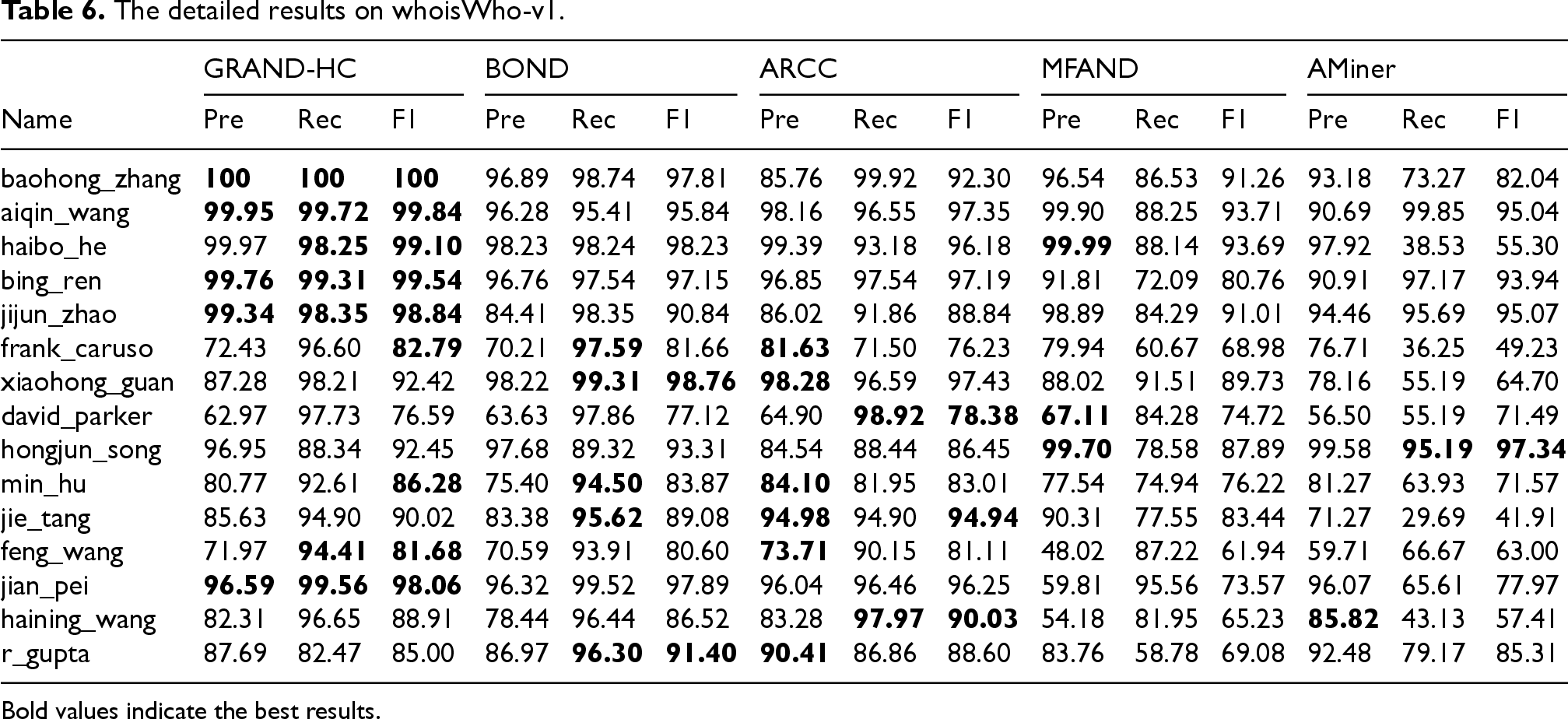
Bold values indicate the best results.
To fully leverage the diverse relational connections between papers, it is essential to carefully select the types of edges when constructing the heterogeneous graph of academic papers. In this section, we build the heterogeneous graph incrementally based on the Aminer and WhoIsWho training datasets by progressively incorporating different types of edges, aiming to explore their impact on the SND task.
Figure 5 illustrates the F1 performance of different paper relational graphs on the name disambiguation task. Specifically, CoAuthor (A) represents the co-author relationship excluding the target disambiguation author (evaluated under scenarios with at least one, two, and three co-authors), CoOrg (O) represents the co-organization relationship of the author to be disambiguated, and CoVenue (V) represents the co-publication venue relationship between papers. We first construct a heterogeneous graph based on the text-pair relations, and then cluster the articles by dividing the different subgraphs into different authors. Finally, we calculate F1 scores according to the clustered text-pair relations and test their results.
Overall, the AMiner dataset demonstrates superior performance compared to the WhoIsWho dataset. This disparity arises primarily because the WhoIsWho dataset reflects real-world scenarios with substantial noise and missing values. Moreover, considering that co-author relationships excluding the target author may also involve instances of name homonymy, we tested different numbers of co-author connections. The results reveal that the best-performing relational graph in both datasets is A1+O+V, achieving F1 scores of 47.57 and 37.16 for the AMiner and WhoisWho datasets, respectively. This indicates that incorporating multi-relationships effectively mitigates the influence of name homonymy and improves performance.
Furthermore, the performance of A+O shows significant improvement over A alone, highlighting the crucial role of co-organization information in complementing co-author relationships and enhancing name disambiguation. However, co-venue relationships contribute minimally to disambiguation performance. We hypothesize that their primary value lies in the semantic information they convey, such as shared research directions.
But an interesting phenomenon is that the final training results have a strong correlation with the precision of the initial heterogeneous graph. We think this may be that graph neural networks need more credible connecting edges to aggregate information to generate reliable embedding representations. In addition since we subsequently refine the distance matrix based on the graph structure, topologies with higher initial precision provide more accurate augmentation locations. Overall, GRAND-HC achieves good results on many types of initial heterogeneous graphs with well generalization.
Ablation of paper embedding generation
This chapter will analyze the importance of each part of our paper embedding generation network.
The embedding generation model mainly relies on harmony contrastive learning. We first adjust the loss weight of simple samples
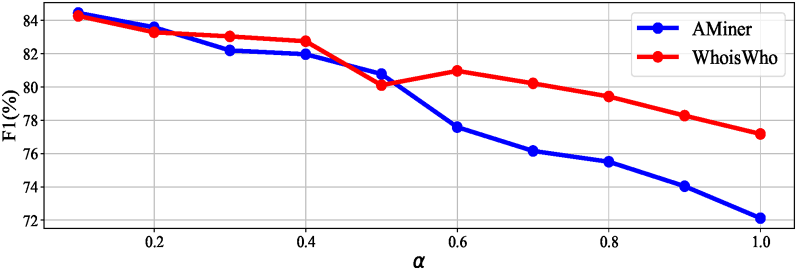
Loss partition parameter
Specifically, in Figure 8, we randomly select a name in the AMiner dataset, and use t-SNE to downscale the paper features of the authors of the same name in the top ten according to their paper counts. When
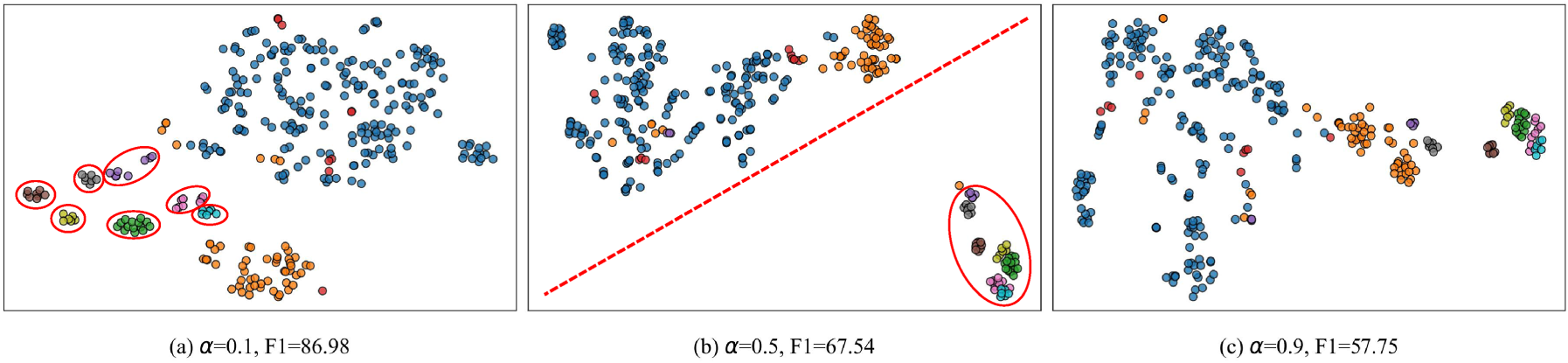
The t-SNE visualization of name ‘hongtao_liu’ in AMiner-v2 for the analysis of parameter
In Table 7, we conducted ablation experiments on the graph information (subgraph labels and degree) of the model inputs. Initial embedding is clustered directly with the embedding of OAG-BERT-V2, and initial graph is divided directly based on the connected component of the initial structure graph. It can be observed that on the AMiner dataset, the quality of initial semantic embeddings is relatively low, leading to poor performance in direct training. GRAND-HC employs a transformer encoder to jointly encode the structural and semantic information of nodes, which effectively improves the F1-score. Either the initial structural or semantic embeddings can relatively accurately reflect the author clusters, GRAND-HC can learn the underlying patterns with strong generalization.
Graph information influence on F1 score(%).

Bold values indicate the best results.
In order to test the effectiveness of the cluster size estimation network, we selected main solutions for this problem as baselines and use root mean squared logarithmic error as evaluation metric according to previous works. We test them on the AMiner-v2 dataset and sample some author results, which is shown in Table 8. Note that results with underline is reproduced by us and others are from AMiner. 5
Comparison of cluster size estimation methods.
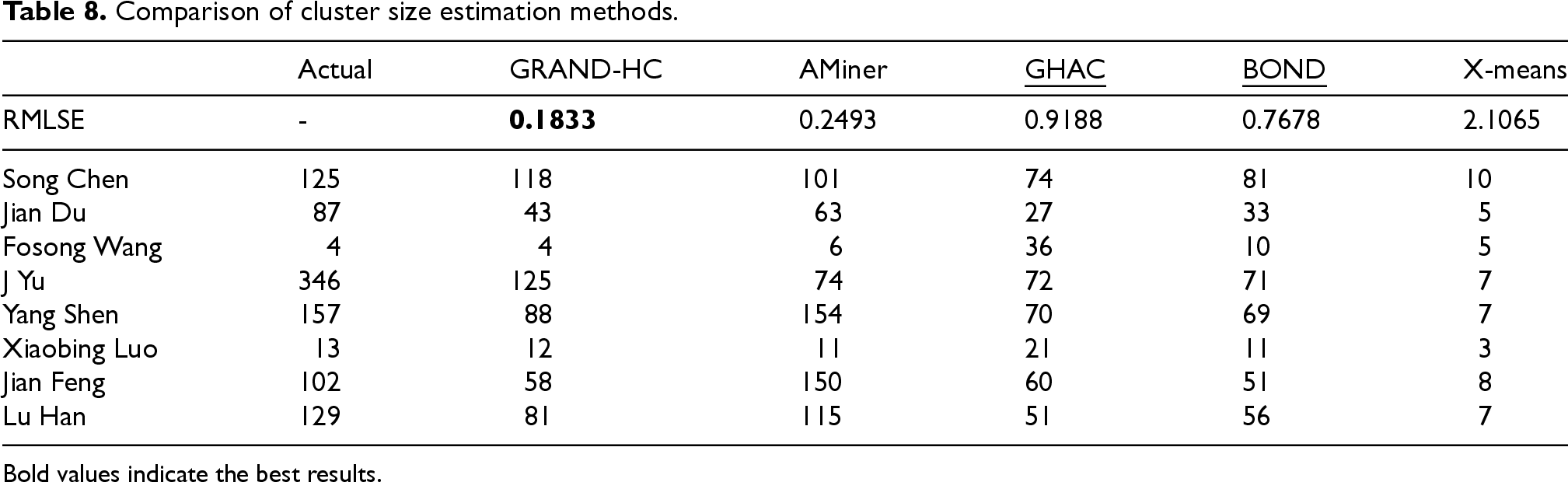
Comparison of cluster size estimation methods.
Bold values indicate the best results.
As previously mentioned, existing cluster size estimation algorithms are mainly categorized into four types. We select the SOTA models for each type and carry out a comprehensive comparison. It can be observed that the RMLSE error of our method is far lower than that of the other algorithms.
The X-means 34 method relying on the Bayesian Information Criterion cannot handle a complex mixture data in high dimension, 46 which deviates greatly from the true value. The graph-based clustering algorithm GHAC 36 tends to find clusters of moderate size and may fail to accurately identify some extremely small or large clusters. Additionally, potential noisy nodes may disrupt the calculation of edge weights, the measurement of cluster similarity, and the evaluation of modularity. The threshold-based DBSCAN 9 in BOND is highly parameter-sensitive and prone to over merge clusters due to ineffective distance metrics in high dimensions and noise misinterpretation, often underestimating the true class count. Aminer 5 samples and constructs a standard dataset with a range from 1 to 300 to make it processable for the RNN. Although this achieves a certain generalization effect, in our model, PCM adopts a fixed-length learnable parameter before RNN for information aggregation, avoiding the need to construct a standard dataset and simplifying the processing flow. Meanwhile, Bi-LSTM can process the data more efficiently, reducing the RMLSE metrics by nearly 6%. We also remove the cross-attention module in PCM, and the RMLSE increases to 0.1940, which demonstrates the necessity of information extraction by the cross-attention module.
Furthermore, we analyze the effect of sequence length of learnable queries on RMLSE in Figure 9 (a). It can be seen that there exists an optimal sequence length around 25. When the sequence is too long, it may contain excessive repetitive information, while a short sequence may lack sufficient useful data with poorer performance. Additionally, in Figure 9 (b), we discuss the impact of
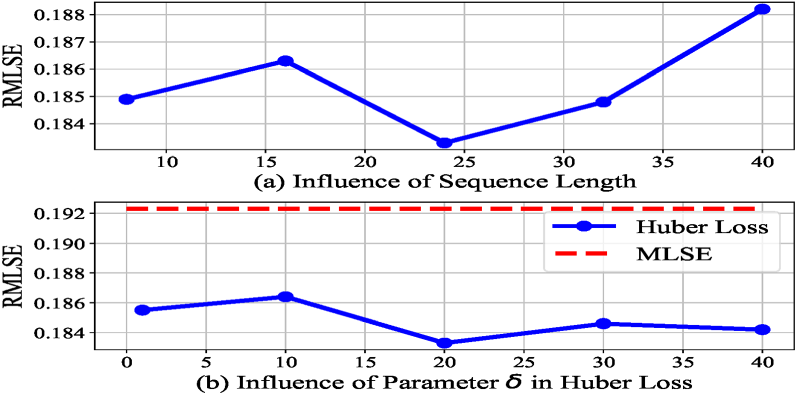
Ablation analysis of PCM. (a) shows the RMLSE changes with the query length. (b) shows the influence of
graph-refined distance matrix(GRDM) consists of two steps: graph structure optimization and graph based distance matrix refinement. We compare our GRDM with another graph-based HAC clustering technique that is similar to our work. In GHAC,
36
if there is an edge between two papers, their similarity is preserved and normalized by a sigmoid activation function:

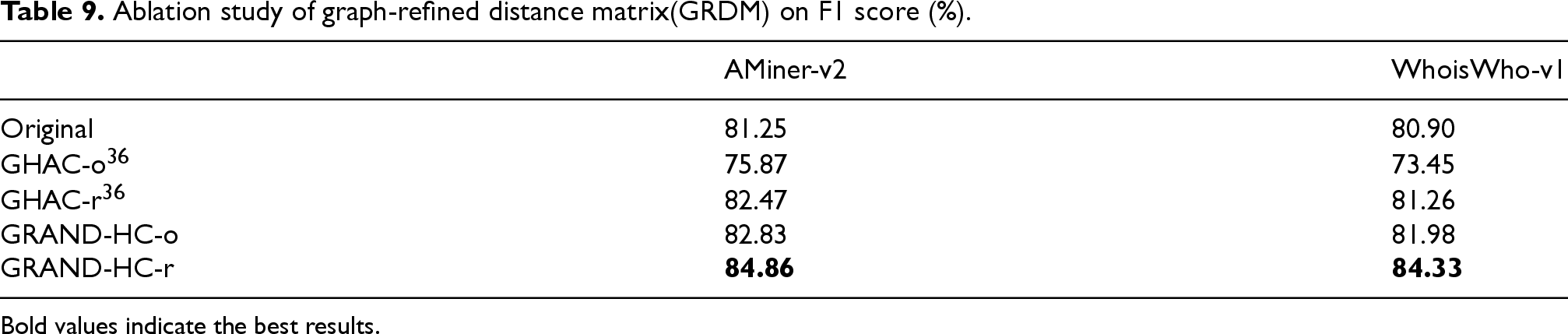
In Table 9, Original represents clustering directly using the cosine distance matrix, while ‘-o’ and ‘-r’ correspond to refine distance matrix based on original graph and optimized graph, respectively. From the results of GHAC-o and GHAC-r, it can be seen that they are extremely dependent on the accuracy of the topology. Whereas GRAND-HC-o, which is adaptively tuned based on degree using (12), is more robust and GRAND-HC-r has a greater improvement when the structure of the graph is more accurate.
Next, we set the range of
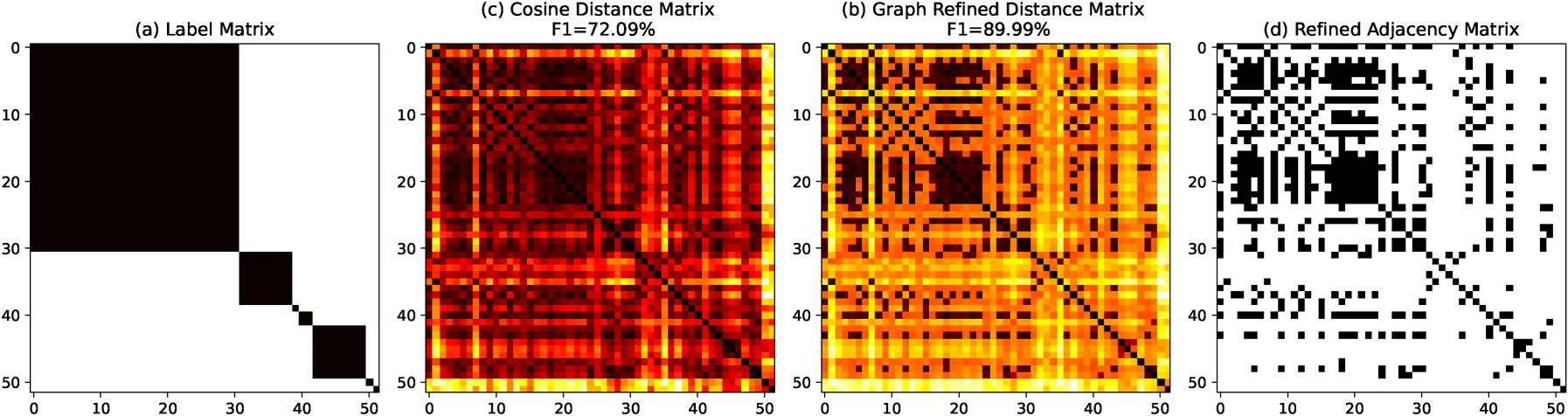
The visualization of name ‘philip_kam_tao_li’ in AMiner-v2 for the analysis of graph-refined distance matrix(GRDM). The lighter the color in (a), (b) and (c), the farther the distance.
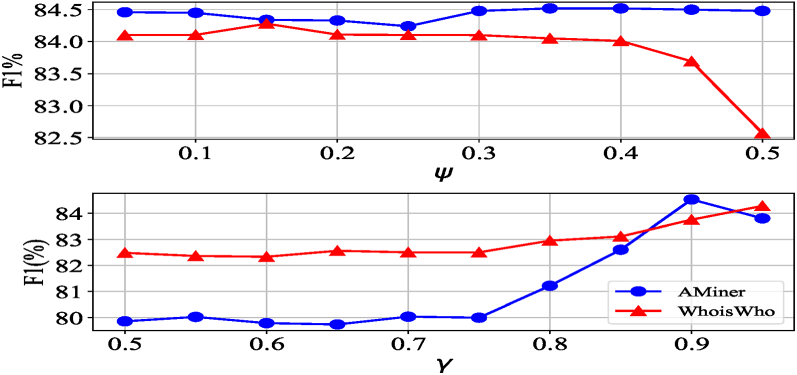
Parameter analysis of
Ablation study of graph-refined distance matrix(GRDM) on F1 score (%).
Bold values indicate the best results.
Analysis of graph refine iterations on F1 score (%).

Bold values indicate the best results.
Finally to show in more detail how the graph-refined distance matrix(GRDM), we visualized it in Figure 10. In Figure 10(a) the ground truth based text pair relations are given as the labeling matrix. The primitive cosine distance matrix is shown in Figure 10(b), which can be seen to be much different from the labeling matrix in Figure 10(a). GRDM firstly optimizes the structure of the graph as Figure 10(d), and adaptively adjusts to Figure 10(c) based on the optimized topology and degree of nodes. Compared with Figure 10(b), its paper pair relationship is more accurate, which enables the HAC clustering algorithm to aggregate effectively, and the F1 score of ‘hongtao_liu’ is improved by nearly 20%.
This paper proposes GRAND-HC, a novel SND framework addressing the imbalanced author class distribution via harmony contrastive learning and a graph-refined distance matrix. By dynamically reweighting misclassified pairs, harmony contrastive learning mitigates overemphasis on features of prolific authors while enhancing distinctions for less-published authors. The graph-refined distance matrix further refines clustering by incorporating node connectivity to prevent over-merging. Experiments demonstrate GRAND-HC achieves SOTA performance in macro-F1 among recent SND methods. Besides, GRAND-HC has been deployed in a billion-scale academic system, which validates its scalability and practical efficacy in real-world author disambiguation tasks. This work advances robust AND solutions for scholarly data management. In our upcoming project, we aim to leverage large language models to enhance the accuracy and efficiency of clustering algorithms.
Supplemental Material
sj-zip-1-ida-10.1177_1088467X261456652 - Supplemental material for GRAND-HC: Graph-refined author name disambiguation via harmony contrastive learning
Supplemental material, sj-zip-1-ida-10.1177_1088467X261456652 for GRAND-HC: Graph-refined author name disambiguation via harmony contrastive learning by Yuanhao Sun, Zhouyang Jin, Yi Xu, Luoyi Fu, Jiaxin Ding, Xiaoying Gan, Xinbing Wang and Chenghu Zhou in Intelligent Data Analysis
Footnotes
Acknowledgement
This work is funded by NSFC (No. 62525209, T2421002, 623B2071), and Shanghai Pilot Program for Basic Research - Shanghai Jiao Tong University.

Funding
The authors received no financial support for the research, authorship and/or publication of this article.
Declaration of conflicting interests
The authors declared no potential conflicts of interest with respect to the research, authorship, and/or publication of this article.
Supplemental Material
Supplemental material for this article is available online.
References
Supplementary Material
Please find the following supplemental material available below.
For Open Access articles published under a Creative Commons License, all supplemental material carries the same license as the article it is associated with.
For non-Open Access articles published, all supplemental material carries a non-exclusive license, and permission requests for re-use of supplemental material or any part of supplemental material shall be sent directly to the copyright owner as specified in the copyright notice associated with the article.
