







Abstract
Contrary to what would be expected from Norbert Elias, whose theory of the civilizing process links criminal violence to impulsivity, data from the Comptes généraux de l’administration de la justice criminelle en France show that rates of homicide due to imprudence in controlling a horse or cart increased with modernization across départements early in the nineteenth century. Drawing on work by Elias and others, we suggest an interpretation based on traffic congestion and changes in the social construction of time as Western societies became more modernized and urbanized.
Keywords
Norbert Elias’s (1939/2000, 1969/1983, 1989/1996, 1992, 1995; see also Blok, 1974; Davetian, 2009; Dunning & Mennell, 1998; Fletcher, 1997; Mazlish, 2004; Mennell, 1989, 2007) theory of the civilizing process maintains that long-term reductions in impulsive violence accompanied a gradual shift over the centuries in the European “habitus,” (learned and shared ways of thinking, feeling, and behaving that are so deeply ingrained as to seem to be second nature). These changes were associated with such factors as the growth of education, the extension of the scope of chains of interdependency, the development of literacy, the money economy, bureaucratization, and urbanization, and with the establishment of monopolies of violence in the hands of the state (i.e., pacification of the citizenry by police). From Elias’s perspective, medieval people were more violent than those of the modern period because they were temperamentally more impulsive, volatile and subject to sudden mood swings, but, because of the increasing survival value of self-control in polite, “civilized” society, people increasingly exercised self-constraint over their aggressive impulses, and impulsive violent outbursts consequently became less common. Significantly, however, Elias’s (1939/2000) theory also allows for “decivilizing” processes involving conditions in which the trend toward greater rationality and impulse control was reversed. We shall have more to say about decivilizing processes below.
In an article published late in his long career, Elias (1995) extended the theory of the civilizing process to cover motor vehicle accidents. Amassing data showing that there was a strong negative relationship between level of development and motor vehicle death rates in cross-national data from the 1950s through the early 1980s, he suggests that the pattern reflects the growth of the civilized habitus. “One would expect that the number of dead and injured as a result of car accidents, as a factor of the number of cars in a country, would be higher in less developed than in highly developed countries,” he argues, because “individual self-regulation in less developed societies will be less stable, less uniform, and permanent than in the more highly developed countries” (Elias, 1995, p. 22).
This article explores the relationships of modernization and urbanization to highway deaths of an earlier day, making use of cross-sectional data for the 85 continental départements of France during the period 1839-1844 on rates of involuntary criminal homicide due to “imprudence” involving the failure to adequately control a horse or cart, or “vehicular homicide” or “highway homicide” for short. As not all of these homicides involved wheeled vehicles and some, probably the majority, took place on city streets rather than highways, we use these terms advisedly in the title, text, and tables rather that endlessly repeating “homicides by imprudence stemming from the failure to properly control a horse or cart” and similar unwieldy but more accurate phrases.
Since the 1980s, the theory of the civilizing process has been the dominant paradigm guiding research on long-term secular trends in European rates of violent crime. The great majority of studies (Cockburn, 1991; Eisner, 2001, 2003; Gillis, 1989, 1994, 1996, 2004; Gurr, 1981; McDonald, 1982; Österberg, 1996; Österberg & Lindström, 1988; Ruff, 2001; Sharpe, 1996; Stone, 1983; Wright, 1983; Ylikangas, 1976; Zehr, 1975, 1976) point to long-term declines in European rates of violent crime. Cross-sectional data suggest that 19th-century European homicide rates were markedly lower in the industrialized and urbanized core in the northern Europe than in the rural periphery to the east and south (Chesnais, 1981; Eisner, 1997, 2003; Johnson, 1995; Thome, 1995). Similar core-periphery patterns have been found within individual nations, including Italy (Chesnais, 1981), France (Guerry, 1833/2002), Germany (Eisner, 2003), Switzerland (Eisner, 1997, 2003), and Poland (Kaczynska, 1995).
Nonetheless, Lodhi and Tilly (1973) point out that fluctuations over time in rates of crimes against persons in 19th-century France exhibit “no general trend whatsoever,” and Whitt (2010) finds that neither urbanization nor modernization is significantly related to the rates of crimes against persons in early 19th-century cross-sectional data for French départements after controlling for other theoretically relevant variables. Negative findings such as those reported by Lodhi and Tilly (1973) and Whitt (2010) suggest that the theory of the civilizing process may not apply to premeditated killings committed in cold blood for personal gain. 1 Whitt (2010) notes that if impulsive crimes against persons decreased whereas “rational” violence increased with modernization and/or urbanization, the two might well have cancelled each other out. As Flewelling and Williams (1999) point out,
Because different types of homicide may be influenced by different factors . . . results of studies that focus on the overall homicide rate . . . may . . . behave in a manner that is inexplicable unless the underlying composition of homicide types is considered. (p. 97)
Indeed, Spierenburg (1994, 1996) argues that Elias’s theory applies only to impulsive violence, not to carefully planned and premeditated violent crime, which might actually increase with the civilizing process. Evidence for this hypothesis is mixed. There is considerable evidence (Eisner, 2003; Hammer, 1978) that the mix of different types of homicide changed over the centuries. Prior to the last half of the 18th century, the great majority of European homicides resulted from male-on-male altercations that “were not premeditated but were, rather, spontaneous, arising on the spot” in the context of tavern brawls where “sharp tongues, quick tempers and strong drink” combined with the ready availability of weapons, especially knives, to form a “fatal combination” (Hammer, 1978, p. 78; see also Eisner, 2003; Sharpe, 1983). Eisner (2003), whose conclusions are based on a meta-analysis of studies that together cover data from the 13th century through the 1880s (Beattie, 1986; Cockburn, 1991; DeWindt & DeWindt, 1981; Emsley, 1996; Given, 1977; Hanawalt, 1976; Schüssler, 1991; Sharpe, 1983; Spierenburg, 1994, 1996), notes that homicides stemming from brawls became progressively less common although the percentage of homicides involving family members, which was very low in the Medieval period, grew steadily over time to the point that by the 19th century they accounted for the majority of homicides. Spierenburg (1994) himself reports that, beginning in the mid-1700s, impulsive violence became less prominent in Amsterdam relative to premeditated killings, largely because of decreases in the incidence of tavern brawls, and Gillis (1994) notes that the extension of literacy in France during the latter part of the 19th century affected the types of homicides committed, repressing crimes of passion (domestic homicides and those based on jealousy and anger) but not cold-blooded murders motivated by financial gain. Elsewhere, however, he (Gillis, 1996) disaggregates French domestic homicides on the basis of premeditation, exploring the relationship of these crimes to rates of divorce and judicial separation. Marital dissolution was viewed in 19th-century France as a civilized alternative to homicide for dealing with domestic disputes. To the extent that divorce is a civilizing process, which is of course problematic, it should reduce spontaneous, unpremeditated domestic homicides, but Gillis (1996) finds precisely the opposite. Unpremeditated murders of spouses increased and premeditated domestic killings decreased over time as separation and divorce became more common. Similarly, Lacour’s (2001) study of early modern Germany fails to verify a trend away from straightforwardly impulsive violence. In her data, uncontrolled angry violence was dominant throughout the 16th, 17th, and 18th centuries, with rates of rational, planned, willful instrumental violence remaining low in comparison throughout the entire period. Indeed, Parrella (1992) finds that, contrary to what Spierenburg would lead us to expect, murders for financial gain were replaced during the 19th century in northern France by family murders based on intense emotional disputes.
This article grew out of an effort to throw some light on the issue of the relationship between civilizing processes and rates of various types of criminal homicide using disaggregated homicide data from annual volumes of the Compte général de l’administration de la justice criminelle en France (hereafter Compte or Comptes in the plural; Département de la Justice et de Cultes 1841-1846) produced during France’s “first great surge of modernization and urbanization” (Lodhi & Tilly, 1973, p. 297). The period 1839-1844 was chosen because some of our independent variables are available only in sources from the 1830s. Moreover, Comptes containing data for years prior to 1839 and the volumes for 1845 and 1849 are unavailable, and, as Beirne (1987) notes, the disruptions associated with “the revolution of 1848, the coup of 1852, and their aftermath were associated with wide fluctuations in crime rates” (p. 1310). Elias would undoubtedly characterize this later period as one in which decivilizing processes predominated.
Homicide data in the Comptes are immensely detailed, with information that permits rates of each major type of crime recognized by the French legal code to be calculated for fine-grained age, sex, and occupational categories, for the seasons of the year, and for each département. They make possible the disaggregation of the several different types of homicide, including but not limited to homicides volontaires such as assasinat, meurtre, empoisonnement, parricide, infanticide, coups et blessures suivis de mort sans intention de la donner, and shedding the blood of judges or other public functionaries. 2 Also included are several types of involuntary homicide or “homicide by imprudence” recognized by the French legal code, including those resulting in the deaths of infants due to maternal carelessness or negligence and fatalities on the streets and roads stemming from the failure to properly control a horse or cart, roughly the equivalent of modern-day vehicular manslaughter. These data on “vehicular homicides” are the focus of this article. Patterns for the other types of homicide, which will be reported elsewhere, need not concern us here.
Homicides by imprudence are perhaps the ultimate in impulsive homicides, because they lack intent and, almost by definition, they result from a deficiency of foresight and planning and a failure to take the consequences of one’s actions into account. Both Elias (1995) and Spierenburg (1994, 1996) would lead us to expect the rate of vehicular homicides to decrease with urbanization, modernization, and other aspects of the civilizing process. Indeed, Gottfredson and Hirschi’s (1990) highly influential general theory of crime, which, like Elias, links violent crime (and for that matter, crimes of all sorts) to poor impulse control, maintains that risky behaviors, including highway accidents, are “psychologically and theoretically equivalent to crime” (p. 92). Studies since the 1940s have shown that “accident prone” people are more likely than others to have court records (Suchman, 1970) and to be marked by irresponsibility and impulsiveness (Conger et al., 1959; Dahlen, Martin, Ragan, & Kuhlman, 2005; Dahlen & White, 2006; Niveau & Kelley-Puskas, 2001; Sansone & Sansone, 2010; Suchman & Scherzer, 1960; Tillman & Hobbs, 1949).
If essentially accidental killings on the streets and roads of 19th-century France were negatively associated with measures of civilizing processes such as modernization, urbanization, and police per capita, the pattern would lend strong support to both Elias’s (1939/ 2000, 1995) theory of the civilizing process and the general theory of crime. Indeed, our findings provide limited support to the deterrent effect of the police, but, unfortunately for other aspects of Elias’s theory, in the course of our exploratory analysis we quite serendipitously discovered that rates of involuntary criminal homicide due to imprudence involving the failure to adequately control a horse or cart varied directly and quite strongly across départements with measures of modernization and urbanization. In what follows, we document the existence of these relationships and suggest an admittedly post hoc theoretical explanation for our anomalous findings.
Data and Measurement
As was noted above, data on rates of involuntary homicide due to imprudence in controlling a horse or cart are drawn from annual volumes of the Comptes généraux (Département de la Justice et de Cultes, 1841-1846) covering the period 1839-1844. There was a 2-year lag in reporting data in the Comptes, hence the different dates. Rates are based on accusations (roughly indictments) rather than convictions or crimes known to authorities. Beirne (1987) argues that for this period “charges are likely to be a more reliable measure than convictions, particularly for violent offenses” (p. 1310).
In addition to crime data, the Comptes include départemental figures on literacy, population size according to the French censuses of 1831 and 1841, population change since the census of 1831, rural and urban populations, and the strength of the Gendarmerie Nationale and communal gardes champêtres who reported to local mayors. Additional data are from tabulations produced during the 1830s by André-Michel-Guerry (1833/2002), Adolphe d’Angeville (1835/1969) and Victor Hugo’s older brother Abel (Hugo, 1835). Guerry and d’Angeville’s tabulations provide data on the extent to which the Industrial Revolution, and hence the civilizing process, had penetrated into French départements (Beirne, 1993; Friendly, 2007; Le Roy Ladurie, 1969; Whitt, 2002, 2010). Like other scholars before (e.g., Dupin, 1827; Malte-Brun, 1810-1829) and since (e.g. Tilly, 1986; Weber, 1976; Whitt, 2010), Guerry (1833/2002) and d’Angeville (1835/1969) noted that there were two Frances based on a geographical division between the “illuminated France” in the north and northeast and the “dark France” in isolated rural areas in the south and southwest. As Weber (1976) notes,
This geographical division was in effect the division between urban and rural France–better still, between the poor, backward countryside and the areas of France, rural or not, that were to some degree permeated by the values of the modern world. (p. 494)
Three measures, “modernization,” urbanization, and police per capita, were included in the spatial lag regressions below to tap Elias’s (1939 /2000) concept of the civilizing process. As in Whitt (2010), modernization was measured by literacy rates, wealth, the development of commerce and industry as indicated by business licenses per capita, the number of persons employed in industry per 1,000 population, and the number of doors and windows in dwellings per capita, the latter of which indicates the growth of an elite who valued luxury and could afford to pay the door-and-window tax imposed under the Directory (Castelot, 1895; Weber, 1976). These five indicators of modernization are highly correlated. To avoid severe multicollinearity, the indicators of modernization were subjected to a principle components analysis. A single factor, with an eigenvalue of 3.16, emerged, indicating that the indicators were all drawn from the same universe of content. This factor accounts for 63.2% of the common variance of the indicators. The factor loadings of .733 for literacy, .742 for wealth, .830 for business licenses, .917 for doors and windows, and .735 for industrial employment were used to construct the single measure of modernization used in the analysis. Urbanization was measured by the natural logarithm of the percentage of the population residing in urban places rather than rural areas and small towns, and police presence, which should theoretically have a deterrent effect, was measured by the number of police (gendarmes and gardes champêtres) per capita.
A fully adequate assessment of the relationships of rates of vehicular homicide to modernization and urbanization would require the inclusion of measures of the extent to which people in each département were placed at risk of dying in road accidents (i.e., the number of person-miles traveled) and for the rate of population change, which would be expected to have a decivilizing effect (see below) because of its impact on urban transportation infrastructures. Although no measure of the number of person-miles driven is available, we were able to locate data on the number of roads per département in Hugo’s (1835) France pittoresque, which, like the Comptes généraux used in this article, has recently been digitized and made available online by Google Books. We have measured population change as the percentage change between the censuses of 1831 and 1841 as reported in the Comptes.
Methods of Analysis
The data were analyzed using spatial econometric methods, including LISA (Local Indicators of Spatial Autocorrelation) maps (Anselin & Bera, 1995) and spatial lag regression models (Anselin, 2005; Anselin, Bera, Florax, & Yoon, 1996; Whitt, 2010). The analysis was conducted using the GeoDa software package (Anselin, 2003, 2005).
LISA Maps
LISA maps (also known as Moran scatterplot maps) provide visual assessments of how variable scores cluster into regions and of the extent to which each département’s scores are similar to those of its neighbors. They categorize départememts into four groups based on scores on a variable in the département itself and the weighted average of the scores of its neighbors on that variable. Only départements in which the variable and its values in neighboring départements (the spatial lag of the variable) are both significantly above (high-high) or both below the mean (low-low) are shaded in the LISA maps shown below. Following standard practice (e.g., Baller & Richardson, 2002; Whitt, 2010), these maps omit low-high and high-low combinations, which indicate significant negative local spatial autocorrelation. This is rare; it occurs primarily at the margins of regions with uniformly high or low rates. Départements were defined as neighbors using the “queen contiguity” criterion, which specifies that they were neighbors if their boundaries touched in any way, even if only a single point.
Spatial Lag Regression Models
When the units of analysis are geographical areas such as French départements, the assumptions of ordinary least squares (OLS) regression are violated to the extent that scores on dependent variables and/or their residuals as estimated by OLS regressions cluster in physical space. This is the problem of spatial dependency or spatial autocorrelation, which is analogous to temporal autocorrelation in time series data. Clustering on the dependent variable violates the OLS assumptions that observations are independent and that error terms are uncorrelated. As a result, OLS parameter estimates will be both biased and inefficient. However, if prediction errors (residuals) cluster but the dependent variable does not, parameter estimates will be unbiased but nonetheless inefficient (Anselin, 1988; Anselin & Bera, 1998).
In spatial econometrics, these two types of spatial dependency are handled, respectively, by spatial lag and spatial error regression models, both of which generate unbiased and efficient parameter estimates in appropriate situations. GeoDa provides diagnostic statistics for deciding whether to use OLS, a spatial lag model, or a spatial error model. Details may be found in Anselin et al. (1996) and Anselin (2005). In the present instance, the diagnostic statistics suggest that OLS might suffice, but the clustering of rates of vehicular homicide in the LISA map shown in Figure 1 below leads us to favor a spatial lag model, which is specified in matrix form as:
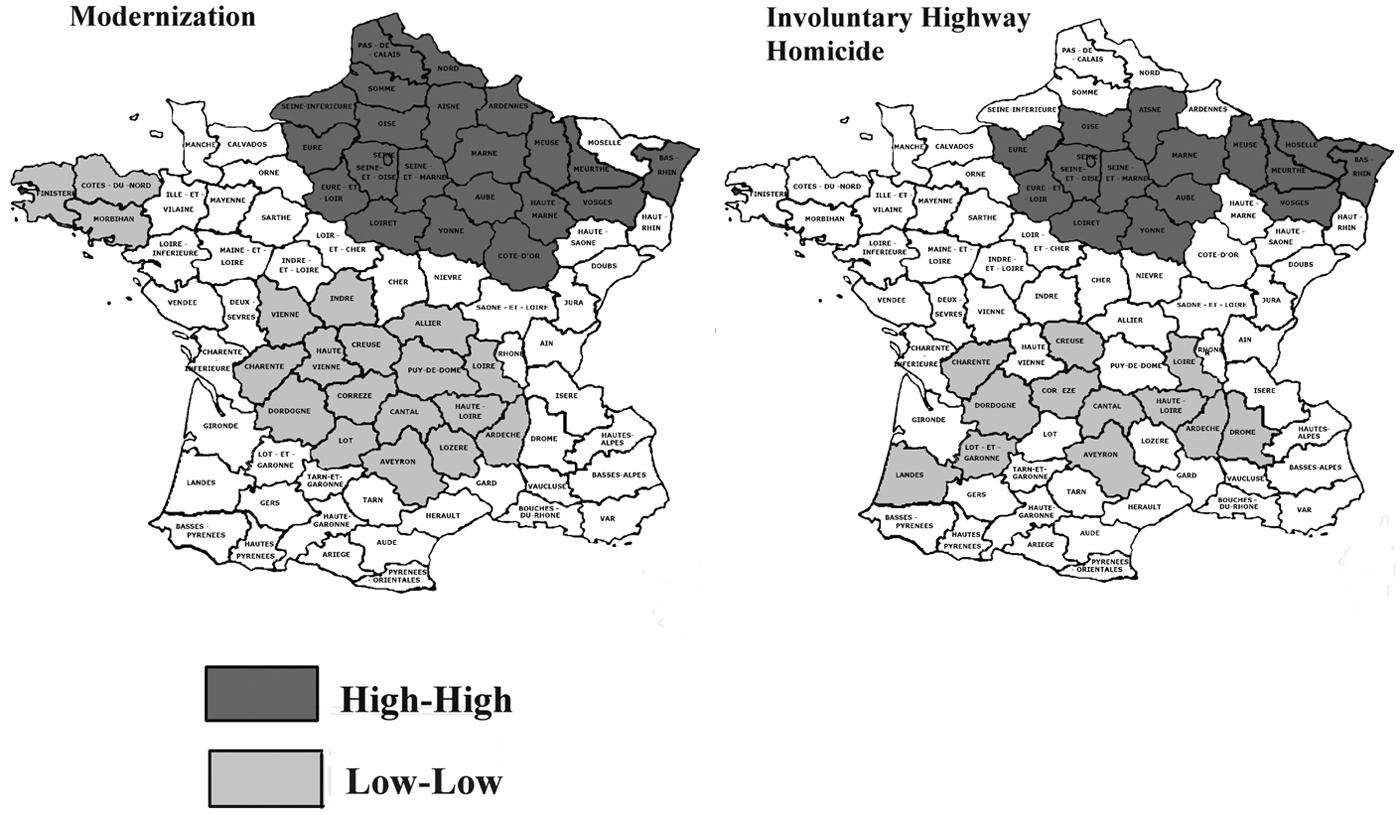
LISA maps of modernization and highway homicide

with

where y is a column vector of n sample observations on the dependent variable, X is an n-by-k matrix of observations on k independent variables including a unit vector, β is a column vector of regression parameters, ϵ is a column vector of unobserved disturbances with expected values of zero and variance
Findings
The LISA maps for modernization and the rate of deaths due to imprudence on the streets and roads shown in Figure 1 clearly show that the relationship between these variables was positive rather than negative as the theory of the civilizing process suggests. 3 The correspondence between the two maps is striking.
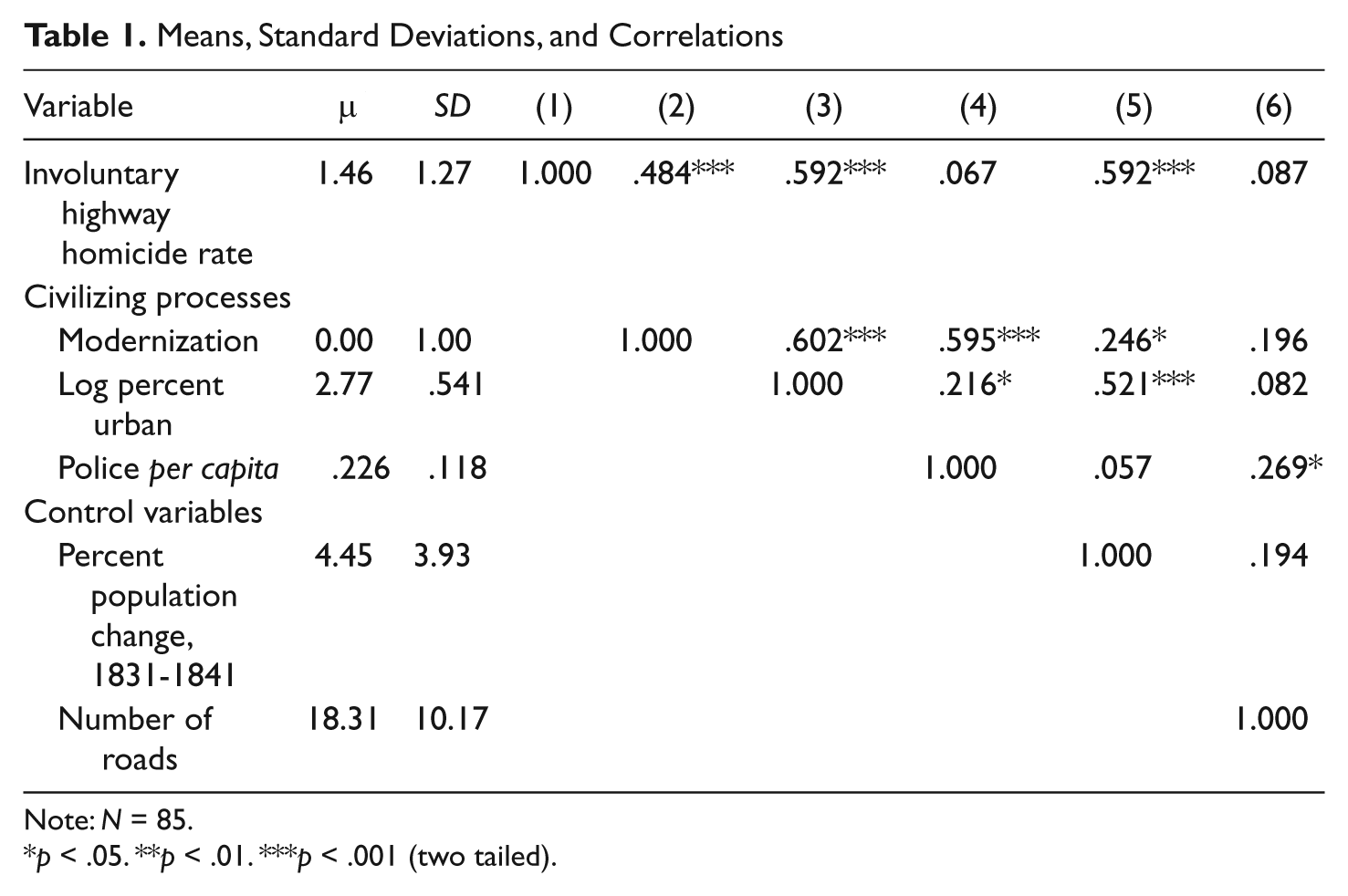
Indeed, as Table 1 shows, the correlation of the rate of involuntary homicides by imprudence involving the failure to control a cart or horse with our measure of modernization is +.484 (p < .001) and its correlation with urbanization is +.592 (p < .001). Its correlation with police per capita, however, is minuscule; r = +.067 (ns) despite the +.595 (p < .001) correlation between modernization and police presence. Table 1 also shows that several of the independent variables are moderately correlated. In particular, the correlations between modernization and both urbanization (r = +.602, p < .001) and police per capita (r = +.595, p < .001) and between urbanization and the rate of population change (r = +.521, p < .001) are large enough to alert us to the possibility of multicollinearity in multivariate analyses. Tests for multicollinearity in the spatial lag equations in Table 2 using the procedures recommended by Whitt (2010) for spatial lag regression models, however, revealed no variance inflation factors in excess of 2.88, suggesting that multicollinearity is not a serious problem.
Means, Standard Deviations, and Correlations
Note: N = 85.
p < .05. **p < .01. ***p < .001 (two tailed).
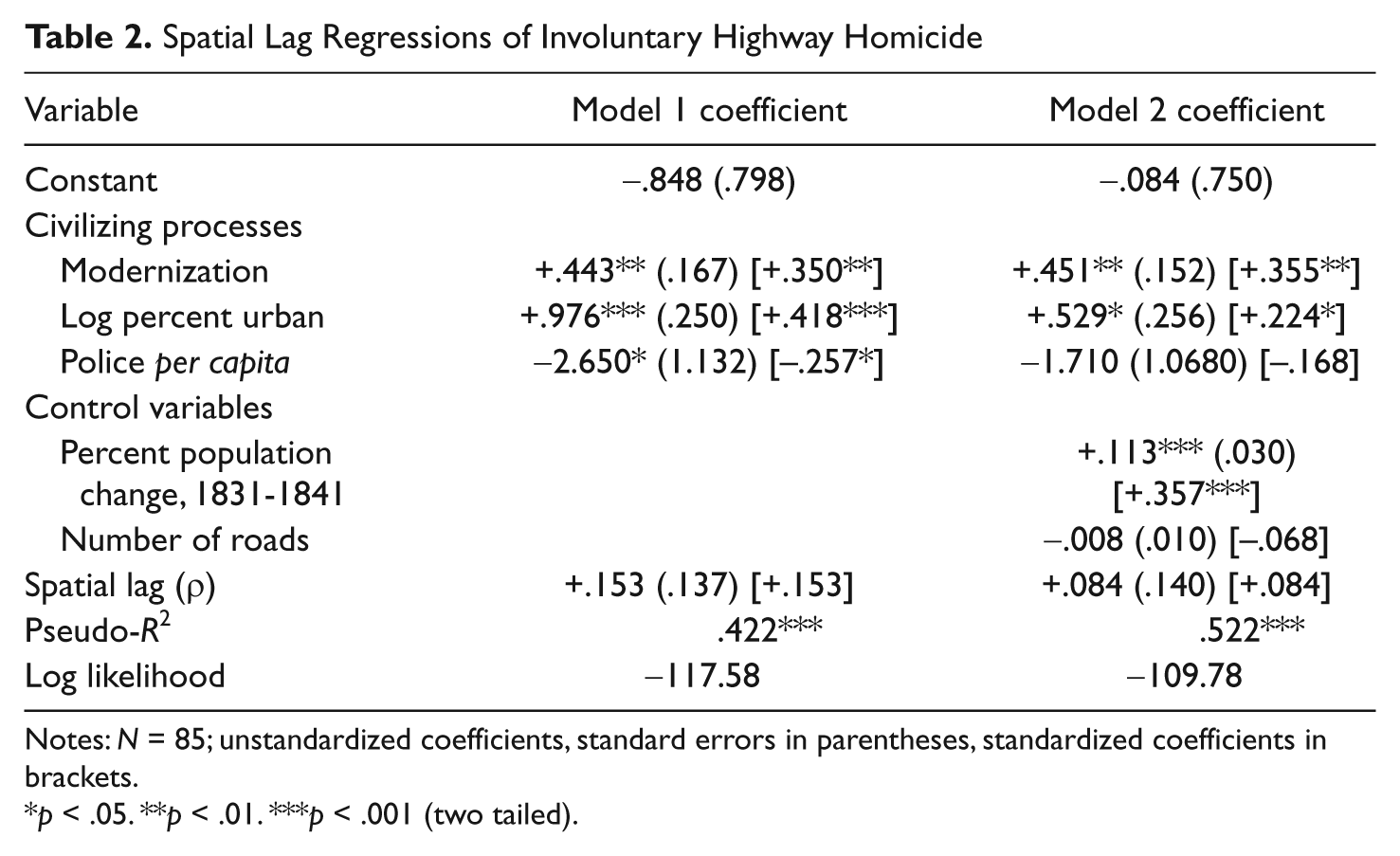
Spatial Lag Regressions of Involuntary Highway Homicide
Notes: N = 85; unstandardized coefficients, standard errors in parentheses, standardized coefficients in brackets.
p < .05. **p < .01. ***p < .001 (two tailed).
When all three measures of civilizing processes are included as predictors in a spatial lag regression model, as the first column of Table 2 (Model 1), modernization (b = .443, β = +.350, p < .01) and urbanization (b = +.976, β = +.418, p < .001) remain significant, and police per capita becomes a significant predictor of reductions in road fatalities due to imprudence (b = −2.650, β = −.257, p < .05). Between them, the three measures of civilizing processes result in a Pseudo-R2 of .422 (p < .001), but only the finding for state police control is consistent with predictions based on the theory of the civilizing process.
The coefficients in the second column in Table 1 (Model 2) show that the positive relationships of inadvertent highway homicides to modernization (b = +.451, β = +.355, p < .001) and urbanization (b = +.529, β = +.224, p < .05) survive controls for population change and the number of roads, but the coefficient for police per capita is no longer significant by two-tailed test (b = −1.710, β = −.168, p = .110) Nonetheless, it barely misses reaching significance (p = .055) by one-tailed test, which we are justified in using because direction has been predicted. Interestingly, the rate of population growth is the strongest measured predictor of rates of involuntary homicides due to imprudence on the streets and roads (b = +.113, β = +.357, p < .001), but the number of roads is virtually unrelated to the rate of vehicular homicides (b = −.008, β = −.068, ns). Pseudo-R2 rises to .522 (p < .001) with the addition of population growth and the number of roads to the equation. 4
Toward a Theory of Distracted Driving and Road Rage in the Equine Era
Decivilizing Processes
Elias himself provides a theoretical basis for arguing that the pattern in the 1830s and 1840s might have been different from that found in his 20th-century data. Although he never actually said so in so many words, it can be argued that the growth of urbanization, the money economy, and bureaucratization and even the “civilized” habitus itself had inadvertent “decivilizing” consequences. Urbanization increased traffic congestion, whereas bureaucratization and the growth of the money economy led to changes in the social meanings of time involving an increased emphasis on speed and punctuality. This argument is consistent with Elias’s broader conceptualization even though it directly contradicts his thinking on the relationship between civilizing processes and highway fatalities. As we noted briefly above, at various points in his writings, Elias (e.g., Elias, 1939/2000, p. 531-532; 1992, 1995; see also Blok, 1974, p. 213; Dunning & Mennell, 1998; Fletcher, 1997; Mennell, 2007; Whitt, 2010) notes that the downward trend in impulsive violence was sometimes reversed under decivilizing conditions such as war, economic downturns, shifting power ratios between classes, rapid social change and population movements, and periods of weakened state control. Indeed, for Elias, the social and technological innovations that were part and parcel of the civilizing process could have unplanned and unanticipated decivilizing consequences. Elias fails to note in his treatment of traffic accidents (Elias, 1995) that certain aspects of the civilizing process, especially urban traffic congestion and a high value placed on meticulous punctuality in the context of “the continuous pressure of time to which they are exposed” (Elias, 1992, p. 150), may have had unintended decivilizing consequences that led people to behave imprudently on the roads and streets. He does suggest (Elias, 1995), however, that the invention of the automobile “was accompanied not only by a civilizing spurt towards a specific form of individual self-regulation, but at the same time, by a ‘de-civilizing spurt’ involving ‘the regular murder of human beings’ in highway accidents” (p. 21). Both the growth of cities per se and an increased emphasis on rigid scheduling may have increased road rage, distracted driving (or riding), and vehicular homicide long before the advent of the automobile.
Urban Growth, the Influx of Horses, and Traffic Congestion
The Industrial Revolution led to the rapid growth of French cities due largely to a massive inflow of rural residents (Pinkney, 1961; Chevalier, 1958/1973; Lodhi & Tilley, 1973). By 1830 the population of Paris had grown by a quarter of a million people since 1800, and increased human population was accompanied by a corresponding growth in the number of horses domiciled in the city and pulling wheeled vehicles into the capital to deliver food for the burgeoning human population (Barles, 2007). Carts also proliferated (Bell, 2004). As Pinkney (1961) notes, Paris “suffered from a social disequilibrium produced by an influx of population greater than the city could assimilate into its normal life . . . . All the essential urban equipment lagged behind the growing needs of the waxing population” (p. 497). Indeed, Jordan (2004) notes the medieval city “was unhealthy, inconvenient, dangerous, stinking, and overcrowded” (p. 1259) and conditions had changed little by the 1830s and 1840s. Rice (1997) notes that,
Most Parisians during [the first half of the nineteenth century] perceived [the streets] as dirty, crowded, and unhealthy . . . . Covered with mud and makeshift shanties, damp and fetid, filled with the signs of poverty as well as the signs of garbage and waste left there by the inadequate and faulty sewer system. (p. 9)
Pinkney (1961) notes that “streets were inadequate for the growing traffic” and that in 1830 no major street construction had been completed in thirty years (p. 497-498; see also Chevalier, 1958/1973). Georges-Eugène Haussmann’s restructuring of the Paris street plan in the 1860s (Papayanis, 2004), which eased traffic congestion by replacing cramped, meandering streets with broad boulevards, was still in the future during the period covered by our data. Conditions in other cities are less well documented, but rural migration to smaller cities and towns was endemic in France during the 1830s and 1840s (Moch, 1981; Moch & Tilly, 1985), and we would expect similar but less severe strains on transportation infrastructures. According to Bell (2004), runaway horses were commonplace in the cities and towns of the period, in part because of an increase in the number of private horse-drawn carriages and coaches in the cities.
Rigid Scheduling, Punctuality, and Changes in the Meaning of Time
Traffic congestion was undoubtedly exacerbated by a growing separation of place of residence from place of employment under the factory system and an increased reliance on horse-drawn vehicles, but a case may be made that a newly developed emphasis on speed and punctuality accompanying industrialization and the growth of the money economy also led to increased pressure on transportation systems and to increased rates of vehicular homicide. These aspects of the Industrial Revolution contributed to changes in the ways in which people thought about time, punctuality, and the necessity of adhering to rigid scheduling. Although the civilizing process encouraged rationality, foresight, efficiency, and civility, it also promoted punctuality and the regulation of behavior by clocks and schedules. As Elias (1992) puts it in his essay on time:
In large urbanized state societies, above all those where the specialization of social functions is far advanced, where the chains of interdependencies binding the performers of these functions to each other are long and highly diversified and where much of people’s daily toil has been taken over by human-made energies and machines, the need for timing and the means of satisfying it, the signals of mechanical timepieces, become inescapable, and so, therefore, does people’s sense of time . . . . Members of industrial nation states usually have an almost inescapable need to know what time it is . . . . The compelling nature of the sense of time . . . is one of the civilizing restraints . . . which . . . form[s] part . . . of the social habitus. (p. 122, 135, and 136)
Elias (1992) explicitly includes punctuality as a component of the internalized civilized habitus, suggesting that the profusion of appointments and meetings and the subordination of work schedules to the clock can lead people to rebel and “come into conflict with themselves” when the requirements of punctuality work against self-interest. He notes that adhering to the time discipline associated with work generates tensions which cry out for release through play, sport, and leisure, and that “the pressure of time . . . creates problems that have yet to be solved” (p. 199). Other scholars agree that the advent of the Industrial Revolution brought about an entirely new and unprecedented societal understanding of time. As Lewis and Weigert (1981) point out, “modern industrialized and rationalized society can function only if most of its members follow a highly patterned and dependable daily round” (p. 439). “Time thrift” (Thompson, 1967) was imposed on the laboring classes as large scale manufacturing centers and steam powered factories become dominant sources of employment and workers’ place of residence became increasingly separated from their place of employment. Factory owners and managers quickly realized that the use of time in the form of a workday must be maximized to compete with rival manufacturers and maximize profits. Workers were encouraged to make efficient use of time to ensure that production remained high. The very movements of the workers’ limbs and the time required by machines to complete a process were recorded by stopwatch; no movement by either human or machine was left untimed (Wright, 1968, p. 210). The time thrift ideology quickly diffused outward from the confines of the working world to the rest of society. Indeed, Thompson (1967) argues that punctuality has been more culturally valued since the 1840s than it was prior to the Industrial Revolution. Similarly, Mukerjee (1943) points out that “the vast, intricate and elaborate division of labor” that characterizes industrialism “demands a meticulous coordination of activities according to anticipated and scheduled time-intervals” (p. 259). With urbanization and industrialization, he maintains, time is increasingly reckoned in seconds and spit seconds, and “the least delay or deviation from the scheduled time throws the system of transportation and technology out of gear.” Indeed, Mukerjee (1943) argues that an emphasis on speed and “meticulous punctuality” is “the backbone of industrialism.” In a treatment of the survival value of speed and punctuality, Mukerjee (1943) argues that a “change of habits is as much necessary for the urban individual’s survival as for the efficiency of the mechanized urban-industrial society” (p. 259-260). Nonetheless, he points to such unanticipated consequences of rigid scheduling and the increased tempo of urban-industrial life as misunderstandings, accidents, and even disasters that Elias would regard as decivilizing.
Bell (2004), who uses passages from novels by Balzac, Stendhal, Dumas, and Zola and other sources to document the increased emphasis on scheduling precision in early to mid-19th-century France and its relationship to a growing importance of speedily moving people (and information) from place to place, points out (p. 3) that the authors of these novels portray a “hectic pace” on the streets and roads in which “impatience and tensions run high” because “time is short” and “movements need to be accomplished quickly.” In a passage reminiscent of Elias, he (Bell, 2004) adds that “[a]ccidents and catastrophes related to these developments became a regular feature of urban landscapes: proof if one were needed that every technological development brings disadvantages along with the advantages it provides” (p. 30).
The Interaction Between Urban Traffic Congestion and Modernization
Models 1 and 2 in Table 2 above were run before we developed the inductive theory in the previous sections. Nonetheless, it is possible to partially test that theory. It seems likely that changes in the social meaning of time resulting from industrialization and a money economy conspired with urban traffic congestion to increase impulsive behavior on the streets and highways. If so, an emphasis on punctuality and the need for speed would have a greater influence on rates of vehicular homicide under crowded urban conditions than in rural areas, and, similarly, the effects of urban traffic congestion on rates of vehicular homicide should be greater in areas that had been touched by the changes in habitus emphasizing punctuality and speed that were associated with modernization. This implies that a statistical interaction between our measures of modernization and urbanization should predict rates of vehicular homicide and that the coefficient attached to the interaction term should be positive.
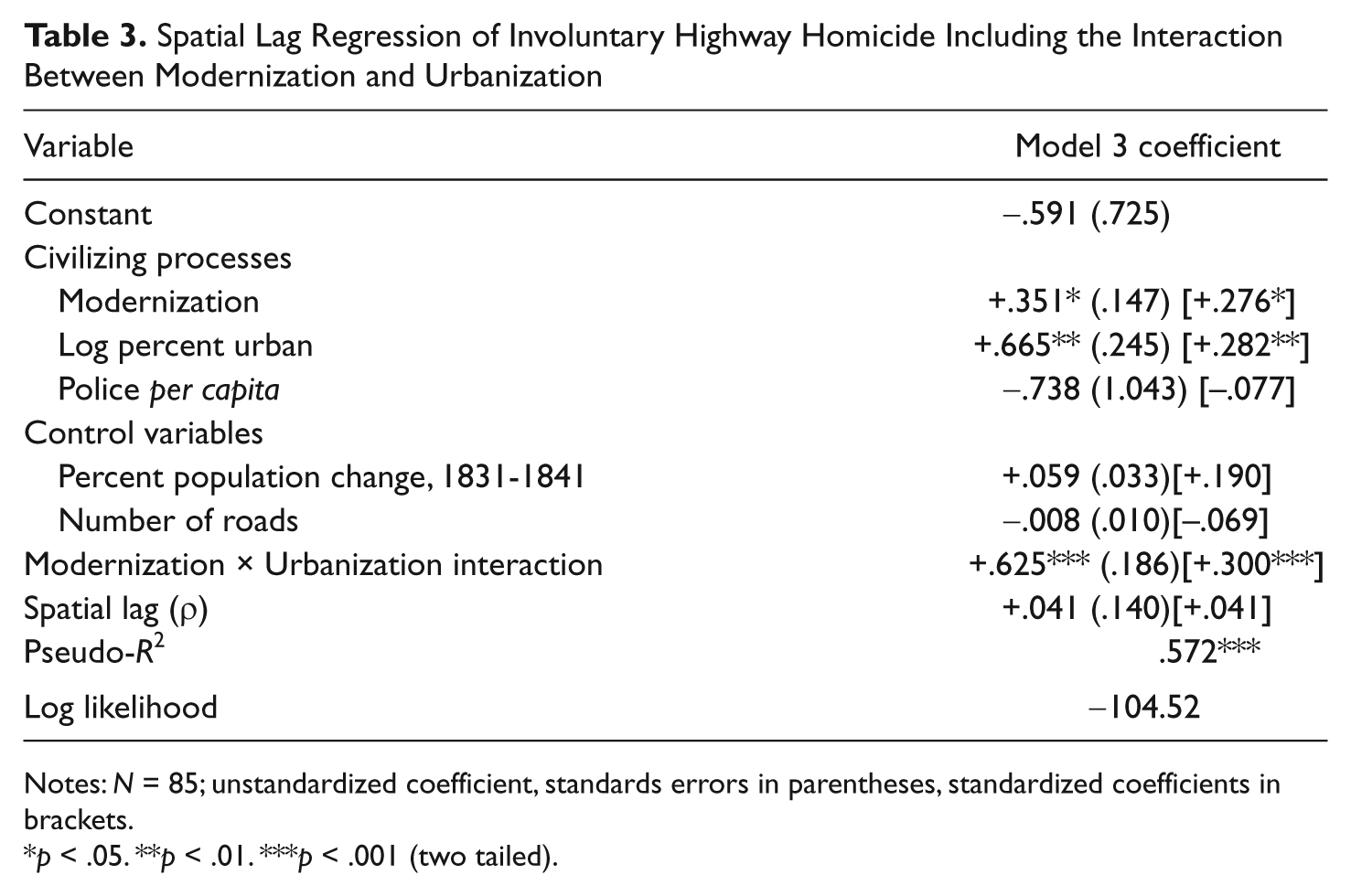
To check this possibility, we added the cross-product of our measure of modernization (which was already centered on the mean) and the mean-centered urbanization variable to the equation in Model 2 in Table 2. The results, shown in Table 3, suggest that a combination of modernization and urbanization strongly drives vehicular homicide. The main effects of both modernization (b = +.351, β = +.276, p < .05) and urbanization (b = +.665, β = +.282, p < .01) remain positive and significant, but the statistical interaction between these two variables has an even stronger positive effect (b = +.625, β = +.300, p < .001). The coefficient attached to the rate of percentage population change, significant in Model 2, is no longer significant but remains positive (b = +.059, β = +.190, ns), and police per capita has little deterrent effect (b = −.738, β = −.077, ns) when the interaction between modernization and urbanization is included in the model. Adding the interaction term increases Pseudo-R2 from .522 to .572.
Spatial Lag Regression of Involuntary Highway Homicide Including the Interaction Between Modernization and Urbanization
Notes: N = 85; unstandardized coefficient, standards errors in parentheses, standardized coefficients in brackets.
p < .05. **p < .01. ***p < .001 (two tailed).
Theoretical Conclusion
There is something to explain in the unexpected positive relationships of the rate of homicide by imprudence on the streets and roads to urbanization and modernization. The pattern becomes theoretically understandable in the context of an argument that includes decivilizing processes. Pinkney’s (1961) observations on the disequilibrating consequence of rapid urban growth during the Industrial Revolution, cited above, highlight the inability of city streets to adequately handle increased traffic flows. At the same time, changes in the economy led to cultural changes such as an emphasis on punctuality, the idea that time is money, and a greater sense of the urgency to be on time for scheduled obligations. Clearly, this change of habits was bought at an emotional price. As Lewis and Weigert (1981) note,
As smaller and smaller units of clock time become invested with increasing significance, everyday life may resemble the tight temporal structure of total institutions in which the daily round is precisely regulated. . . . With this tightness come greater stress, tensions, and time-induced anxiety. (p. 439-440)
The stresses associated with meeting rigid time schedules were exacerbated by the crowded conditions in major urban concentrations. One is reminded of Simmel’s (1902/1950) observations on the consequences for mental life of the increased pace of life in the metropolis. Traffic congestion, coupled with the new emphasis on punctuality and the separation under the industrial system between one’s place of residence and place of work must have created massive traffic jams, jangled nerves, and a tendency to act imprudently on impulse on the city streets.
Discussion
Although the theoretical reconstruction presented above is admittedly post hoc, it is consistent with our findings on départemental rates of homicide by imprudence due to the failure to properly control a horse or cart and with Elias’s broader theory of civilizing and decivilizing processes. Although data necessary to evaluate most aspects of our theoretical argument are unavailable, our findings with respect to the interaction between modernization and urbanization were based on a hypothesis arrived at through deduction. It seems likely that distracted behavior while driving a cart or riding a horse reflect decivilizing processes created by the civilizing process itself.
Other interpretations of our findings are of course possible. One possibility, which is not incompatible with our argument, suggests that homicides and impulsive behavior generally were functions of the presence in the cities of what was known in early 19th-century France as the classes dangereuses or les misėrables (Beirne 1987; Chevalier 1958/1973; Frėgier 1840; Gillis 2004; Hugo, 1862/1951). Whitt (2010) suggests that urbanization perhaps had opposite effects on the urban bourgeoisie, for whom it was a civilizing process, and on the poor, largely illiterate, and frequently unemployed members of the dangerous classes, for whom it was decivilizing. Similarly, Gillis (2004) points out that “[l]ike those suffering from anomie in Merton’s (1938) paradigm, and Wilson’s (1987) truly disadvantaged, les misėrables would face increasing frustration as well as economic pressure to engage in crime (p. 1322).” It is doubtful, however, that many of les misėrables could afford a cart or horse. Durkheim’s (1893/1933, 1897/1951) anomie, in the sense of the normlessness associated with the changeover from a traditional rural society to the new urban-industrial order might also be implicated. If so, rates of vehicular homicide would be expected to have dropped later in the 19th century when the transition was more nearly complete.
As we noted above, our data on vehicular homicides are based on rates of formal accusations rather than those of highway deaths or convictions for homicide by imprudence on the streets and roads. As continues to be true today, officials in 19th-century France had considerable leeway in deciding whether to classify accidental deaths as unintentional homicides or merely unfortunate accidents. Officials in urbanized and modernized areas may simply have been more disposed to bring charges than were their rural counterparts because they expected people to be able to foresee the consequences of their actions, and a significant part of the variance in reported rates of vehicular homicide may have had more to do with regional and urban–rural differences in the orientations of officials than with the imprudence of handlers of horses and carts. Indeed, in some cases it may have been skittish horses rather than their handlers that were behaving impulsively due to urban traffic congestion. There is also evidence that unwritten “customary” law and “infrajudicial” ways of dealing with criminal matters continued to be used well into the 1800s in isolated upland regions of southern France (which had the lowest reported rates of vehicular homicide) in preference to the written laws and standardized criminal procedures on which Compte data are based (Ruff, 2001).
Moreover, the data are based on the location where the incident occurred rather than the place of residence of the accused. As we noted above, a significant portion of urban traffic congestion resulted from travel into the cities to deliver foodstuffs produced in the rural hinterland (Barles, 2007; Bell, 2004). It is possible that many of the offenders charged with vehicular homicide in urban areas were reckless rural people making deliveries to the cities.
Perhaps the most important caveat concerning our findings is our inability to control for the risk of traffic fatalities (i.e., the number of person-miles traveled). We have been forced to make do with rates based on population size and Hugo’s (Hugo, 1835) data on the number of roads per département. Although Hugo provides data on the total length of roads in some départements and Dupin (1827) tabulates the number of horses in northern (but not southern) départements, there is too much missing data in their tabulations to allow us to use these variables, and we aware of no data source on the volume of traffic on French streets and roads in the 1840s. It seems likely that persons in urban areas made a larger number of trips than those in the countryside but that trips were on average shorter in the cities. If so, the total number of person-miles traveled might not have varied greatly from place to place, and population size might after all be an acceptable denominator for computing rates.
Although our findings may hold greater interest for historians than for the criminologists and sociologists who routinely consult this journal, we maintain that they have important implications for the theory of the civilizing process and for Gottfredson and Hirschi’s (1990) general theory of crime. Moreover, although road rage is a modern term, the concept is most likely not a modern invention. Counterintuitively, the civilizing process may have exacerbated vehicular homicide in the 1840s, but, as Elias’s (1995) cross-national study suggests, these same processes seem to have alleviated it in the automotive era a century or more later. Of course, today’s society moves at much faster pace than 19th-century France, but it can be argued that hurry, congestion, distracting driving, and road rage were major factors in traffic accidents, even during the equine era. Modern studies identify speeding and traffic congestion as major factors in highway deaths, and these conditions contribute to road rage and distracted driving (Bowles & Overberg, 1998; Burns & Katovich, 2003). According to the Canada Safety Council (2004), speed is a factor in almost a third of fatal motor vehicle crashes. Joint (1995) points out that “increasing levels of congestion on the roads have undoubtedly played a role in raising tempers among drivers,” and, in an observation that could apply with equal force to the city streets of Paris in the 1840s, Burns and Katovich (2003, see also Dukes, Clayton, Jenkins, Miller, & Rodgers, 2001) note that “gridlock, traffic congestion, suburban sprawl, poorly designed highways/roads, an increasing number of drivers on the road, and so forth” (p. 628) are the most common environmental factors associated with road rage.
Even though vehicular homicide by horse or cart is no longer much of a problem, if future research using additional data sources should show support for our theoretical reconstruction, the patterns in our data suggest that “road rage” (or something closely akin to it) may have existed long before the advent of motor vehicles. It may also be true that drivers of motor vehicles have greater self-control than had the horse and cart operators of an earlier day, but that this does not reflect the impulsivity level in the wider population. For example, licensing and police regulation were probably more relaxed for the handlers of horses and carts in the 19th century than they are for the drivers of motor vehicles today. If so, impulsive operators of motor vehicles, unlike handlers of horses and carts in the 1840s, may be “weeded out” by arrest and loss of driving privileges. The differences between our findings and those of Elias’s (1995) study of the relationship between development and motor vehicle accidents may reflect differences over time and between nations in the extent and effectiveness of governmental regulations.
It would be interesting to explore patterns of vehicular homicide during the period early in the 20th century when motor- and horse-drawn vehicles coexisted on the streets and roads. The automotive France of the 20th century was far more populous, urban, metropolitan, and densely populated than the nation was in the 1840s. As horses, motor vehicles, and pedestrians were increasingly jammed into metropolitan areas, it seems likely that the rate of equine-related distraction and road rage increased both among handlers of horses and drivers of motor vehicles. Similar conditions undoubtedly continue to exist today in the burgeoning megacities of less developed nations (Kasarda & Crenshaw, 1991), where traffic accidents have become a major problem (Satterthwaite, 2003).
Footnotes
The author(s) declared no potential conflicts of interest with respect to the research, authorship, and/or publication of this article.
The author(s) received no financial support for the research, authorship, and/or publication of this article.