







Abstract
Typical circumstances under which the elderly are killed not only differ from typical circumstances under which children or younger adults are killed, but also vary depending on the victim’s gender and age group (ages 60-64, 65-69, 70-74, 75-79, 80-84, and 85 or older). Similarly, the typical circumstances under which the elderly commit homicide not only differ from typical circumstances for other offenders, but vary according to the offender’s gender and age group. In analysis of victim-level and offender-level versions of the Chicago Homicide Data set, we describe trends over time and situational patterns in homicides of the elderly or by the elderly.
Keywords
In general, the elderly are at much less risk of dying from homicide than almost any other age group (Bachman & Meloy, 2008; Copeland, 1986; Fox & Levin, 1991; James, 1992; Nelsen & Huff-Corzine, 1998; Riedel, Zahn, & Mock, 1985). In 2000, for example, the victimization rate for homicides known to the police in the United States was 2.5 per 100,000 population for people age 50 or older, compared to 5.7 for ages 35 to 49, 10.3 for ages 24 to 34, 15.0 for ages 18 to 24, 4.8 for ages 14 to 17, and 1.4 for ages 13 or younger. 1 Furthermore, the rate declined steadily from 1976 (6.8) to 2005 (2.6).2,3 Similarly, data from the 16 states reporting to the National Violent Death Reporting System (NVDRS) for the combined years 2005 to 2008 show that the U.S. homicide rate per 100,000 fell steadily with every 5-year increment increase in age, from ages 20 to 24 (13.3) through ages 75 to 79 (1.79). 4
Given these comparatively low rates, why should we be concerned about homicides of the elderly? There are several reasons. First, considerable research indicates that the risk of death given assault is higher for the elderly than for younger people (see Chu & Kraus, 2004). In support of the conclusion that violence tends to have a greater impact on the elderly, elderly people are likely to suffer more serious consequences from robbery, burglary, or assault, compared to younger people (Jordan et al., 2010; Klaus, 2000, 2005; O’Neill et al., 1989). 5 For example, elderly robbery victims are more than three times as likely as younger victims to die in the robbery (Fox & Levin, 1991). Thus the elderly may be significantly less likely to be victimized (Bachman, Lachs, & Meloy, 2004, p. 1), but when they are victimized, they are more likely to die. 6
Second, homicides of the elderly tend to occur under different situations than homicides of younger victims. Research has consistently found, for example, that elders are at a high risk of becoming a victim of homicide during a robbery or other crime (Bachman, Block, & Meloy, 2005; Block, 1987; Copeland, 1986; Falzon & Davis, 1998; Fox & Levin 1991; Kennedy & Silverman, 1990; Maxfield, 1989; Nelson & Huff-Corzine, 1998; Silverman & Kennedy, 1987; Titterington & Reyes, 2010; Weaver, Martin, & Petee, 2004). In addition, elderly homicide victims compared to younger victims are more likely to be female (Abrams, Leon, Tardiff, Marzuk, & Sutherland, 2007; Shields, Hunsaker, & Hunsaker, 2004), killed at home (Abrams et al., 2007; Ahmed & Menzies, 2002; Krienert & Walsh, 2010; Nelsen & Huff, 1998), killed by a club or blunt instrument (Koehler, Shakir, & Omalu, 2006), and killed by a stranger (Abrams et al., 2007; Ahmed & Menzies, 2002; Nelsen & Huff, 1998). In specific types of homicide, such as sexual (Safarik, Jarvis, & Nussbaum, 2002), caretaker (Karch & Nunn, 2011; Krienert, Walsh, & Turner, 2009; Shields et al., 2004) or intimate partner (Knight, 1983), circumstances surrounding the incident may differ for elderly versus younger victims. As Abrams and colleagues (2007, p. 1666) conclude in their analysis of New York City, “the characteristics of homicide in nonelderly adults do not apply to elderly adults.” Therefore, homicide prevention and intervention practices that may succeed for younger potential victims may not apply to older potential victims.
Aside from arrest, sentencing, or imprisonment, it is difficult to find even the most basic descriptive information about elderly homicide offenders. Research has tended to focus on either the growing proportion of the prison population who is elderly, or mental health diagnoses of elderly versus younger violent offenders (e.g., Barak, Perry, & Elizur, 1995; Putkonen et al., 2010; Ticehurst, Ryan, & Hughes, 1992; Yorston, 1999). Although Chressanthis (1988, p. 187) finds, in an econometric model of criminal homicide arrests of people age 65 and older from 1968 to 1976, that “elderly offenders respond to incentive and disincentive mechanisms modeled for younger offenders,” other research has found that the characteristics and situations of homicides committed by the elderly differ from homicides committed by younger people.
There are substantial gaps in our knowledge of homicide victimization of the elderly and homicide offending by the elderly. Little information is available about elderly victimization other than the demographic composition of older victims, the place of occurrence, and the weapon. Information about homicide offending by the elderly is even less available than information about eldercide (Bourget, Gagne, & Whitehurst, 2010; Brownstein, Goldstein, & Spunt, 1992; Cohen, Llorente, & Eisdorfer, 1998; Feldmeyer & Steffensmeier, 2012; Goetting, 1984, 1992; Fazel, Bond, Gulati, & O’Donnell, 2007; Fazel & Grann, 2002; Kratcoski, 1990; Kratcoski & Walker, 1988; Lewis, Fields, & Rainey, 2006; Stanback & King-Kallimanis, 2011; Wilbanks & Murphy, 1984). Even when the relationship between victim and offender, the location, and the type of homicide are known, the information tends to be very general, such as intimate, acquaintance and stranger relationship, or instrumental versus other motive, or robbery versus argument. Only a few analyses include information on offenders who commit suicide (but see Bourget et al., 2010; Cohen et al., 1998; Salari, 2007) or the elderly killing an intimate partner (but see Knight, 1983). The risk of being killed in an arson fire or the risk of being strangled, both of which are common for elderly victims, or the risk of being killed in one’s own home are seldom available.
This article intends to provide a deeper analysis. Drawing on victim-level and offender-level data sets collected and maintained by the Chicago Homicide Dataset Project, I present descriptions of elderly victims and elderly offenders from 1965 to 2000, looking at the variety of circumstances and situations surrounding risk of victimization or offending, and draw conclusions about possible prevention or intervention strategies. 7
Data
This analysis is based on the Chicago Homicide Dataset (CHD), and demographic data provided by the City of Chicago. 8 Collected with the close cooperation of the Chicago Police Department (CPD) over many years, and containing detailed information on every homicide recorded by the police from 1965 to 2000, the CHD is the largest, most detailed data set on violence available in the United States. The CHD includes all homicides known to the police in Chicago from 1965 to 2000, not only those where an offender was apprehended and convicted but also homicides that never ended in arrest (e.g., homicide-suicides), homicides that are later determined to have been justifiable at the prosecutorial or court level, and homicides where the offender was eventually found not guilty. People killed by police (but not security officers) in the line of duty are generally not included in the CHD. Because the CHD includes murders known to the police, it does not contain cases of concealed death unless the death was later discovered. However, when such cases are discovered, even years after the death, they are added to the CHD. Older cases are more likely to be solved than newer cases owing to the passage of time and the increased number of hours spent on the older cases throughout the years.
The CHD from 1965 to 1995 has been archived in the National Archive of Criminal Justice Data. The archived CHD is available in three “perspectives”: victim level (one record per victim), offender level (one record per known offender), and case level (one record per homicide incident). All three data sets are linked by linking ID numbers. The narrative and all victim identifiers, including the street address, have been removed from the archived CHD. However, all the data have been geocoded to Census tracts, and the geocoded information is included. The victim-level CHD includes 27,345 homicide victims known to the police, of whom the age is unknown for 37 (0.1%). 9 The offender-level CHD includes 28,708 homicide offenders known to the police, of whom the age is unknown for 1,147 (4.0%). The case-level CHD includes 26,345 homicide incidents, each ranging from one to 23 victims and one to 12 offenders. In 4,274 incidents (16.2%), the number of offenders was not known to the police.
The CHD offender-level file contains information about every known offender. When CHD data collection began in the sixties, information for up to three offenders was included in each victim record. This expanded over time to five offenders and then to an infinite number. (The most that has ever occurred is 12 offenders.) The CHD Project used all available information to add information for all offenders to the offender-level CHD back to 1965. In incidents with more than one victim, each offender appears only once. (Because offenders who were identified as an offender in more than one separate homicide incident are listed once per separate incident, the same person may appear more than once.) 10
Most previous analyses begin the “elderly” category at age 60 (e.g., Messner & Tardiff, 1985) although studies begin at age 55 (see Gewerth, 1988) or even at age 50 (see Stanback & King-Kallimanis, 2011). In acknowledgement of the lack of a standard age range considered “elderly,” and because the field of research into the elderly increasingly stresses differences between younger and older people within the “elderly” category (Belsky, 1984; Posner, 1997), this analysis will compare characteristics of victims and offenders falling within each 5-year age group from age 60 to age 85 and older—60 to 64, 65 to 69, 70 to 74, 75 to 79, 80 to 84, and 85 and older. In addition, while acknowledging the differing characteristics of victimization and offending that have been generally found for women versus men, this analysis will, wherever possible, provide separate analyses by gender.
Trends and Patterns in Homicide Victimization and Homicide Offending in the Chicago Elderly
Trends in Numbers and Rates of Victims Age 60 or Older
In Chicago from 1965 to 2000, as elsewhere, the elderly constituted only a small proportion of homicide victims (Figure 1). Overall, 6.4% of all 25,308 victims were age 60 or older at the time of the incident. 11 This proportion varied over time, but was consistently small—the highest was 11.1% in 1976, with 817 total reported victims, and the lowest was 2.7% in 2000, with 622 reported victims. The number of elderly homicide victims remained more constant from year to year than the number of younger victims, though both grew in the 1960s and early 1970s. After a decline to 1988, the number of victims who were younger than 60 rose from 1989 to the early 1990s and then declined in the late 1990s, while the number of elderly victims remained steady or declined. Remember that these trends represent a complex reality. For example, Wilson and Daly (1997) found a significant relationship between neighborhood-level homicide and life expectancy, controlling for economic inequality in Chicago neighborhoods.
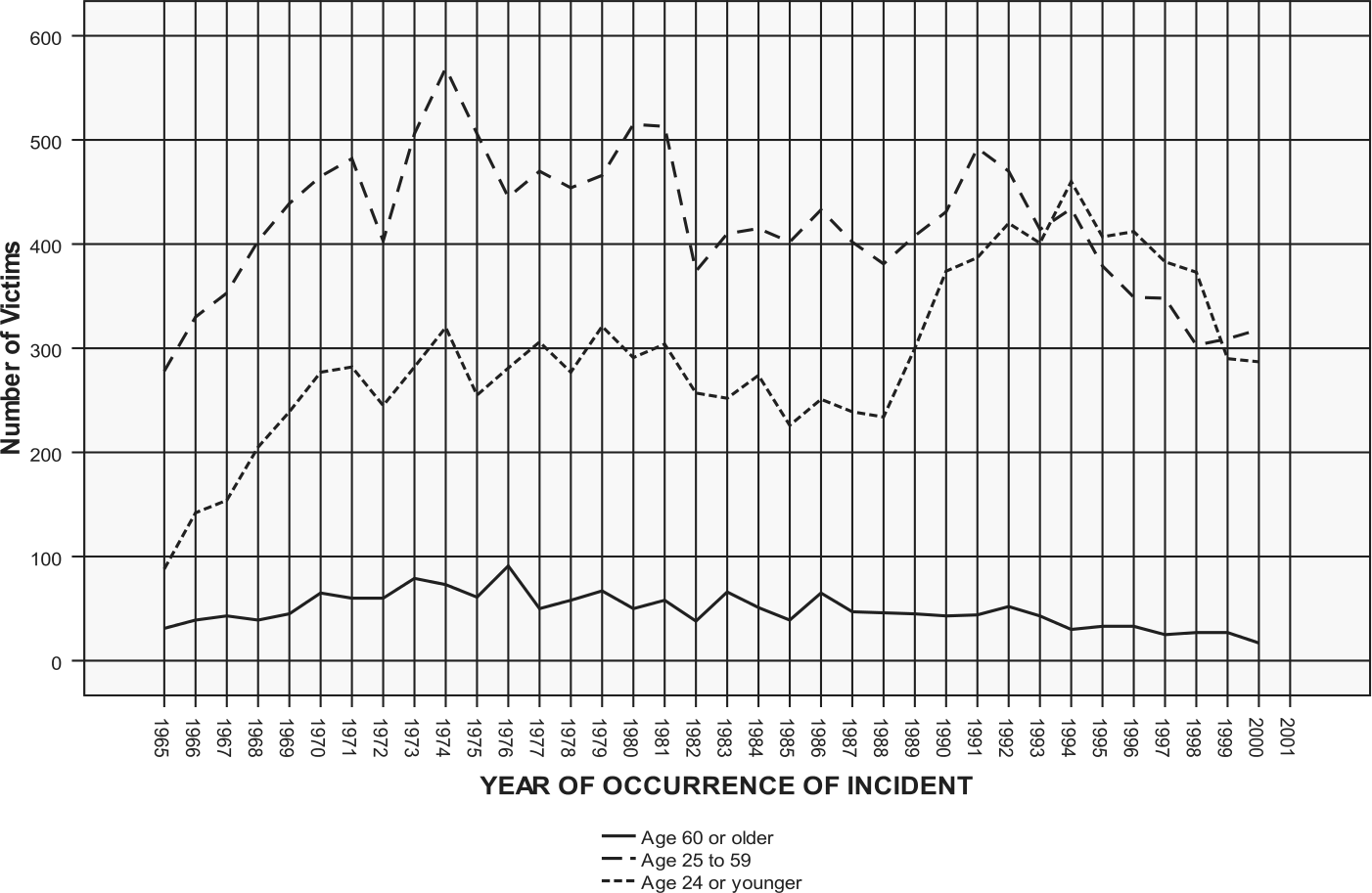
Number of known homicide victims, by age group, Chicago 1965-2000.
Like patterns over time of numbers of elderly homicide victims, the population-based victimization rate shows a rapid increase in the 1960s to the mid-1970s (Figure 2), 12 which can be seen for women, but especially for men. The rates for both women and men generally declined through 2000 and did not show the sharp increase and then decline of the 1990s seen for the rates of younger victims. The high population-based rates for men in some years may surprise those who expect that the risk of homicide for the elderly is low—certainly lower than the rates for elderly men in 1973 and 1974, which both exceeded 40 per 100,000. Looking more closely, about two thirds (64.4%) of the homicides of the 103 men killed in these years could be classified as instrumental, homicides in which the offender is motivated by potentially gaining money or property (see Block & Block, 1991, 1992), compared to 33.8% of men ages 25 to 59 and 16.7% of young men and boys ages 24 and younger.
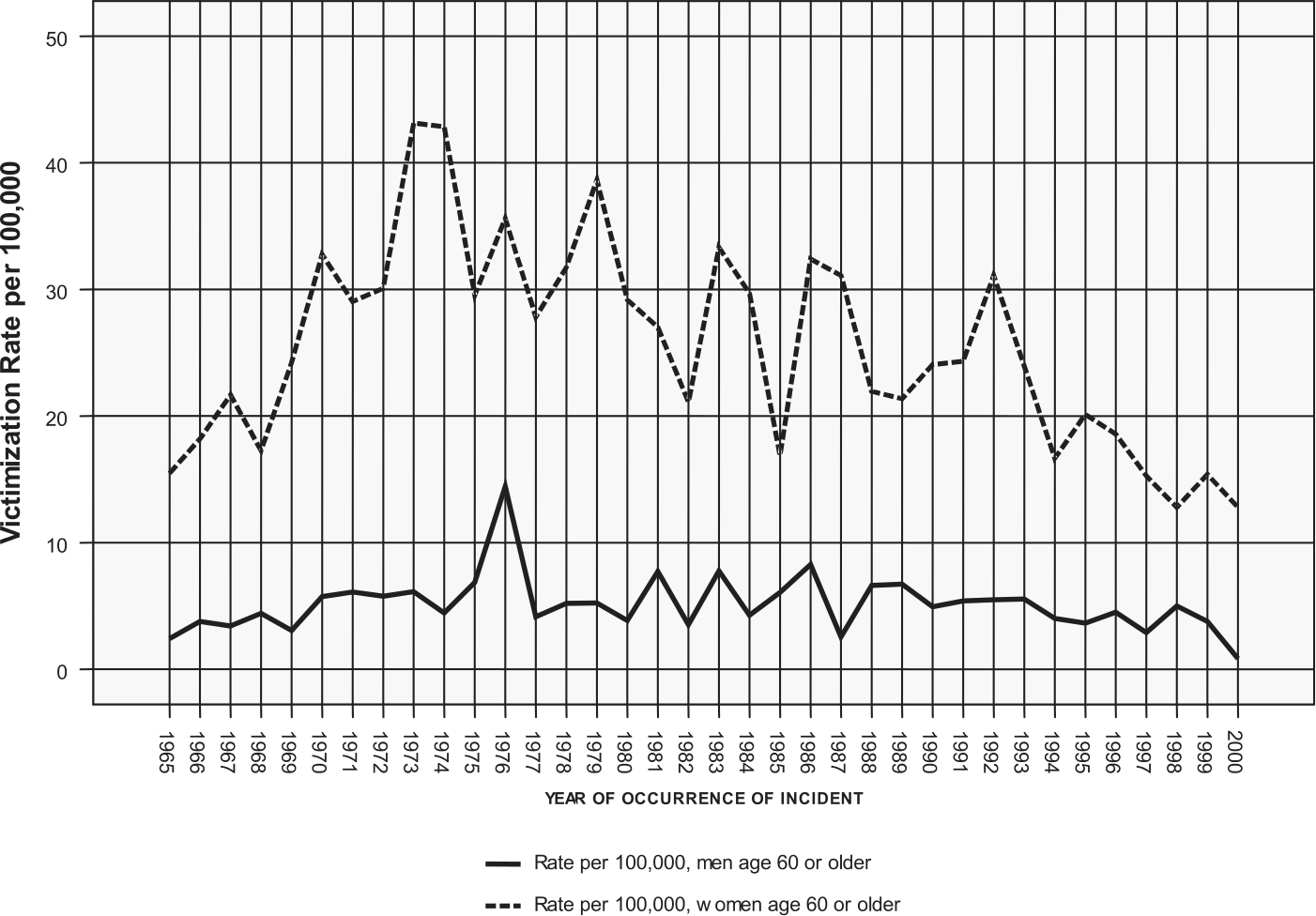
Homicide victimization rate for people age 60 or older, by gender, 1965-2000.
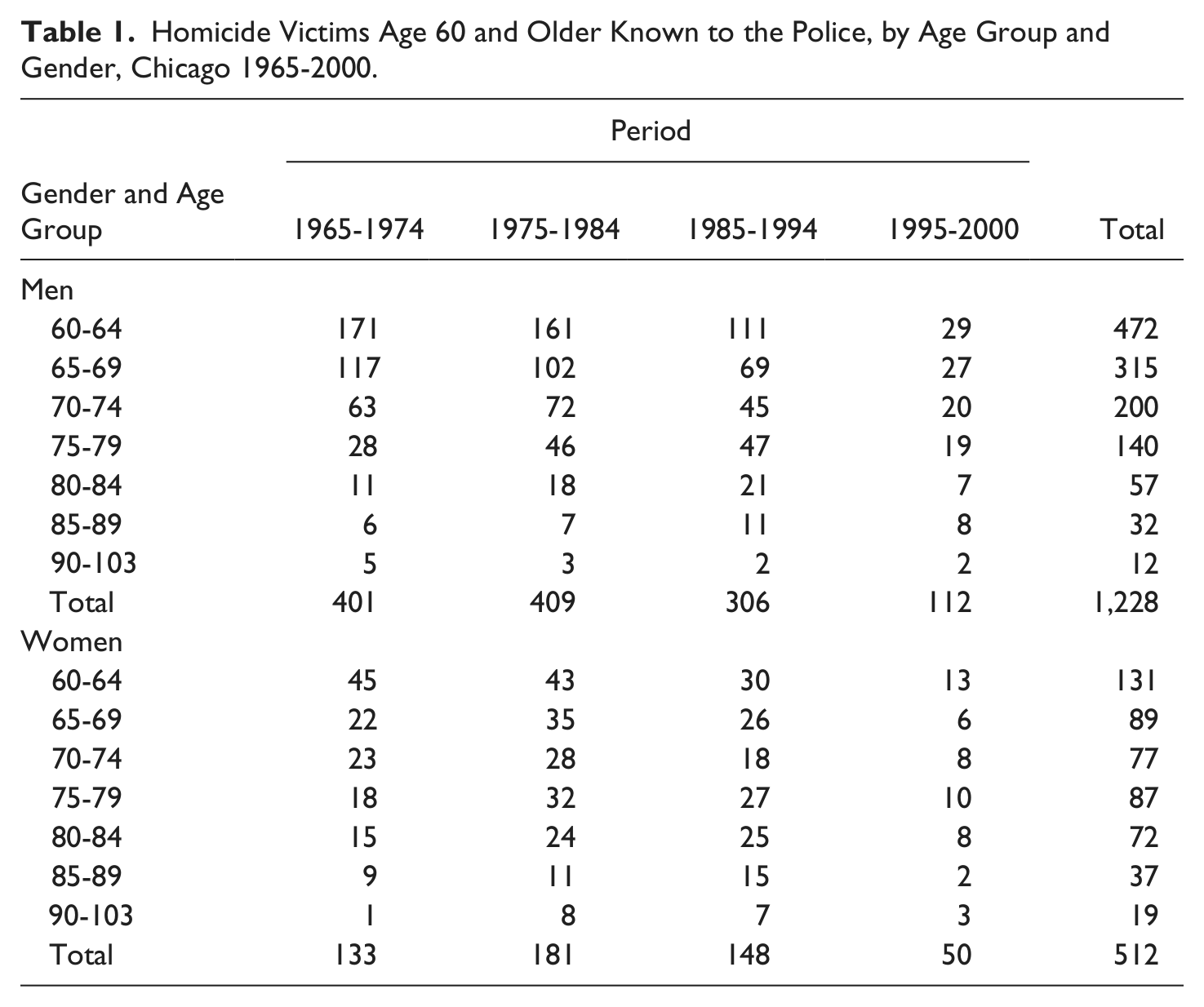
In general, these trend patterns hold for victims who are “young old,” “middle old,” and “older old.” Though the numbers are too small to calculate annual rates, the decline from the mid-1970s seems to have occurred for all age groups within the elderly category and for both women and men (Table 1). (Note that the most recent time period in this table is only 5 years long.)
Homicide Victims Age 60 and Older Known to the Police, by Age Group and Gender, Chicago 1965-2000.
Trends in Numbers and Rates of Offenders Age 60 or Older
For the elderly, homicide offending is even rarer, relative to younger age groups, than is homicide victimization (Figure 3). Overall, only 1.7% of all 27,561 offenders known to the police were age 60 or older at the time of the incident. This proportion varied over time but was consistently small, with the highest, 3.0%, occurring in 1969. The peak population-based rate occurred in 1973 (6.43 per 10,000) and dropped to a low of 0.56 in 2000. The annual number of women offenders age 60 or older was consistently low throughout the time period, but the number of men dropped sharply, from 26 in 1973 to only 2 offenders in 2000 (Figure 4). Like the pattern for elderly homicide victims, there is no indication of a peak in the early 1990s. In fact, by the late 1990s, there is little difference between the number of older men and the number of older women committing homicide in Chicago.
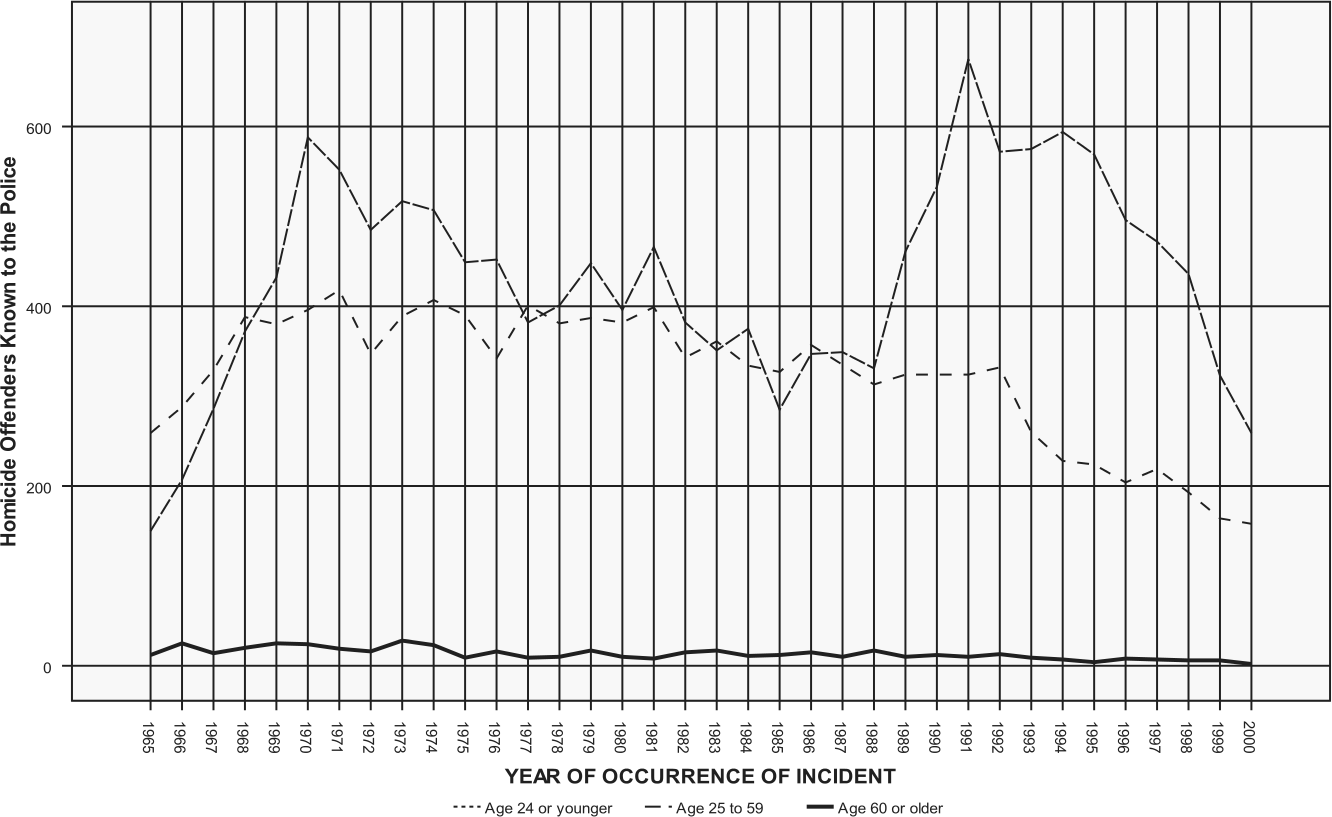
Number of known homicide offenders, by age group, Chicago 1965-2000.
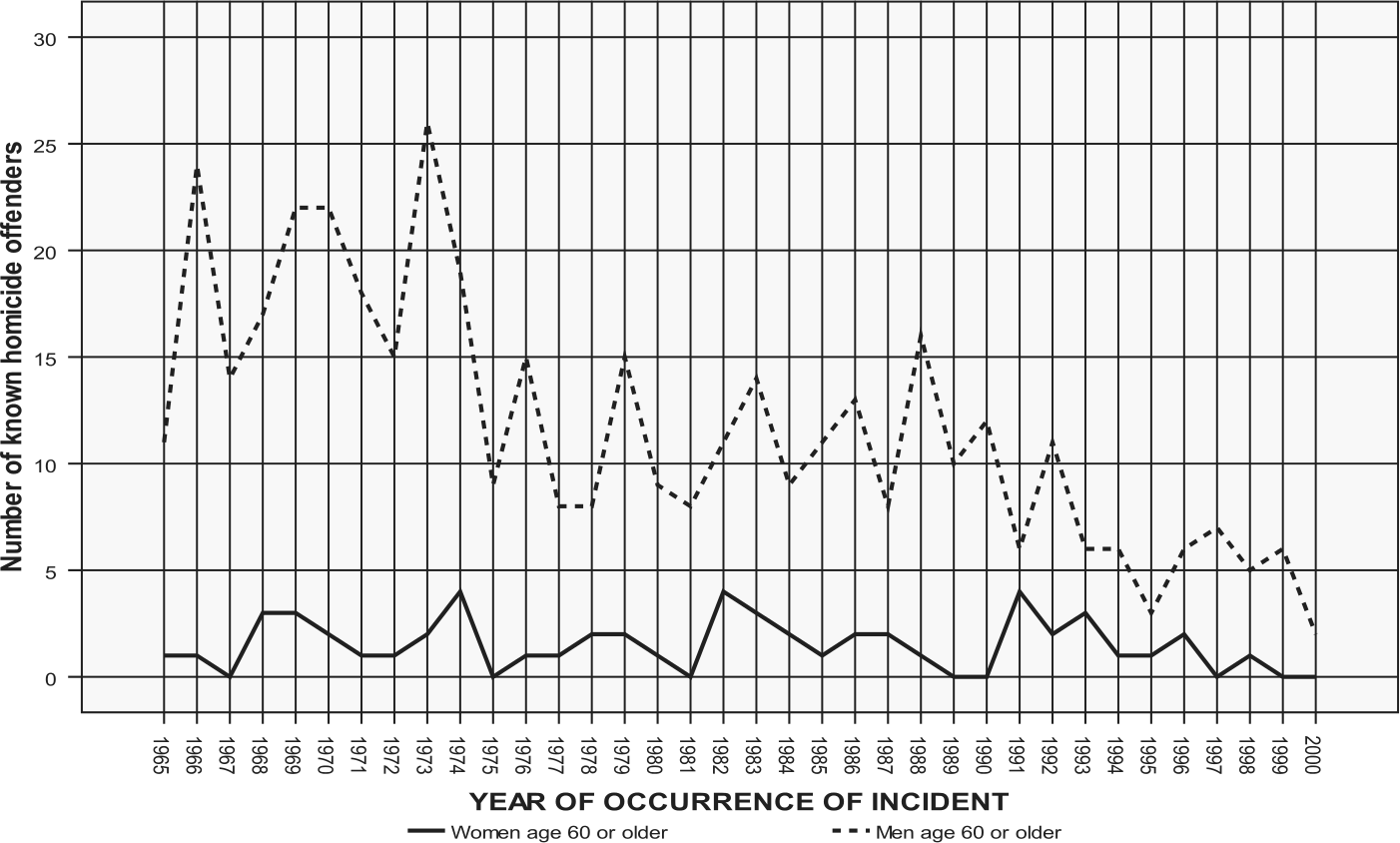
Number of homicide offenders age 60 or older known to the police by gender, Chicago 1965-2000.
In total, 476 homicide offenders ages 60 or older were known to the police in Chicago from 1965 to 2000, 54 women and 422 men. Thus 11.3% of elderly offenders were women, compared to 16.0% of offenders ages 25 to 59 and 7.1% of offenders ages 24 or younger (chi square = 549.6; df = 2; p < .0001). Of elderly offenders, the proportion of women declines with age group, until women constitute only 7.1% of offenders ages 80 to 84. There is no woman offender older than 84.
Race/Ethnicity in Elderly Victims and Offenders
Overall, from 1965 to 2000, elderly victims were significantly more likely to be non-Latino White, compared to younger victims. Of male homicide victims, 34.9% of those age 60 and older were non-Latino White, versus 14.3% at age 25 to 59 (14.3%) and 7.4% at age 24 and younger (chi square 994.0; df = 6; p < .001). Of female homicide victims, 52.5% of those age 60 and older were non-Latino White, versus 18.3% at age 25 to 59 and 13.9% at age 24 and younger (chi square = 389.7; df = 6; p < .001). One reason for this could be that the racial/ethnic demographic pattern has changed in Chicago over time, so that the percentage of the older population who are non-Latino White is increasingly greater. However, the racial/ethnic difference for elderly versus younger homicide victims continues to be strong and significant for both men and women for each decade from 1965/1974 to 1975/1984 to 1985/1994 and for the 5 years from 1995/2000. Elderly victims are more likely to be non-Latino White, and less likely to be non-Latino Black or Latino. (There are no differences by age in the small numbers of Asian or other victims.)
Elderly offenders are likewise more likely to be non-Latino White, and less likely to be Latino, than other offenders. Of men age 60 or older, 19.2% were non-Latino White, compared to 12.4% of male offenders age 25 to 59 and 6.2% of male offenders age 24 or younger. Of women age 60 or older, 14.8% were non-Latino White, compared to 7.8% of female offenders age 25 to 59 and 8.0% of female offenders age 24 or younger. These differences hold across the three decade–plus 5-year time periods.
Characteristics of Elderly Homicide Victims and Their Homicides
Aside from race/ethnicity, how do other characteristics of elderly victims, such as the relationship to the offender (especially matricide, patricide, intimate partner, and prostitute), victim’s prior record, and number of days from the incident to death, compare to those of younger victims? What are the circumstances surrounding homicides following elder abuse or mercy killings? What are the victimization patterns for robbery homicide of the elderly, compared to younger victims? How do characteristics of the case, such as the location, the number of victims or offenders, or the weapon or cause of death (especially arson or strangulation), differ for elderly versus younger victims? And for all of these patterns—do they differ by gender and across elderly age group?
Matricide and patricide
In general, elderly victims are more likely to be killed by a child or grandchild, compared to younger victims. Of men age 60 and older, 3.7% were killed by a natural child, 1.1% by a stepchild, and 0.6% by a grandchild, compared to 0.6%, 0.5%, and 0.0% of victims age 25 to 59, respectively. Of women age 60 and older, 8.6% were killed by a natural child, 0.2% by a stepchild, and 2.7% by a grandchild, compared to 2.0%, 0.1%, and 0.1% of victims age 25 to 59, respectively.
Not all of the homicides of elderly persons by their child are elder abuse. 13 Of the 66 men age 60 or older killed by a child or grandchild (44 fathers, 15 stepfathers and 7 grandfathers), 9 (13.6%) had been victims of elder abuse. Five of these nine men were caretakers of mentally ill children who killed them; in addition, three other men were killed by their mentally ill children. All three of these sons killed or attempted to kill at least one other family member in addition to their father. Of the remaining 54 men, 9 had “struck the first blow” against the child who killed them, 2 were killed in an armed robbery, 4 in an “altercation over money,” and 4 after each asked his son to leave. In addition, a father was killed by the young daughters he was abusing, a father who tried to intervene in an attack by his son on the son’s wife was killed by his son, and a father who tried to intervene when his son was punishing a child was killed by his son. In a typical case of a father–son altercation that appears to be two-sided and not elder abuse, a father (age 77) and son (age 42) became involved in a domestic altercation during which the father was struck with a half-full bottle of liquor and the son was cut with a knife. The father died 82 days later of his injuries.
Of the 59 women age 60 or older killed by a child or grandchild (44 mothers, 1 stepmother, and 14 grandmothers), 13 (22.0%) had been victims of elder abuse. Eight of these 13 women were caretakers of the mentally ill child who killed her. In addition to these eight women, seven other women were killed by their mentally ill children or grandchildren. 14 Of the remaining 38 women, 7 were killed in robberies, 1 in a theft, 6 in an “altercation over money or property,” 2 in an altercation over an alleged theft, and 2 when the offender was attempting to borrow money. Three women were killed after she told her son or grandson to leave. Only 1 had “struck the first blow” against the child who killed her (a 74-year-old mother brandished a knife to force her 33-year-old son to move out of the house).
Intimate partner homicide
Although intimate partner homicide is less common for elderly victims, it still occurs. For men age 60 and older, 6.2% were killed by a female intimate partner and 0.3% by a male intimate partner, compared to 8.8% and 0.4% for men age 25 to 59, respectively. For women age 60 and older, 11.1% were killed by a male intimate partner and 0.2% by a female intimate partner, compared to 39.1% and 0.5% for women age 25 to 59, respectively. Of the 130 women victims age 60 to 64, 24.6% died at the hands of an intimate partner, but this proportion dropped to 12.4% at age 65 to 69 and remained steady thereafter (chi square = 28.1; df = 6; p < .001). For men victims, however, the proportion killed by their intimate partner was fairly steady after age 60, with a high of 10.5% for the 89 men age 65 to 69 (chi square = 8.3; df = 6; ns).
In addition to being killed by their own intimate partner, older people (as well as younger adults) are sometimes killed by the intimate partner of someone the victim is trying to protect from assault. This occurred for 11 (1.2%) older men and 8 (1.6%) older women, compared to 0.9% of men and 1.5% of women age 25 to 59. Several typical cases are the following:
The daughter of a 73-year-old man was being held by force by her husband, who had a gun. The father interceded on behalf of his daughter and was fatally shot.
A 66-year-old mother accompanied her daughter to the daughter’s apartment to get clothing, as she was leaving her husband. The husband shot and fatally wounded her.
The offender, age 40, shot his parents-in-law, ages 61 and 67, in an argument over pending divorce of the offender and his wife. The offender also assaulted his wife (nonfatally).
Prostitute
Though the numbers are very small, men age 60 and older are significantly more likely to have been killed by a prostitute (1.1%) than men age 25 to 59 (0.3%; chi square = 45.4; df = 2; p < .001). There is no difference for women. Although these situations account for only 14 of the victimizations of older men, they require a different approach to prevention than other types of homicide against older men.
Several of the 14 victims were killed in what appears to have been staged robberies. In a typical example, a 70-year-old man had a date with a 19-year-old woman. In his apartment, she stabbed him to death while a confederate ransacked the apartment. Other men had long-term relationships with the prostitute who killed them. In a typical example, a 71-year-old man had been paying the male offender for a period of time US$500 for each act of anal intercourse. On this date, he demanded a “freebie.” The offender tied the victim up with a rope, beat him with a hammer, cut him with scissors, and strangled him.
Days to death
Elderly homicide victims are significantly more likely to suffer a lingering death than younger victims. Though the great majority at every age die the same day as the fatal incident, beginning at age 65 to 69, the elderly are more likely to linger a week or more (at least 8 days) than younger victims. This is true for both men and women (Table 2). Of all men age 60 or older, 12.4% died more than a week after the fatal incident; the percentage increases with older age, from 15.0% at ages 70 to 74 to 25% at ages 95 to 98. Of all women age 60 or older, 9.4% died more than a week after the fatal incident; the percentage increases with older age, from 9.1% at ages 70 to 74 to 15.8% at ages 95 to 103.
Days from Fatal Incident to Death, by Victim’s Age and Gender. a
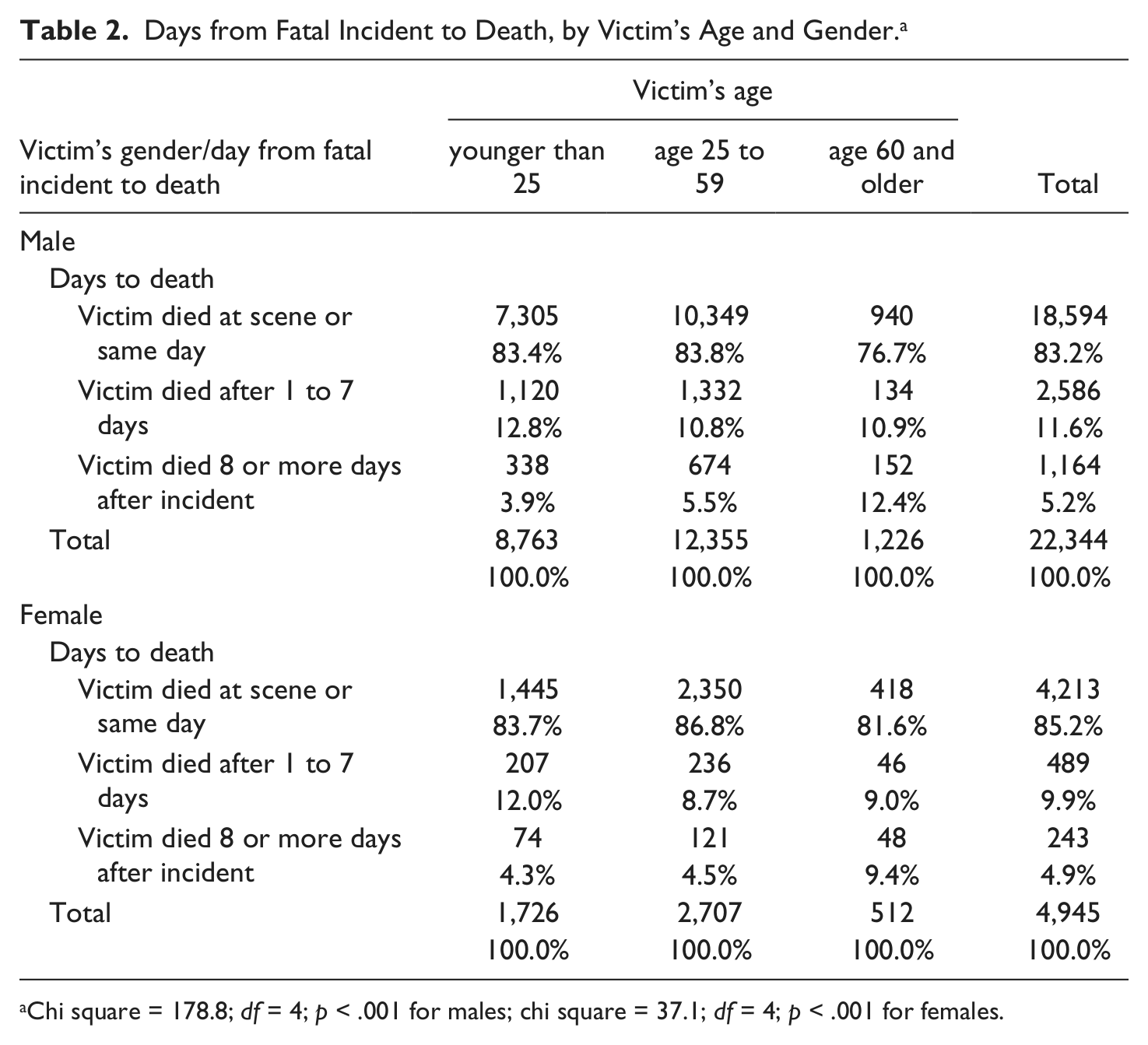
Chi square = 178.8; df = 4; p < .001 for males; chi square = 37.1; df = 4; p < .001 for females.
Prior record
Victims age 60 or older were much less likely to have a prior arrest record (25%) than younger victims (56%; chi square = 637.03; df = 3; p < .001). This is true for both men (33.3% vs. 61.7%) and women (5.3% vs. 28.4%). There is a difference by age group, ranging from 34.3% for age group 60 to 64 to 6.5% for age group 90 to 103. Furthermore, elderly male victims with a record were less likely to have a violent arrest in their record than younger victims (40.2% vs. 52.1%; chi square = 20.23; df = 1; p < .001). For women, there was no significant difference.
Elder abuse
Total figures for elder abuse include all offenders, not only the sons and daughters discussed above. 15 In the Chicago Homicide Dataset, only 1.0% of elderly men and 3.3% of elderly women homicide victims were killed in elder abuse. Of these 29 people, 22 (76%) were killed by a child or grandchild.
Mercy killings
In total, 20 CHD victims died in what appears to have been mercy killings, of whom 11 (2 men and 9 women) were age 60 or older. For example, a nurse had promised her 77-year-old mother that she would not die in pain and injected her with morphine when the hospital said that she would not live through the night. Six of the 11 offenders committed suicide. In addition to the 20 mercy killings, an elderly man died in a suicide pact with his wife.
Robbery and burglary
As research in Chicago and elsewhere has found, the proportion of homicide victims killed in a robbery homicide increases steadily with the victim’s age (Figure 5 and Figure 6). Before age 60, for both women and men, other kinds of homicide predominate. From age 60 on, the proportion of homicides motivated by robbery increases, for women from 36.6% of the 131 homicides at ages 60 to 64 to a peak of 51.4% of the 72 homicides at ages 80 to 84, and for men from 41.1% of the 472 homicides at ages 60 to 64 to a peak of 62.5% of the 23 homicides at ages 85 to 89.
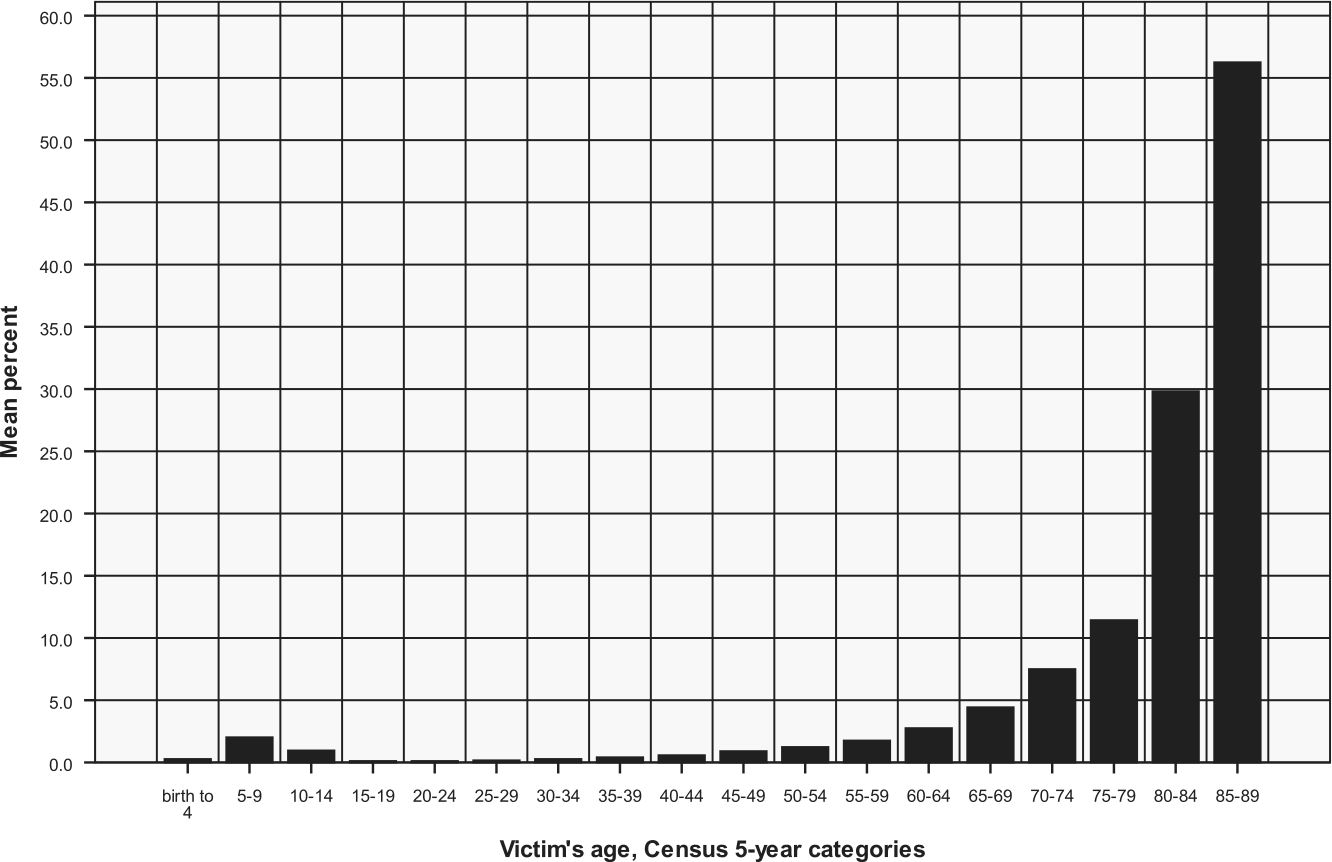
Percentage of all male homicide victims killed in a robbery, by age group Chicago 1965-2000.
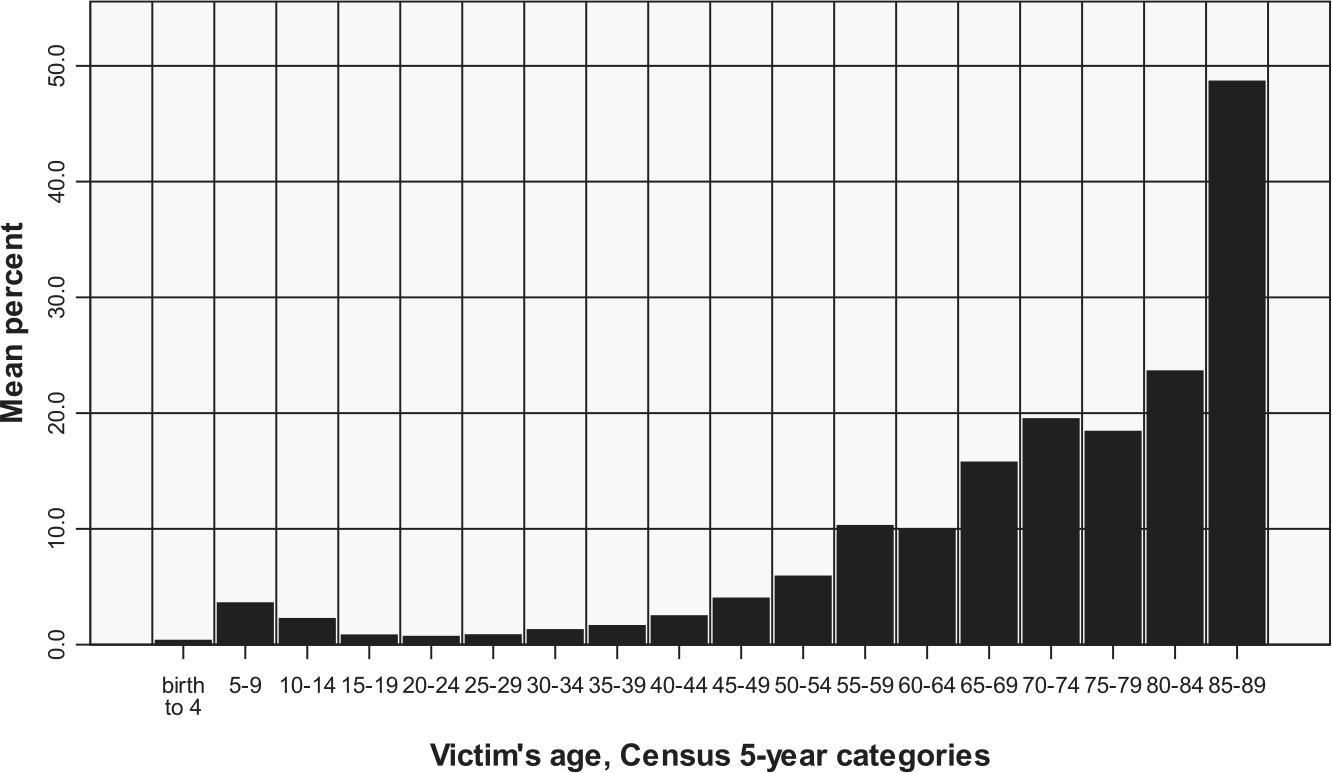
Percentage of all female homicide victims killed in a robbery, by age group Chicago 1965-2000.
In general, elderly victims were more likely to be killed in a robbery or attempted robbery (45.5% of men; 41.6% of women) than were victims age 25 to 59 (18.1% of men; 9.0% of women; for men, chi square = 516.27; df = 1; p < .001; for women, chi square = 374.03; df = 1; p < .001). Burglary homicide is much less common than robbery homicide for any age group of victims. By definition, if a burglar surprises and kills a victim, the crime becomes a “home invasion robbery.” Elderly victims were more likely to be killed in a burglary (2.1% of men; 7.2% of women) than victims age 25 to 59 (0.4% of men; 0.8% of women; for men, chi square = 53.99; df = 1; p < .001; for women, chi square = 95.76; df = 1; p < .001). Typical examples of robbery homicide of the elderly are the following:
Woman age 60: Daughter admits to killing her mother because she wouldn’t give her US$500 to pay a drug debt. She stabbed her in the chest, took the US$200 her mother kept in her bra, and spent it on heroin.
Man age 77: The offenders forced their way into his apartment and robbed him of US$2000. They put a rag in his mouth to keep him quiet and subsequently strangled him. They said they needed the money for crack.
Man age 85: Apparently robbed of his briefcase. He was beaten with a brick about the head and body while going out the door of his home. He died 154 days later.
Woman age 92: Assaulted during the course of a robbery home invasion. Investigation indicates that she was possibly sexually assaulted. Cause of death: club or blunt instrument. Suspect serving a life sentence on two other murders.
Sexual assault
Murders motivated by or including sexual assault account for 6.1% of the murders of elderly women (only two elderly men were sexually assaulted), with the oldest woman age 88 (17.2% were older than 80). 16 The offenders, all male, ranged in age from 16 to 67, and most offenders (71.4%) had a prior record. In 9.1% of the murders, there were multiple offenders. The preponderance (74.3%) occurred in the victim’s home; the most common weapons were beating or strangulation (37.1%) or a knife or sharp instrument (34.3%).
Location
Elderly victims, particularly women, are much more likely to be killed in their own home, compared to younger victims. The CHD specifies not only whether the incident took place in a “home,” but whose home it was—the victim’s home, the offender’s home, the home of both, or someone else’s home. A woman was much more likely to be killed in her own home at age 60 or older (62.0%) than at age 25 to 59 (21.1%) or age 24 or younger (22.7%); 21.1% of elderly women were killed in the home she shared with the offender, compared to 28.6% at age 25 to 59 and 24.7% at age 24 or younger. 17 Combining both categories, the percentage of women killed in her own home increased from 76.9% at ages 60 to 64 to 77.0% at ages 70 to 74 to 85.7% at ages 80 to 84. A man was much more likely to be killed in his own home at age 60 or older (36.1%) than at age 25 to 59 (13.2%) or 24 or younger (7.3%); 10.8% of elderly men were killed in the home he shared with the offender, compared to 11.8% at age 25 to 59 and 6.8% at age 24 or younger. Combining both categories, the percentage of men killed in his own home increased from 38.5% at ages 60 to 64 to 49.2% at ages 70 to 74 to 75.0% at ages 80 to 84.
The proportion of robbery homicides that occur in the victim’s home (“home invasion robbery”) may be surprising. Of victims 60 and older killed in a robbery homicide, 52.9% were killed in their own home; of the victims age 59 or younger, 23.4% were killed in their own home. The proportion of elderly robbery victims killed in their own home increases with greater age—for men, 30.4% at age 60 to 64, 28.9% at age 65 to 69, 39.3% at age 70 to 74, 51.0% at age 75 to 79, 69.6% at age 80 to 84, and 90.5% at 85 or older; for women, 73.2% at age 60 to 64, 92.6% at age 65 to 69, 56.5% at age 70 to 74, 84.4% at age 75 to 79, 81.3% at age 80 to 84, and 89.5% at 85 or older.
In addition, elderly victims are more likely than younger victims to be killed in their workplace. The percentage of men killed in their workplace was 11.5% at age 60 or older, 5.7% at age 25 to 59, and 0.9% at age 24 or younger (chi square = 471.0; df = 2; p < .001); the percentage of women killed in their workplace was 4.5% at age 60 or older, 2.2% at age 25 to 59, and 0.9% at age 24 or younger (chi square = 471.0; df = 2; p < .001). About a third (35.5%) of the 141 men age 60 or older killed in their workplace were the “proprietors” of a business or store; 10.6% were security guards or watchmen, 7.8% were the landlords of the offenders, 7.1% were clerks in a store, hotel, or gas station, and 6.4% were bus drivers. Almost half (47.8%) of the 23 women age 60 or older killed in their workplace were the landladies of the offenders, and 8.7% were clerks in a store, hotel, or gas station. 18 Several typical workplace homicides of the elderly are the following:
The offender was in court for an alimony hearing. He pulled a gun and shot and killed the judge (age 63) and his ex-wife’s lawyer (age 34).
The victim (age 62) owned the store. The offender, age 22, and the victim had had prior verbal altercations. The offender kept tormenting the victim, who ordered him out of the store. The offender then beat the victim and fled.
The offender, age 22, had been drinking and was urinating at basement door of the landlord’s building. When the landlord (age 74) called the offender on this, the offender attacked and choked the victim to death.
Number of offenders
For male victims, there is no discernible pattern between the age of the victim and whether or not he was killed by multiple offenders. For women victims, however, those age 60 or older were more likely to be killed by multiple offenders (20.2%), compared to victims age 25 to 59 (10.7%) or age 24 or younger (17.1%). The percents remain high for women age 60 to 64 (15.7%), to 65 to 69 (21.4%), to 70 to 74 (24.2%), to 75 to 79 (21.9%), to 80 to 84 (22.4%), and to 85 to 89 (20.0%). Many of these homicides of elderly women involved home invasion or purse snatchings by groups of young men or teens. In a typical case, two offenders had been terrorizing a 71-year-old woman. They took up residence in her garage, periodically burglarized her home, and finally left a message for her to leave them US$100 on the TV. Not finding the money, they beat her to death with a baseball bat.
Number of victims
Similarly, for male victims, there is no discernible pattern between the age of the victim and whether or not he was killed alone or with multiple victims. For women victims, however, those age 60 or older were more likely to be killed together with at least one other victim (13.5%), compared to victims age 25 to 59 (9.5%), but the percentage was about the same for victims age 24 or younger (14.2%). Of the 69 women victims age 60 or older who were killed with another victim, the most common circumstances were armed robbery (23.2%) or a work altercation or dispute (18.8%). Most of the 16 armed robberies involved two or three people killed in a home invasion robbery. All of the 13 elderly women killed with multiple victims in a work altercation or dispute were victims in the same incident—an employee of a nursing home became disgruntled and set fire to the home in revenge.
Though the numbers are small, elderly victims were significantly more likely than younger victims to have been killed in familicide—a multiple-victim homicide in which at least two of the victims are each other’s family members (chi square = 24.9; df = 4; p < .001 for men; chi square = 15.2; df = 4; p = .004 for women). Ten (0.8%) men and 20 (3.9%) women victims age 60 or older were killed in a familicide, compared to 0.2% of men age 25 to 59, and 0.5% of men and boys age 24 or younger, 1.9% of women age 25 to 29, and 3.2% of women and girls age 24 or younger.
Cause of death
The primary cause of death differs significantly for older versus younger victims (chi square = 1373.6; df = 12; p < .001 for men; chi square = 239.4; df = 12; p < .001 for women; Table 3). Firearms, whether semiautomatic or not, are less common causes of death for elderly victims, and knives or sharp instruments, blunt instruments, arson, and hands, fists, or feet are more common. Below I discuss in detail two causes of death that are more risky for the elderly strangulation and arson.
Weapon by Age Group and Gender of Homicide Victim. a
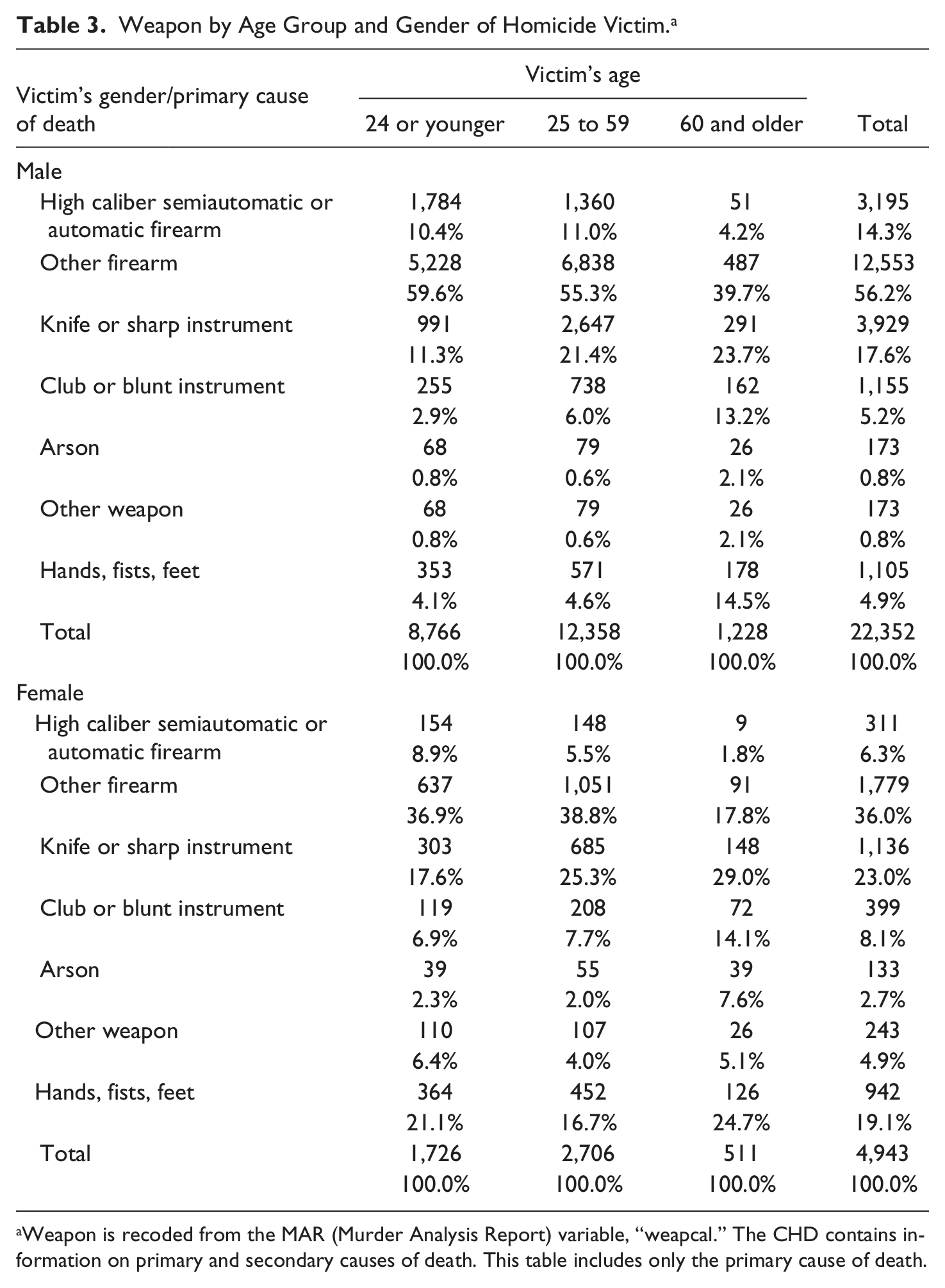
Weapon is recoded from the MAR (Murder Analysis Report) variable, “weapcal.” The CHD contains information on primary and secondary causes of death. This table includes only the primary cause of death.
Strangulation or smothering
Strangulation or smothering (categorized under “hands, fists, feet” in Table 3) is the cause of death for a considerable number of elderly women (14.5%), but the percentage is not significantly higher than for younger women homicide victims. For elderly men, however, although the proportion strangled or smothered may be small (4.1%) it is significantly higher than for younger men and boys. The proportion increases with advancing age, until strangulation or smothering accounts for 8.8% of the 57 murdered men ages 80 to 84, and 20.9% of the 43 murdered men ages 85 or older. This is comparable to the proportion for women ages 80 to 84 (8.3%) and 85 or older (21.5%).
Arson
Though numbers are small, elderly homicide victims are significantly more likely than younger victims to have been killed in an arson fire (chi square = 31.8; df = 2; p < .001 for men; chi square = 53.3; df = 2; p < .001 for women). Arson is the primary cause of death when a fire in a building or vehicle caused the person’s death. For men, this was the case for 2.1% age 60 and older, 0.6% age 25 to 59, and 0.8% age 24 and younger; for women, this was the case for 7.6% age 60 and older, 2.0% age 25 to 59, and 2.3% age 24 and younger. The proportion increased with age for elderly women homicide victims—1.5% at 60 to 64, 6.7% at 65 to 69, 3.9% at 70 to 74, 10.3% at 75 to 79, 13.9% at 80 to 84, and 17.9% at 85 and older—but not for elderly men. 19 Death in an arson fire can be lingering and painful. The mean days to death was 33.0 for elderly women killed in arson versus 5.26 for other elderly women (t test = 4.167; df = 499; p < .001). (For elderly men, the difference was not significant.)
Because prevention methods for arson homicides may differ from prevention methods for other causes of death, it may be helpful to look at typical situations. One fire, started by an employee of a nursing home, claimed the lives of 23 of the 65 elderly victims of arson homicide, and 16 others died as an unintended target of building fires started by a stranger or a neighbor. In these cases, the ability of the elderly person to escape from the building probably entered into their death. In a typical case, the offender had been thrown out of his residence by his sister and was then observed throwing a Molotov cocktail onto the rear porch of her home, where the three victims (ages 60, 68, and 69) were roomers. In other situations, the offender specifically targeted the victim. In 7 of these, the motive was retaliation or revenge: for example, after a domestic altercation, the offender, age 42, poured flammable liquid at the front door of their apartment and ignited it, causing fatal injuries to his 60-year-old roommate. Other motives were home invasion robbery, drug business, and racial hatred.
Characteristics of Elderly Homicide Offenders and Their Homicides
Aside from race/ethnicity, how do other characteristics of elderly offenders, such as relationship to the victim, prior record, and offender suicide, compare to those of younger offenders? Does the victim’s age differ for elderly versus younger offenders? Does the offender’s motive differ for elderly versus younger offenders? Do characteristics of the case, such as time of day or number of offenders differ for elderly versus younger offenders? Do these patterns differ by gender or by elderly age group?
Relationship
Elderly male offenders were more likely than younger adult (age 25 to 59) male offenders to have killed an intimate partner. 20 While only 19.9% of elderly men and 12.5% of men age 25 to 59 killed their intimate partner, the difference between the two was statistically significant (chi square = 20.396; df = 1; p < .001). 21 For women offenders, the majority age 60 or older and age 25 to 59 killed their intimate partner (51.9% and 54.5%, respectively), but the difference between the two was not statistically significant.
Setting aside intimate partner, the top ten victim relationships of the 338 remaining elderly male offenders were acquaintance (21.9%), friend (16.6%), stranger (12.1%), son (6.5%), neighbor (4.4%), sexual rival (3.6%), 22 roommate (3.0%), son-in-law (2.7%), customer (2.7%), and landlord (2.4%). Compared to male offenders age 25 to 59, victims of elderly men were more likely to be a son (6.5% and 0.9%), customer (2.7% and 0.5%), or roommate (3.0% and 0.8%) and less likely to be a stranger (12.1% and 17.4%) or a drug dealer (0.3% and 3.4%). Aside from intimate partner, the top ten victim relationships of the 26 remaining elderly female offenders were friend (19.2%), acquaintance (11.5%), neighbor (11.5%), neighbor in an apartment building (7.7%), stranger (7.7%), and cousin, son-in-law, daughter-in-law, child being watched, roommate, patient, tenant, landlady, and business partner (each 3.8%). Compared to women offenders age 25 to 59, victims of elderly women were more likely to be a neighbor (11.5% and 4.4%) or a neighbor in an apartment building (7.7% and 1.7%), and less likely to be an acquaintance (11.5% and 24.8%), or son (0% and 6.6%).
Prior record
Elderly male offenders were less likely to have a prior violent offense record (31.9%) than men age 25 to 59 (58.6%) or 24 or younger (46.1%) but were somewhat more likely (19.0% vs. 16.0% and 14.8%) to have a nonviolent record (chi square = 499.6; df = 4; p < .001). For elderly women offenders, the difference was even greater. Only 7.8% had a violent record, compared to 29.9% age 25 to 59 and 18.0% age 24 or younger. Elderly women and women age 25 to 59 were almost equally likely to have a nonviolent record (17.6% and 17.1%) and a little more likely than women age 24 or younger (14.7%; chi square = 69.3; df = 4; p < .001). Of the 128 elderly homicide offenders with a violent record, four were women.
Suicide
Elderly offenders were significantly more likely than adults age 25 to 59 to commit suicide at the scene (5.9% vs. 1.9%; chi square = 36.43; df = 1; p < .001). This was true whether the victim was an intimate partner (17.0% vs. 7.5%) or not (2.5% vs. 0.6%). For elderly offenders who did not kill an intimate partner, there was no difference with older age. For the 112 elderly offenders who did kill an intimate partner, those age 75 to 79 were the most likely to commit suicide (36.4%; chi square = 14.47; df = 6; p =.025).
For offenders age 25 to 59, there is a strong and significant relationship between committing suicide and gender (0.5% of women and 2.2% of men; chi square = 25.54; df = 1; p < .001). For elderly offenders, the relationship is weaker (3.7% of women and 6.2% of men) and not significant, but the relationship becomes strong (3.6% of women and 21.4% of men) and significant for those who had killed an intimate partner (chi square = 4.754; df =1; p = .029). Eighteen of the 84 elderly men and one of the 28 women who killed an intimate partner committed suicide at the scene.
Age of victim
At least one of the victim(s) was elderly for 16.0% of elderly offenders compared to 4.2% age 25 to 59 and 3.5% age 24 or younger (chi square = 187.5; df = 2; p < .001). At least one of the victim(s) was a juvenile (16 or younger) for 2.7% of elderly offenders compared to 5.0% age 25 to 59 and 14.0% age 24 or younger (chi square = 628.5; df = 2; p < .001). Though these patterns hold for both men and women offenders, elderly women are much more likely than elderly men to kill the elderly (33.3% vs. 13.7%). Though much of this is explained by the victim being an intimate partner, still, for elderly offenders who did not kill an intimate partner, 23.1% of the 26 women and 10.4% of the 338 men killed an elderly victim (chi square = 3.9; df = 1; p = .048).
Offender’s motive
The most frequent motive specified for an elderly offender killing an intimate partner was “general domestic altercation” (45.2% of the 84 men and 64.3% of the 28 women), 23 followed by sexual jealousy with the offender accusing the victim (10.7% of men; 10.7% of women), altercation over terminating the relationship (9.5% of men; 3.6% of women), drunken fight or brawl (5.6% of men; 7.1% of women), altercation over money or disputed property (4.8% of men; no women), mercy killing (6.0% of men; 3.6% of women), and offender’s mental disorder (4.8% of men; 7.1% of women).
When the victim was not an intimate partner, “general domestic altercation” was still the motive for 10.4% of the 338 men and 3.8% of the 26 women; these victims were children, neighbors, or roommates. Aside from general domestic altercation, the most frequent motives for killing a nonintimate partner were “other altercation” (22.2% of men; 26.9% of women), altercation over money or disputed property (9.2 % of men; 7.7% of women), drunken fight or brawl (7.7% of men; 7.7% of women), retaliation (2.7% of men; 3.8% of women), altercation over a debt (4.1% of men; no women), sexual rivalry (3.8% of men; no women), armed robbery (2.7% of men; 3.8% of women), work altercation or dispute (3.3% of men; 3.8% of women), and offender’s mental disorder (3.8% of men; 7.7% of women).
In general, instrumental motives such as robbery were much less frequent for the elderly compared to offenders aged 25 to 59. 24 For example, elderly homicide offenders are significantly less likely to have committed the homicide during an armed or strongarm robbery compared to younger offenders. This is true for both women (1.9%, compared to 5.2% age 25 to 59 and 15.3% age 24 or younger) and for men (2.1% compared to 13.1% age 25 to 59 and 23.0% age 24 or younger; chi square for women = 90.4; df = 2; p < .001; chi square for men = 454.7; df = 2; p < .001).
Time of day
Elderly homicide offenders are more likely than younger offenders to commit the offense in the daylight hours of 8:00 a.m. to 5:00 p.m. (chi square = 189.1; df = 8; p < .001). This is true for both men and women.
Number of offenders
Elderly offenders are significantly more likely than younger offenders to commit the homicide alone (chi square = 3253.6; df = 2; p < .001). Fully 96.0% of offenders age 60 or older committed the homicide alone, compared to 76.8% of offenders age 25 to 59 and 43.8% of offenders age 24 or younger. This is true for both men and women. There is no difference in the number of victims in homicides committed by older offenders versus homicides committed by younger offenders.
Clearance
The Chicago victim-level homicide data set provides clearance information at the victim case level; the Chicago offender-level homicide data set provides clearance information for the individual offender. Cases with multiple offenders are cleared when at least one offender is arrested or exceptionally cleared. Exceptional clearance occurs when the offender has not been arrested, but the CPD knows who the person is. For, example, the offender is dead. At the victim case level, homicides of elderly victims were less likely than homicides of younger victims to be cleared (75.4% vs. 78.3%; chi square = 11.747; df = 2; p = .003).
Because the offender-level data set consists only of those offenders for whom there is information, an offender in that file has almost always been arrested or otherwise cleared. Thus 80.7% of elderly offenders and 85.7% of offenders age 25 to 59 were cleared by arrest—not a significant difference. There were, however, differences in investigation—elderly offenders were more likely to be arrested at the scene (26.5% vs. 15.1% for age 25 to 59 and 6.6% or age 24 or younger) and correspondingly less likely to have been identified through investigation (22.7% vs. 44.5% and 65.6%, respectively). In addition, elderly offenders were more likely to be exceptionally cleared. Of the 476 elderly offenders, 12.2% died, by suicide, by being killed at the scene, or by natural death, compared to 4.8% age 24 to 59 and 1.7% age 24 or younger (chi square = 340.49; df = 6; p < .001). An additional 7.5% of elderly offenders, 5.5% age 25 to 59 and 3.4% age 24 or younger were cleared exceptionally for other reasons, usually because the States’ Attorney refused to prosecute. 25
Summary of Key Findings
Based on analysis of the Chicago Homicide Dataset, this article presented descriptions of homicides of elderly victims and homicides committed by elderly offenders. A key finding of this analysis was that, reflecting the widely accepted literature showing the relatively higher risk of elderly homicide victims to have been killed in a robbery or other instrumental homicide, elderly victims were significantly more likely to have been killed in an instrumental homicide such as robbery, and less likely than is commonly believed to have been killed in an expressive homicide such as elder abuse (Table 4). An instrumental offense occurs when the primary motive is to gain money or property; expressive homicides are those in which the offender’s primary goal is to hurt the victim, not to gain money or property (Block & Block, 1992). Table 4 separates two kinds of expressive homicides: a fight or brawl, in which both the offender and the victim exchange violence in the fatal incident; and other expressive, in which the victim does not participate in violence in that incident (although there may have been violence from the victim in prior incidents).
Homicide Syndromes of Elderly Victims by Age Group and Gender of Homicide Victim. a
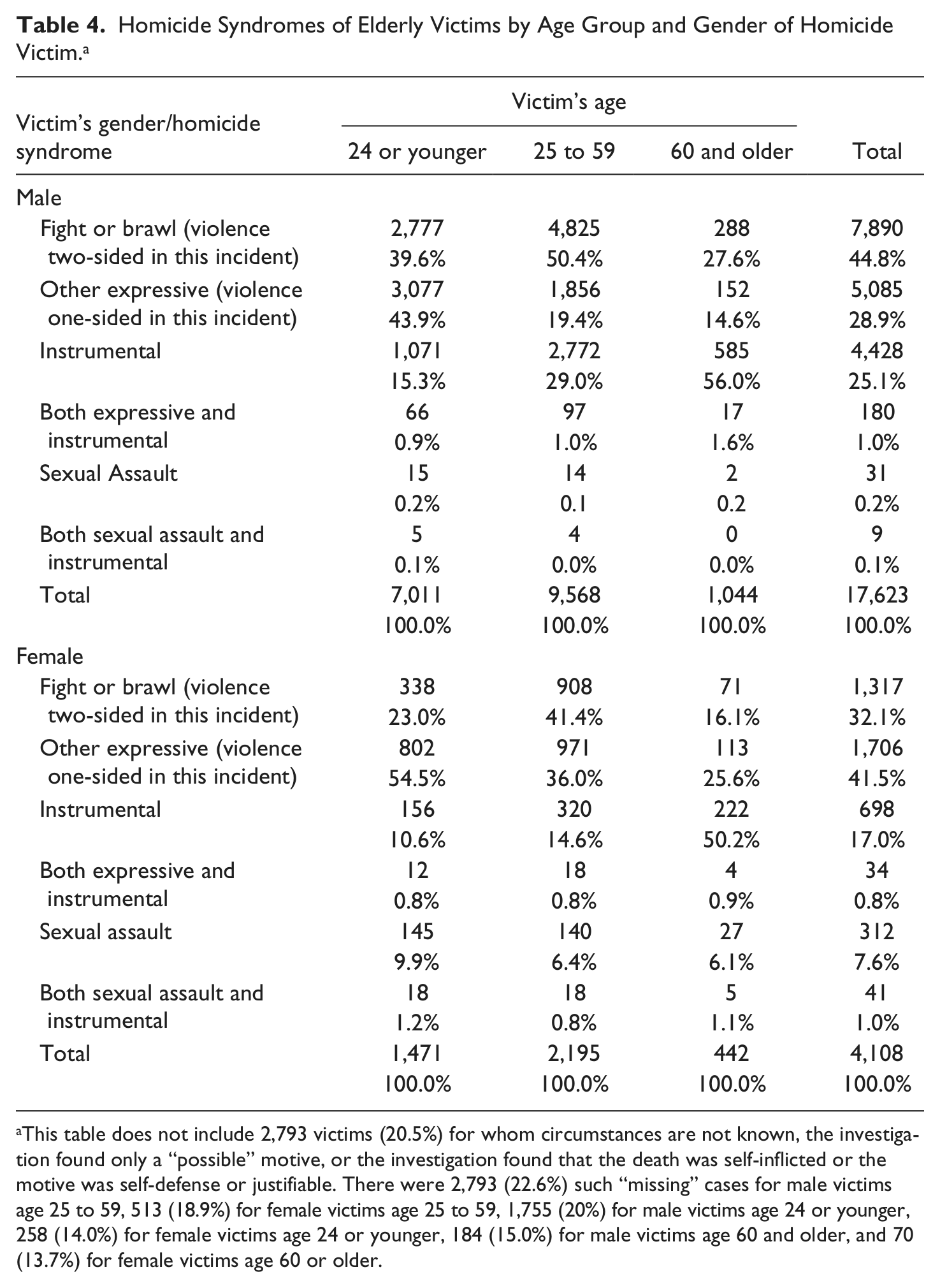
This table does not include 2,793 victims (20.5%) for whom circumstances are not known, the investigation found only a “possible” motive, or the investigation found that the death was self-inflicted or the motive was self-defense or justifiable. There were 2,793 (22.6%) such “missing” cases for male victims age 25 to 59, 513 (18.9%) for female victims age 25 to 59, 1,755 (20%) for male victims age 24 or younger, 258 (14.0%) for female victims age 24 or younger, 184 (15.0%) for male victims age 60 and older, and 70 (13.7%) for female victims age 60 or older.
Although many think of elderly homicide victims as being primarily victimized in elder abuse by caretakers, it is much more common for victims age 60 or older to be killed in a robbery or other instrumental crime. While only 29% of men and 15% of women victims age 25 to 59 were killed in an instrumental homicide, 56% of elderly men and 50% of elderly women were killed in an instrumental homicide. On the other hand, expressive homicides, especially two-sided fights or brawls, accounted for substantially fewer homicides of elderly men and women, compared to younger victims. Sexual assault homicide was equally likely for elderly and younger victims, regardless of gender. Other key findings of this analysis of Chicago from 1965 through 2000 were the following:
Trends in numbers and rates of victims or offenders age 60 or older were more constant over time than trends for younger victims or offenders.
Elderly victims or offenders were more likely to be non-Latino White than younger victims or offenders.
Elderly homicide victims were significantly more likely to suffer a lingering death than younger victims.
Although intimate partner homicide is less common for elderly than younger victims, it is not insignificant. A quarter of women victims age 60 to 64 died at the hands of an intimate partner.
Though the numbers are very small, men age 60 and older are significantly more likely than younger men to have been killed by a prostitute.
Elderly victims, particularly women, were much more likely to be killed in their own home, compared to younger victims.
Elderly victims from age 60 through 74, both men and women, were more likely than younger victims to be killed in their workplace.
The elderly are an exception to the commonly accepted belief that homicide victims have a prior record. Victims age 60 or older were much less likely than younger victims to have a prior arrest record, and if they had a record, it was less likely to include a violent offense.
Women victims age 60 or older were more likely than younger women victims to have been killed by multiple offenders, often in a home invasion or purse snatching.
Though the numbers were small, elderly victims were significantly more likely than younger victims to have been killed in familicide.
Firearms, whether semiautomatic or not, were less common causes of death for elderly victims, and knives or sharp instruments, blunt instruments, arson, and hands, fists, or feet were more common.
Although the proportion strangled or smothered was small for elderly men, it was significantly higher than for younger men and boys, and the proportion increased with advancing age above 60.
Strangulation or smothering was the cause of death for a considerable proportion of women homicide victims, whether age 60 or older or age 25 to 59.
Though numbers were small, elderly homicide victims were significantly more likely than younger victims to have been killed in an arson fire.
Male offenders age 60 or older were more likely than men age 25 to 59 to have killed an intimate partner, although only a minority of either age group did so.
A majority of women homicide offenders, whether age 60 or older or age 25 to 59, killed an intimate partner.
Elderly male offenders were less likely to have a prior violent offense record than men age 25 to 59 or 24 or younger but more likely to have a nonviolent record. For elderly women offenders, the difference was even greater.
Compared to offenders age 25 to 59, elderly offenders were more likely to commit suicide at the scene. Of offenders who had killed an intimate partner, it was much more likely for a man than a woman to commit suicide at the scene.
Elderly women were much more likely than elderly men to kill the elderly, whether the victim was an intimate partner or not.
Discussion and Conclusions
This article intended to fill some of the substantial gaps in our knowledge of elderly homicide victims and offenders and the circumstances under which they became a victim or offender, looking not only at differences between patterns for elderly versus younger victims and offenders but also looking at differing patterns for elderly men and women, and at differences along the spectrum of ages from “young old” to “old old.” What implications does this analysis of Chicago data from 1965 to 2000 (summarized above) have for possible prevention or intervention strategies for elderly homicide victimization or offending?
To develop successful interventions that reduce the risk of homicide victimization of the elderly, we must recognize that different kinds of homicide require different approaches. Hot lines and other efforts to reduce elder abuse are important, but will not, by themselves, prevent the great majority of homicides against the elderly, unless they are linked to other, specific, risky situations, such as the following:
Intimate partner homicide killed about a quarter of women victims aged 60 to 64 and a lesser but still not trivial proportion of other elderly men and women victims. First responders—law enforcement and medical—should be aware of the potential risk of death to this population, as should other service providers, such as shelters and the court system. In addition, the elderly are at risk of dying in a homicide motivated by others’ intimate partner conflict—they are caught in the crossfire. Efforts to reduce levels of intimate partner violence may also save the lives of others who may be at risk, such as the partner’s parents or children.
Support services for intimate partner violence would help to reduce much of the risk of elderly women and men becoming a homicide offender since half of women and a considerable number of men kill an intimate partner.
Increased and continuing support services for families caring for mentally ill children, or for families of drug-dependent children, could help to prevent homicides of elderly parents at the hands of their children.
Arson is not only a largely unrecognized cause of elderly homicide but also often results in a cruel, lingering death. The elderly victim is not usually the target of the offender, but an unintended victim. They die at a greater rate than others because they are less able to escape. The approach to preventing death of the elderly from arson should, therefore, focus on efforts to increase their chance of escaping—such as Fire Department inspections of apartment buildings and building fire drills.
A high proportion of elderly victims are killed in their own home, and the proportion increases with greater age. In addition to arson and threats by intimate partners or children, many of these homicides are home invasion robberies, some planned and some that begin as a burglary and turn into a homicide when the burglar is surprised by the victim being home. The victim is often tied up and otherwise terrorized, often dying from strangulation. The elderly woman is sometimes raped. Many are committed by multiple offenders, with one of the offenders a relative or otherwise known to the victim. Others are committed by a single offender, perhaps a relative, attempting to extort money from the victim. Thus home safety considerations for the elderly should include not only grab bars and ramps but also “target hardening” against robbery and burglary.
Although very few elderly men are killed by prostitutes, the risk is much higher for elderly than for younger male victims. Those who provide medical or other support services to elderly men, including gay men, should be aware of this.
The risk of being killed in the workplace is higher for the elderly than for younger victims. Why is this? Elderly victims are often a proprietor, manager, or clerk in a small store, or they hold jobs such as security guard or cab driver. These jobs are risky in themselves—they involve frequent contact with strangers, available money, and little surveillance—but, in addition, the offender may perceive the elderly to be an “easy mark.” What can be done? Situational crime prevention approaches, such as “cocooning” and repeat victimization policing, would help to reduce risk for workers at small stores; target hardening approaches would help to reduce the risk of driving a cab.
Medical and social support providers for the elderly should be aware of the risk of homicide/suicide for those, especially men, who have thought about or attempted suicide. Increased support services for caretakers of disabled or sick relatives could help to reduce mercy killings.
Though homicides against or by the elderly remain a small proportion of the total, their prevention is important, first, to prevent harm to some of the most vulnerable in our society, second, because a by-product will be preventing harm to other members of society, and third and possibly most important, to prepare for the coming increase in the elderly population. In the future, we can expect that workplace homicides will increase as the elderly population increases and as people continue to be gainfully employed later in their life span. We can expect that “domestic” homicides will increase, unless support services for elderly families struggling to care for a mentally ill or drug dependent child, and support services for intimate partner violence increase. For all of these reasons and more, it behooves us as a society to devote resources to analyzing and finding ways to reduce our elders’ risk of being killed or of killing.
Footnotes
Declaration of Conflicting Interests
The author declared no potential conflicts of interest with respect to the research, authorship, and/or publication of this article.
Funding
The author received no financial support for the research, authorship, and/or publication of this article.