






Abstract
Cultural competence is important to the domestic violence fatality review process. This article reviews current knowledge about cultural competence for Black women abused by men in the United States, with suggested implications for domestic violence fatality review teams (DVFRTs). Help-seeking behaviors, coping strategies, historical context, and cultural values within the African American community are explored. These areas are further examined using a framework inclusive of the structure, goals, processes, outcomes, and barriers of DVFRTs. The implications for how DVFRTs can utilize this information are discussed.
Domestic violence fatality review teams (DVFRTs) provide an important contribution to the communities they serve. The focus of the DVFRT is to better understand how systems can improve to more effectively meet the needs of persons experiencing domestic violence and thus reduce fatalities in the community (Websdale, Town, & Johnson, 1999). By reviewing the life events and systems’ responses, review teams piece together the victim and the perpetrator’s story and try to find the gaps and the places where systems can make a difference for the future (Wilson & Websdale, 2006). The very notion of domestic violence fatality reviews presupposes that these deaths can be avoided: “Fatality reviews can reveal trends and may lead to changes to the system that could prevent future deaths. They may also enhance prevention and intervention programs aimed at reducing the death toll from acts of domestic violence” (Websdale, 2003, p. 27). They provide a venue for different members of a community to think about how to better respond to and prevent future fatalities. Thus, the role of the DVFRT is to consider the systems that are in place and the context of why an event may have occurred.
Domestic violence fatalities present viable challenges to communities across the country and around the world (Campbell et al., 2003). In 2008, 1,817 U.S. women were murdered by a male partner (Violence Policy Center, 2010). A woman is more likely to be killed by a man known to her (94%) than by a man who is a stranger (6%). While fatalities affect all women, they disproportionately affect Black women: “Overall, black women were murdered by men at a rate (2.74 per 100,000) more than two and a half times higher than White women (1.02 per 100,000)” (Violence Policy Center, 2010, p. 9). Thus, Black women are more likely to be killed as a result of domestic violence than other female populations. This information corroborates with information known about victimization. Black women are victimized at a rate 35% higher than White women and 22% higher than other women of color (Rennison, 2003). Black women are seven more times as likely as White women to experience maternal homicide and 11 times more so between the ages of 25 and 29 (Chang, Berg, Saltzman, & Herndon, 2005). More than one quarter (28%) of U.S. women have experienced rape, physical violence, and stalking by an intimate partner; nearly 44% of African American women have experienced these same forms of violence (Black et al., 2011). DVFRTs should recognize the challenges that may have been caused by a lack of cultural competence in formal and informal sources of support. This article will review current knowledge about cultural competence for Black women abused by men in the United States, with suggested implications for DVFRTs.
Overview of the Domestic Violence Fatality Review
DVFRTs began with the notion that it is important to understand what happened to victims to prevent future deaths and help systems work together (Wilson & Websdale, 2006). Since then, DVFRTs are represented in places across the country. Teams are often composed of providers, prosecutors, law enforcement, advocates, survivors, health professionals, criminal justice professionals, and community representatives. Each is charged with bringing their unique lens to the table in an effort to piece together what is often a complex puzzle of information. The team offers recommendations for system improvements. DVFRTs review case records and documentation, and interview family members and friends of the victim, perpetrator, and providers that may have engaged either party: “In a fatality review, community practitioners and service providers identify homicides and suicides resulting from domestic violence, examine the events leading up to the death, identify gaps in service delivery, and improve preventive interventions” (Websdale, 2003, p. 27).
Challenges related to culture have emerged as domestic violence fatality reviews have been conducted. There are barriers experienced by women of color that compromise their safety and diminish their self-sufficiency (Fawcett, Starr, & Patel, 2008). The barriers to acquiring services and the cultural values that impede clients have been identified. For example, “reviews of domestic violence deaths in poor black neighborhoods reveal that African-American women display a deep suspicion of police, social services, shelters, housing agencies, and the courts” (Websdale, 2003, p .29). Review teams must be able to negotiate these challenges to fully understand the linkage between the fatality, the systemic responses, gaps, trends, and community issues relevant to preventing future fatalities. Domestic violence fatality reviews need to take into account the characteristics of the population and the community, historical factors and contemporary realities of discrimination, socioeconomic status, help-seeking and coping strategies, lack of trust in the provider system, and the legal vulnerability of immigrants (Watt, 2003; Websdale, 2003). There should not be a single level of analysis that is only focused on the victim and the perpetrator; community characteristics must also be taken into account when reviewing cases. One should also consider informal social networks to better involve and understand the community (Websdale, 2012). “These community members and professionals often had a different sense of the dangers, difficulties, and compromises victims faced” (Websdale, 2012, p. 28). Thus, it is vital that these issues be addressed when conducting a fatality review and that they be integrated into the systemic process of fatality review. The Washington State domestic violence review team offers suggestions on how some of these issues can be addressed such as having increased training for providers, creating more opportunities for collaboration within communities of color, and lack of addressing the culturally competent services (Fawcett et al., 2008). Finally, they make recommendations specific to communities of color getting involved, such as
“Ethnic community organizations and domestic violence programs should work together to share information and develop strategies for how community members can stay safe while supporting domestic violence victims. Ethnic community organizations should also create opportunities to engage their communities in dialogue about violence against women” (Fawcett et al., 2008, p.10).
While these issues have been identified as vital to conducting domestic violence fatality reviews, how such issues get operationalized into conducting a review is a different story.
Overview of the Cultural Context
It is important to note that the culture of the community is not negative. Persons of color are not inherently violent. There are, however, barriers that affect communities of color that need to be understood to assist this population. Culture is a group’s shared “set of key values, beliefs, understandings and norms” (Daft, 2008, p. 85). According to Bent-Goodley (2012),
Cultural context includes historical experiences of oppression; contemporary realities of discrimination; customs, traditions and practices that can serve as barriers and strengths in the population; and intergenerational exchanges about culture that inform the knowledge, thinking, experiences, and perceived realities of communities of color. (p. 12)
Thus, culture is shaped by help-seeking behaviors, coping strategies, historical context, cultural values, and socioeconomic realities. These components will be further examined to explore how they are connected to cultural context.
Help-Seeking Behaviors
Help-seeking behaviors speak to the ways in which people access assistance. Women of color often delay help seeking for domestic violence for a number of reasons. Women are often socialized to handle their own problems and to not ask for help, particularly African American women who have been taught to be strong and shoulder their problems on their own (Richie, 2012). Furthermore, Richie argues that the socialization of Black women has been shaped by racism, class and gender inequality, and limited access to needed community supports and resources. As a consequence of not being able to fully access resources, Black women are taught to handle problems on their own. Women are celebrated for being able to handle their own problems, for their strength, and endurance. Consequently, reaching out for help can be perceived as a sign of weakness.
Another issue that affects help seeking is that a woman may not want to get her partner in trouble. Racial loyalty is an issue that affects help seeking for Black women. Racial loyalty is defined as when an “African American woman may withstand abuse and make a conscious self-sacrifice for what she perceives as the greater good of the community, but to her own physical, psychological, and spiritual detriment” (Bent-Goodley, 2001, p. 323). Racial loyalty affects help seeking in that the person may not want to get the male in trouble with the criminal justice system. This challenge discourages the woman’s decision to seek supports.
Black women are more likely to seek assistance in medical emergency rooms for domestic violence compared with White women (Hamberger, Ambuel, & Guse, 2007). They seek this assistance as a result of the seriousness of the physical violence but not necessarily to have the health provider intervene in the situation itself. Thus, medical help seeking is an important gatekeeper to other services for Black women that should be further explored. Understanding how help seeking informs and affects the increased risk for Black women to experience serious violence is important for DVFRTs.
Coping Strategies
Women of color are more likely to rely on their religion, spirituality, and social networks as compared with White women (Bent-Goodley, 2007; Campbell et al., 2008; Watlington & Murphy, 2006). African American women often turn to their family and friends first before going to anyone else for support. There is a hesitancy to go to formal providers, such as law enforcement, social workers, mental health providers, and even domestic violence organizations. Thus, they often turn to informal providers, such as faith-based communities, for support (Ansara & Hindin, 2009; Bent-Goodley & Fowler, 2006; Block, 2003). One study found that higher religious involvement increased utilization of social support within the faith community for African American women compared with White women (Gillum, Sullivan, & Bybee, 2006). These faith communities may not be knowledgeable of domestic violence nor been trained on how to respond to domestic violence (Brade & Bent-Goodley, 2009). In addition, they may give mixed messages, damaging messages, or no message. This issue can have implications for how she understands and processes her own sense of spirituality, her prayer life, and her belief in a Higher power to help create change in her situation. Thus, African American women’s reliance on informal networks and faith communities as a coping mechanism can place them at an increased risk for violence and lethality.
Historical Context and Discriminatory Treatment
Historical context is also very important. The community may not have a good historical relationship with formal providers (Bent-Goodley, 2005a; Potter, 2008; Sokoloff, 2005). Therefore, they may not see the providers as allies. They could see the provider systems as working against the community. Thus, not only are they not trusted, but they may also be viewed in a hostile manner. Law enforcement, criminal justice, and court professionals may be viewed in a leery way. Understanding the history between communities at the local level is very important. Historical context helps explain relationships, identify barriers to relationships, understand opportunities to build relationships, and consider who should be involved in relationship building. The historical context of how institutions are perceived and received is critical to understanding how to work with communities of color.
Persistent forms of discriminatory treatment from a historical and contemporary perspective impact the willingness of survivors of color to seek assistance. The police are often not viewed as a resource and can instead be viewed as a hindrance and perhaps even a barrier to getting help (Potter, 2008; Richie, 2012). There is a fear of calling the police because the women do not know if they are also going to be arrested. This perception, whether it is domestic violence-related or not, affects perceptions about police readiness, willingness, and interest in responding to domestic violence.
Negative stereotypes of African American women have also had an impact on discriminatory treatment. These negative stereotypes of Black women, as being loud, violent, and able to deal with all things without support (the superwoman), have had a grave impact on how Black women are served (Hill-Collins, 2008). For example, West (1999) describes a Black woman seeking shelter services for domestic violence being turned away because of the perception of her being “loud” and aggressive in her approach to seek services. When negative stereotypes impact service provision, it creates the perception that providers do not know how to work with the population, do not care, or are indifferent. Understanding how these issues intersect and affect perceptions of formal provider systems and readiness to access formal support services is vital for the work of the DVFRT.
Cultural Values
There are also cultural values that affect domestic violence (Bent-Goodley, 2005a; Burman, Smailes, & Chantler, 2004). The idea of keeping your business in the family is something that is communicated to Black women very early. The notion of talking with someone outside of the family about what is being experienced within the family is taboo. Black women are socialized to keep these types of issues to themselves (Hill-Collins, 2008; Richie, 2012). In fact, when women share what they are experiencing, they may be met with resistance and even anger from people in the community and within their family (Bhuyan, 2008; Engstrom & Okamura, 2007). If the person is from an immigrant population, she may receive negative remarks, disapproval, and even threats related to her talking about what is happening within the relationship. This issue can be a barrier to talking to others outside of the family or even within the family about what is being experienced. There are also different communication patterns within the Black community (Martin & Martin, 1995). As a community with a history of an oral tradition, there is an emphasis often on storytelling as a way of communicating (Bent-Goodley, 2005b; Martin & Martin, 2002). In addition, the nuances of language are very important. While one may or may not speak the same language as a provider, the meaning behind language and how it is articulated can also cause confusion and even miscommunication between victims and providers. These types of issues are critical to understand to support victims.
Socioeconomic Status
Black women are more likely to be confronted with socioeconomic challenges. They are more likely to experience financial constraints, unemployment, underemployment, and poverty (Williams & Mickelson, 2004). These economic challenges create barriers to the choice of being able to leave a relationship, access resources, and participate in services.
Implications for DVFRTs
Watt (2010, 2003) provides a framework for examining strategies of how to examine a DVFRT. This framework includes a focus on structure, goals, processes, outcomes, and barriers. Structure includes an examination of membership, team leadership, and funding; thus, it is vital to understand how knowledge of cultural values and socialization are reflected within the structure of the review. Goals focus on knowledge development, systems change, and building collaboration that connect to having an understanding of the historical context and environmental factors. Processes examine how cases are selected and reviewed, which links to having knowledge of help-seeking behaviors and coping strategies. Outcomes focus on how recommendations are developed and how information is disseminated, which includes knowledge of the historical and contemporary realities of the population. Barriers identify those things that prohibit the review process, which requires an understanding of the historical context and the impact of discriminatory practices. Because this article focuses on the cultural context of the DVFRTs, these areas will be examined and applied from that perspective using the following case vignette to illustrate these points.
Case Vignette
After 10 years of being in an abusive relationship, Yolanda—a 26-year-old Caribbean American woman—made the decision to leave her husband of 3 years. Her sister would later say that Yolanda talked about leaving Jeff—a 36-year-old African American man—many times, but that this time, it was different. Yolanda had left their residence 2 months before her death and was staying with her sister. A few weeks later, she asked Jeff to meet her at a local coffee shop because she thought that would avoid a scene and any further abuse. She told him that she wanted a divorce and that she did not see any future for them. She left the encounter feeling relieved that it was over. She got into her car and before she could turn the key, Jeff shot and killed her. Jeff was later convicted of manslaughter and sent to prison.
The case was later selected for review by the local DVFRT once it was closed. As the team examined the case, they noticed that there had been no police reports and no contacts made with local domestic violence providers. Court records showed that she did request an order of protection against Jeff from a magistrate 3 months before she was killed. She was not granted the order of protection because the magistrate did not feel that there was sufficient evidence to support her request. Her sister and best friend were interviewed. Her sister detailed the years of physical abuse that Yolanda experienced in her relationship with Jeff. She further shared that they began dating in high school and that she always felt that Jeff was too controlling. Jeff was also 10 years older than Yolanda. Her sister shared that he isolated Yolanda from most of her friends. However, Yolanda also had difficulty finding consistent employment and her parents felt that Jeff was a good provider so she should find a way to work it out. Her parents felt that generations of women had experienced this issue but that they survived and moved on—They suggested that Yolanda do the same. When asked why Yolanda did not call the police, her sister said that calling the police is “just not something you do in ‘our’ community.”
Yolanda’s best friend shared that Yolanda went to a domestic violence program to talk with someone but that when she got there, she saw no one that looked like her and nothing around her that looked familiar. She didn’t feel comfortable there so she did not return. Yolanda’s friend further shared that she began to talk with her pastor about what was going on in the relationship. She said that the pastor talked to her about the importance of believing that God could deliver her from the violence and heal Jeff but that she needed to stick it out with him and support him. The pastor further stated that there were so many Black men in the criminal justice system and that she should not put another one into that system. He gave her particular scriptures to read and told her that he would put them on his prayer list. Yolanda’s friend told her that she disagreed with the pastor but Yolanda chose to stick it out. Eventually, Jeff would prohibit her from going to Church. He took her Bibles and took all of her religious artifacts down. It was then that Yolanda decided to separate from Jeff—2 months before her death.
This case vignette is not from an actual fatality review. However, it represents the story of some of the victims whose stories come before a DVFRT. To illuminate how cultural context might come into play in this review, we will utilize Watt’s framework and examine how culture relates to six areas: structure, goals, processes, outcomes, barriers, and strengths and limitations. Table 1 provides an overview of how the framework and cultural context connect, along with the implications for each area.
Strategies and Implications of Cultural Context for a DVFRT.
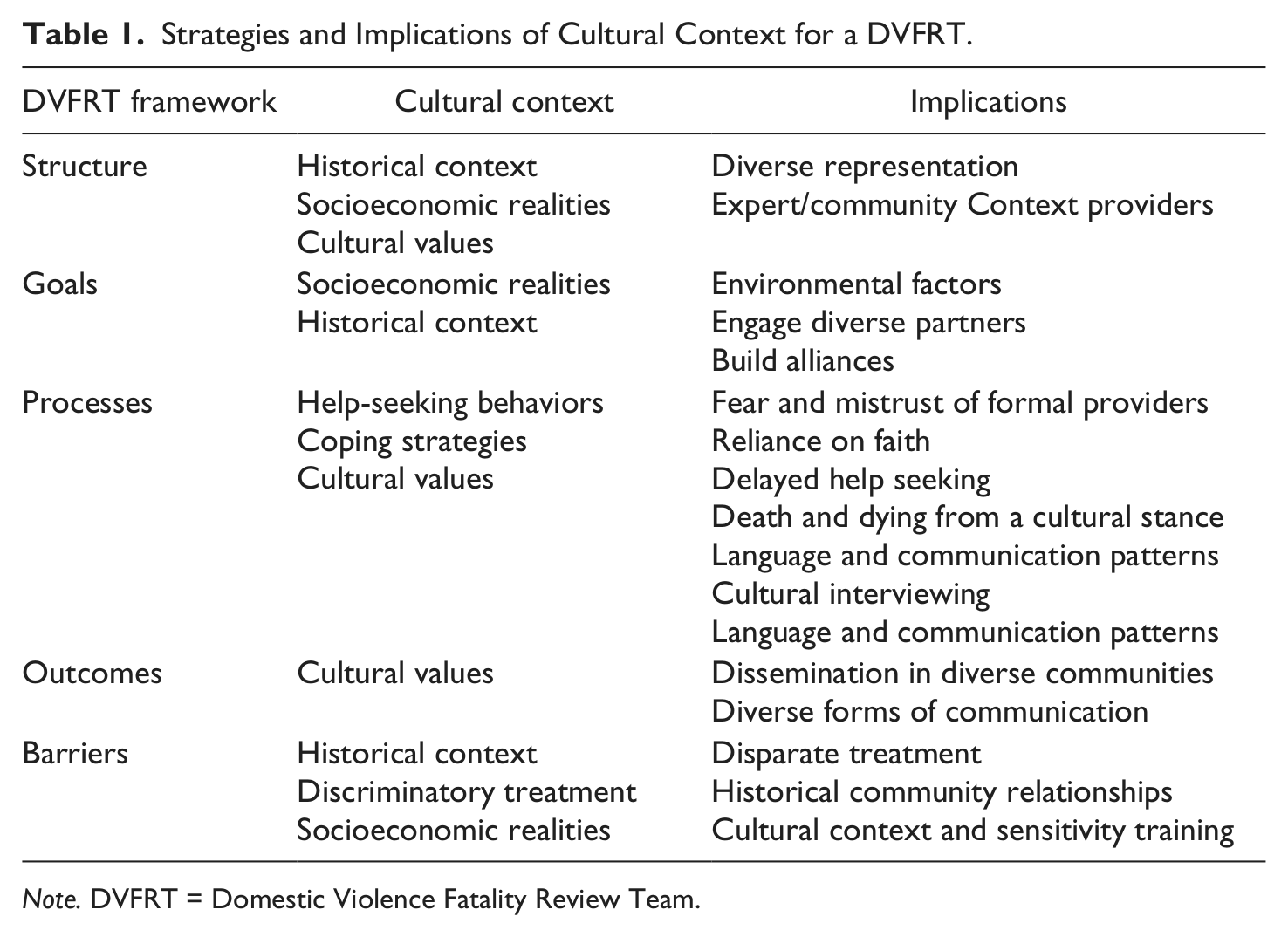
Note. DVFRT = Domestic Violence Fatality Review Team.
Structure
The structure of the fatality review committee is very important. While the committee is likely to not be able to represent all of the diversity in the local community, it is important that there is diverse representation on the review team. There needs to be core ideas that guide the DVFRT and speak to the cultural context of the lives of the victims, awareness of community systems, and an understanding of how to apply cultural context to any given review. In short, you need cultural relevance on the DVFRT. The team should have to examine cultural context and consider how the process should be conducted based on knowledge and awareness of the community being represented in the review. This effort does not mean that the team should seek to have token representation. Instead, each person should have cultural sensitivity and awareness.
For example, there should be room for persons from within the community to share cultural context with the review team if such representation does not exist on the team itself. For example, Yolanda’s case will require identification of the specific Caribbean community she is from. It would also be important to know if she was born in the United States, if she has close family that live in her country of origin, and the degree to which they may have influence within her nuclear family. Understanding ideas about domestic violence within the Caribbean community would also be important to conducting the review. Having a sense of these issues allows for a more accurate process and interpretation of context. It should be noted that just because a team member is part of the community does not mean that he or she is culturally competent. Each team member must be able to distinguish knowledge and skills that support culturally competent practice.
Goals
The goals of the review should go beyond the individual level and include the environmental factors that could have intersected with the case and other cases being reviewed, considering the environmental factors will further the team’s ability to engage community and grassroots partners. By engaging these partners, the team is better positioned to build alliances with informal networks that allow for greater discussion and dialogue, which can ultimately lead to new understandings and opportunities for prevention. In Yolanda’s case, developing relationships with the Caribbean American community could help to foster opportunities for education and awareness within the community. It could lead to developing new understandings and creating bridges to a community that otherwise may not be engaged in this issue.
Processes
The process of understanding what you need to know about the community and how that informs conducting the actual review is important. Knowledge of help-seeking behaviors, coping strategies, and cultural values is particularly important in this area. The family and/or friends may have a fear or mistrust of formal provider systems. Despite wanting to see a change resulting from the loss of the victim, family and friends may still have hesitation or fear of talking with persons from formal provider systems.
Death and dying issues are also different for diverse cultural groups (Bent-Goodley, 2009; Martin & Martin, 1995). Despite the time that may have passed, the family may still be dealing with the death, and that process takes place within the context of the family’s culture. Most families would still be dealing with the loss; however, some cultural groups have longer mourning periods whereby specific acts are required. It is important to have awareness of how the community experiences death and dying issues to interview them.
The delay in help seeking and reliance on informal networks, such as faith-based providers, may be challenging for the team to understand. The focus on faith-based networks, for example, may seem troubling to team members, particularly when the faith-based provider does not support the safety of the victim. The team may feel conflicted with the influence of informal supports that may have encouraged the victim to try to work it out or may have discouraged the victim from obtaining supports from formal provider systems. These kinds of issues are important to identify and work through prior to conducting interviews with family members and friends.
Finally, communication patterns for the cultural group may be different from the team’s cultural communication systems. Words may have particular meanings or understandings in the community. It would be important for team members to understand this before going into any interview. It is not always permissible for a team member to ask what one means in the midst of such a sensitive interview. Therefore, having an awareness of these types of communication patterns becomes important before going into the interview. While the team may have a standard interview protocol, those being interviewed may present information using a storytelling format. They may not answer questions in a linear fashion but may instead seem to respond in a circular fashion. Recognizing that the oral tradition may be different across communities will be important to conducting the interview. In addition, team members should be careful not to overstate their knowledge of a group based on limited interactions with similar groups or individuals. Cultural sensitivity is about having knowledge, awareness, and appreciation of diverse groups and recognizing that no one person embodies all the characteristics of any cultural group.
In Yolanda’s case, the team may wonder why she did not call the police. They may also wonder why she did not seek help from a different provider. It may also be unclear why she did not seek out the assistance of an advocate after her court appearance. Yolanda’s experience as a woman of Caribbean descent may have colored her perspective of the police and may have limited her notion of the police as a resource to address domestic violence. In addition, the immigration status of someone within her family could have impacted her willingness to seek help. She may have felt that a person in her family could be deported once the police came into her life and began conducting their investigation. These are important factors to consider. It is also recognized that she was discouraged by her faith-based provider from reaching out to the police and discouraged by her parents from talking about the abuse. As a result, reaching out for help was not considered as an option for her despite her risk level. While Yolanda relied on her sister and closest friend for support, they lacked an awareness of resources and the lethality associated with domestic violence. Thus, they could not fully support her toward accessing the help she needed.
Outcomes
Once the team has completed the review process, recommendations are generated. These recommendations should be specific to what could have helped to prevent the fatality being reviewed and how to hopefully prevent future fatalities. Thus, the recommendations speak to the systemic issues that could have made a difference for the victim, and they should also speak to the broader community and environmental factors that can help prevent future fatalities. These recommendations are typically put into a report format and shared with stakeholders. It is important that recommendations also speak to systemic failures that may have taken place. In addition, it is important to consider recommendations that community members can use to improve their responses to domestic violence. These recommendations can inform how subgroups within the community can respond, and they can also speak to broader environmental constraints that disparately impact the community. These recommendations should be widely disseminated in the community, particularly within the victim and perpetrator community. In addition, the dissemination materials and process should be shared with consideration for cultural context. For example, if there are pictures in the document that do not reflect the community group, the document may not be perceived as relevant to the community. If the document has not been translated into the primary language within the community, then the document may not be readily accessible to the community.
In Yolanda’s case, it would be important that the recommendations are shared within her community. The report could be widely distributed to faith-based and grassroots leaders in the community to create awareness and build networks within the community to address domestic violence. Fact sheets could be created to identify major points for the community to consider. In addition, resource information could be provided to the community in an effort to create awareness of local domestic violence resources and lethality indicators.
Barriers
Having knowledge of the barriers that diverse communities may experience is important. Understanding possible barriers can put the information reviewed in context. It helps to understand delayed help seeking when one learns about the host of reasons why Black women often do not report. It builds understanding around the reliance on spirituality and faith-based providers as a resource if one understands the barriers to working with formal providers. Having awareness of how communities of color perceive and experience the criminal justice system builds understanding as to why calling 911 or trusting a judicial officer to assist can be a barrier. Having an understanding of the disparate inequity in communities is also relevant to explaining financial circumstances and economic choices. Team knowledge of cultural factors within the community can also help understand possible messaging to the victim and the perpetrator that could have augmented risk of serious injury or lethality. These matters help to build understanding of what might be transpiring and can also help to determine how to best respond.
In Yolanda’s case, she experienced barriers within the agency she attempted to connect with, within her family, and within her faith-based community. Awareness of these barriers could help the team understand her help-seeking behaviors. It could also allow the team to explore the nature of the relationship between the Caribbean community and the local criminal justice system. It is important to recognize that examination of these relationships must happen over a period of time to take the historical relationship into account and not just the contemporary realities. This awareness could lead to efforts to build more positive relationships with the communities, in areas of domestic violence and outside of domestic violence, so that communities can begin to view law enforcement as a resource and not as a threat. Communities could augment their efforts to address this issue as it relates to domestic violence and the perpetration of abuse. A lack of understanding of cultural context can result in missing important details.
Strengths and Limitations
Domestic violence fatality review teams provide an opportunity to identify the strengths and the limitations within a community in responding to domestic violence. They can also illuminate how race and gender intersect for Black women who have been victims of domestic violence. Ultimately, DVFRTs can inform how communities can be more responsive in future for Black women who have experienced domestic violence.
It is important that the team identify strengths from within the team and the local community. The team should know something about the diverse communities within its purview. Again, while not able to necessarily identify all cultural groups, having a sense of the process of recognizing such diversity is a skill that can be utilized with groups that may not be as well known to the team. Creating knowledge of the organizations and resources from within the community is important. While the community may appear to be disengaged and even disorganized, there are still unifying entities that exist. Even if teams do not engage those groups, they should minimally know of their existence. In Yolanda’s case, she belonged to the women’s ministry in her church and a local civic organization. Through asset mapping, the team may have been able to identify not only these entities, but sorority chapters, civic groups, and Caribbean-focused organizations actively working in the community. When the team shares its recommendations, these entities can receive them and be engaged to support prevention and intervention efforts within the community. They can help to build linkages with provider systems. They can also be actively engaged as board members and advisory groups to help strengthen culturally relevant services within the local community. These groups can be activated to follow court activities for victims. They can provide supports that the provider system is unable to provide. Again, without knowledge of such strengths, there are missed opportunities to optimally support communities.
DVFRTs can conduct asset mapping to identify gaps in services and limitations that can negatively impact the review team and its process. Limitations such as gaps in criminal justice systems, poor resources to providers, lack of training on cultural context, and poor accessibility to services can be uncovered. Recognition of these limitations can help to understand the context of the victim’s situation. For example, if the services are not geographically accessible, the victim may not be in a position to access the services and receive the supports needed. This knowledge can also provide awareness of areas that require focused attention and change. In Yolanda’s case, an awareness of the resources within her local community can help to build understanding of her perceived choices. They can also help to identify needed areas of training. For example, the provider system that she accessed needed to receive information on cultural sensitivity and be monitored for implementation of culturally competent practices. Teams can suggest that all provider systems be trained in culturally competent services and encouraged to monitor cultural sensitivity. Community groups can be accessed to help reinforce the importance of such services.
Conclusion
This article presents an opportunity to explore why culture matters related to domestic violence and how they can help shape and inform the work of the domestic violence fatality review team and process. It is vital that DVFRTs be active contributors to building domestic violence awareness within the community and reaching out to key partners, such as the faith-based community, to support their response to domestic violence. Teams must be willing to work with these communities, even if there is not an initial acceptance or understanding of the information being provided. Through persistence, consistency, and an authentic concern about the issue of domestic violence within the Black community, teams can build relationships that allow for a shared understanding of how to respond and utilize a coordinated approach to addressing domestic violence before it becomes a fatality. To meet this need, DVFRTs must receive training that builds not only knowledge related to culture but also cultural sensitivity, which speaks to why this information is important and necessary to optimally meeting the goal of DVFRTs. Training should be ongoing and required for DVFRT members with opportunities for open discussion as to how to improve in this area.
While the article focuses on domestic violence as experienced by Black women, a number of the issues extend to other cultural groups (Dutton, Orloff, & Hass, 2000; Flicker et al., 2011; Rizo & Macy, 2011; Yoshihama, Bybee, Dabby, & Blazevski, 2011). By understanding and building an appreciation for culture, fatality team members are better able to contextualize and obtain information from reviews. It can also create new relationships and build new alliances across the community. These new relationships and alliances can ultimately link to the prevention of domestic violence fatalities in the community. Thus, knowledge and skills associated with cultural context are important to the work of the DVFRTs. Teams should include a focus on cultural context to improve their accuracy, strengthen their contribution, and augment their relevance within diverse communities.
Footnotes
Declaration of Conflicting Interests
The author declared no potential conflicts of interest with respect to the research, authorship, and/or publication of this article.
Funding
The author received no financial support for the research, authorship, and/or publication of this article.