







Abstract
This study tests the hypothesis that psychopathy is more associated with instrumental homicides than mixed and reactive homicides, and explores relationships between Psychopathy Checklist-Revised (PCL-R) facet/item scores and different forms of homicide: instrumental (n = 130), mixed (n = 103), and reactive (n = 219) homicides. Instrumental homicides scored higher on facet 2 (p < .01) but scored lower on facet 4 (p < .1) compared to reactive homicides, whereas no facet scores differed between mixed and reactive homicides. Among the items of facet 2 (affective), remorselessness (item 6), and callousness (item 8) were predictive of instrumental homicide.
Keywords
The psychopathy construct is a combination of interpersonal (facet 1), affective (facet 2), lifestyle (facet 3), and antisocial (facet 4) features that have been often utilized as one of the riskiest predictors for violent behaviors (Hare, 2003). Meta-analyses have supported the view that psychopathy predicts institutional misbehaviors, nonviolent, and violent criminal behaviors as well as general recidivism (e.g., Guy et al., 2005; Kennealy et al., 2010; Leistico et al., 2008). A relationship between psychopathy and the instrumental-reactive distinction in violence research has also received significant attention. While those with higher psychopathy were more likely to be identified as instrumental offenders than those with lower psychopathy (e.g., Cornell et al., 1996; Patrick, 2018; Raine, 1993), one meta-analysis questioned the hypothesis that psychopathy is more related to instrumental compared to reactive violence (Blais et al., 2014). Additionally, violent youths with high psychopathy scores did not use significantly more instrumental violence than their counterparts (Hutton & Woodworth, 2014). Moreover, a clear link between psychopathy and homicide offending has been a focus of studies (e.g., Fox & DeLisi, 2019; Rodre et al., 2019), and most of the homicides by psychopathic offenders were instrumental (Porter et al., 2018). However, no studies have assessed whether psychopathy facets and items have relationships with instrumental/planned homicide that the current study exclusively targeted.
Theories for Instrumental and Reactive Violence
The manifestations of different forms of violence and aggressive behavior vary. The frustration-aggression hypothesis defines reactive aggression as the result of perceived threat or frustration (Berkowitz, 1989). A systematic review suggested the attentional bias theory in that hostile or threat-relevant stimuli (bias) is likely to trigger reactive aggression (Manning, 2020). Correspondingly, hyperresponsivity to threat was identified as a risk factor for reactive aggression (Lickley & Sebastian, 2018). Regarding the amygdala dysfunction hypothesis, while there is a strong link between psychopathy and instrumental aggression, a link between psychopathy and reactive aggression was not robust (Reidy et al., 2011). Such brain dysfunction can be central to understanding the positive relationship between high sensitivity to alleged threats or frustrations and reactive aggression (Bertsch et al., 2020). In contrast to reactive aggression, which is perceived as more emotional, social learning theory views proactive aggression as behavior that anticipates a reward (Bandura, 1973). Dehumanization theory explains the psychological and social process of impersonalizing victims to impose instrumental violence (Markowitz & Slovic, 2020; Over, 2020). Thus, we would anticipate that psychopathic individuals would be more likely to engage in instrumental and predatory homicide relative to reactive homicide.
Comparisons between instrumental/proactive and emotion-laden/reactive violence have been also reported. Violent offenders who were psychopathic used more instrumental violence without emotional arousal (Cornell et al., 1996), and proactive aggression was more linked with mothers’ rating of a psychopathic personality (Raine et al., 2006). Although comparisons between instrumental and reactive violence are of value, not all manifestations of violence are dichotomous. In one review, studies that categorized proactive-only or reactive-only groups were relatively small, whereas many studies have found reactive and proactive types of aggression to be more common (Kempes et al., 2005). Consistently, homicides can be caused by humiliation, frustration, or rage as socialized emotions (reactive) or by an organized project (instrumental) (Katz, 1988), and psychopathic traits have been associated with both instrumental and reactive aggression (Babcock et al., 2014). As such, there has been theoretical as well as empirical interests in instrumental and reactive violence, although not all studies specifically addressed psychopathy.
Psychopathy Total Scores and Instrumentality
Higher psychopathic traits in homicide offenders have been well-documented (e.g., Fox & DeLisi, 2019; Kennealy et al., 2010; Rodre et al., 2019). A recent meta-analysis reviewed studies from Finland, Germany, Sweden, Canada, United States, and Brazil and found a large effect size (r = 0.68) for the relationship between psychopathy and homicide, with higher effect sizes for multiple and serial homicides (r = 0.80 and r = 0.74, respectively) (Fox & DeLisi, 2019). This study also compared PCL-R total scores across samples and found that murderers from the American continent scored higher than European murderers, although a comparison with non-Western/European countries could not be included.
Psychopathy as one of the leading risk factors for instrumental homicide has been reported in the studies below. A study of 228 homicide offenders in Sweden found that those committing instrumental homicide had higher PCL-R total scores than expressive homicide offenders (Rodre et al., 2019). Similarly, a study of 82 violent offenders in Belgium found that those committing predatory crimes had higher psychopathy scores compared to those who committing affective crimes (Declercq et al., 2012). Higher PCL-R total scores in 100 Canadian homicide offenders related to instrumentality such as planning and control over the crime (Mossière et al., 2020). The results from 361 sexual homicide offenders in England and Wales suggested that these sexual murderers showed predatory violence (i.e., stalking, returning to the crime scene, etc.) during the peri-murder period (Stefanska et al., 2020). In a study of 50 Canadian homicide offenders, psychopaths tended to commit more instrumental homicide than non-psychopaths, and psychopaths were more likely to inflate the reactivity of their killing to exculpate themselves from the instrumental nature of their homicides (Porter & Woodworth, 2007). Another study of 125 homicide offenders replicated the finding that homicides by psychopathic offenders were more instrumental in nature (Woodworth & Porter, 2002). Psychopathic offenders had a tendency to believe that planned instrumental violence is less likely to result in being arrested (Porter et al., 2018), a finding somewhat consonant with a study addressing significantly higher intelligence in instrumental murderers compared to affective murderers (Hanlon et al., 2013). Thus, the literature overall supports the notion that psychopathy is more related to instrumental and predatory homicide.
Psychopathy Factor 1 and Factor 2 Scores and Instrumentality
Whether Factor 1 or Factor 2 is more useful in predicting violence that is more predatory in nature still warrants further analysis. An earlier meta-analysis compared factor scores and found homicide offenders had higher Factor 2 scores, which embraces more lifestyle-antisocial facets than Factor 1 that instead encompasses interpersonal-affective facets (Fox & DeLisi, 2019). Similarly, Factor 2 was more predictive of overall violence than Factor 1 in another meta-analysis of North American and European studies (Kennealy et al., 2010). In a study of 87 Italian homicide offenders, while male murderers had higher Factor 2 scores, female murders scored higher on Factor 1 (Carabellese et al., 2020). Furthermore, neither Factor 1 nor Factor 2 predicted instrumental violence among 145 female violent adolescents in British Columbia (Hutton & Woodworth, 2014).
In contrast, personality traits abstracted in Factor 1 have been more related with instrumental violence than the behavioral traits encapsulated in Factor 2 (Flight & Forth, 2007; Porter & Woodworth, 2007; Rodre et al., 2019; Skeem et al., 2003; Woodworth & Porter, 2002). A study that reviewed mostly samples from Canada and the US reported that Factor 1 related more to instrumental violence, while Factor 2 related more to impulsive violence (Blais et al., 2014). Similarly, Factor 1 was related with proactive aggression, while Factor 2 was related with reactive aggression in 120 French sexual homicide offenders (James et al., 2020). While no psychopathy scores were examined, another French study on 1,009 rapists reported instrumentality for sexual crimes in that angry rapists traveled farthest, whereas opportunistic rapists traveled the least to commit instrumental crimes (Hewitt et al., 2020). A Belgian study found that Factor 1 positively correlated with predatory violence scores, whereas Factor 2 negatively correlated with predatory violence scores (Declercq et al., 2012). A positive association between interpersonal-affective facets and instrumental violence was found in 51 violent adolescents (Flight & Forth, 2007). After controlling for Factor 2, Factor 1 positively correlated with instrumental homicides, whereas Factor 2 did not correlate with instrumental homicides, after controlling for Factor 1 in Canadian murderers (Woodworth & Porter, 2002). Another study reported that only Factor 1 but not Factor 2 predicted the instrumentality of homicides (Porter & Woodworth, 2007). Swedish homicide offenders who were instrumental perpetrators had significantly higher Factor 1 scores compared to expressive homicide offenders, whereas Factor 2 did not separate instrumental and expressive murderers (Rodre et al., 2019). One study has proposed that the interpersonal-affective traits that make up Factor 1 better explain the motivations for violent crimes that psychopathic offenders chose to commit (Skeem et al., 2003). Taken together, these studies suggest that those who have higher interpersonal and affective facet scores tend to commit more predatory and instrumental forms of violence.
Psychopathy Facet and Item Scores and Instrumentality
Although studies focusing on correlates of underlying facets with instrumentality are relatively sparse, some have reported on relationships between facet scores and instrumental violence. In a study of 248 American male offenders, while facet 1 (interpersonal) and facet 4 (antisocial) positively related to instrumental violence, facet 2 negatively related to instrumental violence (Walsh et al., 2009). Facet 1 was found to play a stronger role in instrumental violence than facet 2 in a Belgian study (Declercq et al., 2012). Facet 1 was also significantly related with homicide, rape, and aggravated assault in 65 Swedish male forensic patients (Laurell et al., 2010) and was the facet most strongly associated with instrumental aggression among American male adolescents (Vitacco et al., 2006). Similarly, facet 1 was more related to instrumental violence, while facet 4 was least related to instrumental violence in a meta-analysis of 53 studies (Blais et al., 2014). In another study of 82 Belgian violent offenders, facet 4 had a negative relationship with predatory violence (Declercq et al., 2012). These findings conflict with findings reporting that facet 4 over and above other facets plays an important role in violence among American offenders (Walters & Heibrun, 2010). In Canadian homicide offenders, similarly, facet 4 scores more related to instrumental violence (i.e., planning), whereas facet 2 scores were not significantly related with overall instrumentality (Mossière et al., 2020).
Evidence for the role of the affective facet 2 in predicting violent crimes has been found in non-Western violent offenders (Sohn & Lee, 2021; Sohn, Raine, et al., 2020; Sohn, Reyes, et al., 2020). Korean offenders who reconvicted for violent crimes had significantly higher facet 2 scores than those who committed nonviolent crimes (Sohn, Raine, et al., 2020). Furthermore, sexual recidivists scored significantly higher on facet 2 compared to recidivists who committed homicide, robbery, burglary, and misdemeanor (Sohn & Lee, 2021). Another study comparing facet scores between child sex offenders, adult sex offenders, and non-sex offenders reported that child sex offenders scored higher on facet 1 and facet 2 than non-sex offenders. The absence of emotion that facet 2 assesses has been observed in predatory murderers (Meloy, 2012) and violent youths who had instrumental motives to gain sex, money, or drugs (Flight & Forth, 2007). Both facet 2 and facet 3 had the strongest predictive abilities for institutional violence among adult homicide offenders (Mossière et al., 2020). In a study of Hong Kong adolescents, proactive aggression related more with affective empathy, and reactive aggression had a strong relationship with somatic/motor empathy (Chen et al., 2021). While studies reporting the utility of items of psychopathy in predicting the predatory nature of crime are few and far between, one study of Korean offenders found that callous/lack of empathy and failure to accept responsibility for own actions (facet 2 items) were the strongest items to predict violent crimes (Sohn, Raine, et al., 2020). A qualitative study about one career criminal reported that he scored higher on remorselessness, callousness, and refusal to accept responsibility (facet 2 items) as well as the total PCL-R score (DeLisi et al., 2020). These initial findings led us to examine psychopathy facets and items to further test for links between underlying psychopathy traits and instrumental homicide.
Current Study and Hypotheses
To the best of our knowledge, the relationships between psychopathy facets/items and different forms of homicide offending have not been investigated. The main goal of the current study is to examine the relationship between psychopathy scores and three forms of homicide: instrumental/planned, reactive/emotional, and mixture of reactive and instrumental homicides. Many prior studies have used total and factor scores, while no study has used facet and item scores for probing instrumental homicide. Thus, we here examine whether any specific facet and item has a stronger link with instrumentality in homicide. We hypothesize that instrumental homicide offenders would have higher psychopathy scores in a specific facet compared to mixed and reactive homicide offenders. To test this hypothesis, a two-step analysis was conducted:
We first analyze whether three homicide groups (instrumental vs. mixed vs. reactive homicide offenders) differed on psychopathy facet scores.
We then examined the item scores of a significant facet to identify specific relationships between psychopathy and instrumental homicide.
Method
Sample
From a sample of 550 offenders convicted of homicide from 2016 to 2018, 457 murderers had psychopathy scores available, while 93 murderers did not have these scores. Therefore, the sample description below is based on 457. Homicides from six major districts in addition to Jeju Island in South Korea were included in the sample. Kyongsang had 163 homicides (35.7%), Kyonggi had 123 homicides (26.9%), Seoul had 63 homicides (13.8%), Julla had 45 homicides (9.8%), Choonchung had 40 homicides (8.8%), Kangwan had 16 homicides (3.5%), and finally Jeju had 7 homicides (1.5%). The average age of the sample at offense was 49.86 years with a median of 51 years. There were 405 (88.6%) male homicide offenders and 52 females (11.4%). While 414 murderers (90.6%) did not have an accomplice, 42 murderers (9.2%) committed homicides with an accomplice (one was missing). Education level was relatively high in that 191 (41.8%) graduated from high-school and 86 (18.8%) had a college education, whereas 98 (21.4%) had middle-school and 74 (16.2%) had elementary-school education (eight were missing). Clinical disorder of offenders was available only for 279 offenders. Most had no clinical disorder (n = 205), whereas some (n = 74) had disorders including depression, panic disorder, insomnia, and alcohol problem.
Measures
The Korean PCL-R (2008)
All interviewees (homicide offenders) were assessed using the Korean version of the PCL-R (Cho & Lee, 2008) which is a translation of the original PCL-R (Hare, 2003). Cronbach’s α for each facet was as follows: facet 1 = .74, facet 2 = .86, facet 3 = .73, and facet 4 = .63, indicating good to modest internal consistency. Further details on internal consistency can be found in Sohn, Raine, et al. (2020). All facet scores have shown construct validity (Sohn & Lee, 2016). For predictive validity, facet 1 (interpersonal) and facet 2 (affective) better predicted inmates’ risk that was attitudinal violence, while facet 3 (lifestyle) better predicted both risky attitudes and general recidivism (Sohn et al., 2017). Raters conducted semi-structured interviews to assign scores, 0 = not applicable, 1 = when an item applies for some degree, or 2 = when an item applies, for a total of 20 items of the PCL-R; hence, a total score can range from 0 to 40 (review, the Supplemental Table). Further details on how facets and items are inter-associated can be found in Sohn and Lee (2016). The average scores of factor and facet scores of the sample were as follows: Factor 1 = 5.12 (SD: 3.33), Factor 2 = 6.93 (SD: 3.97), facet 1 = 1.61 (SD: 1.76), facet 2 = 3.52 (SD: 2.23), facet 3 = 4.30 (SD: 2.35), and facet 4 = 2.63 (SD: 2.28). The PCL-R scores of the sample ranged from 1 to 30 with the mean of 12.30 (SD: 6.37) and a median of 11, implying the sample had a relatively low level of psychopathic traits.
Homicide
Type of homicide with psychopathy scores were available for 452 cases (valid case of the study). If offenders had obviously planned their homicide, these homicides were labeled as instrumental homicides (n = 130, coded = 3). If homicides contained a mixture of instrumental and reactive characteristics, these homicides were addressed as mixed homicides (n = 103, coded = 2). Conversely, if offenders had killed based on anger, emotional outburst, or any interpersonal conflict without any clear evidence of planning, these were labeled as reactive homicides (n = 219, coded = 1), and we utilized this reactive group as the reference category.
Procedure and Analytic Plan
The Korean Institute of Criminology (KIC), the national research institute of the Office for Government Policy Coordination in South Korea, was involved in the collection of data. The Korean Prosecution Office investigates all homicide offenders when the prosecution for a homicide is initiated. Thus, the data with respect to offenders are based on the recorded investigations by the Prosecution Office, and interviewers were affiliated with either the KIC or the prosecution office. The PCL-R raters who conducted interviews were clinical psychologists, licensed investigators, and probation officers who had completed training by the Korean Prosecution Office.
The analytic plan was to ascertain whether instrumental homicide offenders differ from reactive and mixed homicide offenders on their psychopathy scores. We employed multinomial logistic regressions to test for any difference in psychopathy facet scores between the three homicide groups. If a specific relationship between facet scores and the three forms of homicide groups was found, we further assessed that facet’s constituent items to identify which item(s) was related to group membership.
Results
PCL-R Facets and Instrumental versus Mixed versus Reactive Homicide Groups
Group comparisons from multinomial logistic regressions are given in Table 1. Significant differences between instrumental and reactive homicide groups emerged for facet 2 (p < .01) and facet 4 (p < .1). Instrumental homicide offenders had significantly higher affect deficits (facet 2), but lower behavioral antisociality (facet 4), compared to reactive/emotional murderers. In contrast, facet scores did not differ between mixed and reactive homicide groups.
PCL-R Facets and Instrumental versus Mixed versus Reactive Homicide Groups.
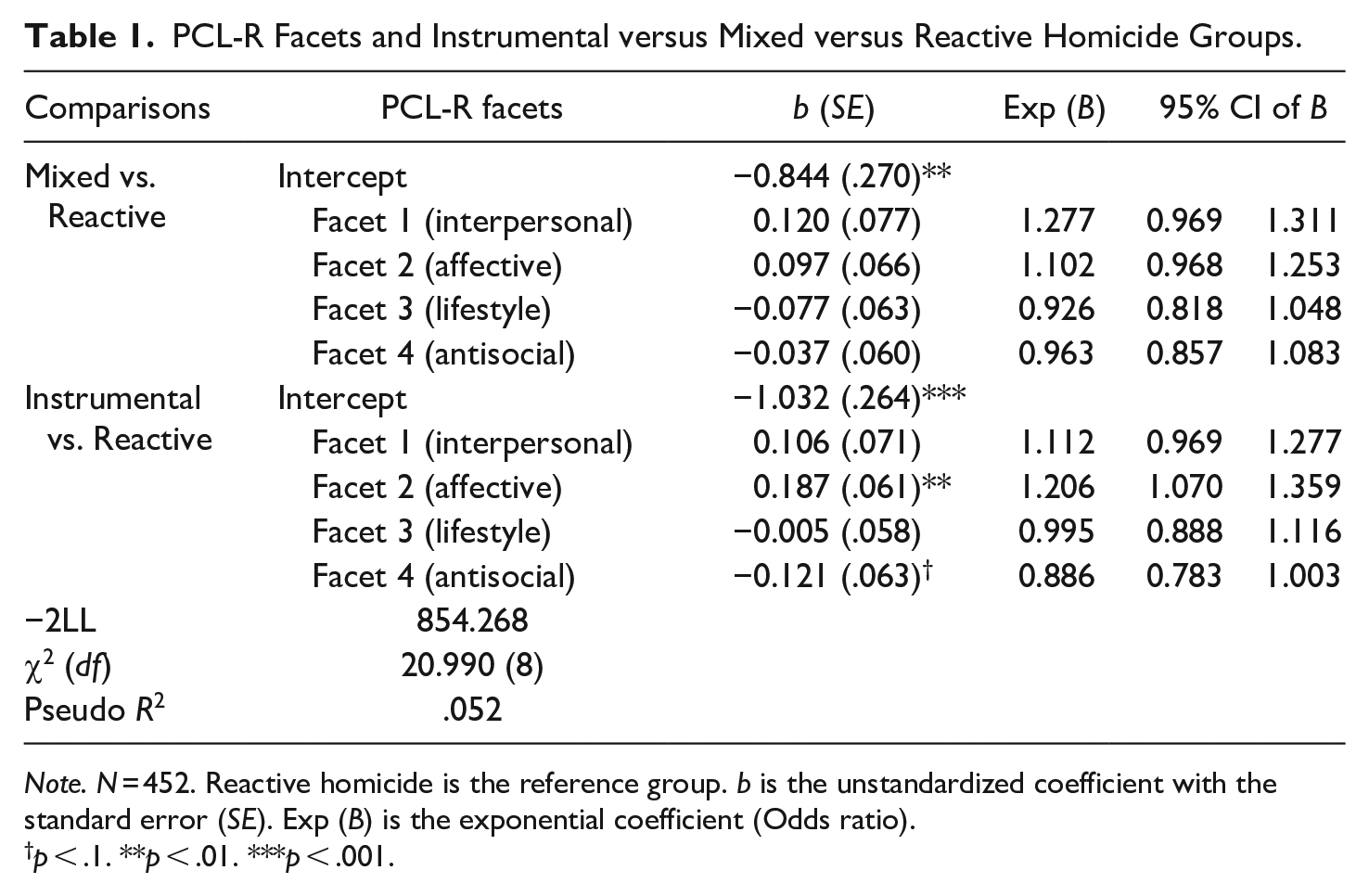
Note. N = 452. Reactive homicide is the reference group. b is the unstandardized coefficient with the standard error (SE). Exp (B) is the exponential coefficient (Odds ratio).
p < .1. **p < .01. ***p < .001.
Facet 2 Items in Predicting Instrumental Homicide
After observing a significant group difference on facet 2, we further examined relationships between psychopathy facet 2 items and the three homicide groups. Item 6 (lack of remorse or guilt), item 7 (shallow affect), item 8 (callousness/lack of empathy), and item 16 (failure to accept responsibility for own actions) constitute facet 2. Results are presented in Table 2. Lack of remorse or guilt and callous/lack of empathy were marginally significant (p < .10) for a comparison between instrumental and reactive homicide groups. Thus, we found a trend indicating that instrumental murderers lacked a sense of guilt and empathy compared to reactive murderers, while no facet 2 item distinguished between mixed and reactive homicide groups.
Facet 2 Items in Predicting Instrumental Homicide.
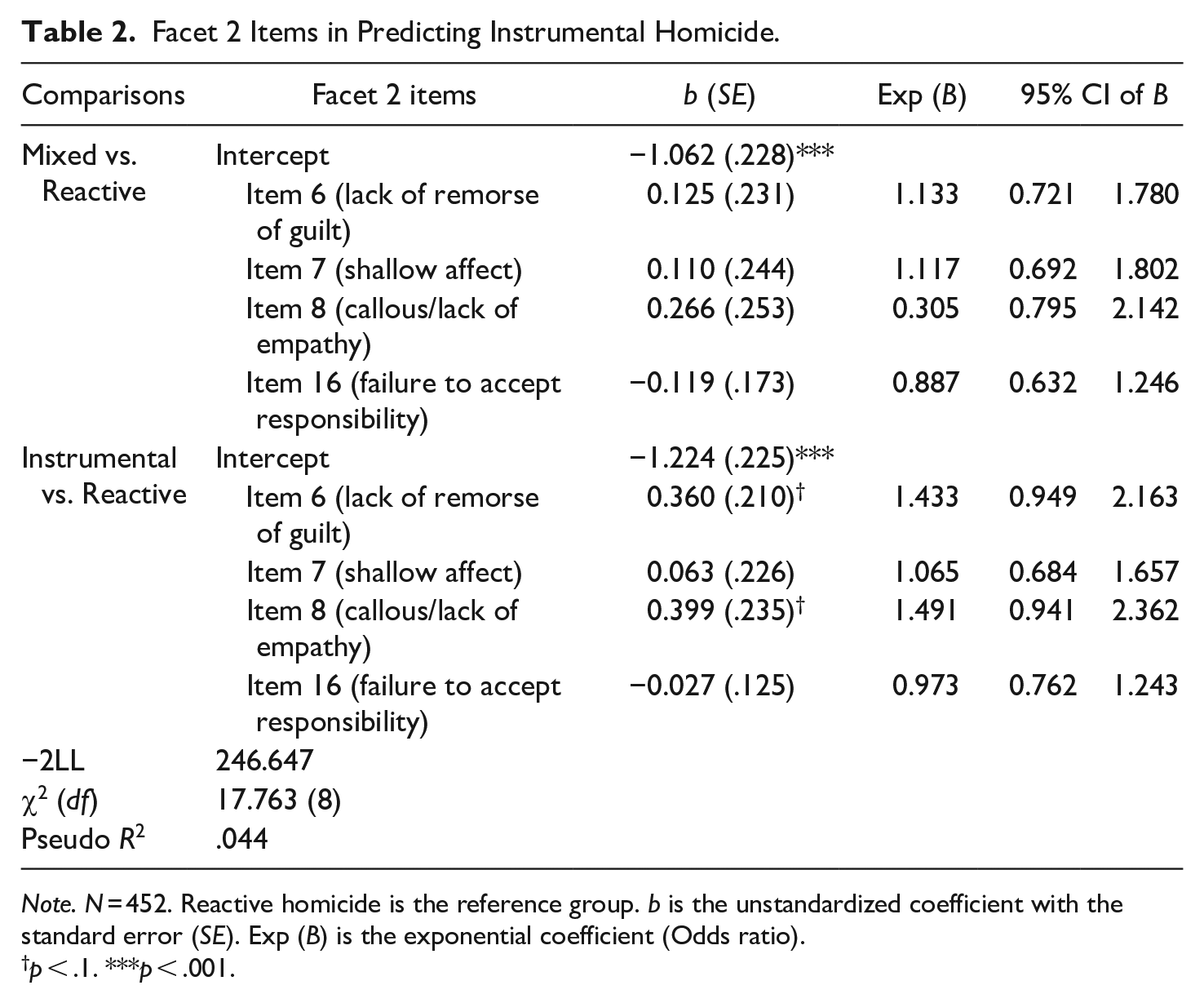
Note. N = 452. Reactive homicide is the reference group. b is the unstandardized coefficient with the standard error (SE). Exp (B) is the exponential coefficient (Odds ratio).
p < .1. ***p < .001.
Discussion
This study aimed to ascertain whether specific PCL-R facets or items emerge as being more associated with instrumental/planned homicide as opposed to homicides that were reactive/emotional and mixtures of reactive and instrumental. Results indicated that facet 2 (affective) and its items of lacks in remorse and empathy played key roles in differentiating instrumental homicide from reactive and mixed homicides. Collectively, the emotional/reactive homicide group was impaired less on affective features (facet 2) than the instrumental homicide group, and within the items of this significant facet 2, instrumental homicide offenders had higher deficiencies on remorselessness and callousness traits compared to those who killed emotionally. As outlined further below, because the majority of the sample were not serious offenders and because their psychopathy scores were low, this led to lower variances in facet and items scores resulting in low pseudo R2 values for both facets (0.052) and items (0.044) in the regression models. Very few studies have reported R2 values. In one study pseudo R2 of the interpersonal-affective (Factor 1) for proactive aggression was 0.30 (James et al., 2020), and adjusted R2 of Factor 1 for predatory aggression was 0.10 (Declercq et al., 2012). While the current study’s pseudo R2 values are low, our strategic plan was to examine underlying facets and items that have lower variances of scores than factors. Similarly, an alpha level of .10 was considered as significant due to the exploratory nature of the study testing facets and items for instrumental homicide and to reduce false negative errors (we may fail to reject null hypothesis, when facet/item is significant). This study appears to be the first study to document that remorselessness (item 6) and callousness (item 8) represent the core psychopathic feature to differentiate instrumental homicide from other forms of homicide.
The main finding of this study is that facet 2 characterizes instrumental homicide, whereas other facets failed to do so. Offenders who had higher deficits on facet 2 (affective) traits tended to be killers who had planned their homicides. While Flight and Forth (2007) who investigated violent youth and Sohn, Raine, et al. (2020) who investigated violent adults have both stressed facet 2 in predicting violent crimes, and while Rodre et al. (2019) found instrumental murderers than expressive murderers to have higher Factor 1 (facets 1 and 2 combined), no study to our knowledge has tested facet and item scores to examine instrumentality of homicide offenders. Our findings are relatively novel and confirm a significant role of facet 2 (and lacks in remorse and empathy items in particular) for killing someone instrumentally. Studies have suggested the importance of facet 1 in European samples (e.g., Laurell et al., 2010; Walsh et al., 2009) and American samples (e.g., Vitacco et al., 2006) in predicting instrumental violence, and while these studies were not concerned with homicide per se, however, our findings do not provide support for facet 1 scores in predisposing to instrumental homicide. Some studies have reported that facet 3 is associated with both instrumental and reactive violence (Blais et al., 2014), however, our findings in contrast do not support a relationship between facet 3 and instrumental homicide. In addition, facet 4 was negatively related to instrumental homicide compared to reactive homicide in our study. This finding bears resemblance to other studies reporting either null findings (Blais et al., 2014) or a negative relationship between facet 4 and instrumental violence (Declercq et al., 2012). Although studies have supported the predictive abilities of facets 1, 3, and 4 in relation to instrumental violence, in this Korean homicide sample, specifically in relation to instrumentality in homicide, only facet 2 was found to be a valid predictor.
We believe that one relative strength of the current study is the comparatively large sample size of homicide offenders to specifically analyze the underlying construct of psychopathy. The current study utilized 452 Korean homicide offenders, whereas one Swedish study for example used 228 homicide offenders (Rodre et al., 2019), a Canadian study used 125 homicide offenders (Woodworth & Porter, 2002), and 248 American violent offenders were used to study instrumentality of violence (Walsh et al., 2009). Many studies have consistently reported that psychopathy and instrumental violence are linked (e.g., Cornell et al., 1996; Meloy, 2012; Walsh et al., 2009), and that psychopathy and homicide offending are also significantly related (Fox & DeLisi, 2019; Rodre et al., 2019). However, our study is the first to report a link between specific psychopathy facets and item scores and instrumental homicide offending.
Finding a central psychopathic trait for instrumental homicide was one of the study’s theoretical/conceptual aims. We tested for a relationship between psychopathy traits and instrumental killing suggested by theories and empirical findings and found facet 2 that assesses affective features to be central to this relationship. Among the items of facet 2, lack of remorse or guilt and callous/lack of empathy tended to be the most important individual traits in understanding instrumentality in homicides, although these findings were only marginally significant. In one recent study, facet 2 and two of its items (lacks in empathy and responsibility) were the only traits to predict violent crimes (Sohn, Raine, et al., 2020), a finding consistent with the current study. Another study replicated facet 2 as one of the most predictive facets for child sex offenders compared with non-sex offenders (Sohn, Reyes, et al., 2020), which is again consonant with the current study. Similarly, a study using Dutch and the US samples identified callous/lack of empathy as central to understanding psychopathy (Verschuere et al., 2018). As such, although samples and predatory crime types vary, our findings provide further support for a relationship between affect and instrumentality in crimes.
The current study has several limitations. First, the sample is not a representative sample of all homicide cases in South Korea, and as such findings cannot be generalized to the wider South Korean population. Second, the average psychopathy score of the sample was 12.30 which is relatively low. While this low mean score was unexpected, homicide offenders from Germany (M = 17.4), Sweden (M = 20.2), and Finland (M = 20.3) showed lower averages compared to North American homicide offenders (e.g., US offenders: M = 26.2) (Fox & DeLisi, 2019). The study’s sample mean score is even lower than that of a Korean high-risk offender sample which had an average score of 19.51 (Sohn, Raine, et al., 2020), and which was comparable to the European averages outlined above. In a study (Sohn & Lee, 2021) that used the same sample of Sohn, Raine, et al. (2020), however, the psychopathy score of homicide offenders was significantly lower than sex offenders, although both are predatory offenses. It suggests that homicide offenders in South Korea may have lower psychopathic traits compared to killers in other countries or compared with criminals who commit other predatory/instrumental offenses. In contrast to a high-risk offender sample (i.e., Sohn, Raine, et al., 2020) which had a 5.2 average for prior criminal history, most murderers (87%) in the study’s sample did not have any prior criminal record and were mostly first-time offenders. In addition, unfortunately, not all raters were trained through Robert Hare’s workshop or who were clinical psychologists who might have received more adequate/skilled training to assess psychopathic traits, and interrater reliability data were not available. Hence, the overall lower criminality of the sample, rater reliability, and the different cultural context in Korea could have contributed to the lower PCL-R score of the sample. Third, all offenders in the sample were homicide offenders. A meta-analysis of reported killers who are psychopathic found that Factor 1 was twice as high as non-offenders (Fox & DeLisi, 2019). We did not compare our sample which consisted only of homicide cases with other offenses that can be also viewed as instrumental (e.g., robbery, burglary, etc. to gain monetary values) and in addition we did not compare the sample with non-criminals. Future research could explore if homicide offenders have higher psychopathy scores than those committing predatory crimes that are not homicides, and with non-offenders. Fourth, unlike other studies on psychopathy with Korean offenders which are prospective in nature (i.e., Sohn, Raine, et al., 2020), this study is in contrast retrospective as offenders in the sample had already committed homicides before the PCL-R interview. Thus, this study did not test a causal relationship between psychopathy (cause) and instrumental homicide (effect).
In closing, our findings are broadly consistent with existing studies which have reported on psychopathy in relation to instrumental violence and homicide offending. Unlike other studies however we have further narrowed down the role of psychopathy at a facet and item level in relation to instrumental homicide. We documented a link between psychopathy facet/item scores and homicides that were instrumental as opposed to reactive or mixed homicide, that previous studies somewhat overlooked. Better predictive utility of facet 2 for instrumental nature of violence has been already reported for violent recidivists compared to nonviolent recidivists (Sohn, Raine, et al., 2020) and for sex offenders compared to nonsex offenders (e.g., Sohn, Reyes, et al., 2020). This study has added more evidence of facet 2 as a valid predictor for instrumental homicide. In sum, our study strengthens the role of facet 2 for predatory/instrumental nature of offenses and suggests insight for practical strategies to predict a probability of predatory nature of violence and recidivism. We conclude that the affective facet is particularly characteristic of instrumental homicide, and tentatively conclude that lack of remorse or guilt and callous/lack of empathy are traits that represent risk factors for instrumental homicide.
Supplemental Material
sj-pdf-1-hsx-10.1177_10887679211028879 – Supplemental material for A Link between Psychopathy Affect and Instrumentality in Homicide
Supplemental material, sj-pdf-1-hsx-10.1177_10887679211028879 for A Link between Psychopathy Affect and Instrumentality in Homicide by Ji Seun Sohn, Adrian Raine and Young-Oh Hong in Homicide Studies
Footnotes
Acknowledgements
The preliminary results of this manuscript were submitted/accepted for the 2020 American Society of Criminology, that has been cancelled.
Declaration of Conflicting Interests
The author(s) declared no potential conflicts of interest with respect to the research, authorship, and/or publication of this article.
Funding
The author(s) received no financial support for the research, authorship, and/or publication of this article.

Supplemental Material
Supplemental material for this article is available online.
Author Biographies
References
Supplementary Material
Please find the following supplemental material available below.
For Open Access articles published under a Creative Commons License, all supplemental material carries the same license as the article it is associated with.
For non-Open Access articles published, all supplemental material carries a non-exclusive license, and permission requests for re-use of supplemental material or any part of supplemental material shall be sent directly to the copyright owner as specified in the copyright notice associated with the article.
