







Abstract
The current study provides findings from a systematic review of the police use of deadly force literature over the most recently completed decade (2011–2020). After an exhaustive search of four scientific databases, 1,190 peer-reviewed articles related to the use of force were identified. Of these, 181 articles specifically examined deadly force, with 86 of them drawing on such force as the dependent variable. We found that the number of articles examining police use of deadly force increased dramatically over the course of the study period and encompassed a wide range of determinants of behavior. Citizen possession of a weapon continues to be the most consistent risk factor of police use of deadly force across decades of policing literature. Additionally, while many studies have attempted to examine the link between race and lethal force, a determination of such a relationship is difficult given both mixed findings and a lack of available national data.
Introduction
Within a democratic republic, and for the purpose of pursuing public safety, the police are vested with enormous power in which they have the legal authority to stop, search, arrest, and use coercive force. As such, a critical task of policing is the ability to maintain effective social control while maintaining individual legal rights (Walker, 1993). Given such power and with it the potential for abuse, scholars have long studied police discretionary decision-making (Davis, 1969). Not surprisingly, a key part of this research centers on the most extreme form of power—deadly force.
The purpose of this article is to provide a high-level look into the most recently completed decade (2011–2020) of lethal force research focusing mainly on how often and why the police use such force. Clearly, concerns over deadly force have been exasperated by a series of high-profile incidents that have resulted in civil unrest in many communities across the United States (Terrill & Ingram, 2016). Bolstered by the role that technology (e.g., smartphones, body-worn cameras) plays in capturing use of force interactions, the general public has greater access to viewing police behavior than at any time in history. More specifically, before the chosen decade, there were virtually no body-worn cameras, and citizens were rather limited in their capabilities to record officer-citizen encounters due to an absence of smartphones with the ability to record videos. Therefore, the period being examined is unique in that during this time, many of these technologies were being heavily introduced, thereby making the use of force encounters more readily available to view. Given police use of lethal force encounters are perhaps the most important type of police-citizen interaction in assessing and understanding the legitimacy of the police role, continuing to understand what we know, and what we do not, is vitally important.
We begin with a brief overview of key research findings that preceded the most recent decade. A comprehensive review of the full scoop of this earlier work in a detailed fashion is beyond the scope of the current inquiry. Our primary focus is on identifying the breadth of deadly force-related topics that researchers have examined between 2011 and 2020, the extent to which there has been an increase in published research, the available data sources for which to draw on and their related limitations, the frequency in which the police resort to deadly force, and importantly the characteristics and correlates related to this most extreme use of police power.
It is important to note a key limitation of deadly force research at the outset, both in terms of conceptualization and operationalization. As first stated by Fyfe more than 40 years ago (1978, p. 32), “[d]eadly force is physical force [d]eath at the hands of the police is not a sound operationalization of the concept “police use of deadly force.” This is so for the simple reason that all available evidence indicates that no one is killed in most incidents in which police officers discharge their firearms.
Unfortunately, there is a lack of consistency across studies in which researchers have drawn on officer-involved shootings resulting in death verses officer-involved shootings regardless of death as a result. As such, and at the risk of exacerbating the issue, splitting study findings in our review into these two different categories would make it exceedingly difficult for readers to consume. Thus, we rely on the general phrase deadly or lethal force to cut across shootings resulting in, and not resulting in, death.
Initial Wave of Research
Empirical work on police use of lethal force dates back to the 1960s, followed by a substantial push in the 1970s and 1980s (Binder & Fridell, 1984; Binder & Scharf, 1980; Blumberg, 1981, 1989; Fyfe, 1978, 1979, 1980, 1981, 1982; Geller, 1982; Geller & Karales, 1981; Goldkamp, 1976; Jacobs & Britt, 1979; Kania & Mackey, 1977; Kobler, 1975; Langworthy, 1986; Margarita, 1980; Matulia, 1985; Meyer, 1980; Reiss, 1968, 1980; Robin, 1963; Sherman & Langworthy, 1979; Takagi, 1974; Waegel, 1984). Much of the work during this time period examined how often the police used deadly force and the potential correlates or predictors of such (i.e., environmental, legal, organizational, suspect, and officer-based), with a key emphasis on subject race. As a collective whole, this initial wave of research produced mixed results. For instance, while many of the findings uncovered racial disparity, researchers struggled to discern whether the disparity equated to discrimination or bias when factoring in various contextual factors such as crime involvement (see Fyfe, 1980; Jacobs & Britt, 1979; Kania & MacKey, 1977; Robin, 1963; Takagi, 1974). However, a key finding that did begin to emerge with some degree of consistency was the increased likelihood of police use of deadly force in encounters where suspects were armed and posed some form of resistance (Kobler, 1975; Reiss, 1968; Robin, 1963). Additionally, and quite importantly, Fyfe’s (1978, 1979, 1980, 1981, 1982) pioneering work during this era demonstrated the effect that restrictive lethal force policies can have, which showed that such policies may not only reduce the number of police shootings, but also racial disparity (see also Blumberg, 1989; Reiss, 1968, 1980). Fyfe’s research helped stimulate a national shift in policy and legal development (e.g., Tennessee v. Garner, 1985).
Second Wave of Research
During the next few decades (1990s and 2000s) researchers continued to study deadly force using a variety of methodologies across numerous jurisdictions (Geller & Scott, 1992; Jacobs & O’Brien, 1998; Klinger & Brunson, 2009; Liska & Yu, 1992; McElvain & Kposowa, 2008; Smith, 2003; Sorensen et al., 1993; White, 1999, 2001, 2002). Similar to prior work, a good deal of the research published during this time frame focused on the predictors of deadly force, especially the potential role that race may play. Yet, discerning any type of consistency with regard to the findings remained elusive. For instance, when analyzing deadly force incidents across U.S. cities, Jacobs and O’Brien (1998) found that both economic inequality and violence were related to deadly force but found no relationship between deadly force and racial composition; while Sorensen et al. (1993) found that cities with a higher percentage of blacks, as well as greater economic inequality and violent crime rate, had more deadly force incidents. However, a number of scholars (Geller & Scott, 1992; Walker, 1993; White, 2001) did report finding further support for the impact of administrative policy on lethal force. Additionally, suspect resistance in the form of presenting a threat (most often in the form of a firearm) continued to emerge as a consistent predictor of deadly force that appeared consistent over time. As stated by White (2002, p. 729), “[t]he literature typically shows that the majority of suspects who are shot or shot at present a real and imminent danger to the police” (Binder and Fridell, 1984; Binder and Scharf, 1980; Fyfe, 1980, 1981; Kobler, 1975; Margarita, 1980; Robin, 1963). Yet, besides these two factors (i.e., restrictive organizational policy and perception of deadly threat), one would be hard-pressed to identify consistent predictors of this crucial decision across the many studies conducted.
2011–2020 Research
The latest wave of research has emerged within the context of greater public access to seeing police use of force than at any time in U.S. history. As a result of technological advances, police-citizen encounters are increasingly captured in video format, which can be streamed to millions within an instant. With such access, there has been growing public concern when video clips show questionable shootings, especially as they relate to race. In fact, it is not a stretch to state that the United States has been experiencing the most widespread period of distrust of the police and civil unrest since the 1960s (Terrill & Ingram, 2016). It is within this broader context that we review key research findings published over this most recently complete decade.
Methods
A systematic review of police use of force literature was conducted using four scientific databases: Criminal Justice Abstracts/EBSCO Host, Sage Publications, HeinOnline, and Google Scholar. We began by identifying all the police use of force-related literature that was published between 2011 and 2020. For the purposes of this review, we only selected peer-reviewed journal articles, with books, magazines, and trade publications excluded from the collection process. A search for several keywords was conducted, including police use of force, lethal force, deadly force, less-lethal force, as well as police use of tasers, conducted energy devices, and weapons. The title and abstract of the articles that appeared in the initial screening process were examined for indications that the study examined police use of force. As Figure 1 demonstrates, the initial screening process generated a sample of 1,190 peer-reviewed articles published between 2011 and 2020. During the initial screening process, 181 peer-reviewed articles were identified from the titles and abstracts to examine, more specifically, police use of deadly or lethal force. The method, data, and result sections of these 181 peer-reviewed articles were further examined to determine if the study specifically examined officer-involved shootings using empirical data. Of the 181 identified articles, 86 peer-reviewed articles were determined to examine officer-involved shootings as the main dependent variable in the study’s analyses. For these 86 peer-reviewed articles, which constitute the sample of the current study, information related to the study’s author(s), publication outlet, sample, data source, methodology, and key findings were collected.
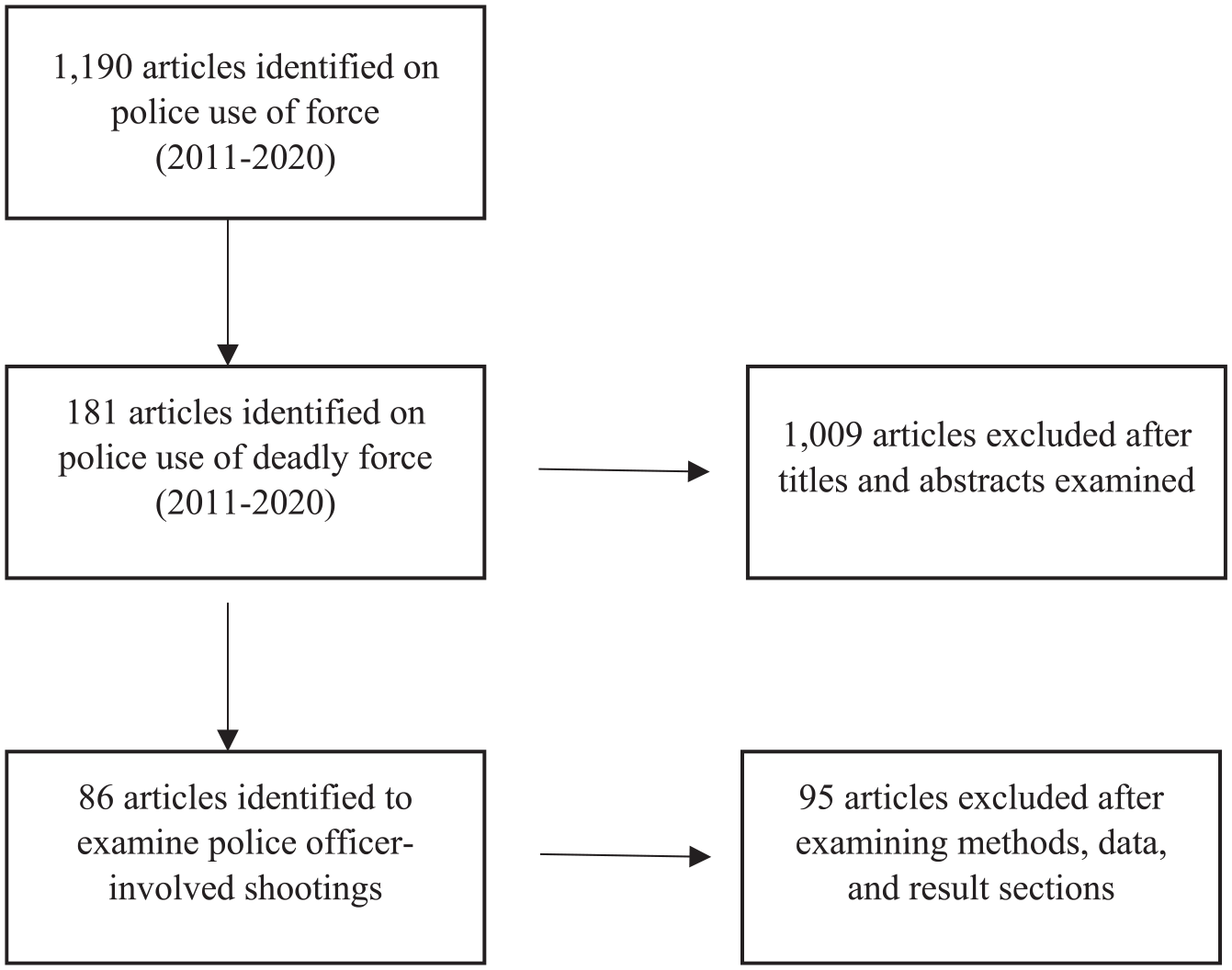
Flow chart of manuscript selection process.
The 95 articles that were excluded at the final stage of the selection process generally focused on examining a plethora of police use of deadly force-related topics. For example, several scholars examined other forms of police use of force apart from officer-involved shootings, including but not limited to physical control, prone positioning, chemical agents, and other impact weapons (see Atherley & Hickman, 2014; Boivin & Lagacé, 2016; Dijkhuizen et al., 2020; Goldsworthy, 2014; Hall et al., 2012, 2015; Hamilton, 2016; Karch, 2016; McCarthy et al., 2019; Meneses & Fondevila, 2014; Ouellet et al., 2019; Porter, 2013; Strote & Hickman, 2020).
Further, other scholars reviewed the laws pertaining to the use of deadly force among law enforcement officers (see Carbado, 2017; Fairley, 2019; Flanders & Welling, 2015; Garrison, 2018; Goodman, 2013; Holland, 2020; Johnson, 2017; Lee, 2018; Leider, 2018; Le Roux-Kemp & Horne, 2011; Loehr, 2018; Longo, 2011; Macfarlane, 2018; Marcus, 2016; Minner, 2019; Shah, 2018; Vandegrift & Connor, 2020); reviewed the limitations of police use of deadly force databases (see Alpert, 2016; Brucato, 2017; Fryer, 2018; Klinger, 2012; Koper, 2016; Lim, 2017; Murphy, 2016; Nix, 2020; White, 2016); reviewed prior literature on police use of deadly force (see Correll et al., 2014; Jones, 2017; Terrill, 2016; Zwach, 2015); examined and/or called for extensions of police use of deadly force policies (see Albrecht, 2011; Bruce, 2011; Engel et al., 2020; Katz, 2014; Klinger, 2020; Lee, 2016; Morrison & Garner, 2011; Nunes, 2015; Zimring, 2020); examined the collateral consequences of police use of deadly force (see Baker & Pillinger, 2020; Bor et al., 2018; Chaney & Robertson, 2015; Sewell et al., 2021); examined the negative effects of officer-involved shootings on police officers (see Broomé, 2014; Carson, 2014; Frankham, 2018; Komarovskaya et al. 2011); examined performance errors in police shootings (Lewinski et al., 2015; Taylor, 2019; Vickers & Lewinski, 2012); examined memory recall following officer-involved shootings (see Hartman et al., 2017; Hope et al., 2016; Porter et al., 2019); and examined citizen perceptions of police use of deadly force (see Baker & Fidalgo, 2020; Culhane, 2016; Culhane & Schweitzer, 2018), among other topics.
Results
Figure 2 displays the number of published articles across the 10-years under examination. Overall, the number of published articles examining police use of deadly force has been increasing steadily, with the number of publications peaking in 2020. Specifically, over the course of the study period, there was a 533.33% increase in the number of published peer-reviewed articles examining officer-involved shootings. Of the 86 published articles, 59 appeared in unique peer-review journals. While the majority of the articles were published in criminology and criminal justice journals (n = 23), journals from other related disciplines were also present, including journals from the areas of law (n = 9), psychology (n = 2), sociology (n = 3), medicine (n = 8), political science (n = 2), interdisciplinary studies (n = 7), and other disciplines (n = 5).
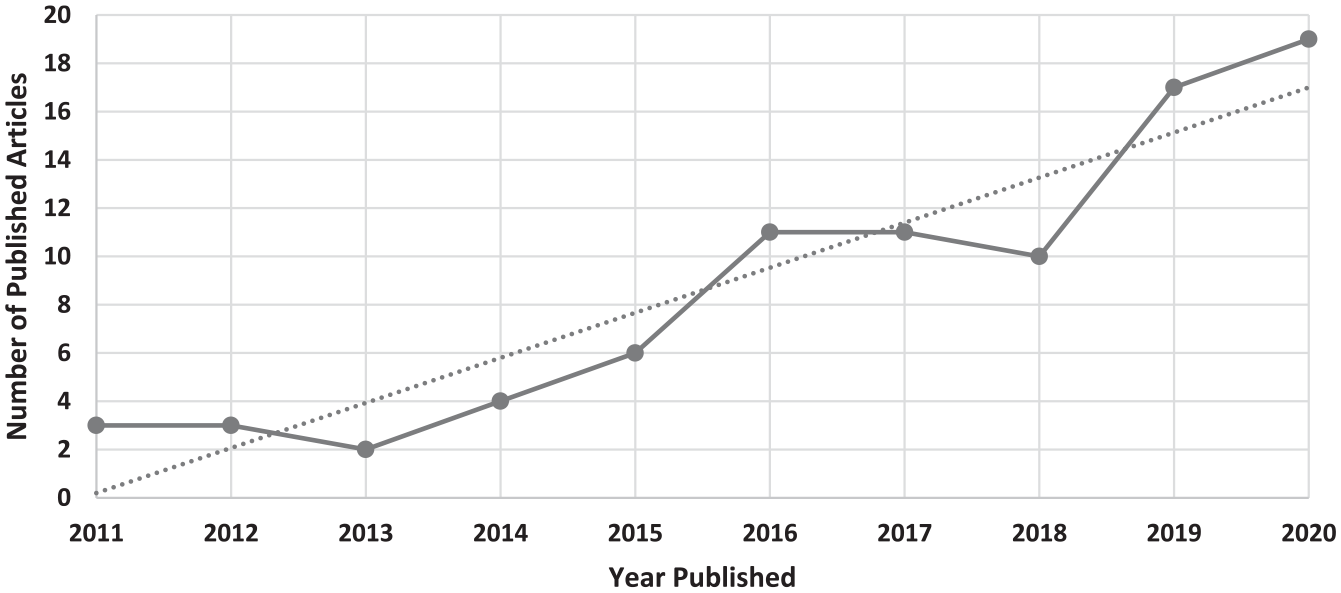
Prevalence of police use of deadly force publications (2011–2020).
Table 1 displays the top six journal outlets in which the police use of deadly force literature was published during the period of study. These journals include Crime & Delinquency (n = 5), Criminology & Public Policy (n = 5), Journal of Criminal Justice (n = 3), Journal of Ethnicity in Criminal Justice (n = 3), and Policing: An International Journal of Police Strategies and Management (n = 3). Collectively, these six journals published approximately a quarter of all the police use of deadly force articles that were published between 2011 and 2020.
The Top Six Journal Outlets on Police Use of Deadly Force Research (2011–2020).
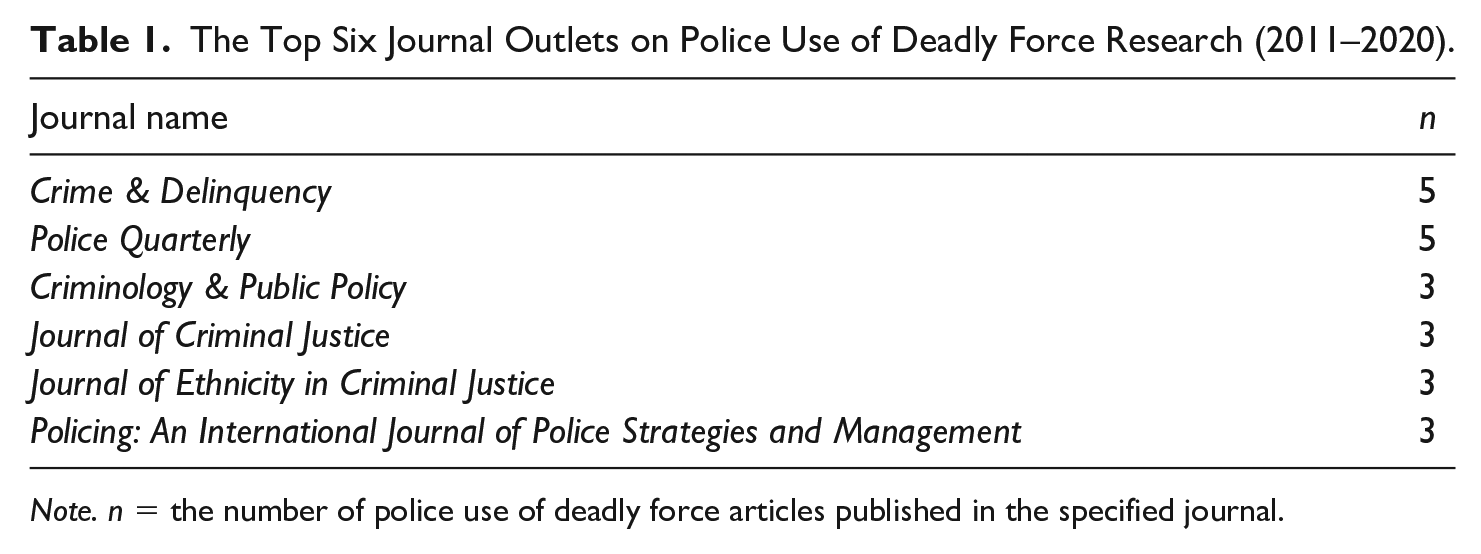
Note. n = the number of police use of deadly force articles published in the specified journal.
Figure 3 displays the prevalence of the countries examined among the 86 peer-reviewed articles on police use of deadly force. Specifically, police use of deadly force was examined across 15 countries, with the majority of the studies examining officer-involved shootings in the United States (n = 76), followed by Canada (n = 5), Australia (n = 3), the Philippines (n = 2), England and Wales (n = 2), Sweden (n = 1), South Africa (n = 1), Russia (n = 1), Portugal (n = 1), Jamaica (n = 1), India (n = 1), Germany (n = 1), El Salvador (n = 1), Chile (n = 1), and Brazil (n = 1). 1 Additionally, 93% of the studies utilized a quantitative methods approach (n = 80), 5% utilized a qualitative methods approach (n = 4), and 2% utilized a mixed methods approach (n = 2) in examining officer-involved shootings.
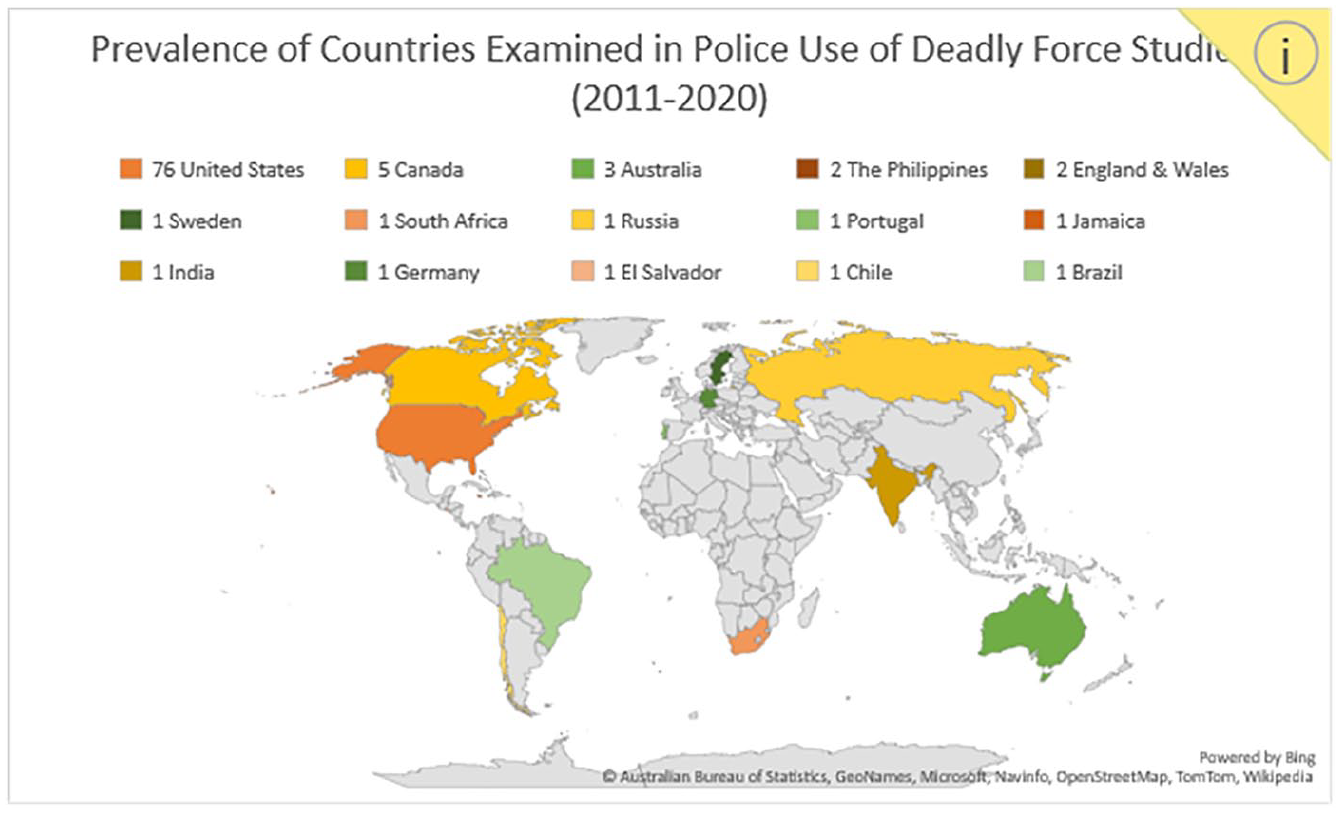
Prevalence of countries examined in police use of deadly force research (2011–2020).
On the other hand, there was greater variation among the articles in relation to sample size, unit of analysis, time periods, and methodologies. For example, sample sizes ranged from two case studies (Kargin, 2016) to 30 officer-involved shootings (Parent, 2011) to 23,578 police-related homicides (Finch et al., 2019). We also observed variation in the unit of analysis examined, as studies examined officer- (n = 8), agency- (n = 5), incident- (n = 57), county- (n = 3), city- (n = 5), state- (n = 2), and country-level (n = 2) differences, among others. There was also great variation in the time period examined by scholars, as the number of years examined ranged from 1-year to 39 years (Parkin et al., 2020). Likewise, there was extensive variation in the methodologies used by scholars, which included case studies, descriptive statistics, experiments, bivariate regressions, multivariate regressions (e.g., Poisson and negative binomial regressions, multinomial logistic), and hierarchical linear models, among others. 2 Lastly, of the 86 articles, 61 examined fatal officer-involved shootings and 25 examined all officer-involved shootings regardless of the outcome.
Data Sources
While several scholars have collected original data, the majority of scholars examining police use of deadly force in the United States have relied on either administrative and/or open-data sources that track the prevalence of police use of deadly force. Table 2 provides the most common data sources on police use of deadly force, alongside the years for which data are available, the website link, and the frequency for which the source was used in the study’s sample. Specifically, four administrative data sources have been used by scholars to examine police use of deadly force: the Federal Bureau of Investigation’s (FBI) Supplementary Homicide Report (n = 10), the National Violent Death Reporting System (n = 3), the National Vital Statistics System (n = 3), and the Arrest-Related Deaths project (n = 2). The Supplementary Homicide Report, which reports national police officer-involved homicides under the category of “justifiable homicides,” is administered by the Federal Bureau of Investigation’s Uniform Crime Report, for which available data (1976–2020) can be accessed through the Inter-university Consortium for Political and Social Research’s (ICPSR) data archive.
Most Common Data Sources Used in Police Use of Deadly Force Research (2011–2020).
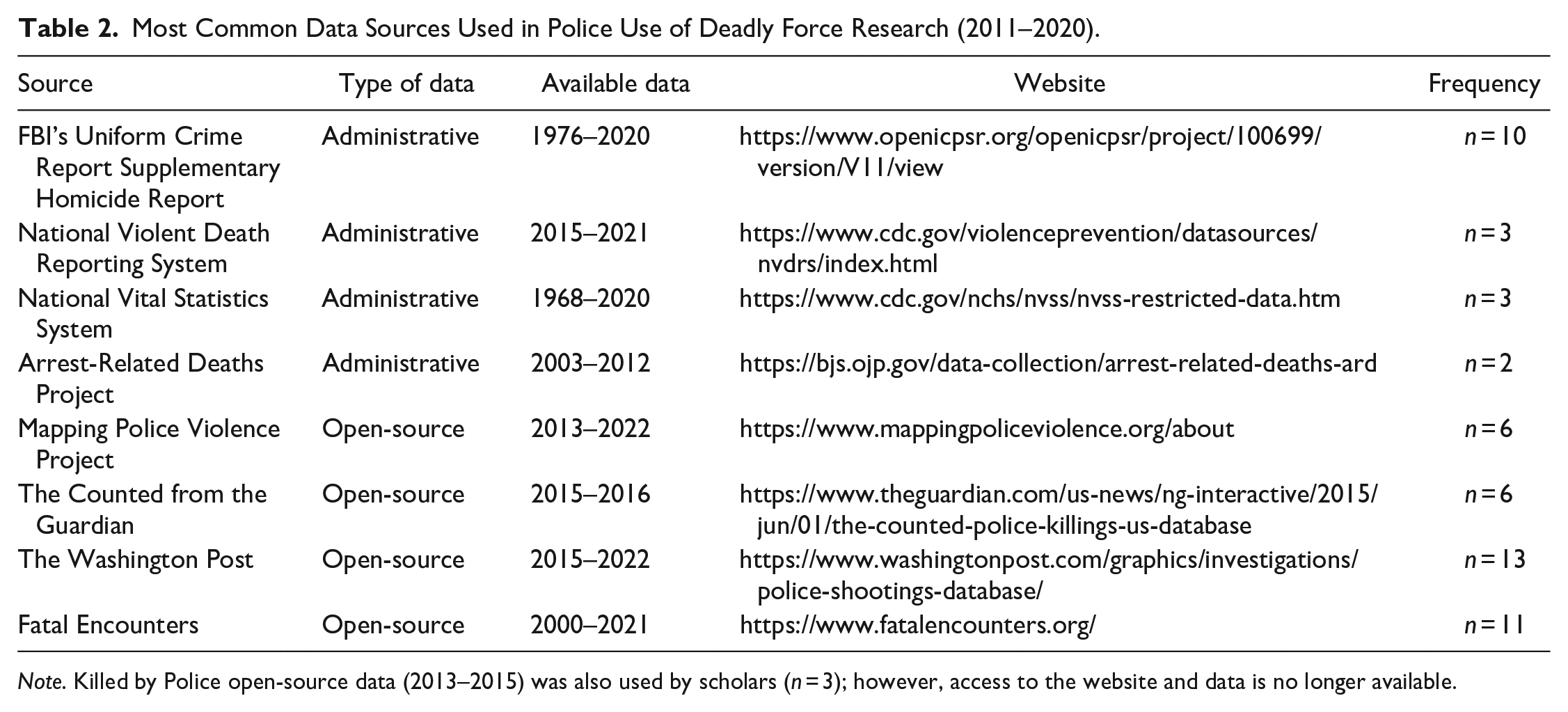
Note. Killed by Police open-source data (2013–2015) was also used by scholars (n = 3); however, access to the website and data is no longer available.
The National Violent Death Reporting System (2015–2021), which reports national police-involved deaths, is administered by the Centers for Disease Control and Prevention (CDC). While descriptive data can be accessed for free, the NVDRS Restricted Access Database (RAD), which provides case-level data, can only be accessed via a formal request process. The National Vital Statistics System (NVSS), which reports national fatalities caused by police violence (1968–2020), is also administered by the CDC. Similar to the NVDRS, access to restricted data from the NVSS requires a research-proposal review and formal approval by the National Center for Health Statistics (NCHS). Lastly, the Arrest-Related Deaths (ARD) program, which was administered by the Bureau of Justice Statistics, collected national case-level information on fatalities that occurred under the process of arrest or while in the custody of law enforcement. Data from 2003 to 2012 is available upon formal request.
Scholars also relied on open-source databases to examine police use of deadly force, including the Mapping Police Violence Project (n = 6), the Counted from the Guardian (n = 6), the Washington Post (n = 13), and Fatal Encounters (n = 11). 3 Since 2013, the Mapping Police Violence project has been documenting police killings in the United States by pooling data from various sources, which include Fatal Encounters, Washington Post, Meltwater, and Google News Alerts. Additionally, between 2015 and 2016, the Guardian documented citizen fatalities by police in the United States through a crowdsource system, which also relied on data from Fatal Encounters and Killed by Police. In 2015, after the killing of Michael Brown, the Washington Post began tracking fatal police shootings in the United States through the examination of news reports, social media postings, and police reports. Lastly, Fatal Encounters is a project that aims to document fatal encounters with police in the United States (2000–2021). This data is predominantly acquired via paid researchers, public record requests, and crowdsourcing. Data for all four open-source databases can be downloaded via the organization’s website.
Frequency/Prevalence of Deadly Force
Prevalence statistics reported by scholars suggest that in the United States, police-officer involved deaths have remained fairly stable within the past two decades, with an average of between 1.3 to 1.6 police killings per million population (Campbell et al., 2018; Zimring, 2016b; Zimring & Arsiniega, 2015). More specifically, using several data sources (e.g., SHR, NVSS, ARD program, Washington Post, Guardian, and FiveThirtyEight.com), Zimring (2016b) reported that between 2014 and 2015, approximately 1,000 civilians were killed by the police, which is double the number reported by official sources. These statistics are higher than those examined in other countries, with Canada reporting 0.64 police killings per million population, followed by Australia (0.13 per million), England and Wales (0.02 per million), and Germany (0.073 per million) (Zimring, 2016a). Beck and Uchida (2019), who examined officer-involved shootings among Los Angeles Police Department, reported that among the 318 officer-involved shootings in which a civilian was struck between 2006 and 2015, approximately 56% proved fatal. Lastly, Pinizzotto et al. (2012) reported that in their national sample of police officers in the United States, 96% reported drawing their firearm at least once a year, 20% reported being involved in at least one incident in which they fired their weapon, and 70% reported being involved in at least one incident in which they were legally justified to fire their weapon but chose not to.
Characteristics of Deadly Force
Several descriptive characteristics of police use of deadly force incidents have been reported by scholars. More specifically, and not surprising based on research from prior decades as well, citizens tend to be armed with a weapon (e.g., firearm) (DeGue et al., 2016; Fagan & Campbell, 2020; Farrell & Monk-Turner, 2019; Johnson et al., 2019; Kesic et al., 2012; Kreuzer, 2018, 2019; Mohandie & Meloy, 2011; Jennings et al., 2020; Nix et al., 2017; Petersson et al., 2017; Pinchevsky & Nix, 2018; Schroedel & Chin, 2020; Sekhon, 2017; Shane et al., 2017; Wertz et al., 2020; Wheeler et al., 2018) and/or behave in an aggressive manner toward police officers or other civilians (DeGue et al., 2016; Fagan & Campbell, 2020; Farrell & Monk-Turner, 2019; Kesic et al., 2012; Mohandie & Meloy, 2011; Nix et al., 2017; Pinchevsky & Nix, 2018; Rodrigues et al., 2015; Sekhon, 2017; Shane et al., 2017). For example, using data from the Washington Post (2015–2018), Fagan and Campbell (2020) found that out of 3,544 police killings, approximately 88% of civilians were armed and approximately 67% of civilians posed a serious threat to law enforcement. Fatal police shootings also often occur after the commission or suspected commission of a crime by the civilian involved (Anderson et al., 2016; DeGue et al., 2016; Farrell & Monk-Turner, 2019; Parent, 2011; Pinchevsky & Nix, 2018; Razack, 2020; Schroedel & Chin, 2020).
Further, evidence suggests that the most common subject of police shootings tend to be men (DeGue et al., 2016; Buehler, 2017; Fagan & Campbell, 2020; Farrell & Monk-Turner, 2019; Fridel et al., 2020; Jennings et al., 2020; Mohandie & Meloy, 2011; Nix et al., 2017; Schroedel & Chin, 2020; Shane et al., 2017; Wheeler et al., 2018), those with a history of mental illness and/or suicidal ideation (Farrell & Monk-Turner, 2019; Mack, 2014; Mohandie & Meloy, 2011; Parent, 2011; Patton & Fremouw, 2016; Schroedel & Chin, 2020), and Whites (Fagan & Campbell, 2020; Farrell & Monk-Turner, 2019; Fridel et al., 2020; Gray & Parker, 2019, 2020; Jennings et al., 2020; Nix et al., 2017; Shane et al., 2017), although Blacks, and to a lesser extent, Hispanics have been found to be over-represented in officer-involved shootings (Buehler, 2017; DeGue et al., 2016; Edwards et al., 2019; Fridel et al., 2020; Hopkins, 2015; Jennings et al., 2020; Legewie & Fagan, 2016; Nix et al., 2017; Shane et al., 2017), and in some instances are the majority (Jetelina et al., 2020; Johnson et al., 2019; Sekhon, 2017; Wheeler et al., 2018). For example, using data from Fatal Encounters, The Guardian, and the Washington Post (2013–2016), Legewie and Fagan (2016) found that Blacks are disproportionately killed by law enforcement, such that Blacks are killed at a ratio of 2.29 killings compared to Whites; findings which are comparable to the findings by Edwards et al. (2019) and Buehler (2017). Moreover, police officer-involved shootings tend to occur in minority communities (Jetelina et al., 2020; Sekhon, 2017) and in areas characterized as having high levels of concentrated disadvantage (Fridel et al., 2020). Additionally, scholars have found that between 33 and 57% of officer-involved shootings in their samples can be characterized as suicide by cop (Kesic et al., 2012; Mohandie & Meloy, 2011; Patton & Fremouw, 2016). Additionally, most officer-involved shootings occur within seconds to a minute between the time the officer arrives at the scene and the fatal shooting (Kesic et al., 2012; Petersson et al., 2017).
Correlates/Predictors of Deadly Force
Given widespread interest and the continued importance of better understanding how race and ethnicity may affect police use of force decision-making, we review these findings in the following subsection, followed by a combined subsection of the remaining factors that have been examined.
Race/ethnicity
The greatest amount of research, understandably, has been geared toward examining potential racial bias, with the majority of the studies finding overall mixed empirical support in relation to disparity. For example, a number of studies have failed to find subject race as a statistically significant factor when considering benchmarking beyond simply population comparisons and controlling for several factors theorized to affect the decision to use lethal force (Cesario et al., 2019; Shjarback & Nix, 2020; Streeter, 2019). As stated by Cesario et al. (2019, p. 587), “Insofar as Blacks and Whites have different police exposure rates, a more correct benchmark to calculate racial disparity in fatal police shootings is not population proportions but instead rates of police exposure.” Other studies have found that police officers are less likely to shoot unarmed or armed Black civilians than White civilians (Fryer, 2016; James et al., 2016; James et al., 2013; Wheeler at al., 2018; Worrall et al., 2018). For example, using officer-involved shooting data from the Dallas Police Department (2003–2016), Wheeler et al. (2018) found that Black civilians were 45% less likely to be shot than similarly-situated Whites. Likewise, studies have also found that officers take significantly more time (0.20–1.34 seconds) to shoot armed Black civilians than Whites in video simulations of “shoot-don’t-shoot” decision scenarios (James et al., 2016; James et al., 2013). Lastly, Johnson et al. (2018) found that providing civilian race information to officers during a simulation experiment reduced racial biases in decisions to shoot.
Conversely, another body of literature has found racial disparity in police use of deadly force. Collectively, these studies have found that armed and unarmed Black civilians are more likely than armed or unarmed White civilians to be shot by the police in police-citizen encounters controlling for several relevant factors (Charbonneau et al., 2017; DeGue et al., 2016; Edwards et al., 2019; Fagan & Campbell, 2020; Legewie & Fagan, 2016; Nix et al., 2017, Ross, 2015; Scott et al., 2017; Shjarback & Nix, 2020; Tregle et al., 2019). For example, Tregle, Nix, and Alpert (2019) found that when population, police-citizen interactions, or total arrests were used as the benchmark—the at-risk population for which to contextualize racial disparities—Black civilians were approximately 2.91, 3.30, and 1.3 times as likely as White citizens to be fatally shot by police officers, respectively; however when violent crime arrests and weapons offense arrests were used as the benchmarks, the results indicated that Black civilians were approximately 0.80 and 0.67 times less likely as White citizens to be fatally shot, respectively. 4 Thus, it appears that the benchmark used by scholars to examine racial biases in police use of deadly force significantly affects the observed outcome.
While the majority of studies have examined racial disparities, a few studies have also examined ethnic disparities in officer-involved shootings (see Edwards et al., 2019; Fagan & Campbell, 2020; Fryer, 2016; James et al., 2016; James et al., 2013; Johnson et al., 2019). While the studies by Fryer (2016) and James et al. (2013) found no significant difference in the likelihood of police officer shootings of both armed and unarmed Hispanic and White civilians, other scholars have found ethnic disparities in officer-involved shootings. For example, Edwards et al. (2019) found that while Latino men have a higher lifetime risk of being killed by the police compared to their White counterparts (i.e., between 1.3 and 1.4 times more likely), Latina women have a lower lifetime risk of being killed by police compared to White females (i.e., between 12 and 23% less likely). Lastly, Fagan and Campbell (2020) found that when civilians were either armed or neither armed nor experiencing a mental health crisis, the odds of being killed by the police are higher among Latinx civilians than Whites.
Scholars have also begun to examine in recent years the factors that influence Black-White disparities in police use of deadly force. For example, Schwartz and Jahn (2020) found that in metropolitan statistical areas (MSA) where the rate of fatal police-citizen encounters among White civilians was high, the Black-White and the Latinx-White disparities in police use of deadly force were smaller than in MSAs where the rate of fatal police-citizen encounters among White civilians was low. Additionally, scholars have also found a positive association between a state’s racism index and the Black-White disparity in officer-involved shootings of unarmed civilians (Mesic et al., 2018; Siegel, 2020), as well as between implicit racial prejudices and stereotypes held by White residents and Black-White disparities in fatal police encounters (Hehman et al., 2018). Lastly, scholars have found that the level of racial segregation by neighborhood, city, and state has a positive association with both fatal police encounters among Black and Hispanic males (Johnson et al., 2019) and the Black-White disparity in fatal police shootings (Mesic et al., 2018; Siegel, 2020; Siegel et al., 2019). For example, using data from the Mapping Police Violence project (2013–2017), Mesic et al. (2018) found that a 10-point increase in the overall state racism index (i.e., segregation, economic disparity, employment disparity, incarceration gap, and educational attainment gap) increased the Black-White disparity ratio of police shootings of unarmed civilians by 24%, with racial segregation alone increasing it by 67%.
Additional correlates/predictors
Beyond studies centered on examining potential race or ethnicity effects, researchers have also looked at a host of additional factors. Scholars have found that in police-citizen encounters in which a subject is armed with a gun or weapon and an officer is injured, the likelihood of officer-involved shootings (Davies, 2017; Jordan et al., 2020; Morgan et al., 2020; Taylor, 2020; Wheeler et al., 2018; Worrall et al., 2018), the number of shots fired by the police officer (White & Klinger, 2012), and the lethality of an officer-involved shooting (Fridel et al., 2020; Jennings et al., 2020; Johnson et al., 2019), all significantly increase. Researchers have also found a significant positive association between officer-involved shootings and police officers with prior police misconduct or citizen complaints (Kargin, 2016; Ridgeway, 2016; Worrall et al., 2018; Zhao & Papachristos, 2020), police militarization (Lawson, 2019), levels of household gun ownership (Hemenway et al., 2019), mental illness (DeGue et al., 2016; Lord, 2014), and Western states (Helms & Costanza, 2020; Johnson, 2013; Willits & Nowacki, 2014).
Conversely, scholars have found a number of policies are related to decreased officer-involved shootings. More specifically, cities with restrictive policies on police use of deadly force (Nowacki, 2015), policies that require officers to write a report for drawing and pointing a firearm (Jennings & Rubado, 2017), and policies or practices that allow the use of conducted energy devices (Ferdik et al., 2014), are all negatively associated with officer-involved shootings. Additionally, researchers have found that officers who join the police force later in their careers (Kargin, 2016; Ridgeway, 2016, 2020), and who have made more misdemeanor arrests (Ridgeway, 2016, 2020), are also less likely to be involved in deadly force incidents.
Other factors that have been examined have produced more mixed results. For example, while some scholars have found that violent crime rates are not a significant predictor of fatal police shootings (Fagan & Campbell, 2020; Fridel et al., 2020; Johnson, 2013; Johnson et al., 2019; Ross, 2015), other scholars have found violent crime rates to be positively associated with officer-involved shootings (Helms & Costanza, 2020; Hemenway et al., 2019; Klinger et al., 2016; Kopkin, 2019; Lawson, 2019; Osse & Cano, 2017). Further, while Willits and Nowacki (2014) found that police use of deadly force was significantly higher in the South than in the Midwest, other scholars have found that the South is negatively associated with the number of civilians killed by police (Gray & Parker, 2019; Helms & Costanza, 2020).
Additionally, while some scholars have found that the proportion of the Black population is not a significant predictor of the use of deadly force (Johnson, 2013; Klinger et al., 2016; Lawson, 2019), other scholars have found a positive association between the proportion of the population that is Black and deadly force incidents (Carmichael & Kent, 2015; Helms & Costanza, 2020; Johnson et al., 2019; Legewie & Fagan, 2016; Ross, 2015; Willits & Nowacki, 2014); and yet other scholars have found a negative association between percent Black and the number of Black civilians fatally shot by police (Gray & Parker, 2019, 2020; Nowacki, 2015). For example, Klinger et al. (2016), using a sample of 230 police shooting incidents by officers of the St. Louis Metropolitan Police Department (2003–2012), found that shootings tended to occur in socioeconomically disadvantaged neighborhoods with larger minority populations; however, the neighborhood’s socioeconomic status and racial composition no longer had a significant direct effect on the frequency of police shooting incidents once the curvilinear relationship between police shootings and the level of firearm violence was modeled.
Furthermore, findings on the effects of income inequality are mixed as some scholars find that income inequality has no significant relationship (Johnson, 2013; Klinger et al., 2016), while others find that it has a positive association (Ross, 2015; Willits & Nowacki, 2014), or a negative association (Gray & Parker, 2019) with police use of deadly force. Likewise, the findings on the effects of female police officers are mixed, as Carmichael and Kent (2015) and Fridel et al. (2020) found that it has a significant negative association with lethal police action, while Deller and Deller (2019) found that it has a significant positive relationship with police-caused deaths. Lastly, the research is mixed on the effects of diversity, with Legewie and Fagan (2016) finding that a more diverse police force, when interacted with Black-on-White homicide rates, was negatively associated with officer-involved killings of Black civilians, Jennings and Rubado (2017) finding no significant relationship between racial diversity and officer-involved deaths, and Ochs (2011) finding a negative association between black elected officials and the incidence of lethal force.
Finally, there are a number of potential determinants for which researchers have not found a statistically significant relationship. For instance, the color of police uniforms (Johnson, 2013), the number of police officers killed by civilians (Parkin et al., 2020), and the police officer’s state of fatigue (James et al., 2017) have not been found to be related to deadly force.
Comparisons Across Data Sources
Another group of studies compared police use of deadly force incidents across various data sources. For example, Ozkan, Worrall, and Zettler (2018) found that while reporting of civilians killed by officer-involved shootings were mostly consistent across data sources (i.e., Fatal Encounters, Deadspin, the Washington Post, and Dallas Open Data), incident details were less consistent. Gray and Parker (2019) found similarities and differences across regression models that relied on either the Supplementary Homicide Report (SHR) or the Mapping Police Violence (MPV) database. For instance, they found that in both the SHR and the MPV models that examined police shootings of Black civilians, the variables south, total population, percent black, percent aged 15–29, and economic inequality were significant predictors; however, Hispanic/Latino and unemployment rate were only significant in the SHR model.
On the other hand, Renner (2019) compared deadly force across three databases: Fatal Encounters, SHR, and NVSS, and that while all three data sources contained systematic measurement error, Fatal Encounters was the most reliable data source of police use of deadly force, given that it contained the least amount of measurement error. Lastly, Finch et al. (2019) evaluated the Fatal Encounters database. Overall, Finch et al. (2019) report that the Fatal Encounters database provides the greatest coverage of police use of deadly force incidents compared to other administrative or open-source databases. Further, the authors report several advantages of Fatal Encounters (e.g., specificity of incidents, incident geo-locations, documentation of police agencies involved in deadly force, and availability of data), as well as the associated disadvantages of this data source (e.g., missing data on key variables and missing data on earlier years) (Finch et al., 2019).
Police Use of Deadly Force Training and Policy Evaluations
Finally, a few studies have evaluated the effectiveness of police use of deadly force- related training and policies (see Andersen et al., 2018; Campbell, 2019; Goh, 2020). Andersen et al. (2018) evaluated an intervention program aimed at reducing police use of lethal force in Canada. The evaluation of this intervention, which included psychoeducational and scenario-based training, indicated that post-intervention, police officers reduced their decision to engage in lethal force in shoot/no shoot simulations. These effects were maintained a year-post intervention. Campbell (2019) examined the effects of both Title II status and Crisis Intervention Team (CIT) training on the likelihood that civilians in a mental health crisis will be fatally shot by the police. Campbell found that neither Title II status nor CIT exposure alone decreased the likelihood that civilians in a mental health crisis would be fatally shot by police. However, the interaction between Title II status and CIT exposure was statistically significant. Further, Campbell (2019) found that only CIT training significantly decreased the likelihood that unarmed civilians experiencing a mental health crisis would be fatally shot by the police. Lastly, Goh (2020) evaluated the effectiveness of consent decrees on fatal shootings by police officers between 2000 and 2016. Overall, Goh (2020) found that consent decrees did not significantly reduce police killings; however, she did find that court-appointed monitors and Department of Justice (DOJ) investigations had statistically negative associations with the number of people killed by police and that technical assistance letters administered by the DOJ were positively associated with police killings.
Concluding Note
After many years of research, including the most recent decade examined here, the most consistent risk factor associated with police use of deadly force to date is citizens’ possession of a weapon, predominately a firearm. As aptly stated by Fridel et al. (2020, p. 961), “[f]atal police–citizen encounters overwhelmingly feature the use of firearms: citizens killed by the police are almost exclusively armed with firearms; and approximately nine out of ten citizens who kill police officers do so with firearms (Geller and Scott 1992; Nix et al. 2017). Accordingly, research has substantiated the relationship between high rates of gun ownership and both police lethal victimization and police use of deadly force (Hemenway et al., 2019; Swedler et al., 2014).” Beyond weapon possession, however, the evidence remains mixed in terms of other correlates. Clearly the issue of citizen race is of paramount importance and the area in which the most research effort has been given with respect to police use of deadly force. Unfortunately, despite the increase in studies seeking to flesh out whether race is correlated or predictive of deadly force, the findings continue to remain extremely mixed (Cesario et al., 2018; Fryer, 2019; Nix et al., 2017; Ross, 2015). Perhaps, Klinger et al. (2016, p. 194) best characterize the uncertainty by stating: In sum, the available data and prior research do not permit sound assessments of the social determinants of the use of deadly force by the police, racial disparities in police shootings, or the degree to which racial disparities may reflect biased or discriminatory police behavior.
Moreover, until (or unless) there is a comprehensive, reliable, and valid national data collection system, it will remain difficult to shed greater light on how often the police shoot at citizens and the reasons why.
Footnotes
Declaration of Conflicting Interests
The author(s) declared no potential conflicts of interest with respect to the research, authorship, and/or publication of this article.
Funding
The author(s) received no financial support for the research, authorship, and/or publication of this article.
