







Abstract
Interpersonal dynamics of self-esteem are explored. The author proposes that the desire to be seen as having positive qualities and avoid being seen as having dreaded qualities paradoxically leads to lowered self-esteem and lowered regard from others through its adverse effects on interpersonal relationships. The author also argues that the human capacity to transcend concerns with the images others hold of oneself, through caring about the well-being of other people, paradoxically leads to higher self-esteem and regard from others through its salutary effects on relationships. Data from two recent studies demonstrate these paradoxical effects and prompt questions about the nature of persons and situations, research methods, and the union between personality and social psychology. Accordingly, the author reflects more broadly on how people create their social situations, which in turn create the self, and what that means about the methods scholars use to understand social behavior.
The capacity to conceive of oneself distinguishes humans from other animals and plays a key role in many human abilities (Baumeister, 1998; Leary & Tangney, 2003). Yet the self is also a curse, contributing to human misery and suffering (Leary, 2004). Self-esteem plays a central role in people’s experience of themselves, contributing to its highs and lows. Believing that one has worth and value as a person feels great, whereas believing that one lacks worth or value feels painful (Crocker & Wolfe, 2001). Consequently, people often pursue self-esteem, seeking opportunities to boost their self-esteem and avoiding situations that could damage their self-esteem (Crocker & Wolfe, 2001; Wolfe & Crocker, 2003). When boosting self-esteem or avoiding drops in self-esteem takes priority over other important goals, pursuing self-esteem can have costs for learning, self-regulation, relationships, and psychological well-being (Crocker & Park, 2004).
Social and personality psychologists have long recognized that self-esteem is an interpersonal as well as an intrapsychic phenomenon. Self-esteem rises and falls in the context of real and imagined social interactions and relationships (Leary, 2007). Because other people can validate or invalidate self-worth, people not only want to believe personally and privately that they have worth and value but also want other people to recognize and acknowledge their desired qualities, and not see them as having dreaded qualities (Baumeister, Tice, & Hutton, 1989; Leary & Baumeister, 2000; Murray, Holmes, & Griffin, 2000). Accordingly, people pursue self-esteem through interpersonal as well as intrapsychic means.
In this article, I explore some of these interpersonal dynamics of self-esteem. I propose that the desire to be seen as having positive qualities and avoid being seen as having dreaded qualities paradoxically leads to lowered self-esteem and lowered regard from others through its adverse effects on interpersonal relationships. I also argue that the human capacity to transcend concerns with the images others hold of oneself, through caring about the well-being of other people, paradoxically leads to higher self-esteem and regard from others through its salutary effects on relationships. I present data from two recent studies that demonstrate these paradoxical effects. The results of these studies have prompted me to question deeply held assumptions about the nature of persons and situations, research methods, and the uneasy union between personality and social psychology. Accordingly, I use this research as a springboard to reflect more broadly on how people create their social situations, which in turn create the self, and what that means about the methods we use to understand social behavior.
The Debatable Importance of Self-Esteem
Many psychologists have assumed that people have a universal and fundamental need for self-esteem (Allport, 1955; Leary & Baumeister, 2000; Maslow, 1968; Pyszczynski, Greenberg, Solomon, Arndt, & Schimel, 2004; Rogers, 1961; Rosenberg, 1979; Taylor & Brown, 1988); some have even argued that humans evolved as a species to pursue self-esteem (e.g., Pyszczynski et al., 2004). To be sure, the desire to believe that they have value shapes how people think about themselves, other people, and events in their lives. High-self-esteem people feel happier and more satisfied with themselves, their lives, and their relationships than people with low self-esteem (e.g., Diener, 1984; Murray et al., 2000). The best predictor of satisfaction with positive events is their impact on self-esteem (Sheldon, Elliot, Kim, & Kasser, 2001). The desire for high self-esteem can even outweigh the desire for a favorite food or favorite sexual activity, being with friends, or receiving a paycheck (Bushman, Moeller, & Crocker, in press).
Recently, however, researchers have begun to question the value and importance of high self-esteem. In a detailed review and critique of research, Baumeister and his colleagues concluded,
Overall, the benefits of high self-esteem fall into two categories: enhanced initiative and pleasant feelings. We have not found evidence that boosting self-esteem (by therapeutic interventions or school programs) causes benefits. Our findings do not support continued widespread efforts to boost self-esteem. (Baumeister, Campbell, Krueger, & Vohs, 2003, p. 1)
As a result of this influential review, self-esteem has fallen out of favor among many policy makers, and enthusiasm among researchers has waned.
Yet to paraphrase Mark Twain, reports of self-esteem’s demise are premature. Self-esteem, like many subjective experiences, has the qualities of both a trait—it shows stability over time and across situations—and a state—it can increase or decrease in response to events (Kernis & Waschull, 1995; Rosenberg, 1979). Self-esteem is important not only for the pleasant feelings that accompany high trait self-esteem and the bad feelings that accompany low trait self-esteem but also for the good feelings associated with boosts to state self-esteem and the bad feelings associated with drops in state self-esteem. Increases in self-esteem feel good, whereas drops in self-esteem feel bad (e.g., Crocker, Karpinski, et al., 2003; Crocker, Sommers, & Luhtanen, 2002). Consequently, people seek the emotional high of a boost to self-esteem and want to avoid the emotional pain of a loss of self-esteem (Crocker & Park, 2004; Crocker & Wolfe, 2001). That is, people pursue self-esteem.
Paradoxical Consequences of Self-Image and Compassionate Goals for Self-Esteem
For the past 10 years, my collaborators and I have explored the consequences of pursuing self-esteem for learning, relationships, self-regulation, and mental health (Crocker & Park, 2003, 2004; Crocker & Wolfe, 2001). This work is driven by the idea that the pursuit of self-esteem can be dysfunctional—the emotional highs of boosts to self-esteem are short-lived, and the things people do to obtain them undermine learning and growth, self-regulation, relationships, and mental health, resulting in considerable dissatisfaction, emotional pain, and frustration over time. Amy Canevello and I have examined the consequences of pursuing self-esteem interpersonally, by trying to get others to recognize and acknowledge one’s positive qualities and avoid having others see one’s undesirable qualities (Canevello & Crocker, 2010, 2011; Crocker & Canevello, 2008; Crocker, Canevello, Breines, & Flynn, 2010; Crocker, Olivier, & Nuer, 2009). As in my previous work, we propose that pursing self-esteem through trying to control the images others hold of oneself—the interpersonal goal to construct desired images and avoid negative or dreaded images—has dysfunctional consequences. To put it simply, over the long term it doesn’t work.
We drew on the relationships literature to understand the consequences of impression management efforts for self-esteem. We proposed that in ongoing close relationships—romantic, friendship, or work relationships—the crucial driver of both self-esteem and others’ regard is not the images one constructs but responsiveness to and of relationship partners (Canevello & Crocker, 2011). We suggested that when people pursue self-esteem by trying to control the images others have of them, people actually undermine the other’s regard for them, and in the process they undermine their own self-esteem (Canevello & Crocker, 2011). Pursuing self-esteem is like reaching through a small hole in a barrel to grasp a delectable apple; the act of grasping makes the fist too large for the hole, so it is impossible to get the apple out of the barrel. Those who grasp tightly to the apple cannot eat it. With self-image goals, people who try to be seen in desirable ways by relationship partners are themselves poor relationship partners because they become less responsive to others’ emotional needs. Other people notice, and their esteem for the self declines. The end result is that people who try to boost self-esteem by getting others to recognize their desirable qualities actually drop in self-esteem over time, and they create collateral damage in their relationships and for other people’s self-esteem.
In contrast, we suggested that when people let go of pursuing self-esteem, and instead try to support others, they become more responsive to others, others’ regard for them increases, and in the process their own self-esteem increases. A person with compassionate goals to support others is the Johnny Appleseed of self-esteem. Johnny Appleseed planted apple seeds so others could enjoy the fruit and moved on to plant apple seeds elsewhere. Although he did not plant seeds so he could eat the apples, his efforts resulted in a land where apples were plentiful for him as well as others. Like Johnny Appleseed, the person with compassionate goals provides support to promote others’ well-being, not to gain self-esteem. Yet with compassionate goals, the effort to be supportive makes people good relationship partners. Other people notice, and their regard increases. The end result is that people who do not pursue self-esteem, but rather try to support others, actually increase in self-esteem over time, and they create better relationships and boost the self-esteem of their relationship partners in the process. The increase in self-esteem that results from having the goal to support others is not a short-term boost that dissipates quickly; rather, it is a long-term benefit, an unintended side effect that results from creating positive dynamics in relationships.
Research on impression management suggests that attempts to shape others’ views of oneself sometimes succeed (see Schlenker, 2003, for a review). For example, when people try to construct the image of having a particular personality characteristic, such as extraversion, they are generally successful even if they do not have the characteristic themselves (see DePaulo, 1992, for a review). Schlenker’s thoughtful review of the literature concludes that under optimal conditions, in which people care moderately, but not excessively, about how the immediate audience regards them and feel confident that they can create the desired impression, people effectively create the impression they desire, whether it accurately or inaccurately portrays their personal characteristics (Schlenker, 2003; Schlenker, Britt, & Pennington, 1996).
For a variety of reasons, the negative effects of self-image goals and the positive consequences of compassionate goals on self-esteem and others’ regard may be difficult to discern in typical studies of impression management. Most of this research focuses on relatively brief laboratory interactions in which impression management goals or characteristics of the “audience” are manipulated. Laboratory manipulations of impression management goals often instruct people to create a specific impression on a relationship partner, such as appearing extraverted or introverted (e.g., Pontari & Schlenker, 2000; Toris & DePaulo, 1992). Negative effects of self-image goals may emerge most strongly when people’s egos are highly invested in appearing a particular way. Furthermore, although people can have self-image goals in close relationships (Schlenker, 2003), most studies of the consequences of impression management goals examine these goals in the context of relationships with strangers or in work- or academic-related contexts such as job interviews (e.g., Jones, Rhodewalt, Berglas, & Skelton, 1981; Wayne & Liden, 1995). Negative effects of self-image goals may emerge in ongoing relationships such as close personal relationships or close working relationships because these relationship partners may “see through” efforts at impression management. Perhaps most important, most studies of impression management involve observations or manipulations in 30- or 60-minute laboratory sessions with no expectation of interacting in the future, which may be too brief to observe paradoxical consequences of self-image goals on self-esteem that unfold over days, weeks, or months.
If the paradoxical effects of interpersonal goals on self-esteem operate through responsiveness dynamics that unfold over time in close relationships, they may be particularly difficult to capture in laboratory experiments that manipulate self-image goals and involve brief interactions, usually with strangers. To observe these effects may require assessing the goals people have in their daily lives and observing responsiveness dynamics as they unfold in a specific relationship over time. Furthermore, observing change in a personality trait as stable as self-esteem may require studying these dynamics in ongoing relationships, where repeated small effects may accumulate over time. At the same time, effects may be most evident in new relationships, before people have settled into established relationship routines, and relationships that people do not select themselves, because when people choose their relationship partners it can be more difficult to disentangle the effects of actors’ goals on partners from partners’ effects on actors’ goals.
We chose to study these dynamics in the context of roommate relationships of first-semester college students. New college roommate relationships provide some important advantages over other long-term relationships such as romantic relationships, friendships, or work relationships. First, college roommates in our samples are assigned quasi-randomly; they are not matched on personality or other characteristics, so we avoided interpretive problems resulting from self-selection into relationships. Because we excluded roommates who knew each other prior to college and recruited participants as soon as possible in the first semester of college, their relationships were relatively free of relationship histories, or “baggage,” and were unlikely to have settled into routine patterns, which increased the likelihood of observing change over time. Because college roommates share a living space, they regularly interact. And because students in our sample rarely change roommates in the first year of college, we knew that roommates would form a stable dyad for at least the first semester of college.
Interpersonal Goals and Change in Responsiveness
People who seek to boost self-esteem and others’ regard by attempting to construct desired images of themselves seem to misunderstand what creates lasting increases in close others’ regard and self-esteem. They seem to think that by getting others to recognize their positive qualities, others’ regard for them will increase, validating their worth and value. As noted previously, when people interacting with strangers don’t care too much about creating desired images and feel confident that they can do so, this strategy might work in the short term (see Schlenker, 2003, for a review).
When actors have self-image goals, they focus on controlling others’ impressions of them to get their own needs met; they consider how their partner views them and how they can construct desired images of themselves in their partner’s eyes. Self-image goals do not prompt people to consider what their partner needs or to be understanding, caring, and validating of the partner. Consequently, when actors have self-image goals, their responsiveness to partners should decline. If people attend to others’ intentions toward the self, partners should notice when actors’ responsiveness declines and reciprocate with decreased responsiveness. In this way, actors with self-image goals may actually instigate a negative responsiveness dynamic that decreases partners’ perceptions of their responsiveness and partners’ responsiveness in return, harms relationship quality, and ultimately undermines the regard partners have for actors and the self-esteem of both actors and partners.
In contrast, compassionate goals focus on supporting others, not to obtain something for themselves but out of concern for others’ well-being (Crocker & Canevello, 2008). When people have compassionate goals, they want to contribute to others’ well-being. When actors have compassionate goals they may be more responsive to relationship partners, giving emotional support or providing understanding, caring, and validation.
We examined whether self-image and compassionate goals shape day-to-day responsiveness dynamics in roommate relationships (see Canevello & Crocker, 2010, for a complete description). In the Roommate Goals Study, 65 previously unacquainted same-sex roommate dyads recruited early in the first semester of college completed pretest questionnaires, 21 daily online reports, and posttest questionnaires; measures focused on goals for the roommate relationship and a wide variety of relationship processes, including responsiveness. We paid participants for their participation based on the number of reports they and their roommates both completed, with a bonus for completing the 21 daily surveys in fewer than 27 days. This procedure resulted in very low attrition from the study; 95% of dyads completed the pretest, the posttest, and the 21 daily reports.
We assessed compassionate and self-image goals using measures we developed previously (see Crocker & Canevello, 2008, Study 2). Self-image goal items asked participants how much they want or try to get their roommate to see them in desired ways (e.g., “avoid revealing my shortcomings or vulnerabilities”; “convince my roommate that I am right”). Compassionate goal items asked participants how much they want or try to be helpful and constructive (e.g., “be supportive of my roommate”; “avoid being selfish or self-centered”). Both scales had high internal consistency at pretest, at posttest, and in each daily report (average α = .83 for self-image goals and .95 for compassionate goals).
We measured daily responsiveness to roommates with a modified version of a measure used in previous research (Cutrona, Hessling, & Suhr, 1997; Gore, Cross, & Morris, 2006). Participants rated their responsiveness toward their roommates each day on eight items (e.g., “I did things to show my roommate that I care about him/her”; “I didn’t really take my roommate’s concerns seriously” [reversed]; and “I really listened to my roommate when he or she talked”). Responsiveness was reliable in each of the daily reports (.89 < α < .95, Mα = .93).
A parallel set of items assessed participants’ perceptions of their roommates’ responsiveness (e.g., “My roommate did things to show me that he/she cares about me”; “My roommate didn’t really take my concerns seriously” [reversed]; and “My roommate really listened to me when I talked”). This measure had high reliability in each of the daily reports (.84 < α < .92, Mα = .89).
Because participants in this study were nested within dyads, which were crossed with days (Kenny, Kashy, & Cook, 2006), we analyzed the data using multilevel modeling to take into account the nonindependence in the data (see Canevello & Crocker, 2010, Study 2, for a more complete description). In these roommate dyads, every participant is both an actor and a partner.
We hypothesized that when actors have compassionate goals, their responsiveness increases. We further hypothesized that partners notice these increases, affecting partners’ relationship quality. To test these hypothesized changes over time, we conducted lagged day analyses. Lagged day analyses test whether participants’ scores on a variable one day predict residual change in their standing on another variable the next day. Although lagged analyses do not demonstrate a causal association, they do test the plausibility of a causal effect over the particular time frame of the assessments; the failure to find a significant effect suggests the absence of a causal association over that particular time frame. For ease of communication, I refer to Day 1, Day 2, and Day 3, although we tested the associations using every 3-day sequence in the data. Because we hypothesized a sequence of events, we tested a path model in which actors goals on Day 1 predict residual change in actors’ responsiveness to partners from Day 1 to Day 2, which predict residual change in partners’ perceptions of actors’ responsiveness from Day 1 to Day 2, which predict change in partners’ relationship quality from Day 1 to Day 3 (see Figure 1). All paths were tested controlling for variables hypothesized to occur previously (i.e., to the left in the path model).
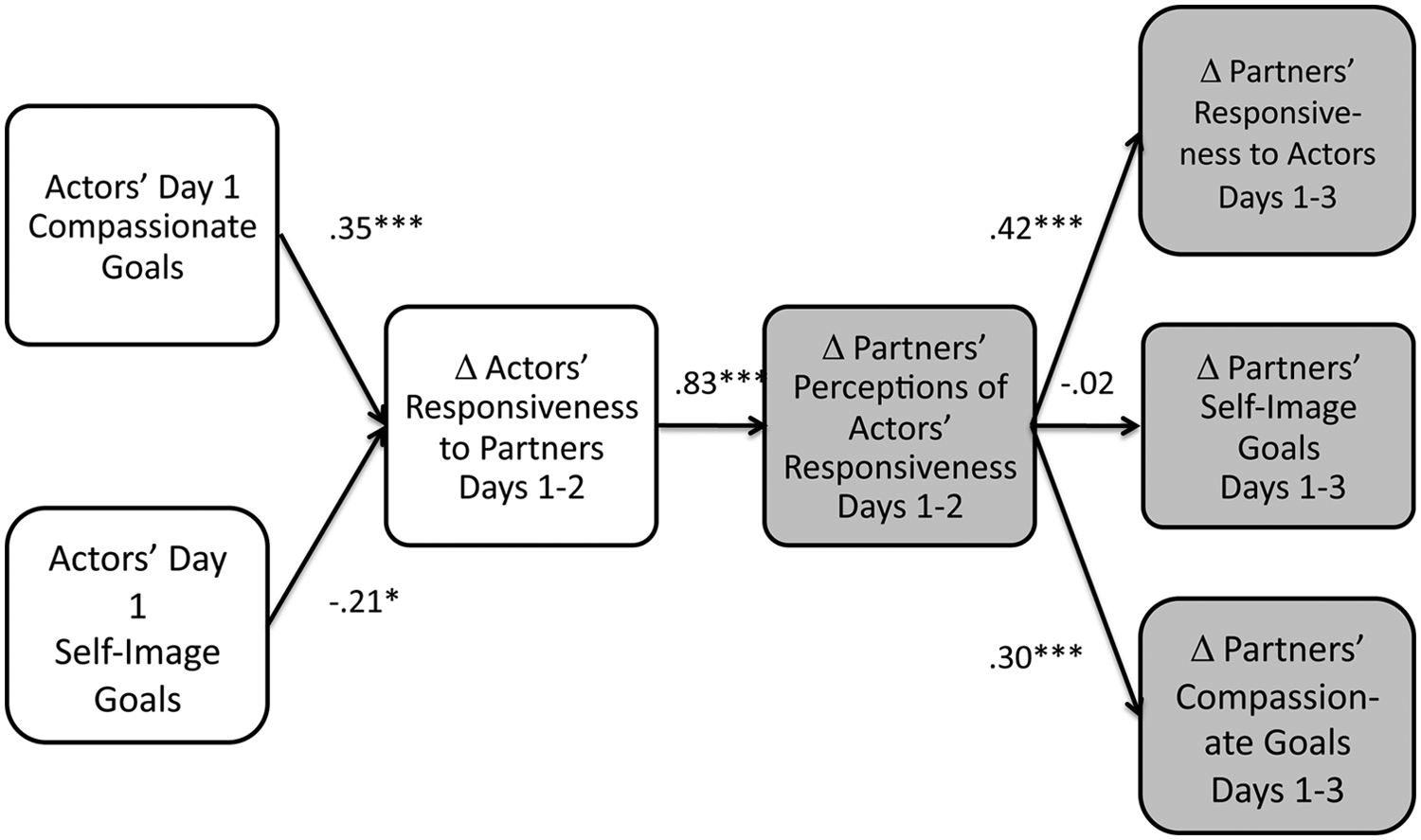
Path analysis of lagged-day associations predicting change in partners’ responsiveness to actors, partners’ self-image goals, and partners’ compassionate goals
We first tested whether actors’ goals on Day 1 predicted actors’ responsiveness on Day 2, controlling for actors’ responsiveness on Day 1. That is, we tested whether actors’ goals predict residual change in actors’ responsiveness the following day. As expected, actors’ compassionate goals on Day 1 predicted increased responsiveness to their partners on Day 2 (according to actors’ own reports), pr = .35, p < .001. Actors’ self-image goals on Day 1 predicted decreased responsiveness to their partners on Day 2, pr = −.21, p < .05.
We next tested whether roommates noticed these changes in actors’ responsiveness. Controlling for actors’ goals on Day 1, change in actors’ reports of their own responsiveness from Day 1 to Day 2 strongly predicted change in partners’ perceptions of actors’ responsiveness from Day 1 to Day 2, pr = .83, p < .001. That is, when actors’ reports indicated that their responsiveness had increased, partners noticed an increase in actors’ responsiveness.
These increases in partners’ perceptions of actors’ responsiveness predicted increases in partners’ compassionate goals and relationship quality on Day 3, pr = .30, p < .01, even when controlling for partners’ compassionate goal or relationship quality on Day 1, actors’ goals on Day 1, and actors’ responsiveness on Days 1 and 2. That is, when partners noticed increases in actors’ responsiveness, partners’ own compassionate goals increased and partners felt more close, satisfied, and committed to actors. The increase in partners’ compassionate goals initiates a new sequence of increased responsiveness on the part of partners, which actors notice, leading to increased responsiveness of actors, creating mutually reinforcing upward spirals of responsiveness.
We also tested this same sequence, in which actors goals predict change in actors’ responsiveness, which predicts change in partners’ perceptions of actors’ responsiveness, which predicts change in partners’ compassionate goals and relationship quality within days (see Canevello & Crocker, 2010). In the same-day models, we person centered predictors, to test whether departures from participants’ own average goals predicted their responsiveness to partners, which predicted partners’ perceptions of their responsiveness, which predicted partners’ responsiveness. Because all variables in these same-day analyses were assessed at the same time, these analyses do not permit any conclusions about the plausibility of causal associations. However, these same-day analyses have the advantage of removing any individual differences in goals and individual differences associated with the goals. Results of the same-day analyses showed the same general pattern of associations, except that within-person increases in actors’ self-image goals did not predict decreased actors’ responsiveness. Within-person increases in compassionate goals did predict increased responsiveness and increased compassionate goals and relationship quality in their partners.
Finally, we tested this same sequence across a much longer time frame. We tested whether actors’ compassionate and self-image goals averaged across the 21 daily reports predicted increases over 3 weeks, from pretest to posttest, in actors’ responsiveness to partners, partners’ perceptions of actors’ responsiveness, and partners’ compassionate goals and relationship quality (Canevello & Crocker, 2010). These analyses focus on individual differences in compassionate and self-image goals, examining what happens over much longer time intervals for people who are chronically high or low in each of the goals. Again, the results supported the hypothesized sequences. Actors chronically high in compassionate goals increased in responsiveness to their partners from pretest to posttest, whereas actors chronically high in self-image goals decreased in responsiveness. Again, change in actors’ responsiveness was reflected in change in partners’ perceptions of actors’ responsiveness, this time over 21 days. As partners’ perceptions of actors’ responsiveness increased, partners’ compassionate goals and relationship quality increased.
Taken together, these results indicate that when people have compassionate goals, they initiate upward spirals of responsiveness in their roommate relationship, whereas when people have self-image goals, they initiate downward spirals of responsiveness. Interestingly, the negative effects of self-image goals on responsiveness were evident over time in both the lagged-day and pretest to posttest analyses but not in the same-day analyses, suggesting that the costs of self-image goals for relationships do not show up immediately but become apparent over time.
Interpersonal Goals and Change in Self-Esteem and Others’ Regard
Our next study investigated the implications of these responsiveness dynamics for others’ regard for the person as well as self-esteem. We hypothesized that actors’ self-image goals undermine partners’ regard for actors, actors’ self-esteem, and partners’ self-esteem.
Responsiveness and others’ regard for the self
In ongoing relationships, people want to know the intentions of others toward them—in the language of actor–partner dyads, actors want to know whether partners are, or will be, friend or foe. Partners who care only about themselves do not make good relationship partners because they provide support and respond to others’ needs only when it serves their own interests. Partners who care about the well-being of actors, who try to be supportive and constructive, and who take actors’ needs into consideration do make good relationship partners.
Others’ intentions, we suggest, are signaled by their responsiveness. People develop high regard for responsive relationship partners. Responsiveness involves understanding, caring, and validation (Gable & Reis, 2006). Responsive partners “attend to and react supportively to central core defining features of the self” (Reis, Clark, & Holmes, 2004, p. 203). Perceived responsiveness in relationship partners leads to closeness and intimacy in relationships (Reis et al., 2004). It seems logical, then, that people hold responsive relationship partners in high esteem. When actors are responsive, partners should notice, and partners’ regard for actors should increase.
Responsiveness and self-esteem
What predicts changes in actors’ self-esteem over time? Actors with self-image goals seem to assume that if they can get partners to recognize their positive qualities, partners will be more responsive—understanding, caring, and validating—thereby boosting actors’ self-esteem. Again, however, this strategy may reflect a misunderstanding of what actually leads to long-term boosts to self-esteem.
Increases in actors’ self-esteem may result not from perceptions of partners’ responsiveness to actors but rather from actors’ responsiveness to partners. That is, long-term increases in self-esteem may be the result of what one gives to others, not how others respond to the person. A growing body of research demonstrates the positive consequences of giving to others for physical and psychological well-being (Brown, Brown, & Penner, in press; Post, 2005). For example, Dunn and her colleagues found that when people receive a financial windfall, well-being was higher among those who gave it away than among those who spent it on themselves (Dunn, Aknin, & Norton, 2008). Closer to the present studies, controlling for support received, giving support to roommates predicted decreases in symptoms of anxiety and depression, whereas controlling for support given, receiving support from roommates did not predict decreased anxiety and depression (Crocker et al., 2010). People who give support to others also experience increased meaning in life (Crocker et al., 2010). This research suggests that responsiveness to roommates may predict increased self-esteem better than perceptions of roommates’ responsiveness to oneself. In particular, people who are responsive to others may feel that they are able to make a positive difference for others, increasing their relational value. Alternatively, if relational value is signaled by others’ responsiveness to the individual, then increases in perceived responsiveness of roommates may predict increased self-esteem better than the person’s increased responsiveness to roommates.
When people are responsive to others, they make a positive, constructive difference in other people’s lives. Knowing that they can make a positive contribution to others may do more to give people a sense of worth and value than increases in their relationship partners’ responsiveness to them.
Responsiveness and partners’ self-regard
Extending this line of reasoning to changes in partners’ self-esteem, Canevello and Crocker (2011) suggested that partners’ self-esteem increases not as a result of increases in actors’ responsiveness to partners but rather as a result of partners’ responsiveness to actors. This does not mean, however, that actors’ responsiveness is irrelevant. In close relationships, responsiveness is typically reciprocated, as demonstrated in the study of goals and responsiveness described previously; increases in actors’ responsiveness elicit increases in partners’ responsiveness. Actors may boost partners’ self-esteem indirectly when actors are more responsive to partners, partners reciprocate with increased responsiveness to actors, and, as a result of their own increased responsiveness, partners develop increased self-esteem.
Does self-esteem predict decreased self-image and increased compassionate goals?
The link between self-esteem and interpersonal goals might also work in the reverse direction over time. That is, when people have low self-esteem, their self-image goals may increase, whereas when self-esteem is high, compassionate goals may increase. Evolutionary theories suggest that negative mood may signal difficulties with current goals and foster shifts to more attainable, self-protective, or less risky goals (Keller & Nesse, 2006; Nesse, 1991; Nesse & Ellsworth, 2009; Wrosch & Miller, 2009). Related to this view, sociometer theory suggests that low self-esteem serves as a signal that one’s relational value is low; that is, low self-esteem may signal difficulty with the goal to be accepted and belong (Leary & Baumeister, 2000). Self-esteem also serves a status-signaling function for others; perceivers infer that people who are low in self-esteem have low status (Zeigler-Hill & Myers, 2009). Taken together, this research suggests that when people have low self-esteem, they might become motivated to repair the images others have of them, leading to increases in their self-image goals.
Conversely, high self-esteem may signal that all is well with self-interested goals. According to sociometer theory, high self-esteem signals that one’s relational value is high; belongingness goals are or can be met (Baumeister & Leary, 1995; Leary & Baumeister, 2000). Perceivers assume that high self-esteem people have high status (Zeigler-Hill & Myers, 2009). High self-esteem may therefore signal that one’s needs or desires have been or will be met in collaboration with others, freeing people to care about the well-being of relationship partners.
The possibility that low self-esteem prompts increases in self-image goals and high self-esteem prompts increases in compassionate goals need not contradict the hypothesis that self-image goals lead to decreased self-esteem and compassionate goals lead to increased self-esteem over time; causal influences could flow in both directions. With reciprocal effects, interpersonal goals and self-esteem may reinforce each other over time. People with self-image goals may create downward spirals of decreased responsiveness, lowering their self-esteem, leading them to have even stronger self-image goals. Conversely, people with compassionate goals may create upward spirals of increased responsiveness, increasing their self-esteem, leading them to have even stronger compassionate goals. These reciprocal associations could lead to significant changes in self-esteem over a period of weeks or months.
We examined whether self-image and compassionate goals predict changes in self-esteem and others’ regard over 12 weeks through their effects on responsiveness to roommates and responsiveness of roommates in the Roommate Goals and Mental Health Study (see Canevello & Crocker, 2011, for a more extended description). A total of 115 previously unacquainted same-sex roommate dyads recruited early in the first semester of college completed pretest questionnaires, 10 weekly online reports, and posttest questionnaires. As in the Roommate Goals Study, we paid participants for their participation based on the number of reports they and their roommates both completed, with a bonus for completing the 10 weekly reports in 11 weeks. This procedure resulted in very low attrition from the study; 109 of the original sample of 115 dyads (95%) completed the pretest, the posttest, and at least 8 weekly reports.
Of particular interest is change in trait self-esteem and roommates’ regard over the 10–12 weeks between the pretest and posttest surveys. We assessed trait self-esteem at pretest and posttest using the 10-item Rosenberg Self-Esteem Inventory (Rosenberg, 1965). The Rosenberg scale assessed global self-esteem with items such as, “I am person of worth, at least on an equal basis with others.” It demonstrates high stability over time, with test–retest reliabilities over 2 weeks around .80 (Blascovich & Tomaka, 1991). In this study, the correlation between pretest self-esteem and posttest self-esteem measured 10–12 weeks later was r = .65, p < .001. Using a trait measure with high test–retest reliability provides a stringent test of the potential for change in self-esteem over time. Self-esteem had high internal consistency at pretest (α = .88) and posttest (α = .91) in this study.
We assessed regard for roommates with a modified version of the Rosenberg Self-Esteem Inventory; instead of rating themselves, participants rated their roommates (e.g., “My roommate is a person of worth, at least on an equal basis with others”). The test–retest reliability of roommate esteem was much lower than the test–retest reliability of self-esteem in this study (r = .35, p < .001), which we found unsurprising because roommates had known each other only a few days at pretest; esteem for a new roommate should be less stable than esteem for oneself. Regard for roommates had high internal consistency at pretest (α = .92) and posttest (α = .93).
Similar to the Roommate Goals Study, we measured responsiveness to roommates at pretest and posttest using a six-item version of a responsiveness measure used in previous research (Canevello & Crocker, 2010; Cutrona et al., 1997; Gore et al., 2006). Responsiveness had high internal consistency at pretest (α = .93) and posttest (α = .97). We measured perceptions of roommates’ responsiveness with six items paralleling the responsiveness to roommates items. This measure also had high reliability at pretest (α = .95) and posttest (α = .98).
We assessed compassionate and self-image goals in each weekly survey, using a modified version of the measure used in the Roommate Goals Study, to assess students’ goals over the past week (see Canevello & Crocker, 2011, for a complete description). Both compassionate and self-image goals scales had high internal consistency at pretest and posttest.
Again, participants were nested within dyads, so we analyzed the data using multilevel modeling (see Canevello & Crocker, 2011, for a more complete description). Extending our research on interpersonal goals and responsiveness reported earlier to a longer time frame, we hypothesized that actors’ chronic compassionate and self-image goals, averaged across the 10 weekly reports, would predict change in their responsiveness to roommates from pretest to posttest. Chronic compassionate goals should predict increased responsiveness, whereas chronic self-image goals should predict decreased responsiveness. We further hypothesized that partners notice this increased responsiveness and become more responsive to actors. Of particular interest here are the consequences of these responsiveness dynamics for partners’ esteem for actors, actors’ self-esteem, and partners’ self-esteem. We examined these consequences in three separate path analyses, following the general strategy described previously.
Partners’ esteem for actors
As predicted, actors’ goals predicted residual change in actors’ responsiveness to partners from pretest to posttest (see Figure 2). Compassionate goals predicted increased responsiveness (pr = .65, p < .001), whereas self-image goals predicted decreased responsiveness (pr = −.16, p < .05). Furthermore, change in actors’ responsiveness from pretest to posttest predicted change in partners’ perceptions of actors’ responsiveness over the same time frame (pr = .48, p < .001), even controlling for actors’ compassionate goals. These findings replicate results of our previous research on responsiveness in a new sample over a much longer time frame. Increases in partners’ perceptions of actors’ responsiveness predicted increases in partners’ esteem for actors from pretest to posttest (pr = .55, p < .001), controlling for actors’ goals, residual change in actors’ responsiveness, and residual change in partners’ perceptions of actors’ responsiveness.
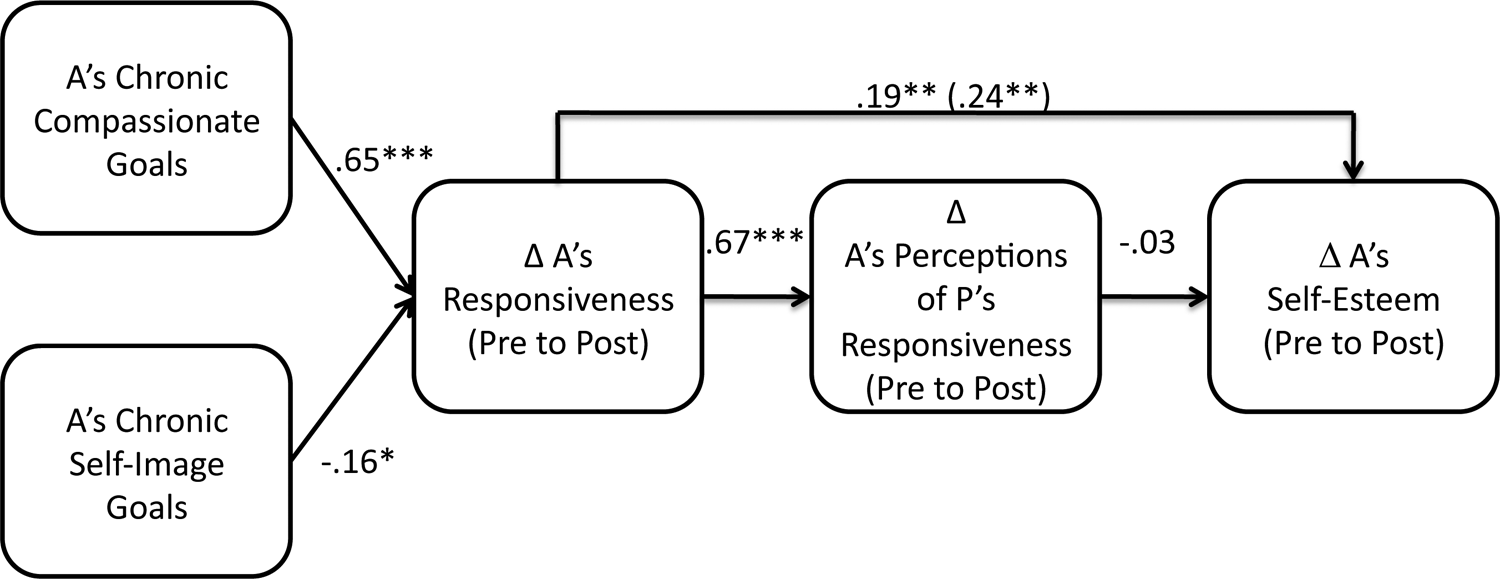
Path analysis of lagged-day associations predicting change in partners’ esteem for actors
These findings indicate that actors’ chronic self-image goals do not promote increases in their relationship partners’ regard for them. Rather, the negative association between actors’ self-image goals and actors’ responsiveness leads partners to perceive actors as less responsive, and this decreased responsiveness predicts decreases in partners’ esteem for actors. Admittedly, because the association between actors’ self-image goals and decreased responsiveness is relatively weak, the indirect path through actors’ responsiveness and partners’ perceptions of actors’ responsiveness accounts leads to small decreases in partners’ self-esteem. Nonetheless, it is clear that actors’ self-image goals did not increase partners’ regard for actors. In this context, and over this time period, self-image goals seem clearly ineffective.
On the other hand, when actors have chronic compassionate goals, their relationship partners’ regard for them does increase, through the responsiveness dynamics we have described. Each link in the indirect path from actors’ compassionate goals to increases in actors’ responsiveness to increases in partners’ perceptions of actors’ responsiveness to increases in partners’ esteem for actors was strong and highly significant. These data indicate that relationship partners’ regard changes in response to perceptions of responsiveness, which are linked to actors’ compassionate goals through actors’ responsiveness to partners.
Actors’ self-esteem
What do interpersonal goals and subsequent relationship dynamics do to actors’ self-esteem? Given the stability of self-esteem over time, including in these data, it would not be surprising if the answer were “nothing.” But if the answer were “something,” then a further question would arise: Are increases in actors’ self-esteem the result of increases in actors’ perceptions of partners’ responsiveness or actors’ own responsiveness?
We tested these possibilities in path models. As in our path model of the effects of goals on partners’ regard, chronic self-image and compassionate goals predicted increased responsiveness to roommates from pretest to posttest (see Figure 3). Increases in actors’ responsiveness to partners predict increases in actors’ self-esteem (pr = .24, p < .01). We then tested whether this path from increases in actors’ responsiveness to actors’ self-esteem was the result of increases in actors’ perceptions of partners’ responsiveness from pretest to posttest. Change in actors’ responsiveness to partners predicted change in actors’ perceptions of partners’ responsiveness, as expected (pr = .67, p < .001). However, controlling for actors’ goals and change in actors’ responsiveness, change in actors’ perceptions of partners’ responsiveness did not predict change in actors’ self-esteem (pr = .03, ns), and the path from change in actors’ responsiveness to change in actors’ self-esteem remained significant (pr = .19, p < .01).
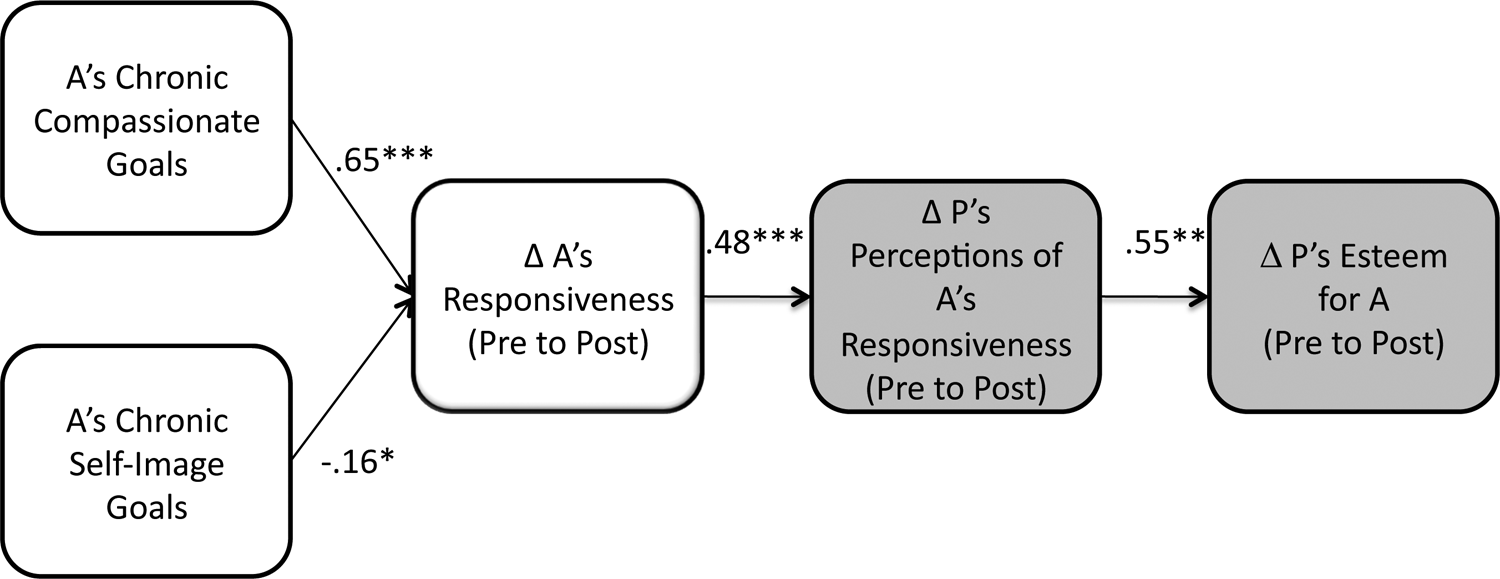
Path analysis of pretest-to-posttest associations predicting change in actors’ self-esteem
These findings suggest that people with chronic self-image goals may experience decreased self-esteem because they become less responsive to relationship partners. In contrast, people with chronic self-image goals experience increased self-esteem, apparently because they are more responsive to relationship partners. These findings add to the growing body of research suggesting that giving to others can improve well-being. Further research is needed to identify whether these increases in self-esteem are the result of increases in a sense of meaning and purpose and/or increased feelings of relational value.
Partners’ self-esteem
Putting these analyses together, we hypothesized that through a similar process, actors’ chronic self-image and compassionate goals could influence partners’ self-esteem. That is, when actors have compassionate goals they are more responsive to partners, partners perceive those increases and reciprocate the increased responsiveness, which increases partners’ self-esteem. As in previous analyses, we found that actors’ compassionate goals predict increased and self-image goals predict decreased responsiveness of actors to partners and partners perceive this increased responsiveness (see Figure 4). Increases in partners’ perceptions of actors’ responsiveness predict increased responsiveness of partners to actors (pr = .73, p < .001), which in turn predicts increased self-esteem in partners (pr = .22, p < .01).
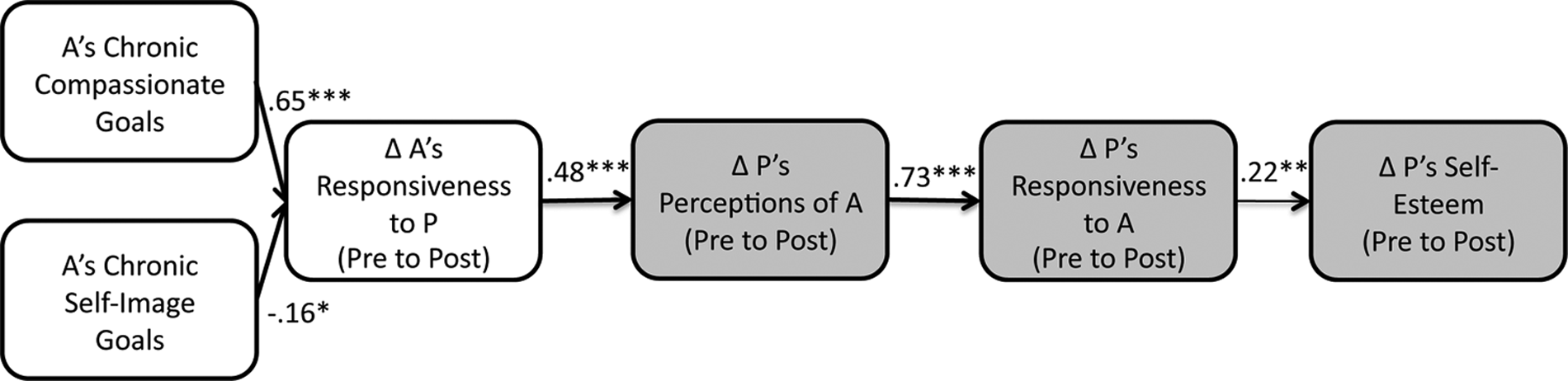
Path analysis of lagged-day associations predicting change in partners’ responsiveness to actors, partners’ self-esteem
These findings suggest that actors’ goals can indirectly affect their partners’ self-esteem. When actors try to get relationship partners to see them in desired ways, the resulting responsiveness dynamics predict decreased self-esteem in partners, whereas when actors try to be supportive and constructive, resulting responsiveness dynamics predict increased self-esteem in partners.
Self-esteem and change in goals
To this point, our analyses have examined whether self-image and compassionate goals predict change in actors’ and partners’ self-esteem and partners’ regard for actors. However, we also examined the reverse sequence, in which self-esteem predicts change in self-image and compassionate goals. A reverse association in which self-esteem predicts change in goals could explain how upward spirals of increasing self-esteem and partners’ regard, or downward spirals of decreasing self-esteem and partners’ regard, could develop over time. If actors’ compassionate goals predict increased self-esteem in both actors and partners, and increases in self-esteem predict increased compassionate goals in actors and partners, then upward spirals could result. On the other hand, if actors’ self-image goals predict decreased self-esteem in both actors and partners, and decreases in self-esteem predict increases in self-image goals, then downward spirals could result.
To test the reverse sequence, we computed a measure of chronic self-esteem, averaging across 10 weekly reports, and used it to predict residual change in goals. As hypothesized, actors’ chronic self-esteem predicted decreases in actors’ self-image goals (pr = −.20, p < .01) and increases in actors’ compassionate goals (pr = .23, p < .01) from pretest to posttest.
Summary
In sum, self-image goals do not increase others’ regard for a person, nor do they increase self-regard or partners’ self-regard; in fact, chronic self-image goals appear to decrease people’s self-esteem and their relationship partners’ esteem for them. In contrast, compassionate goals predict increases in partners’ regard for actors, actors’ self-esteem, and partners’ self-esteem. Path models support the hypothesis that self-image and compassionate goals influence self-esteem and others’ regard through the interpersonal dynamics of responsiveness. Furthermore, goals and self-esteem have reciprocal effects on one another; higher actors’ chronic self-esteem predicted increases in actors’ compassionate goals and decreases in actors’ self-image goals.
Taken together, the results of these studies support the idea that interpersonal goals can have paradoxical consequences. When people try to get others to see their positive qualities, others’ regard actually declines. This association is, in part, the result of the effects of self-image goals on responsiveness. When people have self-image goals, they are less understanding, caring, and validating of their relationship partners. Their partners perceive them as less responsive and reciprocate with decreased responsiveness.
Compassionate goals also have paradoxical consequences. When people have compassionate goals, they care about others’ well-being, not about how others view them. Consequently, they are more understanding, caring, and validating of their relationship partners. Their partners perceive them as more responsive and reciprocate with increased responsiveness, and partners’ regard increases, along with actors’ and partners’ self-esteem. The associations between interpersonal goals and responsiveness dynamics are robust; we observed them in the Roommate Goals Study in same-day, lagged-day, and pretest to posttest analyses over 3 weeks, and again in the Roommate Goals and Mental Health Study from pretest to posttest over 10–12 weeks.
The paradoxical consequences of self-image and compassionate goals for others’ regard and self-esteem add further support to the idea that pursuing self-esteem has costs. These studies examined pursuit of self-esteem through interpersonal means, by trying to get others to see the self as having desired qualities, and showed that self-image goals have detrimental effects on relationship dynamics, which ultimately predicted negative effects on others’ regard, self-esteem, and relationship partners’ self-esteem. These studies also add to an accumulating body of evidence that people can avoid the costs of pursing self-esteem by transcending concerns about self-esteem or self-image and focusing on making a contribution to something or someone outside of themselves.
Implications for Personality and Social Psychology
These findings, and others like them, have forced me to reconsider some deeply held beliefs about the very nature of persons and situations, research methods, and the state of the union between personality and social psychology. These beliefs go back to my graduate training and have resisted change for several decades, so I have been slow to recognize some of the implications of my own data.
The distinction between persons and situations
As a graduate student, I learned that social psychologists study the power of the situation to influence behavior, whereas personality psychologists study personality traits that were supposed to predict individual differences in behavior across situations. Of course, more ecumenical social and personality psychologists assume that personality and situations interact; stable characteristics of people shape behavior more in some situations than others. Mischel and Shoda (1995) argued that personality is reflected in “signature” patterns of behaviors that emerge predictably under particular circumstances. And social psychologists generally recognize that situations affect some people more than others, even in classic demonstrations of the power of the situation such as the studies of Asch and Milgram that all Introductory Psychology students learn.
The Person × Situation framework assumes that persons and situations are independent variables; in the laboratory, situations are manipulated so personality variables are crossed with situations. The studies Amy Canevello and I have conducted suggest that in lives outside the laboratory, persons and their situations are not independent variables but rather mutually influence one another. Other researchers have also noted the interdependence of persons and situations. For example, as Snyder and Ickes (1985) noted, outside the laboratory people often choose the situations in which they find themselves. In particular, people often choose their relationships, including romantic relationships and friendships. Relationships are interpersonal situations, and most situations involve relationships, in reality or in mind (Reis, 2009).
The present studies suggest that even when they do not choose their relationship partners, people create and shape their relationship situations. In our data, people create responsive relationship partners by being responsive to them, which shapes relationship partners’ goals and regard for the self. Furthermore, in creating responsive relationship situations, people also create or at least shape the self and relationship partners. Specifically, people with compassionate goals are more responsive to their partners, which leads them to have increased self-esteem. Furthermore, because their partners reciprocate the responsiveness, partners’ self-esteem also increases. Increases in self-esteem then lead both relationship partners to have increased compassionate goals, creating a virtuous cycle.
These studies indicate that when situations involve interpersonal relationships, persons and their situations are not independent variables but rather continually and mutually constitute each other over time. Ultimately, these dynamic, reciprocal relationship processes can lead to significant change in both relationship situations and personality characteristics over surprisingly brief time intervals. In our data, we observed change in self-esteem, a generally highly stable personality characteristic, over 10–12 weeks.
Granted, the generality of these findings needs to be established in further research. College roommates are an unusual type of relationship because two previously unacquainted people who did not choose each other share a small living space while experiencing the opportunities, challenges, and stresses of the first semester of college. In most friendships and romantic relationships, people select themselves into relationships, and they may choose relationship partners with similar or complementary interpersonal goals. But the general parameters of roommate relationships are not entirely unique, either. Relationships with people at work, friends of friends, and relatives of romantic partners all involve spending considerable time with people others select for us. In each of these types of relationships, the dynamics of interpersonal goals could shape the relationship, which in turn shapes the person’s personality and self-views.
Others have made these points before. For example, Endler and Magnusson (1976) proposed a dynamic model in which people and their situations mutually influence each other. But social psychologists, firmly convinced of the power of the situation, have not, on the whole, embraced this view. Their reluctance may stem from the inherent difficulty of studying dynamic reciprocal influences of persons and relationship situations. At the time Endler and Magnusson argued for the mutual influence of persons and situations, the field lacked the research methods to capture these dynamics and the statistical tools to analyze them. In the 21st century, however, we have both technology in the form of the Internet, hand-held computers, and smart phones as well as highly sophisticated statistical software that makes exploring these dynamic processes feasible.
Research methodology
These data have also provoked me to question some of my most cherished assumptions about research methods. Along with the belief in the inherent superiority of focusing on the power of situations to influence behavior, my graduate training instilled in me a belief in the superiority of laboratory experiments, which provide stronger grounds for causal inference, the gold standard of social psychological research. Correlational studies, typically used in personality research, cannot test hypotheses about cause and effect. Of course, as a graduate student I was instructed in the limitations of laboratory experiments—lack of mundane realism, the possibility that findings with college students might not generalize, and so on—but the value of testing causal hypotheses far outweighed these limitations.
I now think that social psychologists are sometimes overconfident about the power of experiments to identify causal mechanisms. Manipulating independent variables can provide evidence of causal associations, but the gap between the conceptual independent variable and the operationalization of that variable in a particular study can lead to erroneous conclusions about causal processes. In the study of self-processes, for example, researchers have studied “self-affirmation” by having participants write about important values; these manipulations reduce defensiveness. However, whether this manipulation actually affirms the self, boosting self-esteem or self-images, has not been established (Sherman & Cohen, 2006); it may, instead, enable people to transcend the self (Crocker & Canevello, 2008). Thus, although they are often held up as the gold standard of research designs in social and personality psychology, laboratory experiments are not without weaknesses. Although in carefully controlled studies researchers can conclude that something they manipulated caused observed differences between conditions in the dependent variable, interpretations of what aspect of the independent variable caused the observed results and why can be erroneous.
Lately, I have wondered about the costs of social psychologists’ faith in the superiority of laboratory experiments. Dynamic processes such as those described here cannot easily be detected in laboratory experiments that treat the person and the situation as independent variables, remove people from their usual relational contexts, study people for an hour or less, and test only one direction of causal effects. These dynamic processes can be detected only in studies that involve multiple assessments over time, such as experience sampling and daily or weekly diary studies, or laboratory studies with multiple measurements. Short-term longitudinal studies can illuminate associations and processes that might be missed in experimental or simple correlational designs and in long-term longitudinal studies that assess participants yearly, or even less often.
Furthermore, to study the mutual influence of persons and their social situations researchers must include other people, such as friends, roommates, romantic partners, or coworkers, in their studies. Social psychological experiments rarely include other people, and when they do, it is usually in the role of experimental confederates trained to keep their behavior constant. Yet in our view such a research strategy intentionally removes the very dynamic processes through which people and their relationship situations mutually constitute one another (e.g., Sadler & Woody, 2003).
My point is not to criticize experimental research; elegant and subtle experiments demonstrating the power of the social situation and construals of it constitute some of the most compelling research in social psychology. However, I wish for greater open-mindedness about methodology, an attitude that embraces the richness of studying people’s lives over time, in their relationships, and how they, their relationship partners, and their relationships evolve. In my experience, journal editors sometimes reflexively (at least, it seems so to me) insist on the addition of a laboratory experiment to a manuscript reporting longitudinal research. Yet years of failed attempts to “manipulate” compassionate goals suggest to me that people truly have a compassionate goal only when they generate it themselves, and choose it. Although the failure to manipulate compassionate goals could be seen as a serious limitation to this program of research, the difficulty of manipulating these goals suggests the possibility that social psychologists who limit themselves to laboratory experiments may overlook some important and powerful phenomena.
In my view, social psychology would be enriched by including the study of people over time in their “real-life” contexts in the methodological repertoire. Full understanding of the nature and importance of social phenomena requires it. Reciprocal causal effects between people and their situations can transform initially small effects of people on their situations and situations on people into large effects with important consequences over time. Furthermore, when situations involve other people, effects can become contagious and reverberate through social networks. Phenomena that appear quite constrained in the laboratory may be much more powerful when studied in vivo. And the opposite may also be true; phenomena that seem powerful in the laboratory may be much less so when people are studied in the wild, where countervailing forces may constrain them.
It seems to me that the traditional view of social psychology—that the power is in the situation, with people merely reacting to the situations in which they find themselves—encourages people to view themselves as being at the mercy of situational constraints, unable to change their experience or behavior unless the situation changes. This view denies evidence that people at least to some degree create their situations; people are sometimes the source, rather than at the mercy, of what they experience. When we teach about the power of the situation, we do not teach people to identify the power they have to create what they do want. Furthermore, the situations people create for themselves shape who they are. Ultimately, rigid adherence to the mantra that the power is in the situation undermines our ability to understand social behavior fully, and does a disservice to the field and the consumers of our work.
The time has come for social psychologists to let go of their biases against personality psychology and nonexperimental methods and embrace the full range of ideas, theories, and methods that can help us better understand people and their behavior in social contexts. The bright line separating personality and social psychology is more in our minds than in our missions.
Footnotes
Acknowledgements
This article is based on an address titled “The Social Self: Egosystem or Ecosystem?” presented at the 2010 meeting of the Society for Personality and Social Psychology, Las Vegas, Nevada. I am grateful to Amy Canevello for her many contributions to the conceptual and empirical aspects of this research and for her thoughtful comments on a draft of this article. I also thank Rebecca Caulfield, Timothy Cavnar, Andrew Crocker, Paul Denning, Sarah Franz, Lilita Matison, and Dominik Mischkowski for their assistance with data collection and entry.
The author(s) declared no potential conflicts of interest with respect to the research, authorship, and/or publication of this article.
The author(s) disclosed receipt of the following financial support for the research, authorship, and/or publication of this article: The projects described were supported by Grant R01MH058869 from the National Institute of Mental Health. The content is solely the responsibility of the author and does not necessarily represent the official views of the National Institute of Mental Health or the National Institutes of Health.