







Abstract
Social identification denotes individuals’ psychological bond with their ingroup. It is an indispensable construct in research on intragroup and intergroup dynamics. Today’s understanding of social identification is firmly grounded in self-stereotyping principles (i.e., assimilation to the ingroup prototype). However, we argue for a more integrative approach to understand social identification, including a more prominent role for the personal self. We present the Integrative Model of Social Identification (IMSI) and postulate that there are two cognitive pathways to self–group overlap that can simultaneously yet distinctly explain social identification: self-stereotyping and self-anchoring (i.e., projection of personal self onto ingroup). We review different theoretical and methodological approaches to both processes and integrate them into one model. Subsequently, we empirically demonstrate the positive relationship between self-stereotyping, self-anchoring, and identification in various group contexts and individuals. In sum, our model highlights the dynamic interplay of personal and social self as cornerstones of social identification.
“No man is an island, entire of itself, every man is a piece of the continent, a part of the main.”
Humans are social beings. It is important to belong to groups to fulfill the basic needs for safety, survival, and reproduction (Baumeister & Leary, 1995). The extent to which an individual attaches affective significance to a group she or he belongs to is defined as social identification. Social identification shapes social perceptions, feelings, and behaviors (Tajfel & Turner, 1979). Those who identify highly with their ingroup think of themselves in terms of their group membership, feel close to the group, are committed to the group, and act on behalf of the group (e.g., H. J. Smith & Tyler, 1997; Spears, Doosje, & Ellemers, 1997; van Zomeren, Leach, & Spears, 2012). As such, people’s social identification is psychologically relevant and socially consequential. It is an indispensable construct in almost all research on intragroup and intergroup dynamics (see for overviews Ellemers, Spears, & Doosje, 2002; Haslam, van Knippenberg, Platow, & Ellemers, 2003; Jetten, Haslam, & Haslam, 2012).
Considering the large body of research on social identification, particularly on its consequences for social-psychological functioning, it is quite remarkable that there is little insight in the antecedents of social identification. What processes explain group members’ level of social identification? Currently, our understanding of the intraindividual mechanisms that determine social identification levels is still limited. Specifically, there is a lack of integrative models providing insights into the cognitive processes through which people come to attach significance to their ingroups. In this review, we introduce such model: We provide a framework in which we propose that there are two cognitive pathways that complement each other in explaining how people identify with groups, namely, self-stereotyping and self-anchoring. We integrate the pathways in the Integrative Model of Social Identification (IMSI). We will show that such model offers a new, dynamic, and fine-grained understanding of how individuals in different groups identify via different cognitive pathways.
We start from the assumption that social identification is grounded in the cognitive integration of the ingroup into the self-concept. Our self-concept represents “who we are.” It is formed by both our personal dispositions, goals, and values (personal self), as well as by our group memberships (social self; e.g., Tajfel & Turner, 1979). For example, when someone asks you “Who are you?,” you will probably disclose some of your personal attributes (e.g., organized, extraverted) as well as some of your group memberships (e.g., sports club, profession). In essence, the groups we belong to are inextricably linked to our self-concepts and vice versa (E. R. Smith & Henry, 1996). The more people perceive mental overlap between the self and an ingroup, the higher their social identification levels (Cadinu & De Amicis, 1999; Coats, Smith, Claypool, & Banner, 2000; Tropp & Wright, 2001). This implies that understanding how mental overlap between the self and the group emerges is crucial to understanding how people identify with groups. Where does self–group overlap come from? Am I like the group or is the group like me?
The Traditional Cognitive Pathway to Social Identification
Following the “I am like my group” rhetoric, Self-Categorization Theory (SCT; Turner, Hogg, Oakes, Reicher, & Wetherell, 1987) states that mental overlap between self and group emerges top-down, via the assimilation of the self to an ingroup’s prototype. This process is called self-stereotyping. To illustrate this process, imagine Ron, a die-hard football fan. He dresses in the typical colors of the football team and behaves fanatically at the stadium on behalf of his team. Clearly, Ron is highly assimilated with the football team’s prototypical features. In fact, who he is in terms of his personality (i.e., introverted, organized, sweet tooth) is irrelevant. More generally stated, SCT proposes that an individual’s personal self (a person’s unique characteristics) and a social self (prototypical group characteristics) exist at opposite ends of the same continuum. When the social self is salient, the personal self shifts to the background or depersonalizes, and ingroup members start to define themselves in accordance with prototypical group characteristics.
To date, research and theorizing on social identification are firmly grounded in self-stereotyping principles. According to SCT, social identification emerges solely via the social self: the higher the assimilation to a group’s prototype, the higher the social identification (Turner et al., 1987; Turner, Oakes, Haslam, & McGarty, 1994). Without casting doubt on the relevance of self-stereotyping, we believe that a mere focus on this process is insufficient and somewhat one-sided to explain social identification. In particular, the discontinuity between people’s personal and social self that is assumed with self-stereotyping implies that people’s level of identification is irreconcilable with individuality in the group: As people come to perceive themselves as interchangeable exemplars of a group’s prototype, their self-concepts become depersonalized (Onorato & Turner, 2004). However, to fully understand how people identify with groups and integrate a social identity into the self-concept, we believe that the personal self may not, and cannot, always be negligible.
To illustrate this, consider that self-stereotyping is a highly context-dependent, short-term process. How we self-define (i.e., what social self is activated) depends on the particular intergroup context that is salient at that moment. As such, self-stereotyping explains how we identify in response to short-term changes in the intergroup context (e.g., Turner et al., 1994). Yet, a longitudinal perspective on how individuals identify with groups and how ingroups become integrated parts of our self-concepts is not incorporated into this perspective (see also Amiot, de la Sablonniere, Terry, & Smith, 2007). Also, we take our unique dispositions with us across different contexts and when joining new groups (cf. Deaux, 1993). This is not taken into account when relying solely on self-stereotyping to explain social identification levels. In addition, self-stereotyping requires the availability of clear group prototypes for people to assimilate to. However, in today’s societies, groups are often complex, diverse, or ambiguously defined (e.g., Crisp & Meleady, 2012). For example, think of the complexity of the European Union, diversity in large international companies, or virtual reality in computer-based groups. In these groups, a shared perception of the group prototype is likely absent or vague. What constitutes the social self in these groups? And, if not solely via self-stereotyping, how does social identification emerge?
A New Cognitive Pathway to Social Identification
The examples above indicate the need for a more elaborate and inclusive understanding of how people identify with groups than a mere reliance on self-stereotyping. We argue that in situations described above, the personal self is crucial to shape self–group overlap. Building from this argument, research has shown that there is yet another way to create a mental bond between the self and the ingroup, namely, via self-anchoring. 1 Self-anchoring is the opposite process from self-stereotyping; information about the personal self-concept is used as an anchor to define an ingroup (Cadinu & Rothbart, 1996). To illustrate this, imagine Mark, a newcomer in an organization. He considers himself to be creative. Because Mark is unfamiliar with the organization’s prototype, he creates a mental bond with the organization by generalizing his creative self to the group. This results in overlap between the self and the ingroup, so that Mark views the organization as creative too. Thus, with self-anchoring, the personal self plays a central role in shaping self–group overlap. Presumably, the perception that “the group is like me” forms an important additional piece of the puzzle to understand how people identify with groups. Therefore, we propose that the cognitive basis for social identification lies within the self—both the social and the personal self.
Self-anchoring and self-stereotyping are well-established concepts in social-psychological literature. Both account for emergence of cognitive self–group overlap, yet the starting point for this overlap differs. Considering their close relationship, it is remarkable that there is little research investigating self-stereotyping and self-anchoring simultaneously. Studies by Otten and Epstude (2006) and Cho and Knowles (2013) are exceptions to this. Both focused on a methodology to integrate self-anchoring and self-stereotyping measures. However, these studies do not provide theoretical understanding on the consequences of such integration for group functioning, and particularly social identification. There is some support for a self-stereotyping and social identification link (e.g., Latrofa, Vaes, Cadinu, & Carnaghi, 2010; Spears et al., 1997; Verkuyten & Nekuee, 1999), but overall, empirical evidence is scarce. Moreover, the idea that self-anchoring could be relevant to social identification has only recently been introduced in the literature (Van Veelen, Otten, & Hansen, 2011). Yet, it may be precisely this process that, in addition to self-stereotyping, enriches current theorizing on social identification and offers insight into how people identify with groups in which similarity and prototypicality do not, or cannot, form the cornerstone of group membership.
Our aim is to integrate self-anchoring and self-stereotyping in one research model and demonstrate that both processes form two distinct, but complementary, pathways to explain how people identify with groups. To achieve such integration, we need to overcome some theoretical and methodological challenges. Specifically, self-stereotyping and self-anchoring stem from different research traditions, with self-stereotyping rooted in Social Identity Theory (SIT; Tajfel & Turner, 1979) and self-anchoring rooted in research on social judgment and bias (Ross, Greene, & House, 1977). This has led to contrasting theoretical viewpoints on the primacy of the person or the social context as the basis for social inference (e.g., DiDonato, Ullrich, & Krueger, 2011; Guimond, Chatard, Martinot, Crisp, & Redersdorff, 2006; Karniol, 2003; Mussweiler, 2003). Moreover, in these separate research traditions, scholars have used a wide variety of measures to tap into the same social inference process. Such measurement inconsistency obscures construct validity, and also poses a great challenge on integration and comparison of self-anchoring and self-stereotyping in one research model.
In this review, we first provide a brief overview on self-stereotyping and self-anchoring literature. Second, we will discuss the theoretical and methodological barriers that may have formed obstacles to the joint investigation of self-anchoring and self-stereotyping and provide solutions to overcome them. Next, we will introduce the IMSI and discuss the basic premises and empirical evidence so far. Finally, we apply the model to different group situations and individuals, and demonstrate that in some social situations assimilation to group prototypes may work best, whereas in other situations relying on the personal self may work best to shape a group bond.
Background Self-Stereotyping and Self-Anchoring
Self-Stereotyping
Building on SIT (Tajfel & Turner, 1979), SCT (Turner et al., 1987) provides a cognitive framework on how people form a connection between the self and the ingroup: People belong to groups to the extent that they define, describe, and evaluate themselves in terms of the group prototype, and apply ingroup norms and values onto the self (self-stereotyping). After its theoretical establishment, many empirical studies focused on self-stereotyping. Without claiming to be exhaustive, we will give some prominent examples.
Evidence was obtained that the tendency to self-stereotype is stronger when an intergroup context is salient compared with when an intragroup context is salient (Hogg & Turner, 1987). Similarly, self-stereotyping was shown to be stronger when a social identity is salient as compared with when a personal identity is salient (Lorenzi-Cioldi, 1991; Onorato & Turner, 2004). Moreover, minority or low-status ingroup members were found to self-stereotype more strongly than majority or high-status members (Cadinu, Latrofa, & Carnaghi, 2013; Pickett, Bonner, & Coleman, 2002; Simon & Hamilton, 1994; Spears et al., 1997), because the ingroup identity is especially salient and important to the self-concept for members of minority or low-status groups (Latrofa et al., 2010). Indeed, research demonstrated that category salience (Hundhammer & Mussweiler, 2012; Verkuyten & Nekuee, 1999) and meaningfulness of the social category (Simon, Hastedt, & Aufderheide, 1997) are positive predictors of self-stereotyping. Furthermore, although previous research revealed that self-stereotyping is only present regarding positive ingroup stereotypes (i.e., selective self-stereotyping; Biernat, Vescio, & Green, 1996), later research showed that low-status group members attribute both positive and negative group stereotypes to the self (Latrofa, Vaes, Pastore, & Cadinu, 2009) and that negative self-stereotyping is also present using implicit measures (Lun, Sinclair, & Cogburn, 2009).
Aside from antecedents, self-stereotyping also has relevant consequences. For example, self-stereotyping serves a protective function for group members’ well-being in response to intergroup threat (Branscombe, Schmitt, & Harvey, 1999; Latrofa, Vaes, & Cadinu, 2012; Latrofa et al., 2009). Also, self-stereotyping has been related to system justification theory (Jost & Banaji, 1994), such that in a situation of status inequality, self-stereotyping serves to legitimize the hierarchical system and to perceive it as fair (Laurin, Kay, & Shepherd, 2011). Moreover, a domain that has especially received research attention is the impact of self-stereotyping on ingroup favoritism (e.g., Pickett et al., 2002; Voci, 2006).
Following SIT, people are motivated to achieve and maintain positive ingroup identities (Rubin & Hewstone, 1998), which can be achieved by favorable comparisons with outgroups. According to Sedikides and Strube (1997), this motivation is driven by an innate human need for self-enhancement and self-esteem. At the same time, SCT assumes that when a certain ingroup becomes salient, people define themselves in terms of the attributes of this ingroup (self-stereotyping; Turner et al., 1987): What is defined as “we” defines “me.” Taken together, it is assumed that in salient intergroup contexts, ingroup favoritism, that is, a positive bias toward the ingroup relative to outgroups, emerges via self-stereotyping (Abrams & Hogg, 1988) to fulfill self-enhancement needs (Hogg & Abrams, 1990).
Importantly, ingroup favoritism is a remarkably reliable phenomenon (Hewstone, Rubin, & Willis, 2002) that emerges under the most minimal laboratory conditions. People who are randomly and anonymously categorized into one of two meaningless groups on the basis of some trivial criterion favor their ingroup over the outgroup (Rabbie & Horwitz, 1969). However, the explanation of ingroup favoritism in such minimal group paradigms (MGP; Tajfel, Billig, Bundy, & Flament, 1971) in terms of a self-stereotyping process serving a self-enhancement need (Hogg & Abrams, 1990) has been widely criticized (e.g., Cadinu & Rothbart, 1996; Robbins & Krueger, 2005; Rubin & Hewstone, 1998). One of the main problems with the self-stereotyping approach to ingroup favoritism is the “minimal” nature of these groups. Given the lack of group prototypes in an MGP, one may wonder on what grounds people evaluate their ingroup positively and use this information to infer their self-image. Importantly, this critique on the self-stereotyping account for ingroup favoritism formed the starting point for Cadinu and Rothbart (1996) to investigate self-anchoring as an alternative: “Overall, ingroup favoritism in the minimal group paradigm is a well-established phenomenon, but the exact reasons for this favoritism remain unclear” (p. 661).
Self-Anchoring
Self-anchoring, or the projection of personal characteristics on the ingroup, indicates that one does not necessarily have to rely on group prototypes (i.e., self-stereotyping) to create a mental link between self and ingroup. Instead, this link can be based on using the personal self as a positive standard to define an ingroup and distinguish it from relevant outgroups. Specifically, Cadinu and Rothbart (1996) provided three theoretical premises for their reasoning: First, people generally possess favorable beliefs about themselves (e.g., Diener & Diener, 1996). Second, in minimal groups, people infer ingroup characteristics from the positively evaluated characteristics of the self. Third, based on projection of the personal self onto the ingroup, the ingroup is regarded favorably and, by principle of differentiation (Doise & Dann, 1976), the outgroup will be regarded less favorably.
Cadinu and Rothbart (1996) tested their assumptions by providing participants with either selective information about a minimal ingroup, or with information about the personal self. Subsequently, participants rated the self or the ingroup, respectively, on the applicability of this selective information. Results showed that the tendency to generalize self-information to the ingroup was twice as large as the generalization of ingroup information to the self. Thus, in minimal groups, self-anchoring was more prevalent than self-stereotyping. Moreover, this effect was specifically pronounced for positive self-information projected onto the ingroup, but not the outgroup. This finding corroborated that a positive self-image can account for ingroup favoritism in minimal groups (e.g., Gramzow & Gaertner, 2005).
Further research demonstrated that the level of self-anchoring differed more strongly between the ingroup and the outgroup when intergroup salience increased (Krueger & Clement, 1996). Furthermore, whereas Cadinu and Rothbart (1996) based their self-anchoring account for ingroup favoritism in the MGP on the three premises described above, work by Krueger and colleagues suggested a more parsimonious explanation: Only egocentric projection of the positive self to the ingroup can account for ingroup favoritism, and the differentiation principle between ingroup and outgroup is not necessary for ingroup favoritism to emerge. Specifically, it is the asymmetry in the strength of association between the positive self and the ingroup on one hand and the outgroup on the other hand that instigates ingroup favoritism (Clement & Krueger, 2002; DiDonato et al., 2011; Krueger, 1998a). This notion was further supported with implicit measures (affective priming), showing that favorable ingroup evaluations do not necessarily rest on explicit social comparisons with outgroups but rather rely on a simple association with the positive self (Gramzow, Gaertner, & Sedikides, 2001; Otten, 2002; Otten & Moskowitz, 2000; Otten & Wentura, 1999). These findings reveal that an intergroup phenomenon (ingroup favoritism) can be explained at an intragroup level by merely focusing on the dynamic between the self and the ingroup.
Finally, self-anchoring is more than a valence effect. By disentangling projection of valence from projection of self-information, research showed that self-information was a stronger predictor of ingroup favoritism than valence (Otten & Wentura, 2001) or social desirability of traits (Clement & Krueger, 2000, 2002). This implies that the self serves as an informational base to distinguish ingroups from outgroups (Gramzow et al., 2001).
Taken together, research in minimal groups demonstrated clear evidence for self-anchoring: When no information is available about an intergroup context, people project their personal self onto the ingroup, to positively distinguish the ingroup from the outgroup. Contrary to minimal groups, in real groups, providing evidence for self-anchoring is more challenging. In real groups, information about group stereotypes is typically available. Thus, here people have the option to assimilate the self to ingroup stereotypes (i.e., self-stereotyping) as well. Considering that in real groups self-stereotyping is a viable option, the question is whether self-anchoring is still a relevant process to create self–ingroup overlap. Otten (2004) investigated this question by measuring the strength of the association between self and a real ingroup (i.e., high school students) while varying the order of self and ingroup ratings; this research provided only tentative evidence for a self-anchoring effect. More compelling evidence was provided later when self-anchoring was demonstrated in gender groups (Otten & Epstude, 2006), student groups (Riketta & Sacramento, 2008; Van Veelen, 2008; Van Veelen et al., 2011), and the (Dutch) nationality (Van Veelen, Otten, & Hansen, 2013b).
Two Steps Toward an Integrative Model
With the introduction of self-anchoring in real groups, we turn to the challenge of disentangling self–ingroup overlap stemming either from a self-stereotyping or self-anchoring process and integrating both in one model. As stated before, there are theoretical as well as methodological challenges that have formed obstacles to integrative models of self-anchoring and self-stereotyping. We discuss those challenges and our view on how to overcome them.
Step 1: Overcoming Theoretical Challenges
There are different theoretical viewpoints on the primacy of the personal self or the group as inferential starting point to self–group overlap. From the self-stereotyping perspective it is argued that generic knowledge about (group) prototypes serves as a default 2 for social inferences; any self–group overlap based on the personal self as a point of reference would either be impossible or indicate an error in social judgment (e.g., Deschamps & Devos, 1998; Karniol, 2003). In contrast, from the self-anchoring perspective, it is argued that the personal self is the most accessible standard in the cognitive system. Therefore, personal self-knowledge should be the default in making social inferences (e.g., Epley, Keysar, Van Boven, & Gilovich, 2004; Krueger, 2003; Mullen, 1985). We explain both viewpoints below.
Self-stereotyping as the default process
Theoretical support for self-stereotyping as the default process stems from the self-as-distinct model (Karniol, 2003). In this model, a protocentric view of the self in relation to others is put forward, stating that generic representations or prototypes (i.e., group stereotypes) serve as a default for inferring similarity between the self and others. According to this view, using self-knowledge to make social inferences should only occur in developmentally immature social beings: This would be a transitional stage in childhood that passes with maturation, when people are able to successfully transport themselves into the perspective of other people or groups (Selman, 1980). Moreover, according to Karniol (2003), the use of the personal self to infer similarity to others is hard to reconcile with the notion that the self is a unique entity, used to differentiate oneself from others (e.g., Brewer, 1993; Deschamps & Devos, 1998): An entity that is classified as being distinct cannot serve as a tool to infer similarity. The minor role of the personal self in social perception is also emphasized in SCT. Specifically, as stated earlier, an important proposition of SCT is that people’s relation to ingroups is built on the perception of self as an interchangeable exemplar of a group’s prototype, and thus the shift away from the personal self. Following the principle of depersonalization, self–ingroup overlap cannot be based on the personal self and thus not on self-anchoring (e.g., Onorato & Turner, 2004; Simon et al., 1997; Turner et al., 1987, 1994; Verkuyten & Nekuee, 1999).
Empirical support for the self-stereotyping-as-default point of view was found in research showing that the associative strength between self and ingroup is stronger when judgments about the self are based on prototypical ingroup information than when judgments about the ingroup are based on self-information (Biernat, Manis, & Kobrynowicz, 1997; Simon & Hastedt, 1997). Furthermore, several studies claim to have empirically demonstrated that the correlation between self and ingroup ratings is higher when ingroup ratings precede self-ratings than vice versa, suggesting the prevalence of self-stereotyping over self-anchoring (e.g., Guimond et al., 2006). However, in the section “Step 2: Overcoming Methodological Challenges,” we discuss why this evidence should be interpreted with caution.
Self-anchoring as the default process
Proponents of the self-anchoring viewpoint argue that the personal self serves as the default to make judgments and predictions about others in self-relevant domains. This tendency can hardly be overridden by any inference based on stereotypes (e.g., DiDonato et al., 2011; Krueger, 2007). The personal self is seen as the locus of experience and thus as basic source of inference about others. Specifically, with self-anchoring, there is always a direct link between a person’s personal perception and a social stimulus, whereas self-stereotyping always requires additional information about generic representations in the social context. Thus, the personal self is seen as the most immediate, parsimonious source of information; inferences based on self-knowledge therefore are likely to overrule generic knowledge (Epley et al., 2004; Krueger, 2003).
There is a substantial body of empirical evidence supporting the self-anchoring-as-default point of view. Abrams (2011) demonstrated that among children, self-anchoring does not decrease with age, which contradicts Karniol’s (2003) assumption that egocentrism decreases with the development of the theory of mind. Other studies revealed that, as compared with ingroup ratings, self-ratings are made faster (Cadinu & De Amicis, 1999; Clement & Krueger, 2000), more easily, more accurately, and more consistently over time (Krueger & Stanke, 2001). Finally, inferences from self to ingroup are stronger compared with inferences from ingroup to self (Cadinu & Rothbart, 1996; Clement & Krueger, 2002; Krueger & Stanke, 2001; Otten & Epstude, 2006; for an overview, see Krueger, 2007). These findings directly contrast results demonstrating self-stereotyping as the default process.
Reconciling self-stereotyping and self-anchoring
All in all, theoretical and empirical support for self-stereotyping or self-anchoring as a default process is mixed. So far neither side has been successful in completely ruling out the relevance of the respective other process, nor has a clear-cut explanation been offered for why sometimes self-stereotyping and sometimes self-anchoring is more prevalent. From our perspective, this is because there is not one most fundamental or default process (see also Ames, 2004a, 2004b 3 ; Cho & Knowles, 2013). Rather, we propose that self-stereotyping and self-anchoring complement each other and exist in parallel to infer self–ingroup overlap.
Regarding the self-stereotyping perspective, evidence for the claim that the social self only serves to assimilate to others whereas the personal self only serves to differentiate from others (e.g., Karniol, 2003; Turner et al., 1987) is weak. A large body of research on the false-consensus effect has unambiguously shown that evaluations of others tend to be assimilated to the personal self (e.g., Krueger, 1998a; Ross et al., 1977). In fact, both the social and the personal self can serve as inferential starting point, under circumstances in which the self is somehow seen as compatible with the social target (Ames, 2004b; Mussweiler, 2003; Mussweiler, Epstude, & Rüter, 2005). From studies in both the self-stereotyping (e.g., Voci, 2006) and the self-anchoring domain (e.g., Cadinu & Rothbart, 1996; Krueger, 1998a; Otten & Wentura, 2001), there is no doubt that ingroups (contrary to outgroups) are perceived as compatible with the self. Also in our own studies, negative associations between the personal self and the ingroup are rarely found (e.g., Cadinu & Rothbart, 1996; Otten & Wentura, 2001; Van Veelen et al., 2011, 2013b). Thus, self–ingroup overlap inferred from the personal self is related to assimilative tendencies.
Regarding the self-anchoring perspective, indeed, convincing empirical evidence exists for the parsimony or higher cognitive accessibility of the personal self, as indicated by quicker response times on inferences based on the personal relative to the social self (e.g., Krueger & Stanke, 2001). Yet, higher cognitive accessibility of the personal self at the implicit level, in itself, does not provide sufficient evidence for the primacy of self-anchoring over self-stereotyping. It merely suggests that the level of information processing is different. Indeed, when measured explicitly, self-anchoring levels can be similar to (Van Veelen et al., 2011), lower than (Cadinu & Carnaghi, 2015), and higher than (Van Veelen et al., 2013b) self-stereotyping. Moreover, most empirical evidence showing higher prevalence of self-anchoring than self-stereotyping was found in minimal, group contexts. Such contexts are bound to reality constraints, because in “real” social situations, people have information not only about themselves at their disposal but also about their social context, to make social inferences (see also “Measurement Criteria” section).
Connectionist models to understand the mental representation of self and group (Balcetis & Dunning, 2005; E. R. Smith, Coats, & Walling, 1999; E. R. Smith & Henry, 1996) provide an adequate basis for our proposition that the social self and the personal self act as two complementing sources to infer self–ingroup overlap. Specifically, connectionist models assume that social inferences are based on two types of self-relevant knowledge: (a) individuating self-knowledge and (b) generic knowledge about the social category or ingroup (Balcetis & Dunning, 2005). Accordingly, we argue that when people search for ways to give meaning to who they are (i.e., their personal self-concepts; their ingroup memberships), both self-anchoring and self-stereotyping can serve to fill cognitive gaps in the representation of either the person or the group. To this end, self-anchoring and self-stereotyping serve as informational processes of “meaning making” that mutually reinforce each other to dissolve cognitive ambiguities in the relation between the person and the ingroup.
Step 2: Overcoming Methodological Challenges
A theoretical integration of self-stereotyping and self-anchoring provides the starting point for their simultaneous measurement and comparison in one research paradigm. To be able to interpret self–group overlap unequivocally as a unidirectional inference process, and to assure its discriminant validity, one should ideally measure self-anchoring and self-stereotyping simultaneously and intraindividually. Moreover, it is important for self-stereotyping and self-anchoring measures to show construct validity (Krueger, Acevedo, & Robbins, 2006). Instead, scholars have used a large variety of measures to tap into the same inference process. This obscures construct validity and diffuses interpretation of results in support for either self-stereotyping (e.g., Biernat et al., 1997; Guimond et al., 2006) or self-anchoring (Clement & Krueger, 2002; Otten & Epstude, 2006). To develop a more comparable measure of both processes, we provide four measurement criteria. Based on these criteria, we discuss how to disentangle self-anchoring and self-stereotyping in one research paradigm, so that both constructs can be compared for their impact on social identification.
Measurement criteria
When specifying measurement criteria, a clear conceptual definition is important. We define self-stereotyping as an inference process in which self–ingroup overlap emerges unidirectionally, by applying prototypical ingroup characteristics to the self (e.g., Latrofa et al., 2010; Otten & Epstude, 2006; Turner et al., 1987). Furthermore, we define self-anchoring as an inference process in which self–ingroup overlap emerges unidirectionally, by applying personal characteristics to the ingroup (e.g., Cadinu & Rothbart, 1996; Otten & Epstude, 2006; Van Veelen et al., 2011). Based on these elements, we discuss four criteria: overlap, directionality, content, and valence. Table 1 provides a taxonomy of self-anchoring and self-stereotyping measures evaluated on these criteria. 4
Overview of Operationalization of Self-Stereotyping and Self-Anchoring, Evaluated Based on the Four Measurement Criteria, Namely, Overlap, Directionality, Content, and Valence.

Note. (1) The “X” label means that the criterion was taken into account. (2) The “0” label means that the criterion was not taken into account. (3) The “?” label means that information about this criterion was not specified in the article. (4) For the Content criterion specifically, “NA” (Not Applicable) means that the content criterion is not a precondition for an appropriate measure (i.e., when measuring self-anchoring in a minimal group). (5) For Valence, an “X” means that valence of items was either taken into account, and/or controlled for in the calculation of the score (for example, based on item popularity).
Lun et al. (2009) is inserted twice in this table as they adopted more than one methodology to measure self-stereotyping.
Onorato and Turner (2004) was inserted twice in this table as they adopted more than one methodology to measure self-stereotyping.
Schubert and Otten (2002) developed a similar pictorial measure to capture self–group overlap, but did not claim any directionality for this measure and therefore they are not included in this table.
Studies that were conducted in minimal groups. They have been marked because the content criterion does not apply to self-anchoring measures in this type of group context.
Based on bogus feedback manipulation of group stereotypes in minimal group.
Ingroup was made salient before self-ratings. Stereotypes were part of the study, but always referred to an outgroup. Studies 2 to 4 only measured self-anchroring to outgroup (not ingroup) and were therefore beyond the scope of this article.
Although eight stereotype-irrelevant traits were inserted in the methodological approach in this study, they were not included as part of a self-anchoring measure.
Based on bogus feedback manipulation on group stereotypes in real groups.
Based on bogus feedback manipulation on personality traits.
Content of traits merely related to stereotypical group attributes and hence not suitable for the measurement of self-anchoring.
Direction of self- and group ratings was (group → self), which is opposite from what self-anchoring requires.
Direction of self- and group ratings was (self → group), which is opposite from what self-stereotyping requires.
Although four stereotype-irrelevant traits were inserted in the study, they were not included as part of a self-anchoring measure.
An order manipulation of self–group directionality was implemented, but no hypotheses were formulated on self-stereotyping.
Overlap
Self-stereotyping and self-anchoring are concerned with the emergence of overlap between self and ingroup. Following from connectionist models (Balcetis & Dunning, 2005; E. R. Smith et al., 1999; E. R. Smith & Henry, 1996), operationalizations should thus include a measure about the perception of the ingroup and another measure about the perception of the personal self. The degree of agreement between the two serves as a proxy for self–ingroup overlap. Generally, calculations of self–group overlap are based on mean squared distance scores
Directionality
After self–ingroup overlap is established, we need to know where this overlap comes from. In real groups, the informational base of self–ingroup overlap can either stem from the personal self or from the ingroup prototype. Hence, to be able to infer directionality in self–ingroup overlap, we should ensure that either the personal self affects subsequent ingroup ratings (i.e., self-anchoring) or the ingroup prototype affects subsequent self-ratings (i.e., self-stereotyping). Directionality can be implemented between participants, following the induction–deduction paradigm (Cadinu & Rothbart, 1996). Here, for one half of the participants, fictitious information about the personal self is provided first, and subsequently, the ingroup is rated based on this self-information. For the other half, the opposite procedure is implemented with an ingroup-feedback-then-self-ratings sequence. Directionality can also be established within participants with a repeated-measures design, Here, on a first measurement occasion participants rate the personal self, on a second measurement occasion they rate the ingroup, and on a final measurement occasion the self again (Latrofa et al., 2010; Otten & Epstude, 2006; Van Veelen et al., 2011, 2013b).
Directionality is a necessary criterion, yet not sufficient to completely disentangle self-anchoring from self-stereotyping. This especially holds for self-stereotyping, because a mere order manipulation (first-group-then-self-ratings) cannot completely rule out the influence of the personal self when making ingroup trait ratings (see also Cadinu & De Amicis, 1999; Otten, 2004). This is because the personal self is always cognitively accessible (i.e., we take it with us in every social situation), whereas the social self is not (Robbins & Krueger, 2005). However, when measuring self-anchoring in real groups, directionality does serve to control for group identity salience. Here, the personal self should always be rated prior to making the social category salient. If not, personal self-ratings may be contaminated by the activated social identity (e.g., Latrofa et al., 2010; Riketta & Sacramento, 2008). To conclude, to resolve limitations with directionality, an additional criterion to take into account is content.
Content
Content refers to what kind of information people use to make inferences about the self or the ingroup. Ideally, the content of the traits that form the basis to infer self–ingroup overlap should be the same across self-anchoring and self-stereotyping measures to optimally compare the relative impact of each process. In an MGP, there is a possibility to achieve this between participants by giving similar bogus feedback (about fictitious attributes) to participants about either their personality or the minimal group. In this way, self-anchoring and self-stereotyping can be compared across conditions, whereas the content of self and ingroup information is kept constant (Cadinu & Rothbart, 1996). However, an obvious shortcoming of providing false feedback about personality or group attributes on fictitious traits is that this set-up is rather artificial. Therefore, self-anchoring and self-stereotyping are mostly measured rather than manipulated. In minimal groups, this means that only the personal self provides a meaningful entity to make social inferences (Otten & Wentura, 2001). Thus, self–group overlap (irrespective of direction and content) can be attributed to self-anchoring. 5 In real groups, measuring self-anchoring and self-stereotyping means that they become comparable on an intraindividual level. Here the content of self-anchoring and self-stereotyping measures should coincide with available knowledge about the personal self or the ingroup stereotype, respectively. Consequently, the content of traits cannot be similar across both processes: Self-stereotyping can only be captured with traits consensually shared as diagnostic for the relevant social category (i.e., stereotype-relevant) but not for the personal self. Self-anchoring can only be captured with traits that are diagnostic for the personal self (i.e., stereotype-irrelevant), but not for the group. Therefore, prior to a main study, conducting pilot studies to establish the stereotype (ir)relevance of traits regarding the social category of interest is crucial.
Valence
Finally, self-anchoring and self-stereotyping are informational ingroup- or self-defining processes that should be distinguished from self- or ingroup-enhancement processes (Cadinu, Latrofa, & Carnaghi, 2013). Therefore, it is important to take into account valence as a potentially confounding factor. There are several ways to do so. First, valence can be part of the research design by including an equal number of positive and negative traits and implementing valence as a within-participants factor (e.g., Otten & Epstude, 2006). Second, one could pilot test traits and include only those that are neutral in valence. Third, one could partial out valence of traits within the score itself, by correcting for the valence or social desirability of the traits (e.g., Cadinu, Latrofa, & Carnaghi, 2013; De la Haye, 2000; Krueger & Clement, 1994). A combination of selecting neutral traits and correcting for variations in trait valence provides an even more conservative test (Van Veelen et al., 2011). Fourth, individuals differ in their perception of trait valence. By assessing interindividual differences in trait valence, and controlling for them in subsequent analyses (Cadinu, Latrofa, & Carnaghi, 2013; DiDonato et al., 2011; Riketta & Sacramento, 2008), valence effects are even more rigorously controlled for.
Disentangling Self-Anchoring and Self-Stereotyping
From Table 1, it is evident that high variation exists in self-stereotyping and self-anchoring measures, and that large differences exist in their adherence to the measurement criteria. This is particularly the case for self-stereotyping. For example, general similarity and self-descriptive measures of self-stereotyping merely focus on the perception of self as being similar to the ingroup, and do not include the overlap criterion. Therefore, these measures may not only capture self-stereotyping but are likely to also include self-anchoring. Overlap measures are used both to operationalize self-stereotyping and self-anchoring, alone or simultaneously. Yet, content, directionality, and valence criteria are dealt with very differently across studies. Therefore, studies that claim empirical support for either self-stereotyping or self-anchoring as a default process (e.g., Guimond et al., 2006; Krueger & Stanke, 2001) should first be carefully evaluated on measurement criteria, before interpretation of these findings can be considered reliable. Below we discuss two methods to disentangle self-anchoring from self-stereotyping while taking into account the measurement criteria.
An implicit method
The first scholars to measure self-anchoring and self-stereotyping simultaneously in real groups while addressing measurement criteria were Otten and Epstude (2006). Their research design was based on an implicit reaction time paradigm by Smith and colleagues (e.g., E. R. Smith et al., 1999; E. R. Smith & Henry, 1996). First, 90 positive and negative traits (valence) were rated for the self and the ingroup on a 7-point Likert-type scale. Then, self-anchoring scores were calculated with response time analysis on subsequent ingroup ratings (yes/no; overlap and directionality), only with those traits that, on the prior task, were ambiguously defined for the ingroup (the scale midpoint 4) and clearly defined for the self (1-3 and 5-7; content). Conversely, self-stereotyping scores were calculated with response time analysis on subsequent self-ratings (yes/no) with traits a priori defined as ambiguous for the self, yet clear for the group. Results showed significant evidence for self-anchoring but not for self-stereotyping. Using a similar paradigm, subsequent studies further replicated and refined this method (Cho & Knowles, 2013; Van Veelen, 2008). 6
An explicit method
Recently, self-anchoring and self-stereotyping were also disentangled based on explicit overlap measures (Van Veelen et al., 2011, 2013b). Prior to the main study, a large number of traits were pilot tested on stereotype relevance or irrelevance in relation to the ingroup of interest (i.e., students; the Dutch). An equal amount of stereotype-relevant and irrelevant traits was selected for the main study (content), all being approximately neutral in valence (Valence 1). In the main study, to measure self-anchoring, the personal self was rated on stereotype-irrelevant traits, prior to making the ingroup salient. Subsequently, the ingroup was rated on the stereotype-irrelevant traits (overlap and directionality). A profile correlation was calculated while controlling for item popularity (Valence 2). To measure self-stereotyping, the ingroup was also rated on the stereotype-relevant traits. Subsequently, the self was rated again, this time on the stereotype-relevant traits, and profile correlation was calculated. Results showed that the associative strength of self–ingroup overlap was equally strong for both processes.
The IMSI
By overcoming the challenges discussed above, theoretically self-anchoring and self-stereotyping can exist in parallel to form two cognitive means to create self–group overlap. Methodologically, with help of measurement criteria, both concepts can be distinguished from each other intraindividually. This sets the stage for the IMSI (Figure 1).
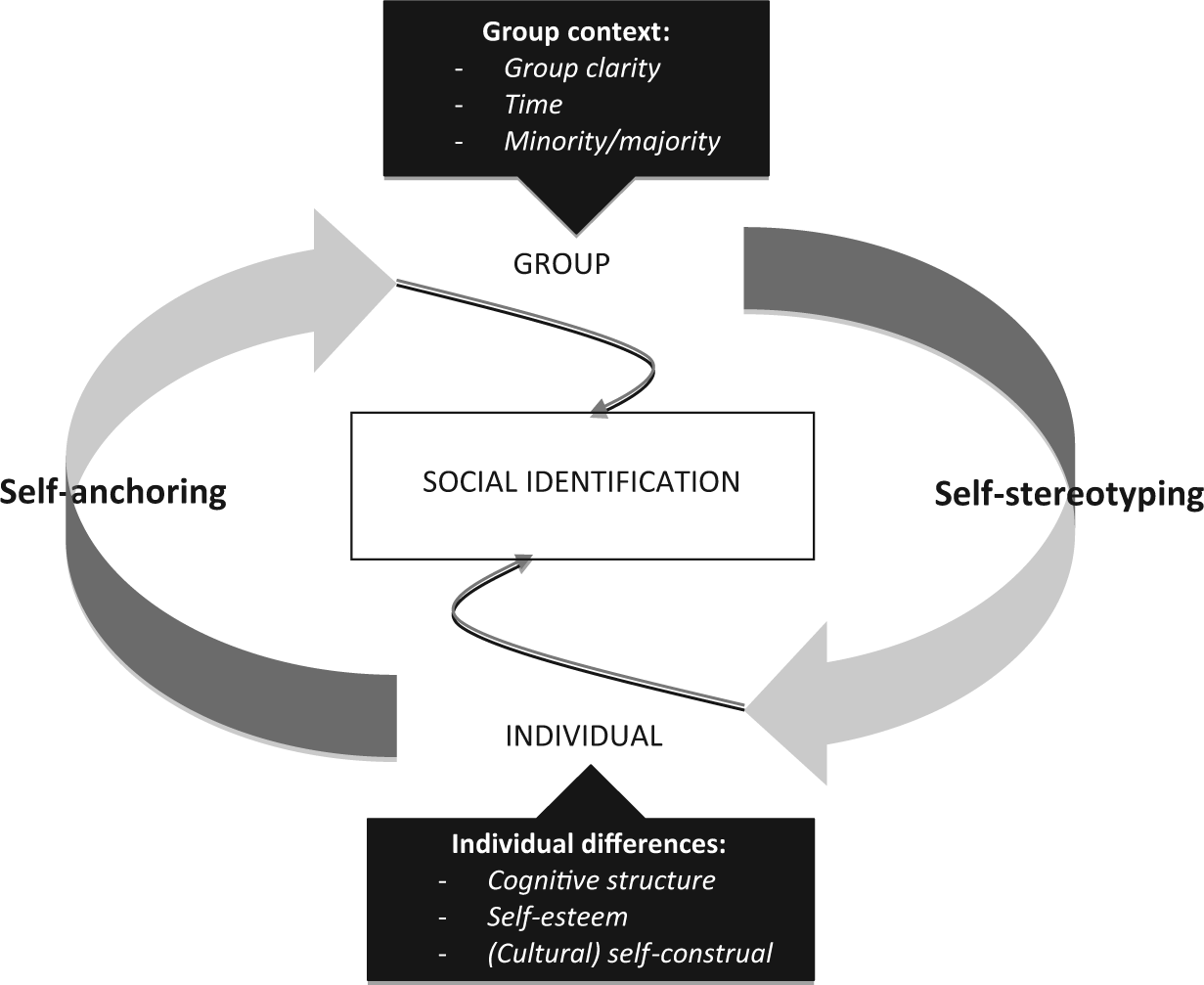
The Integrative Model of Social Identification (IMSI): Self-stereotyping and self-anchoring as two cognitive pathways.
Premises of the Model
The model is based on the premise that both self-anchoring and self-stereotyping are informational processes of “meaning making” that can mutually reinforce each other to dissolve cognitive ambiguities in the relation between the person and the ingroup (see also discussion in “Reconciling Self-Anchoring and Self-Stereotyping” section). This reasoning fits with induction–deduction principles (e.g., Cadinu & Carnaghi, 2015; Cadinu & Rothbart, 1996; Krueger, 2007). Specifically, self-anchoring follows the principles of inductive reasoning by Krueger and colleagues (e.g., DiDonato et al., 2011; Krueger, 2007). Here, the personal self is used as a sample of n = 1 to infer from what is known (i.e., the personal self) to the yet unknown (i.e., the ingroup representation). Self-anchoring is thus conceptualized as a process in which people project personal attributes onto an ingroup to fill “cognitive gaps” in the representation of the ingroup. Circumstances under which this is likely to happen is when there is uncertainty or lack of clarity about what the group identity stands for (Cadinu & Carnaghi, 2015; Van Veelen et al., 2013b).
In addition, in daily life, people often do not only have information about the personal self at their disposal but also information about shared behaviors, thoughts, and feelings as ingroup members (i.e., the social self). Following the principles of deductive reasoning, this means that stereotypical ingroup traits can also form an informational base (an additional sample) to make self–group inferences (Dawes, 1990). Thus, self-stereotyping is a process that is particularly likely to occur when stereotype-relevant ingroup information serves as a diagnostic tool to provide meaning to unknown or undiscovered parts of the self-concept (Van Veelen et al., 2011, 2013b). This latter reasoning also fits Uncertainty Reduction Model (URM; Hogg, 2007), such that self-stereotyping occurs to reduce uncertainty and give meaning to the self in social context.
Taken together, both the personal and the social self can serve as knowledge base to resolve cognitive ambiguities in the representation of the group or the person respectively. Our assertion is that when people successfully align the self-concept in relation to their ingroup—via self-anchoring or self-stereotyping—this forms the basis for their level of social identification. This assertion implies that the IMSI presumes that it is possible to have a causal path from self-anchoring and self-stereotyping as cognitive predictors to social identification as an outcome variable. This path is supported by cognitive appraisal theories also proposing a “first-cognition-then-affect” sequence to explain emotional responses (Frijda, Kuipers, & ter Schure, 1989). Moreover, it also fits the social judgability approach (Yzerbyt, Schadron, Leyens, & Rocher, 1994) stating that people need to have diagnostic information before they feel they can make social judgments.
In self-anchoring literature, this causal path is indirectly supported by research on ingroup favoritism in MGPs. Here, the personal self forms the only source of inference to provide meaning to a relatively unknown ingroup and to subsequently explain ingroup favoritism (e.g., Cadinu & Rothbart, 1996; Otten & Wentura, 2001). Based on this work, we assume that to the extent that the personal self provides meaning to unknown parts of an ingroup, it also enables members to identify, that is, attach affective significance to the group.
Similarly, for self-stereotyping, we assume that when an ingroup prototype provides meaning to unknown or undiscovered parts of the personal self-concept, this results in an affective bond with the ingroup. For example, people may decide to join groups because they expect these groups to bring certain valuable new elements to their self-concept. Through interaction and experience as ingroup members, ingroup prototypes become meaningful to the self (e.g., L. G. E. Smith & Postmes, 2011), and self-stereotyping becomes diagnostic of social identification. Supporting this assumption, empirical evidence from a recent longitudinal study showed that self-stereotyping among newcomers (Time 1) predicted identification after a socialization period, once group membership was well established (Time 2). No evidence was found for the reversed causal path (a longitudinal effect of newcomers’ social identification on self-stereotyping). These findings corroborate self-stereotyping as a possible predictor of social identification (Van Veelen, Hansen, & Otten, 2014).
Empirical Evidence
Particularly for the self-stereotyping and social identification link, the empirical evidence is remarkably scarce; many influential theories and models to understand group processes rely on this link to explain why people think, feel, and act on behalf of their ingroup. For example, URM (Hogg, 2007) assumes that people identify with groups via the assimilation to an ingroup prototype to reduce uncertainty about the self. Optimal Distinctiveness Theory (ODT; Brewer, 1991) assumes that people’s need to belong instigates the assimilation of the self to an ingroup’s prototype, which results in social identification (Leonardelli, Pickett, & Brewer, 2010). Finally, the Social Identity Model of Collective Action (SIMCA; van Zomeren et al., 2012) relies on SCT (Turner et al., 1987) to explain how people’s perception of self in ingroup terms enhances the willingness to act on behalf of their ingroup. Yet, the assumption that self-stereotyping forms the cognitive basis for social identification in these models was not empirically tested.
The first empirical studies on the self-stereotyping and social identification link focused on the relation between general indicators of similarity or prototypicality in the ingroup (as proxy for self-stereotyping) and social identification (Spears et al., 1997; Verkuyten & Nekuee, 1999). However, based on the measurement criteria above, we should interpret this evidence with caution, because general similarity measures do not disentangle self-stereotyping from self-anchoring processes. The first empirical evidence corroborating the link between self-stereotyping and identification, while taking into account methodological criteria, was provided by Latrofa and colleagues (see Table 1). They measured self-stereotyping among low-status groups (i.e., Southern Italians: Latrofa et al., 2009; women: Cadinu et al., 2012; Latrofa et al., 2010) and found a significant relation with identification. 7
The first empirical evidence for the self-anchoring and social identification link was provided in two studies using real groups (Dutch national identity: Van Veelen, Otten, & Hansen, 2010; Psychology students: Van Veelen et al., 2011, Study 1) and showed that projection of personal attributes to the ingroup positively related to social identification. This was the first evidence demonstrating a central role for the personal self in shaping a group bond. However, these studies did not focus on the joint impact of self-anchoring and self-stereotyping on identification. When individuals are given the opportunity to self-stereotype in real groups, does self-anchoring still uniquely contribute to social identification? In recent follow-up studies, self-anchoring and self-stereotyping were measured simultaneously, and results showed that both predicted a unique proportion of variance in social identification. These findings delineate that in real groups, where knowledge on group stereotypes is available, the personal self also plays a central role for social identification (Van Veelen et al., 2011, 2013b; Van Veelen et al., 2014).
Together, these findings provide support for the IMSI, in which both self-anchoring and self-stereotyping form cognitive paths to social identification. In contrast to earlier assumptions of SIT and SCT (e.g., Mullen, Migdal, & Rozell, 2003; Tajfel & Turner, 1979; Turner et al., 1987), the IMSI implies that the social and the personal self are not necessarily functionally antagonistic, existing at opposite ends of one continuum. Rather, they may exist on two separate continua and work together as two distinct sources of inference to create mental overlap and to identify with ingroups.
Moderators
We now apply the IMSI to different group contexts and individuals to outline the conditions under which either self-anchoring, self-stereotyping, or both may form the cognitive mechanisms to explain social identification levels. We argue that the relative impact of self-anchoring and self-stereotyping on identification varies depending on the extent to which group knowledge and/or self-knowledge allow for a meaning-making process. Specifically, self-stereotyping should be a cognitive explanation for social identification, when information about the group’s prototype is perceived as available and applicable to the self. In contrast, self-anchoring should be a cognitive explanation for social identification, when information about the personal self is available and applicable to an ingroup. When both self- and ingroup knowledge are available and applicable, both self-anchoring and self-stereotyping may simultaneously explain social identification. Conversely, when self- and ingroup knowledge are both absent, this may obstruct cognitive alignment of the self with the ingroup and result in low identification. Thus, application of the IMSI in various groups and among different individuals offers a framework to explain for whom (type of individual) and when (type of ingroup) the two processes function as cognitive catalysts for identification.
Group context moderators
In this section, we discuss empirical evidence on three group context variables expected to moderate the impact of self-anchoring and self-stereotyping on social identification in the IMSI, namely, clarity of a group’s identity content, time, and majority/minority position.
Clarity of a group’s identity content
A group is unclearly defined when there is no clear-cut knowledge available about the content of a group identity, whereas a clearly defined group context provides unequivocal knowledge about its identity content (see also Machunsky, Meiser, & Mummendey, 2009; Waldzus, Mummendey, Wenzel, & Weber, 2003).
In both the self-stereotyping and self-anchoring literature, there are indications that self-stereotyping plays a more important role in clearly defined groups, whereas self-anchoring does so in unclearly defined groups. Within the self-stereotyping domain, research has shown that a social category should be highly salient (Verkuyten & Nekuee, 1999), meaningful (Simon et al., 1997), and important (Pickett et al., 2002) for people to assimilate the self to the group prototype. Along this line, there is evidence revealing that for minority, or low-status, group members (for whom their group membership is generally highly salient [McGuire & McGuire, 1988] and meaningful [Simon & Hamilton, 1994]), prevalence of self-stereotyping is higher than for majority members (e.g., Cadinu et al., 2012; Latrofa et al., 2010; Spears et al., 1997).
Within the self-anchoring domain, a meta-analysis across 19 studies (Robbins & Krueger, 2005) indicated that the projection of personal attributes onto the ingroup (i.e., self-anchoring) is significantly higher in minimal groups (in which a group’s identity is absent or meaningless) as compared with real groups. Furthermore, research directly manipulating the clarity of a group’s identity content in both a minimal and a real group revealed that with decreasing levels of group clarity, the level of self-anchoring increased (Van Veelen et al., 2013b). Finally, Cadinu and Carnaghi (2015) compared self-anchoring and self-stereotyping levels in groups pilot-tested as being meaningful (i.e., women sorority, and left-handedness) and showed that in these meaningful groups, self-stereotyping prevailed over self-anchoring. This finding directly contrasts with results from Cadinu and Rothbart’s (1996) initial studies in minimal groups, in which self-anchoring prevailed over self-stereotyping.
All in all, these findings provide direct or indirect evidence that the ratio in explained variance of self-stereotyping relative to self-anchoring gradually increases as the content of an ingroup identity shifts from clear and well-defined, to ambiguous and ill-defined. An additional step is required to find out whether group clarity also affects how people identify. If self-information is more diagnostic to make inferences in unclearly defined groups, whereas group information is more diagnostic to make inferences in clearly defined groups, this implies that in clear groups, identification is most likely predicted via self-stereotyping, whereas in unclear groups, via self-anchoring. Direct evidence for this was provided in a study in which group clarity was manipulated and people’s levels of self-anchoring, self-stereotyping, and social identification were measured. Results showed that in the unclear group, self-anchoring most strongly related to identification, whereas self-stereotyping did so in the clear group (Van Veelen et al., 2013b). Thus, the impact of self-anchoring versus self-stereotyping on identification was moderated by group clarity.
Time
A second group context moderator in our model showing relevant links with the clarity of a group’s identity content is time. The IMSI assumes there are longitudinal changes in the role of self-anchoring and self-stereotyping for social identification. Remember Mark, the newcomer in an organization. As a new employee, one of his primary concerns is probably to get to know the organization and affiliate with his new colleagues (Tuckman, 1965). For new group members such as Mark, what it means to be a member of a new group is often quite unclear. There is still a lot to learn about the group, including its stereotypical characteristics and practices (Levine, Moreland, & Ryan, 1998). Consequently, new group members are often quite uncertain about what their new group identity stands for. Therefore, at an early stage of group membership, the scarcity of information about the group may lead newcomers to rely heavily on self-knowledge as a cognitive basis to create self–group overlap and identify highly with groups. We derive this reasoning from our prior discussion demonstrating that self-anchoring is more prevalent in ill-defined, minimal groups, compared with well-defined, real groups (Robbins & Krueger, 2005; Van Veelen et al., 2013b). At later stages, group members become more familiar with the group’s norms and values. Indeed, a longitudinal increase in familiarity with the group leads to greater accuracy of group stereotype estimations (Judd, Ryan, & Park, 1991; Ryan & Bogart, 2001). Thus, for full-fledged group members, prototypical characteristics of the group are likely more clear and can therefore be integrated in the self. For newcomer Mark, this implies that over time he can use not only self-knowledge (i.e., self-anchoring) but also group knowledge (i.e., self-stereotyping) to infer a self–ingroup bond and identify with his organization.
First empirical support for longitudinal changes in the impact of self-anchoring and self-stereotyping on identification was provided by a study investigating changes in group identity development among first-year psychology students (Van Veelen et al., 2014). Students filled out a questionnaire on identification with psychology students in the first month of their studies, and again after 6 to 7 months, when group membership was expected to be well established (Amiot et al., 2007). Results showed that among newcomers, self-anchoring predicted identification, whereas self-stereotyping did not. In contrast, after 6 months of socialization, self-stereotyping but not self-anchoring predicted social identification. These findings provide first support that newcomers in groups rely more heavily on their personal than the social self to identify with groups, and vice versa when group membership is well established.
Minority/majority position
Third, the role of self-anchoring and self-stereotyping for social identification may be different for members in a minority relative to a majority subgroup position. 8 Research has shown that when faced with identity threat, low-status minority members’ self-stereotyping positively relates to identification and subjective well-being, whereas no such effect was found for majority members (Latrofa et al., 2009, 2012). Thus, for minority, more than for majority members, self-stereotyping forms a good strategy to identify, to protect themselves against identity threat, and to re-affirm a positive subgroup identity and well-being (Branscombe et al., 1999). However, although self-stereotyping serves a protective function for minorities in their own subgroup, paradoxically, it also legitimizes minority members’ low-status position in the superordinate social hierarchy. To illustrate this, research revealed that the more both men and women attributed gender stereotypes to themselves, the more they legitimized status differences between men and women (Laurin et al., 2011). Thus, within the subgroup, self-stereotyping protects minority members’ well-being and identification, but in the superordinate social hierarchy, self-stereotyping justifies minority members’ unfair treatment and lack of inclusion relative to majority members.
The IMSI may shed more light on this negative effect of self-stereotyping for minority members’ identification with superordinate groups and puts forward self-anchoring as a potentially better alternative. Self-stereotyping relies on assimilation to a group prototype. Yet, the superordinate group’s prototype typically only fits with majority but not with minority members (see also ingroup projection; Mummendey & Wenzel, 1999). Thus, self-stereotyping likely works best as a cognitive route to identification for majority members and hinders minority members’ identification, as they are comparatively deviant from the superordinate group’s prototype. In contrast, with self-anchoring, prototypicality is no longer a relevant criterion to make social inferences, but the personal self is. Everyone has a personal self at his or her disposal, to infer a cognitive bond with a superordinate group. Indeed, people’s personal self forms a relevant sample of n = 1 to project to a superordinate category (Krueger & DiDonato, 2008; Riketta & Sacramento, 2008). Thus, self-anchoring may facilitate majority and minority members’ identification with a superordinate group.
First empirical support for the reasoning above was found in a study by Van Veelen, Otten, and Hansen (2013a). Here, participants were categorized in either a minority or majority subgroup position in the lab, and instructed to engage in either self-anchoring or self-stereotyping. Results showed that minority members’ identification with the superordinate group was significantly higher when they engaged in self-anchoring compared with self-stereotyping. For majority members, equal levels of identification were observed for both projection processes. Hence, the relative impact of self-stereotyping and self-anchoring on identification with superordinate groups was moderated by minority/majority position. This moderating effect rests on differences in perceived applicability of group knowledge to the self (and not availability as with the previous two moderators). Indeed, minority, more than majority members, indicated that self-stereotyping was difficult, suggesting that the group prototype did not fit their self-concept (Van Veelen et al., 2013a). These findings are highly relevant in today’s diverse society in which majority and minority subgroup members are required to co-exist within the same inclusive groups. Here, taking the personal (rather than the social) self as a starting point to make social inferences may allow all group members to belong while being different.
To conclude, group context moderators are important to understand the relation between self-anchoring, self-stereotyping, and social identification. The empirical evidence summarized above illustrates that our cognitive understanding of how people identify with groups largely benefits from a dynamic approach; different cognitive routes provide an answer to how people identify in different groups varying in the availability and applicability of group knowledge. Therefore, we encourage research on the IMSI to further understand and optimize identification processes in complex, diverse, or new groups.
Individual differences
Not only differences at the group level but also differences at the individual level may affect the role of self-anchoring and self-stereotyping for social identification. Do some people rely more heavily on their personal selves to make social inferences, whereas others rather infer who they are from generic representations of the social context? There is little research on how individual differences affect self-anchoring, and even less so on self-stereotyping. Next, we introduce three individual difference variables in the IMSI, which we assume to affect cognitive social inference processes, namely, the ability and need for cognitive structure, self-esteem, and (cultural) self-construal.
The ability and need for cognitive structure
In 1998, Stanovich was the first to examine the relationship between individual differences in cognitive ability and social inference processes, such as self-anchoring. However, he found no significant relation between the two. In reviewing this literature, Krueger (1998b) concluded that most people project from the self to groups, and some do it more than others, but that factors explaining these individual differences are still absent. In 2002, first empirical insights into individual differences in self-anchoring were reported by Otten and Bar-Tal; they found that people high in ability and need for cognitive structure self-anchor more.
From this evidence it seems that people who are able to process information thoroughly and in structured fashion to create certainty in their lives show a higher tendency to use the personal self as a source of social inference. In this case, people perceive self-knowledge as both applicable and available to make inferences about ingroups. Whether need and/or ability for cognitive structure are related to self-anchoring and self-stereotyping as cognitive paths to social identification is still unclear. To provide further insights into this matter, it is necessary to measure both self-anchoring and self-stereotyping simultaneously (a condition not met in the research by Otten & Bar-Tal, 2002). Such research could investigate how people with a low ability for cognitive structure create certainty and order in their lives. One could speculate that in this situation, rather than focusing on the personal self, people may reach out to the group prototype to make social inferences and create cognitive structure. This would be in line with URM’s (Hogg, 2007) proposition that identification via self-stereotyping reduces uncertainty and provides structure.
Self-esteem
Self-esteem is another individual difference variable that may affect people’s perceived applicability and availability of self-knowledge to make social inferences between the self and the ingroup. First evidence for this premise was provided by Gramzow and Gaertner’s (2005) Self as Evaluative Base (SEB) model. In four experiments with minimal groups, these authors demonstrated that personal self-esteem enhanced positive ingroup evaluations (relative to outgroup evaluations), independent of the valence of the group context (ingroup and outgroup were objectively the same), independent of cognitive information processing, and independent of other individual difference variables (i.e., right-wing authoritarianism, narcissism). Later research further showed that global self-esteem contributes to ingroup favoritism specifically through its association with the trait-based positivity of the self-image (DiDonato et al., 2011).
Potentially, these findings imply that those with high personal self-esteem also identify more strongly with groups via self-anchoring. We know from recent research that particularly among high identifiers of a minimal group, self-esteem was positively related to intergroup bias, a process that Roth and Steffens (2014) call associative self-anchoring. Yet, the role of personal self-esteem in the relation between self-anchoring, self-stereotyping, and identification has not been investigated so far. Therefore, we encourage further research on the application of this individual difference variable in the IMSI.
Self-construal
Finally, people’s level of self-anchoring or self-stereotyping and its implications for social identification may also vary depending on whether people construe their self-concepts based on personal goals, values, and characteristics, or based on group goals, values, and characteristics. Self-construal is an individual difference variable that refers to the content of self-knowledge and therewith to the type of information that is available about the self. A large body of research revealed that within and across cultures, people vary in how they construe themselves as a unique individual, independent of their social context, or as interdependent social being, embedded in the social context (e.g., M. Becker et al., 2012; Brewer & Roccas, 2001; Markus & Kitayama, 1991; Singelis, 1994).
Thus far, little research has been conducted on how variations in self-construal affect people’s social identification processes. Prior research has shown that with individualism, judgment and causal inference are oriented to the person as the unit of analysis, whereas with collectivism, judgment and causal inference are oriented to the social context as the unit of analysis (Choi, Nisbett, & Norenzayan, 1999). Thus, one may assume that because identification via self-anchoring places such high emphasis on the personal self, this process requires an individualistic, independent self-concept. To the contrary, because identification via self-stereotyping places emphasis on assimilation and conformity to the group, it requires a collectivistic, interdependent self-concept. A first indication for this idea was found by Van Veelen et al. (2011), who investigated the relationship between self-anchoring, self-stereotyping, social identification, and people’s self-concept stability. Self-concept stability refers to the extent to which individual self-concepts are stable and accessible across different situations and in interaction with different people (Kernis & Goldman, 2005), and thus to an independent self-construal (Singelis, 1994). Two studies demonstrated that those with highly stable self-concepts identified via self-anchoring (Studies 1 and 2), but not via self-stereotyping (Study 2; Van Veelen et al., 2011). These findings suggest that differences in self-construal may form an important explanatory factor in relation to the two cognitive pathways to social identification. However, the picture of this dynamic is still far from fully painted, and future research is required. For example, one could focus on manipulating self-construal based on “I” versus “we” primes (Gardner, Gabriel, & Lee, 1999; Oyserman & Lee, 2008), or study the effects of self-anchoring and self-stereotyping cross-culturally, to unravel the cognitive pathways to identification in individualistic versus collectivistic cultures. Thus far, the empirical evidence is promising and suggests a relevant area for further research.
Overall, the group and individual difference moderators in the IMSI delineate the importance of a dynamic approach to understand how people identify with groups. In future research, we encourage investigating group and individual differences together in one study. The extent to which people rely on the personal self or the social self to identify with their ingroup is likely to be determined by the dynamic interplay between individual and group differences in the availability and applicability of self- and group knowledge.
Implications and Future Perspectives
In this review, we presented the IMSI. We demonstrated the conditions under which self-stereotyping, self-anchoring, or both positively relate to identification with ingroups. The IMSI is grounded in a review of theory and research on self-anchoring and self-stereotyping. We tackled theoretical and methodological challenges to allow for the joint investigation of self-anchoring and self-stereotyping as two complementary processes to social identification. Theoretically, our model delineates how, by the principle of meaning making, both the social and the personal self may function as cognitive mechanisms to identification. Methodologically, our measurement criteria lay the groundwork to substantially facilitate and improve research designs that aim to integrate self-anchoring and self-stereotyping for their impact on group phenomena. Finally, the model’s application to different types of groups and individuals sets the stage for future research to explore the dynamic interplay between the individual and the group.
Personal and Social Self
The IMSI adheres to the increased interest in the role of the personal self in social identity research (Brewer & Roccas, 2001; Jans, Postmes, & Van der Zee, 2011; Jetten & Postmes, 2006; Postmes, Spears, Lee, & Novak, 2005; Sedikides & Brewer, 2001). To understand how people function as ingroup members, we argue that it is important to consider both the personal (individual) self and the social (collective) self. This denotes an interactive view of the personal and the social self, in relation to social identity processes (Deaux, 1993; Eidelman & Silvia, 2010; Reid & Deaux, 1996). Also, the idea that the personal and social selves complement each other to create self–group overlap and to facilitate social identification forms a new, different view on classic SCT assumptions, in which both exist as opposite ends of a continuum (e.g., Turner et al., 1987).
In our research, we generally find a positive correlation between self-anchoring and self-stereotyping: High identifiers use both pathways to create self–group overlap. Yet, there are variations in the strength of associations between the two across studies. For example, in the study on newcomers’ identification, the correlation between self-anchoring and self-stereotyping was substantially lower at the beginning of group membership than after 6 months of socialization (Van Veelen et al., 2014). This finding suggests an interesting link to a recently growing literature on identity fusion (Swann, Jetten, Gómez, Whitehouse, & Bastian, 2012). Identify fusion implies that sometimes, personal and social selves collide completely. In other words, “I becomes we” and vice versa. Presumably, when the lines between social and personal selves are blurred, self-anchoring and self-stereotyping show high multicollinearity despite efforts to methodologically disentangle both. Nevertheless, in our studies, intraindividual measures of self-anchoring and self-stereotyping have always explained unique variance in social identification, thus capturing the unique contribution of the personal and the social self. Future research should investigate when the association between self-anchoring and self-stereotyping is such that it would qualify as a fused identity.
Advancing Social Identity–Based Theories
The IMSI further advances theories and models relying on self-stereotyping principles to social identification. In most social identity research, it is assumed, at least implicitly, that a group member strongly assimilating the self to ingroup norms (i.e., self-stereotyping) is a high identifier, whereas a group member deviating from ingroup norms is a low identifier (e.g., Ellemers et al., 2002). However, recent research demonstrates that people can be loyal to their ingroup (Hornsey & Jetten, 2005) or identify strongly with their ingroup (Packer, 2008) without necessarily conforming to ingroup norms. Our model subscribes to this idea and offers a cognitive explanation for how non-conforming, but highly identified group members may identify: via self-anchoring. Self-anchoring allows to create a cognitive self–group bond via the personal self, without the necessity to assimilate to group norms. One could even speculate that those who self-anchor are particularly mindful about the problems that current group norms pose to the ingroup and aim to re-shape and negotiate ingroup norms to stimulate social change (L. G. E. Smith, Thomas, & McGarty, 2014).
As stated before, URM (Hogg, 2007) assumes that people’s need to reduce uncertainty about themselves leads to social identification via self-stereotyping. Our model is in line with this assertion, but also suggests that uncertainty may not only reside in ourselves but also in our ingroups. Some groups provide little certainty on how to define the self in that social context (i.e., minimal, complex, diverse groups). In these groups, uncertainty may be reduced through self-anchoring. Indeed, in groups lacking clarity on their identity content, identification increases in response to self-anchoring (Van Veelen et al., 2013b). Further research should focus on the interplay between uncertainty at the personal and the group levels in relation to cognitive mechanisms to explain identification in our integrative model.
Finally, in the SIMCA (van Zomeren et al., 2012), social identification is an important predictor for collective action. One might speculate that self-anchoring and self-stereotyping have different consequences for the kind of collective action highly identifying group members engage in. With self-stereotyping, identification is based on assimilation to shared ingroup norms. Hence, the kind of collective action may relate to preserving current group norms and status quo. In contrast, with self-anchoring, a group bond is based on projection of personal attributes. Perhaps those who highly identify via self-anchoring are more likely to initiate collective action to change the current group norms and status quo. This idea forms an interesting venue for further research.
Alternative Pathways
In the IMSI, a principle of meaning making serves as a basis for self-stereotyping and self-anchoring as cognitive pathways to social identification. This principle is also put forward in work on creative distinctiveness (Spears, Jetten, Scheepers, & Cihangir, 2009) to explain positive ingroup bias in minimal groups. Spears and colleagues argue that to positively evaluate a minimal ingroup, one seeks to define the meaningless ingroup based on differentiation with what “we are not” (the outgroup). This alternative explanation implies that the positive affect we feel toward our ingroups is highly dependent on the presence of an outgroup. In the IMSI, we take an intragroup perspective and argue that we do not necessarily need outgroups to attach positive significance to our ingroups (see Gaertner, Iuzzini, Witt, & Oriña, 2006; Otten, 2002, for similar views). Rather, social identification can be explained based on the mere relationship between self and ingroup.
In line with cognition-based models of social inference (Dawes, 1990; DiDonato et al., 2011), the IMSI assumes that self-anchoring and self-stereotyping are cognitive processes of meaning making. Hence, group and individual moderators in the model focus on availability or applicability of self- and group information that allows for a cognitive meaning-making process. Nevertheless, an interesting venue for future research could be to expand the IMSI to include motivational aspects as well (Easterbrook & Vignoles, 2012; Machunsky, Toma, Yzerbyt, & Corneille, 2014). Currently, the model outlines that meaning making in groups may be resolved through social inference and result in higher identification. How self-anchoring and self-stereotyping might be driven by motivational needs is still unexplored. From the Optimal Distinctiveness Theory (Brewer, 1991), we know that belongingness needs are fulfilled through self-stereotyping. Work by Locke, Craig, Baik, and Gohil (2012) showed that high belongingness needs result in strong projection of personal preferences onto others. Moreover, in recent unpublished data, we found that the need to belong was positively related to both self-anchoring and self-stereotyping (Van Veelen, Hansen, & Otten, 2015). This work forms a starting point to understand how motivations may enrich the IMSI.
The IMSI assumes that the level of self-anchoring and self-stereotyping can predict the level of social identification. This assumption is supported by initial empirical evidence (Van Veelen et al., 2014). At the same time, we do not wish to rule out the possibility for a reverse causal sequence. Particularly in the self-stereotyping literature, scholars would argue that when an ingroup identity is highly salient (Haslam, Oakes, Reynolds, & Turner, 1999; Spears et al., 1997) or threatened (Latrofa et al., 2010), high identifiers are particularly motivated to self-define in terms of ingroup stereotypes. We agree that situational salience of an ingroup identity can temporarily increase the tendency to self-define as a stereotypical ingroup member. However, temporal in(ter)group salience does not explain how those high identifiers incorporated the ingroup as a part of the self-concept in the first place. IMSI focuses on a more stable, long-term process of identification rather than short-term changes in perceived self-prototypicality in response to (inter)group events. Therefore, for the purposes of our model, the personal and social selves are positioned as cognitive building blocks to social identification. Our longitudinal study provided first evidence for this causal link (Van Veelen et al., 2014), but thus far, most studies are correlational and cross-sectional. It is therefore important to conduct more longitudinal and experimental studies to investigate the causal flow between self-anchoring, self-stereotyping, and social identification more thoroughly.
Our model may be highly relevant to understand fluctuations in social identification levels in response to group identity changes over time. There is relatively little research about consequences of change in a group’s prototype for social identification. From the organizational literature we know that company mergers lead to a new overarching group identity in which some aspects remain, whereas others change (van Leeuwen, van Knippenberg, & Ellemers, 2003). Change is also studied in the context of schisms or the separation of a subgroup, because the core of a group identity changes (Sani & Reicher, 2000). In essence, in a context of change, some group members’ identification levels rise, whereas others start to disidentify. To date, empirical studies on the intraindividual cognitive mechanisms that explain such changes are absent. For example, it is assumed that people disidentify because of a cognitive misfit between core aspects of the personal self and the group (J. C. Becker & Tausch, 2014). To test this, we believe that the IMSI may form a good basis.
Finally, we define social identification as a general construct, focusing on the overall level of affective significance people attach to their ingroup, without specifying between different subcomponents of identification (see also Cadinu, Latrofa, Carnaghi, 2013). IMSI is a complex model to understand antecedents of social identification, and it is applicable in many different types of groups. The utility of such complex model asks for a simple construct of social identification (e.g., Reysen, Katzarska-Miller, Nesbit, & Pierce, 2013). Indeed, most scholars define and operationalize social identification as a single construct for practical reasons, and/or because their hypotheses do not differentiate between subcomponents (e.g., Latrofa et al., 2010; Riketta, 2005; Rockmann, Pratt, & Northcraft, 2007; Spears et al., 1997). Therefore, we consider a general construct of social identification as suitable and valid for the theoretical and practical purposes of IMSI. Nevertheless, in prior literature, several models demonstrated the multicomponent nature of social identification (Ashmore, Deaux, & McLaughlin-Volpe, 2004; Cameron, 2004; Leach et al., 2008 9 ; Roccas, Sagiv, Schwartz, Halevy, & Eidelson, 2008), differentiating, for example, between the importance to, satisfaction with, or loyalty to the group. In future research, the IMSI could be tested on the relevance of self-anchoring and self-stereotyping on these specific subcomponents of social identification.
Inclusive Intergroup Relations
Otten (2005) discussed possible consequences of self-anchoring and self-stereotyping for the perceived variability in perceptions of the ingroup’s identity. With self-anchoring, arguably there should be variability in ingroup judgments across group members (i.e., heterogeneity). In contrast, because self-stereotyping is based on the premise that a consensual ingroup prototype is available, this process should reflect relatively little intragroup variability (i.e., homogeneity) in ingroup judgments. Such difference in variability of a group’s identity representation may be highly relevant and consequential for how people cognitively adapt to an increasingly complex, diverse society, and how intergroup relations may be improved within diverse groups (Crisp & Meleady, 2012). Potentially, a shift from the social to the personal self in inferring a self–group relation in a diverse group increases people’s perceived level of complexity within a group identity (see also Crisp & Hewstone, 2007). Results from a recent study addressing this issue (Van Veelen, Otten, & Hansen, 2014) indeed reveal that self-anchoring leads to a more inclusive and tolerant perspective on group diversity, whereas self-stereotyping fosters similarity-based “us” and “them” thinking, and intergroup bias. So far, this research has been limited to laboratory groups, in which diversity was based on a single category dimension. We encourage future research to focus on more complex, multiple group categorizations (Crisp & Hewstone, 2007), and natural group settings such as multicultural societies (Verkuyten, 2005) or organizations (van Knippenberg, De Dreu, & Homan, 2004) to investigate how a cognitive bond with diverse groups can best be achieved.
Conclusion
The IMSI demonstrates that people’s level of social identification is based on two cognitive mechanisms: self-stereotyping and self-anchoring. The model is grounded in empirical findings and offers innovative theoretical and practical implications for future research. The core premise of the model is that the social and the personal self complement each other as cognitive mechanisms fostering social identification. Integrating self-anchoring and self-stereotyping into one research model provides new theoretical insights into how people identify with groups. Finally, unraveling group and individual moderators in our model allows for a dynamic understanding of why some do, and others do not identify, why people can belong to ingroups without necessarily conforming to group prototypes, and how people may cognitively adapt to an increasingly complex and diverse social environment. This is a promising start. Research on the integrative role of self-anchoring and self-stereotyping will hopefully flourish in the future.
Footnotes
Acknowledgements
We would like to thank Anne Maass for her valuable contribution to this article, specifically for her help with formulating the methodological criteria and the set-up of the theoretical model.
Declaration of Conflicting Interests
The author(s) declared no potential conflicts of interest with respect to the research, authorship, and/or publication of this article.
Funding
The author(s) received no financial support for the research, authorship, and/or publication of this article.