







Abstract
The mainstream epistemology of social psychology is markedly ahistorical, prioritizing the quantification of processes assumed to be lawful and generalizable. Social psychologists often consider theory to be either a practical tool for summarizing what is known about a problem area and making predictions or a torch that illuminates the counterintuitive causal force underlying a variety of disparate phenomena. I propose a third vision of critical-historical theory. From this perspective, theories should be committed to deep interdisciplinarity and historical validity claims—understanding individual and group experiences as part of historically contingent forces. Theories also should be critical, containing an awareness of the researcher as implicated in the social process and committed to actively improving society. To demonstrate its viability, I review classic works from the history of the discipline that exemplify critical-historical theory and offer concrete implications for theorists interested in employing this approach in their own work.
Theory is the net man weaves to catch the world of observation—to explain, predict, and influence it . . . Data from the world of observation must be enmeshed in a web of ideas if there is to be a significant scientific yield.
Theory is not a storehouse of hypotheses on the course of particular events in society. It constructs a developing picture of society as a whole, an existential judgment with a historical dimension.
An initial thought experiment will illustrate the workings and lacunae of standard approaches to theorizing in social psychology. A social psychologist is tasked with understanding social class differences in a contemporary Indian city. They have been given a large amount of psychological data from individuals across the social class spectrum: some respondents live in slums with inadequate sanitation, and others are experiencing social mobility working in international call centers and at Western-oriented colleges. The question is: How would the social psychologist use theory in interaction with these data and this research problem?
I propose this theorist would likely proceed along one of three broad lines of approach. One social psychologist might use theory as a tool to tackle the problem of persistent social class differences in urban India, posing a central empirical question: “What psychological forces can be marshalled to move more lower-class individuals into better-paying occupations in global companies?” They would proceed to develop a set of systematically formulated hypotheses taking into account everything discernible from the data about the causal forces pertaining to this question. They would also incorporate whatever constructs and relationships are known from prior relevant literature. For instance, drawing on research concerning individualism-collectivism (Hofstede, 1980), construal level (Trope & Liberman, 2010), and person-environment fit (Edwards & Shipp, 2007), they might propose the “globalization orientation model” to catalog factors that encourage or inhibit worker success in an international company. This model would organize the data and make predictions, such as—for instance—greater collectivism in lower class Indian contexts instills more concrete cognitive styles, which conflict with the abstract cognitive tasks required in the global company workplace. Experiments and intervention studies would be enumerated to increase abstract thinking styles among lower class Indian workers.
Given the same data and problem, another social psychologist might use theory differently: as a torch to illuminate otherwise hidden sources of the class disparities in urban India, refracting them in light of universal aspects of the human condition. This theorist would not emphasize any unique qualities in the modern Indian context, nor would they focus on applying theory to a particular practical dilemma. Instead, they would understand the “noise” of the cultural, linguistic, and sociopolitical context as a superficial layer masking ubiquitous and deep-seated psychological processes. For instance, this theorist might interpret the different behaviors of lower and upper class urban Indian residents as yet another manifestation of evolutionarily evolved “fast” and “slow” strategies within the framework of life history theory (Griskevicius, Tybur, Delton, & Robertson, 2011; Neuberg & Sng, 2013). From this perspective, the lower class people in this context grew up in “harsh” and “unpredictable” environments characterized by mortality cues to which they adapted by pursuing high-risk behaviors geared toward reproductive quantity (e.g., earlier pregnancies); by contrast, the upper class people adapted to their more predictable environment by investing in delayed-reward behaviors with stable payoffs (e.g., building social capital). For this theorist, the failure of lower class urban Indian residents to attain social mobility is unsurprising, given evolutionary imperatives.
Although these two theorists might develop or apply different kinds of theories, with different kinds of aims, ultimately they would concur on the true test of their theory: Whether it generates predictions that withstand empirical verification using quantitative methods. Now, consider a third approach to theorizing, the one actually taken to these data by psychologist Sunil Bhatia (2018). He does not construct a theory of how to influence lower class (Indian) mentalities to enter the global workforce, nor does he interpret urban Indian experience as a test case through the lens of a universalistic framework. Instead, he crafts a holistic, historical account of how disparities in urban India originated and have been exacerbated as a result of the political-economic movement known as neoliberalism (Harvey, 2005). Since the late 1970s, the global capitalist class and political leaders have actively worked to maintain Western economic dominance and to deregulate and globalize markets, resulting in the gross national income (GNI) of the “Global North” dramatically increasing relative to that of the “Global South” in proportion to the unequal flow of income into the United States (Dicken, 2007; Duménil & Lévy, 2011). As Bhatia (2018) documents, the neoliberal movement has had massive effects on Indian society especially since the 1990s and created a polarized environment in which upper class youth increasingly aspire to global lifestyles of conspicuous consumption, while 40% of the population lives in poverty. Based on his data, Bhatia (2018) develops a theoretical account of Indian society understood in historical terms, with the ultimate goal of identifying pathways for major structural change to reduce local and global income disparities. In doing so, he is also compelled to critique the mainstream theoretical approaches to culture and poverty described above, insofar as they ultimately contribute to a body of decontextualized empirical findings, rather than employing theory to directly engage with this sociohistorical context of human suffering.
Nearly half a century ago, Kenneth Gergen (1973) argued that all of social psychological research is history. I am going to argue the opposite with regard to theory in social psychology—that none of mainstream social psychological theory is history. The mainstream “tool” and “torch” approaches illustrated in this example have a primarily a-historical orientation, emphasizing the establishment of presumably universal causal “laws” for empirical test. Yet, there is a strong alternate tradition in the discipline—exemplified by Bhatia’s approach—of what I call critical-historical theory. Articulating this critical-historical approach, and considering its strengths and weaknesses vis-à-vis mainstream epistemology, stands to create a more balanced view of theory in the discipline. I will achieve this by first considering the mainstream epistemology in social psychology and its origins in the writings of Kurt Lewin. I will then present the alternate epistemology of critical-historical theory by describing its roots in the writings of social theorist Max Horkheimer and reviewing exemplary works from the annals of social psychology.
The Mainstream Epistemology of Social Psychology
Compared to scholars in other disciplines, social psychologists are reticent to explicitly formulate their epistemological views. Discussions of theory in the discipline often barely broach philosophical issues, reading instead as “how-to” guides for the methodology of theory construction. McGuire (1997) lists a number of heuristics for hypothesis generation, Kruglanski (2001) contends that “theory workshops” should be offered to young social psychologists, Higgins (2004) compares theories to children and offers “parenting advice” on how they should be treated, and Gray (2017) recommends the use of “theory maps.” On those rare occasions when the purpose of theory is explicitly discussed, it is usually in terms of the kinds of explanations theories should offer. It is argued that theories should be broad or parsimonious, explicit and mathematically precise or providing novel predictions, and falsifiable or offering logically coherent accounts. It does not take much thought to recognize that some of these expectations can be contradictory (Coan, 1979).
I propose that most social psychologists have unquestioningly inherited an epistemology that is a strange brew of logical empiricism (like that of the “Vienna Circle”; see Cahan & White, 1992) and Popper’s (1985) ubiquitous fallibilism. Although it is rarely explicitly formulated, one could argue that this blend represents a remarkably dominant epistemology. I will refer to it as the “mainstream epistemology” of social psychology, characterizing especially research conducted with convenience samples in WEIRD settings (Henrich, Heine, & Norenzayan, 2010), published in the major journals of the discipline (e.g., Journal of Personality and Social Psychology), and rooted in the “canon” of U.S. social psychological theorizing (e.g., Allport, Lewin and his students).
Kurt Lewin (1931/1935) did much to inaugurate the mainstream epistemology when he distinguished between an Aristotelian and a Galilean approach to science and moved psychology toward a more Galilean approach (Marrow, 1969). According to Lewin, an Aristotelian approach is characterized by obfuscating “value concepts” and a counterproductive “historic-geographic” stance on validity (in other words, Aristotelian theorists judged the importance of phenomena in terms of their observed frequency in the world). By contrast, Galilean science emphasized the uncovering of the “situational dynamics” that determined the occurrence of a phenomenon and operated on an assumption of “exceptionless lawfulness” (in other words, causal events demonstrated in the “possible” world of the lab were assumed to operate similarly across external contexts). In Galilean science, the goal is not to assess the frequency of events in the (historical) world, but rather to identify what Wicklund (1990) refers to as psychological forces or simply variables. To this day, arguably what unites the otherwise disparate content of the theoretical perspectives in social and personality psychology is the common emphasis on studying (presumably transcendent) variables (Schiff, 2017); the intellectual process of specifying variables and their effects is usually what social psychologists refer to as “theory-building.” 1
Lewin had a tremendous influence on the development of the mainstream epistemology, not only through the large number of students he trained but through his becoming the “archetype” of the modern experimental psychologist (Patnoe, 1988). The key to Lewin’s influence is that he united several disparate scientific tendencies: he insisted applied research should be theoretically informative and vice versa (Marrow, 1969). It should be borne in mind that social psychology developed in a context where studies of group dynamics and personal motivation were largely funded by industries interested in increasing worker productivity (Adelman, 1993; Gillespie, 1991; Weisbord, 2004). Lewin was the perfect figure for his moment: He argued it was straightforward to cross the lines between theory-focused or laboratory work and field studies of social problems. His assumption of “exceptionless lawfulness” sanctioned the belief that processes observed in a simulated classroom or a particular factory would apply similarly in a variety of types and levels of environments (e.g., a democratic vs. authoritarian classroom operates in the same way as a democratic vs. authoritarian society).
Lewin’s choice of Galilean science as the model for social psychology was no accident, bringing social psychology in line with the worldview of contemporary natural science (Brannigan, 2004). Galileo is the figure associated with shifting inquiry toward the attainment of an “Archimedean point” through experimentation that would define natural laws: In the experiment man realized his newly won freedom from the shackles of earth-bound experience; instead of observing natural phenomena as they were given to him, he placed nature under the conditions of his own mind, that is, under conditions won from a universal, astrophysical viewpoint, a cosmic standpoint outside nature itself. (Arendt, 1958, p. 265)
Psychology has perhaps excelled among the sciences in the ardor of its attempt to attain such a universal, transcendental standpoint. Because of this, as Bruner (1990) recognized, Lewin’s Galilean program helped usher in a disciplinary tradition of dual distrust of culture and history. Culture is distrusted because it is the perspective-dependent record of what people say about what they do, and history is the transient record of what has occurred in nature, unable to supply a clear path for controlling nature in the future. In contrast to the subjectivist, teleological explanations offered by culture and history, Lewin’s Galilean approach insists on the superiority of causally predicting future behavior, to master the social world.
Since Lewin’s day, theorists working within the mainstream tradition have elaborated on these Galilean principles and (largely implicitly) adopted two primary approaches to theory construction. As illustrated by my opening example, there is first a pragmatic approach that views theory as a tool to solve delimited problems. A good contemporary explication of the tool-type view can be found in Schaller (2016), and a prototypic example of such a theory would be the elaboration likelihood model of persuasion and attitude change (Petty & Cacioppo, 1986). 2 According to this view, a theory is basically a storehouse of insights, a time-saving heuristic device. Theories gather together all the relevant propositions that are necessary to understand a particular problem area, such as how to motivate lower class people to attain jobs in international companies. The purpose of the theory is to parsimoniously explain most if not all relevant findings in this area and to allow researchers to make confident predictions regarding how any set of relevant variables will operate. Accordingly, such theories tend to focus on fairly proximal and situation-specific mechanisms; theorists are not likely to claim that their propositions will apply across a wide range of social situations beyond the one for which the theory was originally designed. Proponents of this view are likely to praise the explicit—if possible, mathematical—formulation of theories, which they judge primarily on their adequacy to the problem base and logical consistency. Once a theory has begun to triangulate on a particular carving of the phenomenon—a set of axioms and experimental findings—the enumeration and explication of processes for their own sake, regardless of external applicability, often becomes the goal (Mook, 1983). Additional statements are added to the theory and additional studies run not to solve new practical problems, but to fill apparent logical gaps, identify boundary conditions, and in general to produce a coherent set of “explicitly articulated . . . depersonalized statements that follow from the systematic application of ‘if-then’ logic” (Schaller, 2016, p. 110). Theory and data become an enclosed world unto themselves; each theoretical statement requiring a supporting experimental demonstration, each experiment reducible to a theoretical statement.
However, there is a “broader” approach that views theory as a torch which casts light on a wide array of seemingly disparate phenomena, revealing latent isomorphism beneath manifest layers of difference. The torch-type view can best be encapsulated by considering Plato’s allegory of the cave: humans spend most of their lives unaware of the true nature of the world and the causes of their behavior; they perceive the surface, illusory qualities of events without penetrating to their true origins (“shadows” on the wall of a cave where we are tied with our backs to the fire). Following the allegory, theory operates as a “torch” that sheds light on the hidden reality beneath the surface of daily life—its primary function is to penetrate the layer of perceptual illusion and reveal Platonic “essences,” the common processes to which a variety of disparate phenomena can be reduced. When the contemporary experimental method cast new Cartesian doubt on the veracity of people’s intentional and teleological explanations for their behavior, theorists were free to reinvigorate any of the 19th century candidates for the true cause of all human striving (what Allport, 1985, called “simple and sovereign theories”)—be it Darwinian biologism (e.g., game theory; Curry, 2016), Marxist class consciousness (system justification theory; Jost & van der Toorn, 2011), or existential threat (terror management theory; Greenberg, Pyszczynski, & Solomon, 1986). Despite their differing preferred causal variables and levels of analyses, all these perspectives share a torch-type essence, claiming that people do not understand the true source of their attitudes and behaviors, which can be causally explained by a few distal factors.
It is important to delineate between these two approaches to theory because epistemological debates in social psychology often devolve into arguments over their differential merits, arguments that nevertheless remain within the bounds of the underlying mainstream epistemology. 3 Tool-type theorists stress the logical coherence of their theories, the extent to which all aspects of a phenomenon are accounted for and the extent to which the theory can integrate all the empirical data available on the subject. Torch-type theorists stress the values of reductionism and generativity: theories are useful, from this perspective, to the extent that they reduce a wide range of “surface” phenomena to a common core process and that predictions can be generated across an ever expanding array of domains. Torch-type proponents write critiques of the field arguing for less mundane attention to practical problems and for the development of grander, integrative perspectives (e.g., Moscovici, 1972), whereas tool-type proponents write critiques urging theorists to more clearly specify rigorous, depersonalized logical sets (e.g., Schaller, 2016), and, occasionally, requests are made for theorists to do both simultaneously (Muthukrishna & Henrich, 2019). These debates are often cast in terms of the conflict between explanatory breadth (torch-type) and predictive power (tool-type; Trafimow & Uhalt, 2015). In some instances, entire areas of inquiry may become partly bogged down in such cyclic debates, as I would argue is the case in the competing theories of moral cognition proposed by Haidt and colleagues, on the one hand, and Gray and colleagues on the other. 4
I am not advocating in any way that either tool- or torch-type theories are inherently superior, nor that both are fundamentally deficient. Indeed, social psychology would benefit from a healthier respect for epistemological eclecticism. Different types of theories may be primarily appropriate for different kinds of problems, and some of the theories mentioned have achieved their aims to a remarkable degree. What is important in the present context is that despite their different orientations, tool- and torch-type theories both spring from the mainstream epistemology, and differences between them are more of degree than of kind. The result is that debates and prescriptions regarding theory leave the fundamental Lewinian-Galilean assumptions intact, walling off many researchers and theorists from the alternate critical-historical approach that has a rich tradition within, and stands to further enrich, our discipline.
Both tool- and torch-type theories share the assumption that subjectivist explanations, including those of the observer, cannot be trusted; biases must be checked by methodological controls in pursuit of the universal, Archimedean point (Kruglanski & Orehek, 2009; Washburn, Morgan, & Skitka, 2015). Mainstream social psychologists are wary of research that appears too “applied” or too “political,” as well as work that strays from causal explanations and explores the “noise” of people’s transient experiences (Shweder, 1995). The mainstream epistemology is also embedded in an empirical logic of quantification, suggesting theoretical propositions “hit bedrock” when they can be converted into continuous variables, because lay or intuitive descriptions of phenomena are considered either too imprecise and incoherent or misguided rationalizations. This mistrust of language extends beyond methodology to meta-theory: mainstream theorists tend to be suspicious of theoretical formulations that are “imprecise” and “go beyond the data” (Gawronski & Bodenhausen, 2015).
As Bruner (1990) noted, this mistrust of intentional and teleological explanations extends to disinterest in cultural and historical factors. Discussion of history is not entirely absent from mainstream theories, but when it occurs it tends to ironically suppress the importance of contingent historical forces. When mainstream theorists invoke historical data, they often do so to achieve one of the following, largely anti-historical aims: (a) to validate a general principle (e.g., Allport’s, 1979, use of the example of anti-Semitic prejudice in the United States to validate the principle that prejudice is contingent on historical change and norms), (b) to provide support for a hypothesis to be tested empirically (e.g., Festinger, Riecken, & Schachter’s, 1956, review of the historical literature on failed prophecies), or (c) to establish the existence of a “culture-transcendent” factor (e.g., Sidanius & Pratto’s, 1999, use of ethnographic evidence to suggest that tendencies toward hierarchical domination are ubiquitous in human societies). To the extent that history has been represented at all in contemporary social psychology, one would think that it basically consisted of World War II and desegregation in the United States (and, arguably, the inventions of television and the Internet). Mainstream social psychology has received a few bursts of inspiration from major (but geographically limited) historical events, but these are subsequently “assimilated” and reduced to paradigms that are metastasized into human universals. A trained social psychologist may know very little about the concrete historical details of the Holocaust and might more readily imagine an electric chair in a Yale laboratory than a Dachau chamber when the word is mentioned. Moreover, this trainee might conjure the identical image when the contemporary genocide in Sudan is mentioned.
Thus, while theorists within the mainstream can rigorously debate the merits of different theories within the boundaries of shared assumptions, major lacunae persist. Chief among these is the absence of attention to historical factors, the price paid for an emphasis on universalistic “laws” of human behavior; and the absence of a clear critical potential, the price paid for demarcation via empiricism and hesitation to “go beyond the data.” The mainstream epistemology is content to describe and illuminate “human nature,” stopping short of responsibility for strong normative recommendations (generally farmed out to other disciplines). My aim in articulating the critical-historical tradition is not to oust other perspectives, but rather to complement them, showing that social psychologists have often successfully grappled with the complexity of history and the challenge of value-laden critiques. In his prescient discussion of the conflict between universalizing, experimental versus more historically sensitive scientific worldviews, Sampson (1978) advocated for an “equal status partnership” that would be enriching to the discipline as a whole. The hope is that, rather than being suppressed as “anti-scientific” or relegated to the “context of discovery,” the critical-historical tradition will eventually be recognized for what it has always been: a valid approach to theory within social psychology.
Alternative Psychologies
I refer to a mainstream epistemology; yet, social psychology is a diverse field that has tolerated a number of methodologies and epistemological positions, even if they have not all received equal weight in terms of publication prestige, grant funding, and textbook representation. The critical-historical approach to theory ultimately derives from the work of the Frankfurt School, and particularly their long-standing director Max Horkheimer. This was an interdisciplinary group of scholars positioned in Germany (but exiled to Berkeley during World War II, where they conducted The Authoritarian Personality studies) that sought to develop a philosophically grounded social science by integrating the work of Marx and Freud (cf. Morelock & Sullivan, in press). The latter two authors, together with Nietzsche, have been famously considered masters of the “school of suspicion” (Ricoeur, 1970), and their work laid the foundation not only for the Frankfurt School but for a number of alternate social psychological movements that have questioned the mainstream epistemology (Teo, 2015).
Two primary elements that unite these thinkers, and which accordingly recur throughout the movements they have inspired, are (a) the importance of historical processes for understanding psychology and (b) the importance of critique of status-quo categories. These elements go hand-in-hand because studies of human behavior which fail to take history into account tend to reify behavior: to assume that the actions and categories of the contemporary individuals under study apply to most people at most times in most places, rather than to consider the possibility that these particular actions and categories have arisen under isolated historical circumstances. Thus, Wilhelm Dilthey (inspired by Nietzsche) argued that social science should seek humanistic understanding of individual motives and their grounding in cultural-historical contexts, rather than natural-scientific lawful explanations of human behavior on causal grounds (Dallmayr & McCarthy, 1977). Building from Dilthey, Gordon Allport (1968) famously advocated that idiographic (or “morphogenic”) methods should be developed and used in psychology with the same frequency as nomothetic (or “dimensional”) methods.
Similar arguments from more contemporary scholars either directly trace their origin to, or draw substantial inspiration from, Gergen’s (1973) formulation of the historical nature of social psychology. Gergen (1973) contended the discipline’s historical nature suggests a profound shift for theory. He proposed that social psychology should be a discipline not of prediction but of sensitization—that our theories need not primarily generate predictions regarding likely behavior, but could instead sensitize scientists and the public to the psychological realities of specified historical contexts. At the time Gergen was formulating his argument, there was also a wide-ranging attempt by European researchers to initiate an alternative psychology that would draw upon but go beyond the narrow empiricism of the U.S. approach (e.g., Israel & Tajfel, 1972). Future bodies of work took inspiration from this “crisis” moment and are now collectively termed critical psychology.
Tracing points of convergence from the 19th century masters of suspicion, down through the various suggestions for an alternate psychology and the 1970s crisis, it could be argued that three contemporary movements have pressed for an alternative to the mainstream epistemology more oriented to Gergen’s aim of sensitization: critical psychology, certain versions of cultural psychology, and narrative psychology.
Critical psychologists document the ways in which psychological categories, formulated and legitimized by experts, actively marginalize disadvantaged group members in society. They repeatedly call attention to the inherently political nature of psychological research and practice, undermining illusions of value neutrality and insulation from society (Prilleltensky, 1997). Their studies are often (but not always) characterized by the use of nonmainstream methods, in particular qualitative data and discourse analysis (Billig, 1996; Wiggins & Potter, 2008). Cultural psychology, particularly in the form articulated by Richard Shweder (1995), also critiques the reifying consequences of social psychology’s search for “universal processing mechanisms,” emphasizing instead the mutual constitution of mind and culture. Cultural-historical activity theory (Cole, 1996) seeks mediational links (i.e., artifacts, tools) which embed the individual in a cultural setting and constitute the context-dependence of all human activity. This approach incorporates history at multiple levels, attempting to understand how anthropoid phylogenetic history interacts with more circumscribed processes of institutional and technological development. Finally, narrative psychologists use various qualitative and quantitative methods to study the life stories of individuals. This approach necessitates attention to the broader cultural-historical setting (e.g., the intergenerational context; Cohler & Hostetler, 2003) and hence has roots in the epistemology of “understanding” promoted by Dilthey and others (McAdams, 1988; Schiff, 2017).
Each of these movements has provided important tools and frameworks for expanding the mainstream epistemology. All of these approaches have contributed to the alternate tradition of critical-historical theory that I am outlining, and accordingly, there will be representatives of each tradition in the review of studies offered in the following. Stepping back into intellectual history, however, there is a particular reason why I am rooting critical-historical theory in the Frankfurt school’s philosophy of science, based in turn on the 19th century masters of suspicion. The reason is simply that critical, cultural, and narrative psychologies have, for the most part, focused on questions of method, and more specifically of validity (Bronfenbrenner, 1979; Greenfield, 1997). This is not to say that these traditions are not rich in productive theory—nothing could be further from the truth. Rather, in seeking an alternative to the mainstream epistemology, these movements have often focused on bringing (cultural, historical) context in to more accurately understand individual behavior or phenomenology, and this invariably necessitates methodological refinement. My present aim runs along a parallel but distinct trajectory: To identify an alternate conception of theory which is not only somewhat method-independent, but which in many ways seeks the opposite goal of reaching out beyond individual behavior or phenomenology to understand the societal, historical context. Although many strands essential to the formulation of such a theoretical project can be found in the alternative psychologies reviewed here, I believe the most complete statement was made by Horkheimer.
Horkheimer’s Formulation of Critical-Historical Theory
At the same time that Lewin was advocating for Galilean psychology, Horkheimer (1936/2014) articulated what I call critical-historical theory. 5 He was concerned that the dominant epistemology of his day (the logical positivism that influenced contemporary social psychology) shackled theory by making it subservient to data, preventing the formulation of broader social-critical claims through a myopic focus on empiricism. Horkheimer (1936/2014) offered instead a version of theory in which “constructive thinking plays a more important role . . . than empirical verification” (p. 211). This involves the ambitious attempt to link philosophy and history with more micro-level data about the relationship between society and the individual. This view of theory has two primary aspects: the historical, which involves a commitment to holism and an understanding of validity as historical causality, and the critical, involving commitments to reflexivity and value-laden aims.
Holism: Deep Interdisciplinarity and a Social Structural Approach
Critical-historical theory attempts “a radical analysis, guided by concern for the future, of the historical process” (Horkheimer, 1936/2014, p. 214). To understand the role of history in social psychological phenonema, such theories must be holistic, this term having two basic connotations. First, critical-historical theories seek “deep” interdisciplinarity: such theories must equivalently integrate historical data, contemporary and methodologically precise empirical findings, and philosophical analysis: Every step rests on knowledge of man and nature which is stored up in the sciences and in historical experience . . . Thus the critical theory of society begins with . . . the help of relatively universal concepts. It then moves further, using all knowledge available and taking suitable material from the research of others as well as from specialized research. (Horkheimer, 1936/2014, p. 215)
Critical-historical theory resists the institutional urge to “demarcate” appropriate and insurmountable boundaries between disciplines and methods, gravitating instead by necessity toward a flexible interplay.
This view of theory is holistic in a second sense, namely, that it always attempts to understand society (or rather, a society) as a whole. Most mainstream theories in social psychology are content to understand an isolated domain within society (e.g., the workplace; advertising media), or to focus on the individual while assuming a vague, malleable background of social contexts or socialized content. At best, mainstream theorists attempt to account for all the forces in a given “life situation,” which, since Lewin’s foundational writings, tends to exclude both the “macro” political-economic context and the historical forces which gave rise to that particular situation. By contrast, critical-historical theory always struggles to link the observations of a particular study of a specified life domain to the societal context in which it is immersed. As a result of this holistic emphasis, these theories must always contend with the complex nature of human existence in particular sociocultural settings, and they must be far more open to modification and tentative speculation—as a reflection of the ever-present potential for historical change—than conventional theories searching for ironbound “laws” of behavior: The individual parts of a theory which attempts to deduce the complicated reality of [society] . . . cannot be as indifferent to the time-element as the steps in a deductive system of classification are . . . The continuous change of social relationships, due immediately to economic developments . . . does not affect only some areas of the culture. It also affects the way in which the culture depends on the economy and, thus, the key ideas in the whole conception. This influence of social development on the structure of the theory is part of the theory’s doctrinal content . . . Since the theory is a unified whole which has its proper meaning only in relation to the contemporary situation, the theory as a whole is caught up in an evolution. (Horkheimer, 1936/2014, pp. 220-223)
Validity: Historical, Not Deductive, Causality
In direct opposition to Lewin’s Galileanism, Horkheimer advocates a more “Aristotelian” approach to causality for which “historic-geographic” and “frequentist” understandings of validity are paramount. The deductive-nomological model of mainstream epistemology prioritizes (a) classifying individual cases as representative of “exceptionless laws” and (b) determining the adequacy of a theoretical explanation by testing its capacity for accurate prediction of behavior. This results in a tendency for mainstream theory to “spatialize” (or “de-historicize”) its constructs: [Mainstream theory views] . . . facts as individual cases, examples, or embodiments of classes. There are no differences due to time between the unities in the system. Electricity does not exist prior to an electrical field, any more than wolf as such exists before or after particular wolves. As far as an individual knower is concerned there may be one or other temporal sequence among such relationships, but no such sequence exists in the objects themselves. (Horkheimer, 1936/2014, p. 213)
Critical-historical theory downplays the importance of both lawfulness and deduction, emphasizing instead theory’s capacity to holistically explain how a specific event or psychological attitude emerged out of an observed set of historical circumstances (cf. Calhoun, 1998, on these different understandings of causal explanation). Of course, the observation of psychological or social consequences in a historical context permits the formulation of predictions for future, similar scenarios. But this is not the primary aim of critical-historical theory. Horkheimer (1936/2014) offers the example of a critical-historical theory of capitalism: It is relatively unimportant that the hypothetical form of statement be used. That is, the stress is not on the idea that wherever a society based on simple exchange prevails, capitalism must develop—although this is true. The stress is rather on the fact that the existent capitalist society, which has spread all over the world from Europe and for which the theory is declared valid, derives from the basic relation of exchange. (p. 215)
Accordingly, a primary function of critical-historical theory is to de-reify constructs by accounting for how they have emerged in time, as a function of actually occurring, reconstructed historic forces. Adorno (1968/2000), Horkheimer’s close co-author, later wrote that the purpose of theoretical interpretation in social science lies primarily in the fact that history is stored up in phenomena which are seemingly at rest, which seem to be something given and entirely momentary. The faculty for interpretation is essentially the ability . . . to grasp things which purport to be existent and thus given by nature in terms of their having come to be. (p. 146)
Reflexivity: Active, Not Passive, Observers
The historical aspect of Horkheimer’s stance manifests in his stress on holism and historical causality. But this approach also has a critical edge, which manifests first in the theorist’s embrace of “reflexivity.”
6
Mainstream epistemology attempts to minimize the presence of the observer to the fullest extent possible, relying on precise and replicable protocols to eliminate the investigator’s normative biases: The object with which the scientific specialist deals is not affected at all by his own theory. Subject and object are kept strictly apart. Even if it turns out that at a later point in time the objective event is influenced by human intervention, to science this is just another fact. (Horkheimer, 1936/2014, p. 217)
Critical-historical theory sees this not only as a flawed and impossible ideal but also as a handicap preventing social science from achieving its desired aim: the critique of extant society in the hope of its more rational and pluralistically beneficial redesign. This version of theory therefore fully acknowledges the reflexivity of the researcher, that is, his or her position in the processes of empirical investigation and in relation to the individuals and objects under study. This has two primary implications. First, critical-historical theorists maintain an awareness of the dependence of results on methods used. Rather than hypostatize their methods as the ultimate arbiters of “truth,” such theorists recognize the benefits and blindspots of each individual method and discuss them honestly in their reporting of results (this links with deep interdisciplinarity; the only real solution to the limitations of method is not to “perfect” the method, but rather to triangulate using multiple, highly distinct methods). Second, the critical-historical theorist lays bare their own normative perspective, because their aim is to grapple directly with their position within a society that should be understood to be improved. Furthermore, such a theorist recognizes that the very emergence of scientific and social-critical perspectives is a part of the society that needs to be explained; science does not happen in a vacuum, but happens within the very social structures that social scientists seek to elucidate. “A consciously critical attitude is part of the development of society . . . If we think of the object of the theory in separation from the theory, we falsify it and fall into quietism or conformism” (Horkheimer, 1936/2014, p. 217).
Aims: Rational Societal Reconstruction, Not Pseudo-Value Neutrality
The critical aspect also manifests in the acknowledgment of value-laden aims. Mainstream epistemology has long stressed the importance of “value neutrality” in science, that is, preventing researchers’ normative and political stances from coloring the interpretation of results, and, down to this day, methodological procedures are trumpeted as ways of “eliminating” such bias. A large body of literature suggests that true elimination of such biases in science is virtually impossible (Kuhn, 1970; Latour, 1987). Importantly, the social scientist to whom the principle of value neutrality is generally attributed—Max Weber (1949/2011)—stressed the corrosive danger of pseudo-value neutrality: researchers convincing themselves that they had attained a window onto “objective” reality, free of bias, without recognizing subtle ways biases were built into their research.
Mainstream theorists generally perceive their duty to be the elucidation of “facts on the ground”; how those facts are utilized is left to “applied” scientists and policymakers. If a mainstream theoretical perspective suggests human nature is such that oppression will always exist, or if it has no obvious bearing on matters of social consequence and suffering, this is considered not the fault of the theory, but the nature of the object of study. When mainstream theories do speak to the well-being of individuals, they generally accept the categories and contingencies of society as-is and identify ways to best adjust the individual to them (see Adams, Estrada-Villalta, Sullivan, & Markus, 2019). Critical-historical theory, by contrast, asserts that if the purpose of social scientific investigation is to improve social conditions, then it is the immediate task of theory to analyze ways through which society may be improved. This involves critical questioning of status-quo standards as well as the identification of new, more desirable aims. This approach is inherently “suspicious of the very categories of better, useful, appropriate, productive, and valuable, as these are understood in the present order, and refuses to take them as nonscientific presuppositions about which one can do nothing” (Horkheimer, 1936/2014, p. 201). The critical-historical theorist is both scientist and philosopher and makes no attempt to compartmentalize their intertwined roles as an investigator of and an implicated participant in their society (Horkheimer, 1936/2014, pp. 201-203).
A Review of Research Employing Critical-Historical Theory
Horkheimer’s work, and its contrast with Lewin’s, offers an epistemological foundation for a third approach to theory in social psychology. Nevertheless, such a foundation is not especially useful if it remains abstracted from the concrete work of empirical investigation. Fortunately, there is a long-standing tradition of research employing some version of a critical-historical approach. Because these studies have stemmed from different researchers in different settings, and even different disciplines, they do not all adhere exactly to the prescriptions made by Horkheimer. Nevertheless, there are a number of important studies—including some well-respected within contemporary social psychology—that have demonstrated a commitment to most, if not all of them.
To make a case for the coherence of the alternate critical-historical epistemology is to make a case for the practical implementation of Horkheimer’s principles. Accordingly, I devote this section to a necessarily high-level review of major studies which exemplify the development of critical-historical theories in relation to particular datasets and social issues. Table 1 describes 15 studies that have appeared throughout the existence of modern social psychology (dating back to the 1920s). They are only primary exemplars and other studies could have been included. Importantly, these studies are diverse in form and content, addressing different issues and using a wide variety of qualitative and quantitative methods (many adopt a mixed-methods approach). As Table 1 outlines, what they share is an enactment of the principles of interdisciplinary and sociological holism, historical (vs. deductive) causality, reflexivity on the part of the researcher, and an explicit commitment to value-laden aims of rational societal reconstruction. Rather than describe each study in detail, for illustrative purposes, I will discuss how each of these four principles is exemplified in a particular study and then describe at length how one study employs all four simultaneously. Let each of the following works stand as a testament to a rich alternate tradition in social psychology which, though perhaps not recognized by the mainstream of the field, has always been with us.
Review of Major Works Employing a Critical-Historical Approach to Social Psychological Theory.
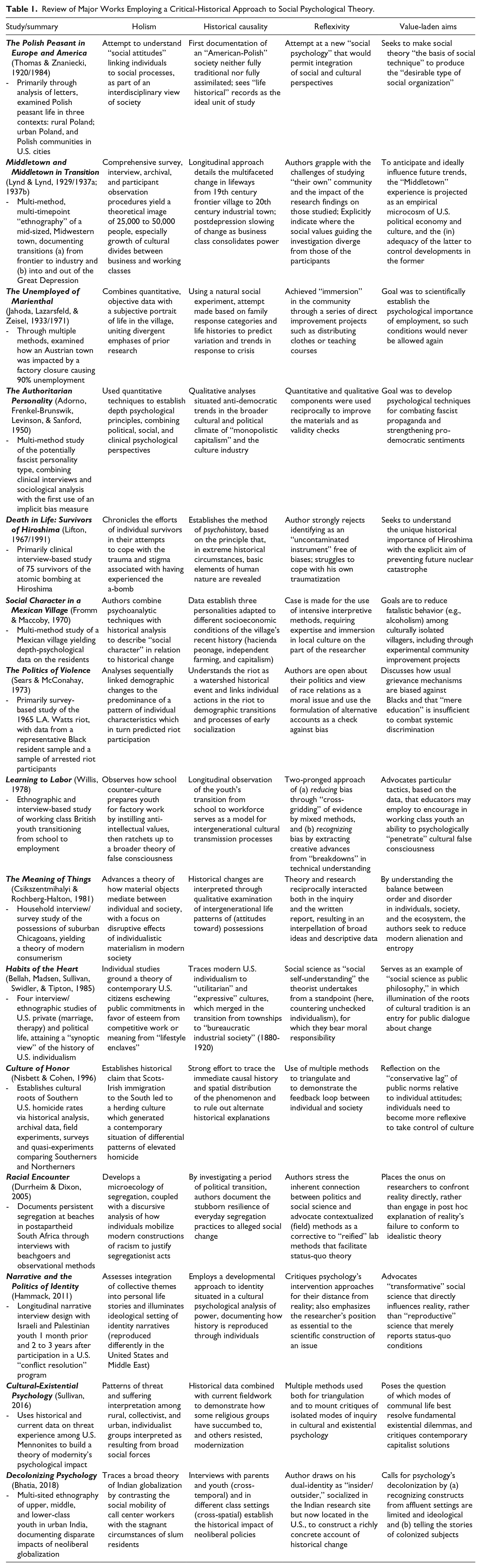
Holism: Culture of Honor
Nisbett and Cohen’s (1996) work on the Culture of Honor in the Southern United States (Nisbett & Cohen, 1996) is probably the best-known case of a critical-historical theory in social psychology. It emerged as an attempt to understand the social problem of homicide rates being higher in the southern as opposed to the northern cultural area of the country. Rather than following the torch-type approach of positing some universal dimension on which Southerners differ from Northerners, Nisbett and Cohen (1996) instead made a very specific historical argument concerning the region and its people. The authors contend that a history of Scots-Irish immigration to the South left a cultural inheritance of an “honor” mentality adaptive in herding (versus agricultural) societies. Because their ancestors developed cultural norms in a setting where one’s wealth was easily compromised, and where institutions of social control were largely inaccessible, white Southerners had been strongly socialized to defend their own and their family’s honor against any possible threat or insult. The analysis is supported by certain nuanced patterns in the national homicide data: for example, the South-North discrepancy only occurs among non-Hispanic whites in rural areas, and is especially pronounced when the homicide was prompted by insult or conflict (Nisbett & Cohen, 1996, pp. 81-83).
What makes the analysis unique is, first, the attempt to very carefully trace and delineate the immediate causal history and spatial distribution of the phenomenon under study (pp. 1-9, 22, 30-32, 88). The researchers investigate and, where possible, rule out alternate historical explanations for the observed patterns (p. 3, 22, 83-85). For instance, they acknowledge that the variable distribution and history of slavery as a practice in the region also played an important, independent role in establishing past and current crime rates (pp. 71-73, 85). Most importantly, Nisbett and Cohen (1996) are committed to a holistic perspective, using multiple methods to capture the dialectical interplay between individual and society (pp. xvii, 78). The direct contribution of a historically transmitted culture of honor to disproportionate Southern violence is demonstrated not only by historical analysis and use of archival homicide data, but by multiple representative surveys of attitudes toward violence and quasi-experiments comparing Southerners and Northerners on behavioral and physiological responses to provocation. Especially important from a critical-historical perspective is the effort to document “collective expressions” of the culture of honor at the societal level, via analyses of regional variation in gun control and domestic violence laws, as well as a field experiment in which newspapers in different parts of the country are asked to produce a journalistic account of an incident of violence (Nisbett & Cohen, 1996, pp. 57-59, 72-73, 75). The Culture of Honor stands out in the recent history of social psychological research as a compelling illustration of how social problems can be explained through concrete historical theories, which can in turn be carefully supported through the creative employ of multi-method triangulation.
Historical Causality: The Politics of Violence
The Watts riot, which occurred in Los Angeles in August 1965, was a watershed historical moment for U.S. society in that era. The riot was a complex, 5-day event that developed out of a single encounter between a Black citizen and a White police officer and eventually involved tens of thousands of (primarily Black) participants, the deployment of National Guard forces, and thousands of arrests. Sears and McConahay (1973) led an interdisciplinary team that carried out a survey on experience of and attitudes toward the riot in 1965-1966 among approximately 600 Black L.A. residents (a representative sample) as well as approximately 100 Black arrestees who had been directly involved. Data were also collected from representative samples of non-Black L.A. residents. The researchers developed a critical-historical theory of the event that differed substantially from most popular accounts.
Specifically, Sears and McConahay (1973) sought to link the individual and group-average attitudes they quantified to broader demographic trends. Through this strategy, they construct and defend a “politics of violence” theory, which first specifies (and demonstrates empirically) that the best proximal predictors of riot participation were high levels of positive Black identity, political sophistication and disaffection, and a subjective sense of deprivation (Sears & McConahay, 1973, pp. 88-89). Next, the theory proposes that documented demographic shifts have led to the emergence of what the authors call the “New Urban Black” population of Los Angeles: Black individuals who come from northern states, live in urban and largely segregated environments, and who tend to be young and well-educated (p. 40). Completing the causal circle linking historic, societal trends to individual attitudes and behavior, this historically contingent group is shown to possess relatively high levels of the characteristics most predictive of riot participation.
The authors employ their data not only to buttress this historically specific account of the riot but also to expose the limitations of more classically “situational” or universalizing causal explanations (e.g., the contagion hypothesis for mob violence). Finally, they document the unique perspective of the impacted community on the event, finding that local Black citizens held a “riot ideology” that framed the event as a political protest against racialized social structures (pp. 185-186, 189, 195). This study provided a starting place for one of the leading critical-historical theorists of contemporary social psychology—David Sears—who has continually integrated standard empiricism and theory with a commitment to historical analysis (as demonstrated by the “Black exceptionalism” hypothesis; Sears & Savalei, 2006).
Reflexivity: Death in Life
Psychiatrist Robert Jay Lifton (1967/1991) proposed a new approach to psychological research he called psychohistory. This method seeks to illuminate how universal psychological tendencies are shaped by cultural and especially historical variation, and it assumes that unprecedented historical events are actually most likely to reveal the core of human psychology: it is exactly when a society loses its cultural “script” in the face of extremity that people react with their basic existential defenses. As an exercise in such a method, Lifton (1967/1991) visited Hiroshima approximately two decades after the atomic bombing to understand the impact of a truly unique historical moment. His core methodology was a series of 75 interviews with a random sample of Japanese hibakusha—Hiroshima a-bomb survivors. Lifton (1967/1991) found that the experience of the a-bomb, and even the deleterious health effects of contamination afterward, were only an originary wound for survivors, who had to cope with personal trauma and social problems for years afterward. These people—many of whom were visibly marked by radiation exposure—dealt with extreme forms of social stigma and a lack of understanding of their experience, including employment discrimination.
Lifton (1967/1991) frequently practices very explicit reflexivity in connection with this highly sensitive work: “With a problem of this kind it is particularly mischievous to pretend that the investigator undertakes his study as a tabula rasa or an uncontaminated ‘instrument,’ totally free of bias or preconception” (p. 5). From the side of his participants, Lifton had to find ways to cope with their reticence and suspicions, including fears that he was simply a representative of the U.S. military seeking instrumental information about the effects of atomic bombing. For his own part, Lifton found that he was deeply disturbed by the firsthand accounts he heard and observed himself developing his own defense of “psychic numbing,” assimilating information to theoretical categories rather than processing it on its own, raw terms (pp. 8-10, 508). Lifton’s documentation of his experience as part of the research process testifies to the inseparability of research and researcher. He concludes that the ultimate significance of his work is its revelation that the social psychological reaction to Hiroshima is an emblematic case study of trends toward psychic numbing in the wake of disastrous violence that have reached global proportions.
Value-Laden Aims: The Meaning of Things
In their investigation on The Meaning of Things, Csikszentmihalyi and Rochberg-Halton (1981) set out to address a seemingly simple question: What is the relationship between people and the most important objects they possess? In formulating their answer, however, these researchers were driven by the holistic goal of understanding the dialectic of influence between individual and society, to facilitate critical statements about the collective well-being of the modern United States. In 82 sampled households in suburban Chicago, interviews were conducted with family members representing three generations who identified and discussed 1,694 objects in their possession. Through a comprehensive process, the data were sifted to generate a large set of “meaning” codes, the latter representing the kinds of meanings participants associated with their objects. The primary finding was that people were overwhelmingly likely to prioritize objects that had egocentric, differentiating, and hedonistic functions; in other words, either objects that represented the owner’s unique self (e.g., a chair a father had built) or facilitated leisure (e.g., a television set). Households were also differentiated in terms of their “affective environment”: “warm” families (in which more members expressed highly positive attitudes toward the home) were more likely than “cold” families to possess connections to the broader community outside the home, for instance, by participating in civic activities (pp. 153-155; 167).
From this empirical foundation, the authors build up a value-laden theoretical interpretation. They identify a historical ailment dubbed “pathology of privacy” (pp. 214-224): a tendency, more pronounced in some households, to feel disconnected from any broader community or sense of social generativity, resulting in compensatory materialist behavior filling the void left by meaningless relations to objects. This pathology is traced to broader historical forces of capitalism, urbanism, and individualism, which leave people increasingly isolated and insecure: By becoming entirely dependent on a market economy, we have become vulnerable to fears that we have tried to assuage by developing increasingly expensive symbolic demonstrations of our autonomy and power. Material possessions serve as pacifiers for the self-induced helplessness we have created. (Csikszentmihalyi & Rochberg-Halton, 1981, p. 230)
In the ultimate step of their critical-historical theory, Csikszentmihalyi and Rochberg-Halton link this family-level analysis to societal and global trends toward mass environmental exploitation. With families and individuals increasingly burdened by contemporary anxieties and continually driven to purchase objects as status symbols or hedonistic distractors, the relationship between humanity and the natural world will gradually fade from consciousness; the ecosystem and our long-term survival will be cashed in for the short-term succor of the latest iPhone. The rich blend of data and theory offered in The Meaning of Things are a testament to the fact that even the most basic of questions—how do people relate to their possessions?—can be answered from a critical-historical perspective if researchers step outside dominant paradigms.
Bringing the Four Elements Together: Narrative and the Politics of Identity
The intergroup contact literature in mainstream social psychology has often been invoked in what is undoubtedly the best-studied intractable conflict in the discipline: the Israeli-Palestinian conflict. In his critical-historical theory, Phillip Hammack (2011) seeks to bring a new methodological and theoretical perspective to bear on this well-researched problem. In Narrative and the Politics of Identity, Hammack (2011) draws on both narrative analysis of longitudinal qualitative data and historical theorizing to sketch an account of why the Israeli-Palestinian conflict is so resistant to (social psychological) intervention.
Hammack (2011) insists on the necessity of theorizing the interlocking nature of individual and collective narratives (pp. 16-18, 22, 38-39, 63). His major goal in the study is to employ a developmental approach to narrative and identity, which, when situated in a societal analysis of power structures, can document how history is reproduced, and identity reified, through individual psychological constructions (what he calls the “psychological cycle of history,” p. 331; cf. pp. 338, 340). Hammack’s (2011) primary data derive from a longitudinal narrative interview design. He would conduct autobiographical interviews (using a “lifeline” method) with Israeli and Palestinian youth, in locations within both Israel and Palestine, approximately 1 month prior to their participation in a “conflict resolution” program in the United States. Hammack would then engage in participant observation of his informants during their 1-month period of program participation. Crucially, Hammack would also conduct a follow-up interview with each participant between 2 and 3 years after program participation and their return to the Middle East. Hammack (2011) ultimately submitted 45 individuals to this intensive longitudinal procedure and analysis, reasonably representative of diversity in the region (pp. 105-106).
In his analysis of the narratives, Hammack (2011) is particularly sensitive to indicators of their ideological setting: the ways in which historically transmitted collective themes infuse youths’ personal life stories, subjecting them to a “regime of identity essentialism” (p. 45). Jewish-Israeli youth draw on master narratives of the Israeli state as a source of strength compensating for an eternity of Jewish persecution (p. 117), Palestinian youth evoke master narratives of resistance in response to dispossession (p. 160), and both groups use rhetoric to delegitimize the identity claims of the other. The consequence is what Hammack (2011) terms a “narrative stalemate” as a “cycle of identity polarization . . . ensures its pernicious survival into another generation” (p. 288). What is most revealing from Hammack’s (2011) study, however, is not necessarily the content of the narratives at a summary level, but rather his documentation of how their content changes as a function of the narrator’s immediate environment.
Hammack observed that, immediately after their immersion in the “safe space” of the conflict resolution camp, participants invoked narratives of identity transcendence. They would break down in tears as they realized that the “others” they had been demonizing all their lives were indeed people just like them, with their own hopes, fears, and tragic stories to tell. Thus, at least in the short term, the conflict programs appear remarkably effective. But what primarily interests Hammack (2011) is whether his participants would continue to construct narratives of transcendence 2 to 3 years after program participation and re-immersion into the existentially insecure setting of their native region (pp. 271, 285-289). More often than not he found the opposite: Whatever gains youth had made during their time at the peace camp, once they had become re-accustomed to the constant anxiety of living in spaces occupied by the military and threatened by political violence, they often shifted toward narratives of identity accentuation, becoming even more polarized in their construction of the conflict as an apologetic response to their previous lapse of judgment. Thus, Hammack’s (2011) design not only attests to the viability of longitudinal and contextually sensitive approaches to narrative psychology but also to their fundamental importance. What people say in a unique and artificial environment—even if these are the kinds of environments most conducive to intervention or data collection—does not necessarily reflect what they will continue to believe in their routine social contexts.
Hammack (2011) takes an actively reflexive position vis-à-vis his research. He believes that his own experiences of embodied terror during fieldwork in Israel and Palestine contributed substantially to his ability to grasp the psychological essence of his participants’ narrative dilemmas and resolutions (pp. 7-13, 58-59). Furthermore, he developed his unique epistemic stance out of a critical desire to avoid perpetuating “insular” and “depoliticized” forms of psychology (pp. 47-49). By refusing to acknowledge real, empirical barriers to successful intergroup contact, social psychology may actually serve to reproduce the conditions of conflict, by promoting utopian visions of contact which can easily be attacked as straw men by embattled individuals on the ground. By contrast, directly confronting these barriers—beginning with documentation of their historical embeddedness—sets the stage for emergence of a “transformative, rather than reproductive, social science” (p. 342).
Implications of the Critical-Historical Approach for Social Psychological Theory
The critical-historical interpretations offered by the preceding theories yield accounts of the relevant phenomena or events under consideration that differ substantially from theories produced within the mainstream epistemology. In each of the studies reviewed, a critical-historical theory is presented that does not strive for “exceptionless lawfulness.” Instead, psychological universals and historical specifics are dialectically refracted against each other in broad, dynamic interpretations of the data. To do justice to a holistic perspective, the researchers believe their data cannot be understood save in light of an understanding of the history of the society and group(s) they are studying, that is, in light of historical validity.
If I have succeeded in outlining the alternative epistemology of critical-historical theory, and demonstrating that this approach has been used in various ways by social scientists since the inception of social psychology, questions remain regarding the implications of this project. Why is it necessary for mainstream social psychology to engage with this alternate approach to theory, and how might researchers who prefer working with other approaches apply some of these ideas in their own theorizing? In the remainder of this article, I will outline some major implications of this approach for mainstream theorizing in the form of recommendations for interested scholars on how they might make small steps toward engaging with the critical-historical approach.
Embrace Epistemological Questions and Define Your Own Epistemology
As stated earlier, social psychologists have been strangely reticent to articulate their epistemological views. This suggests that methodological battles dating to the 19th century have been largely resolved within the field, and the kind of theoretical exposition characteristic of Lewin and Heider is no longer considered necessary for scholars working under the dominant paradigm. In contemporary presentations of research, the standard methods have long been assumed ideal; at some point epistemology ceased to be up for discussion, let alone debate.
If there is any unequivocal good that has come out of the current replication crisis (e.g., Funder et al., 2014), it is that scholars on all sides of this issue are revisiting foundational questions of epistemology. This is progress: scientists should not simply inherit theoretical and methodological frameworks without understanding their philosophical underpinnings and questioning their aptness if necessary. Yet despite divergent positions of advocates in current replication crisis debates, there is often general (tacit) convergence on the soundness of the mainstream epistemology. Herein lies the primary difference between the crisis sparked by Gergen and the contemporary crisis; whereas the former questioned the general usefulness of mainstream epistemology and methods, the latter primarily stops at considering their accuracy and functioning. Hence, propositions are made, for instance, to resolve the crisis by reducing the alpha level for concluding significance (Benjamin et al., 2018).
Throughout the history of mainstream social psychology, “crisis”-style discussions of epistemology have invariably been resolved by an almost naïve conviction in methodological innovation. The answer is never to radically question the philosophical foundation of our research; it is instead always to “double-down” on statistical methods that will “correct” the biases of the investigator; the theoretician’s gaze is always subsumed to (more) data and (new, better) means of collecting it. This means the field increasingly moves toward a conception of “statistical objectivity” (Freese & Peterson, 2018), a view of the world in which meta-analysis and big data actually render our empirical image of the world accurate and extensive enough so as to make theory obsolete (Anderson, 2008; Greenwald, Pratkanis, Leippe, & Baumgardner, 1986). On this view, theory is simply a means of organizing the data, subject to the error of human values and distortion, and we should control, reduce, or eliminate this subjective barrier between us and the data as much as our techniques allow. The social values that drive science in the first place must be sacrificed if they threaten to compromise “the truth” evident in (enough) data.
This resistance to holism and willful shackling of our theoretical ambitions leaves our value-laden aims stillborn, or, what is potentially worse, supplants them with the aim of upholding methodological canon. The problem is that the strong position of statistical objectivity ignores the very real issues of reflexivity: that we are all implicated in the social phenomena we study, that science itself is part of contemporary society, that there can be no “neutral” position outside of a social phenomenon, and that inaction is also a form of action with respect to social problems. What is increasingly lost in these debates and methodological innovations is a sense of what was once considered the social scientist’s most significant asset: their capacity for reason in an Enlightenment-philosophical sense (Horkheimer, 1947). Our perennial fear that the theorist’s subjectivity will cloud their judgment blinds us to the fact that both data and theory are useless unless they are harnessed to the service of rational societal reconstruction, the ultimate and only justification for social science (Weber 1949/2011). The critical-historical approach sees the purpose of theory as offering the scholar a thorough and actionable account of the data, these latter being the actual manifestation of social phenomena at a given point in history. Thus, it is essential to keep one’s aims in mind when evaluating the functionality of a theory (Cudd, 2005; Laudan, 1977). The aims and practicability of a theory are not an attractive bonus weighed in funding decisions; rather, they are integral to the scientific value of the theory. The “adversarial” model of science (Sears, 1994), in which the strength of competing theories is tested in the court of rational public opinion (rather than in the “impartial” court of “method”), is the only viable model for adjudicating theories from the critical-historical perspective.
At the very least, theorists working under mainstream assumptions need to articulate for themselves what those assumptions are. If one ultimately believes in the severe limits of individual reason and the compromising nature of subjective values, then one may well embrace a strong notion of statistical objectivity. But a minimal implication of the critical-historical approach is that these epistemological issues must be understood and articulated. The mainstream epistemology emerged from a particular philosophical vision of science, and alternate visions have existed and continue to exist within our field. There is undeniable value to mainstream quantitative methods—such as the ability to carefully weigh effect sizes in multiple regression or to relatively quickly isolate causal factors in lab experiments—and tool- and torch-type theories are often needed to organize and interpret the results of such work. But there is also clear value to the critical-historical approach, including the potential to critique and revitalize mainstream techniques when they fall short of achieving important social aims, and the ability to sensitize scholars and policymakers to the factors that have been historically important in generating a contemporary situation or which may be most important in a period of current transition. To facilitate these potentials, social psychologists should minimally grant critical-historical theory an “equal status partnership.”
Grant Critical-Historical Theories an “Equal Status Partnership” With Mainstream-Epistemological Theories
Since Lewin (1931/1935) oriented the field away from “Aristotelian” theories, mainstream social psychologists have been skeptical of work that attempts a more historical perspective. Nevertheless, the most significant implication of the preceding review is not only that the critical-historical approach to theory is possible but also that it exists and has existed as an alternate tradition throughout the course of the discipline. Indeed, some of the studies discussed have quite comfortably occupied a place of honor at the fringes of the mainstream literature. What is essential is not the question of whether tool-type, torch-type, or critical-historical theories represent the most “generative” or “appropriate” form of social scientific theorizing. Rather, what is essential is to acknowledge that all three types of theory co-exist, and that, if they can be constructively recognized as equally worthy of scientific status (Sampson, 1978), a more robust and comprehensive social psychology will result.
I encourage theorists of all backgrounds to consider how the strengths of these different approaches might be combined to yield more disciplinarily comprehensive and politically actionable maps of contemporary social problems. In the current division of academic labor, historians fail to benefit from the insights into causality that can be provided by social psychological methods, just as mainstream social psychology proceeds with almost complete indifference to the socially decisive nuances of political and economic history. Yet deep interdisciplinarity and an eclectic epistemological approach, blending the strengths of tool, torch, and critical-historical theories, is almost certainly required for social scientists to have major societal impact. A positive example of these possibilities being pursued can be found in recent developments in attachment theory. A classic torch-type approach, attachment theory reduces not only the great complexity of human relationships but a variety of other psychological phenomena across the lifespan to a core set of factors and the simple dimensions of anxiety and avoidance. Yet, interdisciplinary scholars have recently come together to propose a systematic revision of the theory, based both on a critical assessment of its shortcomings when applied to public policy and a recognition of its narrow historical, cultural, and sociological vision (see esp. Carlson & Harwood, 2014; Gaskins et al., 2017; Rosabal-Coto et al., 2017). These efforts represent a productive example of wedding mainstream theory to a more critical-historical approach and generating a new framework in the process, rather than discarding wholesale contributions from one epistemological vantage.
It should also be recognized that, unless one subscribes to a strong understanding of the lawfulness of psychological effects that is probably inappropriate for the human context, it is methodologically and conceptually difficult to produce positive evidence for a psychological universal (Berry, Poortinga, Breugelmans, Chasiotis, & Sam, 2011; Norenzayan & Heine, 2005). Yet, if one is in pursuit of such elusive universals, not only a broad contemporary evidence base (Henrich et al., 2010) but also a broad historical view is almost certainly required. I submit that if torch-type theorists are interested in identifying human universals, they would do well to conduct systematic historical inquiries over the course of only the past 100 years. It has long been recognized and statistically documented (Bell, 1976; Dicken, 2007) that the time since the 19th century has seen the most rapid global economic and technological changes of any anthropocentric historical period. There is likely no better way to test the universality of a particular human characteristic than to observe (through historical documents and studies) its resistance or malleability in the face of such sweeping change.
In conducting such historical inquiries, social psychologists will be forced to engage in certain forms of theorizing with which they may be less familiar or comfortable. Here again, interdisciplinary collaboration may prove essential. At the very least, if social psychologists working in the mainstream tradition recognize the potential contribution to be made by critical-historical theories, they can encourage their development—as well as the further development of standards by which they may be judged—rather than condemning them out-of-hand as “unscientific.”
Critically Assess the Limits of Research Produced From the Mainstream Epistemology
Greater recognition in the discipline of the validity of critical-historical theorizing would eventually lead to a strengthening of social psychology’s overall contribution to society. As should be clear, critical-historical theories stand to complement those from the mainstream epistemology, in part by offering a critique of such theories rooted in substantive engagement with long-standing or changing societal conditions. The reviewed studies demonstrate how the discipline’s constriction to a singular, a-historical epistemology leads to significant problems, for instance in the mainstream intergroup contact literature. Studies such as Politics of Violence, Racial Encounter, and Narrative and the Politics of Identity all criticize psychological interventions built according to tool-type theories from a body of lab experiments, which refuse to engage with the complexities of diverse geo-historical conditions and which instead artificially delimit the field of inquiry to the search for controlled optimal conditions. Hammack’s (2011) work in Israel documents how interventions designed explicitly according to mainstream psychological standards fail to gain traction under situations of intractable intergroup conflict (very different from the conditions of U.S. desegregation under which the mainstream contact hypothesis was developed).
A social psychologist defending the traditional intergroup contact model would doubtless argue that the theory already predicts that contact will not lead to improved relations under conditions of insecurity and lack of institutional support. However, it is not a question of whether the theory has correctly specified the right set of universal mechanisms for healthy contact. It is instead an issue of reflexivity, the appropriate role of the scientist in society, and the unavoidable entanglements between theory, method, and social reality. If the “optimal conditions” for contact fail to hold in some of the most prominent modern settings where we might wish to apply the theory, then what is the ultimate benefit to society of specifying and endlessly testing optimal conditions in the lab? If the theory specified a key condition that repeatedly fails to materialize in relevant social situations, then why, instead of searching for a new theory more appropriate to reality, do we consider ourselves beholden to the theory and search for the right conditions in the lab to “prove” it?
However sophisticated, our quantitative methods are practically useless if they remain divorced from theories that directly engage contemporary social conditions, and their historical origins, in all their dizzying complexity. Simply waiting for other researchers or disciplines to “do the job” will leave the job perennially undone. We already have prominent contemporary examples of social psychologists making the effort to connect lab-based theorizing with concrete social problems (e.g., Paluck’s, 2009, work on media interventions in Rwanda, or the many interventions cataloged in the SPARQ database run by Jennifer Eberhardt, Hazel Markus, and Alana Conner). Acknowledging the scientific validity of the critical-historical approach to theory will enhance such efforts at the fulfillment of specified social aims, which can sometimes only occur through historically grounded critique and modification of mainstream theories.
Consider Gergen’s Proposal for Social Psychology as a Discipline Focused on “Sensitization” Rather Than Prediction
A final way in which granting “equal status” to critical-historical theories stands to enrich the discipline is by offering new criteria for establishing causal validity. In contrast to the traditional focus on deductive causation—ultimately determined by a theory’s capacity for the “prediction and control” of behavior—the critical-historical approach fosters an emphasis on compelling historical accounts of observed behavior. The implication is that a more epistemologically eclectic social psychology would recognize both prediction and what Gergen (1973) called “sensitization” as important theoretical aims. The fruits of social psychological theory should not be restricted to the ability to predict what an individual will do in a rigorously delimited situation; (some of) our theories should also have the capacity to sensitize citizens and policymakers to the key characteristics of people in a given society at a given moment, if possible even permitting prediction of future historical trends (Varnum & Grossmann, 2017).
Expanding our notions of theoretical validity and aims entails a willingness on behalf of researchers to recognize circumstances where the critical-historical approach might be the most appropriate for a given social problem or dataset. The review of studies above (see Table 1) suggests that there are three primary types of critical-historical theory addressing different research situations:
The social experiment: Sometimes researchers are almost forced to adopt a historical approach when confronted by a “once-in-a-lifetime” event, usually characterized by features of radical transition for a society or group. Examples from the reviewed studies would be The Unemployed of Marienthal, Middletown in Transition, Death in Life, The Politics of Violence, and Racial Encounter.
The identity excavation study: Sometimes researchers seek to understand a unique contemporary group (or groups) in light of their extended demographic, political, and economic history. Examples from the reviewed studies would be The Polish Peasant in Europe and America, Social Character in a Mexican Village, Learning to Labor, Culture of Honor, and Narrative and the Politics of Identity.
The modernity study: Sometimes researchers examine how contemporary samples—often the “Western” convenience samples of mainstream inquiry—have also been historically shaped by processes of capitalism, technological development, and globalization typically subsumed under the label of “modernization.” Examples from the reviewed studies would be The Authoritarian Personality, The Meaning of Things, Habits of the Heart, Cultural-Existential Psychology, and Decolonizing Psychology.
Hopefully, theorists in the mainstream tradition will not find it controversial to acknowledge that critical-historical approaches may be more appropriate in the first two research cases—moments of major social change and cases where we are trying to understand the identity of a delimited group of people caught up in particular circumstances. What will perhaps be controversial is that I encourage mainstream theorists to consider the possibility a critical-historical approach may even be appropriate when we are trying to understand how our convenience samples react to conventional stimuli. For instance: How did our society develop such that the majority of our studies are now done on a platform called “Mechanical Turk” using people called “MTurk workers?” Who are these people, and what are the sociohistorical circumstances that have made such an arrangement possible?
Here, we arrive at the “modernity study” and the fact that social psychology, in its a-historical orientation, has failed to develop an adequate theory of the influence of neoliberalism on psychology. This is a significant omission, as the emergence of neoliberalism is probably the most important economic event of the last half-century. Indeed, when reading all of the works reviewed in Table 1, one encounters a surprisingly complete chronological account of the slow emergence of neoliberal culture, economics, and politics over the course of the 20th century, from the early transformation of U.S. townships to industrial centers around 1900 (Middletown) through the consolidation of ideologies justifying income inequality in 1970s Britain (Learning to Labor) all the way up to Bhatia’s (2018) documentation of the disparate impact of globalization in contemporary India. This body of critical-historical theory documents how collective and individual psychologies have been progressively shaped by the growth of the neoliberal movement, that is, through the dismantling of social and governmental structures that promote interpersonal solidarity and buffer personal risks, and the emergence of a notion of the ideal self as one who focuses on self-interest, commits to consumerism and work as their sole life goals, and is personally responsible for any setbacks (Adams et al., 2019).
Exactly, this vision of the individual—free to move between relationships and groups at will, and compelled to exert agency in the pursuit of happiness—has been assumed or actively promoted by most major strains of mainstream social psychology, including positive psychology (Binkley, 2011), social identity theory and health psychology (McDonald, Gough, Wearing, & Deville, 2017), attachment theory (Carr & Batlle, 2015), and even the psychology of culture and social class (Adams & Estrada-Villalta, 2016). Although it is highly doubtful that the researchers in these areas emphasize a construction of the individual that suits the neoliberal agenda explicitly for that reason, it is also unnecessary to point out that virtually none of them acknowledge the possibility that this construction is rooted in a particular political-economic era in history. Thus, lacunae in theorizing can contribute directly to the scientific reification of a historically contingent category endorsed by a political movement that many social scientists believe is negatively impacting global human flourishing. Moreover, because of social psychology’s reticence to engage in holistic, historical theorizing, the field has uncovered many phenomena that are directly related to the triumph of neoliberalism—including the effects of growing income inequality (Oishi, Kesebir, & Diener, 2011) and consumerism (Markus & Schwartz, 2010) on unhappiness, processes of gentrification (Oishi, Miao, Koo, Kisling, & Ratliff, 2012), rising levels of anxiety (Twenge, 2000), rising levels of individualist subjectivity (Santos, Varnum, & Grossmann, 2017), and growing political polarization (Haidt, 2012)—while failing to interpret all of them in terms of their common sociohistorical origin. Thus, lacunae in theorizing lead to a failed opportunity for social psychology to actively engage with a contemporary political issue of major importance. Finally, many other phenomena brought about by neoliberalism that are substantially impacting people’s lives—for instance, the spectacular rise in levels of consumer debt (Lazzarato, 2012)—are entirely overlooked by contemporary social psychology.
It is not necessary that every social psychologist incorporate a theoretical understanding of neoliberal capitalism into their research. Minimally, however, social psychologists should be expected to have at least a working understanding of the political and economic trends occurring in their society, if they are to truly understand how the individual is shaped by social processes.
While lip service is often paid in mainstream research articles to the need for future work that will adopt a more integrative perspective, address structural causes, or directly influence policy, the cold reality is that these “future studies” will never be carried out unless we embrace a more pluralistic epistemology. As long as social psychologists are incentivized to restrict their work to mainstream methodological boundaries, and to avoid “speculation” on social problems from a “value-laden” perspective, our theories will never reach their potential for revolutionary social impact: Psychology would greatly benefit from a de-emphasis on particular methods in favor of constructing particular research questions that address real problems of human living. Psychology can continue to (rightfully) lay claim to the individual as primary unit of analysis, and the mind as its primary object of study. But an openness to methodological [and theoretical] pluralism means that we can ask more research questions that can be answered outside of the laboratory. I believe this shift in research practice, away from a methods-driven science and toward a problem-focused orientation, creates new challenges for our received paradigms. Yet it is precisely toward new paradigmatic formulations that we must look to address the unique problems we face in the twenty-first century. (Hammack, 2011, p. 361)
As social psychology moves forward, it must learn that the act of awaking from Joyce’s “nightmare” of history occurs not through forgetting, but through remembrance.
Footnotes
Acknowledgements
The author expresses deep gratitude to Roman Palitsky, Harrison Schmitt, and Isaac Young for their suggestive contributions to and comments on this paper. He further acknowledges Glenn Adams and the Cultural Psychology Research Group at the University of Kansas for their feedback on an earlier draft. Finally, he thanks the authors of all of the reviewed exemplary studies in critical-historical theory—particularly the living authors—for being sources of profound inspiration and guidance.
Declaration of Conflicting Interests
The author(s) declared no potential conflicts of interest with respect to the research, authorship, and/or publication of this article.
Funding
The author(s) received no financial support for the research, authorship, and/or publication of this article.