







Abstract
Many empirical studies have demonstrated the psychological effects of various aspects of money, including the aspiration for money, mere thoughts about money, possession of money, and placement of people in economic contexts. Although multiple aspects of money and varied methodologies have been focused on and implemented, the underlying mechanisms of the empirical findings from these seemingly isolated areas significantly overlap. In this article, we operationalize money as a broad concept and take a novel approach by providing an integrated review of the literature and identifying five major streams of mechanisms: (a) self-focused behavior; (b) inhibited other-oriented behavior; (c) favoring of a self–other distinction; (d) money’s relationship with self-esteem and self-efficacy; and (e) goal pursuit, objectification, outcome maximization, and unethicality. Moreover, we propose a unified psychological perspective for the future—money as an embodiment of social distinction—which could potentially account for past findings and generate future work.
Money plays a major role in almost every person’s life; most people handle money multiple times a day. As such, money is so prevalent that hardly anyone can live a life devoid of it. Like it or not, people are constantly placed in various economic settings—such as closing a business deal, showing generosity by giving change to the homeless, or buying a significant other an engagement ring. Due to what money can offer and provide, money motivates many people; their lives revolve around how much money they have and can spend. Money defines, to a large extent, people’s social standings and even their identities. Because of the sheer profoundness of money’s presence in people’s daily lives, it is natural to ask: How does money affect people’s minds and behavior?
Money was invented about 3,000 years ago to serve as a medium of exchange, a unit of accounting, a store of value, and—sometimes—a standard of deferred payment (Weatherford, 1998; for a historical view on debt or money, see Graeber, 2012). Because money enables people to access valuable resources, money is, unsurprisingly, a powerful incentive. Conventional knowledge predicts that people work harder and perform better when they are paid (Bijleveld & Aarts, 2014). Such an assumption about money as a motivator that energizes and directs behavior aligns with the traditional approach that has dominated the scientific study of money (Bijleveld & Aarts, 2014). However, a large body of research from behavioral economics suggests that monetary incentives (e.g., paying for intrinsically interesting tasks or noble acts) can backfire (for a review, see Gneezy et al., 2011) because the meaning of money has gone beyond its original role as a medium of exchange or store of value (Bijleveld & Aarts, 2014). Nowadays, money has strong symbolic and psychological value, and money’s psychological meaning shapes how people think and act.
Importantly, money and its related economic activities have profoundly influenced human societies—a topic that economists, sociologists, (economic) anthropologists, and historians have given much attention. These macro-level approaches deal with, for instance, how financial institutions (usually at a national level) can regulate economies via monetary and fiscal policies; how money influences politics and society; how economic activities are embedded in social structures, which in turn can be the causes and consequences of social changes; and how economies and societies are virtually indistinguishable (e.g., Baker & Jimerson, 1992; Simmel & Frisby, 2004). In contrast, psychologists generally take a more micro-level approach and are concerned with money’s effects at the individual and (sometimes) interpersonal levels. That is, they are concerned with how people’s thoughts, feelings, and behaviors change as a result of money.
To date, many empirical studies have demonstrated money’s psychological effects. Such research has focused on various aspects of money, including the aspiration for money (e.g., love of money attitudes, materialism), mere thoughts about money (money priming 1 ), possession of money (e.g., high socioeconomic status [SES]), or placement of people in economic contexts (e.g., labeling or assigning economic value to people). Several psychological theories and views have been proposed to explain these various psychological effects, including the market-pricing mode (Fiske, 1992); materialism and value system (Kasser, 2016); the love of money and spirituality (Tang, 2010); the self-sufficiency view (Vohs et al., 2006); money as tool and drug (Lea & Webley, 2006); the exchange theory of money and self-esteem (Zhang, 2009); and ideas about social class, solipsism, and contextualism (Kraus et al., 2012).
Previously, study findings in psychology were predominantly interpreted through only one theory. However, although multiple aspects of money have been focused on and varied methodologies have accordingly been implemented, the mechanisms underlying the empirical findings from these seemingly isolated areas overlap to a great extent. Therefore, in this article, our primary aim was to take a novel approach by providing a comprehensive review of money literature in psychology, grouping findings by mechanism rather than by theory. Importantly, in this article, we broadly operationalize the concept of money, including aspiration for money, mere thoughts about money, possession of money, or placement of people in economic contexts.
To identify money’s psychological effects, we reviewed articles from these previously isolated areas and identified five major streams of psychological mechanisms: (a) self-focused behavior; (b) inhibited other-oriented behavior; (c) favoring of a self–other distinction; (d) money’s relationship with self-esteem and self-efficacy; and (e) goal pursuit, objectification, and unethicality. Doing so provided us an integrated view of the findings documented in psychology literature. Moreover, it facilitated the generation of an overarching framework that can account for the existing findings’ breadth and provide future research directions.
To this end, we will first briefly review the existing psychological theories in the broadly defined field of money and the methodologies adopted in research guided by each of these theories. 2 We will then review the past empirical findings. Importantly, our primary aim was to group them by the underlying mechanism that was examined to provide an integrated view despite their varying foci on the surface. Our secondary aim was to propose a new tentative psychological perspective—money as an embodiment of social distinction—that will be subject to further testing.
A Brief Overview of Past Theories of Money
Market-Pricing Mode
Fiske’s (1992) relational models are primarily concerned with how people connect with others. The market-pricing mode is one of the four fundamental relational models or schemata that people use to construct relationships with others and shapes how they perceive and interact with their social partners. The prototypical relationships in this mode are those wherein money acts as the typical medium of exchange or those that involve money-related concepts. People in this relationship mode tend to use rational numbers to measure their interactions with others, focusing largely on the ratio between their inputs (i.e., costs) and outputs (i.e., benefits). One’s position and the achievement of the expected utility and fair trade are what matter in such a calculation.
Materialism and Value System
Materialism has mostly been treated as a value or goal that reflects the importance of material possessions in one’s life (Kasser & Ryan, 1993; Richins & Dawson, 1992). To this end, values are organized in a circumplex fashion in which certain values are concordant but conflict with others (Schwartz, 1992). Because materialism falls within the self-enhancement cluster (e.g., hedonism, achievement, and power) and is opposite to self-transcendence (e.g., benevolence and community), materialistically oriented individuals usually engage in behavior that can bring self-enhancement and hedonic pleasures but is less other-oriented (Kasser, 2016).
The Love of Money and Spirituality
The love of money refers to one’s desire and aspiration for money (rather than one’s need for it or greed), including affective, behavioral, and cognitive components (e.g., Tang, 2007; Tang & Chen, 2008). The prevalent goals in life (e.g., financial success, popularity, affiliation, and feelings of community) can be arranged along two dimensions—the extrinsic (physical) and intrinsic (self-transcendence) dimensions—within a circumplex, and money and spirituality lie at opposite ends (Grouzet et al., 2005). As a result, individuals with high desire for money tend to demonstrate not only increased unethical intentions and behaviors but also reduced well-being.
Self-Sufficiency View
Self-sufficiency is defined as “an emphasis on behaviors of one’s own choosing accomplished without active involvement from others” (Vohs et al., 2008, p. 209). As social beings, people rely on their social groups for achieving and maintaining desirable outcomes; hence, social acceptance within a group is vital. Nonetheless, money provides an alternative by enabling people to meet their needs regardless of whether others know or like them. As a result, monetary thoughts or reminders of money activate a state of self-sufficiency that undermines interdependency by allowing people to attain their goals without social connections.
Social Class, Solipsism, and Contextualism
Members of the upper class who enjoy financial abundance can pursue their personal goals and interests free of external constraints because they have access to valued (economic) resources and elevated social standing, a fact that is consistent with the self-sufficiency view. As a consequence, they are individualistically orientated and motivated by their own states and goals. In parallel, they show reduced attention to others and their environments compared with their less-affluent counterparts.
Money as Tool, Money as Drug
Money is a tool in a metaphorical sense because it serves as a way of obtaining biological rewards and is the most efficient means of facilitating economic exchanges. As such, money serves as a means to an end and is strongly associated with instrumentality. In addition, money is a tool that allows people to convey their competence, and it provides a sense of security. Because of its functionality, which is a strong incentive, money also acts as a form of drug. As a result, people might be obsessed with it or driven by it, which is evident in behaviors such as compulsive gambling and unethical acts.
An Exchange Theory of Money and Self-Esteem
Money can be used to maintain a positive self-image and demonstrate one’s competence, a fact that is consistent with the above view that posits that money is an efficient way of demonstrating one’s competence. Because competence is one of the defining aspects of self-esteem, money can accordingly be used to increase self-esteem or compensate for a lack of it. As such, a high monetary payoff could indicate a positive self-image by conveying competence, which in turn bolsters self-esteem. Thus, money and self-esteem partially compensate for each other because both are positive indicators of a person’s self-image.
A Summary of Past Methodologies
In the past, various methods have been employed to study money’s psychological effects, including assessments of money-related attitudes (e.g., the love of money and materialism), the effects of having money (e.g., high SES or upper-class status), thoughts of money (e.g., money priming), and the placement of people in an economic context (e.g., assigning economic value to targets, using situational labeling, or using money as a medium of exchange). Interestingly, in studies examining each theoretical perspective, researchers have tended to adopt specific methods (see Table 1).
Past theoretical perspectives and their specific methods.
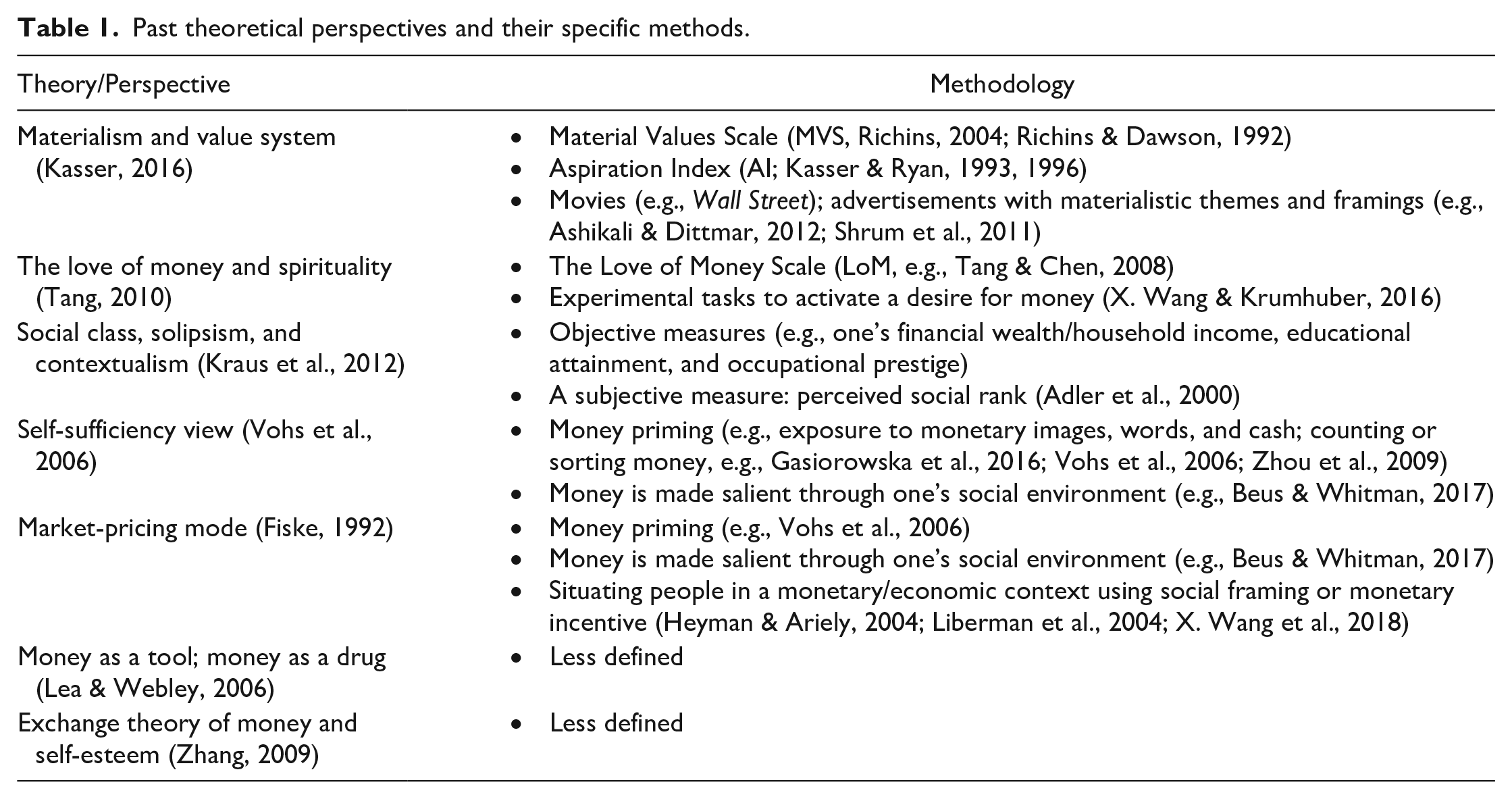
The literature on materialism is vast and has received attention from consumer researchers and psychologists since the 1980s. More recent research has treated materialism as a value or goal, reflecting one’s stable disposition toward monetary possessions and a mindset that could be momentarily activated (Kasser, 2016). In other words, materialism is the degree to which people strive for money, material goods, popularity, and beauty, with the latter two often being expressed through money and personal possessions (Kasser & Ryan, 1996). The two most widely used scales for assessing materialism at a dispositional level are the Material Values Scale (Richins, 2004; Richins & Dawson, 1992) and the Aspiration Index (Kasser & Ryan, 1993, 1996) To momentarily activate a materialistic mindset in participants, researchers have used visual stimuli such as movies (e.g., Wall Street); advertisements with materialistic themes (e.g., (Ashikali & Dittmar, 2012; Shrum et al., 2011); and contextual framing that depicts, for example, interaction partners as consumers rather than citizens (Bauer et al., 2012).
The love of money reflects the combined notions of the importance attached to money (cognition), the desire to be rich (affect), and efforts toward pursuing money (behavior; Tang & Chiu, 2003). Interestingly, the love of money has been predominantly treated as a dispositional factor and is usually assessed using the Love of Money Scale (Tang & Chen, 2008), which is a subset of the Money Ethics Scale. Recently, researchers have started to examine the temporary state of wanting to gain money. Their experimental tasks required participants to develop strategies for increasing seed money via a writing task (X. Wang & Krumhuber, 2016). Because the aspiration for money is the central feature of materialism and the love of money, this aspiration can also be classified as a desire for or value of money.
SES is defined as one’s social standing based on material possessions (Kraus et al., 2012). Financial wealth and household income, educational attainment, and occupational prestige are the three most frequently used indexes of such objective capital. Although these three indexes are highly correlated and usually summed to create a composite measure of one’s overall SES, Côté et al. (2017) proposed that income information is the most robust predictor of social class. Therefore, a high SES is considered reflective of a person’s ample monetary and material resources. In addition, the subjective unit of social class (i.e., an individual’s material wealth in comparison with his or her local context) is often assessed via the social status ladder (Adler et al., 2000). This reflects the extent to which one’s material resources are thought to be abundant or lacking relative to those of other people. As such, a high SES or perceived social rank indicates a state or feeling of having money.
Studies on money priming have examined whether the mere thought of money is sufficient to cause behavioral changes (see Note 1). In these studies, people were exposed to images or objects of money (especially a large stack of money) or had to descramble sentences containing money- or economy-related words (e.g., cash and salary; Vohs et al., 2006). Due to inconsistent findings and failures to replicate the results (see Caruso et al., 2017; Crawford et al., 2019; Klein et al., 2014; Rohrer et al., 2015), these subtle manipulations have recently received substantial criticism. It is worth pointing out that more explicit manipulations—including counting and sorting money (Gasiorowska et al., 2016; Yang et al., 2013; Zhou et al., 2009) and placing one’s hands in a bowl filled with money (Reutner et al., 2015)—generate larger main effects than the aforementioned subtle manipulations (Lodder et al., 2019). In field studies, researchers have employed more natural methods of activating thoughts of money by targeting individuals within a specific social environment. For instance, economics students (vs. students of other subjects) are presumed to have a monetary mindset by default (e.g., L. Wang et al., 2011). Likewise, money is salient for sports players who are in their final contract year (Beus & Whitman, 2017), and people who have just withdrawn money from a cash machine would naturally think about money (Guéguen & Jacob, 2013).
The final group of money studies focused on methods that placed individuals in a monetary and economic context by letting them assign economic value to targets, use contextual framing, or manipulate the type of exchange in a given situation. For example, to put a price on time, participants were instructed to calculate their hourly wages (e.g., DeVoe & House, 2012). Similarly, people’s monetary outcomes in a labor market game were made dependent on the number and type of employees hired (Harris et al., 2014). Contextual framing is typically achieved by giving different names to the same game (e.g., “Wall Street Game” vs. “Community Game”; Liberman et al., 2004). Money, as a universally recognized tool for economic transactions, is naturally associated with a monetary context. Psychologists have therefore started to examine how the use of money as a form of reward or medium of exchange influences how people think and act (Heyman & Ariely, 2004; X. Wang et al., 2018).
Empirical Evidence
We identified articles by applying a snowball technique, starting with the references of recent review articles on money priming, materialism, love of money attitudes, SES, and monetary incentive. We also conducted additional searches in relevant psychology journals. As a result, our review is informed by empirical studies in the fields of social and personality psychology, consumer psychology, organizational psychology, economic psychology, and social neuroscience. Although we aimed to be as exhaustive as possible, we only included published empirical studies reported in English (see Note 2).
Although multiple aspects of money have been focused on and varied methodologies have accordingly been implemented, the mechanisms underlying the empirical findings from these seemingly isolated areas overlap to a great extent. Therefore, instead of separating the existing empirical studies by methodology, we grouped them by the type of mechanism examined. In the remaining sections, we use the term money in a broad sense, which includes various conceptualizations. These conceptualizations include the effects of loving money (e.g., the love of money attitude and materialism), having money (e.g., high SES or upper-class status), thinking about money (i.e., money priming), and situating people in an economic context (e.g., assigning an economic value to targets, using situational labeling, or using money as a medium of exchange).
We posit that money’s psychological effects can be classified into five domains. In the first, money leads to a self-focus by encouraging behaviors in line with self-centeredness, self-uniqueness, and self-enhancement. In the second, money inhibits other-oriented behaviors by initiating a shift from interdependence to individualism while impairing prosociality and perspective-taking. In the third, money motivates self–other distinctions, including the endorsement of inequality and a preference for competition over cooperation. In the fourth, money can provide people with a sense of strength, which allows them to bolster their self-esteem and overcome various negative life events. In the final domain, money makes people focus on self-advancement and goal pursuit, which can further lead to objectification and unethicality.
Stream 1: Money and Self-Focus
Self-serving behaviors
Marwell and Ames (1981) employed the public goods game, which enables people to engage in free-riding behavior that benefits them by allowing them to contribute zero or a low percentage of tokens at the cost of the total gain at the group level. The specific contribution levels indicate self-serving behavior. It was found that economics students (i.e., those who chronically have a monetary mindset) contributed only 20% of their resources to the public pot on average, which was significantly lower than the contributions of students of other subjects (42%, p < .05). When given the opportunity to divide $10 between themselves and a randomly assigned counterpart in any way that they wished, economics students were also more likely than other students to sacrifice the interests of other players to benefit themselves, t(107) = 3.66, p < .001, d = 0.33 (L. Wang et al., 2011). In addition, individuals who value money and fame were found to secure their own benefit by eliminating forests sooner in a resource dilemma compared with those who valued intimacy and community, t(35) = 2.18, p < .05 (Sheldon & McGregor, 2000).
Increased self-serving behavior can be witnessed when thoughts of money are activated via a natural environment or experimental manipulation. In a field study by Beus and Whitman (2017), players scored significantly more points per game (an index for self-serving behavior) in their final contract years, when money was naturally salient to them, than in previous years, γ = 0.38, p < .01; γ = 2.20, p < .01. When social relations were framed in monetary terms (i.e., consumers as opposed to individuals), Bauer et al. (2012) showed that people felt less responsible for selfish acts (i.e., their water usage during times of short supply), t(76) = −2.12, p = .04, d = 0.47. People also expressed reduced levels of trust, t(76) = −3.86, p = .001, d = 0.80. In addition, they showed a lower tendency to view others as partners, t(76) = −2.43, p = .02, d = 0.53. This finding points toward the link between money and reduced cooperative engagement, which we will discuss in more detail in a later section. Furthermore, when money (vs. candy) was used as the medium of exchange in economic games, participants’ decisions were more driven by self-gain, F(1, 712) = 39.7, p < .001,
Self-uniqueness and self-enhancement
Among American adults, the importance attached to money and material objects was negatively correlated with one’s degree of conformity, r(373) = −.14, p < .01 (Burroughs & Rindfleisch, 2002). In terms of consumer behavior, relative to those from a working-class background, participants from the middle class (as defined by higher family income) were more likely to make unique choices, χ2(1) = 3.86, p < .05; t(63) = 3.53, p = .01 (Stephens et al., 2007). They also felt more irritated when choosing the same car as others, χ2(1) = 5.51, p < .05. In addition, advertisements targeting middle-class consumers were more likely to contain messages suggesting extreme uniqueness than those targeting the working class, χ2(1) = 6.96, p < .01. Interestingly, priming participants with the concept of money encouraged choices that amplified uniqueness and disconformity. This was particularly true when a large amount of money (e.g., RMB 100 vs. RMB 0.01) was presented (Ma et al., 2017). As such, people were more likely to choose a brand that was not favored by the majority of the group, χ2(1) = 4.30, p < .05. They were also more likely to choose unique products, χ2(1) = 7.44, p < .05; χ2 (1) = 6.16, p < .05. The tendency to adopt disconformity caused by money was further shown to lead to adverse outcomes in the form of participants’ rejection of a factually correct majority response (t = 2.162, p < .05, d = 0.97; Shi et al., 2013).
In addition, Piff (2014) found that subjective and objective social standing derived from one’s economic achievement results in an elevated sense of entitlement. That is, compared with lower-class counterparts, people from the higher class felt that they deserved more, r(178) = .17, p = .021; r(93) = .22, p = .036; r(96) = .19, p = .059. They also believed they were more important, t(162) = 2.03, p = .044; showed increased narcissistic tendencies, t(146) = 1.93, p = .055, b = 4.00, SE = .86, t(126) = 4.64, p < .001; and looked into a mirror for a significantly longer time, b = .22, SE = .11, p = .047. Interestingly, once egalitarian values were introduced, their narcissism dropped to levels on par with their unprivileged counterparts, suggesting the mediating role of perceived superiority in this process. Kasser and Ryan (1996) further demonstrated that aspirations for financial success positively predict excessive self-representation, such as seeing oneself as special, being apt to show off, and wanting to be the center of attention, r(192) = .35, p < .01. Similarly, when money-oriented values were cued by situational versus neutral labeling (i.e., consumer vs. citizen reaction study), people were more likely to associate their names with stimuli reflecting self-enhancement values, t(56) = 2.33, p = .02, d = 0.59 (Bauer et al., 2012).
Summary
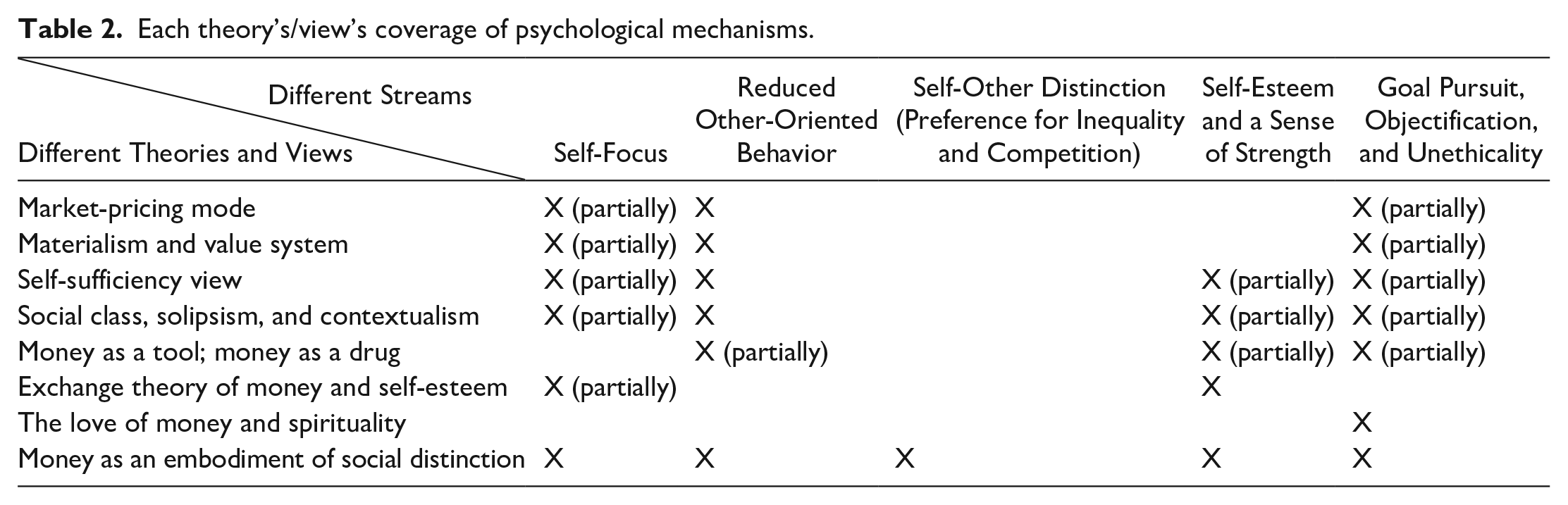
A number of empirical studies have demonstrated both the correlation and the causal relation between money and self-focused behaviors. In particular, money makes people focus on self-gain, even though the benefits of others need to be sacrificed in such a course of action. In addition, people desire to show their uniqueness and are more likely to engage in self-enhancement beliefs and show narcissistic tendencies. These effects could be (partially) explained by the materialism and value system (Kasser, 2016); the self-sufficiency view (Vohs et al., 2006); social class, solipsism, and contextualism (Kraus et al., 2012); the market-pricing mode (Fiske, 1992); and the exchange theory of money and self-esteem (Zhang, 2009). (Pursuing) money directs people to engage in behaviors of self-interest and of self-enhancement (Kasser, 2016). Money, as a valuable social resource, endows people with the freedom to pursue their interests and goals without depending on others or their social environment (Kraus et al., 2012; Vohs et al., 2006). The mental calculation of input versus output during social interactions could make people prioritize self-gain (Fiske, 1992). In addition, the bolstered self-esteem gained by (having) money (Zhang, 2009) could encourage people to see themselves as superior and deserving of more privileges than others (see Table 2 for each theory/view’s coverage of existing empirical findings).
Each theory’s/view’s coverage of psychological mechanisms.
Stream 2: Money and Reduced Other-Oriented Behavior
Independence and individualism versus communalism
Compared with those in the control condition, money-primed participants preferred solitary activities [money vs. seascape, t(58) = 2.75, p < .05, d = 0.59; money vs. flowers, t(58) = 2.10, p < .05, d = 1.06; money vs. fish, χ2(1) = 7.00, p < .05, odds ratio = 11.25; money vs. no-screensaver, χ2(1) = 8.22, p < .05, odds ratio = 15.00; Vohs et al., 2006]. Simultaneously, they kept greater physical and psychological distance between themselves and others. Not only did money-primed participants sit farther away from a newly acquainted person [money vs. fish, t(33) = 2.37, p < .05, d = 1.07; money vs. no-screensaver, t(33) = 2.30, p < .05, d = 0.85; Vohs et al., 2006], but they also withdrew from opportunities to talk with others, F(2, 73) = 4.15, p = .02,
Relatedly, the importance attached to money and material possessions negatively predicted one’s collective-oriented values, such as developing and maintaining close and caring relationships with family members, r(373) = −.19, p < .01, and the local community, r(373) = −.17, p < .01 (Burroughs & Rindfleisch, 2002). Likewise, focusing on achieving financial success and fame was associated with poor relationships with romantic partners and friends (Kasser & Ryan, 2001). Family income was positively correlated with marital disagreement, r = .05, p < .05 (Booth et al., 1984). Even parent–child relationships are not immune to money’s negative impacts. SES negatively predicted the extent to which parents experienced a sense of meaning and purpose in child care, r(182) = −.20, p = .008 (Kushlev et al., 2012). Even exposing parents to a photograph depicting money (vs. flowers) made them experience less fulfillment in their time spent with their children, t(64) = 2.15, p = .035.
An impaired communal orientation could translate into lower social engagement. Indeed, a mindset of money or materialism was found to thwart people’s inclination to engage in social activities, t(43) = −2.38, p = .02, d = 0.70 (Bauer et al., 2012). This effect was also witnessed during social interactions, such that undergraduates from an upper-class background (vs. their lower-class counterparts) displayed reduced engagement (e.g., head nods, laughs), t(88.40) = −2.16, p < .05, β = −.21, d = 0.45, and higher disengagement (e.g., doodling), t(84.45) = 2.63, p = .01, β = .26, d = 0.58; t(84.45) = 2.01, p < .05, β = .20, d = 0.44 (Kraus & Keltner, 2009). These findings align with a study showing that SES negatively predicts heart rate deceleration, a physiological index of orienting to the social environment, when individuals watch a video indicating others’ suffering from misfortune, B = .80, t(114) = 2.55, p = .01 (Stellar et al., 2012). Given the overlap between brain regions that respond to physical and social warmth (Inagaki & Eisenberger, 2013), such “social coldness” caused by money could be bodily grounded and translated into actual sensations of physical coldness. Indeed, placing their hands in a bowl filled with banknotes (vs. slips of paper) caused individuals to feel physically colder, F(3, 36) = 8.36, p = .006,
Given that happiness is most often derived from activities with communal value (Kahneman et al., 2004; Mogilner, 2010), people’s sense of happiness should be affected by the downstream consequences of the shifted focus brought about by money. In this vein, income unsurprisingly serves as a weak predictor of happiness-related variables, such as life satisfaction and emotional well-being, especially once one’s basic needs are met (e.g., Aknin et al., 2009; Kahneman et al., 2006; Kushlev et al., 2015; Mogilner & Norton, 2016). In addition, a focus on money, indexed as a strong internalization on financial aspirations, leads to less self-realization, vitality, and happiness. It may even be associated with various mental disorders, such as anxiety (e.g., Kasser & Ahuvia, 2002; Kasser & Ryan, 1993; McBride, 2010; Schmuck et al., 2000). A meta-analysis examining 753 effect sizes from 259 independent samples confirmed a negative relationship between materialism and well-being, r = −.19; r = −.16 (Dittmar et al., 2014).
Reduced empathy and compassion
Reminders of money resulted in more negative attitudes toward emotions than reminders of neutral concepts, F(1, 92) = 6.87, p = .01,
Empathy—the ability to take others’ perspectives and understand others’ experiences—usually paves the way to compassion. After being primed with economic words (vs. neutral words), participants showed dampened feelings of empathy, t(48) = −2.03, p < .05; t(78) = −2.06, p < .05; F(1,133) = 5.86, p < .05. This also resulted in reduced feelings of compassion toward others, t(48) = −2.03, p < .05; t(48) = −2.24, p < .05; t(78) = −2.22, p < .05; F(1,133) = 3.95, p < .05, when they had to deliver bad news with economic implications for the targets (Molinsky et al., 2012). Similarly, employees of two global Fortune 100 companies who were primed with the concept of money (vs. not) became less willing to take responsibility for their customers’ financial losses, b = 0.85, SE = 0.38, p < .05 (van Laer et al., 2013). Finally, having money negatively predicted levels of dispositional, β = −.25, p < .001, and situational compassion, b = −0.25, t(91.52) = −2.75, p < .05 (Stellar et al., 2012).
Impaired prosociality
Given that money promotes individualism, money could have a pronounced influence on prosocial behaviors—the tendency to sacrifice one’s personal interests to accommodate others’ preferences and needs. In line with this notion, SES negatively predicted the degree of participants’ generosity in an economic game, β = −.23, t = −2.52, p = .01, and their beliefs about how much of one’s income should be spent on charitable donations, r(72) = −.23, p < .05; t(76) = −2.29, p < .05, d = 0.53 (Piff et al., 2010). Similar findings have been reported for those with a chronically economic mindset. Among 576 college professors randomly chosen from 23 disciplines, the average amount of donations by economists was the smallest, despite their generally higher incomes (Frank et al., 1993). When money was used as a form of payment, the effort people exerted to help others was directly proportional to the magnitude of their compensation, F(1, 607) = 5.03, p < .001. Interestingly, people sometimes spent more effort helping others in exchange for no payment than when low payment was expected, F(1, 607) = 4.65, p < .001 (Heyman & Ariely, 2004). Similarly, Guéguen and Jacob (2013) demonstrated that people who entered a monetary mindset by handling money at a cash machine were less willing to answer a short survey than those in the control condition, χ2(1, N = 100) = 7.85, p = .005, ϕ = .27, or warn a confederate about her dropped bus pass, χ2(1, N = 50) = 9.44, p = .002, ϕ = .39.
Past research has shown that even subtle reminders of money from exposure to monetary cues (e.g., words, images, or sorting money) can result in reduced prosocial behavior. These behaviors can range from picking up pens in front of another person [high money vs. low money, t(32) = 2.75, p < .02, d = 0.81; high money vs. control, t(32) = 2.13, p < .05, d = 1.23] to giving directions to a confederate, t(42) = 2.13, p < .04, d = 0.63; helping with data coding, t(37) = 2.06, p < .05, d = 0.66; donating money, t(38) = 2.13, p < .05, d = 0.64; bringing crayons to the experimenter, F(1, 118) = 269.66, p < .001, η2 = .696; t(127) = 6.97, p < .001, d = 1.24; t(62) = 4.66, p < .001, d = 1.18; and giving stickers to others (money vs. button, F(1, 122) = 29.24, p < .001, η2 = .19; money vs. candy, F(1, 122) = 18.122, p < .001, η2 = .13; Gasiorowska et al., 2016, 2012; Vohs et al., 2006). Notably, such lowered levels of prosocial behavior due to money have occurred among various samples, including adults, adolescents, and children aged between 5 and 8 years whose knowledge about money was limited (Gasiorowska et al., 2016). In addition, societies such as the United States and Western Europe, which value individualism, are not the only ones subject to such influences. Countries such as India, which favor communalism and collectivism, are no exception (Savani et al., 2016). Even in intimate relationships in which mutual support and benevolence are central features, reminders of money significantly lowered people’s inclination to help, such as with cleaning the house, t(125) = 2.772, p = .006, d = 0.49.
The concept of time is usually associated with the pursuit of emotional meaning because time, by definition, is the opportunity to have experiences in the world (Liu & Aaker, 2007). Therefore, priming time promotes prosocial acts. For example, framing donations in terms of time (vs. money) increased the amount people were willing to give to a charity, F(1, 195) = 4.38, p = .04; t(190) = 4.07, p < .001; F(1, 46) = 6.09, p = .02 (Liu & Aaker, 2008). Ironically, once people were made to think about their own time in terms of money, such effects were eliminated. Specifically, people who were paid by the hour (vs. not paid by the hour) engaged in fewer volunteering activities, χ2 = (1, N = 11,872) = 43.43, p < .001 (DeVoe & Pfeffer, 2007). Also, making people calculate their hourly wage significantly lowered their willingness to volunteer, β = −.25, t(58) = −2.21, p = .03 (DeVoe & Pfeffer, 2007). Furthermore, people who economically evaluated their time were less likely to volunteer than those who thought about others’ time this way, β = −.26, t(48) = −2.00, p = .05, suggesting that the reduced levels of prosociality brought about by money are partly due to people’s self-focus (Pfeffer & DeVoe, 2009).
Summary
Many studies have now demonstrated that money inhibits other-oriented behaviors. First, people become more individualistic, preferring solitude over communal activates. In addition, money discourages prosocial behaviors and impairs empathy and perspective-taking, which further lower compassion for those in need. Such reduced other-oriented behaviors can mostly be explained by materialism and one’s value system (Kasser, 2016); the market-pricing mode (Fiske, 1992); the self-sufficiency view (Vohs et al., 2006); and social class, solipsism, and contextualism (Kraus et al., 2012). Given that (pursuing) money or simply the economic mindset (i.e., the market-pricing mode) activates values that oppose the communal mode, features such as generosity and benevolence are naturally absent or inhibited (Fiske, 1992). In addition, the autonomy and sense of independence provided by having money (Kraus et al., 2012; Vohs et al., 2008) should shift people’s attention away from others and decrease their concern with what others need and want. In addition, the negative impacts on well-being (e.g., anxiety and lower vitality) due to one’s aspirations for money provide some support for the theory considering money as a drug (Lea & Webley, 2006). As such, once people become addicted to money, they will suffer from undesirable “side effects.”
Stream 3: Money and Self–Other Distinction
Reduced egalitarianism and increased inequality preferences
The link between money and inequality has been observed in multiple behavioral studies allowing for the distribution of resources. When participants allocated points to themselves and a person known as “the other,” people with high SES were less likely to favor cooperative and egalitarian choices, t(153) = −2.86, p < .05; instead, they preferred options that reflected their competitiveness and individualism (Piff et al., 2010). Similar effects have been documented with economics students (L. Wang et al., 2011). When allowed to divide $10 between themselves and a counterpart, 64.1% of economics students (vs. 40.1% of education students) opted for unfair offers, χ2(2) = 6.55, ρ < .05. Furthermore, economics majors were less likely to use words related to fairness when asked to explain their decisions, t(110) = −2.54, p < .05. Interestingly, these effects do not only apply to adults who are equipped with monetary knowledge. After seeing pictures of money (vs. flowers and plants), the percentage of children (age 5–8 years) who made egalitarian choices in a sticker allocation game significantly dropped, χ2(1) = 11.492, p < .001, even when there was no direct cost to themselves (Gasiorowska et al., 2012).
Such reduced preference for equality has also been documented when one’s personal benefit remains intact (e.g., by making decisions for someone else from the perspective of a third party). Specifically, participants were asked to state their opinions regarding resource distribution as outside consultants. Interestingly, when monetary bonuses were made (vs. in-kind goods such as holidays or chocolates), participants considered it less fair to offer the same amount of bonuses to all sales associates whose yearly sales figures differed from one another, F(3, 260) = 4.95, p = .002,
Competitiveness and reduced cooperation
Bauer et al. (2012) showed that people desire a competitive form of social relationship when materialistic concepts such as “expensive” and “assets” were made salient. As such, they derived a higher sense of self-respect and fulfillment from outperforming other people, t(64) = 2.04, p = .05, d = 0.49, than those in the control condition. In parallel, they reported fewer intentions to take part in socially engaging activities that require cooperation, such as joining a student organization or volunteering for a good cause, t(64) = −2.05, p = .04, d = 0.48. When the participants in a study by Kay et al. (2004) were exposed to objects associated with business and economics (e.g., a male suit or a boardroom table), constructs related to competition became more cognitively accessible, F(1, 65) = 9.92, p < .01,
The relationship between money and competitiveness can also be seen in people’s actual behavior when they play the prisoner’s dilemma game, wherein the participants must decide whether to act cooperatively to maximize joint outcomes or competitively, at the other player’s expense. In line with this notion, Sheldon et al. (2000) found that individuals who valued life goals of financial success and fame tended to choose the competitive rather than the cooperative strategy in the game. Similarly, the tendency to act competitively in this game was almost twice as high (60.4% vs. 38.8%, p < .005) for economics students compared with those from other disciplines, after controlling for gender and age (Frank et al., 1993). Competitiveness can also be fueled by contextual information, which can create the desire for money. Exposure to objects associated with business and economics made participants behave more competitively than exposure to neutral objects did, F(1, 35) = 4.71, p < .05,
Summary
A number of studies have shown that people in the monetary mindset prefer inequality over egalitarianism. This preference is reflected in not only their value system but also their actual behaviors. Importantly, this increased preference for inequality is even witnessed when one’s personal benefits stay intact. Similarly, studies have repeatedly demonstrated that competitiveness is a byproduct of money. As such, money not only makes the construct of competition more cognitively accessible but also makes people desire competitiveness and act competitively. Despite these consistent findings using multiple measures and money manipulations, no theories about money proposed so far can directly account for the effects demonstrated above.
Stream 4: Money, Self-Esteem, and a Sense of Strength
Money and self-worth
Although income does predict well-being and happiness, it only explains a moderate amount of variance (Oswald, 1997). In contrast, relative income, defined as the ratio of an individual’s income to the state per capita income, has been shown to be a much stronger predictor (Blanchflower & Oswald, 2004). Similarly, income rank (one’s income in comparison with a social reference group), but not actual income, predicted life satisfaction (regional reference groups, b = 0.294, t = 9.36, p < .001; gender-education reference groups, b = 0.289, t = 10.89, p < .001; age reference groups, b = 0.270, t = 4.95, p < .001; Boyce et al., 2010). In addition, people’s satisfaction with their income significantly dropped as their peers’ average incomes increased, with potential negative consequences for their social rank (A. E. Clark & Oswald, 1996; Luttmer, 2005). Similarly, when the responsibility for a man to support his family with his earnings is taken up by a spouse, the former’s self-esteem is challenged (Tesser, 1988). On the other hand, having money may boost one’s self-worth when positive feelings cannot be derived from a person’s social relationships. For instance, African Americans were willingly to pay more for the same products after status threat, b = 35.35, t(312) = 2.73, p < .01 (Ivanic et al., 2011), and suffering from peer rejection predicted elementary school children’s endorsement of materialistic values, r(169) = .25, p < .001, probably because money and monetary possessions were a means by which to regain self-esteem and popularity (Banerjee & Dittmar, 2008). In addition, activating the concept of money (vs. time) made people cheat more when a task was framed as an intelligence test revealing one’s competence, F(1,138) = 6.69, p = .01, but not when it was framed as a personality test designed to assess the type of person they were (Gino & Mogilner, 2014), verifying the link between money and competence.
Money and a sense of strength
Because money acts as a valuable social resource, thoughts about money should activate a sense of strength and efficacy, which in turn should facilitate persistence in adverse situations, such as the ability to withstand physical pain. This was shown in a study by Zhou et al. (2009), in which participants who had counted money (vs. paper) reported less pain after placing their hands in hot water, F(1, 92) = 15.73, p < .001. In contrast, thinking about losing money by thinking about one’s expenditures made people vulnerable to such pain, F(1, 92) = 28.59, p < .001.
Because social pain produces effects akin to physical pain (MacDonald & Leary, 2005), the sense of strength brought about by money may buffer various social pains. Handling money (vs. paper) was found to reduce distress over social exclusion, F(1, 80) = 13.17, p < .001, and losing money magnified such distress, F(1, 104) = 37.34, p < .001 (Zhou et al., 2009). In addition, while social exclusion fueled participants’ desire for money, t(70) = 3.01, p < .01; t(70) = 2.08, p < .05; t(70) = 2.54, p < .02 (Zhou et al., 2009), participants who were made to feel socially included placed less monetary value on objects than those in the control group, t(180) = 2.52, p < .013; b = −0.92, t = −2.09; p < .05 (M. S. Clark et al., 2011). Similarly, students who had visualized being unconditionally accepted for their true selves were less likely to value financial success than those in the control condition, t(147) = 2.56, p = .01 (Sheldon & Kasser, 2008). The sense of security induced by feelings of social acceptance can therefore substitute for the strength people derive from monetary possessions.
The possibility that money may provide a sense of strength that can buffer negative social outcomes is further supported by works in which self-image, intimacy, bonding, personal growth, and physical existence were threatened. For example, compared with unthreatened participants, those experiencing a self-image threat showed a greater propensity to save money, b = 8.34, t(1265) = 2.210, p =.027; F(2, 197) = 3.04, p = .050, η2 = .03; F(2, 172) = 3.50, p = .03, η2 = .04; F(1, 58) = 5.12, p = .03, η2 = .08; F(1, 184) = 4.30, p = .04; F(1, 213) = 4.75, p = .03; F(1, 220) = 3.93, p = .05; F(2, 77) = 3.06, p = .05, η2 = .07 (Steinhart & Jiang, 2019). Consistent evidence points to a link between heightened desire for money among adolescents and a lack of intimate and affective relationships with their parents, as indexed by parenting styles that are overly punitive and controlling rather than warm and supportive (t = −2.97, p < .01; t = −2.43, p < .05; t = −3.67, p < .01; Kasser et al., 1995; Moore & Moschis, 1981; t = −3.49, p ≤ .001; Rindfleisch et al., 1997; b = −0.26, p < .001; Williams et al., 2000). Similarly, deprivation of personal growth due to objectification made female participants favor material products, such as a coupon for grocery store, χ2(1, N = 45) = 4.47, p < .05 (Teng et al., 2017). In contrast, participants who were reminded of essential human traits, such as warmth and emotionality, were less likely to prioritize money than those in the control condition, t(60) = −3.17, p = .002; t(96) = −3.73, p < .001 (Ruttan & Lucas, 2018). Finally, mortality salience, induced by having participants write short essays about death, was found to increase their financial expectations for the future [overall worth, t(44.5) = 1.99, p = .05; pleasure spending, t(52.8) = 2.30, p = .02]; their resource consumption in a subsequent game, t(71) = 2.13; p = .04; and their focus on financial achievement, t(82) = 2.22, p < .03 (Kasser & Sheldon, 2000; Sheldon & Kasser, 2008). Exposing people to money cues inhibited their death-related cognition after mortality reminders, effect = .560, SE = .097, Z = 5.745, p < .001 (Gasiorowska et al., 2018).
Summary
People’s money or ability to make money in comparison with that of their peers directly affects their self-esteem. In this sense, money is a double-edged sword: although lower monetary performance decreases self-esteem, monetary possessions could be used as a means with which to gain social popularity. In addition, money offers a sense of strength and efficacy, which in return buffers physical and psychological pains as diverse as physical discomfort, social exclusion, lack of an intimate relationship, deprived personal growth, and even existential fear. These effects could largely be explained by the exchange theory of money and self-esteem (Zhang, 2009). Given the association between money and competence, lacking money can negatively impact one’s self-esteem, whereas an abundance of money can compensate for a lack of self-esteem. Similarly, the sense of competence one derives from having or using money (monetary possession) as a form of social display (Lea & Webley, 2006) could further translate into a sense of strength and then be used to overcome negative life events. The self-sufficiency view, social class, solipsism, and contextualism (Kraus et al., 2012; Vohs et al., 2006) could also account for money’s buffering effects on ostracism because reduced attentiveness and reliance on others makes social acceptance less important to those with money.
Stream 5: Goal Pursuit, Objectification, Outcome Maximization, and Unethicality
Goal pursuit
Experiments with adults, F(2,49) = 3.73, p < .04; t(35) = 2.03, p = .05, d = 0.65, and with children aged 3 to 6 years (persistence, t(66) = 3.15, p = .002, d = 0.96; performance, χ2(1, N = 68) = 5.95, p =.015; t(88) = 2.99, p = .004, d = 0.64) showed that the salience of money increased people’s task performance and persistence (e.g., Gasiorowska et al., 2016; Vohs et al., 2006). Zedelius et al. (2014) systematically reviewed research employing a reward-priming paradigm in which the participants were presented with monetary rewards for performing well, and they found that both conscious and unconscious reward processing facilitated effort in their performance. A meta-analysis of 146 studies (n = 31,861) examining the effects of individual (g = 0.32) and team-based (g = 0.45) financial incentives on peoples’ performance also revealed a positive relationship (Garbers & Konradt, 2014). In a study by Mogilner (2010), money priming also made participants report a greater desire to engage in work-related activities with the potential to define their personal advancement, F(2, 73) = 2.39, p = .06,
Objectification
Objectification refers to the perception and treatment of others as objects and is considered one of the most deleterious forms of prejudice (Nussbaum, 1999). If money makes people focus on achieving goals, then people with a monetary mindset could show a greater tendency to use others as tools (i.e., instrumentality) to facilitate goal achievement. In line with this notion, the tendency to construe social relationships based on a target’s usefulness was significantly higher among participants primed with money (vs. control) and those who attached greater (vs. lower) importance to money, d = 0.54, 95% CI [0.29, 0.78], z = 4.30, p < .001 (Teng et al., 2016) and r(118) = .37, p < .001; t(82) = −2.91, p = .005, d = 0.64 (X. Wang & Krumhuber, 2016).
In parallel, if money makes people focus on goal achievement, then the most efficient way to achieve one’s goals is to ignore and deny others’ mental capacities (i.e., denying a person’s essential humanness, especially when attending to others’ minds is irrelevant to attaining one’s personal goals). Supporting this view, neuroimaging studies have revealed that people show a dehumanized brain response when economic value is assigned to social targets in a simulated labor market scenario in which these targets serve as commodities (Harris et al., 2014). Similarly, X. Wang and Krumhuber (2016) showed that temporarily heightening people’s motivation for money made them reluctant to attribute mental capacities to other targets, including people, F(1, 83) = 9.09, p = .003,
This withdrawal of mental capacity could further facilitate a third aspect of objectification—violability (Nussbaum, 1999)—given that mental attributions are essential for moral concern (Gray et al., 2012). Indeed, X. Wang and Krumhuber (2016) demonstrated that those with a temporarily heightened motivation for money (vs. control) behaved more destructively toward a plush toy by causing more damage to it, t(80) = 3.37, p = .001, d = 0.74. Such destructive behavior was partially caused by the degree of mental deprivation brought about by money. In addition, the intent to prevent robots with economic functionality from harm was lower than that for robots with social functionality, F(1,109) = 6.97, p = .010,
Unethicality
Individuals primed with money (vs. control) demonstrated more unethical intentions and behaviors (Gino & Mogilner, 2014). Wealth is also related to unethical behavior (Gino & Pierce, 2009a). Exposing participants to large piles of cash, creating a visible proximity to monetary wealth, specifically increased their propensity to overstate their performance for personal gain. Indeed, a meta-analysis of 26 experiments (N = 2,776), including exposing participants to money or wealth, using a monetary incentive, and making economic inequality salient, revealed a significant relationship between money and unethicality, Hedges’s g = .45, p < .001 (Belle & Cantarelli, 2017). Notably, envy due to financial inequality promotes not only unethicality for self-gain but also dishonesty, even at one’s own expense. As such, participants were willing to dishonestly hurt those with higher initial payoffs by understating their own performance, which also caused themselves to suffer a financial cost (Gino & Pierce, 2009b).
In addition, numerous studies have also documented that the extent to which people consider money important (i.e., their love of money attitude) predicts their unethicality. Various samples yielded such a link, including among full-time faculty and students, r(87) = .19, p < .10; business majors [theft: r(299) = .15, p < .05 and corruption: r(299) = .16, p < .01]; employees and managers [abuse of position: r(211) = .16, p < .05; abuse of power: r(211) = .25, p < .05; and abuse of resources: r(211) = .22, p < .05]; and marketers from cosmetic companies, r = .675, p < .01 (Chen et al., 2014; Li et al., 2008; Nkundabanyanga et al., 2011; Tang & Chiu, 2003). Furthermore, SES predicted various unethical acts, including breaking the law while driving, b = 0.36, SE = 0.18, p < .05; b = 0.39, SE = 0.19, p < .05; engaging in lying and cheating out of self-interest, b = 0.13, SE = 0.06, t(103) = 2.05, p < .04; t(124) = 3.18, p < .01, d = 0.57; t(125) = 2.31, p < .03, d = 0.41; b = 0.22, SE = 0.11, t(181) = 1.98, p < .05; t(45) = 2.04, p < .05; and endorsing unethicality in the workplace, b = −4.55, SE = 1.90, t(103) = −2.39, p < .02 (Piff, Stancato, Côté, et al., 2012).
Summary
When money is salient, people focus on personal achievement and pursuing their goals. Such goal pursuit could further cause people to treat others as instruments to facilitate goal achievement, depriving the irrelevant others of their mental capacities, and acting aggressively without any concern for others. In addition, money encourages people to maximize self-gain, so unethicality can be a byproduct. Interestingly, unethicality fueled by money could also result from envy caused by unequal wealth. These findings could partially be explained by materialism and one’s value system (Kasser, 2016), the love of money and spirituality (Tang, 2010). Values activated by (pursuing) money are aligned with self-achievement and hedonism but oppose spirituality and communality, so money could further facilitate unethicality. In addition, focusing on the mere calculation of inputs versus outputs as well as the reduced intention to attend to others’ needs and feelings during social interactions could also allow objectification (Fiske, 1992; Kraus et al., 2012; Vohs et al., 2006). Given that money serves as a means to an end, money’s instrumentality could also encourage people to focus on how social targets can facilitate goal achievement (Lea & Webley, 2006).
Future Directions
Although each stream of the money literature uses different methodologies, empirical evidence reveals that they often yielded surprisingly similar effects. More importantly, although each theoretical perspective can explain some effects demonstrated in the literature, an overarching perspective that accounts for the existing psychological findings remains to be shown. To fill this gap, we propose a new and tentative psychological perspective largely inspired by sociologists, especially Max Weber, Pierre Bourdieu, and Jean Baudrillard. 3 Such a perspective could potentially unify past results on money’s psychological effects.
A New Psychological Perspective: Money as an Embodiment of Social Distinction
People initially created money to facilitate economic exchange. However, the social significance and symbolic meaning of money go well beyond its original role as a medium of exchange and value storage. Money socially distinguishes one person from another by acting as a valued social resource that meets various needs. Compared with primitive societies (i.e., kinship-oriented cultures), in which resources are unconditionally shared among group members via reciprocity and altruism, people in modern society use money as a medium with which to obtain their wants and needs. As such, money helps people to survive and determines their quality of life. Thus, material wealth and financial success are highly valued assets in people’s (often) economically oriented society.
Distributing money and wealth equally among individuals is impossible within most social groups. Sociologists have long indicated the link between money and inequality. French philosopher Rousseau (1994) argued that wealth inequality becomes inevitable as human society progresses, which in turn magnifies status competitions and leads to social segregation. Marx (1967) pointed out that capitalism leads to two class forms: the dominant bourgeoisie and the dominated proletariat. Weber (2013) further stated that social class based on economic status in the market is one crucial component of social stratification. Bourdieu (2013) also argued that economic capital (with other forms of capital, e.g., social and cultural capital) creates social distinction with which to determine people’s position in society. These views consistently suggest that wealth (i.e., possessed monetary assets, personal property, and items that can be traded for money) and income (i.e., the money one can make over a time period) directly reflect economic inequality, which stratifies societies. People’s relative position within a social group and category can (partially) be derived from their monetary possession. We borrowed the term social distinction from sociologists such as Bourdieu and define it as a social force that assigns people various values and statuses in society—not in an egalitarian manner but as higher and lower positions (sometimes) in relation to others. Crucially, money can mark such social differentiation and be used to categorize and evaluate oneself and others. Money’s defining feature, social distinction, could be the result of a long historical and social evolution; hence, it is socially learned. Unsurprisingly, absolute social justice and fairness are hardly observed in society, and money acts as an important index for such inequality.
Given that competence forms the basis for status hierarchies (Berger & Wagner, 2007), individuals who possess or can acquire large amounts of money are typically higher placed in the stratification system. In addition, people’s status within a society is usually a result of their relative wealth and income (i.e., the amount of money they possess compared with others in the same group or society). Consequently, money can allow for upward social mobility; that is, individuals in one social stratum can move to a higher level. For instance, an industrial worker from the working class could move to the upper class if he or she becomes wealthy via a business. This notion also aligns with conspicuous consumption. According to Veblen (1994), spending money can publicly display one’s economic power, which can serve as a means of acquiring or maintaining a social position. Baudrillard (1970/1998) states that societies are organized around economic and material possessions, through which individuals gain social standing and identity.
People have different goals in their lives, including self-focused (e.g., striving for financial success, power, or social display) and other- or group-oriented goals (e.g., social bonding, seeking spirituality, or showing benevolence; Burroughs & Rindfleisch, 2002). If money is strongly associated with social distinction, then the most salient goal activated by money should help to elevate one’s relative standing within a society. In addition, money encourages people to separate from their group; thus, competition is a natural byproduct of social stratification. As such, money makes people prioritize goals that serve themselves and maximize their own gains; money naturally inhibits other-oriented goals because they often conflict with self-focus, and one can only handle so much information at a time, even if no material conflicts are expected.
Although our view is inspired by sociologists and philosophers, it still fundamentally differs from their views. Sociologists and philosophers generally take a macro-level approach concerning how society is stratified via monetary and financial capital (together with other factors) and how social classes consequently form based on these factors. In contrast, we take a more micro-level approach by considering people’s thoughts and feelings attached to money, which subsequently shape their behavior. In other words, we consider whether people, as individuals, hold a mental association between money and social distinction and consider money as an (important) index by which to define one’s position in a society. Importantly, when we mention money and social distinction, we are not interested in the forms of money that economists, sociologists, and economic anthropologists would normally distinguish—such as cash, currency, funds, debt, value, salary, capital, profit, or metals—nor their related human activities—including labor, productivity, and services. Instead, we consider the aspects of money upon which psychologists focus and that have been empirically shown to influence people’s thoughts and behaviors. That is, we suggest that the link between money and social distinction becomes mentally accessible when people think about money, desire money or monetary possession, have (or lack) money, and are situated in a monetary relation or context. In addition, although we posit that the mental association between money and social distinction shapes people’s behavior, we do not claim that money is the only index for social distinction, a point to which we will return in the Intervention section.
The Inclusiveness of the New Psychological Perspective
Given that money strongly indicates social rank in any society with unevenly distributed resources, the most salient goals activated by money should elevate a person’s standing within that system. Hence, money should elicit self-focused behavior that mainly benefits oneself, even at the expense of others and one’s group. In addition, people should emphasize their uniqueness by engaging in self-enhancement, with a tendency toward narcissism. To acquire a better position in society, people must believe that they differ from and deserve more than others, which could in turn lead to excessive self-representation.
Second, social distinctiveness via money should inhibit behaviors based on collective values, such as the development and maintenance of close and caring relationships. As such, people should tend to engage in individualistic and independent behaviors because those are related to personal (rather than group) achievement. Similarly, money should discourage behaviors derived from motives such as benevolence and genuine care. As resources within a society are generally limited, acquiring more for oneself would undoubtedly reduce the resources available to others. Even with no direct resource conflicts between oneself and others, one’s cognitive effort at a particular time is finite. Hence, focusing on oneself inevitably reduces attention toward others, which could then impair perspective-taking, empathy, compassion, and prosocial acts.
Third, given its role of signaling social distinction, money should, by default, make people more likely to endorse inequality and legitimize socioeconomic differences within a society. This assumption exists because social distinction and stratification oppose egalitarianism. A preference for inequality induced by money could be due to selfish motives (e.g., the acquisition of resources for oneself will result in less resources for others) and manifest as a meritocratic belief that justifies inequality. The essence of social stratification implies inequality, with increased competitiveness being a natural byproduct of social stratification. People therefore must compete with others to acquire valuable (monetary) resources in societies where such resources are limited.
Fourth, given that money and particularly monetary possessions define one’s social standing, money should predict self-esteem and self-worth. Because money allows a person to “stand higher” in the hierarchical system, it is an effective means with which to demonstrate competence. Possessing (adequate) money also enables people to overcome undesirable situations by liberating them from others’ influence and preparing them for negative life events. Thus, money provides a buffer from various negative events, both physically and psychologically.
Fifth, as a powerful index for differentiating oneself from others, money should activate a state of goal pursuit, especially for those who wish to elevate their relative social status. Thus, the most salient goals triggered by money are those that benefit oneself, which may cause unethicality. The important association between money and inequality could lead to envy, which subsequently fuels immorality. Furthermore, to effectively achieve self-focused goals, people may objectify others by treating them as a means by which to facilitate this process. Alternatively, they may ignore irrelevant others and conserve their mental energy for considering more useful information. Money should therefore increase people’s motivation to maximize their gains in a given situation, even if they must exclude others from consideration or engage in immoral acts.
Developing Our Toolbox
If money embodies social distinction, money’s psychological effects result from the learned association between money and social stratification. Hence, establishing measurements to quantify the social meaning ascribed to money is important. Several existing scales measure people’s attitudes toward money (e.g., Tang, 1992; Tang & Chiu, 2003) and related constructs such as money obsession, evaluation, anxiety, retention, nongenerosity, and power prestige (Furnham, 1984; Lim & Teo, 1997; Yamauchi & Templer, 1982). Tang’s (1992) Money Ethics Scale further groups attitudes toward money into several classes, including good, evil, budget, achievement, self-esteem, and freedom or power. Although the achievement component touches upon money’s social meaning as a form of social stratification (e.g., money represents one’s achievement), more specific measures are needed that directly capture the above concepts, including social distinction, inequality, and social display.
Examining Individual and Cultural Differences
The symbolic and psychological meaning of money lies within its role as an index for social distinction, so people likely to favor social stratification and social hierarchy should be more driven by money (Hypothesis 1). In addition, people who attach greater importance to money and material possessions should be more likely to demonstrate behaviors and beliefs that will elevate their social position within society (Hypothesis 2). These effects can be as diverse as pursuing goals that align with self-achievement and maximum gains as well as constructing beliefs that enforce a hierarchical social order based on merit rather than on benevolence. Although money should generally evoke those psychological outcomes, such effects should be more pronounced for people who view money as an index of one’s social position and personal identity (Hypothesis 3).
Money was invented as a medium for economic transactions and value storage, but its psychological consequences might vary by society. Given that inequality levels (as reflected by the Gini index) are not homogeneous across societies and countries, people can reasonably be assumed to be more prone to money-specific effects in societies with greater social inequality, where money is more strongly associated with social stratification (Hypothesis 4). In addition, the strength of the effects may depend on how much a person’s social rank and hierarchy are defined by money (e.g., in the United States) instead of other factors such as hereditary title (e.g., in the United Kingdom; Hypothesis 5). Furthermore, money’s effects could be more robust in open stratification systems that allow mobility between strata and in which people’s social position can change via their ability to acquire valued resources within or between generations. As such, the more people internalize money as an embodiment of social distinction and as a means of achieving upward social mobility, the more likely their behaviors are to be driven by money, such as the behaviors reviewed in previous sections (Hypothesis 6).
A Developmental Approach
Uncovering this phenomenon’s developmental trajectory by examining the age when people start being influenced by money would be interesting. Given that money’s association with social stratification is socially learned, money-evoked behavior should be observable once people’s minds establish the link between money and social distinction (Hypothesis 7). As Gasiorowska et al. (2016) showed, such a tendency might occur in children as young as 3 years old, even before they develop a clear understanding of money. The social and cultural meanings attached to money may be learned even before children acquire any mathematical knowledge. Children who grow up in cultures with greater social inequality and in which money is strongly associated with social stratification may likely grasp money’s social meaning of money and demonstrate the behaviors reviewed in early sections at an earlier age (Hypothesis 8).
Interventions
Money reduces other-oriented behaviors and enhances self-serving biases, so possible interventions should be explored. Previous researchers have pointed in several directions, such as imbuing money with humanlike characteristics (Zhou et al., 2019), deliberately asking people to spend money on others (rather than on themselves; e.g., Dunn et al., 2008), or making people shift their attention from money to time (e.g., Aaker et al., 2011). The concept of money as an embodiment of social distinction, as introduced in this article, presents a promising new avenue. If people associate money with social distinction and inequality, then they should naturally focus on self-gain and reduce their interest in benevolence and genuine care for others. Hence, breaking or weakening this link by showing people that social position relies not only on money but on other important factors, such as reputation via cooperation and public service, could make people less likely to demonstrate the behaviors reviewed earlier (Hypothesis 9).
Footnotes
Declaration of Conflicting Interests
The author(s) declared no potential conflicts of interest with respect to the research, authorship, and/or publication of this article.
Funding
The author(s) disclosed receipt of the following financial support for the research, authorship, and/or publication of this article: This research was supported by a grant from the John Templeton Foundation (to Chen; 60958).
