







Abstract
The diversity of human existence and survival calls for multiple reconsidered approaches to knowing and understanding lives. The standard procedures of knowing have so far been reflective of an understanding which is distant from the everyday realities of people. Ethical approaches used in research need to be sensitive not just to the context of enquiry but also to the varied ways of experiencing, engaging and negotiating with everyday life. The present article discusses the everyday ethics of engagements in the field through examples from ethnographic enquiries in different ecologies within India. Ethics of transparency, accountability, sensitive procedures, authenticity and mutuality in the relationships established in the field and beyond are argued to be vital to the research process. Dharma is understood as the basis of the universe in the Indian philosophy. Dharma encourages openness, sensitivity, and mutual respect towards all forms of life, embracing multiplicity and alterity. The article explores the nuances of four ethnographic studies from India to understand the choices and positions of the researchers in the light of Dharma as an approach while navigating the dynamic elements of the field enabling them to reduce the distinction between self and other.
‘To see how different routes to knowing – tracing microhistories and micro geographies of neighbourhoods, through attentiveness to words that swell up without warning and through quotidian forms of revelation and concealment – are all braided into each other as I try to understand the texture of the ordinary’. Das (2020, p. 2)
The ethics of human research is embedded in the disciplinary practices and professional training of researchers and the personal and cultural positions of the persons who engage with each other as a part of the research process. Every discipline has its own epistemological and ontological goals that frame the core focus of research, accept or reject techniques and methods and direct the attention of the researcher through a carefully crafted lens. In the case of the human sciences, we believe that research ethics needs to extend beyond the mandated institutional protocols and procedures and be replaced by a focus on the practice of ethics. What this entails is an integration of ethical accountability with the research process beginning from the point of approaching and understanding the phenomena, developing the research design, constructing theory and methods, and continued through interpretation and analysis. Expanding the vocabulary of research practices to go beyond entrenched ideas of what is acceptable as scientific data, research tools and methods is crucial to avoid violation of ethical principles (Tuli, in press). Based on human values of mutual respect, recognition and the fundamental interconnectedness between all persons, the idea of relational ethics (Abebe & Bessell, 2014) emphasizes the dyadic nature of human interactions and encourages accountability towards all persons and communities who participate in research processes.
In this article we argue to extend the understanding and praxis of research ethics beyond procedural checklists by demonstrating through selected ethnographic studies from India, the limitations of guidelines and processes that may not be relevant in culturally diverse settings. Each of the studies shared here, provide instances of the challenges, dilemmas and internal dialogues experienced by the researchers that created opportunities for rethinking, reviewing and even rejecting the ideas with which they entered the field. The active, dynamic nature of the field constantly requires attention and a reflexive stance to make sense of the complexities of human systems. Establishing reciprocity, questioning the ethical requirement for participant anonymity, engaging in the everyday lives of the community and extending an ethics of alterity and care to all relationships, abandoning standardized methods and parameters of measurement and interpretation, seeking alternative conceptualizations through contextually mediated positions, acknowledging the ‘other’ as a source of knowledge and agentic in the construction of their narratives are some of the concepts from academia, research and ethics that have been confronted through these studies. The other commonality that we attempt to highlight for the reader is that of Dharma, or the responsibility of mutual respect and right conduct. Although not articulated as Dharma, the modalities selected by the researchers, their commitment to establishing respectful, mutual relationships and their willingness to rethink the processes of engagement while recognizing their responsibility towards authentic representation exemplify some of the core ideas of Dharma.
The researcher is the instrument through which ‘data’ is attended, collected, amplified, silenced, interpreted and disseminated. This reality challenges the idea of research objectivity. It calls out the central role of the researcher that plays out alongside the beliefs, assumptions, biases, and the personal, cultural, historical background of the researcher. Openness to the field is a basic requirement for qualitative research and it includes avoiding any preformulated notions or hypotheses while designing the study, while selecting the participants and while engaging with the field and interpreting data. What this also means is recognizing the other as a knower with experiences that are worthy of attention and with histories and geographies that require locally constructed frames for interpretation and meaning making. As researchers it is critical for us to appreciate our difference and distance from culturally diverse situations, acknowledge the limitations of universal methods and frameworks without ‘othering’ the communities we engage with. Ethnographic research proceeds through channels of co-constructed social interactions that require the researcher to recognize not only the position of the participant as contributing to ‘data’ but also our own situation that creates the space in which interpretation is facilitated.
An overemphasis on tools and standard procedures tends to narrow the focus of research to established ways of entering the field, selecting participants (sample selection), interacting with the people (data collection) and interpretation (data analysis) (Valsiner, 2022). A critical view of the terminology used in research (actively adopted from the physical sciences for ‘scientific acceptability’) reveals its impersonalized, clinical, objective emphasis. When engaging with human experience, the sharing will naturally be personal and subjective, rarely lending itself to any dichotomies and categories described by social scientists. How one engages with the daily unfolding of lived experiences is something that cannot be pre-decided. Instead, it needs to evolve from the interpersonal connections and responses that we are able to create as we engage with others. The rules, procedures and tools that are established as a part of mainstream academic research practice, fall short in their ability to truly represent the lives of persons not a part of this mainstream. While we recognize the inherent limitations of doing research and of research as a method, one cannot refute the exponential impact of doing research in the Global south using unfamiliar frames of reference from the Global north. The distance that is typically created between the researcher and the researched without a contextually embedded lens further problematizes the research process.
Authenticity in representation and loyalty to the phenomenon are widely accepted as the key responsibility of research. This requires reviewing established practices and rejecting processes that do not provide accurate descriptions. In this article, we present as examples, some accounts of ethnographic research in India that were based on reflexive approaches to engaging with communities and challenged the dominant procedures in favour of responsive, situated, dyadic interactions and interpretive frameworks. We try to understand the deeply embedded human responses that come into play in any interaction and examine how ethics in research cannot be guided by monolithic, universalized processes but instead emerge from the cultural and personal human values of researchers. We will share from selected research studies based in India that have been particularly guided by the realities, norms and interactions of the people being studied, prompting the researchers to review, modify and discard entrenched methods and frameworks in favour of culturally responsive ones.
We experience our lives between moments of complete engagement and disengagement, attachment and detachment, movement and stillness as we contemplate our existence. Ethnographic research provides a vast canvas for understanding human lives through all the engagements and disengagements with the living, non-living and self. It provides the ground for understanding lives as it is experienced. The research studies presented in this paper provide an insight into the diverse experiences of the researchers in the field and their attempt to understand and present lives as it is.
Embedded Enquiry
The first example we use to position ourselves is an ethnographic study with the Agariya community of salt workers who live in the saline desert of The Little Rann of Kutch in Gujarat, in western India (see map, Figure 1). The study focused on the everyday lives of children and families (Gupta, 2021). For eight months of the year, the land is parched and cracked, and for the remaining four, the monsoon rains beat down on the cracked surface, leaving behind a vast salt marsh of around 4954 sq.km, swamped by up to two meters by rain, stream water and water from the Arabian Sea in the months from June to September. As the water recedes, the salt becomes available for mining. Salt production in this desert dates to the 10th century by the Agariyas for generations (Bharwada & Mahajan, 2008). The Annual Report of the Salt Department, Govt. of India (2018) indicates that India is among the largest salt producers in the world and Little Rann of Kutch has remained the major source of the mineral.
The Agariya salt workers belong to the Chunvaliya koli or Thakor
1
caste group. Every year in September, the families move to the desert from the villages at the periphery of the desert. They construct makeshift houses with bamboo and jute which function as their home for the entire period of salt production (Picture 1). Every Agariya family receives Rs17/100 kg of salt while the traders earn around Rs 40–50/100 kg of salt. Basic facilities are scarce in the desert and the Agariyas live in conditions of extreme poverty. Fresh vegetables, fruit and milk are scarce, and the weather remains unpredictable, with extreme heat and strong dusty winds. The Little Rann of Kutch, Gujarat (source https://en.wikipedia.org/wiki/Little_Rann_of_Kutch).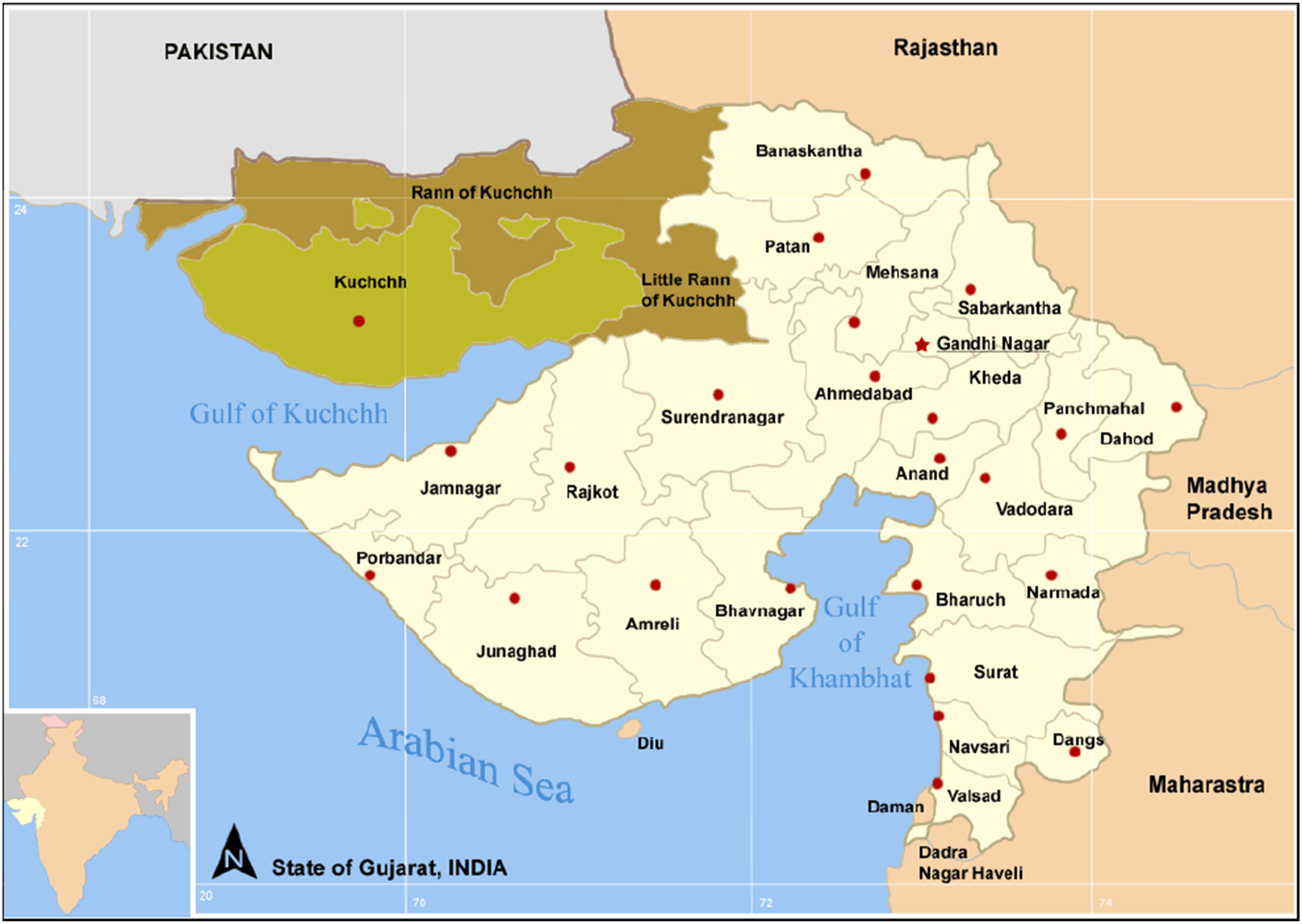
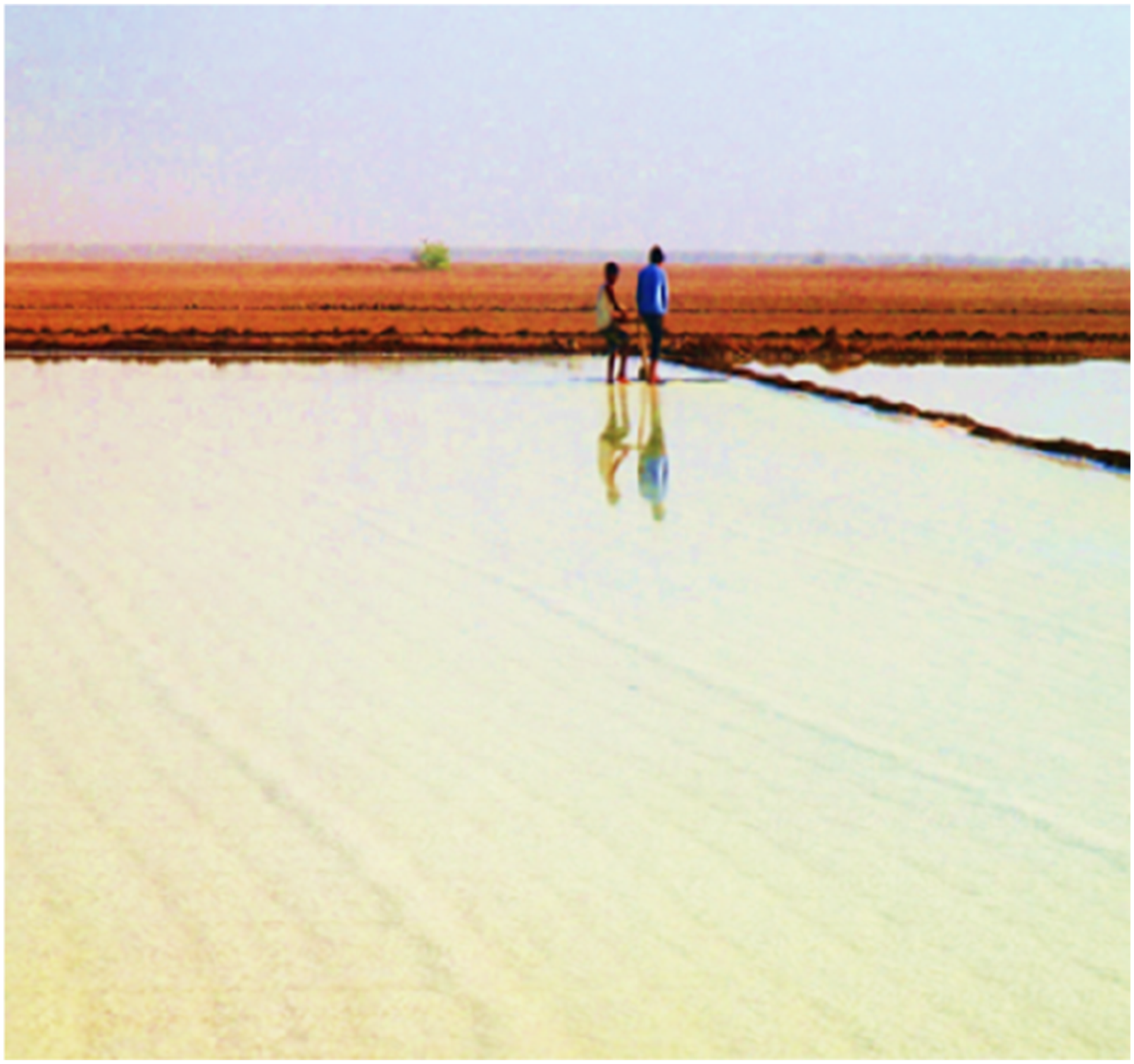
The Agariyas work for long hours, standing in the brine-filled salt pans from early morning till evening, surviving without sanitation and healthcare facilities during the work season (Picture 2). Living in the desert also means dependency on the supply of potable water from tankers sent by the government on a fortnightly basis. The only source of electricity in the desert is from the generator used for the salt pans, which was occasionally used to light up a single bulb in the house during the day. At night the generators are shut down and the entire desert becomes engulfed in complete darkness. The Little Rann of Kutch (picture: Deepti Gupta). Salt pans or patas in the desert (picture: Deepti Gupta).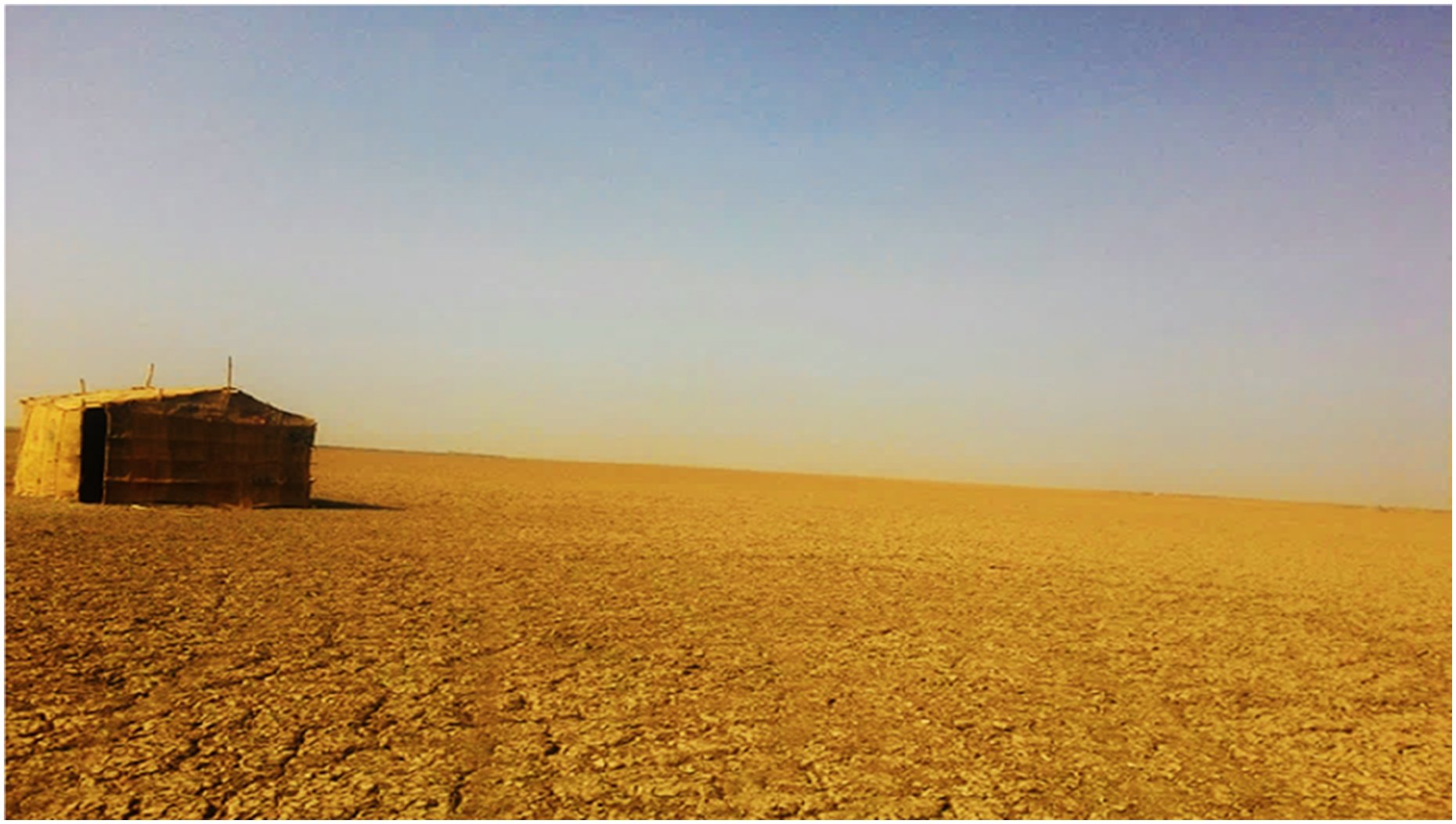
During the study, an exploration of the physical, historical, socio-cultural and economic dimensions was undertaken to understand how children of the Agariya navigated their lives in the village and the desert along with their families and how this movement from village to desert and back was integrated into the circle of family life. To access and comprehend this shifting rhythm of Agariya lives, ‘moving along’ with the participants of the study was seen as vital.
Initial visits to the field facilitated the study of dynamic aspects of the ecology and underscored the need to participate in these movements. The ‘walk-along’ strategy (Kusenbach, 2001) has been successful in understanding everyday routines and experiences while traversing the social, physical and mental ecology. Both movement and stillness were encountered within the routines of the community, and both were explored as these were seen to be integral to the lives of the Agariya community. Over a period of 12 months, I (Deepti) stayed with the Agariya families and made several trips to the village, developing many connections with community members to get to know the people better and become familiar with their lives. At some point during the initial visits, it became obvious that using a translator would not be as effective as being able to speak with them directly. In order to facilitate the personal connections, I learnt some basics of the native language before I started living with them, and continued to familiarize myself with the meaning, use and context of words over time. Despite the challenge it placed on my urban background, I made the effort to fully engage with the everyday activities, from assisting at the salt pans to meal preparation. These efforts proved to be highly valuable in gaining the trust and respect of the community. I was not seen as just a passing phenomenon, but someone who genuinely cared for the families and children, and who wished to study their lives in depth to understand how they lived and worked.
Complementing the effort taken to learn the language, I also spent time with families in complete silence. Often, in the evenings, after a hard day’s work, the family would sit in silence when I would join in this silent companionship. The ‘field’ itself continuously shaped, directed and mediated patterns of engagement, allowing me to witness and understand everyday lives as they were being experienced. I ‘walked along’ while children worked in the salt pans, stepping into the pans with them, allowing my feet to be fully immersed in the saltwater, feeling the pressure of the sharp edges of salt crystals, dragging the dantaara 2 along with the children as the sun beat down on our backs. Contribution to their everyday lives facilitated intimacy and membership. The relational dynamics within the field were palpable; my position as a young, urban, educated, female researcher was starkly distant from the world I was trying to enter and understand. As a researcher, I went from experiencing the vastness of the desert for the first time and observing families from the periphery of the salt pans, to being addressed using kin terms, for example, fui (aunt) or aapdi chokri (our daughter). This required me to carefully tread the evolving pathway of understanding human lives, roles and relationships. This also necessitated a sensitivity to social conduct appropriate for the role assigned to me. Kin terms assign a range of prescriptions and proscriptions that one needs to be cognizant of and go along with. On one occasion, I was asked to participate in the naming ceremony of a child where I was instructed to swing the palna 3 during the rituals, a duty usually performed by the child’s aunt. When elderly members visited my host family, I was asked to carry a dupatta (scarf used by women to cover themselves) and sit near the hearth along with other women of the household as this was seen as respectful. Despite the gap between our lives, the effort I had taken to try to bridge the distance during my time with them was instrumental in making sense of the everyday lives in the community. The concept of Dharma encourages us to look at others as a part of one’s own self and not separate, recognizing individual rights as well as the interdependence and responsibilities towards others. The continuum from self to others incorporates the essence of Dharma whereby everyday ethics remain embedded in the interconnectedness and care for one another.
The relationships in the field gradually moved towards varying degrees of closeness, allowing me to experience different forms of care from the research participants. For instance, the host family would ensure that somebody accompanied me when I had to travel to a Rannshaala (desert school) that was in the other part of the desert so that I do not get lost in the desert, particularly when it would get dark. Looking after me during illness or providing me with warm food during winters to help me endure the cold night winds in the desert were some other ways in which I was cared for in the field. These experiences urged me to reciprocate the care in whatever intangible form it was possible which included being continuously available to the participants even after completion of fieldwork and returns to the field.
The everyday ethics of engagements in the field raised issues of reciprocity, dignity, identity, privacy, anonymity and many other nuances of social life that repeatedly challenged my knowledge and understanding of ethical conventions. The practice of confidentiality and anonymity was questioned by the Agariyas who expressed concern over their identities being masked. They viewed using a pseudonym in writing about them as a deviation from the truth that would prevent others from relating to the life of people in a difficult ecology (Gupta, in print). This contrast between their perspective and the conventions of research raises an important ethical conundrum. In this passage, I have chosen not to use individual names.
Negotiating Boundaries
While working with preliterate, rural or tribal communities, as well as among families in smaller towns and traditional communities in larger cities in India, the protocol for research necessitates a sensitive entry into the field, one that is aligned with the social mores of the community. These may be different for different groups and are likely to be somewhat opaque until the entry itself. Thus, a researcher must be flexible and open to uncertainties. In such a social climate, uncertainty is even greater (Trawick, 1990). Such approaches determine whether the researcher is accepted or not, and even if accepted, whether she would have access to the phenomenon. In sharp contrast to standardized methodology and controlled conditions, it is only by abandoning these protocols that it becomes possible to advance in fieldwork of this nature. Apart from being aligned with the local worldview, this is also ethical, in line with our Dharma as researchers.
The selection of methods and tools is often guided by the nature and purpose of the research. How one enters the field and positions oneself in relation to the research participants is also driven by our personal values and cultural grounding in and respect towards others. Using the example of another study based in urban and rural areas of north India, a multi-method, grounded approach was used to investigate the understanding of child rights among families of urban, street and rural settings by Negi (2023). During visits to the different sites, it became amply evident that she would be required to adapt to the context in each situation, being alert to the local conditions, work patterns, family dynamics and relationships. Thus it was not possible to use a singular strategy for entering the field, interacting with the participants and conducting the research. Due to the wide variations and complexities of the field, as well as the social distance between the researcher and participant and among the different communities, each site needed specific attention to details. The delicate nature of the inquiry further required the development of mutual trust. While observations, interviews, group discussions and community surveys were used to understand the socio-cultural contexts of families, each setting afforded different opportunities for entering and initiating the research.
The challenge of creating a balance between her position as an outsider and also being able to engage with the families was perhaps most pronounced with the urban street families. These families comprised of women and children and some men who lived on the pavement, under the flyovers 4 in south Delhi. The women worked as labour or as domestic workers in the homes of the residential colonies nearby and the men worked as daily wage workers on construction sites. While adults were at work, young children were cared for by older siblings, cousins, who could be found at various places along the road or in a nearby shelter home provided by the State administration. It was these sibling caregivers who became the point of access to the street families. The researcher would approach them (mostly adolescent girls, and some boys) and strike a conversation with them as they went about their daily chores like washing, cooking and caring. At some point, conversations about the research were initiated after explaining to them what was being done. They were also informed about the need for making audio recordings. When notes were made, important points were read back to them for confirmation about their views. Over time, Negi’s relationship with these youngsters became quite trusting and they even started assisting her with the translations and recordings. Many of the nuanced meanings and behind the scenes activities were accessible only because of the contributions made by these young people. By deliberately choosing to set aside more formalized and standard procedures and soliciting the enthusiastic contributions of these girls and boys as ‘knowledgeable’, the process of data gathering was facilitated, and Negi successfully moved from her position as an outsider, to a friend on the fringes and a collaborator. By co-constructing the narratives of their lives in their own words and by giving the families agency to correct, edit and decide what ‘story’ is told, the researcher consciously attempted to avoid misrepresentation, inaccuracy and silencing (Negi, in print).
Thresholds of Life
‘Concepts are not dispassionately objective or world ordering. The world is far in excess of our concepts of it’ (Singh, 2015, p. 2). The book, Poverty and the Quest for Life, is based on two years of ethnographic study of the Sahariya community, a primitive tribe living in Shahbad, a drought-stricken region of southeastern Rajasthan, India. Reported as living a ‘life that is unthinkable’ due to extreme poverty, Singh seeks to understand the commonly used measure ‘quality of life’ from his study of the Sahariyas. Rejecting polarized approaches in favour of the unpredictable, unexpected ‘rhizome’ of what emerged as he proceeded with his work, Singh embraces the diversity and multiplicities of human existence. The book questions the notion of misery, depletion and deficit associated with poverty and instead offers an opportunity to imagine such a life through an alternate, contextualized conceptualization. In building the story of the Sahariyas, Singh includes all manner of elements: human, divine, natural and supernatural phenomena, forests, animals and spirits. Local residents assisted in navigating the socio-cultural, and interpersonal terrain of Shahabad, becoming not only translators and scribes but also interpreters. The choice to include all reflects the belief that all can be crucial contributors to their own narratives.
The author’s honest stand for uncertainty and the challenge of precision in conceptualizing and understanding the Sahariyas is testimony to the impossibility of ‘measuring’ life experiences. Power and ethics are the two primary themes in the book that Singh tries to understand through the context of the Sahariyas. In his search for an understanding of these independently and as interlinked entities that are firmly planted in the cultural and collective ethos of the Sahariyas, the author acknowledges the multiple interpretations of power (as both violence and for welfare and operating at the interpersonal and state level at varying levels of strength) and explores the coexistence of its contradictory forms (violence and intimacy, dominance and resistance). Transcending typical contradictions created by academia, the attempt to examine alternate as well as inconsistent elements provides an opportunity for rich description and novel interpretations.
The final chapter of the book presents ideas of ‘thresholds of life’ (akin to stages of life, strata, to explain how quality of life cannot be measured by static indicators) and ‘intensities’ to describe the constantly shifting experiences that we encounter. Both ideas defy the rigid, exacting notions that are typically theorized and promoted in the world of academia. The description of ethnography as a process that begins with impressions and converts to thoughts and expressions as research ideas begin to be organized into concepts. At the same time these concepts may limit us to observe and understand less than what we see. Singh (2015), discusses his return to the field and the discovery of the illness of a participant of his research. He questions his efforts in looking for him and feels that his inability to witness his “highest man in a reduced state” prevented him from making further enquiries (p. 295). Navigating through these relational dynamics and emotional states becomes a part of everyday life in the field. Open declarations of subjective experiences and emotional reactions may often be suppressed during research, but we argue that it is the same quality of being human, potentially vulnerable and fundamentally emotional that provides the critical point of engagement between what is basically a social interaction between people.
Insider-Outsider Conundrum
Although we make concerted attempts to enter and understand the field of research, it is important to be aware of the play with social distance that becomes necessary. Mostly it is advantageous to make efforts to be like an insider, one has to realize that being a researcher does entail living on the outside, especially in the case of social distance. This dynamic was evident in a study with a tribal community in the State of Tripura aimed to explore the everyday negotiations of the people with the state by understanding the lived experiences of the highland people (Tripura, 2022). During the study, the researcher, a local who shared his name with that of the State, discovered that the conventional interview techniques made the participants ‘uncomfortable’, quite contrary to their assumed usefulness in the field. After spending substantial time in the field and understanding the daily activities, Tripura chose a conversation style and simply ‘chatted’ with people in different spaces, “the village yard, in tea shops, by the roadside, and even inside the truck while travelling to the weekly market at Gonda Twisa” 5 (p.10) setting aside the standard questions. These social observations enabled him to become part of the ‘everyday engagements’ which helped in making sense of the hegemonic, unpredictable nature of the field and the survival approach of the members of the tribal community through participation in village meetings, visiting local stakeholder along with the community members and travelling to other villages with them to participate in a protest. Being from the region, he was constantly aware of the insider-outsider dynamics. While being an insider in the field, it became paramount for him to remain sensitive to the views of the community and the codes of conduct, while also requiring sometimes to ‘unlearn and relearn’ the ethos of the community. Since he had spent a significant period away from the community for higher education in another region, returning to the native place, she shifted from being seen as someone with ‘superior social capital’ to struggling to adapt to the expected way of life (Tripura, 2023). Ethical dilemmas are inevitable for a researcher, and one must continuously navigate the shifting landscape of being the insider-outsider in the field. In one instance during a celebration, the researcher was given the tribal food guduk 6 and immediately after eating he made sounds indicating difficulty consuming the spicy food. Community members commented that distance from her native home had distanced him from the local ways as seen in his intolerance for the traditionally spicy food. Even though it was a small incident, meant to be light-hearted, it stayed with Tripura (2023) as a marker of being a failure to fully return to local status.
The Ethical Ground
The need for understanding the ethics of engagement that arise from the various positions experienced in the insider-outsider continuum is recognized in the profiles presented from different research studies. Human entanglements evolve in a way that allows the familiar to become unfamiliar and the strange to become familiar. These continuous shifts in familiarity with the field thereby require continuously assessing the everyday ethics of engagements in the field and navigating them carefully. The field also provides a sense of ‘home’ and the openness to the constant uncertainty of field relations. These provide the researcher with a footing and a sense of being connected with the milieu they inhabit. These examples also provide an insight into the ethics of responsibility that forms the core of engagements along the insider-outsider continuum.
The examples highlight the need to revisit and review standard protocols of research which do not align with the research context and the conventions of the participant community. These protocols often fail to recognize the lived reality of people in diverse ecologies and the diverse ways of approaching and understanding their lives. The researcher-researched relationship embodies a power dynamic which is often prejudiced against the participants. While research is aimed at presenting the ‘voices’ of the participants, the research process itself often creates opacity for the voices to be heard. When we bring in techniques which are not in tandem with the varied ways of living and surviving, we distance ourselves from the reality and truth of human life. The techniques instead reinforce the existing prejudices or beliefs about cultural groups which are distinct from the researcher. Tripura (2023) describes how the lack of openness and a sense of superiority among the colonial ethnographers resulted in creating a view of tribal people as “lazy, wild, savage, naked, primitive, exotic, degraded Tribes, warlike, sexist, barbaric, uncivilized, and criminal” (p.3). Similar misconstrued images of communities and groups smeared with assumptions continued to make them invisible in the mainstream discourse.
Transparency, accountability and authenticity in research can be seen as guiding ethics across the four research studies. The researchers discussed their observations with the participants, clarified doubts and tried to understand how the participants interpreted the observations through different approaches. The attempt was to enable the participants to partner in the research, develop mutual responsibility and review any dominant research process (Tripura, 2023). In linguistically diverse and distinct environments, transparency further ensures accuracy in the data, contextualizing the observations and the meaning derived from them.
Ethics in the Land of Dharma
In the title, we introduce the concept of Dharma with regard to social conduct, accountability, ethics and relationships in research. Buddhist and Hindu traditions are recognized as living traditions (Paranjpe, 2024), in the sense that these beliefs continue to underlie much of the socio-cultural belief system in modern society despite profound change. In this section, we will try to connect some conventional concepts from Hindu and Buddhist traditions. Dharma is understood by Hindus as the universal natural law central to life which enables a person to encounter the entire cosmos as connected thereby raising an awareness of coexistence and complementarity with the entire social, cultural reality and nature. Emphasis is placed on moral conduct and righteousness in our conduct toward everyone and everything outside of us. Realising such a continuity between life forms underscores the ethics of responsibility and care for others in the ethics of Dharma. The Brihadarnayak Upanishad states, yo vai sa dharmah satyam vai tat, implying Dharma is nothing but the truth (Madhavananda, 2023). Looking for the truth in research will eventually bring the researcher closer to Dharma. Dharma recognizes a natural order to all things which is Rta or the ‘right being’, that recognizes sensitivity to context as central to Dharma (Ramanujan, 1989).
The eighth-century Buddhist Philosopher, Santideva emphasized the deconstruction of wholes through the concept of Pratityasamutpada, which explains the dependence of the origin of one phenomenon on the other, thereby making the existence of one impossible without the other. In similar ways, research methods and ethics too are dependent on and defined by the participants and the context in which it is carried out. Ethical contextualism is based on the underlying ontological context. Recognizing the role of each part of the whole and the various combinations of multiple parts, as well as how change occurs because of varied configurations of those parts forms the basis of ethics (Frazier, 2023). In the study on the Sahariya community, the author’s decision to recognise as sources of knowledge all elements that constitute the life and existence of the people of Shahabad is reflective of this interdependency among phenomena and the idea of ethical contextualism. By seeking the participation of the older children in confirming the accuracy and interpretation of her conversations, Negi (2023) acknowledges the street children as valuable knowers. At the same time, she confirms her ethical responsibility for research authenticity. The idea of Dharma recognizes individual entities as well as their interconnectedness as integral to the cosmic order. This insight underscores not just the basic approach to doing research but also enables openness to varied experiences in the field that take you beyond the conventional role of the researcher. The study of the Agariya community also reflects a similar attention to Dharma as an ethical choice for the researcher.
For Indian communities, it is often quite unreasonable to expect participants to come to the centre of research like a university or outreach centre. Given the nature of community life and access to resources, the movement is usually done by the researcher to the field. This shift prevents the domination of urban, educated and middle-class participants, and offers an entry into the ecological plurality of society in India.
The moment a researcher enters the field, each interaction determines the trajectory that is eventually taken. Our understanding of the field and ourselves continuously evolves as we traverse through it. It is impossible to predict the unfolding dynamics and how all the factors will work together, how one needs to connect with participants and how they will respond to you. As researchers witness these varied combinations in the field, they oscillate between the states of vidya and avidya (knowing and not knowing). Vidya refers to true knowledge or wisdom which eventually leads to enlightenment, whereas avidya refers to illusion or misconceptions which lead to ethical confusion. In the field, one moves between these states, as what we know, what we do not know and what we can know are reassessed and reviewed continuously. There are certain parts of the field that are likely to be witnessed at an early stage of the research, but their meaning might be revealed after some reflection. There also will be parts that will never be revealed or features which will remain impossible to fathom. The frame of reference of the researcher juxtaposed against the myriad elements and the back-and-forth movement between knowing and not knowing is essential to making sense of the lived experiences of people as demonstrated by Tripura (2023). Recognizing the ever-changing and dynamic nature of the field and moving along with the changes, has been underscored in all four pieces of research. Singh (2009) reflects on the changes he observed in the field after his return and writes, ‘If I had begun fieldwork now, I would have written a very different book. And this is just in the space of two or three years. Life waned suddenly on this small patch of land that was my home for a while. But it may return’ (p. 295).
When we take a concerted decision not just to work with people from our social milieu and extend the lens of research onto a wider landscape, the immersive nature of ethnographic inquiry provides strength to the world co-constructed in research. The long durations of fieldwork enable complete immersion of the researcher and the researched in the lives of each other. Understanding the responsibilities as a part of the ethics of care is a significant aspect of research. As one recognizes a continuum between the researcher and the researched, understanding the ‘researcher-carer’ self enables complete immersion in the milieu. Incorporating the core concepts of Dharma provides a selfless outlook towards the relationships developed in research. This enables continuity in the relationship with the participants beyond the period of staying in the field and therefore facilitates reciprocity (Gupta, in print). On several occasions, Gupta writes that she was asked to look after young children when their parents were travelling to the village and was also asked to guide and support children in preparation for annual school exams. On one occasion, the researcher was asked to look after an elderly woman for a day when her 26-year-old son had not returned home, and the rest of the family members were going out to search for him. These are situations which cannot be anticipated and recognizing that care for one’s participants and participating as well as offering one’s own time and energy as a fellow human being becomes important, although one may not always be able to fulfil that responsibility.
Describing the story of Sulabhā and Charaka Samhita, Frazier (2023) stated that humans are varied, complex systems within a larger system, but can choose the boundaries of their agency and attention owing to the emergent faculty of reason and suggests that an ethically guided person will be aware of the multiplicities of existence. The context determines the way actions and actors are understood and thereby Dharma is guided by the aggregation of the varied forms of human experiences and entanglements.
Explorations of patterns of human thriving and becoming have been seen, understood, and discussed from the lens controlled by the forces of the Global North, rooted in colonialism, imperialism and unequal power relations. Procedures and protocols for maintaining ethics in the field too are guided by Western social conventions. Although universal claims are made, there are specific affordances and constraints that are essentially local and may not be shared even with a neighbouring community. As Singh finds in a recent publication, neighbourhoods with similar socio-demographic features can have different socio-genetic currents (Singh, 2021), and sensitivity and attention to these nuances is critical to gaining reasonable access to knowledge.
The ‘field’ for researchers as a result can become a ground for ‘othering’. The worlds that are inhabited and created by the ‘researched’ are seen as an aberration or an anomaly while being constantly juxtaposed with the worlds of the so-called knowledge bearers or controllers. While there has been a recognition of ‘diversity’ and diverse ways of living, acceptance of those innumerable and unimaginable forms of ordinary life is yet to be fully explored. The absence of context sensitiveness distances the researcher from reality, resulting in epistemic injustice and violence. When we allow the field to decide, it reduces epistemic injustice and enables knowledge of people about their own lives to be valued and appreciated. It also dilutes our assumptions about the lives of people and advocates that their lives are discussed in ways they desire to be known and understood.
The reason for invoking the concept of Dharma is precisely to present an epistemological shift in research practices that recognizes the varied lived realities. The Dharma path facilitates the co-creation of life worlds, lessens the self-other distinction, and emphasizes the ethics of alterity. Researchers will thus be able to integrate themselves into an ethical society by realizing that ‘care’ is fundamental to all kinds of relationships, both inside and outside of the field (Gupta, in print).
Conclusion
Human lives follow a pattern of uncertainty, analogous to the occurrences at the subatomic level. The way of determining or understanding everything about a particle at a given time is not possible; similar are the lives that humans lead. Therefore, what we eventually understand about the lives that are imagined and lived will only be equivalent to an anu (atom) in comparison to the brahmand (universe) that is still out there, unknown, and unfathomable.
Expanding on the Hindu idea of Dharma and its place in understanding the fundamental divergences between a rights-based and a duty-based society, Bhatia (2000) makes a connection between moral practices and self-other relationships. What is the position of the other in our representation of our self? Humanistic psychology and American psychology emphasize an understanding of the self as individual, bounded, atomic and self-contained (Bhatia, 2000; Menon, 2003). This is quite distinct from the Hindu notion of the self as being ‘dividual, heterogenous and open’ (Menon, 2003, p. 433). The idea of personhood is fundamentally linked to the interconnectedness we feel with others.
Humans can truly interpret the world once we move beyond and see how non-human entities also ‘constitute’ what we come to understand as human and the human self (Kohn (2013). In the shared worldview of Hinduism and linked religions, the cosmos is believed to be organized as an ecosystem which is sustained by a complex web of symbiotic relationships between interdependent pieces, each of which has a distinct role to play that benefits the whole framework (Holdrege, 2004). As Dharma guides navigation through the complexities of existence amidst the interdependent pieces, it can also become the guiding force for negotiating life in the field for a researcher. Recognizing continuity and interconnectedness between all elements enables researchers to be closer to all forms of intensities and fragilities of life. This sense of interconnectedness evokes a sense of responsibility and reciprocity towards the field while remaining open to the experiences in the field. The concept of Dharma further helps in decolonizing and humanizing the codes of research which lack context sensitiveness and is a reminder of the ethics of care and alterity which is not limited to the time spent in the field and ensures continuity between the different parts of the whole.
Footnotes
Action Editors
Wade E. Pickren and Thomas Teo.
Declaration of Conflicting Interests
The author(s) declared no potential conflicts of interest with respect to the research, authorship, and/or publication of this article.
Funding
The author(s) received no financial support for the research, authorship, and/or publication of this article.
