







Abstract
In the first such review to our knowledge, we analyze 85 studies conducted since World War II addressing how cognitive, affective, and behavioral biases against Jewish people take form in childhood, adolescence, and emerging adulthood; their implications for Jewish youth; influences on their development; and efforts to reduce them. Studies were concentrated in the Middle East and Western countries and used a wide variety of methods. Although many studies have significant theoretical or methodological limitations, others are quite strong. Collectively, this work highlights the foundational roles of social categorization and labeling, ingroup-outgroup dynamics, and essentialist thinking. Across development, knowledge of Jews is limited and replete with misconceptions. Common negative stereotypes increase with age, as do negative attitudes and antisemitic behaviors, which are increasingly interrelated with anti-Israel sentiment among emerging adults. Jewish children and youth are well aware of and concerned about anti-Jewish bias, but hesitant to call it out. Very little research has explored cultural, school, neighborhood, parent, peer, and media influences on children’s anti-Jewish bias. However, several studies point to its malleability through interventions focusing on social-cognitive and emotional skill building and positive contact with Jewish peers. Implications for future research, education, and policy are discussed.
Keywords
Introduction
How do biases against Jewish people take form in childhood, adolescence, and emerging adulthood, what are their implications for Jewish youth, what influences the development of such biases, and what can be done to reduce them? Answers to these questions have important implications for understanding the viral spread of antisemitism, one of the world’s oldest forms of hate, understanding the psychosocial consequences for those who are targets of this hate, and shaping future research, education, and policy. To our knowledge, there is no systematic analysis of the literature on the development of antisemitism or anti-Jewish beliefs, attitudes, and behavior. Here, we describe and evaluate developmental research on these topics. We first characterize the current state of the science—the features, methods, and strengths and weaknesses of the studies. We then draw preliminary, empirically-supported conclusions about the development, antecedents, and implications of anti-Jewish biases as well as efforts to mitigate them. In order to capture as much relevant research as possible, we deliberately cast a wide net, including articles that vary widely in their definitions and operationalizations of anti-Jewish beliefs, sentiments, and discriminatory behaviors.
Why is understanding the development of antisemitism important? After all, Jews compose only about 2.4% of the U.S. population (Pew Research Center, 2021) and have long represented only about .2% of the global population (Pew Research Center, 2012). First, the Jewish population is small in part because of centuries of persecution across the globe, including enslavement in ancient Egypt, killings and forced conversion during the Spanish inquisition, Eastern European pogroms in the early 20th century in which at least 50,000 (but perhaps closer to 200,000) Jews were murdered, and the Holocaust, which resulted in the massacre of 6 million Jews, a third of the world’s Jewish population at the time (Anti-Defamation League, 2020; Goldberg, 2025). These atrocities were spurred, in part, by widespread anti-Jewish stereotypes and conspiracy theories, some of which can still be found in contemporary discourse and media. Across centuries, Jews have been accused of blood libel, blamed for economic recessions, and blamed for pandemics (Anti-Defamation League, 2020; Langer, 2022; Tevis, 2023).
Antisemitism and anti-Jewish biases continue to be of concern in contemporary society. In the United States, events such as the neo-Nazi march in Charlottesville, Virginia in 2017 with its chants of “Jews will not replace us,” the 2018 murders of 11 worshippers at the Tree of Life synagogue in Pittsburgh, and the murder of two young Israeli Embassy staff members in Washington, DC in May, 2025 have brought home the seriousness of antisemitism in America. Every year since 1991 (the earliest available FBI data) Jews have been the targets of more hate crimes than any other religious group in the U.S.; many of those years, Jews were the second-most targeted social group overall (FBI Crime Data Explorer, 2025). Then, in the wake of the October 7, 2023 Hamas massacre of Israeli civilians and the ensuing war, the U.S., like many countries, saw an even sharper increase in hate crimes toward Jews. According to FBI statistics, in 2023 there were a record high 12,498 hate crimes in the U.S., and hate crimes against Jews represented 16% of all hate crimes that year (FBI Crime Data Explorer, 2025). Moreover, from October to December of 2023, more hate crimes were committed against Jews than against any other social group.
It is clear that hate toward Jews is alive and well, not only in the United States but around the world (Anti-Defamation League, 2025). As developmental scientists, we seek to understand its origins and start by taking stock of what we already know about the development and developmental consequences of bias toward and hatred of Jews.
Method of the Review
Scope
We focused this review on studies of children, adolescents, and emerging adults (primarily college students aged 18–25) that have relevance to anti-Jewish bias or antisemitism. To set the stage, we cite a working definition of antisemitism offered by the International Holocaust Remembrance Alliance (2016) and adopted by the U.S. government and several other countries: Antisemitism is a certain perception of Jews, which may be expressed as hatred toward Jews. Rhetorical and physical manifestations of antisemitism are directed toward Jewish or non-Jewish individuals and/or their property, toward Jewish community institutions and religious facilities.
The IHRA definition, which includes a list of specific examples, is widely cited but it is not the only definition that has been put forth (e.g., there are the NEXUS and JDA definitions), and it is not universally embraced. Controversies have arisen because of the many different aspects of antisemitism that can be emphasized or deemphasized in a definition and because of the difficulty of defining which negative statements or actions regarding Israel are antisemitic (see Bogle, 2022; Waxman et al., 2021). Some have argued that definitions of antisemitism should be based on a “bottom up” approach, that is, based on Jewish people’s perceptions of others’ denigrating thoughts, damaging actions, and negative effects on their emotions (DellaPergola, 2024; and see Volodarsky et al., 2025, for an application of this approach in which Jewish college students in the U.S. defined which statements about Israel they considered antisemitic).
Although the phrase “a certain perception of Jews” in the IHRA definition may encompass latent thoughts and feelings, the emphasis in this and other definitions is on verbally or behaviorally expressed antisemitic hatred and discrimination of the sort adults display. We are not as sure these definitions apply to children, who may have not yet learned specific antisemitic tropes and conspiracy theories, converted any dislike or negative emotions they may feel into acts of hatred, or be in positions to discriminate against Jews. This review therefore casts a broader net: We examine from a developmental perspective cognitive, affective, and behavioral biases of non-Jewish youth toward Jewish people or Jewish institutions—especially negative biases that reflect antisemitism or that lay the foundation for the development of antisemitism—and are therefore critical to investigate scientifically if we want to understand the development of antisemitism.
Social psychologists investigating racism, ageism, and other social biases generally examine three phenomena (e.g., see Nelson & Olson, 2024): stereotypes (beliefs about a group or its members), prejudice (biased evaluations), and discrimination (negative behavior or biased treatment), reflecting, respectively, cognition, affect, and behavior. Accordingly, in addressing our first guiding question about how antisemitism takes form during childhood and adolescence, we defined the focus of our review as anti-Jewish bias, encompassing (a) cognition: for example, social group categorizations, (mis)conceptions, knowledge gaps, belief in negative stereotypes and conspiracy theories about Jewish people; (b) affect: for example, sentiments about, dislike of, or at least less liking of or less positive attitudes toward Jewish people relative to non-Jewish people; and (c) behavior: for example, desire for social distance or low willingness to interact; verbal and/or physical mistreatment or discrimination, including exclusion by peers. We noted evidence of positive perceptions of Jewish people in the data as well in the interest of accuracy and completeness.
With respect to our second question, we sought studies of Jewish youths’ awareness of and reactions to others’ perceptions of and behavior toward themselves or toward other Jewish people and of effects of anti-Jewish bias on their emotions, sense of well-being, sense of identity, mental health, and functioning. Third, we took note, in both studies of anti-Jewish bias and studies of Jewish youths’ perceptions of and reactions to bias, of possible influences on antisemitism—how it may be socialized by cultural forces, schools and neighborhoods, parents, peers, and media. To address our fourth and final question, we sought studies reporting educational programs and prejudice prevention or reduction interventions designed to mitigate either bias against Jews or negative effects of bias on Jews.
In view of the small quantity and diverse nature of the research and the many constructs examined, we pursued this as a narrative review. We did not believe it feasible to conduct a systematic review or meta-analysis following PRISMA guidelines because we did not find enough studies addressing the same, well-defined research question (see Page et al., 2021). However, in the spirit of PRISMA, we strove to be systematic and transparent in our procedures.
We cast a broad net with regard to study focus, discipline, methodology and the country where the study was conducted. Our goal was to find and assess whatever research had been conducted relevant to our guiding questions. We included studies that are: • quantitative, qualitative, or mixed method in approach; • published in professional journals or books, as well as reports of surveys issued by major organizations (e.g., the Anti-Defamation League, the Louis D. Brandeis Center for Human Rights Under Law, Brandeis University’s Maurice and Marilyn Cohen Center for Modern Jewish Studies, and the UK’s Centre for Holocaust Education); • published during the period from 1945 (the end of World War II) to August, 2024; and • conducted in any relevant discipline and in any country, but published or available in English.
As for exclusion criteria, we removed from search results duplicate entries for the same study; studies that did not pertain to individuals in the early childhood to emerging adult age range; studies that did not address one or more of the four guiding questions stated above; studies about Holocaust education that did not assess effects on students’ anti-Jewish biases (see Pistone et al., 2024, for a review of many of the types of pedagogical studies excluded); non-research articles such as conceptual analyses, discussions, and opinion pieces; and working papers, unpublished papers, master’s theses and dissertations, and other documents that did not appear to have undergone a peer or editorial review process. We set aside a number of other studies that focused on the attitudes of Jewish children toward other social groups that did not include data on biases of non-Jewish groups toward Jews.
Search Terms
Because studies of children rarely used the term “antisemitism,” we used a wide variety of search strings incorporating varied constructs to locate eligible studies on biases toward and hatred of Jews. An example search string was: (antisemit* OR anti-semit* OR anti-Jewish OR prejudice OR bias OR negative attitudes OR stereotypes) AND (child* OR develop* OR adolesc* OR teen* OR college) AND (Jew* or Judaism)
Other search strings included one or more of the following terms combined with Jew* AND (child* OR adolesc* OR teen* OR college): perceptions of, knowledge of, social distance from, rejection of, exclusion of, tolerance of, contact with, liking of, dislike of, attitudes toward, friendship with, bias toward, discrimination against, ethnic identity of, ethnic-racial socialization of, bullying or bias-based bullying of. To find additional studies of effects of bias on Jewish youth, we also searched for: reactions to, perceptions of, concerns about AND (antisemit* OR anti-semit* OR anti-Jewish).
Databases searched included: PsycInfo, Google Scholar, ERIC, Sociological Abstracts, International Political Science Abstracts, Google, PubMed, and Web of Science. In addition, we searched for other works by authors of especially relevant papers and for studies that cited such studies, and captured relevant references from the articles we obtained. After the exclusion of many more documents that were ineligible, these search strategies yielded 85 studies that met the inclusion criteria. We do not claim that this review is exhaustive, but we earnestly tried to find every published study available in English on the development of ideas, emotions, and behaviors related to antisemitism and their correlates, malleability, and implications for Jewish youth.
Coding System and Process
Characteristics of the 85 Studies Coded and Intercoder Agreement
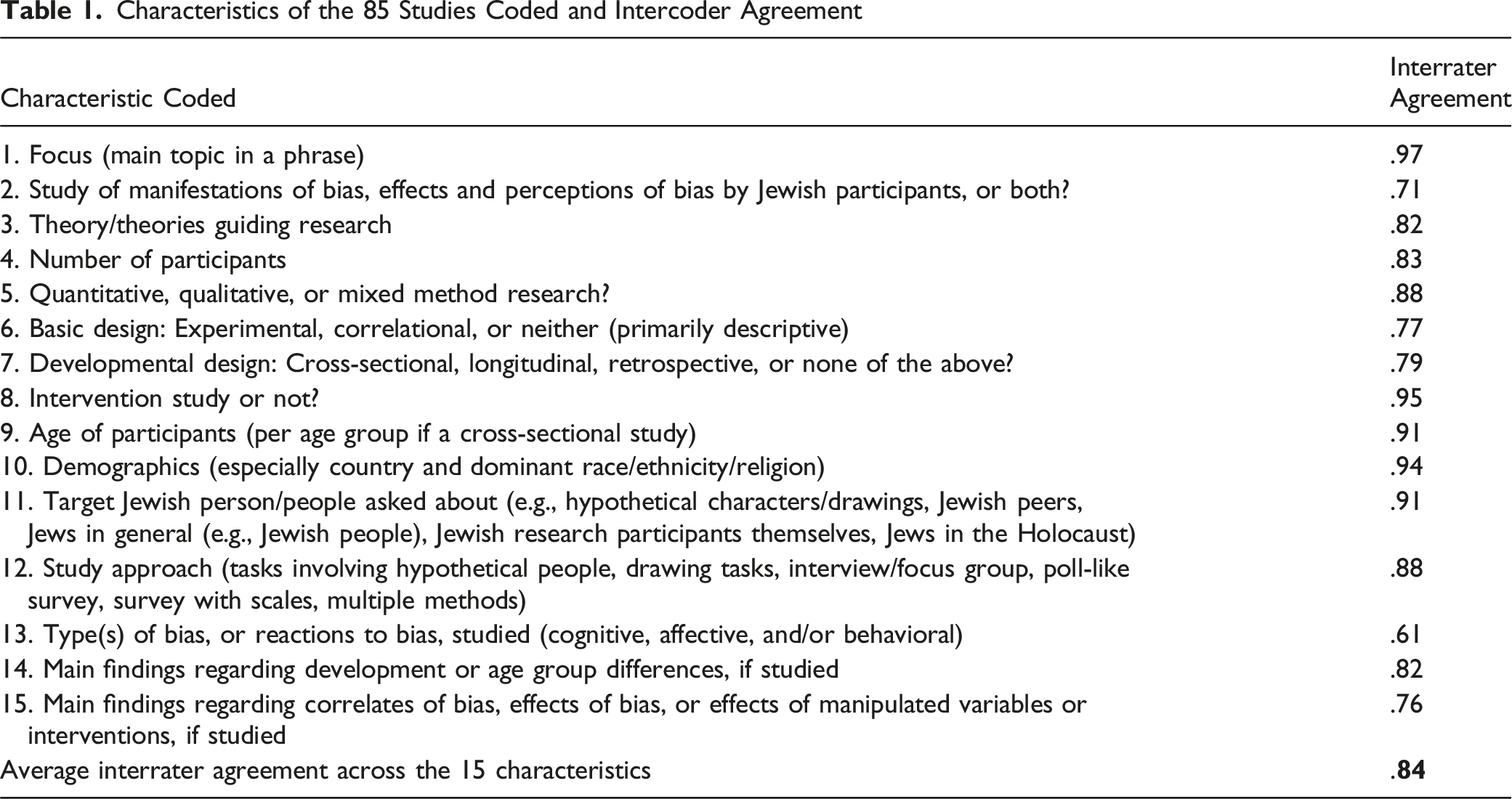
Studies were coded by rotating pairings of four trained undergraduate students and the lead author, who trained and met with the students and reviewed and finalized all coding. The coding submitted by two coders for an article were compared and disagreements were resolved by student coders in weekly meetings or, when necessary, by the lead author.
As Table 1 shows, interrater reliability across the 15 coded characteristics averaged 84% for the first 66 articles coded by mid-June, 2024; 19 more eligible studies were located and were coded by two trained coders or the lead author subsequently. Ten of the 15 interrater reliability figures were 80% or higher. Only one figure—for “Type(s) of bias studied”—was below 70%, primarily because of difficulty distinguishing whether cognition, affect, or both should be coded for measures that arguably assessed both (e.g., trait adjective scales where a high score indicated positive attitudes and a low score negative ones).
Results of the Review
It is important to know how researchers have approached studying a topic in order to interpret and evaluate their findings. We therefore begin by characterizing the types of studies we located and reviewed, and then turn to the studies’ findings, addressing in turn our four guiding questions.
Characterization of the Studies
To describe the kinds of studies that have—and have not—been conducted on anti-Jewish biases in childhood through emerging adulthood, we characterize the 85 studies in terms of their foci and research designs, characteristics and contexts of participants, guiding theoretical perspectives, and research methodologies and measures. See Supplemental Materials for a table with selected descriptive information about each of the studies.
Focus and Research Designs
Most studies (72%) focused primarily on anti-Jewish bias (including evaluations of this bias in non-Jews, and Jews’ reports of anti-Jewish incidents), 17% on effects/perceptions of bias, and 11% on both. In approach, 73% were quantitative (liberally defined as including at least some descriptive statistics; e.g., means or percentages), 22% were entirely qualitative (often involving very small samples and lacking established qualitative research methodologies), and 5% were mixed methods. With respect to design, 57% were correlational, 21% experimental, and 22% descriptive (e.g., they were qualitative reports of interviews or focus group sessions, or poll-like survey reports lacking correlational analyses). Fifteen studies (18%) reported on interventions; but five of these did not have a control group (e.g., they were one-group pretest-posttest designs).
Importantly, only 39% of studies employed developmental designs or at least had a time dimension: 27% were cross-sectional comparisons of at least two age groups or studies correlating age with responses; 8% were longitudinal studies; 2% were intervention studies with longitudinal follow-up assessments (all relatively short term); and one (1%) was retrospective. The majority of studies (61%) were therefore not developmental but instead examined one age group or another, limiting our ability to piece together a developmental story.
Participants and Sociocultural and Historical Contexts
Aggregated Study Characteristics
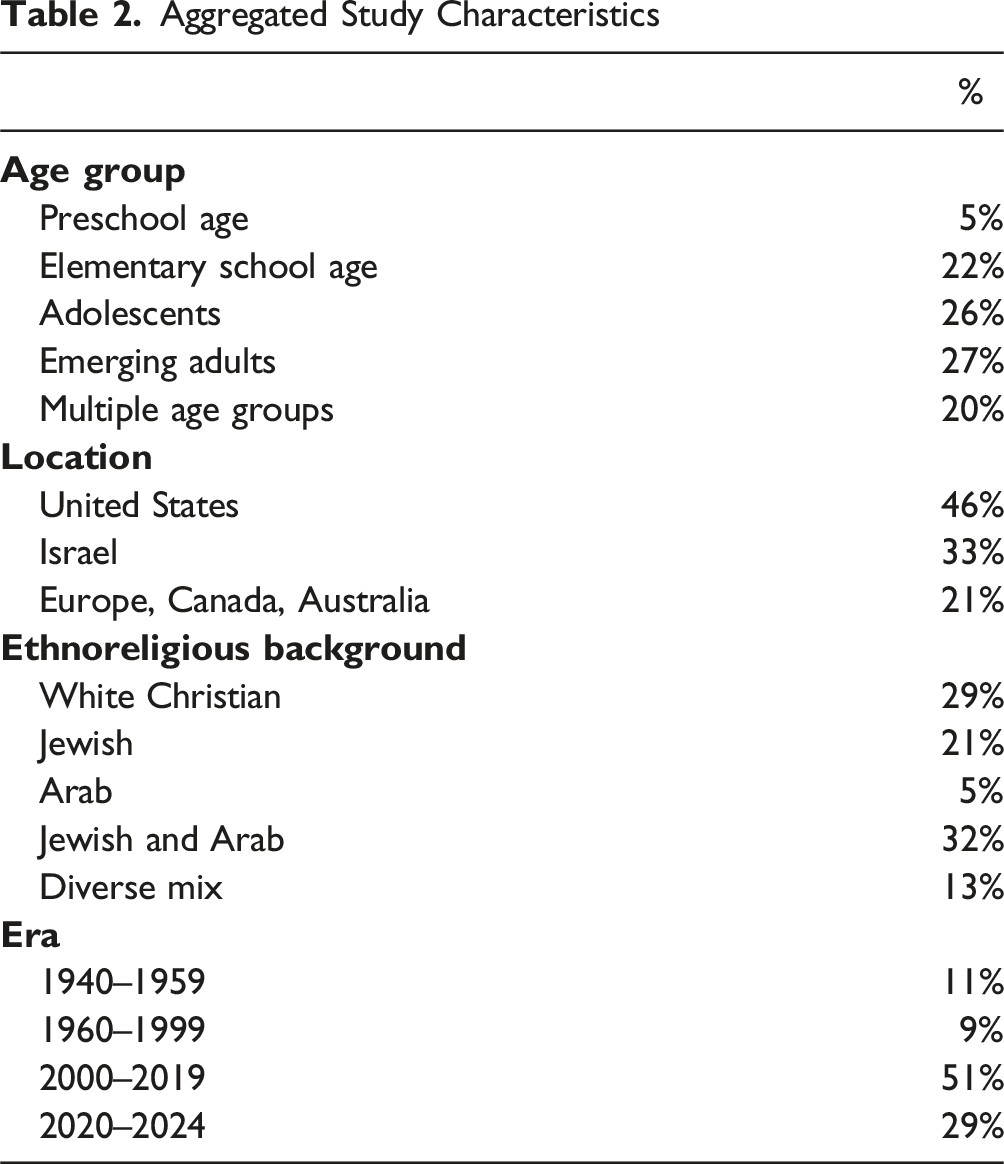
In interpreting study findings, it is important to appreciate that Israel is a very different sociocultural context than other regions in which studies were conducted. In contrast to nearly everywhere else in the world, in Israel Jews are the majority rather than the minority, hold governmental and political power, and have long been engaged in a conflict with surrounding Arab states and organizations (e.g., the Palestinian National Liberation Movement, Hamas, Hezbollah). Moreover, Jews and Arabs in Israel often have different languages, dress, cultural and religious practices, and statuses—differences likely to facilitate children’s recognition of and learning about the two groups. These unique sociocultural and historical factors must be considered when interpreting studies in which Israeli Jews and Muslim Arab participants are asked about each other. However, it should also be acknowledged that Jews are still in the minority position in the Middle East—representing approximately 1.6% of the population (Pew Research Center, 2012)—and that Israel is the world’s sole Jewish nation, surrounded by 22 majority-Muslim Arab League nations.
The historical context of a study is also important, as studies and their participants are a reflection and product of their time. Only a fifth of the work on these topics was conducted in the mid-to-late 1900s. The 2000s–2010s was a period of marked activity, when more than half of our studies were conducted. This increase in research volume has persisted, as 29% of our studies were published just between 2020 and August of 2024. This may partially reflect increased psychological study of a variety of social biases and stereotypes in the 21st century (e.g., Leaper & Brown, 2018; Neville et al., 2024). As well, the events of October 7, 2023 seem to have sparked greater scholarly interest in attitudes toward Jewish people.
Guiding Theoretical Perspectives
What theoretical perspectives have guided scientific research on the development of anti-Jewish biases? Although it was not prominent in our corpus of studies, psychoanalytic theory was highly influential in the first wave of studies of antisemitism after World War II, memorialized in the publication of Adorno et al. (1950), The Authoritarian Personality. Antisemitism and other prejudices were traced to internal personality conflicts and anxieties attributable to a child’s parenting. Although we did not include in this review a seminal article by one of the book’s co-authors, Else Frenkel-Brunswik (1948), because it did not supply a formal analysis of their data on adolescents’ prejudice, this article was undoubtedly influential. Frenkel-Brunswik traced antisemitic attitudes to an “anti-democratic” personality profile rooted in punitive, obedience-focused parenting that was believed to foster submission to, but repressed resentment of, authority and motivate coping through expression of prejudice toward outgroups.
The most important statistic regarding the theoretical foundations of our corpus of research is this: Only 56% of the 85 studies were judged to have described a guiding theory or theories. Moreover, when theories were mentioned, usually little was said about them and they were rarely formally tested. Intergroup contact theory (Allport, 1954) stood out as the most frequently mentioned theory (9% of the studies), guiding not only intervention studies that involved contact between groups but studies of the implications of personal contact (e.g., having Jewish friends) for attitudes (e.g., McKenna & Francis, 2021). Another 7% of studies drew on social identity theory (Tajfel & Turner, 1979) or the social identity development theory derived from it (e.g., Nesdale, 2004), emphasizing children’s categorization of themselves into ingroups and outgroups and its implications. The “other theory” category (16%) included some other well-known social-cognitive developmental theories of prejudice, all of which involve some combination of social categorization processes and social influences; examples are Aboud (2008), Bigler and Liben (2006), and models rooted in social domain theory (Smetana, 2006; Turiel, 1983) that examine the development of prejudice in relation to the development of social cognition, group identity, and social norms and morality, particularly with regard to the fairness or unfairness of excluding peers who are different (e.g., see Rutland et al., 2010, 2024). Also, in the “other theory” category were several non-developmental theories from psychology and sociology (e.g., common identity theory, group threat theory, ecological theory, and implicit personality or mindset theories). Finally, 22% of articles referred to multiple theories.
Research Methodologies and Measures
Research methods and measures in studies of anti-Jewish biases from early childhood to emerging adulthood necessarily varied with sample age. Of our 85 studies, 12% used tasks and questions involving hypothetical target persons, typically shown in drawings or photos (e.g., a Jewish man and an Arab man in ethnic/religious dress). Another 4% used projective drawing tasks (e.g., draw a Jewish person, draw an Arab person) that were analyzed for a variety of features (see Michael & Rajuan, 2009; Racheli & Tova, 2011). Both of these methods were most commonly used with children. Individual interviews or focus groups (27% of the studies) were used across the full age range of interest, whereas poll-like surveys (14%) and surveys with scales measuring constructs of interest (29%) were understandably employed primarily in studies of adolescents and emerging adults. Multiple methods were used in 14% of the studies.
Another key methodological choice is what to ask participants about—the question target. Can we expect similar responses with similar implications when children are asked about a drawing of a Jewish man in Jewish garb, about “Jewish people,” or about Jewish children in their school? In a third (34%) of the studies, participants were asked about Jewish people in general. In about a quarter (22%), participants were asked about themselves, often in interviews and surveys of older Jewish youth about their experiences of bias. Still other participants (18%) were asked about hypothetical Jewish characters portrayed in visuals and/or brief stories. Jewish agemates were the focus of 15% of the studies, some combination of these target persons was utilized in 8%, and two studies (2%) asked about Holocaust victims.
The corpus of studies touched on all three main components of bias: cognitive, affective, and behavioral. The affective component was most often gauged (in 88% of studies), followed by the cognitive component (in 74% of studies). In contrast, the behavioral component was gauged in just 37% of studies. Actual experiences of antisemitic behavior were reported by older Jewish respondents in some “effects of bias” studies. Otherwise, the closest that studies of bias usually came to assessing behavior was to gauge desired social distance or willingness to interact, not actual interactions with Jewish individuals. As these numbers suggest, most studies gauged multiple components of bias: 53% of them gauged two of the three components, 23% all three. Impressively, some studies devised reasonable, age-appropriate measures to tap all three aspects of bias. In an intervention study involving contact between Jewish- and Palestinian-Israeli fifth graders, for example, Berger et al. (2018) assessed: (a) cognition (stereotyped ratings of the outgroup on bipolar traits like smart-stupid, and expectations about how likely outgroup members were to engage in five negative behaviors such as hurting or stealing), (b) affect (expected experience of positive and negative emotions when interacting with outgroup members such as secure and calm versus anxious and threatened), and (c) behavior (willingness to meet and play with members of the outgroup).
As we will see later, a variety of approaches have been taken to assess attitudes toward Jewish people. However, we discovered no scale that was designed to measure children’s or adolescents’ antisemitism and that was widely used. Some researchers did administer scales to assess antisemitism among adolescents and emerging adults but the scales were varied in content, often only a few items long, and not always well-established psychometrically. For example, McKenna and Francis (2021) developed a five-item “Scale of Anti-Jewish Attitudes” for use with 13- to 15-year-old adolescents in Great Britain—a mix of items about desired social distance, approval of and interest in Jewish people, and acceptance of Jewish students wearing religious clothing to school. Villano (1999) administered short “blatant” and “subtle” antisemitism scales in a study of Italian adolescents and adults. Shenhav and Kopstein (2020) assessed both antisemitic attitudes tapping into Jewish stereotypes and conspiracy theories and anti-Israel attitudes among college students in the U.S. by drawing items from existing scales, reporting a modest correlation between the two scales as well as differences in their correlates. Other scales have combined items pertaining to both Jews and Israel (for some additional antisemitism scales, see Hersh & Royden, 2023; Schröder, 2020; Wright et al., 2024; and the section below on Negative Attitudes). Shifts in the sociohistorical environment sometimes demand a rethinking of key constructs—a point illustrated by the growing need to conceptualize and measure both anti-Jewish and anti-Israel attitudes, and to determine their associations.
Summary
A total of 85 studies published over the nearly 80 years since World War II does not suggest a thriving research enterprise, although the increase in studies in recent decades is encouraging. Collectively, the studies reflect a healthy mix of quantitative and qualitative, and experimental and correlational, approaches that examine cognitive, affective, and behavioral aspects of both bias and its impacts, and that often employ multiple measures and measurement approaches. However, this literature is often not theory-driven; lacks reliable, valid, and widely accepted methods of measuring anti-Jewish bias; focuses too little on the roots of bias in early childhood, and overrepresents Israel and the Anglo-dominated U.S. and U.K. countries while underrepresenting the rest of the world. Finally, and most importantly, many studies are exploratory and descriptive in nature and most are not developmental as they do not examine age-related differences or changes. Next, we draw upon this research to reach conclusions about age-related differences in anti-Jewish biases, Jewish persons’ experiences of anti-Jewish bias, correlates of and potential influences on these biases, and interventions to reduce them.
Concepts, Beliefs, Sentiments, and Behavior toward Jewish People
Our first guiding question is: How do biases against Jewish people take form in childhood, adolescence, and emerging adulthood? Having few cross-sectional studies, much less longitudinal studies, in our corpus, it is difficult to draw many firm conclusions. Still, we are able to glean several apparent age-related differences in aspects of anti-Jewish biases and their precursors. We begin with basic cognitive processes that may lay a foundation for the development of antisemitism; then turn to studies of knowledge, beliefs, and stereotypes regarding Jewish people; and finally consider negative attitudes and discriminatory behavior toward Jewish people. Some of these studies do not directly examine “antisemitism” or “anti-Jewish bias” per se, but instead reveal how children who are not Jewish conceptualize Jewish people, for better or worse—concepts that might have implications for the later development of antisemitic or anti-Jewish biases.
Basic Social-Cognitive Processes
Although the literature we reviewed does not explore the full range of social-cognitive processes involved in prejudice (e.g., see Nelson & Olson, 2024), we call attention here to two such processes, ingroup-outgroup differentiation and social essentialism, that serve as important foundations for the development of concepts, beliefs, and sentiments about social groups.
Ingroup-Outgroup Categorization
The questions of interest in the few studies of children under age 6 include whether young children categorize people into ethnic/religious groups and distinguish between Jewish people and their own group. Theories of the development of prejudice often begin with the child’s categorization of people, including themselves, into groups based on salient dimensions such as gender, religion, and race/ethnicity (e.g., see Bigler & Liben, 2006; Nesdale, 2004). This sets the stage for early preference for one’s ingroups over outgroups—and later, for some at least, dislike of outgroup members. Brenick et al. (2010) reported that 74% of the Jewish and Arab children aged 4 to 7 that they interviewed in Israel and neighboring lands had a basic awareness of the outgroup (in the case of Arab children, Jews) and that some associated negative stereotypes with the outgroup.
In an early study of children in the United States aged 5 to 8 years from Catholic, Protestant, and Jewish families, Radke et al. (1949) reported that children did not often use religious labels spontaneously when merely shown projective drawings meant to convey the Jewish religion (e.g., a synagogue). But when presented a drawing in tandem with the researcher’s use of the label “Jewish,” non-Jewish children tended to articulate specific traits they believed to be associated with Jewish people (for example, to say Jewish children are “foreigners” or “talk differently”) and to express more rejecting attitudes toward them than toward Catholics or Protestants (see also Birnbaum et al., 2010, on the influence of group labels).
Once social groups are distinguished, categorized, and labeled, new information about a group is incorporated in an ever more elaborated cognitive schema of the group. However, this process may differ depending on whether a person encountered is an ingroup or outgroup member. People commonly believe that members of their own group vary in their personalities, behaviors, preferences, and so forth, but expect that members of an outgroup will be quite similar to one another—a phenomenon known as the out-group homogeneity effect (e.g., Park & Rothbart, 1982). This effect can spur social stereotypes. For example, Nasie et al. (2022) found that 8-year-old but not 5-year-old Israeli Jewish and Arab children demonstrated a bias toward requesting category information about hypothetical outgroup members (Arabs, Jews, or Scots) but seeking individuating information about ingroup members when asked questions like, “Do you want me to tell you something about Avraham or about Jews?,” versus “Do you want me to tell you something about Ahmed or about Arabs?” Choosing to obtain information mainly about a group as a whole, while understandable if one knows little about the group, is likely to lead to seeing members of the group as all alike and might therefore build, maintain, and strengthen stereotypes of the outgroup. Indeed, Study 3 by Nasie et al. (2022) demonstrated that providing individuating information about outgroup members reduced negative attitudes toward them. In short, much follows from categorizing oneself and other people into social groups and coming to view some people as ingroup members and others as outgroup members.
Essentialism
No basic social-cognitive bias has received more attention in research on children’s perceptions of Jews than social essentialism. Social essentialism is the belief that certain social categories (e.g., Jews and Arabs, males and females) have underlying or inherent essences that are distinct, stable across time and circumstance, and informative about social group members’ other characteristics (Gelman, 2003). Humans readily essentialize social groups as early as the preschool years, and it is likely a basis for later stereotyping, prejudice, and discriminatory behavior toward outgroup members (Prentice & Miller, 2007; Rhodes & Mandalaywala, 2017). For example, Zagrean et al. (2024) reported an association between Italian adolescents’ essentialist beliefs about nationality and both high anti-immigrant prejudice and low contact with immigrants. Importantly, parent-child similarity in essentialism partially accounted for parent-child similarity in prejudice.
Measures of essentialist thinking differ, and findings using different measures sometimes differ as well (e.g., see Birnbaum et al., 2010; Chalik et al., 2017; Deeb et al., 2011; Diesendruck, Birnbaum, et al., 2013; Diesendruck & Haber, 2009). Studies of social essentialism frequently employ a “switched-at-birth” paradigm. For example, children might be asked whether a baby of Jewish parents, who is adopted at birth and raised by an Arab family, will grow up to be Jewish or Arab and will have traits like those of the biological parents or the adoptive parents. Predicting similarity to the biological parent rather than the adoptive one is evidence of an essentialist intuition. Some researchers have also used a 14-item set of questions developed by Diesendruck and Haber (2009) to assess essentializing of physical, physiological, and psychological differences between groups. Others have assessed the inductive power of ethnicity compared to the power of other characteristics (such as gender or occupation) in shaping inferences about people (e.g., Deeb et al., 2011).
Research involving Jewish and Palestinian and/or other Arab children, much of it comparing children approximately 5, 8, and 12 years of age, paints a coherent picture. In a study of religious and secular Jewish Israelis and Muslim-Arab Israelis in kindergarten, second grade, and sixth grade (Birnbaum et al., 2010), ethnicity was pitted against other traits such as gender to determine which was more inductively powerful—for example, whether a depiction of an Arab girl was judged to better match a depiction of an Arab boy or a Jewish girl. Ethnicity more powerfully influenced children’s categorizations than other characteristics, even at 5-years of age. Interestingly, the inductive potential of ethnicity weakened when drawings of Jewish and Arab people in ethnic dress were not given ethnic labels, especially among the young children, so labeling may be a precondition for essentializing. Studying the same ethnic and age groups, Deeb and colleagues (2011) also assessed the salience of ethnicity compared to other characteristics that were varied in drawings of adults (gender, wealth, profession, body build, and religion). They also administered an adapted version of Diesendruck and Haber’s (2009) essentialism scale to assess whether children saw differences or similarities between Arabs and Jews in various characteristics (e.g., how they think, what kind of blood they have), inheritance, and potential to change from one category to the other. With age, essentialist responses decreased, yet the salience of ethnicity compared to other characteristics increased. The essentializing of young children was viewed as an intuitive bias guided more by group category labels than by knowledge about group characteristics (see also Birnbaum et al., 2010). The authors suggested that intergroup contact and social learning increase children’s awareness of ethnic groups and of differences within ingroups and outgroups, which counter essentialist beliefs about ethnicity.
Focusing on children’s beliefs about the relative inheritance of ethnicity, Diesendruck, Birnbaum et al. (2013) asked Jewish and Muslim Arab children which of two characteristics of an adult (ethnicity, religiosity, wealth, profession, and body build) was most likely to characterize the adult’s child. Second- and sixth-graders chose ethnicity and social status as the characteristics most likely to transmit across generations. Kindergarteners did not differentiate strongly among the characteristics. In a subsequent switched-at-birth study that evaluated children’s beliefs about the absolute biological inheritance of distinct characteristics, children across the age range judged ethnicity to be more biologically-based than social status, religiosity, or psychological properties (but not as biologically-based as physical properties).
Does the essentialist thinking about Jewishness shown by Arab children in the Middle East exist elsewhere, or is it the product of intense intergroup conflict? A study by Chalik et al. (2017) of 5-year-old, 10-year-old, and adult Christian and Jewish New Yorkers is instructive. When asked whether a baby would develop the religious beliefs and behaviors of its biological parents or adoptive parents (e.g., would believe in the Torah or believe in the Gospels), 5-year-olds were more likely than older participants to essentialize religion, consistent with previous findings (e.g., Deeb et al., 2011; Rhodes & Mandalaywala, 2017). Indeed, 5-year-olds essentialized when the biological and adoptive parents were said to believe in distinct novel religions, suggesting that religious labeling alone triggered essentialism among 5-year-olds. Relatedly, Diesendruck, Goldfein-Elbaz, et al. (2013) found that Jewish children essentialized people based on their wearing stereotypical Jewish or Arab ethnoreligious attire by 5 years of age in Israel and by 10 years of age in the U.S. Essentializing different aspects of Jewishness (such as religion and ethnicity) occurs across societies, but might develop to different degrees and on different timetables as these intuitions are shaped by personal experience and the broader sociocultural context.
Knowledge, Misconceptions, and the Emergence of Stereotypes
How much do children know about Jewish people and to what extent do they learn stereotypes of Jewish people? Such knowledge and stereotypes are bound to vary across sociocultural contexts. Studying Israeli Jewish, Israeli Palestinian, and Palestinian 4- to 7-year-olds’ perceptions of Jews and Arabs, Cole et al. (2003; see also Brenick et al., 2007) examined awareness of stereotypes, knowledge of cultural symbols, and understanding of similarities in the activities and lives of Jewish and Arab children. Answers to the questions, “What is an Arab?” or “What is a Jew?” (while viewing a drawing of an adult male in ethnic dress), revealed stereotyped descriptions of the outgroup as early as age 4, increasingly positive descriptions by Israeli Jewish and Israeli-Palestinian children with age, but more negative descriptions by Palestinian children with age. Apparently aware of conflict in the region, Palestinian children’s descriptions of a Jewish man included phrases like “wants to put us in jail” and “shoots at us” (Cole et al., 2003, p. 420). Both Jewish and Palestinian children believed that children from their own group would be more likely than children from the other group to engage in common activities like riding a bike and knew more about cultural/religious symbols from their own group than from the other group.
In further analysis of these same three groups of 4- to 7-year-olds and a Jordanian sample, Brenick et al. (2010) discovered that Arab children’s descriptions of Jews (when given a drawing of a Jewish child and asked, “What is a Jew?”) were mostly positive among Israeli-Palestinian children but mostly negative among both Palestinian and Jordanian children. Mainly, these studies show ingroup preference and outgroup negative stereotyping in early childhood, at least in a conflict-torn area where ethnoreligious identities are highly salient.
A pioneering and illuminating study by Radke and colleagues (1949), carried out in the aftermath of World War II, focused on knowledge and biases regarding Catholics, Protestants, Jews, and Blacks among children 5 to 8 years old in Philadelphia who represented all four groups. Knowledge of the different religious groups did not increase much over the age range studied, with the oldest children still either ignorant or prone to misconceptions. Of those children who did hold conceptions of Jewish persons, they most often cited Jews’ distinct nationalities or distinct ways of speaking, or they identified specific Jewish persons; religion was rarely mentioned. Jewish children were more aware of their group identity than Catholics or Protestants were, consistent with other evidence that ethnic minority youth may, as a result of more ethnic socialization and experiences such as discrimination, become more aware of their group identity and its meaning (Williams et al., 2020). Anti-Jewish biases were greatest among older children, especially those from neighborhoods with tensions between Catholics and Jews.
Still older children, while knowing more than young children about the meaning of “Jewish,” hold many misconceptions about Judaism and Jewish people. Asked about differences between Jews and Arabs (Shamoa-Nir et al., 2022), Israeli Jewish and Arab elementary school children aged 6 to 13 years often gave no response; when they did respond, they focused more on cultural and ethnic differences (60% of responses) than on religious ones (30%). Short and Carrington (1992, 1995) examined knowledge of Jewishness and awareness of antisemitism (without asking directly about it) through qualitative interviews with pairs of children in the U.K. They grouped children ages 8–9, 10–11, and 12–13. Most children across the age range had little understanding of what “Jewish” means, but interesting age-related patterns emerged nonetheless. The youngest children often considered Jews to be foreign (see also Allen, 2023, on third graders in the U.S., and Radke et al., 1949). The 10- and 11-year-olds had some awareness that Jewishness involves both religion and group heritage or culture. The 12- to 13-year-olds, however, viewed being Jewish as primarily a religious affiliation. Most 12- to 13-year-olds did not think that Jews and Christians believe in the same God; some even confused Judaism with Islam; only about half knew that Jesus was Jewish; and most at this age thought that a person born to Jewish parents who becomes a Christian would no longer be Jewish in any sense—that is, they did not seem to essentialize Jewishness. Some awareness of anti-Jewish bias was evident among the two oldest groups—for example, nearly all knew that Jews were believed to be stingy, rich, and the like and were said to have distinctive facial features, although it was rare for children to mention antisemitic acts in the region and none expressed antisemitic attitudes themselves (see Short & Carrington, 1995, for similar findings in Britain).
Negative Attitudes
Negative attitudes toward Jewish people have been examined in different ways in childhood, adolescence, and emerging adulthood. In their study of 5- to 8-year-olds in Philadelphia, Radke and colleagues (1949) used an elaborate set of projective drawings and questions about them to assess cognitive and affective responses toward each group. For example, one drawing showed two boys on the steps of a synagogue and four boys across the street and researchers asked what was occurring. Older children (compared to younger ones) expressed less accepting and more rejecting attitudes toward certain groups—especially Black persons, but also Jews. Meanwhile, Jewish children were aware of prejudice against their group.
Radke’s study was conducted shortly after World War II in an era of strong and often explicit prejudices toward both Black and Jewish people in the U.S. Lacking multiple studies conducted in multiple eras, it is difficult to know whether the stronger prejudice among older children reflects strong socialization influences of the time, cognitive development, or both. The fact that children’s attitudes were quite homogeneous suggested to Radke and colleagues that broad societal influences were more important than individual personality dynamics (of interest to psychoanalytic theorists) in explaining early social biases and awareness of biases. However, personality was studied only through case studies of a few children.
At around the same time, Gough et al. (1950), guided by psychoanalytic theory, explored personality test profiles related to tolerance or intolerance toward Black people and, less thoroughly, toward Jewish people, among students about ages 8 to 10 in Minneapolis. Desire to be socially distanced from Jewish people was evident and was associated with general intolerance of other groups and negative attitudes toward Black people. Gough concluded that desire for social distance from Jewish people, like negative attitudes toward Black people, was rooted in maladaptive personality development involving being cynical and distrustful and feeling unfairly treated and fearful of being exploited.
Comparing the attitudes of American students in fifth to twelfth grade (roughly ages 10–18), Radke and Sutherland (1949) observed an increase across grades in negative descriptions of Jews (including classic stereotypes of Jews as greedy, dishonest, and dominating government and business) and hostility/dislike toward them—despite living in a town in the Midwest with only one Jewish family. Children were more negative than positive toward Jews at all ages. Chyatte et al. (1951), in another early study of American 4- to 15-year-olds, concluded, like Radke and Sutherland (1949), that children learn by observing what other people say about Jews in daily life, books, and media—for example, by hearing “Jew them down” used as a term for bargaining down the price. Chyatte et al. (1951) did not find noteworthy age-related differences.
Although many prejudices have been intensely studied using measures of implicit and explicit attitudes, we located only two such studies examining children’s and adolescents’ attitudes toward Jews. Heiphetz et al. (2013, Studies 3–5) asked Christian children aged 6–8 and adults in the U.S. explicit attitude questions about which person—a Christian or a Jew—might have engaged in good and bad behaviors and administered versions of the Implicit Association Test (IAT), measuring largely unconscious associations of positive or negative words with one’s ingroup (here, Christians) versus an outgroup (here, Jews). Religious group was conveyed through stories with specifics such as the name of their God and going to temple versus church. Explicit bias toward Jews was not evident at either age. However, implicit preference for Christians (e.g., faster associations of positive words with Christian words vs. Jewish words, and slower associations of negative words with Christian words vs. Jewish words) was evident among both children and adults. The authors speculated that participants who showed implicit but not explicit bias were either unaware of their prejudice or did not express it because of social desirability concerns.
Using a similar approach and analyzing Jewish-American and Arab-American adolescents’ attitudes toward each other, Huesmann et al. (2012) found only modest correlations between an explicit attitude measure (a semantic differential scale with items like friendly-unfriendly) and the IAT (r = .30 or so). Both groups displayed more positive and less negative attitudes toward their own group than toward the other group on both the explicit measure and two types of implicit attitude measures.
Taking a different approach, Niwa, Boxer, Dubow, Huesmann, Landau et al. (2016) assessed the negative and dehumanizing beliefs about ethnic outgroups of Palestinian, Israeli Jewish, and Israeli Arab children (ages 8, 11, and 14 at the start of a 3-year longitudinal study). Palestinian and Israeli Arab children were asked to rate, for example, how true it is that Jewish people love their family, feel sad when someone they love dies, and are mean. Negative, dehumanizing views of Jews were expressed more by Palestinian than Israeli Arab children, increased somewhat over time among Palestinians, and decreased over time among Israeli Arab children (see also Teichman & Zafrir, 2003). Expressing more negative, dehumanizing attitudes over time was associated with greater exposure to ethno-political violence. In another study of the Palestinian sample, high levels of aggressive behavior and emotional desensitization to the distress of living in a war zone were associated with viewing hostility and aggression aimed at Jews as more acceptable (Niwa, Boxer, Dubow, Huesmann, Shikaki, et al., 2016).
Comparing Italian adolescents (ages 16–19), emerging adults (20–30), and adults (31+) on antisemitism scales, Villano et al. (1999) found less evidence of blatant antisemitism than of subtle antisemitism at all ages. The latter often involved a lack of positive attitudes toward Jews but denial of antisemitic stereotypes and negative feelings toward Jews. However, adolescents emphasized differences between Jewish and non-Jewish people more and scored higher on a measure of ethnocentrism, whereas emerging adults and adults expressed more liking for Jews (see also Kane, 1947). Adolescents may have been less influenced by societal norms of tolerance or perhaps less committed to a “color blind” position on ethnic and racial differences.
Recent studies of antisemitic attitudes among older adolescents and emerging adults, even before October 7, have attempted to measure—and, if possible, distinguish between—“classic” antisemitic attitudes and anti-Israel attitudes. As Volodarsky et al. (2025) has shown using a “bottom up” approach to defining antisemitism, it is important to take into account that Jewish students view some anti-Israel sentiments as antisemitic but others as acceptable political criticisms.
During adolescence, youth become more aware of the war in the Middle East and the politics surrounding it, and one must ask whether some expressions of negative attitudes toward Israel may serve as a more socially acceptable way of expressing antisemitism (Gross & Rutland, 2014). Among the U.S. college students studied by Shenhav-Goldberg and Kopstein (2020), anti-Israel attitudes were the strongest predictor of antisemitic attitudes with other variables controlled, although the correlation was only .18 and the association likely bidirectional. On average, students expressed more negativity toward Israel than toward Jews.
A 2024 survey of over 4,000 undergraduates at 60 schools in the U.S. also focused on attitudes about both Jewish people and Israel (Wright et al., 2024). About two-thirds of non-Jewish students did not express negative attitudes toward either Jews or Israel; 15%, who identified with the political left, were highly negative toward Israel, often not believing that it has a right to exist, but rejected traditional stereotypes of Jews. Another 16% endorsed at least some anti-Jewish statements, especially conspiracy theories about Jews having too much power, but were not as critical of Israel. The latter group leaned more to the political center or right and was prone to dichotomous thinking (for example, agreeing with statements like, “People can clearly be distinguished as being ‘good’ or ‘bad’”). Thus, holders of anti-Jewish versus anti-Israel attitudes were distinguishable. Among the German ninth graders surveyed by Schröder (2020), the association between right-wing political attitudes and antisemitism (assessed with a short scale combining classic and Israel-related items) proved stronger than the associations between left-wing and Islamist attitudes and antisemitism, but both were evident.
In an informative study about age and racial/ethnic differences in antisemitism among emerging adults aged 18–30 in the U.S., Hersh and Royden (2023) examined antisemitism on both the political right and left and the role of the Israeli-Palestinian conflict. As in some prior studies, antisemitic attitudes (e.g., responses to items like, “Jews in the United States have too much power”) were especially strong among Black and Hispanic young adults, along with white, alt-right, conservative adults. However, young minority group members were generally more positive toward Israel and its government than whites, suggesting that their stronger antisemitic attitudes may not have been primarily rooted in identification with the Palestinians or hostility toward Israel, even though anti-Israel and antisemitic attitudes were correlated. Perceptions among minority groups that they are victims of Jewish conspiracies or are in competition with Jews economically might need to be investigated more thoroughly in order to account for the comparatively strong antisemitism expressed by certain minority-group members in some studies (Hersh & Royden, 2023).
Discriminatory Behavior
How might ingroup preferences and negative attitudes toward outgroups pave the way to discrimination against Jews? We know little. Shamoa-Nir et al. (2021), guided by Nesdale’s (2004) developmental social identity theory, examined how outgroup discrimination might grow out of earlier steps of categorizing ingroup and outgroup and preferring the ingroup. This study of Jewish and Arab Israeli 6- to 13-year-olds documented an ingroup preference in both groups in their prosocial behavior (giving more of their prizes to a hypothetical ingroup member than to an outgroup member). Using their cross-sectional data, the authors found that the association between age and less giving to the outgroup was mediated sequentially by (a) preference for ingroup religious and cultural symbols, and (b) negative attitudes toward the outgroup.
Also assessing discriminatory prosocial behavior, Razpurker-Apfeld et al. (2024) asked Israeli Arab-Christian children ages 6 to 13 about either Arab-Muslim or Jewish children. Arab-Christian children perceived fewer differences between their group and Arab-Muslims than between their group and Jews, their attitudes toward Arab-Muslims were more positive, and they gave more prizes to a hypothetical Arab-Muslim child. Participants who believed that their Arab-Christian ingroup and Jewish children were different across multiple dimensions tended to hold less positive attitudes toward Jewish children. However, perceiving more between-group differences was unrelated to prosocial behavior toward a hypothetical Jewish child—with one interesting exception: adolescents were more prosocial toward a Jewish child, possibly because they were more aware than younger children of norms of fairness toward outgroup members.
Summary
From these studies, we can piece together a rough picture of how fundamental social-cognitive processes, and knowledge of, stereotyped beliefs about, and attitudes and behavior toward Jewish people may take form. (1) Based on salient group characteristics, children begin to categorize their social world into groups—including ingroups and outgroups—and children exhibit preferences for and relatively positive attitudes toward ingroup members compared to outgroup members, while also viewing outgroups as more homogeneous. Early essentialist intuitions support beliefs that social groups are inherently different, and that these essential differences will persist across time and circumstance and reveal a lot about what people are like. Early essentialism regarding ethnic and religious groups typically rests on limited specific knowledge about groups, and its emphasis on inherited, biologically-based characteristics often wanes with age. (2) With increasing age, children learn more about the characteristics and statuses of different groups in their society. Knowledge of Judaism, Jewish culture, and Jewish people appears to remain limited across childhood for many of the non-Jewish children studied, but this does not stop children from acquiring knowledge of stereotypes of Jewish people (often centered on money), and awareness of societal prejudice and discrimination against Jews. (3) Older children also often express more negative attitudes toward Jews than young children. As adolescents and emerging adults solidify their ethnic and religious identities, wider sociocultural and political influences further shape their thinking and attitudes, as is clear from studies of the complex associations between attitudes toward Jews, attitudes toward Israel and its government, and attitudes surrounding the Israel-Hamas war. (4) Finally, preference for one’s ingroup and negative attitudes toward Jews sometimes appear to pave the way for discriminatory behavior toward Jews. However, we must turn to studies of Jewish young people’s experiences of anti-Jewish biases for a fuller picture of how antisemitic attitudes manifest in anti-Jewish behavior.
Experiences and Effects of Anti-Jewish Bias Among Jewish Children and Youth
Several studies of Jewish pre-adolescents, adolescents, and emerging adults, many qualitative, address our second guiding question: What are the implications of anti-Jewish bias for Jewish children and youth? Studies of their experiences of and reactions to antisemitic attitudes and behaviors reinforce parts of the picture sketched above about anti-Jewish cognition, affect, and behavior starting in childhood and provide insight into how Jewish youth interpret, emotionally react to, and cope with being Jewish.
Children and Adolescents
As noted earlier, the 5- to 8-year-old Jewish children studied by Radke et al. (1949) appeared to be aware of prejudice against their group, but researchers since have largely avoided asking Jewish children about anti-Jewish bias. In a close, longitudinal look at the experiences of 16 Jewish girls in Canada interviewed three times from age 10 to age 12, Gold (2012) asked about being Jewish and what the girls perceived as good and bad about it. Although these girls felt mostly good about being Jewish, concerns about antisemitism surfaced. Public school students reported some direct antisemitic incidents (e.g., a boy drawing a swastika on his hand and showing it to a girl). Many in both public and Jewish schools reported indirect experiences (e.g., desecration of a local cemetery), and the age-12 interviews revealed emerging awareness of incidents elsewhere in the world (e.g., windows smashed at a synagogue in Toronto and events in France and Russia). These young adolescents perceived antisemitic incidents in their own experiences to be connected to both the Holocaust and the conflict in Israel. They were concerned about antisemitism and did not understand why it exists but expected it to continue. Sometimes they internalized antisemitic sentiments or wanted to keep their Jewish identity hidden: “Sometimes I’m scared to tell people there my religion cause, like, you never know, like, there could be people in the world who, like, are antisemitic” (p. 546). With age, some came to understand that antisemitism is one of many forms of hatred and is not the fault of the hated.
An ethnographic, qualitative study in Sydney and Melbourne, Australia (Gross & Rutland, 2014) included 55 Jewish students in Special Religious Instruction/Education (SRI/SRE) classes in both primary and secondary public and multicultural schools with high Jewish representations. Teachers, principals, parents, and Jewish community leaders were also interviewed. Like Gold, the authors did not set out to study antisemitism and asked no questions about it but heard plenty from Jewish students about incidents that happened outside of their “safe place” (their SRE classes), often on the playground in the form of antisemitic verbal taunts and bullying by peers, which the authors speculated were transmitted from one generation to the next through the peer culture. Reports of antisemitic bullying, some verified by teachers/staff, were more common at the junior high school level than at younger ages. The report is rich in examples—students saying “Heil Hitler” each day as a Jewish student walked into class, charges that Jewish students were Zionists, and this chilling account from a male high school student (Gross & Rutland, 2014, p. 318): … if you are Jewish you are teased. They call you stingy. They throw five cents at you. Or they throw money on the ground and call out ‘who is the Jew?’ Or they will say: ‘That’s a Jew nose.’ They say something about payot [sidelocks]. Then they have a brit set [circumcision set]. Or they take scissors and go like this [demonstrating scissors cutting with his hands]: ‘do you want another brit?’
In response, students sometimes made efforts to hide their Jewishness and often did not report antisemitic taunts, which often came from friends and were dismissed as jokes, even though they hurt. Principals and teachers minimized or even denied antisemitic bullying at their schools—perhaps in part because many Jewish students accepted and did not report it, perhaps in part to protect their schools’ reputations. Gross and Rutland identified: (a) mostly racial/ethnic antisemitism centering on money stereotypes, Nazi swastikas, and so on; (b) some religious antisemitism in the form of talk about circumcision and Jewish dietary practices; and (c), among older students, some anti-Israel sentiment associated with the Israeli-Palestinian conflict that the authors thought may have represented a newer form of antisemitism. In a similar qualitative study of Australian Jewish children, adolescents and their parents echoed these findings of antisemitic verbal behavior on school grounds, a tendency of Jewish children to put up with it rather than resist or report it, and anti-Israel sentiment among 12- to 14-year-olds but not 9- to 11-year-olds (Ben-Moshe & Halafoff, 2014). Whereas Gross and Rutland found racial/ethnic antisemitism to be most common, Ben-Moshe and Halafoff emphasized religion-based biases associated with ignorance of Judaism, school emphasis on Christian holidays and practices, and teacher and staff biases (see also Moulin, 2016, for similar concerns and coping approaches among Jewish adolescents in England).
In the United States, Dupper et al. (2015) reported focus group discussions of the experiences of 50 U.S. students in grades 6–12 who belonged to religious minorities (Jewish, Muslim, Catholic, Universalist/Unitarian) and lived in a predominantly evangelical Christian area. Awareness of their religious minority status was common across groups, as schools prioritized Christian holidays and events. Christian students sometimes tried to convert students of different faiths or warn them of the consequences of not becoming a Christian. Multiple examples were offered of peer harassment—often perceived as teasing if from a friend but as bullying if from a less well-known peer. Jewish students reported one of them having a star of David pendant ripped off, another being told in the hall, “Go get in the oven now, Jew!” (p. 41). Using data from this sample, Forrest-Bank & Dupper (2016) emphasized the importance of appraisal processes in determining how students coped with being religiously different and with prejudice and discrimination.
In still another of her pioneering studies, Radke-Yarrow (1953) assessed how Jewish students in the U.S. aged 7 to 17 coped with being Jewish, in terms of whether they internalized negative stereotypes about Jews and identified positively as a Jew. Internalization of stereotypes was assessed by asking whether several negative Jewish stereotypes applied to one or both members of pairs of photos labeled as Jewish and Christian peers. Students did not overidentify Jewish peers as having stereotyped Jewish traits, nor did they assign these negative traits more to the Christian peers. They also expressed no preference for the Jews versus the Christians depicted as friends. However, for questions about whether they would choose an activity or group with a Jewish name or a non-Jewish name, younger students more often identified with the Jewish name than older students. Radke-Yarrow speculated that high school students may have been more sensitive or even anxious about their Jewish identity and may have been seeking greater acceptance in the wider peer group.
Investigating how U.S. sixth through eighth graders coped with stressors associated with being Jewish, including antisemitic incidents, Dubow et al. (2000) concluded that a strong Jewish ethnic identity was associated with reporting more ethnic stressors, possibly because of greater sensitization to them, as well as greater use of ethnic-religious coping strategies, such as seeking God’s direction or seeking Jewish friends. In contrast, Weisskirch et al. (2016) found that Jewish ethnic identity search and affirmation appeared to strengthen rather than weaken the link between discrimination experiences and depression among Jewish students.
Emerging Adults
At the college level, attention has focused more directly on experiences of and concerns about antisemitism. In one survey, 54% of Jewish students at 55 American colleges and universities reported that they were subject to or witnessed an antisemitic incident (Kosmin & Keysar, 2015). Repeated surveys of U.S. college students and other emerging adults aged 18–27 who applied to Birthright Israel have revealed that, despite little change between 2017 and 2019 in the frequency of personal antisemitic experiences, concern about antisemitism and personal safety increased, especially among politically liberal Jews (Wright et al., 2021). Religiously Conservative Jews reported more antisemitic experiences than liberals, possibly because they were more likely to interpret criticism of Israel as antisemitic or because they were more identifiable based on their religious practices or attire.
Wright et al. (2023), also surveying Birthright Israel applicants, documented striking trends in Jewish college students’ experiences with antisemitism from before to after the October 7, 2023 Hamas attack on Israeli civilians. Educational institutions were sorted into “hostility” quartiles based on students’ reports of concerns about antisemitism. Even at the least hostile schools, about half of the students reported some hostility toward Jews on campus, and more than half reported hostility toward Israel on campus; these numbers approached 85% and 95%, respectively, on the most hostile campuses. Exposure to antisemitic imagery was reported by 52% of students on the least hostile campuses and 73% on the most hostile campuses. Jewish students also frequently felt blamed for Israel’s actions (ranging from 28% on least-hostile campuses to 46% on most-hostile campuses). While students were often concerned about traditional antisemitic attitudes, they were even more concerned about antisemitism linked to criticism of Israel and antisemitism coming from the political left rather than from the political right. Perceptions of antisemitic hostility were clearly more widespread than they had been in a similar 2016 survey of Birthright Israel applicants from most of the same institutions (Saxe et al., 2016). For example, at institutions with the highest perceived hostility toward Jews, 31% to 43% of students in 2016 agreed at least “somewhat” that there was a hostile environment for Jews at their school, compared to over 80% of the students at such schools in 2023. Feeling blamed for Israel’s actions was also more common in 2023 than in 2016. Finally, perceiving one’s campus as hostile toward Jews was associated with feeling blamed and with feeling less safe on campus.
Studies published since our review’s cutoff date have expanded on how, in the wake of October 7 2023, many American Jewish college students have been denigrated for supporting Israel’s actions and even its existence, endured slurs and exclusion by classmates, and felt a need to hide their opinions and their Jewish identity (e.g., American Jewish Committee, 2024; Hersh & Lyss, 2024; Samuel et al., 2024). The stress among Jewish students associated with antisemitism and the Israel-Hamas conflict has been linked to heightened depression symptoms (Morstead & DeLongis, 2025).
Qualitative studies of Jewish college students in the U.S. detail topics such as Jewish ethnoreligious identity development in the face of antisemitism (MacDonald-Dennis, 2006); experience of and resistance to antisemitism and a perceived blurring of lines between anti-Israel, anti-Zionist, and antisemitic sentiments (Abrams & Armeni, 2023; Farber & Poleg, 2019; Flasch, 2020); and exclusion of Jews from campus DEI (Diversity, Equity, and Inclusion) and social justice initiatives (Abrams & Armeni, 2023; Farber & Poleg, 2019). Jewish students complain of being perceived as white when Jews are a racially and ethnically diverse group (Farber & Poleg, 2019). Like Jewish adolescents who are a small minority in majority-Christian schools, some Jewish college students avoid disclosing or otherwise calling attention to their Jewishness (Cieslik & Phillips, 2021; and see Gal, 2020, on how middle-aged adults who had been victims of antisemitism as children under Argentina’s dictatorship continued to rely on coping strategies—like being invisible—that they used as children).
Finally, a study by Leets (2002) examined how Jewish and gay college students would likely react to samples of hate speech toward their group (e.g., a quote from Louis Farrakhan about Jews, an example they had personally experienced). Participants often saw hate speech as stemming from ignorance or repressed hostility, said they would most often react passively to it (e.g., say nothing, walk away, avoid calling attention to themselves), and favored seeking social support as a coping strategy.
Summary
From at least early adolescence onward, Jewish youth are very aware of anti-Jewish biases, both in their immediate world and beyond, and are concerned about it. An enlightening survey of the parents of K-12 Jewish students in Ontario, Canada by Brym (2025) corroborates the qualitative reports from Jewish students featured so far, indicating that antisemitic incidents are part of the lives of many Jewish youth, increase with age, are upsetting, and are rarely reported or disciplined. While some individuals, especially at the college level, actively resist it, a clear theme is that many defend themselves from it by lying low—making their Jewishness less obvious, not calling out or reporting Jewish jokes and taunts, and reacting passively rather than confrontationally. Finally, there is a glaring gap in this research: we found virtually no research examining the impacts of anti-Jewish biases on the longer-term development and adaptation of Jewish youth—only studies in which they reported experiences of antisemitic behavior, immediate emotional reactions to it, and concerns about antisemitism more generally.
Potential Socialization Influences on Anti-Jewish Bias and Antisemitism
Our third guiding question is this: What influences the development of anti-Jewish biases? The literature reviewed above, primarily descriptive of anti-Jewish biases and their perception by Jewish youth, says little about the cultural, school, neighborhood, parent, peer, and media influences that together form a social ecology for the development of antisemitism. Overall, we located few studies that directly examine specific socialization influences. However, enough literature exists that we can present a preliminary outline of influences that sociocultural contexts, schools, neighborhoods, parents, peers, and media can have on the development of beliefs and sentiments about Jews.
Sociocultural Context
Throughout this review, we have noted the potential importance of sociocultural factors in anti-Jewish bias. For example, we have seen that essentialist beliefs about ethnic/religious groups probably start with a relatively content-free “intuitive essentialist bias” but are then overlaid with specific beliefs about particular groups that are prominent in a given sociocultural context (e.g., Birnbaum et al., 2010; Rhodes & Mandalaywala, 2017). Most of the research we reviewed on children’s essentialism of Jews has been conducted in Israel and neighboring areas, where the salience of the Israel-Hamas conflict is high and where even many preschool children view the outgroup as hostile (e.g., Brenick et al., 2007; Brenick et al., 2010; Cole et al., 2003). Yet differences in stereotypes and attitudes toward Jews have been detected between groups of non-Jews in the region: Israeli-Palestinian children express more positive stereotypes and attitudes than Palestinian children residing outside of Israel (Brenick et al., 2007; Brenick et al., 2010; Niwa et al., 2016; Teichman & Zafrir, 2003). Whether this is because Israeli-Palestinians are not in direct conflict with Israeli Jews, identify as both Palestinians and Israelis, or are more hesitant to express negative attitudes is unknown.
Essentialist thinking about Jews among children is evident not only in the Middle East but in the U. S., although possibly later in development (Chalik et al., 2017; Diesendruck, Goldfein-Elbaz, et al., 2013). We do not know about children’s thinking elsewhere, but we know that many prejudices begin to take shape in early childhood (e.g., Gibson et al., 2015; Raabe & Beelmann, 2011) and can arise despite limited direct contact with outgroup members (Anti-Defamation League, 2025; Radke et al., 1949).
As we have also seen, the conflict in the Middle East, along with campus protests against the Israeli government, U.S. military support of Israel, and people considered to endorse a “Zionist” ideology, have altered the sociocultural environment of antisemitism, especially for college students in the U.S. and Europe. These historical and social-political forces have increased concern about both anti-Jewish and anti-Israel biases (e.g., Schröder, 2020; Shenhav-Goldberg & Kopstein, 2020; Volodarsky et al., 2025; Wright et al., 2024), as well as their emotional impacts on Jewish college students (e.g., Wright et al., 2023).
Religious contexts and religious socialization also affect attitudes toward Jewish people. Studies of adolescents and emerging adults have documented the negative implications of being a small religious minority in a cultural context dominated by a different religion (e.g., Ben-Moshe & Halafoff, 2014; Cieslik & Phillips, 2021; Rosenberg, 1962). Moreover, they have uncovered differences between participants from different religious traditions within a society—as well as within religious groups—in attitudes toward Jews. For example, Muslims tend to hold less positive attitudes toward Jews than other religious groups do (e.g., Bevelander & Hjerm, 2015; Mayhew et al., 2018; Shenhav-Goldberg & Kopstein, 2020; Thomas, 2016), especially if they are highly involved in religious and ethnic organizations (Ruttenberg et al., 1996). Moreover, Short and Carrington (1995) identified that high perceived similarity between Christianity and Judaism mitigated antisemitism among Christians (see also Razpurker-Apfeld et al., 2024). Pargament et al. (2007), focusing on the extent to which Jews are perceived as a threat to Christians’ beliefs, found that the implications of this sense of threat for antisemitic attitudes depended on the individual’s form of religious coping. Users of a coping style emphasizing punishment by God were more antisemitic than those who relied on a coping style emphasizing Christian love. Others have studied the effects of priming Christian, Jewish, or Muslim religious concepts on negative stereotyping of Jews, with complex results (Razpurker-Apfeld & Shamoa-Nir, 2015; Shamoa-Nir & Razpurker-Apfeld, 2019). Clearly, much remains to be learned about differences in the form and intensity of antisemitic biases in different socio-cultural contexts, and about why some religious beliefs are linked to tolerance whereas others are linked to prejudice.
School and Neighborhood Contexts
Schools and neighborhoods are also important socializers of children’s beliefs, attitudes, and behaviors. One question of interest is whether the racial-ethnic-religious diversity of a school or neighborhood has implications for Jewish youth. Not surprisingly, Jewish students more often experience antisemitism directly if they attend public schools with non-Jewish students than if they attend Jewish schools (Gold, 2012; Sigal et al., 1981). Perhaps as a result, public school students may feel more compelled to view combatting antisemitism as an important part of identifying as Jewish (Sigal et al., 1981).
In early studies employing sociometric surveys, Lundberg and Dickson (1952a, 1952b) asked non-Jewish White, Jewish, Japanese, Chinese, and African-American eighth through 12th graders in two schools in Seattle to choose which fellow students they would like or not like to associate with (e.g., date, befriend, or select as a school leader). Ingroup preference was evident in both the majority white and minority groups, but findings varied depending on the specific question asked (e.g., choice of leaders versus choice of dates); see also (Trafimow & Gannon, 1999, on dating preference). The sizes of the different groups in a school also mattered. For example, majority-group students made more minority outgroup choices in the school where the minority groups were smaller. Also revealed was heightened mutual dislike between Japanese and Jewish students, possibly because these were the largest minority groups and both strove for high academic achievement (Lundberg & Dickson, 1952b). More contemporary sociometric research in schools with reasonably large proportions of Jewish students is sorely needed.
At the college level, diversity on campuses also varies greatly and can make a difference for Jewish students. Guided by a contextual/ecological model incorporating individual, relational, and institutional factors, Mayhew et al. (2018) and Selznick et al. (2022) found that where campuses in the U. S. are perceived to be less inclusive and welcoming, non-Jewish students express lower opinions of Jewish people’s values and contributions to society. Jewish college students also feel less safe on less inclusive campuses (Wright et al., 2023). At the high school and college levels, then, the composition and inclusiveness of the student body appear to influence the social experiences of Jewish students.
We found only one study—albeit a revealing one—of neighborhood influences on anti-Jewish bias. Rosenberg (1962) examined Catholic, Protestant, and Jewish adolescents in New York State who grew up in either religiously homogeneous or heterogeneous neighborhoods. Students reported more experiences of prejudice and discrimination if they had grown up in “dissonant contexts” where their religious group was a small minority than if neighborhood children were primarily of their own religious affiliation. Moreover, growing up as part of a small religious minority was associated with lower self-esteem and more anxiety and depression symptoms. Interestingly, these findings held true for all three religious groups. Moreover, the negative implications of being one of the few members of one’s religious group were evident even when experiences of prejudice were controlled.
Thus, findings for school environment and neighborhood environment align, despite coming from studies conducted from the 1950s through the 2020s using different methods: Jewish students generally seem likely to experience more prejudice and more negative emotional effects of negative attention and prejudice when they are a minority in a predominantly non-Jewish community.
Parents
Developmental scientists have long regarded parents as the most important socializers of children’s social attitudes. Indeed, parents are implicated in the development of racial and ethnic prejudices, as suggested by moderate correlations between parents’ and children’s intergroup attitudes (e.g., Degner & Dalege, 2013; Perry et al., 2025; Zagrean et al., 2022). To our surprise, the studies we reviewed rarely examined the role of parents in either fostering or counteracting their children’s anti-Jewish attitudes. As noted earlier, the psychoanalytic thinking that was prominent after World War II associated anti-Jewish prejudice in children with a distrustful, cynical personality rooted in harsh, authoritarian parenting (Frenkel-Brunswik, 1948; Gough et al., 1950). Although the evidence for that argument is limited by today’s scientific standards, the question of how parents influence the development of antisemitism remains critically important.
Of particular interest here is a 1952 study by Radke-Yarrow et al. (1952) reporting on intensive interviews with 99 parents from Philadelphia, mostly Protestant and Catholic. Parents were asked about their views regarding intercultural socialization in general and about their children’s interacting with Black, Jewish, and Catholic peers. The findings suggested that parents of this era felt ill-equipped to teach their children about ethnic and religious group differences and the importance of accepting others, but were happy to have schools do so. Meanwhile, they often expressed negative stereotypes and attitudes toward outgroups, and often restricted their children’s social contacts with outgroup members in some way, even though most favored mixing rather than segregating children of different backgrounds in classrooms. Given an opportunity in one question to describe what they would say to their child about a scenario in which a Jewish child was excluded by another child, 6% of parents supported this discrimination, 42% neither supported nor rejected it, another 20% called vaguely for children to be nice, and a mere 6% explicitly said they would express disapproval of discrimination against Jews. The remaining 25% did not respond or did not know how to respond. Using interview data assessing the attitudes toward Jews expressed by these parents’ first and second graders (reported in Radke et al., 1949, discussed earlier), Radke-Yarrow et al. (1952) inferred from rough comparisons of parents’ and children’s responses that children’s attitudes toward Jews tended to mirror those of their parents. Overall, the study suggested that parents are important socializers for antisemitism, not so much by explicitly teaching children about Jews and Judaism or prejudice as by exposing children to their own prejudiced words and actions. Although parents may not directly teach children about minoritized groups, they and their children often share social biases. This suggests that parents may transmit biased information indirectly, perhaps as children overhear their communications with other adults (for work showing how children can quickly acquire social biases by overhearing conversations, see Conder & Lane, 2021; Lane et al., 2020).
Another intriguing study points to the possible influence of parents’ multicultural experience on their children’s attitudes. It focused on tolerance of the outgroup among 9-year-old Jewish and Arab Israelis (Tadmor et al., 2017). The multicultural experience survey completed by mothers covered not only contact with the Israeli outgroup but broader exposure to other cultures and foreign languages, including living in other countries and liking foreign foods and music. Multicultural experience was associated in a mediation model with: (a) a mother’s low need for cognitive closure (high need for cognitive closure, or more rigid thinking, having been found to predict prejudice in other research) and, in turn, with (b) mother’s tolerance toward the outgroup (desire for social closeness), and finally, through these mediators, with (c) the child’s greater tolerance of the outgroup, as reflected in positive trait attributions, positive emotions about the prospect of interacting with members of the other group, and willingness to interact.
Peers
Peers gain strength as socialization agents during adolescence; thus it is predictable that prejudice in adolescents’ peer networks tends to be associated with their own prejudice (e.g., Hjerm et al., 2018) and that intergroup friendships may reduce such prejudice (e.g., Killen et al., 2022). Yet, peer influences on anti-Jewish bias have received even less attention than parent influences, despite evidence that contact with outgroup peers can sometimes buffer against negative parental influence on prejudice (Zagrean et al., 2022). As noted earlier, data from qualitative studies suggest that the child peer culture could well be a primary purveyor of antisemitic tropes and misconceptions (e.g., Ben-Moshe & Halafoff, 2014; Gross & Rutland, 2014). Moreover, sociometric research has revealed some of the factors associated with peer acceptance and rejection of Jewish adolescents in racially and ethnically mixed high schools (e.g., the type of social relationship envisioned, the relative sizes of ethnic/racial groups in a school; see Lundberg & Dickson, 1952a; 1952b).
Meanwhile, having Jewish friends has been linked to less antisemitic bias among adolescents (McKenna & Francis, 2021), although merely knowing a Jew is likely to have less effect (Bevelander & Hjerm, 2015). In college, interaction with peers who have different worldviews, participation in interfaith activities, and experiences that foster a worldview embracing diversity are linked to more positive attitudes toward Jews (Mayhew et al., 2018; Selznick et al., 2022). These studies only scratch the surface and point to the need for greater attention to the influences of both friends and broader peer networks on anti-Jewish biases.
Media
Other than intervention studies that used specially-designed Sesame Street programs to foster positive intergroup attitudes among preschool children (Brenick et al., 2007; Cole et al., 2003; discussed next in the intervention section), we found only one study examining associations between media exposure and youth attitudes toward Jews. Huesmann et al. (2012) explored the impact of media coverage of the Israeli-Palestinian conflict at the time of the study on the attitudes of Jewish- and Arab-American adolescents toward each other. Their analyses indicated that exposure to media on the Israeli-Palestinian conflict predicted measures of ethnic identity, perceived exposure to violence by Israelis and violence by Palestinians, and degree of identification with the Palestinian versus the Israeli side; which in turn predicted bias against Jewish Americans versus Arab Americans (as measured by an implicit attitude measure). Ethnic identity was a critical “lens” through which the conflict was seen. Thus, for example, adolescents identifying as Arab American identified more with the Palestinians, saw more violence by the Israelis, and held more negative implicit attitudes toward Jewish-American peers.
Huesmann’s findings, although correlational, are consistent with social identity theory’s claim that people’s social identities shape their perceptions of ingroup and outgroup members (Tajfel & Turner, 1979). They also carry a sobering message about how perceptions of a war halfway across the world can color perceptions of an ethnic outgroup at home. Exposure to fictional Jewish characters on television or in movies may also shape viewers’ impressions of Jews. Although adults who watched more TV programs with Jewish characters evidenced stronger antisemitic attitudes than other adults (Mandell & Stamps, 2023), we are not aware of such research with children.
Antisemitic content on the internet has increased in recent years, and the algorithms used by social media platforms to boost revenue have the capacity to spread and amplify antisemitic content, threats, and attacks faster and farther than ever before. Studies of adults’ experiences of antisemitic media content are underway (e.g., see Czymmek, 2022; Hübscher & von Mering, 2022; and see Bailard et al., 2024, for an intervention to reduce adults’ engagement with antisemitic websites). The impacts of online hate speech, discrimination, cyberbullying, and the like on children and adolescents in racial/ethnic minority groups are also being examined (e.g., see Christakis & Hale, 2025; Thomas et al., 2023). So far, however, although antisemitic material is abundant on social media platforms like TikTok (Weimann & Masri, 2021), we are not aware of research examining the impacts of antisemitic social media content on children’s and adolescents’ attitudes toward Jewish people. Following the lead of Huesmann et al. (2012), researchers might also explore how children and adolescents process and are affected by news clips on social media sites about the war in Gaza and antisemitic hate crimes.
Summary
Our highlighting of the small number of studies that directly evaluated socio-contextual predictors and correlates of children’s anti-Jewish biases should not detract from our primary conclusion about this body of work: Despite extensive research on the socialization of racism and many other prejudices and biases, very little seems to be known about the socialization of anti-Jewish biases. Further concerted study is needed of the various social environments in which children and adolescents develop (from their cultural and religious contexts to their neighborhoods and schools); the ways in which interactions with parents, peers, and various media shape their views about Jews; and how these socialization influences interrelate with each other and with the youth they influence. For example, children may learn about social groups via the traditional media and social media that they observe their parents and peers consuming.
Interventions to Reduce Antisemitism and Anti-Jewish Bias
Finally, our fourth and final guiding question: What can be done to reduce anti-Jewish bias in childhood and adolescence? Knowing that prejudices begin to take form early in life, intervention starting early in life is warranted (e.g., Nasie, 2025). In an effort to educate and improve attitudes among young children in Israel and neighboring lands, Sesame Street programs were specially designed for either Jewish or Arab 4- to 7-year-old audiences (Cole et al., 2003; Brenick et al., 2007). Although control groups were lacking, the educational programs appeared to increase, in some subgroups studied, knowledge of the outgroup and its members’ daily lives, decrease negative views and stereotypes of the outgroup, and increase prosocial reasoning about including peers who are different in some way in activities.
A quite different approach to reducing prejudice is to emphasize the common identity of ingroup and outgroup (see Gaertner et al., 2000). Its effectiveness was tested in a brief experiment by Nassir and Diesendruck (2024) in which Israeli Arab and Jewish 5- and 10-year-olds were primed with stories about cities associated with Jews, or Arabs, or Israelis (common identity), or none of the above. City identities were conveyed through features like language, place of worship, and holidays. Children were asked to release nice animals (e.g., rabbits) and not nice animals (e.g., reptiles) to either the ingroup city, the outgroup city, or the zoo (a neutral site). Children gave the ingroup city more ‘nice’ animals and the outgroup city more ‘not nice’ animals. Even 5-year-olds showed biases that were pro-ingroup, anti-outgroup, or both. Most importantly, priming the common Israeli identity shared by Israeli Jews and Israeli Arabs was associated with the lowest levels of intergroup bias, suggesting that this might, if the findings generalize to real-world settings, provide the basis for a viable prejudice reduction approach.
Much other research on educational programs and prejudice prevention/reduction interventions has been guided by contact theory and/or the social-cognitive developmental theories that have informed successful interventions aimed at racism and other biases (see Beelmann & Lutterbach, 2022; Nasie, 2025; Weems et al., 2022). Interventions for school-aged children have sometimes involved extensive direct contact between Jewish and Palestinian children. For example, studies by Berger and colleagues (2015, 2016, 2018) tested an ambitious intervention program with students in third to fifth grade (roughly ages 8 to 11). As many as 12, four-hour sessions created opportunities for interaction between Jewish and Palestinian Israeli students through an integrated art program. Compared to a control program, the program achieved positive effects on cognition (stereotypes), affect (expected experience of positive or negative emotions in intergroup interactions), and behavior (willingness to interact with outgroup members). The integrated arts program proved superior to a usual socioemotional learning program (Berger et al., 2016) and was equal in effectiveness to a special socioemotional skills program with a focus on perspective-taking, empathy, and compassion (Berger et al., 2018).
Using a different social-cognitive approach with Israeli fifth graders (age 10–11), Brenick et al. (2019) reported that a social-cognitive emotional skills training program, either alone or combined with contact, led to less prejudiced responses—here, less acceptance of an ingroup story character’s exclusion of an outgroup peer from an activity (e.g., exclusion by an Israeli Palestinian of an Israeli Jewish peer), less reliance on stereotypes and social norms to justify exclusion, and more justification of inclusion with appeals to fairness and empathy. In contrast, children in a social studies control program showed more prejudiced decisions and reasoning about exclusion than they had before their program.
Interventions for adolescents have focused on either education or contact. The U.K. has mandated Holocaust education for young adolescents since 1991 as part of its National Curriculum (Foster et al., 2016). Yet a major national survey and focus group study of British students aged 11–18 cast doubt on the education’s effectiveness by revealing limited knowledge and many misconceptions about the Holocaust (Foster et al., 2016; see also Gray, 2013). Students grossly overestimated the size of the Jewish population in Germany at the start of World War II (most saying that it was either 15% or 30%, when the correct answer, chosen by only 8.8% of students, was less than 1%) and underestimated how many Jews died as a result of the war. They did not understand why Jews were targeted by Hitler, and they did not appreciate how Germans and Nazi collaborators elsewhere shared the blame with Hitler for what happened. Moreover, 68% did not seem to know what “antisemitism” means. Knowledge of the Holocaust among U.S. teens is similarly limited, and U.S. adults are only somewhat more knowledgeable (Pew Research Center, 2020).
Studies of the impacts of Holocaust education that have focused on changing anti-Jewish biases have been rare and methodologically weak (see Pistone et al., 2024). Studies suggest improved attitudes toward a variety of groups and increased beliefs that racism is wrong, but little impact on views of Jews in particular (Carrington & Short, 1997; Cowan & Maitles, 2007). In a small randomized trial, a study abroad program in Israel increased awareness of antisemitism among mostly Christian college students and educators from the U.S. (Harris et al., 2023). Other educational interventions aimed at adolescents or college students, although lacking control groups, have included a peace education program (Yablon & Katz, 2001) and a program to build emotional intelligence and intergroup empathy (Masri et al., 2023), both in Israel.
Interventions for adolescents and emerging adults guided by contact theory have been more rigorously tested and have proven more effective. For example, virtual and face-to-face contact through cooperative video gaming increased tolerance among Israeli Jewish and Israeli Palestinian sixth graders (11- to 12-year-olds) randomly assigned to the experimental group rather than to an intragroup contact control group and followed up after 6 months (Benatov et al., 2021). White et al. (2021) brought Israeli Palestinian and Jewish teens together in a camp. The researchers formed mixed Jewish-Arab pairs of campers, as well as homogeneous pairs of campers, who then engaged in activities such as dialogue groups, sleeping in bunk beds, and sharing dining tables. Closer, more meaningful contact with outgroup members through the mixed pairings was associated with more relationships formed with outgroup members and feelings of greater closeness in those relationships. In addition, Goldenberg et al. (2017) augmented the effects of intergroup contact between Israeli Palestinian and Jewish eighth and ninth graders through a pre-contact program that emphasized the malleability of outgroup members’ traits, especially their capacity to become less hostile. Ingroup and outgroup members were later brought together to engage in tasks requiring cooperation, and the pre-contact program led to more successful cooperation and more positive emotions than a control treatment. Finally, a unique “indirect contact” intervention, evaluated with eight cohorts of Polish middle- and high school students and two control groups, educated students about the Jews who lived in their area prior to World War II (Stefaniak et al., 2022). The program not only increased knowledge of and interest in local history but improved attitudes toward Jewish people and toward diversity more generally.
Summary
These intervention studies suggest that positive changes in the cognition, affect, and behavior of non-Jews toward Jews can be achieved through theory-driven, well-designed interventions. Like other prejudices, anti-Jewish biases have proven to be modifiable through contact with Jewish peers under favorable circumstances. Moreover, social-cognitive developmental theories have proven to be useful guides in designing the content of prejudice prevention/reduction interventions, with or without contact. However, studies of the impacts on anti-Jewish biases of educational programs about Jewish people and about the Holocaust appear to be rare, especially in elementary school. Moreover, since most prejudice prevention/reduction studies have been conducted in the unique context of Israel and neighboring lands, more are needed in different contexts, which might require designing context-sensitive interventions. Finally, we located no research testing interventions aimed at reducing the negative impacts of anti-Jewish bias on Jewish children and youth.
It should be noted that several of the intervention studies reported here lacked control groups, and that the few randomized controlled trials could be made even more informative through use of still more sophisticated study designs. The Solomon four-group design (Solomon & Lessac, 1968), for example, accounts for the fact that intervention participants may be influenced by the experience of being pretested, and provides a clearer assessment of the true effects of an intervention relative to the mere passage of time.
Implications and Recommendations for Future Research, Education, and Policy
This collection of 85 studies offers a patchwork story about the emergence, predictors, and consequences of anti-Jewish biases, as well as interventions to curb these biases. As our characterizations of the studies suggest, studies with these foci are quite rare and studies that are scientifically rigorous are even rarer. Much more—and more strategic and sophisticated—research on these topics is needed. Nonetheless, the existing studies suggest promising directions for researchers, educators, and policy makers.
Research
Based on this review, we can clearly identify scientific practices and lines of inquiry that will be especially important in pursuing a concerted and fruitful developmental science of antisemitism. • Future research questions and research designs should optimally be theory-driven, building on prior theory relevant to the development of biases toward social groups and considering a range of personal and environmental factors. • Scholars would do well to devise and utilize theory-based, reliable, and valid measures of anti-Jewish (and anti-Israel) biases appropriate for use with children and adolescents. • Researchers can advance both quantitative and qualitative approaches to studying the development of antisemitism by incorporating more contemporary theories and sophisticated research methods. • Researchers will want to move beyond studying one age group or comparing age groups cross-sectionally to tracing longitudinally the development of anti-Jewish cognitive, affective, and especially understudied behavioral biases and their interrelationships. They might prioritize charting developmental pathways between early social-cognitive biases and later prejudice and hateful behavior. • Research on the impacts of anti-Jewish biases should now move beyond documenting the immediate reactions of Jewish youth to additionally assess longer-term impacts on their development. • Anti-Jewish biases are highly susceptible to sociohistorical influences. Our understanding will be greatly advanced by studies that explore how a wide range of social-ecological factors and socialization agents uniquely and collectively influence anti-Jewish biases in a variety of sociocultural contexts over time. • To combat antisemitism, scholars should aspire to design and rigorously test a fuller range of theory-based anti-bias interventions in different sociocultural contexts.
Let us expand on some points. To advance further, research on the development of anti-Jewish biases should draw on the most fruitful theories, concepts, research questions, and methods of investigation that have guided research on other racial, ethnic, and religious prejudices and their development. Advances in theory stimulate advances in research questions, constructs, measures, study designs, and statistical models. As a result, more valid conclusions can be drawn, questions yet unanswered can be identified and asked, and strengths and limitations of guiding theories can be revealed. Theoretical models of human development have evolved considerably over the decades covered by this review toward more complex, systems perspectives in which individuals and their multi-faceted environments reciprocally influence one another over time—as illustrated by Bronfenbrenner’s bioecological theory and modern relational developmental systems models (e.g., see Bronfenbrenner & Morris, 2006; Lerner, 2015; Sameroff, 2009). These theoretical advances have demanded and inspired more complex research methods and statistical approaches such as structural equation modeling, dynamic systems models, and growth modeling (e.g., Creemers et al., 2010). These and other advances in both theory and methods now need to be applied to the study of the development of antisemitism.
More specifically in the current context, using theories concerning early cognitive biases like essentialism and the development of prejudice to generate and test hypotheses using longitudinal and multivariate designs will help us identify what the development of anti-Jewish biases and the development of other, more extensively studied prejudices have in common, as well as what is unique about the development of anti-Jewish biases—and, therefore, what learning about it can contribute to a fuller understanding of the origins and nature of social biases.
Important research highlighted here on the early development of social categorization and labeling, ingroup-outgroup dynamics, and essentialist thinking clearly needs to be expanded—especially to contexts where Jews are a minority and where the salience of being Jewish is not magnified by intergroup conflict. Research on early cognitive biases challenges the more ingrained social learning and socialization perspectives on prejudice captured in the South Pacific song, “You’ve got to be carefully taught!” Such research suggests that the potential for prejudice springs from our basic human tendency to associate ourselves with our own social groups rather than others.
Contemporary research with Jewish and Arab children in Israel and surrounding lands is currently the most advanced theoretically and methodologically, but does it generalize to other societies? It most likely reveals earlier-than-usual development of awareness of and emphasis on ethnoreligious differences and ingroup-outgroup thinking about Jews and Arabs. By comparing findings from Israel and neighboring areas with findings from other sociocultural contexts guided by appropriate theoretical models (such as bioecological theory), we can begin to assess the ways in which antisemitism’s origins and course are universal and context-specific. The question becomes this: How do early, and possibly universal, cognitive biases combine with the cognitive, affective, and behavioral products of context-specific social learning experiences to produce antisemitism later in life—and do so in some contexts more than others?
Influences on and mechanisms of development are in urgent need of investigation, as much of the existing literature is exploratory and descriptive rather than hypothesis-driven and explanatory. This requires much more investigation of key socialization agents and forces and their individual and interactive influences on developing ideas, emotions, and behaviors related to Jewish people. Parents, peers, schools, neighborhoods, media, and larger cultural and historical influences all demand much more attention. We do not yet understand why antisemitism shows itself so reliably in so many eras and places and why it is especially virulent in particular times and places. Also ignored in the developmental literature, at least since psychoanalytic theory’s heyday, are the influences of individual cognitive and emotional characteristics—for example, aspects of personality and motivation such as perception of threat and need for self-esteem. These kinds of individual characteristics are commonly examined in the adult literature on antisemitism and other prejudices (e.g., see Jaspal, 2023; Kofta et al., 2020; McFarland et al., 2019).
We also need serious research about how antisemitism’s existence and manifestations affect the development of Jewish youth. The literature increasingly educates us about their emotional reactions to and styles of coping with antisemitic incidents and safety concerns. Given that children of different ages have their own cognitive, emotional, and behavioral characteristics, it might prove revealing in this context, using a “bottom up” approach to defining antisemitism (DellaPergola, 2024), to ask Jewish children and adolescents to tell us what antisemitism looks and feels like to them, and to use the answers to develop age-appropriate measures.
Although the extant research is largely silent about the longer-term impacts of anti-Jewish bias, these effects are being actively investigated in other research literatures on prejudice and discrimination: for example, interference with positive ethnic identity formation; implications for the development of social relationships with and social acceptance by both ingroup and outgroup members; and adjustment, sense of well-being, and mental health. Also in need of attention are the impacts of repeated experiences of anti-Jewish hatred, bullying, and discrimination on such molecular and physiological phenomena as gene expression and biological aging, chronic stress and dysregulation of the stress response system, and chronic inflammation and resulting disease (e.g., Mulligan, 2021; Priest et al., 2024). Particularly relevant to antisemitism in this regard are preliminary demonstrations of associations between epigenetic effects of traumatic experiences during the Holocaust and patterns of gene expression among survivors’ children and grandchildren (Yehuda et al., 2016; Yehuda & Lehrner, 2018).
Methodologically, we need child- and adolescent-appropriate measures of anti-Jewish biases with established reliability and validity. Children may need measures with drawings, videos, stories, and the like to convey recognizable examples of Jewish and non-Jewish individuals. Starting in early adolescence, measures will need to assess both traditional anti-Jewish beliefs and attitudes and anti-Israel ones to reflect how attitudes have evolved in response to the Israel-Hamas war and surrounding sociopolitical trends. It will be important to determine which anti-Israel-beliefs and attitudes are interpreted to be antisemitic and which are acceptable criticisms of the Israeli government’s actions, to examine longitudinal changes in the associations between anti-Jewish and anti-Israel attitudes, and to sort out the antecedents and consequences of these two sets of attitudes. It will remain useful to conceptualize anti-Jewish biases in terms of cognition, affect, and behavior—especially if researchers look at how each develops and how they interact over the course of development. We especially need behavioral data on interactions between Jewish and non-Jewish peers and on the frequency of anti-Jewish microaggressions, verbal taunts, jokes, and other everyday occurrences that cause distress and may lay the groundwork for more hostile forms of antisemitism later in life.
Education
A review of research on educational interventions to reduce intergroup bias in young children in conflict areas such as Israel by Nasie (2025) lays out three useful principles that, with a bit of elaboration, can guide education about Jewish people and Judaism at any age: (1) provide accurate information about the outgroup, including their everyday lives, (2) present similarities or common identities shared by the ingroup and outgroup, and (3) facilitate contact, relationships, and especially friendships. In this review, we have seen plenty of evidence of ignorance and misconceptions about Jewish people and their religion, culture, and history among non-Jewish children and adolescents (e.g., Foster et al., 2016; Radke et al., 1949). Basic education guided by developmental theories of prejudice should be the starting point. Facts about Jewish people that counter misconceptions and stereotypes, along with understanding of cognitive biases that can either foster or reduce prejudice toward Jewish people (e.g., essentialism, ingroup preference, perceived outgroup homogeneity, and the concept of common identity), can be used to strengthen education and prejudice prevention and reduction programs. For example, even young children can be taught to view “American” as a common identity encompassing both Jews and non-Jews in the U.S. or be taught about the tremendous heterogeneity within the category “Jewish people.” Socialization agents such as parents, peers, teachers, media, and religious and cultural organizations can all be mobilized to aid in this educational effort. Clearly even young children can learn about Jewish people, can learn to recognize commonalities between themselves and Jews, and can learn to forge close relationships with them, especially through positive contact, direct or indirect (e.g., Allen, 2023; Cole et al., 2003; Masarwah Srour et al., 2022; Nassir & Diesendruck, 2024; White et al., 2021).
Schools will likely need to take the lead in educating children about Jewish people and Judaism, if parents today feel as ill-equipped as parents of the 1950s did (Radke-Yarrow et al., 1952). A fundamental mission of schooling is to prepare children to live and thrive in a diverse, multicultural society. Yet multicultural education and diversity initiatives have not focused much attention on Jews. Some have even excluded Jews from curricula or have included them but proposed focusing more on Israel’s oppression of Palestinians than on antisemitism (e.g., Farber & Poleg, 2019; Rubin, 2024). Factual information about Jewish people, along with members of many other religious and racial/ethnic groups that are targets of prejudice and discrimination, should be made more familiar to children, whether through books and media or face-to-face and virtual contact. Intervention programs based on contact theory and social-cognitive developmental theories that have reduced intergroup biases and increased tolerance in some parts of the world should be tested, refined, and implemented more widely.
Policy
A key role for democratic governments—federal, state, and local—is to establish and maintain norms and laws against hate speech, hate crimes, exclusionary policies, and other forms of prejudice and discrimination and to protect the civil rights of all citizens. The federal government in the U.S. routinely collects and distributes hate crime statistics and, in 2023—well before October 7—the United States government put forth a national strategy for countering antisemitism (The White House, 2023), along with a parallel strategy for countering Islamophobia and anti-Arab hate. Both policy statements called for enlisting the federal government and society as a whole to undertake education, research, service, intervention, and legislative activities aimed at preventing and reducing these forms of hate and discrimination and their damaging impacts. Both statements are now archived.
State and local governments have key roles to play in educating children, adolescents, and adults alike to appreciate that all individuals share a common humanity and deserve the same rights and respect as everyone else. Psychologists and other social scientists have important roles as well. They can start by communicating to policy makers at all levels and to the public that children are cognitively equipped to develop biases toward outgroups that can be transformed by social forces into full-blown prejudices if we as a society do not take active steps to prevent this trajectory.
Calling attention to and educating policy makers and the public about the damage done by hate and discrimination and the need for action on multiple fronts is a critical starting point, but to have an impact, concern about antisemitism needs to be translated into priority initiatives and funding. The relationship between science, public policy, and practice is complex and dynamic. In the case of antisemitism and its development, policies cannot yet be solidly science based, because much of the science that needs to be done has not yet been done. However, the scientific literature on bias and discrimination as they pertain to other marginalized groups is larger and more theoretically and methodologically sophisticated. In combination with what we already know about the development of anti-Jewish biases, this broader research base can help identify funding priorities for the most critically needed research programs and educational and therapeutic interventions. Governmental initiatives are likely to stimulate more consequential theory, research, and intervention, which in turn will inform even more wisely targeted and better justified science-based policies and programs. However, the best anti-bias research and policy recommendations in the world will not improve the world unless they are translated into specific educational, psychological, and health programs and practices, and implemented widely within service delivery systems equipped to introduce and support innovation (Wandersman et al., 2024). Whatever happens as this dynamic between science, policy, and practice plays out with regard to antisemitism, governments in democratic societies will, we hope, fulfill their fundamental responsibility to encourage understanding and tolerance of all groups in society and protect their members from harm—starting in childhood.
Supplemental Material
Supplemental Material - Negative Beliefs, Sentiments, and Discriminatory Behavior Toward Jews: A Developmental Review
Supplemental Material for Negative Beliefs, Sentiments, and Discriminatory Behavior Toward Jews: A Developmental Review by Carol K. Sigelman, Jonathan D. Lane and Sarah L. Friedman in Review of General Psychology
Footnotes
Acknowledgments
The authors are very grateful to the students who reviewed, coded, and otherwise characterized the studies reviewed: Rachel Bashe, Hannah Gluck, Reya Jacobs, and Laine Schlezinger of GWU, and Zoe Bernstein of Cornell University. Thanks too to Eleanor Guichet and Katrine Gankin for helping to finalize the review and to the anonymous reviewers for their care and insightful suggestions. Portions of this paper were presented at a symposium at the 2024 meeting of the American Psychological Association about the past and future of research on antisemitism and human development (Friedman et al., 2024; Sigelman et al., 2024).

Funding
The authors received no financial support for the research, authorship, and/or publication of this article.
Declaration of Conflicting Interests
The authors declared no potential conflicts of interest with respect to the research, authorship, and/or publication of this article.
Data Availability Statement
Upon request, the corresponding author will share the article coding scheme and coded data for the 85 studies.
Supplemental Material
Supplemental material for this article is available online.
References
Supplementary Material
Please find the following supplemental material available below.
For Open Access articles published under a Creative Commons License, all supplemental material carries the same license as the article it is associated with.
For non-Open Access articles published, all supplemental material carries a non-exclusive license, and permission requests for re-use of supplemental material or any part of supplemental material shall be sent directly to the copyright owner as specified in the copyright notice associated with the article.
