







Abstract
This article presents an introduction to a proposed transformational psychology. Our use of the term is to characterize a school of psychological thought, theory, and research that emphasizes those aspects of psychology directed toward the discernment and achievement of a common good—a good that will make the world a better place for all. A transformational psychologist has as a primary goal to make a positive, meaningful, and potentially enduring difference to the world, at some level. We contrast transformational psychology with transactional psychology, which is psychology directed toward achieving a kind of tit-for-tat exchange of rewards, such as the production of articles or the application of therapy, with primary goals such as the acquisition of resources, publications, grants, promotions, or other specifiable tangible rewards. We also contrast transformational psychology with pseudo-transformational psychology, which is the superficial appearance of transformation, but is actually directed toward the acquisition of resources at the expense of others and which too often results in doing harm to others. We review various schools of psychology and show how the distinction proposed here crosscuts other schools. We propose ways in which transformational psychology might become integrated into instruction, in psychology, and otherwise.
Keywords
What is, or should be, the role of psychology in a world in which some people freely elect narcissistic, malign dictators and would-be dictators; knowingly act in ways that increase global climate change and air and water pollution; and use addictive drugs that can only lead them to ruin? Given the massive and serious problems that the world faces now that challenge our cognitive abilities to show, in our lives, our intelligence, creativity, and wisdom (Kutlaca et al., 2025; Moghaddam, 2022; Power et al., 2023; Sternberg, 2021a; Sternberg et al., 2019, 2025, 2026a), is it enough just to keep doing, in psychology, what we have done before, or is it time to have at least a school of psychology that is directed specifically toward addressing and hopefully providing solutions, or at least, paths to solutions, for these problems? The problem is not a new one (Bakan, 1996; Fox et al., 2009; Nelson & Prilleltensky, 2004; Parker, 2015; Prilleltensky, 1994; Zimbardo, 2004). Indeed, the promotion of psychology, and especially social psychology, as a means toward solving world problems dates back at least to Kurt Lewin (Gold, 1999; Lewin, 1951). Moreover, Hartshorne and May (1928) were investigating a social-psychological phenomenon, honesty, in the real world, even before the work of Lewin.
Conceptual Background: Some Major Schools of Psychological Thought
One might think of a possible need for a new “school” of psychology devoted to making the world a better place, which is the focus of this article. Schools of psychology are, of course, nothing new. There have been a number of major schools of psychological thought (see, e.g., Hothersall & Lovett, 2022; Leahey, 2025; Woody & Viney, 2023), not all of which were developed by psychologists. None of the schools fully explains all behavior; rather, the schools focus on specific classes of behavior.
Common Characteristics of Schools of Psychology
What exactly makes a school of psychology a “school”? That is, what are the common characteristics of a school of psychology? There is no definitive answer to this question, but, in psychology, a school of thought is a relatively coherent tradition that shares at least six common characteristics: (1) (2) (3) (4) (5) (6)
Commonalities among Extant Schools of Psychology
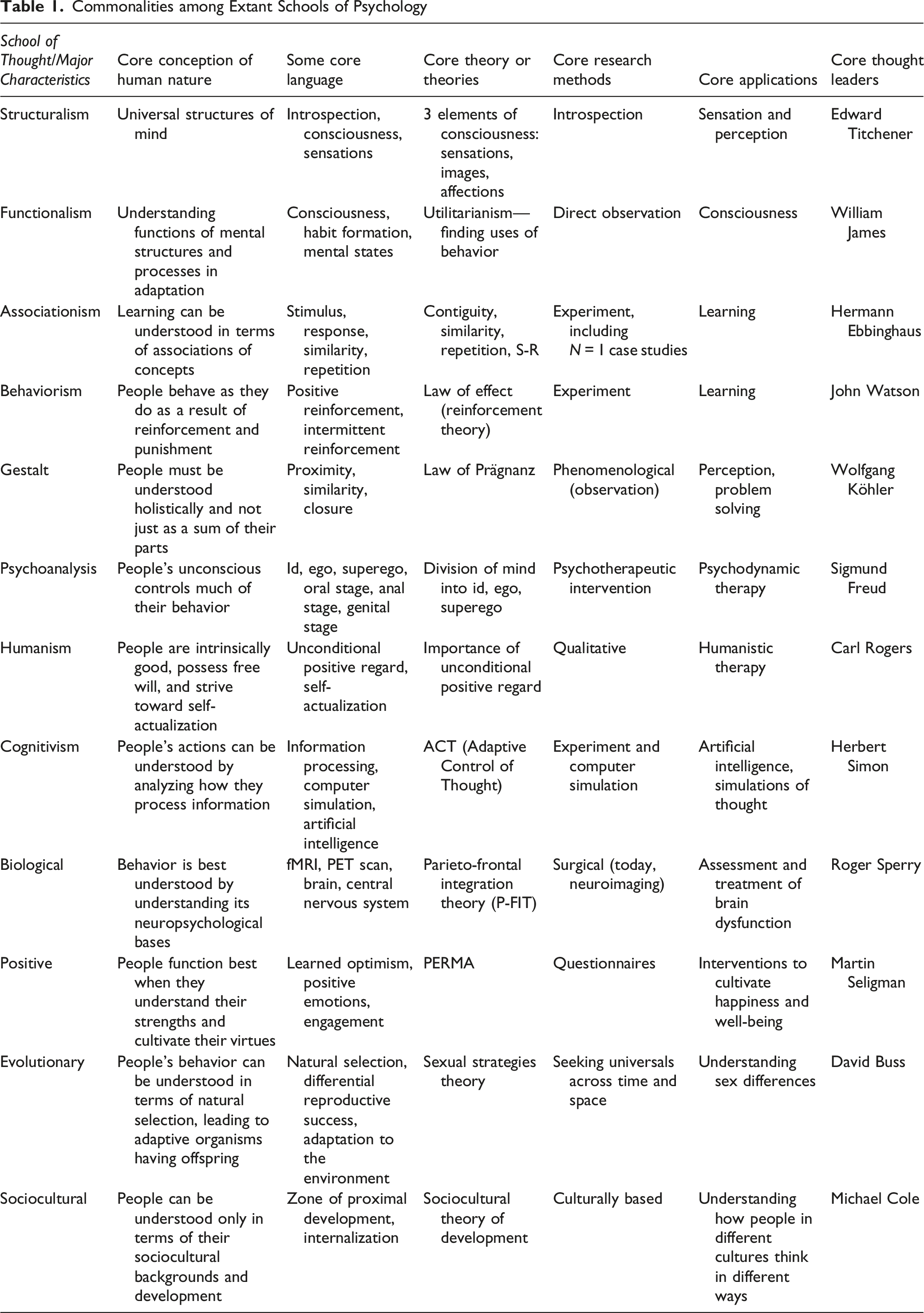
There are some caveats that need mentioning regarding the schools of psychology.
First, the schools of psychology described above are neither exhaustive nor mutually exclusive. For example, some might classify pragmatism as part of functionalism, whereas others might describe it as a distinct movement despite its origins in functionalism.
Second, what the schools actually accomplished or attempted to accomplish was often quite different. Behaviorism provided an elaborate set of principles for understanding learning, through classical conditioning and operant conditioning (and later, through observational learning, which never quite fit into the original behaviorist framework). Gestalt psychology, too, provided a set of principles for perception. Functionalism never had such a clear set of principles; rather, it was an approach to thinking about behavior in terms of the adaptive functions it serves.
Third, the empirical testability of ideas within the schools has been quite different. Some of the schools of psychology, such as the cognitive school, have seen a great deal of careful empirical testing. Others have seen less empirical testing.
Fourth, it is not always even clear whether the schools are in opposition to, or complementary to, each other. Cognitivism originally developed in large part as a reaction to and rejection of the notion of behaviorism that one cannot understand and should not even try to understand what goes on in the head (Miller et al., 1960), yet subsequently, behaviorism and cognitivism have been highly successfully combined into cognitive-behavioral therapy (e.g., Beck, 2011; Ellis & Dryden, 1987; Meichenbaum, 1977).
Fifth, the schools often crosscut each other. One can certainly be a positive psychologist and a humanist—indeed, positive psychology can be seen as a descendant of humanistic psychology. Associationists can be behaviorists, and vice versa, and someone might be oriented toward biological analysis but still recognize the importance of culture in interacting with biology--through opportunities that cultures provide, through epigenetics, and through various kinds of gene–environment interactions.
In sum, the schools of psychology should not be seen as rigidly demarcated from each other or as discrete offerings, but rather as overlapping and sometimes complementary approaches to understanding the human mind and behavior. Although there has sometimes been competition between schools, so has there been competition within schools, such as between the views of John Watson, often known as the “father of behaviorism,” who focused on stimulus-response connections, and B. F. Skinner (1953), who emphasized operant conditioning instead of stimulus-response connections. Within the cognitive approach, Herbert Simon emphasized serial processing of information (e.g., Newell & Simon, 1972; 1986), whereas David Rumelhart et al. (1986) emphasized parallel processing. There are often divergences of viewpoints, whether within or between schools of thought.
The various schools of psychology have certain structural similarities. The similarities are characterized in Table 1. These similarities and their characterizations are obviously not in-depth examinations of the details of these various schools, which can be found in history-of-psychology texts (e.g., Benjamin, 2014; Goodwin, 2015; Hergenhahn & Henley, 2014; Leahey, 2025; Schultz & Schultz, 2019). Our goal here is only a brief characterization of some major features of these schools.
The origins of these schools of psychology are most closely associated with work in the 20th century. It is still early to tell what schools of psychology will emerge in the 21st century. We believe work in this century is less oriented toward specific schools of thought than toward psychological problems, with multiple methods used to address those problems. An example of an emerging school, however, might be possibility psychology (Glăveanu, 2020, 2023, 2024), which studies how thinking about future possibilities shapes human behavior in the present.
In writing this article, the authors in no way claim to be presenting a full (or historically established!) school of psychology in the same way that many of the schools listed above have done. Rather, we are suggesting a paradigm for psychology which we hope that at least some meaningful number of psychologists will find worthwhile—perhaps personally as well as professionally—to consider adopting in current times. In his December 1776 Revolutionary War pamphlet, The American Crisis, No. 1, Thomas Paine wrote that “These are the times that try men’s souls.” We suggest that we now live in times that truly try the souls of humans of all kinds, and that psychology can and should help us find a way out.
What Is Psychology Today, and What Might It Be?
In this section, we consider where psychology stands today and where it might be. Today, most psychology is what we call transactional, borrowing the language of past work on leadership (Bass et al., 1996; Bass & Riggio, 2006; Bass & Steidlmeier, 1999; Burns, 1978), intelligence (Sternberg, 2021c), creativity (Sternberg, 2021b), wisdom (Soleimani-Dashtaki et al., 2024; Sternberg & Soleimani-Dashtaki, 2024), and giftedness (Sternberg, 2020b; Sternberg et al., 2021, 2022). What exactly does it mean for most psychology (or any other academic discipline) to be largely transactional?
Transactional Psychology
When we reflect upon the founders and prominent exponents of schools of psychology, they are leaders who were, or at least appear to have been, passionate about the work they were doing—they each were trying to change the field of psychology, and perhaps the world, for the better by introducing a new way of looking at people and how they think, feel, and act. However, over time, many of these perspectives—whatever their original aspirations—have ended up being used primarily to help individuals adapt to existing social rules and institutions: learning how to set culturally rewarded goals and achieve them. Even psychologists are not immune to the same reward structures that they study: the profession itself powerfully nudges scholars and practitioners toward transactional work. The following paragraphs illustrate how people gradually become transactional in their field of work, rather than aiming to work toward making a positive change in the world.
Some psychologists—whether in research or in practice—start their careers with an orientation that aims to change the world for the better, but then the world gets the better of them. There are so many external pressures that impinge upon psychologists. These pressures lead scholars to have a transactional mindset. The scholars are besieged with institutional and other expectations, and the expectations continually reinforce a transactional mentality that can carry over into the kinds of research they do in relation to the kinds of rewards or punishments they expect to receive. For academics, there are the pressures of getting hired, tenured, multiply promoted, preparing classes, dealing with student ratings, dealing with seeking publication and getting rejections from journals (which are pretty much inevitable), seeking funding from granting agencies and getting rejections (which also are pretty much inevitable), doing tedious administrative chores, going to faculty meetings, correcting papers, including ones that in current times may have been written by AI, and on and on the list goes. All these pressures occur while one must deal with salaries that are usually subpar and, for adjuncts, almost always way below what is needed to maintain one’s standard of living. For practitioners, there are the problems of getting hired or established in a practice, finding and keeping clients, dealing with regulatory agencies, dealing with insurance companies, dealing with the overhead of maintaining a physical space, keeping one’s credentials updated, and keeping up one’s income during lean times.
The general point is that, however one may start out, one may find oneself, more and more, becoming transactional in one’s work. You give something; you get something; you give a bit more; you get a bit more (or at least, you hope you do). You work for your salary (if you have one), for renown (whether as a researcher or as a practitioner), for reimbursements, for anything you need to do to hold onto your job or, at times, to find another one. Work can very easily become primarily transactional, essentially “tit-for-tat.” Often, whatever idealism one may have started with is crushed by the pressures of the world. And if the pressures of the world are not enough, sometimes those pressures come from within us, as we begin to wonder why we are doing what we are doing and whether it is even worthwhile continuing to do it.
One often finds that being creative—to the extent that it is even possible—is not rewarded but rather ignored or even punished (Sternberg, 2025a). Instead of one’s creativity being recognized and appreciated, people often question it, resent it, or even disparage it. One may realize that this castigation of creativity is how the world often works, but the lack of reward for creativity nevertheless stings. Indeed, one begins to realize, according to some theories (e.g., Sternberg et al., 2002), that the work which is most valued is work that is a small increment beyond what has been done before which threatens no one. And if one tries to be wise in one’s work—balanced, non-ideological, unbiased, fair, impartial—one may find oneself the target of ideological groups, from the political left or right or from groups adhering to powerful professional paradigms—that attack one precisely because one is trying to be balanced and fair. It is hard to be wise in an unjust world, as Socrates and so many of his successors—Nelson Mandela, Martin Luther King, Abraham Lincoln, Mohandas Gandhi, Marie Curie, Malala Yousafzai—have found out the hard way, often paying for their wisdom with their health or even their lives (see Sternberg, 2024). In today’s world, as in the past, it is often the wise people who are most targeted, not only by colleagues, but also by autocratic governments, usually posing as “democracies,” that seek to crush opposition.
The pressure to be transactional starts before one’s career begins, with college and university education more and more being looked at as a transactional venture. Students pay money to educational institutions in the hope of obtaining good employment (Fischman & Gardner, 2022; Greenberg, 2022) and a desired future standard of living. The students expect a return on investment.
Is there something about the work itself that leads scholars and practitioners alike to become transactional? We believe that the short-term reward system favors those who stick within established norms and do not rock the boat. With regard to publications and grant proposals, submitting something that is paradigm-defying is likely to upset reviewers and other evaluators, a fact recognized long ago by Kuhn (1970). A new junior faculty member has only a short amount of time to impress their senior colleagues with their abilities, and the system scarcely encourages creative risk-taking, especially when one metaphorically steps into others’ shoes in taking risks. Long-term projects that may yield special dividends are discouraged because they may not be finished before one’s promotion or tenure meeting. And taking risks in teaching can be the kiss of death if the students or administration do not like what they see or hear. For practitioners, one needs to establish a client base but risk that base if the practitioner uses unusual therapeutic interventions that may ultimately end up sabotaging their career. The result is that, regardless of one’s particular specialization or approach to psychology, the pattern that is set down is, metaphorically, to color within the lines.
The transactional goals may be set by others, by oneself, or by a combination of both, but whichever way things go, the reward system benefits most those with high tacit knowledge, or practical intelligence, about how the field works and what one can do to succeed so as to maximize one’s number of allies and to minimize one’s number of enemies (see Sternberg & Horvath, 1999).
Transactional contributions do not necessarily pay off. Those who attempt to be transactional may not be identified as successful or may be identified as either inertly or incompatibly transactional.
In the first undesirable case, the scholar or practitioner does whatever they believe it takes to succeed, but it just does not work or works only at a barely satisfactory level. One is unsuccessfully transactional. For example, most work in psychology is hardly cited at all, and many scholars are barely known outside their own institutions. The work may be viewed as bad, off-track, or as too weak to be worthy of attention.
A second undesirable outcome is when, from the standpoint of one’s institution or field, one’s contributions are inert—they are not going anywhere. One may work hard but to no avail. The work is not viewed as bad, but it is not even recognized as being serious work.
A third undesirable outcome is one in which one’s work is incompatibly transactional. One is seen as doing work, perhaps serious work, but not what the institution or field values at the time. Perhaps the work is viewed as dated, or as in a field other than psychology, or as following a school of psychology that is not highly regarded. In each case, the attempt to be transactional fails due to a mismatch between what the individual values and what the institution values. For example, a professor may be a highly competent researcher but be in a teaching-oriented institution where research is devalued or seen as irrelevant to the mission of the institution. Conversely, the professor may be a great teacher but not be seen as a serious researcher. Or a practitioner may use a kind of therapy (e.g., psychoanalysis) that is not valued in a cognitively oriented group practice. In these cases, the transactions fail to accomplish what the individual had hoped they would accomplish.
Sometimes, as professionals age, they become disenchanted, dated, or simply out of sync with the times. What the professionals once did is no longer valued, and their value to the institution or field is seen as lesser or obsolete. In these cases, the individual may be ignored, punished, or encouraged to move on to other employment or to retirement.
Transactionalism can pervade a field as well as the career of an individual. When new paradigms start out, their followers often have a sense of mission and of bringing something new and valuable into the world. But as Kuhn (1970) recognized, paradigms have a lifespan. They do not last forever. And over time, they become worn out, spent, and eventually in need of refreshment or replacement. If one works in a spent paradigm and has no ideas for a new one, or at least a new one that has a chance of broad acceptance, one may find oneself spinning one’s wheels and doing strictly transactional work because that is all that the paradigm has left to offer. The work tends to become replicative or to represent small incremental advances on existing work (Sternberg et al., 2002) and so to leave the field, and its practitioners, realizing that what they have to offer is not what the world needs; but they may not realize, at least right away, what it is that the world needs at the time the work is being done.
There is nothing inherently wrong with transactional psychology, which can encompass a wide variety of work that is being done at a given time and in a given place. But often its practitioners recognize that the work they are producing fulfills none of the ideals they may once have had, or that they thought might develop through their work as the years go by. It has become a conceptually exhausted transactional psychology. There may be a feeling that something is missing—that one is not making the kind and level of contribution of which one is capable. And a strictly transactional orientation may lead to burnout and a desire to do something else that will provide one with more personal and professional satisfaction.
The transactional paradigm is not a “replacement” for any of the traditional schools of psychology described earlier. Rather, it crosscuts those schools and other schools of psychology. It refers more to a state of mind than to a particular approach. That state of mind is one where: (a) the scholar or practitioner does work in exchange for rewards; (b) the rewards are forthcoming in part or in whole or, in unlucky circumstances, are not provided; (c) the rewards, if given, serve as reinforcements for more work of the same kind, thereby leading to (d) more work of more or less the same kind, in a potentially endless loop.
The adoption of a transactional-psychology framework for one’s research is not merely a personal choice among options: It is an option that is heavily favored by most environments. The scholar might adopt it because they believe that it is what is expected, or even necessary for survival as a scholar in a typical college or university environment. For example, one typically is expected to teach courses, publish research, and do certain administrative tasks. The expectations are transactional, and if a scholar does not meet them, their employment may be in danger or perhaps simply terminated. If a therapist does not serve their clients, their job may be short-lived. The question is not whether one will do transactional work—if one is paid, most likely one will have to do such work. The question rather is whether, in addition to the transactional work, one will go beyond it, as discussed below.
The transactionality of much of psychology and of the individuals in it must be understood, like so much else, as a person x task x situation x audience interaction. The diverse environmental contexts in which people live and work (Bronfenbrenner, 1979) reward transactionalism in a way that, at least now, they do not reward transformationalism. In general, psychologists, like everyone else, have bills to pay and families to feed, and may adapt a transactional orientation toward their work because that is where the rewards, or at least the extrinsic rewards, are.
Much of the world is based on exchange. Even work with loftier goals may still have an element of exchange in it. Who does not want to see their career advanced for good work (see Colby & Damon, 1992; Damon, 2009; Gardner et al., 2001; Peterson & Seligman, 2004)? But at a time when so much in the world is in disarray—politically, socially, economically, culturally, climatologically, psychologically, and in other ways—is there a possibility that psychology potentially can offer something more than just transactional, tit-for-tat work? We believe that it is possible for psychology to transform itself in this way, just as society in general can transform itself (Glăveanu, 2020, 2023). That is the subject of the next section of the article.
Transformational Psychology
Transformational psychology is the study of the mind and of behavior with the goal of making the world a better place—of making positive, meaningful, and potentially enduring differences to the world (thereby echoing the goals of transformationality in other domains, such as wisdom (Sternberg & Soleimani-Dashtaki, 2024). Transformational psychology, as such, can be relevant to research, teaching, or practice. With regard to research, it encompasses research that seeks to make the world better. With regard to teaching, it refers to teaching students how to make the world a better place. With regard to practice, it encompasses practice where the goal is to improve mental health by contributing not just to the client's own better future, but also to a better world through the client's role in it.
The term “transformational psychology” appears to have been used before as a Christian approach to psychology with a strong emphasis on spiritual formation (e.g., Coe & Hall, 2010). It may have been used in other contexts as well. Our use of the term is secular and in a different sense, as derived from work by Burns (1978), Bass et al. (1996), Sternberg (2020b, 2021b, 2021c; Sternberg & Soleimani-Dashtaki, 2024), and others, as is explicated in this article.
An assumption of transformational psychology is that, for all their individual and group differences, humans have a certain “human nature” in common. For example, they all can learn, communicate in some way, feel, and think (whether they choose to or not) (Kronman, 2007). Kruglanski et al. (2022) have suggested that this commonality lies in their seeking significance in and to their lives. However divergent their paths, those commonalities can be leveraged to find common paths toward a better human condition. Whether they will follow those paths is a matter of choice. Some will choose darker paths. These paths must be resisted by those in search of a common good, whatever the pressures may be to go down the darker paths.
Many of the concepts in transformational psychology, as described here, have been addressed in the past by various psychological schools and approaches. For example, issues of the common good, institutional constraints, and social transformation have been addressed in critical psychology, community psychology, liberation psychology, and other approaches to psychology. The goal here is not to present an entirely novel concept, but rather to draw upon different aspects of what we call here “transformational psychology” and combine them into a single, unified, and hopefully, coherent, and actionable framework.
Participation in transformational psychology is a process, not a reached goal state. One never knows, when one undertakes a research project or a therapeutic intervention, what the ultimate effect of it will be. It may make the world better, or it may represent a failed effort. Moreover, of course, different people have different ideas about what constitutes a better world. To participate in transformational psychology, one must, at some level, accept at least a weak version of a kind of philosophical universalism, according to which there exist, even if they are not all knowable, universal truths (Plato, 2004), universal moral principles (Kant, 1996), a universal moral intelligence for what is right and wrong (Boehm, 2025; Kohlberg, 1981, 1984; Sternberg, 2025c; United Nations General Assembly, 1948), and some kind of common good that transcends the kinds of pseudo-common goods being promoted today that advance narrow and often parochial goals, such as of nationalism (e.g., “America First”), particular religions, or particular political or other ideological agendas (Sternberg & Soleimani-Dashtaki, in press).
Proposed universal moral principles, such as those described in major religious texts (including those of Judaism, Christianity, and Islam, among others), Aristotle (2009), St. Thomas Aquinas (1988), Immanuel Kant (1996), Derek Parfit (1984, 2011a, 2011b), and the UN Universal Declaration of Human Rights (United Nations General Assembly, 1948), are normative, not matters of empirical demonstration. They are complementary to culturally and historically specific moral principles, not mutually exclusive of them. They help to achieve a meaningful common good.
The common good is defined by the highly esteemed Stanford Encyclopedia of Philosophy as “those facilities—whether material, cultural, or institutional—that the members of a community provide to all members in order to fulfill a relational obligation they all have to care for certain interests that they have in common” (https://plato.stanford.edu/entries/common-good/). Examples given in the Encyclopedia include a well-functioning judicial system with courts, public schools, public safety, civil liberties, freedom of speech and association, clean air and clean water, and a system of property. The Encyclopedia notes that these institutions apply to liberal democracies, and a brutal autocracy might have a different conception of how a society should be structured; but in such an authoritarian government, it is not clear that anything is actually done for any common good as opposed to the particular good of the autocrats. Different people may have different particular institutions that they would highlight in the common good, but the general idea is to benefit, to the extent possible, all members of a society, or ideally, we believe, all members of humanity, in the long run.
Finding such a common good is not easy and, in some cases, may not even be possible at this time. But that difficulty is not an excuse for descending into the kind of superficial thinking that pits interest groups against each other in an unending zero-sum game in which, ultimately, whatever any particular group may believe it is winning in the short-term, all groups end up losing in the long term. In the absence of such views regarding universal truths and morality, the risk is that one will be seeking a psychology and a science that disguises advantages for one group under the banner of seeking advances for all, as scientific racism has done under the pretense of seeking objective facts (Gould, 1996; Guthrie, 2004; Jackson, 2005; Saini, 2019). None of this argument is to deny the existence of individual or group differences, to deny the profound effects of culture on human development and behavior, or to deny the existence of legitimate differences in points of view. On the contrary, sociocultural differences can have an enormous effect, for example, on how intelligence is conceived and how it develops (Nisbett, 2003; Sternberg, 2020a), and even on how general cognition takes place in the mind (Cole et al., 1968; Luria, 1976; Markus & Conner, 2013; Nisbett et al., 2001; Ordin et al., 2024; Park & Huang, 2010). But if science is seeking just what is “true” for one group, it is not really science but rather ideology wearing thin but pseudo-scientific garments. Scientific truth may be difficult or even impossible to find, but it should nevertheless be our goal to search for it, even if we do not yet find it. And, as Sternberg (2025c) has argued, although different groups may have different moral or ethical beliefs, there are some moral and ethical beliefs that appear to be universal or nearly so, such as the Golden Rule (act toward others as you would have them act toward you) and the principles outlined in the UN Universal Declaration of Human Rights, such as freedom, equality, and justice for all persons.
What are the basic tenets of a transformational psychology?
Transformational psychology has some basic tenets. Here are five principal ones.
(1) The world is not anywhere close to where it needs to be. It is on a path that is often not world-constructive, but rather often is, in some ways, world-destructive, a path in which, ultimately, everyone will lose to a lesser but, more likely, to a greater degree. This is our view; others may disagree. But it is also a view, with respect to just one issue, the state of democracy, of many leading world experts (e.g., Albright, 2018; Applebaum, 2024; Gorokhovskaia et al., 2023; Levitsky & Ziblatt, 2018, 2023; Lipman-Blumen, 2006; Martín-Baró, 2017; Mounk, 2018). Martín-Baró (2017), in particular, speaks of the importance of psychologists challenging societal systems that are failing many of their members. That list of experts does not take into account those who are extremely worried about climate change, terrorism, weapons of mass destruction, air pollution, water pollution, poverty, economic polarization, and myriad other issues. So, such a comment may sound too pessimistic or even catastrophic in tone, but as we write, there is a war in Iran that is causing global havoc, for which the rationales have changed by the day (Mazzetti et al., 2026). We believe that our characterization is accurate, while recognizing that others may see things differently. Transformational psychologists, whatever their views, will certainly see great room for improvement in multiple areas. What might bring us all down is not clear, whether it be climate change making the world uninhabitable, one or more pandemics killing people off, pollution damage to health, wars and other violence of people against people, accidental or terrorist detonation of weapons of mass destruction, some combination of these threats, or other causes. Current work on misinformation and disinformation is an important example of transformational psychology (e.g., Edelson et al., 2024; Lu et al., 2023; Maertens et al., 2021; Pennycook & Rand, 2021; Roozenbeek & van der Linden, 2024; van der Linden, 2023). This field is an example of a seriously pressing world problem that psychologists are confronting and trying, in a transformational way, to address and propose solutions.
(2) Psychologists not only have a role to play in helping to guide the world from this destructive path, but also have a responsibility, as really every citizen of the world should have. Psychologists, especially social psychologists, dating back to the early part of the 20th century, recognized that their work could be used to understand the world and potentially to make it better (e.g., Hartshorne & May, 1928). Unfortunately, not all the studies followed the ethical canons that we would expect today, such as the Little Albert experiment on conditioned emotional responses (e.g., Watson & Rayner, 1920), the Festinger et al. (1956) prophecy study, or even what may be the most consequential experiments ever done in social psychology, the Milgram (1963, 2009) obedience experiments. Watson and Rayner conditioned a boy to fear white rats, but when the fear generalized to other white furry objects, such as white rabbits, there is no evidence that Watson and Rayner sought to reverse the conditioning. Milgram sought to study obedience in order to understand how people could have obeyed the Nazis, but persuaded participants to cause harm (or so the participants thought) to a learner, and without adequate informed consent. Festinger et al. (1956) studied how, when cult prophecies fail, the believers in the cult may become even more fervent believers in the failed prophecy than before the prophecy fails—but they, as researchers, perhaps inadvertently, influenced the results of the study. The lesson is that, to improve the world, one must do so in a way that does not sacrifice ethical practice and the well-being of the participants for the sake of some abstract greater good. The Robber’s Cave study of Sherif (1956, 1958; Sherif et al., 1961), which showed how enforced intergroup cooperation could be used to reduce intergroup conflict, was a particularly notable example of how psychology could be used to the betterment of people’s understanding of how to make the world a more cooperative place in which to live. But the study also created, at one point, artificially induced bad will between groups of children.
(3) Betterment of the world can be achieved through a wide variety of subfields and methodologies of psychology. There are no particular content restrictions on the operation of transformational psychology. Studies such as those by Sherif, as mentioned above, or by Kelman and Barclay (1963) on how to increase trust among enemies, or by Lewin et al. (1939) on aggressive behavior, emanate from social psychology. A problem with such experimental studies is that they might not successfully make it through contemporary Institutional Review Boards (IRBs). Janis’s (1972) classic work on groupthink circumvented this problem by doing retrospective case studies. Abelson and Carroll (1965), in simulating a right-wing “true believer,” also circumvented the problem by using a computer simulation, which did not require human participants. But there is much to be learned from social psychology. Gilovich and Ross (2016) published an entire book on how people can benefit in their lives from social-psychological insights. For example, we tend to over-attribute the behavior of other people to their undesirable personality traits rather than to the situations in which they find themselves; we often have a naïve belief in the validity of our own observations—that how we see things is how they really are; we often believe that the likelihood of something being true is a function of how confident we are of its truth; and we often assume that disagreement shows bad faith on the part of others (but not of ourselves). If we are dealing with others, our fallacies about how they behave make it harder to deal with them positively, whether they are within our own culture or in another one.
Clinical-psychological insights also have a long history of being used to seek improvements in the world. For example, cognitive therapy has been used to help countless people recover from depression, in its original form (A. T. Beck et al., 1987) and combined with behavioral therapy (J. S. Beck, 2011), but A. T. Beck also applied ideas from his clinical work to combating hate in the world (A. T. Beck, 1999). In particular, Beck showed how hate often stems from cognitive distortions, and the spread of hate often originates in willful distortions by purposeful manipulators. Taking a more social-psychological approach, Sternberg (2026a) likewise has argued that hate is often purposely spread by leading people not only to engage in cognitive distortion, but also to feel a negation of intimacy (revulsion, repulsion) toward real or imagined enemies, to develop a passionate distaste and even loathing for these real or imagined enemies, and to become cognitively committed to their hate. A transformational goal is to combat hate through at least three mechanisms: (a) applying wisdom, (b) replacing hate with love, and (c) showing how the people one comes to hate are often no different from oneself and can become allies instead of enemies.
(4) Transformational work seeks what is better not only for the individual—which is closer to the domain of positive psychology—but also for the world in terms of achieving a common good that balances the interests of stakeholders in relevant decisions and that seeks long-term as well as short-term solutions to pressing world problems. Where transformational psychology perhaps differs most from conventional positive-psychological approaches is that transformational psychology is oriented toward making individual lives better, but in a way that also potentially improves everyone else’s lot in life. Transformational psychology should help to identify and dismantle systemic barriers to people’s achieving their individual and mutual goals, and to dismantle the exploitation of particular targeted groups. In this respect, it draws on critical psychology (Parker, 1999, 2007; Prilleltensky & Nelson, 2002). Psychology, transformationalists believe, has perhaps been too focused on results for individuals in ways that may ignore or even disadvantage the collective. For example, psychotherapy can be used to improve individuals’ lives (e.g., Pucci, 2006) and to create happiness. Happiness is an admirable goal: There are countless books available on increasing personal happiness, many of them by eminent positive psychologists and their associates (e.g., Csikszentmihalyi, 1990; Diener & Biswas-Diener, 2008; Fredrickson, 2009; Gilbert, 2006; Lyubomirsky, 2007; Seligman, 2002, 2011; Staub, 1978, 1979). The audience seems to be large. The most popular course, ever, at Yale University (Shimer, 2018), has been one called Psychology and the Good Life on campus, and called The Science of Well-Being online. It has been designed and taught by Professor Laurie Santos. More than 4.6 million people apparently have taken the course, which is offered for free by Coursera (Nafría, 2024). Books on other topics, such as creativity, have also focused on how these other topics, such as creativity, can make one happier (e.g., Kaufman, 2023).
It is admirable that positive psychology and other related lines of work have concrete, empirically supported techniques for improving people’s happiness. Apparently, there is a tremendous market for such work. That is not surprising, given the current unhappy state of much in the world. But transformational psychology would place happiness only as a subsidiary outcome rather than as a principal aim of its application. The goal of transformational psychology is to make the world better and, hopefully, for people to achieve some happiness through seeing the world change for the better. Many of the most transformational (and wisest) people in recent history—including those mentioned earlier (Nelson Mandela, Martin Luther King, Alexei Navalny, Abraham Lincoln, Mohandas Gandhi, Malala Yousafzai), did not necessarily have the happiest lives, or in some cases, happy lives at all. But they made the world a better place for countless millions of people. The goal of transformational psychology is to understand how individuals such as these made this improvement in the world possible and, hopefully, to offer other people roads to world-changing that will make things better not just for them, individually, but for everyone. In an individualistic society and world, the risk is that people’s focus will end with themselves. But happiness is separate from making the world better. Truly awful people—evil dictators, torturers, criminals—perhaps can achieve some measure of happiness through positive-psychological techniques. The goal of transformational psychology is not to make them happy, however, but to lead them, and others, to change their destructive ways toward positive and constructive ones. Transformational psychology is not about making an individual’s life happier, perhaps at the expense of others. It is about making their life happier through the happiness that comes, metaphorically, from a rising tide raising all ships.
(5) Transformational psychology is about seeking a long-term as well as a short-term good free of selfish narrow self- and group interests, deception, power plays, posturing, and perfidy. Any number of individuals, especially leaders of various kinds, claim to seek a common good. For many of them, the only question is whether they are engaged in self-deception, other-deception, or both. They either put their own self-interest first, or the interests of their family, or the interests of the group with which they identify (same religion, socioeconomic stratum, nationality, political party, ideology, or whatever). There may not be many leaders who currently seek a genuine common good, but transformational psychology would seek to develop more of them. One might call them “idealistic,” but they nobly pursue an ideal that will benefit all. An enormous problem in the world is that people seem to wish not for transformational leaders, but for pseudo-transformational ones—ones who pretend to be making the world better while making it worse. The attainment of a common good does not require everyone to quickly, or even after some reflection, agree on the end-product, or even to have the same value system. It does require negotiation in good faith for the benefit of all, not just the select few, and to achieve an outcome that will benefit all in the long term, not just the short term. And it requires honesty rather than self-interested deception of others and sometimes, oneself.
Many, perhaps most, people prefer leaders who are not transformational, not wise, and not generous of spirit. The leaders they prefer are those who could be identified as pseudo-transformational. These leaders are toxic and, ultimately, harmful to the people who prefer them (Bass, 1985; Bass & Steidlmeier, 1999; Conger, 1990; Kellerman, 2004; Lipman-Blumen, 2006; Sternberg, 2021c; Sternberg et al., 2025; Tourish, 2013; Örtenblad, 2021).
It is the job of transformational psychology to figure out not only the characteristics of bad leaders and why people prefer such leaders, but also, more importantly, what to do about this conundrum, because the world cannot become better if people keep choosing leaders who make it worse. Why do people prefer bad leaders, and how can we change their preferences?
The study of why individuals support toxic leaders is an application of transformational psychology to leadership. For example, transformational education would teach young people why so many of them prefer bad leaders, and how they might change their ways of thinking. These reasons for preferring toxic leaders stem, in part, from people’s credulity (Gilbert et al., 1993; Pennycook & Rand, 2019; Sternberg, 2025b), their often-justified fear of what will happen to them if they do not fall into line (Sternberg et al., 2025a), their desire to be an accepted part of a conforming crowd of believers (Sternberg, 2025a), and their frustration with the ways things are and their passionate desire for change. But there is more, according to Lipman-Blumen (2006) and others, and the “more” includes (a) attraction to the self-confidence of narcissists, (b) credulously believing bedazzling but false stories about how the narcissistic leaders will make their lives better, (c) succumbing to greed or the belief that other people’s misfortunes will be their good fortune, (d) falling for the old canard that it’s the outsiders who are responsible for all of people’s woes (however, “outsiders” are conveniently defined by the authoritarian), and (e) people’s tolerance of corruption, incompetence, and stark malfeasance as being just the way things are and always will be.
The job of transformational psychology is to try to inoculate citizens against their own metaphorical mental “autoimmune illnesses,” whereby they work against themselves. Scholars have come a long way toward understanding how to accomplish this goal (McGuire, 1961, 1964; Roozenbeek & van der Linden, 2019, 2024; van der Linden et al., 2017; van der Linden et al., 2020). Some transformational research has been done: Now, schools need to use it.
Another job of transformational psychology is to teach young people to be continually questioning, and not merely to be credulous, with regard to authorities, particularly those individuals in positions of authority who have no expertise and have destructive ideas that they view as signs of their imagined expertise (Sternberg, 2025b; 2014). Literary authors such as Sinclair Lewis in It Can’t Happen Here (2014), Arthur Koestler (1941) in Darkness at Noon, George Orwell (1949) in 1984, Philip K. Dick (1962) in The Man in the High Castle, Philip Roth (2005) in The Plot Against America, and Margaret Atwood (1985) in The Handmaid’s Tale all recognized how easily people can succumb to cynical, manipulative, and often brutal authoritarians. Many of these novels were adumbrated by Franz Kafka's (1937) classic work, The Trial. In the novel, a nameless and faceless bureaucracy, which many people do not even know exists, holds arbitrary power, including that of life or death, over them. Meanwhile, they live in a world in which nothing seems to make much sense; but it is a world that people accept as it is, nevertheless.
These literary authors were writing, in part, in response to the events of their times, but many of the same patterns of submissive and even obsequious behavior, driven by self-interest, fear, and susceptibility to manipulation, are happening today in multiple nations. People will do a lot to achieve significance (Kruglanski et al., 2022). As long-time dictators entrench their power, and new ones come into power, the same patterns of fear, submissive behavior, cowardice, and learned helplessness that the world has seen before are reappearing quickly and all too pervasively. We no longer have to ask in stunned disbelief how Nazi Germany could have happened, if we ever had to ask. We can see the answer all around us.
Transformational psychology has a role to play in how to recognize and combat such behavior (Sternberg et al., 2025; Sternberg & Fischer, 2023). How? We believe that the first step is for psychologists to find the courage in themselves to study transgressive behavior on the part of nations as well as of individuals and to call it out when it occurs. This step may sound minor, but the senior author of this article has not written any article—literally, none—on the topic of national transgressive behavior for which at least one reviewer or editor has not expressed concern about, or objected to, the author discussing contemporary national transgressive behavior without the author's being urged to engage in “bothsidesism” (or “allsideism”). He has been strongly urged to see all moral issues as having two (or more) sides that each deserves to be explained, respected, and viewed as having both positive and negative sides. Or he has been chastised for being too “political.” Generative AI, in the author's experience, also encourages “allsideism” and moral hedging so as not to offend anyone. In calling out a contemporary leader as racist, sexist, xenophobic, or dictatorial, the author’s experience is that one is likely to be asked to take out the example or, if one really feels one must discuss the issue, to use an example of someone who is deceased. The reviewers often emphasize how some readers will be offended, and imply that offense is an outcome to be avoided at all costs.
As Bloom (2025) has pointed out, professors often tend to be cowardly—to believe that they should stay out of worldly matters in which they risk being offensive, being rejected, being canceled, having their funding pulled, being disciplined, or even being fired. The hope of some authorities is that psychologists or others will self-censor, or if they do not, that their colleagues, even those who agree with them, will tell them to be “more scientific”—by which they mean staying away from controversial issues. Indeed, it is often difficult to get funded for any research that might offend the government in power. These fears are not unrealistic. Existing funding may be pulled. And in some societies, the scholars may be imprisoned or worse. This situation has gotten worse over time, not better.
Serious transformational psychology will not be possible if psychologists are afraid to speak out, or if they are told that they can speak out but that then they will not have their work published. A second step, beyond courage, is to be exceptional and assertively speak out. There are brave exceptions who have spoken out. For example, Kellerman (2004) and Lipman-Blumen (2006) have discussed failed leaders, including living ones, as well as the citizens who have failed in their civic duty and supported them. Neither researcher, however, has a home in a psychology department. Sometimes, the matter is as simple as stating that genocide, such as the war in Ukraine today, is wrong, whether the genocidal leaders or the people supporting them are living or dead.
The third step is to avoid falling into the trap of saying that we can never predict with certainty what will happen if people do this or that, so we should never blame people who could not predict the adverse outcomes of their actions. The purpose of Institutional Review Boards is to identify unethical research before it happens. Psychologists are on these boards. Transformational psychologists need to apply the same principles of ethics beyond just psychological research. Torturing people, committing genocide, harming people in the name of ideology or politics—these are morally wrong, and we, as psychologists, must be willing to call out such behavior rather than avert our eyes if we are going to help end it. Psychologists can predict one aspect of the future—if these practices are allowed to continue, that future will not go well.
This article is not a call for psychologists to become even more ideological—whether left-wing or right-wing—than they have been. The field of psychology has had more than enough of that. Rather, it is a call to take positions of universal morality when leaders, societies, or other individuals or groups commit morally transgressive behavior, such as murder, genocide, torture, deprivation of liberty, rape, or wanton cruelty, that violates the principles of human dignity set out in the UN Universal Declaration of Human Rights.
Practitioners of transformational psychology are unlikely to be a-transactional or anti-transactional. They, like everyone else, need to earn a living, and they may well seek the same tangible rewards that others in the field seek. They need, at times, perhaps often, to be transactional. But they do not stop with the tangible rewards or let their work be dominated by the exchange of rewards. Rather, they go beyond such rewards to seek the common good that eludes so many of us, and that too many of us simply ignore or disparage. They do not seek to enhance their own professional standing by illegitimately lowering that of others, whether acting individually or as part of a group, such as a social-media mob.
The concept of transformational psychology as presented here draws upon the notion of universal moral principles (e.g., Aquinas, 1988; Kant, 1996; Kohlberg, 1981, 1984; Lind, 2008; Sternberg, 2025c; United Nations General Assembly, 1948). We would argue, with Rachels and Rachels (2019), that what differs is how the universal moral principles are manifested, applied, and evaluated in different societies. This is not to say that there are not some moral principles that differ from one sociocultural group to another, but rather, that there are other moral principles that transcend the more local ones. We would also note that however universal some principles may be, those principles sometimes end up being prescriptive rather than descriptive, as is seen in religious and other groups that believe in the sanctity of human life and then avidly violate their own principles. Too often, the moral principles turn out, at best, to apply to people who look like, think like, or feel like them.
Other scholars take a more culturally relative position. For example, Haidt and Joseph (2007) have argued that certain moral principles or, in Haidt and Joseph’s case, foundations, are universal, but which ones apply where varies. Westermarck (1932), Herskovits (1972), Shweder (1991), Prinz (2007), and Benedict (1934) would differ with us and question whether there are such universal moral principles. If there are no universal moral principles, however, any hope for the solution of many world problems may diminish, as people may simply claim to be acting morally as they blithely murder, steal from, or otherwise harm others, supposedly on the authority of their religion, ideology, political system, or whatever. Such authority is manufactured, often cynically, to fit the situation.
One might worry that a terrorist, an evil dictator, or a psychopath might decide that what they are doing is transformational. They indeed might, but they would be wrong, because, in our view, there are universal principles of morality, and these individuals would be blatantly violating them. Anyone can, under the right circumstances, convince themselves of almost anything, and psychologists know how strong myside bias is (Baron, 2023; Stanovich, 2021). But rationalization is not rational thinking—it is, rather, a Freudian defense mechanism against truth (A. Freud, 1937). When one murders others in cold blood, when one violates human rights and dignity, when one discriminates against others on the basis of demographic characteristics, in violation of the UN Universal Declaration of Human Rights, the Hippocratic Oath, and the principles of religions and historically-important ethical systems, such as Kant’s (see Sternberg, 2025c), any attempts to justify one’s behavior are simply self-serving rationalizations of gross violations of human dignity. The acts are, in a word, immoral, no matter what excuses are offered for them. Terrorists, murderers, psychopaths, narcissists, sadists, and others may have rationalized excuses for their behavior. But the excuses do not pass the tests of universal morality. Rather, they are simply manifestations of toxic behavior rationalized for the benefit of certain individuals or groups at the expense of others—examples of myside bias. We should not dignify them or their pretense of validity with “bothsidesism.” And loud assertions of morality or ostentatious pretensions to morality by supposedly religious or similar observance do not justify immoral acts against others.
Although the emphasis in this article is on universal principles of justice, ethics, and right behavior, there are also principles that can be found at sociocultural and individual levels (e.g., Haidt, 2001; Haidt & Joseph, 2007; Rogoff, 2003; Shweder et al., 1987; Sternberg, 2026b; Turiel, 2002; Vygotsky, 1978). Our reason for emphasizing universal principles as a basis for transformational psychology is that sociocultural principles differ and often come into conflict with each other. In such cases, perhaps the only just resolution may be an appeal to universal principles that transcend the thinking or interests of any single particular sociocultural group.
Pseudo-Transformational Psychology
Pseudo-transformational psychology, like pseudo-transformational leadership, as discussed above, is based on the appearance of transformational psychology, sometimes only with a thin veneer, that is deceptive in intent, consequences, or most usually, both. It alleges to do something good while doing nothing of the sort and, perhaps, the opposite.
An example would be psychological techniques newly designed to extract information from alleged terrorists. Terrorists are a great threat to practically everyone—even themselves, as weapons sometimes explode at unexpected times—and obtaining information about them to thwart future terrorist attacks is obviously of the utmost importance.
Two psychologists, James Mitchell and Bruce Jessen, were apparently able to convince high-level CIA officials that they had devised effective ways of obtaining information. One of their supposedly effective ways was “waterboarding,” which involves simulated drowning of a prisoner whereby the prisoner is led to believe they are going to be drowned. The goal, it appears, is thereby to bring the prisoner to despair, at which point the prisoner will supposedly give up their secrets. The two psychologists were reportedly paid more than $80 million to operationalize the scheme (Chappell, 2017). Multiple prisoners at Guantanamo and, presumably, elsewhere, were waterboarded. It is not clear that the alleged terrorists ever provided, as a result, useful information. However, after these attempts, the psychologists reportedly were personally sued (because they were government contractors rather than employees) and the matter was apparently, at least legally, “settled.” It is not clear what the psychologists paid toward the settlement or whether it was they, or rather the US government, that paid. But the use of torture (which was euphemistically called “enhanced interrogation”) to extract information is always against international law and is also clearly deeply unethical.
Another example of what appears to have been pseudo-transformational psychological practice was the elicitation by psychologists of what came to be labeled as “repressed memories.” The idea was that some adults who have trouble adjusting to life have such troubles because they were abused as children and then, in a Freudian sense, repressed the memories of their mistreatment. The psychologists involved in this endeavor claimed to be able, through hypnosis and other techniques, to bring these supposedly repressed memories back into consciousness.
The problem—and it was a big one—is that there was and still is no solid empirical evidence that the repressed memories were real (Ley, 2019; Loftus & Davis, 2006; Otgaar et al., 2019, 2022; Patihis et al., 2014). Rather, a number of patients appear either to have made stuff up or, worse, to have had false memories implanted, presumably inadvertently, by the therapists who treated them. We may one day have an empirical demonstration that such memories can be and are real, but that conclusive demonstration has not happened yet. What has happened is that families apparently have been destroyed, legal settlements have been made based on apparently fallacious information, and society has been led to the inevitable conclusion that psychologists are not always careful in the claims they make about the work they do.
Perhaps the worst example of pseudo-transformational psychology, in conjunction with pseudo-transformational psychiatry, was the prefrontal lobotomy. This was a surgical procedure that severed the nerve fibers connecting the prefrontal cortex to the remainder of the brain. The goal was, allegedly, to treat severe mental illnesses that had resisted treatment by more conventional means. The operation was designed to reduce the severe mental distress that patients were experiencing. But the results were catastrophic, and it is a sad commentary that the procedure was used for as long as it was (roughly from the late 1930s to the mid-1950s). Sadly, the discontinuation of the procedure was due at least as much to the development of anti-psychotic drugs as to the recognition of the horrors of the operation. The operation typically resulted in individuals becoming apathetic, seemingly mentally vacant, socially impaired, and experiencing a loss of imagination. The patients became, figuratively, something like the “living dead.” A 1975 movie, One Flew Over the Cuckoo’s Nest, starring Jack Nicholson and directed by Miloš Forman, was based on the nightmare of the procedure. Egas Moniz, who developed the technique, won the Nobel Prize for it. Walter Freeman, a neurologist, brought the technique to the United States. It was an absolutely disgraceful chapter in the history of psychiatry (and of psychology for those psychologists who supported it). People, including researchers, learn in different ways (Zhang & Sternberg, 2002), but their learning through research should not be at the expense of participants in research whose human dignity and integrity are exploited and abused in the name of the research or other enterprise.
There have been many other works in psychology (and related fields) that have been less than, or different from, what met the eye at the time they were done. Harry Harlow’s monkey experiments, although well-intentioned, involved severe maltreatment of rhesus monkeys (Harlow, 1958). Milgram’s (1963, 2009) obedience experiments today would be considered highly unethical. The experiments left participants for the rest of their lives knowing that, had the cover story they had been given actually been true, they might have killed a person for the sake of an experiment. However, the participants could have, at any time, walked out of the study. The CIA had an unethical and probably illegal program using human subjects, Project MKUltra (1953–1973) (CIA, 2025), to develop drugs and techniques of mind control. Philip Zimbardo et al.’s (1999) Stanford Prison Experiment subjected participants to rather horrific, prison-like conditions, but the experiment was flawed in its execution so that, although anecdotal reports abound, nothing could be concluded from it scientifically. The study was aborted at the urging of Zimbardo’s future wife (Christina Maslach). Zimbardo’s later work on the “Lucifer effect” (e.g., Zimbardo, 2007), however, has had an important and far-reaching positive effect on psychological thinking, beyond what may or may not have been shown by the flawed prison experiment.
It is important to differentiate between what have been called pseudo-transformational contributions and para-transformational ones (Sternberg, 2021b). Para-transformational contributions are ones that, in the short run, seem like a good idea, but whose long-term consequences are fuzzy and unclear in prospect. They are usually innovations or products that have not been sufficiently tested in real life, prior to adoption, for the potential harm they could cause down the road. For example, psychotherapies or drug therapies that are not sufficiently tested before going into widespread use would be examples of para-transformational contributions.
Para-transformational contributions are different from pseudo-transformational ones, including the horrific interrogation techniques introduced by Mitchell and Jessen, such as waterboarding. The pseudo-transformational techniques were cruel and inhumane, and those who introduced and used them presumably knew it. They could later claim, as did Hitler’s willing accomplices, that they did not see it at the time, but if that was the case—which seems unlikely—they apparently were purposely blind. (Fortunately, there were also those who risked themselves to save the people Hitler persecuted—Oliner and Oliner, 1988). The researchers could have tried the techniques on themselves to see what they were doing. Similarly, lobotomies were horrific and should have been thoroughly investigated before widespread use. It would not have taken a lot of research to observe and, indeed, predict the results. To the extent their originators and users were not doing due diligence, simply claiming “ignorance” is not much better than Hitler’s accomplices claiming either that they did not know what was going on or that they were just following orders. These were not para-transformational contributions. Rather, their horrendous outcomes were the result of pseudo-transformational, professional, and moral irresponsibility.
In sum, psychology can be transformational, but it can also be pseudo-transformational, promising to make the world better but doing nothing of the sort and perhaps making it worse. Regrettably, under the right circumstances, some people will believe almost anything, so they are susceptible to pseudo-transformational ideas (Sternberg, 2025b). Psychologists, whether in research, teaching, or practice, always must be asking whether what they promise is what they are going to deliver, or whether they are selling others, and perhaps themselves, a false bill of goods.
Similarities and differences between transformational psychology and related subfields of psychology
There are several subfields of psychology that share features in common with transformational psychology. A few words should be said about how these fields relate to transformational psychology. It is impossible to list all of the branches of psychology that one or another scholar might find to be relevant to transformational psychology. Here are some of these related fields: (1) (2) (3) (4) (5) (6) (7) (8) (9) (10)
What, then, are the key features that distinguish transformational psychology from these and other related subfields and modes of study that have come before? (1) (2) (13) (14) (15)
In sum, we believe that transformational psychology is related to various past fields and schools of psychology, but that it has a unique and, we hope, important contribution to make to a world, not just a field, that desperately needs people whose goal is global betterment, at whatever level they can operate.
Conclusion
This article proposes transformational psychology as a school of psychological thought oriented explicitly toward improving the world through the scientific study of mind and behavior. The proposal is offered in response to contemporary conditions that strain human judgment and collective problem solving—conditions in which individuals and groups may endorse destructive leaders, discount evidence about climate and environmental harms, and persist in behavior patterns that predictably undermine health and well-being (Kutlaca et al., 2025; Moghaddam, 2022; Power et al., 2023; Sternberg, 2021a; Sternberg et al., 2019, 2025). The core question is whether psychology should continue primarily in its existing forms or whether the field also needs a coherent tradition that is explicitly directed toward diagnosing and mitigating large-scale threats to human flourishing.
Summation
Schools of psychology have historically differed in their foundational assumptions about human nature, characteristic language, core theories, preferred methods, and signature applications. The schools of psychology often were developed or advanced by influential thought leaders (Hothersall & Lovett, 2022; Leahey, 2025; Woody & Viney, 2023). Transformational psychology is intended to meet the criteria of a school of psychology: It has a relatively coherent tradition; it assumes meaningful human agency and responsibility; it develops a vocabulary centered on concepts such as the common good, moral intelligence, and transformational wisdom; it interprets research and practice in part by their implications for sustainable collective well-being; and it prioritizes applications that foster constructive, durable change rather than narrow short-term gains.
The Differences Among Various Kinds of Psychology
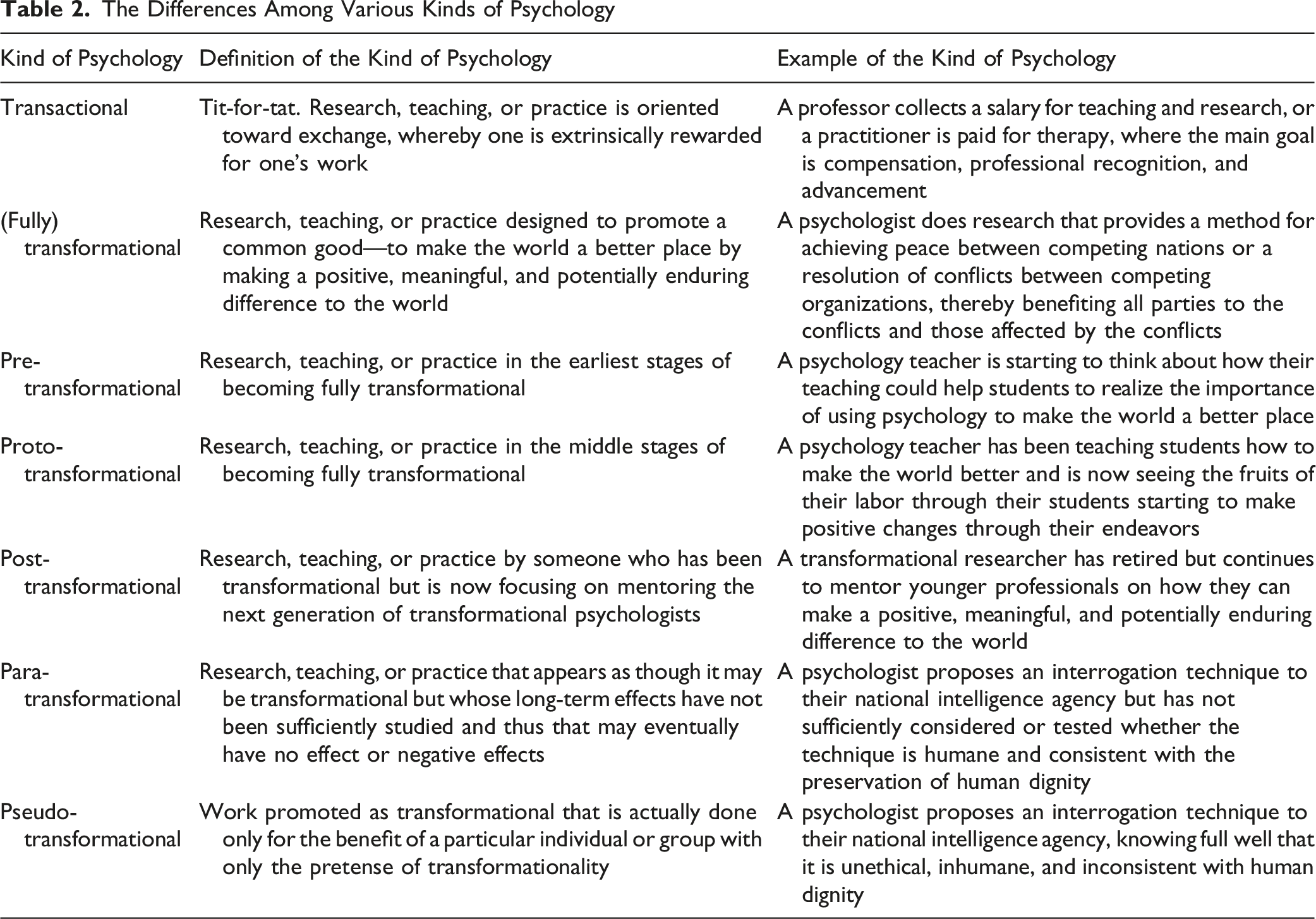
The principal distinctions are that transactional psychology has as its raison-d’être a tit-for-tat orientation—one gives in exchange for extrinsic rewards, and those rewards lead to further giving in the hope of obtaining further rewards, ad infinitum. Transformational psychology has as its raison-d’être the goal of making the world a better place, regardless of what the extrinsic rewards may be. Pseudo-transformational psychology makes the pretension of being transformational but is actually done for the benefit of the individual or the individual’s identity group. The rest is for show.
Transactional psychology, as used here, refers less to any particular substantive school and more to an incentive-shaped stance toward research and practice: Work becomes calibrated to professional transactions and reinforcement contingencies (e.g., publication, funding, promotion, reimbursement), often favoring low-risk incremental advances and discouraging paradigm-challenging efforts (Kuhn, 1970; Sternberg et al., 2002, 2025a). Transactional work is not inherently flawed; indeed, it has yielded enormous scientific and applied progress. The concern is that an exclusively transactional orientation can become conceptually exhausted and insufficiently responsive to urgent societal problems, particularly when those problems are driven by predictable psychological mechanisms, such as credulity, conformity pressures, motivated reasoning, intergroup hatred, and susceptibility to pseudo-transformational leaders (e.g., Pennycook & Rand, 2019; Roozenbeek & van der Linden, 2019, 2024; Sternberg, 2025b, 2026a).
Transformational psychology is not proposed as a replacement for existing schools of psychology. Rather, it is designed to crosscut and integrate them, leveraging their theoretical and methodological strengths while orienting them toward outcomes that advance sustainable, widely shared well-being. For example, principles from behavioral psychology (e.g., reinforcement, habit formation) can be used to support pro-environmental behavior and reduce harmful consumption; social-psychological work on intergroup conflict and cooperation can inform interventions that reduce polarization and violence; clinical approaches can be extended beyond symptom reduction toward reducing hate and cognitive distortions that fuel social harm (A. T. Beck, 1999; Sherif et al., 1961; Sternberg, 2026a). The defining feature is not the method, population, or subfield, but rather the aim and its execution: to generate verifiable explanatory knowledge and practical tools that help individuals and institutions pursue the common good ethically and effectively. While there is no consensus on what constitutes a common good, transformational psychology can help stakeholders work together not only to achieve a common good but also to figure out what it might be. What matters most is an honest process that encompasses the needs of all affected groups, not just one’s own or one’s preferred groups.
The conclusion also underscores an essential caution: Psychology can be transformational, but it can also be pseudo-transformational—adopting the rhetoric of helping humanity while producing harm through unethical practice, weak evidence, or self-serving agendas. Historical examples illustrate how claims of world betterment can be used to rationalize coercion, deception, or profound violations of human dignity. Transformational psychology, therefore, requires not only aspiration but also ethical discipline: ends do not justify means, and interventions must be grounded in rigorous evidence and respect for persons.
Transformational Psychology as a School of Psychology
It is now time to return to the issue of schools of psychology and what it is that makes transformational psychology understandable as a school. (2) (3) (4) (5) (6)
Implications
Three implications of transformational psychology concern education, measurement, and the school’s relationship with concepts such as self-actualization and altruism.
First, education is central to the school. Transformational psychology implies a form of transformational education that equips learners to evaluate claims, resist manipulation and coercion, and reason dispassionately about the long-term consequences of individual and collective action. Educational practice should cultivate capacities associated with moral intelligence (Clarken, 2009; Lennick & Kiel, 2005; Sternberg, 2025c) and wisdom—abilities to reason with reference to broadly defensible ethical standards and to balance stakeholder interests over the short and long term (Baltes & Staudinger, 1993, 2000; Lerner et al., 2005, 2015; Sternberg, 1998, 2004, 2024). Importantly, wisdom does not automatically follow from intelligence, expertise, or technical ingenuity (Soleimani-Dashtaki et al., 2024; Sternberg, 1998, 2024; Sternberg et al., 2024; Sternberg & Soleimani-Dashtaki, 2024). Many contemporary crises reflect not a deficit of knowledge, but a deficit of good and reasoned judgment about how knowledge should be applied—what Sternberg and other scholars have described as a failure to balance self, others, and larger systems with humility, perspective-taking, and responsibility for the common good (e.g., Grossmann, 2022; Sternberg, 1998, 2024; Westrate & Bluck, 2022). Transformational education would also teach how to recognize pseudo-transformational influence—leaders and movements that promise collective salvation while concentrating power, inflaming hatred, or eroding ethical constraints.
Second, transformational psychology invites deliberate work on measurement. If transformational aims are to be treated as scientific goals rather than as slogans, psychologists will need defensible operationalizations and multimethod assessments to measure transformational thoughts and actions. One useful distinction is between typical performance (how individuals characteristically think and feel, often assessed via self-report and personal report) and maximum performance (what individuals can do under conditions that elicit their best reasoning and skill, often assessed via performance tasks, simulations, case-based judgment, or behavioral indicators). Both are important: Individuals may possess the capacity for wise or ethical judgment but fail to deploy it, or they may perceive themselves as capable when their demonstrated reasoning does not support that belief. Measurement strategies, therefore, should combine self-report with behavioral methods (e.g., scenario-based assessments of stakeholder balancing, simulations of misinformation resistance, third-party evaluations of real-world action, or longitudinal follow-ups). Transformational outcomes also pose a methodological challenge: The downstream effects of actions may be delayed, diffuse, and context-dependent. Accordingly, transformational measurement will often require designs that capture time-lagged consequences, examine unintended effects, and evaluate whether benefits generalize beyond a narrow in-group.
Third, the relationship between transformational psychology and other concepts, such as self-actualization and altruism, needs elucidation. Transformational psychology by no means rejects personal growth; rather, it reframes growth as incomplete when severed from responsibility for and toward others. Classic accounts of self-actualization emphasize the realization of human potential (Maslow, 1943), while transformational psychology aligns most directly with later extensions that treat self-actualization as culminating in transcendence—integrating personal fulfillment with ethical and societal commitment (Kaufman, 2021). Likewise, empirical and theoretical work on altruism and prosocial behavior highlights pathways through which concern for others can be cultivated and expressed, even under challenging situational constraints (Batson et al., 1981, 1988; Darley & Latané, 1968; De Waal, 2008; Fehr & Fischbacher, 2003; Staub & Vollhardt, 2008). From a transformational perspective, the key question is not whether individuals can thrive, but rather, whether thriving is directed toward ends that strengthen collective well-being rather than merely optimizing the self, often at others’ expense.
In sum, transformational psychology is offered as an organizing school of psychology that takes both the promise and the peril of psychological influence seriously. It seeks to orient theory, research, practice, and education toward strengthening moral intelligence and wisdom in service of the common good, while maintaining rigorous ethical and scientific standards. The proposal is not that all psychologists must adopt this orientation, but that the discipline should make room—intellectually, institutionally, and methodologically—for a school explicitly designed to confront the human psychological contributors to global crises and to develop empirically grounded pathways toward solutions.
One might be concerned that a common good is hard to find, given cultural conflicts in interests, values, and customs. We agree: A common good is hard to find, and we do not claim to have a solution to this problem, any more than anyone else who has tried. We believe that the greatest problem in finding a common good is not actually cultural differences, but rather an ugly aspect of human nature whereby people often want the best for themselves and for people whom they perceive to be like themselves, but not for people they perceive as different (Crocker et al., 1987; Sherif, 1954; Taylor & Doria, 1981). The problem is that they then are not seeking a true common good and do not want to seek a common good; they want to seek a good for themselves and those in their perceived identity group or groups. The role of transformational psychologists is to encourage and help them think beyond their own self-interest.
Charles Osgood (1962) was a pioneer in seeking a common good by reducing inter-group tensions, especially, in his case, as it pertained to international conflicts that can lead to war. He called his method G.R.I.T. (Graduated and Reciprocated Initiatives in Tension Reduction). The method had five basic steps: (a) start with a unilateral conciliatory move; (b) ensure that the action is both visible and verifiable; (c) invite an opposing party to reciprocate; (d) continue the process of small, visible, and verifiable moves; (e) maintain deterrence in case G.R.I.T. fails. Osgood’s method has been studied empirically and has been found generally to be effective (see review of studies in Lindskold, 1978). Other psychologists, such as Kelman (1965) and Ross and colleagues (Bland et al., 2006; Maoz et al., 2002), have also worked toward achieving common goods among parties in conflict.
Future Directions
Future research in transformational psychology should prioritize the development and validation of constructs and measures that capture both typical and maximum performance in transformational capacities, as well as the short- and long-term consequences of transformational action. Six measurement-aligned research questions are especially pressing. (1) Construct validation. What is the latent structure of transformational capacities (e.g., moral intelligence, common-good orientation), and do these constructs demonstrate incremental validity beyond established predictors such as cognitive ability, personality traits, political ideology, and prosocial dispositions? (2) Multimethod convergence. To what extent do self-report indicators of typical performance (e.g., endorsement of common-good values) converge with maximum-performance assessments (e.g., scenario-based stakeholder balancing, ethical dilemma reasoning, misinformation-resistance tasks), and under what conditions do they diverge? (3) Prediction of real-world behavior. Which assessment approaches best predict consequential outcomes such as positive civic engagement, prosocial collective action, resistance to pseudo-transformational persuasion, and willingness to incur personal costs for broadly shared benefits, and do these predictions generalize across cultural and socioeconomic contexts? (4) Sensitivity to intervention and education. Which educational or training interventions (e.g., inoculation against misinformation, wisdom-based reasoning curricula, perspective-taking, and moral reasoning instruction) produce durable improvements on maximum-performance tasks and observable behavior, and what dosage and developmental timing yield the strongest effects? (5) Leadership. How can researchers model the characteristics of toxic leaders and also their followers? And what interventions can be employed to predict and prevent pseudo-transformational leaders from taking and maintaining power? (6) Threat measurement. Transformational psychologists do not pretend that everything is going all right, or that “bothsidesism” (or “allsidesism”) is a requirement, no matter how damaging, immoral, or irrational one side of an argument is. It was that kind of thinking that brought many German universities to sell out to their government in the past, and some U.S. universities to sell out to their government in the present (although hopefully not by mass firing of people of a particular religion or ideology). The threats come from many directions, most of them fully human, but presently, some are only partially human, such as the misuse of AI for harming or killing people, or the offloading of cognitive functions to AI. Enforced neutrality based on the illusion that scientists have no responsibility to society may be transactionally clever, but it is transformationally foolish or, in some cases, toxic, as when psychology or any other science is used to cause harm. (7) Wisdom. The world needs wisdom. Psychologists need to devote more attention to studying it.
Transformational psychology may offer hope, not only for psychology as a force for good but also for a world that is in a state of serious disrepair. We hope that psychologists will wish to try it out, and that those who evaluate papers and grant proposals will recognize that transformational psychological work should be viewed as fulfilling the call of George Miller (1969), in his presidential address to the American Psychological Association, truly to “give psychology away.”
Footnotes

Funding
The authors received no financial support for the research, authorship, and/or publication of this article.
Declaration of conflicting interests
The authors declared no potential conflicts of interest with respect to the research, authorship, and/or publication of this article.