







Abstract
Background:
Bhangra dance is vibrant and energy demanding art form involving dynamic footwork, jumps, kicks and rapid movements. Poor biomechanics and uneven plantar pressure is a crucial factor for injury among dancers thus, this study protocol aimed at evaluating the efficacy of comprehensive foot strengthening program in improving faulty foot biomechanics and plantar pressure distribution to reduce the risk of lower limb injuries among male Bhangra dancers.
Methods:
A single-blinded randomized controlled trial (RCT) will be performed. One hundred forty professional dancers will be recruited for this study based on G* power calculations. Seventy participants will be randomly allocated to the experimental group, undergoing a structured intrinsic foot strengthening program (IFSP; 12 weeks, 5 days/week, 30-60 minutes, mild-severe intensity). Seventy participants will be allocated to the waitlist control group, which will follow their exercise regime and dance training (randomization 1:1 ratio). Outcome measures to assess biomechanical characteristics of the foot and plantar pressure distribution will be foot posture index, navicular drop test, feiss line, arch height index, foot print parameters (Clark’s Angle, Chippaux-Smirak Index, Staheli Index), and baropodometer at baseline (0 week), and at the end of the exercise program (after 12th week). Injury incidence and type will also be recorded using a self-designed questionnaire.
Discussion:
This study aims at evaluating the efficacy of comprehensive foot strengthening program in improving foot biomechanics and plantar pressure distribution to reduce the risk of lower limb injuries among male Bhangra dancers. The findings of this RCT will have implications for dance training protocols and injury prevention strategies.
Trial status:
Recruitment has not yet started.
Keywords
Key Points
This study will evaluate a 12-week intrinsic foot strengthening program (IFSP) to improve foot health in Bhangra dancers.
This study will aim to improve foot biomechanics and plantar pressure distribution, which are considered crucial factors in lower limb injury risk.
The ultimate goal of this study will be to determine if the foot strengthening program can effectively reduce the incidence of lower limb injuries in this high-impact dance population.
Introduction
Dancers are often considered performing athletes due to the repetitive movements they undertake. Bhangra dance, a traditional folk dance of Punjab, India, holds significant cultural importance. 1 This dynamic dance form demands considerable energy and stamina, as participants frequently engage in repetitive movements, adopt extreme positions, and perform high-impact activities. 2 Consequently, these physical demands place substantial strain on the lower extremities, particularly the knee, ankle, and foot. 3
While the prevalence of injury among Bhangra dancers remains unknown, Sun and Liu 4 have reported an injury prevalence rate of 82% among modern and contemporary dancers. Additionally, Rinonapoli et al 5 assert that lower extremity injuries are the most common of all dance-related injuries, specifically affecting the ankle and foot regions. Several researchers have further indicated that approximately 70% of all dance-related injuries involve the lower limbs.6 -10
The unique physical demands of Bhangra dance necessitate a comprehensive understanding of the biomechanixcal aspects of the feet and their impact on injury risk. Consequently, it is crucial to explore strategies for mitigating these risks to enhance the longevity of dancers’ careers. 11 Despite the widespread popularity of Bhangra dance, there is a notable gap in the current academic literature regarding specific injuries that Bhangra dancers may incur and the strategies that can be implemented to mitigate these risks.
Therefore, this study protocol aims to investigate the effectiveness of the comprehensive foot strengthening program in improving faulty foot biomechanics and reducing the injury risk among male Bhangra dancers through a randomized controlled trial (RCT).
Method/Design
Study Design and Settings
This study is a pragmatic, single centric (Department of Physiotherapy, Lovely Professional University, Phagwara, Punjab-144411), stratified, single blinded and RCT employing a pre-test and post-test control group design. This protocol testing experiment will be carried out after the identification of population in the first phase of the study. The first phase of this trial will involve population identification by analyzing Foot Posture Index, Navicular drop, Feiss line, Arch height Index, foot print variables and Plantar pressure (static and dynamic). Those dancers who exhibit faulty biomechanics and an uneven pressure distribution on the soles will be included in the study conducted during the second stage (Figure 1).
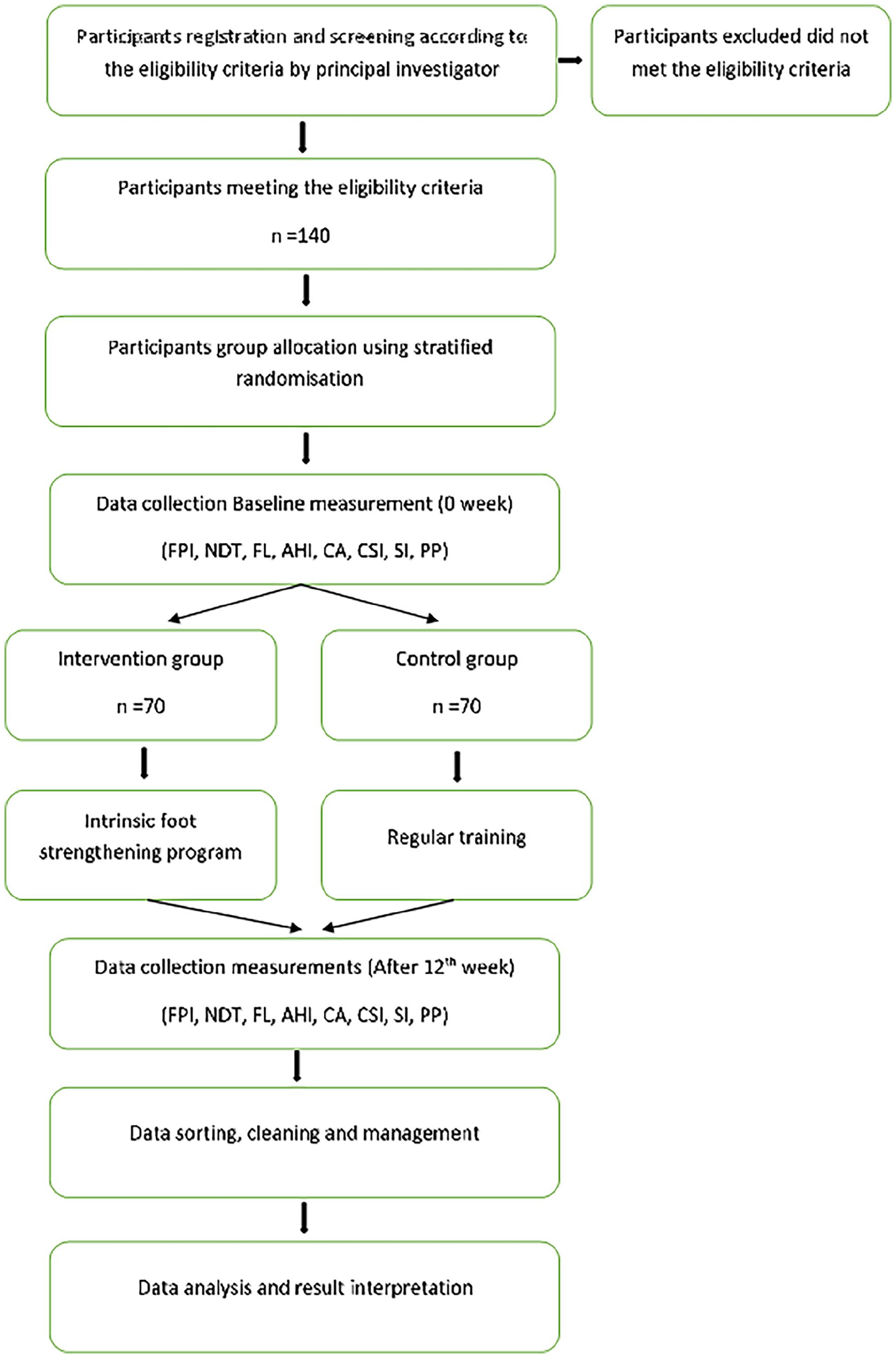
Consolidated Standards of Reporting Trials (CONSORT) flow chart for study. 12
Objective
The primary objective of our study is to test the efficacy of the designed comprehensive foot strengthening program (IFSP) in improving faulty foot biomechanics (static and dynamic) and uneven plantar pressure distribution to reduce the risk of lower limb injuries in male Bhangra dancers.
Hypothesis
Null Hypothesis
The experimental group will not show significant improvement over the control group in improving foot biomechanics and unevenly distributed plantar pressure, and will not reduce the risk of lower limb injuries in male Bhangra dancers.
Alternate Hypothesis
The experimental group will show significant improvement over the control group in improving foot biomechanics and unevenly distributed plantar pressure, thereby reducing the risk of lower limb injuries in male Bhangra dancers.
Ethical Considerations
This trial will be continued as a second phase of the study undertaken for the PhD program, which has received ethical approval on 20 April 2023 from the Genebandhu Independent Ethics Committee, duly referenced as Ref-ECG005/2023. Furthermore, it has been registered in the Clinical Trials Registry-India, with a distinctive trial number: CTRI/2023/05/52343. Our commitment lies in upholding ethical principles and ensuring the safety and well-being of all participants. Each participant will be required to provide informed consent. The execution of this study will be conducted in accordance with the Helsinki Declaration, and adherence to the SPIRIT guidelines for Randomized Controlled Trials (Table 1). 13 The exercise protocols to be used in this study have been thoroughly reviewed after designing and have garnered approval from the appropriate Institutional Review Board. The protocol has been copyrighted under registration number: L- 137234/2023.
Study Period According to the Guidelines of SPIRIT. 13

Abbreviations: FPI, foot posture index; NDT, navicular drop test; FL, feiss line; AHI, arch height index; CA, Clark’s angle; CSI, Chippaux Simrak index; SI, Staheli index; PP, plantar pressure.
Participants
The study will recruit 140 male Bhangra dancers from various academies, selected based on specific inclusion and exclusion criteria (Table 2). The sample size of 128 was estimated using G* Power 3.1.9.7 (Heinrich-Heine-Universität Düsseldorf, Düsseldorf, Germany), 14 and after addition of 10% drop out, Total sample calculated is 140, ensuring a medium effect size (0.50) and power (0.80). Participants will be randomly divided into 2 equal groups of 70 (experimental and control). The study will be single-blinded, with participants unaware of their group allocation. The experimental group will receive predesigned foot-specific strengthening program and control group will be receiving regular exercise and dance training routines. Both the training program will be structure carefully ensuring both sets of training material looks similar in appearance, format and instructions. Group allocation will be disclosed only after the final database is locked, and assessments and training will be conducted by certified Physiotherapist. The sequence of participant allocation will be by randomization (1:1) using the SNOSE (Sequentially Numbered, Opaque, Sealed Envelope) method. 15 The sample will be randomly divided into 2 equal groups of 70 participants in each group (experimental and control group). Further dropout in the study will be analyzed using last reading carry forward mechanism (Intention-to-treat-analysis).
Eligibility Criteria for the Study.

Abbreviations: PARQ, physical activity readiness questionnaire; WHO-5, World health Organisation wellbeing index-5; MOCA, Montreal cognitive assessment; RCT, randomized control trial.
Selection Criteria
The eligibility criteria for this Randomized Control Trial include male Bhangra dancers aged 18 to 45 with a minimum of 5 years of experience, ensuring consistent exposure to the physical demands of the dance. This period allows for sufficient adaptation to the repetitive impact forces on the feet, contributing to changes in foot biomechanics and plantar pressure. Such experience increases the likelihood of chronic adaptations or overuse injuries, which are crucial for examining biomechanical changes in the foot through assessments like the Foot Posture Index (FPI), 16 Navicular Drop Test (NDT), 17 Feiss Line (FL), 18 Arch Height Index (AHI), 19 footprint variables, 20 and Plantar pressure analysis. 21 Participants must be physically, psychologically, and cognitively fit to participate, assessed by the Physical assessment readiness questionnaire for everyone (PAR-Q+) for physical fitness, 22 the World Health Organization (WHO) Wellbeing Index-5 for mental wellness, 23 and the Montreal Cognitive Assessment (MoCA) for Cognitive impairment.24,25 Additionally, they must be able to understand and communicate in Hindi, Punjabi or English language. Dancers involved in any other dance form other than Bhangra dance diagnosed neurological conditions, balance and coordination issues, diabetic peripheral neuropathy, collagen vascular diseases, cardiac conditions, osteoporosis or recent surgery of lower limb will not be included and the Individuals unable to provide written informed consent will also be excluded from the study.
Experimental Group
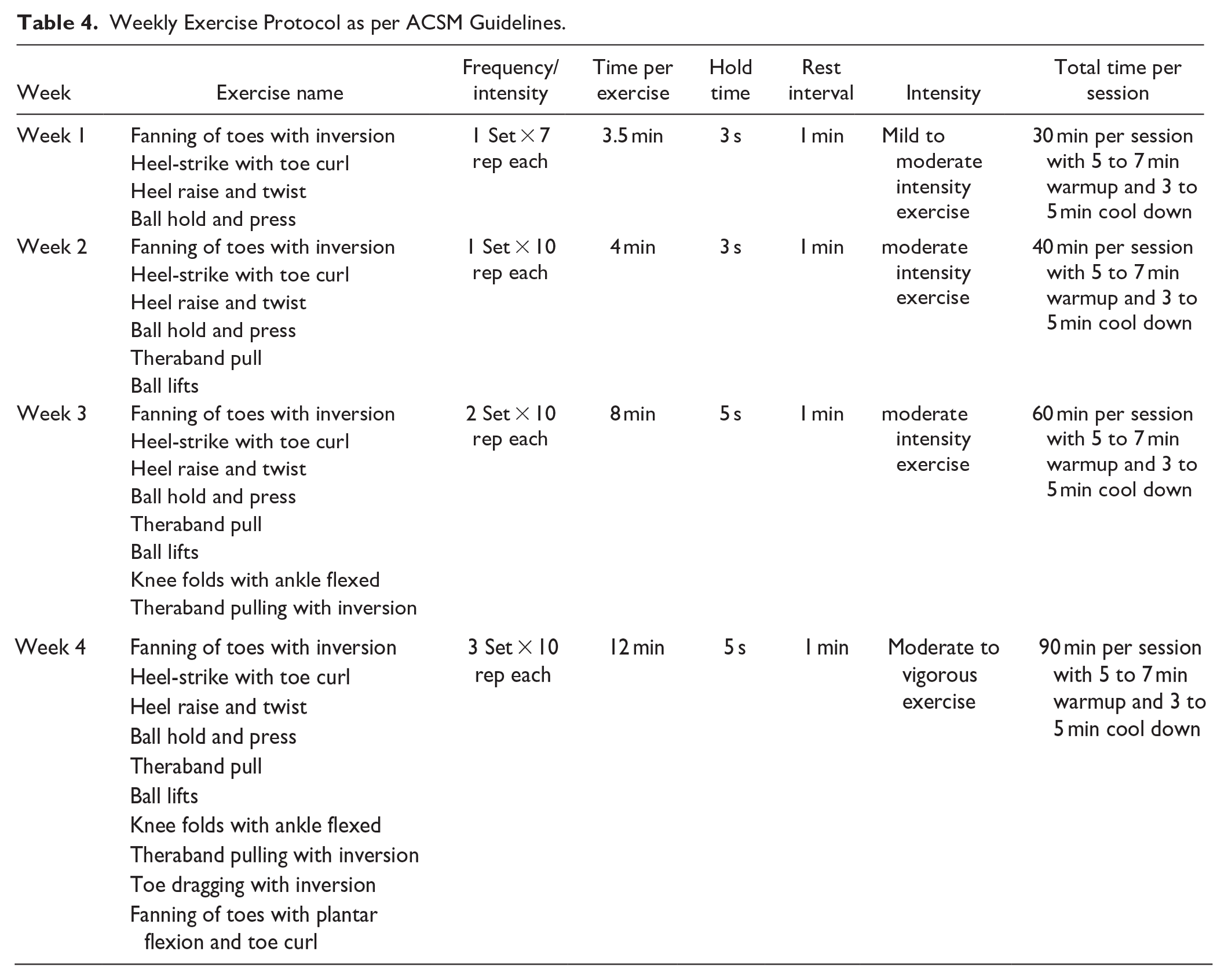
In the experimental group, the participants will engage in a carefully designed program consisting of 10 exercises aiming at strengthening of the intrinsic muscles of the feet. This exercise protocol has been designed as per the guidelines of The American College Sports Medicine (ACSM). 26 This intervention will be continuing over a period of 12 weeks, with participants engaging in the program for 5 days each week. The duration of each session will range from 30 minutes initially and progress to 60 minutes. The exercise program will include a range of intensities, from mild to vigorous, as detailed in Appendix 1. Table 2 and Figures 2 to 11 provides the description of the exercises and Table 3 and Table 4 outlines the weekly protocol.
Control Group
In the control group, participants will continue their assigned regular exercise and dance training routines without any additional foot-specific training exercises. This wait-list control group will serve as a comparison group to evaluate the effects of the intervention.
Outcome Measures
Biomechanical Assessments
Baseline and post-intervention assessments of foot biomechanics will be conducted. These assessments will include the Foot posture Index (FPI), 27 Navicular Drop test (NDT), 28 Feiss Line (FL), 29 Arch Height Index (AHI) 30 and foot print parameters: Clarks Angle (CA), Chippaux Smirak index (CSI), Staheli Index (SI). 31
Plantar Pressure Distribution
The plantar pressure distribution will be assessed using Win-track (Medicapteurs France SAS, Balma, France) is a Baropodometer/foot pressure analyzer which provides detailed analysis of static and dynamic plantar pressure distribution within the each foot as well between feet. 32
Injury Incidence
The injury incidence will be recorded using a Self-Structured Questionnaire (Appendix 2), which is copyrighted by the Government of India under copyright number
Clinical Trial Registration of the Main Study
Registration number
Ethical Approval of the Main Study
Genebandhu Independent ethics committee
The Copyright Registration Number for Questionnaire
Copyright office, Government of India under copyright number
Copyright Registration Number for Protocol
Copyright office, Government of India under copyright number
Trial Status
Recruitment has not yet started.
Data Analysis
Statistical analysis will be conducted using software IBM SPSS Statistics 22 (IBM Corp. Armonk, New York, USA.) and MS Excel 2016 (Microsoft, Inc., Redmond, Washington, USA). The normality of the data will be tested by using to Wilk’s Shapiro normal distribution test (sample size < 2000). After testing the normality parametric and non-parametric test will be decided to compare the mean of Experimental and control group to test the hypothesis. The mean will be compared within the group and between the group. Descriptive statistics of the samples will be calculated (mean ± SD and median (range); the confidence interval was 95%). Paired t-test and Independent t-test will be used to compare mean within and between groups. Pearson’s correlation coefficient or spearman rank correlation will be used to detect the relationships among the variables. The test level for statistical significance of differences between both groups is defined as P ≤ .05 for all tests.
Discussion
This study focused to investigate the effectiveness of the comprehensive foot strengthening program in improving faulty foot biomechanics and reducing the injury risk among male Bhangra dancers through a randomized controlled trial. Several biomechanical parameters, including the Foot Posture Index, Navicular Drop Test, and other measures, will be assessed before and after the intervention. These improvements in foot biomechanics are expected to lead to more efficient and safer dance movements.
Plantar Pressure Distribution
Another key aspect of this study is the evaluation of plantar pressure distribution. Understanding how weight is distributed across the feet during dance movements is vital as abnormal pressure distribution can lead to injuries. The study anticipates that the experimental group will show a more even plantar pressure distribution compared to the control group, which can contribute to in reducing the incidence of injuries among dancers.
Injury Incidence
The study will gather data on past injury incidence over the previous year, and monitor injury incidence throughout the intervention period by using self-structured questionnaire. The past injury information
Implications for Dance Training Protocols
The findings of this study may have significant implications for the development of dance training protocols. Dancers and their instructors will benefit from evidence-based recommendations on the incorporation of foot muscle strengthening program into their training routines. This can help the Bhangra dancers to prepare and maintain their bodies for the rigors of dance, ultimately enhancing their performance and prolonging their careers.
Contribution to Injury Prevention Strategies
The study’s results will not only benefit the field of dance but also contribute to injury prevention strategies in sports and physical activities. Understanding how targeted training exercises can improve biomechanical characteristics can be applied to other athletic disciplines where lower extremity injuries are prevalent.
Study Limitations
Despite its potential contributions, this study has some limitations. The sample size of 140 participants is relatively small, and the study duration is limited to 12 weeks. Additionally, individual variations may influence the study’s findings. Even this protocol should be tested in other dance forms as the injury rate is high in other dance forms as well.
Trial Status
This clinical trial yet to recruit participants for phase 2. Phase 1 have started to identify the population with problems.
Conclusion
In conclusion, this randomized controlled trial aims to test the efficacy of comprehensive foot strengthening program to improve the faulty foot biomechanical characteristics and uneven plantar pressure distribution in male bhangra dancers. The study’s results have the potential to reshape dance training protocols and injury prevention strategies in the field of dance and beyond.
Footnotes
Appendix 1
Weekly Exercise Protocol as per ACSM Guidelines.
| Week | Exercise name | Frequency/intensity | Time per exercise | Hold time | Rest interval | Intensity | Total time per session |
|---|---|---|---|---|---|---|---|
| Week 1 | Fanning of toes with inversion | 1 Set × 7 rep each | 3.5 min | 3 s | 1 min | Mild to moderate intensity exercise | 30 min per session with 5 to 7 min warmup and 3 to 5 min cool down |
| Heel-strike with toe curl | |||||||
| Heel raise and twist | |||||||
| Ball hold and press | |||||||
| Week 2 | Fanning of toes with inversion | 1 Set × 10 rep each | 4 min | 3 s | 1 min | moderate intensity exercise | 40 min per session with 5 to 7 min warmup and 3 to 5 min cool down |
| Heel-strike with toe curl | |||||||
| Heel raise and twist | |||||||
| Ball hold and press | |||||||
| Theraband pull | |||||||
| Ball lifts | |||||||
| Week 3 | Fanning of toes with inversion | 2 Set × 10 rep each | 8 min | 5 s | 1 min | moderate intensity exercise | 60 min per session with 5 to 7 min warmup and 3 to 5 min cool down |
| Heel-strike with toe curl | |||||||
| Heel raise and twist | |||||||
| Ball hold and press | |||||||
| Theraband pull | |||||||
| Ball lifts | |||||||
| Knee folds with ankle flexed | |||||||
| Theraband pulling with inversion | |||||||
| Week 4 | Fanning of toes with inversion | 3 Set × 10 rep each | 12 min | 5 s | 1 min | Moderate to vigorous exercise | 90 min per session with 5 to 7 min warmup and 3 to 5 min cool down |
| Heel-strike with toe curl | |||||||
| Heel raise and twist | |||||||
| Ball hold and press | |||||||
| Theraband pull | |||||||
| Ball lifts | |||||||
| Knee folds with ankle flexed | |||||||
| Theraband pulling with inversion | |||||||
| Toe dragging with inversion | |||||||
| Fanning of toes with plantar flexion and toe curl |
Appendix 2
Acknowledgements
The authors would like to thank the participant of the present study and also like to extend the thanks to family and friends for constant support and love.
Credit Authorship Contribution Statement
All the authors have distinctive role in formulation of this study protocol;
1. Sakshi sadhu: will take lead role in conceptualization and designing of protocol, ethical consideration, data collection and management responsibility, manuscript preparation, exercise protocol designing and drafting, questionnaire designing and drafting, drafting final version of manuscript and publication responsibility.
2. Dr. Ramesh Chandra patra: conceptualization and designing of protocol, will provides the supervision through the study, revision of manuscript, exercise protocol designing and drafting, questionnaire designing and drafting, drafting final version of manuscript.
Declaration of Conflicting Interests
The author(s) declared no potential conflicts of interest with respect to the research, authorship, and/or publication of this article.
Funding
The author(s) received no financial support for the research, authorship, and/or publication of this article.
Ethical Approval of Main Study
Genebandhu Independent ethics committee Ref ECG005/2023.
Clinical trial Registration of Main Study
Registration number (CTRI/2023/05/052343).
Copyright Registration Number for Questionnaire
7838/2023-CO/L.
Copyright Registration Number for Protocol
L- 137234/2023.
