







Abstract
Keywords
Key Points
Reliable, valid, and responsive measurements of développé height can be made efficiently in field settings.
Dancers with considerable prior training can improve développé height by modifying their approach while engaging in strengthening and stretching exercises designed to improve développé performance.
Performance ratings of développé by experienced Ballet and Modern Dance teachers suggest that the improvements achieved were practically important as well as experimentally valid.
Introduction
Measuring dancer capacities can present special challenges for dance medicine and science researchers. Many dance skills incorporate a range of motion or an aesthetic quality that is not common in other physical activities. Yet effective measurement is critical for the success of our rapidly growing applied research field. 1 When dance researchers wish to study a skill or capacity for which a reliable, valid, and responsive measurement system has yet to be developed, they may need to create a uniquely tailored measurement protocol. 2 One example is the distinctive dance skill, développé to the side, which is commonly used in concert dance forms such as ballet and modern dance. Other descriptors and related skills include: développé à la seconde3,4 and extension to the side.3 -5
Développé to the side involves an unfolding of 1 leg from a turned-out position on 2 feet (with the hips externally rotated so knees and feet point to the sides). The dancer draws 1 foot up to the opposite knee and then unfurls the gesturing leg high and to the side while balancing on the other leg as shown in Figure 1. For this study, we focused on développé to the side, here after referred to simply as développé. The skill can also be performed to the front (en avant) and back (derrière). Développé is not the only important dimension of competence in the world of concert dance, but its performance requires mastery of many subtle movement skills (i.e., balance, control, appearance of unlimited freedom of movement) that make dance unique. Many dancers seek to optimize their performance of développé while training for a career in dance.5,6
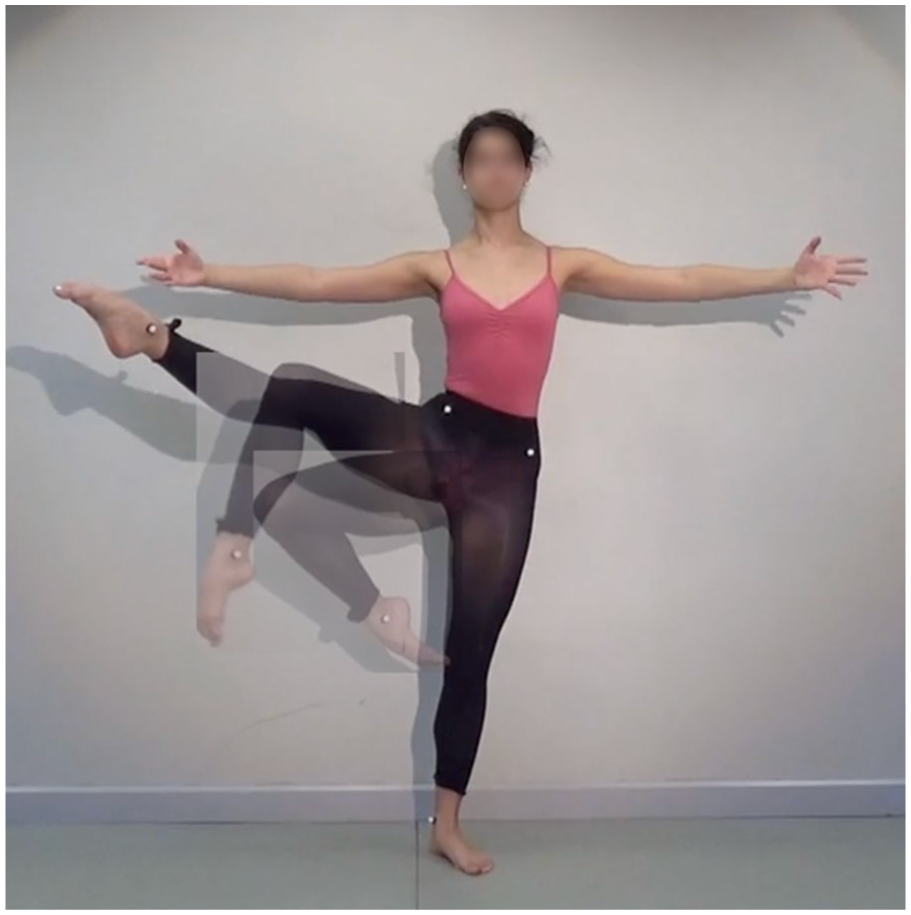
Overlay image of Dancer 2 performing développé to the side prior to training.
Previous research has demonstrated the ability to increase dancers’ développé height with isolated strengthening 6 and stretching 7 techniques. Dance kinesiologist and fitness trainer Karen Clippinger suggested that dancers put more emphasis on efficient execution of the movements involved in performing développé to improve height. She suggested stabilizing the standing leg first, lifting the gesture knee to its highest point, and then extending the knee to lift the lower leg.5,8 The logic of this approach is appealing but we were unable to find empirical evidence to support its use.
Other researchers have shown that training that targets a specific skill in a context that allows dancers to receive individualized instructions, cues, and feedback can improve the performance of complex and subtle dance skills such as balanced pelvic alignment9,10 and effective control of turnout 11 in university dancers, and fundamental skills such as kick, turn, and leap in younger, competition dancers. 12 If dancers can learn to recruit, in a specific sequence, muscles that are well-positioned to perform the movements involved in développé, while releasing muscles that may interfere with efficient execution of those movements, they may be able to increase développé height.13,14
The purpose of this study was twofold: (1) to evaluate a field-deployable approach to measuring développé height twice weekly for 8-1/2 weeks and (2) to evaluate the effects of 4 weeks of targeted training on university dancers’ développé height.
Method
Participants, Setting, and Equipment
Six (norm for single-case experiments) 15 female dance majors volunteered to participate in this study. Their mean age was 20 ± 0.4 years and years of dance training was 15.3 ± 0.5 years. They were enrolled in year 3 of a 4-year university dance training program. All dancers had completed 2 courses in the dance sciences that focused on anatomical concepts and principles of fitness training as part of their program curriculum. During the study, all 6 dancers attended 3 hours of ballet and contemporary technique classes 4 days per week. They also participated in 6 to 9 hours of evening rehearsals per week and 1 to 2 hours of afternoon classes that did not emphasize movement training. In response to a short questionnaire, all dancers said they believed they had already achieved their personal best développé but would be interested in improving the height of their développé if offered a reasonable means of doing so.
Before the study began, the dancers were evaluated by a physical therapist to ensure they had no conditions that would limit their ability to improve their développé or put them at risk of injury while completing the exercises used in training. The study was reviewed and approved by the university IRB and all participants signed consent forms before any data were collected.
Measurements were made in a 6 × 6-meter dance studio with one blank wall that provided a clear backdrop for video recording. Training was conducted in a 10 × 10-meter dance conditioning studio in the same building. It contained a 3 × 6-meter dance floor, wall mirror, ballet barre, and several portable props (55 cm stability ball, 15 cm plastic playground balls, 2 m medium-resistance bands) that were used in some of the exercises.
Assessing Développé Performance
Measuring développé height
Développé measurements for all 6 dancers were made on Mondays and Fridays immediately following morning technique classes for the 8½ week duration of the study, with the exception of 1 session when a dancer was not measured because she was ill. We developed a field deployable approach to measuring développé height that could be conducted in a dance studio using readily available equipment. The approach allowed us to make the frequent measurements required by the experimental design used in this study. The 2-dimensional measurement protocol was adapted from research on other dance skills.9 -11,16
The dancers were instructed to wear tight-fitting dancewear during développé measurements. Light-reflecting, spherical markers (3 cm) were attached to the anterior superior iliac spines (ASIS—front corners of the pelvis) and the medial malleoli (inside ankle bones) on the right and left sides of the dancer’s body (see Figure. 2). A projector light was used to illuminate the markers and create distinct visual reference points on the body.
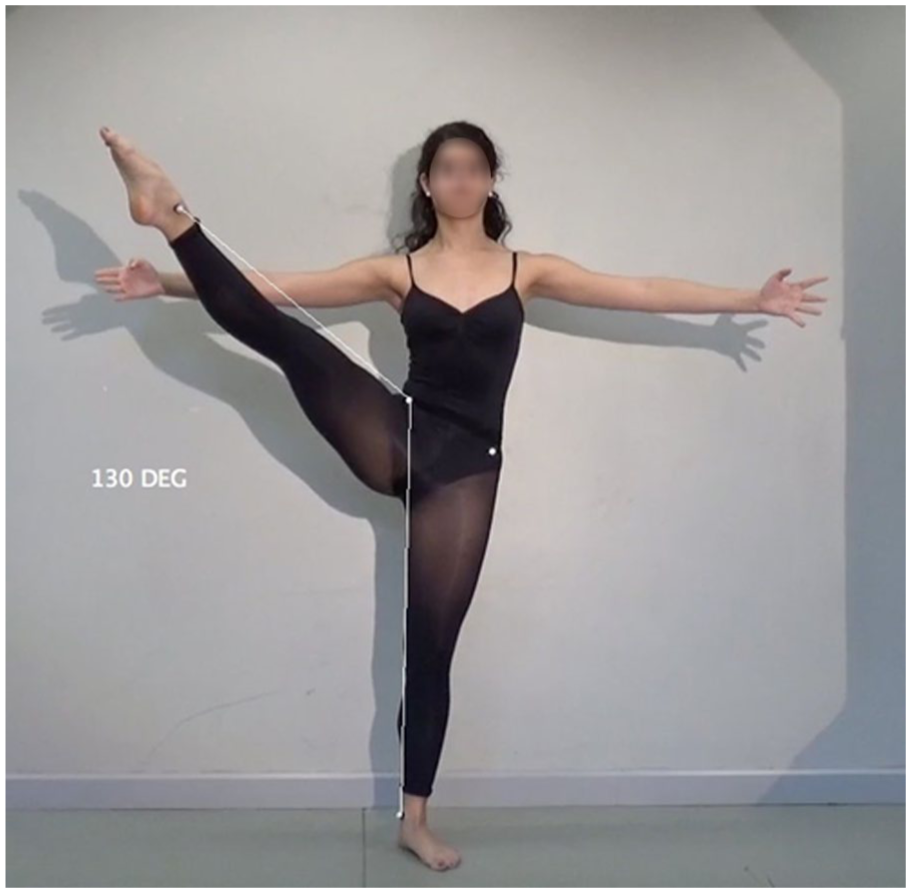
Image of Dancer 2 showing placement of markers and angle measured during twice weekly assessments of développé height. This image was recorded at the end of training.
We filmed each dancer performing développé using a digital video camera (Sony HDR-PJ540) mounted on a tripod and set at the level of the dancers’ hip joints. The lens was zoomed all the way out. The location of the camera and where the dancer was to stand were marked with gaffer tape to ensure consistent placement throughout the study. The dancers were directed to alternately perform développé with their right, then left leg twice through while the researcher audibly counted two sets of 8 for each développé, 4 counts to lift the gesture leg to passé, 4 counts to extend the leg high and to the side, 4 counts to hold the position, and 4 counts to lower the gesture leg to first position standing. A moderate tempo (~110 bpm) was used to prevent the dancers from using momentum to kick their legs up and to avoid having them lift their legs so slowly that the movement would have been more arduous than necessary. To minimize reactivity, only the dancer being assessed was in the studio while her performance of développé was being filmed. The other dancers waited in an adjacent classroom until they were called for filming.
After each filming session, the researcher uploaded the recordings to a laptop computer and captured the frame at the point when the dancer held the extension position for 4 counts. An open-source software angle-measurement tool in the ImageJ suite 17 was used to measure the angle created by a pair of lines drawn between the medial malleolus of the standing leg, the ASIS of the gesture leg, and the medial malleolus of the gesture leg (see Figure 2). These anatomical landmarks were chosen through trial and error during pilot testing with other dancers. The angle described by the lines connecting these landmarks offered a reasonable approximation to the angle university dancers and teachers use to represent “développé height” while training.
Measurement reliability
Confirming the consistency of the repeated measurements made when conducting single-case experiments is essential for ruling out threats of history and instrumentation.18,19 Three observers independently re-measured a randomly selected total of 60 measurements (20 per observer), a total of 30% of the 202 images measured by the primary observer. Measurements that differed by 1 degree or less were considered agreements and measurements that differed by more than 1 degree were considered disagreements. Inter-Observer Agreement (IOA) was calculated by dividing the number of agreements by the number of agreements plus disagreements and converting the resulting proportion to a percentage.20,21 We also assessed inter-observer agreement using ICC (2,1), random effects (model 2) with each image re-measured by 1 reliability observer (form 1).21,22,23
Teacher assessments
To evaluate whether improvements that resulted from training were important to dance teachers, 3 Ballet and Modern Dance teachers were asked to rate video recordings of each dancer’s développé performance before and after training. Neither the teachers nor the dancers knew who was making the teacher assessments. Dancers did not know what dimensions of développé the teachers were assessing. The videos chosen for these assessments represented the median performance, in terms of développé height, of the last three measurements in each condition. The pre- and post-training video clips for each dancer were sequenced back-to-back to facilitate comparison. Half of the paired videos were presented with the post-training video clip preceding the pre-training clip. The order in which the paired recordings were presented was randomized and not revealed to the teachers. The teachers were asked to rate 5 performance dimensions: (1) développé height, (2) movement efficiency, (3) control, (4) alignment, and (5) aesthetic line. Ratings were made using a 7-point scale (7 being “optimal” and 1 being “needs substantial improvement”).
Procedure: Développé Training
Training emphasized a specific approach to executing développé and performing exercises targeting muscle groups likely to be important for performing développé. Key components included:
(a) engaging deep postural muscles to stabilize the standing leg and torso;
(b) lifting the gesturing knee while pressing down through the standing leg; and
(c) delaying extension of the knee until the knee reached maximum height.
To help dancers learn and refine this functional approach to training développé, the researcher used a combination of strategies which are sometimes present in large-group dance classes, but difficult to administer with precision in that context. The teaching strategy involved:
breaking the skill into component parts;
focusing the dancer’s attention on each component in sequence;
providing image-based instructions and tactile cues tailored to each dancer’s needs; and
acknowledging improvements for individual dancers as they were occurring.
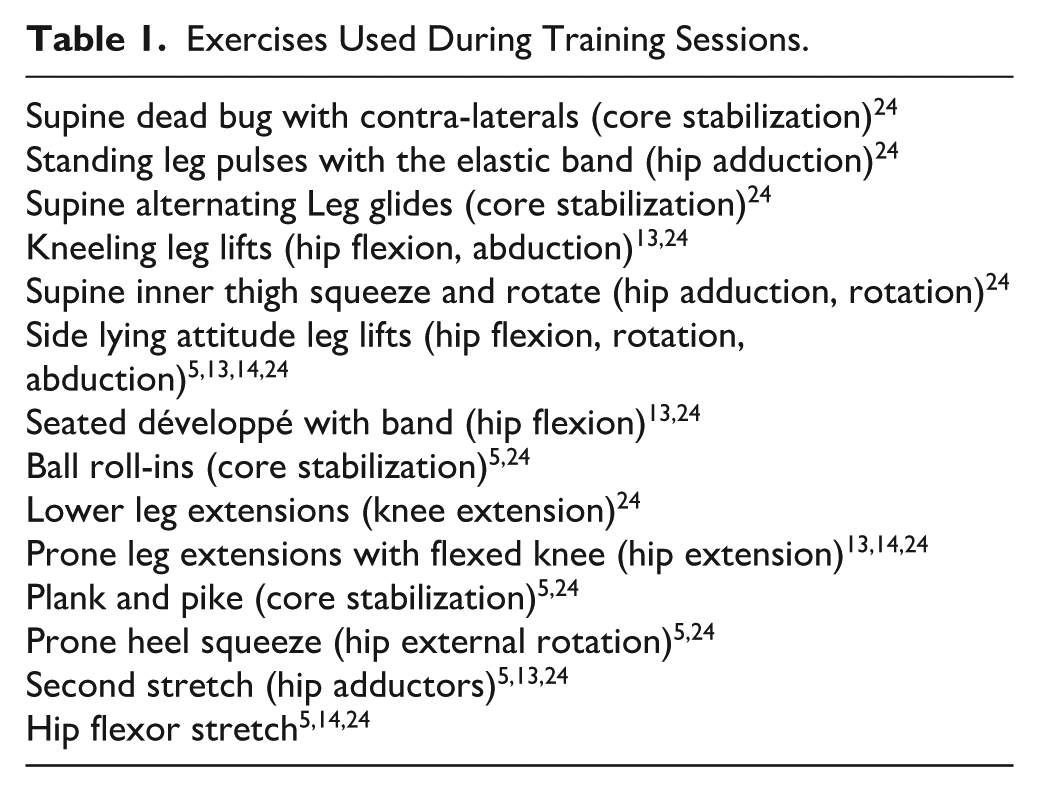
The researcher selected and adapted dancer-specific hip and core strengthening exercises to provide opportunities to rehearse the new approach to performing développé and to develop awareness and physical capacities needed to execute développé efficiently.5,8,24 The exercises are listed in Table 1.
Exercises Used During Training Sessions.
The researcher used the complementary principles of progressive overload13,14 and shaping 25 to adjust the number of repetitions, resistance, and form of the exercises to match each dancer’s evolving ability to practice each exercise without compensating their alignment or using excessive tension. Dancers were encouraged to ask questions as they rehearsed the skills they were learning. 26
Training was administered by the researcher, an active dancer who interned with the university physical therapy staff one, 4-month term. She met with 3 dancers at a time for 1 weekly, 30-minute training session across 4 consecutive weeks. Training sessions were scheduled between the Monday and Friday filming sessions with the day and time adjusted to accommodate the dancers’ availability. The dancers were instructed to complete 3 additional, self-guided sessions per week. A training checklist was handed to each dancer during the weekly training session and a digital copy, with attached exercise descriptions, was emailed immediately following training. The dancers were asked to log their sessions on the checklist and encouraged to use the blank space provided to record any questions or comments to be addressed at the next training session with the researcher. The researcher was the only person to see the logs and she assured the dancers that there would be no penalty if they did not complete the prescribed number of self-guided sessions. They were encouraged to be honest in their reporting.
Experimental Design
A concurrent multiple-baseline-across-participants design, an elaboration of time-series analysis, was used to assess experimental control of the primary dependent variable (développé height) by the independent variable (développé training).20,27 Développé height for both legs was measured twice each week during all experimental conditions for all 6 dancers. The sequence of conditions was as follows.
Baseline for all six dancers
Développé height was measured for all 6 dancers before training until the height measurements stabilized at a common level and did not reveal an increasing trend across at least 3 consecutive observations. 20 Baseline measurements for Dancers 1, 2, and 3 met this criterion after the first 3 observations.
Training for dancers 1, 2, and 3
Développé training was initiated for Dancers 1, 2, and 3 between the 3rd and 4th measurement sessions and continued for 4 weeks (8 observations). The other 3 dancers remained under baseline conditions (no développé training).
Training for dancers 4, 5, and 6
Two and one-half weeks after training was initiated for the first 3 dancers, baseline measurements for the other 3 dancers satisfied the stability criteria. Développé training was initiated for Dancers 4, 5, and 6 between the eighth and ninth measurement sessions and ran for 4 weeks.
Post training
When training concluded for each dancer, they were encouraged to continue performing the développé training exercises and asked to record any self-guided training they did. The researcher continued to collect exercise logs weekly and to make développé measurements twice weekly.
Data Analysis
To analyze the influence of développé training (IV) on développé height (DV) we plotted the measurements made for each dancer individually and looked for discontinuities in the data patterns that suggested a systematic influence of training on développé height.20,28,29 To determine whether the changes showing in the graphic display might have occurred by chance, we created celeration lines for each baseline, adjusted their level to make split-middle lines, and projected the baseline forecasts onto the treatment condition data panel for each dancer (see example in Supplemental Materials). 21 We used a binomial test to determine the probability that the number of data points above the baseline projection might have occurred by chance (see Table 2). Although generally not used in single-case experiments, a null hypothesis for a comparable group design analysis might be: Targeted développé training will have no effect of développé height. We used the teacher ratings to evaluate the practical importance of the changes made.
Binomial Test Results.
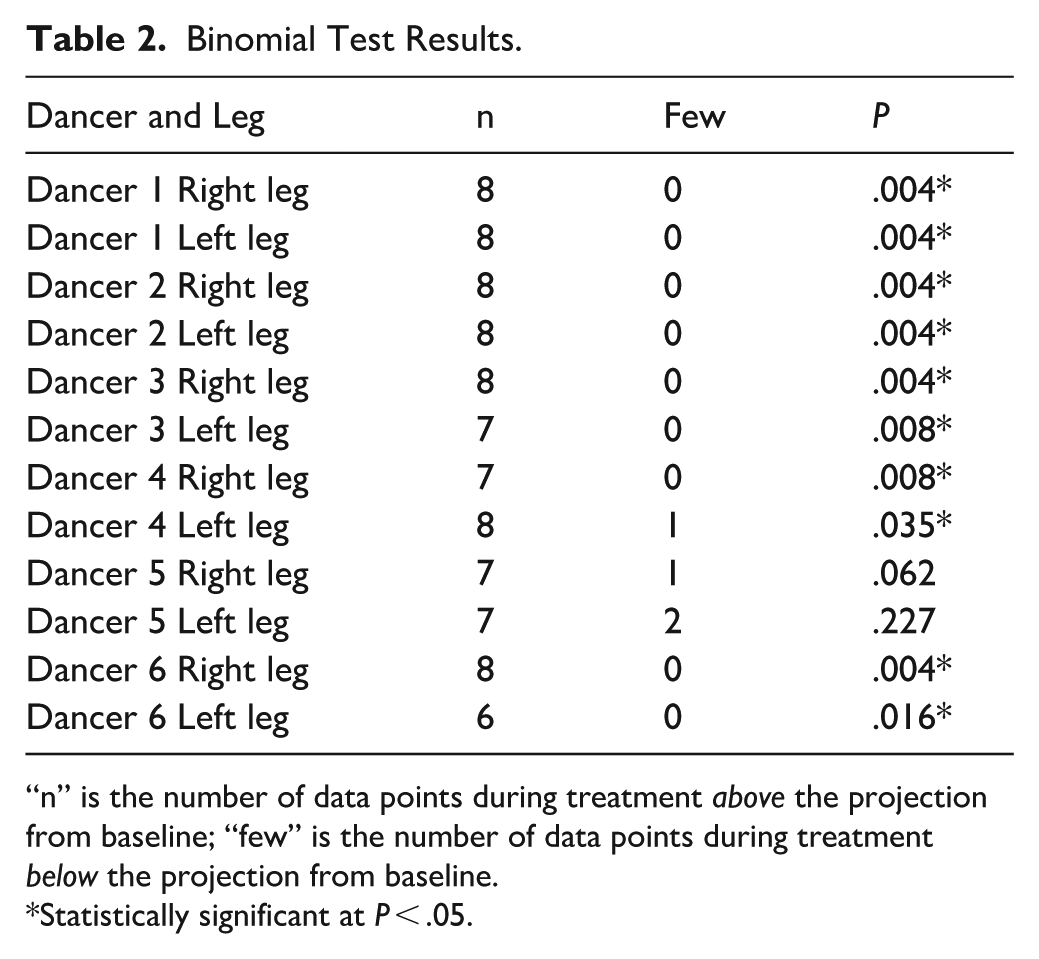
“n” is the number of data points during treatment above the projection from baseline; “few” is the number of data points during treatment below the projection from baseline.
Statistically significant at P < .05.
Results
All dancers completed all 4 weekly training sessions with the researcher, and they reported completing 96% of the self-guided sessions during training. Figure 3 displays each dancers’ performance under baseline, training, and post-training conditions. Développé height increased systematically on both legs when each dancer received training. Overall Inter-Observer Agreement for the développé height measurement was 93%, well above the 80% requirement for a new measurement protocol. 20 The ICC assessment also yielded a high level of absolute agreement with ICC (2,1) for the 3 observers, ranging from 0.985 to 0.998 (95% CI = 0.964-0.999].21,22,30,31
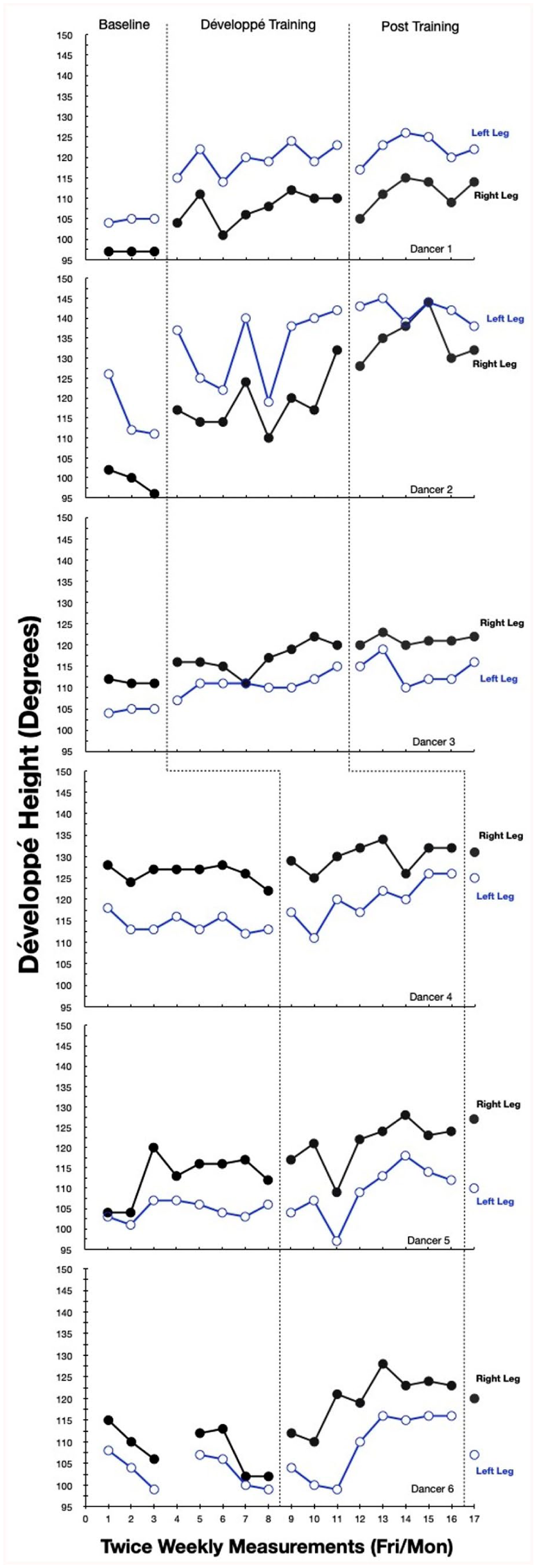
Multiple baseline display of développé height during baseline, training, and post-training conditions for each of the 6 dancers. The vertical dashed lines indicate condition changes.
Dancer 1’s développé height stabilized after 3 baseline measurements. When training was initiated, développé height increased immediately and continued to increase across the 4 weeks of training. When training concluded, développé height initially decreased modestly but recovered to the level achieved during training.
Développé height for Dancer 2 showed a decreasing trend during the 3 baseline observations. When training was initiated, her performance increased immediately, varied considerably during training, but showed the same general increase during training as Dancer 1. Dancer 2 showed a greater increase on her right leg, bringing her développé height closer to symmetrical on both legs by the end of the study.
Dancer 3’s développé height stabilized during the first 3 baseline measurements and showed a modest and gradual increase as training was applied. She sustained her new level of performance over the 6 post training observations.
Développé height for Dancer 4 remained stable throughout the 8 baseline measurements. Training was initiated after 8 measurements and a gradual increase in développé height followed. Similar to Dancer 2, her developpe height was closer to symmetrical at the end of the study.
Dancer 5 showed a marked increase in height on the right leg early in baseline, but her performance stabilized after 8 measurements. She improved gradually throughout training except for 1 measurement session where her développé height decreased on both legs.
Dancer 6 missed 1 measurement session during baseline due to illness. She showed a decline in développé height during baseline followed by a strong increase during the 4 weeks of training and decreased modestly during her single post-training assessment.
The binomial test revealed that the changes from baseline to training seen in the visual display for Dancers 1, 2, 3, 4, and 6 were unlikely to have occurred by chance (see Table 2). Dancer 5 also improved in développé height, increasing 10° on each leg during training, but the proportion of measurements above the projection from her baseline for either leg was not statistically significant (P = .06 and P = .23, right and left legs).
Overall increases for each dancer were calculated by comparing the mean of the last 3 développé measurements during baseline with the mean of the last 3 measurements during training. Figure 4 displays increases in développé height for each dancer’s left and right legs. The mean increase for all 6 dancers was 13.9° (range 7.7-23.7°) on the left leg and 13.1° (range 4.7-23.7°) on the right leg.
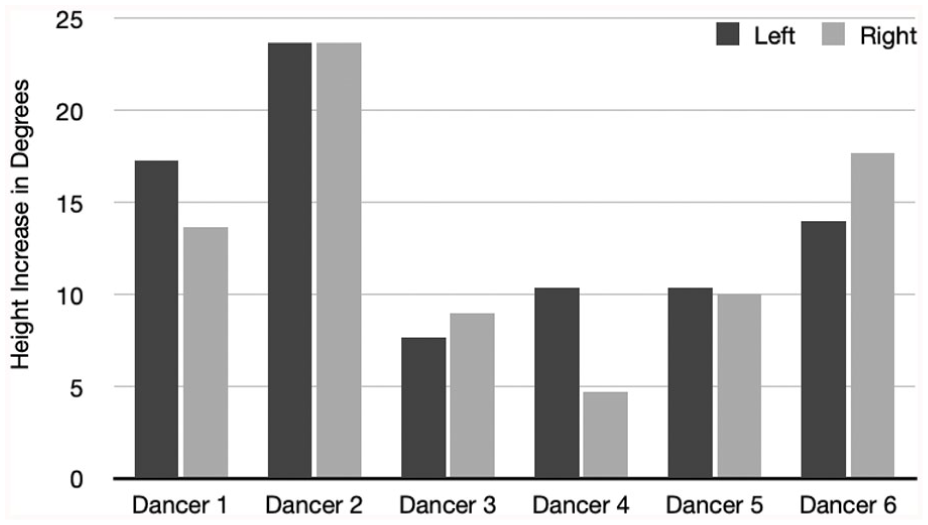
Mean improvement in développé height for each dancer based on the last three measurements during baseline and the last three measurements during training.
Teacher Ratings of Développé Performance
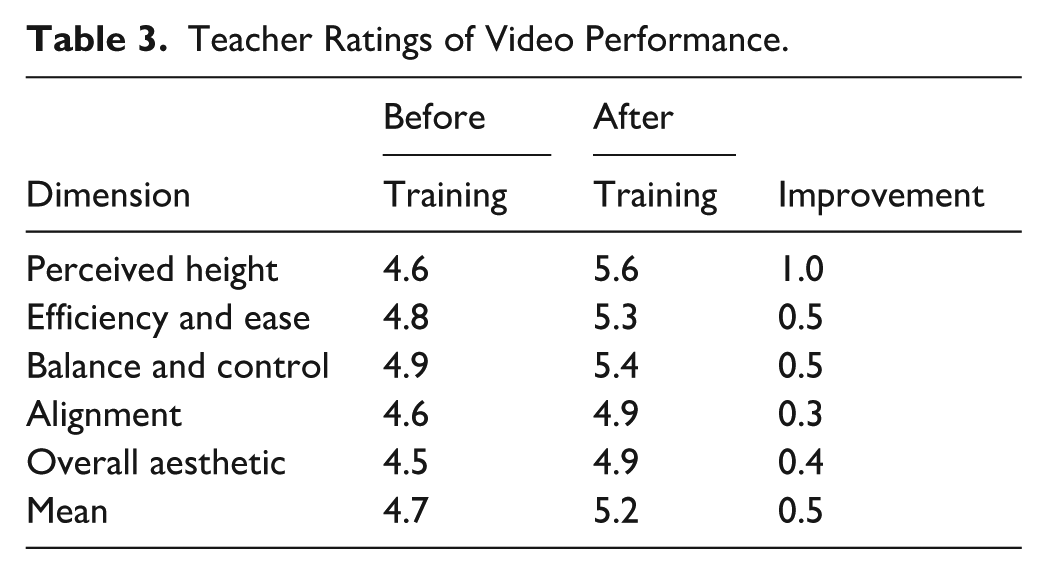
Mean teacher ratings on the 5 dimensions of développé performance before and after training are displayed in Table 3. Mean ratings for perceived développé height, movement efficiency, control, alignment, and overall aesthetic improved by 0.5 on a 7-point scale. Teacher ratings of développé height showed the largest improvement (1.0) and ratings of dancer alignment showed the smallest improvement (0.3).
Teacher Ratings of Video Performance.
Discussion
We used a concurrent-multiple-baseline-across-participants experimental design to evaluate the influence of targeted training on développé height for 3rd-year university dance majors. Because développé height improved only when training was initiated, and training was initiated at different times for different dancers, it seems reasonable to conclude that développé training, and not other uncontrolled variables, was responsible for the improvements observed. 32 The binomial test results support this conclusion for 5 of the 6 dancers.
The magnitude of the increases in développé height (5° to 24°) and the ratings by the teachers suggest that the improvements were practically important as well as experimentally valid. Differences in the approaches used to measure développé height across studies does not permit a direct comparison but changes are in the same direction across studies.6,7
An important benefit of the graphic display with repeated measurements is the ability to observe individual patterns of change over time. Figure 4 shows that every dancer who experienced développé training increased développé height on both legs suggesting that the training approach was robust across dancers. The graphic display (Figure 3) reveals that some dancers had higher rates of acquisition, some had greater variability in their performance, and at least 1 dancer (#2) continued to improve after weekly sessions with the trainer concluded. Figure 3 also shows that performance decreased briefly for some dancers early in training as might be expected when acquiring a new skill. 25 Displaying individual performance across time may help practitioners anticipate what to expect from the dancers they train should they choose to use a similar approach.
Displaying repeated measurements may also suggest topics for future research. For example, height improvements occurred soon after training was initiated for some dancers suggesting that change in behavior (rather than changes in strength or flexibility) was probably the salient variable for some dancers. Other dancers improved gradually suggesting that physiological adaptation may have played a larger role in improving their développé height. These potentially interesting differences would not have been visible had we presented the data as a pre-test and post-test group comparison. The marked improvements achieved in 8 hours of targeted training in this study might be considered an advantage for busy dancers and teachers. Future research might be designed to determine whether a longer duration training program might achieve greater improvements through physiological adaptations.
Three features of the measurement system may account for the high levels of inter-observer agreement achieved. First, we adapted a measurement strategy that was highly reliable when used by previous researchers to assess other dance skills.9 -11,16 Second, pilot-testing with other dancers the year before this study was conducted allowed us to develop a measurement protocol that was field-deployable and highly reliable. Third, measuring développé height twice weekly (17 times per dancer) allowed us to evaluate measurement reliability as the protocol was being applied in this study.
The measurement approach used in this study appears to offer a practical alternative to measurement protocols that require access to a motion-capture laboratory, sophisticated equipment, and highly trained personnel. The use of 4 markers placed on easy to locate bony landmarks allowed one measurement to represent what we believe many dancers and dance teachers identify as functional développé height. Filming the dancers immediately following technique class, in the same building, minimized use of the dancers’ time. Other measurement tools (e.g., Dartfish, Kinovea)33,34 might automate some steps in the assessment, but we suspect they would not yield results that are any more reliable than those described in this report. Future research might be designed to test this assumption.
Future research might also be designed to evaluate how biomechanically efficient the movement strategy used in this study is and compare its efficiency to other approaches to performing développé. We did not assess strength and range of motion independent of the développé height and teacher ratings, but future research might be designed to isolate these influences.
Of course, height is not the only dimension important in développé performance. Enhancements might be observed in control, alignment, and overall aesthetic appearance as well. The teacher ratings acknowledged improvement in développé performance along several dimensions. Teacher ratings improved the most for développé height while overall aesthetic improved less. One teacher commented that “lifting the knee high before extending the lower leg [appears to] facilitate a higher extension but [she] prefer[s] a smoother, more continuous motion.” Future research might assess whether additional training can improve teacher satisfaction with développé performance.
Perhaps the most important aspect of training was the ability to teach in a context that allowed dancers to receive individual attention as they developed and refined their execution of the new movement approach.26,35,36 By working with the dancers in small groups, the researcher was able to provide individually tailored oral and tactile cues, imagery, and feedback. 37 It allowed the researcher to assess each dancer’s growing mastery of the skill and tailor the training to match individual needs. These teaching tools were not vastly different from those used by skillful teachers in dance classes, but they were probably easier to apply with precision in the 3-dancer training groups used in this study.26,36 A future attempt to replicate this study using different trainers, different dancers, or a different collection of exercises may help clarify which elements of training are essential.
Limitations
Practitioners and researchers may want to give special consideration to some limitations when determining the relevance of the findings of this study to their own work. First, this study was not designed to evaluate the generality and durability of the changes observed. A sufficiently large sample of dancers was not selected at random from the population of university dance majors, we did not measure the dancers’ use of développé in other settings, and we did not assess whether the dancers’ improvement endured over time. In the absence of random selection, we cannot offer a statistical estimate of the generalizability of the results of this study. The ability of future researchers to replicate the results of this study under varying conditions will ultimately determine the generality of the findings reported in this study.28,29,38
Second, the presence of practice (or testing) effects is a potential limitation in studies that use repeated measurements, an essential feature of time-series-based research methods. 19 It is possible, for example, that the twice weekly measurements influenced développé performance. Fortunately, practice effects are not apparent in the display of the repeated baseline assessments in the current study. Future research might be designed to rule out their influence.
Lastly, scheduling constraints necessitated the use of a 2-leg multiple baseline design. Adding a 3rd leg to the multiple baseline (e.g., 2 dancers each in 3 successive training cohorts) in a future study would allow the results to offer a more persuasive demonstration of experimental control.25,29
Conclusion
In conclusion, this study demonstrates that the complex dance skill développé to the side can be assessed reliably using a field-deployable measurement protocol. It also shows that small-group, targeted training, emphasizing an approach to training développé advocated by a dance training expert, can improve développé height in university dancers with a modest investment of dancer and teacher time. Finally, this study suggests that single-case experimentation can offer an instructive approach to studying individual dancer performance in our applied research field.
Supplemental Material
sj-docx-1-dmj-10.1177_1089313X251391036 – Supplemental material for Measuring and Improving Développé Height in University Dancers Using Single-Case Research Methods
Supplemental material, sj-docx-1-dmj-10.1177_1089313X251391036 for Measuring and Improving Développé Height in University Dancers Using Single-Case Research Methods by Kaitlin E. Morgan and Thomas M. Welsh in Journal of Dance Medicine & Science
Footnotes
Author Notes
This study was conducted in the School of Dance at the Florida State University with design, data analysis, and writing assistance from Jon Bailey, Loren Davidson, Gabriel Williams, Keith Miller, and Steven Ramsier, and pre-participation screenings by Tyressa Judge.

Funding
The authors received no financial support for the research, authorship, and/or publication of this article.
Declaration of Conflicting Interests
The authors declared no potential conflicts of interest with respect to the research, authorship, and/or publication of this article.
Supplemental Material
Supplemental material for this article is available online.
References
Supplementary Material
Please find the following supplemental material available below.
For Open Access articles published under a Creative Commons License, all supplemental material carries the same license as the article it is associated with.
For non-Open Access articles published, all supplemental material carries a non-exclusive license, and permission requests for re-use of supplemental material or any part of supplemental material shall be sent directly to the copyright owner as specified in the copyright notice associated with the article.
