






Abstract
Background:
Accurate power estimation is essential for evaluating explosive strength in athletes, but current formulas may not be suitable for dancers due to their unique biomechanics.
Purpose:
This study aims to examine the vertical jump power characteristics of modern dancers, accounting for sex-related differences, and to critically assess the limitations of existing power estimation models in dance performance.
Methods:
The study assessed the applicability of power estimation formulas for dancers, with 52 trained dancers (30 females, 22 males; mean age: 24.5 ± 3.07 years) performing maximal-effort countermovement jumps to evaluate explosive power. Power values were calculated using equations for males (Amonette, Lara, and Quagliarella) and females (Lara and Canavan and Vescovi).
Results:
Significant differences were found among the power estimation formulas for both female (χ2 = 60.0, P < .001) and male dancers (χ2 = 42.0, P < .001). Among female dancers, the Lara medium formula produced higher power estimates than both the Lara elite (P = .004, g = −0.521) and the Canavan and Vescovi (P < .001, g = −1.02) formulas, with effect sizes ranging from moderate to very large. For male dancers, the Amonette formula yielded the highest power estimates (P < .001, g = −1.18), followed by the Lara formula (P < .001, g = −0.85), both showing large effect sizes. The Quagliarella formula consistently provided the lowest estimates (P < .001, g = −1.13). Intraclass correlation coefficients (ICC) indicated good reliability, with ICC values of 0.872 for females and 0.959 for males.
Conclusion:
The examined power estimation formulas did not accurately reflect the vertical jump performance of modern dancers, revealing notable inconsistencies between methods. These findings highlight the need to develop gender-specific models that account for dancers’ unique biomechanics, ensuring more precise and valid power assessments in this population.
Key Points
Existing power formulas may not yield valid results for dancers, as they ignore biomechanical demands specific to this population.
The Lara formula overestimated peak power in female dancers, while the Amonette formula overestimated power in male dancers, showing model discrepancies.
Although high reliability was observed (ICC 0.872-0.959), integrating force platform data could improve the accuracy of power estimations for dancers specific to this population.
Introduction
In modern dance, technique combines aerobic activity with dynamic and explosive movements. 1 Among these movements, jumping is particularly fundamental, playing a crucial role in achieving both aesthetic and technical excellence. Effective jumping performance requires flexibility, speed, strength, coordination, and precision. 2 These jumps vary from small (eg, petit jeté, entrechat) to larger, complex actions (eg, grand jeté), performed at fast tempos (allegro). Such movements involve both eccentric and concentric muscle contractions, engaging the lower limbs in horizontal and vertical planes, placing significant demands on the muscles. 3 Despite their brief duration, ballistic actions like jumps and rapid directional shifts require substantial power for optimal execution, highlighting the importance of explosive power in dance performance. 4
Muscle force refers to the muscle’s ability to generate tension to overcome external resistance, while muscle power denotes the rapid application of force, combining strength and velocity. Dancers require both muscle force for controlled movements and muscle power for explosive actions such as jumps and acrobatics. 5 The importance of jumping ability is underscored in enhancing the aesthetic and artistic dimensions of dance, while also contributing to improved performance through the development of lower limb strength. Furthermore, specialized training programs have been shown to optimize jump height and physical attributes, ultimately facilitating the enhancement of technical proficiency. 6
Dancers typically perform around 200 jumps in a 1.5-hour training session, with this activity being an essential component of their daily technique classes and extending throughout rehearsals and performances. 7 During these activities, they execute jumps at rates of 0.2 to 0.9 jumps per minute in training and 1 to 5 jumps per minute in performances. 8 Given the high frequency and intensity of these jumps, dance-specific leap landings require dancers to safely absorb impact forces that can reach up to six times their body weight. Consequently, dancers must be skilled at performing aesthetic landings while effectively attenuating large-magnitude impacts. 9 This need for efficient force absorption becomes even more critical, as dancers face a high risk of lower extremity injuries due to repeated high-impact jumps, particularly during landings, which are strongly linked to excessive vertical ground reaction forces and rapid loading rates. 10 Strengthening balance and lower-limb muscles enhances force absorption and stability, allowing dancers to maintain precision under fatigue and reduce injury risk. 11 It has been determined that low levels of lower body muscular strength are associated with an increased severity of injuries in dancers. 12 Research strongly indicates that dancers possess lower-than-expected physical fitness given the demands of their discipline, potentially increasing injury risk and significantly limiting performance potential. 13 Accordingly, assessing and enhancing lower extremity muscle strength may play a crucial role in reducing injury risk in dancers.
Due to the high cost of measuring peak power with force platforms or position transducers, 14 vertical jump tests like the squat jump (SJ) and countermovement jump (CMJ) are used to assess explosive power in dancers, a crucial aspect of their performance.15-17 These tests rely on stretch-shortening cycles to store and convert elastic energy, enhancing jump performance. 17 Jump height, commonly measured in vertical jump tests, is not consistently a reliable indicator of lower limb power or maximal power output. Therefore, additional variables, such as jump force and body mechanics, should be considered for a more accurate assessment. 18 Moreover, since heavier individuals require more power to reach the same height, a simple and reliable method for accurately measuring peak power is essential. 14
Over the past 50 years, various predictive equations based on jump height, body mass, or height have been developed. The Lewis formula, 19 which estimates average power, led to the creation of regression-based models to assess both peak and average power across populations. These models include physically active males, 20 university students,21-23 secondary school students, 24 elite volleyball players,22,25 female basketball players, 26 elite junior male basketball players, 27 male soccer player, 28 children and adolscant. 29 However, significant estimation errors are expected when using a given equation, depending on factors such as age, gender, activity level, and the type of jump (eg, countermovement and/or arm swing). 14 Additionally, equations developed for adults may not predict peak power accurately for youth athletes or children. 29
Power estimation formulas developed for physically active individuals or athletic populations20-29 have been applied in limited studies on dancers, though they are primarily based on other groups.3,30 Some models use jump height and body mass, 30 while others also include body weight and height. 3 As noted by Eythorsdottir et al, 31 models tailored to one population may not be directly applicable to others with distinct physical characteristics. This highlights the need for a dancer-specific power estimation model, as existing formulas do not account for the unique demands of this population. Developing a validated model is essential for accurately assessing dancers’ physiological demands, optimizing training, and reducing injury risk. The absence of validated formulas may lead to misinterpretations of performance metrics and ineffective training strategies. Given the unique neuromuscular adaptations induced by dance-specific movements, generic power estimation models may not accurately capture dancers’ true power output, potentially compromising performance assessment and injury prevention. To address these limitations, this study aims to analyze the vertical jump power characteristics of modern dancers, considering sex-related differences, while critically evaluating the shortcomings of current power estimation formulas in dance. By challenging the validity of existing models, this research bridges a significant gap in performance assessment and lays the groundwork for developing more accurate, dancer-specific power estimation methods. Such advancements are essential for optimizing training, improving performance monitoring, and enhancing injury prevention strategies in dance science.
Methods
Participants
The study included a total of 52 trained modern dancers, aged 19 to 30 years (mean age: 24.5 ± 3.07 years), with 30 females and 22 males. All participants volunteered and met the inclusion criteria of having at least 3 years of dance training and a minimum of five training sessions per week. Power analysis was performed using G-Power software (Franz Faul, University Kiel, Germany) based on a non-parametric Friedman test to detect differences among the predicted peak power (PP) values from multiple formulas between groups. Considering an alpha level of .05, a power (1 − β) of .80, and a medium effect size (f = 0.25), the analysis indicated that a minimum of 16 participants per sex group (32 total) was required. The actual sample size of 52 dancers (30 females and 22 males) exceeded this minimum, thus enhancing the reliability and validity of the statistical findings.
Participants were professional dance company members and university dance students, all with similar training levels (at least 5 days/week, 3 hours/day) and dance experience. Prior to participation, all dancers were informed about the study’s purpose, procedures, and potential risks, and written informed consent was obtained. A demographic questionnaire, along with assessments of health, medical history, and physical activity patterns, was completed by each participant. At the time of data collection, all participants were asymptomatic and free from musculoskeletal injuries. The study was approved by the Research Ethics Committee of Marmara University Faculty of Medicine (SAG-D-040712-0272) and was conducted in compliance with the World Medical Association Declaration of Helsinki for medical research involving human subjects.
Procedures
The study utilized a cross-sectional observational design, where data were collected during a single testing session conducted under controlled conditions to minimize potential confounding factors. To ensure consistency, assessments were conducted between 10:00 a.m. and 2:00 p.m., and all procedures were carried out in a controlled dance studio setting. The testing environment was carefully managed to eliminate external influences, and all measurements were supervised by experienced investigators to ensure accuracy and reliability. Dancers were assessed at the midpoint of their annual training cycle, and prior to the session, they were instructed to refrain from caffeine, alcohol, and strenuous exercise for 48 hours. In addition, they were encouraged to maintain proper hydration through ad libitum water intake, while avoiding food and liquids for 2 hours before the test. 32 Only healthy dancers, whose injury status was evaluated by one of the study authors, a physiotherapist, were included in the analysis. Participants were familiarized with the experimental procedures before baseline assessments were conducted. The assessment protocol commenced with anthropometric measurements, including body weight and height, followed by a standardized warm-up and vertical countermovement jump test.
The primary dependent variable in this study is PP which was calculated using the CMJ height (cm) recorded during the jump test on a contact mat. The predicted PP values, expressed in watts (W), were estimated using established equations derived from force platform measurements. The independent variables included participant gender (male and female), with distinct equations applied according to gender-specific differences.
Measures
Anthropometric measurements
Dancers were physically evaluated based on their height and weight measurements, taken while wearing shorts, a T-shirt, and no footwear. Height was measured to the nearest 0.1 cm using a Seca 217 wall-mounted stadiometer (Seca GmbH and Co. KG, Hamburg, Germany). Body weight was determined to the nearest 0.05 kg with a digital scale (WB-110A, Tanita, Tokyo, Japan). Body mass index (BMI) was calculated with the formula: BMI = (Body weight [kg]/height2 [m2]). All measurements were performed in accordance with the guidelines set forth by the Anthropometric Standardization Reference Manual. 33
Jump performance test
The purpose of the countermovement jump test was to assess lower-limb explosive performance capacity. Participants performed a maximal-effort bilateral countermovement jump on a contact mat (Newtest 2000 System; Newtest, Oulu, Finland), which measured flight time (ms) and maximum jump height (cm). Each jump was recorded using a digital timer with an accuracy of ±0.001 s (Ergojump, Psion XP, MA.GI. CA., Rome, Italy), ensuring precise data collection. 34
To ensure consistency and optimal performance during testing, participants completed a standardized warm-up prior to the jump assessment. The warm-up protocol lasted 10 minutes, starting with 5 minutes of indoor jogging, followed by calisthenics (10 pliés, 10 relevés, 10 sit-ups, and 10 back extensions) and 2 minutes of static active stretching, with approximately 15 seconds allocated to each major muscle group. All warm-up exercises were closely supervised and timed by the investigators.
After completing the warm-up, participants performed the CMJ test to assess lower-limb explosive performance. The test began with participants standing upright, feet shoulder-width apart, and hands on their hips to minimize upper-limb contribution. This procedure was adopted based on standardized protocols used in previous studies21,22,26,28 in which the hands-on-hips position was employed to restrict upper-limb involvement, 26 and ensure comparability with the power estimation formulas derived from these methods. Participants performed a downward countermovement, flexing their knees to approximately 90°, before jumping as high as possible. Jumps were performed barefoot to enhance dance specificity. Trials were discarded if participants flexed their knees below 90° during the pre-jump phase, lifted their hands off their hips, or failed to maintain proper form. Proper knee flexion during landing, approximately 90°, was allowed and encouraged to ensure safe and efficient force absorption. Verbal encouragement was provided for all attempts. The highest jump height (cm) from three trials was recorded for analysis, with a 30-second rest between attempts to allow adequate recovery. 15
Reliability of our laboratory at pre-and post-testing countermovement jump test, using on a contact mat (Newtest, Oulu, Finland) was investigated in 10 male and 10 female dancers with 48-hour interval. Interclass correlation coefficients (R) ratio was .95 to .97 and there were no statistical differences between pre- and post-testing mean values (P > .05).
Peak power evaluation
PP was calculated using the CMJ height (cm) obtained during the test. Predicted PP values, expressed in watts (W), were estimated using published equations derived from force platform measurements. For males, the equations by Amonette et al, 14 Quagliarella et al, 28 and Lara et al 21 were applied. For females, the equations by Lara et al 22 (for elite and medium-level athletes) and Canavan and Vescovi 26 were used (Table 1). These formulas share common components such as vertical jump height, body mass, and specific coefficients, and were selected because they are widely used and proven to be accurate prediction models for various athletic populations. Specifically, their selection ensures relevance for male and female dancers of varying skill levels, providing a robust basis for comparison in sports science research. Since body height has no effect on CMJ height 35 it was excluded from calculations. While power estimation formulas have been applied to dancers in a limited number of studies, some lacked coefficients and included only body mass and jump height, 30 whereas others incorporated height as an additional variable. 3 Due to these inconsistencies, formulas without standardized key components were not considered in this study.
Peak Power Calculations for Male and Female Dancers Using Estimation Equations.
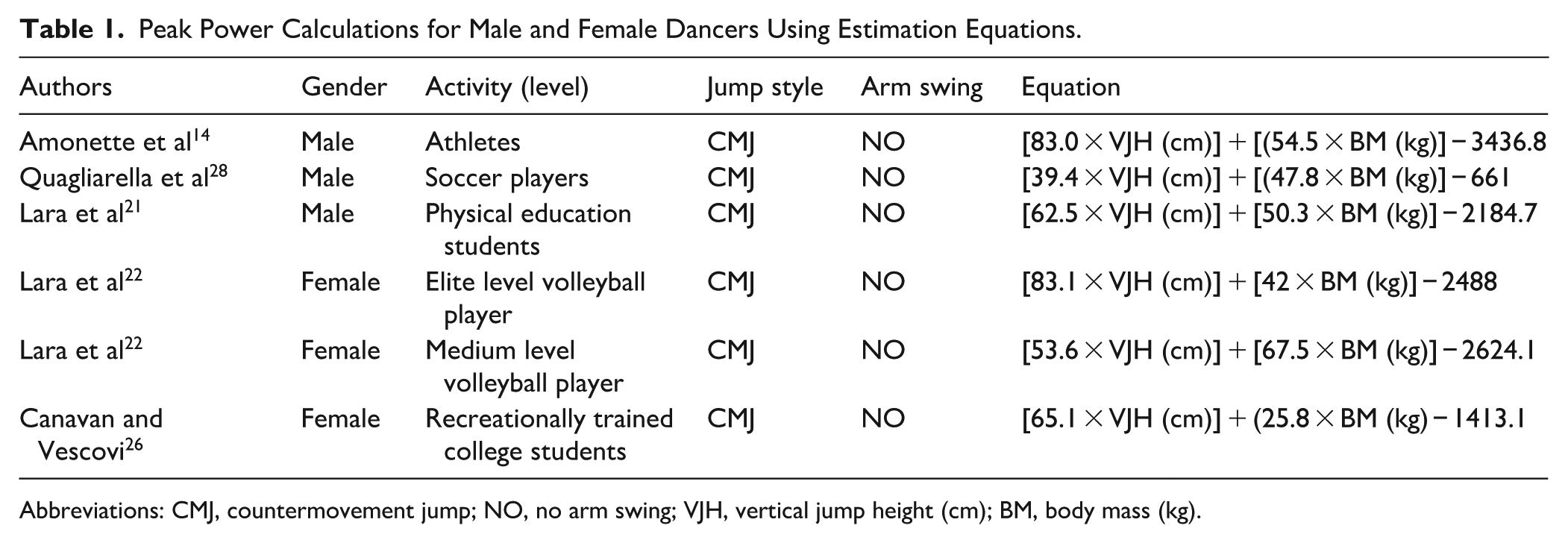
Abbreviations: CMJ, countermovement jump; NO, no arm swing; VJH, vertical jump height (cm); BM, body mass (kg).
Data Analysis
Descriptive statistics for all PP values, including the minimum, maximum, mean, standard deviation (SD), and 95% confidence intervals (CI) were calculated. Normality was assessed by Kolmogorov-Smirnov test, and due to violations, non-parametric tests were applied. The Friedman test was used to identify statistically significant differences among the PP values predicted by different equations for both female and male dancers. Post hoc pairwise comparisons were conducted using the Mann-Whitney U test, and effect sizes (r) were calculated to determine the magnitude of differences. The intraclass correlation coefficient (ICC) was computed to evaluate the reliability of PP estimates across methods. Effect size (ES) statistics were calculated using customized Excel spreadsheets, and Hedge’s g was employed to account for bias often observed in small sample sizes. 36 The magnitude of ES was interpreted as trivial (<0.20), small (0.20-0.50), medium (>0.50-0.80), large (>0.80-1.30), or very large (>1.30). 37 ES values are reported with their corresponding 95% confidence intervals (CI). The interpretation of ICC values follows the guidelines, where coefficients are categorized as poor (0.00-0.49), fair to good (0.50-0.74), and excellent (0.75-1.00). 38 All data analyses were conducted using IBM SPSS Statistics software (version 30.0; SPSS Inc., Chicago, IL, USA), with the significance level set at P < .05.
Results
Anthropometric measures and training characteristics by gender are summarized in Table 2. Power characteristics of female and male dancers were evaluated using three different power estimation formulas (Table 3).
Anthropometric, Training, and Performance Characteristics of Female and Male Dancers.
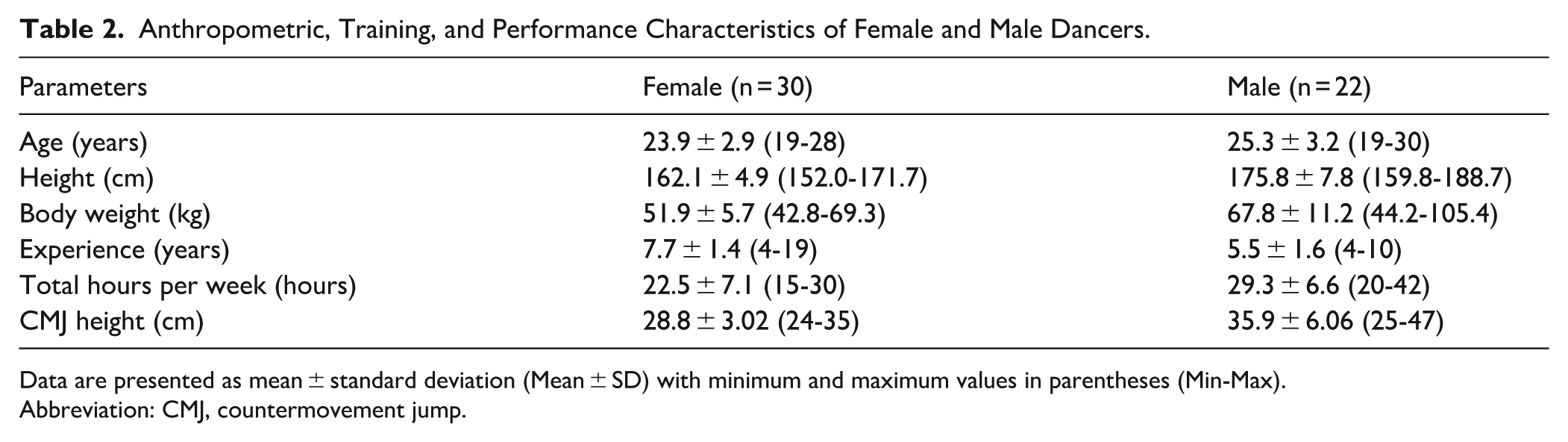
Data are presented as mean ± standard deviation (Mean ± SD) with minimum and maximum values in parentheses (Min-Max).
Abbreviation: CMJ, countermovement jump.
Statistical Analysis of Peak Power in Vertical Jump Performance: A Gender-Based Comparison Using Different Formulas.
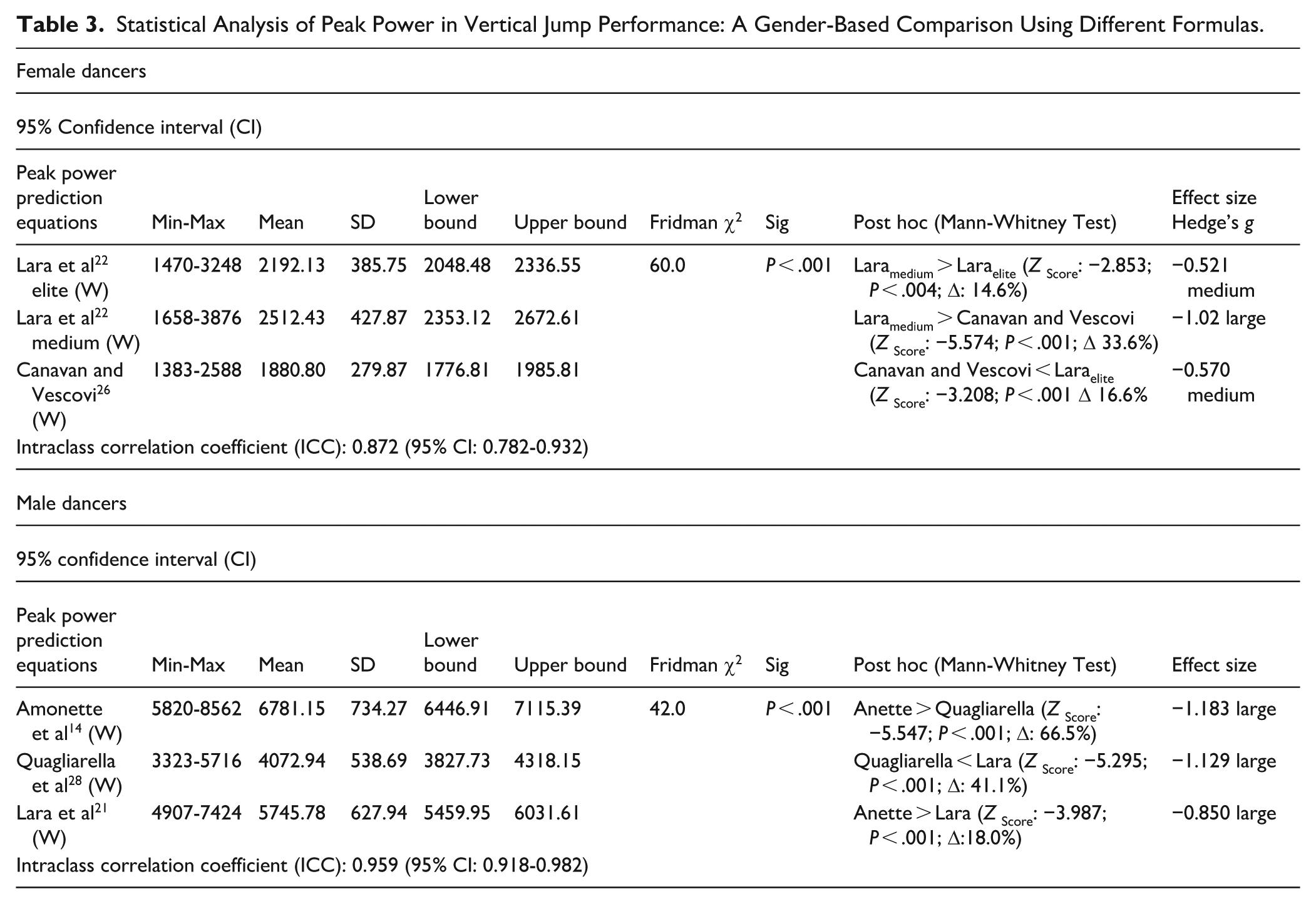
For female dancers, a Friedman test revealed significant differences among the formulas (χ2 = 60.0, P < .001). Pairwise comparisons (Mann-Whitney U tests) indicated that the Lara et al 22 medium formula produced significantly higher power values than both the Lara et al 22 elite (Z = −2.853, P = .004, Hedge’s g = −0.52; moderate effect) and Canavan and Vescovi 26 formulas (Z = −5.574, P < .001, Hedge’s g = −1.02; large effect). Additionally, the Lara et al 22 elite formula yielded higher values than the Canavan and Vescovi 26 formula (Z = −3.208, P < .001, Hedge’s g = −0.57; moderate effect). The intraclass correlation coefficient (ICC) was 0.872 (95% CI: 0.782-0.932), indicating strong reliability.
Similarly, male dancers showed significant differences across formulas (Friedman test: χ2 = 42.0, P < .001). Amonette et al 14 formula generated the highest power values, significantly surpassing both Quagliarella et al 28 (Z = −5.547, P < .001, Hedge’s g = −1.18; large effect) and Lara et al 21 formulas (Z = −3.987, P < .001, Hedge’s g = −0.85; large effect). Quagliarella et al 28 formula produced significantly lower values than Lara et al 21 (Z = −5.295, P < .001, Hedge’s g = −1.13; large effect). The ICC for male dancers was excellent at 0.959 (95% CI: 0.918-0.982).
Bland-Altman analyses showed moderate to strong agreement between formulas for female dancers, although significant mean differences were present (P < .001). Lara et al 22 medium formula tended to give higher values compared to others. Limits of agreement ranged from −0.36 to +0.44 (Lara et al 22 elite vs medium 22 ) and −1.28 to +1.12 (medium 22 vs Canavan and Vescovi 26 ) (Figure 1). For males, significant differences were also noted, with the Amonette et al 14 formula yielding higher power estimates than both Quagliarella et al 28 and Lara et al 21 formulas. Limits of agreement spanned −1.52 to +1.29 (Amonette et al 14 vs Quagliarella et al 28 ), −1.20 to +0.97 (Quagliarella et al 28 vs Lara et al 21 ), and a narrower range of −0.89 to +1.05 between Amonette et al 14 and Lara et al, 21 indicating stronger concordance (Figure 1).
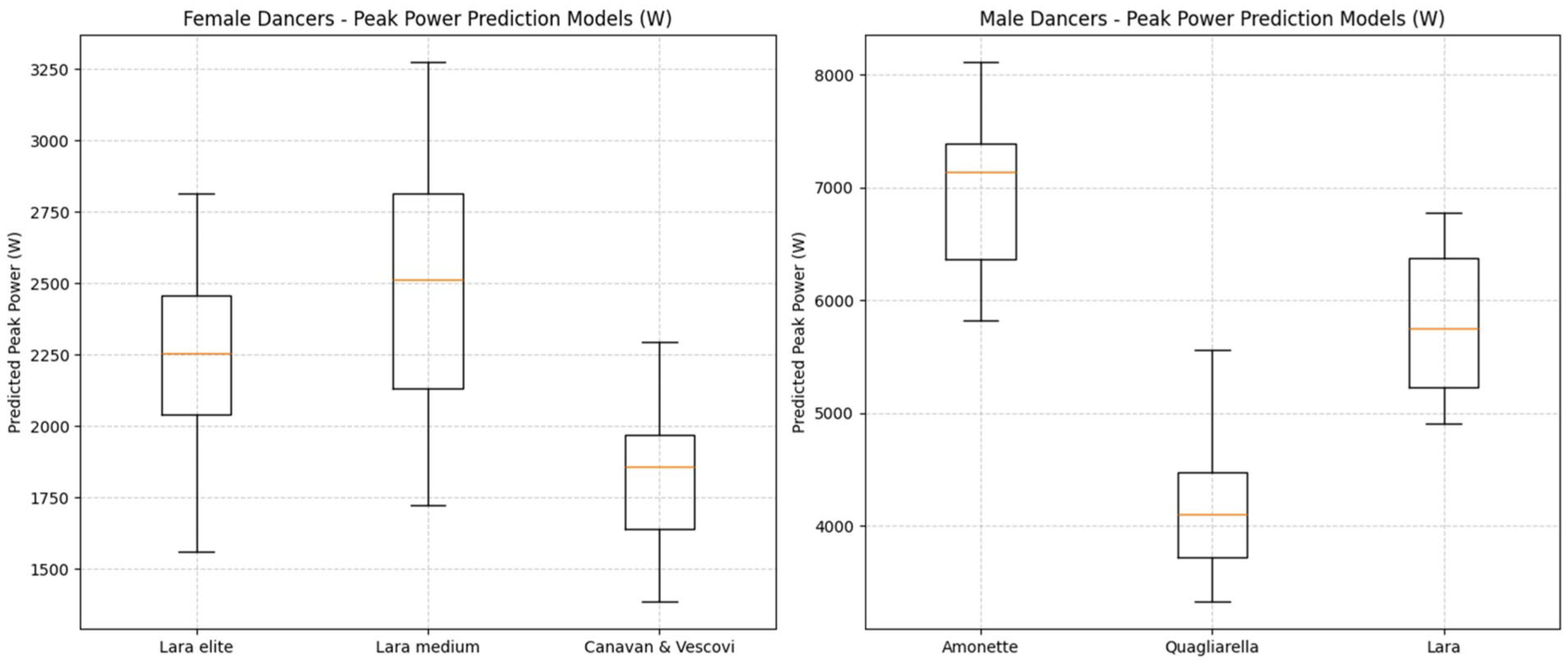
Box plots of predicted peak power (W) from different models for female (left: Lara Elite, Lara Medium, Canavan and Vescovi) and male (right: Amonette, Quagliarella, Lara) dancers. The plots show median values, variability (interquartile range), and outliers, highlighting differences between models and sexes.
Discussion
This study systematically evaluated the validity of various vertical jump power estimation formulas in modern dancers, considering gender-specific differences. Significant discrepancies were found between formulas, indicating their limited suitability for this population. Among female dancers, the Lara et al 22 (medium) formula consistently produced higher power estimates than the Lara et al 22 (elite) and Canavan and Vescovi 26 models, with medium-to-large effect sizes. For males, the Amonette et al 14 formula yielded the highest estimates, while the Quagliarella et al 28 formula produced the lowest.
Bland-Altman analyses, which assess agreement between methods, revealed systematic biases—especially between the Lara et al 22 (medium) and Canavan and Vescovi 26 formulas for females. In males, the Amonette formula overestimated power output compared to Quagliarella et al 28 and Lara et al 22 models. Intraclass correlation coefficients (ICC), measuring consistency, were high for both females (0.872) and males (0.959). However, it is important to note that high ICC values indicate reliability but do not guarantee accuracy in estimating true peak power.
Notably, the Lara et al 22 (elite) formula showed the best correlation with female jump power. Although the Amonette et al 14 formula produced the highest estimates for males, it systematically overestimated power. These results highlight the need for dancer-specific models that account for their unique biomechanical and neuromuscular characteristics.
Previous research indicates that the accuracy of jump power estimation equations varies based on sample characteristics. For instance, Sayers et al 23 found their equation to be more accurate than Harman et al 20 for assessing both athletes and physical education students, regardless of gender. Similarly, Hertog and Hue 25 recommended the Sayers et al 23 equation for sedentary men and elite volleyball players. These findings align with those of Lara et al 21 and Duncan et al 27 However, Canavan and Vescovi 26 argued that the Harman et al 20 equation is more appropriate and proposed an alternative formula.
Such inconsistencies underscore the necessity of validating power estimation models for specific populations. For example, Lara et al 21 developed the first power calculation equation for male physical education students, demonstrating higher accuracy for this group compared to sedentary individuals or athletes. This underscores a key challenge in applying general power formulas to dancers, whose biomechanics and neuromuscular adaptations differ significantly from other populations.
In the present study, the 10-minute standardized warm-up included 5 minutes of indoor jogging, calisthenics, and approximately 2 minutes of static-active stretching, with each major muscle group stretched for no more than 15 seconds. While prolonged static stretching (>60 s per muscle group) can impair neuromuscular performance and explosive power, 39 evidence shows that short-duration stretching (≤15 s) within a comprehensive warm-up—combining aerobic and dynamic elements—has negligible effects on strength and power (Δ1%-2%) and may even aid injury prevention. 40 This short-duration static stretching, integrated with dynamic warm-up elements, likely minimized any negative impact on vertical jump performance. Consequently, the warm-up protocol can be considered both appropriate and representative for dancers in the testing context. Importantly, this design addresses potential concerns regarding pre-test static stretching: unlike prolonged stretching protocols known to reduce immediate power output, the brief stretching applied here is unlikely to confound the results. Nevertheless, future studies should explore how varying warm-up configurations and stretching durations affect explosive performance in dancers. Dancers exhibit specific biomechanical adaptations, including greater hip and knee flexion, increased ankle mobility, and a toe-ball-heel landing strategy. These factors influence jump height, take-off mechanics, and impact attenuation10,34 Such characteristics alter how dancers utilize the stretch-shortening cycle and absorb ground reaction forces, limiting the applicability of standard models.
The present study results support this, given the observed differences between models and the mean jump heights in present study sample, which were higher than those previously reported for novice dancers 17 but comparable to athletic females. 41 Differences in sample characteristics also explain Duncan et al’s 27 findings that the Canavan and Vescovi 26 equation was less accurate for elite basketball players. This further emphasizes the need for population-specific power estimation models.
Dancers’ distinct movement patterns are characterized by frequent jumps, controlled landings, and high neuromuscular demands. Generic formulas may not adequately capture their actual power output. Vertical jumping relies on the stretch-shortening cycle, where muscles store elastic energy during the eccentric phase and convert it into mechanical work during the concentric phase. 34 This mechanism is particularly relevant for dancers, whose neuromuscular control differentiates their jump execution from other athletes.
Compared to conventional athletes, dancers demonstrate greater knee and hip flexion, increased ankle mobility, and lower vertical ground reaction forces. These factors influence both jump height and landing mechanics. 10 Additionally, dancers commonly employ a toe-ball-heel landing strategy, which reduces impact forces and facilitates smoother landings. Given these biomechanical adaptations, dancers might be expected to achieve superior jump performance.
Empirical evidence highlights biomechanical differences among dancers. For example, professional male dancers exhibit greater countermovement jump (CMJ) heights (32 ± 10 cm) than semi-professionals (30 ± 10 cm) and novices (28 ± 10 cm). 17 Notably, the present study sample demonstrated a higher mean CMJ height (35.9 ± 6.06 cm) compared to these previously reported values. Meanwhile, the mean vertical jump (verVJ) height of present study dancers (28.8 ± 3.02 cm) aligns closely with athletic females (29.9 ± 7.1 cm) 41 but remains below the range reported for female collegiate dancers (33-36.6 cm).1,3,16
Variations in jump height may reflect differences in technical execution, training background, sample demographics, or testing protocols. For example, studies that restricted arm movement—a critical determinant of takeoff velocity—have documented lower vertical jump heights (23.1-25.5 cm). 42 It has been observed that previous studies conducted on dancers used different jump protocols, with some allowing full arm movement3,16 and others restricting it.6,15,35,42. In the present study, participants performed the CMJ with their hands on their hips to minimize upper-limb contribution, ensuring that jump performance reflected lower-limb neuromuscular capacity. Furthermore, all peak power formulas applied here used data from this same standardized protocol,21,22,26,28 which share common components such as jump height, body mass, coefficients, and the restriction of upper-limb movement through a hands-on-hips position. This consistency strengthens comparability across formulas and minimizes confounding due to protocol differences, providing a robust basis for evaluating their suitability in dancers.
Additionally, while body mass was used in all peak power estimation formulas in this study, it is important to note that more detailed assessments of body composition—such as fat mass versus fat-free mass—may further influence power outcomes, particularly in dancers.
Indeed, body composition, with a focus on healthy muscle mass levels, is related to improved functional performance outcomes, such as increased strength, endurance, and power, and reduced recovery times. 32 Using body mass provides a practical and widely applied measure; however, incorporating direct body composition analyses in future studies could refine peak power estimation and better account for individual variability among dancers.
These findings collectively emphasize the importance of considering biomechanical, methodological, population-specific factors, and body composition in assessing dancer jump performance.
A key limitation of this study is the absence of direct force platform measurements, which are widely regarded as the reference standard for quantifying explosive power. 14 Due to the cost and limited portability of force platforms in typical dance settings, validated contact mat methods were employed here as practical alternatives. Although these measures showed high test-retest reliability (ICC > 0.87), the lack of force plate data constrains absolute precision.
Future research should incorporate direct force measurements in larger, more diverse cohorts encompassing varied dance styles and experience levels. Longitudinal studies could evaluate how dancer-specific power estimation models respond over time and to training interventions. Refining these formulas to better reflect dancers’ biomechanical and neuromuscular characteristics will advance performance evaluation, training strategies, and injury prevention. Ultimately, developing population-specific models will address current gaps and provide more accurate tools to assess explosive vertical jump power in dancers.
Practical and Clinical Applications and Implications
This study highlights the necessity to refine formulas used for estimating explosive power—particularly as it relates to vertical jump performance—in dancers, whose unique biomechanical and neuromuscular profiles differ from other athletes. Generic power estimation models may inadequately capture these specific characteristics, limiting their effectiveness in monitoring performance and preventing injury.
Developing validated, dancer-specific models could significantly enhance training programs, rehabilitation protocols, and overall assessments of explosive lower-limb power in dance populations.
Conclusion
This study underscores the limitations of applying general power estimation formulas to dancers due to their distinct biomechanics and neuromuscular control during explosive movements like jumping. While the Lara et al 22 formula was most suitable for female dancers, and the Amonette et al 14 formula produced the highest estimated power values for male dancers, discrepancies between formulas complicate definitive conclusions regarding accuracy.
Although the models showed high reliability (ICC: female = 0.872, male = 0.959), this does not guarantee that the estimated values precisely reflect dancers’ true explosive power output during vertical jumps.
Footnotes
Acknowledgements
We would like to express our sincere thanks to the dancers for their invaluable assistance and support with the measurements and this study.

Ethical Considerations
The study was approved by the Research Ethics Committee of Marmara University Faculty of Medicine (SAG-D-040712-0272) and was conducted in accordance with the World Medical Association Declaration of Helsinki for medical research involving human subjects. All participants provided written informed consent prior to participating in the trials.
Author Contributions
Ani Agopyan: Supervised the study; contributed to the literature search, study design; conducted data collection, data interpretation, data analysis, prepared figures, and wrote the manuscript. Demet Tekin: Contributed to the literature search, study design; conducted data collection, data interpretation, data analysis, prepared figures, and wrote the manuscript.
Funding
The authors received no financial support for the research, authorship, and/or publication of this article.
Declaration of Conflicting Interests
The authors declared no potential conflicts of interest with respect to the research, authorship, and/or publication of this article.