






Abstract
Literature review:
Breaking combines dance and acrobatics, making it a physically demanding discipline. Limited evidence suggests muscular imbalances in isometric shoulder strength and jump performance. To date, research has primarily focused on male participants and has not included isokinetic dynamometry assessments.
Objective:
To analyze the isokinetic strength of the shoulder internal and external rotators and the knee flexors and extensors in female breakers, and to explore their association with training habits.
Methods:
A retrospective cross-sectional analysis was conducted on eight women with over 5 years of breaking experience. Concentric isokinetic strength tests were performed for shoulder rotators (at 90°/s and 240°/s) and knee flexors and extensors (at 60°/s and 180°/s). Peak torque, Inter-Limb Asymmetry Index (IAI), hamstring-to-quadriceps (H:Q) ratio, and external-to-internal shoulder rotation (ER:IR) ratio were calculated. Spearman’s rank correlation coefficient (ρ) assessed relationships between training habits and isokinetic strength measures.
Results:
In the shoulder test at 90°/s, the median IAI for internal rotator peak torque was 14.0% (7.7-17.0). The ER:IR ratio showed median values of 38.0% (36.7-44.0) in the right arm and 32.5% (29.2-42.7) in the left. A positive correlation was found between ER:IR ratio and weekly resistance training hours (ρ = .709; P = .049). In the knee test at 60°/s, a positive correlation was observed between extensor torque IAI and weekly breaking hours (ρ = .70; P = .049). At 180°/s, flexor torque IAI was positively correlated with years of breaking practice (ρ = .929; P < .001).
Conclusion:
Female breakers exhibit shoulder and knee muscle imbalances associated with training duration and volume. These findings support the relevance of targeted strength assessments and preventive strategies in this population.
Key Points
All participants showed shoulder ER:IR ratios below normative values, suggesting targeted external rotator strength programs for bgirls.
Elevated H:Q ratios and low knee asymmetry suggest adequate posterior lower-limb chain development, but monitoring is advised as years of practice correlated with increased inter-limb asymmetries.
Higher resistance training hours were associated with more favorable shoulder ER:IR ratios, underscoring its potential role in promoting muscular balance in bgirls.
Introduction
Breaking, also known as breakdance, is a sport that combines elements of dance and acrobatics in high-intensity improvised routines. 1 Each performance takes place in a “battle” format, where competitors face off in one to five rounds of approximately 40 seconds each. 2 Movements are typically divided into four categories. Toprocks, which are upright dance steps; Footworks, which includes ground-level movements where both hands and feet make contact with the floor, often in a deep squat dynamic position; Freezes, in which the dancer holds a challenging position (generally supporting their body weight on the upper limbs); and Powermoves, refer to the most acrobatic elements. 3
Scientific evidence supports the classification of breaking as a high-demand sport,1,4 and this is reflected in the physical adaptations observed among practitioners. Reported body fat percentages include 17.54% (SD 2.28) in women and 10.28% (SD 1.85) in men, 5 and peak cervical isokinetic torque values have been found to be higher than those of non-athletes. 6 Furthermore, compared to dancers of other hip-hop styles, breakers demonstrate significantly greater joint range of motion in the hips, knees, and ankles across all planes of movement when performing dance sequences. 7
However, the physical complexity of breaking is accompanied by a high risk of musculoskeletal injuries, with 4.02 injuries per 1000 hours of training 8 and rates up to five times higher than in ballet. 9 A study of 144 breakers 10 indicated that the highest number of injuries occurs in the upper extremity (wrist, hand, and shoulder), accounting for 49% of all cases, while Joka et al 8 observed the knee as the most common injury site among breakers, representing 23.4% of all injuries in a retrospective cohort of 66 breakers. Overuse injuries, particularly those affecting connective tissues, are widely reported, 10 and injury incidence has shown a significant association with years of experience in the discipline. 8 Furthermore, evidence suggests that many breakers exhibit muscular imbalances in shoulder rotator strength, particularly due to weakness in the external rotators, which may contribute to injury risk. 4
Despite the growing recognition of breaking as an Olympic sport in Paris 2024, scientific research on the physical characteristics of this population remains limited. Most performance-related studies1,4,6 have focused on male participants, and there is still a lack of biomechanical evaluations of the specific muscular adaptations; a gap that is even more pronounced when it comes to female breakers (bgirls). It is important to highlight that objective methods such as isokinetic dynamometry, considered the gold standard for assessing joint-specific muscular function, 11 have not yet been applied to the joints identified as high-risk for injury in breaking, such as the shoulder and knee.8,10
Therefore, the aim of this study was to analyze the isokinetic strength of the shoulder internal and external rotators and the knee flexors and extensors in female breakers, and to explore their association with training habits. Given the specific physical and biomechanical demands of breaking, particularly on the shoulder and knee, isokinetic strength assessments may provide insights into common deficits, and potential risk factors, as well as support the development of performance enhancement and injury prevention strategies based on the available evidence.
Methods
Participants
This study retrospectively analyzed performance data from eight bgirls who participated in isokinetic strength assessments conducted as part of an academic activity linked to a postgraduate course between April and November 2024. All participants were national competitive breakers in federated competitions, sanctioned by the World DanceSport Federation (WDSF) within the official breaking ranking, judging criteria, and Olympic athlete eligibility. 3 All participants also had ≥5 years of continuous training and competition experience. The assessments were offered free of charge as a form of reciprocity, facilitating access to specialized measurements and supporting their athletic development.
The testing protocols were selected based on standard clinical procedures used at Alemana Sport – Clínica Alemana de Santiago, with a specific focus on joints most affected in this population.8,10 Although the evaluations were not originally designed for research purposes, they are part of the center’s routine clinical practice. All participants provided both verbal and written informed consent to undergo the assessments for academic purposes.
Subsequently, given the potential scientific relevance of the data, they were anonymized and organized into a REDCap (Research Electronic Data Capture) database without any personally identifiable information. To authorize their use for research and publication purposes, expedited review and waiver of new informed consent were requested from the Ethics Committee of Universidad del Desarrollo (Approval Resolution 2025-32).
Demographics and Training Habits Data
Demographic data were collected, including age, weight, height, BMI, medical history, and training habits. Questions addressed weekly breaking training hours (including classes, battles, performances), years of practice, and whether participants complemented training with another sport, resistance training (structured strength-oriented exercise such as weightlifting, machine-based or external load exercises, excluding calisthenics due to the nature of breaking), or flexibility training (excluding warm-up stretching). Participants also reported current injuries or pain that could affect performance during the assessments. Information regarding previous injuries was not collected.
Force Testing
All strength assessments were conducted using a Humac NORM isokinetic Dynamometer (CSMi, Stoughton, MA). The device was calibrated according to the manufacturer’s manual. 12 No gravity correction was applied in any of the tests. For standardization, after an autoregulated 10 minute warm-up on a elliptical trainer (Technogym, Cesena, Italy) at a perceived exertion of 4-5/10, a fixed testing sequence was followed. Concentric shoulder rotators strength was assessed first at 240°/s and then at 90°/s, followed by the knee extensor and flexor assessments at 180°/s and 60°/s. Testing always began with the non-dominant side (left). Participants were instructed to avoid intense physical activity, alcohol, and caffeine for 12 hours prior to the assessment. No cool-down was performed. The rater in the present study (OMN) was a sports physiotherapist with 5 years of experience administering isokinetic testing.
Shoulder strength
Participants were positioned with the backrest inclined at 85°, with the shoulder at 45° of abduction and 30° of flexion (scapular plane), and the elbow at 90°. The forearm was placed in a neutral position, parallel to the participant’s thighs, defining the 0° point of shoulder rotation (Figure 1A). The arm was secured with a Velcro strap over the elbow stabilization pad, aligning the humerus axis with the dynamometer axis. The range of motion was set from 40° of internal rotation to 50° of external rotation. To minimize compensatory movements, stabilization straps were used across the trunk. 12
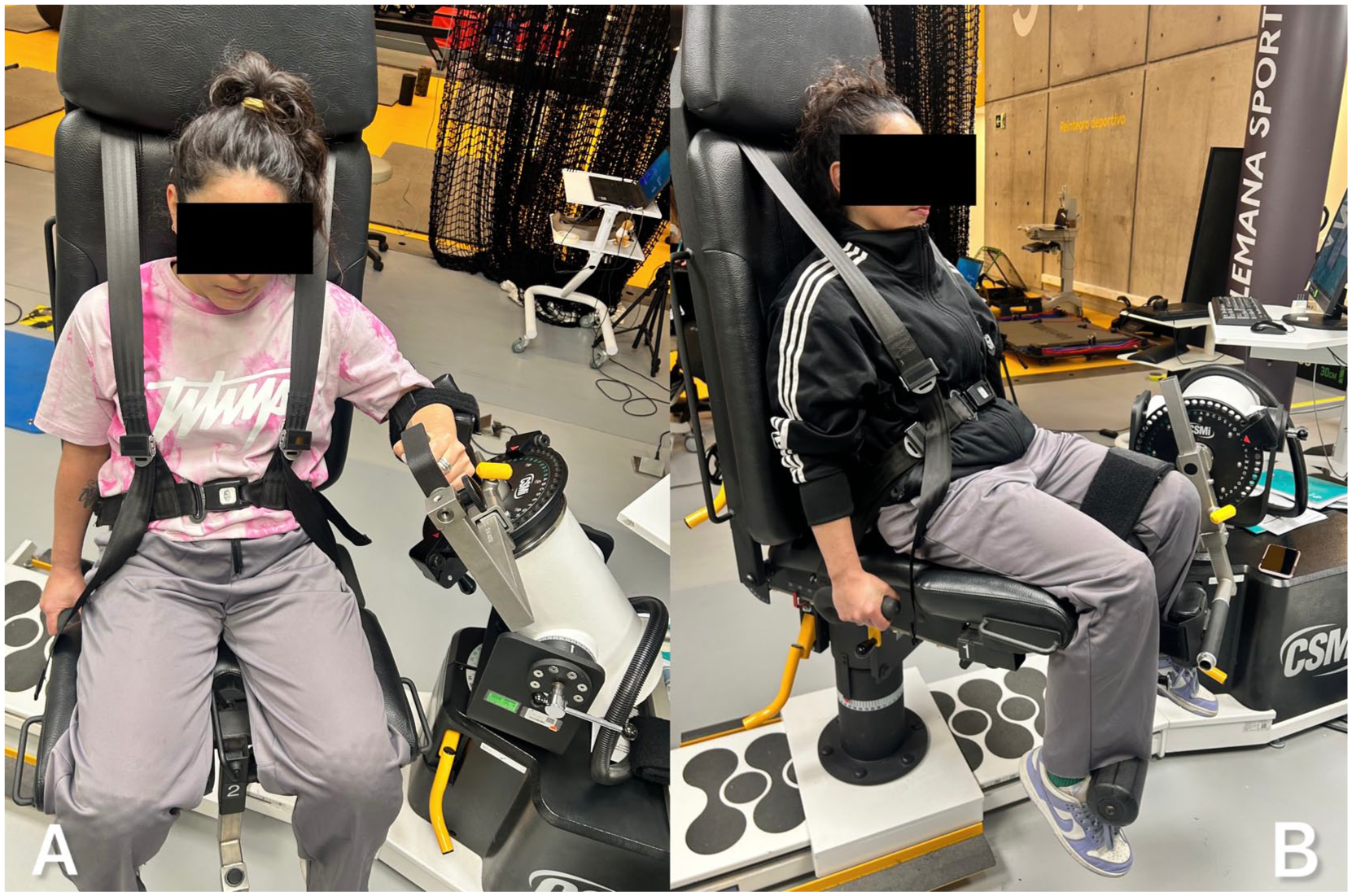
Photographic representation of each isokinetic test setting during measurement. (A) Shoulder strength. (B) Knee strength.
Prior to testing, participants performed four submaximal repetitions with 30 seconds of rest. Then, each arm underwent four maximal concentric isokinetic contractions from 50° of external to 40° of internal rotation at both speeds, with 1-minute rest between arms. Absolute torque (Nm) was recorded, and relative torque values (Nm/kgBW) were calculated by dividing absolute torque (Nm) by body weight (kg).
The external-to-internal rotation ratio (ER:IR) was calculated by dividing the peak torque of the external rotators (Nm) by that of the internal rotators (Nm) at the same angular velocity. Asymmetry between limbs was assessed using the Inter-Limb Asymmetry Index (IAI), calculated as the percentage difference relative to the stronger limb. An IAI below 10% was considered acceptable for both internal and external rotators, while an ER:IR ratio of 0.65 ± 5 was considered within normal limits.11,13
Knee strength
For the knee assessments, participants were seated with the backrest inclined at 85°, adjusted for thigh length. The axis of knee rotation was aligned with the dynamometer axis, and 0° was defined as full knee extension. The lever arm pad was placed proximal to the medial malleolus, allowing free ankle movement. Tests were performed within a range of motion from 90° to 0°. Trunk stabilization straps were used following the manufacturer’s manual (Figure 1B). 12
Prior to the main assessment, participants performed four submaximal repetitions with 30 seconds of rest. Then, each leg completed four maximal concentric isokinetic contractions from 90° of flexion to 0° of knee extension at both speeds, with 1-minute rest between sides. Absolute torque (Nm) were recorded.
Relative torque (Nm/kgBW), and IAI were calculated as previously described. The hamstring-to-quadriceps ratio (H:Q) was calculated as peak flexor (Nm) divided by extensor (Nm) torque at the same speed. IAI <10% and H:Q within ±5 of 0.66 were considered normal.14,15
Statistics
Analyses were conducted using Jamovi (The Jamovi Project, 2025). Continuous variables are presented as medians (25th-75th percentiles), and categorical variables as absolute frequencies. Spearman’s rank correlation coefficient (ρ) was used to examine the relationship between isokinetic strength measures and self-reported training habits (years of practice and weekly training hours).
To assess the robustness of statistically significant correlations, a leave-one-out (LOO) sensitivity analysis was performed, systematically excluding each participant and recalculating correlations. This procedure evaluated whether the observed associations were stable or overly influenced by any single participant. A P-value <.05 was considered statistically significant.
Results
Table 1 presents the descriptive characteristics of the participants and their training habits (n = 8). The median (25th-75th percentiles) number of years of practice was 12 years (9-13), and weekly training hours were 10 (8-14). All dancers reported not participating in any other sport and complemented their breaking training with resistance training. Most were right-handed and had similar levels of experience in the discipline.
Participant Characteristics.
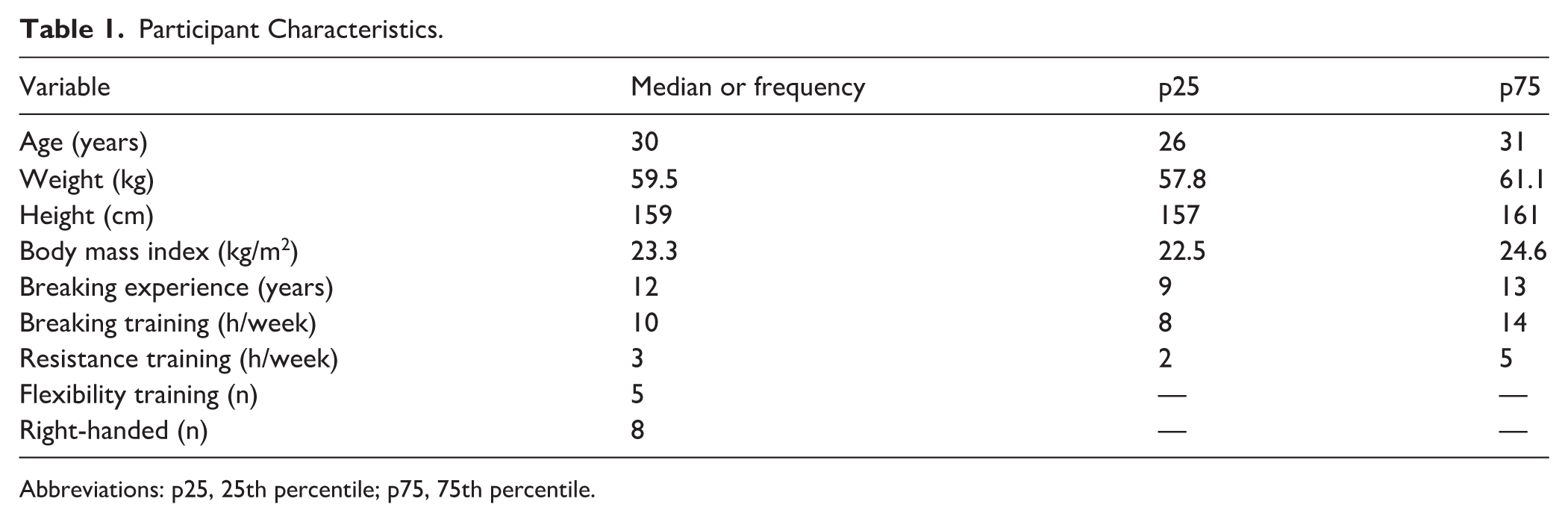
Abbreviations: p25, 25th percentile; p75, 75th percentile.
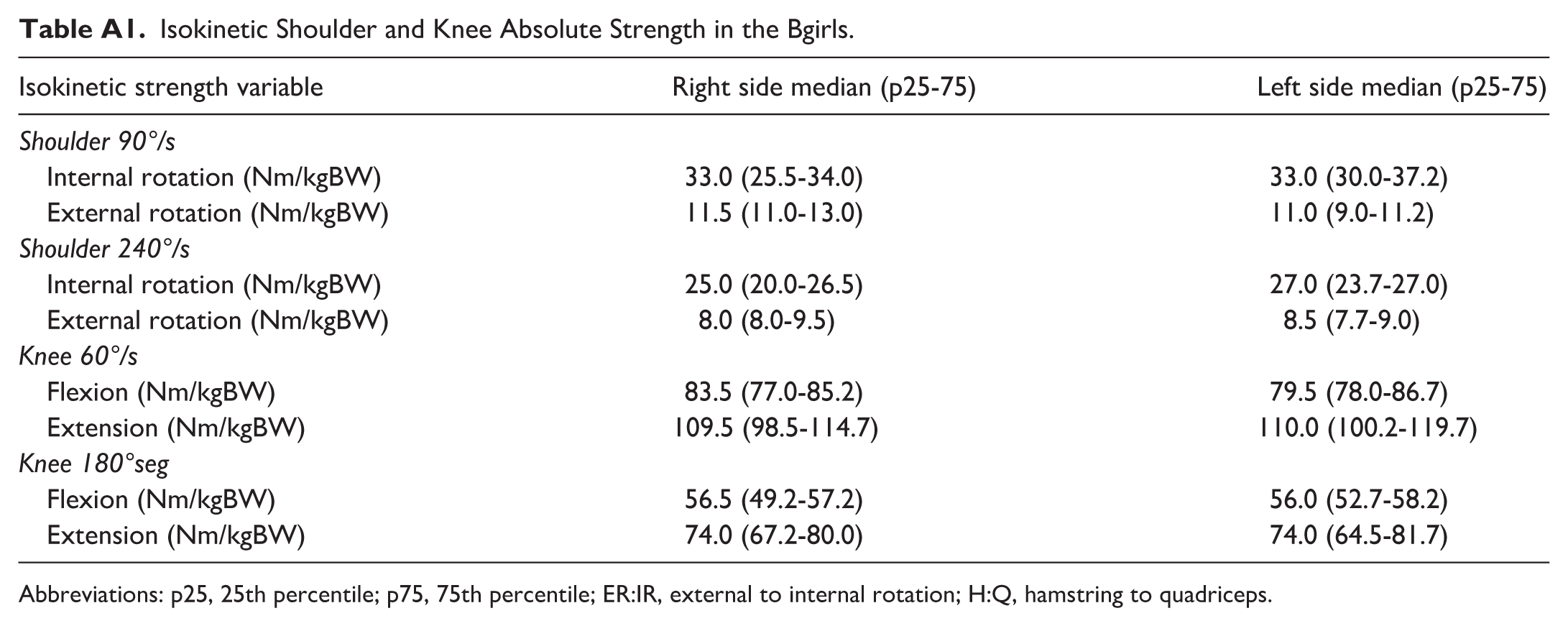
Table 2 shows the relative values obtained from the isokinetic testing, including peak torques and IAI for shoulder internal and external rotation at 90°/s and 240°/s, and for knee flexion and extension at 60°/s and 180°/s. The H:Q and ER:IR ratios are also presented. For shoulder testing, the median IAI for peak internal rotator strength was 14.0% (7.7-17.0), and for external rotators 12.0% (0.0-15.0) at 90°/s. The lower value of ER:IR ratio had a median of 0.38 (0.36-0.44) in the right arm and 0.32 (0.29-0.42) in the left arm, at 90°/s. In regard to knee strength, the H:Q ratios were above the 0.66 ± 5 accepted normative value, with the highest on the left side being 0.79 (0.73-0.86) at 180°/s. Appendix 1 (Table A1) complements these findings with peak torque values relative to body weight.
Isokinetic Shoulder and Knee Relative Strength in the Bgirls, with Ratios and Lymb Symmetry Index.
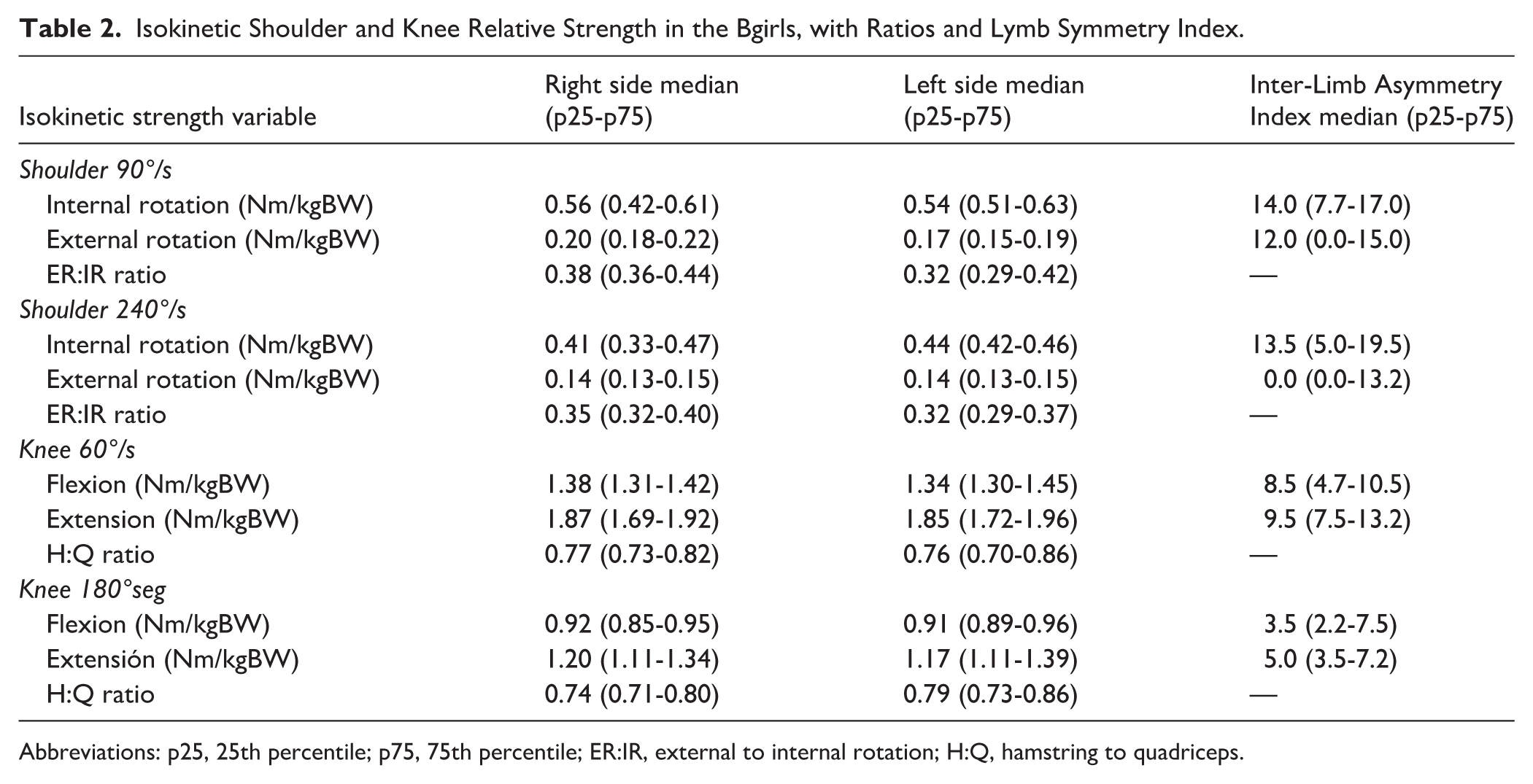
Abbreviations: p25, 25th percentile; p75, 75th percentile; ER:IR, external to internal rotation; H:Q, hamstring to quadriceps.
Table 3 presents the Spearman correlation coefficients between training habits variables and muscular imbalances. In the shoulder rotator test at 240°/s, a positive correlation was found between the ER:IR ratio and weekly resistance training hours (ρ = .709; P = .049). In the knee isokinetic test at 60°/s, a positive correlation was observed between the IAI of extensor peak torque and weekly training hours (ρ = .70; P = .049). Finally, at 180°/s, the IAI of flexor peak torque was positively correlated with years of breaking practice (ρ = .929; P < .001). All other correlations did not reach statistical significance (P > .05)
Correlation Analysis of Isokinetic Muscular Imbalance and Training Habits at Different Velocities in the Knee and Shoulder.
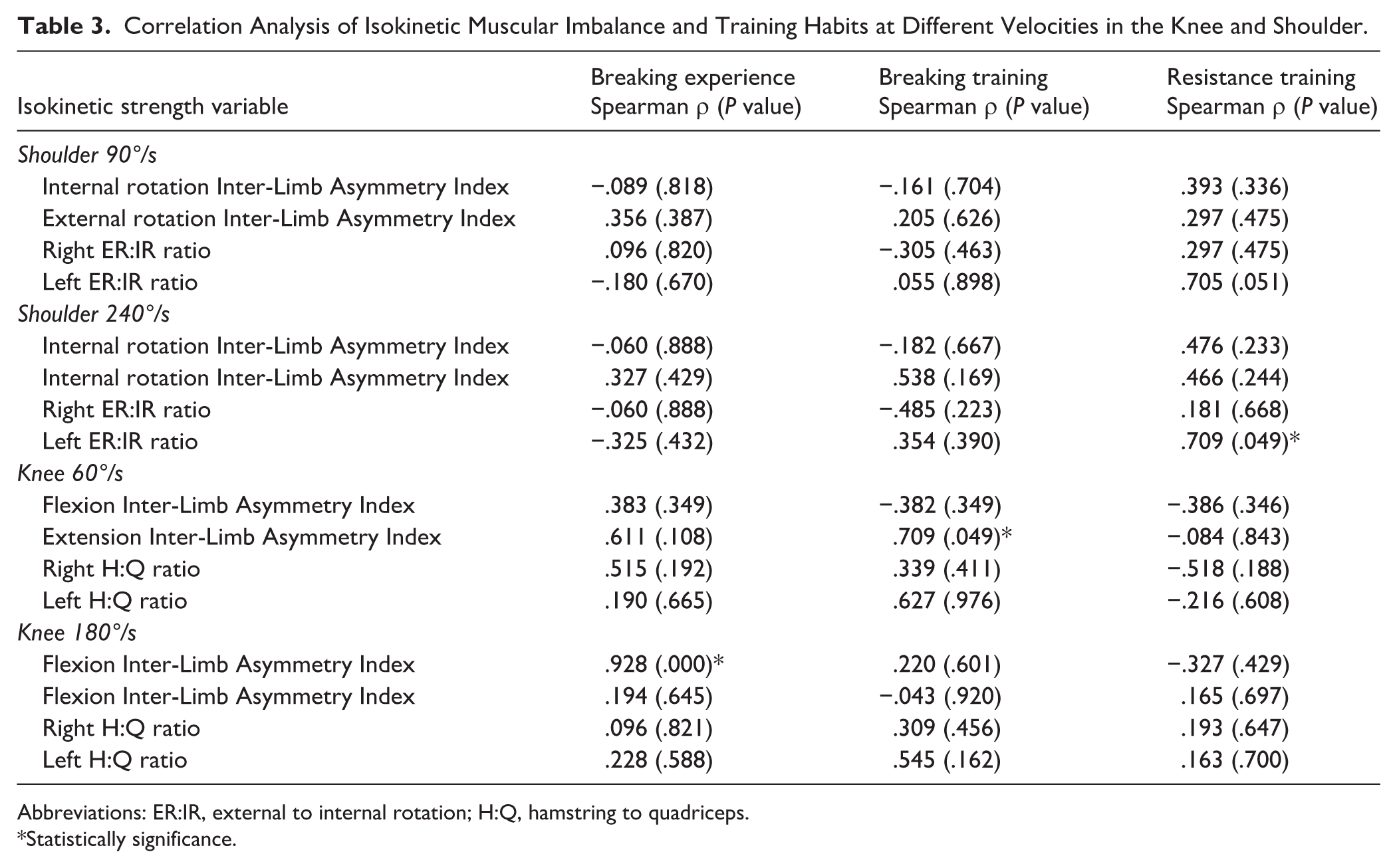
Abbreviations: ER:IR, external to internal rotation; H:Q, hamstring to quadriceps.
Statistically significance.
To assess the influence of individual cases on these associations, a sensitivity analysis using the LOO method was performed. In all cases, the correlation coefficients remained stable and of similar magnitude. For the ER:IR ratio, values ranged from 0.609 to 0.773. For the knee extensor torque IAI, ρ values ranged from 0.633 to 0.855. Finally, for the flexor torque IAI, coefficients ranged from 0.891 to 0.955. These findings suggest that the observed relationships were not disproportionately influenced by any individual case and that, despite the small sample size, the correlations were robust.
Discussion
To our knowledge, no studies have assessed muscle strength using isokinetic dynamometry in breaking athletes. Therefore, our objective was to analyze the isokinetic strength of the shoulder internal and external rotators and the knee flexors and extensors in bgirls, and to explore their association with training habits. Since this approach may help establish preliminary reference values, we reported both absolute and relative strength values. Lastly, we also described the training habits of the bgirls, who had a median age of 30 years, with 11.5 years of dance experience, 2.6 hours per week of resistance training, and 10 hours per week of breaking practice.
Shoulder Strength
Shoulder strength is considered a benchmark in sport rehabilitation. Specifically, the muscular balance between internal and external rotators reflects glenohumeral joint stability during athletic activity. Additionally, IAI has been assessed previously both as a component of health 16 and performance.17,18 In our sample, we found peak torque values of 0.56 Nm/kgBW for internal shoulder rotators and 0.20 Nm/kgBW for external rotators at 90°/s. Due to the considerable variability in evaluation protocols regarding arm positioning, type of contraction, and angular velocities, particularly in female populations, it is not possible to make comparisons with similar reference values. Most existing literature includes testing with the shoulder in 90/90 (90° shoulder abduction and 90° elbow flexion), aligned with throwing mechanics, which dominates the current research. 19 In contrast, our evaluation was performed at 45° of abduction and 30° of flexion, and we acknowledge three main advantages: (1) it has shown the highest reliability; 20 (2) it offered greater comfort during the assessment; and (3) although the global body orientation and weight-bearing demands differ substantially, the position of the arm relative to the torso more closely resembles the upper-limb configuration of the chair freeze, one of the foundational positions in breaking freezes and powermoves. 21
Regarding IAI, the median values observed were outside the ranges generally accepted as normal in various sports, 13 specifically values below 10%. As noted in the Methods, asymmetry was calculated relative to the stronger shoulder, regardless of dominance or direction. Therefore, although our analysis did not explicitly differentiate between dominant and non-dominant sides in the IAI calculation, we observed an interesting pattern in raw torque values: external rotation was greater in the dominant (right) arm, whereas internal rotation was stronger in the non-dominant arm. This divergence from patterns commonly observed in upper-limb dominant sports22-25 may be explained by the unique biomechanical demands of breaking. While recent evidence 21 shows that a large portion of body weight during freezes (specifically the chair freeze) is supported by the dominant arm, other breaking movements may involve more symmetrical upper-limb efforts. For example, footwork and some powermoves (such as flares or 2000s) could require relatively balanced contribution from both arms, whereas other powermoves, such as swipes or air flares, may place greater load on the non-dominant arm, particularly demanding the pushing (and internal rotators) muscles of the non-dominant shoulder. It should be noted that these observations are speculative and based on biomechanical reasoning, as direct measurements for these movements are not yet available. Overall, both arms appear to contribute depending on the movement, and maintaining muscular balance may enhance performance. 26 Accordingly, balanced strength training is recommended.
As for the ER:IR ratio, 100% of the sample showed values below the normal range (ie, <0.65 ± 5) in both arms. The literature reports11,13 an optimal range of 0.60 to 0.70, which is well above the medians observed in our group, that is 0.40 and 0.35 at 90°/s and 240°/s, respectively. This is similar to what was reported by Arundale et al 4 in a cohort of fourteen professional breakers (four females), where the cohort’s median fell below the values considered normal for the shoulder isometric strength ER:IR ratio. In breaking, the upper limbs push against the ground in a closed kinetic chain while supporting the full body weight to generate various acrobatic maneuvers. During horizontal pushing actions (such as in swipes or flares, where the shoulders are at 90° of flexion), the pectoralis major plays a significant role. Given its anatomical orientation, this muscle also functions as an internal shoulder rotator, which likely contributes to the observed imbalance in bgirls. The same applies to the activation of the latissimus dorsi when the body is suspended on the upper limbs with the shoulders in near-neutral flexion and palms facing downward. In these positions, the arms act as stabilizers in a closed kinetic chain to transfer forces between the trunk and limbs. Due to its anatomical orientation, the latissimus dorsi also participates in internal shoulder rotation, which may further explain the imbalance observed.
With respect to the exploratory correlation, to the best of the author’s knowledge, only one study has evaluated specifically the association between isokinetic strength of shoulder rotators and sport-specific adaptations in terms of muscular imbalances, 27 in which no significant correlations were found between athletic history and upper-body imbalances in Ultimate Frisbee players. However, among judo athletes, it was observed that more advanced competitors presented greater internal rotation torque without a corresponding increase in external rotation torque, resulting in a significant decrease in the ER:IR ratio as the years of practice increased. 28 Similarly, in overhead sports such as swimming and badminton, it has been reported that, with more years of training, functional imbalances between rotators tend to increase, particularly due to preferential development of internal rotators. 29 Furthermore, in young handball players, a progressive increase in internal rotator strength has been observed with age and competitive level, while external rotator strength remains relatively constant, contributing to suboptimal ratios (<0.65 ± 5) throughout athletic development. 30 Taken together, these findings suggest that, although exceptions exist, years of athletic practice tend to favor asymmetric muscular development in the shoulder, leading to increased functional imbalances over time.
Finally, our study showed that a higher number of resistance training (ie, structured strength-oriented training involving external loads) hours was associated with an increased ER:IR ratio, which may serve as a protective factor. Future prospective studies are recommended to assess the influence of strength training in addition to breaking on both limb symmetry and the ER:IR ratio in breakers.
Knee Strength
Due to the popularity of team sports and the high incidence of lower limb injuries, isokinetic strength of knee extensors and flexors has been widely studied.14,15,31,32 However, it has not yet been studied in breaking. Although breaking does not involve running (where most lower limb injuries occur) it includes high volumes of footwork, requiring dynamic deep squatting with change of directions, and extreme ranges of motion. 7 Therefore, it is important to evaluate its biomechanics from the perspective of strength and muscular balance, as this may help reduce injury risk or ensure a safe return to sport. 31
In our sample, the relative peak torque of the knee extensors at 60°/s was 1.87 Nm/kgBW. This is similar to what has been observed in non-athletic populations of a similar age (30 years mean; 1.93 Nm/kgBW), while the relative flexor torque in our group of bgirls was 1.38 Nm/kgBW, relatively above the reference values for non-athletic individuals of the same age (0.88 Nm/kgBW). 32 A similar trend was observed at 180°/s.
When compared to reference values from other dance styles, our group showed lower extensor but higher flexor peak torque relative to those reported for modern dancers at both speeds (1.87 vs 2.33 Nm/kgBW and 1.38 vs 0.97 Nm/kgBW at 60°/s; 1.64 vs 1.20 Nm/kgBW and 0.68 vs 0.92 Nm/kgBW at 180°/s, respectively). 33 Breaking is a discipline with high strength demands on the upper limbs, which likely directs physical training towards that segment, in contrast to other dance styles where lower limb work predominates. 34 However, some breakers incorporate acrobatic elements such as backflips and gymnastics-like lower limb movements. 2 This study did not control for whether participants performed such elements or their preferences; therefore, future studies should assess their potential impact on lower limb strength. While comparisons should be interpreted with caution due to potential methodological, population-based, and training-level differences, they nonetheless provide contextual insight into the specific strength profile of female breakers. Finally, other studies assessing isokinetic strength in more biomechanically similar disciplines (eg, gymnastics or ballet) focus on developmental populations, limiting direct comparisons in terms of peak torque.34,35
Regarding muscular imbalance, unlike our upper limb findings, the median IAI of knee extensor and flexor peak torque, at both speeds, remained within the normal <10% values.14,31 This contrasts with findings in other sports such as basketball, rhythmic gymnastics, ballet, and football.34-37 However, the same was not observed for the H:Q ratio, which exceeded the 0.66 ± 5 reference threshold mentioned earlier. 15 This suggests that our group showed greater relative engagement of knee flexors compared to extensors, when evaluated against normative values. One possible explanation is the high involvement of the posterior chain in breaking movements that require hip extension or explosive pushing actions (ie, swipes or backrocks) where force to initiate rotation or elevation is often generated through kicking or “hip thrust” mechanics.
Finally, when correlating the degree of asymmetry with dance experience, a greater number of years practicing breaking was associated with an increase in IAI of the extensor component at 60°/s. On the other hand, a higher number of weekly breaking training hours was associated with a higher IAI of the flexor component at 180°/s. Although there are no studies directly assessing the correlation between years of sports practice and isokinetic asymmetries in quadriceps and hamstrings, research in male football players 36 indicates that more experienced athletes tend to exhibit lower inter-limb imbalances compared to those with less experience. However, in sports such as basketball, where unilateral loading and specific movement patterns may induce particular adaptations, an opposite trend has been observed, with higher levels of asymmetry in more experienced athletes. 37 This suggests that both the type of sport and the number of training years influence asymmetries, although in different directions depending on the nature of the discipline.
In this context, it is possible that the greater professionalization of certain sports, such as men’s football, contributes to better prevention and management of such asymmetries, supported by access to scientific evidence and specialized resources. In fact, recent studies have highlighted a clear disparity in sports medicine knowledge production, with a marked overrepresentation of male athletes in the scientific literature. 38 This concentration of studies may be facilitating a more effective approach to certain issues in those contexts, which does not necessarily occur in sports or populations with lower representation in research.
Limitations
This study has some limitations. First, a convenience sampling method was used, recruiting participants via social media for a previous academic project. Although data were anonymized and ethically handled, this limits the generalizability of findings to the broader bgirl population in Chile. Nonetheless, it represents one of the first quantitative studies on this underrepresented group. Second, the sample was small and showed age heterogeneity. However, all participants met strict inclusion criteria (≥5 years of practice and ≥1 federated competition in the past year), ensuring consistency in athletic profile despite age variation. Third, although the measured muscles contribute in part to breaking movements, laboratory-based assessments do not fully replicate the biomechanical demands of actual battles or practice. Fourth, previous musculoskeletal injuries were not recorded. If any recently resolved injuries had occurred, they might have affected muscle performance during the isokinetic assessments. Finally, as breaking is a newly formalized sport, available research remains limited. These findings should be interpreted within that emerging context.
Practical and Clinical Applications and Implications
This study provides preliminary reference values for isokinetic strength in female breakers, highlighting common shoulder and knee muscular imbalances that appear to be associated with training habits. These findings may guide coaches, clinicians, and dance medicine and science professionals in developing targeted assessments and strength programs, especially in a population where access to objective testing is limited. As breaking continues to grow as a professional sport, incorporating regular strength evaluations could support injury prevention and improve performance outcomes.
Conclusion
To the best of the authors’ knowledge, this is the first study to investigate isokinetic strength in female breakers. Our findings suggest that breaking practice is associated with muscular imbalances in shoulder rotators and knee flexor/extensor strength, similar to what has been reported in other sports. Additionally, more years of breaking practice and a higher weekly training volume were positively correlated with increased IAI percentages for peak torque in knee flexors and extensors, respectively. Due to the limited prior research in this area, we hope these findings will support clinicians and researchers in their future work with breaking athletes.
Footnotes
Appendix 1
Isokinetic Shoulder and Knee Absolute Strength in the Bgirls.
| Isokinetic strength variable | Right side median (p25-75) | Left side median (p25-75) |
|---|---|---|
| Shoulder 90°/s | ||
| Internal rotation (Nm/kgBW) | 33.0 (25.5-34.0) | 33.0 (30.0-37.2) |
| External rotation (Nm/kgBW) | 11.5 (11.0-13.0) | 11.0 (9.0-11.2) |
| Shoulder 240°/s | ||
| Internal rotation (Nm/kgBW) | 25.0 (20.0-26.5) | 27.0 (23.7-27.0) |
| External rotation (Nm/kgBW) | 8.0 (8.0-9.5) | 8.5 (7.7-9.0) |
| Knee 60°/s | ||
| Flexion (Nm/kgBW) | 83.5 (77.0-85.2) | 79.5 (78.0-86.7) |
| Extension (Nm/kgBW) | 109.5 (98.5-114.7) | 110.0 (100.2-119.7) |
| Knee 180°seg | ||
| Flexion (Nm/kgBW) | 56.5 (49.2-57.2) | 56.0 (52.7-58.2) |
| Extension (Nm/kgBW) | 74.0 (67.2-80.0) | 74.0 (64.5-81.7) |
Abbreviations: p25, 25th percentile; p75, 75th percentile; ER:IR, external to internal rotation; H:Q, hamstring to quadriceps.
Acknowledgements
We would like to thank Rodrigo Domínguez, head kinesiologist at Alemana Sport – Clínica Alemana de Santiago, for providing us with the facilities and assessment equipment. We also sincerely thank the Chilean bgirls for their willingness to participate and the time they dedicated to this study. Special thanks are extended to Bgirl Petiza for her unwavering encouragement, personal support, and assistance with participant recruitment throughout the course of this project.

Ethical Considerations
The study was conducted in accordance with institutional ethical standards and the principles of the Declaration of Helsinki. Participant condifendiality was safeguarded through data anonymyzation and secure data management procedures. Ethical approval was obtained from the Ethics Committee of Universidad del Desarrollo (Approval Resolution 2025-32).
Consent to Participate
All participants provided written and verbal informed consent to undergo the assessments for academic purposes. The Ethics Committee of Universidad del Desarrollo approved the secondary use of anonymized data and granted a waiver of new informed consent.
Funding
The author received no financial support for the research, authorship, and/or publication of this article.
Declaration of Conflicting Interests
The author declared no potential conflicts of interest with respect to the research, authorship, and/or publication of this article.
Data Availability Statement
Data are available upon reasonable request with ethical approval.