







Abstract
Parenting programs have the potential to improve the health and well-being of parents and children. A challenge for providers is to recruit and retain parents in programs. Studies researching engagement with programs have largely focused on providers’, policy makers’, or researchers’ reflections of their experience of parents’ participation. We conducted a systematic review of qualitative studies where parents had been asked why they did or did not choose to commence, or complete programs, and compared these perceptions with those of researchers and those delivering programs. We used data-mining techniques to identify relevant studies and summarized findings using framework synthesis methods. Six facilitator and five barrier themes were identified as important influences on participation, with a total of 33 subthemes. Participants focused on the opportunity to learn new skills, working with trusted people, in a setting that was convenient in time and place. Researchers and deliverers focused on tailoring the program to individuals and on the training of staff. Participants and researchers/deliverers therefore differ in their opinions of the most important features of programs that act as facilitators and barriers to engagement and retention. Program developers need to seek the views of both participants and deliverers when evaluating programs.
Parenting programs are short-term interventions to promote changes in the behavior of parents that result in improved relationships with their children and changes in child behavior (National Institute for Health and Clinical Excellence & Social Care Institute for Excellence [NICE & SCIE], 2006). They are usually delivered by health, social care, or voluntary agencies as face-to-face programs, either individually or in groups. Parenting programs are increasingly recognized as an intervention with the potential to improve the health and well-being of both parents and children. An increasing body of research provides evidence of their effectiveness in reducing challenging behavior (Barlow & Stewart-Brown, 2000; Furlong et al., 2012; NICE & SCIE, 2006) and improving educational (Hallam, Rogers, & Shaw, 2004) and mental health outcomes (Barlow, Parsons, & Stewart-Brown, 2005) in children and the improved mental health and well-being of parents (Barlow, Coren, & Stewart-Brown, 2003; Lindsay, Strand, & Davis, 2011). Parenting programs have been developed on the basis of two main theoretical approaches, behavioral and relational, with some programs combining elements of both. Based on social learning theory (Bandura, 1977), behavioral approaches aim to develop parents understanding of the negative impact of attention to problem behavior and lack of attention to positive behavior and teach positive discipline practices including praise and time out; relational programs aim to improve interactions between parent and child, correcting misattributions, and increasing understanding of developmental phases.
Although the principles underpinning parenting interventions are likely to benefit all parents, such interventions tend to be targeted to specific groups of parents whose children are considered to be at high risk of the outcome of interest. A key challenge for providers of programs is to engage parents to participate and then maintain their engagement throughout the program. Engaging parents may be difficult since family circumstances and events prior to being invited to join a program may result in feelings of stigmatization, guilt, or concern by carers that they are perceived to be an inadequate parent. Consequently, those with the greatest potential to benefit from participation may be the least likely to engage (Barrett, 2010). In seeking to improve the evidence base underpinning the use of parenting programs, an increasing number of randomized controlled trials have been funded. Trials often struggle to recruit parents to studies (Barlow & Stewart-Brown, 2000; Stewart-Brown et al., 2004), and it is not surprising that researchers have sought to understand the barriers and facilitators to parental engagement (Barrett, 2008; Boddy et al., 2009; Moran, Ghate, & van der Merwe, 2004).
Research to improve our understanding of the factors that enable families to engage with programs has been derived largely from studies where providers, policy makers, or researchers have reflected on their experience of parents’ participation (Barrett, 2009; Moran et al., 2004), rather than parents’ views, though some have integrated parents’ and professionals’ views (Law, Plunkett, Taylor, & Gunning, 2009). Existing systematic reviews of the qualitative literature have focused on why parents perceive programs to be helpful (Kane, Wood, & Barlow, 2007) rather than barriers and facilitators to engagement or retention. As part of a project to develop a parenting program for parents whose children had recently suffered an unintentional injury, we undertook a systematic review of the literature to identify qualitative studies where parents had been actively asked why they may, or may not, choose to commence, or complete, programs designed to enhance or support their parenting practices and to compare these perceptions with those of researchers.
Method
Search Strategy
To be included in the review, we searched for studies published in the English language that met the following inclusion criteria:
Participants: Parents who are eligible to participate in parenting programs, people who deliver parenting programs, and researchers and authors who undertake evaluations of parenting programs.
Interventions: Programs run by trained facilitators and designed to support parents in their relationship and/or interaction with their children where the author defines this as a parenting intervention.
Outcomes: Features of programs that resulted in engagement and/or retention of parents in the program. Outcomes could include, but were not limited to, those that influence acceptability, access, barriers, experiences, levers, drivers, facilitators, motivators, or those influencing decision making or intent.
Studies: Using qualitative methods within a range of study designs.
No date restrictions or limitation by country were applied.
An electronic database search was developed in Medline using a combination of free-text and thesaurus terms relating to the concepts parenting programs and barriers and facilitators to parental engagement combined with a qualitative methods filter and adapted for other databases as required (Table 1). We searched the following electronic databases between March and April 2011: ASSIA, Australian Institute of Family Studies, Bibliomap, CINAHL, Embase, Medline, NSPCC, PsycINFO, Social Policy & Practice (includes Social Care Online and ChildData), Social Sciences Abstracts, and TRoPHI. Grey literature sources included checking the bibliographies of included studies. Citations were imported into data management software (Thomas, Brunton, & Graziosis, 2010), EPPI-Reviewer 4.0, where possible. Duplicate studies were identified and removed.
Ovid Medline Search.

Study Selection
Study selection was determined by the study aim of summarizing knowledge of the barriers and facilitators to parental engagement in parenting programs derived from qualitative studies involving parents and researchers. The identification of such themes necessitated seeking selected exemplars to provide sufficient breadth and representation, without the requirement to identify all relevant studies. This approach, sometimes referred to as “purposive,” was used to identify the most valuable information for the review, ensuring that new conceptualizations of the barriers and facilitators were identified (Brunton, Stansfield, & Thomas, 2012). We also recognize that, while the search aim may be different, there is sometimes little operational difference between purposive and exhaustive searching. In recognition that qualitative study designs are poorly indexed in databases, we chose to develop a search with high sensitivity applied across multiple databases in order to increase the likelihood identifying studies meeting our inclusion criteria. Inevitably such searches yield large quantities of irrelevant studies. To manage the large number of citations identified by the searches, we combined traditional techniques of screening titles and abstracts with text mining technology (Thomas, McNaught, & Ananiadou, 2011). Text mining is defined as the process of discovering knowledge and structure from unstructured data or text (Ananiadou & McNaught, 2006). In this context, the knowledge gained was whether a given study was likely to be relevant to our review. The titles and abstracts of more than 50% of the citations were screened by one of two researchers to identify a set of studies with an increased likelihood of meeting the inclusion criteria based on study participants, intervention, and study outcome. We used automatic term recognition (Thomas et al., 2011) within the screened citations to identify a set of terms, which could then be applied to the entire set of deduplicated citations. As the majority of parenting programs currently employed use a group-based manualized format, these terms were also included. Titles and abstracts of a subset of the text-mined citations were checked for relevance. This yielded a set of papers for full text screening, prior to identification of the final set of included studies for synthesis.
A data extraction form was developed, piloted, and modified accordingly. Data extraction was undertaken from all included studies on the scope, aims, setting, eligibility criteria, and delivery agent of the program; the qualitative methods used during evaluation; and the barriers and facilitators to participation identified. Three researchers were involved in data extraction, with each report being reviewed independently by two researchers. Reviewers were not blinded to the names of the journals, the authors, the institutions, or the results when extracting data on study methods. Differences in data extraction were resolved by discussion. The assessment of the quality of qualitative research in systematic reviews is a contested issue: both in relation to whether quality should be assessed at all and in the methods that may be used to do so (Harden & Gough, 2012; Pope, Mays, & Popay, 2007). We chose to assess study quality to reduce the risk of arriving at unreliable conclusions. We assessed the risk of bias in included studies by two reviewers independently judging study quality against published criteria for qualitative methods (Public Health Research Unit, 2011). The inclusion of studies identified as of increased risk of bias was decided through discussion.
Data Synthesis
Barriers and facilitators to parental engagement in parenting programs were analyzed and collated through a framework synthesis (Pope, Ziebland, & Mays, 2000). This technique uses an a priori framework that is chosen by the research team, informed by previous research. This initial conceptual framework provides a pragmatic starting point against which data extracted from included studies are compared with the themes within the framework, and the framework developed through a series of iterations, as new themes are identified. The framework becomes increasingly coherent until saturation is reached, when the framework can be tabulated as a map of the nature and range of the concepts, for example, the inclusion of subthemes, or to facilitate comparison between themes (Gough, Oliver, & Thomas, 2012; Barnett-Page & Thomas, 2009). In this review, the initial conceptual framework was one developed for a systematic review of injury prevention interventions for parents with preschool children (Ingram et al., 2012).
Results
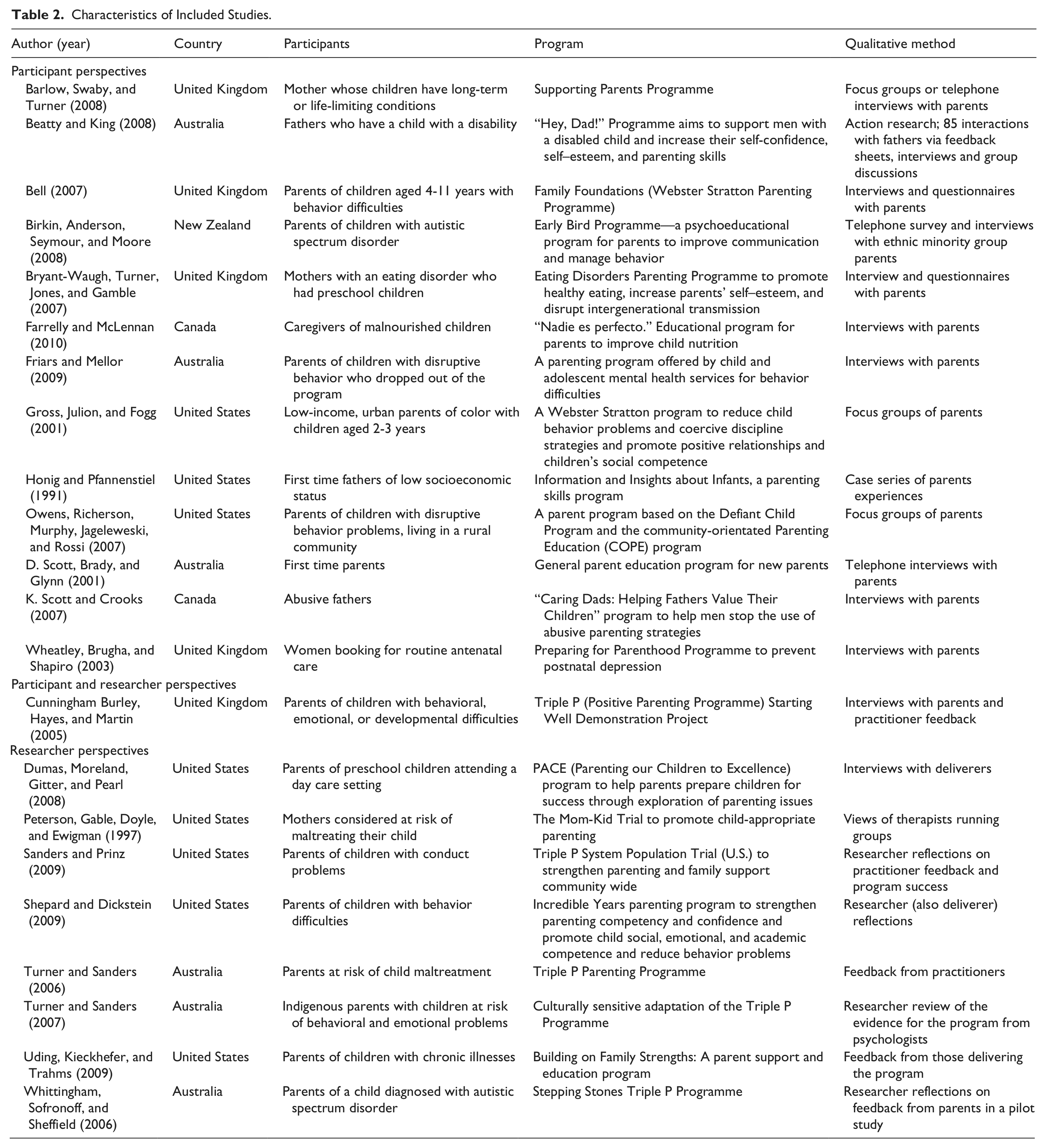
The electronic database search strategy identified 16,513 citations; 12,249 were unduplicated. Title and abstract screening of 7,246 citations was undertaken prior to application of the automatic term recognition tool. A total of 444 citations were checked for relevance prior to the final identification of fixed manualized programs. Twenty-six papers were included in the final review (Figure 1 and Table 2); 15 reporting parent’s perspectives (Barlow, Swaby, & Turner, 2008; Beatty & King, 2008; Bell, 2007; Birkin, Anderson, Seymour, & Moore, 2008; Bryant-Waugh, Turner, Jones, & Gamble, 2007; Cunningham Burley, Hayes, & Martin, 2005; Farrelly & McLennan, 2010; Friars & Mellor, 2009; Gross, Julion, & Fogg, 2001; Honig & Pfannenstiel, 1991; Owens, Richerson, Murphy, Jageleweski, & Rossi, 2007; D. Scott, Brady, & Glynn, 2001; K. Scott & Crooks, 2007; Strain & Timm, 2001; Wheatley, Brugha, & Shapiro, 2003) and 9 reporting researcher’s and deliverer’s perspectives (Cunningham Burley et al., 2005; Dumas, Moreland, Gitter, & Pearl, 2008; Peterson, Gable, Doyle, & Ewigman, 1997; Sanders & Prinz, 2009; Shepard & Dickstein, 2009; Turner & Sanders, 2006; Turner & Sanders, 2007; Uding, Kieckhefer, & Trahms, 2009; Whittingham, Sofronoff, & Sheffield, 2006), hereafter referred to as “researcher perspectives.” One included study reported both parents and researchers perspectives (Cunningham Burley et al., 2005). Five of the nine researchers’ papers reported on the use of Triple P parenting programs (Cunningham Burley et al., 2005; Sanders & Prinz, 2009; Turner & Sanders, 2006; Turner & Sanders, 2007; Whittingham et al., 2006) in a range of settings. The studies reporting the researcher perspective were predominantly from the United States and Australia. Six of these papers specifically reported including the views of deliverers of programs when reaching their conclusions. The 15 papers reporting the perspective of program participants covered studies conducted in a broader range of countries: in the United Kingdom, the United States, Canada, Australia, and New Zealand.

PRISMA flowchart of included studies.
Characteristics of Included Studies.
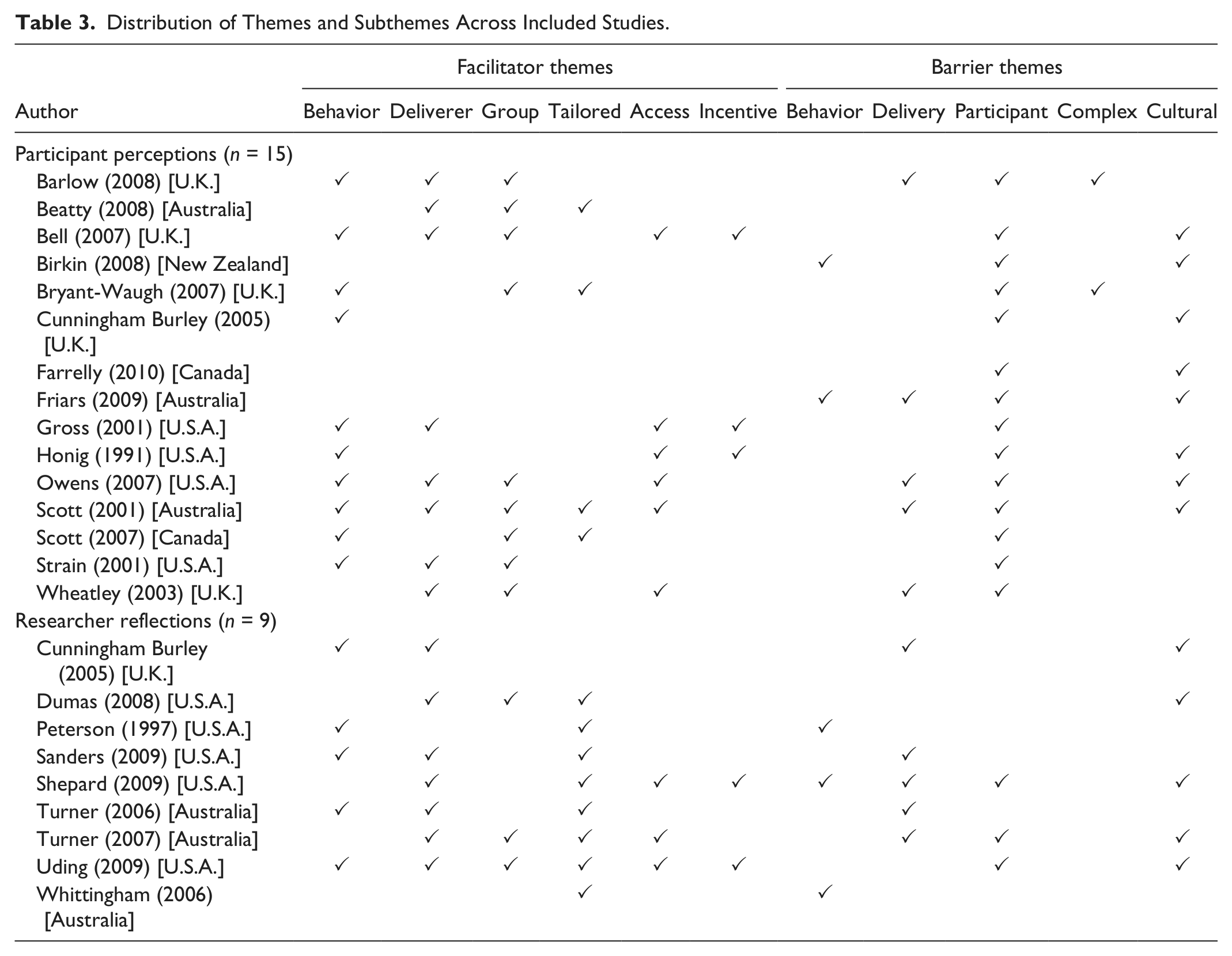
We found six facilitator and five barrier themes as important influences on participating in and delivering parenting programs, which also linked to the previous framework developed for injury prevention programs. The facilitator themes were behavior change, the role of the deliverer, group experience, a focused message, accessibility, and incentives. The barrier themes were behavioral, delivery constraints, participant constraints, complex interventions, and social and cultural barriers (Table 3). The themes were pertinent for both participant perceptions and researcher reflections, but a few of the subthemes were only relevant to one or the other. The framework went through five iterations, and the final version is shown in Table 4, which also shows the frequency of the subthemes.
Distribution of Themes and Subthemes Across Included Studies.
Framework and Frequency Table of Barriers and Facilitators to Parental Engagement in Parenting Programs, by Participant Perspectives and Researcher Reflections.
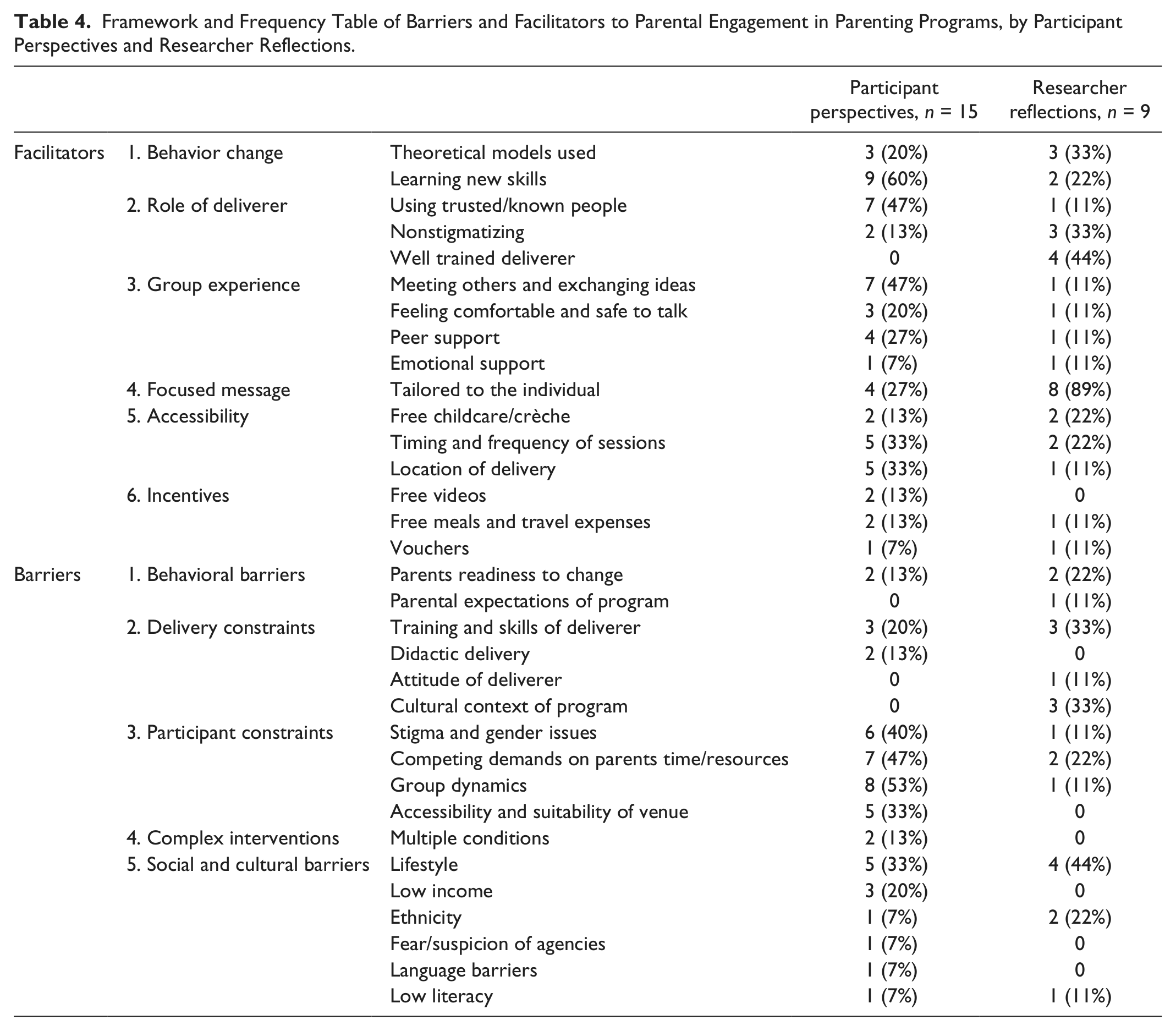
The most important facilitators from the participants’ view point were the opportunity to learn skills (in the behavior change theme), using trusted or known people to lead the course (role of deliverer) and meeting others and exchanging ideas (group experience). The accessibility of the course (timing, frequency, location) was also raised as being important. From the researchers’ papers, highlighted facilitator themes were being able to tailor the course to individual needs and using well trained deliverers.
Barriers to delivering parenting programs focused on participant constraints, particularly competing demands on parents’ time and resources and their experiences of group dynamics. Stigma and gender issues around attending groups, and accessibility of venues were also highlighted. Barriers for researchers not only centered on participants’ lifestyles but also reflected the cultural context in which a program was being delivered and the importance of the training and skills of the deliverer.
Facilitators
Behavior change
The main theoretical model used in the parenting programs was the social learning model (Bandura, 1977). Social learning theory states that people learn within a social context and this is facilitated through modeling and observational learning. “Triple P” was a widely reported parenting program using these beliefs. Self-efficacy techniques were often used to increase the confidence of participants’ parenting skills. Learning new skills during positive group experiences to improve relationships with children was highlighted by 60% of the participant papers as being important, and the overall behavior change theme was reported in two thirds of the papers. Skills valued by parents included addressing a lack of confidence, improving their ability to parent well, goal setting, and program-specific skills that supported their personal development.
Role of the deliverer
Using trusted or known people to recruit to and deliver the course highlighted tutors who were nonjudgmental and empathized with participants; this was emphasized in almost half of the papers reporting the participant perspective. Researchers identified the issue differently; four researcher papers highlighted successful programs as having well-trained deliverers. Training may or may not address generating trust. The nonstigmatizing aspects of a course and deliverer were mentioned by researchers.
Group experience
This was an important theme for participants (60% of papers), who highlighted meeting others, exchanging ideas, feeling it was safe to talk, and receiving support from peers as valuable in encouraging them to take part in programs. Only three (30%) of the researchers’ papers reported features of the group experience as important to facilitate parents’ participation.
Focused message
Being able to tailor the content of a parenting course to the needs of the participants was the most important facilitator reported by the researchers when reporting their perspective (in eight of the nine). Having flexibility within the program included using a range of formats to suit the abilities of the parents, their culture, and the child’s behavior/difficulties. Participants also appreciated having tailored sessions that were relevant to their situations and children.
Accessibility
The time and place of the course delivery were important to participants with community venues, colocalization with child care, and evening classes all mentioned. Researcher papers mentioned similar points and suggested that flexible access facilitated engagement of families.
Incentives
Providing additional incentives, such as vouchers, free meals, and travel expenses to participants to encourage engagement was not mentioned by many participant or researcher papers as being important, but five studies reported that meals and child care were an integral part of the program. However, a small number of papers reported that giving money to parents and providing transport were key to retaining their engagement in the program.
Barriers
Behavioral barriers
Very few studies identified behavioral barriers to engaging with programs. Some participants highlighted the difficulties in changing their own behavior and would have preferred strategies to change their child’s behavior. Similarly, the researchers mentioned that some parents did not accept that child behavior can be modified with a parenting approach, resulting in a mismatch between expectations of parents and the program goals.
Program delivery constraints
Participants disliked didactic delivery and a lack of focus of the program. Papers reporting researcher perspectives were more likely to report the training and skills of the deliverer as a barrier, with those who lacked confidence or who misunderstood the theoretical evidence for the approach diluting a program’s message. Researchers also reported potential cultural barriers, for example, impediments arising from attempts to deliver a program developed in another continent or a lack of consumer support within particular communities. These features were not identified by participants themselves.
Participant constraints
Fourteen participant perception papers identified at least one issue within this theme, particularly group dynamics (the fear of attending groups, reluctance to talk in a group setting, suspicion of others, and large differences between participants). Competing demands on parents’ time and resources, including practical issues such as child care for other children, and the frequency and timing of sessions, which did not fit working patterns or other commitments, were important. Barriers associated with stigma and gender included fathers feeling uncomfortable in predominantly female groups, social status, and the fear of being labeled a “bad” parent. Accessibility and suitability of venues were raised by participants but not identified by researchers, though two papers recognized the challenge for participants of competing priorities.
Complex interventions
Two participant perspective papers mentioned that mixing types of health conditions made the course too complex and caused tensions within group.
Social and cultural barriers
Participant lifestyle issues were reported by about half of the included studies, including mixed parenting styles, complex and chaotic lifestyles, frequent house moves, and poor family support to attend courses. A range of socioeconomic, ethnic, language, and literacy barriers were also mentioned as having an impact on attendance at parenting programs.
Discussion
Our review has highlighted the differences in the views of participants and researchers about the factors influencing parental engagement in parenting programs. Although both participants and researchers agreed that the role of the deliverer was an important factor in parental engagement, the two groups differed on the subthemes they felt most important. For participants using a trusted and known person to deliver the group was important whereas researchers highlighted ensuring deliverers were well trained in the program. Both participants and researchers felt that the course needed to have a focused message, but the ability to tailor the course to the individual was much more strongly reported by the researchers than the parents. The opportunity to learn new skills was valued by the participants, but not reported by researchers as helpful for engagement or retention. The researchers appeared to be less cognizant of the practical factors that were barriers to participation for the parents: issues such as stigma, competing demands on time, group dynamics, and venue accessibility. These were seldom reported by researchers who were more likely to report differences in lifestyles as impeding participation.
A number of overviews have been produced to support the delivery of parenting programs. The practice survey underpinning the work by Barrett (2009) and Butt (2009) identified similar features to those reported by the researchers in this review: the need to match parents to programs, creating a safe space for parents, and using a trainer who is trained to work in a facilitative rather than didactic fashion. In contrast, however, the qualitative studies in our report identified researcher/deliverer views that were not strongly reported by Barrett (2009), including the potential that families with different lifestyles may perceive their way of life means they should not, or could not, engage with programs. Participant views not identified via the survey of practitioners included having a trusted or known deliverer and the competing demands on parents time inhibiting participation. Both our review and the reports by Barrett (2009) and Butt (2009) focus on manualized programs. The need for such programs arises to ensure fidelity of intervention delivery. Although the requirement for fidelity is acknowledged, both parents and deliverers report that flexibility is required to allow program facilitators to adapt content and activities to the requirements of those participating in the program. The solution appears to be to have key components of programs that must be delivered together with other activities that are supportive but not crucial, so that the latter can be adapted, shortened, or dropped depending on need and time available to respond to the group.
The need to make a program attractive, relevant, and interesting to parents is highlighted through a recent report by Davis et al. on behalf of the British Psychological Society (Davis, McDonald, & Axford, 2012). Working with parents and service users, as well as parenting program developers, their report makes recommendations to improve social inclusion within parenting programs through the application of four principles: accessibility, cultural sensitivity, social capital, and sustainability. Our review highlighted a strong belief among deliverers and researchers that programs needed to be targeted to individuals. We found that this was less clearly reported by the parents themselves; they articulated their concerns for applicability by emphasizing the desire to learn useful skills in a group where they felt comfortable and at a time that fitted in with their other commitments.
A challenge in conducting this review was the identification of appropriate studies meeting the inclusion criteria. Qualitative research methodologies are less well referenced than quantitative studies in electronic databases. There is a risk that we have missed eligible studies that may have influenced our framework. The requirement to identify all studies is important if the synthesis is a meta-analysis of effectiveness. If the intention is to achieve conceptual saturation, then the identification of all studies is less crucial if the reviewers believe that they have achieved saturation, as in this study. We used an innovative approach to identify the most likely relevant studies from the results of a large search. We conducted a highly sensitive database search and built up a large database of potentially relevant studies. We then used the text mining tools in EPPI-Reviewer to select the studies for us to screen manually. There were still a significant number of items for us to screen, but the use of text mining meant that we were able to conduct a more sensitive search than would otherwise have been possible, using more sophisticated data mining tools than are available in standard bibliographic databases.
We acknowledge that some researchers contest the synthesis of qualitative research. Synthesizing qualitative research enables reviewers to ask questions that inform the development of, or the implementation of, interventions. For example, in the context of intervention evaluation, they can help define relevant and important questions, help determine appropriate outcome measures by looking at “subjective” outcomes, look in detail at issues concerning implementation or the acceptability or appropriateness of an intervention, identify and explore unintended consequences, contribute to service delivery and policy development by describing processes and contexts, and inform and illuminate quantitative studies, for example, by contributing to the design of structured instruments, assessing the fairness of comparisons in experimental studies, or unpacking variation within aggregated data (Davies, Nutley, & Smith, 2000).
There are many methods for synthesizing the results of qualitative research (Barnett-Page et al., 2009). This article demonstrates the value of one relatively new approach, that of framework synthesis (Carroll, Booth, & Cooper, 2011; Thomas, Harden, & Newman, 2012). The distinguishing characteristic of this method is that it allows preexisting understanding (in the form of themes or categories) to be included in the analysis alongside (and combined with) concepts that emerge from the studies themselves (Dixon-Woods, 2011). This makes it particularly suitable for studies where a relevant related conceptual framework already exists, or where the findings from primary studies need to be explored in the light of perspectives of various stakeholders (e.g., practitioners, parents) in a structured and explicit way.
Implications for Policy and Practice
The current interest in parenting interventions to improve both parent and child outcomes has led to a number of new parenting programs being developed. Although the requirement for robust evidence of effectiveness and cost-effectiveness of interventions is established, new and existing programs need to evaluate their relevance and acceptability to both participants and deliverers, as well as determine their effectiveness. This review has demonstrated that, within a framework of facilitators and barriers to engagement, participants and deliverers/researchers identify different features of programs as important. We argue therefore that program developers should routinely seek views of participants and deliverers during program evaluation.
Footnotes
Acknowledgements
We acknowledge the support of Carol Vigurs in the application of the search strategy to databases during this review.
Declaration of Conflicting Interests
The authors declared no potential conflicts of interest with respect to the research, authorship, and/or publication of this article.
Funding
The authors disclosed receipt of the following financial support for the research, authorship, and/or publication of this article:
This work was supported by the National Institutes for Health Research Health Technology Assessment Programme (Grant Number 09/02/02). The views and opinions expressed therein are those of the authors and do not necessarily reflect those of the HTA program, NIHR, the UK National Health Service, or the UK Department of Health. The NIHR HTA program paid salary costs via the University of the West of England and via the University of Bristol.