






Abstract

Watson, A., Dumuid, D., & Olds, T. (2020). Associations between 24-hour time use and academic achievement in Australian primary school–aged children. Health Education & Behavior, 47(6), 905–913. https://doi.org/10.1177/1090198120952041
In this article, data from the CheckPoint module of the Longitudinal Study of Australian Children were used, and there was an error in how the accelerometry data were processed in the CheckPoint study. As a result, incorrect cut-points were used resulting in shorter physical activity estimates and longer sedentary time estimates. The authors repeated the analyses for this article and the corrected variables are highly correlated with the original variables. For the specific corrections, please see bolded text in sentences and shaded values in revised Tables 1 and 2:
Abstract: “Method. Participants for this study were drawn from two cohorts: the Australian arm of the cross-sectional International Study of Childhood Obesity, Lifestyle and the Environment (n = 452; mean age 10.7 years [SD = 0.4]; 54% female) and CheckPoint (n =
Data Analysis: “Zero MVPA was detected for
Results: Participant Characteristics: “Participants with complete data for all variables were included in the analyses (ISCOLE: Literacy n = 294, Numeracy n = 290; and CheckPoint: Literacy n =
Participant Characteristics.
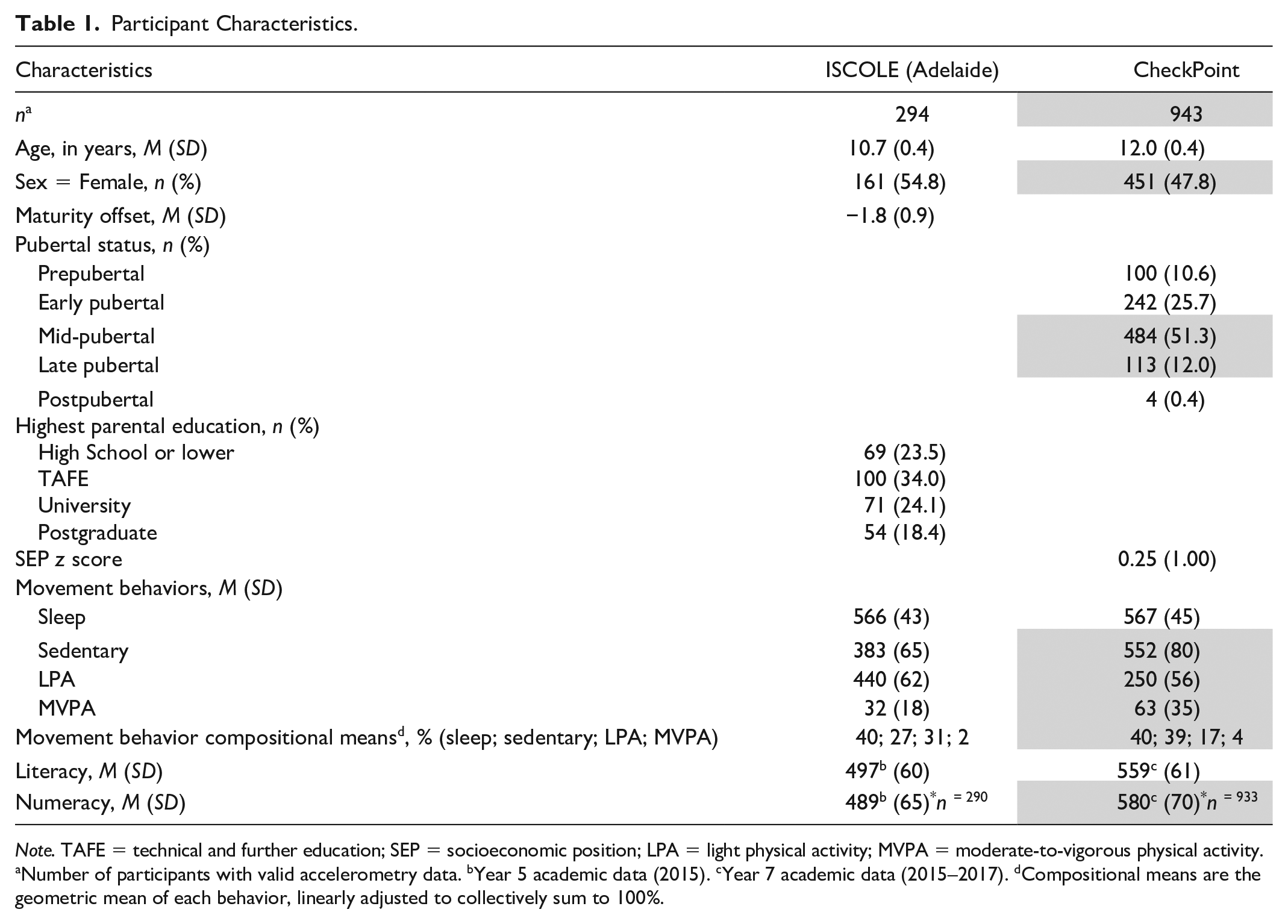
Note. TAFE = technical and further education; SEP = socioeconomic position; LPA = light physical activity; MVPA = moderate-to-vigorous physical activity.
Number of participants with valid accelerometry data. bYear 5 academic data (2015). cYear 7 academic data (2015–2017). dCompositional means are the geometric mean of each behavior, linearly adjusted to collectively sum to 100%.
Relationships Between Movement Behaviors and Academic Achievement: Results From Compositional Models.
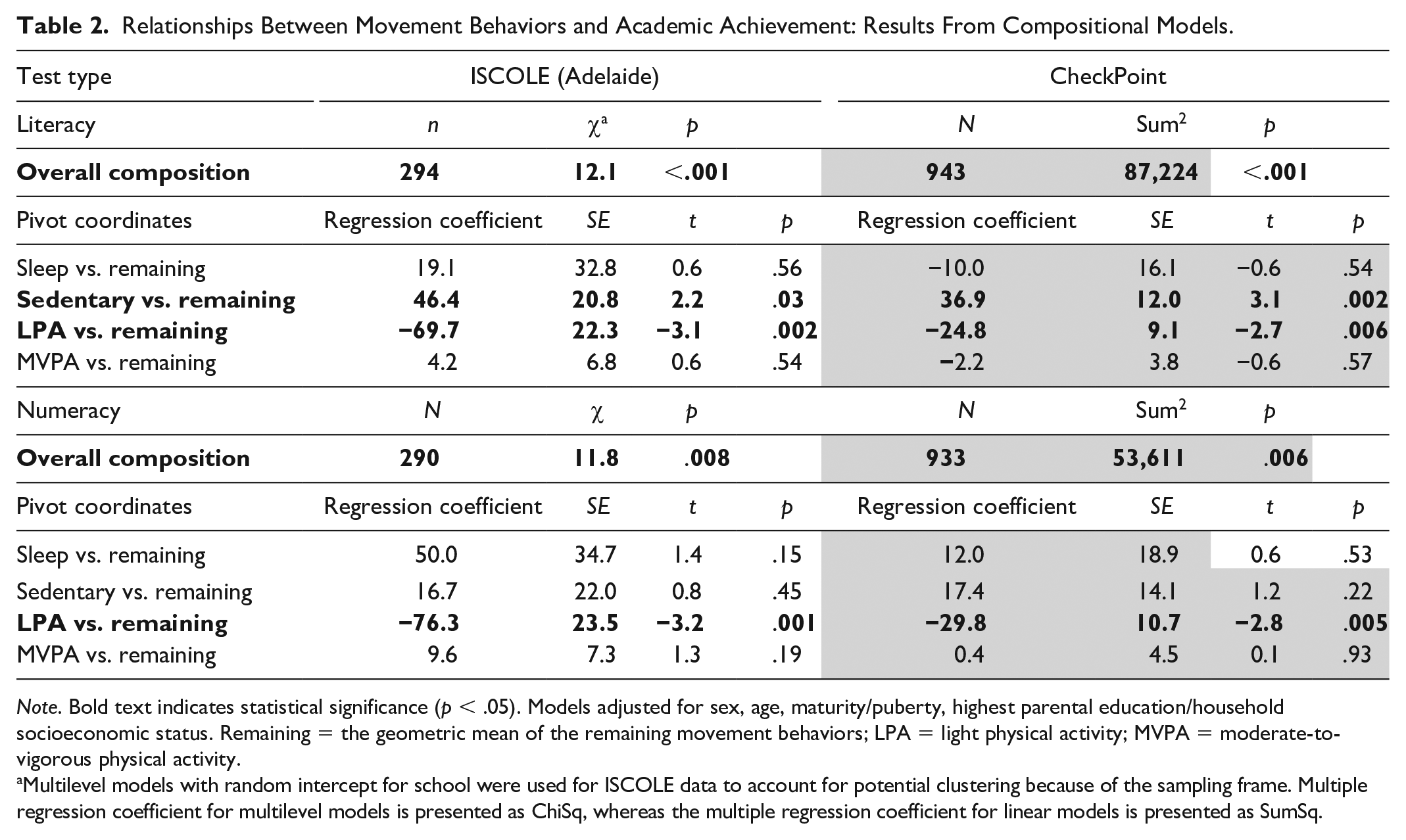
Note. Bold text indicates statistical significance (p < .05). Models adjusted for sex, age, maturity/puberty, highest parental education/household socioeconomic status. Remaining = the geometric mean of the remaining movement behaviors; LPA = light physical activity; MVPA = moderate-to-vigorous physical activity.
Multilevel models with random intercept for school were used for ISCOLE data to account for potential clustering because of the sampling frame. Multiple regression coefficient for multilevel models is presented as ChiSq, whereas the multiple regression coefficient for linear models is presented as SumSq.