






Abstract
While mainstream public health has recognized the prime role of social determinants of health (SDOH) in shaping patterns of health and disease, the field has struggled to find meaningful ways to tackle these fundamental causes of health and health inequities. Though often overlooked within the field of public health, activist campaigns have been a vital force for securing advances in confronting and modifying SDOH, from obtaining wage increases to expanding reproductive health care to securing health care for millions through the expansion of Medicaid. These examples show that social movement activism can encourage public officials to make tackling the SDOH a priority on their policy agendas and contribute to reducing the influence of the special interests who often oppose these changes. To integrate activism with public health practice more consistently, researchers, practitioners, and activists need a robust body of evidence that enables them to leverage activism to address social determinants. This narrative review seeks to explore the role that evaluation can play in strengthening health activism aimed at SDOH and making it a more accepted and familiar component of public health practice. We offer definitions of several key terms, review relevant literature on evaluation of health activism, and propose guiding questions along with real-life examples of corresponding evaluations. We aim to encourage public health practitioners to recognize the role of activism in advancing public health and to find ways to use evaluation to partner with activist campaigns seeking to modify SDOH.
Keywords
Introduction
While mainstream public health has recognized the prime role of social determinants of health (SDOH) in shaping patterns of health and disease, the field has struggled to find meaningful ways to tackle these fundamental causes of health and health inequities (Braveman & Gottlieb, 2014). Several characteristics of SDOH explain this problem—the term is broad and defined differently by different actors; thus, documenting the impact of SDOH on specific health outcomes can be difficult, and the concept challenges traditional biomedical views on causation. As a result, more evidence documents the scope of the problem than guides the development of effective public health strategies to mitigate the harmful impact of social determinants.
Over the last century, activist movements have made important advances in confronting and modifying SDOH (Irwin & Scali, 2007). The labor movement, for example, has won reductions in working hours, limits on child labor, and stronger regulation of hazardous workplace exposures. More recently, Fight for US$15 campaigns in cities and states across the country have led to the first meaningful minimum wage increases in years, thereby improving economic security, a key SDOH, for millions of low-wage workers (Pasquier, 2024). The women’s movement and affiliated movements for sexual and reproductive health and justice have resisted restrictions on abortion and, at least in some places, have expanded access to reproductive health care for low income, Black and Latiné, and immigrant populations (Daniel, 2021). Local and national action to prevent evictions during the COVID-19 pandemic led the CDC, state governments and others to restrict evictions, thus saving thousands from homelessness, family separation, and mental health consequences and, in some cases, leading to more permanent protections for tenants (Smirnova et al., 2024). Years of effort by universal health care activists helped to create Medicaid expansion programs after the passage of the Affordable Care Act, securing access to health care for millions of Americans (Michener, 2025).
These examples show that social movement activism can encourage public officials to make tackling the SDOH a priority on their policy agendas and contribute to reducing the influence of the special interests who often oppose these changes. However, to integrate activism with public health practice more consistently, researchers, practitioners, and activists need a robust body of evidence that enables them to leverage activism to address social determinants more effectively. As a cornerstone of public health practice, evaluation is a tool that can show what works and what does not and provide insights to strengthen activists’ efforts. Systematic assessment of activism to address SDOH can also help public health professionals to better understand the value, impact, and limits of activist movements and campaigns.
This report explores the role that evaluation can play in strengthening health activism and making it a more accepted and familiar component of public health practice. In this narrative review, a flexible method often used to establish a theoretical framework and provide a context for future research (Sukhera, 2022; Ferrari, 2015), we provide an analysis of the current knowledge on the evaluation of health activism aimed at SDOH. Since this study did not collect data from human participants, it did not require review by an Institutional Review Board.
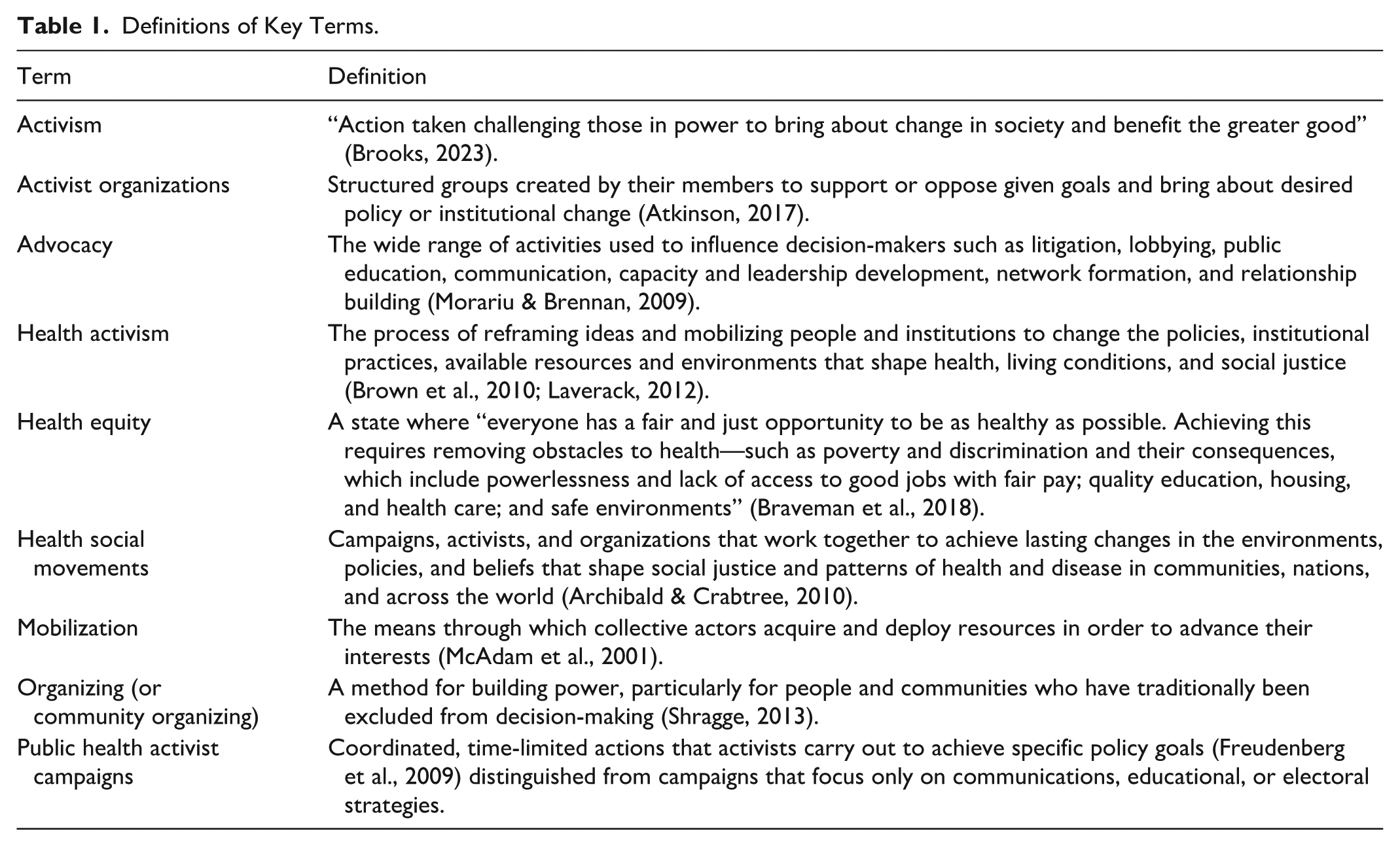
We begin by proposing definitions of several key terms (see Table 1). Next, we review relevant literature on the evaluation of health activism and propose guiding questions for evaluating activism for public health. We propose these questions, along with real-life examples of corresponding evaluations, to encourage public health practitioners to use evaluation to help the field learn from, support, and partner with activist campaigns seeking to modify SDOH, with the ultimate goal of contributing to improving population health and reducing health inequities.
Definitions of Key Terms.
Defining Key Concepts in Activism
Scholars from several disciplines, including sociology, political science, anthropology, communication studies, history, law, and psychology, have studied activism (Anderson & Herr, 2007). These and several health and environmental disciplines have also investigated “health activism”, the subset of activism that seeks to modify health policies or the health of populations (Brown et al., 2010; Laverack, 2012). This scholarship, further enriched by activists and scholars from the women’s, environmental justice, labor, racial justice and other movements, provides a complex, sometimes confusing foundation for the practical assessment of the implementation and impact of activism on practice and policy (Bullard & Chavis, 1999; Fleming & Morris, 2015; Wilkinson & Kitzinger, 2013). To facilitate a shared understanding of key terms used in this paper, we propose definitions of key terms in Table 1.
While scholars and activists have explored the similarities and differences between the concepts of activism and advocacy, our principal focus is on activism because, in our view, it is uniquely suited to take on SDOH (Ardila Sánchez et al., 2020). First, compared to advocates, activists focus more directly on power, both challenging power structures and mobilizing the power needed to implement the desired changes. Second, activists may be more likely to use disruptive, confrontational, and adversarial strategies than advocates, who often work within more traditional political processes. Third, some empirical evidence suggests that advocates may focus more on improving health and less on reducing health inequities (Cohen & Marshall, 2017), a key goal of health activists. In practice, some use the terms interchangeably, while others use advocacy to describe promoting policy change and limit the term activism to describe the use of power to redress grievances or inequities (McKeever et al., 2023). We use the latter approach, but in citing others, we use the term the authors employ.
Scholarship on Evaluating Activism and Advocacy
Prior scholarship on the evaluation of activism has considered the assessment of various levels of organization including social movements (Bosi et al., 2016), activist organizations (Zald & Ash, 1966), and activist campaigns (Freudenberg et al., 2009). There is also an increasingly robust literature that has sought to advance the theory, methods, and practice of advocacy evaluation (Raynor et al., 2021).
Evaluators typically seek to specify the goals of the activity they are assessing, the process of implementation, the impact on selected metrics and indicators, and the longer-term impact of the activities under investigation. Several factors distinguish activist campaigns from other types of public health interventions, with important implications for evaluation. Unlike for evaluation of other public health activities (e.g., immunization drives), those who evaluate activist campaigns seldom control the events or have the capacity to modify them for research purposes. In addition, the outcomes of activist campaigns are influenced by external political and social forces. As Barbara Klugman, a South African evaluator of health advocacy and activism, explained, “Policy wins are usually the result of multiple strategies coupled with windows of opportunity that may not be predictable” (Klugman, 2011). This makes it challenging to propose and test specific causal hypotheses. It also can make it hard to confidently attribute outcomes to the actions of activist campaigns, or to determine the precise role that activism played in achieving a certain policy goal, often a valued aim of public health evaluators in other contexts.
Finally, activist campaigns often yield outcomes that may be difficult to assess, such as developing the capacities of organizations and communities to win subsequent victories, inspiring activists in other places or working on other topics to emulate their strategies, identifying new allies who can help to win the power needed to achieve their goals, or shifting public opinion and dominant narratives about an issue. Assessing these types of outcomes can help to demonstrate whether a campaign was successful, but may need different approaches than those typically used in evaluation.
Evaluators, activists, advocates, and scholars offer insights for addressing these challenges, ranging from broad guidance to specific methodological approaches. Devlin-Foltz et al. note that the unpredictable context and non-linear nature of advocacy require a more flexible approach to evaluation than is typically used for evaluating health promotion programs. They caution against simply tracking outputs and encourage evaluators and campaigners to consider what information will actually be meaningful for moving toward policy changes. They emphasize using a “learning perspective,” where evaluation is “seen as an ongoing process aimed at adjusting strategy” (Devlin-Foltz et al., 2012). Along these lines, they and others have highlighted the value of using developmental evaluation—which focuses on navigating complexity, real-time feedback and continuous learning, and partnership between evaluators and implementers—for evaluation of policy change efforts (Devlin-Foltz et al., 2012; Taddy-Sandino et al., 2021).
Several researchers propose use of frameworks, in particular those that focus on a theory of change or conceptual map, to guide evaluation of activism and advocacy (Glass, 2017; Klugman, 2011). Klugman uses a theory-of-change framework comprising eight categories of social justice outcomes (e.g., strengthened base of support and allies, shift in social norms) to evaluate reproductive rights campaigns in South Africa. She concludes that this framework can help activists with ongoing assessment of a range of outcomes, as well as facilitating reflection on whether the voices of those who are most excluded are being fully included in their campaigns (Klugman, 2011). Moore et al. adapt an 8-step change process framework commonly used in the field of management studies to help health advocates identify best practices and understand the impacts of their approaches during public health campaigns. Based on their use of the framework to assess a campaign to incorporate environmental sustainability and social equity into the Australian government’s food and nutrition policy, the authors propose two additional steps, resulting in a 10-step framework that includes establishing a sense of urgency, empowering broad-based action, and incorporating changes into the culture (Moore et al., 2013). Another relevant framework is Kingdon’s model for policymaking, which includes the problem stream, the politics stream, and the policy stream (Kingdon, 1984). When progress occurs across all three streams, writes Kingdon, a “window of opportunity” opens, increasing the chances for success (Kingdon, 1993).
Some scholars recommend assessing changes in organizational and leadership capacity as part of evaluating advocacy efforts (Devlin-Foltz et al., 2012; Glass, 2017). Devlin-Foltz et al. (2012) note that in contrast to policy change—which is often outside the control of campaigners—capacity building is an important part of advocacy that can be more readily controlled and measured (Glass, 2017). Klugman similarly highlights the importance of measuring improvements in organizational capacity, a quality she identifies as a prerequisite for successful advocacy (Klugman, 2011). She also notes the importance of having strong organizational and leadership capacity in place even after a policy campaign has “won” to ensure that policies are implemented and sustained.
In a more recent paper, Fox and Post emphasize the importance of power building, a strategy also embraced by public health organizations seeking to advance health and racial equity (Building Community Power to Advance Health Equity, n.d.; Health In Partnership, n.d.; Our History—The Praxis Project, n.d.; Policy Process Evaluation for Equity, n.d.; Fox & Post, 2021). The authors note that while power building is fundamental to social change, it is often neglected in advocacy evaluation. A key insight from their evaluation of a power-building effort is “that power enables individual and collective liberation; it is not just about achieving policy change and changing material conditions. [. . .] When power is the goal, we need to look beyond changes in policies and material conditions to understand the liberatory outcomes of power building.” They posit that shifting to focus on power building will require evaluators to reconceptualize and expand current understandings of the goals and outcomes of social change efforts (Fox & Post, 2021).
Other studies describe evaluations of specific campaigns. Watts et al. (2021) detail the evaluation of a campaign for universal school meals in NYC, describing metrics used to track progress and gather evidence to support their advocacy. Patton describes using the General Elimination Method for a retrospective evaluation of a campaign to influence an unnamed health-related Supreme Court decision to determine what factors led to a successful policy outcome (Patton, 2008). Garibay et al. sought to learn from the failure of efforts to pass a statewide tax on sugar-sweetened beverages in California. Using qualitative document analysis guided by the Advocacy Coalition Framework, they compared the efforts of a public health coalition and an industry coalition to identify what strategies and arguments were effective, with the goal of informing future campaigns (Garibay et al., 2024).
Guiding Questions for Evaluating Health Activism
At some point, planners and participants in activist campaigns must ask, “Is what we are doing working?,” “Are we achieving our goals?,” or “What should we be doing differently?” Asking these questions at various stages of a campaign can make the difference between success and failure, between learning from and correcting ineffective strategies and tactics or not. To answer these questions, activists have devised various ways to monitor, assess, and improve their activities. This can help activists modify their strategies, document their impact on policy and health, and share their lessons learned with others. Though challenging, some evaluations are able to measure the impact of campaigns on health and on the capacity of activist organizations to achieve their goals.
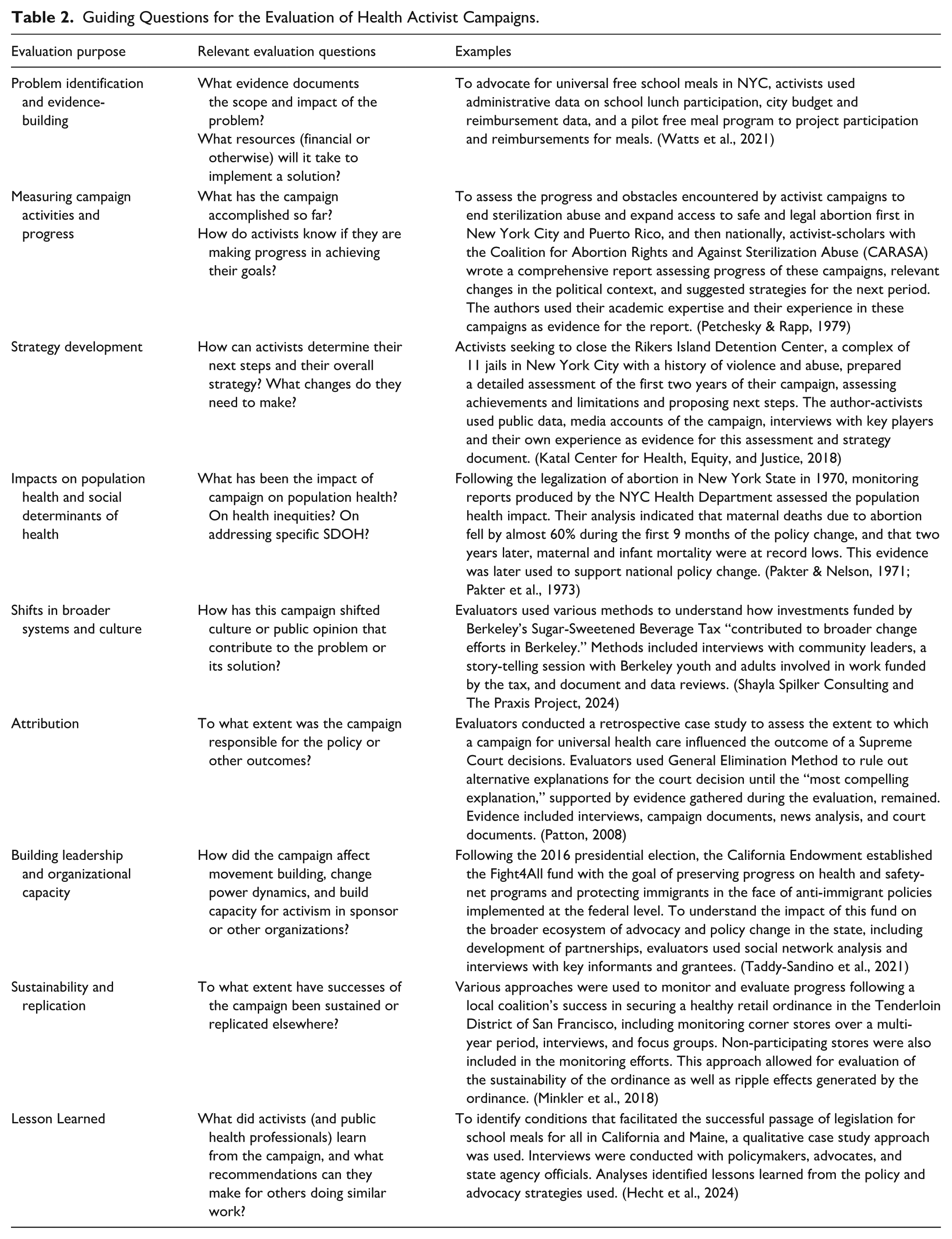
Informed by the literature reviewed above, an in-depth investigation of health activism in New York City (Freudenberg, 2026) and our own experiences, Table 2 suggests a series of questions to help public health activists and evaluators assess the implementation and impact of activist health campaigns. This approach considers the different purposes for evaluation of health activism (Column 1 in the table), the type of questions that activists might seek to answer (Column 2) for each purpose, and examples from real-life activist campaigns (Column 3). We focus on the evaluation of campaigns because campaigns have specific goals, activities and timeframes, characteristics that make them more familiar to those who evaluate public health interventions than other forms of activism and more amenable to assessment. As shown in Table 1, campaigns are defined as a “coordinated time-limited series of actions that activists carry out to achieve specific policy goals” (Freudenberg et al., 2009).
Guiding Questions for the Evaluation of Health Activist Campaigns.
Discussion and Conclusion
Evaluation is a cornerstone of public health practice, but limited evidence guides public health professionals who want to use insights from evaluation of health or broader social justice activism to expand their impact on health and health equity. Given the potential of activism to contribute to modifying health-harming SDOH, creating a robust body of literature evaluating such activism can help to equip activists and researchers with tools to leverage this potential.
The guiding questions for the evaluation of health activist campaigns proposed here offer concrete questions that can support the success of and build learning from activist and advocacy campaigns. Public health researchers, professionals, and activists can modify and expand these questions to evaluate activist organizations and health social movements as well as discrete campaigns. Applying a public health lens to these two streams of vital work—evaluation and activism—serves to highlight the potential for strengthening their integration within the field of public health to support health equity and social change.
To further advance the use of evaluation for public health activist campaigns, public health professionals, evaluators, advocates, and activists should continue to develop a common understanding of and language for activism, advocacy, and evaluation, and leverage their shared aims and mutually beneficial contributions. Creating dedicated spaces, forums, and learning communities where evaluators, activists and others can exchange ideas, debate differences and identify lessons learned can accelerate the creation of a shared body of knowledge and practice. Public health educators can explicitly incorporate health activism into public health education and training, for example by offering courses on health activism, covering the role of activism in modifying SDOH, and bringing the issue of evaluation of activist campaigns to public health courses on evaluation.
As public health practice, scientific evidence, and activism for health and health equity come under attack from a variety of political forces, the importance of more explicitly integrating activism and public health takes on an added urgency. Importantly, some public health organizations are doing this—Health in Partnership explicitly aims to build power with social justice movements, Partners in Health organizes regular U.S. Health Justice Calls to bring together organizers, advocates, and activists for movement building, Robert Wood Johnson Foundation supports building community power to advance health and racial equity, and the Praxis Project highlights community-led power for social change (Building Community Power to Advance Health Equity, n.d.; Health In Partnership, n.d.; Partners in Health: US Health Justice Calls, n.d.; The Praxis Project, n.d.). Building on these efforts to promote the integration of evaluation of activist campaigns as part of public health practice is an important area of expansion for public health.
As the United States and other countries face growing threats to health that have their roots in social, political, and economic arrangements, addressing the fundamental causes and social determinants of these threats becomes ever more important. Throughout modern history and in the current era, social movements and activist campaigns have shown their willingness to tackle and modify these deeper determinants of health and health equity. By developing its capacity to evaluate the impact of this activism, the public health community can contribute new approaches to improving well-being.
Footnotes

Funding
The authors disclosed receipt of the following financial support for the research, authorship, and/or publication of this article: This project was supported in part by funding from Columbia’s University’s Region 2 Public Health Training Center.
Declaration of Conflicting Interests
The authors declared no potential conflicts of interest with respect to the research, authorship, and/or publication of this article.