







Abstract
This paper extends the current literature by considering the existence of the flypaper effect internationally, with donor countries supplying foreign aid to recipient countries. The flypaper effect refers to the empirical anomaly associated with intergovernmental grants stimulating government expenditures more than can be explained by a pure income effect. The results reveal evidence of flypaper behavior such that for recipient countries one dollar of foreign aid raises public spending by $0.21-$0.42, whereas an equal increase in domestic income raises government expenditures by only $0.09-$0.16. Furthermore, we exploit variation in political institutions across countries and find that the flypaper effect is most pronounced in less democratic countries and find no flypaper effect in more democratic countries. This suggests that government officials are more likely to behave as expected by the median voter model when they are held accountable. Furthermore, countries with proportional, rather than majority/plurality, voting mechanisms do not display flypaper behavior.
Keywords
Introduction
Sub-national governments often receive intergovernmental transfers, termed “grants,” from higher levels of government to coordinate use of common fiscal resources. Similarly, developing countries may receive transfers, termed “aid,” from foreign sources that support the welfare or development of the recipient country. Sub-national governments typically expend funds received from lump-sum transfer payments at a higher rate than an equivalent lump-sum transfer from its tax base, regardless of the source of such transfers. This frequently observed empirical finding, commonly referred to as the “flypaper effect,” runs contrary to the “equivalence theorem” developed by Bradford and Oates (1971). The equivalence theorem generates the expectation that a lump-sum transfer to the sub-national government from the national government or an identical lump-sum transfer from taxpayers ought to have the same effect on government spending. The inherent similarity between grants from national to sub-national governments and foreign aid from donor countries to recipient countries raises the question of whether foreign aid exhibits flypaper behavior in recipient countries. If so, then no matter the source or reasoning behind the transfers, both aid and grants stimulate public-sector spending more than can be explained by equivalent increases in tax-base income.
While numerous empirical studies find non-equivalence by analyzing transfer schemes within single federations (see, for example, Bailey and Connolly (1998), Hines and Thaler (1995), and Inman (2008)), this paper extends the equivalence theorem hypothesis test to an international setting. The analogous situation examined is the stimulative government spending power of foreign aid relative to a comparable increase in income.
Using data from foreign aid transfers to analyze the equivalence theorem has a few advantages over transfers within a single nation. First, the transfer is clearly external to the recipient since transfers are not from shared resources. This feature circumvents the general equilibrium problem associated with federal and sub-federal governments sharing a common tax base to fund grants (Fisher 1982). Second, aid is provided by numerous donors within a given time period, including both government and non-governmental organizations, which decreases the likelihood of unobservable implicit conditions being placed on the aid. The misclassification of transfers that are effectively matching transfers as lump-sum can create the illusion of the flypaper effect, and multiple donors mitigates this issue (Bailey and Connolly 1998; Inman 2008). And finally, using foreign aid enables us to exploit variation in governmental institutions which is not possible in single-nation analyses. Consequently, we consider how differences in political regimes and democratic institutions impact government spending from aid. These features of foreign aid schemes provide a useful environment to analyze the equivalence theorem and advance our understanding of the flypaper effect.
Foreign aid is an important component of many developing nations’ economies highlighting the importance of examining the stimulative power of aid. In 1960, eight countries and the Commission of the European Economic Community joined together to form the Development Assistance Group in order to improve the effectiveness of foreign aid to developing countries. In 1961, the group was reconstituted to its present form as the Development Assistance Committee within the Organisation for Economic Co-operation and Development (OECD). The Development Assistance Committee has maintained its original mission and has since expanded to include twenty-nine countries that have provided aid to over 180 states during its now sixty-year history. One measure of aid established by the Development Assistance Committee is termed Official Development Assistance, which includes grants and concessional loans among other things (DAC Glossary of Key Terms and Concepts 2019). Official Development Assistance given to developing countries for the purpose of promoting economic growth and well-being generally has been rising over time with net Official Development Assistance increasing from $17.5 billion in 1960 to $146.6 billion in 2017 (measured in 2010 USD). In 1960, about half of Official Development Assistance was provided by the United States, while in 2019 this figure was about one-fifth.
Official Development Assistance is targeted to countries that qualify based on gross national income (GNI) per capita as published by the World Bank. In 2019, Nauru received the most Official Development Assistance on a per capita basis, $4,318 per capita. This aid amounts to 31 percent of Nauru's GNI. In 2019, aggregate countries defined as low income by the World Bank received Official Development Assistance of 9.4 percent of their GNI, while aggregated middle-income countries received only 0.2 percent of GNI. There is wide variation in the amounts of transfers between countries providing an opportunity to examine the stimulative nature of foreign aid across heterogeneous countries.
Some of the existing literature finds that international aid does raise recipient governments’ public expenditures (Njeru 2003; Remmer 2004; Van de Walle and Mu 2007), while others report evidence to the contrary (Kono and Montinola 2013; Pickard and Warrell 2012). The present paper contributes to the literature by comparing behavior observed among national and sub-national governments relative to the expansionary effects of domestic income and foreign aid on developing countries’ expenditures, testing explicitly for the existence of the flypaper effect related to foreign aid across a large sample of nations. Furthermore, unlike most of the previous literature, we account for the possible endogeneity of aid by employing an instrumental variables approach.
We find that the flypaper phenomenon transcends national borders. We show that just as grants from national governments to sub-national governments stimulate sub-national government spending more than what can be explained by a pure income effect, foreign aid from a donor country to a recipient country stimulates recipient government spending by more than an equivalent increase in domestic tax-base income. In consequence, the flypaper behavior of foreign aid contributes to the expansion of the public sector. Moreover, we find that flypaper behavior is conditional on the extent of recipient nations’ degree of institutionalized democracy. In particular, countries with low degrees of democracy experience a significant flypaper effect, while in countries with high degrees of democracy foreign aid and domestic income stimulate government spending equivalently. Furthermore, we find that recipient countries adopting majority/plurality or mixed voting (as opposed to proportional voting), show evidence consistent with the flypaper effect.
The remainder of the paper begins with a review of the literature on the flypaper effect in the next section. Section 3 describes the data and empirical methodology. Section 4 reports the results, and Section 5 concludes.
The Flypaper Effect
Bradford and Oates (1971) provide a theoretical framework based on a median voter model to explain the effect of intergovernmental grants on government expenditures. The median voter finds that their most preferred levels of private and public goods are selected by a majority-rule political process. Bradford and Oates (1971) show that if lump-sum grants to a collectivity are allocated based on individuals’ tax shares, the effect of an increase in lump-sum grants and a comparable increase in income should have the same effect on government spending, known as the equivalence theorem. However, the equivalence theorem has not held up under empirical scrutiny, which shows that grants have a greater stimulative effect on government spending relative to income, dubbed the flypaper effect. This gave rise to various explanations of this so-called flypaper effect.
Many studies have attempted to better understand the flypaper phenomenon. 1 One of the most promising explanations for the flypaper effect is politics (Inman 2008). In democracies, elected officials are chosen to represent citizens by, for example, majority rule. However, this can result in a contracting problem between the two groups even when assuming voters are informed and rational (see, e.g. Chernick (1979) and Knight (2002)). Citizens do not have the ability to write a binding contract with the representatives they elect.
Bae and Feiock (2004) ascertain that the median voter model does not account for the influence of political institutions on government expenditures. They present institutions as a possible explanation for the flypaper effect and include an interaction term between aid and governance type at the local level in the United States. Brooks and Phillips (2010) also provide an institutional explanation for grants-in-aid stimulating government expenditures more than an equivalent increase in income. In contrast to existing theory, they find that governments are not likely to return augmented revenue from grants to citizens in the form of tax cuts. Likewise, Tovmo and Falch (2002) conclude that a unified political environment with only one major political party reduces the flypaper effect. They also find a large flypaper effect in regions characterized by fragmented political parties.
Among the many theories proposed, one class suggests that the flypaper effect arises from inefficiencies related to government revenue collections (Dahlby 2011; Dahlby and Ferede 2016; Hamilton 1986; Sepulveda 2012; Vegh and Vuletin 2016). 2 Within the contributions to that strand of the literature, we use the general results in Dahlby (2011) as the basis for our model, and we include a simple representation of possible political regimes.
Theory
Dahlby (2011) shows that lump-sum grants stimulate government spending more than an equivalent increase in income and that the magnitude of the flypaper effect depends on the marginal cost of public funds.
3
He models a benevolent local government that funds its expenditures with distortionary taxes. As the distortionary tax rates rise to generate more revenue, the marginal excess burden of taxation also rises.
4
The marginal cost of public funds represents the marginal direct cost and the marginal excess burden of raising an additional dollar of revenue. Formally, the marginal cost of public funds is:

Unlike previous theories that model subnational governments, we analyze how the variation in political regimes of nation states may affect the perceived flypaper effect. States receiving aid differ in the fraction of people with political power exerted in governing or in the “degree of democracy.” On a scale of democracy lies autocracy at one extreme and a consensus democracy at the other, with oligarchies and various kinds of democracies in between. In the broadest terms, autocratic governments are characterized by the perpetual rule of a single dictator, control of political dissent by a standing army, and the exploitation of minorities. Conversely, democratic governments are characterized by electoral competition, rotating governing majorities, and, frequently, protections for minorities. We assume that the greater degree of democracy improves citizens’ ability to enforce a political contract with elected leaders. In a fiscal governance setting, we must ask how a government's degree of democracy affects public budgetary decisions. 5
Consider a simple model of taxation and government spending that incorporates the marginal cost of public funds and allows for different governing regimes. In the model, state taxing and spending decisions are determined by a fraction of the population, similar to the “redistributive democracies model” in McGuire and Olson (1996). This fraction corresponds to the degree of democracy and takes on any positive value less than or equal to one, where smaller values are less democratic and a value of one is a consensus democracy. In this model, membership in this group is exogenously given and individuals cannot join or leave. This group, the “ruling class,” governs solely in their own interest. Except for membership in the ruling class, every individual is identical and is included in the tax base. The ruling class requires unanimous support from its members to adopt any tax and expenditure policy. Thus, to determine the enacted policy, we examine the decision calculus of a single a member of the ruling class, who equates their individual marginal benefits with their individual marginal costs.
Given that every taxpayer is identical and members of the ruling class will consider their personal tax burden when supporting a policy, we can divide marginal cost of public funds by the population, n, to find an individual's marginal cost of raising an additional dollar of public revenue. We represent that cost as
Equating individual marginal benefits to marginal costs determines the equilibrium level of government taxation and spending

In the aggregate model, we assume a marginal cost of public funds curve that follows Dahlby (2011). A single marginal cost of public funds curve is used to demonstrate how an autocracy would differ from a democracy under an equivalent fiscal setting and is represented by the curve labeled MCF. The rule for determining the equilibrium level can be written,

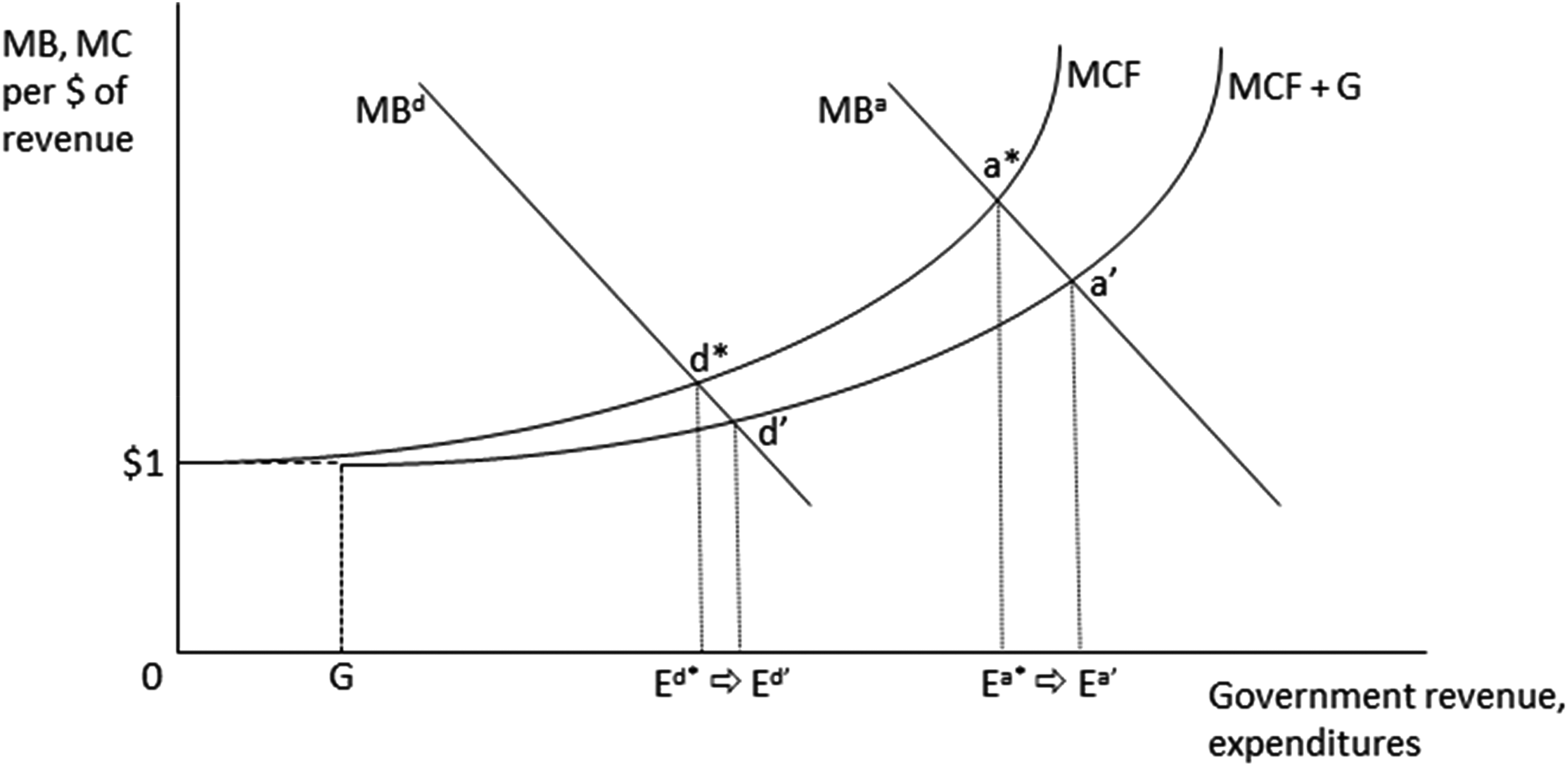
Optimal government taxing and spending
The MB curves intersect the MCF at different points. Point a* represents the equilibrium for an autocracy, and point d* represents the equilibrium for a democracy. At these points, Ea* and Ed* are the levels of government expenditures for an autocracy and a democracy, respectively. Thus, less democratic countries have larger marginal excess burdens and government expenditure equilibria higher up the MCF curve. The equilibrium levels show that as the degree of democracy rises, government expenditures fall, ceteris paribus.
When we apply the policy experiment of exogenous lump-sum aid, we shift the MCF curve to the right by an amount of aid, G, so the new MCF curve is MCF + G. We see that while both equilibria shift right, the equilibrium for autocracy shifts further in magnitude from its original equilibrium than the equilibrium for democracy. Thus, the impact of aid on expenditures is noticeably greater for autocratic governments than for democracies due in part to the shape of the MCF curve and the imposed marginal excess burden. Or, the difference in changes between equilibria occurs because the price effect from aid will be larger for higher MCF, which is consistent with Dahlby (2011). Furthermore, majority/plurality and proportional democracies that differ in terms of the fraction of people with political power will demonstrate various degrees of a flypaper effect with respect to aid. The model presented predicts that the flypaper effect is greater in countries with low levels of democracy, and the empirical analysis evaluates this prediction, providing estimates of the magnitudes of these differences.
A great deal of empirical evidence contradicts the predictions of Bradford and Oates' (1971) equivalence theorem. 6 Of the first to investigate this empirically, Henderson (1968) and Gramlich (1969) find that an additional dollar of personal income is associated with a $0.02 to $0.05 increase in government spending, while government spending increases $0.25 to $0.53 in response to an additional dollar of grants-in-aid. This empirical anomaly is known as the flypaper effect. More recently, Bailey and Connolly (1998) provide a comprehensive review of the flypaper literature and show that estimates for the effects of an additional dollar of general lump-sum grants on government spending range anywhere from $0.25 to $1.00. (See Table 1 on page 339 of Bailey and Connolly (1998).)
While most studies examine the flypaper effect as it relates to subnational government grants, some research examines the impact of foreign aid on government spending. Njeru (2003), for instance, studies the effect of foreign aid on government expenditures in Kenya. He finds that total official development aid given to Kenya significantly stimulates government expenditures. While Njeru does not specifically refer to this as flypaper behavior, it has the same interpretation. Van de Walle and Mu (2007) find that aid devoted to rural road rehabilitation in Vietnam stuck largely within that sector. For this very specific case, there is again evidence of a flypaper effect. Remmer (2004) is the first to consider many countries in her analysis and finds that foreign aid results in more government spending and thus a larger government sector. This paper expands on Remmer's analysis by further exploiting cross-country variation in foreign aid and contributing to the understanding of how democratic institutions influence the relationship between aid and government expenditures.
The effectiveness of foreign aid has been widely debated in the literature, and many of the existing studies highlight the extreme sensitivity of the analysis (based on econometric specifications, data availability, and removal or addition of observations). The literature considers two outcomes of foreign assistance: economic development and human development. Only more recently has the relationship between aid and human welfare been explored and findings suggest that aid is not an effective tool to increase overall health (Williamson 2008).
Regarding economic development, there is evidence that foreign aid is ineffective and does not increase economic growth (Bauer 2000; Boone 1996; Brumm 2003; Djankov, Montalvo and Reynal-Querol 2006; Easterly 2001; Easterly 2006; Easterly, Levine and Roodman 2003). There is a small literature that finds that, with good policies (Burnside and Dollar 2000) or if public goods are specifically allocated for development (Minoiu and Reddy 2010), aid can be effective in promoting economic development. These findings indicate that aid should be conditioned on good policy to increase economic growth and thus motivates the importance of political regimes in the discussion of foreign aid allocation.
Finally, extensions of this literature examine variations on the econometric specifications studied above including non-linearities, additional controls, and conditioning on other political variables. For example, Svensson (1999) finds that aid can have a positive impact on growth if the country is democratic; however, most aid does not flow to these countries. Collier and Dollar (2004) also claim that aid is conditionally effective. Guillaumont and Chauvet (2001) find that this relationship does not depend on good policy but on the vulnerability of the country. However, there is a literature that concludes the conditionality of aid on good policy is ambiguous or non-existent (Dalgaard and Hansen 2001; Hansen and Tarp 2001). Thus, the interaction between aid and politics deserves additional attention.
In this paper, we expand the empirical literature examining the response of government spending to income and grants-in-aid to an international setting where foreign aid from a donor country is given to the recipient country for development purposes. According to the equivalence theorem, recipient governments spend an equivalent amount of money from foreign aid as with domestic income. This hypothesis is tested against the flypaper effect that foreign aid stimulates government spending more than an equivalent increase in income. Different from government transfers from national to subnational governments, foreign aid is not financed by taxes on the same citizens and thus represents a true increase in community income. 7 From this perspective, flypaper behavior with respect to foreign aid provides more convincing evidence of its existence.
In addition, we follow Bae and Feiock (2004) and extend the analysis to include the effect of political institutions on flypaper behavior in an international setting which provides more institutional variation to offer insight into the mechanism driving flypaper behavior. In particular, countries that embrace democracy allow voters the power to hold elected officials accountable by effectively enforcing their “political contracts” with elected officials. In the least democratic countries, voters have less power to control Leviathan behavior of budget maximization (Niskanen 1968). Consequently, our model shows that the flypaper effect is most robust in least democratic countries. Furthermore, while the median voter model relies on majority voting, we examine how flypaper behavior depends on different electoral systems—i.e., proportional voting relative to majority/plurality voting.
Data and Empirical Methodology
Data
To determine the impact of foreign aid on public expenditures in developing countries, we collect data on 102 different countries for 50 years from 1960 to 2016. 8 We focus on countries most likely to receive foreign aid and split the sample into four categories defined by the Word Bank (see also Remmer (2004)): (1) low-income; (2) lower-middle income; (3) middle-income; (4) full sample (i.e., low, lower-middle, and middle-income). The dependent variable is general government consumption spending per capita (GovExp). Government consumption expenditures includes government current expenditures of goods and services (including employee compensation) and most expenditures on national defense and security.
The two explanatory variables of interest, foreign aid (Aid) and national income (Income), are defined as net Official Development Assistance per capita and gross national income per capita, respectively. 9 Our primary measure of foreign aid is defined as the sum of grants and disbursements of concessional loans (with a grant element of at least 25 percent) provided by official agencies minus repayments of the principal on previous loans. These loans made on concessional terms and/or grants are intended to further economic development and welfare in developing countries and territories (a list of recipients is decided by the Development Assistance Committee). Grants are defined by the Development Assistance Committee as “transfers made in cash, goods or services for which no repayment is required” (The OECD Glossary of Statistical Terms 2012). From this, we can infer that most Official Development Assistance takes the form of lump-sum grants as opposed to a grant with a matching component. Goods and services are valued at the cost to the donor (OECD 2019). Figures 2 and 3 show, respectively, the distribution of foreign aid across countries and the general rise in foreign aid over time.
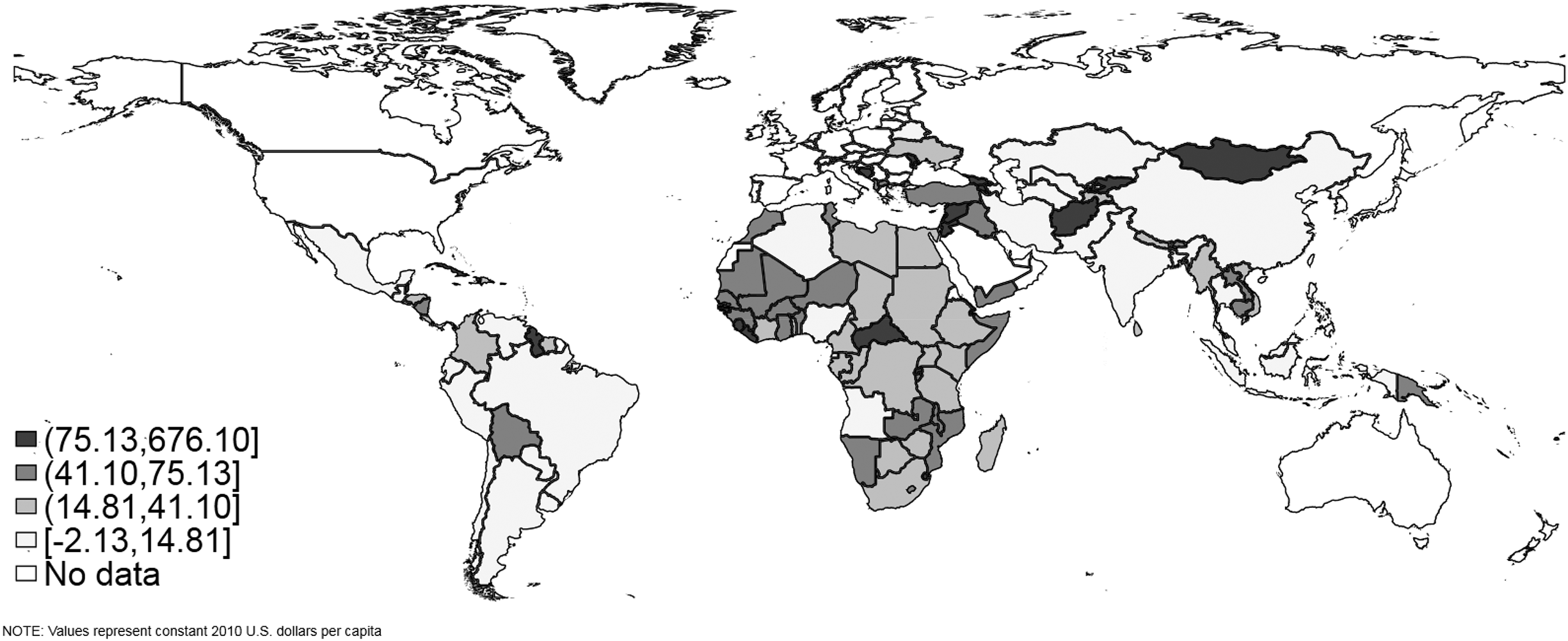
Net official development assistance and official aid received (Aid) average 1960 to 2016
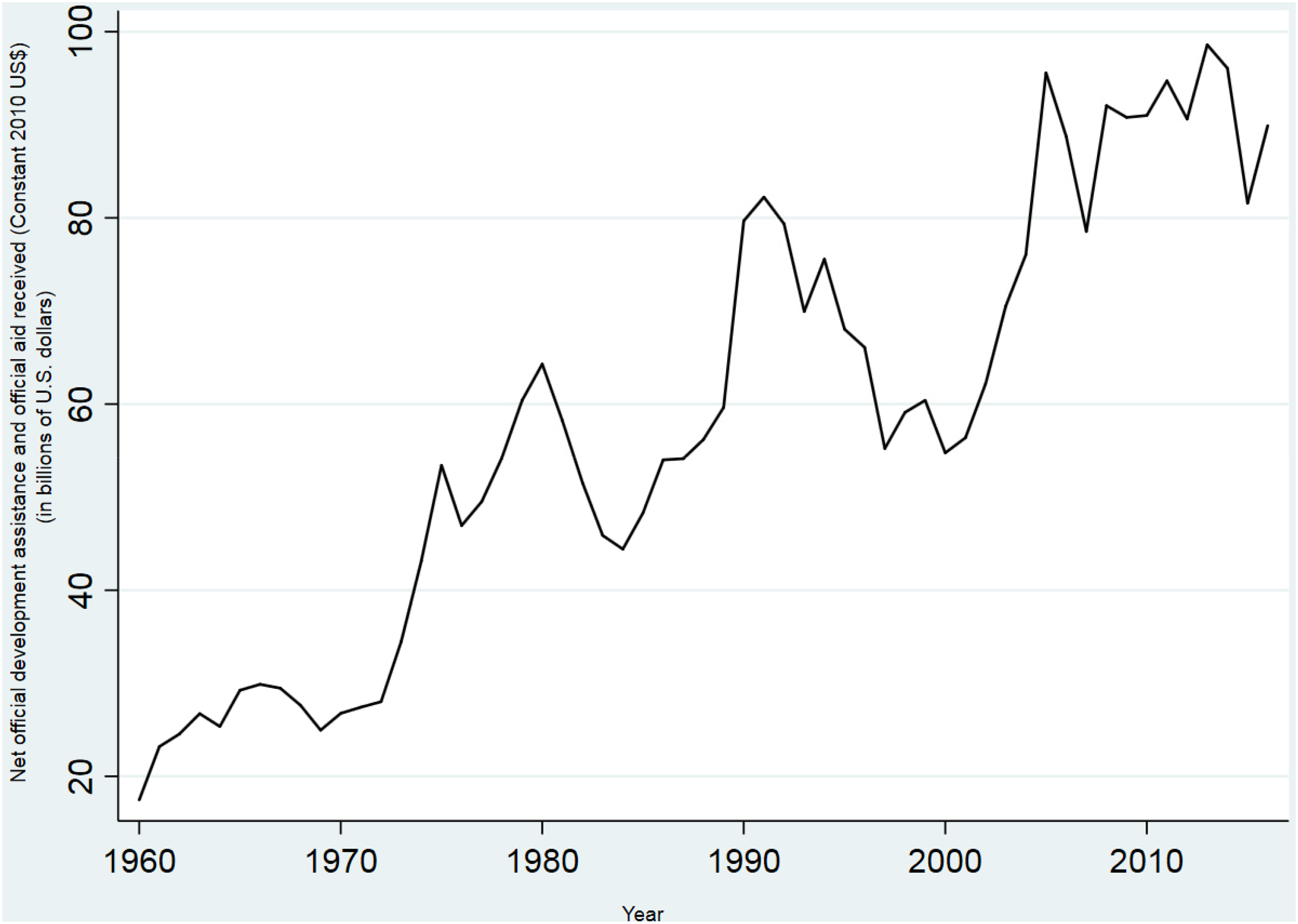
Net official development assistance and official aid received (Constant 2010 US$)
In order to control for other factors that influence government spending, we include several additional variables in the analysis. Because government spending likely responds to demographic shifts, we include age dependency and life expectancy. Urban areas have somewhat different demands for public goods and services; thus, we include population density to account for these unique aspects. Higher primary education enrollment increases government spending, while a more educated population raises awareness of the benefits (or dangers) of a larger public sector.
Finally, we control for political institutions that influence government spending by including an index for the degree of institutionalized democracy from the Polity IV Project. The index is measured on an additive scale from 0 to 10 with higher values denoting a higher degree of democracy. The index is based on three interrelated factors including the competitiveness of political participation, openness and competitiveness of executive recruitment, and constraints on the chief executive. According to Marshall and Gurr (2020, 14), democracy is based on “the presence of institutions and procedures through which citizens can express effective preferences about alternative policies and leaders”; “the existence of institutionalized constraints on the exercise of power by the executive”; and “the guarantee of civil liberties to all citizens in their daily lives and in acts of political participation.” Therefore, more democratic countries include institutions and procedures that allow citizens to express their preferences for alternate policies and leaders, possess constraints on the power of the executive, and guarantee civil liberties in daily life and political participation. See Table 1a for variable definitions and sources, and Table 1b for summary statistics.
Variable definitions and data sources
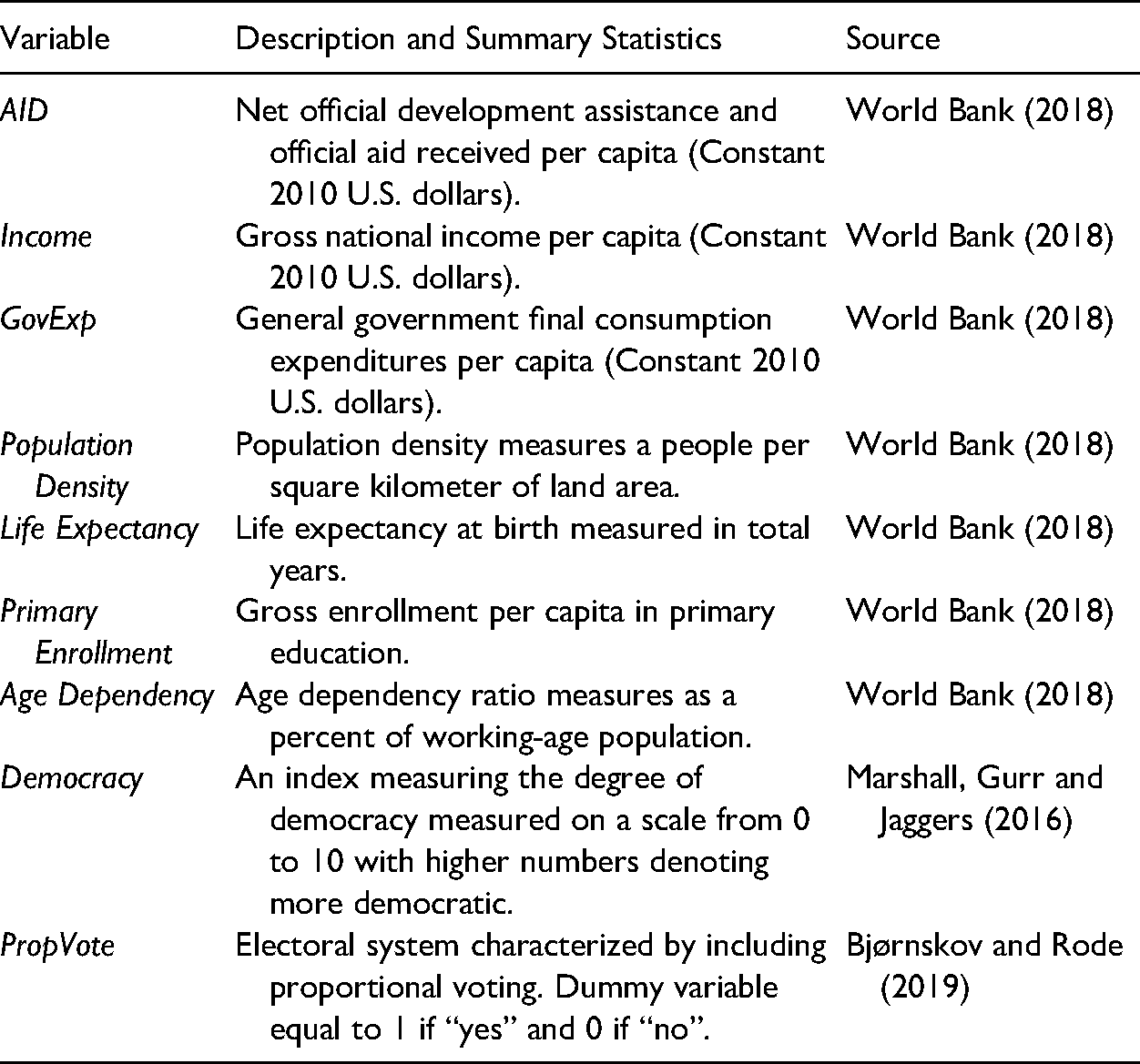
Summary Statistics
Notes: Summary statistics are based on annual observations from 1960 to 2016 for 102 countries. Nominal variables measured in current U.S. dollars are deflated by the U.S. GDP deflator (2010 = 100).
The international empirical model equivalent of the median voter's demand for public goods is:
In addition, we also consider the influence of political institutions on estimates of the flypaper effect. Countries with stronger democratic institutions give citizens more power to control the use of foreign aid through their elected officials; therefore, we expect to find that the flypaper effect is attenuated in more democratic countries. Conceivably, in democratic countries, citizens have more of a voice in the political sphere to control government spending (or the size of government). To investigate the effect of democratic institutions on the flypaper effect, we run the following augmentation of specification (4) including an interaction term between the level of democracy and aid and between the level of democracy and income:
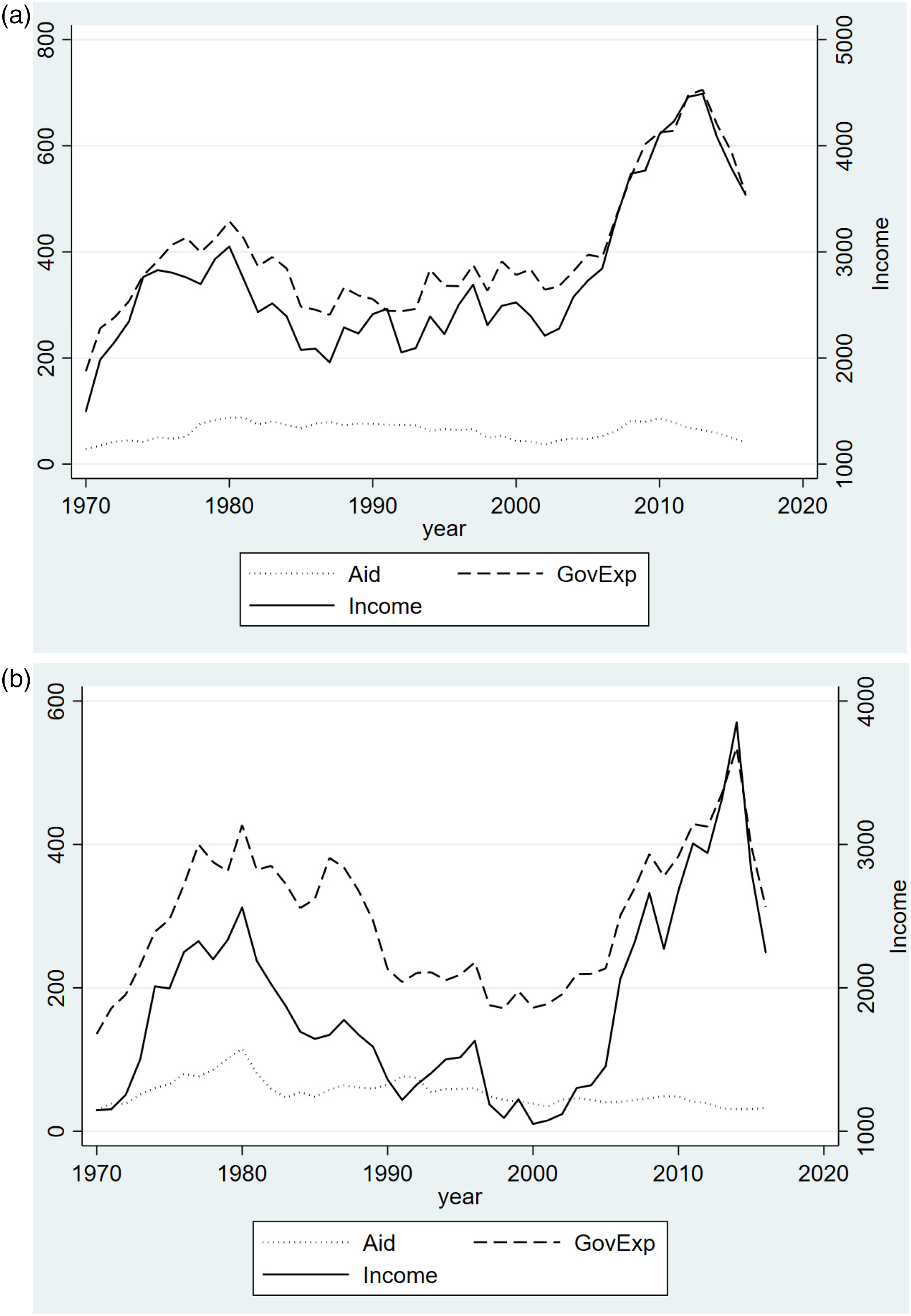
(a) High democracy countries. (b) Low democracy countries.
In equation (5), we test the equivalence theorem conditional on the degree of democracy where 

In addition, we also condition the effect of aid and income on the type of electoral system, because the median voter model relies on several assumptions such as majority voting. However, Bailey and Connolly (1998) note that many governments rely on proportional voting; therefore, we examine the influence of the voting system on the simulative effect of grants. To do this, we condition grants and income on the type of electoral system by replacing
The literature recognizes that problems of endogeneity can bias coefficient estimates of the marginal effect of foreign aid on expenditures (Chernick 1979). Therefore, to obtain consistent estimates of the model parameters, we use an instrumental variables (IV) approach. In the absence of any clear external instruments for foreign aid and income, we rely on “internal” instruments by using temporal lags (dated two years to five years back) of grants-in-aid and income as instruments (see Arellano and Bond (1991)). 11
To be “good” instruments, they must satisfy two conditions: (1) relevancy (i.e., highly correlated with the endogenous variable); and (2) validity (i.e., orthogonal to the errors). Lagged values of aid (income) are highly correlated (>0.85) with contemporaneous aid (income), and likely only effect contemporaneous foreign government spending through their effects on contemporaneous aid (income). However, to ensure that these are both relevant and valid, we report three diagnostic tests at the bottom of Tables 2 through 4 (for details, see Baum et al. (2007)). To test the relevancy of the instruments, the Kleibergen-Paap rk LM test is reported under the null that the instruments are not correlated with the endogenous variable. However, weakly correlated instruments can be problematic (see Stock and Yogo (2005)); therefore, we also report the Kleibergen-Paap rk wald test under the null that the instruments are only weakly correlated with the endogenous variables. 12 The validity of the instruments is tested using the Hansen J test under the null that the instruments are valid. Rejection of the former two tests and insignificance of the Hansen J statistic are evidence that the temporal lags are relevant and valid instruments.
Flypaper estimates; Dependent variable: Government Expenditures
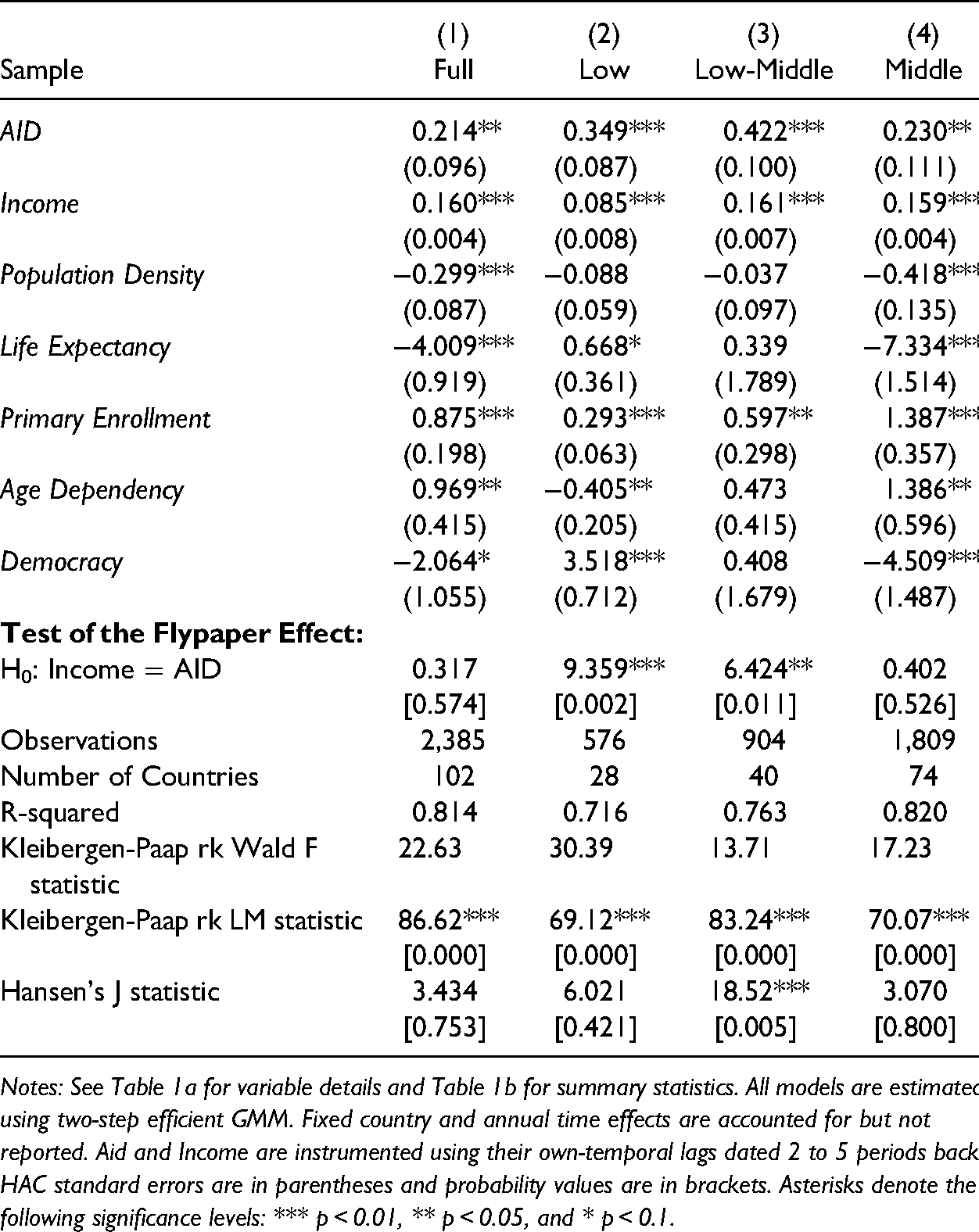
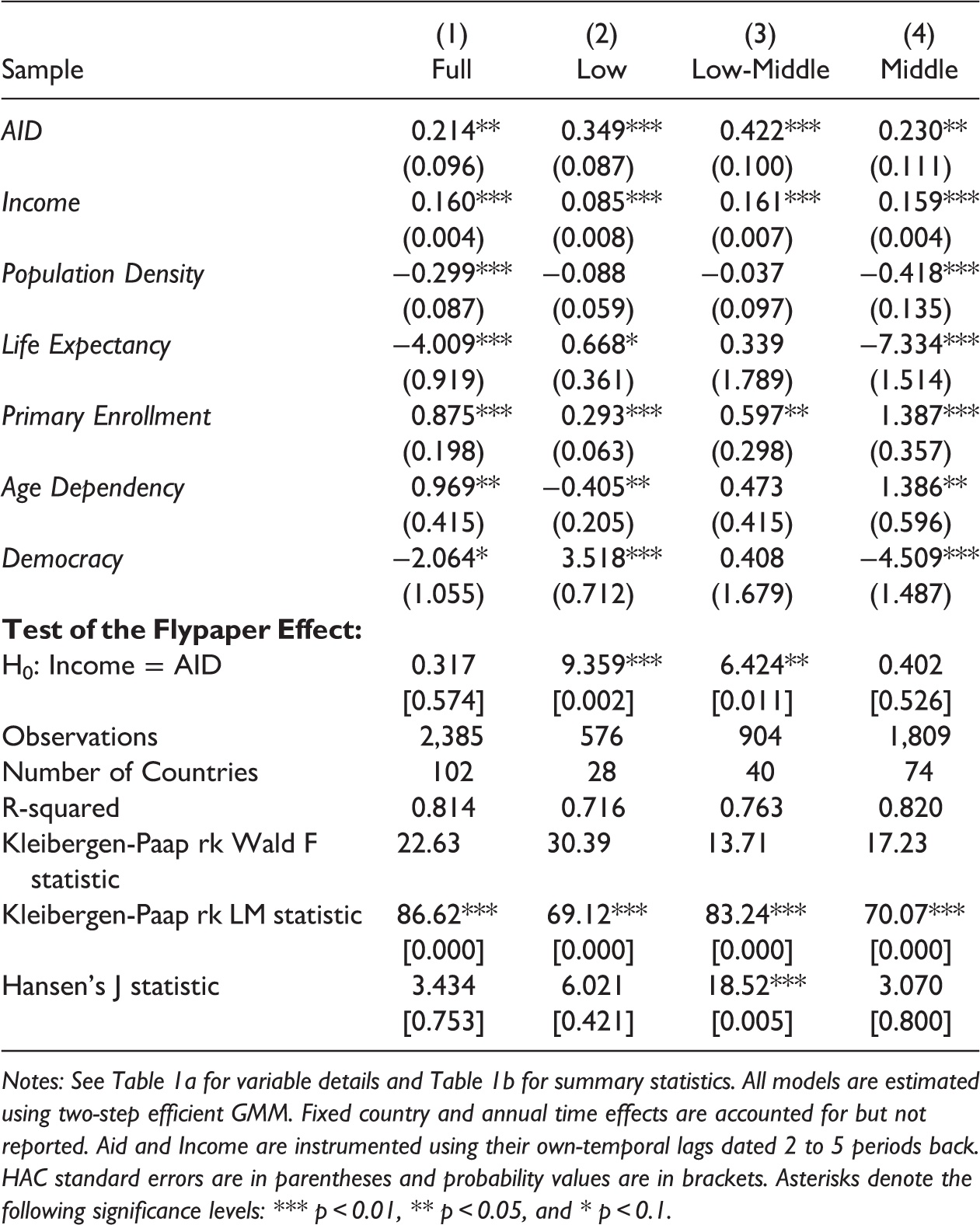
Notes: See Table 1a for variable details and Table 1b for summary statistics. All models are estimated using two-step efficient GMM. Fixed country and annual time effects are accounted for but not reported. Aid and Income are instrumented using their own-temporal lags dated 2 to 5 periods back. HAC standard errors are in parentheses and probability values are in brackets. Asterisks denote the following significance levels: *** p < 0.01, ** p < 0.05, and * p < 0.1.
Equations (4) and (5) are estimated using the two-step feasible efficient generalized method of moments (GMM) estimator (see Hayashi (2000)). 13 While the IV estimator is inefficient (but consistent) in the presence of heteroskedasticity, the GMM estimator employs orthogonality conditions that allow for a consistent and more efficient estimator in the presence of unknown forms of heteroskedasticity (Baum et al. 2003). 14
Baseline Results
Results from estimating equation (4) using two-step efficient GMM for each income category are in Table 2. The diagnostic tests reported at the bottom of Table 2 show that the instruments are both relevant and valid, except in column 3 the significant Hansen test suggests potential validity problems with the instruments in the low-middle income country specification.
According to the full sample reported in column 1, the propensity of the government to spend income is approximately $0.16 per one-dollar increase, and the propensity to spend from a one-dollar increase in aid is approximately $0.21. Consistent with the flypaper effect, governments spend more of foreign aid relative to the same increase in community income; however, a statistical test of the flypaper effect shows that these are not statistically different.
When the full sample is disaggregated, the results show that a one-dollar increase in income increases government spending anywhere from $0.09 (low-income countries) to $0.16 (low-middle income countries), whereas a comparable increase in aid stimulates government spending by $0.23 (middle-income countries) to $0.42 (low-middle income countries). While the coefficient on aid is greater than the coefficient on income across all models, tests of the flypaper effect reveal that the difference is statistically significant for low- and low-middle income countries. 15
Although the literature typically finds that income stimulates government spending in the range of $0.02 to $0.10 on the dollar, the higher simulative effect of income in lower-income countries is consistent with an expected higher marginal propensity to consume relative to the more advanced countries used in the literature. The simulative effect of foreign aid is roughly consistent with what is found in the literature with respect to the stimulative power of intergovernmental grants ($0.25 to $1.06). 16 In fact, this estimate is surprisingly similar to that found by Gramlich et al. (1973) who show that an additional dollar in federal grants stimulates local and state government spending by $0.43.
Turning next to the control variables, we find that population density negatively affects government spending across all samples, but it is significant in only the full and middle-income subsamples. It is conceivable that there are economies of scale in urban areas, lowering the cost of government services. Greater life expectancy negatively affects government spending in the full and middle-income samples; however, it is positive and significant in low-income countries. Countries with higher primary enrollments show a positive and significant effect on government spending across all samples. The effect of a larger age dependency on government spending is positive and significant in the full sample and middle-income sample and negative and significant in the low-income sample. Finally, government spending in more democratic nations is, on average, less in the full sample and middle-income sample and more in the low-income sample. Citizens are better able to control the growth of government using the power of democracy; however, in low-income countries there may be demand for government to focus on building productive institutions (e.g., a judicial system to secure private property rights). Although the influence (in sign, significance, and magnitude) of the control variables vary somewhat across the samples, the consistency (at least in magnitude) of the flypaper effect is noteworthy. 17
Overall, the results show that the flypaper effect exists in an international context where donor governments give grants-in-aid for economic development to recipient governments. In other words, money given to the public sector stays in the public sector even when aid has to travel overseas. From the perspective of the donor government, this means that the majority of the aid given to low-income countries is being used to increase the size of the public sector. Contrary to Fisher's (1982) argument that the flypaper effect is a product of failing to take into account general equilibrium issues of using taxes to finance grants, the results here suggest that this does not explain the full story and there must be other explanations, for example, differences in political institutions. It is possible that some foreign aid is not completely fungible. Thus, there would be no impact of this type of aid on government spending on other expenditures, and we would expect that overall government expenditures increase. However, if foreign aid specified for a particular public good is already provided, it could crowd out income-financed government spending. This overlap in provision is more likely to happen in countries with a high level of democracy, thus leading to a smaller flypaper effect in these nations. In order to better understand the underlying causes of the flypaper effect and test the predictions from our theoretical model, the following section focuses on estimates of the flypaper effect conditional on democratic and electoral institutions. If political institutions have a modifying influence on the flypaper effect, then this potentially biases the aid and income estimates reported in Table 2.
Political Determinants of the Flypaper Effect
Given that the anomalous flypaper effect transcends national borders, this section exploits the heterogeneity across countries to empirically examine determinants of the flypaper effect. As Inman (2008) suggests, a more promising explanation for the existence of a flypaper effect is the composition of political institutions. For instance, it is conceivable that lobbying higher-level governments or, in this case, developed countries (or agencies distributing foreign aid) for transfers is politically less costly than raising taxes. This idea is based on the citizen's being unable to write complete contracts with their elected officials.
One such political institution that influences how voter preferences are translated to public goods provision is democracy. Democracy allows citizens a voice in the political arena to incentivize elected officials to serve the interests of their constituents or risk being removed from office. Moreover, the median voter model assumes majority voting; however, other voting mechanisms (e.g., proportional voting) play a role in how government officials spend grant (or foreign aid) money. In the following two sub-sections, we condition the stimulative effect of foreign aid on the recipient country being a democracy (Section 4.2.1) and on the country having a proportional voting system (Section 4.2.2).
Democracy and the Flypaper Effect
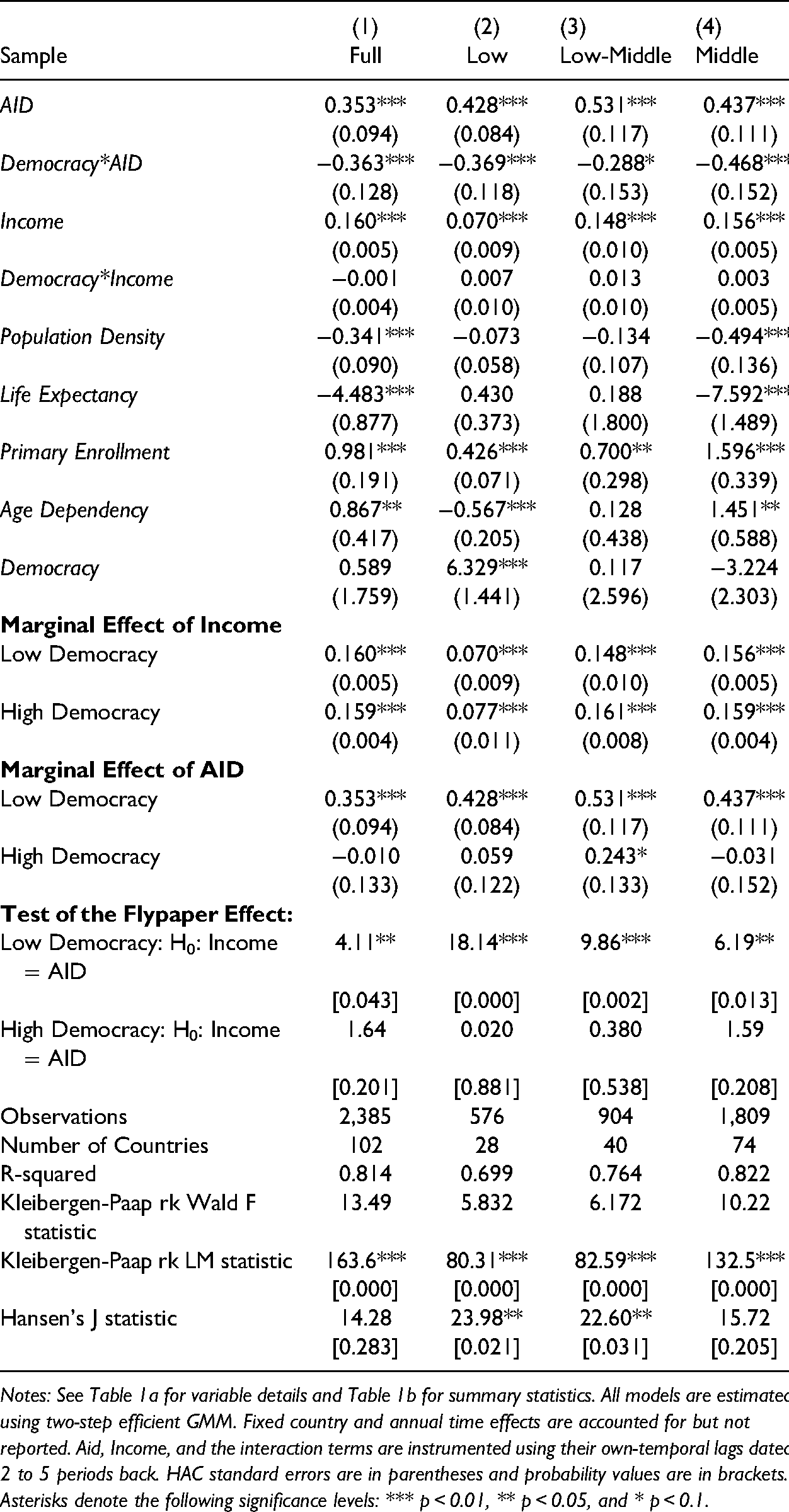
To better understand the mechanism driving the flypaper effect, estimates for equation (5) with democracy as the conditioning variable are reported in Table 3. The effect of income on government spending is approximately the same as in Table 2 and is relatively constant across degree of democracy. Interestingly, the simulative effect of aid on government spending varies significantly across levels of democracy. Specifically, when democracy is low, aid has the largest simulative effect on government spending ranging from a high of $0.53 (low-middle income countries) to a low of $0.35 (full sample). Remarkably, these values fall within the range of the flypaper effect found in the literature ($0.25 to $1.06). When democracy is high, aid has the smallest simulative effect on government spending ranging from a high of $0.24 (low-middle income countries) to a low of $-0.03 (middle-income countries). Moreover, it is interesting to point out that the effect of aid on government spending is statistically significant across all samples in low-democracy countries, yet statistically insignificant across all samples in the high-democracy countries (with the exception of the low-middle income sample).
Flypaper estimates: the effect of democracy; Dependent variable: Government Expenditures
Flypaper estimates: the effect of democracy; Dependent variable: Government Expenditures
Notes: See Table 1a for variable details and Table 1b for summary statistics. All models are estimated using two-step efficient GMM. Fixed country and annual time effects are accounted for but not reported. Aid, Income, and the interaction terms are instrumented using their own-temporal lags dated 2 to 5 periods back. HAC standard errors are in parentheses and probability values are in brackets. Asterisks denote the following significance levels: *** p < 0.01, ** p < 0.05, and * p < 0.1.
Turning to the tests of the flypaper effect, we find that the equivalence theorem is rejected in favor of the flypaper effect in all cases for countries with low levels of democracy, and we fail to reject the equivalence theorem in all cases among countries with high levels of democracy. These results confirm the predictions of our theoretical model and highlight the importance of democratic institutions in dictating how grant income is spent.
Electoral systems define how votes in a general election translate to seats won by parties and candidates (Reynolds, Reilly and Ellis 2005). Different electoral systems (e.g., plurality/majority, proportional, or mixed) induce different incentives for elected officials in how they respond to the electorate's demands (for a detailed discussion see Reynolds, Reilly and Ellis (2005)). For instance, Lizzeri and Persico (2001) show that desirable public goods are provided less often in a winner-take-all system compared to a proportional system. Likewise, using cross-country data from around 1990, Persson and Tabellini (1999) show support (albeit weak) for the prediction that majoritarian elections are associated with less public goods. Conceivably, these differences in electoral systems and their underlying incentives may translate to how governments respond to increases in grants. In our sample, roughly 39 percent of the countries have a proportional voting system. Specific to our case is that the median voter model assumes majority voting; therefore, the relevant question is: does the flypaper exist under different electoral systems?
To address this question, we condition grants on the type of electoral system by replacing democracy in equations (5), (6), and (7) with a dummy variable equal to one for proportional voting and zero otherwise (PropVote). The results, reported in Table 4, show that the marginal effect of aid is positive and statistically significant for countries with non-proportional voting systems (i.e., either majority/plurality, other or mixed). Yet, the effects of aid are insignificant for countries with proportional voting (except low-income countries).
Flypaper estimates: the effect of electoral systems; Dependent variable: Government Expenditures
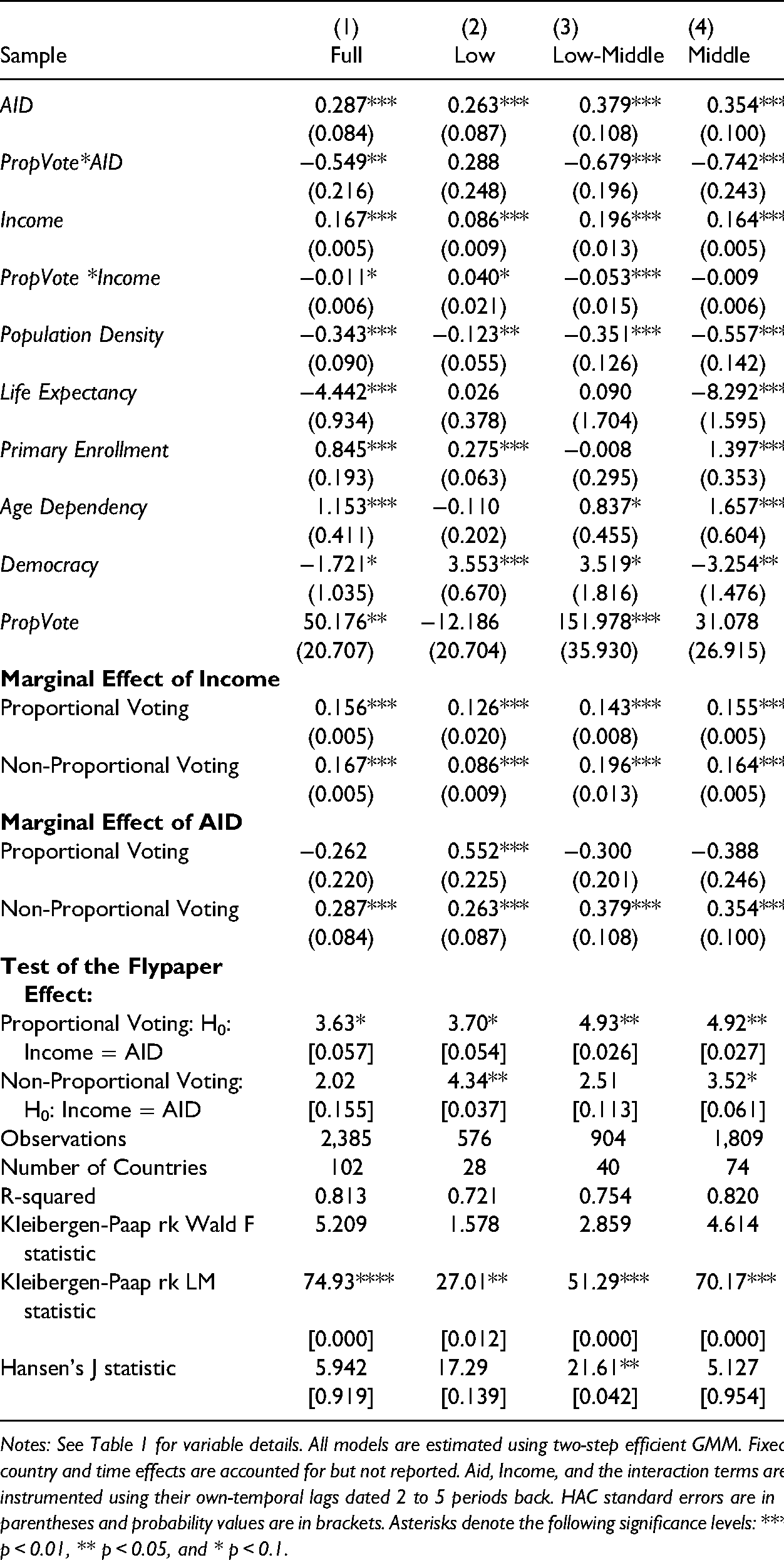
Flypaper estimates: the effect of electoral systems; Dependent variable: Government Expenditures
Notes: See Table 1 for variable details. All models are estimated using two-step efficient GMM. Fixed country and time effects are accounted for but not reported. Aid, Income, and the interaction terms are instrumented using their own-temporal lags dated 2 to 5 periods back. HAC standard errors are in parentheses and probability values are in brackets. Asterisks denote the following significance levels: *** p < 0.01, ** p < 0.05, and * p < 0.1.
Overall, the results suggest that the flypaper phenomenon is conditional on political institutions and can be explained by the level of democracy and electoral system within a country. In particular, countries with low levels of democracy show significant evidence favoring the flypaper effect. In other words, countries with more competitive political participation with open and competitive executive recruitment and constraints on the chief executive are more likely to have governments that spend increases in community income the same—whether it came from foreign aid or the private sector. If citizens are able to enforce their contract with their government through the democratic process, then elected officials are better held accountable and more likely to spend income consistent with voter preferences regardless of its origin. 18
As discussed by Weingast (2006), democracy alone is not sufficient to sustain the rights of the citizens. Democracies are embedded with complementary institutions and norms that may allow elected officials to abuse their power without proper accountability measures in place. Indeed, we show that the flypaper effect is also conditional on the electoral system. That is, proportional systems show limited evidence of flypaper behavior, whereas, other voting systems including majority/plurality show evidence consistent with flypaper effects. These results offer a glimpse of some possible explanations of flypaper behavior.
In this paper, we examine the stimulative effect of foreign aid given to recipient countries. We find strong empirical evidence for a flypaper effect as it relates to foreign aid given from donor to recipient countries. In particular, our results show that the marginal propensity to spend from gross national income is between $0.09 to $0.16 out of every dollar, and this remains robust across samples. In contrast, one dollar in aid stimulates government expenditures in the range of $0.21 to $0.42. These estimates are remarkably consistent with the current estimates in the flypaper literature. Moreover, formal testing of the flypaper effect significantly rejects the equivalence theorem in favor of the flypaper effect in low- and low-middle income countries. This result provides more convincing evidence of flypaper behavior given that foreign aid is not financed by taxes on the recipient government's citizens, and therefore, can be considered a pure income effect. This paper contributes to the current literature by revealing that the flypaper effect transcends national borders and arises when foreign aid is given to recipient countries.
To better understand the mechanism for the large stimulative effect associated with foreign aid and test the predictions from our theoretical model, we condition grant stimulus on differences in political institutions that influence spending of aid. We find that countries with low levels of democracy exhibit a larger flypaper effect, whereas countries with high levels of democracy spend an equivalent amount regardless of whether the increase in income is from its citizens or foreign aid. Furthermore, we find, dependent on the level of development, that proportional voting systems show little evidence of the flypaper effect, while majority/plurality (among others) do show signs of flypaper behavior. These results highlight the importance of political institutions in explaining flypaper behavior.
Understanding how aid is spent is important as money allocated to public goods for development could significantly increase economic growth in these countries (Minoiu and Reddy 2010). However, the growth in the public sector as a result of foreign aid could potentially infringe on market-orientated reform and decrease the incentive for citizens to monitor government (Brautigam 1992; Knack 2001; Remmer 2004). However, it is also important to recognize the shortcomings of this analysis. Endogeneity is a formidable barrier to identification and while we attempt to mitigate its effects, improvements in this area are encouraged. For example, identifying unique natural experiments would be useful in circumventing endogeneity issues. Further, the analysis is limited to government consumption expenditures. As newer more refined cross-country data become available, it would be interesting to test for evidence of the flypaper effect by disaggregating across various spending categories. We leave these questions for future research.
Footnotes
Acknowledgements
We would like to thank William Hoyt and David Wildasin for comments and suggestions on an earlier draft of this paper. All errors and omissions are our own.
Declaration of Conflicting Interests
The author(s) declared no potential conflicts of interest with respect to the research, authorship, and/or publication of this article.
Funding
The author(s) received no financial support for the research, authorship and/or publication of this article.

Notes
Appendix
Country list Notes: n = 102 countries. * denotes low-income countries and # denotes lower-middle-income countries.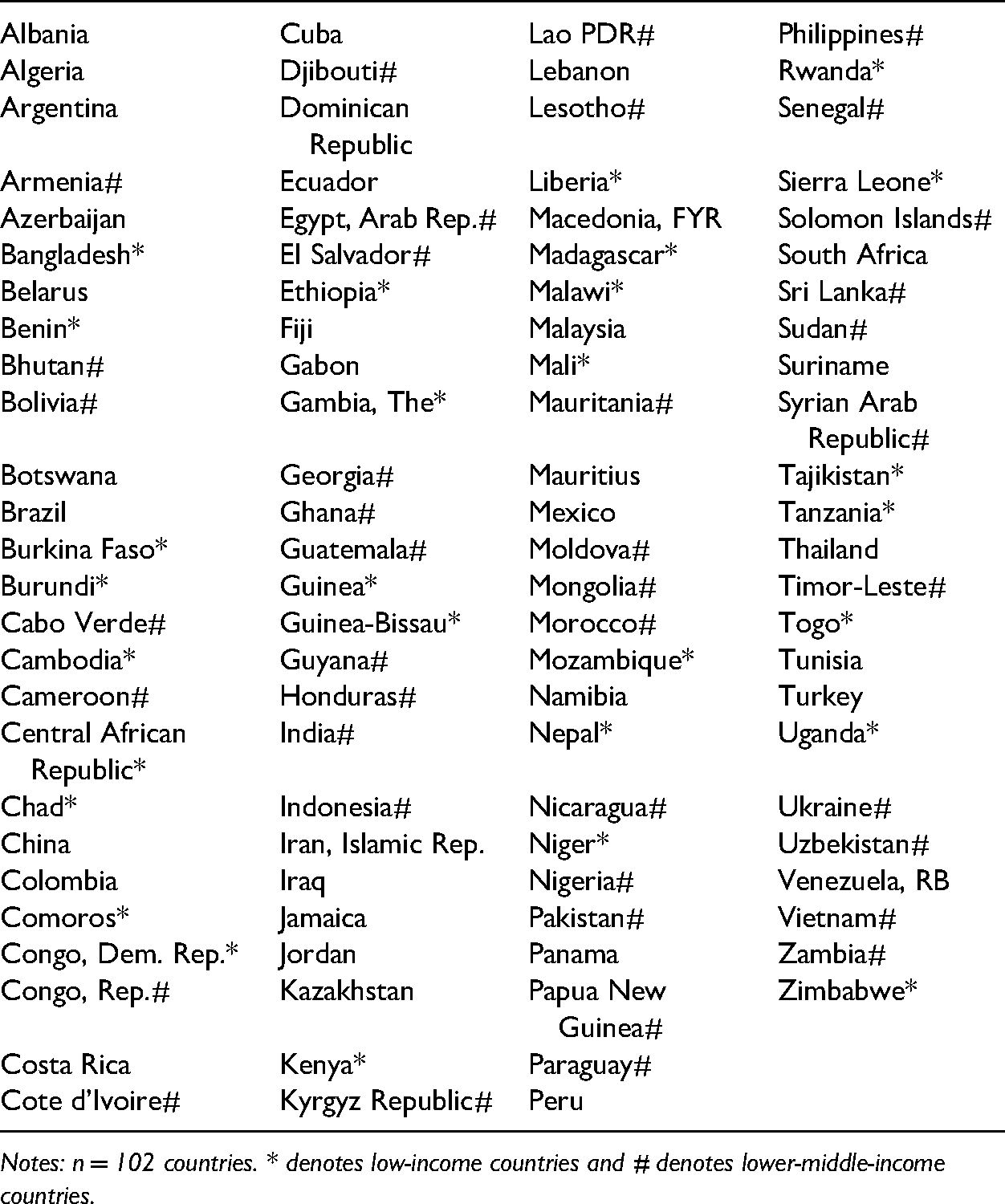
Albania
Cuba
Lao PDR#
Philippines#
Algeria
Djibouti#
Lebanon
Rwanda*
Argentina
Dominican Republic
Lesotho#
Senegal#
Armenia#
Ecuador
Liberia*
Sierra Leone*
Azerbaijan
Egypt, Arab Rep.#
Macedonia, FYR
Solomon Islands#
Bangladesh*
El Salvador#
Madagascar*
South Africa
Belarus
Ethiopia*
Malawi*
Sri Lanka#
Benin*
Fiji
Malaysia
Sudan#
Bhutan#
Gabon
Mali*
Suriname
Bolivia#
Gambia, The*
Mauritania#
Syrian Arab Republic#
Botswana
Georgia#
Mauritius
Tajikistan*
Brazil
Ghana#
Mexico
Tanzania*
Burkina Faso*
Guatemala#
Moldova#
Thailand
Burundi*
Guinea*
Mongolia#
Timor-Leste#
Cabo Verde#
Guinea-Bissau*
Morocco#
Togo*
Cambodia*
Guyana#
Mozambique*
Tunisia
Cameroon#
Honduras#
Namibia
Turkey
Central African Republic*
India#
Nepal*
Uganda*
Chad*
Indonesia#
Nicaragua#
Ukraine#
China
Iran, Islamic Rep.
Niger*
Uzbekistan#
Colombia
Iraq
Nigeria#
Venezuela, RB
Comoros*
Jamaica
Pakistan#
Vietnam#
Congo, Dem. Rep.*
Jordan
Panama
Zambia#
Congo, Rep.#
Kazakhstan
Papua New Guinea#
Zimbabwe*
Costa Rica
Kenya*
Paraguay#
Cote d'Ivoire#
Kyrgyz Republic#
Peru