







Abstract
There is a well-documented “natural resource curse” whereby the presence of immobile natural resources leads to weaker economic performance and a deterioration in the quality of economic institutions and governance. We propose the novel hypothesis that a similar curse exists for historic resources such as the Egyptian Pyramids, Roman Colosseum, and Gettysburg Battlefield. These captive wealth-producing resources are also immobile and cannot flee from oppressive or inefficient government policies, enabling governments to levy high taxes, impose burdensome regulations, and expropriate property for preservation. Historic resources are therefore also associated with weaker economic performance, increased government corruption, and lower economic freedom.
Introduction
In this paper, we propose the novel hypothesis that historic sites result in an institutional and economic curse—which we term the curse of historic resources. We build upon the existing resource curse literature that documents the presence of a negative link between the presence of fixed (immobile) natural resources and economic performance, first identified by Sachs and Warner (2001). Although our curse of historic resources theory does share some of the same causes, we believe there are several additional channels through which historic resources create an even stronger negative effect on governance, institutions, and economic activity.
Since the time of Smith (1976 [1776]) economists have known of the strong link between the quality of institutions and economic growth and prosperity. 1 The development of various indices of economic freedom in the past few decades has now allowed this relationship to be tested and confirmed empirically. We now know that better institutions, as measured by higher levels of economic freedom, are associated with numerous beneficial outcomes such as higher per capita income, faster economic growth, improved health and happiness, and higher rates of productive entrepreneurship. 2
Although it is now firmly established that institutions matter, we know considerably less about what factors drive the quality of institutions—that is, why some areas have better institutions than others. 3 Acemoglu, Johnson and Robinson (2001), for example, argue that a country's colonial or legal origins play a significant role in shaping a country's future institutions through examination of European and African countries. One major issue with this line of reasoning, however, is that colonization (and thus the associated legal system) is not exogenous to preexisting resources. Colonizers (and migrants as well) chose specific geographic areas to invade, capture, and colonize based on the fact that those specific areas had resources, either natural or historic, worth capturing or utilizing. The “New World” of North America held out the promise of abundant natural resources for European empires of the 15th century, while Egypt's numerous historic landmarks made it a desire of many empires and rulers from Alexander the Great to the Byzantine Empire. 4 Thus, colonization and legal origins are not exogenous but rather determined by existing resources. This presents a logical and empirical problem for the legal origins literature that is frequently overlooked by its proponents. Recognizing it, however, shifts the focus of explaining institutional differences across areas into examining differences in underlying resource structures.
The literature has identified a clear negative correlation between the presence of immobile natural resources and economic performance across countries (Sachs and Warner 2001; Frankel 2010; Azhgaliyeva 2018). Although there are several possible causal reasons behind this relationship, one of the most prominent explanations is the “institutional channel” in which the presence of immobile wealth-producing natural resources causes a decline in the quality of institutions through actions such as rent-seeking, corruption, and attempts to use the political process to extract and redistribute the wealth and income associated with the fixed natural resources (Mehlum, Moene and Torvik 2006). 5 The economic returns that accrue to these valuable resources, and the associated capitalized asset values, are immobile—they cannot exit, or “vote with their feet”—and are therefore prime candidates for expropriation through both illegal means (corruption and violence) and redistributive government policies (through taxes, regulation, and property rights restrictions and seizures).
The empirical literature employing international data has found areas with captive natural resources have higher taxes and regulation, less secure property rights, increased corruption, increased propensity for violent conflict, reduced bureaucratic quality, diminished political rights, and lower levels of economic freedom (Mehlum, Moene and Torvik 2006; Campbell and Snyder 2012; March, Lyford and Powell 2017).
A similar negative relationship has also been found to exist between natural resources and weak economic performance at the U.S. state level (Papyrakis and Gerlagh 2007). More directly, O’Reilly and Stansel (2017) provide the first examination of the relationship between natural resource (oil) abundance and institutional quality at the state level, and one of our subsequent empirical analyses is based on extending their model and data to account for historic resources.
Our novel hypothesis is that because historic sites also produce immobile economic returns, they too can result in an institutional and economic curse. Our hypothesis predicts that places with substantial historic resources will have more corruption, worse institutional quality, and weaker economic performance. The key link in the analogy with the traditional resource curse literature is that these income and wealth-producing historical areas are also immobile and ripe for political expropriation. Historic sites such as the Roman Colosseum, Egyptian Pyramids, and Gettysburg Battlefield, and even the historic districts in U.S. cities such as Charleston, Savannah, Philadelphia, and New Orleans, are examples of the types of historic resources we have in mind. Like immobile natural resources, historical resources also cannot flee inefficient or oppressive government policies. This enables governments in these historic jurisdictions to levy higher taxes, impose burdensome regulations, and expropriate property for cultural historic preservation, leading to worse economic institutions and the potential for increased government corruption and worse bureaucratic quality—the same outcomes as with captive natural resources.
We begin by outlining the channels through which historic resources may translate their curse into specific types of government policies and provide several real-world examples. We believe the curse of historic resources is likely stronger than the curse of natural resources as there are several additional, unique channels through which negative economic and institutional effects may occur in the case of historic resources. We then provide some data that are supportive of our hypothesis at both the U.S. state and international level. We conclude with some interesting implications for the tourism literature that has found mixed results on economic growth, based on applying our hypothesis to historic tourism, and why the economic outcomes may be worse in those areas than in areas with nonhistory-related (e.g., beach) tourism.
The Channels of the Curse
There are many channels through which institutions and economic activity may suffer in the face of significant historic resources. The nature of these historic locations and their associated income flows allows for extensive regulations and other perverse policies that far exceed the level of intervention present in nonhistoric areas. In this section, we describe some of those channels. Although a few are the same as applied to natural resources, we believe there are several additional channels in the case of historic resources that have the potential to make the curse of historic resources more severe than the curse of natural resources.
Excessive Taxation: Public Choice Meets Public Finance
Even in the traditional public finance framework, there are reasons to expect higher levels of taxation on immobile (captive) natural and historic resources. A social welfare maximizing, benevolent dictator would follow the Ramsey (1927) rule and levy higher tax rates on those items that create the least deadweight loss per dollar of revenue—that is, those with the most inelastic response to the levying of the tax. Because of immobility, the income associated with an oil field, or equivalently the Egyptian Pyramids, is less sensitive to the tax rate—and under the Ramsey rule should be subject to a higher tax rate to minimize the deadweight loss of taxation.
Decades of more recent research in the field of public choice have, however, led to the conclusion that government does not act as a benevolent dictator to maximize social welfare. The reason these items may be more heavily taxed likely is not the result of a deliberate attempt to minimize the deadweight loss of taxation. Rather individuals in government are self-interested; and the tax structure in the real world is a complex function and outcome of the political, collective decision-making process, as is argued by Buchanan (1979) and Holcombe (1998). Somewhat ironically, the Brennan and Buchanan (1980) Leviathan model of government produces “politically” optimal, revenue-maximizing tax rates that also mirror the Ramsey outcomes in that tax-inelastic sources are taxed at higher rates to maximize tax revenue. 6
Thus, regardless of whether the government is a purely benevolent social welfare maximizing entity from the public finance literature or a Leviathan revenue-maximizing government from the public choice literature, one would expect to witness higher tax rates and a more burdensome tax structure in areas with either immobile natural or historic resources because of the greater inelasticity of the equilibrium quantity to the tax rates and/or compliance costs imposed.
The key link in this creating a larger and more relevant economic problem is that because taxation follows political boundaries, having these types of activities in a political jurisdiction means the rest of the economic activity in the jurisdiction, in other industries, and in surrounding geographic areas, is often subjected to these same higher tax rates which more generally reduces wealth creation and entrepreneurship, and retarding prosperity.
For example, Charleston, South Carolina is a metro-area is comprised of the City of Charleston as well as several surrounding municipalities such as the cities of Mount Pleasant, North Charleston, and Summerville. Like many other areas with high levels of historic tourism, the City of Charleston, in an attempt to export its tax burden, has imposed accommodation, property, and sales taxes at much higher rates than in surrounding cities (up to three times higher). 7 Although many tourists and businesses are willing to pay these higher prices to stay or locate in the actual historic district in downtown Charleston, the problem is these higher rates are city-wide and thus also apply to the city suburb of West Ashley that is within Charleston City limits but far away from the actual tourist historic district. This has created a situation where the suburb of West Ashley is a high tax area because it lies within the same political boundaries as the historic district and thus has a large economic disadvantage when competing for businesses and residents relative to the other (equally distant) suburbs, like Mount Pleasant, that are different political jurisdictions with no historic district and lower taxes (and regulations, which we will discuss momentarily).
Stationary Bandits, Rent Extraction, and Corruption
When a resource generates nontransferrable and immobile income or wealth that is specifically tied to that resource, it becomes a target for expropriation. This expropriation may take illegal forms such as outright theft, corruption, and violence or may occur through existing legal and political institutions. These redistributive government policies can take many forms, including taxes, regulation, and property rights restrictions and seizures. In turn, these higher taxes, worse regulations, and less secure property rights, not only retard other nonresource-related economic activity in the jurisdiction but also create opportunities for increased government corruption and bribes as individuals attempt to skirt these onerous policies. 8 Thus, one common finding in the existing literature on the curse of natural resources is a worse quality of governance and more corruption.
The idea that “extractive” governments arise in areas of stationary wealth to fund their activities by expropriation is now a fundamental idea in the literature regarding the formations of governments and societies (Davidson and Potts 2017). The argument is that roving bandits seek to conquer, take, and destroy, while stationary bandits establish themselves and provide protection in return for tribune, and have some incentive to ensure the economic activity they skim is protected and continues. However, rather than the government simply being a passive participant expropriating its share of the flow of rents from these fixed resources, the rent extraction literature following the work of McChesney (1987) suggests that governments are not simply passive actors. They credibly threaten firms, individuals, and resources with unfavorable policies to maximize their opportunity to extract rents.
The argument outlined in this subsection is the more traditional explanation of the institutional channel of the natural resource curse. With immobile resources, governments attempt to extract rents through taxation, regulation, and restrictions and seizures of property rights. This can lead to increases in corruption, higher levels of bureaucracy, and worse quality of governance. These worse economic and political institutions then retard wealth creation across the entire political jurisdiction across all industries in a manner similar to the one detailed by the example in the previous section.
Compounding Regulations and Institutional Sclerosis
As has been quoted in various forms by many individuals from Milton Friedman to President Ronald Reagan and Utah Senator Wallace Bennett, there is nothing as permanent as a temporary government program. 9 The larger point is that once a government program or regulation is put in place, it is often difficult to remove even once it is no longer needed. The many unnecessary New Deal programs that remain in place and the permanence of the transportation security responses to the terrorist attacks of September 11, 2001, fit into this category. Peacock and Wiseman (1961, 1979) and Higgs (1987) propose a ratchet theory of government growth in which temporary government programs that are enacted in response to major crisis events become permanent, thereby providing an explanation for government growth.
Regulations suffer the most from this compounding phenomenon, and it is one of the reasons why one of the most important ingredients for a well-functioning regulatory code is the presence of sunset provisions that automatically cause regulations to expire if not renewed. 10
Whether it is outdated regulations or continuing government programs, the point is that with the passage of time, government spending and rules tend to compound and grow. Why this is important for the current paper is that historic sites exist precisely in historic areas—meaning that the governments that exist in those places have generally been there for a longer period of time. Thus, areas with historic resources tend to have older governments with more historic policy overhang that also, independently, broadly negatively impacts economic performance.
This time-based accumulation can also happen through interest groups that influence government policy. As is as described by Olson (1982), if entrenched interests in the political process grow stronger through time under stable governments and become vested, the accumulation of these groups leads to more government intrusion in markets and weaker economic performance through time. Olson (1982) terms this institutional sclerosis. Historic areas may have governments with more entrenched interest groups, and worse government policies for this reason as well.
Thus, because areas with significant historic resources will tend to have governments that existed for a longer length of time, they will suffer economically from more compounded regulations and institutional sclerosis than nonhistoric areas. This is one source of the economic curse that historic resource areas have that would not necessarily be present for areas with only natural resources.
At Any Cost–History Is “Priceless”
Property restrictions and regulations on historic sites prevent the owners from employing those resources in the most profitable ways, often deliberately. For example, historic districts often have regulations on building height and density, and zoning rules prohibiting many activities. Some outright prohibit changes or demolition and replacement. In some cases, these rules create opportunities for corruption as individuals seek to pay regulators or enforcers to ease or overlook the barriers in place (Dutta and Sobel 2016). In other cases, they lead to costly secondary effects and unintended consequences.
Perhaps surprising to most economists unfamiliar with the topic, historic preservation regulations are, by law, supposed to be conducted and implemented without regard to economic cost–benefit analysis. These standards have been upheld all the way to the U.S. Supreme Court based on claims that the need for preservation of “significant” historic sites is worthy even in cases where it reduces overall economic activity or the efficiency of resource use. Kazam (2017) provides a complete legal and historical analysis of this issue and also estimates the enormous excess costs of these mandates. As is best stated by Kazam (2017, p. 429), “preservation has become pervasive, freezing the development of vast neighborhoods filled with undistinguished buildings… preservation commissions tend to focus on the benefits of saving old buildings rather than the costs.” Proponents of preservation often have the upper hand in both the political and legal system based on claims that the benefits of preservation (including educational opportunities, tourism, community/civic identity, and city aesthetics) are immense and hard to measure.
Thus, regulations that govern historic areas are often considerably more onerous and costly than those in other areas and are enacted without consideration of the benefits relative to the costs. It is important to clearly stress that these regulations are inefficient, and income and wealth destroying, by design. Governmental regulations and laws are put in place to prevent outcomes that would otherwise exist based on market profit and loss. They are intended to keep a historic home from being torn down to build a hotel, for example, and only exist and bind the market in cases where the hotel would indeed be a more efficient use of the property and generate more income and wealth. By their very design, these historic preservation laws intentionally reduce the economic efficiency of asset allocation, reducing income and wealth relative to nonhistoric areas to achieve other goals favored by those with political power. This is an additional economic curse historic areas have that does not exist simply for the original natural resource curse. The property in a historic area simply cannot follow market profit and loss signals as easily and produces a lower income flow for the area as a result.
Should History Be Privately or Publicly Owned?
There exist many legal and social arguments claiming that important historic artifacts, documents, monuments, buildings, and shipwrecks should not be allowed to be privately owned at all for fear of improper preservation and lack of public access. For example, in 2009, the state of Maine challenged a private owner's claim to an original copy of the Declaration of Independence. 11 Shipwrecks from the Titanic to the Lusitania, as well as a major wreck discovered by the private for-profit company Odyssey Marine Exploration, Inc., have also been challenged, many being overturned in favor of the public (government) ownership (Curfman 2008). Simply put, ownership of a historic building or artifact comes with a substantial risk of expropriation.
Although economic theory might suggest private ownership is the best means of ensuring preservation, the ambiguity of the value of these items gives the arguments merit in both public opinion and courts of law. In many locations, even digging up a historical artifact in your backyard, from an arrowhead to a dinosaur bone, results in the item becoming government (public) property. In addition, finding such an item, or ancient human remains, which is not uncommon in historic areas, can result in major interventions of government agencies on the property. 12
Interventions into property rights based on arguments of historic value and public purpose result in the property rights to historic items, including historic sites and the land surrounding historic areas, being more risky and less secure from public expropriation. This weakens property rights and creates risk, both of which can directly reduce economic activity and wealth creation in historic areas, adding yet another reason for a historic resource curse to develop. This property right intervention effect is also above and beyond the effects that are also common to natural resources, worsening the degree of the curse on historic resources.
Frictional and Structural Unemployment
Market economies are characterized by ongoing processes that Schumpeter (1942) termed creative destruction. There is a constant churning as new products and businesses replace old ones. There can be many reasons for the disruptions such as technological change (online movie streaming displacing movie rental stores), competition from more efficient producers, or consumer preferences shifting from some items toward others. Regardless of the cause, a market economy is in a constant state of reallocating resources from old to new uses. All economists will be familiar with the idea that in labor markets human capital can be underutilized and unemployed due to these changes for both frictional and structural reasons. That is, it takes time for resources to be repurposed due to information and matching (frictional unemployment); and there are also cases where old resources do not translate well to new needs (structural unemployment). Our argument is that this same transitional unemployment logic interestingly applies in an economically meaningful way to physical capital (e.g., buildings) in historic areas.
Because historic resources are subject to significant regulations, they often require numerous government permissions to do even minor improvements or renovations. 13 In some cases, these rules outright prohibit numerous possible changes to the structure or land. Thus, historical capital can be left unemployed for substantial periods due to either the time required to get the permissions to move the resource from one use to another—somewhat analogous to a process of frictional unemployment of labor or due to a complete mismatch between the original facility and current business opportunities that cannot be overcome due to rules prohibiting alterations—somewhat analogous to a process of structural unemployment of labor.
For example, an undistinguished 1970s gas station was somewhat randomly placed within the boundaries of the New York City Landmark Commission's SoHo historic district, preventing the owner's plans to redevelop the property into a mid-rise condo development. 14 The owner even needed a lengthy city approval to install new doors on an equipment shed on his property. Despite the fact that the gas station was no longer profitable, and had gone out of business, the historic designation prevented the resource from being properly and efficiently reallocated to a new use. Cases like this result in properties within historic districts often being left idle for lengthy periods of time.
As another example, a restaurant named Big Bad Breakfast, which operates multiple locations in Mississippi, Alabama, and Florida, and attempted to open a new location in the historic district in Charleston, South Carolina. According to the owner, John Currence, the Charleston location was “the most protracted development in which he's ever participated,” and has “taken four times as long as it's ever taken us anywhere else before.” He continued, “[i]n Charleston it's been a long process…I don't think there is a desk in Charleston this hasn't been across. … It's arduous… [w]e were warned on the front end that's just the way things work [in a historic district].” 15 In the end, despite the fact that the location itself was a restaurant that had recently gone out of business, it took over two years for a new restaurant to be able to open for business in the same physical space due to the regulations specific to the historic district on even simple changes such as paint color. These two years of economic inactivity are lost income and wealth that was destroyed due to the policies associated with the curse of historic resources.
As a third example of the frictional-type unemployment of historic capital, the first local apartment building in Charleston, South Carolina's historic district (built in 1949), which was purchased for redevelopment after falling into major disrepair, was tied up for seven years in a variety of public and court battles that even allowed the surrounding public community, in some cases even individual homeowners blocks away, to reject and change the rules for the property at will after seeing the many different alternative plans produced by the developer. Only after threatening to challenge the underlying constitutional legal status of Charleston's historic area regulatory bodies did the process begin to move forward. 16
In areas without historical restrictions, the profit motive guides the allocation and repurposing of properties in the economic development process toward the areas that generate the most income and profit. In contrast, in areas with historical restrictions, objectives other than profit maximization guide behavior, such as preserving history, maintaining culture, and even redistributing economic returns. 17 In the end, this means that less income and economic activity is produced due to the frictional and structural unemployment of historic buildings that is caused by the excessive regulations and rules placed on redevelopment in these areas. This also creates opportunities for increased corruption. This is also a negative effect above and beyond the effects present for natural resources, which leads to yet another reason why the curse of historic resources may be stronger than for natural resources.
The Dutch Disease (Exchange Rate Effects)
Another, noninstitutional, explanation for the original natural resource curse regard how the export industry associated with natural resources causes an artificially high demand for a country's currency which appreciates the country's exchange rate. Although this makes imports relatively cheaper, it leads to damage to other export industries by making them less competitive. This is also known as the Dutch Disease.
This channel of the natural resource curse also applies to historic resources when substantial foreign tourism occurs to visit the historical resources, such as in the case of Egypt. Tourism accounts for almost a quarter of Egypt's foreign currency, and almost 90 percent of Egypt's tourists come solely to visit historical sites. This influx of foreign historical tourism increases the demand for the nation's currency and drives up the exchange rate value of the currency. The fact that areas with substantial historic resources such as Egypt or Italy are not generally large exporters of other manufactured goods is due to the same exchange rate effect that dominates natural resource economies.
Although the other channels we have discussed focus on the institutional or governance-related negative effects of historical resources, this noninstitutional channel still has negative overall economic effects that can help to explain the presence of an economic curse associated with historical resources. 18
Summary of Transmission Channels
This section has outlined what we believe are at least seven possible channels through which historic areas and sites can result in detrimental effects on economic activity and wealth-creation—in a nutshell, a curse of historic resources. Although a few are the same arguments normally applied to natural resources; in the case of historic resources, there are even more additional reasons to be convinced of a possibly even stronger negative linkage. Given our discussion above, we believe the areas of government policy most likely to be negatively distorted are taxes, regulations, property rights, and government spending.
It is important to explicitly note that we make no normative claim to whether historic preservation or development is more desirable for a certain area. Our argument is simply that the effect of it is to lower the overall level of economic activity and income generated, when compared with an identical area without historic resources. Although some of the reasons why economic activity is reduced are unintended consequences, others are in fact deliberate. Preservation rules constrain possible uses of a property, and in doing so they result in decreased income flows. Laws are passed to prevent property owners from tearing down historical landmarks to build a hotel precisely because in a free market it would happen if the hotel produced more income. The net result is a curse of lower economic prosperity.
Empirical Analysis
The main purpose of our paper is outlining the novel argument regarding the curse of historic resources and the channels through which it can be manifested. As has been the case with the theory of the curse of natural resources, to fully prove our claim would require a body of case studies across multiple locations, both domestic and foreign, as well as a more microlevel local data analysis that far exceed what we can provide here. Nonetheless, we find it worthwhile to see whether we can at least identify the existence of a basic negative relationship between historic resources and government institutions that may motivate other future researchers to pick up this idea for further study.
U.S. State-Level Evidence
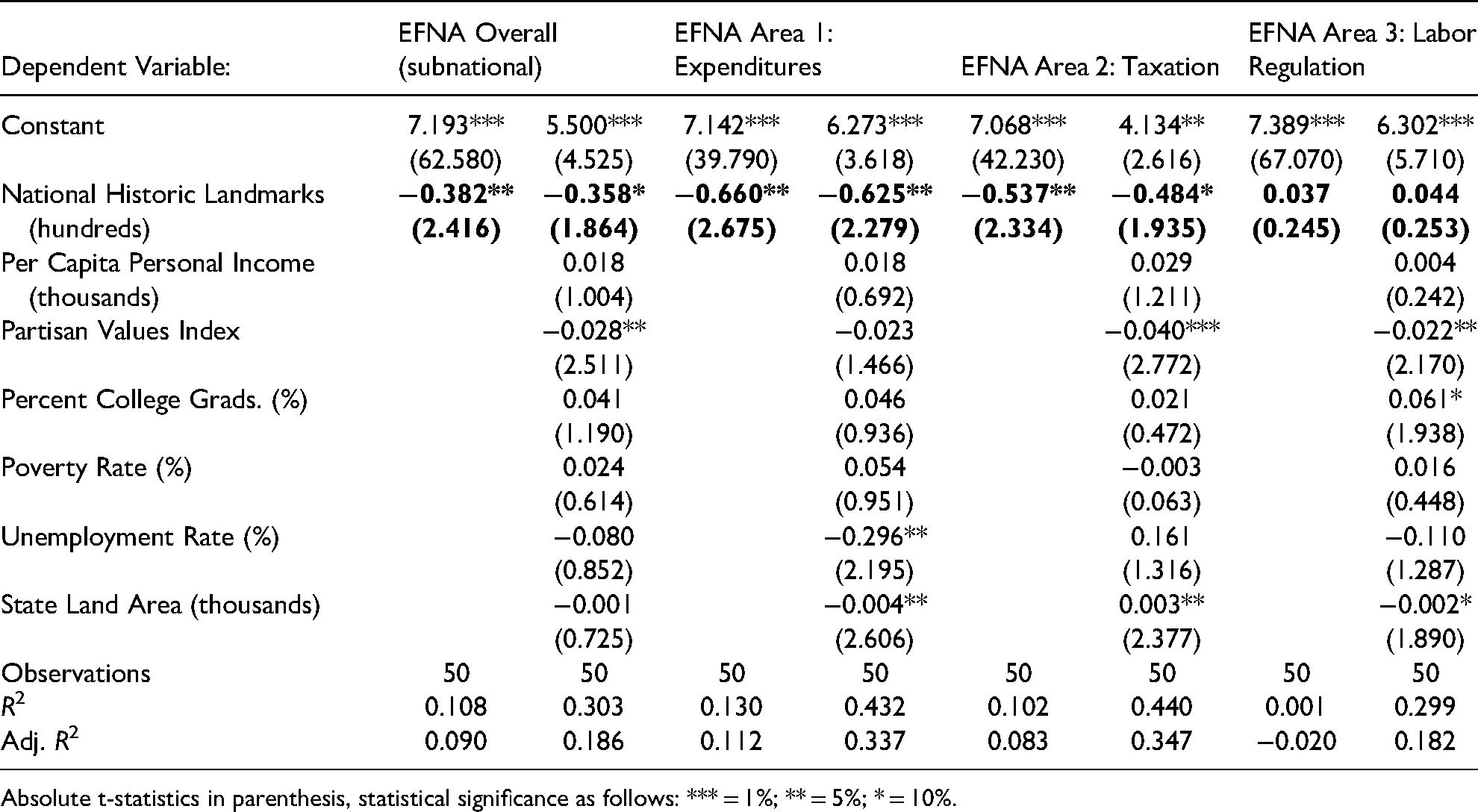
We begin by attempting to follow the empirical model of the natural resource curse employed by O’Reilly and Stansel (2017) but employing measures of historic, rather than natural, resources at the U.S. state level. 19 Using state-level data can help to avoid the complications introduced by the many different factors that vary across countries that may interfere in the analysis. As dependent variables, O’Reilly and Stansel (2017) employ the overall score and the three subarea scores from the Economic Freedom of North America (EFNA) report from Stansel, Torra and McMahon (2017). The overall score is a combination of the area scores, which reflect government spending (Area 1), taxes (Area 2), and labor regulation (Area 3). Based upon our logic, we expect historical resources should be associated with higher government spending and higher levels of taxation. We are unclear how it will impact the regulatory measure as the index measures only labor regulation and would not pick up the types of regulation we envision with regard to the stock of historic capital (buildings, etc.).
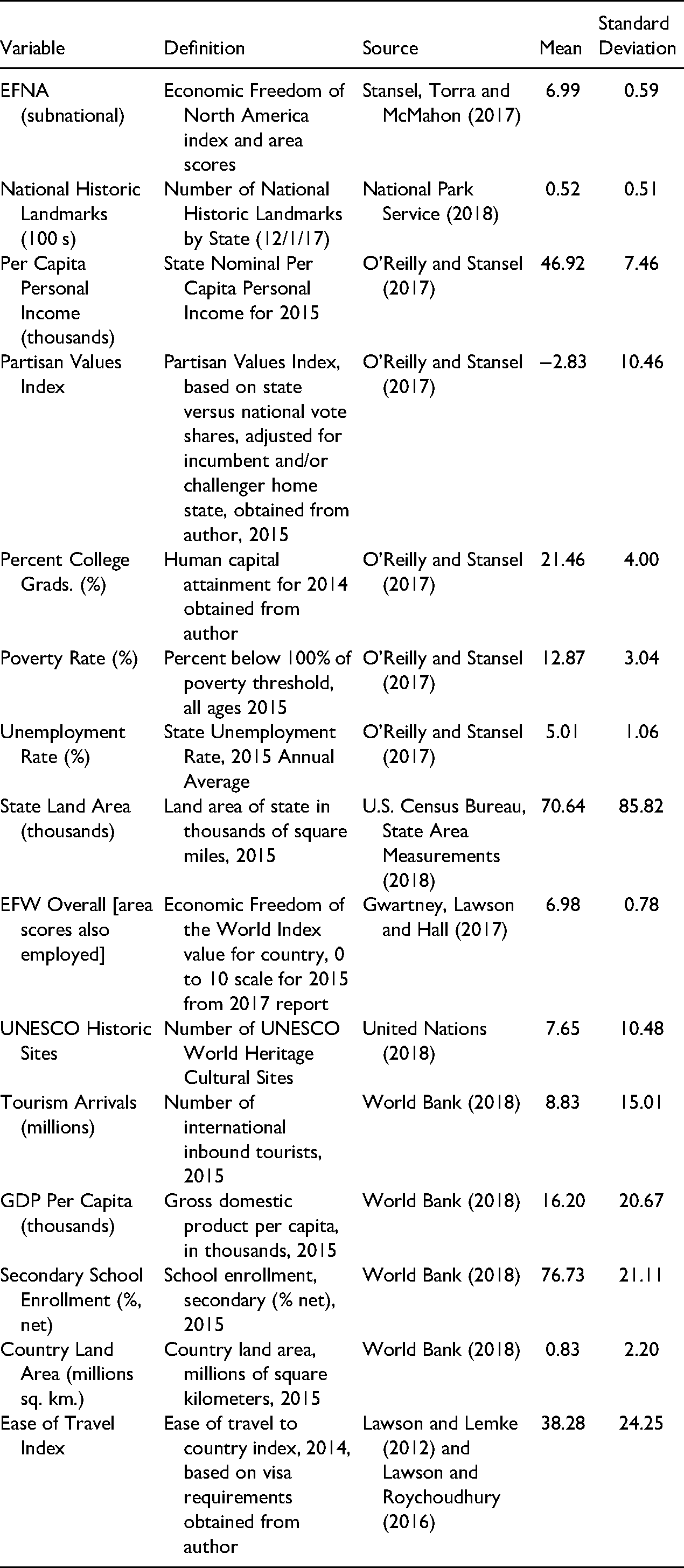
We begin with a simple pairwise regression for each index score and the number of national historic landmarks in each state. We add a control for the land area of the state out of concern that larger states may have more landmarks. In actuality, there is a negative and very small correlation coefficient between landmarks and state land area (−0.05) likely because the smaller eastern states were settled prior to the larger western states. We then continue by adding all of the control variables employed by O’Reilly and Stansel (2017) in their natural resource curse analysis, which are measures of the college graduation rate, poverty rate, unemployment rate, and the Partisan value index to capture state ideological differences. Appendix 1 lists all of the variables used in our paper, as well as their definitions, sources, and descriptive statistics. Our regression results at the U.S. state level are provided in Table 1.
State Economic Freedom vs. Historic Landmarks.
Absolute t-statistics in parenthesis, statistical significance as follows: *** = 1%; ** = 5%; * = 10%.
The first two columns show the results for the overall economic freedom (EFNA) subnational score for each state. 20 In both the univariate model and the model with controls, the coefficient on the number of national historic landmarks is negative and significant, consistent with our hypothesis. The subsequent columns show similar regression results for each of the subareas of the index. Again, for both government expenditures (Area 1) and taxation (Area 2), the estimates for both models show a negative and significant effect of historical resources on institutional quality. Given the size of the coefficient estimates, the typical state with significant historic resources would have almost a one-unit lower score in Areas 1 and 2 of the economic freedom index.
The regression results for Area 3, reflecting labor market regulations, show no significant effects. This is interesting, as unlike immobile historic capital, labor is mobile. Following even a simple Leviathan model of government such as Brennan and Buchanan (1980), this would result in the immobile resource being subjected to worse policies, as the mobile factor can exit. The fact that labor regulations are the only area unaffected actually may be helpful in showing that the correlations shown in the other two areas are not simply spurious with regard to all institutional measures. In summary, we find evidence from the overall EFNA index, as well as the areas reflecting government spending and taxes, that states with more extensive amounts of historic capital have worse formal institutions as measured by the index—in fact about a one-unit lower level of economic freedom.
Before moving on to our international evidence, it is worth mentioning that a study of the economic freedom levels for subnational jurisdictions (states and provinces) in Australia, Argentina, and Germany by Sobel (2021) found a significant negative link between the year of statehood and the overall level of economic freedom for the states and provinces in these countries. This finding is supportive of our curse of historic resources theory as well. Although the year of statehood is a less direct measure of historical resources than the U.S. measure we present in this section, there is a clear correlation between the age of each state or province and the degree of historic resources that should be present. Simply put, states and provinces that are older in these countries have lower levels of economic freedom, and one reason is likely to be our theory of the curse of historic resources.
International Evidence
In this section, we attempt to take our state-level model and estimate it at the international level, employing UNESCO World Heritage Cultural Sites as our measure of historic resources. As with our state model, we start with a univariate model that examines how the number of historic sites correlates with institutional quality. At the international level, our measure of institutional quality is the Economic Freedom of the World (EFW) index from Gwartney, Lawson and Hall (2017). As dependent variables, we employ the overall EFW score for each country, as well as the five area scores individually that reflect a country's institutions in the areas of size of government (taxes and spending), property rights, stable money, trade openness, and regulation. Again, all variables with sources, definitions, and descriptive statistics are provided in Appendix 1. An important note is that in the international index the regulatory area does include a broader set of regulations, not just those on labor. Our theory would predict a negative effect overall on economic freedom, and among the subareas the strongest negative effects to be present in taxes and regulations (Areas 1 and 5). We might also expect negative effects on overall property rights (Area 2), but generally would not necessarily expect any large effects on monetary stability (Area 3) or trade openness (Area 4).
One complicating factor at the international level is that for a location to be subject to the historic resource curse requires those resources to be wealth or income producing, and we believe the most significant source of that, especially for locations like Egypt or Italy, is tourism. Although North Korea may have as many historic sites as South Korea, the inability of foreigners to visit North Korea means these locations are not producing the income and wealth that can be regulated, taxed, or expropriated, nor do they produce the exchange rate effect that would produce a curse. This presents a nice opportunity for a falsification test as areas that are tourism friendly should see more of a curse of historic resources than those that are not. In our models, we attempt to control for the tourism aspect in two different ways and expect the results to be stronger with these controls than without.
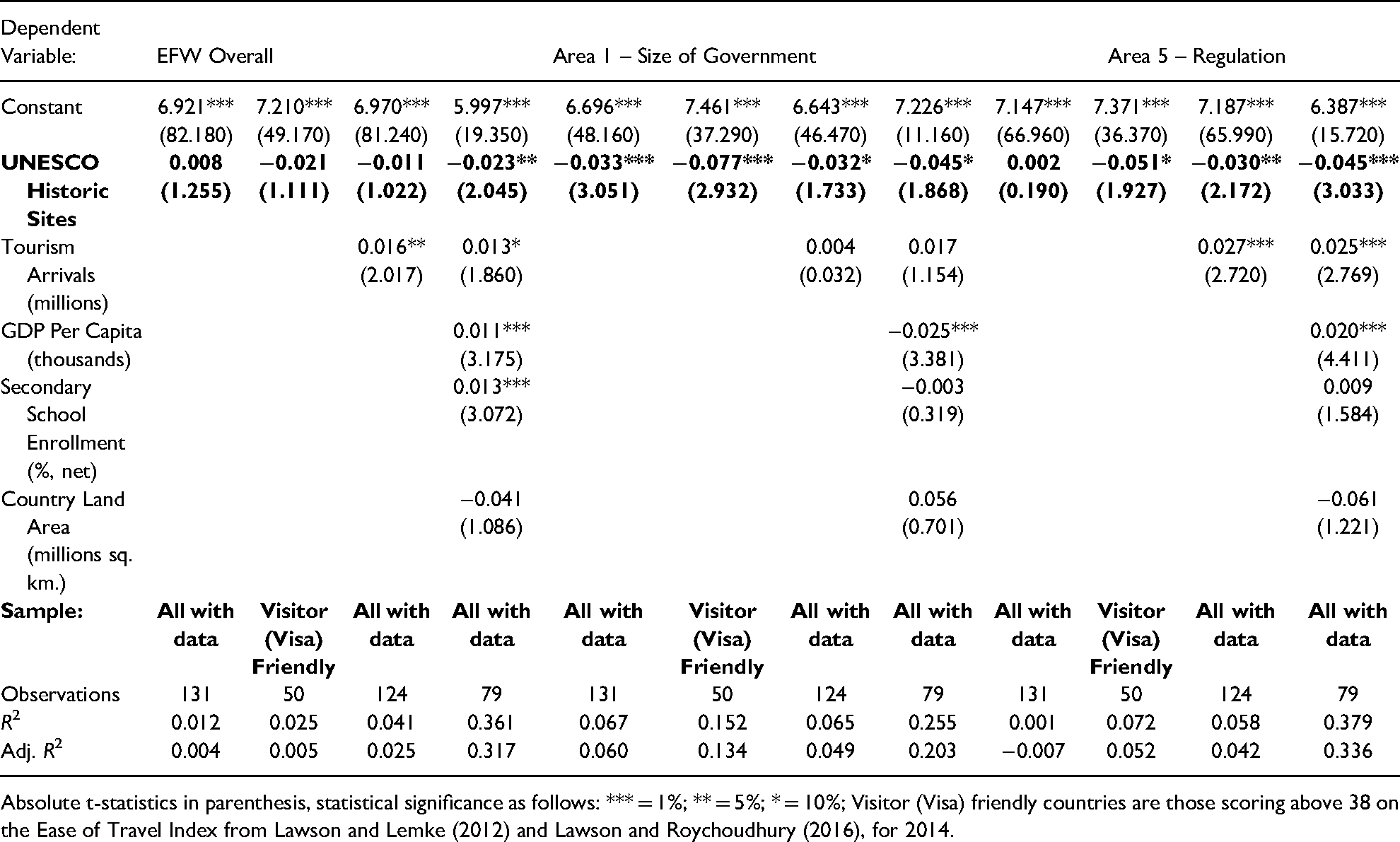
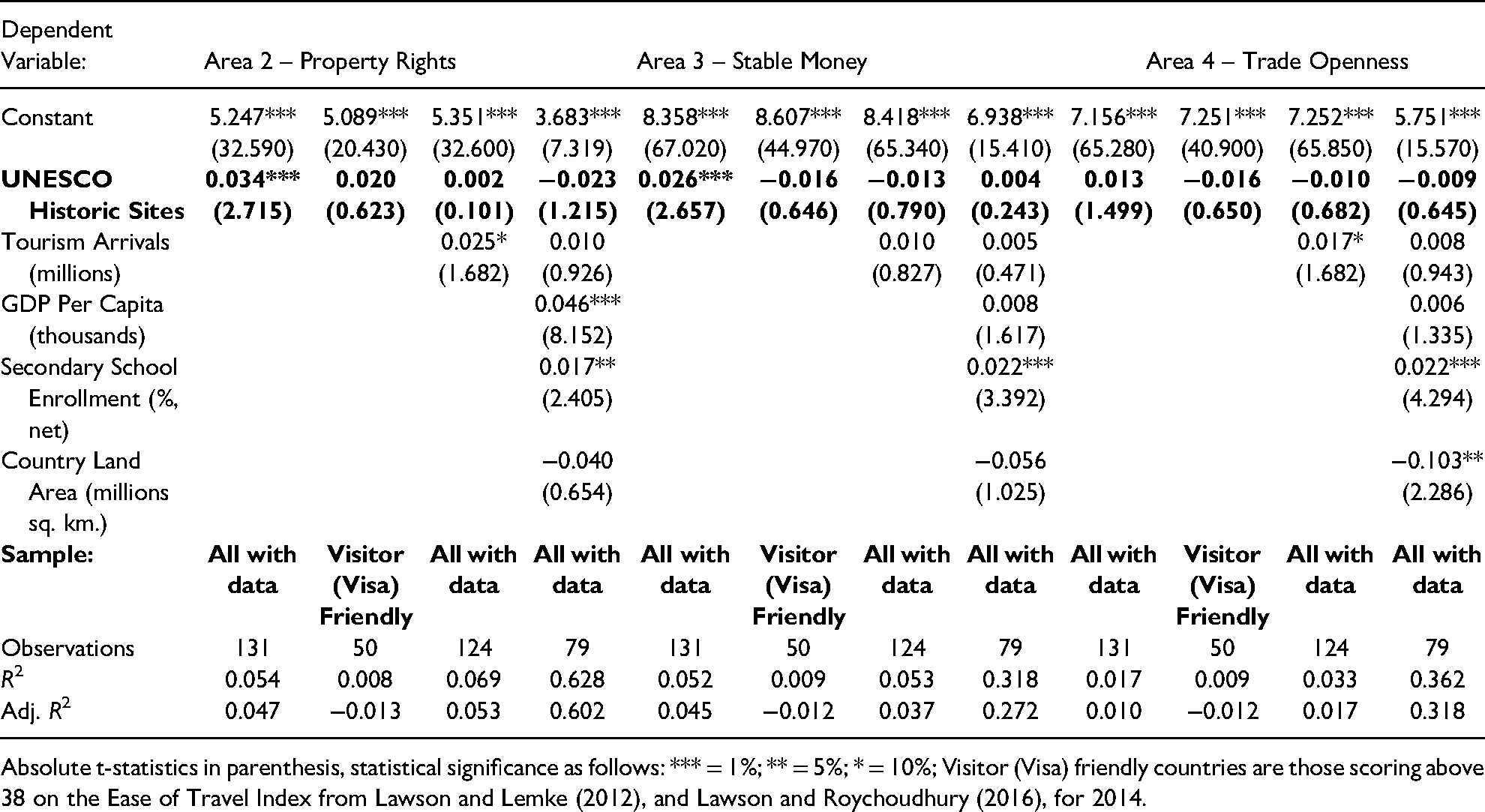
Our results are presented in Tables 2A and 2B. For each of our six dependent variables (the overall EFW score and the five subareas), the first columns for each dependent variable in Tables 2A and 2B show the results when all countries are included, while the second columns for each dependent variable show the results when the analysis is restricted only to countries that are tourism (visitor/visa) friendly. 21 The third column for each dependent variable again considers all countries as the sample but includes a control for tourism arrivals. A final, fourth column for each dependent variable shows this model with additional controls for the country land area, school enrollment, and GDP per capita. These variables, especially land area and income, can have complicated relationships with various areas of government activity (Lawson, Murphy and Powell 2020; Sobel 2021). 22
Table 2A shows the results for the areas where we expect the largest negative effects of historical resources. As expected in the models either restricted to a tourism-friendly sample or that control for tourism, we generally find negative and statistically significant results. Countries with larger stocks of historic sites have higher taxes and regulations, as is reflected in the lower economic freedom scores in those areas, and these tend to lower the overall economic freedom score. As expected, the results presented in Table 2B show that this effect does not seem to flow into reduced monetary stability or trade openness. Property rights were one area where the effect could have likely been negative, but they are insignificant in our basic models, which is the only perhaps surprising finding.
Country Economic Freedom vs. UNESCO Historic Sites (EFW Overall, Area 1, Area 5).
Absolute t-statistics in parenthesis, statistical significance as follows: *** = 1%; ** = 5%; * = 10%; Visitor (Visa) friendly countries are those scoring above 38 on the Ease of Travel Index from Lawson and Lemke (2012) and Lawson and Roychoudhury (2016), for 2014.
Country Economic Freedom vs. UNESCO Historic Sites (EFW Areas 2, 3, 4).
Absolute t-statistics in parenthesis, statistical significance as follows: *** = 1%; ** = 5%; * = 10%; Visitor (Visa) friendly countries are those scoring above 38 on the Ease of Travel Index from Lawson and Lemke (2012), and Lawson and Roychoudhury (2016), for 2014.
In terms of economic significance, given the underlying values of the variables, the difference between areas with many historic locations and ones with few is about a one-point difference in the index score in the areas of regulation and size of government, which is similar to our findings at the U.S. state level. 23
In summary, our results from both the state and international models are supportive that there is indeed a negative and economically meaningful correlation between the extent of historic resources and measures of economic freedom in the areas of taxes, spending, and regulation. For our novel hypothesis of a “curse of historic resources” to be fully confirmed requires both future empirical analyses using more detailed local data and specific case studies. We hope the ideas and results presented here, however, are sufficient to warrant future consideration by other researchers in the literature.
Conclusion
This paper offers the novel argument that there exists a “curse of historic resources” similar to the curse of natural resources. The original natural resource curse holds that because underground stocks of coal or oil are immobile, the economic income and wealth they generate become targets for expropriation by governments in the form of excessive taxes, regulations, and corruption. This institutional deterioration then negatively impacts overall economic activity. We argue this same logic transfers to historic resources, such as the Egyptian Pyramids, Mayan Ruins, or Roman Acropolis, that are also immobile income-generating resources that can become targets for expropriation.
In the case of historic resources, we believe there are additional reasons beyond those present for natural resources to think economic activity may suffer due to weak institutions and unfavorable government policies. These include the compounding nature of government regulations and programs, institutional sclerosis, the lack of cost–benefit analysis in historic regulations, the threats to private ownership of items of historic significance, and the frictional and structural unemployment of historic capital.
This paper outlines the logic behind our argument and presents some basic empirical results showing the correlation between historic sites, at both the state and international level, and measures of institutional quality. We find that government spending, taxation, and regulation are most affected by the presence of historic resources. Overall areas with significant historical resources tend to have about a one-point lower level of economic freedom. We believe that further analysis is warranted by our paper, likely a combination of case studies and more local-level empirical analysis, to confirm our hypothesis.
Interestingly, we believe our paper may also help explain why the academic literature in the field of tourism has found such mixed results regarding the effect of tourism on economic growth. Some have found negative effects, others positive, or neutral. Our argument suggests areas with mainly historic-site-based tourism could have fundamentally different economic outcomes than other tourist destinations due to the curse of historic resources.
Footnotes
Declaration of Conflicting Interests
The author(s) declared no potential conflicts of interest with respect to the research, authorship, and/or publication of this article.
Funding
The author(s) received no financial support for the research, authorship, and/or publication of this article.

Notes
Author Biographies
Appendix 1
Variable Definitions, Sources, and Descriptive Statistics.
| Variable | Definition | Source | Mean | Standard Deviation |
|---|---|---|---|---|
| EFNA (subnational) | Economic Freedom of North America index and area scores | Stansel, Torra and McMahon (2017) | 6.99 | 0.59 |
| National Historic Landmarks (100 s) | Number of National Historic Landmarks by State (12/1/17) | National Park Service (2018) | 0.52 | 0.51 |
| Per Capita Personal Income (thousands) | State Nominal Per Capita Personal Income for 2015 | O’Reilly and Stansel (2017) | 46.92 | 7.46 |
| Partisan Values Index | Partisan Values Index, based on state versus national vote shares, adjusted for incumbent and/or challenger home state, obtained from author, 2015 | O’Reilly and Stansel (2017) | −2.83 | 10.46 |
| Percent College Grads. (%) | Human capital attainment for 2014 obtained from author | O’Reilly and Stansel (2017) | 21.46 | 4.00 |
| Poverty Rate (%) | Percent below 100% of poverty threshold, all ages 2015 | O’Reilly and Stansel (2017) | 12.87 | 3.04 |
| Unemployment Rate (%) | State Unemployment Rate, 2015 Annual Average | O’Reilly and Stansel (2017) | 5.01 | 1.06 |
| State Land Area (thousands) | Land area of state in thousands of square miles, 2015 | U.S. Census Bureau, State Area Measurements (2018) | 70.64 | 85.82 |
| EFW Overall [area scores also employed] | Economic Freedom of the World Index value for country, 0 to 10 scale for 2015 from 2017 report | Gwartney, Lawson and Hall (2017) | 6.98 | 0.78 |
| UNESCO Historic Sites | Number of UNESCO World Heritage Cultural Sites | United Nations (2018) | 7.65 | 10.48 |
| Tourism Arrivals (millions) | Number of international inbound tourists, 2015 | World Bank (2018) | 8.83 | 15.01 |
| GDP Per Capita (thousands) | Gross domestic product per capita, in thousands, 2015 | World Bank (2018) | 16.20 | 20.67 |
| Secondary School Enrollment (%, net) | School enrollment, secondary (% net), 2015 | World Bank (2018) | 76.73 | 21.11 |
| Country Land Area (millions sq. km.) | Country land area, millions of square kilometers, 2015 | World Bank (2018) | 0.83 | 2.20 |
| Ease of Travel Index | Ease of travel to country index, 2014, based on visa requirements obtained from author | Lawson and Lemke (2012) and Lawson and Roychoudhury (2016) | 38.28 | 24.25 |