







Abstract
Corruption is a symptom of wider political dynamics intertwined with sectors prone to criminal activities. This arises due to the laxity of legal enforcement or a dysfunctional political system. This paper analytically demonstrates the nexus between organized crime and corruption in the presence of the public sector. The relevant questions at this juncture are: (i) How does capital investment in the industrial sectors affect the crime–corruption nexus? (ii) Why a more stringent law-and-order enforcement may produce counterproductive outcomes? and (iii) Whether the creation of alternative income opportunities in the legally approved sectors by the government will lower corruption and decriminalize society? What we will try to show is that when corruption becomes necessary to sustain the criminal sector, capital expansion and deterrence policy augment crime and corruption. This crucially depends on a multitude of general equilibrium factors including the labor relocation effect, capital relocation effect, and factor intensity of sectors.
Introduction, Motivation, and Interventions
Corruption is a symptom of wider political dynamics and electoral malpractice and is likely to thrive in conditions where law enforcement and legal institutions are weak or politically dysfunctional. When organized crime dominates in the public sector, corruption within these sectors is bound to grow. The word “crime” covers a variety of violations which are prohibited by the criminal law, and may include murder, robbery, assault, theft, or any other public offences. On the other hand, “corruption” is the manifestation of wider complex factors which the Cambridge dictionary defines as the dishonest or illegal behavior involving a person in a position of power. It can include public servants demanding bribes or favor in exchange for services, politicians using power to grant contracts to their sponsors or corporations bribing public officials to get lucrative deals (Transparency International). 1 It is quite obvious that corruption may result in grotesque misuse of power. Corruption and crime are intertwined and quite often they are used interchangeably. When the public sector is dominated by organized crime, corruption is bound to go beyond tolerable limits. Though corruption is illegal in general, it may be socially acceptable or tolerated. In this paper, crime is the illegal extraction of output produced by the public sector. This is a dominating factor in cases of operations of the public sector on a large scale in developing countries. Crime is sustained by a network of corruption, which includes inter alia bribes and similar instruments. The focus of the paper is on the nexus between crime and corruption in a developing country in which the public sector plays a propulsive role in the development process.
Let us consider a few illustrations of how crime and corruption feed each other. These illustrations are based on Indian experiences. In particular, we will consider three incidences namely, illegal coal plunder, theft of electricity, and illegal sand mining that would help to understand the nexus of crime and corruption in the public sector and how these two types of complex crime reinforce each other.
First, India is the second-largest coal-producing country in the world with coal production of 700,382 thousand metric tons in the year 2020 (U.S. Energy Information Administration Statistics). 2 Coal India Limited (CIL) is an Indian government-owned public-sector enterprise that has near-monopoly power in coal extraction and refining. CIL with its eight subsidiaries is the single largest coal mining company in the world. One of its major subsidiary units, Eastern Coalfield Limited (ECL), is located in the coal-rich states of Jharkhand and West Bengal, which is also a hub for local gangsters commonly referred to as “coal mafias” in the local language. These coal mafias are involved in the outright theft of coal from the open mines of ECL and pay off company officials, police, bureaucrats, and local politician to mine and transport coal illegally and evade punishment (Daniel and Williams 2013, Reuters report; Singh and White 2019). 3 According to a report published by Singh, Chakraborty, and Katakey (2014), about 13 percent of annual coal produced by the CIL is stolen by the gangsters. This amounts to a yearly loss of about USD 23.02 crore for the company (Singh 2011). These gangsters employ people from the pool of local poor unskilled workers to plunder the coal from the mines. 4 What happens next is that the pilfered coal is sold illegally to brick kilns, sponge-iron factories, roadside eateries, tea stalls, and households to meet their energy demand for cooking. The price charged to sell this pilfered coal varies from USD 0.1 to USD 0.38 (Singh 2013, The Guardian). The police, managers, contractors, and public officers are bribed to allow operations in this organized criminal sector.
Second, the menace of power theft is another such episode of crime and corruption that has led to substantial financial losses for the Government of India. Pilferers illegally resort to terminal tapping of the overhead lines of the low voltage side of the transformer. According to a report in the Economic Times (2019), in the Konkan region of Maharashtra state in India, 1949 cases of power theft were detected by the Maharashtra State Electricity Distribution Company Ltd. (MSEDCL). In the Haryana state, 5,500 cases of power theft had been detected by the Uttar Haryana Bijli Vitran Nigam (UHBVN) (Economic Times, 2021). This unauthorized leakage of electricity leads to an economic loss of around USD 255.83 crores annually for the entire nation (Chatterjee and Viriyam 2021). In the Meghalaya state of India, the industries located in Byrnihat are accused of stealing electricity provided by the public sector firm Meghalaya Energy Corporation Limited (MECL) with the help of the company officials by bribing them (Assam Tribune 2021). 5 In this case, also, the pilferers can plunder electricity with the connivance of company officials, public servants, and police.
Third, illegal sand mining in India is another highly lucrative business. Sand mafias unlawfully mine sand from inland and riverbeds, which is estimated to be worth USD 16 million. 6 Police personnel are bribed by the truck drivers carrying illegally mined sands which is USD 0.8–USD 1.5 per truck. Alternatively, officials are bribed by the transporters with an amount ranging from USD 80–USD 160 per sand-filled truck to obtain the official code number for unregistered trucks carrying sand (Rege 2015; Seshacharyulu 2013).
Now few explanatory remarks based on the above-mentioned illustrations for this paper are in order. First, the nature of the product which is pilfered is an intermediate good that is used as an input for further production in the final good sector. Second, this intermediate good is a publicly produced private good. These intermediate products are produced by the public sector undertakings or public sector enterprises (
The domain of literature on corruption had extensively analyzed its various forms that include the agency theory of corruption (Khalil, Lawarrée, and Yun 2010; Laffont and Tirole 1991; Strausz 1997), bureaucratic corruption (Acemoglu and Verdier 2000; Breen and Gillanders 2012; Mookherjee and Png 1995; Shleifer and Vishny 1993), bribe competition (Burguet, Ganuza, and Garcia Montalvo 2016; Finocchiaro Castro 2020), corruption and foreign investment (Egger and Winner 2005; Gillanders and Parviainen 2018a; Habib and Zurawicki 2002), corruption and environment (Dincer and Fredriksson 2018; Ganda 2020) political cronyism and corruption (Chang 2020; Chang and Chu 2015; Chaudhuri, Dastidar, and Mahata 2022), etc. However, the literature linking organized crime and corruption has been very scant. Blackburn et al. (2017) is an exception that analyzed the macroeconomic implications of organized crime, its interaction with corruption and its effect on economic growth. They found that if corruption leads to a higher (lower) expected payoff from extortion, then the growth-diminishing effect of crime is greater (smaller) in the presence of corruption. The intuition behind the results is that corruption operates as a tax on criminality, the outcome depends on the expected payoffs of the crime syndicate when having to pay bribes to corrupt law officers. On the contrary, in our paper, corruption is necessary to sustain the criminal sector. Besides this, unlike Blackburn et al. (2017), which is a partial equilibrium analysis, our model captures the general equilibrium linkage of the crime–corruption nexus with a micro-foundation that explains the genesis of the criminal sector.
There has been substantial empirical research which analyzed the effect of corruption on foreign capital. The majority of the studies found a negative long-run impact of corruption on foreign capital inflow (Asiedu 2006; Habib and Zurawicki 2002; Hines 1995; Tosun, Yurdakul, and Iyidogan 2014; Wei 2000). This has been explained as corruption can increase the cost of doing business to the point of making the business unsustainable. On the other hand, corruption can lead to economic expansion if it acts as a substitute for poor governance and can act as a helping hand to foster foreign capital inflow (Al-Sadig 2009; Egger and Winner 2005; Gillanders and Parviainen 2018a; Houston 2007). This helping hand argument is based on the greasing the wheels’ hypothesis. We take the opposite route in this paper from the existing set of literature. We analyze how capital injection into the economy affects corruption as well as crime.
Next, we analytically examined the popular perception which suggests that stronger law enforcement authorities can lower the incidence of crime and corruption by keeping a strong vigil over the parallel economy. Some of the earlier literature on deterrence theory includes Beccaria (1764) and Bentham (1781). Beccaria (1764) proposed that punishment must be proportionate to the crime committed. Bentham (1781) argued on similar lines based on a utilitarian approach and suggested that people can be deterred from harming others by establishing punishments. Both theories assumed that a potential criminal compares the expected benefit of committing a crime with the benefit of not committing it. The theory held that if the cost of committing the crime is increased such that the net benefit from crime falls, people will not commit the crime. Becker (1968) provided a formal treatment to the theory of crime, punishment and deterrence. It was suggested that an increase in income opportunities in the legal sector would shift the balance and make it more likely that a person would not commit a crime. The arguments and analysis put forward by Beccaria (1764), Bentham (1781), and Becker (1968) led to the economic theory of rational deterrence that involved three crucial instruments—the severity of punishment, certainty of being caught, and the speed of punishment. Therefore, the government can indirectly increase the cost of committing a crime by utilizing the above three instruments. This perception was evident in the study by Haddad and Moghadam (2011), which obtained a negative relationship between crime and deterrence factors using the panel data for Iran. A similar result was obtained by Meera and Jayakumar (1995) using crime data from Malaysia. On the other hand, Dari-Mattiacci and Raskolnikov (2021) found that neither higher sanctions, nor a greater probability of detection unambiguously increases deterrence. Hazra (2020) found a positive association between deterrence and crime in India.
Given all of these, the purpose of this paper is to demonstrate the genesis of crime and corruption and the intertwining relationship between them in a distortion-ridden developing economy in the presence of a public sector that produces a private intermediate good. Crime in this paper is limited to the size of the criminal sector proxied by the number of criminals who plunder the public sector output, while corruption is measured by the amount of bribes paid by the criminal sector to the officials to evade punishment. Given the pre-existence of economic distortions and dysfunctionalities of the legal institutions, what we will try to show is that the effect of capital expansion on crime and corruption crucially depends on a multitude of factors including the labor relocation effect, capital relocation effect, and factor-intensity of sectors. The existing literature by and large has explained the effect of corruption on capital inflow. In this paper, we have reversed the causality and attempted to examine the effect of capital inflow on the crime–corruption nexus. In so doing we have attempted to develop a five-sector general equilibrium model for a small open economy. We will also try to show how the popular perception that deterrence lowers crime, may not hold good rather it may be counterproductive if general equilibrium interlinkage effects are carefully dealt with. Besides this, we demonstrate the theoretical conditions under which “crime does not pay,” that is, despite a rise in the risk of getting caught, criminals may not get higher compensation for undertaking this risk. This is opposite to Becker (1968) and is discussed later in the comparative statics section. The extant literature, by and large, uses a partial equilibrium framework, our departure is that we use a general equilibrium framework without sacrificing the micro foundation. Our analysis reveals how corruption becomes necessary to sustain this localized form of organized crime. We obtained that capital investment in the industrial sectors worsens the incidence of corruption and augments the criminal sector, while an attempt to improve the enforcement of law-and-order in presence of economic vis-à-vis legal distortion produces counterproductive outcomes in terms of an expansion of the criminal sector. These findings are premised on the “relative factor compositions of the sectors” and “dualism in both the labor and capital market” which is a crucial feature of a developing economy. In this model, the agriculture sector is relatively unskilled labor-intensive compared to natural resources (land) than the public sector, whereas, the manufacturing sector is relatively capital intensive compared to skilled labor than the high-skilled service sector. Unlike the partial equilibrium framework, the above results in our general equilibrium analysis depict the multitude of cross effects and sectoral interdependence. Finally, we attempt to test the proposition of Becker (1968) whether an increase in legal income by providing agriculture price subsidy can curb the size of the criminal sector.
Description of the Economy
We consider a
Sector 1, 2, and 3 are the three-traded sectors, while the sector G is a non-traded PSE. The product prices of the three traded sectors are internationally determined, while the price of the intermediate product produced by the public sector is administratively fixed at an exogenous level,
In the factor market, labor earns a competitive (informal) return W in sector 1 while its counterpart earns a high-institutionally determined (formal) wage rate,
The operation of the illegal (criminal) sector of the economy exists parallel alongside the legally authorized sectors and all transactions carried out within this sector are legally prohibited and officially remain unaccounted. This criminal sector (sector
Table 1 summarizes the general equilibrium structure of the representative developing economy.
The Structure of the Representative Economy.
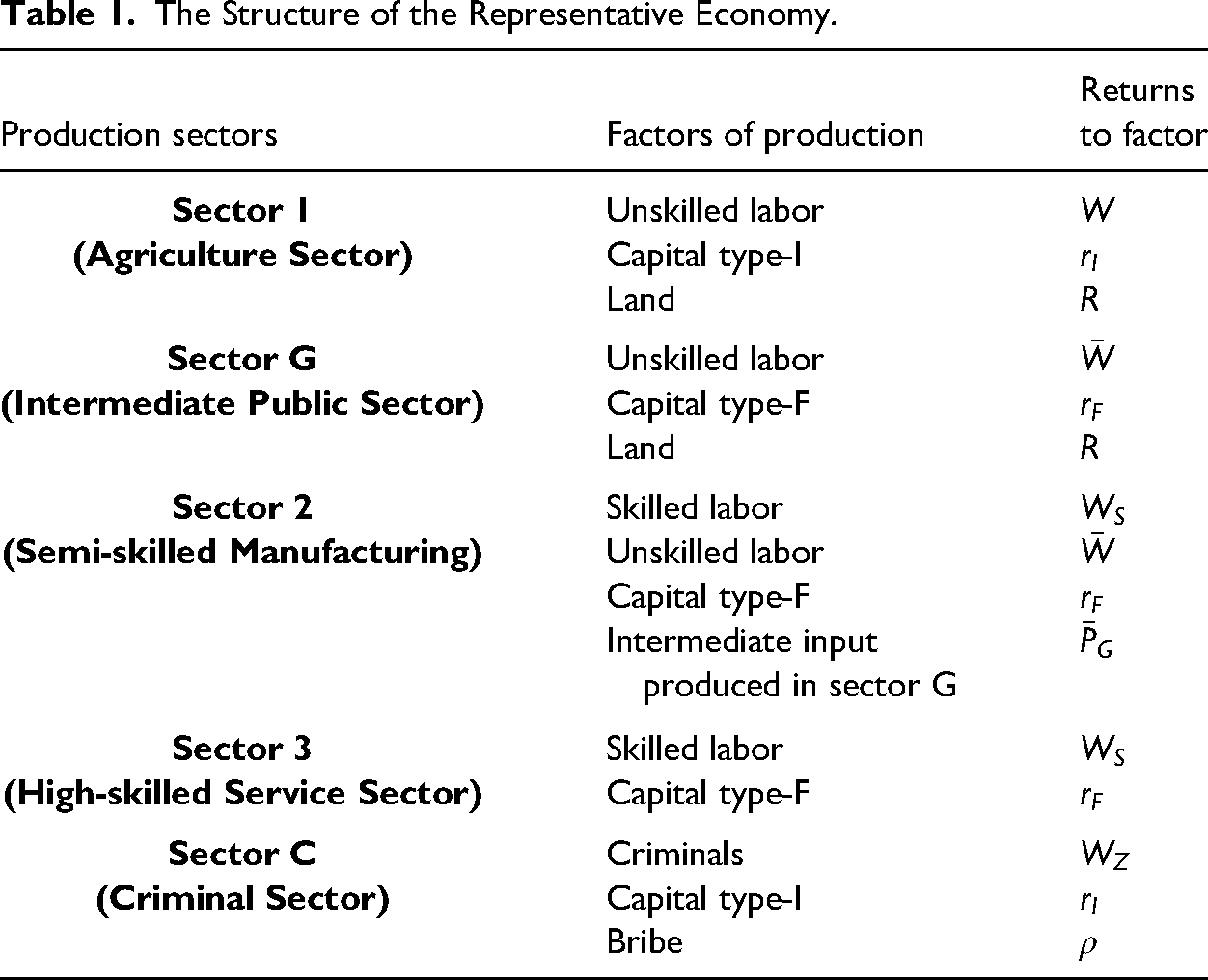
In what follows, we highlight the legal and economic specification of the sectors in three categories—formal, informal, and illegal production activities. An activity is defined as formal when it is subject to government regulations and complies with these regulations (Kanbur, Lahiri, and Svejnar 2012). Sectors 2, 3, and G are the formal sectors. On the other hand, the shadow economy or the unofficial economy constitutes activities that are not recorded in government statistics (Choi and Thum 2005; Gillanders and Parviainen 2018b). It is pertinent to note that not all types of sectors operating in the shadow economy are illegal. Kanbur, Lahiri, and Svejnar (2012) specify the informal sector as the complement of the formal sector and categorizes three types of the informal sector—evaders, avoiders, and outsiders. “Evaders” are subject to regulation and are not complying, “avoiders” are not subject to regulations but only because they have adjusted out of the bounds and “outsiders” are those to whom regulation does not apply. The former two are involved in illegal practices while the latter falls under the legal ambit. In this paper, sector 1 (agriculture) and sector C (criminal) both constitute the informal economy. This is because workers in sector 1 and C receive an informal wage rate with loose job contracts (or, no job contracts), while its counterpart in the other formal sector receives a high-institutionally determined wage rate. Sector 1 falls under the third type of shadow economy, that is, outsiders to which regulations do not apply. For example, in India, the regulation of minimum wage legislation or social security benefits does not apply to the informal sectors which are unincorporated firms employing ten or fewer workers (Ministry of Labour and Employment, Government of India 2013–2014; Srija and Shirke 2014). Sector C is an illegal sector (evaders). According to the System of National Accounts (2008), SNA 6.43 specifies that illegal production activities include those whose sale or purchase are either forbidden by the law or unlicensed/unauthorized production of legal goods. Sector C illegally plunders the public sector output and sells it in the open market without legal authorization at a price different from what the government regulated.
Endogenous Determination of the Number of Criminals
The economy is populated with (
To construct the model, the following notations are used:
If the representative unskilled individual remains in the legal production sectors, then the utility function takes the following form.
10


The individual solves the following optimization problem: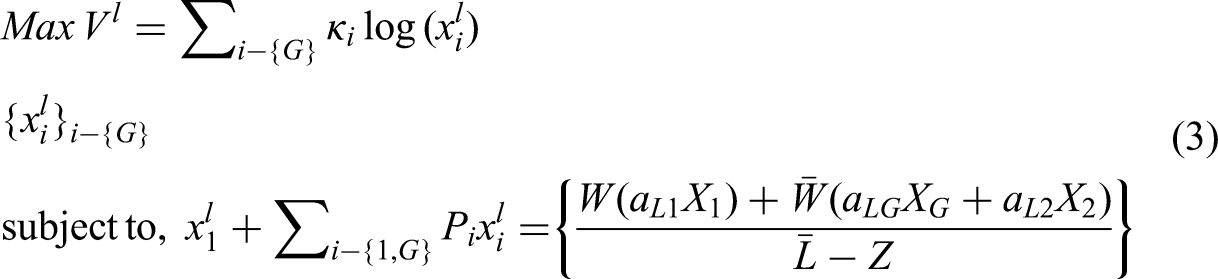



Similarly, if the individual participates in the criminal sector the utility function takes the following form:
(i)
Assumption 1(i) implies that an increase in the amount of pillaged output increases the chance of the criminal sector getting exposed to the legal system or the vigilance authorities, while a higher bribe rate reduces the chance of getting caught. Assumption 1(ii) reveals that if no bribe is paid then the probability of getting caught is relatively high, that is,
Given assumption 1, the individual solves the following constrained-optimization problem while engaged in the criminal sector: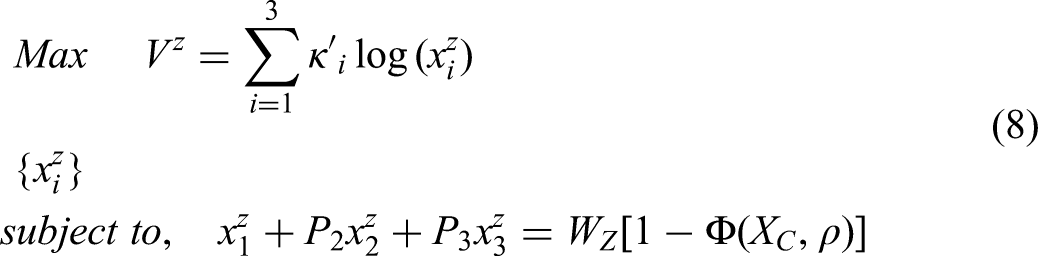

The marginal individual is indifferent where the expected income from engaging in the criminal sector is equal to the expected wage income from participating in the labor market that is obtained by juxtaposing equations (6) and (9). This leads to the following labor relocation equilibrium between the legal product sectors and the criminal sector:
The General Equilibrium Analogue
The following notations are used to represent variables and parameters:
The price-average cost parity condition in sectors 1, 2, and 3 are represented by the following expressions:


The public sector has a natural monopoly in the production of intermediate input 
The criminal sector (sector 
The factor market equilibrium conditions are obtained as follows:





We make the following assumptions:
(i)
(i)
Assumption 2(i) and 2(ii) implies that sector 1 is relatively unskilled labor-intensive compared to the land than sector G and sector 2 is relatively more capital-intensive compared to skilled labor than sector 3 in both physical and value sense, respectively. 2(iii) is required as a sufficient condition to solve the values of equilibrium changes in the variables of the economy.
The amount of pillaged output (


Determination of General Equilibrium Variables and Their Properties
In this general equilibrium system, there are fifteen main endogenous variables, viz.,
The model can be further decomposed into subsystems. A subsystem is a miniature form of Hecksher-Ohlin that comprises sectors among which at least two factors are (perfectly or imperfectly) mobile which confirms the Hecksher-Ohlin properties. In the present setup, sectors 2 and 3 form a subsystem with respect to capital type F and skilled labor, sectors 1 and C are another subsystem with respect to capital type I and unskilled labor, and sectors 1 and G form a subsystem with respect to land and unskilled labor. This completes the description of the properties of the model.
Comparative Statics
In this section, we perform a few comparative static exercises pertaining to our analysis.
Capital, Crime, and Corruption
An increase in capital investment in the industrial sectors (sectors 2, 3, and
The intuitive explanation can be offered as follows. An increase in capital endowment
An increase in capital investment in the industrial sectors leads to (i) contraction of the agriculture sector, (ii) the high-skilled sector contracts while the semi-skilled sector expands, and (iii) the public sector expands.
The contracting sector 1 releases capital type I, which gets absorbed in sector C, which leads to an expansion of sector C. This effect arises due to the relocation of capital across the sectors and can be termed as
An increase in Z leads to the relocation of labor across the sectors which can be termed as the
The scale of operation of the criminal sector expands, the probability of getting caught by legal institutions rises and the number of unskilled individuals choosing to become criminals escalates due to capital augmentation in the industrial sector. Output plundered by the criminal sector accentuates.
From the earlier discussion, it is found that the net availability of public sector output falls (
An increase in the stock of capital lowers the expected return to the unskilled labor in the legal production sectors which makes the legal labor market less attractive relative to the criminal sector. However, capitalists gain, while the market power of the public sector deteriorates.
Policy Analysis
Two alternative policy measures are analyzed in terms of an attempt to improve the law-and-order measures and an increase in agriculture price subsidies. Popular perception suggests that stronger law enforcement authorities can lower the incidence of crime and corruption by keeping a strong vigil over the parallel economy. On the other hand, a subsidy to the agriculture sector causes it to expand; thus, employment opportunities in the legal commodity-producing sectors improve which incentivizes unskilled workers to keep themselves away from engaging in the criminal sector. This is based on Becker (1968) that an increase in legal income can be an economic deterrence to lower crime. In what follows, this common perception is tested against the analytical framework in this paper.
Deterrence and Stringent Law Enforcement. The perception that a rise in detection rate reduces the size of the so-called criminal sector was evident in the study by Haddad and Moghadam (2011), which obtained a negative relationship between crime and deterrence factors using the panel data for Iran. A similar result was obtained by Meera and Jayakumar (1995) using crime data from Malaysia. On the contrary, Hazra (2020) found a positive association between deterrence and crime in India. This suggests that the deterrence factors have mixed effects on the incidence of crime in developing economies. What we find in this section is a possibility of expansion of the criminal sector in the wake of the rise in detection rate.
In this paper, the bribe rate
An improvement in law-and-order that curbs down the rate of bribes leads to counterproductive results in terms of accentuating the amount of pillaged output, expansion of the criminal sector and may augment the number of criminals.
Agriculture Price Subsidy. The question that is raised in this section is whether an agriculture price subsidy can act as friction to restrict unskilled workers from joining the criminal sector. To obtain the effect of a rise in agriculture price subsidy, we substitute
The intuition can be explained as follows. From equation (23) we find that a rise in “
An increase in agriculture price subsidy generates no effect on the size of the criminal sector and the number of criminals, the output of other sectors remains unchanged; however, the amount of corruption inflates.
Conclusion
The paper analytically examined the intertwining relationship between organized crime and corruption from a developing economy perspective distorted by labor and capital market imperfections. In so doing, we have developed a
Footnotes
Acknowledgments
The authors are grateful to the editor and the anonymous referee for their comments and revisions. The authors are also indebted for the constructive comments received from Dr. Jayanta Kumar Dwibedi at 2nd Annual Economics Conference, St. Xavier’s University, Kolkata, India; Dr. Amarjyoti Mahanta at GRM 2021, Indian Institute of Technology, Guwahati, India; Prof. Oguzhan Dincer, Dr. Robert Gillanders, Dr. Eric C.C. Chang, and Mr. Nicolás Jaramillo at 3rd Workshop on Corruption, Institute of Corruption Studies, Illinois State University, USA; Dr. Biswajit Nag at 7th EIITF Conference, Indian Institute of Foreign Trade, Kolkata, India; and Dr. Shivangi Chandel at ACEP 2021, OP Jindal Global University, Haryana, India, which helped improve and clarify this paper. The authors remember (Late) Prof. Sarbajit Chaudhuri with great fondness and respect for encouraging diverse issue-based research in the domain of applied general equilibrium models. This work is in memory of (Late) Prof Sarbajit Chaudhuri. However, the usual disclaimer applies.
Declaration of Conflicting Interests
The author(s) declared no potential conflicts of interest with respect to the research, authorship, and/or publication of this article.
Funding
The author(s) received no financial support for the research, authorship, and/or publication of this article
