







Abstract
To bolster entrepreneurship and innovation in welfare service provision, numerous countries have established quasi-markets. Yet, the actual benefits from these reforms have often been modest. We posit that quasi-markets can realize their potential only within the appropriate institutional framework, which highlights the need for studies in the field of institutional economics that identify how best to regulate quasi-markets so that they deliver in line with these expectations. While competition and the presence of for-profit actors are necessary conditions for quasi-market improvements, they alone are insufficient. We illustrate this point by showing how the three leading entrepreneurship conceptions—Knightian, Kirznerian, and Schumpeterian—risk falling short of their potential in typical quasi-market setups. Most importantly, our analysis identifies the necessity for a set of complementary institutions that are epistemic in nature. Such reforms should help bolster (Knightian, Kirznerian, and Schumpeterian) quasi-market entrepreneurship and help users construct the requisite knowledge to make informed choices.
Introduction
Entrepreneurship scholars widely recognize the pivotal role of institutions in shaping economic behavior (Baumol 1990). An institutional perspective is prominent in much of the entrepreneurship literature, illuminating many real-world entrepreneurial phenomena and underscoring the importance of society's rules of the game in fostering productive entrepreneurial venturing (Boettke and Coyne 2009; Bjørnskov and Foss 2013; Bylund and McCaffrey 2017; Henrekson and Johansson 2009; Minniti and Lévesque 2008). Thus far, however, scholars have largely overlooked an institutional-entrepreneurial phenomenon of growing empirical importance across the globe: quasi-markets in the welfare service sector. We use the term welfare services in a broad sense to denote publicly financed services such as education, health care, and social care that are provided to the general population.
The documented and/or perceived shortcomings of public monopolies to deliver and improve welfare services was a key motivation for many governments worldwide to institute quasi-markets for various welfare services (Le Grand 2009), notably education, health care, and social care services such as nursing homes and domestic care services for the elderly. The development began in the UK in the late 1980s, as part of broader public sector reforms driven by the Conservative government under Margaret Thatcher and her successors (Hood 1991).
In quasi-markets, the government primarily assumes the role of a financier, 1 procuring services from an array of private, public, and voluntary providers engaged in competition (Ferlie 1992). Commonly stated reasons why governments turn to quasi-markets are to unleash creativity, efficiency, and innovation through competition between public and private providers while safeguarding user equality. The need for innovation in welfare sectors is, if anything, more pressing than in other sectors of the economy. The reason is that costs in these sectors rise more than their proportion of the real economy because of a combination of Baumol's Cost Disease (Baumol 1967, 2013) and a high income elasticity of demand (Fogel 1999). The only way out of this dilemma is to make these sectors more innovative; the alternative is a substantially reduced quality over time. Thus, welfare sectors need entrepreneurship and innovation to safeguard and/or improve service quality while avoiding unmanageable relative cost increases.
To offer a few examples of outcomes, the international evidence suggests that quasi-market reforms improve pupils’ academic outcomes (Cohodes and Parham 2024; Shakeel, Anderson and Wolf 2021), and that the beneficial effects occur both because private providers do well (Chabrier, Cohodes and Oreopoulos 2016) and because competition encourages all providers to improve (Figlio, Hart and Karbownik 2023). In elderly care, another sector where quasi-markets are often introduced, the evidence is more mixed; sometimes private for-profits do worse in terms of quality (Bos, Boselie and Trappenburg 2017) and sometimes they do better (Tran et al. 2019), and the competition effect on prices and quality is ambiguous (Yang, Yong and Scott 2022).
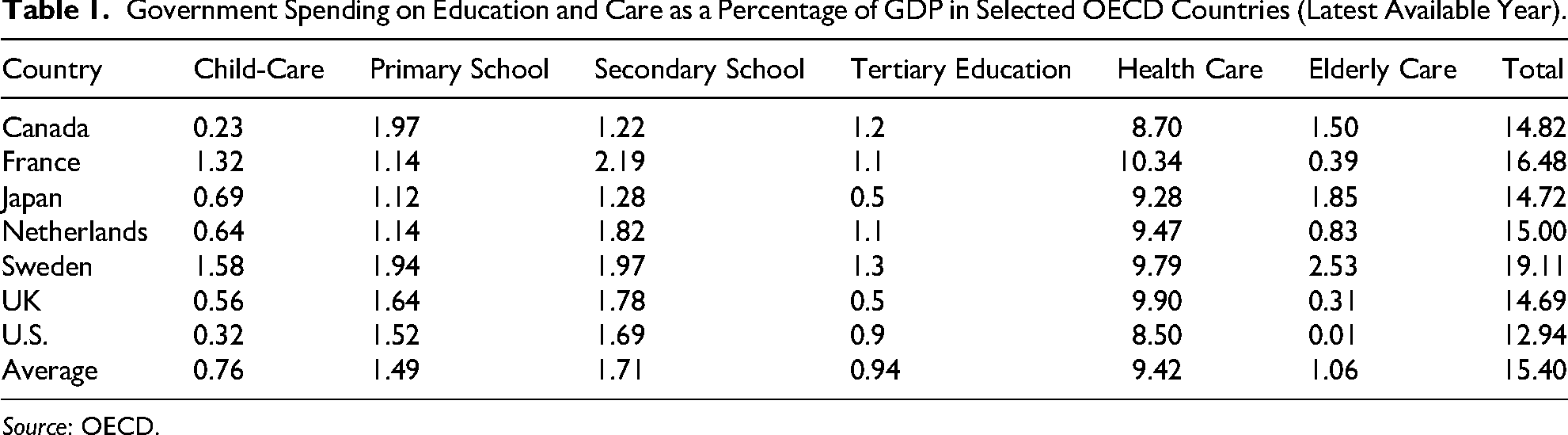
To our knowledge, however, institutional economics has scarcely addressed the relationship between quasi-markets and entrepreneurship. 2 Yet, the average portion of government spending allocated to education and care as a percentage of GDP across seven OECD countries currently stands at 15.4 percent (Table 1), 3 and it is possible to expose most of these government activities to competition. As a matter of fact, the trend to turn towards quasi-markets for the provision of welfare services shows no sign of abating (Blix and Jordahl 2021; Le Grand 2009). Thus, more scholarly focus on the relationship between quasi-market institutions and entrepreneurship should enable valuable insights on a phenomenon growing in importance across the globe.
Government Spending on Education and Care as a Percentage of GDP in Selected OECD Countries (Latest Available Year).
Source: OECD.
This paper intends to demonstrate that this is the case and highlight what we deem to be the most important institutional aspects necessary for quasi-markets to deliver better welfare than public monopolies. When analyzing such a complex issue, a New Institutional Economics perspective (NIE, see Alston 2008; Eggertsson 2013; cf. Coase 1984) is particularly useful. After all, NIE incorporates rules, norms, and conventions that shape human interaction into the analysis of economic processes. Focusing on individual agency, NIE assumes that individuals are rational and seek to maximize their utility within the constraints imposed by institutions. That said, it is always a judgment call to choose which institutions to focus on; this choice, in turn, requires deep pre-existing knowledge about the phenomenon under study, and a quasi-market is no exception. First and foremost, what is required is a recognition of the importance of institutions for entrepreneurship and innovation (Baumol 1990; Minniti and Lévesque 2008).
Getting the incentives right and providing the requisite conditions for continuous innovation and increased cost efficiency in quasi-markets pose formidable challenges. To be sufficiently relevant for quasi-markets, we argue that institutional analysis needs to take epistemic problems related to entrepreneurial action in these markets into account, e.g., uncertainty regarding the value of alternative service models, difficulties in identifying profitable opportunities due to fixed prices or restricted entry, and lack of reliable quality indicators guiding entrepreneurial experimentation. 4
To show why institutional entrepreneurship scholars are well-placed to undertake such theory development, we relate quasi-markets as they normally function to three key characterizations of the entrepreneurial function: the Knightian perspective, emphasizing the role of ownership in judgmental decision-making and risk-taking (Knight 1921); the Kirznerian perspective, conceptualizing entrepreneurship as alertness to opportunities (Kirzner 1973); and the Schumpeterian perspective, emphasizing its importance for product, process, and market innovation (Schumpeter 1934). Each characterization reveals challenges the entrepreneur faces in quasi-markets that an institutional analysis without the epistemic perspective risks missing. Thus, relating the three characterizations of the entrepreneurial function to institutional preconditions yields actionable reform prescriptions on how quasi-markets should be organized.
The analysis also identifies how institutional economists can offer important guidance to policymaking pertaining to quasi-markets. We sketch an answer to the pertinent policy question of how quasi-markets’ regulatory framework can incentivize productive entrepreneurship in the welfare sector, i.e., quasi-market entrepreneurship that is beneficial from a Kirznerian, Knightian, and/or Schumpeterian perspective. As a side effect, our analysis underscores the significance of quasi-market entrepreneurship as a vital but largely overlooked research area.
Our key policy prescription is to put in place an epistemically conducive institutional system. Specifically, we offer three institutional suggestions that would improve quasi-markets’ epistemic functioning and therefore quasi-market entrepreneurship of a Knightian, Kirznerian, and/or Schumpeterian kind: i) introduce and/or strengthen freedom of choice; ii) provide relevant information and evaluation criteria and establish reliable reputation mechanisms; iii) mitigate the negative impacts of failed entrepreneurial ventures as much as possible.
Such reforms would result in a system that is better at creating the kind of information quasi-market actors (including but not limited to entrepreneurs) need to make sense of the world. The system would also help actors acquire this information, generating the incentives they need to construct the knowledge necessary for action.
Quasi-Markets
Why Quasi-Markets?
Already Ostrom and Ostrom (1977) highlighted quasi-markets’ potential to improve the efficiency and responsiveness of public service provision by introducing elements of choice and competition between multiple production units. Rather than viewing markets and hierarchies as mutually exclusive, they argued that public goods can be delivered through institutional arrangements where collective consumption units—such as municipalities—interact with several producers in a competitive or negotiated manner. This, they suggested, can yield many of the informational and incentive benefits of markets while maintaining collective oversight and accountability.
As mentioned, the government primarily assumes the role of a financier in modern quasi-markets, procuring services from an array of competing private, public, and voluntary providers (Ferlie 1992). In fact, the mere size of welfare markets in most countries, highlighted in Table 1, has an inherent allocative effect: If profits can be made in marketized welfare sectors, some entrepreneurial individuals should redirect their talents from “traditional” industries into those sectors (Baumol 1990). Indeed, countries and regions that have implemented welfare quasi-markets witness an influx of entrepreneurs (e.g., Blix and Jordahl 2021; Le Grand 2009).
To ensure productive entrepreneurial venturing in any market, it is relevant to understand the requisite rules of the game, and a quasi-market is no exception. A challenge for regulators, then, lies in crafting an institutional framework around quasi-markets that prevents the pursuit of individual wealth from overshadowing the primary goal of serving beneficiaries, e.g., pupils and the elderly. Rather, the rules should encourage continuous improvements and cost efficiency.
Well-designed quasi-markets, the traditional argument goes, should potentially improve quality in two ways compared to government monopolies: (i) direct improvements resulting from some modes of operation delivering better care than others, and (ii) an indirect effect where heightened competition spurs all providers to shape up, akin to “a tide that lifts all boats” (Epple, Romano and Zimmer 2016; Hoxby 2003; Le Grand 2009). That said, the label “quasi-market” holds considerable structural heterogeneity; as many as seven dimensions have been identified to distinguish between different types of tax-financed market service models (Jordahl and Öhrvall 2013, p. 46). Here, we focus on what we believe to be the crucial distinction, namely that the competitive dynamics may vary depending on whether providers are selected through public procurement, user choice, or a combination of the two methods.
How are Quasi-Markets Structured?
There are at least seven types of market models for tax-financed welfare services, but the main difference concerns whether the choice of provider is made by bureaucrats or users (Jordahl and Öhrvall 2013). While prices are often fixed, there are (partial) exceptions; for example, private firms in Swedish elderly care can employ some forms of topping up, but public operators cannot, and topping up is outlawed in the Swedish school market. Still, the greatest differences exist between the contracting model and the freedom-of-choice model; they are worth highlighting because these two quasi-market types are both theoretically distinct and empirically relevant (Blix and Jordahl 2021).
The contracting model operates in a top-down manner in that politicians choose between public and private service provision, appointing the provider through a procurement procedure in which actors can submit bids. The winning bidder gains a temporary monopoly. Competition is thus for the market; if a private company wins the contract, the entire production unit shifts from government to private management, which can be considered as a (temporary) privatization.
The incentive provided by the profit motive is expected to stimulate innovation and improved service quality in the contracting model. However, there is a recognized risk that profit-driven providers may prioritize cost-cutting measures that compromise quality, particularly in areas where service quality is challenging to specify in contracts (Shleifer 1998). Requirements and regulatory supervision are therefore seen as crucial to channeling the profit motive appropriately. Of course, external control is also needed for government providers, but the problem in this case is that the provider's incentives for innovation, indeed for any kind of change, are weak. Regardless of the provider, there is also a risk that control becomes demoralizing, stifling change efforts in their infancy.
In contrast, the freedom-of-choice model operates in a relatively bottom-up manner, empowering users with tax-financed vouchers to select their preferred service providers. Here, providers compete within the market, to which access is relatively free. Providers can generally be either public or private, and private providers may be either for-profit or non-profit, though some countries and sectors only allow private non-profits. 5 The model facilitates a gradual privatization process, driven by individual user choices. Competition is thought to give the freedom-of-choice model's providers incentives to continuously improve their operations, as they would otherwise lose the voucher when users bring it to a competitor. Crucially, such loss is unattractive for both profit-driven and altruistic providers (Le Grand 2009).
Clearly, the institutional setups in quasi-markets differ substantially from the institutional setup in conventional markets. What this means for the exercise of entrepreneurship varies depending on which entrepreneurial function one has in mind. For tractability, we frame our analysis below in terms of its impact on the relevant entrepreneurship functions: Knightian, Kirznerian, or Schumpeterian.
Quasi-Market Entrepreneurship: Three Functions and Related Epistemic Problems
Entrepreneurship scholars have long emphasized that the institutional environment shapes the direction and intensity of entrepreneurial activity. Economists typically argue that innovation and economic growth are more likely in conventional markets when political and economic institutions reward productive entrepreneurial activities—such as introducing new goods, services, or organizational forms—rather than unproductive activities such as rent seeking (Hwang and Powell 2005; Thomas and Mueller 2000; Urbano and Alvarez 2014). Institutions such as the rule of law, secure property rights, and well-functioning market regulations are therefore commonly seen as central to enabling productive entrepreneurship (Bjørnskov and Foss 2013; Hall and Jones 1999; Henrekson and Johansson 2009).
Yet the institutional challenges involved in fostering entrepreneurship may be particularly pronounced in quasi-markets for welfare services. Compared to their conventional market counterparts, quasi-market actors often operate where prices are administratively determined, competition is partially constrained, and service quality is difficult to evaluate. These conditions create distinctive knowledge problems for both users and providers.
Entrepreneurship scholars have long analyzed regular market processes through different theoretical lenses. Three influential perspectives are associated with Knight, Kirzner, and Schumpeter. Explicitly or implicitly, entrepreneurship takes place subject to genuine uncertainty (rather than calculable risk) in all three perspectives. Rather than describing different “types” of entrepreneurs, these perspectives highlight different defining entrepreneurial acts within the broader market process. In the Knightian tradition, particularly as developed in the modern judgment-based approach (Foss and Klein 2012, 2015), entrepreneurship consists of judgment over the allocation of resources under uncertainty. The Kirznerian tradition defines entrepreneurship by alert discovery of profit opportunities (Kirzner 1973). In the Schumpeterian tradition, the defining entrepreneurial act is innovation through new combinations of resources (Schumpeter 1934). Although all three perspectives encapsulate all forms of entrepreneurship, for example, Kirzner also emphasized the creation of opportunities, stressing that this entrepreneurial function had many similarities to Schumpeter's entrepreneur (e.g., Kirzner 1999, 2009; Korsgaard et al. 2016)—the three perspectives differ in what they identify and isolate as the defining act of entrepreneurship. We use these differences in the defining act to examine how quasi-market institutions affect entrepreneurial processes.
All three perspectives highlight the importance of epistemic problems, that is, problems related to the discovery, interpretation, and use of knowledge in economic decision-making. Entrepreneurs must identify opportunities, assess uncertain outcomes, and experiment with alternative resource combinations without complete knowledge of the future. The list of problems includes, but is not limited to, uncertainty regarding the value of alternative service models, difficulties in identifying profitable opportunities due to fixed prices or restricted entry, and lack of reliable quality indicators guiding entrepreneurial experimentation.
Quasi-markets alter the institutional environment in which these epistemic problems arise. In particular, they affect the informational signals and discovery processes that guide entrepreneurial action in conventional markets. Table 2 summarizes the defining entrepreneurial act in each theoretical perspective, the corresponding epistemic problem in conventional markets, and the ways in which quasi-market institutions further affect these epistemic conditions.
Entrepreneurial Perspectives and Epistemic Problems.
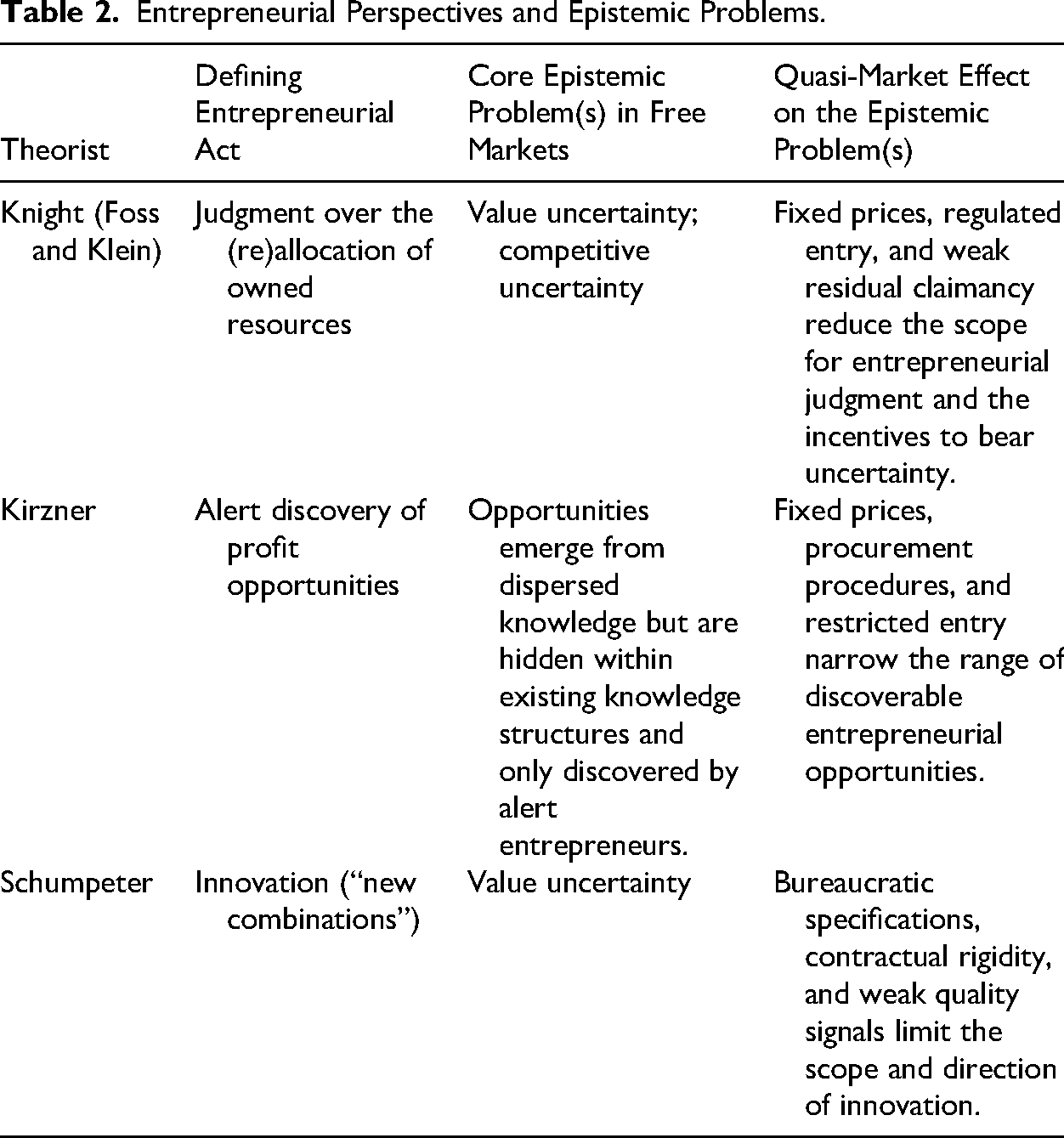
While quasi-market institutions do not eliminate entrepreneurship altogether, they change the epistemic environment in which entrepreneurial discovery, judgment, and innovation occur. In many cases, these institutional features reduce the scope for entrepreneurial learning and experimentation relative to conventional markets.
Judgment-Based Entrepreneurship
In the judgment-based perspective, building on Knight's (1921) analysis of uncertainty and developed more fully in the modern judgment-based approach (Foss and Klein 2012, 2015), the defining entrepreneurial act consists of exercising judgment over resource allocation under conditions of uncertainty. The perspective typically links entrepreneurial judgment to ownership and residual claimancy, since those who control resources and bear the financial consequences of their decisions have the strongest incentives to form and act on such judgments. From this perspective, entrepreneurs in conventional markets face two major epistemic challenges. First, they must assess value uncertainty, that is, whether consumers will ultimately value a particular product or service sufficiently to make production profitable. Second, they must cope with competitive uncertainty, since other entrepreneurs may discover superior ways of meeting consumer demand.
Quasi-markets modify these epistemic conditions in several ways. First, the prevalence of public and non-profit providers in quasi-markets weakens the link between ownership and decision-making. While managers in such organizations may exercise some discretion, the absence of residual claimancy reduces incentives to engage in entrepreneurial judgment over resource allocation.
Second, the institutional rules governing quasi-markets often constrain the scope for entrepreneurial judgment even among private providers. In contracting systems, providers operate under detailed specifications and multi-year contracts that limit their ability to experiment with alternative resource uses. Even in freedom-of-choice systems, fixed prices and regulatory constraints reduce the range of strategic decisions available to providers.
Finally, uncertainty-bearing itself becomes politically and socially more problematic in the quasi-market realm. Because many users—such as school pupils or elderly care recipients—occupy vulnerable positions, entrepreneurial failure can impose costs on individuals with limited ability to protect themselves. This makes regulators more reluctant to tolerate experimentation and failure, further narrowing the scope for entrepreneurial judgment.
Taken together, these quasi-market features reduce both the incentives and the opportunities for exercising entrepreneurial judgment. The epistemic role of judgment in discovering superior resource allocations is therefore diminished relative to conventional markets.
Kirznerian Entrepreneurship
Kirzner's theory defines entrepreneurship as alertness to profit opportunities (Kirzner 1973). In this conception, the entrepreneur's defining act is to discover previously unnoticed opportunities to buy resources at lower prices and sell outputs at higher prices, thereby coordinating markets and moving them toward equilibrium. In this process, entrepreneurial profits signal superior ways of organizing production and attract competitors, which promotes diffusion of successful innovations and gradually shifts the gains from innovation toward consumers (Baumol 2010; Nordhaus 2005).
In conventional markets, such opportunities arise from dispersed knowledge, variable prices, unrestricted entry, and consumer payment autonomy. However, these opportunities are often hidden within existing knowledge structures and can only be discovered by entrepreneurs who are sufficiently alert to notice them.
Quasi-markets affect these discovery conditions in several ways. First, prices are often administratively determined. In freedom-of-choice systems, providers typically receive a fixed remuneration per user, while the relevant price in contracting systems is negotiated between the public purchaser and the winning bidder rather than emerging from decentralized exchange. When providers receive identical payments per student, patient, or client, this limits opportunities to discover profit through price differentials.
Second, entry restrictions and procurement procedures can weaken the competitive process that normally reveals entrepreneurial opportunities. In contracting systems, the winning bidder may enjoy a temporary monopoly until the next procurement round, preventing competitors from imitating superior practices. Even in freedom-of-choice systems, the number of providers and the degree of effective competition may remain limited.
Finally, fixed prices prevent providers from signaling higher quality through pricing. Competition therefore tends to occur along a narrower set of margins, weakening the epistemic signals that normally guide entrepreneurial discovery.
Taken together, these institutional features reduce the range of opportunities that entrepreneurs can discover and act upon. While entrepreneurial alertness may still identify “twenty-dollar bills on the sidewalk,” the quasi-market environment narrows the set of discoverable opportunities relative to conventional markets.
Schumpeterian Entrepreneurship
Schumpeterian entrepreneurship centers on innovation through new combinations of resources (Schumpeter 1934). Such innovations may involve new products, production methods, organizational forms, or markets and are widely seen as a central driver of long-term productivity growth (Baumol 2010; Bloom, Van Reenen and Williams 2019). While innovators face substantial value uncertainty in conventional markets, market experimentation and competition gradually reveal which innovations create value and which do not.
Quasi-markets constrain this process of experimentation. Because welfare services often involve politically sensitive activities and vulnerable users, governments typically specify service requirements and regulatory standards in considerable detail. While such safeguards may serve legitimate purposes, they also create a more restrictive institutional environment that limits the scope for experimentation, particularly in contracting quasi-markets where providers operate under multi-year agreements.
Moreover, the nature of many welfare services makes innovation especially dependent on co-production between providers and users, for example, between teachers and students in schools (Ostrom and Ostrom 1977). Detailed specifications and bureaucratic oversight may therefore restrict the discovery of new ways of organizing service delivery. High contractibility may help prevent quality deterioration (Shleifer 1998), but overly specific requirements also narrow the range of feasible innovations.
Finally, Schumpeterian innovation depends on the availability of reliable signals regarding which innovations create value. In many quasi-markets, however, quality indicators are either weak or unreliable. When performance measures are poorly designed—e.g., when school grades are poor indicators of actual learning—innovative efforts may be directed toward improving measurable indicators rather than underlying service quality. Such distorted signals weaken the epistemic environment in which entrepreneurial experimentation normally occurs.
Together, bureaucratic specifications, contractual rigidity, and unreliable quality indicators are likely to significantly reduce both the incentives and the opportunities for Schumpeterian innovation in quasi-markets.
Policy Prescriptions with Respect to Quasi-Markets
The Fundamental Policy Issue: Reducing Epistemic Paucity
In the preceding section, we discussed epistemic challenges related to three common entrepreneurship characterizations in quasi-markets. Actors in regular markets, quasi-markets, or other contexts are on a continuous quest for the knowledge they require to make the necessary choices to achieve their ends, but actors are far from omniscient. This is also true for government actors, who are limited in what they can do to “correct” erroneous choices, if they can even identify such choices. Moreover, good outcomes cannot be defined ex ante; rather, these outcomes emerge as people engage with each other and try to make sense of the world.
In regular markets, Hayek's (1945) description of how prices help actors coordinate their goals helps us see how desired outcomes can be achieved. However, both the price mechanism and most other knowledge indicators are severely hampered in most quasi-markets. As we have seen, this has important implications for entrepreneurship, regardless of whether it is conceptualized in Knightian, Kirznerian, or Schumpeterian terms, but also for users. A key prediction is therefore that quasi-markets will perform poorly relative to regular markets, unless additional epistemic institutions are put in place that help actors make sense of the world.
Competition and the presence of for-profit actors are likely necessary conditions for well-functioning quasi-markets, specifically because of the epistemic value of these typical quasi-market features. Thus, observing that quasi-markets work poorly relative to regular markets does not imply that the influence of the profit motive should be restricted (a common prescription in the political debate in many countries). Rather, epistemic considerations help us appreciate that every quasi-market problem discussed in section 2 is likely to be exacerbated when profits are further restricted, or competition is curtailed.
For example, a government-mandated profit restriction would effectively abolish entrepreneurial rents in the welfare sector. This would dampen crucial knowledge signals, transformative pressures, and incentives to innovate and replicate successful innovations. A profit restriction would also make it more difficult to raise external equity, forcing companies in the welfare sector to expand largely through retained earnings. Major negative quality and equity consequences would ensue.
Likewise, unnecessarily restricting the number of competitors risks removing competition's disciplining effects and its epistemic value. In the extreme scenario where a single provider monopolizes the market, there are no challengers and therefore no reference points offering guidance as to what potential users value. Therefore, there is a risk that the provider either focuses innovative efforts along dimensions users do not value or prioritizes cost-saving measures at the expense of quality.
However, the challenges we identify significantly curb the positive impacts that competition and the involvement of for-profit entrepreneurs can bring to quasi-markets, unless supplementary epistemically favorable institutions are implemented. This constitutes the central policy recommendation of our analysis: Institutional reforms should create and provide the kind of information quasi-market actors need to make sense of the world and generate the incentives they need to construct the knowledge necessary for action.
The standards for beneficial welfare provision are not immutable. Rather, the outcome depends on the quality of complementary institutions operating across different levels of the institutional hierarchy. These institutions should be epistemically conducive. While quasi-markets can vary in their setup, we have discussed the two most common models, and a prediction is that quasi-markets that contain relatively more of the mechanisms described below will flourish. In other words, they will see (Knightian, Kirznerian, and Schumpeterian) entrepreneurship bolstered relative to quasi-markets lacking these mechanisms.
Strong Choice
An important step towards solving, or at least mitigating, the epistemic problems in quasi-markets involves enhancing choice. We identify three principal avenues to achieve this goal and highlight some of the fundamental ways the reforms impact the three entrepreneurial functions.
Vitalize user choice. At the level of the overall market, this measure entails either strengthening freedom-of-choice when it exists on paper or complementing a pure contracting model with a system of choice. Users would then be furnished with vouchers, enabling demand to vary with users’ subjectively perceived quality. Consequently, users would actively influence service content and the development of valuable epistemic indicators. With vouchers that follow individual users, their quality assessments would guide entrepreneurs. The most important effect of such a reform would likely be that it would help Schumpeterian-type entrepreneurs acquire the kind of knowledge they need to know where to focus their improvement efforts. Broaden market scope. For freedom of choice to be effective, the market must be large enough to incentivize entry. In general, this entails expanding to larger catchment areas, e.g., from the municipal to the regional level, as this greatly reduces the risks for new operators.
6
One important consequence of this reform would be that it reduces the risk for potential entrants, thereby enhancing opportunities for replication. The effect would likely become more pronounced if the reform were coupled with additional fees. Consider allowing supplementary fees. In some quasi-markets, private providers may offer their users additional services. If such “topping up” is allowed for some it should apply to all providers including government-run establishments, as such an experimental measure can help discern genuine user preferences (Karlson and Lundbäck 2022).
7
As mentioned, this would strengthen the Kirznerian “buy low and sell high” function, but it would also aid Knightian-type profit-driven judgmental decision-making by giving the price mechanism some role, aiding economic calculations.
Establish Reliable and Relevant Information and Evaluation Criteria
While service specifications are inevitable, regulations governing quasi-markets should remain open to the possibility that there may be more than one way to achieve the goals of the governmental service descriptions. Ideally, objective outcome indicators should be used to assess operations and guide users who are making choices, complemented by subjective measures of user experience. Again, we highlight some of the core ways these reforms affect the three entrepreneurial functions.
Reliable objective measures. Reliable, objective quality indicators would shift the focus to outcomes, allowing public officials to adopt a hands-off approach to how entrepreneurs achieve desirable results. By lessening this unhelpful kind of uncertainty about how quality is measured, such a reform would pave the way for more innovation by giving Schumpeterian-type entrepreneurs additional knowledge regarding where to focus their innovative efforts. At the same time, reliable indicators would offer greater degrees of freedom in terms of Knightian judgmental decision-making, while also empowering users with the necessary knowledge to make informed choices.
Grades in school quasi-markets offer a cogent illustration, as grading inconsistencies and grade inflation undermine the reliability of this measure of school quality in some countries (e.g., Elert and Henrekson 2025; Silva et al. 2023; Zwick 2017). Implementing anchored, transparent grading reforms, as some countries have done, would alleviate this issue. Such reforms would compel schools to compete and innovate in the most crucial dimension, i.e., the extent to which students acquire relevant knowledge (Henrekson and Wennström 2023). Also in other quasi-markets, government officials should endeavor to compile relevant objective indicators, ensuring that these measures are comprehensible and accessible to users. A commendable example of this approach is the transparent way the British government presents evaluation results on its school portal.
8
(b) Soundly generated subjective measures. Most quasi-markets would benefit from making information from (existing or novel) user surveys easily accessible and understandable. Such comparative information should be based on a few well-chosen quality measures, while people who wish to delve deeper are given the opportunity to do so (Bergman and Jordahl 2014).
Consideration should also be given to introducing the kind of rating systems that have emerged for many private services, e.g., hotels, taxi services, and subletting (Lundberg et al. 2022). Such measures would strengthen reputation mechanisms in both contracting and freedom-of-choice quasi-markets. If (prospective) users can access reviews from users with experience of a provider, the voice of existing users would become a powerful force. Such reputation mechanisms would provide future users with a better basis for decision-making while requiring the provider to be more responsive to current users’ dissatisfaction. These measures may especially strengthen the scope for replicative entrepreneurship, which relates most closely to the Kirznerian perspective.
In summary, objective and easily understandable quality indicators and user assessments can greatly improve the scope for learning in quasi-markets, for both entrepreneurs and users.
Ensure That Exits Improve Learning While Doing Little Harm
The logic of choice in quasi-markets is to incentivize providers to attract users, with financial penalties imposed on those who fail to do so. Ideally, choice acts as a feedback mechanism that prompts weaker providers to reassess and improve their offerings. To be sure, failures are inevitable in any competitive system marked by uncertainty. Failed projects should not be considered a waste of resources; a firm failure provides valuable information to economic agents about whether a business model is viable. Failed ventures must end so that their resources can be redirected to more productive uses. Therefore, “fear of failure” should not prevent new entrants from challenging the status quo. Still, it is important that failures in quasi-markets do not affect users more than necessary, since many users, as we have noted, find themselves in a vulnerable position relative to providers.
Moreover, the system should be designed so that those failures that do occur improve actors’ epistemic positions, i.e., that they learn from these mistakes (Harford 2011). The reform suggestions we offer concern both the conditions for the judgmental decision-making Knightian entrepreneur and the Kirznerian arbitrage entrepreneur.
Reduce the number of “unnecessary” exits. One strategy to mitigate the risk of dramatic failures is to implement measures that discourage such occurrences. For instance, requiring operators of essential services such as schools or elderly care facilities to provide a bank guarantee could incentivize financial monitoring by banks. It would also protect users against sudden closure by ensuring that a guaranteed amount accrues to the operator who is required to take over. This measure also puts a price tag on the government's obligation to swiftly relocate users to alternative service providers, thereby enhancing the epistemic understanding of both providers and local authorities. As such, the reform would aid entrepreneurs in their judgmental-decision-making role. Prioritize user protection. When failures do transpire it is imperative that the burden falls on (the risk-bearing) providers rather than users. One approach would be to put underperforming providers under compulsory administration rather than outright closure. In such a situation, it should be possible to outsource the operation of the underperforming operator to an external actor with documented competence, akin to the charter takeovers implemented in deficient schools in the United States. Giving such a provider greater degrees of freedom could also spur the Schumpeterian entrepreneurial function, by permitting them to experiment and discover what works best in a bottom-up fashion.
9
Implications
Implementing the epistemic institutions we propose would offer considerable guidance to quasi-market entrepreneurs, serving to strengthen their judgmental decision-making (Knight), provide them with better information on where to buy low and sell high (Kirzner), and reveal along which margins they should innovate (Schumpeter). Users would experience immediate improvements in their ability to make informed choices without compromising their safety. Over the long term, they stand to gain from more abundant and affordable services as the benefits of entrepreneurial quasi-markets materialize.
Conclusion
Baumol's Cost Disease (Baumol 1967, 2013) underscores the challenge of rising costs in labor-intensive service sectors due to stagnant productivity growth. The relative costs of welfare services such as education and elderly care will increase, and unless their share of total real consumption falls, their share of nominal GDP will rise. In this article, we discuss the only conceivable way out of this dilemma when the services in question are tax-financed, namely how policymakers should set up the regulatory framework of quasi-markets for welfare services to incentivize value-enhancing innovative entrepreneurship while safeguarding user equality.
In a broader perspective, we view polycentricity as a fundamental prerequisite for effective welfare service provision. The concept describes a system in which users enjoy substantial freedom of choice and where numerous relatively autonomous decision-making units and levels coexist within a shared framework of rules and norms (Aligica and Tarko 2012; Ostrom 2008). Users can then experiment and choose solutions suited to their circumstances, but the outcomes will only be truly beneficial if the rules and norms of the polycentric system promote value-creating production. The epistemic problems we have identified largely stem from shortcomings in those institutional frameworks that are typical in countries that have introduced quasi-markets in recent decades—hence our detailed discussion of how they may be improved.
We offer three suggestions that would improve quasi-market's epistemic functioning and therefore quasi-market entrepreneurship of a Knightian, Kirznerian, and/or Schumpeterian nature. First, introduce or reinforce freedom-of-choice mechanisms. Second, establish reliable and relevant information and evaluation criteria, alongside robust reputation mechanisms. Third, mitigate the adverse effects of entrepreneurial exits by ensuring that they are managed prudently.
Private for-profit entrepreneurs have an important role to play in quasi-markets for welfare services, but regulatory frameworks need to be reformed in an epistemic direction to fully unleash their potential. That said, details in the rules governing these quasi-markets will typically fall short initially. Some of the positive effects of the reforms may then be delayed. To ensure that the interests of profit-seeking entrepreneurs and society coincide, policymakers need to safeguard the system's stability. Such a long-term view keeps emphasizing the value of competition and for-profit companies while adjusting the regulatory framework in response to weaknesses that emerge. This will also reduce the temptation of for-profit providers to exploit such weaknesses.
Our proposed reforms aim to empower welfare markets to generate essential information and knowledge as a matter of course. By enabling providers to compete based on user-valued criteria, the reforms stimulate both innovation and replication. Precisely because these markets remain dominated by government providers with weaker incentives to innovate and improve, it becomes even more important that the private providers can take risks in the hope of future returns. Balanced regulations can align profit-seeking endeavors with societal interests, ensuring a mutually beneficial outcome for all interested parties.
While the relationship between for-profit private action and social outcomes has been extensively studied, the institutional economics literature has paid scant attention to the related phenomenon of quasi-markets in the welfare sector. Our study is a first attempt in this arena, but to increase our understanding of how to bolster innovative capacities and enable entrepreneurial actors to deliver high-quality welfare services in a cost-efficient manner more research on different sectors and countries is needed. Future studies should try to apply both econometric and qualitative approaches, e.g., process-tracing, to formally examine the strength of evidence linking potential causes to consequences.
“The devil is in the details” when it comes to welfare service quasi-markets. This highlights the necessity of applying a case-focused, holistic analysis to different quasi-markets, polities, and countries. Such analyses must be grounded in an intimate knowledge of relevant sectors, comparing outcomes in terms of costs, quality, and innovation with empirical evidence from other sectors and countries. Such a contextual approach would bridge the gap between the individual case and the broader understanding of quasi-market effectiveness. In conjunction, it is possible to conceive of a more quantitative track, e.g., exploiting regional or municipal variation in how quasi-markets are set up.
Our primary aim has been to bring attention to what we perceive as an underappreciated topic in institutional economics. We hope that future studies will explore this topic comprehensively, leveraging both qualitative and quantitative analytical tools.
Footnotes
Acknowledgements
We are grateful for comments on previous versions of this paper by Per Bylund and Sven-Olov Daunfeldt.
Declaration of Conflicting Interests
The authors declared no potential conflicts of interest with respect to the research, authorship, and/or publication of this article.
