







Abstract
The Expert Panel for Cosmetic Ingredient Safety (Panel) assessed the safety of Levulinic Acid and Sodium Levulinate as used in cosmetic formulations. These ingredients are both reported to function in cosmetics as skin conditioning agents, while Levulinic Acid is also reported to function as a fragrance ingredient. The Panel reviewed relevant data relating to the safety of these ingredients in cosmetic formulations, and concluded that these ingredients are safe in cosmetics in the present practices of use and concentration described in this safety assessment when formulated to be non-irritating.
Keywords
Introduction
This is a safety assessment of Levulinic Acid and Sodium Levulinate, as used in cosmetic formulations. According to the web-based International Cosmetic Ingredient Dictionary and Handbook (Dictionary), both Levulinic Acid and Sodium Levulinate are reported to function in cosmetics as skin conditioning agents; Levulinic Acid is also reported to function as a fragrance ingredient. 1 Sodium Levulinate is the salt of Levulinic Acid. Upon dissociation in aqueous solution, these ingredients are identical. Thus, these ingredients are reviewed together in this report.
This safety assessment includes relevant published and unpublished data that are available for each endpoint that is evaluated. Published data are identified by conducting an exhaustive search of the world’s literature. A listing of the search engines and websites that are used and the sources that are typically explored, as well as the endpoints that the Expert Panel for Cosmetic Ingredient Safety (Panel) typically evaluates, is provided on the Cosmetic Ingredient Review (CIR) website (https://www.cir-safety.org/supplementaldoc/preliminary-search-engines-and-websites; https://www.cir-safety.org/supplementaldoc/cir-report-format-outline). Unpublished data are provided by the cosmetics industry, as well as by other interested parties.
Much of the data included in this safety assessment were found on the European Chemicals Agency (ECHA) website.2,3 Please note that the ECHA website provides summaries of information generated by industry, and it is those summary data that are reported in this safety assessment when ECHA is cited. Data from a Research Institute for Fragrance Materials (RIFM) safety assessment of Levulinic Acid have also been included, and that assessment is cited when primary references were not available. 4
Chemistry
Definition and Structure
Levulinic Acid (CAS No. 123-76-2) is the organic acid that conforms to the structure depicted in Figure 1.
1
Levulinic Acid is a 5-carbon, oxocarboxylic, keto acid.
5
Levulinic acid.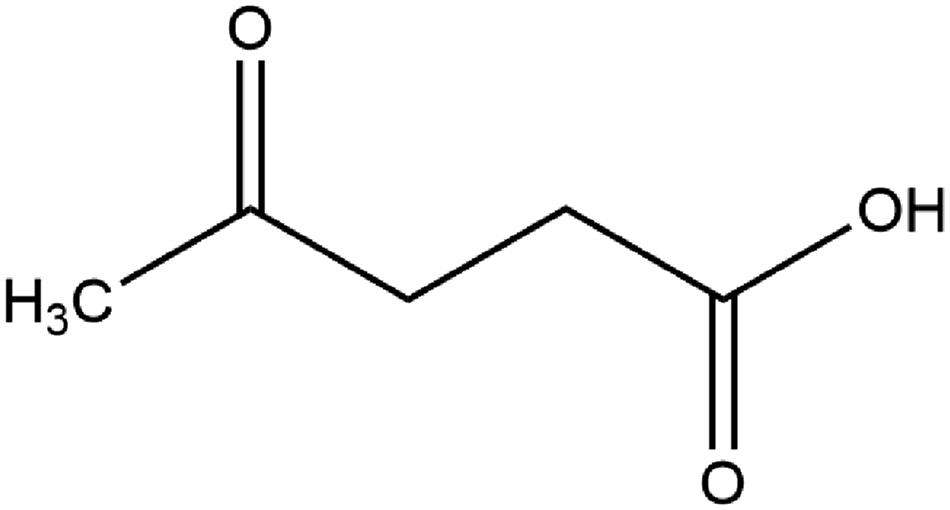
Sodium Levulinate (CAS No. 19856-23-6) is the sodium salt of Levulinic Acid
1
that conforms to the structure depicted in Figure 2. Sodium levulinate.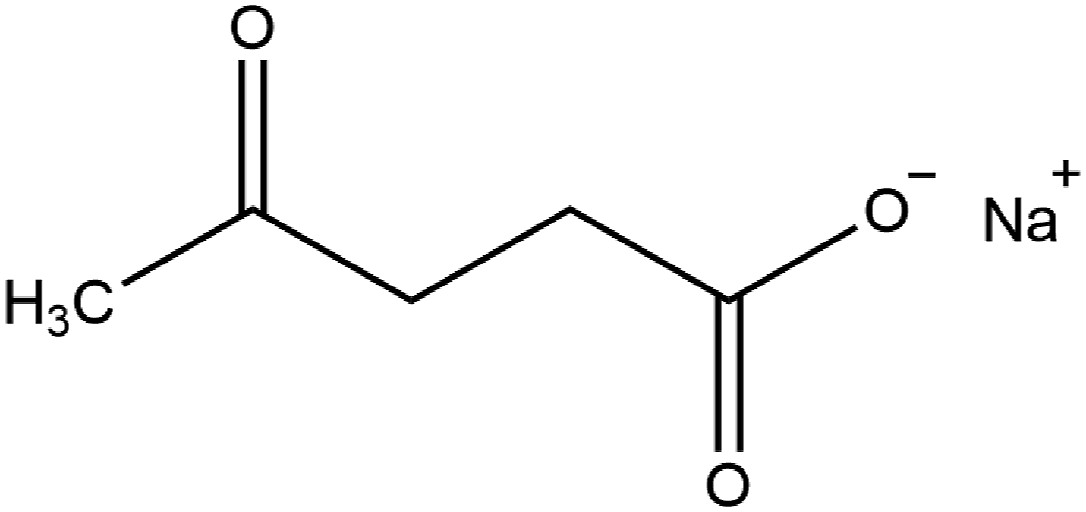
Chemical Properties
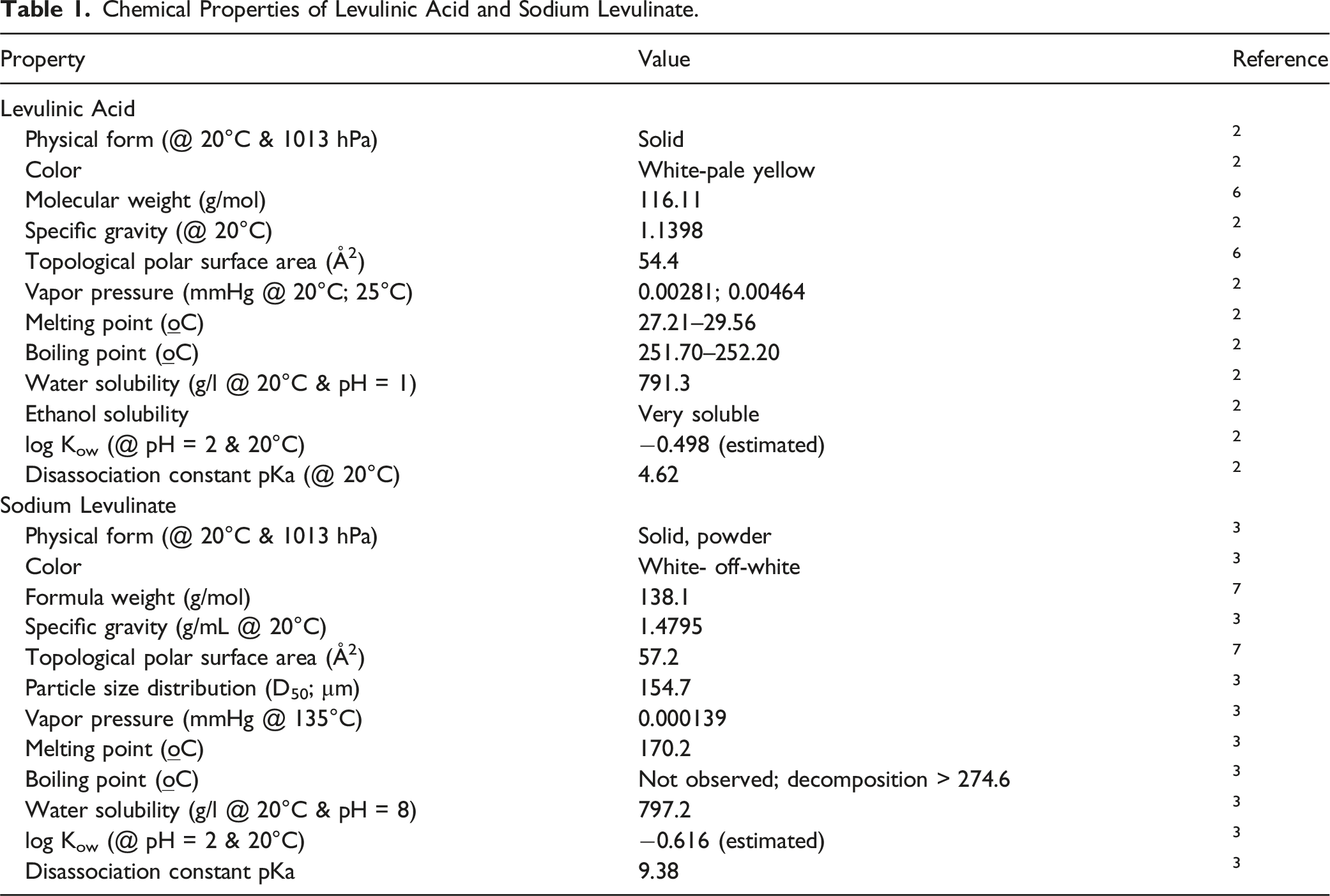
Levulinic Acid has a molecular weight of 116.11 g/mol and an estimated log Kow of −0.498, while Sodium Levulinate has a formula weight of 138.1 g/mol and an estimated log Kow of −0.616.2,3,6,7 Levulinic Acid and Sodium Levulinate are both highly soluble in water and comprise carboxylic acid and ketone functional groups. While Sodium Levulinate is a solid, white to off-white powder, Levulinic Acid is a solid with a low melting point, which exhibits limited granularity.2,3
Chemical Properties of Levulinic Acid and Sodium Levulinate.
Natural Occurrence
Levulinic Acid is found in both natural and processed foods, such as Chinese quince, papaya, rice, sake, and wheaten bread. 8
Method of Manufacture
The following are general industrial methods of manufacture; it is unknown if these apply to the manufacture of cosmetic ingredients. Levulinic Acid can be produced from low-grade cellulose, 9 sugar and starchy crops, wood, organic waste, or algae, as a hydrolysis and conversion step in the biorefinery process. 10 Sugars and starches are the most frequently used feedstock for mass production of Levulinic Acid and typically undergo a multi-step manufacturing process, including hydrolysis of polysaccharides with a Brønsted-Lowry acid (such as sulfuric acid) to yield hexose or pentose sugars (such as glucose), isomerization of glucose by a Lewis acid to yield fructose, dehydration of fructose to 5-(hydroxylmethyl)furfural (5-HMF) by a bifunctional acid,5,9 and, lastly, rehydration of 5-HMF by a Brønsted-Lowry acid to yield Levulinic Acid. 10 Sodium salts, such as Sodium Levulinate, are typically derived from the reaction of the free acid (e.g., Levulinic Acid) with an inorganic base, such as sodium hydroxide. 1
Impurities
Specifications for food-grade Levulinic Acid include an acceptance criterion of no lower than 97% purity. 11 No further impurities data were found in the published literature, and unpublished data were not submitted.
Use
Cosmetic
The safety of the cosmetic ingredients addressed in this assessment is evaluated based on data received from the US Food and Drug Administration (FDA) and the cosmetics industry on the expected use of these ingredients in cosmetics. Use frequencies of individual ingredients in cosmetics are collected from manufacturers and reported by cosmetic product category in the FDA Voluntary Cosmetic Registration Program (VCRP) database. Use concentration data are submitted by the cosmetic industry in response to surveys, conducted by the Personal Care Products Council (Council), of maximum reported use concentrations by product category.
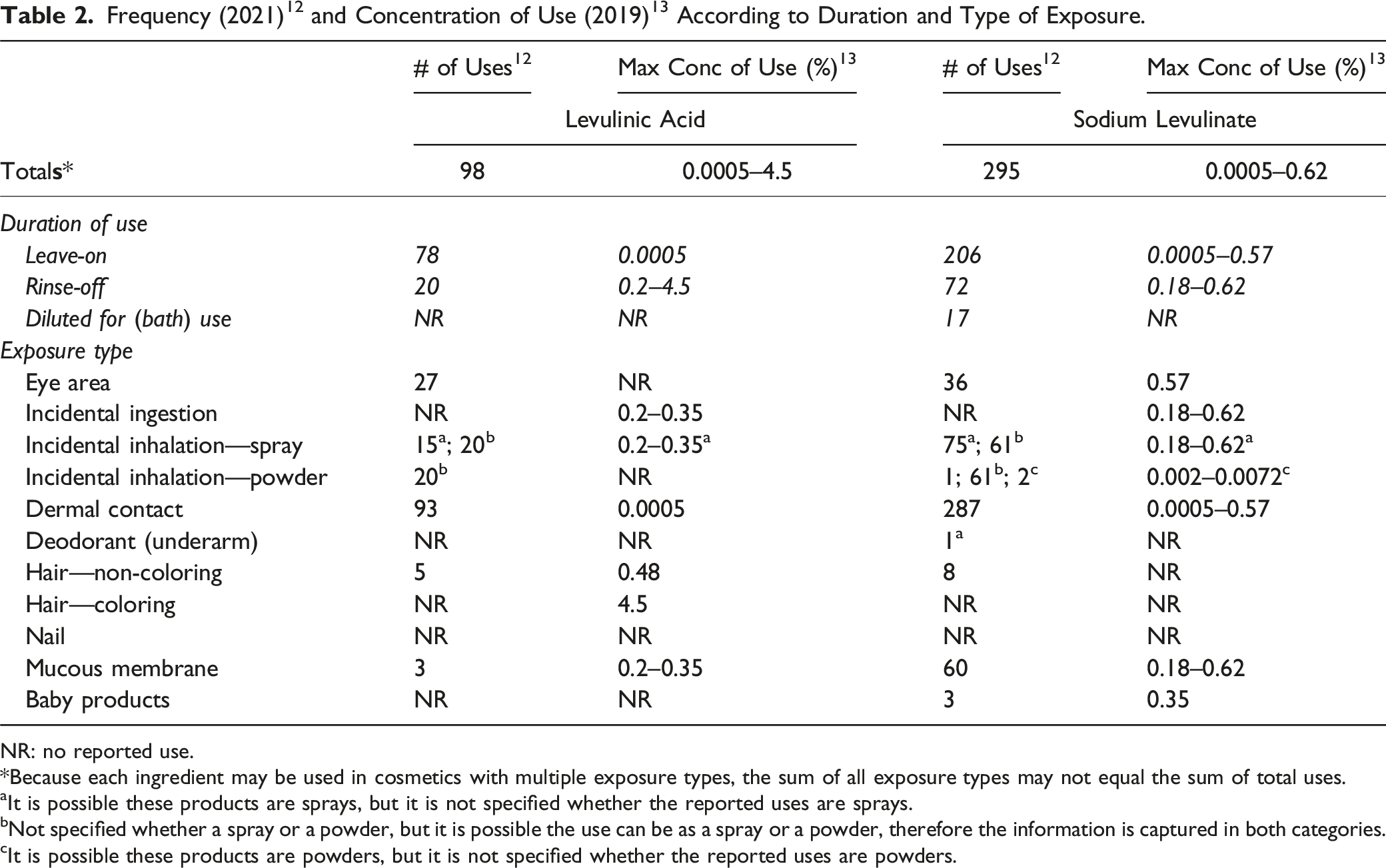
NR: no reported use.
*Because each ingredient may be used in cosmetics with multiple exposure types, the sum of all exposure types may not equal the sum of total uses.
aIt is possible these products are sprays, but it is not specified whether the reported uses are sprays.
bNot specified whether a spray or a powder, but it is possible the use can be as a spray or a powder, therefore the information is captured in both categories.
cIt is possible these products are powders, but it is not specified whether the reported uses are powders.
These ingredients have been reported to be used in products that may come into contact with the eyes; for example, Sodium Levulinate is reported to be used at up to 0.57% in eye shadows. The use of both ingredients in mouth freshening products, at a reported maximum concentration of 0.35% for Levulinic Acid and 0.62% for Sodium Levulinate, may lead to incidental ingestion and exposure to mucous membranes. Sodium Levulinate is reported to be used in baby products, at up to a 0.35% in baby lotion, oil, or cream formulations.
Additionally, Sodium Levulinate is reported to be used in 1 face powder formulation (concentration of use not reported), and could therefore possibly be inhaled. Conservative estimates of inhalation exposures to respirable particles during the use of loose powder cosmetic products are 400-fold to 1000-fold less than protective regulatory and guidance limits for inert airborne respirable particles in the workplace.14–16
Both Levulinic Acid and Sodium Levulinate are not restricted from use in any way under the rules governing cosmetic products in the European Union. 17
Non-Cosmetic
The bulk of Levulinic Acid use is as a chemical intermediate in the manufacture of biofuels and chemicals, fuel extenders, biodegradable polymers, plasticizers, herbicides, and antibiotics.5,18
In the US, Levulinic Acid is a food additive approved for human consumption as a flavoring agent and related substance, assuming good manufacturing practices and minimum use to achieve the desired effect [21 CFR 172 § 515]. Levulinic Acid was included in the list of nonharmful artificial flavoring substances by the Council of Europe in 1974, at 50 ppm. 19 In 1999, the Joint Expert Committee on Food Additives (JECFA) deemed that Levulinic Acid posed no safety concerns. 20 Additionally, Levulinic Acid is proven to be effective in stunting bacterial growth in preserved, ready-to-eat meats and as a cytocidal agent in oral rinse solutions.21–23
Levulinic Acid appears on the FDA Inactive Ingredient List, for inclusion in approved drug products, and is listed as an inactive ingredient in the manufacturing of transdermal, extended release film and patches, with a maximum potency per unit dose of 16.5 mg and 20 mg, respectively. 24 Levulinic Acid has been investigated for its effectiveness in enhancing dermal penetration of drugs. 25
Toxicokinetic Studies
Penetration Enhancement
Levulinic Acid
The performance of 3 transdermal buprenorphine patch formulations, combined with 8% (w/w) Levulinic Acid, lauryl alcohol, or Tween 80, was tested upon 1.5 cm × 1.5 cm of abdominal skin from male Sprague-Dawley rats (number not specified). 25 Response surface methodology was used to evaluate the interactive effects of various skin permeation and adhesion properties. The skin flux, and hence penetration potential of buprenorphine, was highest in the presence of Levulinic Acid. The authors postulated that the chemical structure of Levulinic Acid has the potential to disrupt or fluidize lipids in the stratum corneum, hence leading to an increased partitioning and absorption of buprenorphine.
Absorption, Distribution, Metabolism, and Excretion (ADME)
In Vitro
Sodium Levulinate
Livers isolated from male rats (number not specified) were used to observe the metabolism of [C1-5-13C] to 4-hydroxypentanoate in the presence and absence of ethanol. 26 The rat livers were perfused with 4 mM glucose and (i) nothing – the controls, (ii) 2 mM [C1-5-13C]levulinate, (iii) 2 mM levulinate + 20 mM ethanol, or (iv) 20 mM ethanol. 26 In contrast to metabolism observed in live rats, ethanol almost doubled the uptake of levulinate in the liver, and tripled the production of 4-hydroxypentanoate from levulinate in the isolated rat livers.
Animal
Intravenous
Sodium Levulinate
A study was conducted in rats to assess if Sodium Levulinate is metabolized to 4-hydroxypentanoate, and whether this process is accelerated in the presence of ethanol. 26 Twelve anesthetized male Sprague-Dawley rats were infused intravenously with a 150 mM solution of Sodium Levulinate at 12 μmol/min/kg for 2 h. Half of the rats dosed with Sodium Levulinate received an intraperitoneal bolus of 10% ethanol (1.7 M) in saline at 15 min in an amount calculated to achieve 10 mM ethanol concentration in the body. This bolus was then followed by a continuous intravenous 10% ethanol in saline infusion at 40 μmol/min/kg. The remaining six rats, dosed with Sodium Levulinate, were used as controls and were only infused with saline. Arterial blood was sampled every 20 min for 2 h. Compared to controls, rats infused with ethanol had significantly increased plasma levulinate and 4-hydroxypentanoate concentrations. The authors postulated that this incongruency is due to ethanol decreasing overall levulinate metabolism in vivo, in spite of stimulating the natural reduction of levulinate to 4-hydroxypentanoate.
Toxicological Studies
Acute Toxicity Studies
Dermal
Levulinic Acid
The acute dermal toxicity of Levulinic Acid was investigated following a single, semi-occlusive application to Sprague-Dawley rats, in accordance to Organisation for Economic Cooperation and Development (OECD) Test Guideline (TG) 402. 2 Five male and 5 female rats were exposed to a single, undiluted dose of 2000 mg/kg and observed for mortality and clinical abnormalities for 15 d. No mortality and signs of toxicity were observed in either sex during the observation period, or at necropsy. Abnormalities at the treated site were absent as well. The acute dermal LD50 in rats was therefore determined to be > 2000 mg/kg. In rabbits, the acute dermal LD50 of Levulinic Acid was > 5000 mg/kg. 19 (Details were not provided).
Oral
Levulinic Acid
The acute oral toxicity of Levulinic Acid was determined in female Sprague Dawley rats, using a single gavage exposure and 14-d observation, followed by necropsy. 2 Initially, 3 rats were dosed at 2000 mg/kg bw in distilled water. All 3 animals died the next day. Hunched posture, piloerection, and decreased activity were observed at the time of dosing. In a second group, 3 female animals were dosed at 300 mg/kg bw in distilled water. No deaths occurred and no signs of toxicity were seen at necropsy. A third group (of 3 rats) was also dosed at 300 mg/kg bw. No premature deaths occurred, and no signs of toxicity were seen during the necropsy of these animals. No gross or clinical abnormalities were seen in animals that had prematurely died. It was determined that the oral LD50 is greater than 300 mg/kg bw, but lower than 2000 mg/kg bw.
In another study, the acute oral LD50 of Levulinic Acid in rats was determined to be 1850 mg/kg. 19 (Further details were not provided.)
Short-Term Toxicity Studies
Animal
Oral
Levulinic Acid
In a short-term toxicity study, 3 groups of 3 rats were fed a diet with 0, 1, or 2% Levulinic Acid for 16 d. 27 No indications of toxicity were observed. (No further details provided.) Guinea pigs were used to investigate the short-term oral toxicity of Levulinic Acid. 27 The animals (number not specified) were given 0.5 to 5.0 ml of 10% Levulinic Acid per day (dosing duration not specified) by means of a 1-ml pipette, or a stomach tube. No gross abnormalities were observed upon necropsy.
Human
Oral
Levulinic Acid
Six healthy, human male adults ingested 3 ml of pure Levulinic Acid in 150 to 400 ml of fruit juice on a daily basis, with the exception of Sundays, for 30 d. 27 Clinical and laboratory testing of the resulting biological samples were taken prior to the test substance administration, after 2 wk of administration, and after 4 wk of administration. No significant or cumulative toxic effects were noted in the men, and the immediate hematological effects of the test substance on sugar, non-protein nitrogen, and creatine content were within expected ranges for ingestion of other ordinary foods.
Developmental and Reproductive Toxicity Studies
Developmental and reproductive toxicity studies were not found in the published literature, and unpublished data were not submitted.
Genotoxicity
In Vitro
Levulinic Acid
In an Ames test, Levulinic Acid was evaluated, in accordance with OECD TG 471, using Salmonella typhimurium strains TA98, TA100, TA1537, and Escherichia coli strain WP2uvrA. 4 The strains were treated with Levulinic Acid, in water, at concentrations up to 5000 μg/plate. No increase in the mean number of revertant colonies was observed at any tested concentration in the presence or absence of S9 metabolism. (No further details provided.) Levulinic Acid was not considered mutagenic.
Levulinic Acid was assessed in the BlueScreen assay (i.e., a screening assay measuring genotoxic stress through human-derived gene expression). 4 Levulinic Acid was found positive for cytotoxicity without metabolic activation, and negative for genotoxicity, both with and without metabolic activation. (No further details provided).
A chromosomal aberration assay was performed (with and without metabolic activation) in cultured human lymphocytes, in accordance with OECD TG 473, to determine the clastogenic potential of Levulinic Acid.2,4 Three treatment series were included in the study. The cells underwent a short, 3-h treatment with the test substance at concentrations up to 1160 μg/mL in dimethyl sulfoxide (DMSO), both in the absence and presence of metabolic activation. A long-term, continuous treatment followed with the test substance at concentrations up to 580 μg/mL, only in the absence of metabolic activation, until harvest at 24 h. Appropriate negative and positive controls were included. Following treatment with the test substance, no statistically significant increases in the incidence of cellular aberrations were observed.
Levulinic Acid was further examined for mutagenic activity by assaying for the induction of 6-thioguanine resistant mutants in Chinese hamster lung fibroblast V79 cells after in vitro treatment, according to OECD TG 476. 2 A main assay was performed in the absence and presence of S9 metabolism. The test substance was assayed at concentrations of 36.3, 72.5, 145, 290, 580, and 1160 μg/mL. No relevant toxicity was observed at any concentration tested, in the absence or presence of S9 metabolism. It was therefore determined that the test substance does not induce genetic mutation in Chinese hamster V79 cells, under the reported experimental conditions.
Carcinogenicity Studies
Carcinogenicity studies were not found in the published literature, and unpublished data were not submitted.
Dermal Irritation and Sensitization
Irritation
In Vitro
Levulinic Acid
A study to investigate the skin irritation potential of Levulinic Acid was conducted using a reconstructed human epidermis (RhE) model, EpiSkin™, in accordance with OECD TG 439. 2 The test substance and controls were tested for their ability to impair cell viability after an exposure of 15 min followed by a 42 ± 1 h recovery period. Twenty microliters of the test substance, or negative/positive control, were placed in each well. The colorimetric measurement of 3-(4,5-dimethylthiazol-2-yl)-2,5-diphenyltetrazolium bromide (MTT) reduction was used as an index of cell viability. Results from the blank, negative, and positive controls were as deemed acceptable. The test substance was determined to not be irritating, based upon the measured cell viability above the 60% threshold for skin irritation potential (i.e., 62%).
Animal
Levulinic Acid
In a dermal irritation study, Levulinic Acid was applied undiluted to intact or abraded rabbit skin for 24 h, under occlusion. 19 The occlusive exposure of Levulinic Acid was moderately to severely irritating to rabbit skin. (No other details were provided.)
Human
Levulinic Acid
Levulinic Acid was tested for dermal irritation potential in humans at 4% in petrolatum using a 48-h occlusive patch. 19 No irritation was observed. (No other details were provided.)
Sensitization
In Vitro
Sodium Levulinate
The sensitizing potential of Sodium Levulinate was evaluated using the human cell line activation test (h-CLAT), in accordance to OECD TG 442E. 3 Human monocytic cells (THP-1) were exposed to eight concentrations of the test substance ranging from 39.1 to 5000 μg/mL in RPMI (Roswell Park Memorial Institute) growth medium for 24 h. Post-exposure, the expression of two cell surface antigens, CD86 and CD54, was measured by flow cytometry; vehicle control (RPMI), negative control (lactic acid), and positive controls (2,4-dinitrochlorobenzene or nickel sulfate) were also run in parallel. The measured relative fluorescence intensities (RFI) of CD86 and CD54 remained lower than the test positive criteria of ≥200% for CD54 and ≥ 150% for CH86, between concentrations of 39.1 to 2500 μg/mL. RFI values, however, were higher than 200% and 150% at 5000 μg/mL, indicating the potential of the test substance as a sensitizer at higher doses.
Animal
Levulinic Acid
The ability of Levulinic Acid to induce skin sensitization in female CBA/JN mice was evaluated using the local lymph node assay (LLNA) according to the OECD TG 442b. 2 The test item was topically administered at concentrations of 5, 10, or 25% (w/w), in a 4:1 ratio of acetone:olive oil, for 3 d. Vehicle controls (13–19 animals) received acetone and olive oil mixture, while test animals received topical applications of Levulinic Acid at 5% (21–27 animals), 10% (29–35 animals), or 25% (37–43 animals). The positive control group (31–45 animals) received 25% (w/w) α-hexylcinnamaldehyde, in a 4:1 ratio of acetone and olive oil. After 1 d of no treatment, bromodeoxyuridine 5-bromo-2′-deoxyuridine (BrdU) solution was injected intraperitoneally. One day after the BrdU injection, the animals were killed, auricular lymph nodes were rapidly excised, and cell suspensions were prepared for the evaluation of lymph node proliferation. An increase in the cell proliferation of draining lymph nodes was observed in the low-, medium-, and high-dose groups with a stimulation index (SI) of 1.31, 1.88, and 2.05, respectively, and a statistically significant difference between both the mid- and high-dose groups with the negative control group was observed.
Human
Levulinic Acid
A human skin maximization test was conducted on 26 subjects. 19 Levulinic Acid was tested at a concentration of 4% in petrolatum and produced no sensitization reactions. (No further details were provided).
Sodium Levulinate
A product containing 0.4011% Sodium Levulinate was tested in a human repeated insult patch test (HRIPT) in 103 subjects. 28 The test material (approximately 25–38 mg/cm2) was applied to the back via nine, occlusive, 24-h induction applications, made over a 3-wk induction period; induction sites were scored 24 and 48 h after patch removal. After a 2-wk non-treatment period, a 24-h challenge application was made to a previously untreated site in the same manner as the induction applications, and the reactions were scored on a scale of 0 to 4, at 24 and 72 h after application. No signs of irritation or sensitization were observed during induction or challenge; the researchers concluded that the test material did not induce dermal sensitization.
In a separate HRIPT, a product containing 0.57% Sodium Levulinate was tested in 53 subjects, following the same procedure described above. 29 No signs of irritation or sensitization were observed during induction or challenge; the researchers concluded that the test material did not induce dermal sensitization.
Ocular Irritation Studies
In Vitro
Levulinic Acid
The potential of Levulinic Acid to cause ocular irritation was investigated in a human cornea model, EpiOcular™ eye irritation test, according to the OECD TG 492. 2 Fifty μL of the test substance were applied to three-dimensional human cornea tissue, in duplicate, for an exposure time of 30 min. After treatment, the test substance was rinsed, and tissue cell viability was evaluated by an MTT assay. Demineralized water and methyl acetate were tested concurrently as negative and positive controls, respectively. The mean tissue viability was found to be 2.5%, which is well below the threshold for irritation potential (≤60%). The test substance was considered an eye irritant and capable of inducing serious eye damage.
In accordance with OECD TG 437, Levulinic Acid was further evaluated for the potential for ocular irritancy in a bovine corneal opacity and permeability (BCOP) assay. 2 Using the “closed chamber-method,” 750 μL of the negative control, Hank’s Balanced Salt Solution, positive control, dimethylformamide, or the test substance were pipetted on to the cornea, which had been incubated with Eagle’s medium without phenol red at 32 ± 1°C for 1 h. The test substance was incubated on the cornea for 10 min at 32 ± 1°C. Post-removal of the test substance and 2 h post-incubation, corneal opacity and permeability values were measured. The calculated in vitro irritancy score (IVIS) was 84.29, which is within the range for classification for a substance causing serious eye damage.
Summary
This report addresses the safety of Levulinic Acid and Sodium Levulinate, a carboxylic acid and its salt. According to the Dictionary, Levulinic Acid and Sodium Levulinate are reported to function as skin conditioning agents in cosmetics, while Levulinic Acid is also a fragrance ingredient. In 2021, Levulinic Acid is reported to be used in 98 cosmetic formulations, and Sodium Levulinate is reported to be used in 295 cosmetic formulations. According to 2019 concentration of use data obtained by the Council, the highest concentration of use of Levulinic Acid is in hair dyes, at 4.5%, and the highest concentration of use of Sodium Levulinate is in mouthwashes and breath fresheners at 0.62%. The highest reported concentration of use in a leave-on formulation for Sodium Levulinate is 0.57% in eye shadows. Both Levulinic Acid and Sodium Levulinate are used in products which involve dermal and mucous membrane contact, and Sodium Levulinate could possibly be inhaled, as it is reported to be used in a face powder formulation. Non-cosmetic uses include manufacturing of biofuels, chemicals, fuel extenders, plasticizers, pharmaceuticals, food additives and flavoring, and as inactive ingredients in approved drugs.
Three transdermal buprenorphine patch formulations were tested for penetration using 8% (w/w) Levulinic Acid, lauryl alcohol, or Tween 80. The penetration potential of buprenorphine was highest in the presence of Levulinic Acid.
Isolated male rat livers were used to observe the metabolism of Levulinic Acid to 4-hydroxypentanoate in the absence and presence of ethanol. Ethanol almost doubled the uptake of levulinate, and tripled the production of 4-hydroxypentanoate from levulinate in the isolated rat livers.
Anesthetized male Sprague-Dawley rats were infused intravenously with a 150 mM solution of Sodium Levulinate at 12 μmol/min/kg for 2 h. Half of these rats then received an intraperitoneal bolus of 10% ethanol 15 min after the exposure to Sodium Levulinate, while the other half only received saline (control). Compared to controls, the rats infused with ethanol had significantly increased plasma levulinate and 4-hydroxypentanoate concentrations.
The acute dermal LD50 of a semi-occlusive application of Levulinic Acid in Sprague-Dawley rats was determined to be > 2000 mg/kg. The acute dermal LD50 in rabbits exceeded 5000 mg/kg.
In an acute toxicity study, female Sprague-Dawley rats were dosed by gavage with Levulinic Acid. Animals dosed with 2000 mg/kg bw died the following day. After 2 groups of 3 rats were dosed with 300 mg/kg bw without dying prematurely or showing signs of toxicity, the acute toxicity estimate was determined to be greater than 300 mg/kg bw, but lower than 2000 mg/kg bw. In another study, the acute oral LD50 of Levulinic Acid in rats was determined to be 1850 mg/kg.
In short-term oral toxicity studies with Levulinic Acid, no signs of toxicity or gross abnormalities were observed in rats fed a 16-d diet with up to 2% Levulinic Acid, or guinea pigs dosed with up to 5 mL of 10% Levulinic Acid. Similarly, in humans, no significant immediate or cumulative toxic effects were observed when 6 male subjects ingested 3 mL of Levulinic Acid daily in fruit juice over the course of 4 wk.
In an Ames test, Levulinic Acid was evaluated at concentrations up to 5000 μg/plate in S. typhimurium strains TA98, TA100, TA1537, and E. coli WP2uvrA strains. No increase in revertant colonies was observed in the presence or absence of metabolic activation. Levulinic Acid was determined to be non-mutagenic. In a BlueScreen assay, Levulinic Acid was found positive for cytotoxicity without metabolic activation, and negative for genotoxicity, both with and without metabolic activation. Levulinic Acid was assayed at up to 1160 μg/mL to test its ability to induce chromosomal damage in cultured human lymphocytes, and 6-thioguanine resistant mutants in Chinese hamster V79 cells, in the presence and absence of metabolic activation. No toxicity was observed in either study at any concentration tested, in the presence or absence metabolic activation.
Levulinic Acid was determined to not be irritating in the EpiSkin™ assay. In a dermal irritation study in which Levulinic Acid was applied full strength to intact or abraded rabbit skin for 24 h under occlusion, moderate to severe irritation was observed. When Levulinic Acid was tested at 4% in petrolatum in a 48-h occlusive patch test in humans, no irritation was observed.
The sensitizing potential of Sodium Levulinate was evaluated using the h-CLAT, and the test substance was identified as a potential sensitizer at the highest tested concentration of 5000 μg/mL. In an LLNA, evaluating Levulinic Acid at 5, 10, and 25% (w/w), statistically significant differences between the SI values of the mid- and high-dose groups, compared to the negative control group, were observed. In a human skin maximization test, 26 volunteers were exposed to 4% Levulinic Acid in petrolatum. No sensitization reactions occurred. In two separate HRIPTs, evaluating products containing 0.4011% and 0.57% Sodium Levulinate, no signs of irritation or sensitization were observed during induction or challenge; the test materials were deemed non-sensitizers.
Levulinic Acid was determined to be a potential ocular irritant, based on the results obtained in an EpiOcular™ assay. Levulinic Acid was further evaluated in a BCOP assay, and the calculated in vitro irritancy score was within the range of causing serious eye damage.
Discussion
This assessment reviews the safety of Levulinic Acid and Sodium Levulinate, which are essentially identical in aqueous solution, as used in cosmetic formulations. The Panel concluded that the data included in this review are sufficient for determining the safety of these ingredients as reportedly used in cosmetics.
The Panel recognized that Levulinic Acid and Sodium Levulinate may enhance the penetration of other ingredients through the skin, as demonstrated in a study of transdermal buprenorphine patch performance. The Panel cautioned that care should be taken in formulating cosmetic products that may contain these ingredients in combination with any ingredients whose safety was based on their lack of dermal absorption data, or when dermal absorption was a concern. Conversely, the Panel noted the negative log Kow values for both ingredients, suggesting a low likelihood for either ingredient to cross the stratum corneum.
The Panel discussed the issue of incidental inhalation exposure from powder products. VCRP data indicate that Sodium Levulinate is being used in a face powder formulation; however, concentration of use data were not available. Particles deposited in the nasopharyngeal or bronchial regions of the respiratory tract present no toxicological concerns based on the chemical and biological properties of these ingredients. Coupled with the small actual exposure in the breathing zone and the concentrations at which the ingredients are used, the available information indicates that incidental inhalation would not be a significant route of exposure that might lead to local respiratory or systemic effects. A detailed discussion and summary of the Panel’s approach to evaluating incidental inhalation exposures to ingredients in cosmetic products is available at https://www.cir-safety.org/cir-findings.
The Panel recognized that although specific information regarding the possible impurities of these ingredients was not available, Levulinic Acid is approved by the FDA as a food additive, and food-grade Levulinic Acid is produced at no lower than 97% purity. Considering the low reported use concentrations in cosmetics, that exposure from food would result in much larger systemic exposures than what is possible from cosmetic use, and the low likelihood that these ingredients would cross the stratum corneum, any concern or need for further information on impurities and dermal toxicity was mitigated.
Because these ingredients are reported to be used in in products that might incidentally come into contact with the eyes, the Panel was concerned that the potential exists for ocular irritation with the use of products formulated using these ingredients. The Panel, therefore, specified that products containing Levulinic Acid or Sodium Levulinate must be formulated to be non-irritating.
Conclusion
The Expert Panel for Cosmetic Ingredient Safety concluded that Levulinic Acid and Sodium Levulinate are safe in cosmetics in the present practices of use and concentration described in this safety assessment when formulated to be non-irritating.
Footnotes
Author’s Note
Unpublished sources cited in this report are available from the Director, Cosmetic Ingredient Review, 555 13th St., NW, Suite 300W, Washington, DC 20004.
Author Contributions
The articles in this supplement were sponsored by the Cosmetic Ingredient Review.
Declaration of Conflicting Interests
The authors declared no potential conflicts of interest with respect to the research, authorship, and/or publication of this article.
Funding
The authors disclosed receipt of the following financial support for the research, authorship, and/or publication of this article: The articles in this supplement were sponsored by the Cosmetic Ingredient Review. The Cosmetic Ingredient Review is financially supported by the Personal Care Products Council.