







Abstract
The Expert Panel for Cosmetic Safety (Panel) assessed the safety of 8 naturally-sourced clay ingredients, of which 6 were previously reviewed, as used in cosmetic formulations. All of these ingredients are reported to function in cosmetics as absorbents and bulking agents; other cosmetic functions are also reported. The Panel reviewed all relevant data and concluded that Kaolin is safe in cosmetics in the present practices of use and concentration described in this safety assessment. The remaining 7 naturally-sourced clay ingredients are safe in cosmetics in the present practices of use and concentration, with the exception that the available data are insufficient to make a determination that these ingredients are safe in products that may be incidentally inhaled.
Keywords
Introduction
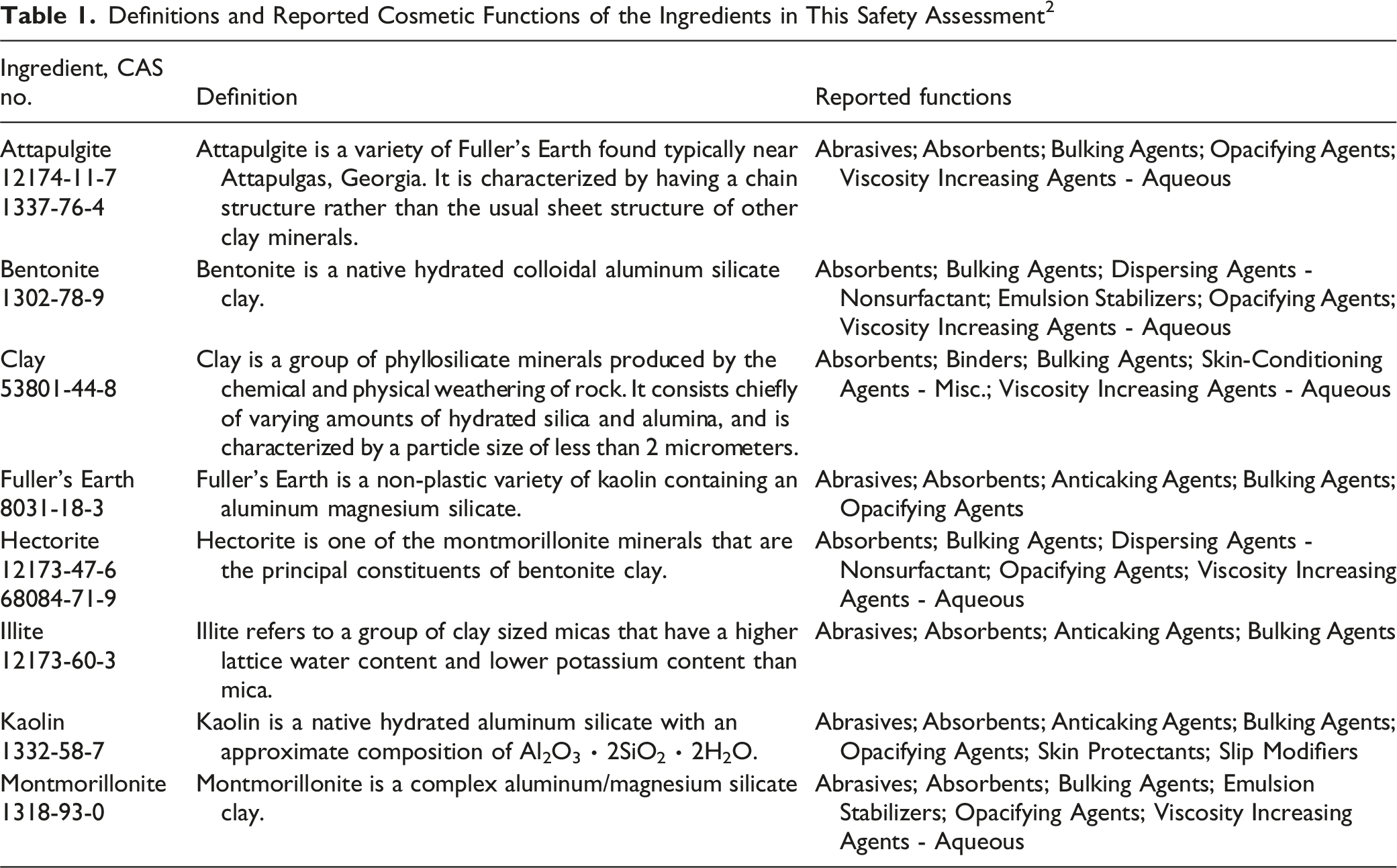
Definitions and Reported Cosmetic Functions of the Ingredients in This Safety Assessment 2
Attapulgite*
Bentonite*
Clay
Fuller’s Earth*
Hectorite*
Illite
Kaolin*
Montmorillonite*
*Previously reviewed by the Panel.
The Panel has also reviewed related ingredients. In a report that was finalized in 2019, the Panel concluded that synthetically-manufactured amorphous silica and hydrated silica are safe in the present practices of use and concentration when formulated to be non-irritating. 3 In 2021, the Panel concluded that silicate ingredients, including aluminum silicate and magnesium aluminum silicate, are safe in cosmetics in the present practices of use and concentration when formulated to be non-irritating, with the exception that the data are insufficient to make a determination that naturally-sourced (ie, mined) silicate ingredients are safe for use in products that may be incidentally inhaled. 4 (The reports on these ingredients are available on the Cosmetic Ingredient Review (CIR) website (https://www.cir-safety.org/ingredients). Although the clay ingredients comprise silica and/or silicates, silicates, synthetically-manufactured amorphous silica, and hydrated silica are neither part of this safety assessment, nor are data from those reports included in this assessment.
This safety assessment includes relevant published and unpublished data that are available for each endpoint that is evaluated. Published data are identified by conducting an exhaustive search of the world’s literature. A listing of the search engines and websites that are used and the sources that are typically explored, as well as the endpoints that the Panel typically evaluates, is provided on the CIR website (https://www.cir-safety.org/supplementaldoc/preliminary-search-engines-and-websites; https://www.cir-safety.org/supplementaldoc/cir-report-format-outline). Unpublished data are provided by the cosmetics industry, as well as by other interested parties.
Chemistry
Definition and Structure
The definitions of Clay (CAS No. 53801-44-8) and the other clay ingredients included in this review are provided in Table 1. 2 These inorganic oxide ingredients, comprising in part silicon dioxide, are solids derived from naturally occurring minerals.
Clays in general have atomic lattices consisting of two structural units. 1 One unit consists of two sheets of closely packed oxygens or hydroxyls. Aluminum, iron, or magnesium atoms are embedded within these sheets in octahedral coordination, so that they are equidistant from the oxygen or hydroxyl groups. The second unit is composed of silica tetrahedrons. Assuming there are no distortions in each tetrahedron, a silicon atom is equidistant from four oxygens or hydroxyls, if needed to balance the structure, arranged in the form of a tetrahedron with a silicon atom in the center. The silica tetrahedral groups are arranged in a hexagonal network, which is repeated infinitely to form a sheet of composition Si4O6(OH)4. The tips of the tetrahedrons all point in the same direction and the bases are all in the same plane. Substantial distortion of these units occurs in order to fit into determined unit-cell dimensions of minerals.
Figure 1 depicts the general structure of clay ingredients. Clays are composed of magnesium, lithium, aluminum, and/or iron silicate sheets with various exchangeable cations. These sheet-like structures are in sharp contrast to the hexagonal crystalline structure of crystalline silica (eg, quartz). General structure of clay ingredients.CIR Staff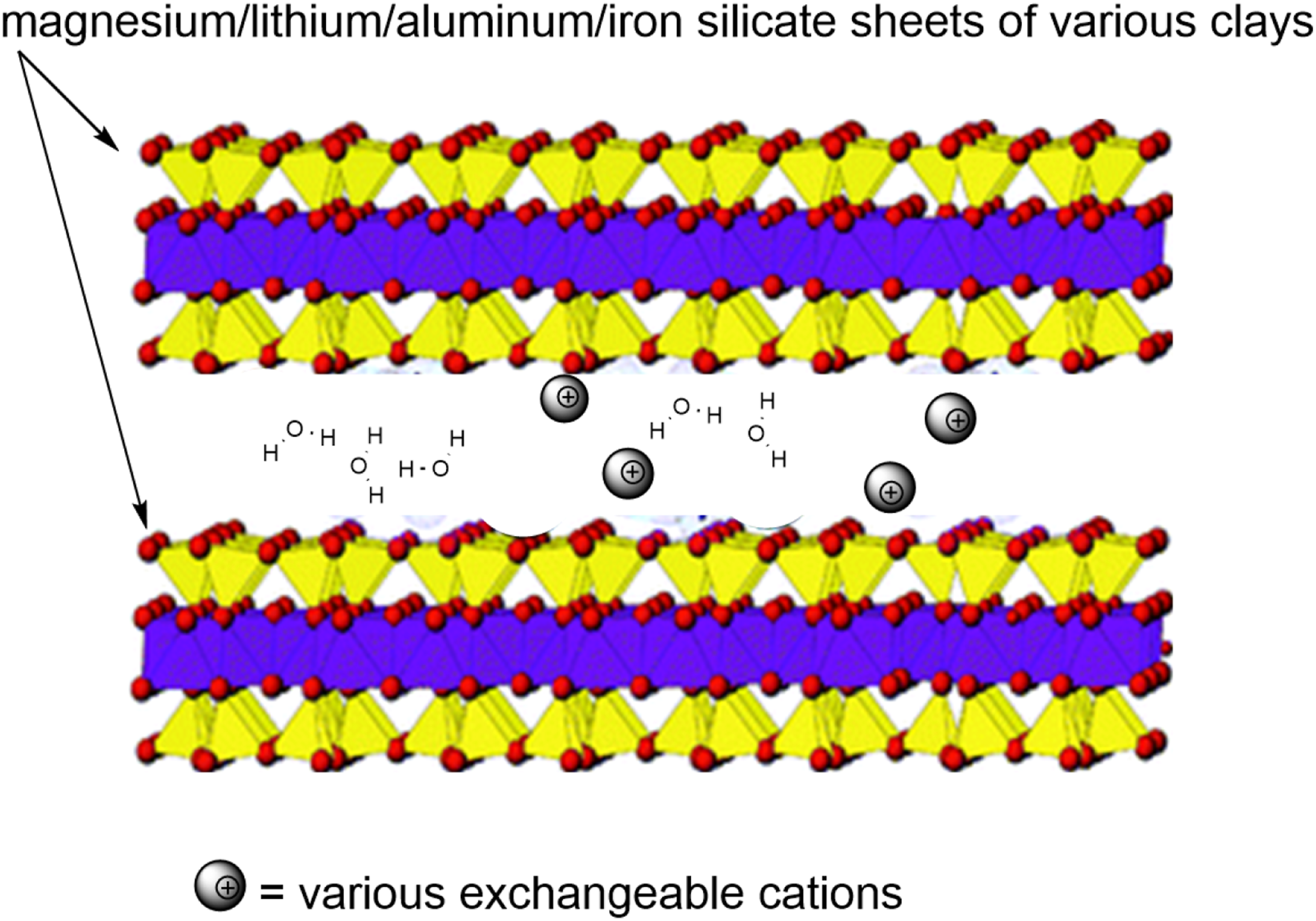
Attapulgite
The structurally important element is the amphibole double silica chain oriented with its long direction parallel to the c-axis. 1 Attapulgite consists of double silica chains situated parallel to the c-axis with the chains linked together through oxygens at their longitudinal edges. Tetrahedral apexes in successive chains point in the opposite direction. The linked chains form a kind of double-ribbed sheet with two rows of tetrahedral apexes at alternate intervals in the top and bottom of the sheets. The ribbed sheets are arranged so that the apex oxygens of successive sheets point together and are held together by aluminum and/or magnesium in octahedral coordination between the apex oxygens of successive sheets. Chains of water molecules run parallel to the c-axis and fill the interstices between the amphibole chains. Aluminum substitutions for silicon are considered probable.
Bentonite, Hectorite, and Montmorillonite
Bentonite, Hectorite, and Montmorillonite (also known as smectites) units comprise of two silica tetrahedral sheets with a central alumina octahedral sheet. 1 All tetrahedral tips point in the same direction and toward the center of the unit. The tips of the tetrahedrons of each silica sheet and one of the hydroxyl layers of the octahedral sheet form a common layer. As in Kaolin, the atoms common to both the tetrahedral and octahedral layer are O instead of OH. These layers are continuous in the a and b directions and are stacked one above the other in the c direction. As a consequence, O layers in the units become adjacent and a very weak bond is created with the possibility of cleavage. The preeminent feature of these clay ingredients is the ability of water and organic molecules to enter between unit layers and expand in the c direction. Expansion properties are reversible; however, the structure is completely collapsed by removal of interlayer polar molecules. Most of these clay ingredients have substitutions within their lattices: aluminum or phosphorous for silicon in the tetrahedral coordination and/or magnesium, iron, zinc, nickel, lithium, etc. for aluminum in the octahedral sheet.
Illite
Illite is a non-expanding, clay-sized, dioctahedral mineral that is considered part of the mica group.5,6 It is a layered alumino-silicate, known as a phyllosilicate. Its basic unit is a layer composed of two inward-pointing silica tetragonal sheets with a central alumina octahedral sheet. Poorly hydrated potassium cations occupy the space between the sequence of layers, which prevents swelling or the expansion of the layers. Illite is very similar structurally to common mica (muscovite), with slightly more silicon, magnesium, iron, and water, and slightly less tetrahedral aluminum and interlayer potassium.
Kaolin
Kaolin’s structure is composed of a single silica tetrahedral sheet and a single alumina octahedral sheet combined in a unit so that the tips of the silica tetrahedrons and one of the layers of the octahedral sheet form a common layer. 1 All the tips of the silica tetrahedrons point in the same direction and toward the center of the unit made by the silica and octahedral sheets. Composite octahedral-tetrahedral layers are formed due to the similarity between the sheets a and b dimensions. The common layer between the octahedral and tetrahedral groups consists of two-thirds of shared atoms between silicon and aluminum that become O instead of OH. Analyses of Kaolin have shown there is little substitution within the lattice. In a small percentage of cases, iron and/or titanium has replaced aluminum. This has only been seen in the relatively poor crystalline varieties of Kaolin.
Chemical Properties
Chemical Properties
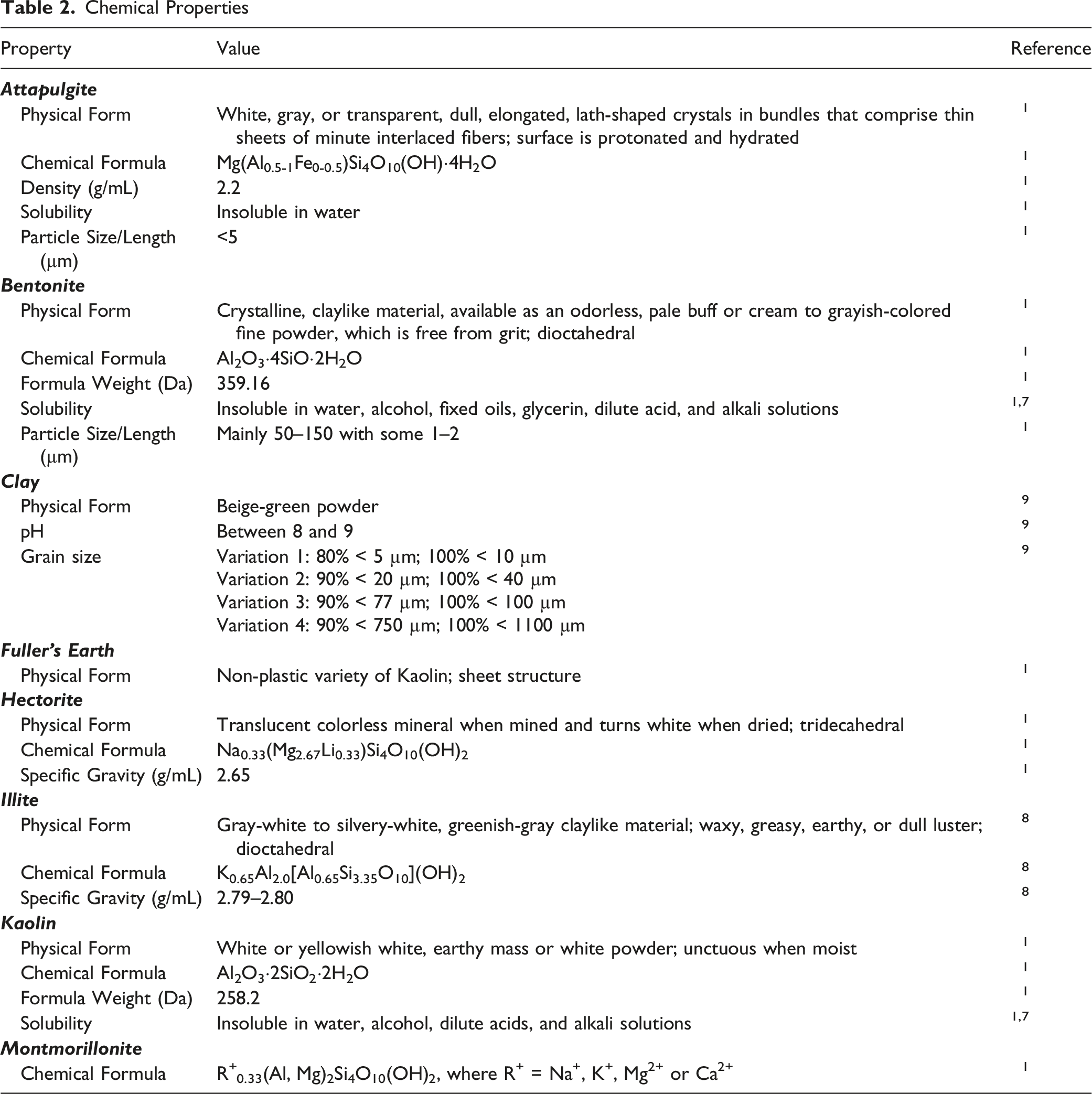
A supplier has reported the particle size distribution at D50 for Bentonite and Kaolin to be 61.1 and 3.1 µm, respectively. 10 The mean particle sizes for 5 different Hectorite products were 19.9–25.4 µm, and the particle ranges for these products were 2.9–131.7 µm. 11 Another supplier provided specifications for a Clay raw material containing 75% Illite, 19% Kaolin, and 6% Montmorillonite (see Clay in Table 2); however, there is no information therein to indicate the particle size of resultant final cosmetic formulations. 9
Method of Manufacture
Attapulgite
Attapulgite is produced through an opencast mining technique, stripping layers with heavy machinery. 1 The clay is then transported to a processing plant where crushing, drying, classification, and pulverizing take place. High-heat drying to remove water may occur to enhance absorbent qualities. Attapulgite is mined in 10 countries: Australia, China, France, India, Russia, Senegal, South Africa, Spain, Turkey, and the US.
Bentonite
Large deposits of Bentonite have been discovered in Canada, China, France, Germany, Great Britain, Greece, Hungary, Italy, Japan, Mexico, New Zealand, North Africa, Poland, South Africa, the post-Soviet states, and the US. 1 The mine ore of Bentonite is processed to remove grit and non-swelling materials.
A supplier has reported that Bentonite is mined mineral. 12 The material is then washed, filtered, dried, treated, and tested for quality.
Clay
A supplier has reported that Clay (75% Illite, 19% Kaolin, and 6% Montmorillonite) is naturally sourced, mechanically refined, and not chemically processed. 9 A dehydration process is used to eliminate bacteria prior to sorting through induction.
Illite
Illite is formed by the weathering of silicates (feldspar), by the alteration of other clay minerals, or during the degradation of muscovite.5,6 The formation of Illite is generally favored by alkaline conditions and by high concentrations of aluminum and potassium. Deposits of Illite are widely distributed globally: it is commonly found in soil and argillaceous sedimentary rocks, as well as in some low-grade metamorphic rocks.5,6,8
Kaolin
Deposits of Kaolin have been found in England, the US, France, the Czech Republic and Slovakia, Germany, and Japan. 1 Kaolin is extracted from kaolinized granite by washing it out with powerful water hoses. The clay stream is then pumped to the separation plant where sand and mica are removed. The purified clay is filtered when wet and then dried. The very fine powder is formed by milling.
Composition/Impurities
Attapulgite
Attapulgite commonly is found with smectites, amorphous silica, chert, and other minerals. 1 A typical mineral composition of Attapulgite is approximately 55% silicon dioxide, 10% aluminum oxide, 3.5% iron (III) oxide, 10.5% magnesium oxide, 0.5% potassium oxide, and 20% water.
Bentonite
The principal constituent of Bentonite is Montmorillonite. 1 However, other minerals such as Illite, kaolinite, and nonargillaceous detrital minerals can be present. Most bentonites appear relatively pure and other mineral contributions rarely exceed 10%. Cristobalite is often present. Montmorillonite compositions frequently vary either in its lattice structure or in the exchangeable ions present. A typical mineral composition of Bentonite is approximately 60% silicon dioxide, 20% aluminum oxide, 3% iron (II) oxide, 1.5% magnesium oxide, 0.6% calcium oxide, 0.6% potassium oxide, and 21% sodium oxide.
According to the Food Chemicals Codex, Bentonite is composed of natural smectite clays consisting primarily of colloidal hydrated aluminum silicates of the Montmorillonite or Hectorite type of minerals with varying quantities of alkalis, alkaline earths, and iron. 7 Food-grade Bentonite should contain no more than 5 mg/kg arsenic, no more than 15 mg/kg lead, no more than 1000 colony-forming units (cfu)/g aerobic microbes, and have no detectable Escherichia coli in a 25 g sample.
In particle size analysis of Bentonite, 90% of the particles were smaller than 68 µm, 50% were smaller than 5 µm, and 10% were smaller than 2 µm. 13 No particles were smaller than 0.9 µm. A second analysis of Bentonite showed that 90% of the particles were smaller than 25 µm, 50% were smaller than 6.5 µm, and 10% were smaller than 1.6 µm. 14 No particles were smaller than 0.5 µm.
Clay
A supplier has reported that Clay contains 75% Illite, 19% Kaolin, and 6% Montmorillonite and does not contain quartz. 9 Trace heavy metals may be present: <0.5 ppm antimony, <17 ppm arsenic, <0.5 ppm cadmium, <7 ppm cobalt, <0.5 ppm tin, <0.05 ppm mercury, <20 ppm nickel, and <20 ppm lead were detected using inductively coupled plasma-optical emission spectrometry (ICP-OES). Bacterial, yeast, and mold content were below the threshold of detection. Dioxin and polychlorinated biphenyl “results are near zero.”
Fuller’s Earth
Principal deposits of Fuller’s Earth include Montmorillonite, Bentonite, Attapulgite, and sepiolite. 1
Hectorite
Principal impurities of Hectorite include calcite, dolomite, silica crystals, and grit. 1 A typical mineral composition of Hectorite is approximately 56% silicon dioxide, 0.1% aluminum oxide, 0.03% iron (III) oxide, 25% magnesium oxide, 0.1% potassium oxide, 3% sodium oxide, 1% lithium dioxide, 6% fluorine, and 12% water.
According to some suppliers of Hectorite products (97–100% pure), crystalline silica (also described as quartz and/or CAS No. 14808-6-7) may be an impurity.15,16 Quantities of crystalline silica were reported to be 1–3%.
Illite
The sheets of Illite are composed of silicon, magnesium, iron, aluminum, potassium, and water. 6 In analysis of 0.5 kg samples of 3 clay products containing Illite, the major element composition (as mean concentration) comprises silicon (23.02%), aluminum (8.80%), calcium (4.55%), iron (4.22%), potassium (3.19%), titanium (0.48%), sulfur (0.21%), phosphorus (0.10%), and manganese (0.041%). 17 Trace element impurities (as mean concentration) were identified as barium (426.70 mg/kg), rubidium (253.7 mg/kg), strontium (227.07 mg/kg), zinc (100.97 mg/kg), cesium (65.93 mg/kg), nickel (35.37 mg/kg), neodymium (30.23 mg/kg), lanthanum (28.00 mg/kg), lead (26.77 mg/kg), copper (25.07 mg/kg), arsenic (16.33 mg/kg), thorium (8.83 mg/kg), uranium (3.78 mg/kg), and bromine (<1 mg/kg). Bulk composition analysis indicated the samples contained calcite and quartz.
Kaolin
Quartz, mica, and feldspar are often found associated with Kaolin as the crude mineral and are often removed through screening and elutriation. 1 Potentially pathogenic organisms were absent. The bacteria present were mostly gram-positive aerobic spore-formers. A typical mineral composition of Kaolin (reported as kaolinite) is approximately 45% silicon dioxide, 39% aluminum oxide, 0.8% iron (III) oxide, 0.08% magnesium oxide, 0.08% calcium oxide, 0.1% potassium oxide, 0.7% sodium oxide, 0.2% titanium (IV) oxide, and 14% water.
According to the Food Chemicals Codex, Kaolin is a purified clay consisting mainly of alumina, silica, and water. 7 Food-grade Kaolin should contain no more than 3 mg/kg arsenic and no more than 10 mg/kg lead.
According to some suppliers of Kaolin products (up to 100% pure), crystalline silica (described as quartz, free respirable silica, and/or CAS No. 14808-6-7) may be an impurity.18,19 Quantities of crystalline silica were reported to be ≤2%.
Montmorillonite
A typical mineral composition of Montmorillonite is approximately 51% silicon dioxide, 20% aluminum oxide, 0.8% iron (III) oxide, 3% magnesium oxide, 2% calcium oxide, 0.1% potassium oxide, 0.04% sodium oxide, 0.1% zinc oxide, and 23% water. 1
Use
Cosmetic
The safety of the cosmetic ingredients addressed in this assessment is evaluated based on data received from the US Food and Drug Administration (FDA) and the cosmetics industry on the expected use of these ingredients in cosmetics and does not cover their use in airbrush delivery systems. Data are submitted by the cosmetic industry via the FDA’s Voluntary Cosmetic Registration Program (VCRP) database (frequency of use) and in response to a survey conducted by the Personal Care Products Council (Council) (maximum use concentrations). The data are provided by cosmetic product categories, based on 21CFR Part 720. For most cosmetic product categories, 21CFR Part 720 does not indicate type of application and, therefore, airbrush application is not considered. Airbrush delivery systems are within the purview of the US Consumer Product Safety Commission (CPSC), while ingredients, as used in airbrush delivery systems, are within the jurisdiction of the FDA. Airbrush delivery system use for cosmetic application has not been evaluated by the CPSC, nor has the use of cosmetic ingredients in airbrush technology been evaluated by the FDA. Moreover, no consumer habits and practices data or particle size data are publicly available to evaluate the exposure associated with this use type, thereby preempting the ability to evaluate risk or safety.

NR – not reported.
NA – not applicable.
*likely duration and exposure are derived based on product category (see Use Categorization https://www.cir-safety.org/cir-findings).
**Because each ingredient may be used in cosmetics with multiple exposure types, the sum of all exposure types may not equal the sum of total uses.
aIt is possible these products are sprays, but it is not specified whether the reported uses are sprays.
bNot specified whether a spray or a powder, but it is possible the use can be as a spray or a powder, therefore the information is captured in both categories.
cIt is possible these products are powders, but it is not specified whether the reported uses are powders.
ǂIncludes entries for Kaolinite from the VCRP database.
Clay ingredients may be used in products that can be incidentally ingested; for example, Kaolin is used in lipstick (at up to 14.5%). 21 Additionally, clay ingredients have been reported to be used in products that may come into contact with the eyes and mucous membranes; for example, Kaolin is used at up to 8.5% in eye shadows and at up to 5% in bath soaps and detergents.
Moreover, clay ingredients are used in cosmetic formulations that could possibly be inhaled; for example, Bentonite is reported to be used at 0.9% in spray suntan products and Kaolin is reported to be used at up to 15% in face powders. 21 In practice, as stated in the Panel’s respiratory exposure resource document (https://www.cir-safety.org/cir-findings), most droplets/particles incidentally inhaled from cosmetic sprays would be deposited in the nasopharyngeal and tracheobronchial regions of the respiratory tract and would not be respirable (ie, they would not enter the lungs) to any appreciable amount. Conservative estimates of inhalation exposures to respirable particles during the use of loose powder cosmetic products are 400-fold to 1000-fold less than protective regulatory and guidance limits for inert airborne respirable particles in the workplace.
While no data have been submitted from the cosmetics industry indicating that these clay ingredients are used in nanoform in cosmetic formulation, a report from a nanotechnology research company provides statistical data showing that nanoclays can be used as cosmetic additives for lipsticks, eyeliners, and toothpaste, functioning for rheology modification, viscosity control, thixotropic effect, as well as increased stability and pigment dispersibility. 22
Although products containing some of these ingredients may be marketed for use with airbrush delivery systems, this information is not available from the VCRP or the Council survey. Without information regarding the frequency and concentrations of use of these ingredients, and without consumer habits and practices data or particle size data related to this use technology, the data are insufficient to evaluate the exposure resulting from cosmetics applied via airbrush delivery systems.
In regulations regarding cosmetic products in the European Union (EU), no restrictions were listed for Attapulgite, Clay, Fuller’s Earth, Hectorite, Illite, or Montmorillonite. 23 Bentonite and Kaolin are listed in Annex IV-Allowed Colorants under CI 77004 with the chemical name of “natural hydrated aluminum silicate…containing calcium, magnesium or iron carbonate, ferric hydroxide, quartz-sand, mica, etc. as impurities;” the remaining clay ingredients named in this report are not restricted from cosmetic use in any way. Note, these ingredients are not approved as colorants in the US. 2 Bentonite, Hectorite, and Kaolin were included in the scientific opinion by the EU Scientific Committee on Consumer Safety (SCCS) on the safety of aluminum in cosmetic products. 24 The SCCS concluded that the use of aluminum compounds is safe at the following equivalent aluminum concentrations up to 6.25% in non-spray deodorants/antiperspirants, 10.60% in spray deodorants/antiperspirants, 2.65% in toothpaste, and 14% in lipstick.
According to the Australian Industrial Chemicals Introduction Scheme (AICIS), the following ingredients are Tier I chemicals (not considered to pose an unreasonable risk to the health of workers and public health): Bentonite, Fuller’s Earth, Kaolin, and Montmorillonite. 25 Attapulgite is a Tier II chemical (requires risk management measures to be instituted for safe use for human health). Hectorite is listed as a chemical unlikely to require further regulation to manage risks to human health.
Non-Cosmetic
Based on the properties of broad surface area, rich porosity, diverse morphology, good adsorption performance, and high ion exchange capacity, nanoclays have been widely applied in many fields, such as drug delivery systems, 26 food and beverage packaging, 27 paper manufacturing, 28 and constructional material. 29
Attapulgite
Attapulgite is reported to be used in absorbents, pesticides, oil and petroleum treatment, and as a filler in many products. 1
Bentonite
Bentonite is reported to be used in foundry sand bonding, bleaching clay in oil refining and decolorizers, filtering agents, water impedance, animal feed, pharmaceuticals, paint, plasticity increasers, and iron-ore pelletizing. 1
Bentonite is generally recognized as safe (GRAS) as a direct food additive for humans (21 CFR§184.1155) and animals (21 CFR§582.1155). Bentonite is also GRAS as an indirect food additive in adhesives and components of coatings (21 CFR§175.105), in paper and paperboard components (as a colorant only, 21 CFR§176.170), in adjuvants as a colorant for polymers (21 CFR§178.3297).
Clay
Clay (natural) is GRAS as an indirect food additive in polymers (cellophane; 21 CFR§177.1200).
Fuller’s Earth
Fuller’s Earth is reported to be used as a military decontaminant for removal of hazardous materials from the skin. 30
Hectorite
Hectorite has been approved for use in internally and externally applied products, as well as dentifrices and externally approved pharmaceuticals. 1
Hectorite is reported to be used as drug-delivery system in anticancer therapy because of its biocompatibility, mechanical strength, and natural availability. 31
Illite
Illite has been studied for use in environmental remediation of contaminated soils and water as an adsorbent.32-35 It also has been studied for use in veterinary applications, such as dietary supplements for swine 36 and topical therapeutic treatment in equine injuries. 37
Kaolin
Kaolin is reported to be used in the paper industry to fill and coat the surface of paper, as a filler in rubber and plastics, paint extender, ceramics manufacture, ink, adhesives, insecticides, medicines, food additives, bleaching, adsorbents, cement, fertilizers, crayons, pencils, detergents, porcelain enamels, paste, foundries, linoleum, floor tiles, and textiles. 1 It has been classified by the National Formulary as a tablet and/or capsule diluent.
Kaolin clay is GRAS as an indirect food additive with no limitation other than current good manufacturing practice (21 CFR§186.1256). It is used in the manufacture of paper and paperboard that contact food. Kaolin (colloidal) is an approved over-the-counter (OTC) drug as an antidiarrheal active ingredient (21 CFR§335.10), an anorectal active ingredient (21 CFR§346.14), and a skin protectant active ingredient (from 4% to 20%; 21 CFR§347.10). Kaolin is used as a digestive aid (21 CFR§310.545); however, the data are currently inadequate to establish general recognition of the safety and effectiveness of this ingredient for this specified use. Kaolin is exempted from the requirement of a tolerance for pesticide residues when used on or in food commodities to aid in the control of insects, fungi, and bacteria (food/feed use; 40 CFR§180.1180).
Kaolin minerals (specifically kaolinite) have been studied for use in environmental remediation of contaminated soils and water.34,35 This clay material has also been studied for use in veterinary applications, such as dietary supplements for swine 36 and topical therapeutic treatment in equine injuries. 37
Montmorillonite
Montmorillonite is reported to be used for food packaging and in paper manufacturing.27,28 It also has been studied for use in environmental remediation of contaminated soils and water34,35 and in veterinary applications, such as use in dietary supplements for swine. 36
Toxicokinetic Studies
Absorption, Distribution, Metabolism, and Excretion (ADME)
Clay
In ex vitro bioavailability studies using human skin models, the ability of transcutaneous passage of heavy metals (vanadium, lead, arsenic, barium, nickel, chromium, and aluminum) in 3 clay pastes was analyzed. 38 The clay pastes were white Montmorillonite, Kaolin, and Clay (composed of 75% Illite, 19% Kaolin, and 6% Montmorillonite). Approximately 150 g of each product were tested with human skin samples in Franz cells and incubated for 24 h. The tested products, the diffusion liquids, and the storage liquids were then analyzed for metal content (details not provided). No detectable quantities of heavy metals were found in the diffusion or storage liquids. It was determined that the traces of heavy metal in the clay pastes did not penetrate cutaneous tissue.
Kaolin
In a dietary study, a group of 10 male Sprague-Dawley rats were fed a control diet plus 0.5 mL 20% Kaolin – 1% pectin for 48 h. 1 Stool samples were collected 72 h later and analyzed for volume, sodium, potassium, and fat content. The results were a 103% increase in sodium, a 184% increase in potassium, and fat excretion remained at baseline.
Montmorillonite
Polydisperse and monodisperse [134Cs]-fused Montmorillonite suspensions were administered to groups of 40 rats and mice and to 120 beagle dogs by a multiport nose-only inhalation exposure system. 1 Aerosol concentrations ranged from 0.1 to 0.001 mg of fused Montmorillonite/L of air (additional properties not provided). Equal numbers of male and female rats and mice and 74 male and 46 female dogs were utilized. Single exposure times for rats and mice ranged from 25 to 45 min and for dogs 15 to 50 min. All animals were whole-body counted for the labeled particles. Five rats and 5 mice from each group were killed 4 h after exposure. The remaining rats and mice were killed at various times after exposure. Tissues from rats and mice were collected on post-exposure days 2, 4, 8, 16, 32, 64, 128, 256, 365, 512, 730, and 850. Tissues and excreta from the dogs were also collected on the same schedule, but also at 4, 5, 7, and 9 yr after inhalation exposure. Two dogs were scheduled for termination at times ranging from 4 h to 9 yr. All animals were necropsied and tissues from lungs, lung-associated lymph nodes, gastrointestinal tract, spleen, kidneys, abdominal lymph nodes, blood, skeleton, muscle, and skin were prepared for analysis of [134Cs]-exposure. The mass of material deposited into the lungs of rats and mice was ∼0.01 to 0.1 mg and for dogs was ∼1 to 10 mg. The mass of Montmorillonite for all three species was <0.1 mg/g of lung. Clearance of the initial 134Cs occurred by dissolution and mechanical clearance. Mechanical clearance from the nasopharynx was rapid, and the clearance rate was decreased to a negligible value for all three species within a few days. Most initial deposits were cleared via the gastrointestinal tract. Long-term mechanical clearance from the pulmonary region occurred at a constant rate for all species. Solubilization was the primary factor in long-term lung clearance for most particles inhaled by dogs and mechanical clearance was dominant in rats and mice. Most of the long-term clearance of deposited particles went to lung-associated lymph nodes in dogs and occurred at a slower rate as compared to rats and mice. Rats and mice had a rapid clearance from the pulmonary region, where most of the mechanical clearance occurred via the gastrointestinal tract. Long-term clearance of the particles in dogs occurred at 3500-d half-time in the lymph nodes and 6900-d half-time clearance in the gastrointestinal tract. The transport rate of the particles in the dog was 0.0002/d of the lung burden. The long-term biological clearance half-term day was 690 d for rats and 490 d for mice. The lymph node accumulation process was modeled by a short-term process that became negligible after a few days.
Radiolabeled, [134Cs]-fused Montmorillonite particles were instilled into specific lung lobes or injected intraperitoneally into 32 beagle dogs. 1 Necropsy was performed 34, 182, and 365 d later. Specific sites of instillation included right apical lobe, right cardiac lobe, right diaphragmatic lobe, right intermediate lobe, left apical lobe, left diaphragmatic lobe, and intraperitoneal. Initial burdens in the peritoneal cavity or the lungs ranged from 0.50 to 14 µCi for 29 dogs and from 42 to 64 µCi lung burdens for the other 3 dogs. Effective translocation half-time of lung instillations was 390 d. The accumulation rate of [134Cs]-fused particles in the lymph nodes was 0.03% per day. Individual lung lobes cleared particles to 1–2 lymph nodes, and specific lymph nodes accumulated particles from 1 to 3 lung lobes. Lymph nodes that collected particles from the lung included the left mediastinal node and the left, left-middle, right, and right-middle tracheobronchial lymph nodes. The destination for translocated particles was primarily the nodes proximate to the tracheal bifurcation. Particles injected into the peritoneal cavity were translocated mainly to mesenteric lymph nodes and left and right sternal lymph nodes. A small percentage of particles went to the left tracheobronchial lymph node.
Toxicological Studies
Acute Toxicity Studies
Dermal
Clay
In an acute dermal toxicity study performed in accordance with Organisation for Economic Co-operation and Development (OECD) test guideline (TG) 402, rats received 2000 mg/kg bw of Clay (75% Illite, 19% Kaolin, and 6% Montmorillonite) on clipped skin. 38 The test material was moistened with 0.2 mL distilled water. A control group received only distilled water. The rats were observed for 14 d. No mortality or clinical signs of toxicity were observed. The LD50 was greater than 2000 mg/kg. No further details were provided.
Oral
Clay
In an acute oral study performed in accordance with OECD TG 423, rats were exposed to a single dose of 2000 mg/kg bw of Clay (75% Illite, 19% Kaolin, and 6% Montmorillonite) in distilled water. 38 No mortality or clinical signs of toxicity were observed. Visceral examination did not reveal any lesions of pathological significance except uterine distension in one rat, which was not considered to be treatment-related. The LD50 was greater than 2000 mg/kg bw. No further details were provided.
Hectorite
Five male and 5 female Sprague-Dawley rats were administered a single dose of 5 g/kg of Hectorite by gavage. 1 None of the animals died; the acute oral LD50 was >5.0 g/kg bw.
Kaolin
In an acute oral study, 120 rats were fed doses of Kaolin ranging from 100 to 210 g/kg. 1 Fourteen rats were controls. Kaolin was inert and non-static except for the danger of bowel obstruction resulting in perforation. The clinical signs were listlessness, anorexia, oliguria, hypothermia, and dyspnea. These were pathological reactions from overdistention of the alimentary canal by an inert solid. The number of fatalities and the incidence and advance of bowel obstruction along the small intestine were dose-related. The dose that killed 50% of the rats by bowel obstruction was 149 g/kg.
Inhalation
Clay
In an acute inhalation study performed in accordance with OECD TG 403, rats were exposed to 3.856 mg/L air of Clay (75% Illite, 19% Kaolin, and 6% Montmorillonite). 38 A control group was exposed to air passed through inert bed material (iron grit). Both groups of rats were exposed for 4 h and then observed for 14 d. No mortality or clinical signs of toxicity were observed. The LC50 was greater than 3.856 mg/L. No further details were provided.
Illite, Montmorillonite, Kaolin
The inhalation toxicity of an environmental dust sample containing Illite, Montmorillonite, Kaolin and α-quartz was determined in a group of 6 male CD(SD)BR rats exposed to an aerosol of the dust (12 mg/m3, ∼10 µm mean diameter) for 3 h in open cages. 39 The dust was composed of approximately 75% of the 3 clay aluminum-silicates and approximately 20% α-quartz. A control group of 6 male rats were exposed to room air only. Animals were killed at recovery periods of 0 h, 24 h, 8 d, and 30 d. Lung tissues underwent microscopic and histopathological examination. Rats that were exposed to the dust exhibited preferential particle deposition at the first alveolar duct bifurcations after the terminal bronchiole immediately after the 3 h exposure. No extracellular particles were observed in the recovery periods after this point, in either treated or control animals. The average number of particles observed at the first bifurcation after the 3 h exposure (recovery time 0 h) was 4.6 ± 1.0 particles per bifurcation. Histological sections showed prominent first alveolar duct bifurcations characterized by accumulation of mononuclear cells 24 h after exposure. The presence of macrophages with ingested aluminum silicate particles were observed. Macrophage migration to the bifurcations was observed to a lesser degree immediately after exposure. At 24 h, 87 ± 12% of the first bifurcation contained a significantly increased number of macrophages. After 8 and 30 d, particles and alveolar macrophages were not significantly elevated and histology was back to normal.
Parenteral
Illite, Montmorillonite, Kaolin
In a study of the environmental dust sample described above, 6 male albino Wistar rats received tracheal instillations of 50 mg of the dust (3.2 µm mean diameter) in 300 µL of sterile phosphate-buffered saline (PBS). 39 Control animals (groups of 6) received either 300 µL of PBS, 50 mg of carbonyl iron in 300 µL PBS, or 50 mg of α-quartz in 300 µL PBS. The animals were killed 30 d later. Tissues, particularly the lungs and trachea, underwent microscopic and histopathological examination. Multifocal interstitial lung disease was observed using light microscopy. Mononuclear cell infiltrates, composed of macrophages and lymphocytes located mainly around the small airways and alveolar walls, were identified during examination of all lung sections. No nodules or granulomata were observed. Collagen fibers were observed in the interstitial lesions. The α-quartz instillation resulted in multiple silicotic nodules; iron instillation did not produce any interstitial lesions (some alveolar macrophages with intracellular iron spheres were identified), and no alterations were observed in the animals that received PBS alone.
Short-Term Toxicity Studies
Parenteral
Kaolin
Nano-sized Kaolin (primary particle size 4.8 µm) was instilled intratracheally in groups of 4 male gpt delta transgenic mice (a strain that allows for analysis of deletion mutations) as either a single dose of 0.2 mg/animal or multiple doses of 0.2 mg/animal/wk for 4 consecutive instillations. 40 Control mice received solvent alone intratracheally. The mice were killed at 12 wk after instillation (for a single dose) or 8 wk after the last instillation (for multiple doses). Tissues, particularly the lungs and kidneys, underwent histopathological examination. Kaolin-phagocytized alveolar macrophages were found, diffusely distributed in the lungs. Focal granulomatous formation, with or without phagocytized alveolar macrophages, were also frequently observed in the lungs of mice that received multiple instillations. Similar observations were made in the mice that received a single instillation, but with a slight degree of particle accumulation and granuloma formation in the lungs. No abnormalities were observed in the kidneys.
Subchronic Toxicity Studies
Oral
Montmorillonite
In a 90-d feed study, 10 male Wistar rats received a Montmorillonite clay (40 mg/kg/d; modified with hexadecyltrimethylammonium bromide) in the diet. 41 Another 10 male rats received only standard diet as control. During the treatment period, clinical signs, body weight, and feed and water consumption were recorded weekly. At the end of the treatment period, the rats were fasted for 18 h before being killed. Histopathological examinations were performed, and liver, kidneys, lungs, spleen, brain, testes, gastrointestinal tract, and heart were weighed. Blood samples were obtained for analysis. No rats died during the treatment period and no remarkable clinical signs were observed. Body weight gains and feed and water consumption were comparable to controls. No significant changes were noted in clinical biochemistry, organ weights, or in the histopathological examinations when compared to controls.
Parenteral
Kaolin
Toxicity of some of the minerals present in coal-mine dust was examined in groups of 10 SPF Sprague-Dawley rats. 1 The rats were exposed over a period of 3 mo to 50 mg/animal intratracheal instillations of Kaolin. The following assessments were made: weight of the fresh lungs; macroscopic and microscopic lesions in the lungs; amount of collagen and dust present in the lungs; and calculation of the toxicity index from the amount of collagen formed per mg of dust. The weight of fresh lungs subjected to Kaolin was 1.76 g. Collagen formed per lung was 23.9 mg. The dust per lung was 30.2 mg and the collagen/dust ratio was 0.79. Microscopic examinations of the lungs showed no alveolar proteinosis but Kaolin was detected in the bronchovascular lymphoid sheaths. No information regarding nonexposed lungs was presented. The opinion of the investigators was that exposure to Kaolin results in “pulmonary toxicity” and possesses “fibrogenic capacity.”
Chronic Toxicity Studies
Oral
Montmorillonite
The potential toxicity of a naturally-occurring calcium Montmorillonite clay, an anti-caking agent in animal feed, was studied using groups of 10 male and 10 female Sprague-Dawley rats for 28 wk. 42 The rats received the test material at 0, 0.25, 0.5, 1.0, or 2.0% w/w in their feed. Rats were observed daily for clinical signs and deaths. Feed consumption was recorded daily for the first month and then every fourth day. Body weights were measured weekly. At the treatment end, final body weights were recorded and blood was drawn for analysis. After the rats were killed, histopathological examinations were performed, and select organs were weighed. Total feed consumption, cumulative feed consumption, body weight, total body weight gain, and relative organ weights were not affected in either sex at any dose tested. No differences in relative organ weights or gross or histopathological changes compared to controls were observed. Non-dose-dependent significant changes were observed in mean corpuscular hemoglobin, serum calcium, serum vitamin A, and serum iron.
Developmental and Reproductive Toxicity Studies
Kaolin
Groups of 12 Sprague-Dawley female rats were fed a control diet, 20% Kaolin diet, or iron-supplemented 20% Kaolin diet. 1 The diets were fed for 37 to 86 d, 69 to 85 d, and 96 to 117 d prior to fertilization. These same diets were fed for the duration of the gestation period. The animals fed the 20% Kaolin diet had significant reductions in hemoglobin, hematocrit, and red blood cell numbers, indicating maternal anemia. Significant reduction in the birth weight of the pups was observed. Animals fed the iron-supplemented diet maintained their hematocrit, hemoglobin, and red blood cell levels.
Genotoxicity Studies
Genotoxicity Studies

Clay (75% Illite, 19% Kaolin, and 6% Montmorillonite; 5000 µg) was not mutagenic in an Ames test, with or without metabolic activation. 38 Unmodified Montmorillonite clay (at up to 125 µg/mL) and one type of cation-exchanged (hexadecyltrimethyl-ammonium) montmorillonite clay (at up to 250 µg/mL) also were not mutagenic in an Ames test with or without metabolic activation, but significant increases in revertant colonies were observed in one strain with metabolic activation in 2 other cation-exchanged montmorillonite clays. 43 No mutagenic activity was observed in a Salmonella microsome assay, with and without metabolic activation, when tested in Montmorillonite and cation-exchanged montmorillonite, in both nano- and non-nano-sized material at up to 141 µg/mL and up to 14.1 µg/plate, respectively. 44 However, the cation-exchanged montmorillonite material (both nano- and non-nano-sized, at up to 226 µg/mL and 170 µg/mL, respectively) in this study was genotoxic in a concentration-related manner in a Comet assay with Caco-2 cells. The natural clay was not considered genotoxic. Clay (75% Illite, 19% Kaolin, and 6% Montmorillonite) did not induce chromosomal aberrations in Chinese hamster ovary (CHO) cell cultures when tested at up to 5000 µg/mL, with or without metabolic activation. 38 Micronucleus induction was observed in a dose-dependent manner by micro- and nano-sized Kaolin in CHO AA8 and primary normal human diploid epidermal keratinocytes and fibroblasts, with fine particles having a higher genotoxic potency than coarse particles. 45 A 4-fold increased frequency of micronucleated cells was observed in human lung cancer A549 cells following exposure to nano-sized Kaolin. 40 Statistically significant increases in the frequency of micronuclei were induced by Montmorillonite clay at 62.5 µg/mL in a cytokinesis block micronucleus cytome assay in human hepatoma cell lines, but this effect was not observed at a concentration of 31.25 µg/mL or lower. 46 No effects in nucleoplastic bridges or nuclear buds were observed at any concentration in this study. In an in vitro micronucleus assay and kinetochore analysis using human lung fibroblasts, the genotoxic potential of Bentonite at up to 15 µg/cm2 was determined to be generally low, but could be altered by the content of quartz and available transition metals. 47 In an in vitro Comet assay with micro- and nano-sized Kaolin in CHO AA8 and primary normal human diploid epidermal keratinocytes and fibroblasts, the test materials promoted DNA damage in a dose-dependent manner, and the particles that were 200 nm had a higher DNA-damaging potency than those that were 4.8 µm. 45
In an in vivo Comet assay with nano-sized Kaolin intratracheally instilled in mice, DNA damage was induced with 0.2 mg/mouse, but not with 0.05 mg/mouse, after a 3-h exposure. No difference in induction was observed after the 24 h exposure compared to the 3 h exposure. 40 Increased gpt and Spi- mutant frequencies were observed in the lungs of the mice following intratracheal instillation with either single or multiple doses of 0.2 mg nano-sized Kaolin. A mutation spectra analysis showed >60% of G:C to C:G transversions occurred in the gpt genes. In another Comet assay, rats were given 2 oral doses of up to 1000 mg/kg bw cation-exchanged montmorillonite clay. 48 There was no statistically significant difference in % tail DNA between the negative controls and the different treatment groups for any of the cells (liver, kidneys, colon) tested.
Attapulgite
In 2 studies looking at unscheduled DNA synthesis (UDS) in rat hepatocytes, Attapulgite did not cause a significant increase in DNA-specific activity at up to 10 µg/mL with no cytotoxicity. 1 However, in another UDS study using rat pleural mesothelial cells, Attapulgite tested at 2, 4, or 10 µg/cm2 produced a significant increase in UDS and inhibited cell growth at 10 µg/cm2. Attapulgite did not induce point mutations in a third DNA study.
Hectorite
In the Salmonella typhimurium LT2 spot test (TA98, TA100, TA1535, TA1537, and TA1538) with or without metabolic activation, Hectorite was found to be non-mutagenic. 1 In primary hepatocyte cultures, the addition of Attapulgite at 10 µg/cm2 caused significant increases in UDS in rat pleural mesothelial cells.
Carcinogenicity Studies
The International Agency for Research on Cancer (IARC) has determined there is inadequate evidence in humans for the carcinogenicity of Attapulgite (IARC uses the mineralogical term “palygorskite” for Attapulgite). 49 Further, IARC has determined there is insufficient evidence in experimental animals for the carcinogenicity of short Attapulgite fibers (<5 µm); however, there is sufficient evidence in experimental animals for the carcinogenicity of long Attapulgite fibers (>5 µm). Overall, long Attapulgite fibers (>5 µm) are possibly carcinogenic to humans (Group 2B) and short Attapulgite fibers (<5 µm) cannot be classified as to their carcinogenicity to humans (Group 3).
Attapulgite (palygorskite fibers >5 µm in length) is listed by California Proposition 65 as a carcinogen. 50
Inhalation
Attapulgite
In a rat inhalation study, groups of 40 (20 male and 20 female) SPF Fischer rats were exposed to samples of Attapulgite dust mined in Lebrija or Leicester in inhalation chambers at a concentration of 10 mg/m3 for 6 h/d for 5 d/wk until they were killed (no further details were available). 1 Negative and positive control groups received Kaolin and crocidolite, respectively, at 10 mg/m3. Four animals were killed at 3, 6, and 12 mo, and the remaining rats were allowed to live their life span. All animals were subject to necropsy; the lungs, liver, spleen, kidneys, and other relevant organs were examined microscopically. At microscopic examination, 1 peritoneal mesothelioma, 1 adenocarcinoma, and 3 bronchoalveolar hyperplasia were found in rats treated with Lebrija Attapulgite. Thirty-five rats had no proliferative changes. In rats treated with Leicester Attapulgite, proliferative lesions observed included 2 plural mesothelioma, 1 peritoneal mesothelioma, 1 malignant alveolar neoplasm, 2 benign alveolar neoplasms, and 8 bronchoalveolar hyperplasias. Twenty-seven rats had no proliferative lesions. Rats exposed to the negative-control Kaolin had 2 bronchoalveolar hyperplasias. Rats in the positive-control crocidolite group had 1 lung adenocarcinoma and 3 bronchoalveolar hyperplasias.
Kaolin
Kaolin was reported to be the negative control in the above rat inhalation study. 1 The rats received 10 mg/m3 Kaolin for 6 h/d for 5 d/wk. Two bronchoalveolar hyperplasias were reported.
Parenteral
Attapulgite
In an intratracheal study, groups of 5 rats received a single instillation of Attapulgite at 1, 5, and 10 mg. 1 One month after treatment, bronchoalveolar lavage and microscopic examination of the lungs were performed. The average length of the fibers was 0.8 µm, and 100% of the fibers were less than 3 µm. Every test animal had type A lesions, which are characterized by an accumulation of inflammatory cells, mostly macrophages, and epithelioid cells around fiber deposits. These inflammatory cells form a compact cellular infiltrate at the periphery of the deposits and some are focally dispersed throughout the alveolar region. The bronchoalveolar lavage (BAL) fluid had mostly macrophages and a small number of neutrophils at 5- and 10-mg doses. At the 5-mg dose, 3.6% of the cells were lymphocytes.
Two groups of 30 to 50 female Osbourne-Mendel rats received a single direct application to the left pleural surface by open thoracotomy of 40 mg of 1 of 2 Attapulgite samples. 1 The samples were 90% pure with quartz being the other component. One dose consisted of fibers >4 µm and the other contained no fibers >4 µm. The rats were killed at the end of 2 yr. Pleural sarcomas were seen in 2/29 rats. The incidences of pleural sarcomas in the untreated groups were 3/491 and 17/615 of the rats receiving the pleural implants of Attapulgite. Of rats receiving the positive control, crocidolite, 14/29 developed pleural mesotheliomas.
Attapulgite (20 mg/mL of 0.9% sodium chloride) was injected into the pleural cavities of 36 Sprague-Dawley rats. 1 The median fiber length was 0.77 µm. Two control groups, untreated and saline-injected, were utilized. Necropsy was performed after the rats died or killed when moribund. No mesothelial neoplasms were found in either controls or in rats treated with Attapulgite. Survival times between the Attapulgite-treated group and the controls were not statistically different.
Attapulgite was injected intrapleurally as a single dose of 0.5, 2, 4, 8, 16, or 32 mg into 6 groups of 25 Fischer 344 rats. 1 Nearly all the fibers were <1 µm in length. Mesotheliomas were present in 2/140 treated rats compared to 1/79 incidences in control groups. The median life span was 839 days for Attapulgite-treated animals and 729 days for nontreated animals.
In another intrapleural study, injections of 20 mg of different Attapulgite fiber samples in 1 mL of saline were administered to 2-mo-old Sprague-Dawley rats. 1 The control group received only a saline injection. All rats were allowed to live full life span. The mean length of Attapulgite fibers in this experiment was 0.77 µm. The number of groups were not reported; however, 36 rats were reported to comprise each group. Pulmonary and thoracic neoplasms were fixed and processed for histopathological examination. The survival time of the treated groups (788 ± 155 days) was very similar to that of the control groups (809 ± 110 days). The incidence of mesothelioma was 0% for control groups and treated groups. The researchers concluded Attapulgite was not carcinogenic in this study.
Samples of Attapulgite from Lebrija, Torrejon, and Leicester were injected intrapleurally as a single injection in groups of 20 male and 20 female SPF Fischer rats. 1 Concentrations were not reported; however, fiber length was reported as < 2 µm, for Lebrija Attapulgite, at most 0.54% > 6 µm for Torrejon Attapulgite, and 19% > 6 µm for Leicester Attapulgite. Kaolin and saline were used as negative controls, and crocidolite was used as a positive control. The animals were allowed to live their life span but were killed if they appeared distressed. Upon death, necropsy and microscopic examination of tissue were performed. Dust extraction was obtained from granulomas removed from the diaphragm or mediastinal tissue. Mesotheliomas were reported in 2, 14, 30, and 34 rats for Lebrija Attapulgite, Torrejon Attapulgite, Leicester Attapulgite, and crocidolite, respectively. In the negative controls, no mesotheliomas were reported for the Kaolin and 1 mesothelioma was reported for the saline group. Lebrija Attapulgite dust extracted from the lung had fibers <2 µm. Material examined from Torrejon Attapulgite was fibrous and had fiber length up to 8 µm. Leicester Attapulgite fibers from extracted lungs were up to 25 µm. The investigators considered these fibers to be tumorigenic.
Three samples of 25 mg of Attapulgite dust were injected intraperitoneally into 40 Wistar rats. 1 Electron microscopy of the sample revealed 37.5% of fibers <2 µm long and 70.0% < 5 µm. All animals were observed until they died either spontaneously or were killed. Saline was injected into 80 control animals. The time required to produce the first tumor in the rats was 257 days and the tumor incidence rate was 65%.
In a carcinogenicity study conducted with 3 samples of Attapulgite labeled Georgia, Lebrija, and Morimoiron, female Wistar rats (112, 115, and 114 per sample type, respectively) were injected intraperitoneally. 1 Each sample was injected 1/wk for 9 wk at 60 mg per injection. Fiber dimensions for each of the samples Morimoiron, Georgia, and Lebrija were as follows: <50% fiber length was 0.7, 0.5, and 0.8 µm, respectively and <50% fiber diameter of 0.07, 0.07, and 0.04 µm, respectively. Some rats died spontaneously or others in poor health were killed. Surviving animals were killed 2.5 yr after treatment for necropsy. At necropsy, neoplasms or organs with suspected neoplasm tissue were fixed for microscopic examination. The percentage of rats with tumors were 3.5%, 3.5%, and 3.6% for the Morimoiron, Lebrija, and Georgia samples, respectively. These 3 samples were determined to be noncarcinogenic.
In another experiment by the same investigators, a fourth sample of Attapulgite from Caceres was tested in 30 rats. 1 Intraperitoneal injections of 2, 4, and 4 mg were administered consecutively for 3 wk. The fiber length and diameter of this sample were <50% 1.3 and 0.07 µm, respectively. Animals in poor health were killed. Surviving animals were killed 2.5 years after treatment for necropsy. At postmortem examination, parts of neoplasms or organs with suspected neoplasm tissue were fixed for microscopic examination. Forty percent of the rats had tumors. The results were considered moderate in relation to the dose.
Montmorillonite
Heat-treated Montmorillonite in doses of 5, 15, and 45 mg was given to groups of 4 Sprague-Dawley rats by intratracheal instillation. 1 Following a 3-mo postexposure period, the animals were killed and tissues were subjected to microscopic examination. The Montmorillonite particles were mainly restricted to alveoli within and adjacent to alveolar ducts regardless of dose. Most particles were contained within small to moderate numbers of pulmonary alveolar macrophages. However, some particles were free in alveoli. Adjacent alveoli septae were mildly thickened. Interstitial fibrosis was present in all groups. At the 5- and 15-mg doses, fibrosis was mild to moderate, multifocal, and loose, meaning less collagen. The 45-mg dose produced dense fibrosis. Macrophages contained clay particles and lymphocytes were present in the lesions. Occasionally giant multinucleate cells were seen.
Other Relevant Studies
Adsorption
Clay ingredients are reported to adsorb various chemicals, molecules, and microorganisms. 1 These compounds include, but are not limited to, strychnine, quinine, atropine, ampicillin, amoxycillin, Agrobacterium radiobacter, Escherichia coli, Serratia marcescens, Bacillus species, bacterial endotoxins and enterotoxins, and aflatoxins.
Cytotoxicity
Numerous studies with various cell lines on the cytotoxic and hemolytic effects of clay ingredients have been reported. 1 Results varied and may have been dependent on different factors, including mineral composition of the test materials.
Illite and Montmorillonite
The protective effect of Illite and Montmorillonite (up to 1 mg/mL each) on alterations in cell viability and epithelial barrier function induced by mycotoxins was evaluated using Caco-2 cells in a colorimetric 3-(4,5 dimethylthiazol-2-yl)-2,5-diphenyl tetrazolium bromide (MTT) assay and a lactate dehydrogenase (LDH) assay. 51 Both clays provided protection against mycotoxin effects. Aflatoxin B1- and fumonisin B1-induced cytotoxicity were completely abolished by Illite. Decreases in the gene expression of specific claudin isoforms and the reduction of trans-epithelial electrical resistance of cell monolayers (an indicator of the epithelial barrier integrity) induced by mycotoxins were reversed by Illite. Montmorillonite also provided protection against mycotoxin effects, but at a lesser degree.
Illite, Montmorillonite, Kaolin
The cytotoxicity of an environmental dust sample (dust samples collected from a Mexican city) comprising approximately 75% Illite, Montmorillonite, and Kaolin, and approximately 20% α-quartz was studied in alveolar macrophages obtained from male albino Wistar rats. 39 LDH release was used as an indicator of cell membrane disruption. The alveolar macrophages were incubated with and without the dust (3.2 µm mean diameter) for up to 2 h. LDH was measured in the supernatant at 0, 1, and 2 h, with controls run in parallel. Rat alveolar macrophages incubated with the dust released increasing amount of LDH into the medium as a function of time. Significant levels above control values (2.2 ± 2.6 LDH U/l) were observed by 1 h (19.5 ± 2.6 LDH U/l) and 2 h (29.5 ± 4.0 LDH U/li) of incubation.
The hemolytic activity of the dust was also investigated by incubating different particle concentrations (0.1, 0.5, 1.0, 1.5, and 2.0 mg/mL) with a 0.6% suspension of human red blood cells obtained from normal donors. Cell-particle suspensions were incubated at 37°C in PBS for 1 h under moderate agitation. The results indicated the dust induced significant hemolysis. An amount of 2 mg/mL produced 95 ± 3% hemolysis. The effect was observed starting at 1 mg/mL in a dose-related manner.
Kaolin
In a study examining the toxic mechanisms of typical fine particulate air pollution (PM2.5), human bronchial epithelial (16HBE) cells were treated with nano-scale Kaolin at concentrations of 40 to 240 µg/mL. 52 The particle size information was not available; however, the authors stated the nano-scale Kaolin utilized in the study was to imitate Kaolin in atmospheric fine particles (PM2.5). Cytotoxicity results of the cell counting kit-8 (CCK-8) assay showed the 16HBE cells had high viability after exposure to 40 µg/mL nano-sized Kaolin, but cell viability decreased significantly at doses greater than 80 µg/mL. A lactate dehydrogenase assay indicated that nano-sized Kaolin caused membrane disruption in a dose-dependent manner.
Hemostatic Response
Bentonite
The ability for Bentonite (2/3 weight) and a zeolite (type not specified; 1/3 weight) to act as a hemostatic agent was studied in 12 male Sprague-Dawley rats. 53 Another 12 rats served as controls. Approximately 8 g of the material was applied on wounded skin. Wounds were circular, full-thickness and 2 cm in diameter; skin samples were excised and evaluated stereologically after scarification. On days 12 and 21, 6 rats from the test group and 6 rats from the control group were killed. At day 12 termination, a reduction in the length density of the blood vessels (31%) and diameter of the large and small vessels (38% and 16%, respectively) was observed in the rats that received the test material. At day 21 termination, volume density of both the dermis and collagen bundles was reduced by 25% in the treated rats when compared to the controls. The researchers concluded the hemostatic agent containing Bentonite may cause vasoconstriction and inhibition of neoangiogenesis.
Other Parenteral Studies
Attapulgite
In an intratracheal study, groups of 5 rats received a single instillation of Attapulgite at 1, 5, and 10 mg. 1 One month after treatment, BAL and microscopic examination of the lungs were performed. The average length of the fibers was 0.8 µm, and 100% of the fibers were less than 3 µm. Every test animal had type A lesions. Type A lesions are characterized by an accumulation of inflammatory cells mostly macrophages, and epithelioid cells around fiber deposits. These inflammatory cells form a compact cellular infiltrate at the periphery of the deposits and some are focally dispersed throughout the alveolar region. The BAL had mostly macrophages and a small number of neutrophils at 5 and 10 mg doses. At the 5 mg dose, 3.6% of the cells were lymphocytes.
Groups of 5 male Wistar rats received 1, 5, or 10 mg of Attapulgite by transtracheal injection to examine alveolar macrophage production of interleukin-1 (IL-1) and macrophages-derived growth factor (MDGF) from fibroblasts. 1 Saline and chrysotile B asbestos were used as controls. At 1 mo, Attapulgite produced granulomas and the chrysotile B produced fibrosis. At 8 mo, the granulomatous reactions had either resolved or were greatly diminished, whereas the fibrosis persisted. Cells obtained by BAL included multinucleated giant macrophages in animals treated with Attapulgite, but not in those treated with chrysotile B. Enhanced production of IL-1 was seen in all treated groups. MDGF production was only seen in animals with lung fibrosis.
Attapulgite with a mean fiber length of 0.8 µm and diameter of 0.02 µm was delivered to the lungs of sheep by bronchioscopic cannulation. 1 The tracheal lobe of 16 sheep was subjected to a single exposure of 100 mg of Attapulgite in 100 mL of saline. A BAL was conducted at 2, 12, 24, 40, and 60 d, and necropsy was conducted on day 60. Total BAL cells, macrophages, and neutrophils, fibronectin content, and LDH and β-glucuronidase (β-GLUC) activity were examined. Nine samples of the tracheal lobe of the lung were obtained each time for microscopic examination. The controls were saline-exposed sheep and had no changes in BAL or pulmonary morphology. The total BAL cells/mL and subpopulations increased significantly above control numbers at days 12, 24, and 40 but returned to control levels by day 60. Albumin and procollagen III did not differ from controls, whereas fibronectin, LDH, and β-GLUC activities were significantly above the controls. Microscopic examination revealed infiltrates that were predominantly alveolar and peribronchial lesions. Macrophagic alveolitis with minimal airway distortion was seen. Three sheep had lesions of peribronchiolar alveolitis.
Bentonite
The ability of Bentonite to increase susceptibility to bacterial pneumonia was studied in mice. 1 The animals were injected intratracheally with 1, 10, or 100 µg Bentonite. In vivo bacterial-infectivity screening assays were conducted by exposing the animals to aerosolized Group C Streptococcus species. The severity of infection was calculated by recording the deaths of the mice over a 15-d period. Control animals were exposed to titanium dioxide. At the 100 µg dose, Bentonite increased the infectivity of the bacteria. Mortality was 85%. Even at 10 µg, Bentonite caused increased animal mortality (43.3%). Control dust at 100 µg produced only a 5% mortality.
The effects of Bentonite dust in rats were analyzed in a 2-part intratracheal instillation study. 1 A 0.5 mg dose of Bentonite with a mean particle size of 0.3 µm was instilled. Control animals were injected with sterile saline and titanium dioxide. Animals were killed at 1, 2, 6, 24, and 48 h and 4 and 7 d after instillation. Bronchopulmonary lavage was carried out and alveolar macrophages and polymorphonuclear leukocytes were recovered. The activity of LDH and protein content of the lavage fluid were also determined. In the first experiment, a rapid influx of polymorphonuclear (PMN) leukocytes was detected at 6 h. PMN leukocyte response peaked at approximately 19 × 106 cells after instillation and started declining more slowly up to 4 d. At 7 d, the polymorphonuclear leukocyte numbers were 2.5 × 10⁶. The greatest increase in the numbers of alveolar macrophages recovered occurred at 4 and 7 d. The mean diameter of macrophages increased from 11.0 to 12.5 µm over the first 48 h after instillation. The mean diameter decreased at 4 and 7 d. LDH activity at 24 h was maintained at 40 milli units (mU)/mL and then increased (73 mU/mL) with the influx of polymorphonuclear leukocytes into the lungs after 48 h. Protein concentration was calculated at 500 µg/cm3 for the first 24 h and was maintained for 48 h.
In the second experiment, after instillation of 5 mg of Bentonite, the animals were killed at 1, 7, 49, and 100 d. 1 In addition to the above measured parameters, peroxidase and lysozyme activity were also measured. A large number of polymorphonuclear leukocytes were recovered at day 1. However, the severity of the response did not differ significantly from the 0.5 mg dose. By 7 d, the numbers had decreased and were similar to control values. A significant decrease in the number of alveolar macrophages compared to controls was observed at 24 h after instillation. This decrease was followed by a sharp increase that exceeded control values by 7 d. Total number estimates were similar to those of the first experiment. LDH activity and protein concentration from Bentonite and titanium dioxide were very similar. The initial rise at day 1 following administration was short-lived. Peroxidase activity was minimal. Lysozyme activity rose sharply between 1 and 7 d, but returned to control values at 49 and 100 d.
In an intratracheal instillation study, a single dose of 40 mg of Bentonite suspended in 1 mL of physiological saline containing 40 000 IU of crystalline penicillin was administered to male CFY rats. 1 The Bentonite composition consisted of 73% Montmorillonite, 18% cristobalite, 3% quartz, 3% feldspar, and 3% other minerals. Particle sizes were <2 µm. The control group received 1 mL of physiological saline containing 40 000 IU of crystalline penicillin. Animals were killed 12, 24, 48, or 72 h or 90 d after exposure. Body and lung weights of the rats were measured. The right lung was fixed and sectioned for microscopic examination. The lipids and phospholipids were analyzed in the left lung. The body weights of the rats were moderately decreased and the lung weight increased 72 h after Bentonite exposure. After 90 d, the lung weight was only slightly greater than that of the control animals. Upon microscopic examination at 12 h, Bentonite exposure had resulted in a nonspecific inflammation of mostly neutrophils with perivascular edema, alveolitis, and incipient bronchopneumonia. A small number of macrophages and lymphocytes were detected. Dust particles were observed in the leukocytes and macrophages or extracellularly in the alveoli. After 24 h, bronchopneumonia was present after coalescence of the inflammatory foci; the pneumonia then became necrotizing and desquamative. Necrotic neutrophilic leukocytes and eosinophil leukocytes were observed. The reticular network collapsed between 48 and 72 h. After 90 d of exposure, Bentonite caused storage focal tissue reaction (large foamy cells with pale cytoplasm). Closely-packed cells with dark cytoplasm and nuclei were located at the periphery. After 12 and 24 h, the amount of lipids and phospholipids in the lungs were not altered. However, between 48 and 72 h, the lipid and phospholipid content increased but distribution remained the same. After 90 d, the value was the same as seen at 72 h.
In another study by the same research group, male CFY rats were given a single intratracheal dose of 60 mg of Bentonite in 1 mL of physiological saline containing 40 000 IU crystalline penicillin. 1 Bentonite particle size was less than 5 µm. Control groups received 1 mL physiological saline containing 40 000 IU penicillin. Animals were killed at the end of 72 h, weeks 2 and 4, and months 3, 6, and 12. The acid phosphatase activity and the progression of fibrosis were determined. The lungs were processed for microscopic examination and fibrosis determined by Belt and King’s classification. Acid phosphatase activity was increased at 72 h and had returned to normal by the first month. Loose reticulin fibrils, but no collagen, were observed after months 1–12.
Bentonite dust was administered intratracheally as a single 60-mg dose to Sprague-Dawley rats. 1 The animals were killed 3, 6, and 12 mo after exposure. The right lung was studied microscopically and the lipids, phospholipids, and hydroxyproline values were determined. Significantly greater phospholipid values compared to controls were observed. Among the phospholipid fractions, the greatest quantitative increase was seen in phosphatidylcholine (more than twice the control) and the smallest increase was seen in phosphatidylethanolamine (less than 1.6 times). After 6 and 12 mo, the values were similar. Lung lipids had a greater range of values than did the phospholipids (no details given). The wet weight of the lung in grams increased in 5% to 10% Bentonite-treated rats compared to controls at month 3. No difference was detected at 6 and 12 mo. Hydroxyproline content of treated rats (mg/g lung wet weight) was very similar to controls at 3, 6, and 12 mo.
Subplantar injections of 0.05 mL of a 5% solution of Bentonite were given to male Wistar rats. 1 The rats either received Bentonite injections in both hind paws at an interval of 24 h, or their left paw was injected with Bentonite and their right paw injected with 0.05 mL of a 10% solution of Kaolin (control). Subcutaneous Bentonite granulomas were produced on the left side, both dorsally and ventrally. Simultaneously, Kaolin granulomas were produced on the right side analogous to the Bentonite injection. Sodium salicylate and prednisone suppressed the Bentonite edema during the first 24 h. The presence of mononuclear cells was confirmed.
Kaolin
The ability of Kaolin to increase susceptibility to bacterial pneumonia was studied in mice. 1 The animals were injected intratracheally with 100 µg Kaolin. In vivo bacterial infectivity screening assays were conducted by exposing the animals to aerosolized Group C Streptococcus species. The severity of infection was calculated by recording the deaths of the mice over a 15-d period. Control animals were exposed to titanium dioxide. A 100-µg dose of Kaolin caused statistically significant but modest (<50%) increased death due to infection by a large dose. Mortality was calculated at 38.9%. Control dusts at 100 µg produced only a 5% increase in mortality.
Dermal Irritation and Sensitization
Dermal Irritation and Sensitization Studies
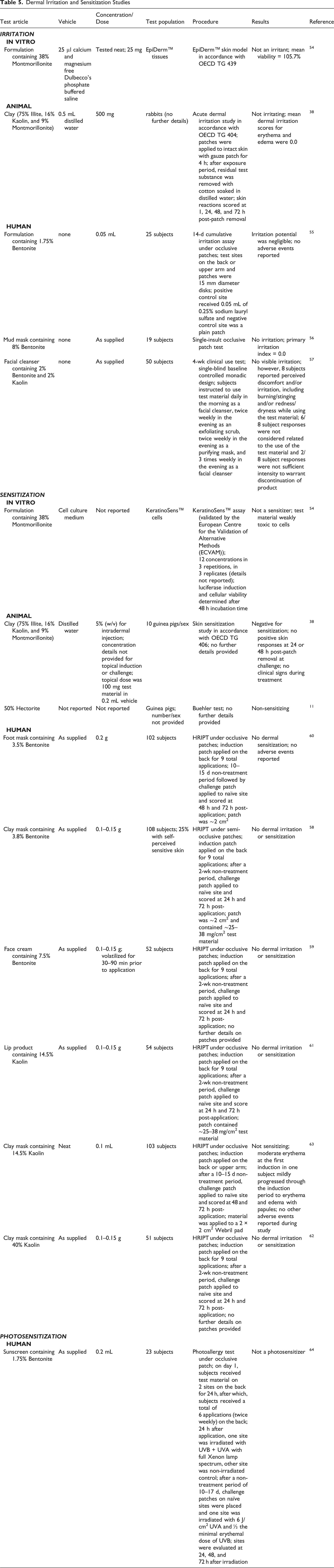
A formulation containing 38% Montmorillonite was predicted to be non-irritating in an EpiDerm™ skin model when tested neat. 54 Clay (75% Illite, 19% Kaolin, and 6% Montmorillonite) was not irritating to rabbit skin when tested at 500 mg in distilled water. 38 A formulation containing 1.75% Bentonite was not irritating to 25 human subjects in a 14-d cumulative irritation assay, nor was a mud mask containing 8% Bentonite irritating in a single-insult occlusive patch test in 19 subjects.55,56 No visible irritation was observed in a 4-wk clinical use test (50 subjects) of a facial cleanser containing 2% Bentonite and 2% Kaolin; however, some subjects reported perceived discomfort and/or irritation. 57
A formulation containing 38% Montmorillonite was predicted to be non-sensitizing in a KeratinoSens™ assay. 54 No sensitization was observed in guinea pig studies of 50% Hectorite (Buehler test, details not provided) or of Clay (75% Illite, 19% Kaolin, and 6% Montmorillonite; intradermal induction at 5%; no further information on dosing for topical induction or challenge provided).11,38 Dermal sensitization was not reported in human repeated insult patch tests (HRIPTs) with a foot mask containing 3.5% Bentonite (102 subjects), a clay mask containing 3.8% Bentonite (108 subjects), or in a face cream containing 7.5% Bentonite (52 subjects).58-60 No sensitization was observed in HRIPTs with a lip product containing 14.5% Kaolin (54 subjects) or a clay mask containing 40% Kaolin (51 subjects); however, one subject in a study of a clay mask containing 14.5% Kaolin (103 subjects) had moderate erythema progressing to erythema and edema with papules through the induction and challenge phase.61-63 A sunscreen with 1.75% Bentonite was not a photosensitizer in 23 human subjects. 64
Hectorite
A primary irritation study patterned after the Draize method was conducted using 6 white rabbits. 1 Either a 0.5 mL or a 0.5 g sample of Hectorite was applied to two sites, one on abraded skin, and the other on intact skin of the backs of the rabbits. The test sites were occluded for 24 h. At the end of the 24 h, the binders were removed and the sites were gently wiped clean. One-half hour later, the sites were examined and scored for erythema and edema. The sites were examined again at 72 h. The average score was 0.0. Hectorite was nonirritating to the skin of rabbits.
Ocular Irritation Studies
Animal
Clay
In an ocular irritation study performed in accordance with OECD TG 405, 100 mg of Clay (75% Illite, 16% Kaolin, and 9% Montmorillonite) was instilled into one eye of rabbits. 38 The other eye served as a control and was instilled with 0.1 mL normal saline. No adverse effects were noted following treatment up to 72 h after instillation. The test material was considered to be non-irritating to rabbit eyes. No further details were provided.
Hectorite
In a primary eye irritation study using 9 New Zealand white rabbits, a 0.1 mL liquid or semisolid (100 mg of the solid) sample was instilled into the one eye of each rabbit. 1 The eyes of 6 rabbits were not rinsed, and the eyes of 3 rabbits were rinsed approximately 4 s. All untreated eyes served as controls. The eyes were then examined with sodium fluorescein and an ultraviolet lamp at 24, 48, and 72 h and at 7 d. The mean score at 24 h was 2.0. All subsequent scores were 0.0. The test sample was considered moderately irritating to rabbit eyes without rinsing and practically nonirritating to the eyes with rinsing 4 s after instillation.
Kaolin
The potential for ocular irritation from a clay mask with 14.5% Kaolin was investigated in a tissue equivalent assay with EpiOcular™ cultures. 65 The EpiOcular™ human cell constructs were exposed to 100 µl test material under standard culture conditions for 4, 8, 16, and 24 h. Tissue viabilities were then examined by MTT assay. The duration of exposure resulting in a 50% decrease of tissue viability (t50) was calculated to be 5.2 h (at 4 h, tissue viability was 63.4%). The positive control yielded expected results. As residual test article may bind to the tissue and result in a false MTT reduction signal, a freeze-killed tissue control was used, and calculations were performed to correct for the amount of MTT reduced directly by the test article residues in the tissues. The clay mask with 14.5% Kaolin was predicted not to be an ocular irritant in this assay.
Clinical Studies
In a study of total pulmonary non-asbestos mineral content in lung tissue from 20 individuals with no occupational dust exposure, Attapulgite and Kaolin were identified in 12 individuals. 1 No correlations were made between numbers or types of fibers and age, sex, or smoking. Approximately 8400 out of 106 000 fibers (7.9%) were identified as Attapulgite and approximately 3500 out of 106 000 fibers (3.3%) were identified as Kaolin. Mineralogical analysis found that 100% of the Attapulgite fibers and 94% of the Kaolin fibers were 1–4.9 µm in length.
Oral
Montmorillonite
The effect of oral ingestion of Montmorillonite on protection against the adverse effects of the ingestion of aflatoxins were studied in 23 male and 27 female human subjects. 66 The subjects received 1.5 g/d or 3.0 g/d in capsules. A total of 9 capsules were ingested over a 2-wk period. The study was randomized and double-blinded. Blood and urine samples were collected before and after the study. Mild gastrointestinal effects were reported with no statistical significance found between the treatment groups. No significant differences in hematology, liver and kidney function, or electrolytes were reported in either group.
Case Reports
Bentonite
Several case studies involving Bentonite workers have been reported. 1 Some milling plants had dangerous concentrations of silica that ranged from 2 to 10 times the safe maximal concentration according to the US Bureau of Mines. Silicotuberculosis developed in four patients studied.
Fuller’s Earth
A patient that reported working no more than 15 yr in a Fuller’s Earth plant as a young man was diagnosed with terminal aspiration pneumonia, pneumoconiosis due to Fuller’s Earth exposure, bilateral emphysema, and fibrous pleural adhesions. 1 The lesions differed from typical silicotic lesions of the lungs; no formations of the whorled, acellular collagen typical of silicotic nodules were observed. Isolated cavities in the apices were filled with black sludge and surrounded by vascular and cellular collagen. The dust in the lymph nodes had only stimulated the formation of reticulin fibers. No subpleural nodules were present. At mineralogical analysis, the Fuller’s Earth deposits were constituted mainly of Montmorillonite (85.2% to 90%).
Two additional cases of pneumoconiosis in employees that worked in processing or milling Fuller’s Earth for at least 28 yr were reported. 1
Kaolin
A patient was reported with multiple pulmonary Kaolin granulomas. 1 The man had a history of bilateral recurrent pneumothorax. Both pleural spaces were destroyed with a suspension of liquid Kaolin. Recurrent right-sided pneumothorax devolved and reobliteration was again performed. In a follow-up chest radiograph, multiple well-defined peripheral nodules were in both lungs and pathological analysis revealed a bland acellular material surrounded by chronic inflammatory cells. By light microscopy, the particles were consistent with Kaolin. It was presumed that Kaolin entered the lungs through pleuroalveolar or pleurobronchial openings.
In another investigation, the death of a 62-yr-old man who worked in a cotton textile mill for 43 yr was reported. 1 The patient complained of progressive dyspnea and a productive cough. After being admitted to the hospital, a bronchoscopy was performed and no endobronchial lesions were found. A lung biopsy had lesions of severe interstitial fibrosis with bronchioalveolar structures extensively involved in the fibrotic process. Pathological alterations such as bronchiectasis, interstitial fibrosis with thickening of alveolar septa, mobilization of macrophages, and multinucleated giant cells were identified. Neither ferruginous bodies nor pleural hyaline plaques were identified. Kaolin particles were present with a mean size of 0.88 µm. Chrysotile asbestos was also detected, but the majority of particles were Kaolin. The man died as a consequence of respiratory failure despite an aggressive therapy of antibiotics and tuberculosis therapy.
The lungs and chest X-ray films were evaluated in a pair of case studies of men who worked in a Kaolin-processing plant for many years. 1 The first case was a 36-yr-old man who worked on the plant for 17 yr. Chest films were taken at the end of his career and detected lesions of extensive confluent consolidation and nodule formation of advanced pneumoconiosis with infection. Autopsy and microscopic findings included alveolar spaces uniformly expanded, three areas of whorled fibrous tissue, scattered areas of cystic spaces, hilar nodes heavily pigmented, deposits of brownish black particulate matter, a large vessel with recent thrombus, hemorrhage, and necrosis, marked fibrous thickening of the pleura, and dense fibrous scarring of the lymph nodes. The final diagnosis was pneumoconiosis (kaolinosis) with pulmonary thrombosis and infarction of the lungs. The second case study was a 35-yr-old man who worked in the Kaolin-processing plant for 21 yr. Within his last 3 yr, he had dyspnea and a slight cough with small amounts of dark colored sputum. The sputum was negative for bacteria. Chest films revealed advanced pneumoconiosis with infection, confluent consolidation, nodular infiltration, cavitation, and emphysema. Autopsy and microscopic findings included nodules in the right and middle lobes, pleural spaces were thickened and shaggy, large bulbous emphysematous blebs, a pulmonary artery with organizing thrombus, heavily pigmented hilar lymph nodes, whorled fibrous collagenous tissue, and spaces and walls with macrophages. The final diagnosis was pneumoconiosis (kaolinosis).
A 35-yr-old man who worked at a Kaolin-processing plant for 17 yr presented with chest pain and was hospitalized. 1 For the previous 2 yr before admittance, the man had packaged dried, processed Kaolin. Chest films revealed diffuse reticulonodular pulmonary infiltrates and a well-defined, noncalcified mass in the upper right lobe. A thoracotomy was performed and an 8 cm × 12 cm × 10 cm conglomerate pneumoconiotic lesion containing large amounts of Kaolin was found. X-ray diffraction material from the lesion had peaks corresponding to Kaolinite. The presence of silica was not confirmed by X-ray diffraction.
Pulmonary tissue was obtained from 5 Kaolin workers with advanced pneumoconiosis. 1 Chest radiographs detected small irregular shadows and large opacities typical of Kaolin pneumoconiosis. At autopsy, firm, grey-brown nodules and masses were in the parenchyma and in the hilar lymph nodes. Microscopic lesions were extensive pulmonary Kaolinite deposition associated with the formation of peribronchiolar nodules. The nodules were composed of Kaolinite aggregates transversed by bands of fibrous tissue rather than dense whorled collagen. Kaolin was detected in the lungs. Silica was not detected by either analytical scanning electron microscopy or X-ray diffractometry.
Six additional cases of pneumoconiosis in employees of 12 yr in Kaolin processing or milling facilities were reported. 1
Montmorillonite
A 73-yr-old Montmorillonite worker developed signs of pneumoconiosis, but subsequently died of acute gastrointestinal hemorrhage from a benign gastric ulcer. 1 A chest radiograph taken 2 yr before his death showed a bilateral fine reticulonodular shadowing, while another radiograph taken a few weeks before his death indicated a slight increase in the reticulonodular opacities and a mass at the left hilum and apex. At autopsy, numerous soft stellate grey-black dust lesions 4–5 mm in diameter were observed occupying most of the lungs. No lesions of progressive massive fibrosis were identified. Also present were lesions of severe emphysema and a 4 cm diameter neoplasm arising from the bronchus of the left upper lobe. At microscopic examination, numerous interstitial collections of dust-laden macrophages were situated around the respiratory bronchioles and along the adjacent alveolar septa. A slight degree of fibrosis associated with the dust lesions was observed, and the neoplasm was a poorly differentiated adenocarcinoma containing giant cell areas. Mineralogical analysis showed a large amount of calcium Montmorillonite.
Occupational Exposure
Attapulgite
A cohort of 2302 men employed for at least 1 mo between January 1, 1940 and December 31, 1975 at an Attapulgite mining and milling facility was studied. 1 A significant deficit of mortality from nonmalignant respiratory disease was observed based on age, calendar year, and rates. A marked deficit of nonmalignant respiratory disease was seen regardless of presumed dust exposure level, induction-latency period, or duration of employment. A statistically significant excess of mortality from lung cancer was observed among whites, but a deficit occurred among nonwhites. Lung-cancer risk in either race was not altered substantially with presumed dust exposure level, induction-latency period, or duration employed, with one exception—those employed for at least 5 yr in high-exposure level jobs. An increased mortality was observed for gastric cancer (6 observed) and a deficit due to nonmalignant respiratory disease was observed (9 observed).
Kaolin
A study was performed on the prevalence of ventilatory impairment, chest symptoms, and radiographic abnormalities in over 2000 Kaolin workers representing over 95% of the employees in the industry at the time. 1 Of the participants, 19% admitted having a cough. Of those participants with a cough, 17% had an abnormal forced expiratory volume and 14% had an abnormal vital capacity. Of those without a cough, 5.5% had an abnormal forced expiratory volume and 7% had an abnormal vital capacity. Also, 18% of the participants admitted to chronic sputum production. Of those with sputum production, 16% had abnormal forced expiratory volume, and 12.5% had abnormal vital capacity. Of those without sputum production, 6% had an abnormal forced expiratory volume, and 7.5% had an abnormal vital capacity. About 30% of the participants complained of shortness of breath, 3.1% of the cases were classified as severe. Wheezing was reported by 29% of the subjects. Satisfactory chest films for 2069 of the subjects were available for examination. Radiographic findings of 90 subjects revealed simple pneumoconiosis. Eighteen subjects (0.89%) had complicated pneumoconiosis. Of men with either case of pneumoconiosis, 51.1% were dry processors, compared to 6.3% of the men who worked in wet processing. Of the nonsmoking participants (549), 542 and 537 men had a satisfactory forced expiratory volume and forced vital capacity, respectively, in addition to an acceptable chest radiograph. Of these nonsmoking workers, 516 were studied for dust exposure and pulmonary function. Among the nonsmokers with no pneumoconiosis, those persons working in calcined clay had a greater prevalence of lung function abnormalities. This group had a significant increase in the risk of having an abnormal forced expiratory volume but tended to have less incidences of pneumoconiosis. In short, ventilatory impairment was related to the presence of complicated pneumoconiosis, employment in clay calcining, and cigarette smoking. Also work in dry processing was associated with a greater risk of developing pneumoconiosis.
The lungs of 62 recently deceased men between the years of 1968 to 1981 were taken for an assessment of the severity of lung disease. 1 Fifty-four of the 62 men worked with Kaolin or related kaolinized mineral stone. All the test subjects were employed in the mining industry. Chest radiographs were available for 39 of the 62 cases. Sections of lung tissue were examined microscopically for nodular and interstitial fibrosis and an overall grade ranging from 0 (none) to 3 (severe). Samples from 42 cases were analyzed for mineral content by X-ray diffraction and lung-dust concentrations. Radiographic lesions included 13 cases of progressive massive fibrosis and 22 cases of simple pneumoconiosis. Only four cases had no evidence of any disease. Nodular opacities tended to reflect a high quartz content, whereas high-Kaolin lung content had interstitial changes and irregular radiological changes. An increasing quartz concentration appears to be related to nodular fibrosis. The degree of interstitial fibrosis appeared to be more related to dust lung concentrations, although these results failed to reach statistical significance.
The Occupational Safety and Health Administration (OSHA) lists the following permissible exposure limit (PEL) for 8 h work shifts for Kaolin: total dust – 15 mg/m3 and respirable fraction – 5 mg/m3.67,68 The National Institute for Occupational Safety and Health (NIOSH) lists the following recommended exposure limit (REL) for up to 10 h time weighted average for Kaolin: total dust – 10 mg/m3 and respirable fraction – 5 mg/m3.
Bentonite
In a toxicological and occupational epidemiological review of Bentonite, the authors concluded Bentonite is probably not more toxic than any other inert insoluble dusts. 69 However, because some forms may contain variable amounts of respirable crystalline silica, prudent management and adherence to occupational exposure limits is appropriate.
Summary
This report assesses the safety of 8 clay ingredients as used in cosmetics. All of these ingredients are reported to function as absorbents and bulking agents; other cosmetic functions are also reported. The Panel previously reviewed the safety of Attapulgite, Bentonite, Fuller’s Earth, Hectorite, Kaolin, and Montmorillonite in a report that was published in 2003. In that report, the Panel concluded that these ingredients were safe as used in cosmetic ingredients. In accordance with its Procedures, the Panel evaluates the conclusions of previously-issued reports approximately every 15 yr, and it has been at least 15 yr since this assessment has been issued.
According to 2023 VCRP survey data, Kaolin has the most reported uses in cosmetic products, with a total of 787; the majority of uses are in leave-on formulations. Bentonite has the second most reported uses in cosmetic products, with a total of 221; a little more than half are reported in leave-on formulations. The frequencies of use for both of these ingredients have greatly changed since the original safety assessment was finalized; in 1998, Kaolin was reported to have 509 uses and Bentonite was reported to have 94. The results of concentration of use surveys conducted by the Council in 2022 indicate Kaolin also has the highest maximum concentration of use in leave-on formulations; it is used at up to 53.2% in manicuring preparations. For leave-on dermal preparations, specifically, Kaolin also has the highest reported maximum concentration of use, at 16% in face and neck products, and Bentonite has the next highest, at 8% in face and neck preparations. According to the original safety assessment, the maximum leave-on use concentration in 1999 for Kaolin was 100% in skin care preparations; the maximum leave-on use concentration for Bentonite was 8% in makeup foundations.
Several of these clay ingredients are GRAS as direct and/or indirect food additives. Kaolin is also an approved OTC drug.
Ex vitro bioavailability studies were performed using human skin models. Trace heavy metals in 3 clay pastes (white Montmorillonite, Kaolin, and Clay (75% Illite, 19% Kaolin, and 6% Montmorillonite)) did not penetrate cutaneous tissue.
In acute dermal and oral toxicity studies in rats, Clay (75% Illite, 19% Kaolin, and 6% Montmorillonite) had an LD50 greater than 2000 mg/kg. The same product was tested in an acute inhalation study in rats and had an LC50 greater than 3.856 mg/L. Inhalation studies in rats with an environmental dust sample composed of approximately 75% of Illite, Montmorillonite, and Kaolin and approximately 20% α-quartz demonstrated that the majority of particles were deposited at the first alveolar duct bifurcations, and at 24-h later, numerous particles had been ingested by alveolar macrophages. Rats instilled intratracheally with the same dust developed a multifocal interstitial lung disease.
Nano-sized Kaolin (primary particle size 4.8 µm) instilled intratracheally in mice (single and multiple (4) instillations) produced diffuse alveolar macrophages containing Kaolin in the lungs. Focal granulomatous formation, with or without alveolar macrophages containing Kaolin, were also frequently observed in the lungs of mice that received multiple instillations. Similar observations were made in mice that received a single instillation, but with a slight degree of particle accumulation and granuloma formation in the lungs. No abnormalities were observed in the kidneys.
In a 90-d oral study in male rats, a modified Montmorillonite clay at 40 mg/kg/d did not cause any deaths during treatment, and no significant changes were noted in clinical biochemistry, organ weights, or in histopathological examinations when compared to controls. As an anti-caking agent in animal feed, calcium Montmorillonite clay produced non-dose-dependent significant changes in mean corpuscular hemoglobin, serum calcium, serum vitamin A, and serum iron when tested at up to 2.0% w/w in rats in a dietary study; however, no adverse effects were noted in feed consumption, body weight, organ weights, or in gross or histopathological exams.
Clay (75% Illite, 19% Kaolin, and 6% Montmorillonite; 5000 µg) was not mutagenic in an Ames test, with or without metabolic activation. Unmodified Montmorillonite clay (at up to 125 µg/mL) and one type of cation-exchanged Montmorillonite clay (at up to 250 µg/mLl) also were not mutagenic in an Ames test with or without metabolic activation, but significant increases in revertant colonies were observed in one strain with metabolic activation in 2 other cation-exchanged Montmorillonite clays. No mutagenic activity was observed in a Salmonella/microsome assay with and without metabolic activation when tested in Montmorillonite and cation-exchanged montmorillonite in both nano- and non-nano-sized material at up to 141 µg/mL and up to 14.1 µg/plate, respectively. However, the cation-exchanged Montmorillonite material (both nano- and non-nano-sized, at up to 226 µg/mL and 170 µg/mL, respectively) in this study was genotoxic in a concentration-related manner in a Comet assay with Caco-2 cells. Clay (75% Illite, 19% Kaolin, and 6% Montmorillonite) did not induce chromosomal aberrations in Chinese hamster ovary (CHO) cell cultures when tested at up to 5000 µg/mL, with or without metabolic activation. Micronucleus induction was observed in a dose-dependent manner to micro- and nano-sized Kaolin in CHO AA8 and primary normal human diploid epidermal keratinocytes and fibroblasts, with fine particles having a higher genotoxic potency than coarse particles. A 4-fold increased frequency of micronucleated cells was observed in human lung cancer A549 cells following exposure to nano-sized Kaolin. Statistically significant increases in the frequency of micronuclei were induced by Montmorillonite clay at 62.5 µg/mL in a cytokinesis block micronucleus cytome assay in human hepatoma cell lines, but this effect was not observed at a concentration of 31.25 µg/mL or lower. No effects in nucleoplastic bridges or nuclear buds were observed at any concentration in this study. In an in vitro micronucleus assay and kinetochore analysis using human lung fibroblasts, the genotoxic potential of Bentonite at up to 15 µg/cm2 was determined to be generally low, but could be altered by the content of quartz and available transition metals. In an in vitro Comet assay with micro- and nano-sized Kaolin in CHO AA8 and primary normal human diploid epidermal keratinocytes and fibroblasts, the test materials promoted DNA damage in a dose-dependent manner, with greater DNA-damaging potency in the nano-sized Kaolin than in the micro-sized Kaolin.
In an in vivo Comet assay with nano-sized Kaolin intratracheally instilled in mice, DNA damage was induced at 0.2 mg/mouse but not at 0.05 mg/mouse after 3 h exposure. No difference in induction was observed after 24 h exposure compared to the 3 h exposure. Increased gpt and Spi-mutant frequencies were observed in the lungs of the mice following intratracheal instillation with either single or multiple doses of 0.2 mg nano-sized Kaolin. A mutation spectra analysis showed >60% of G:C to C:G transversion occurred in the gpt genes. In another Comet assay, rats were given 2 oral doses of up to 1000 mg/kg bw cation-exchanged montmorillonite clay. There was no statistically significant difference in % tail DNA between the negative controls and the different treatment groups for any of the cells (liver, kidneys, colon) tested.
IARC has determined there is inadequate evidence in humans for the carcinogenicity of Attapulgite. Further, IARC has determined there is insufficient evidence in experimental animals for the carcinogenicity of short Attapulgite fibers (<5 µm); however, there is sufficient evidence in experimental animals for the carcinogenicity of long Attapulgite fibers (>5 µm). Overall, long Attapulgite fibers (>5 µm) are possibly carcinogenic to humans (Group 2B) and short Attapulgite fibers (<5 µm) cannot be classified as to its carcinogenicity to humans (Group 3). Attapulgite (palygorskite fibers >5 µm in length) is listed by California Proposition 65 as a carcinogen.
The ability for Bentonite (2/3 weight) and a zeolite (type not specified; 1/3 weight) to act as a hemostatic agent was studied in 12 male Sprague-Dawley rats. This hemostatic agent may cause vasoconstriction and inhibition of neoangiogenesis. Illite and Montmorillonite were observed to have protective effects on cytotoxicity induced by mycotoxins in MTT and LDH assays. An environmental dust sample composed of approximately 75% of Illite, Montmorillonite, and Kaolin and approximately 20% α-quartz induced LDH release from alveolar macrophages of rats, and showed hemolytic effects on human red blood cells. Cytotoxicity results of the CCK-8 assay showed the 16HBE cells had high viability after exposure to 40 µg/mL nano-sized Kaolin, but cell viability decreased significantly at doses greater than 80 µg/mL. A LDH assay indicated that nano-sized Kaolin caused membrane disruption in a dose-dependent manner.
A formulation containing 38% Montmorillonite was predicted to be non-irritating in an EpiDerm™ skin model when tested neat. Clay (75% Illite, 19% Kaolin, and 6% Montmorillonite) was not irritating to rabbit skin when tested at 500 mg in distilled water. A formulation containing 1.75% Bentonite was not irritating to 25 human subjects in a 14-d cumulative irritation assay, nor was a mud mask containing 8% Bentonite irritating in a single-insult patch test in 19 subjects. No visible irritation was observed in a 4-wk clinical use test (50 subjects) of a facial cleanser containing 2% Bentonite and 2% Kaolin; however, some subjects reported perceived discomfort and/or irritation.
A formulation containing 38% Montmorillonite was predicted to be non-sensitizing in a KeratinoSens™ assay. No sensitization was observed in guinea pig studies of 50% Hectorite (further dosing information not provided) or Clay (75% Illite, 19% Kaolin, and 6% Montmorillonite; intradermal induction at 5%, no further information on dosing for topical induction or challenge provided). Dermal sensitization was not reported in HRIPTs with a foot mask containing 3.5% Bentonite (102 subjects), a clay mask containing 3.8% Bentonite (108 subjects), or in a face cream containing 7.5% Bentonite (52 subjects). No sensitization was observed in HRIPTs with a lip product containing 14.5% Kaolin (54 subjects) or a clay mask containing 40% Kaolin (51 subjects); however, one subject in a study of a clay mask containing 14.5% Kaolin 103 subjects) had moderate erythema progressing to erythema and edema with papules through the induction and challenge phase. A sunscreen with 1.75% Bentonite was not a photosensitizer in 23 human subjects.
A clay mask with 14.5% Kaolin was predicted to not be an ocular irritant in a tissue equivalent assay with EpiOcular™. In an ocular irritation study in rabbits, Clay (75% Illite, 19% Kaolin, and 6% Montmorillonite) produced no adverse effects and was considered to be non-irritating.
Nine capsules containing Montmorillonite (up to 3.0 g/d) were administered to 50 human subjects over a 2-wk period. Only mild gastrointestinal effects were reported.
OSHA lists the following PEL for 8-h work shifts for Kaolin: total dust – 15 mg/m3 and respirable fraction – 5 mg/m3. NIOSH lists the following REL for up to 10-h time weighted average for Kaolin: total dust – 10 mg/m3 and respirable fraction – 5 mg/m3. In a toxicological and epidemiological review of Bentonite, the authors concluded Bentonite is probably not more toxic than any other particulate. However, because some forms may contain variable amounts of respirable crystalline Silica, prudent management and adherence to occupational exposure limits is appropriate.
Discussion
In 2003, the Panel published a final report that included Attapulgite, Bentonite, Fuller’s Earth, Hectorite, Kaolin, and Montmorillonite, and concluded that the ingredients named in that report were safe as used in cosmetic products. In accordance with its Procedures, the Panel re-evaluates the conclusions of previously-issued reports approximately every 15 years, and when appropriate, additional ingredients are included in the resulting re-review. Accordingly, the Panel re-reviewed the safety of these 6 clays, with the addition of 2 related ingredients (Clay and Illite), and concluded that the available data are sufficient to determine that Kaolin is safe in cosmetics in the present practices of use and concentration as described in this safety assessment. Furthermore, the Panel concluded that the remaining 7 naturally-sourced clay ingredients are safe in cosmetics in the present practices of use and concentration, except for those products that may be incidentally inhaled, for which the available data are insufficient.
The Panel expressed concern regarding heavy metals that may be present in these ingredients. Heavy metals associated with clay ingredients did not penetrate the skin. The Panel stressed that the cosmetics industry should continue to use current good manufacturing practices (cGMPs) to limit these impurities in cosmetic formulations.
The Panel was made aware that nanoforms of clay ingredients could potentially be used in cosmetic formulations, including those that could result in incidental ingestion (eg, lipstick and toothpaste; categories of sprayable products were not reported based on current available data). However, use of nanoform ingredients is unlikely to translate into nanoparticle form within final formulations under in-use conditions (or under in-use exposure scenarios). In these formulations, low concentrations of use (eg, maximum reported use concentration of Kaolin in lipstick is 14.5%) would limit exposure, and in addition, processing would be expected to result in much larger particle sizes (by, for example, agglomeration) in the consumer product.
Additionally, some naturally-sourced clay ingredients were reported to be used in spray and powder products that could possibly be inhaled. For example, Bentonite is reported to be used at 0.9% in spray suntan products and Kaolin is reported to be used at up to 15% in face powders. For Kaolin, the data available from inhalation studies, including acute, chronic, and carcinogenicity data, suggest little potential for adverse respiratory effects at relevant doses for this naturally-sourced clay ingredient. These data have mitigated the concern of the use of Kaolin in cosmetic products which may be incidentally inhaled.
Conversely, the data are insufficient to determine the safety of the remaining 7 naturally-sourced clays for use in formulations which may be incidentally inhaled. The Panel noted that Bentonite and Hectorite may contain crystalline silica (cristobalite), which is a human carcinogen, as an impurity. Furthermore, the Panel noted that Attapulgite with long fibers (>5 µm) is possibly carcinogenic to humans and animals. The additional data needed to determine safety of these 7 ingredients for such use are composition and impurities data, especially quantification of crystalline silica, and negative repeated-dose inhalation data on naturally-sourced clay ingredients.
The Panel’s respiratory exposure resource document (https://www.cir-safety.org/cir-findings) notes that airbrush technology presents a potential safety concern, and that no data are available for consumer habits and practices thereof. As a result of deficiencies in these critical data needs, the safety of cosmetic ingredients applied by airbrush delivery systems cannot be determined by the Panel. Therefore, the Panel has concluded the data are insufficient to support the safe use of cosmetic ingredients applied via an airbrush delivery system.
Conclusion
The Expert Panel for Cosmetic Ingredient Safety concluded that Kaolin is safe in cosmetics in the present practices of use and concentration described in this safety assessment.
The Panel also concluded that the following 7 ingredients are safe in cosmetics in the present practice of use and concentration described in this safety assessment, with the exception that the available data are insufficient to make a determination of safety for these ingredients in products that may be incidentally inhaled.
Attapulgite
Bentonite
Clay
Fuller’s Earth
Hectorite
Illite
Montmorillonite
Footnotes
Author’s Note
Unpublished sources cited in this report are available from the Director, Cosmetic Ingredient Review, 555 13th Street, NW, Suite 300W, Washington, DC 20004, USA.
Author Contributions
The articles in this supplement were sponsored by the Cosmetic Ingredient Review.
Funding
The authors disclosed receipt of the following financial support for the research, authorship, and/or publication of this article: The articles in this supplement were sponsored by the Cosmetic Ingredient Review. The Cosmetic Ingredient Review is financially supported by the Personal Care Products Council.
Declaration of Conflicting Interests
The authors declared no potential conflicts of interest with respect to the research, authorship, and/or publication of this article.