







Abstract
Purpose
Incubators have long been relevant actors in the development of start-ups. This paper proposes studying mentoring in incubators as a decision aiding process that aids a specific design process, namely the activities of a start-up during incubation.
Design/methodology/approach
Methodologically, this paper assumes a parallelism between mentoring and decision aiding, as well as between business modelling and a design process. According to this approach, mentors are viewed as decision aiding actors who operate within Contexts of Action and adopt more or less appropriate tools to aid business modelling design activities. A protocol analysis was carried out on 86 mentoring sessions with 53 entrepreneurial teams at the I3P Incubator of the Politecnico di Torino.
Findings
The study allowed us to obtain a deep understanding of the mentoring activities and the appropriateness of the tools used in each phase of the incubation process.
Originality
This paper introduces five elements of novelty. First, it looks at business mentoring as a decision aiding process of a design process, specifically the incubation process; second, this has allowed us to refer to a framework provided by the Decision Aiding literature; third, it adopts an alternative research approach to surveys, questionnaires and interviews; fourth, it provides an abstract/standardised unit of analysis to describe the situational nature of mentoring. Finally, it identifies the building blocks of mentoring and how the activities are methodologically conducted.
Introduction
Incubators have become a ubiquitous phenomenon throughout the world. Apart from covering a variety of economic roles, including those of consultancy, two-sided platforms, or business clusters (Cantamessa, 2016), they also represent a valuable support for start-ups in their early-stage development (Bergman & McMullen, 2022; Grimaldi & Grandi, 2005). Incubators often adopt well-known blueprints, including both traditional business planning (e.g., Mullins, 2012) and ‘lean’ approaches (e.g., Mansoori et al., 2019), to support the development of start-ups. This assistance is typically labelled “business mentoring”.
Mentoring is usually considered a key element in the evolution of organisations, whether they are established (e.g., Lane & Clutterbuck, 2004) or not, in incubators (Grimaldi & Grandi, 2005) or other ecosystems (de Alvarenga et al., 2019; Hausberg & Korreck, 2020). A variety of practices, such as training, coaching, mentoring, counselling, and consulting have been reported, and they mainly differ according to the application environment (Kenworthy, 2013). ‘Mentoring’, defined as a “one-to-one relationship between a more experienced member and a less experienced member of an organization or profession” (Mullen, 1998), fits instead quite well into the relationship that is often established in the context of start-up incubation.
This paper has specifically focused on business mentoring in incubators, for three main reasons. First, even though incubators and business mentoring only represent one possible way of supporting start-ups (for a review, see Ratinho et al., 2020; Bergman & McMullen, 2022), they have proved to be a determinant of the survival of start-ups (Blank, 2021; Theodorakopoulos et al., 2014), and to have significant effects on learning and performance (e.g., Marmer et al., 2011; Scillitoe & Chakrabarti, 2010; Xiao & North, 2017). Second, value-added services in incubators, such as mentoring, are becoming more and more important beyond the traditional provision of facilities (Blank, 2021). Nevertheless, and this embodies the third reason, the appropriate way of providing such a service is still a matter of discussion (Ahmad & Ingle, 2011; Bergek & Norrman, 2015; Bruneel et al., 2012).
The literature on incubators has generally adopted a high-level perspective, which looks at the general outcome of an incubation process (e.g., the growth and probability of success of a start-up after a mentoring program, Xiao and North, 2017; Blank, 2021), the portfolio of offered services (Bruneel et al., 2012), the physical infrastructure (Cabral & Winden, 2020), or at the local innovation ecosystem (Nair et al., 2020). The internal functioning of incubators has also been described (Alpenidze et al., 2019; Dhochak et al., 2019), but without mentioning any theoretically grounded methodologies (Bergek & Norrman, 2015; Ratinho et al., 2020).
On the other hand, the literature on mentoring has focused on the characteristics of the mentors (e.g., Bennetts, 2002; Clutterbuck, 2004), on mentoring programs (e.g., Sanchez-Burks et al., 2017), on the perceived benefits from the entrepreneurs’ perspective (e.g., Brodie et al., 2017) and on the ‘coachability’ of entrepreneurs (e.g., Kuratko et al., 2021). However, the methodological and decisional aspects have been neglected, even though the decision-making support of mentors has been proved to be effective and to ideally translate into later entrepreneurial activities (Fischhoff, 1982; York & Danes, 2014). Ahmad and Ingle (2011) specifically highlighted a lack of explanatory theories to describe the underlying mechanisms of “how incubators incubate”, especially concerning the methodology behind the offered support (Bergek & Norman, 2015). Cunningham and Menter (2020) emphasised the need to consider a micro-level perspective when dealing with academic entrepreneurship, and the need to focus more on individual actors, their actions and their decisional processes.
Indeed, such a viewpoint on decisional processes along the incubation process is essential if the aim of the research is to delve into the typology of the offered support and the adopted methodology. Thus, the main aim of this paper has been to fill this gap in the literature, by providing an in-depth investigation on how business mentoring in incubators works, through an empirical investigation of the mentoring actions that are performed to aid business model design decisions, as well as of the types of tools that are used for this purpose. To this aim, the authors have studied mentoring process through the established protocol analysis technique (Gero & Mc Neill, 1998; Simon & Kaplan, 1989).
Studying the mentoring process at a micro-level offers an alternative and original viewpoint to the one traditionally adopted in the literature, which instead considers incubators, start-ups, mentors or mentor-start-up relationships as the elementary units of analysis (Bennetts, 2002; Clutterbuck, 2004).
The paper proposes the results of a study that was conducted in the start-up incubator of the Politecnico di Torino. This case study was selected since it is one of the main university incubators in Europe, which was recognised as the global “best public incubator” in the 2019–2020 UBI Index.
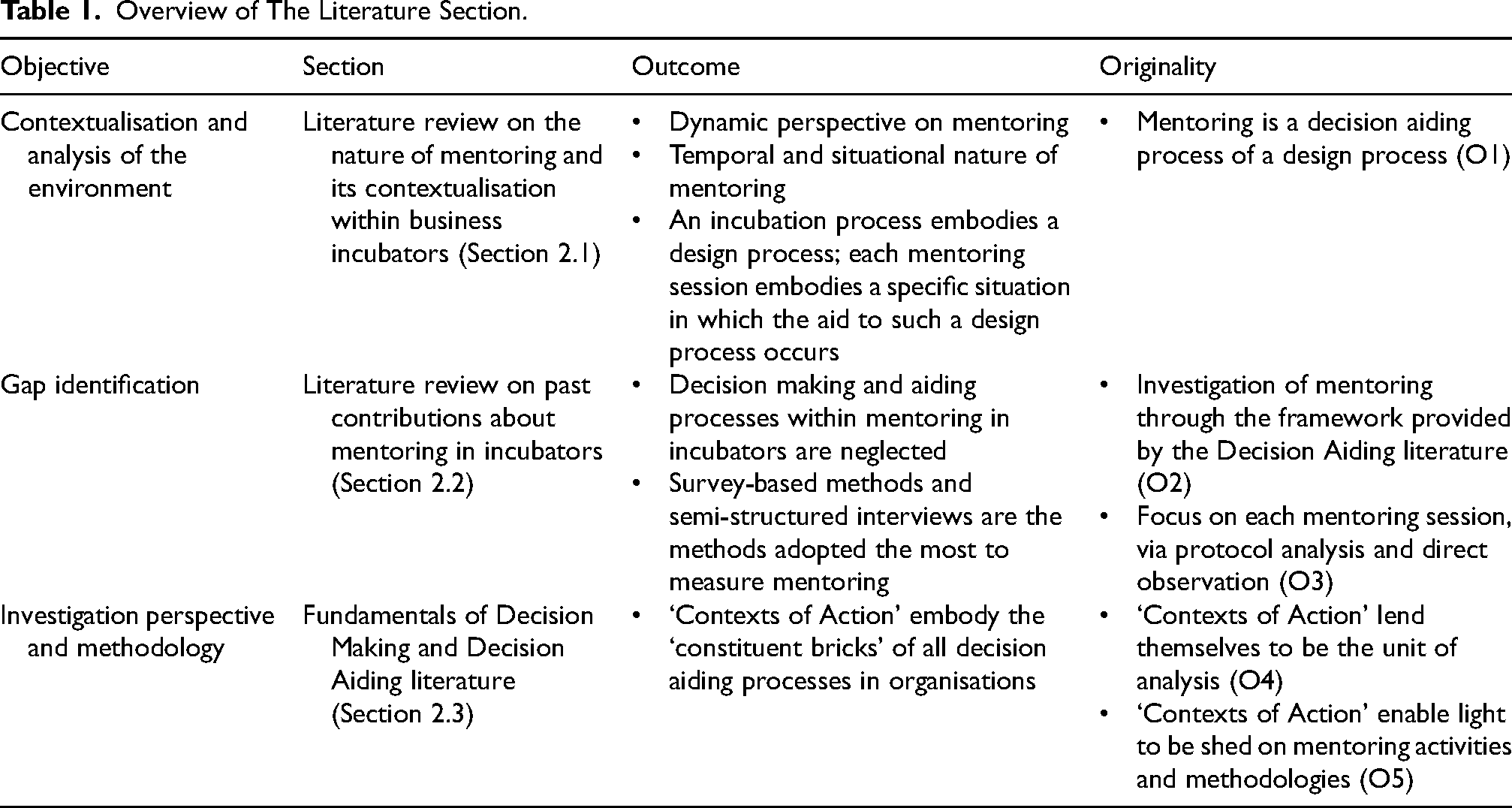
The paper is structured in five sections. The following section discusses the mentoring process within the context of start-up incubation and in relationship with decision aiding processes. Drawing on this connection, the investigation perspective and the unit of analysis are defined. In this sense, Table 1 associates each section of the analysed literature with the resulting contribution, with the aim of elucidating the thread of analysis and highlighting the elements of originality introduced by this study. The methodological section presents the protocol analysis technique that was applied to the business mentoring activities. Finally, the empirical findings and possible avenues for future research are discussed in the last section.
Overview of The Literature Section.
Background
Understanding The Nature of Mentoring in Incubators
Regardless of the variety of ways (see Mullen & Klimaitis, 2021 for a list) and domains (e.g., education, individual career development, corporate programs) through which mentoring can be operationalised, it embodies a developmental process for the informal transmission of knowledge, experience, social capital and psychosocial support. The literature encompasses different supporting actions under the term ‘developmental interaction’, in which a subject on the receiving end of the relationship is exposed to a personal and/or professional growth as a result of interacting with actors on the transmitting side. A variety of practices, such as training, coaching, mentoring, counselling, and consulting, have been reported and they mainly differ according to their environment of application, the type of learning process, and as individual or group actions (Kenworthy, 2013).
This paper falls into the branch of literature that deals with ‘mentoring’ according to the definition of Mullen (1998), which fits rather well with the relationship observed in the context of start-up incubation, although some aspects usually associated with other types of developmental interactions can also be detected. Indeed, it is possible to observe elements of coaching (Koopman, 2013), as the start-up development process is also aimed at personal growth and sometimes has to cope with overcoming significant psychological stress (Scillitoe & Chakrabarti, 2010). It is also possible to speak about tutorship, since the ongoing activities in incubators often include a formal and structured transfer of knowledge to entrepreneurs (e.g., learning how to validate a business model by using metrics, understanding a venture capital term sheet, etc.). Similarly, one could find elements akin to consultancy, since a lack of knowledge of the entrepreneurial team can be supplemented by the direct action of the incubator staff.
However, since coaching focuses on psychological elements, tutorship and consultancy on task execution, mentoring can be considered as an activity that includes the widest spectrum of exchanges between the two subjects involved in the developmental interaction. Therefore, for the purpose of this study, we posit that ‘mentoring’ is the activity that best represents the developmental interaction that takes place between the staff of an incubator and start-up entrepreneurs.
Mentoring can be viewed from either a static or a dynamic perspective. Applied to the context of start-up incubation, the former focuses on such elements as the personality and prior experiences of both mentors and mentees, and on the status and the environment (e.g., the industry, the business model and stage of development), while the latter highlights the evolution of the mentoring relations and of the involved actors (e.g., Hackmann & Malin, 2020; Johnson, 2015). According to this perspective, each mentoring relationship and activity has a temporal and situational nature (Kram, 1983), so that it is challenging to define a universal mentoring process or to examine it in an aggregated form (Clutterbuck, 2004; Cox, 2005), even in incubators (Ahmad & Ingle, 2011; Cull, 2006; Waters et al., 2002). To grasp the situational nature of such dynamic relationships, the study posits that an incubation process is a special case of a design process, such as those in multistakeholders contexts (Cantamessa et al., 2012, 2016), but where the outcome is the creative and progressive development of a business model. Therefore, each mentoring session represents the specific situation in which the aid for such a design process is exploited (O1).
The Need to Investigate Business Mentoring Processes in Incubators
Mentoring processes in incubators (aka business mentoring) are considered a key element in start-up development (Blank, 2021; Breznitz et al., 2018; Theodorakopoulos et al., 2014) to enhance learning and competencies (Seet et al., 2018; Xiao & North, 2017) and, as such, it is one of the main reasons why new ventures participate in incubation programs (Brown et al., 2019; Crisan et al., 2021). Indeed, novice entrepreneurs often have to face early-stage challenges, not only in terms of access to resources, but also concerning the lack of business development skills, market knowledge and a professional network (van Rijnsoever & Eveleens, 2021; Yusubova et al., 2020), and may thus need support on these aspects.
The literature about mentoring programs in incubators has investigated the growth and probability of success of start-ups after a mentoring program, looking at the specific aspects of both mentors and mentees.
The former contributions focused on a mentor's familiarity with the industry and extended networks (Hallen et al., 2020), a mentor's personal characteristics and intention (Tings et al., 2017), and a mentor's motivation for engaging in a mentor–venture relationship, (Yusubova & Knoben, 2023). Among the latter, mentees have been investigated about the absorptive capacity of a start-up (Samaeemofrad & Van Den Herik, 2020), prior managerial experience (Blank, 2021), gender (Nicholls-Nixon & Maxheimer, 2022), and in relation to the chances of survival of a start-up (e.g., Blank, 2021). Moreover, some contributions have explored the mentor-mentee interaction mechanisms (e.g., Kuratko et al., 2021; Mansoori et al., 2019) and the perceived value of such a relationship, although only from the perspective of the entrepreneurs (Brodie et al., 2017; Vaz et al., 2022).
However, very few studies have looked at the mentoring process in detail or at the way entrepreneurs’ decisions are made and aided. When decision-making processes were studied, the contributions considered either the decisions made by incubators when selecting the start-ups (Aerts et al., 2007; Yin & Luo, 2018) or biases and heuristics to which entrepreneurs are subjected in their decisions (Koellinger et al., 2007; York & Danes, 2014). As far as Decision Aiding is concerned, Samaeemofrad et al. (2016) looked at the aiding activities offered by incubators and classified them into five different categories (i.e., networking, monitoring, knowledge development, resource mobilisation and the creation of exposure) to measure their effectiveness.
In this stream of the literature, mentoring in incubation is considered as a way of mitigating biases and heuristic procedures in decisional processes, and of encouraging analogical reasoning and rational approaches (York & Danes, 2014). The Decision Making and Aiding perspectives can both be considered relevant, since entrepreneurial decisions are unique, instantiable (Dew et al., 2009; Packard et al., 2017; Townsend et al., 2018) and affected by uncertainty and/or complexity (Shepherd et al., 2015).
Hence, this paper provides an in-depth investigation into the flow of design decisions that start-up entrepreneurs make during the incubation process, and into the aid provided to them. Consequently, the study specifically refers to a framework provided by the Decision Aiding literature (Norese & Ostanello, 1988), able to provide a meta-perspective that results original in this domain (O2) and particularly suitable for providing a high-level paradigmatic view to a process in which actions are tailored to the needs of the mentee.
Finally, all the above-mentioned studies were aimed at measuring the subject of their investigations by adopting survey-based methods for data collection or semi-structured interviews, but rarely through ethnography (Mansoori et al., 2019; Vaughan, 2009). This paper instead adopts protocol analysis, a research method that elicits verbal interactions by/among participants (Ericsson & Crutcher, 1991). Thanks to this adopted research protocol, the present study has been able to reach the micro-perspective suggested by Cunningham and Menter (2020). The study in fact has not looked at the whole incubation process, but has instead focused on each mentoring session, via direct observation. This completely original viewpoint (O3) mainly studies the way the interactions among actors are carried out in order to grasp the situational nature of mentoring in the decision process of each phase.
The Unit of Analysis Offered by Decision Making and Decision Aiding
Decision Making is an extremely varied field, and it spans from Economics and Strategic Management to the Organisation Theory and Operation Research, and to Knowledge Management. A seminal reference that is common to all these domains is the three-stage decision making model of Simon (1960) (Figure 1a). This model presents Problem-Solving and Design as fundamental activities in any decision process, and it highlights a link between Decision Making and Design. Such a link is also revealed in the Design literature, where the three main phases of design processes (Pahl & Beitz, 2013; Smith & Browne, 1993; Stempfle & Badke-Schaub, 2002; Figure 1b) appear to be aligned with Simon's model. Design processes, in turn, can be seen as a sequence of design decisions (Montagna, 2011), in which Simon's ‘design’ phase occurs, thus making the relationship between Design and Decision processes even more articulated.
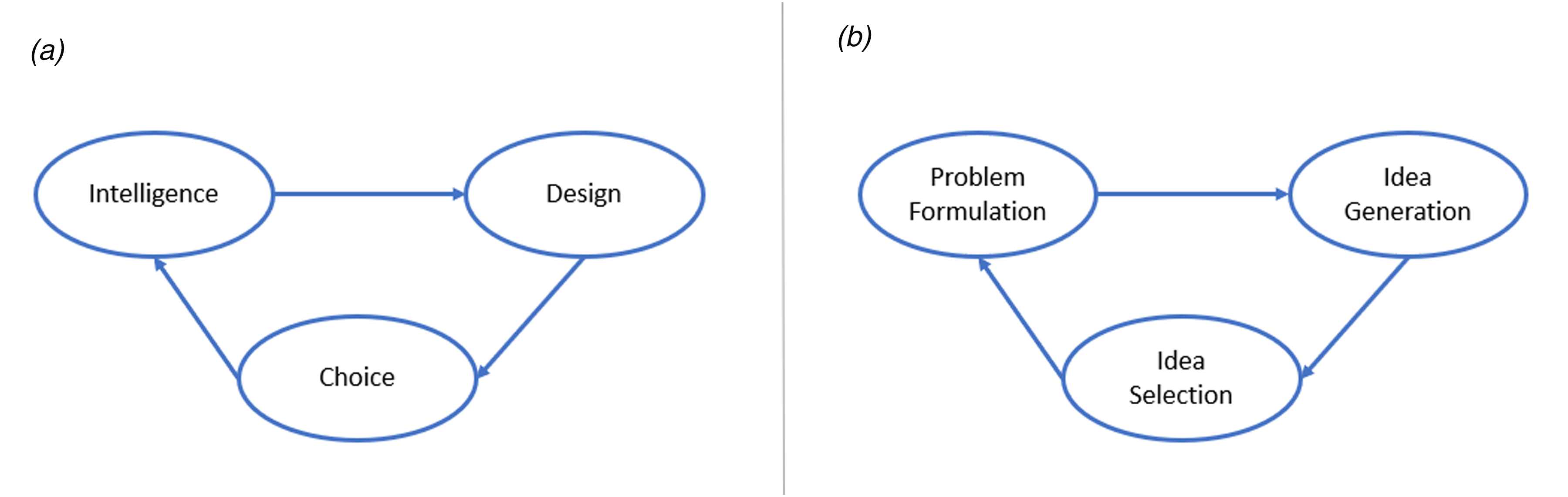
Similarities between decision-making process (a) and design process (b).
Therefore, aiding design processes (like the one we are considering here) implies aiding decision processes (Cascini et al., 2013) and, consequently, the methodological reference leads to the Decision Aiding literature of design processes.
Decision aiding, in turn, is a stream of Operations Research, above all in the areas of the Decision Theory, Multi-Criteria Decision Aid, and Problem Structuring Methods. Decision Aiding literature has stated that such activities should be performed in a different way for each specific situation, and the framework of contexts of Action (Norese & Ostanello, 1988; henceforth labelled CoAs, or CoA if singular), namely Identification (Id), Structuring (Str), Development (Dev), Control (Cnt) and Communication (Com), specifically represent such a situational nature. The tools adopted for any aidare conditioned to any specific CoA and should be changed accordingly (Roy, 1990; Tsoukiàs, 2007)
- Identification involves aiding activities that are aimed at capturing the motivations behind the requested aid and at recognising the problem. It involves collecting data, information, and knowledge about the situation, the status of a situation, and/or about what has already occurred/been defined. - Structuring provides an operative framework for problem formulation (see Mingers & Rosenhead, 2004), whereby the various elements of the problem are conceptually linked. - Development is the context in which possible solutions and alternative actions are generated. - Control includes the activities of verification, evaluation and validation (Landry et al., 1983) of the performed activities. - Communication between the organisation and the stakeholders, and with the decision-makers, plays a central role when decision aiding has a significant political-organisational connotation.
The CoAs in the Decision Aiding literature embody the ‘constituent bricks’ of all decision aiding processes in organisations. On one hand, they are sufficiently fine-grained to grasp the situational and detailed interactions of mentoring and, on the other, they are sufficiently abstract (as they are derived from a generic design aiding action) to remain applicable across the diverse or to avoid getting lost in the variety of specific activities that can occur within incubation processes. Therefore, in this paper, as shown in Figure 2, CoAs lend themselves to be the unit of analysis through which incubation and mentorship processes are investigated, considering the aid provided to start-ups in their constant flow of decisions, thus providing a complete innovative perspective (O4).
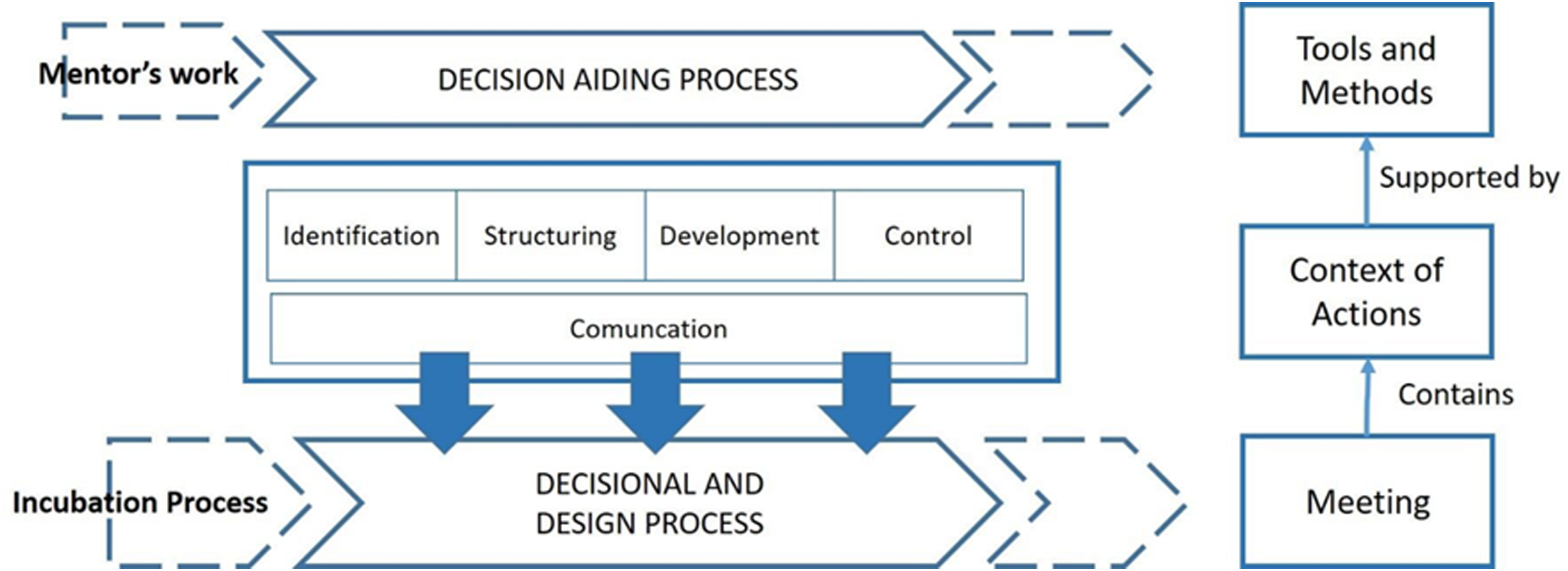
CoA framework for the incubation and mentorship processes.
Moreover, in view of their specific aiding objectives, CoAs drive the choice of the design method that should be adopted for each specific situation (Montagna, 2011). In this sense, thanks to such rigorous matching between a CoA and the methods that can be adopted within it, this paper sheds light on knowledge about the methods that are adopted in mentoring activities in incubators (O5).
Research Questions
The relationship between Design and Decision Making, and hence Decision Aiding, enables the concept of CoAs in incubation processes to be referred to. Moreover, and more specifically, it is reasonable to expect that, since different decisions are made along the incubation process and, above all, the typology of these decisions changes in the process, the relevance of CoAs might also evolve. Consequently, the first research question has been defined as follows:
What are the CoAs that characterise mentoring activities? And what is the relevance, in terms of time spent, of each CoA in the different incubation phases?
Since the identified CoAs bring about the choice of what aiding tools need to be adopted, the paper is also aimed at investigating the association of the aiding tools with the phases of the incubation process, which leads to the following research question:
What are the aiding tools that are used in mentoring during an incubation process?
Before a mentoring session, a mentor sets himself an objective, in terms of advancing with a decision or contributing to the entrepreneurs’ learning. It is inevitable that not all the supporting activities can be considered effective, and this may depend on the interaction between the actors, but also on the adopted aiding methods. Consequently, the research activities in this paper were also aimed at investigating the expectations and perceptions of a positive outcome of each mentoring session.
It is clear that the adopted perspective is that of the mentor, although we are well aware that this represents a ‘unilateral’ view of a ‘bilateral’ process between a mentor and a mentee. However, other one-sided analyses can be found in the literature, and this study attempts to be similar, but complementary, to other contributions that focused on the entrepreneur's perspective (Brodie et al., 2017). Specifically, akin to Dost et al. (2021), but looking at the achievement/non-achievement of the objectives set by the mentor, the study verifies to what extent such a perceived achievement could be dependent on the typology of the aiding activity itself, and how much time was spent on that CoA and on the employed aiding tools.
Thus, the paper attempts to shed light on an additional aspect, namely the perceived effectiveness of each session, which leads to the following corollary question (CQ): Is there any correlation between the perception of a positive outcome of a mentoring session and (a) the time spent on each CoA, and (b) the adopted aiding tool?
Research Methodology
The protocol analysis was originally conceived for cognitive psychology (Crutcher, 1994) and was then used for cognitive science (Ericsson & Crutcher, 1991; Simon & Kaplan, 1989), behavioural investigations (e.g., Austin & Delaney, 1998), and still later for other applications, such as in Design research (Gero & Mc Neill 1998; Tang et al., 2011). This research method elicits verbal interactions from/among participants, which are transcribed, reported, and then coded to systematically analyse the content (Ericsson & Crutcher, 1991).
The protocol analysis has different objectives from those of interviews or questionnaires (Todd & Benbasat, 1987). Being based on observation, it does not introduce any significant biases of the respondents, although the coding of observations may be subject to errors made by the analysts. Furthermore, it allows a fine-grained analysis of the phenomena and supports quantitative analysis of the data that arise from the coding of the observations. At the same time, and because of the required effort, a protocol analysis is usually carried out on samples of limited size, which makes it unsuitable for statistical inference (Alsaawi, 2014; Elliott & Timulak, 2005; Todd & Benbasat, 1987).
In this study, the protocol analysis was focused on single meetings between a mentor and an entrepreneurial team (i.e., the mentoring session). Each observation was coded to generate segments characterising the meeting, its evolution, and the mentor-mentee relation. Such mentoring sessions involved at least one representative of the entrepreneurial team and one mentor from the incubator. In each session, two analysts were also involved in the real-time data collection to validate and monitor the data. The coding of the observation was conducted independently by two analysts, validated by a third coder, using a audio recording of the mentoring sessions in order to minimise errors, and then shared through a cross-coder agreement of the three analysts.
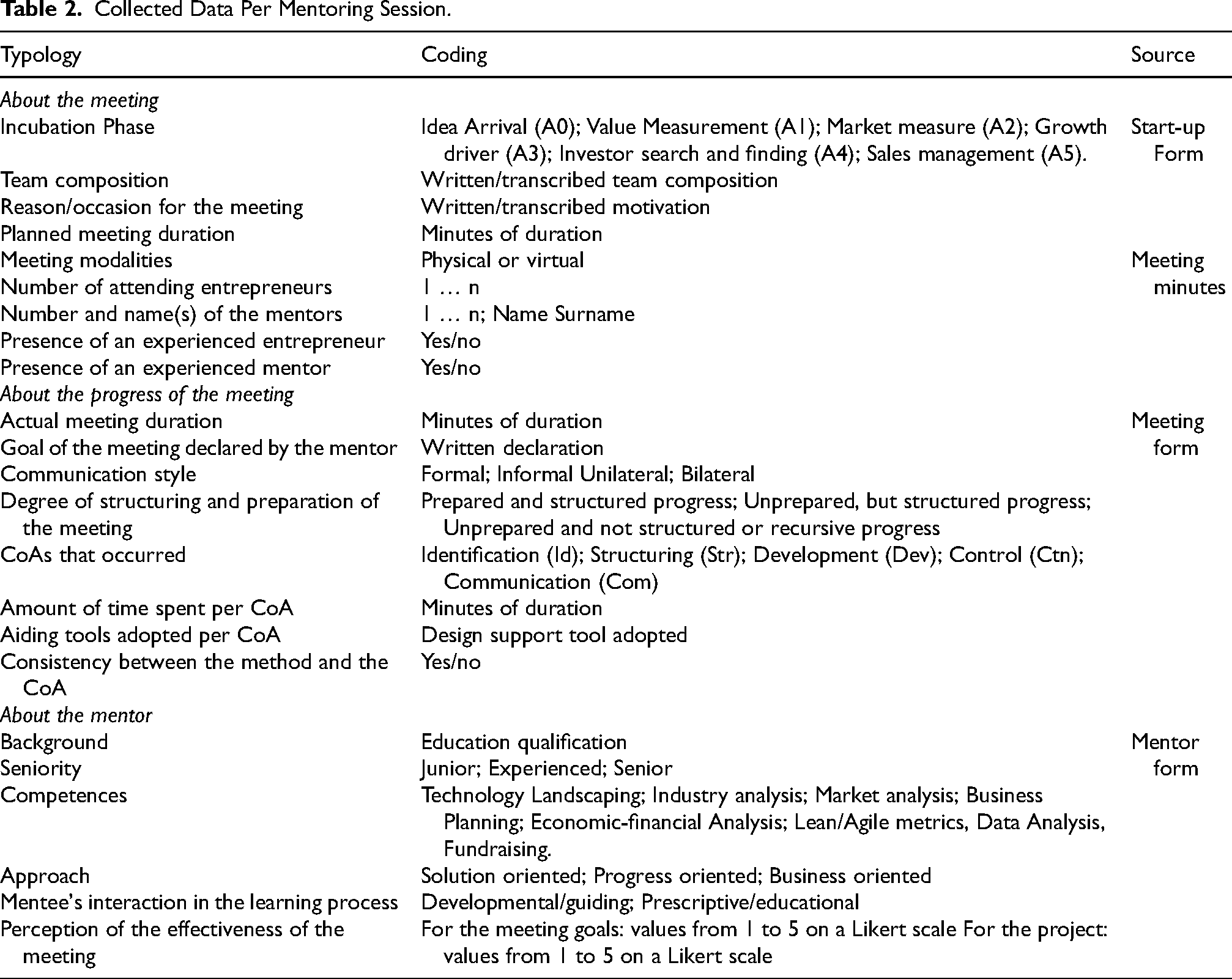
In view of the set of the variables generally suggested for protocol studies (e.g., Gero & Mc Neill, 1998; Simon & Kaplan, 1989), the data considered for each mentoring session were the ones shown in Table 2, which were collected by means of 3 Microsoft® Excel forms:
- A ‘Start-up form’which was about the composition of the team, the phase within the incubation process, the reason for the meeting, and the type of needed aid; - A ‘Meeting form’ which was used to collect qualitative (such as the incubation phase, team composition, etc.) and quantitative information (such as duration and number of participants) for each meeting. The communication style of the meetings was coded as formal vs informal, while the mentor-mentee communication was categorised as unilateral, bilateral, but led by the mentor, or fully bilateral, as suggested by Conley et al. (1995). The degree of structuring/preparation of the meetings considered whether the initial objectives were crisp and the material was ready for discussion, or instead such a discussion followed a recursive process (Jay, 1976).
Collected Data Per Mentoring Session.
The length and percentage of time spent on each CoA in each session, and the frequency and number of methods that were used were also recorded . The coding of the CoAs was performed according the guidelines provided to the analysts, which were referring to the classification in the literature (Landry et al., 1983; Mingers & Rosenhead, 2004; Norese & Ostanello, 1988), while the theoretical consistency between the used methods and CoA referred to the framework proposed in Montagna (2011) and was expressed by a Boolean variable (1 if consistent, 0 otherwise).
- A ‘mentor form’, which was used to profile the mentor's background and his/her competencies/experience, as well as to describe the focus of the mentoring activities, Which could have been solution, progress or business oriented (Rice, 2002). Moreover, the type of mentoring behaviour was coded according to the two distinct attitudes identified in the literature: developmental and prescriptive (Kullman, 1998). Finally, the evaluation of the perceived effectiveness of each mentoring session was expressed on a 1 to 5 Likert scale after checking with the mentor.
Table 2 summarises the collected data and Figure 3 relates them to each research question.
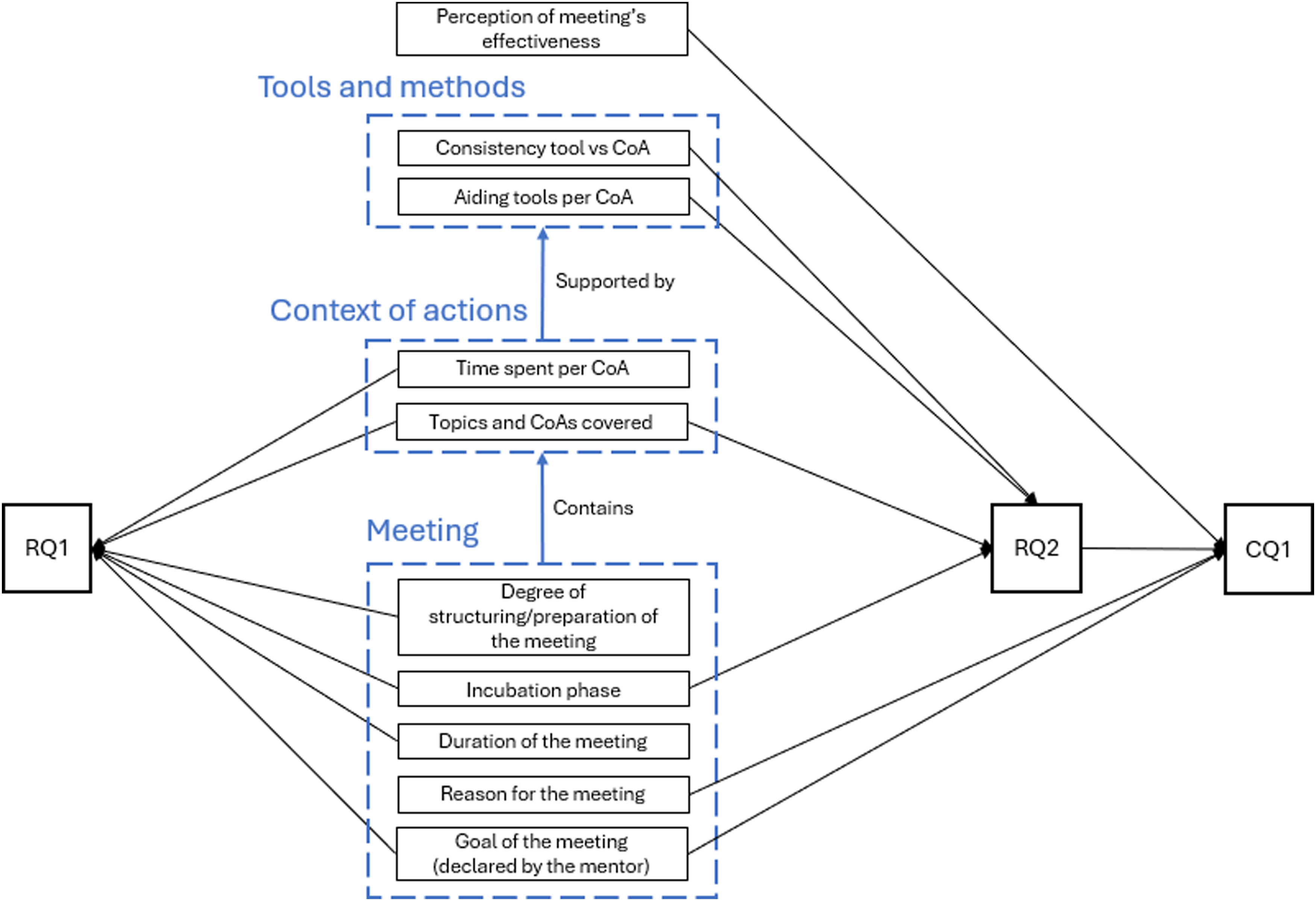
Variables observed and used per research question.
Case Study
The analysis was carried out within I3P, the start-up incubator of the Politecnico di Torino. This incubator was chosen since it is one of the main European university incubators, and was recognised as the global “best public incubator” in the 2019–2020 UBI Index. The yearly figures for 2023 reveal that over €51 million was raised in funding, with more than 900 ideas being accepted, more than 120 projects being launched, and 23 start-ups being incubated.
I3P provides mentoring on how to define a business model, how to draft business plans and how to strengthen the entrepreneurial team, as well as on promotion and networking activities with university departments, investors, and large corporations. Finally, I3P offers shared facilities, such as offices, co-working spaces, and meeting rooms. Such support, which involves tangible and intangible resources, is in line with the offer of most incubators (Samaeemofrad et al., 2016).
The incubation process in I3P mainly follows the Lean Start-up model (Ries, 2011), which is aimed at obtaining a sustainable business, and at drastically reducing the times and costs and, consequently, the possibility of late-stage failure. This organising framework encourages experimentation instead of planning, customer feedback to pure intuition, and agile and iterative design to product development. There are five main steps (Figure 4):
Idea Arrival (A0). This phase coincides with the first meetings between a mentor and entrepreneurs. The objective of the mentor is to understand the potential of the proposed idea and illustrate the services offered by the Incubator; Value Measurement (A1). This phase embodies the ‘problem-solution fit’ phase of the lean start-up methodology. Questionnaires and interviews are set, a Minimum Viable Product is developed, and market information is collected. At the end of this phase, the target of the entrepreneurial project is identified; Market measure (A2). In-depth analyses and market research are carried out in this phase. Communication plans and marketing and commercialisation strategies are also developed; Growth driver (A3). In this phase, the start-up is ready to test its initial product on the market. Data and metrics are collected to refine the business model. The start-up can decide to pivot back to the initial steps, to redefine new product characteristics and/or identify new target markets; Fundraising (A4). Using the previous metrics, the start-up can focus on looking for investors. Communication plans for crowdfunding are set up, and meetings/negotiations with professional investors are carried out. This activity does not raise any conflict of interest for mentors, as the incubator does not invest or have any privileged relationships with investors; Sales management (A5). In this phase, the start-up has already reached a greater autonomy. The activities are mainly aimed at developing and implementing a strategy for customer acquisition and a robust sales force.
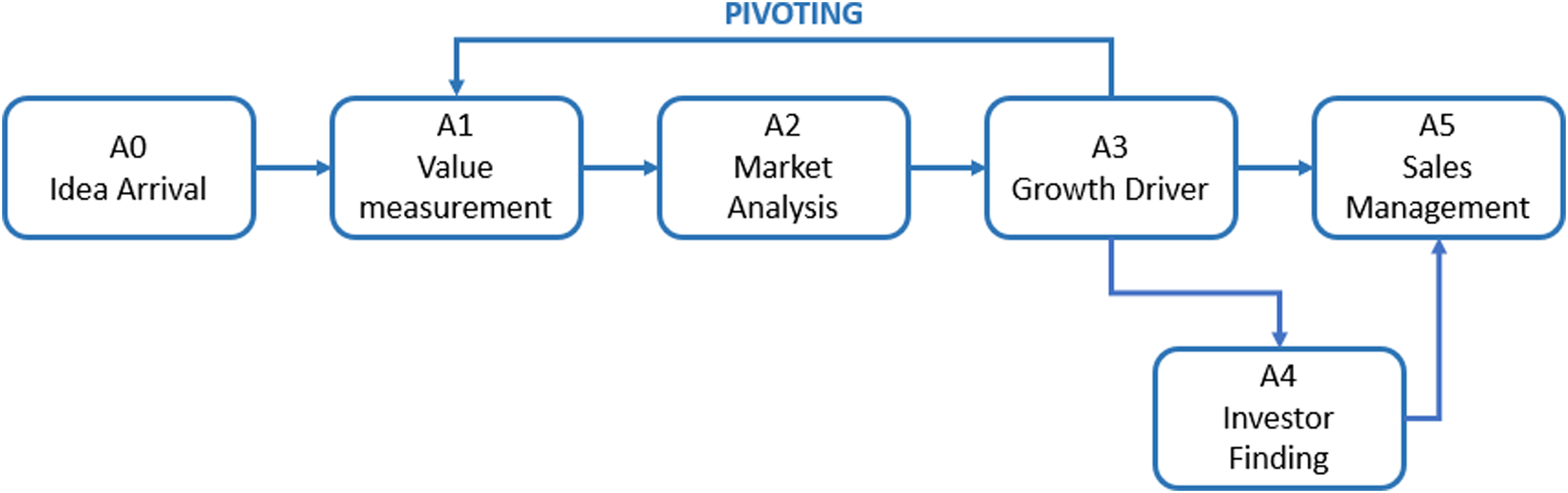
Steps of the incubation process in I3P.
Although the incubation process is formalised, the mentors in I3P do not follow standardised aiding processes, as they each have their own approach that may be based on their personal background, experience and attitude. Each mentor is responsible for supervising a number of start-ups. They do not constantly monitor/control the start-ups evolution, and only intervene at specific milestones and/or upon entrepreneurs’ request. Therefore, each meeting is closely tailored to the start-up, the problem, and the incubation step at which the meeting occurs, thereby confirming the ‘situational’ nature of mentoring.
Overall, 53 different entrepreneurial teams were followed during the study in 86 mentoring sessions. Each team attended at least one session with one or more representative, with a total of 82 entrepreneurs being involved.
Five mentors were observed at work: two ‘senior’ mentors, with many years of experience in mentoring and entrepreneurship, and three ‘junior’ mentors with specific domain competencies.
Table 3 shows some of the descriptive data of the participants.
Descriptive Data of The Participants.
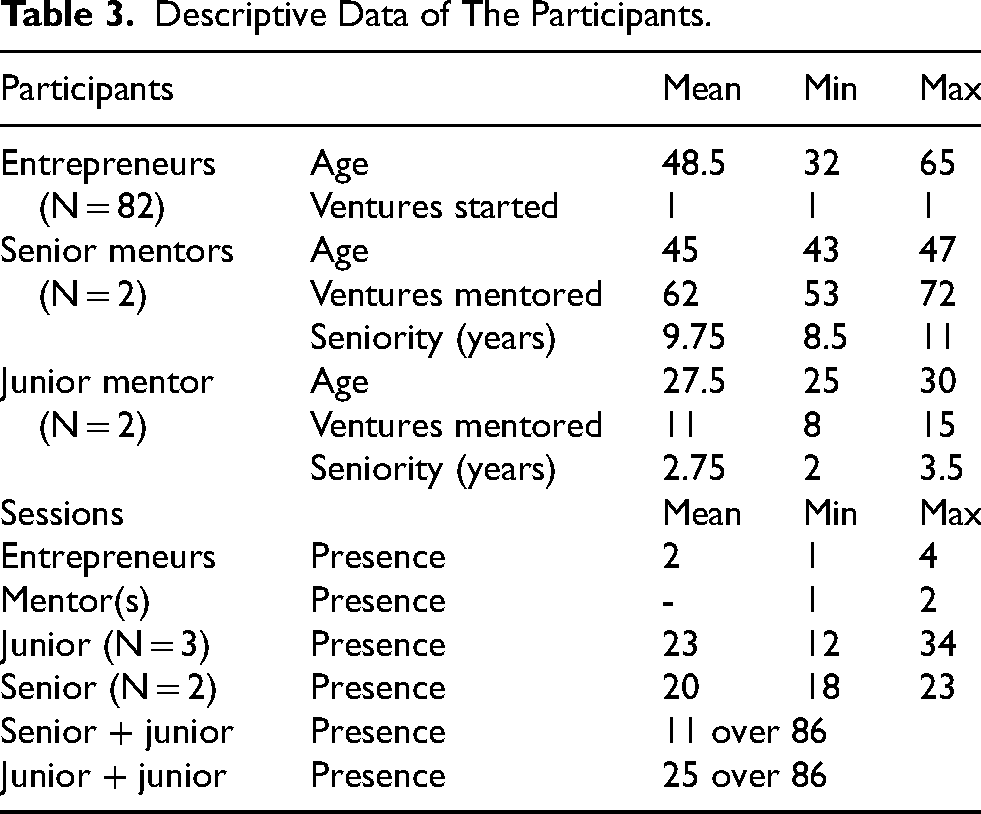
Table 4 reports the number of mentoring sessions, their average duration, and the standard deviation per step. The number of observations was homogeneous in all the incubation phases, except for the phase preceding the exiting of the program (A5), where no records were registered. Therefore, A5 is excluded from the following analyses. On average, the A0-A4 sessions lasted 50 min, while the A3 sessions were the most time-demanding.
Number of Sessions and Duration Per Incubation Phase.

Results
The CoAs Adopted in The Mentoring Process
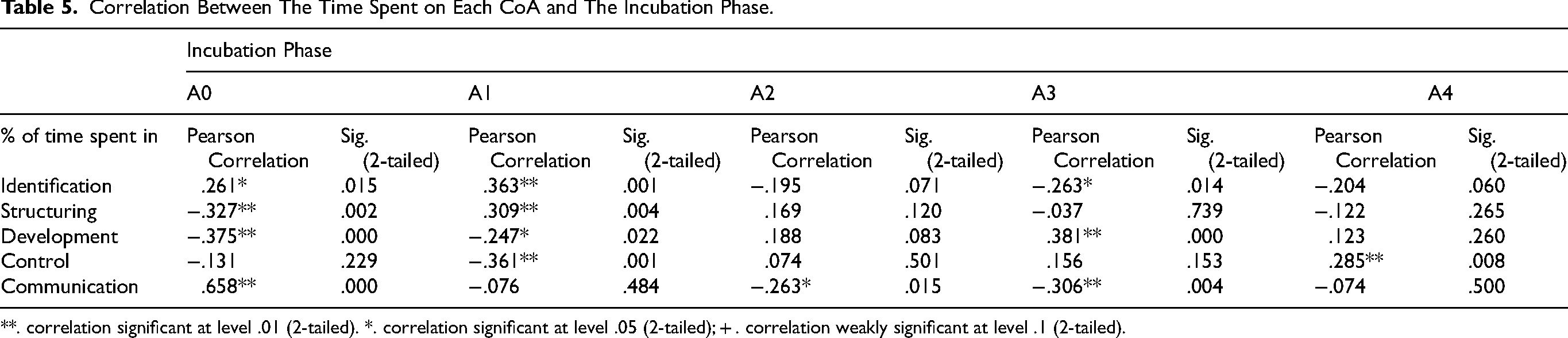
Observing the time spent on the different CoAs helps to identify the predominant CoAs in the different incubation phases. Figure 5 presents the time dedicated per session (in percentage terms in the left-hand panel, in minutes on the right), and shows that all the CoAs were present in each step of the incubation process. Table 5 presents the correlation between the time spent on each CoA and each phase of the process, from the ‘Idea Arrival’ (A0) to the search for investors (A4).
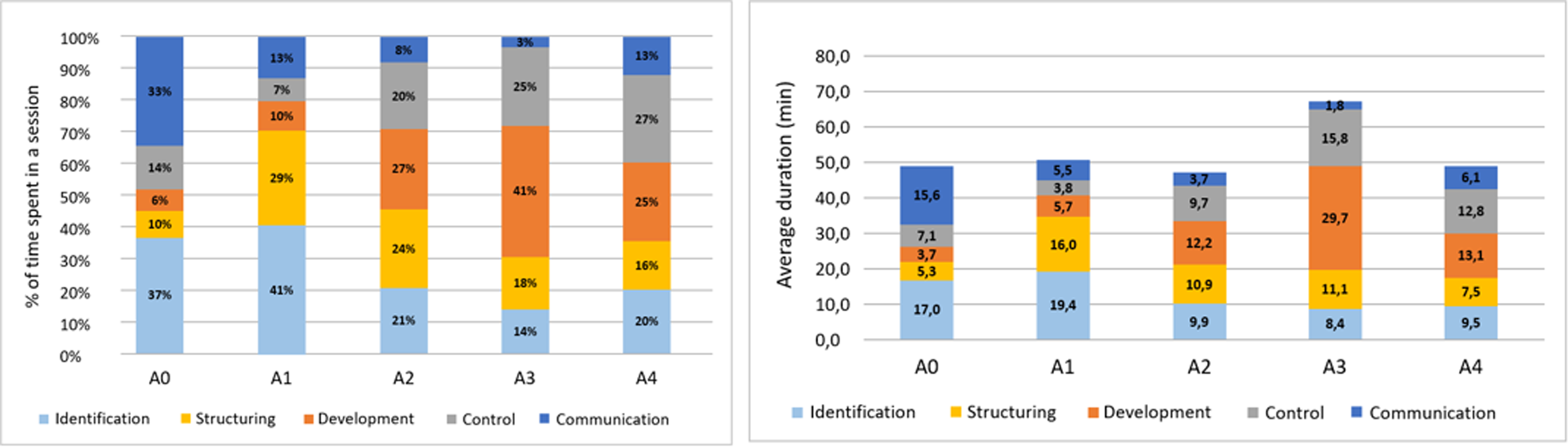
Time spent per coa in each process phase expressed in % (a) and absolute values (b).
Correlation Between The Time Spent on Each CoA and The Incubation Phase.
**. correlation significant at level .01 (2-tailed). *. correlation significant at level .05 (2-tailed); + . correlation weakly significant at level .1 (2-tailed).
Identification activities are predominant in A0 and A1, when information on a business proposal was collected at the beginning of the process, and the Minimum Viable Product started to be developed. Table 5 confirms this evidence and shows a significant positive correlation between the time spent on Identification in A0 (ρ = 0.261) and A1 (ρ = 0.363), while it becomes negative in the remaining phases of the process. The Communication CoA also appears to be relevant in A0 (ρ = 0.658), while its role progressively decreases throughout the process.
Structuring is dominant in A1 and A2. The correlation in A1 is highly significant and positive (ρ = 0.309); while the importance of the Structuring CoA in A2 is comparable with the Development one, even though it is not generalisable. This finding likely derives from the iterative development (between A1 and A2) of the partial versions of the value proposition of the start-ups, which is typical of the Lean Start-up methodology. At the same time, this could also embody a flaw, since extra time is spent on problem structuring before moving on to the development of a solution.
The Development and Control CoAs result to be dominant as the incubation process progresses, when the activities of convergent thinking or solution development prevail. Development, in particular, prevails when metrics and indicators have to be designed to drive the strategy, in the growth phase of the start-up (A3). The positive and highly significant correlation shown in Table 5 (ρ = 0.381) should be interpreted in this sense.
The final steps of incubation are characterised by the Control CoA. The correlation between the time spent on Control in phase A1 is negative and significant (ρ = −0.361), while it progressively acquires a role, especially in A4 (ρ = 0.285), where it is essential to monitor investors’ research activities.
Methods and Tools Used to Support Incubation
The frequency of use and the number of tools employed for each CoA and in each step of the incubation process are depicted in Figure 6 for the tools adopted by mentors during the sessions.
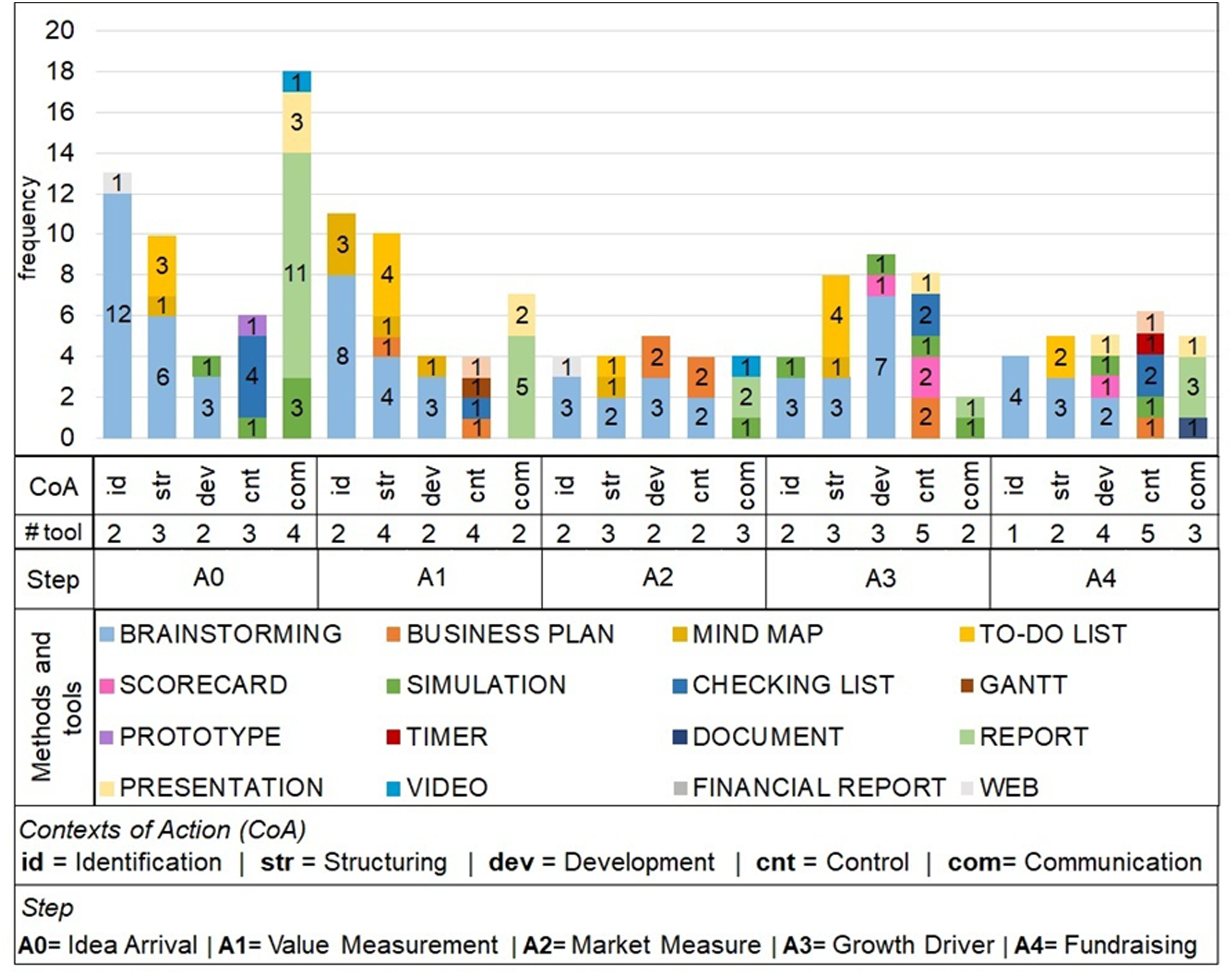
Frequency of use and number of tools employed in incubation phases.
As can be seen in the figure, the CoA most frequently supported by a tool/method is Communication, while Control is the one in which the greatest variety of tools is employed. Very few methods are used in Structuring and Identification. Nevertheless, the prevalence of the methods in Control is coherent with the Lean methodology, which usually suggests dwelling less on business model formulation to reach customer validation as soon as possible.
Looking at the variety of methods/tools employed in each step, it is possible to observe that multiple methods/tools are often used to support the same step, rather than relying on a single one. In some cases, these are used in the CoAs for which they are theoretically appropriate, but a method/tool that is expected to be appropriate for a specific CoA is also often applied for other purposes. The business plan and canvas, for instance, are suitable for the Structuring and Development CoAs and, in fact, they were used in A1 and A2, when all the information required to elaborate a sales strategy and financial plans had to be framed. Brainstorming, instead, which is a method that is typically used to generate ideas, and is hence a proper Development tool, is also broadly applied for Identification and Structuring. However, it has sometimes been replaced by other tools in the Development CoA, such as Mind Maps in A1. Similarly, Identification tools are used in Structuring (e.g., To-do lists are used in A0 to structure the project plan), while Communication has been aided by Control tools (e.g., checking lists in A0).
It can be observed that the consistent use of a method/tool for the aid activity for which it was designed clearly influences the effectiveness of a meeting. It is not uncommon for brainstorming to be used more for “chatting in long sessions without a result” than for generating alternatives following its rigorous procedure.
This is why the perceived effectiveness of each session of the study was also investigated.
Coa Adoption and The Perceived Effectiveness of Mentoring
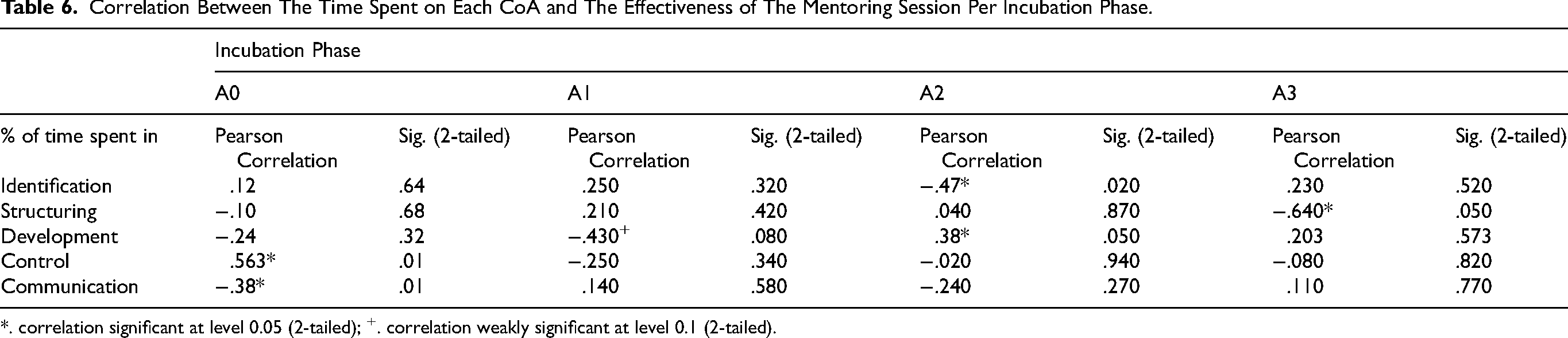
The possible influence of the methodology on the perceived mentoring effectiveness can be detected by examining the correlation between the percentage of time spent on each CoA and the perceived positive outcome of the session (Table 6).
Correlation Between The Time Spent on Each CoA and The Effectiveness of The Mentoring Session Per Incubation Phase.
*. correlation significant at level 0.05 (2-tailed); +. correlation weakly significant at level 0.1 (2-tailed).
Starting from A0, where the first meeting between the mentor and the entrepreneurial group occurs, the perceived effectiveness of the meeting increases for the time spent on control activities (ρ = 0.563), while it decreases for time spent on Communication (ρ = −0.38).
The Control activities, at this stage of the process, consist of discussing issues with entrepreneurs in order to validate their business idea, understand the aid they require, the adequacy of the team composition, etc. Consistently, Communication mainly embodies the description of the business idea and of the services offered by I3P. Evidence suggests that mentors perceive a higher degree of effectiveness for meetings that are dedicated to Control in A0, while less value was perceived when slipping towards descriptive chatter.
Table 6 shows a weakly significant negative correlation between the perceived effectiveness of the session and the time spent on Development (p = −0.43) for A1, where the value of the proposed idea is assessed and the potential target market is identified. A non-significant positive impact of Identification and Structuring can also be observed.
Here, Identification mainly concerns the collection of information related to the business proposal to identify the possible strategies, to define the pros/cons of possible decisions (e.g., about partners, market positioning, commercial channels), etc.; while Structuring is dedicated to placing such information in an appropriate framework. Development instead focuses on conceptualising the business model.
The obtained evidence confirms, albeit only for the recorded sessions, given their non-generalisable significance, the preparatory role of the conception of Identification and Structuring, in line with what the Decision Making theory assigns to these CoAs. The negative correlation of the time spent on Development instead tells us that the mentors, after collecting the maximum amount of information, perceive a higher effectiveness for moving quickly from the ‘Minimum Viable Product’ to its validation. This evidence is again in line with the adoption of the Lean methodology by I3P.
The analysis reveals a negative correlation between the perceived effectiveness and the time spent on Identification (ρ = −0.47) in A2, but a positive correlation with the time spent on Development (ρ = 0.38).
At this stage of the process, more in-depth market research is carried out, communication plans and marketing/sales strategies are drawn up and contracts with potential customers, suppliers and partners are defined. It is, therefore, reasonable to assume that a more pragmatic approach (which involved stopping looking for information and/or spending time on discussing) was perceived to have a positive effect on the mentoring session.
The market metrics and indicators for monitoring product sales are processed in A3. The obtained evidence confirms an expectable negative correlation between the perceived effectiveness and the time spent on Structuring. The entrepreneurial team is in fact mainly aided for go-to-market actions, where there is no longer any time for framing information or conceiving alternatives.
Finally, the perceived effectiveness of the mentoring sessions was also investigated in view of the adopted methods/tools (i.e., the theoretical coherence between a tool and CoA). Unfortunately, no relevant information could be deduced, due to the insufficient number of observed sessions, apart from a robust confirmation: when tools/methods are adopted consistently with CoAs (e.g., an identification tool is used in an Identification CoA), meetings are perceived as being more effective.
Discussion
Our findings confirm in start-up business mentoring, the presence of the expected CoAs as they are described in the Decision Aiding literature (Mingers & Rosenhead, 2004; Mintzberg et al., 1976; Norese & Ostanello, 1988), especially for design processes (Montagna, 2011). When progressing along the incubation process, there is a clear evolution of the roles and interplay of the different CoAs, from Identification and Communication to Development and Control. Structuring is quite evenly distributed throughout the incubation process.
The findings also allow the approach adopted in the incubator to be highlighted. Indeed, our evidence shows that the collection of a substantial amount of ex-ante information allows mentors to spend relatively less time on Development, in accordance with the inherent iterative nature of the Lean start-up approach. This is particularly true in the early phase of the incubation, when a deep understanding of the problem and context allows to define a more solid start-up tailored framework. In fact, during the phases of ‘Idea Arrival’ and ‘Value Measurement’, the activities of gathering data to recognise and correctly frame the problem are imperative for an agile and effective generation of alternatives, as well as possible pivot decisions in the following stages.
Moreover, although not generalisable, the collected evidence allows some preliminary considerations to be drawn about the use of tools and methods within the incubation process. Consistently with what is described in the literature (Montagna, 2011; Norese & Ostanello, 1988) and with the impossibility of using standardised recipes, it can be observed that each step of incubation can be supported by several methods/tools and that, at the same time, a method or tool that is theoretically more appropriate to one specific CoA can also be applied within other CoAs. However, when a tool is used appropriately for its specific purpose and its CoA, the perceived effectiveness of a meeting increases. It is therefore advisable for mentors to foster the use of tools/methods that are appropriate for the specific task in the step they are engaged in, but, at the same time, the ability to adapt and effectively use tools for different purposes may be desired to provide a more valuable support, as the success of a task is not contingent on the tool selection.
It is worth to mention a few divergences in the role of a mentor in an incubator compared to the ones played by facilitators into traditional design and decision-making processes. Individuals who aid decision making, whose appellations range from facilitator to consultant to interventionist, also embracing technical adviser or chauffeur (Ackermann, 1996), are meant to enhance decisions without affecting the content of those decisions (Schein, 1969). In the case of incubation processes, that paradox of facilitation (Griffith et al., 1998) is less remarkable, as giving advice and imparting knowledge are key aspects in assisting entrepreneurs (Warren et al., 2009; the ‘expertise power’ of facilitators, Griffith et al., 1998). Moreover, in incubators, the cognitive phenomena proper of Design (Simon, 1960) occur to a more comprehensive exploration of a business model rather than the definition of a product/service. Indeed, the balance between convergent and divergent processes within incubation differs in relevance and weight compared to the ones in design processes. Convergent analysis and evaluation processes (e.g., sustainability, economic assessments) in fact represent a major and continuous validation of possible alternatives, and not merely a constraint or a requirement to address.
Conclusions
This paper analyses mentoring aid in those decision processes that underpin the development of start-ups in business incubators. Methodologically, the paper assumes a parallelism between incubation and design processes, as well as between mentoring and Decision Aiding. Accordingly, mentors are viewed as decision aiding actors who operate within Contexts of Action and adopt more or less appropriate tools to aid business model design activities.
In this sense, this paper enriches the literature of reference, which usually focuses on the general outcomes of incubation activities, or on the skills or styles that mentors should have, and discusses the aiding activities offered by incubators to a lesser extent. The paper complements the work of Samaeemofrad et al. (2016), but also considers decisional aspects, as suggested by Cunningham and Menter (2020).
A protocol analysis was applied to a somewhat relevant number of sessions with entrepreneurial teams at the Incubator of the Politecnico di Torino, and this allowed a deep understanding of the structure of the mentoring activities and the appropriateness of the tools used in each phase of the incubation process to be obtained.
Although time consuming and labour intensive (as mentioned by Todd & Benbasat, 1987), such a fine-grained analysis could complement interviews or questionnaires (Alsaawi, 2014; Elliot & Timulak, 2005) and be suitable for preliminary steps of a research program (as in the case of this paper). The Decision Aiding perspective, in turn, provided an appropriate conceptual backbone to the protocol analysis and, consequently, allowed the micro-perspective suggested by Cunningham and Menter (2020) to be reached and the adopted methods to be focused on, as pointed out by Bergek & Norrman (2015).
The evidence on these latter aspects was obtained thanks to the reference to CoAs as the ‘unit of analysis’. Investigating the adopted tools/methods, as well as the time spent on each CoA, in fact offered a completely new viewpoint on the aiding actions involved in mentoring, which allowed us to grasp the dynamic nature of mentoring and capture how sessions change throughout an incubation process.
The reference to CoAs as unit of analysis was enabled by the methodological parallelism between design and decision-making vs incubation (the design of a business model), or between mentoring and decision aiding, which lies at the core of the study. This perspective might be questioned, especially when the main reason why start-up entrepreneurs choose an incubation program is other than being aided in the business model design, but rather networking, access to resources, etc. In those situations, the design/exploration activity is ancillary to the focus, and therefore the parallelism with a design process may become less valuable in describing the process.
However, the main academic contribution of the study pertains to the proposal of an interdisciplinary research approach that can be used to study the development of start-ups through the interactions that entrepreneurs have with other subjects.
From a practitioner's perspective, the results of this paper lead to interesting and easily shared insights on the way business mentoring is performed. The analysis was not aimed at being prescriptive (e.g., at the preference of entrepreneurial teams for the attitude of one mentor rather than that of another), but at being a source of reflection for incubator managers concerning possible improvements in mentoring approaches and resource provisions. Each incubation and mentoring process in fact is unique because, in addition to the dynamics of the specific activities taking place, there is the uniqueness of the team being supported. A greater awareness of the aiding process in mentoring could thus foster a more-focused preparation of mentors, about the type of intervention to ensure and the tools to be used. Accordingly, a structured and effective method to formalise the study of mentoring processes has been proposed, to ultimately enable business incubators to optimise their organisational structure and take more efficient actions. Such a research methodology could be transformed, for instance, into a set of tools that incubator managers (or the mentors themselves) could use to systematically monitor mentoring processes and/or to train professionals that do not have any prior experience of such a specific job.
Despite the Lean start-ups methodology adopted in I3P is employed in most incubators to stimulate the growth of start-ups, in some contexts approaches of different nature might be more suitable and the concept of minimal viable product can sometimes be too limiting and represent a source of later failures. Future studies could consider these aspects.
Footnotes

Funding
The authors disclosed receipt of the following financial support for the research, authorship, and/or publication of this article: This publication is part of the project PNRR-NGEU which has received funding from the MUR – DM 118/2023.
Declaration of Conflicting Interests
The authors declared no potential conflicts of interest with respect to the research, authorship, and/or publication of this article.