







Abstract
The essence and vital roots of scientific activities create theoretical propositions and models that provide unique integrity of the associated concepts, definitions, approaches and methodological components. Design engineering education has made great progress to date by integrating modern methods and tools into the existing process models focused on unique curriculum programs for students’ progress during various scientific and technical levels. Contemporary and integrated socio-scientific environments, however, are generally more productive and initiative for future success stories of engineering graduates with high qualifications and science/technology-motivated professional life. Today's global transition from the “industrial-digital age” to the “sustainable knowledge economy and digital society” opens a new path for design engineering education, enforcing a paradigm shift towards training creative professionals who develop and implement new knowledge in real-world social environments. This paper presents and discusses the models, methods and tools to establish a road-map into next-generation creative design engineering education paradigm.
Introduction
It is generally accepted that five historical industrial revolutions initiated and forced technological changes and associated developments on the global society. Five phases of the socio-economic characteristics are identified by welfare levels significantly. (Ziatdinov et al., 2024) and explained by the “Industry 1.0–5.0” and “Society 1.0–5.0” models reflecting technology-based transformation on the evolution of production and society. The former is the evolution of production techniques and factories, starting with the mechanization through steam power (1.0), electricity (2.0), automation (3.0), cyber-physical systems (4.0), and finally, human-centered, sustainable, and durable production (5.0). The latter is the societial transition from anthropological periods (hunter-gatherer) (1.0), agriculture (2.0), industrialization (3.0), information society (4.0), and today's super-smart, human-centered society (5.0) with cyber-physical/spatial integration (Huang et al., 2022).The current Society 5.0 paradigm (Fukuyama, 2018), with its human-centered perspective, is a well-identified step as compared to the previous phases in technological levels. Society 3.0 (Industrial Society) and Society 4.0 (Information Society) imply socio-economic development from “scale and efficiency” perspective. Their development and surveillance are mainly based on “mass production” and “consumption” issues. Society 5.0, on the other hand, focuses on initiating needs and associated values instead of efficiency, through creative products/services provided by the digital technology and new scientific achievements in artificial intelligence, human-computer interfacing, biotechnology, data science and quantum computing. While “single type” and “at certain time” lifestyle and service were accepted in the previous phases, Society 5.0 focuses on a heavily personalized lifestyle and maintained service independent of time and space. As this trend continues, differentiation among the individuals and societies will be even clearer. Society5.0 will eventually emphasize the power of information, spread over the daily lives of covered societal segments and members. As another distinguishing characteristic; Society 5.0 aims inherently to eliminate permanent environmental damage observed during the previous social phases by changing production and service delivery paradigms (Bartoloni et al., 2022). Unlike the information society, it is envisaged that with sustainable energy sources and need-oriented product/service delivery, excessive consumption of resources will be reduced and minimized, generating a sustainable environment and integrated society in harmony with nature (Keidanren, 2018).
Society 5.0 focuses mainly on the connection of the physical world (earth) with the cyber world, emerges as a new paradigm that places individuals at the center of innovation. This new and human-centered society model, suggested by the concept of Society 5.0, focuses heavily on solving social problems (Narvaez Rojas et al., 2021; Rosenstand et al., 2023). It is highly focused and implemented to develop such solutions and design systems by integrating cyberspace and physical spaces (Bartoloni et al., 2022). Huang et al. (2022) draws attention to the four-dimensional re-structuring of Society 5.0 as (i) goal, (ii) value, (iii) organization, and (iv) technology. The goal of Society 5.0 is to build a society that is (a) shared and accessible by everyone, (b) human- and/or nature-centered, (c) super-smart, and (d) lean. In the value dimension, it addresses the entire life cycle of the product/service, including innovative R&D and efficient production, as well as personalized service, recycling, etc.; even more value-added processes are created in natural flow of the life cycle. In the organization dimension, industrial institutions continue to serve as important and active components for the society; however, in addition, Society 5.0 will also create more wealthy life by using personalized service systems, intelligent transportation system, intelligent production system, etc. by combining cyberspace and physical space (Horváth & Erden, 2024) to solve problems effectively as a “system of systems”. In terms of technology, Society 5.0 is observed to be affected deeply by and to be shaped with the new technologies, such as next-generation wireless networks, big data, artificial intelligence, digital twin, robots and human-robot interaction. The new structure of any contemporary industry or even the connected new society will benefit from the digitalization and intellectualization trend driven by the introduced novel technologies.
The four-dimensional structure of the novel society is directly related to the design engineering which has been continuously evolved along with the (a) developments in science and technology, (b) varying human and social needs, and (c) workforce dynamics over socialization. Design engineering education has evolved in all phases depending on social, technological and economic formations. Engineering students focus on pre-defined curriculum programs, resulting in specialization in various narrow fields. Contemporary and integrated scientific environments, on the other hand, are generally more productive and creative, aiming to develop novel products for the society. Society 5.0 creates an increasing and overwriting need for engineers to design systems that are not only technically efficient but also socially and environmentally responsible. There is an increasing and overwriting need for engineers to design systems that are not only technically efficient but also socially and environmentally responsible. However, engineering education in general and design engineering education in particular may contain barriers that may prevent the development of such systems; at both system and application levels. Society 5.0 reveals the fact that engineering education as a whole and design engineering education in particular are at an important junction for a paradigm shift suitable for a novel socio-economic structure.
The evolution of engineering education should embrace interdisciplinary learning, practical experience, and ethical considerations to train creative engineers capable of designing intelligent systems that serve humanity and the environment. Today's global transition from the “industrial-digital age” to the “sustainable knowledge economy and digital society” opens a new path for design education in engineering and necessitates a paradigm shift towards educating creative professionals who develop and apply new knowledge in real-world social environments. This article presents and discusses models, methods, and tools to create a roadmap for the next generation creative design engineering education paradigm with the following research questions:
What are the required competencies in engineering design for smart societies? What methods are used for these competencies be imparted in engineering education? How can these methods be embedded into a structured plan for design engineering education?
The remaining sections of this article are organized as follows: Section 2 presents a literature survey on design engineering education for Society 5.0 by emphasizing essential competencies, pedagogical strategies and barriers to change. Section 3 presents a new path for design engineering education. Chapter 4 introduces a methodological approach for creative design engineering education. Chapter 5 proposes a structured plan for creative design engineering education. Chapter 6 introduces case studies as pilot experiments to implement the suggested plan. Finally, Chapter 7 gives the conclusions with authors’ contribution and recommended actions for the future of design engineering education.
Design Engineering Education
An Overview
Three of the five major changes observed in engineering education during the recent 100 years are still developing and it is difficult to predict their long-term outcomes and effects (Froyd et al., 2012). These are (i) the shift to emphasize engineering design; (ii) the shift to apply research results from education, learning, and social and behavioral sciences; and (iii) the shift to integrate information, computing, and communication technology in education. These three changes are closely related to the concept of “Education 4.0” (Miranda et al., 2021), which enables educators and students to use modern infrastructure and emerging technologies to improve higher education practices. Pedagogical approaches are also reorienting their paradigms towards innovation in education to meet the needs of an ever-changing technological society. Design engineering education has also evolved through various stages, influenced by changing technology and workforce dynamics (Broo et al., 2022), as the increasing social responsibilities of engineers increase. During the infant stage after the first industrial revolution, design engineering educationhas been generally limited to technical knowledge and manual skills, focused on production processes, functionality, efficiency, and material use. There was no interdisciplinary approach and engineering students were mostly trained in workshops with hand-made models. In the early twentieth century, scientific and mathematical foundations developed in engineering. Systematic and computational engineering design solutions resulted in shifting design engineering education to more abstract areas. During this period, design engineering activities focused more on theoretical issues, still keeping the focus on functionality and production. What appears new was more laboratory work, experimental methodologies, and technology-oriented courses. From the 1950s to the end of the 1980s, a new dimension was added to design engineering education with the rapid development of computer technologies, resulted in using CAD and CAM technology (Adediran et al., 2024). Digital tools enhanced design engineering by sppeding up virtual prototyping. In the 1990s, as engineering design processes evolved to be increasingly complex, concepts such as “systems engineering” and “integration” were introduced. During this period, engineers had to focus not only designing a physical product, but also all system interactions throughout the whole design process. System-oriented thinking (Costa Junior et al., 2018), project-based learning, and multidisciplinary approaches (Say et al., 2022) became important drivers of design engineering education. Concurrently, design engineering education began to focus not only on traditional factors such as functionality and manufacturability, but also on elements such as user experience (UX), aesthetics and innovation. Concepts such as user-centered design and design-oriented thinking (Design Thinking) were widely accepted in engineering education (Au & Goonetilleke, 2025). Students were equipped with not only technical skills but also creative thinking and problem-solving skills. Design engineering education focused on practices such as understanding user needs, creating prototypes, receiving feedback and continuous development.
Design engineering education is still reshaping by the influence of digital transformation and Industry 4.0. Areas such as smart products, artificial intelligence, the internet of things (IoT), robotics and sustainability have become fundamental components of the design processes. Students no longer just learn to design, but also gain the ability to optimize design processes with advanced technologies such as digital twins, artificial intelligence-supported design, data analysis and machine learning. In addition, social responsibilities such as minimizing environmental impacts, sustainability and ethical values are considered to be significant issues in design engineering education (Byrne, 2012; Narong & Hallinger, 2024).
Despite the significant developments with the social, technological and economic changes, design engineering education still focuses on methodological problem solving based on technical competence, while paying insufficient attention to the broader effects on society and nature. The Society 5.0 model, which aims to transform technology into a human-centered quality of life, requires new competencies and pedagogical strategies in design engineering education.
Essential Competencies
The current level of technology affects the societial needs and expectations along a new direction since people directly interact with technology. Engineering is no longer only a unique platform “for humans”, but “human-focused” and “human-driven”. Thus, engineering education needs a new path along this direction with the following questions; (1) What abilities and skills are needed for a human-focused engineering education? (2) What are methods and techniques acquisition of these skills? With the level it has reached today, technology has made it easy and fast for students, as well as everyone else, to access and use information. Education in general, and engineering design education in particular, it is seen that the current paradigm based on the transfer and use of information within the classical teacher-learner relationship has modified and changed significantly. With the development of technology and especially with the impact of the COVID-19 pandemic, increasing distance education opportunities now enable educational processes that are not limited to the physical environment of the classrooms. Physical environments such as classrooms and laboratories are still meaningful and important in the acquisition, internalization and application of many professional skills are considered, seriously. However, we are now at the stage of redefining learning-teaching processes according to the needs of today's technology and the future expectations. The teacher is no longer the one who transfers knowledge, but rather a guide for the development of the student's abilities. Research shows that effective experiences before university form the basis of the development of self-efficacy in engineering. (Power et al., 2025). An educational model is needed in which the initiative to seek solutions for engineering problems, find solutions and apply the found solutions is based on the unity of the teacher and the learner (dos Santos et al., 2021). The impact of digital transformation, which is important in structuring such a model, emerges in three areas related to the content of engineering education and/or the pedagogical approaches applied (Gumaelius et al., 2024); (1) the differences between the place of digital information in society and its impact on engineering education; universities are rarely seen as the driving force of digital innovation (2) continuous training of senior faculty in engineering education targeting digital transformation and (3) universities provide more focus and dedicated time for the development of engineering education. Teaching methods to be shaped within the framework of social digital transformation should go beyond merely transferring knowledge and should also support skills and abilities to be acquired through practical application. Engineering design requires knowledge and skills such as (1) Creativity and Innovation, (2) Systems Thinking and Interdisciplinary Learning, (3) Human-Centered Design, (4) Sustainability and Ethical Considerations and (5) Communication and Collaboration Skills, which should be taught both conceptually and philosophically and experienced practically.
Creativity and Innovation
Creativity in design engineering is the whole of the processes in which a set of “unpredetermined” system components are imagined by designers, created and defined in full detail to fulfill the necessary function(s) to meet (a) “predetermined” need(s). In engineering creativity, the basic engineering education and experience of the design engineer are important and determining factors for original and successful products. The product of the engineering creativity process is the definition of a real and physically applicable system, machine, tool or object. This definition can be a simple or complex draft image within the applicable engineering rules and methods to make a first step. The credibility of design creativity at the investor and user/consumer levels before production is an important but risky responsibility in terms of design engineering. Engineers generally prefer to design known products and systems to meet known needs without taking unknown risks. In order to reduce the design success risks in creative design engineering education, the approach of encouraging “failure as learning” is gaining importance (Henriksen et al., 2021). Productive failure can be effective in developing creative process skills and students’ entrepreneurial ideas by reinforcing the idea that creative outputs are rarely useful in the first experience (Kapur, 2015). This pedagogical approach (fear and hesitation) can be supported by digital technologies to control and manage failure during the design experiments in education process. Students’ fear and avoidance of failure is not ignored. However, when integrated into the education process in a controlled manner and supported by digital tools that allow new design ideas to be experienced, it can become productive and efficient (Lee & Chen, 2015). Learning from failure can be internalized by applying teaching, learning and assessment principles that will encourage design innovation and risk-taking (Simpson et al., 2018).
Systems Thinking and Interdisciplinary Learning
Cases where engineering creativity is limited and remains within a predetermined (engineering) discipline topic wise creates significant disadvantages and distances the design engineer from original designs that are open to future developments. Original products that have superior and unique features, and different from existing product experiences, it is necessary to benefit from the contents and experiences of ‘Multi-Disciplinary’ or ‘Interdisciplinary Design’ approaches. It is important to apply approaches and methods compatible with these definitions, for original product designs. The holistic approach of considering all components of engineering solutions interacting with each other; emphasizing the connection of these solutions not only from a technological perspective, but also from a social, economic, environmental and human factors forms the basis of the system approach. In this approach, the problem is not addressed only within itself, but within the entire system, and the design of subsystems is carried out from this perspective. Input-process-function-output models and feedback-based improvements are the characteristics of the approach. In these cases, responsibilities and functions of the design engineer should be to maintain communication between various disciplines, to transfer knowledge and experience, and to integrate different disciplines at the system level. In order to gain a holistic perspective, students in engineering design education should be encouraged to collaborate across disciplines (e.g., environmental science, ethics, economics, design, etc.) to develop comprehensive solutions. In creative design, system-level components can be in different configurations (compositions). This makes conceptual design more flexible, but can optionally increase the number and qualities of design alternatives. It is possible to end engineering creativity within an engineering discipline. However, multidisciplinary and interdisciplinary product design approaches have been developed and spread over in the natural scientific development process, with the opportunity to create widespread and different options for the product in the design processes in different technologies. This change has resulted in significant consequences in engineering creativity, and radical changes and creative renewal phenomena have been observed at the process and/or product levels.
Human-Centered Design
Engineers develop artificial products and systems that will provide future solutions to various current problems that have significant socio-technical challenges. The holistic approach addresses all components of engineering solutions in interaction with each other; emphasizing the connection of these solutions not only from technological perspective, but also from social, economic, environmental and human factors; forming the basis of the system approach. In this approach, the problem is not addressed only within itself but also within the entire system, and the design of subsystems is carried out from this perspective. Input-function-output models and feedback-based improvements are the characteristics of the approach. Human-centered design, as it is widespread recently, allows engineers to develop a comprehensive understanding of socio-technical features and reflect them in their design engineering activities. This approach requires collaboration with users and leads the inclusion of training methods and tools that will enable engineering students to develop experiences in their design education. Need for effective human-centered design strategies provide collaborative experiences for students to prioritize user needs, experiences, and accessibility in the design process and develop user empathy (Sanders et al., 2024; Shehab et al., 2025; Wallisch et al., 2021). It is of great importance that user experience is supported by social science-based approaches that lead to understanding people and society, such as psychology and sociology, as integrated into the design education.
Sustainability and Ethical Considerations
Sustainability receives more attention in engineering education, both conceptually and in practice, in terms of design activities and their widespread results, conservation of resources and assessment of environmental impacts, in extended area of human. It is a necessity to create a sustainable and ethical framework for design education, considering the long-term effects of the outputs and results of the engineering design process on the global society and the planet. Regulations and accreditation criteria are prominent needs for defining engineering competencies related to sustainability and developing various teaching methods related to them, and providing sustainability learning outcomes in line with changing industry norms (Narong & Hallinger, 2024). In addition, an increasing focus on the practice of Industry 4.0 technologies as a flexible approach to achieve sustainability issues, and a sustainable curriculum change is necessary to transform engineering education towards including sustainability successfully.
Engineering design approaches that emphasize social sustainability within the framework of environmental as well as ethical principles after the influence and impact of digital technologies in society also affect educational processes and activities in design field. However, some difficulties are observed in this respect, and research observations indicate that it is difficult to convey the significance of ethical issues to unaware students (Vilaza & Bækgaard, 2022). Therefore, it is concluded that more emphasis should be placed on basic professional philosophy education in engineering.
Communication and Collaboration Skills
Public policy activities for engineering design decisions lead the infrastructure of mechanisms for incorporating social criteria into design education are classified under the following headings (Hyman, 2003); (1) Regulations and standards, (2) Technology innovation policy, (3) Research and development, (4) Procurement, (5) Incentives and subsidies, (6) Analysis and dissemination of technical information and (7) Regulating the practice of engineering. These activities are carried out efficiently and successfully by establishing effective communication channels between engineers, designers, social scientists, policy makers and the public. New areas of collaboration are necessary between teams and disciplines. Engineers interested in the sustainability problems of the recent generations need to collaborate in various contexts and formats (Kolmos et al., 2024). Methods that guide the conceptualization of teamwork skills in a broader sense in engineering design (Kimpton & Maynard, 2025) also provide insights into factors associated with the development of teamwork skills in tertiary engineering contexts, as it is mentioned above. Most engineering institutions have responded to the need for sustainability by integrating active learning methodologies such as collaborative learning, problem-based learning, project-based learning, design-based learning, or a combination of these that fits into a single interdisciplinary curriculum.
Despite the importance of interdisciplinary learning and its status as one of the most complex areas of contemporary educational practice, research activities on the topic are limited. Same studies have been reported to advance ecological perspectives encompassing concepts and methodologies for complex heterogeneous learning practices and apply these perspectives to interdisciplinary learning research (Markauskaite et al., 2024).
A need arises to investigate the mechanisms of collaborative learning in small groups and project teams – both across disciplines and within disciplines. The diversity in collaborative learning methodologies will provide the basis for students to experience collaboration in various formats and types of projects. Students may experience differences in collaborative patterns, transfer and transform collaboration after practices in their education. This is a new core competency in interdisciplinary engineering education, along with technical and scientific knowledge.
Pedagogical Strategies
Creative design engineering education is a dynamic process that not only transfers knowledge but also aims to transform the student's way of thinking and personal talent. In order to train engineers who can cope with today's complex problems and think beyond boundaries, it is inevitable that educational approaches go beyond traditional patterns. In this section, application-oriented, interactive and creative methods and strategies that aim to provide students with the knowledge and skills defined above will be discussed. The goal is to train individuals who go beyond memorization, experience, question and internalize design as a practice of engineering approaches.
Project-Based Learning, Hands-on Experience, Vertical Integration
To gain future competencies and emphasize the creative elements of engineering design, it is necessary to integrate real-world design challenges into the curriculum through the integration of interdisciplinary project-based learning (PBL) and hands-on experiences. It is also important to establish partnerships with industry and community stakeholders to provide students with practical, impact-focused experiences. Project-based learning (PBL) and vertical integration (VI) are effective methods for engineering candidates to achieve twenty-first-century competencies (Al-Dojayli & Czekanski, 2017; Wang et al., 2015). Students should be equipped to serve as global engineers who are technically sophisticated, able to solve systems-level problems, are effective communicators, can function on diverse teams, and demonstrate social responsibility (Savage et al., 2008). A common theme for gaining such competencies is to emphasize the creative elements of engineering through the integration of project-based learning (PBL) experiences. Students who are self-directed through these methods are better equipped to adapt to change and can also gain the skills necessary to implement lifelong learning. PBL application varies at four different levels, namely (i) curriculum level, (ii) course level, (iii) cross-course level and (iv) project level (Chen et al., 2021). At the course level, PBL application is adopted in a course through lectures or workshops to provide students with self-directed learning skills, usually over a semester (Gratchev & Jeng, 2018). At the cross-course level, PBL refers to the combination of a series of related or multidisciplinary courses to support students’ project over a period of time, mostly one semester or in a few cases two semesters (MacCrum, 2017). At the curriculum level, PBL forms the backbone of a curriculum, while other traditional learning methods such as lectures become supporting elements (Perrenet et al., 2000). At this level, PBL is used as the main learning method in most or all of vocational education. At the project level, PBL refers to the organization of a short-term (one or two months) or long-term (six months to one year) project (such as summer schools and joint educational projects) using PBL methods by a university, partner higher education institutions, or universities with companies. In particular, pedagogical approaches to hybrid and digital learning modes (Laursen & Ryberg, 2025) can enable the integration of digital technologies into physical design studios in the context of PBL using networked learning principles.
Within the PBL approach, vertical integration (VI) allows for the gradual development of design practices. Students are involved at different levels in project teams composed of students with diverse engineering interests and expertise. Vertically integrated projects also include the concept of peer mentoring through interactions between students from different years, which may also provide students with some insights into the diverse composition of future design teams in industry (McBride et al., 2009). There are successful applications of VI in engineering education that combine VI and PBL. Giralt et al. (2000) describe a holistic approach to engineering education by integrating several first- and fourth-year courses into a common design project in an elective ‘Project Management Practice’ course. Teams composed of first-year students are led by a fourth-year student, thus introducing engineering skills, including project and quality management to the first-year students. In addition, the roles of fourth-year students as project managers and team leaders encourage active learning and peer mentoring. Clayton et al. (2000) reported on team evolution, performance, and student satisfaction in a vertically integrated ‘Materials Science and Engineering Design’ course in which mixed teams of sophomores, juniors, and seniors worked together to solve small design problems. The impact of vertically integrated student team experiences was assessed through a survey administered before and after the experience. The Vertically Integrated Team Design Project (VITDP) has been developed for chemical engineering education, in which teams of freshmen through seniors teamed up with an industrial or faculty mentor to solve an open-ended design problem (Prettyman et al., 2005; Qammar et al., 2004). Hardin and Sullivan (2006) describe the vertical integration of junior engineering students into a senior design project. It is noted that successful vertical integration requires a high level of planning and preparation to provide an organizational structure robust enough to provide adequate technical, communication, administrative, logistical, and project management support for the entire integrated project. In addition, lower-level projects should be developed in a way that is skill-appropriate for lower-level students and technically related to senior project work. Equally important is the involvement of seniors in developing and managing these lower-level projects. Schlemer and Macedo (2009) tried to bring students from a sophomore “business design” class and a senior “facility design” class together to work on industry projects. They found that the younger students gained more appreciation for their major choices, developed mentoring relationships, and learned about the technical aspects of the projects, while the seniors gained important skills, especially management skills and relearning. One of the challenges of engineering and technology education is the packaging of knowledge into individual courses. While such a system is logistically advantageous, it makes it difficult for students to make connections between various subjects and see the “big picture” of engineering (Newcomer, 2001). The solution to this dilemma has been to move toward vertical integration of classes through the use of continuous design projects. Projects are initiated in one class and then continued in one or more subsequent courses. These projects allow students to make connections as they continue to develop their design concepts into more complex designs as they acquire new knowledge. The classic project-based vertical integration model encourages students to make connections between technical concepts and topics, thus strengthening their technical knowledge and skills base.
Experiential Learning and Immersive Simulations
The use of technologies such as 3D simulations, AI (Artificial Intelligence) (Cañavate et al., 2025), VR (Virtual Reality) (Soliman et al., 2021), and AR (Augmented Reality) (Álvarez-Marín & Velazquez-Iturbide, 2022) are increasingly effective in allowing students to experiment with the system design approach and test real-world scenarios. The results of a study evaluating the integration of new generation students with digital environments through the example of interpreting engineering drawings, which is important in design, revealed that Generation Z students have difficulty comprehending traditional 2D engineering drawings (Ilanković et al., 2025). In the study, a new textbook with 3D interactive models was introduced and students accessed these models via QR codes embedded in the textbook. The 3D models, which can be viewed on mobile devices, provided an immersive learning experience by allowing rotation, zooming, and cross-sectional analysis. This study involved undergraduate students from all classes who were assigned to solve comprehension exercises using both 2D and 3D methods. The results indicated that students performed better with higher accuracy and reliability when using 3D models; the most significant improvements are observed among first-year students. Moreover, time efficiency and engagement levels are observed to be improved significantly when 3D tools were used. These findings underscore the need for a paradigm shift in engineering education toward integrating 3D technologies alongside traditional methods. By aligning teaching strategies with students’ cognitive preferences, educators can bridge the comprehension gap, improve learning outcomes, and better prepare graduates for modern engineering practice. 3D technologies also transform abstract concepts into physical models, enabling a more concrete understanding of theory and closing the gap between theory and practice. A case, while students used to interact with complex engineering systems theoretically or by observing previously constructed models, 3D printing allows them to build and interact with their own models, such as a scaled-down engine or a section of a mechanical joint (Munir et al., 2025).
Artificial Intelligence (AI) is increasingly impacting the work environment, pedagogy, and management practices in engineering education. Although literature reviews providing a systematic review and analysis of AI in engineering education in general are limited, a recent comprehensive study on AI applications in engineering education has been conducted (Liu et al., 2025). This study divides the application of AI technologies in engineering education into seven categories, namely (i) Virtual Experimental Environments, (ii) Learning Prediction, (iii) Learning Analytics, (iv) Engineering Education Robots, (v) Intelligent Tutoring Systems, (vi) Automated Assessment, and (vii) Reinforced Learning. The study reveals that these technologies are already widely adopted. Furthermore, this paper summarizes the impact of AI technologies on engineering education, along with their implications and challenges, and provides a foundation for further research on the integration of AI technologies into educational systems. However, the impact and outcomes of AI technology in the field of creative design engineering still remain uncertain. The use and integration of AI tools such as ChatGPT and GitHub Copilot and AI-enabled workflows enable students to rapidly prototype complex projects with an emphasis on real-world applications such as SLAM robotics (Adorni & Grosso, 2025). The results obtained showed that artificial intelligence enhances the human decision-making process but does not replace it.
Ethics and Sustainability Modules
It is expected that Education for Sustainable Development (ESD) framework proposed by UNESCO to develop knowledge, skills, values and behaviors in young people for sustainable development (Álvarez-Vanegas et al., 2024) will be integrated into design engineering education as well as all educational processes, and a type of experiential learning will be implemented where students combine their academic studies with community service that is compatible with their learning goals. Responsible creativity aims to promote innovation while ensuring sustainability. Therefore, it is of great importance for future design engineers to understand the concept of responsible creativity and its broader societal impacts, including its role in addressing contemporary challenges in socio-economic, environmental and ethical dimensions, starting from their educational processes (Rebecchi et al., 2024). In this framework, courses and modules focusing on technology ethics, social responsibility and environmental sustainability are recognized widely and strongly. Importance of sustainability lead researchers to develop various frameworks and approaches to determine desired learning outcomes and challenges towards sustainability in engineering education (Alhassani et al., 2025). In CoDesignS ESD framework (Ahmad et al., 2023), transformative pedagogies and teaching methods are presented with cognitive, socio-emotional, and behavioral perspectives for holistic design and implementation.
Another crucial competency in engineering design education is seen as compliance with ethical principles, and it should not be merely a technical add-on but rather take a socio-technical approach (Martin et al., 2021a). Ethics is being incorporated into engineering design education through case studies using “real data” and “stakeholder-participating” scenarios (Martin et al., 2021b). The use of technological tools (simulations, interactive teaching) is also recommended as a pedagogical model to enhance ethical reasoning in engineering education (Mohamed, 2025). As an ethical concern, generative artificial intelligence (AI), which has been increasingly used in the product design process is addressed in recent years within the framework of how it has been used and the possibilities of how applications may develop in the future (Bartlett & Camba, 2024). In order to enhance learning in design engineering education, it is important to include students in discussions about AI. Legal and ethical implications such as bias, hidden labor, theft from artists, lack of originality of outputs, and lack of copyright protection are discussed, and educators are advised to introduce AI as one of many tools in the designer's toolkit and encourage its use as a process tool rather than to produce final design outputs.
Collaborative Problem-Solving Techniques
Various models are available to encourage group work that reflects real-world engineering projects, includes diverse perspectives and collaborative approaches in the creative design engineering education structure. The twenty-first century is focused on sectoral dynamism and complexity environments, soft skills and, hence, have evolved to be essential elements for achieving professional success. The results of a study analyzing how students perceive the impact of a teaching methodology characterized by a solid and systematic integration of Information and Communication Technologies (ICT). All stages of the teaching-learning process as based on the combination of reverse learning, collaborative work and gamification on the development of soft skills and their relationship and together with academic performance show that students have highly positive perception of the impact of the teaching methodology (Sanz-Angulo et al., 2025). It may be useful to adapt such methodologies to design engineering education at higher education levels. A modified and adapted format of such a training program is believed to be highly effective for students and highly beneficial for companies. Researchers in engineering education focused on the impact of collaborative learning strategies such as Think-Pair-Share (Al Mezrakchi & Al-Ramthan, 2022), or task- and idea-oriented scaffoldings using online platforms (Ouyang et al., 2021) on engineering students’ ability to problem solve and apply theories to practical applications.
Challenges and Barriers to Change
There are significant challenges in redesigning or even revamping traditional educational structures and curricula with a creative design engineering vision, and this requires an institutional readiness process. Institutional readiness is a multifaceted construct that determines an organization's ability to embrace and sustain change (Wong & Li, 2025). It encompasses the alignment of the leadership vision, the readiness of faculty, the adequacy of the infrastructure, the adaptability of the institutional culture, and the capacity of students to interact with the demands of change. Educational systems often reflect cultural and societal norms that may be resistant to change. It has been demonstrated that innovative and interdisciplinary models developed for engineering education in different countries have facilitated the transition to flexible and collaborative learning ecosystems at the global level by redefining them around themes such as sustainability, digital transformation and social impact (Xu, 2024).Adapting education to new cultural and societal dynamics, including diverse perspectives and global awareness is a challenge. Curricula in traditional systems can be rigid and standardized, which can hinder innovative teaching and learning. The goal of implementing more flexible and dynamic curricula and new assessment methods that measure twenty-first-century skills and competencies rather than rote memorization may not be immediately adopted. Resistance to change may develop from administrators, educators, and even students (Kumar, 2025). For example, a study revealed that teacher resistance to the transformation of technology and engineering education is mostly due to uncertainty, pedagogical identity anxiety, and insufficient support; therefore, active participation of teachers and continuous professional development are critical in the change processes (Rigler, 2016). In this case, convincing all stakeholders that the change will be beneficial for all and demonstrating successful practices are critical.
The change process should be addressed in a holistic manner, not only with content updating but also with teaching methods, institutional culture and stakeholder participation (Kolmos et al., 2016). For a successful adaptation for the process of change, experienced educators in interdisciplinary teaching and modern pedagogical strategies are unavoidable. It is immediately obvious that interdisciplinarity is not an easy concept to teach or learn, especially for academics who have spent most of their education and career in one discipline (Lyall et al., 2015). Interdisciplinarity represents a way of thinking and working that moves away from traditional field-specific knowledge understandings and embraces a worldview that encourages individuals to adopt multiple perspectives and synthesize knowledge from different disciplines (Turner et al., 2024). This is a case where many false steps end up with inefficient system of failure.
In order to ensure that students are ready to deal with the complexities of integrated design systems, it is necessary and important to support creativity with the basic technical skills. This requirement also requires institutions and educators to be ready to provide these skills. In the process of integrating AI into design education, it is necessary to motivate faculty members and provide them with AI skills. Industry-driven AI technology advances make industry collaboration more important in design education. Student demands are also accelerating AI adoption (Schleiss et al., 2024). In addition, it is essential to work on the relevant governance structures and financing models for program-level change. The financial constraints and investments required to create novel and new programs and applied learning and experimentation infrastructures need to be addressed.
The presented literature review highlights a number of important studies that outline the core competencies required for Society 5.0 in engineering education and propose various pedagogical strategies to develop these competencies for students. Despite these valuable contributions, the current body of research appears to lack an integrated and practical framework that specifically addresses the unique context of design engineering education. This gap highlights the need for a comprehensive, applicable, and sustainable roadmap to reshape design engineering education through the lens of Society 5.0. Such a roadmap may holistically integrate technological literacy, creativity, human-centered thinking, ethical awareness, and interdisciplinary collaboration to ensure that future engineers are equipped to contribute to a smart, inclusive, and sustainable society.
A New Path for Design Engineering Education Towards Creativity
Engineers design and produce systems with social, economic, and environmental consequences to solve existing problems for the benefit of individuals and societies. Every engineered product creates individual and societal interactions (Figure 1) and, consequently, shapes society. With the historical development of engineering design, twentieth-century civilization, while increasing individual and societal comfort, exacerbated vital problems in the long run. Today, society is witnessing the rise of intelligent systems (e.g., autonomous vehicles, smart cities) that interact in complex ways with users and the environment. In the twenty-first century, individuals and societies will seek solutions that do not add new problems to their existing problems. Awareness of engineering practices that provide comfort for individuals and societies began in the late twentieth century and gained momentum in the twenty-first century. The demand for “seamless problem-solving” in engineering practices has emerged and become widespread. To this end, more holistic perspectives and design approaches are needed. The twenty-first century has also brought with it the global challenge of “sustainability.” Sustainability is the effort to use resources fairly and efficiently and establish a systemic balance, while also considering the needs of future generations over time. Engineers are among the most strategic actors in this endeavor. Engineers not only produce technical knowledge but also possess the power to reshape society's lifestyle, infrastructure, and interaction with nature.
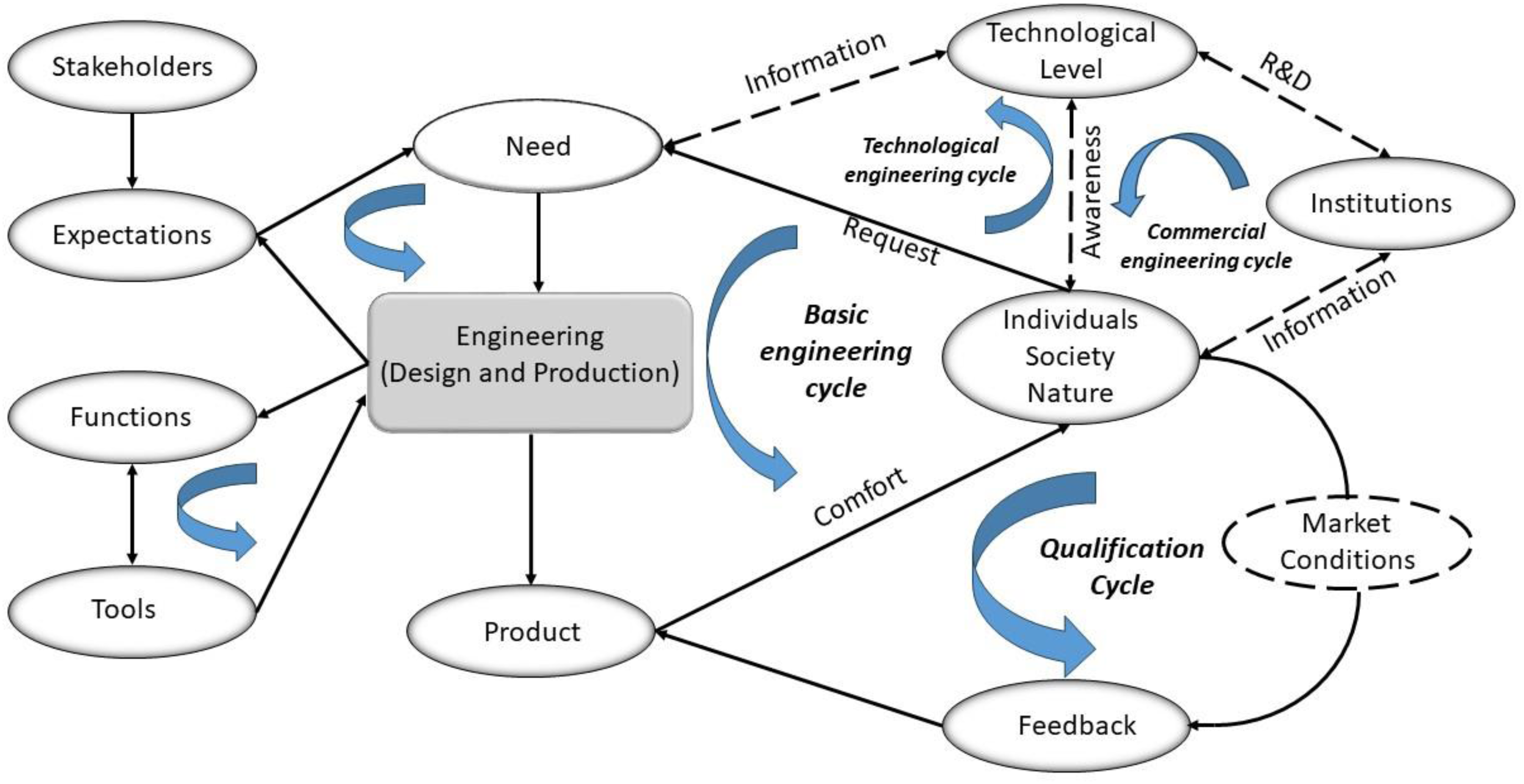
Interactions of the Individuals, the Society and the Nature in Product Development (Adapted from Erden, 2025).
Today, engineering activities are evaluated not only by cost, efficiency, and performance criteria, but also by sustainability criteria such as environmental impacts, carbon footprints, resource cycles, and social responsibilities. Furthermore, it should not be overlooked that engineers have not only technological but also social and ethical responsibilities. The concept of sustainable engineering requires opposing projects that harm nature and society for the sake of short-term economic gain. An engineer is responsible not only for the functionality of the designed system but also for its impacts on nature and society. In this context, engineering ethics are an integral part of sustainability, and engineers play a key role in building a sustainable future. Through the technologies and systems they develop, they not only improve the quality of life but also contribute to the protection of nature and the balanced use of resources. The widespread adoption of sustainable practices in many sectors such as energy, construction, environment, transportation, and manufacturing is possible only if engineers adopt an environmentally conscious, ethical, and systemic perspective. Another socially significant aspect of sustainability is the social justice perspective of engineering products and technologies (Miller, 2021), which is associated with the design of engineering products in a way that supports social justice (Marino & Ribot, 2012; Syal & Kramer, 2025). The role of creativity is paramount in addressing such complex and multifaceted challenges from all perspectives. Engineering education at universities should be reshaped accordingly; prospective engineers should be trained with ecological awareness and a sense of social responsibility, in addition to their technical skills. Only in this way can a healthy and sustainable balance be established between technology, nature, and society. Creative design thinking and creative design in engineering should be integrated into educational processes as a way to challenge traditional patterns and approach problems from unique and diverse perspectives. In order to determine the unique and real needs in the development and application stages observed in engineering fields, it is important to distinguish between the concepts of ‘design engineering’ and ‘engineering design’ and to correctly understand, internalize and direct design engineering.
A Methodological Approach to Creative Design Engineering Education
Design is, by its nature, a creative effort to propose a physical product that does not exist before. The design procedure in engineering is a journey from “design engineering” towards “engineering design”. These terms are closely related and sometimes used interchangeably, but they carry different emphases depending on the use context. The former term has the “product engineering” synonym and is defined as “the creative, conceptual, early-phase effort focused on needs definition and solution ideation”, relying on mental explanations and imagination. The closest synonym of the latter is “detailed design” and, by definition, it means a systematic, downstream activity with analytical, implementation-focused process tied to engineering science”, resulting in system realization. This distinction has an impact on both the related disciplinary contents (epistemology) and the objectives (pedagogical aims) of educational programs. ‘Design engineering’ and ‘engineering design’ are as different, yet related actions as ‘asking questions’ and ‘answering questions’. However, the question and dilemma of whether the action is a question or an answer is first uncertain and then scientific. Creativity is required to overcome the difficulties encountered in the design process and to produce proposals for new solutions to satisfy a need. Every good design has a stance and a story to tell. Instead of waiting for inspiration, it is important to actively seek and try new ideas. Creative design engineering is the process of proposing, defining and modeling a useful “set of solution principles” that meets a predefined concrete need and a holistic system that will realize it. Creative design engineering activities include investigating the options within the scope of existing and accessible technology, as well as selecting the most appropriate mechanisms and their components. In addition, it should also include the identification and selection of relevant scientific variables and parameters in this context.
In a perfectly organized creative design engineering process, activities are defined and developed without emphasizing a specific engineering discipline. In addition, some theoretical approaches are developed and proposed using unique abstract concepts and symbols for applicable design models. Scientifically validated models are produced using well-known mathematical approaches. This is defined as mathematical modeling of the product before physical realization and is one of the main responsibilities of design engineers after creative thought.
In creative design engineering, an engineering system is a holistic and artificial entity with functional and operational configuration that develops in four stages as organ systems, organs, limbs and elements (components) within the world model, as depicted in Figure 2. Organ systems are a set of functionally defined organs. On the other hand, organs are modular and functionally defined organ components integrated within the structure of organ systems. In the individuality plane, organs are formed by the clustering and integration of technologically defined limbs with well-known structures and systems, preserving their individual qualities. Limbs and limb clusters forming organs are sets of inseparable elements (components, individuals) at the ‘atomic (indivisable) level’ that unite different disciplines and have individualized, unique and distinctive qualities and characteristics. According to the structure of the engineering system, a system (entity) may have different technologies, and also, the number of organ systems, individual organs, individual limbs and, as a result, individual elements. In this definition, individuality is to be understood as the inability of an organ or limb to be decomposed into its smaller (functional, structural/physical) parts at the level of engineering definitions (atomic level). The quality of inseparability can be defined for a single tooth of a gear wheel located in a gear box, or a gear (gear wheel) itself or a gear box consisting of gear wheels, shafts and shaft bearings can have individual and atomic qualities as a whole. Naturally, it is possible to decompose all entities into their smaller parts. However, in this case, the functionality and atomic quality (being functionally indivisible) of the whole are lost and the functionality of the parts comes to the fore at lower levels. Therefore, it is possible to individualize (define as individual elements) all the parts that make up a system without affecting the defined functions of the entities by scientific influences and restrictions, institutional standardization process or commercial and technological concerns. The defining feature of independent units is that their individually defined components become functional when integrated into a higher-level structural system.
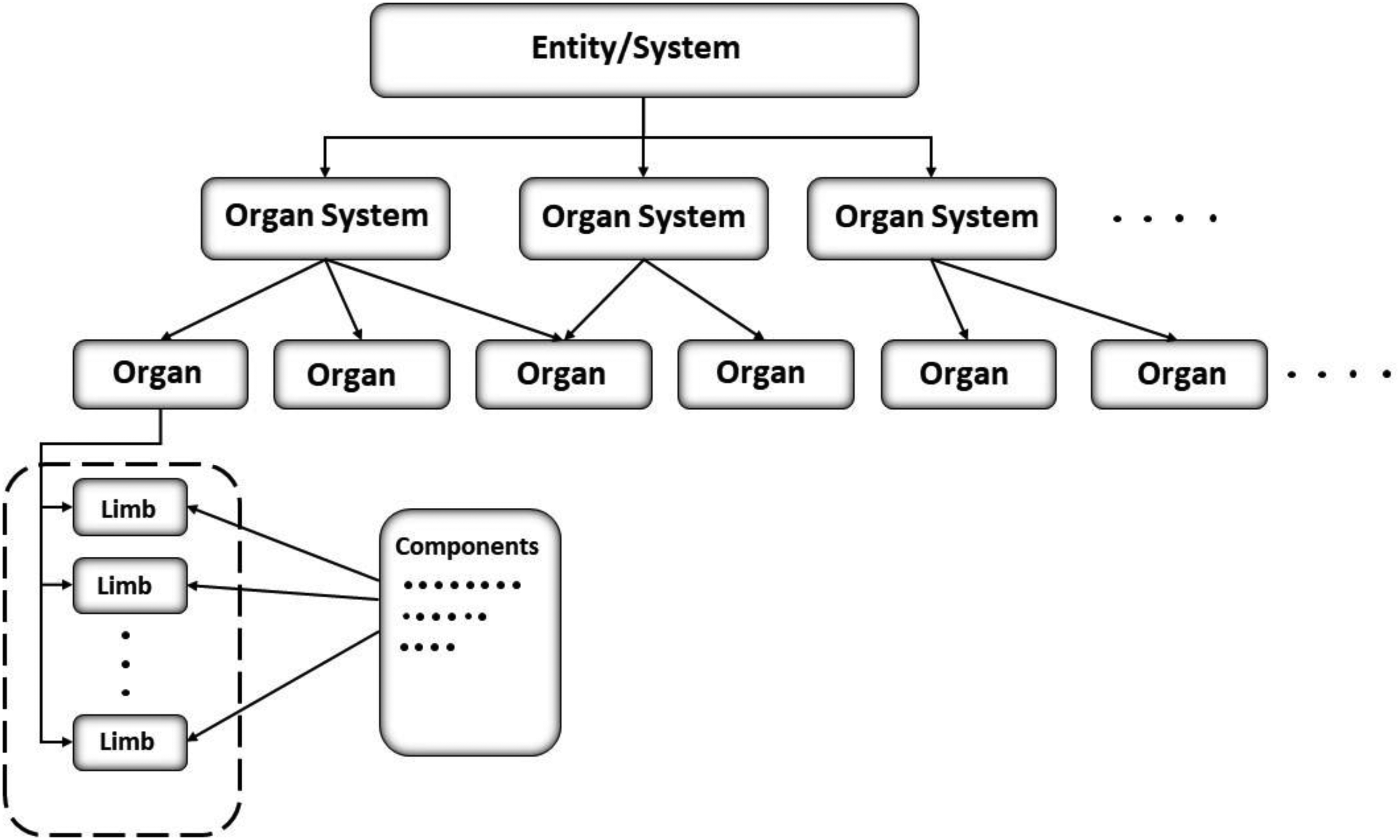
Five-Levels of Creative Design Engineering (Adapted from Erden, 2025).
Recommendations for Creative Design Engineering Education
Society and individuals, nature and its components are the natural stakeholders of all engineering activities. All stakeholders are deeply and permanently affected by the outputs of these activities, either positively or negatively. In design engineering, stakeholders that are prioritized and need to be protected can be defined in two groups as (i) Society individuals and social structure, (ii) nature and its components. The sustainability of individuals, society and the nature are vital issues for all stakeholders. Figure 3 illustrates the successive activities within design engineering process completed with a sequential order as {A B C D E}. However, many sub-components of within thee cycle can be maintained independently together within the process in the common and unique time axis. Since the outputs of the cycle components are inputs to the next component, there is no predefined end or termination for the cycle. Therefore, within the definition of design engineering, the design process is a set of activities that follow each other, have continuity in the cycle and in operational time. The cycle is open to interventions from outside the cycle. In {C, D, E} components, changing science and technology have significant effects on the process. It is thought that the changes in individual requirement definitions and stakeholder preferences in {A, B} components affect the process at a weaker level.
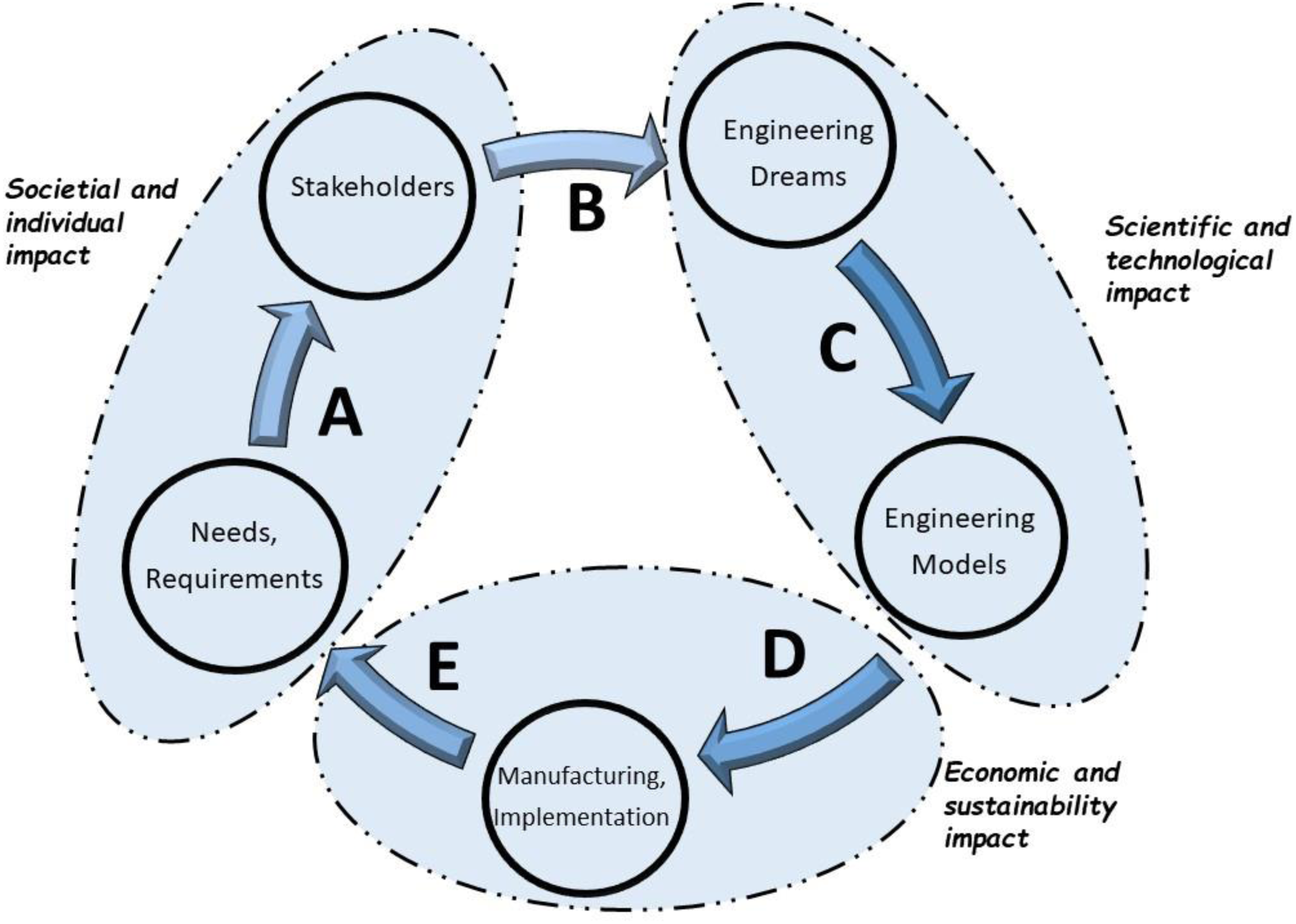
Activities and Interactions in the Product Development Process (A, B: First Steps in Design Engineering; C: Advanced Steps in Design Engineering; D. Modelling and Analysis in Discipline-Specific Engineering Fields; E: Product Realization in Discipline-Specific Engineering Fields) (Adapted from Erden, 2025)).
The transition process from stakeholder narratives to engineering products is explained as main headings in Figure 4. According to the responsible design engineering approach; it is expected and required for the product engineer to assume different tasks and responsibilities at each step of the process along the design-time axis. Possible suggestions and changes for the benefit of individuals and society are conveyed to the responsible stakeholders. This process, as it is on the time domain, is defined as the renewal of the design. In renewal processes, it is necessary to focus especially on contemporary technological changes and developments, and stakeholder feedback information should not be underestimated or ignored.
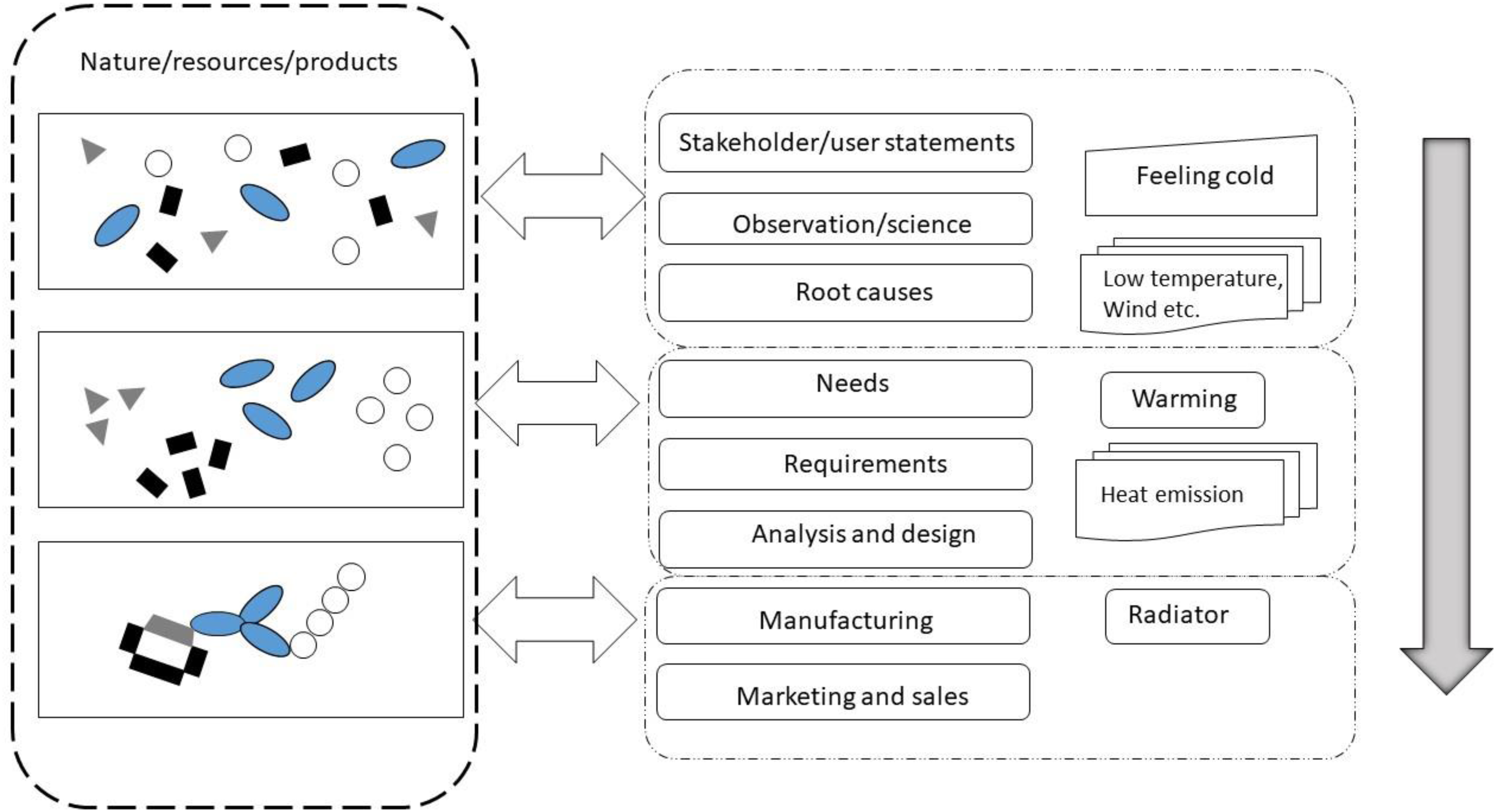
Transition from Stakeholder Feedback to Design Products (Adapted from Erden, 2025).
Therefore, instead of the current inductive design engineering approach, a deductive approach can clarify the big picture in creative design, as shown in Figure 5. Within the figure's approach, creative design examples from different application areas, and natural, social, individual and technological care of stakeholders integrated together. Hence, designers recall parallel approaches, and makes sense of discipline-specific basic science and basic engineering courses given in the first two years of engineering education. In addition, basic information on holistic creative design such as “design philosophy and methodology”, “system approach”, “information technology” etc. can be provided in the first stage with the support of basic philosophy, sociology, psychology, law, economy, history and ecology that will enable students to understand and internalize the social integration of the products/systems they design and the social innovation they create. The next stage can be devoted to understanding their subsystems/components and their relationships with each other, supported by examples of engineering solutions that are creative design products; for example, “sensor and actuator technologies”, “control systems”, “system hardware and software integrated structures”, “algorithms”, “communication”, “artificial intelligence”, “human-machine interaction” etc. Creative education in engineering should be independent of any specific discipline until the end of this stage, where it can be assumed that students understand a solution that will respond to the defined need and a product/system. That will embody it and all its components in a task-based and holistic way, and are informed about how the system components interact with each other. Specialization can begin after this stage and instead of being “field specific” (mechanics, electronics, software, materials, etc.), it should be integrated into education as “system/subsystem specific” (perception system, cognitive system, control system, human interaction system, etc.). Later, at the master's level, specialization in details and specific topics based on these systems should be preferred. This type of engineering education approach ensures that all engineers have sufficient knowledge about intra-system/inter-system interactions and encourages multi-disciplinary/interdisciplinary (superior) working principles.
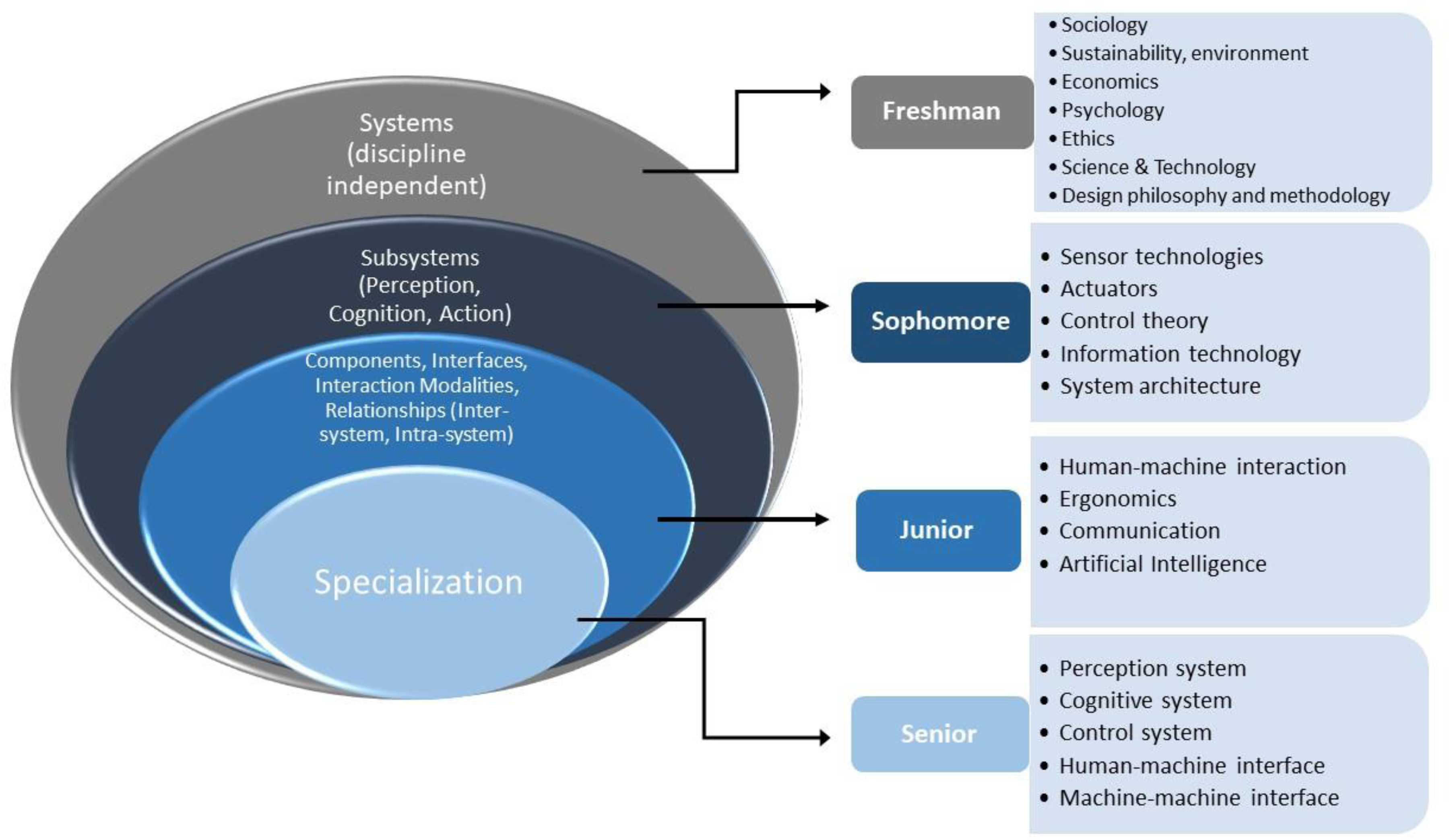
Deductive Approach for Design Engineering Education.
The above-mentioned key characteristics of design engineering can be forwarded into the current structure of education, which needs to be updated for Society 5.0 based on the interrelated concepts as (i) need, (ii) creativity, (iii) compatibility with nature and society, (i) sustainability, and (iv) ethics. Satisfying a need requires generating creative solutions, evaluated not only from a technical perspective but also from environmental, societial, sustainability, and ethical values. The engineering design process integrates creativity, socio-ecological awareness, and ethical responsibility for sustainable societies of the future. Thus, design engineering follows a need/problem-based approach with the following general steps, instead of a solution-based approach:
The actual need or problem is identified. Creative solution alternatives that can meet this need are developed. Alternatives are evaluated in terms of technical feasibility, as well as harmony with nature and society, sustainability, and ethical principles. The design process is advanced by selecting the most appropriate solution.
A vertically integrated and multidisciplinary model is recommended for the application of this approach to design engineering education. This model integrates existing methods such as project-based learning, creative thinking, and idea generation, but places them within a broader framework focused on needs and socio-ecological responsibility. The proposed Design Engineering Education Model is composed of the following phases:
Phase 1: Students learn to identify current social and natural problems and conduct needs analysis.
Phase 2: Creative thinking and idea development methods are taught.
Phase 3: In the third phase, evaluation and feasibility analysis are conducted, encompassing the technical, social, and environmental dimensions of the ideas.
Phase 4: The selected ideas are refined with technical knowledge and transformed into engineering applications.
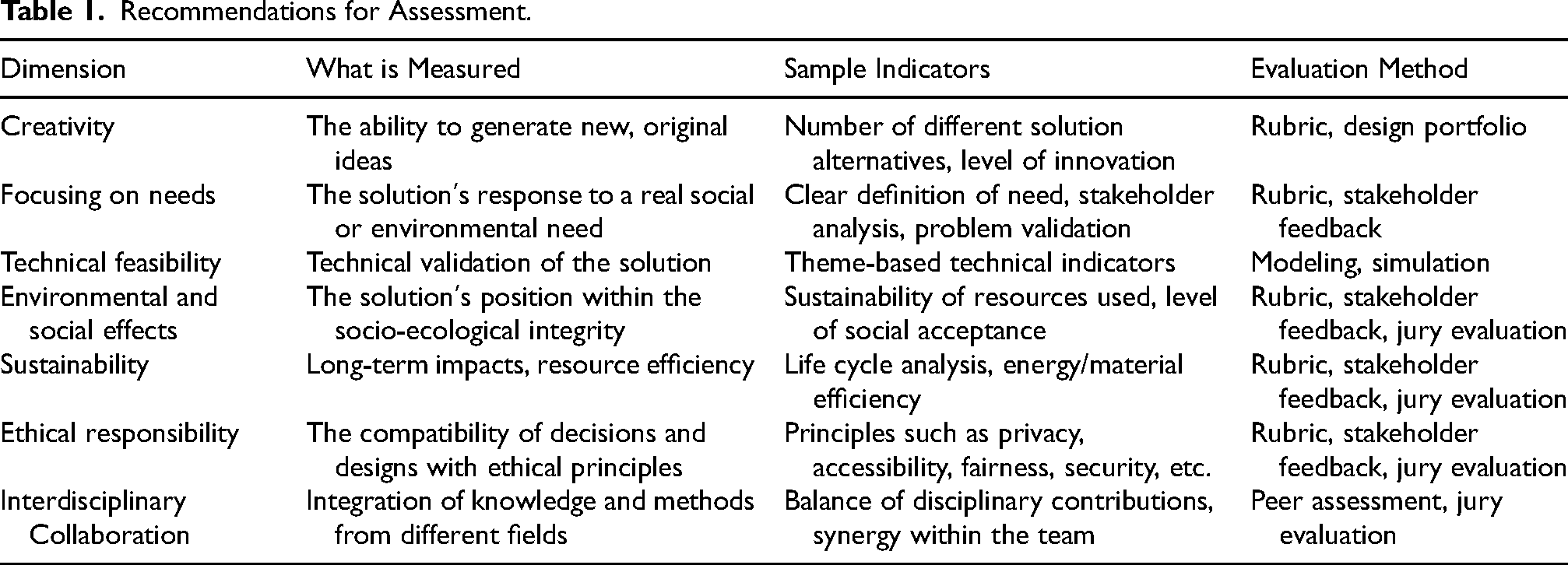
The proposed plan can be effective if the evaluation process considers creativity, needs-centeredness, ethics, sustainability, and interdisciplinarity alongside traditional technical assessment. General recommendations for these evaluation methods are summarized in Table 1.
Recommendations for Assessment.
Applicability of the proposed model is enhanced if adapted to different educational contexts worldwide based on regional, societial, technical and economical priorities. For example, while globally developed regions focus on sustainability, developing regions may prioritize local needs analysis and social innovation. In regional applications of the model, such local characteristics should be considered in alignment with global goals.
Case Studies
This section introduces two case studies from the academic experience of the authors in different universities in Turkey as implementation of creative design engineering education approach proposed in this paper.
Competition Based Capstone Design in Mechanical Engineering
Until the 1990s, student projects in the ME407-Machine Design course, which was considered as “capsone design” at Middle East Technical University (METU)'s Department of Mechanical Engineering, were completed entirely on paper using theoretical calculations and they were evaluated solely on written documents (project reports). Between 1990 and 2002, a structural change was implemented in the ME407 course, and a competitive, “hands-on” project approach was implemented. In this practice, three to four project topics were announced in general terms each semester, and the needs were simply identified without any guidance on solutions. Students formed groups, made their project selections, and worked on their chosen projects throughout the semester under the close supervision of research assistants. By mid-term, a design was created on paper, and a design report, including calculations and technical drawings, was prepared. During the remaining weeks of the semester, the machines resulting from the designs were manufactured in accordance with the technical drawings provided in the design report. At the end of the semester, the performance of these machines was tested in a competition setting. All competition tests were conducted separately and in parallel, depending on the project topics. During this competition, numerical values were obtained for the six criteria listed in Table 2 at the general level and customized for each project topic. Following the competition, all groups presented their designs to a jury composed of course faculty and research assistants.
General Criteria for ME407 Projects.
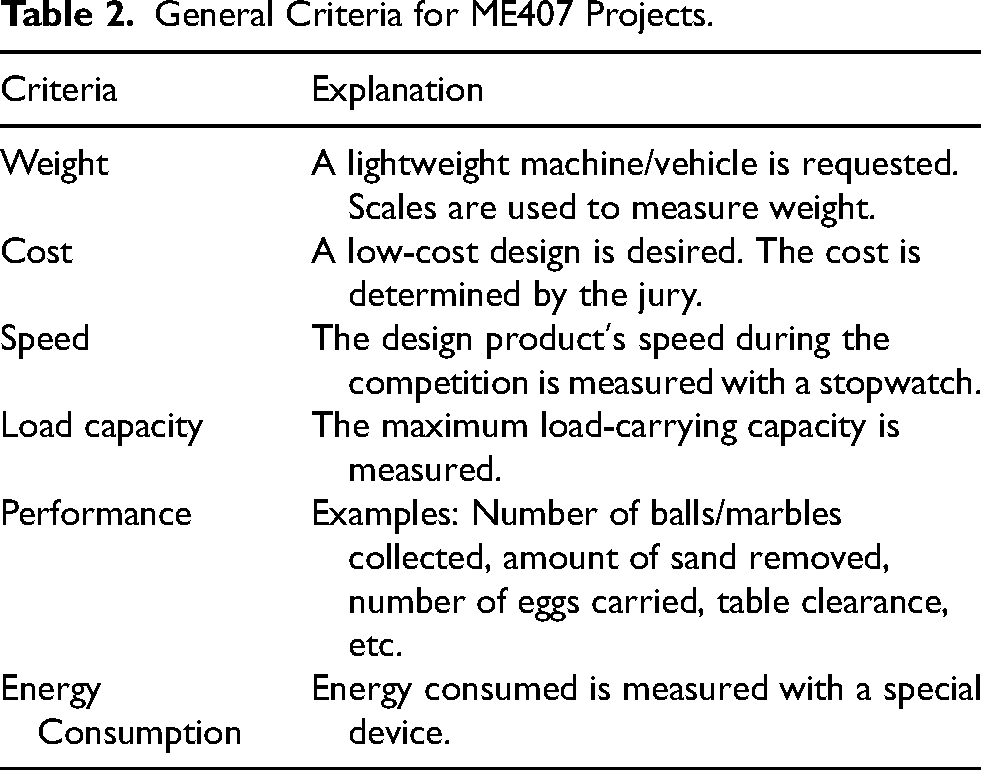
The competition and its associated jury evaluations constitute half of the course grade. Competition grades are assigned based on the numerical values achieved by all designs in the competition for each criterion (weight, speed, etc.) and ranked from best to worst. For each criterion, the best score is 6/6, while the worst is 3/6. A poor performance (such as an inability to carry a load) is 0/6. These grades constitute 30% of the total course grade. The jury grade, which is 20%, is awarded based on aesthetic design, durability, repeatability, creativity, and design features.
An evaluation of this implementation from various perspectives between 1990 and 2002 yielded the following conclusions:
Design project topics should be carefully and meticulously selected by experienced faculty. Choosing the wrong project topic can lead to the following problems:
Manufacturing costs may exceed students’ budget. Designs may be very simple and featureless. There may be machines/tools and toys with similar functions. Students may unconsciously copy these, preventing the desired engineering creativity function. There may be a single solution to the design, in which case all students will be forced to create the same design. The importance of creativity is diminished. Because project groups consist of two to three students, they must be closely monitored weekly, and a balanced workload must be distributed within the group. Research assistants and project groups should meet regularly every week. This prevents students from engaging in unnecessarily complex designs or becoming fixated on a problem they cannot find a solution for. Students must be carefully monitored for manufacturing in accordance with the technical drawings provided in their design reports. Excessive deviations from the technical drawings must not be permitted. The competition must be completed in one day.
Some negative outcomes observed in practice include:
The majority of groups working on the same design tend to choose the design that seems like the most plausible solution. Students avoid taking risks in the competition by introducing different and interesting designs. Some groups improve their designs by using mechanisms like toys. This is attempted to be prevented by the jury's grade. The majority of groups strive for average performance rather than taking risks to achieve better competition performance.
In contrast to the above, unexpected success has been achieved in the following areas:
Although the basic design ideas were the same, there was a great deal of variation in design details. No design product was identical in detail. Some students, viewing the competition as a mechanism to “prove themselves,” showed excessive interest in their projects. As a result, it was observed that they produced very successful designs that were unrelated to their previous grades. Although many products broke and malfunctioned on the day of the competition, very clever solutions were quickly developed, ensuring the completion of the competition on the same day. The percentage of designs that fail on the day of the competition is less than 10%.
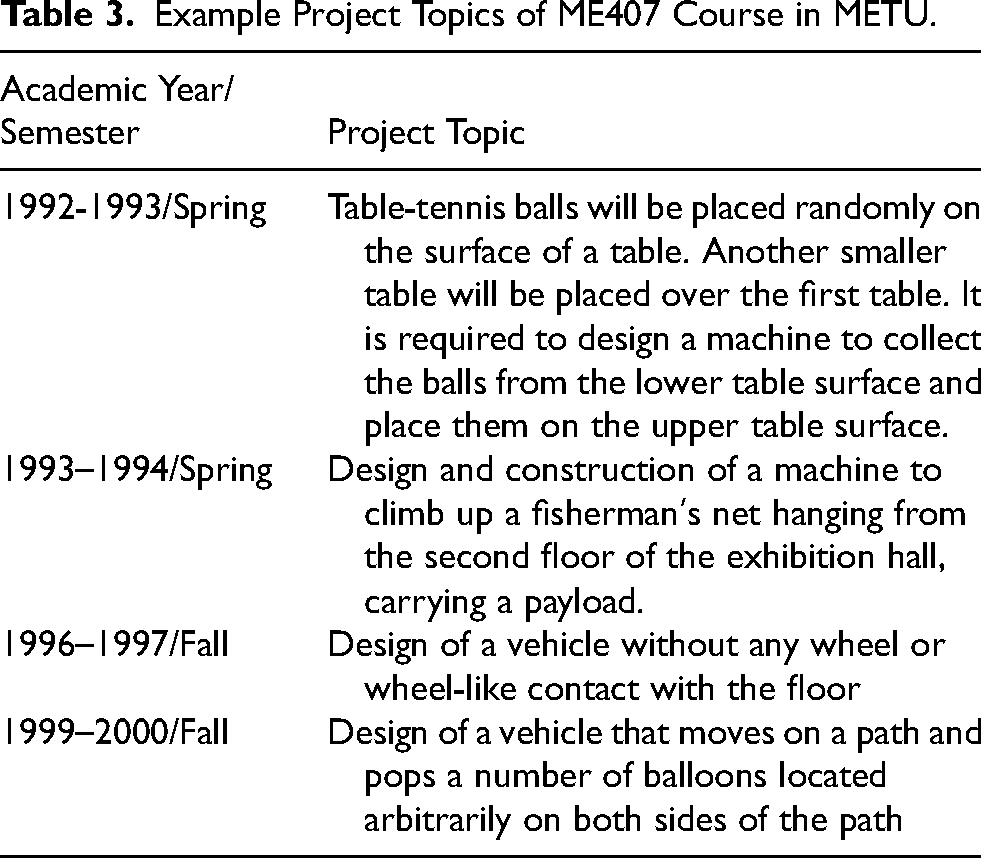
Some examples of competitive design project topics are presented in Table 3, and sample competition photos are presented in Figure 6.
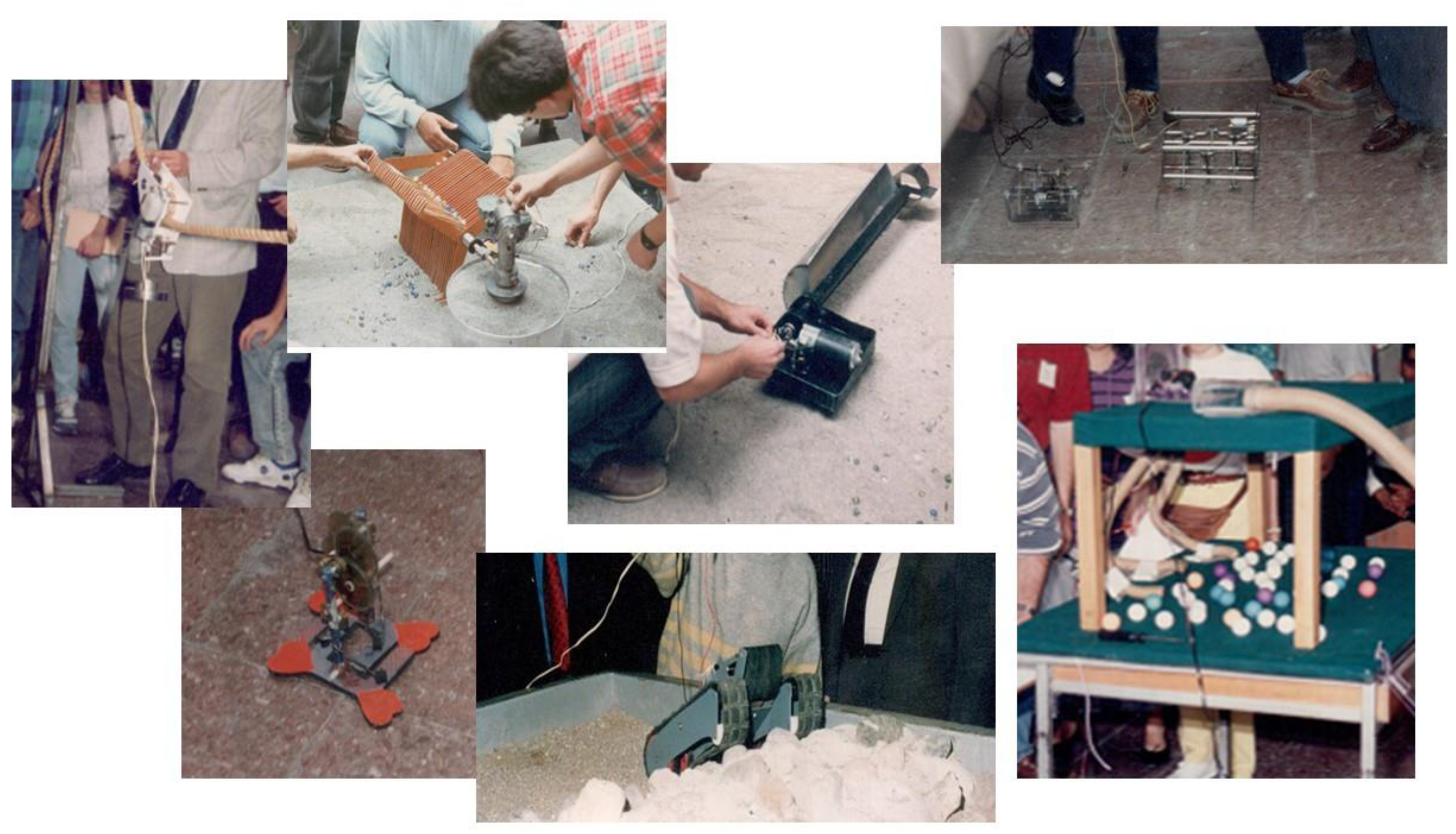
Selected Competition Photographs for ME407 Course in METU.
Example Project Topics of ME407 Course in METU.
Bioinspired Design Approach for Capstone Projects
The competitive design project approach described above was also implemented as the core philosophy in the MECE401/MECE402 Mechatronics Design I/II courses at the Department of Mechatronic Engineering at Atılım University between 2002 and 2017. These courses provided students with core design experience through the design and fabrication of a real robot capable of performing specific functions and exhibiting defined behaviors. The robots developed in these courses were customized as animal-like robots, considering the application of creative design engineering, and the Solution-Based Biomimetic approach (Helms et al., 2008; Konez Eroğlu et al., 2011a; Konez Eroğlu et al., 2011b; Ruiz-Pastor et al., 2023) was employed in accordance with the following process:
Informing students of the biological system (animal) that will be the subject of the robot to be designed. Anatomical and physiological examination and reporting of biological animal characteristics using literature. Definition of the design problem (robot design) in the context of the functional characteristics of the animal under study, conceptual design, and reporting. Preliminary design, reporting, and procurement. Detailed design, procurement, and fabrication of components. Assembly and experiments. Presentation and performance experiments.
The following factors are considered in student course grading:
Application of the engineering approach and design process, Complete engineering calculations, Ability to work individually (mainly MECE401) and as a team (mainly MECE402), Design optimization, Physical production in all its aspects, Project presentation (reporting, technical drawing, and oral presentation) skills, Performance testing of the robot at the end-of-year Mechatronics Engineering Day.
The benefits of this approach are as follows:
MECE401 and MECE402 courses allow students to synthesize the mechatronics engineering knowledge they have gained in other courses with their own personal and team creativity. They are provided with the opportunity to experience all phases of the technological development process, from the idea/imagination stage to physical production, without commercial concerns. By achieving success in this process (by creating a course/project environment that is highly conducive to success), students are enabled to gain self-confidence in design and technological production.
The sustainability of this approach is ensured by the following:
Mimicking the functions of a biological system as a robot, Providing high student motivation, Maintaining excitement for a new design topic each academic year, Working on a new, original topic each year, Although the design topic is different, the design experience accumulated by students can be transferred to subsequent years, Reasonable design and production times, A reasonable production budget, Encouraging students’ free creativity because there are no industrial expectations or limitations, Absence of commercial concerns.
Some examples of robots developed in the MECE401-MECE402 courses are shown in Figure 7.
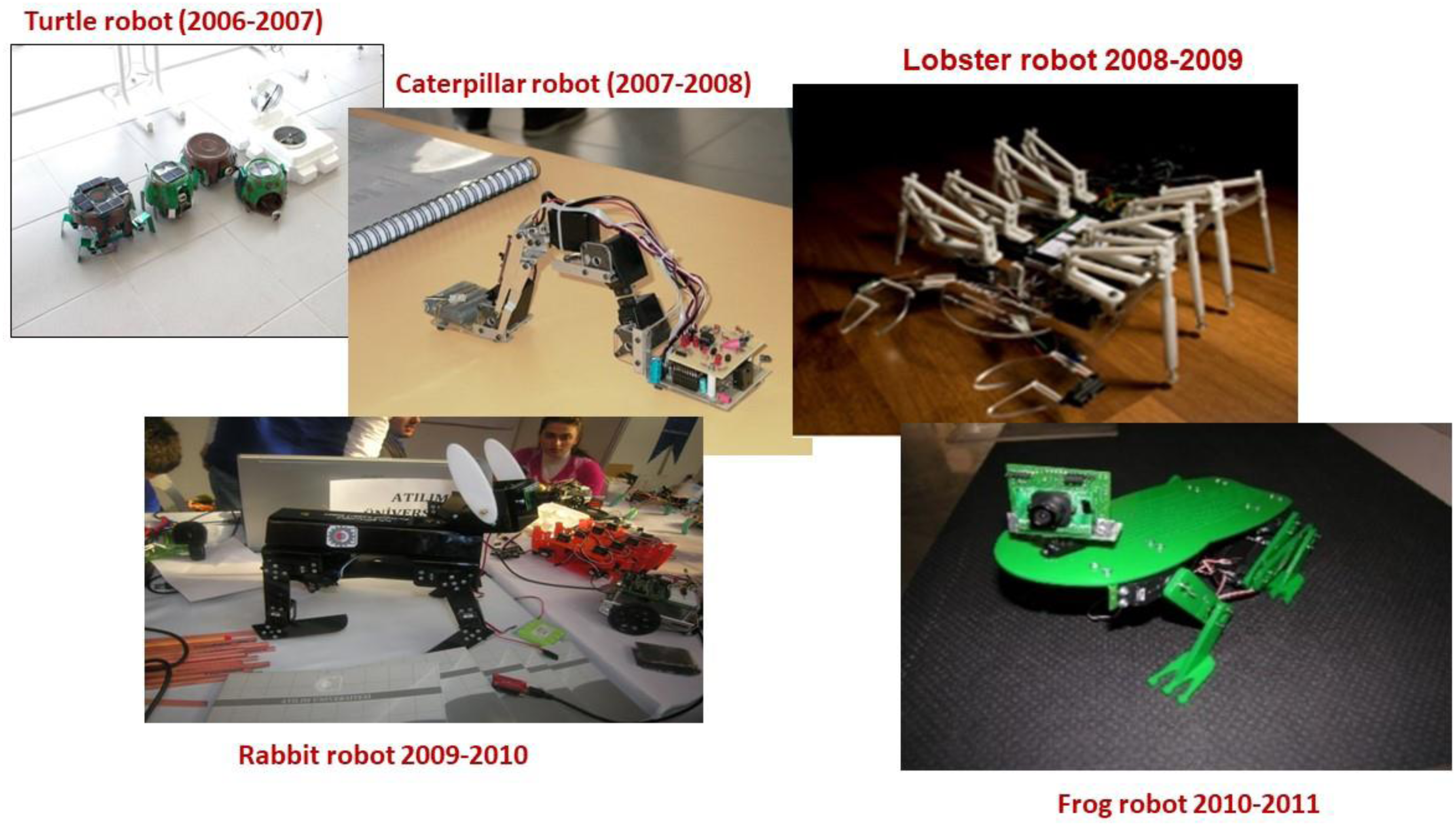
Example Robots Developed in the MECE401-MECE402 Courses.
Students showcase their robots in front of their families and other relatives at the end-of-term Mechatronics Engineering Day, bolstering their self-confidence and showcasing their talents to students in other classes and to those from outside the department.
Both of these case studies provided students with an academic experience of the design engineering and product development processes; this process was conducted in accordance with the general structure presented in Figure 1. In these studies, the design process was initiated not from solutions, but from identified needs or problems. Students were expected to develop engineering products that met expectations using functionally appropriate and appropriate tools. Factors such as students’ knowledge level and the university's resources at the time were decisive factors in product design. The feedback provided during the course directly influenced the quality of the final products. These practices also led to the creation of a significant body of knowledge that contributed to the distinction of the respective universities and departments among similar programs.
Conclusion
The contemporary context of Society 5.0 positions design engineering beyond the traditional goal of producing technology-driven products and systems for social and economic benefit. Instead, it calls for a comprehensive and human-centered design paradigm that envisions intelligent systems fostering social justice, environmental sustainability, and harmonious integration between society and technology. This new paradigm requires a transformative shift in design engineering education, which has undergone significant evolution throughout the twentieth century, but whose fundamental structure, centered around science and technology, based on deductive reasoning, has remained unchanged. In this article, the authors’ contribution is to present a structural plan for the transformation of design engineering education, based on their own experience. The proposed plan initiates the design process from identified needs rather than predefined solutions, encourages user-centered and context-aware thinking, and provides students with realistic experiences in developing innovative and competitive solutions through the implementation of competitive design projects. This approach, which emphasizes conceptual design over practical prototyping, has made the educational process more productive and intellectually engaging. Emphasizing interdisciplinary design strengthens engineering students’ interaction with various fields of knowledge, enabling the development of more holistic, sustainable, and creative design outcomes.
The implementation steps of the proposed plan are suggested below:
Process-oriented design approach: Design is not limited to the final product but rather considered as a holistic “learning and development process.” In this context, the project-based structuring of courses allows students to experience the entire design process, from needs definition to testing. In this approach, evaluation should be based not only on the final product, but also on learning outcomes at each stage of the process. Starting from a need rather than a solution: Identifying “real user needs” and social/environmental problems as the starting point of the design process is important. Students should be expected to complete user survey, observation, and problem definition before moving on to design. This step develops “user-centered and contextual thinking” skills of students. Competitive design projects: Incorporating “competition-based design projects” into the educational process improves students’ ability to produce innovative solutions in a competitive environment. Collaborative competitions, whether in-house or with industry, provide students with real-world experiences, increasing motivation and creativity. Increasing productivity at the conceptual design level: Before physical prototype production, the “conceptual design phase” should be deepened. Teaching creative thinking techniques and using virtual prototyping and visualization tools strengthens students’ ability to generate and express ideas. This step encourages intellectual creativity and the development of original ideas. Strengthening the interdisciplinary design approach: “Joint studio and project environments” should be created where students from different engineering, design, and social science fields can work together. Such interdisciplinary collaborations enable students to develop “holistic, sustainable, and human-centered design solutions” by bringing together diverse perspectives.
Overall, a new vision must be created that will not only provide students with technical knowledge and skills; but also position them as responsible actors capable of understanding complex social and environmental problems, generating solutions, and considering the ethical and social dimensions of the solution process. To this end, collaboration is needed between academics, policymakers, and industry leaders to cultivate professionals open to creative thinking, ethical responsibility, and interdisciplinary interaction beyond the classical understanding of design education. Interdisciplinary approaches enable the synthesis of different fields of knowledge in the design engineering process, leading to the emergence of more effective and innovative solutions. This comprehensive transformation is not a process that educational institutions can achieve solely through their own internal dynamics. To realize this new vision, which will shape the future of engineering education, a strong and sustainable global collaborative environment must be created between universities, policymakers, and industry representatives will be crucial.
Footnotes

Funding
The authors received no financial support for the research, authorship, and/or publication of this article.
Declaration of Conflicting Interests
The authors declared no potential conflicts of interest with respect to the research, authorship, and/or publication of this article.
Author Biographies