







Abstract
In China, interpretation of natural attractions usually includes references to traditional poems, artwork, legends, and stories. Recently, researchers have questioned whether this approach resonates with younger audiences. Guided by the interpretive paradigm, this exploratory study used focus group interviews to explore young Chinese adults’ perceptions, views, and preferences of interpretation at Chinese and Australian nature-based tourist attractions. Findings provide corroborating evidence for subtle generational shifts. When in China, participants preferred interpretation that used traditional Chinese poems, legends, and stories, but questioned the authenticity of guides’ interpretive narratives; when in Australia, they preferred quintessentially Australian stories that provide insights into issues of cultural and scientific importance. A preoccupation with personal safety, particularly in Australia, also emerged. Findings demonstrate the fluidity of the Chinese visitor lens—participants applied different lenses to interpret familiar versus unfamiliar landscapes. Implications for the design of interpretive experiences for Chinese visitors are discussed.
Keywords
Introduction
Deng Xiaoping’s “reform and opening up” policy of 1978 was the catalyst for travel becoming an acceptable and desirable activity in China, and has led to the rise of one of the world’s largest and most influential markets (Sofield & Li, 1998; Xu et al., 2008). In 2019, nearly 155 million Chinese people traveled overseas, almost three times as many in 2010 (Statistica, 2022). Domestic travel was similarly buoyant in 2019, with six billion domestic trips recorded, an exponential increase from the previous 10 years (Statistica, 2022). While the Chinese market has been forced into hibernation by the COVID-19 pandemic, growth is forecast to recover rapidly over the next few years and will soon return to post-pandemic levels (Jin et al., 2022).
Many researchers and industry organizations in both China and overseas have acknowledged the significance of the Chinese market, and have spent considerable time and effort examining Chinese people’s perceptions, preferences, and behaviors (Liu et al., 2019; Packer et al., 2014; Ryan et al., 2009; Weiler & Chen, 2016; Ye, 2021). Some of these studies focus on the experiences of Chinese people when they are engaged in tourism activities; others use a broader definition of visitor experiences that encompasses “immediate or ongoing, subjective and personal response to an activity, setting or event outside of their usual environment” (Packer & Ballantyne, 2016, p. 133). This broader definition of visitors was adopted in the present study because it allows for the inclusion of the experiences of Chinese people temporarily residing overseas (e.g., students, seasonal workers, and backpackers).
Studies investigating Chinese people’s responses to the natural environment have noted that the interpretation of “scenic spots” in China is often framed with reference to famous works of art such as poetry, paintings, legends, and stories, and that Chinese visitors are often drawn to these natural attractions not because of their natural beauty per se, but because of underlying esthetic and cultural meanings, especially connections with famous poets, artists, and celebrities (Xu et al., 2008). The phenomenon of following in the footsteps of famous people is not uncommon. For example, thousands of Chinese visitors are motivated to climb the Mountain Taishan by the words of the poet Du Fu, a household name in the Tang Dynasty (AD 618–907; Xu et al., 2013).
Studies examining Chinese people’s understanding and appreciation of natural landscapes reveal a number of idiosyncratic perceptions and viewpoints (Cui et al., 2017; Gao et al., 2018). Yet few researchers have questioned the fluidity of the Chinese gaze and whether traditional approaches to interpretation hold the same appeal for younger generations. There has also been limited exploration of Chinese people’s views of interpretive practices outside China (Ye, 2021). Studies in Australia have found that viewing natural landscapes is very attractive to the Chinese (Packer et al., 2014; Weiler & Chen, 2016; Weiler & Yu, 2006). It has been noted, however, that Australia’s nature-based attractions are unlikely to offer interpretation that aligns with the Chinese way of describing landscapes in an imaginative and exaggerated way (Weiler & Yu, 2007). Indeed, Moscardo (2007) argues that interpretation offered at Australia’s natural sites is designed to appeal to Western tastes, an approach that may or may not appeal to the Chinese. This exploratory study sought to investigate Chinese perceptions of interpretation with a purposive sample of Chinese young adults who had lived in Australia for at least one year and had visited a range of scenic attractions in both Australia and China. Specifically, we aimed to
explore perceptions of interpretation at nature-based sites in China and Australia,
compare and contrast visitor experiences in both contexts, and
discuss young Chinese adults’ views about the appeal and effectiveness of different interpretive approaches.
Literature Review
There is an emerging and complex body of empirical studies on how Chinese people view and perceive nature-based tourist attractions. This literature claims that the attractiveness of natural sites does not lie in their natural beauty, but their connections with well-known poems, landscape painting, calligraphy and philosophies, stories, and legends (Fountain et al., 2011; Pearce & Wu, 2016; Weiler & Chen, 2016; Xu et al., 2008). For example, Mount Lushan is famous because of the well-known poet Li Bai. Likewise, an enormous number of visitors climb to the top of The Great Wall because they are inspired by the poetic lines: “if you have not been to the Great Wall you are not a full-grown person” (Sofield & Li, 1998, p. 367). Many sites in China, such as Mount Taishan, Mount Huangshan, Mount Emei Scenic Area, and Mount Wuyi have been ascribed World Heritage Site status to acknowledge that the cultural heritage they embody is important as their natural features (Fowler, 2003).
Chinese traditional philosophies provide insights into why Chinese people visit natural scenic spots for their cultural value. Confucianism and Taoism, two renowned philosophies in Chinese history, are taught to children from a young age. Confucianism emphasizes that humans should learn from nature (Li, 2005). “Kind (Ren) man enjoys mountain”; “Wise (Zhi) man enjoys water” is a traditional saying that illustrates that kind men are rational and tolerant and their temperament is as calm as the mountain, while wise men have active thinking and personality, just like the constant flow of water (Xu et al., 2013). Similarly, Taoism encourages human beings to follow nature, seeking enlightenment and esthetic values from being in nature (Xu et al., 2013). These thoughts are embedded in nearly every Chinese person’s mind, and often drive them to pursue the cultural meanings behind nature-based tourist attractions. Thus, “walking in the footsteps of the famous” is a key motive for Chinese people visiting natural landscapes in China (Ballantyne et al., 2014). Given the critical role cultural connotations play in Chinese appreciation of natural scenic spots, the tourism management committees of some natural attractions such as Zhangjiajie National Forest Park invite renowned poets and artists to produce poems and art about their visits. The aim of these requests is to enrich the cultural heritage of the site (Xu et al., 2013).
It is often difficult for Western visitors to view Chinese natural sites in the same way as the Chinese (Arlt, 2006). This is because “When Western tourists look at the Yangtze, they see a river; the Chinese see a poem replete with philosophical ideals” (Sofield & Li, 1998, p. 367). Chinese people can gaze at a famous mountain for hours reflecting upon the famous poets, artists, and philosophers who have created works inspired by the mountain; Westerners find it hard to see or appreciate these deep cultural meanings (Ye et al., 2020). Zhonghua wenhua, translated as Chinese Common Knowledge, explains why the Chinese perceive Chinese natural sites differently (Li, 2005). Poems, stories, legends, Chinese philosophies, art, and history are parts of Zhonghua wenhua and they are embodied in many natural sites (Sarah Li, 2008). This distinct Zhonghua wenhua is the foundation of the “Chinese gaze” at nature-based attractions in China (Fountain et al., 2011).
While common, not all Chinese people are drawn to scenic sites by ancient poems, art, stories, and legends. Cui et al. (2017) argue that not all Chinese like interpretation based on high culture, and propose that interpretive preferences could depend on their familiarity with classical Chinese works of art. These claims stem from observations and interviews with visitors at Mount Huangshan, a famous Chinese natural tourist attraction. Overall, respondents who were less familiar with traditional Chinese culture and art preferred guides to use similes, metaphors, folk stories, and legends to explain features in the landscape. An example of this approach is the tour guide pointing to a rocky outcrop and drawing the groups’ attention to the fact that the rock resembles a man sitting cross-legged. The guide would then explain that the man is sitting there to fish, so the small rock is called “Jiang Taigong Fishing.” He/she does not need to explain why the man is called “Jiang Taigong” because “Jiang Taigong” is a household-name from the Zhou dynasty (BC 1046–256), and his story “There are always fish willing to be caught by angler Jiang Taigong” is well-known throughout China.
Similar preferences for figurative or metaphorical description of natural landscapes have been noted by other researchers. Pearce and Wu (2016) describe the tendency for Chinese interpreters to ascribe human and animal names to oddly shaped rocks and mountains, such as “Monkey Watching the Sea” and “Pig-headed Monk Eating Watermelon.” In Danxia Shan, a natural reserve and geo-park in China, Xu et al. (2013) found that adopting the Western approach of scientific information in signage did not appeal to the majority of Chinese visitors. Instead, they expressed a strong preference for the stories, legends, and exaggerated description of the natural beauty told by Chinese tour guides. This supports Gao et al.’s (2018) suggestion that overall the Chinese prefer interpretation of natural sites to be based on cultural references rather than scientific facts.
Gao et al. (2021) claim that evidence of generational differences is starting to emerge, with younger Chinese being less interested in approaching natural attractions from the perspective of well-known poems and traditional paintings and more interested in gaining experiences and receiving quality service. These suggestions arose from surveys recently conducted with visitors from the Chinese generations of the Lost (born in the 1940s, 1950s, and 1960s), post-70s (born in the 1970s), post-80s (born in the 1980s), and post-90s (born in the 1990s) at a World Cultural Heritage Site Kulangsu Island in China. Notably, the post-90s cohort attached less importance to learning about the historical and cultural significance of the site and listening to the onsite interpretation than the other cohorts. Instead, they cared more about the quality of accommodation and entertainment.
While a story-based approach is well received in China, little is known about whether the Chinese approach of interpreting the natural sites works well for Chinese people outside China (Gao et al., 2018; Ye et al., 2020). In 2021, Ye (2020) conducted “go along” observations and interviews with Chinese visitors at Uluru-Kata Tjuta National Park in Australia and found that they wanted scientific information about the formation of Uluru but were less interested in art, poetry, stories, and literature about the area. Similarly, Hughes et al. (2015) study of Chinese students’ perceptions of Australian natural landscapes revealed they had little interest in Australian celebrities or artists who had previously visited scenic sites. Instead, they sought opportunities to take unique photographs, engage in iconic Australian activities, and have once-in-a-lifetime experiences, providing these were safe. The samples in both studies were young adults; therefore, it is possible that these preferences might reflect generational nuances (Gao et al., 2021). That aside, the studies suggest that Chinese preferences for interpretation may differ when they travel to unfamiliar places outside China.
Further research into Chinese perceptions of interpretation in natural sites both within and outside China is needed to ensure interpretive experiences match their expectations and preferences. Obtaining the views of younger generations is particularly important, as these are the visitors of the future. Accordingly, the aim of this exploratory study is to ask young Chinese adults to compare and contrast the interpretive approaches used in Chinese and Australian natural attractions and to comment on their appeal and effectiveness.
Method
This study sought to explore how young Chinese adults (aged 18–30) view and react to interpretation provided at Australian and Chinese natural scenic sites. Underpinned by the interpretive paradigm (see Knoblauch, 2013; Wilson, 2017), the qualitative design adopted for this study is based on participants’ recall and reflection on previous visitor experiences in the two contexts. The strength of the interpretive approach is that it provides rich, first-hand accounts, and allows contextual characteristics and nuances to emerge (Croucher & Cronn-Mills, 2021; Wilson, 2017). The goal is not generalizability, but transferability and verisimilitude, enabled by thick description (Croucher & Cronn-Mills, 2021; Goulding, 1999; Racher & Robinson, 2003).
Data Collection
Focus group interviews were conducted with young Chinese adults who had lived in Australia for at least one year. Initially, interview questions were pilot-tested with a convenience sample of six adults who fit this criterion to allow the authors to identify any redundancies and misunderstandings, check the sequencing of topics and questions, and ensure the proposed structure was suitable (Hennink, 2014). No issues were identified, therefore responses from the pilot study were added to the main data set.
Thirty-five participants were recruited for the main data set via an advertisement posted on the Chinese social media platform WeChat. Studies exploring the appeal of tourism infrastructure and experiences to international audiences often rely on the opinions of those with transient and brief visitor experiences. Such samples have limited ability to straddle cultural boundaries, raising questions about their ability to make meaningful cultural comparisons. Accordingly, in the present study, a screening question specified that respondents must be between 18 and 30 years old, have lived in Australia for at least one year, and have visited multiple scenic areas in both China and Australia. These criteria enabled the recruitment of participants who could bridge the two different cultural contexts. In essence, they acted as “cultural brokers.” It was felt that this unique positionality would enable respondents to identify subtle cultural nuances that Chinese tourists might miss.
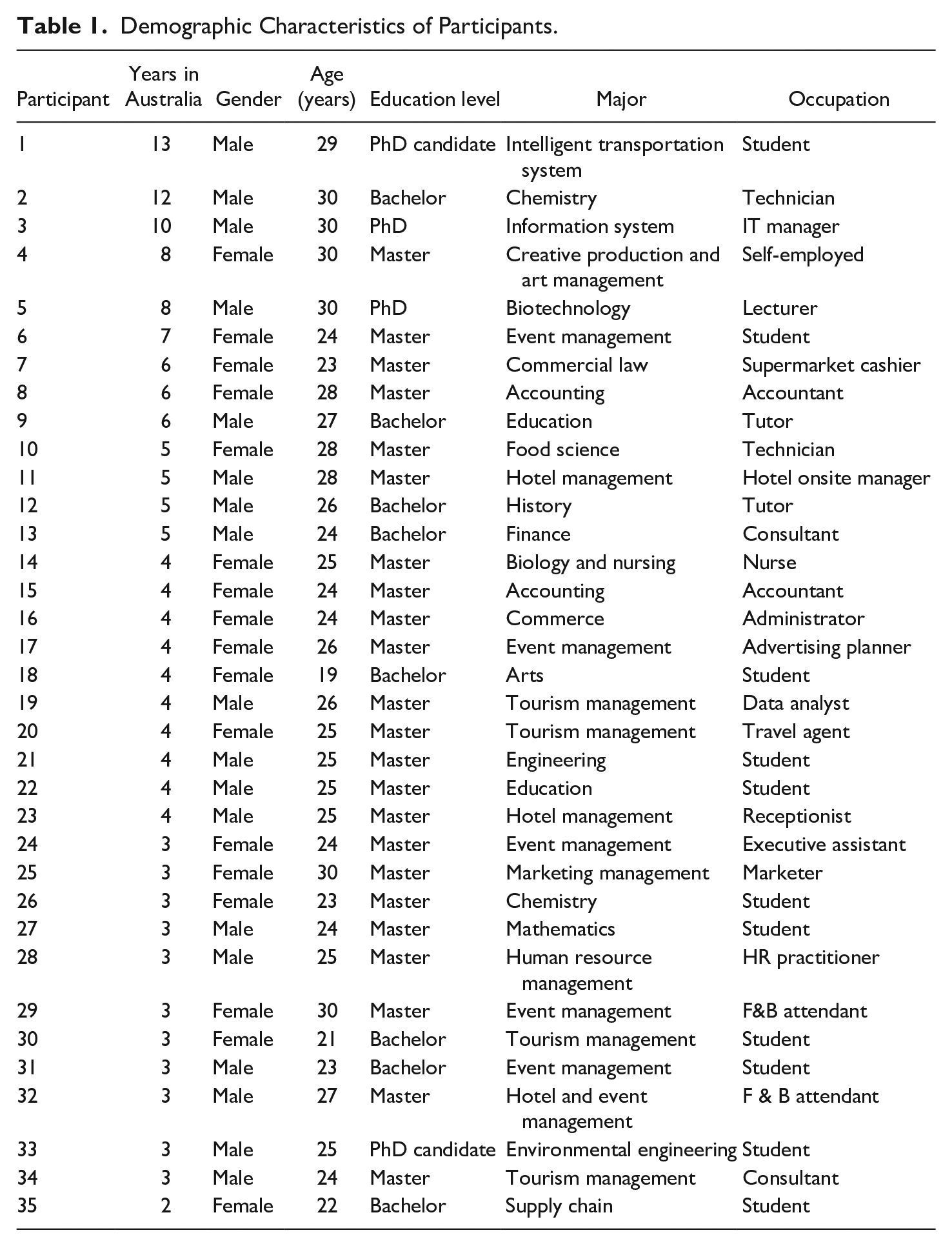
The recruitment strategy produced a well-educated sample, with diverse occupational and disciplinary backgrounds. This pattern reflects in part the Australian immigrational requirements for Chinese young adults working and/or studying in Australia. The average age was 25. The average length of time lived in Australia was 5 years. The sample was evenly divided on gender. Table 1 provides a summary of the sample demographics.
Demographic Characteristics of Participants.
Depending on their availability, respondents were divided into seven groups, each comprising five people. We conducted online focus groups via Zoom, requiring audio-only and the use of pseudonyms to protect anonymity and confidentiality. Interviews were conducted in December 2021 and lasted 90 minutes. An option for conducting further interviews was considered. However, after the initial seven focus group interviews, it was deemed that data saturation had been reached (Hennink, 2014).
The interviews were conducted in Chinese for two reasons. Firstly, as the principal researcher and participants were Chinese native speakers, it was felt discussing issues in their first language would be more likely to generate in-depth and natural conversations. Second, it helped the researcher to build rapport with participants (Colucci, 2007). Interviews were audio recorded to facilitate transcription and subsequent analysis. The goal was to elicit participants’ reflections on their experiences at Australian and Chinese natural attractions using an organic, conversational style. The focus groups interviews were structured around three key foci, namely:
i. Identifying and describing participants’ favorite nature-based sites in Australia and China;
ii. Comparing and contrasting the visitor experiences and interpretation offered in Australian and Chinese contexts; and
iii. Exploring the appeal and effectiveness of different interpretive approaches for young Chinese visitors.
Following each focus group interview, the lead researcher translated recordings into English. Transcripts were then thematically analyzed following procedures proposed by Braun and Clarke (2006). First, the lead author familiarized herself with the data. Since she had conducted the focus group interviews and translated and transcribed recordings immediately afterwards, she was able to build a mind map of the entire data set, a process that enhances data quality (Doody et al., 2013). Second, the lead author created initial codes that represented a summative or evocative statements for a portion of qualitative data (Saldaña, 2009; Sutton & Austin, 2015). To ensure inclusivity, the lead author created as many codes as possible—sixty-five in total. Codes were independently checked by the other two authors and deemed valid.
Third, the three authors independently categorized the sixty-five codes into broad themes. Through an iterative process, we discussed any discrepancies in categorizing the codes and reached consensus on fifteen categories. The researchers refined and condensed these, ensuring that data within each category cohered with each other in a meaningful way, while being distinct from data in other themes (Patton, 1990). Finally, four clear themes were identified from the discussion—Beauty of Nature, Storytelling, Commercialization and Authenticity, and Personal Safety.
Results
Data analysis focused on identifying and exploring young Chinese adults’ experiences, preferences, and perceptions of the way Chinese and Australian natural attractions are presented and interpreted. Responses are presented under the four key themes extracted; namely, Beauty of Nature, Storytelling, Commercialization and Authenticity, and Personal Safety.
Beauty of Nature
Not surprisingly given the context of the study, beauty of the environment was a key facet of participants’ memories of visiting scenic spots in both China and Australia. Many reflected that they had been awestruck by the uniqueness and raw beauty of nature. When discussing how these sites were interpreted, respondents reflected that in China, the metaphors typically used to describe Chinese sites served to enhance their appeal:
There was an attraction called Forest Mazes. To be specific, it was like the forest suffered from the flooding, and water covered the trees and we rowed on the forest. I have not seen it before. I have seen forests and lakes separately, but when it came together, it was amazing and novel.
I went to Xiangbishan or Elephant Trunk Hill in Guangxi Zhuang Autonomous Region. We viewed it across the river, from a certain angle, made out the elephant drinking water with its trunk. I was amazed by how nature can form such an interesting landform.
While description of beauty and uniqueness also emerged when respondents described Australian natural attractions, references to how these features were interpreted or described were rare. Rather, discussions tended to be accompanied by comments relating to opportunities to “escape” and immerse in nature:
The seas here are exactly the same as the poems depict – the sea connects with the sky. Because most of the landscapes here are tranquil scenes, I have the time to reflect on this quiet moment. Back in China, I rarely had the chance to slow down to enjoy the natural view because it was too crowded.
I was born and raised in a city and have not seen many beaches and seas. Whitsunday Islands are different. Look at the color of the sea, from my experience, I only see a similar color in Jiuzhaigou Valley. To be honest, it is precious to have such different and wonderful sea color.
Bruny Island in Tasmania amazed me. When I was on the top of Bruny Island Neck, the view was well worth the effort as there is a road connecting between the ocean and the lake. The lake on the right side was as peaceful as a mirror, while the ocean on the left side was pounding the road. The comparison was breathtaking.
Storytelling
Participants unanimously agreed that the cultural and historical significance of natural attractions adds to their value. Not surprisingly, they felt incorporating cultural elements such as stories, poems, and legends into the site interpretation was important. This particularly applied to Chinese sites:
Since these poems and legends have been passed down through generations, they are long-lasting and meaningful. Thus, these sites that poets had gained endless inspirations from must have enduring appeal.
For sites that we visit for the first time, we just look around briefly. However, if there are interpretive signs or guides who share stories and poems with us, first, we will have a deeper understanding of the site, second, we might view the site with a new perspective.
Traveling in natural attractions is more than taking pictures, enjoying the view, or having some outdoor activities. Interpretation of histories, cultures, legends, and stories are what we learn and bring to others.
Responses across all seven focus groups revealed that although participants were keen to embrace Chinese philosophies and cultural references when visiting Chinese scenic spots, they were less enthusiastic about such interpretive approaches when exploring Australia’s natural attractions. Many remarked that they felt ill-equipped to appreciate Australian historic and cultural references, and that such interpretive content was unlikely to interest or engage them.
The reason I like the Chinese way of interpretation is that I have the recognition of Chinese cultural identity, and I am into Chinese history and cultures. While in Australia, I feel like most natural sites are similar, i.e., crystal-clear sea, white sands, and fresh air.
Everyone likes stories, right? But I don’t have background information or cultural background when I hear stories, so I can’t understand the story to the fullest.
Outback Queensland is a place full of aboriginal culture and local people, but it is hard for me to understand their language and slang even though I want to learn their culture.
There was also a general agreement that Australian culture lacked maturity in comparison to China:
I don’t think I will be interested in it. Because we have been born and raised in China, we are more familiar with the Chinese culture instead of the Australian one. Apart from familiarity, we have strong feelings towards our own cultures and a sense of patriotism.
Anyways, for the culture and history, they are either Indigenous culture, miners’ life, prisoners, or Captain Cook. Compared with five thousand years of history in China, Australia is too “young” to impress us with history and culture.
It is interesting to note that while respondents expressed little interest in Australia’s culture and history, many of their recollections and descriptions of powerful stories have clear historic elements:
I remember the mining field in outback Australia. As it is close to the desert and is scorching hot, those miners must live underground. Later, that place where they used to live had been renovated into a hotel called White Cliffs Hotel. In the hotel, there is interpretation about what the miners’ everyday life was. I found it attracts me a lot if the interpretation is about stories that I haven’t experienced or heard in my life, and I was in the same/similar environment where the main character used to be.
Port Arthur in Tasmania has a prison that used to hold the convicts. The tour guide gave each of us a customized playing card that represented a convict. What we did was finding the prison cell where that convict was held. After we found it, there was an interpretive sign introducing the convict’s personal information and why he/she had been sent to prison. I like this interactive interpretation.
Stories about the everyday lives of Australians held particular appeal because they provide insight into Australian culture and way of life:
I recall my trip in Fraser Island, and I didn’t understand the tour guide’s English and asked him to speak slowly. Then he said every word clearly and I found he just talked about his life and stories. It was interesting.
Respondents’ interest in stories also extended to discovering the stories behind the origin of Australian place names. Some places attracted attention because their names were unusual or unexpected; others because of the romantic images and connotations they evoked:
I heard the name Whitehaven and wondered why it is called “white” and “haven”. I kind of understand after my visit to the beach. The sand is so white, and the whole beach is like pure heaven. I found out that the name originates from the fact that it contains more than 98% pure white silica sands, so it looks very white and shiny. I love it!
Glass House Mountains - I just imagine a real beautiful glass house built in the mountain. I have not seen this name before.
The shape of the Heart Reef happens to be the one that our humans give meaning to. As the shape of the Heart Reef implies, you can immediately associate it with love. Since diamonds last forever and are indestructible, the groom will buy a diamond ring for his bride which stands for love is forever and indestructible. The same is true with the Heart Reef. Besides its beauty, the heart shape symbolizes special love in the eye of couples and girls who desire sweet love.
Commercialization and Authenticity
The potential negative impact of high visitor numbers was a recurrent theme across all focus group discussions. Respondents were concerned about over-commercialization of scenic sites and felt this had the potential to detract from their experience. This was particularly evident when discussing Chinese sites:
The commercialization in Daming Lake is terrible. It is where a household Chinese parody film series titled Princess Huanzhu was shot. It does not develop Daming Lake’s underlying culture, instead, it just has some superficial activities and interpretation, such as taking photos and buying Princess Huanzhu-related souvenirs.
We often encounter pedlars who sell snacks as we climb the mountain, and nearly all of them sell the same and tourist-targeted only products, which is over-commercialized.
Daming Lake itself is very beautiful, but it was incongruous with the so-called activities. There was an activity taking pictures in Princess Huanzhu costumes, I dared not to try their costumes because countless tourists wore them before, and the same costumes were displayed year by year. Also, the theme songs of Princess Huanzhu were played all the time. These things ruined the beauty of Daming Lake.
The majority did, however, acknowledge that moderate commercialization is beneficial for helping people discover the deep beauty of a natural attraction:
If natural sites were not developed by humans, you could only see their superficial beauty. Its in-depth cultures, characteristics, and histories still cannot be known by tourists.
Aligned to over-commercialization concerns, participants across all seven focus groups mentioned the importance of balancing development with protection:
One thing I want to mention is that the human-made facilities are well-blended with the natural landscape in this attraction, and the natural scenery is well-preserved. For example, they didn’t build a bridge for the convenience of tourists, and they built unobtrusive public facilities to make the scene look natural. The manmade tracks we walked on seemed like naturally formed.
From what I have experienced in most natural sites [in China], they develop commercial streets, hotels, and restaurants just for the sake of convenience and gaining profits. They didn’t consider how to integrate the facilities into the site and make these facilities unobtrusive. For example, I went to a well-known mountain, and they built a resort on the mountain to keep tourists longer and consume more. It looked so obtrusive and destroyed the mountain landscape.
Apart from developing Qinghai Lake (the largest lake in China) into a tourist attraction, the management committee did a great job on protecting the environment here. They restricted the walking path for tourists so that I can see the crystal-clear lake, very different from other lakes.
There were very few references to commercialization when discussing Australian natural attractions. Indeed, the lack of tourist infrastructure was generally seen as a positive feature of these sites, though there is an underlying suggestion that this might negatively impact visitors’ ability to fully immerse and engage with nature.
These nature-based tourist attractions are very different from in China, and are not commercialized at all, in this case, they give me opportunities to explore the beauty myself. This adventurous, exploratory and different experience attracts people like me.
I visited a mountain in Queensland before, and there was no walking path for tourists to go. We had to climb the mountain, I mean, climb! I did not bring climbing gear. I saw two local people climbing with their hands, and they were strong and wore very professional gear. However, they quit on the way to the top. At that time, I dared not to try climbing.
Linked to concerns about commercialization were perceptions and impressions of authenticity. During all seven focus group interviews, there was considerable discussion about the authenticity of Chinese tour guides’ interpretation, with criticisms that guides often fabricate or embellish interpretive content to make it more appealing. There was broad consensus that these practices detract from nature-based experiences:
I know a lot of natural sites are titled “the number one mountain/lake in China”, and we don’t know the authenticity of it. I don’t recommend this advertisement as tourists don’t like to be fooled.
I wish the stories to be authentic because if the tour guide shares an inaccurate story with me, I tell my friend that story which I didn’t realize it was fake, and it will embarrass me if my friend argues the authenticity of the story with me.
When I went on a river rafting adventure in a Chinese natural site, the tour guide stressed that this river is in a primary forest, and Nurhaci, the first emperor of the Manchu dynasty in China, had a river rafting experience in this river. Thus, water in this river could bring good luck to those who are preparing for the college entrance exam. To be honest, there was nothing special in this natural site. I just feel like the so-called historical event about Nurhaci was made up by tour guides to attract us to this site for making money.
In contrast, experiences that gave authentic insights into everyday life were highly prized, as evident in the following comments:
In Mongolia, girls taught us how to dance in their way and taught children their local language; rode horses and motorbikes; attended roasted leg of lamb eating festival. It was not just enjoying the natural scenery, but more the interaction between tourists and their culture that attracts me.
I rode the bamboo raft and saw local houses alongside the river. I could see how they live their lives, rather than some performances of their lives which are only prepared for tourists.
As I visited further, there was a bamboo forest, and famous people had visited, and bamboo had been engraved with their names. I found it interesting.
The authenticity of interpretation at Australian sites was also discussed, but this largely revolved around the perceived authenticity and expertise of tour guides rather than encounters with locals:
Last time I went to a cave here, the tour guide was enthusiastic about the cave and conservation. He is indeed an expert. Also, when he introduced a rock, he compared the rock to a cauliflower, while in China, the guide would quote the old idiom behind the rock, like the shape of the rock looks like a famous angler in Chinese history - Jiang Tai Gong.
We went on a bus tour, and the local guide shared a lot of things with us. Even though sometimes I couldn’t fully understand what they said, I still felt he respects and is proud of the natural environment at the site, knows everything about the site, and how desperate he wants to share with tourists.
The passion the tour guide had impressed me and kept me listening. He also told us to pay attention to some plants that were too tiny to notice, the habits of animals living there, and certain animals’ mating season.
Personal Safety
The main point of difference to emerge from discussion of interpretive experiences in China and Australia was the provision of information and facilities to ensure safety in natural environments. Most participants strongly agreed that warning signs and the presence of staff provided comfort and assurance that if something untoward occurred, there would be someone on hand to assist. Respondents felt safe in China due to the high number of people and security personnel at scenic spots; in Australia, the unfamiliarity of the environment together with the low numbers of people sparked concerns for personal safety.
In China, there is a security station every hundred meters in national parks. At least I know there will be service centres, security staff, and emergency contact.
In Guilin, the interpretive sign at the entrance listed two hiking options: children and old people can choose the path that is fully developed; those who like to explore and take risks can choose the rugged path. Moreover, the staff gives away safety helmets, gloves and raincoats. The whole experience on the dangerous path was actually very safe, and I never heard of any accidents happening at this attraction.
[In Australia] I feel it’s deserted and not developed to some extent. From my understanding because many attractions are not developed or have little human modification, my safety cannot be guaranteed.
When asked how overseas attractions could address or overcome common safety concerns, respondents suggested providing guides and/or interpretation that clearly outline potential dangers and preventive measures:
I suggest you raise the safety issue. I remember my partner and I went to Pinnacles in Perth, we were lost. We found our way out after 5 hours! After we went out, everyone went home, and I was so shocked they didn’t even send staff to find us. It’s a desert landscape and is hot and dry. The thing is there were car parking space, a ticket window and gift shops, and how didn’t they realize tourists were still stuck at the site considering our car was still parked in the parking lot.
I’m super interested in the useful information, such as what plants are toxic, what plants can cure me if I’m bitten by insects, and what plants are edible to save my life.
Our rainforest tour was safe because the guide told us to stay away from snakes and spiders, and taught us how to distinguish toxic plants from the non-toxic species.
Discussion
While exploratory, this study highlights the importance of providing unique, place-specific, and authentic story-based interpretive experiences to young Chinese people. Focus group interviews revealed that when traveling in China, references to high culture—poems, classical works of art, calligraphy, stories about famous historical characters—are particularly attractive. Thus, although respondents had experienced alternative approaches to interpretation while living in Australia, they still appreciated and preferred the traditional Chinese methods of interpreting landscapes when in China. These preferences and perceptions are commensurate with previous studies that have revealed that when in China, domestic visitors tend to connect natural sites to traditional poems, paintings, and calligraphy (Fountain et al., 2011; Pearce & Wu, 2016; Weiler & Chen, 2016; Xu et al., 2008, 2013). Thus, on the surface, our findings do not seem to support Gao et al.’s (2021) claim that younger generations have less interest in traditional forms of interpretation. However, participants in the present study all held tertiary qualifications. Higher levels of education could explain why this cohort was drawn to sites where interpretation featured poems, arts, and traditional calligraphy. Such observations have also been made by other researchers—for instance, Cui et al. (2017) proposed that Chinese people who are well versed in the Chinese “classics” are more likely to express a preference for interpretation based on high culture than those who were less well-educated. Further studies with cohorts of different educational backgrounds would be needed to explore the relationship between educational status and preferences for traditional Chinese interpretation.
Although respondents expressed a preference for traditional Chinese interpretive approaches at Chinese scenic spots, many questioned the integrity and authenticity of Chinese interpretation that is based on what has been referred to as “popular culture”—metaphors, folklore, and legends. There was little appreciation or tolerance of such approaches. Participants were particularly concerned about Chinese tour guides fabricating stories to make money at Chinese natural attractions, describing many of these stories as far-fetched, not relevant to the site, and lacking in underlying cultural meanings. They were also scathing about storytelling simply for the sake of entertainment, and felt this practice had the potential to degrade otherwise sacred cultural artifacts and traditions and spoil the experience. Given the recent emphasis in China on promoting Chinese culture through travel experiences, such responses are encouraging as they indicate that domestic visitors are seeking authentic and meaningful interpretive experiences based on traditional forms of cultural expression—poems, calligraphy, art, and authentic stories. Indeed, the responses obtained in the present study suggest these forms of interpretation are not only highly regarded, but also provide young adults with opportunities to connect with their Chinese heritage and affirm their Chinese origins.
The importance of authentic storytelling also emerged as a key point of discussion in Australian contexts. Chinese respondents were very interested in stories, provided these were relevant to the landscape and were delivered without heavy reliance on cultural references and idioms. They were particularly drawn to stories about real people and to tour guides who demonstrated their passion for the environment through their personal stories and experiences. While participants preferred and appreciated references to poems, famous works of art and historical figures in China, the same did not apply at Australian attractions. Instead, respondents expressed a preference for stories and interpretation that featured the unique flora, fauna, and features of the Australian landscape. In this respect, our findings mirror those that emerged from Ye’s (2021) “go along” observations and interviews with Chinese visitors at Uluru-Kata Tjuta National Park in Australia; namely, they seek scientific information about the formation of Uluru but express less appetite for local art, poetry, and literature.
As expected, the natural scenery and uniqueness of the landscape was a significant feature of memorable nature-based experiences in both China and Australia. Previous studies of scenic spots in China have found broad public support for the practice of modernizing these attractions with steps, viewing platforms, garden beds, and retail outlets (Winter, 2009). Responses obtained in the present study provided limited support for these approaches—participants disliked obvious signs of human intervention and preferred facilities to be hidden or at least well-integrated into the natural scenery. There was a real concern that many scenic spots in China are over-commercialized and over-crowded, and that nature was being “loved to death.” Further research is needed to ascertain whether these changing views and preferences are particular to younger generations of Chinese, or simply a reflection of greater public awareness of environmental issues.
Over-development did not emerge as a theme when discussing Australian natural attractions, and in fact, many commented on the lack of infrastructure at these sites. For some, this raised concerns about personal safety. These findings reinforce prior research by Hughes et al. (2015), who found that Chinese students worried about being attacked by wild animals and insects when in Australian nature. They also worried about who would respond if they encountered difficulties, particularly in isolated environments such as Outback Australia and rainforests. This is consistent with literature that claims Chinese visitors will not take risks if a place is perceived to be isolated (Sparks & Pan, 2009; Ye et al., 2020), and emphasizes the importance of designing interpretive experiences that have inbuilt support and visible safety precautions and protocols. Wilderness experiences that offer self-guided opportunities to immerse in splendid isolation are unlikely to appeal to this cohort.
Implications for Practice
Our exploratory study suggests that the way young Chinese adults consume, interpret, and interact with natural landscapes may differ depending on whether that landscape is within or outside China. When traveling in China, our respondents preferred interpretation that incorporates references to high culture—art, poetry, calligraphy, and legends. There was an underlying message of patriotism—respondents were evidently visiting scenic spots to affirm their cultural identity, to connect with their heritage, and to develop an appreciation of what their country has achieved. Our findings therefore suggest that in China, traditional styles of interpretation framed around well-known Chinese philosophies and works of art will probably continue to attract and engage. What may need tempering, however, is interpreters’ use of “pop culture” references—it seems our younger, well-educated respondents had little regard for exaggerated, embellished, and fabricated stories that had been created for tourists’ entertainment.
Preferences for interpretation to include cultural references did not seem to apply in Australia, however. Rather, respondents felt interpretation should highlight features that are unique and different, and provide authentic and personal stories that explain the significance of these landscapes. Wherever possible, these should be framed to provide an insight into the cultural and scientific importance of the site and be free from jargon, idioms, and heavy cultural references. Drawing comparisons with natural scenery in China is unlikely to impress or engage; however, focusing on flora and fauna that is unusual or exclusive to Australian destination may.
Divergent preferences about incorporating cultural elements into interpretation at natural sites in China and Australia probably reflect participants’ perceived inability to appreciate the cultural value of non-Chinese reference points. To accommodate this, Australian interpretation needs to be scaffolded with sufficient cultural information for visitors to understand the nuances of the topics, events or features being interpreted. Presenting evidence to establish the authenticity of the interpretation is also likely to be appreciated, particularly as Chinese visitors are unlikely to have sufficient cultural knowledge to determine this for themselves.
While the uniqueness of Australia’s landscape was a drawcard, its very difference also served to remind participants about potential dangers. Safety concerns were “front of mind” for most participants when traveling through Australian landscapes. As interpreters, we need to be attuned to this market’s sensitivity, and to design activities and experiences that support and reassure them about their personal safety. Augmenting interpretation with practical information about preventive actions and first-aid could help to minimize these concerns and increase their participation in nature-based experiences when in Australia.
Limitations and Areas for Further Research
This paper provides preliminary insights into young Chinese adults’ views and preferences in regards to interpretation of natural attractions in China and Australia. Some limitations of the research must be noted. First, as the study was exploratory, it did not attempt to capture and compare the views of different generations or compare the views of people residing in China and Australia. Thus, responses obtained are only an indicator of the experiences of young Chinese people currently living in Australia. Second, participants were all tertiary educated, possibly due to the fact that the recruitment screening question required them to have spent a year in Australia. As discussed, this may have skewed preferences toward interpretation that references Chinese high culture. Third, living in Australia may have increased tolerance for different forms of communication and interpretation, and decreased the discomfort and disconnection people often feel when encountering foreign environments. In other words, our sample may have assimilated to the Australian way of life and become used to the way in which cultural, historical, and environmental issues are framed and discussed. If so, the contrast between tourists’ reactions to interpretation inside and outside China may be greater than reported here. Fourth, the methodology relied on recollections rather than in-situ responses, consequently, participants may have forgotten or overlooked some elements and nuances of their previous experiences.
Further studies with multi-generational samples are needed. This would provide insights into whether interpretive preferences are evolving, and whether the concerns about over-commercialization of China’s scenic spots are shared by other generational cohorts. Attempts to diversify samples would also help to uncover whether preferences for interpretation are related to educational status. Research could also explore Chinese people’s perceptions of interpretation in a range of overseas destinations to determine whether interpretive preferences apply to all destinations outside China or only those with very different cultural and environmental landscapes.
Footnotes
Declaration of Conflicting Interests
The author(s) declared no potential conflicts of interest with respect to the research, authorship, and/or publication of this article.
Funding
The author(s) received no financial support for the research, authorship, and/or publication of this article.