






Abstract
This report presents a prototype of a terrarium developed to explore a small-scale method for interpreting Panam Nagar, a historic heritage site in Bangladesh. Rather than treating the terrarium as a decorative object, the report examines how a compact three-dimensional display can communicate site identity, spatial orientation, architectural rhythm, and environmental atmosphere. The prototype was photographed and examined through preliminary viewer feedback from 120 participants. Responses suggest that the terrarium format may support visual engagement, perceived immersion, and exhibition or classroom use when compared with a conventional two-dimensional photograph. The report argues that the interpretive value of the terrarium lies in its ability to combine miniature architecture, live ecological material, and multi-angle viewing into a relocatable heritage communication format. The findings are exploratory and provide a basis for future visitor-centered evaluation of terrarium-based heritage interpretation.
Keywords
Introduction
A physical prototype of a terrarium for Panam Nagar was evaluated as a compact medium for heritage interpretation. According to Ungvarsky (2023), terrariums have been widely defined as small enclosed or semi-enclosed spaces containing living plants and natural components. In the context of artificial terrariums as urban habitats, Vaz (2024) highlighted that terrarium-like environments may function as educative and sustainable display environments rather than merely decorative objects. It is therefore pertinent to consider the use of terrariums as a medium for heritage interpretation.
The purpose of this prototype is not to produce an archeological reconstruction or a decorative terrarium. Instead, the report examines whether a terrarium-based display can help viewers engage with selected interpretive qualities of Panam Nagar, including site identity, spatial orientation, architectural rhythm, and environmental atmosphere.
This report asks: How can a terrarium-based physical prototype support the interpretation of Panam Nagar by helping viewers engage with the site’s spatial character, architectural identity, and environmental setting?
The contribution made by this report is exploratory. The terrarium is introduced as a potential format for interpretation, along with some initial comments made by viewers regarding its usefulness within exhibitions, museums, and classrooms. This is done with the intention of addressing the need for interpretation research that poses specific questions regarding the impact of interpretation formats on audiences (Stern & Powell, 2024).
Panam Nagar as the Heritage Context
Panam Nagar, also known as Panam City, is an ancient settlement located in Sonargaon, Bangladesh. It is associated with the history, architecture, and culture of Bengal and includes architectural traces linked with Sultanate, Mughal, and colonial periods (Bangladesh Tourism Board, n.d.). It is known for its historical buildings, street-like formation, facades, and other elements of urbanism in the region. The meaning of Panam Nagar cannot be attributed to individual buildings alone, but also to gateways, streets, facades, and movement through the historic urban setting.
For this reason, a three-dimensional model can represent selected qualities of Panam Nagar, including gateway identity, street depth, architectural rhythm, and environmental atmosphere. While it is easy to capture the facade of the site in two dimensions, it might be difficult to capture its spatial nature.
Therefore, a small-scale model of the site could be useful in imagining certain aspects of the place. The current prototype does not attempt to present an exact representation of the archeological site in question. Rather, it focuses on certain elements of Panam Nagar that can be interpreted visually.
Terrarium as an Interpretive Prototype
Models and dioramas can represent spaces that would otherwise be difficult to observe in reality by scaling down the actual space and presenting it in an easier way for viewers to analyze. The literature on museums and exhibitions suggests that visitor experience is dependent on the interaction between the visitors, the setting, and interpretive objects (Falk & Dierking, 2013). Terrariums are models that include ecological elements, and this living component distinguishes them from conventional static models.
In this report, the emphasis is placed on the interpretive rather than the technical significance of the terrarium. The subject matter here is not about plant maintenance, lighting, substrates, or construction methods. Instead, the topic is how the display, which is living and three-dimensional, can help convey information about heritage. This framing is important because interpretive value depends on what the display helps viewers notice, understand, and connect with (Brochu & Merriman, 2012; Ham, 2016).
The design of the terrarium is interpretive as it helps organize selected aspects of Panam Nagar in a small-scale representation. This is done through the use of the gateway, which indicates the heritage site, the pathway, which indicates movement through the streets of Panam Nagar, the side buildings to convey the architectural rhythm, and the plants which provide the environment surrounding the architectural structure. The terrarium allows for the model to be viewed from multiple vantage points. This three-dimensional viewing context is significant because heritage locations are experienced in space. As such, the interpretive significance of a terrarium goes beyond its visual appeal to include its ability to link together identity, spatiality, architecture, and environment.
Prototype and Feedback Method
In this report, we use a prototype-oriented exploratory method. Prototyping allows a concept to be visualized, tested, and discussed prior to wider implementation (Camburn et al., 2017). For this study, a small terrarium was constructed to act as a representation of certain interpretive elements of Panam Nagar, including a gateway, a path, miniature architecture, and plants. The completed prototype measured 30.48 × 25.40 × 25.40 cm, was built with 3 mm thick glass plates, and weighed approximately 17 to 18 kg, making it suitable for relocation between classroom, museum, or exhibition settings with basic handling support. Construction details such as glass size, substrate layering, plant maintenance, and lighting are not the focus of this report. Rather, we focus on the prototype’s interpretive value. Figure 1 illustrates the whole prototype. Figure 2 shows the relationship between the built structure and the living display. Figure 3 illustrates the central path and the gateway view.
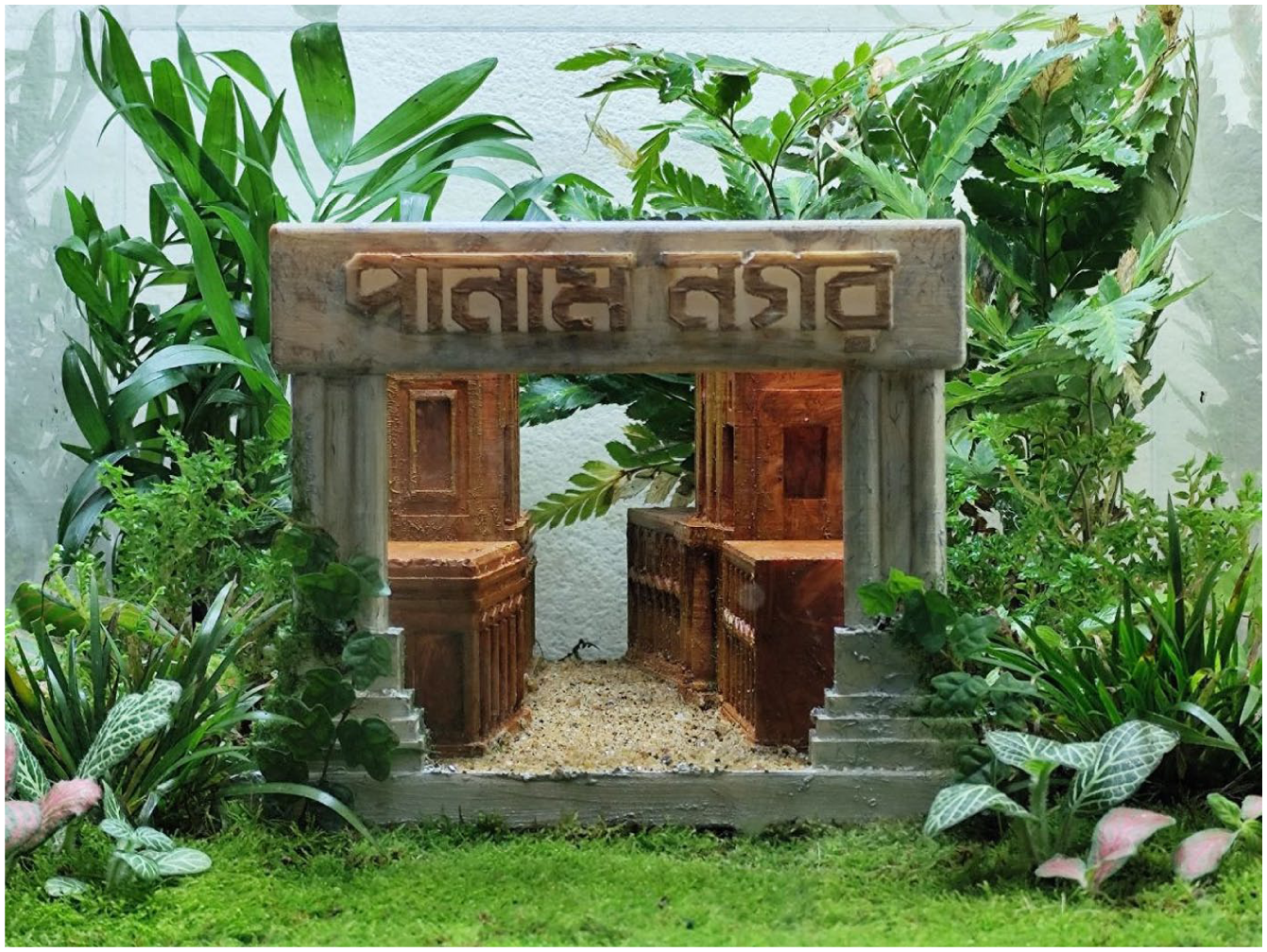
Frontal view of the Panam Nagar terrarium prototype showing the site-name gateway, central pathway, miniature built forms, and surrounding vegetation.
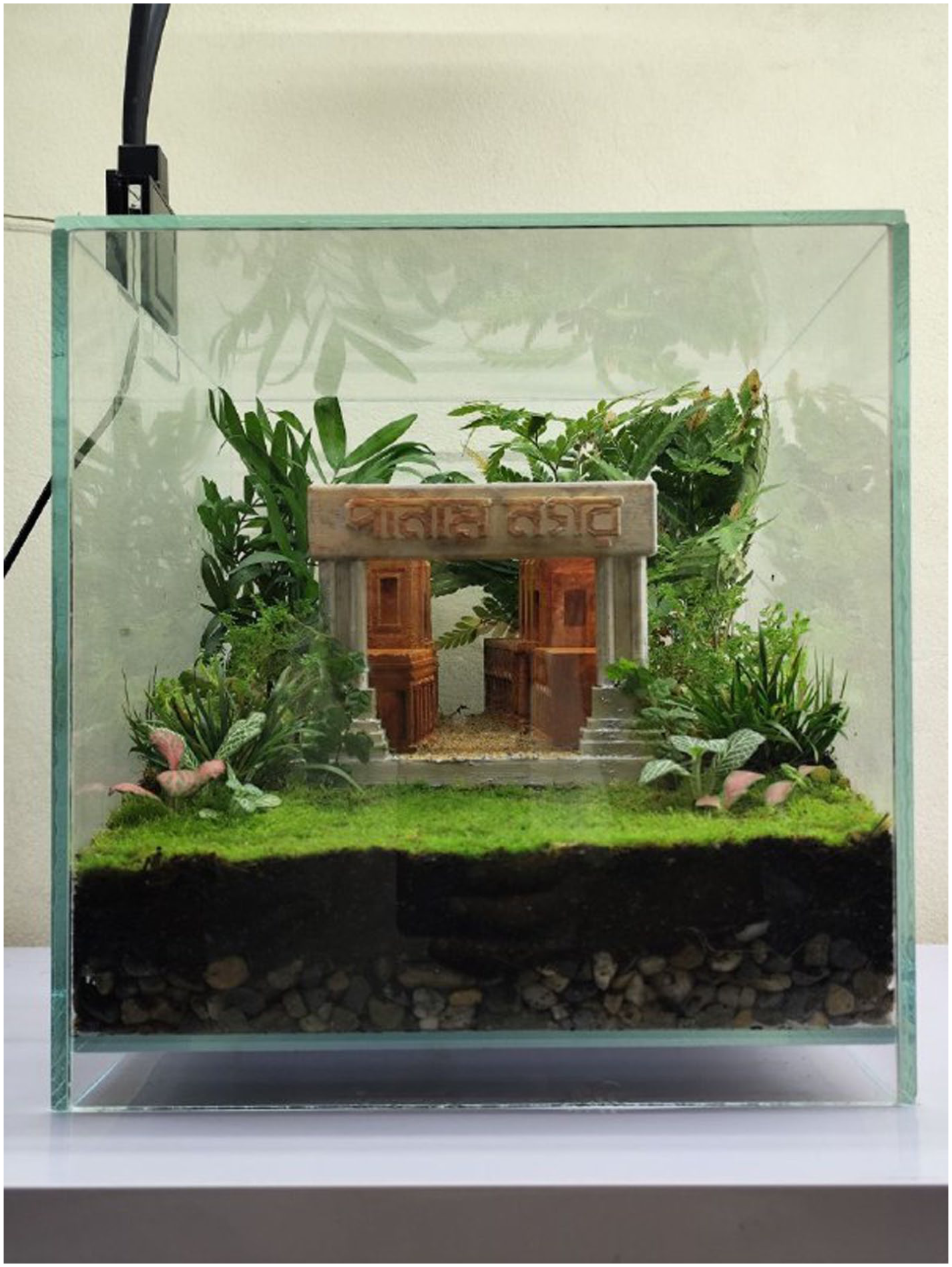
Full terrarium view showing the compact glass enclosure and the placement of the Panam Nagar gateway, pathway, miniature buildings, and living vegetation as a single relocatable interpretive display.
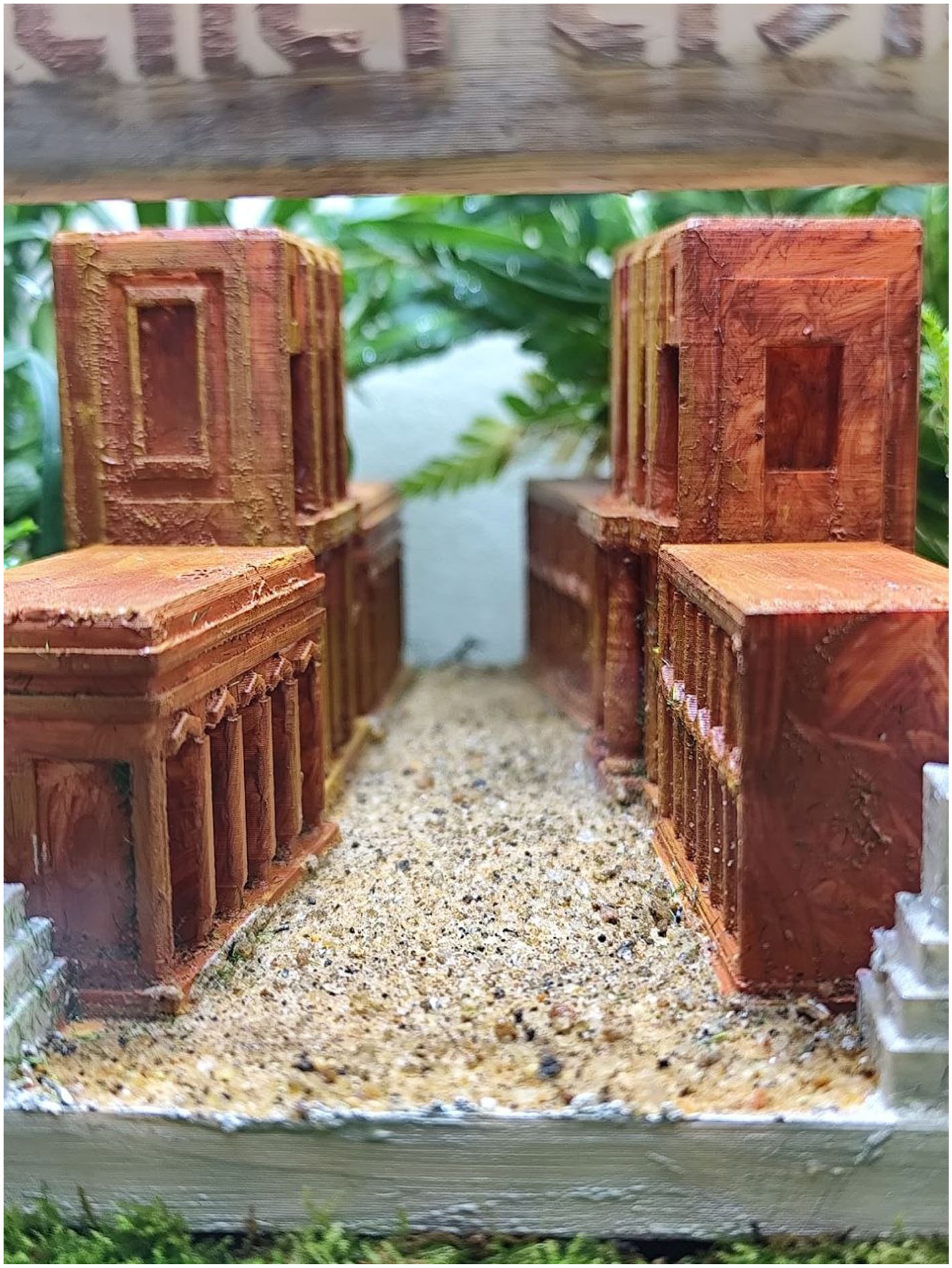
Central pathway and gateway view showing the spatial orientation of the miniature streetscape.
After completion, the prototype was shown to 120 participants through convenience sampling. Participants included university students, teachers, and general viewers. They were shown the terrarium prototype along with a conventional image of Panam Nagar. A short Likert-scale feedback form was used to record responses on visual appeal, perceived heritage understanding, immersion, integration of architecture and plants, usefulness in exhibitions or classrooms, and preference compared with the two-dimensional photograph of Panam Nagar shown to participants. These items were selected to match the exploratory purpose of the study, focusing on perceived interpretive value rather than detailed learning measurement.
One open-ended question was also included to collect brief qualitative impressions. The feedback was analyzed descriptively because the goal was to understand preliminary viewer perception rather than to make generalizable claims about learning outcomes. This approach is consistent with a limited-scope visitor feedback study and with previous interpretation studies that examine visitor perceptions of interpretive methods (Hvenegaard, 2017; Roberts et al., 2014; Sharp et al., 2012).
Preliminary Findings
The preliminary feedback indicates that participants perceived the terrarium prototype as useful for visual and educational interpretation. As shown in Table 1, 95% of participants agreed or strongly agreed that the model would be useful in exhibitions, museums, or classrooms. In addition, 90% agreed or strongly agreed that the model was visually attractive, 85% felt it was more immersive than a normal photograph, and 80% reported that it helped them understand Panam Nagar better.
Preliminary Viewer Feedback on the Panam Nagar Terrarium Prototype.
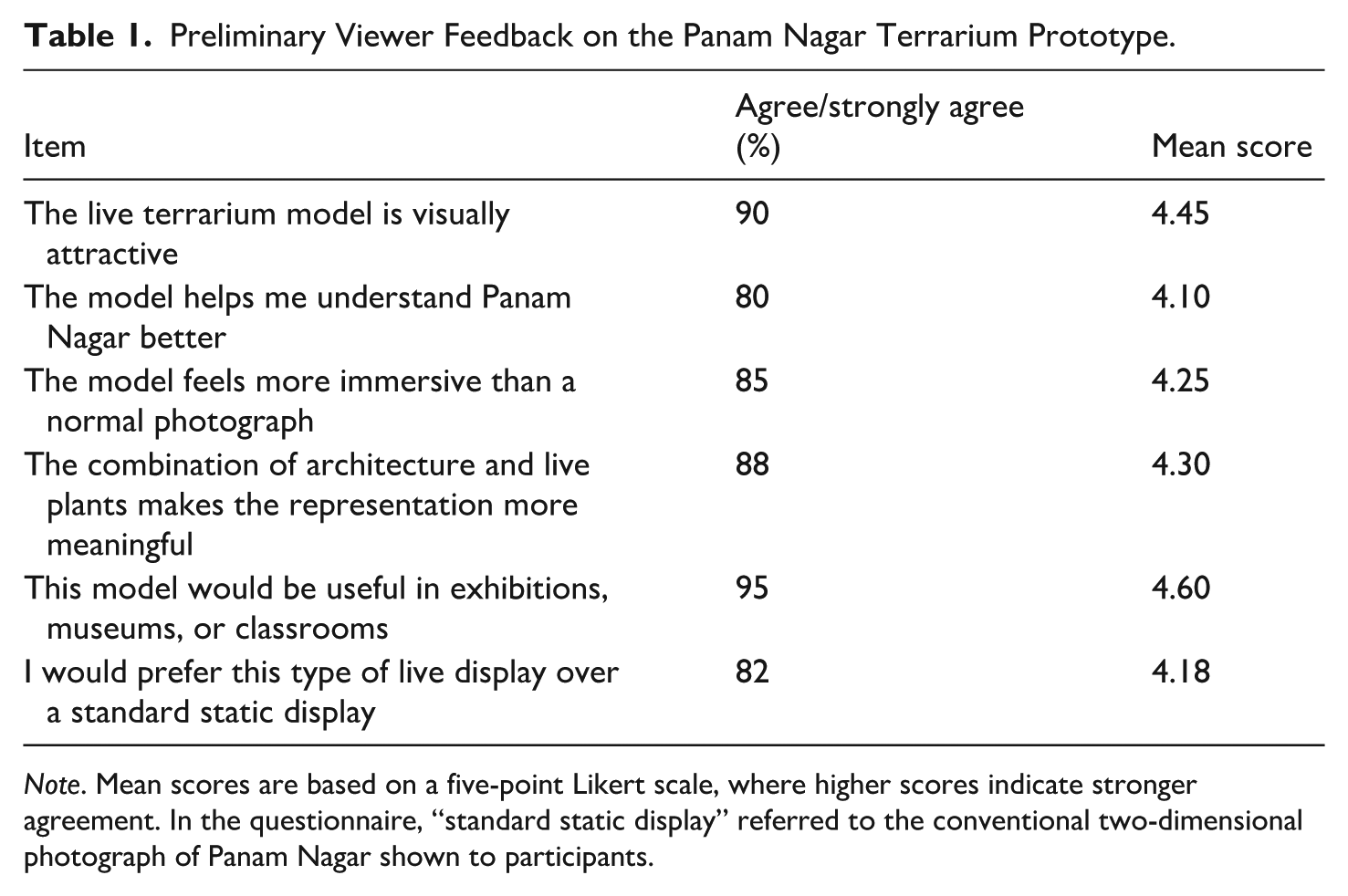
Note. Mean scores are based on a five-point Likert scale, where higher scores indicate stronger agreement. In the questionnaire, “standard static display” referred to the conventional two-dimensional photograph of Panam Nagar shown to participants.
Open-ended responses most often referred to greenery, realism, spatial depth, and the combination of architecture with living plants. These comments suggest that viewers noticed the relationship between built form and environmental setting. This is important because the prototype was intended to communicate Panam Nagar as a spatial and environmental place, not only as a historic image.
This preliminary viewer feedback suggests that the terrarium format may support visitor attention and perceived interpretive value, but further controlled evaluation is needed. This distinction is important because visitor satisfaction and perceived usefulness do not automatically prove long-term learning or behavioral outcomes (Hvenegaard, 2017; Sharp et al., 2012).
Discussion and Practical Use
The prototype suggests that a terrarium can function as an interpretive display when its components are organized to communicate meaning. In this case, the gateway, pathway, built forms, and vegetation work together to represent selected qualities of Panam Nagar. The terrarium does not preserve the site or replace direct visitation. Instead, it offers a small-scale way to introduce viewers to the spatial and environmental character of the heritage place.
This format may be useful in museums, classrooms, tourism exhibitions, heritage fairs, and hospitality or ecotourism settings where relocatable interpretation is needed. Its main practical value is that it can present a heritage place through a compact three-dimensional display that viewers can examine from multiple perspectives. This may be helpful for audiences who are unfamiliar with the site or cannot easily visit it.
The findings also show the need to separate visual appeal from interpretive impact. Participants responded positively to the prototype, but this does not prove that the terrarium improves heritage learning. Instead, the results indicate that the format is promising enough for further evaluation using stronger visitor research methods. Such evaluation could examine whether the terrarium affects visitor understanding, memory, emotional connection, or interest in visiting the actual site (Ham, 2016; Stern & Powell, 2024).
Implications for Practice
For interpreters, museum educators, and heritage practitioners, this prototype suggests that small physical displays can be useful when they are designed around interpretive purpose rather than decoration alone. Our terrarium-based display did not simply place a miniature building inside plants. Rather, we selected a small number of meaningful site features and arranged them so viewers can understand identity, movement, scale, and setting.
In practical terms, a similar display could be developed by first identifying the main interpretive message of a heritage site. For Panam Nagar, the selected message was the experience of entering and moving through a historic streetscape. The gateway, pathway, side buildings, and vegetation were therefore used to communicate that message. Other heritage sites may require different features, such as a river edge, courtyard, monument, or landscape boundary.
We suggest that practitioners using this type of prototype should also evaluate audience response before using it as a permanent display. This type of front-end or formative evaluation is commonly used in exhibitions and interpretive planning to test whether a display communicates the intended message before wider implementation (Camburn et al., 2017; Falk & Dierking, 2013; Hvenegaard, 2017). A short feedback form can ask whether visitors noticed the intended features, whether the display helped them understand the place, and whether it encouraged further interest in the actual site. This type of small evaluation can help interpreters improve the display before using it in museums, classrooms, tourism fairs, or heritage awareness programs.
Limitations and Future Work
This report is limited by its exploratory design, single prototype, convenience sampling, and reliance on preliminary viewer feedback. The feedback measured perception and preference rather than long-term learning, memory, or behavioral outcomes. Future research could compare terrarium-based interpretation with photographs, posters, digital reconstructions, and conventional scale models. Further studies could also include expert review by heritage interpreters, museum professionals, architects, and tourism educators. Longer-term evaluation may also examine whether the plants remain healthy and visually coherent within the display, and whether this affects the prototype’s interpretive use over time.
Conclusion
This report introduced a terrarium-based prototype as a compact interpretive medium for Panam Nagar. The prototype combined a labeled gateway, street-like pathway, miniature architectural forms, and living vegetation to communicate selected spatial and environmental qualities of the heritage site. Preliminary viewer feedback suggests that the format may support visual engagement, perceived immersion, and exhibition or classroom use. The main value of the terrarium is not its novelty or decorative appearance, but its ability to organize site identity, spatial orientation, architecture, and environmental atmosphere within a small three-dimensional display. Although the findings are exploratory, the prototype provides a basis for future research on terrarium-based heritage interpretation and visitor-centered evaluation.
Footnotes
Acknowledgements
The authors thank all viewers and participants who provided feedback on the Panam Nagar terrarium prototype. During the preparation and revision of this manuscript, the authors used generative AI tools to assist with language refinement, text organization, and drafting support. All AI-assisted output was critically reviewed, revised, and verified by the authors, who take full responsibility for the accuracy, originality, and integrity of the final manuscript.

Ethical Considerations
This study involved preliminary feedback collection from human participants through a short questionnaire regarding a heritage-display prototype. Ethical approval was not formally required for this low-risk feedback activity because no sensitive personal data were collected and no intervention was involved.
Consent to Participate
Verbal informed consent to participate was obtained from all participants before feedback was collected.
Author Contributions
Mehraj Hossain Mahi: Conceptualization, prototype development, visual documentation, data collection, analysis, and manuscript preparation. Muhtasimul Hoque Arnab: Interpretation and heritage-tourism input, manuscript review, and conceptual feedback. Fazin Fuad Mahib: Innovation and entrepreneurship perspective, conceptual feedback, and manuscript review. Sunjimul Hoque Ayon: Tourism and hospitality perspective, participant engagement support, and manuscript review. Anzir Rahman Khan: Technical support, conceptual feedback, and manuscript review.
Funding
The authors received no financial support for the research, authorship, and/or publication of this article.
Declaration of Conflicting Interests
The authors declared no potential conflicts of interest with respect to the research, authorship, and/or publication of this article.
Data Availability Statement
The data supporting the findings of this study are available from the corresponding author upon reasonable request.*